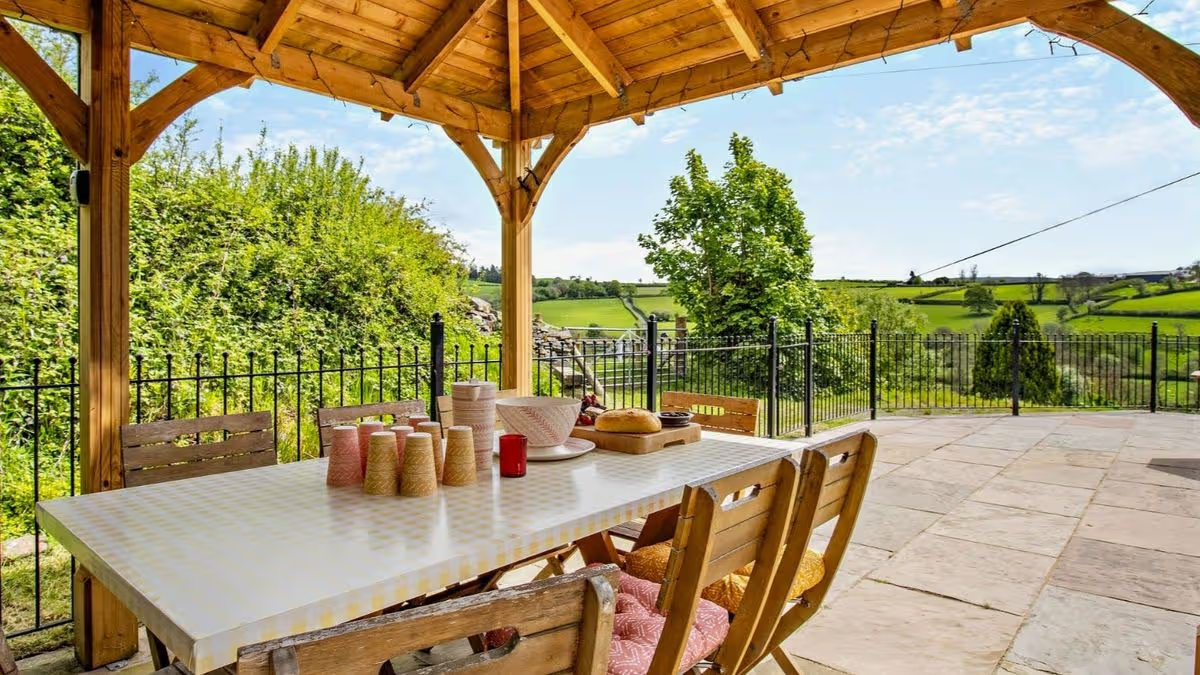
Ysgubor Llwynneuadd is a beautiful barn conversion located in the heart of the Bannau Brycheiniog National Park and has many guests wishing they can stay longer
21:58, 18 May 2026Updated 22:00, 18 May 2026
This article contains affiliate links, we will receive a commission on any sales we generate from it. Learn more
With travel uncertainties looming, those looking to book a getaway might want to consider a holiday cottage escape in the UK. Wales is one of the UK’s most scenic staycation destinations, offering everything from rolling countryside to beautiful coastlines. Holiday cottages provide the ideal base for exploring the beautiful surrounding locations or to simply just unwind somewhere peaceful.
Positioned for exploring the breathtaking surroundings of the Brecon Beacons, the Ysgubor Llwynneuadd is a stylish countryside barn which sits in a secluded spot near the village of Sennybridge, known for its welcoming country pubs.
Guests can enjoy scenic walks through the Welsh countryside, keep an eye out for the area’s famous red kites, or climb up Pen y Fan.
Inside, the spacious open-plan living area is bright and inviting, with floor-to-ceiling windows showcasing the valley views. There’s a cosy lounge with a Smart TV, a relaxing sunroom, and a fully equipped kitchen complete with everything needed for family meals. Love dreamy Welsh homes? Sign up to our newsletter here
Sleeping up to ten guests, the Barn features four comfortable bedrooms, including doubles, twins and additional pull-out beds, alongside multiple bathrooms for convenience. Outside, guests can make the most of the enclosed garden and seating area, an ideal place to sit back and take in the scenery.
Another beautiful barn-conversion is the Y Granar located in Powys which can sleep up to six guests and is available to book on Sykes Cottages. It is a three bedroom, three bathroom property that has beautiful countryside views.
Another holiday homes site worth checking is Luxury Cottages which features beautiful Welsh properties within stunning locations, for example the Mill House in Powys which is dog-friendly and can sleep up to 10 guests.
Advertisement
Those who have stayed in the Ysgubor Llwynneuadd praised the holiday home highly. The most recent review states: “Beautiful cottage great location very comfortable and spacious for 6 adults and 2 dogs . Fully recommended.”
Another pleased visitor said: “We had an amazing time staying at the barn. The property itself is well thought out, the layout is great with so much space. Everything we needed was provided, and more! The enclosed garden was great for the dogs, allowing them some space to run around. The location is absolutely stunning – we miss waking up to those views each morning! It was amazing being so close to so many beautiful places.”
A third reviewer of the Ysgubor Llwynneuadd called it “a great place excellent for families to stay with great views. The barn is beautifully designed and well equipped. “
Advertisement
The visitor went on to say: “We only stayed for 3 nights but would definitely love to visit again and plan for some local walks. Would highly recommend this place to anyone who is thinking of booking this place.”
The Islamic Center of San Diego will be closed until further notice, calling the shooting “an extremely painful and traumatic day for our congregation, students, staff, and the broader San Diego community.”
It asked the public to keep victims in their prayers, avoid speculation, and rely on authorities to sort out what happened and why.
“Places of worship are meant to be spaces of peace, prayer, reflection, and community,” the statement said.
Advertisement
“Violence and hatred have no place in our society.”
Longevity experts list a healthy diet, an active lifestyle, and adequate sleep as well-researched ways to increase your odds of a longer life.
But if you’re looking for a more recreational buffer against ageing, a new paper published in Innovation in Ageing has found that people who engage with the arts tend to age more slowly.
People, especially over-40s, who regularly engaged with culture had lower biological ages at the DNA level, and appeared to age 4% more slowly.
The benefits are “comparable to [those] found in previous studies between current smokers and ex-smokers,” University College London (UCL), whose researchers wrote the paper, said.
Advertisement
How often people attended cultural events seemed to matter
The research, which involved 3,556 adults in the UK, found that, like exercise, regularity mattered.
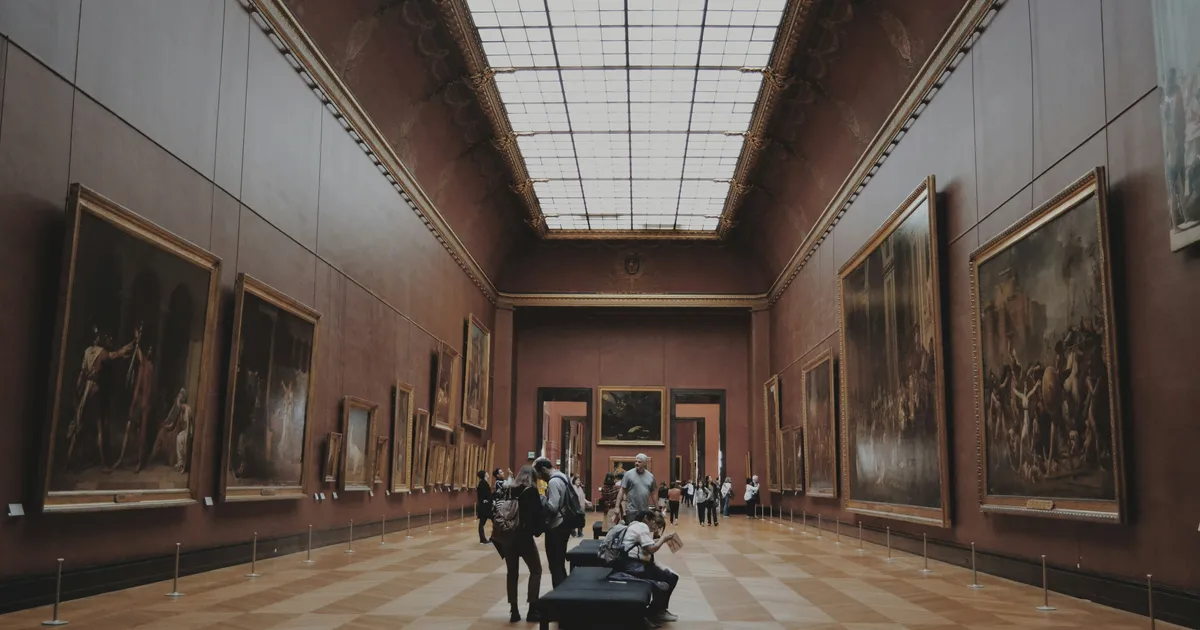
Those who engaged with the arts (including by reading, listening to music, going to an art gallery, and/or taking trips to museums) at least once a week seemed to see the most benefits (4% slower ageing).
The authors also found that attending a cultural event once a week was as beneficial for those who usually never attended any, as exercising once a week was compared to physically inactive people.
Advertisement
Meanwhile, participants who did an arts activity at least three times a year aged 2% more slowly. For those who did so once a month, that rose to 3%.
And the study’s lead author, Professor Daisy Fancourt, said that frequency wasn’t the only factor to consider. Variety might matter, too.
“Our study also suggests that engaging in a variety of arts activities may be helpful,” she shared with UCL.
“This may be because each activity has different ‘ingredients’ that help health, such as physical, cognitive, emotional or social stimulation.”
Advertisement
Why might the arts help us to age better?
This paper didn’t seek to find that out. It just found a link, not a cause.
Nonetheless, senior study author, Dr Feifei Bu, said: “Our study provides the first evidence that arts and cultural engagement is linked to a slower pace of biological ageing.
“This builds on a growing body of evidence about the health impact of the arts, with arts activities being shown to reduce stress, lower inflammation and improve cardiovascular disease risk, just as exercise is known to do.”
Advertisement
Professor Fancourt added, “These results demonstrate the health impact of the arts at a biological level. They provide evidence for arts and cultural engagement to be recognised as a health-promoting behaviour in a similar way to exercise”.
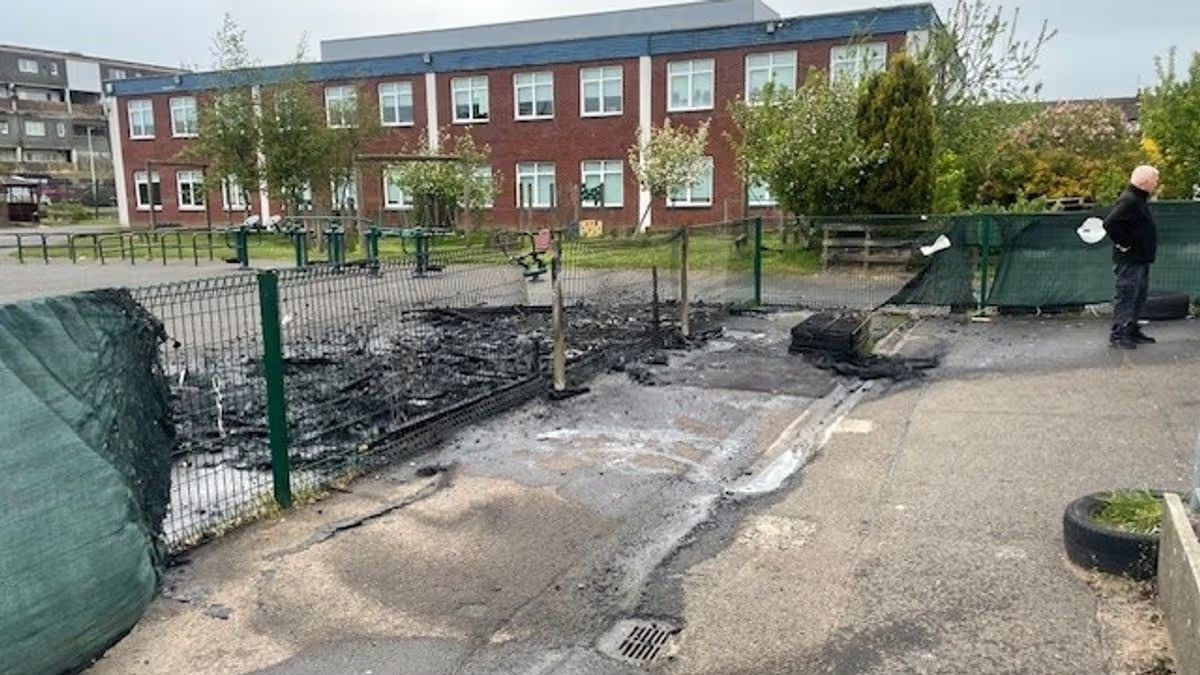
Emergency services were called to Murrayfield Primary School in Blackburn just after 7.15pm on Saturday, May 16.
An investigation is underway following a fire at a West Lothian primary school last week.
Advertisement
Emergency services were called to Murrayfield Primary School in Blackburn just after 7.15pm on Saturday, May 16. Two fire appliances were dispatched to battle the blaze.
The blaze destroyed playground equipment, and left windows in the nursery block damaged due to the intensity of the flames.
Pictures issued by West Lothian Council show piles of charred, blackened material on the ground, and the glass cracked in the affected windows.
However, there was no internal damage and nobody was injured.
The local authority confirmed the school, which is closed on Monday for a local holiday, will re-open as normal on Tuesday, May 19.
A statement read: “There was a fire at Murrayfield Primary School in Blackburn on Saturday evening. Thankfully nobody was hurt and the damage is limited to the destruction of some playground equipment and four windows in the nursery block that have cracked due to the intensity of the flames.
“The playground will have to be cleaned up and the windows replaced, but there is no internal smoke damage and the school will re-open as normal.
Advertisement
“Fire crews were in attendance and the cause of the fire is being investigated.”
A Scottish Fire and Rescue Service spokesperson said: “We were alerted at 7.17pm on Saturday, 16 May, to reports of a fire affecting a wooden play hut at Murrayfield Primary School in Blackburn.
“Operations Control mobilised two fire appliances, and the fire was extinguished.
Advertisement
“There were no reported casualties, and crews left the area after ensuring it was safe.”
Writing on social media, the president said he had been asked by the leaders of Qatar, Saudi Arabia and the United Arab Emirates “to hold off on our planned Military attack of the Islamic Republic of Iran, which was scheduled for tomorrow, in that serious negotiations are now taking place, and that, in their opinion, as Great Leaders and Allies, a Deal will be made, which will be very acceptable to the United States of America, as well as all Countries in the Middle East, and beyond”.
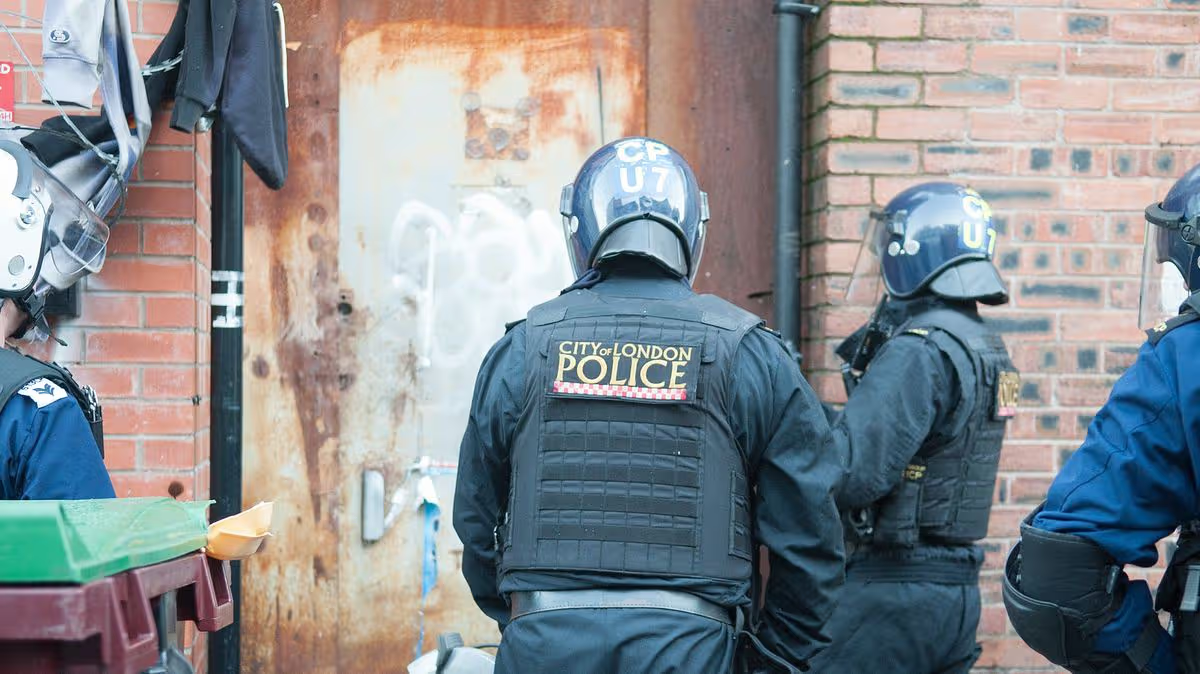
Rogue barber shops, vape stores, mini-marts and sweet shops across the region linked to organised crime will be hit
Police are to be given a funding boost in a major crackdown on ‘dodgy’ shops across Greater Manchester. Organised crime gangs operating across the region will be hit by the new offensive as part of the national plans to shut down the illegal operations.
Advertisement
The Home Office said rogue barber shops, vape stores, mini-marts and sweet shops across Greater Manchester linked to organised crime will face raids, closures and seizures. It is part of the £20 million of funding for the High Street Organised Crime Unit for the national crackdown on money laundering and illegal working.
The unit is to provide national backing to the immediate funding for UK regions with the some of the highest levels of high street organised crime, which includes Greater Manchester as well as the West Midlands, Kent and Essex, it was announced.
Click here to get the biggest stories straight to your inbox in our Daily Newsletter
Across Greater Manchester, additional funding will support enforcement activity in Rochdale, Bury, and Bolton. They are the areas identified as containing the highest levels of high street organised crime activity by the National Crime Agency (NCA).
Advertisement
Under Operation Machinize, Greater Manchester Police carried out more than 120 visits to high-street premises, made 14 arrests, and disrupted dozens of illicit businesses across the region.
According to the Chartered Trading Standards Institute, up to half the number of ‘mini-marts’ and vape shops in parts of the UK are estimated by trading standards officials to have links with organised crime. Around a third of ‘American’ sweet shops and a quarter of fast food takeaways are also estimated to have links with organised crime in some areas.
Advertisement
And the NCA estimates at least £12bn of criminal cash is generated in the UK. Money is often laundered through high street shops like mini-marts, barber shops, vape stores and sweet shops to hide profits. Some businesses are also connected to the sale of fake goods, tax evasion, illegal working and illegal drug supply.
The move is expected to see thousands of businesses raided, with hundreds of arrests made and millions in cash seized nationally.
Security Minister, Dan Jarvis, said: “Criminal groups are using seemingly legitimate businesses across Greater Manchester as fronts for serious organised crime, money laundering, and illegal working.
“We are backing Greater Manchester Police with new funding, better intelligence, and more officers to target these criminal enterprises.
Advertisement
“The High Street Organised Crime Unit will bring together law enforcement, government, and local authorities to put these criminal groups out of business and restore confidence on our high street.”
For most of the 20th century, the model of human origins was a tree: with the trunk dividing into branches, and then twigs. Each species of human relative (hominin) was a neat, single branch.
As an undergraduate, I was taught that Homo sapiens was one of these branches that emerged in Africa, spread across the world, and displaced every archaic human it encountered.
Neanderthals, Homo erectus, and other ancient relatives were evolutionary dead ends – unfortunate cousins who left no descendants. In the 30 years since I left university, those early lessons are now radically revised.
That neat replacement story is now comprehensively wrong, largely thanks to studies like the one published in Nature this week by Qiaomei Fu from the Chinese Academy of Sciences and colleagues. The paper achieves something that would have seemed impossible a decade ago: it recovers meaningful biological information from H. erectus fossils far too old for DNA.
Advertisement
Instead of genetic sequences, the team extracted ancient proteins from the enamel of six teeth from three Chinese sites – Zhoukoudian (which, in the early 20th century, produced fossil remains known as “Peking Man”), Hexian and Sunjiadong – all dating to around 400,000 years ago.
Homo erectus is widely regarded as the first hominin to leave Africa; the evidence suggests this species had moved into Eurasia nearly two million years ago. It remains the most geographically widespread human ancestor that ever lived. The new study indicates that Homo erectus exchanged genes (probably through interbreeding) with Denisovans in East Asia roughly 400,000 years ago.
A tooth from the Zhoukoudian site in Beijing that was used in the analysis. Qiaomei Fu, Institute of Vertebrate Paleontology and Paleoanthropology, Chinese Academy of Sciences, Author provided (no reuse)
The study suggests that some of that genetic legacy, it now appears, was passed on to living people in the Philippines, Papua New Guinea, and across south-east Asia.
Tooth enamel is the hardest tissue in the body, and its proteins survive long after DNA has degraded beyond recovery. What the team found in those proteins is striking. All six specimens share a previously unknown amino acid variant – a tiny molecular signature, a single letter changed in the protein sequence, never seen in any other hominin alive or dead.
Advertisement
This variant clusters these east Asian H. erectus into a distinct group, confirming their identity and settling a long-running debate about whether the unusual Hexian fossils were H. erectus at all. A second variant they share, however, is not unique to H. erectus.
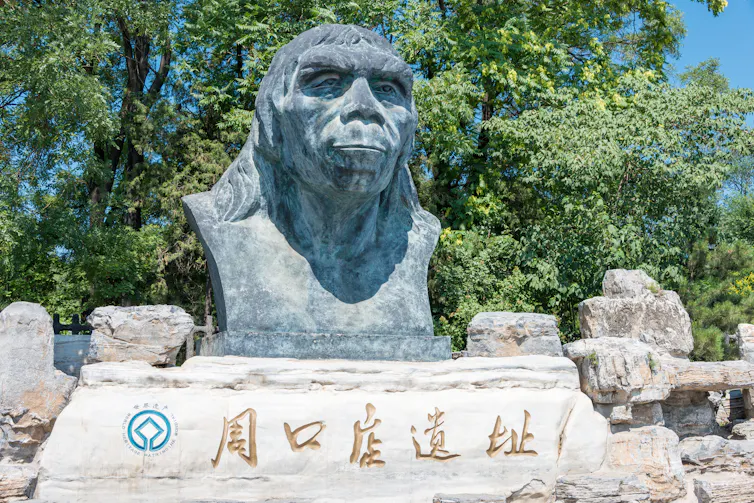
A statue at the Zhoukoudian site, where the Peking Man fossils were discovered. beibaoke / Shutterstock
It also appears in Denisovans – a mysterious archaic (non-Homo sapiens) human group known mainly from a cave in Siberia. The corresponding genetic variant turns up in living people at frequencies of 21% in the Philippines and about 1% in India, distributed in a pattern that matches what we’d expect if it entered modern humans via Denisovan ancestry.
The most reasonable interpretation is that H. erectus populations in east Asia passed this variant to Denisovans through interbreeding, and Denisovans later passed it on to the ancestors of modern south-east Asians and Oceanians. This transfer of genetic material from one species to another is known as introgression.
The lineage we once thought was a dead end has, it turns out, left a small but detectable trace in living human genomes – a molecular thread connecting a Peking Man tooth to living people in Asia.
A pattern repeated
But the significance of today’s paper extends well beyond the specific variant or the specific populations involved. What it really shows is that interbreeding between archaic human lineages was not exceptional. It was routine.
Advertisement
Every major hominin lineage we have been able to examine genomically shows admixture. Modern humans outside Africa carry roughly 2% Neanderthal DNA. Papuans and Aboriginal Australians carry an additional 2–5% Denisovan ancestry.
West African populations carry genetic signatures from an unidentified archaic lineage. Even Denisovans themselves, as today’s study adds further weight to, received gene flow from something older and more diverged — likely H. erectus.
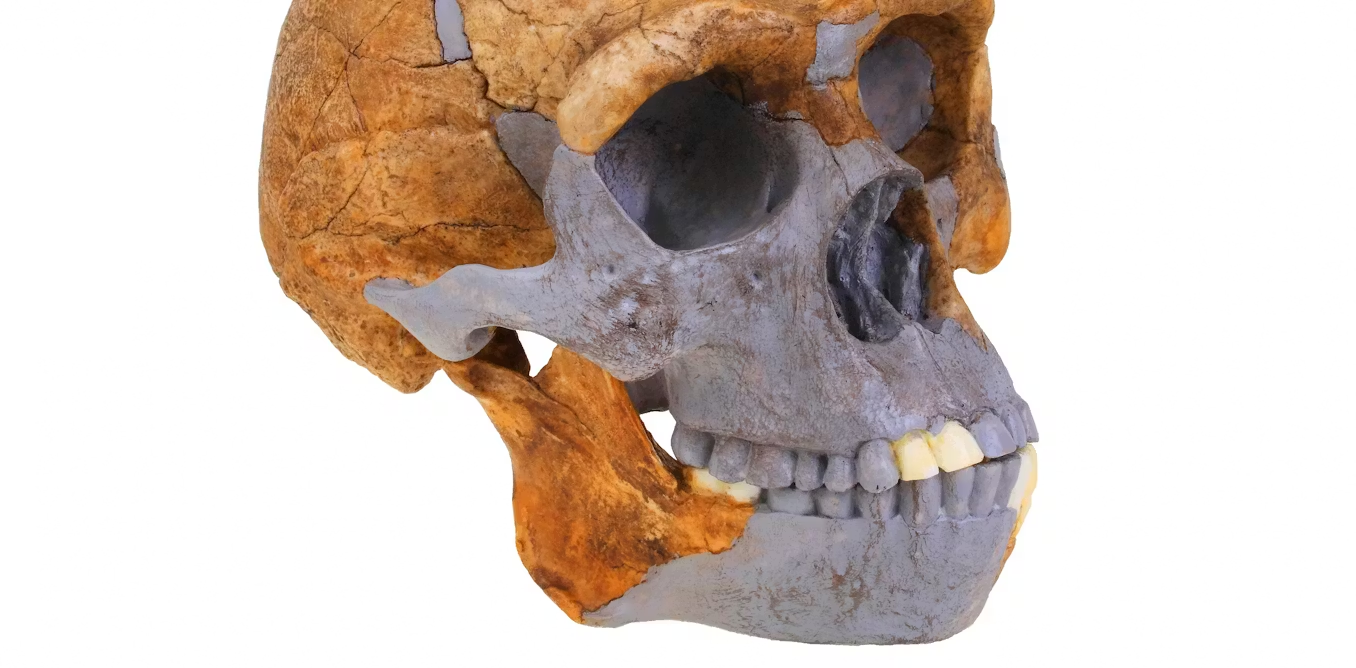
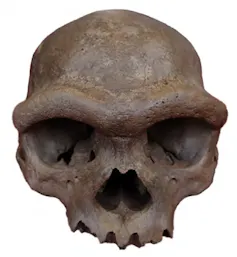
The Harbin skull, discovered in north-east China, was recently identified as a probable Denisovan. Fu et al. Cell, CC BY-SA
A 2019 review in the American Journal of Physical Anthropology documents at least three distinct introgression events from Denisovan-like populations into south-east Asian and Oceanic ancestors alone, some occurring as recently as 20,000 years ago. The picture is not one of clean lineages but of a tangled web of contact and exchange extending across millions of years.
The implications are far-reaching. Our genomes are not the product of a single unbroken lineage emerging from Africa. They are mosaics, assembled from contributions by multiple archaic groups, each adapted to its own regional environment.
Some of the Denisovan-derived variants in Papuan genomes, for instance, appear to influence immune function. The H. erectus-derived variant identified today has unknown functional consequences – that remains an open question – but the precedent from other gene variants that have introgressed (genes that have passed from one species into another) suggests that adaptation to new environments may have been part of the story.
Advertisement
Ghost populations
Perhaps most intriguing is what the new paper implies about all the populations we cannot yet study. H. erectus survived in Indonesia until perhaps 100,000 years ago. Homo floresiensis, the diminutive “hobbit” species, was present on Flores when modern humans arrived. Another human lineage, Homo luzonensis, occupied the Philippines.
None of these populations have yielded DNA, and until today none had yielded any molecular data at all. Were they also absorbed, at least partially, into the human populations that replaced them? The genomic evidence from living people has not, so far, detected their signal clearly – but the tools available until recently were blunt instruments.
The proteomic approach demonstrated in today’s paper offers a way forward. If proteins can be recovered from H. erectus enamel at 400,000 years, the same approach applied to floresiensis or luzonensis material might finally reveal whether those lineages, too, contributed something to the humans who came after them.
The old metaphor of a tree – a single trunk branching into distinct species – has been quietly replaced in the scientific literature. It might be better to consider the process as a braided river, with many channels running partly together and partly apart, exchanging water continuously.
Advertisement
This new study is one more confirmation that when ancient human populations disappeared, they left traces of themselves behind.
Police have urged members of the public to stay away from the area
Alice Scarsi, Annette Belcher and Antonio Scancariello
22:32, 18 May 2026Updated 22:35, 18 May 2026
Five people are dead following a shooting at an Islamic Center, it has been reported. Police officers were dispatched to a mosque, one of the largest in the area, following reports of an ‘active shooter’ situation.
San Diego Police Chief Scott Wahl said two suspects are dead, adding that three people died at the Islamic Centre. The incident is currently being treated as hate crime.
Advertisement
The suspects were teenagers, police have said, with their bodies being found in a car near the mosque, reports The Express.
San Diego police officers rushed to the Islamic Center of San Diego, in Clairemont Mesa, on Monday afternoon, to respond to reports of an active shooter. The message added: “Please avoid the area”.
San Diego Police Department officials began receiving reports of the incident at around 11.40am local time. They later said the threat “has been neutralised”, without immediately providing further details. A spokesperson for Sharp HealthCare of Sharp Memorial Hospital said “reports indicate multiple injured people”. Nearby schools were placed on lockdown as the incident was unfolding.
Three victims were killed outside the San Diego Islamic Center and two teenage suspects were found dead blocks away from self-inflicted gunshot wounds as police now try to piece together what led to Monday’s mass shooting.
“We are safe. The entire school is safe. All the kids, all the staff and the teachers are safe,” Taha Hassane, the center’s director, said in a video recorded outside the building as police lights flashed.
The names of the suspects have not been released and police did not detail a motive. The names of the victims have not been released either, but one was a security guard at the center, who police said “played a pivotal role” in preventing more deaths.
At around 3 p.m. ET, San Diego police started to receive calls about shootings at the center, located in the neighborhood of Clairemont. Authorities said they were on the scene and urged nearby residents to avoid the area.
Advertisement
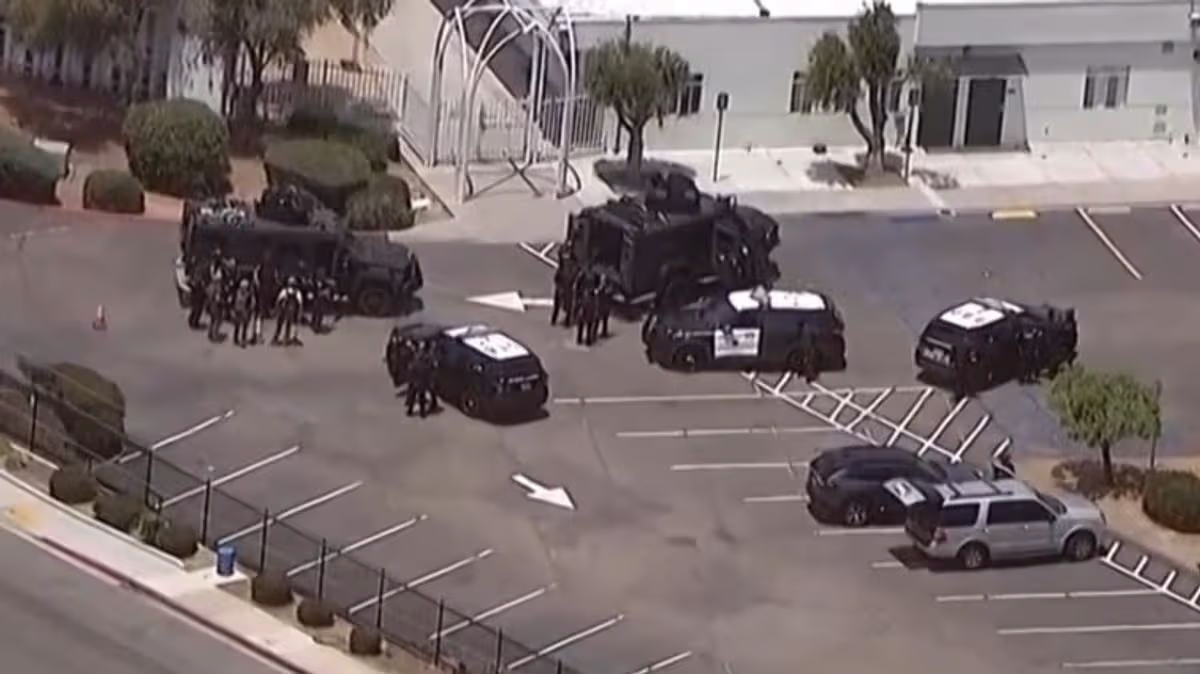
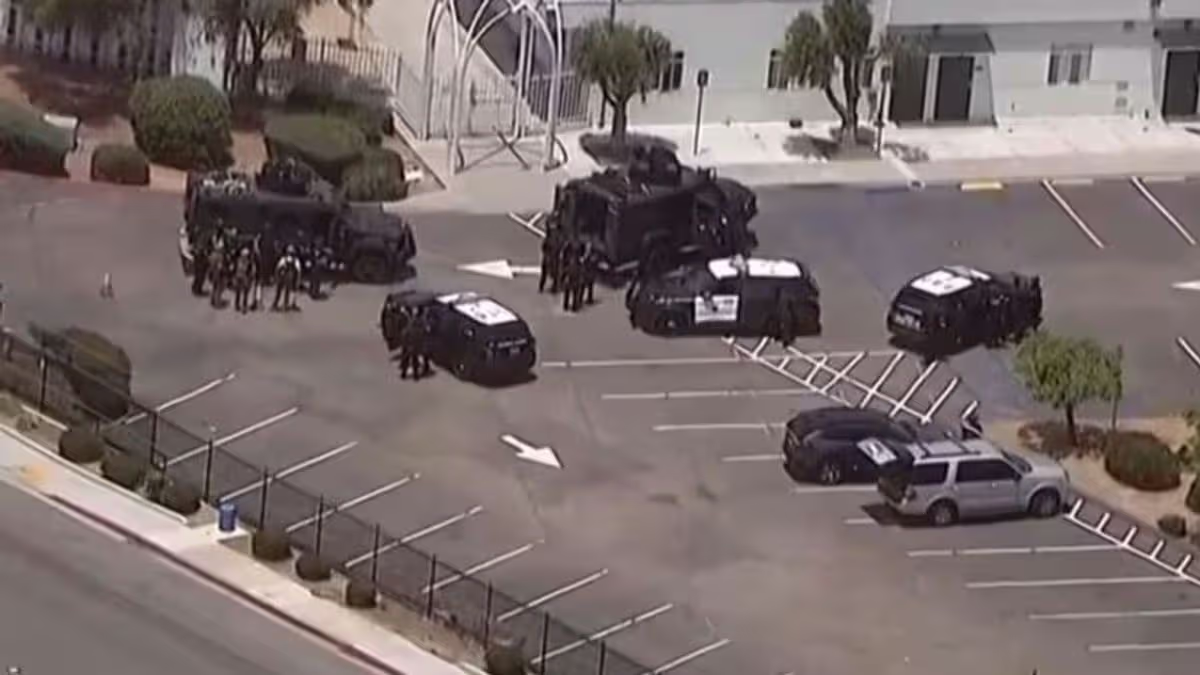
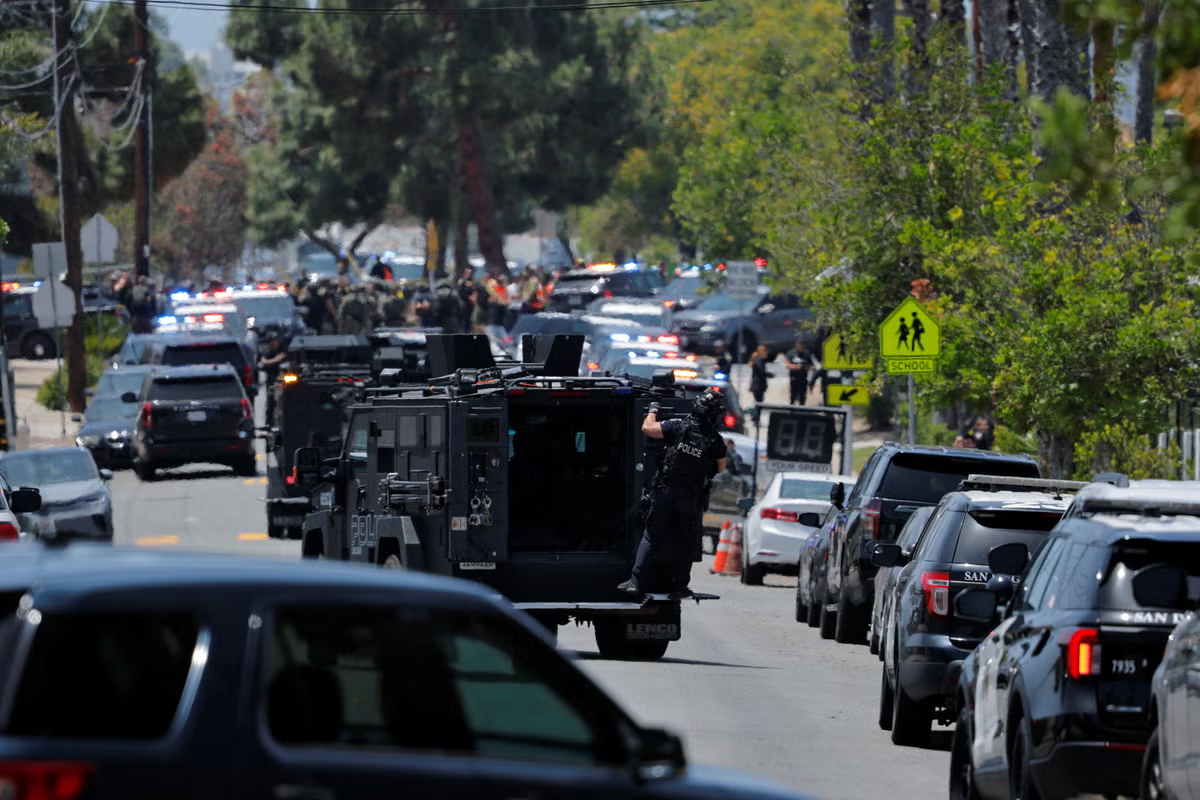
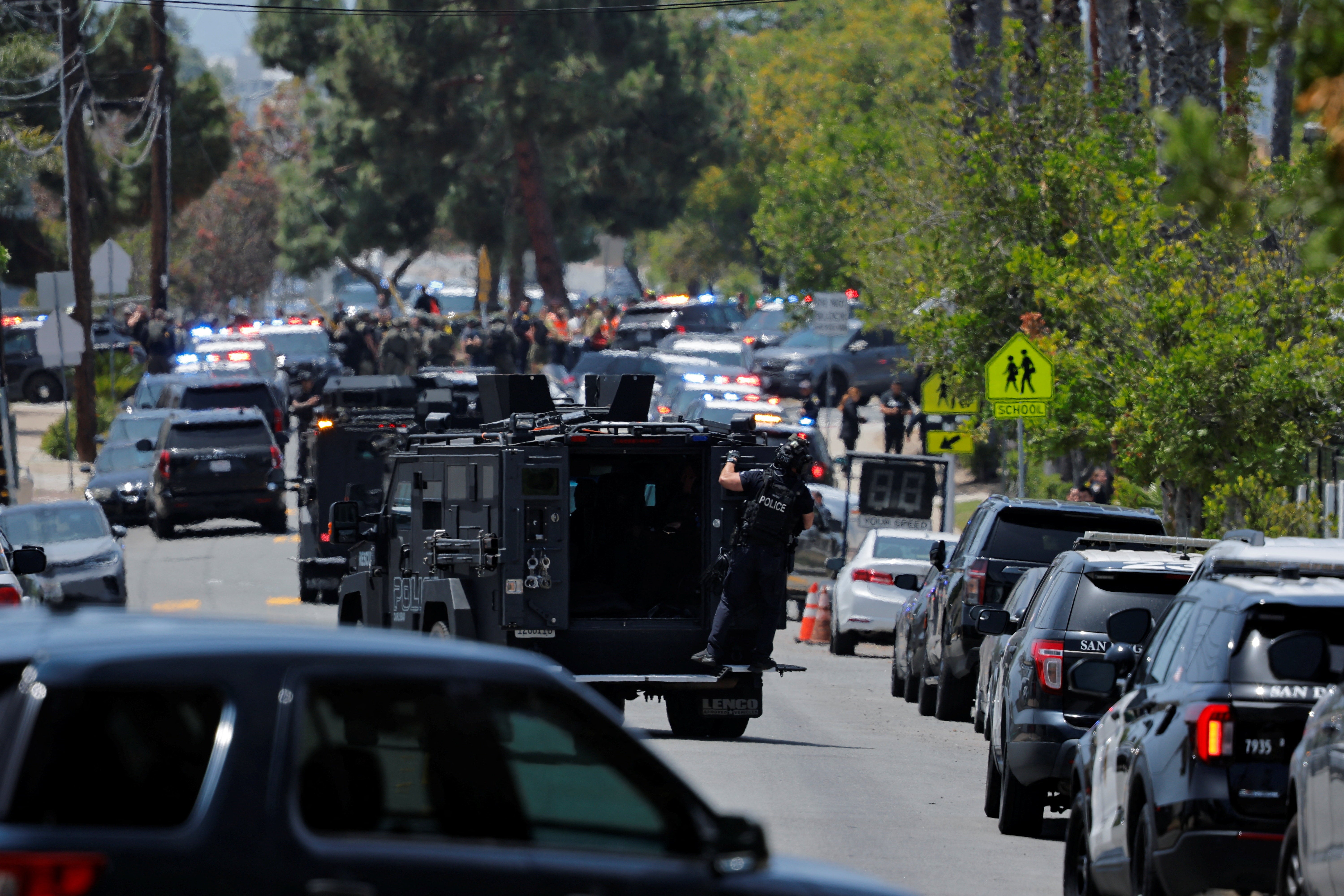
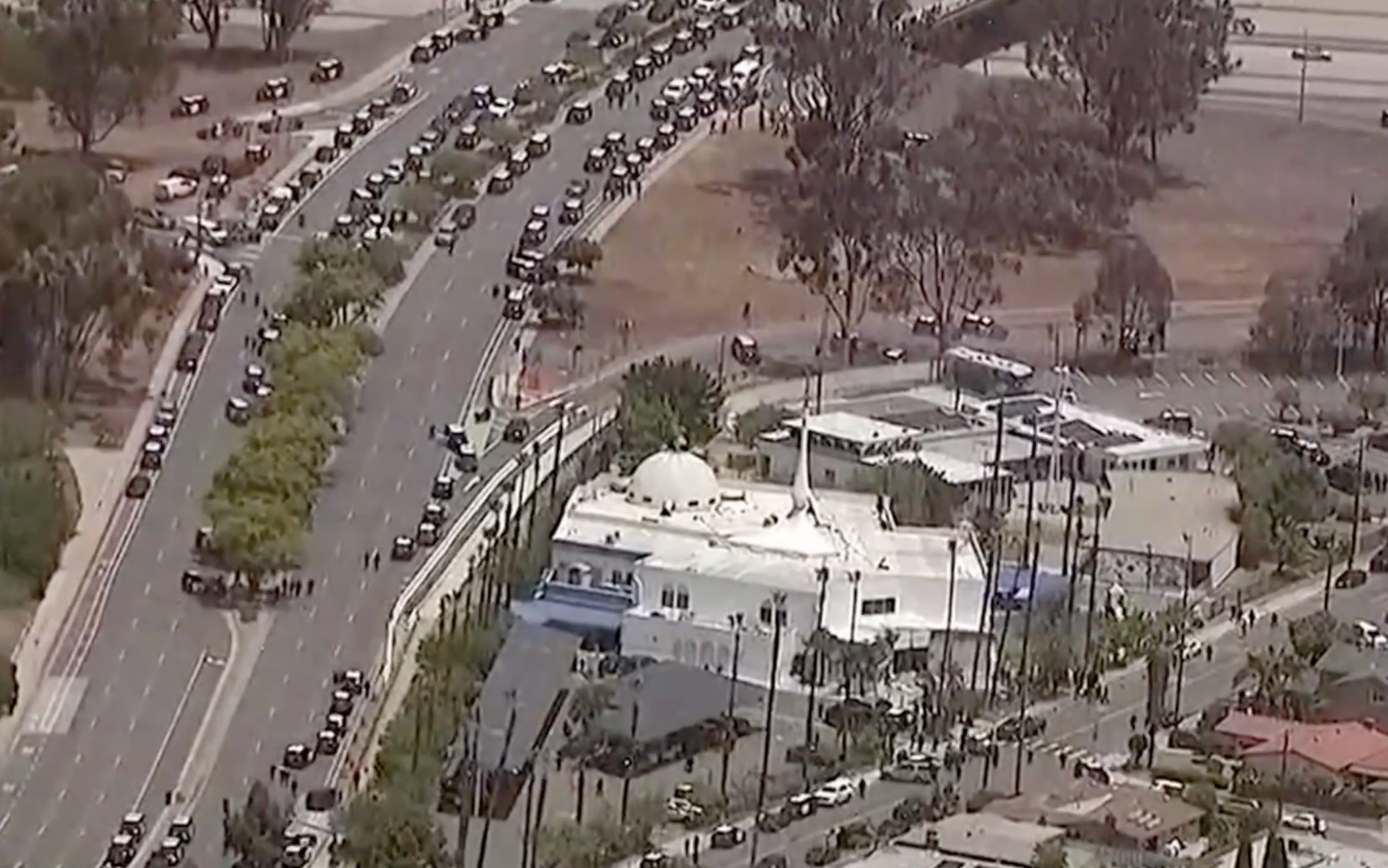
Aerial footage of the scene showed dozens of police vehicles lining a street and yellow caution tape cordoning off the area. Heavily armed officers were seen entering the building as people dispersed from the area, some holding hands.
Five people were killed during a mass shooting near the San Diego Islamic Center on Monday, including three victims, police said (Reuters)
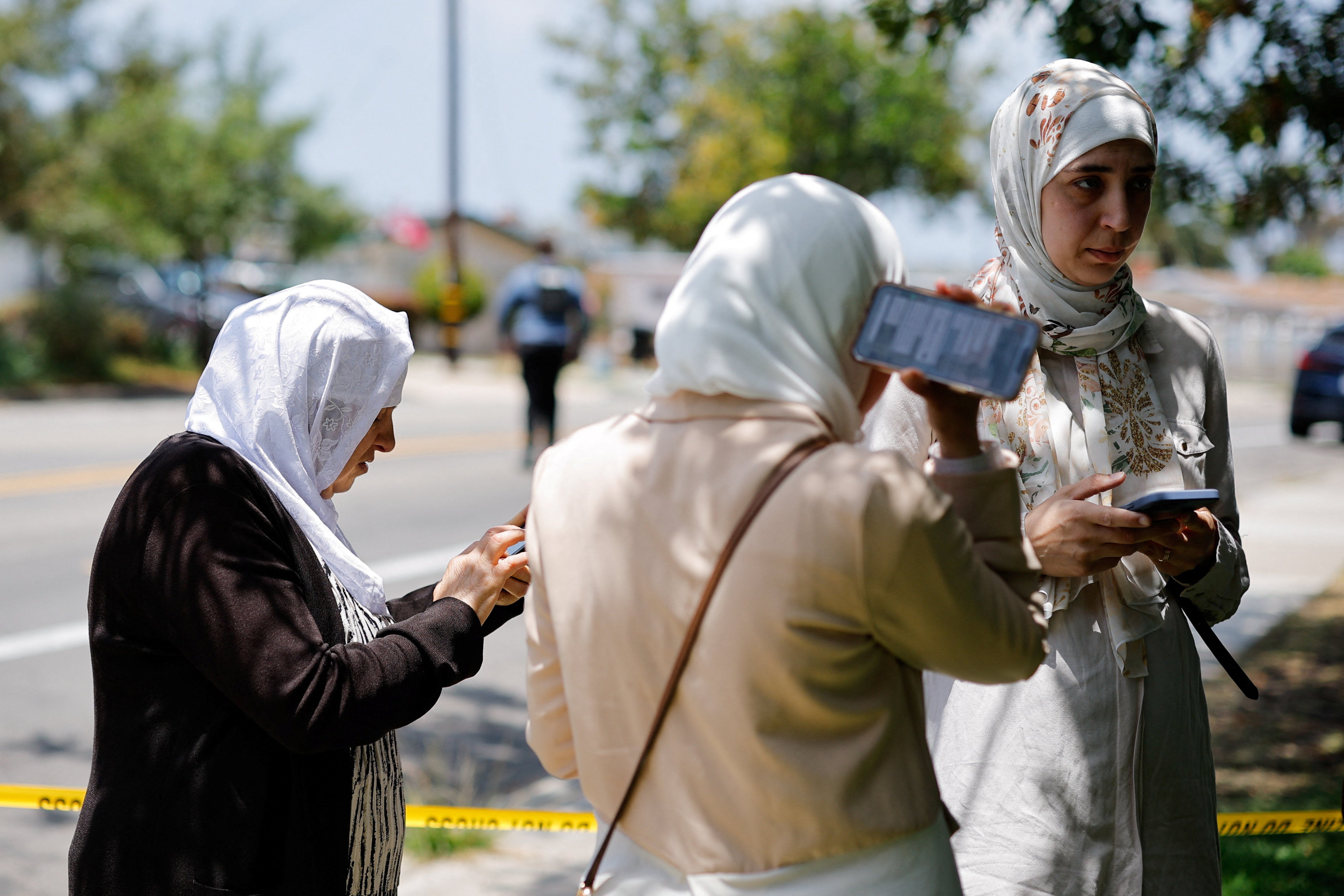
Photos taken outside the center captured anxious onlookers, several of them talking on their phones.
At 3:53 p.m., police provided an update stating that the scene was “still active but contained,” adding that “significant resources” had been deployed.
FBI Director Kash Patel, California Governor Gavin Newsom and San Diego Mayor Todd Gloria released statements saying they had been briefed on the situation and were coordinating with local law enforcement. And a spokesperson for an area hospital told NBC News that patients had been transported to them.
Shortly after 4 p.m., police said the threat at the center had been “neutralized.”
Advertisement
San Diego Police Chief Scott Wahl confirmed in a press conference soon after that three adult men were found dead at the scene and that no officers were involved in the shooting.
Aerial footage showed dozens of police vehicles lining a road near the Islamic center (Reuters)
Authorities also located a vehicle a few blocks away containing two deceased male teenagers, believed to be 17 and 19, who were identified as suspects. They died from self-inflicted wounds.
A security guard at the center was among those killed, Wahl said, adding he he believed the guard “played a pivotal role in assisting from this being much worse.”
Wahl noted that the center is equipped with security cameras, which officials will review for evidence.
President Donald Trump described the shooting as a “terrible situation” on Monday afternoon, adding: “I’ve been given some early updates, but we’re going to be going back and looking at it very strongly.”
Advertisement
Members of the Muslim community were seen using their phones at the scene of a reported active shooter situation at the Islamic Center (Reuters)
The Council on American-Islamic Relations, the largest Muslim-American civil liberties organization in the U.S., released a statement condemning the shooting.
“No one should ever fear for their safety while attending prayers or studying at an elementary school,” CAIR said. “We are working to learn more about this incident and we encourage everyone to keep this community in your prayers.”
According to its website, the Islamic Center is the largest mosque in San Diego County, which has an estimated population of some 3.2 million people.
“Our mission is to serve the religious needs of the San Diego Muslim population and work with the larger community to serve the less fortunate, to educate, and to better our nation,” the website states. The center hosts five daily prayers, sermons and various educational seminars.
As of May 18, there have been 186 mass shootings in the U.S. in 2026, according to the website Mass Shooting Tracker, which defines mass shootings as those in which four or more people are shot.
There was a moment of controversy in the capital when Havertz tried to recover with a sliding challenge on Ugochukwu as the Burnley midfielder broke away, but instead of sliding, the goalscorer threw himself at the Frenchman, planting his studs high up the calf the former Chelsea man’s standing leg.















































You must be logged in to post a comment Login