

Crypto World
Retail Bitcoin Demand Slides 73% as Futures Shorting Surges to $2B

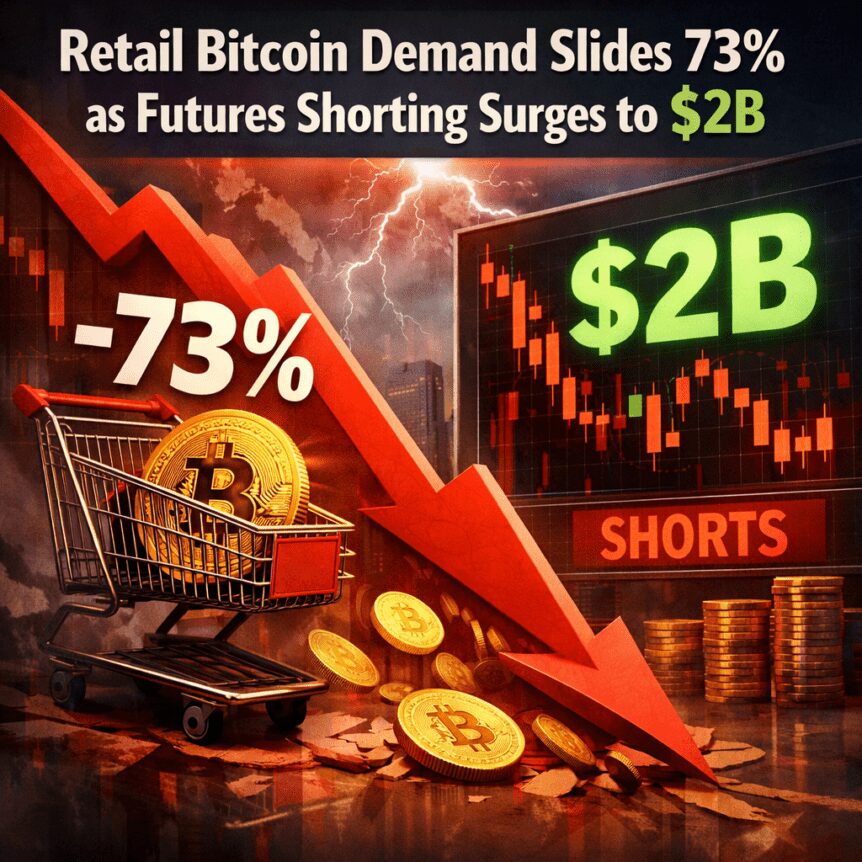
Bitcoin retail investor activity on Binance has slid to its weakest point on record, according to CryptoQuant metrics. Retail BTC inflows to the exchange are averaging roughly 314 BTC per month in 2026, a sharp drop from the around 1,200 BTC seen during Bitcoin’s March 2024 local top. The May recovery also cooled as spot inflows waned, with the 30-day net demand growth slipping 73% over the past three weeks.
Key takeaways
- Binance’s retail BTC inflows have collapsed to about 314 BTC per month in 2026, versus roughly 1,200 BTC at the March 2024 peak.
- The 30-day change in retail demand cooled from earlier levels, with growth at 3.12% this week versus 7.39% the prior week, indicating a thinning pace of retail buying activity.
- Market dynamics show a mismatch between futures and spot demand: futures demand remained positive while spot demand stayed negative, contributing to a more tepid recovery.
- Binance’s dominance in USDT-margined futures has waned, dropping to 21.1% in May 2026 as OKX rose to 26.3%, marking a notable leadership shift in the exchange landscape.
- Sharp taker-sell spikes during the May decline, underscoring ebbing retail participation even as price volatility persisted.
Retail activity cools on Binance as ETF drift considerations intensify
In recent months, observers have noted a shift in the behavior of retail-focused Bitcoin inflows. Darkfost, a CryptoQuant analyst, pointed out that retail inflows to Binance have remained near their historical lows, a condition that has persisted even as prices recovered from recent dips. The data tracks deposits from wallets holding less than 1 BTC, a conventional proxy for everyday retail participation. The current trajectory suggests a sustained reduction in the number of smaller investors actively adding BTC to spot positions on the exchange.
Historically, retail participation was far stronger during prior cycles, with inflows peaking well above current levels (notably around 5,400 BTC in 2018 and 2,600 BTC in 2021). The recent pattern—an extended period of subdued inflows and a halting price recovery—aligns with reports that some market participants may be shifting focus away from direct exchange holdings toward other exposure channels, including spot Bitcoin ETFs, where available. CryptoQuant’s data has also highlighted a cooldown in the pace of retail demand expansion, tempering the sense of a broad-based return to demand that characterized earlier rebound phases.
Evidence of a market mismatch: spot vs. futures demand
Analysts tracking Binance’s order book and flow dynamics have highlighted a notable split between futures and spot activity during the latest rebound. Amr Taha of CryptoQuant noted two sizable spikes in taker sell volume during the May decline, with one around $1.5 billion on May 15 and another exceeding $1.1 billion as Bitcoin traded under $77,000. The takeaway: large-scale price moves coincided with significant sell pressure from active traders, even as overall demand signals remained mixed.
Meanwhile, a broader narrative from market analysts centers on the absence of a balanced demand signal that typically accompanies healthy recoveries. Crazzyblockk, another CryptoQuant commentator, pointed out that the current rally diverges from prior episodes—October 2024, November 2024, and May 2025—when spot and futures demand moved higher in tandem. In the latest cycle, futures demand stayed positive, tallying around +193,000 BTC over 30 days, while spot demand stayed negative at roughly -28,000 BTC and remained subzero for 65 consecutive days. The overall 30-day demand growth declined sharply from about 232,000 BTC in early May to approximately 62,000 BTC by May 16, signaling a 73% drop in momentum.
The pattern matters because it hints at how sustainable the rebound might be. When spot and futures participation rise together, Bitcoin often enjoys stronger and more durable rallies. The current configuration—futures exposure still in positive territory while spot demand remains weak—suggests a fragility in the dip-recovery dynamic that could keep volatility elevated and limit upside unless spot participation improves.
Derivatives leadership shifts shape the market backdrop
The reshuffling of who dominates Bitcoin’s futures landscape adds another layer of complexity. Data cited by analysts show a clear shift in exchange leadership for USDT-margined futures over the past year and a half. Binance, which had commanded roughly 40% to 44% of global USDT-margined futures volume from October 2024 through March 2026, saw its share compress to 21.1% in May 2026.OKX stepped up to 26.3% in the same period, marking the first sustained reversal in exchange leadership for the cycle.
These dynamics matter for traders and liquidity providers because futures market structure often amplifies price moves and influences hedging activity. A decline in Binance’s dominance could reallocate risk and liquidity across venues, potentially affecting funding rates, order book depth, and the speed at which wholesale flows can move BTC across markets. For market participants, the shift underscores the evolving balance of power in the crypto derivatives space and the importance of monitoring cross-exchange flow interactions as price action unfolds.
Related coverage from the industry has underscored the broader context: as retail participation cools, institutional and ETF-linked channels may play an increasingly influential role in determining BTC’s price trajectories, especially if spot demand remains constrained. The market is watching for fresh data on ETF filings, regulatory developments, and any renewed retail appetite that could re-align the spot and futures curves.
In the near term, observers will be watching whether spot demand can recover in tandem with futures activity or whether the current pattern persists, with futures driving price moves while spot participation remains muted. The coming weeks could reveal whether the ETF channel and broader macro liquidity conditions will re-energize retail buying or whether the market settles into a more measured, less enthusiastic phase of recovery.
Across the board, the data points to a market that is transitioning in its participation mix. The interplay between ETF-driven exposure, exchange-specific inflows, and the evolving derivatives landscape will continue to shape Bitcoin’s liquidity profile and price dynamics as traders weigh the evolving risk environment.

Crypto World
Trump’s visit to China triggered volatility in global financial markets. XRP/BTC could continue to rise after the US-China summit
Disclosure: This article does not represent investment advice. The content and materials featured on this page are for educational purposes only.
XRP Power gains attention as global market shifts revive interest in AI-driven crypto platforms.
Summary
- Trump-China talks boost crypto sentiment as XRP Power gains attention with AI-driven digital asset solutions.
- Bitcoin and XRP activity rise after Trump’s China visit, driving interest in AI-powered XRP Power systems.
- XRP Power attracts investors with AI automation, risk control, and smarter crypto participation tools.
Trump’s recent visit to China has once again become the focus of global financial markets. As the two sides discussed issues such as trade, artificial intelligence, and global economic stability, market risk sentiment has begun to shift significantly. Affected by this, digital assets such as Bitcoin and XRP have seen renewed activity, and the overall trading volume of the cryptocurrency market has continued to recover.
Against the backdrop of global capital seeking new growth opportunities, more and more investors are beginning to pay attention to new trends in the digital asset field. Compared to traditional high-volatility short-term trading, some users are turning to more intelligent and structured participation methods. AI technology, automated systems, and transparent operating models are gradually becoming new focuses in the industry.
In this market environment, XRP Power is beginning to attract more users. As a platform focusing on AI intelligent systems and the digital asset ecosystem, XRP Power attracts more and more users interested in digital finance and intelligent technology through automated management, real-time risk control monitoring, and global APP services. As market sentiment gradually recovers, attention is turning to XRP Power, with an increasing number of investors flocking to it amidst the global financial upheaval and crypto market recovery.
XRP Power AI intelligent system’s five core advantages:
1. Employs an intelligent AI automation system, enabling real-time data analysis and automated operation, further improving overall efficiency.
3. Introduces a multi-layered AI risk control monitoring mechanism, combined with a real-time security system, ensuring more stable and transparent operation.
4. Reduces the barriers to entry for traditionally complex operations through intelligent computing power scheduling and automated management, enhancing user experience.
5. Integrates AI technology with the digital asset ecosystem, continuously optimizing platform competitiveness through a transparent system and global services.
XRP Power intelligent AI participation process:
2. Users can freely choose intelligent AI solutions with different periods based on their needs, each corresponding to a different return model.
3. XRP Power fully supports participation in mainstream cryptocurrencies, offering greater flexibility and convenience.
4. Daily earnings will be automatically synchronized to your account balance via an intelligent AI system. Users can choose to withdraw directly or configure other earnings plans.
Popular AI-powered earning contracts
Contract Name: DOGE [AI Intelligent Quantification] Investment Amount: $10,000, Period: 20 days, Daily Earnings: $153, Total Earnings: $3,060, Principal Refund at Maturity: $10,000
Contract Name: BTC/BCH [AI Global Smart Ecosystem] Investment Amount: $50,000, Period: 27 days, Daily Earnings: $860, Total Earnings: $23,220, Principal Refund at Maturity: $50,000
Click to view more detailed contracts
About XRP Power
Faced with the continued volatility of the global financial market and the rapid development of AI technology, more and more users are beginning to rethink how they participate in digital assets. Compared to traditional high-frequency trading models, intelligent, automated, and more transparent and convenient digital financial ecosystems are becoming the new direction for industry development.
As market attention continues to rise, XRP Power is gradually gaining more user and market attention thanks to its AI intelligent system, global services, and more efficient digital asset experience.
For details, visit the official website.
Risk warning
Digital assets, stocks, gold, and other global financial markets are subject to volatility. Their prices may be affected by various factors such as the international economic environment, market sentiment, policy adjustments, and industry changes. Before participating in any digital asset or smart contract, users should fully understand the relevant rules and market characteristics and participate rationally according to their own risk tolerance.
Compared to traditional high-frequency trading models, XRP Power places greater emphasis on AI intelligent management, real-time risk control, and system stability. The platform continuously optimizes overall operational efficiency through intelligent data analysis, multi-layered risk control mechanisms, and real-time monitoring systems.
Meanwhile, users are advised to thoroughly understand the platform rules, contract periods, and related instructions before participating, rationally plan their capital allocation, enhance their risk awareness, and participate in the digital financial market in a long-term and rational manner.
Disclosure: This content is provided by a third party. Neither crypto.news nor the author of this article endorses any product mentioned on this page. Users should conduct their own research before taking any action related to the company.
Bitcoin (BTC) starts a new week under pressure as support levels fade and macro gloom intensifies.
Key points:
- Bitcoin falls below a key 21-week trend line after the weekly close, but hopes of a “bear trap” rebound remain.
- US-Iran war rhetoric continues to push oil higher, pressuring crypto markets.
- Those tensions could still be countered by strong PMI and Nvidia earnings data in the coming days.
- Bitcoin whales are acting as if the bottom is already in, per new analysis.
- Despite this, a surge in exchange inflows from a key investor cohort raises alarm over “capitulation.”
BTC price analysis sees relief bounce after sub-$77,000 dip
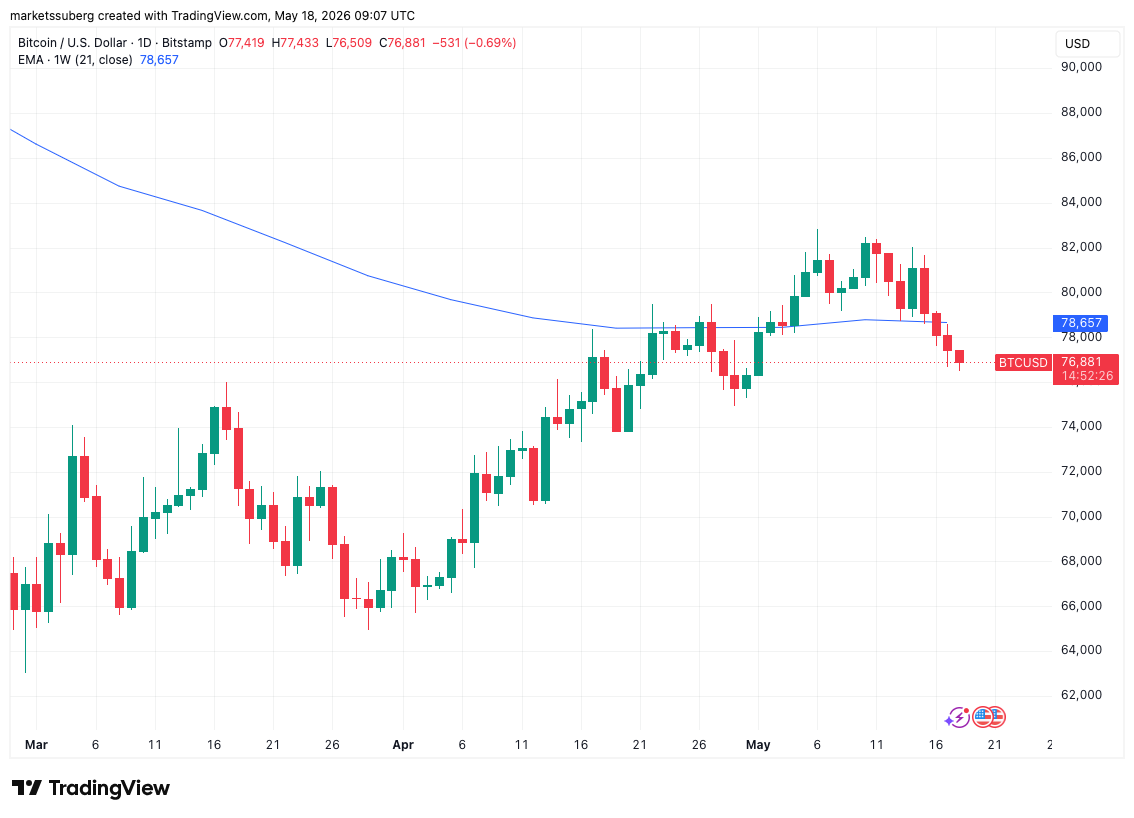
Bitcoin felt the pressure as the new weekly candle began, dropping to $76,500 — its lowest levels since May 1, per data from TradingView.
After several support retests, BTC/USD began to fall through recently recovered ground, which included the 21-week exponential moving average (EMA) at $78,660.
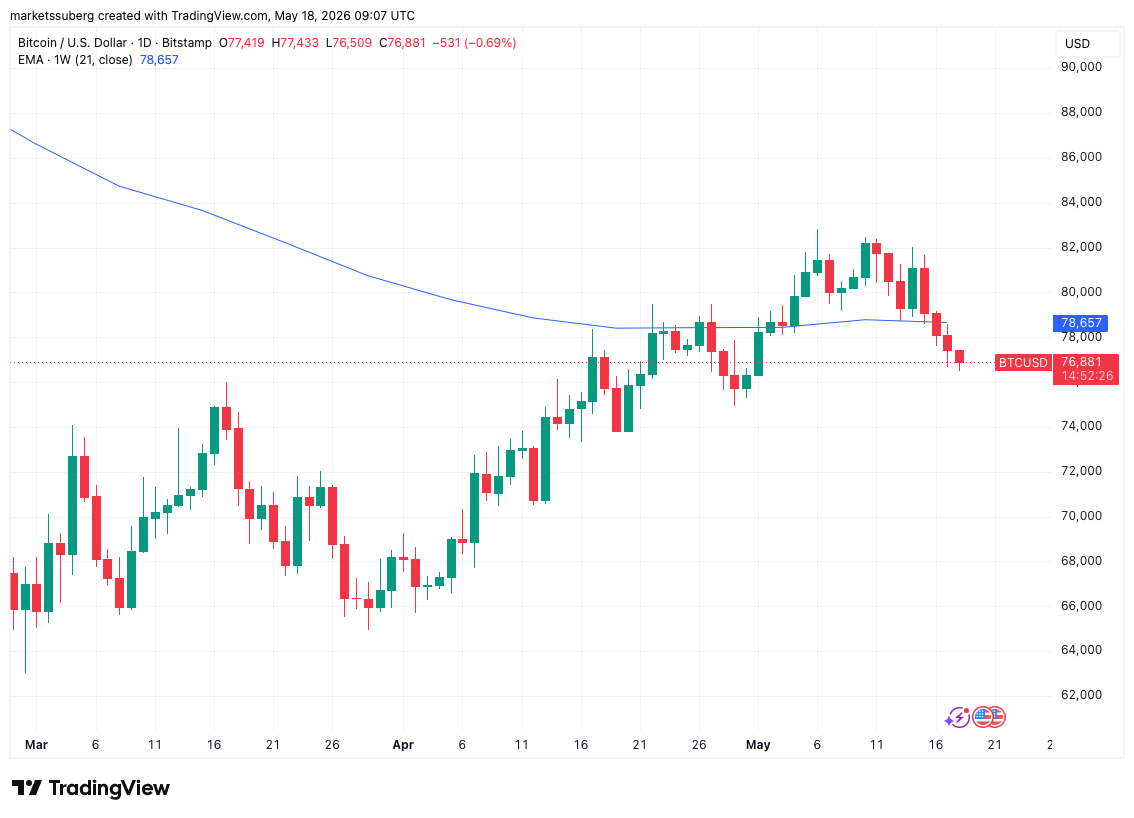
BTC/USD one-day chart with 21-week EMA. Source: Cointelegraph/TradingView
With it, price fell back below the bull market support band.
“Another weekly close at it for now, but to confirm a proper breakout you’d need to see a bounce now,” trader Daan Crypto Trades wrote in X analysis before the trip toward month-to-date lows.
“If this ends up falling back below that $75K-$76K area and closes there on the weekly, then this was just a big deviation/dead cat bounce in my eyes.”
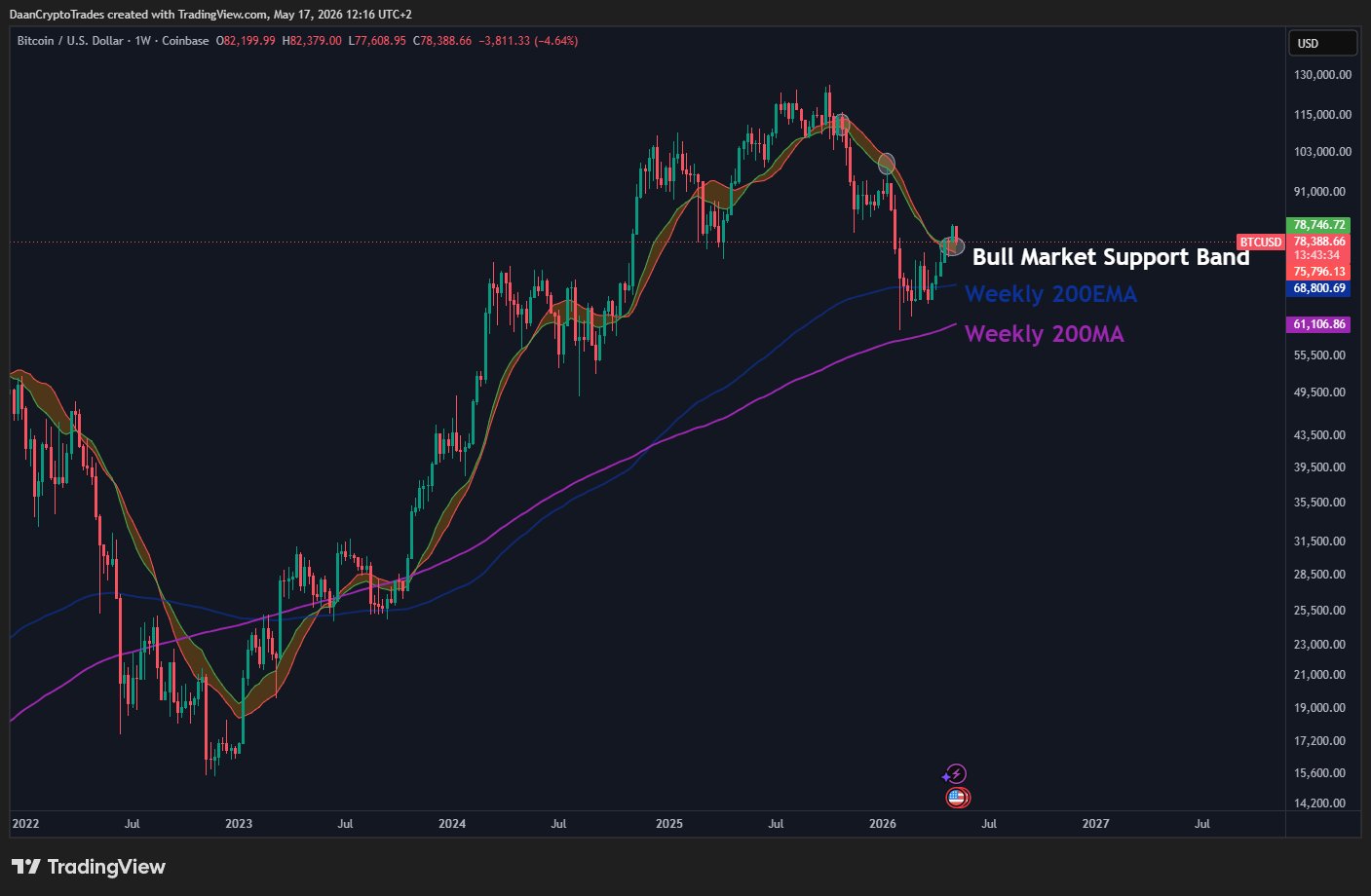
BTC/USD one-week chart. Source: Daan Crypto Trades/X
The downside cost BTC long positions, with cross-crypto long liquidations for the 24 hours to the time of writing passing $670 million.
Data from CoinGlass also shows potential liquidations building either side of spot price, providing fuel for liquidity grabs both up and down.
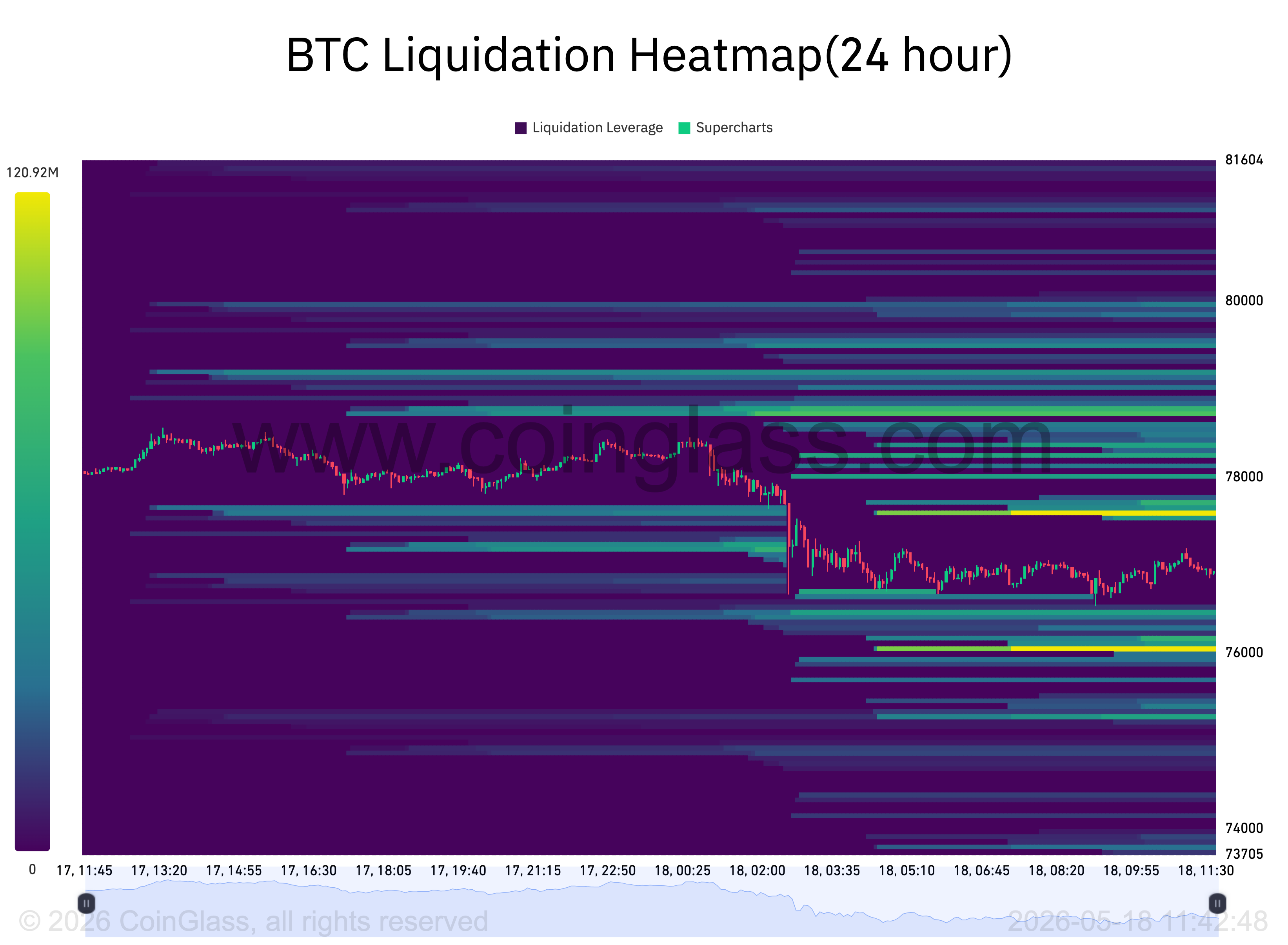
BTC liquidation heatmap. Source: CoinGlass
Commenting, trading account Cryptic Trades saw a bounce coming next due to the magnitude of liquidated longs.
“$BTC has just tapped into the prior Breakout Zone at $75K-$76K,” it told X followers.
“Expecting a bounce here, as the longs I covered in my prior alert also got flushed.”
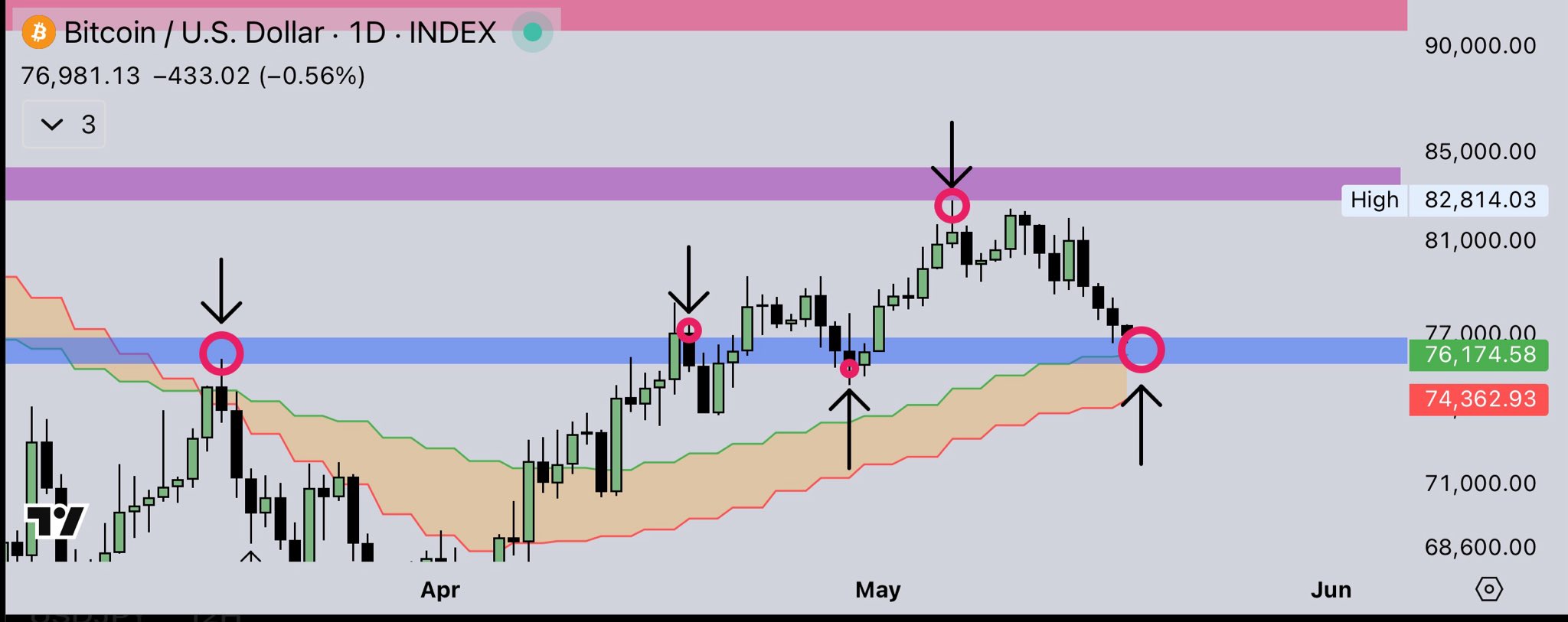
BTC/USD one-day chart. Source: Cryptic Trades/X
At the weekend, Cryptic Trades suggested that any downmove would have the markings of a classic “bear trap,” given rising open interest and negative funding rates.
“This shows us that bears are DOUBLING DOWN right now and betting on a breakdown,” it wrote.
“It also shows that even though the market structure remains intact, bears are shorting as if a breakdown already happened. That’s generally how bear-traps are formed.”
US bond markets “collapsing in real time”
While light on US macro data, the coming week is already shaping up to be a tricky one for crypto traders.
Tensions over the US-Iran war are returning, with the prospect of the Strait of Hormuz oil route fully opening still absent.
In a post on Truth Social over the weekend, US President Donald Trump wrote that the “clock is ticking” for Iran, without giving specific details.
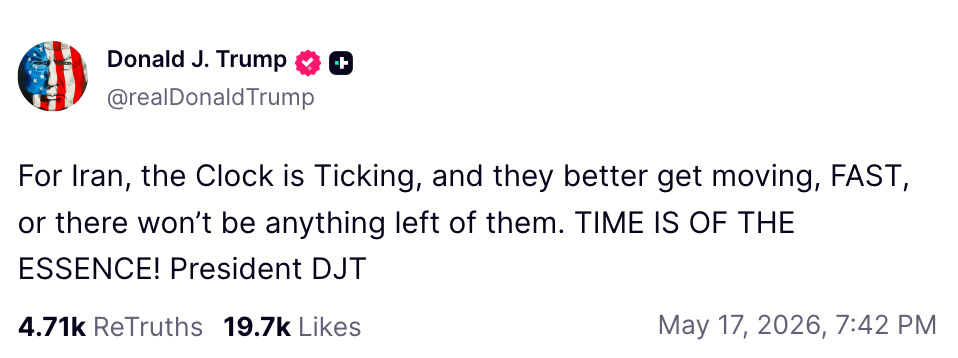
Source: Truth Social
Additional reports claimed that Trump was convening a security meeting to discuss “military options in Iran,” per trading resource The Kobeissi Letter.
Oil futures reacted sharply at the weekly open, with WTI crude reaching near two-week highs of $104.45.
“The impact on energy prices from the war in the Middle East is pushing inflation to its highest level in years,” analytics resource Mosaic Asset Company commented in the latest edition of its regular newsletter, The Market Mosaic.
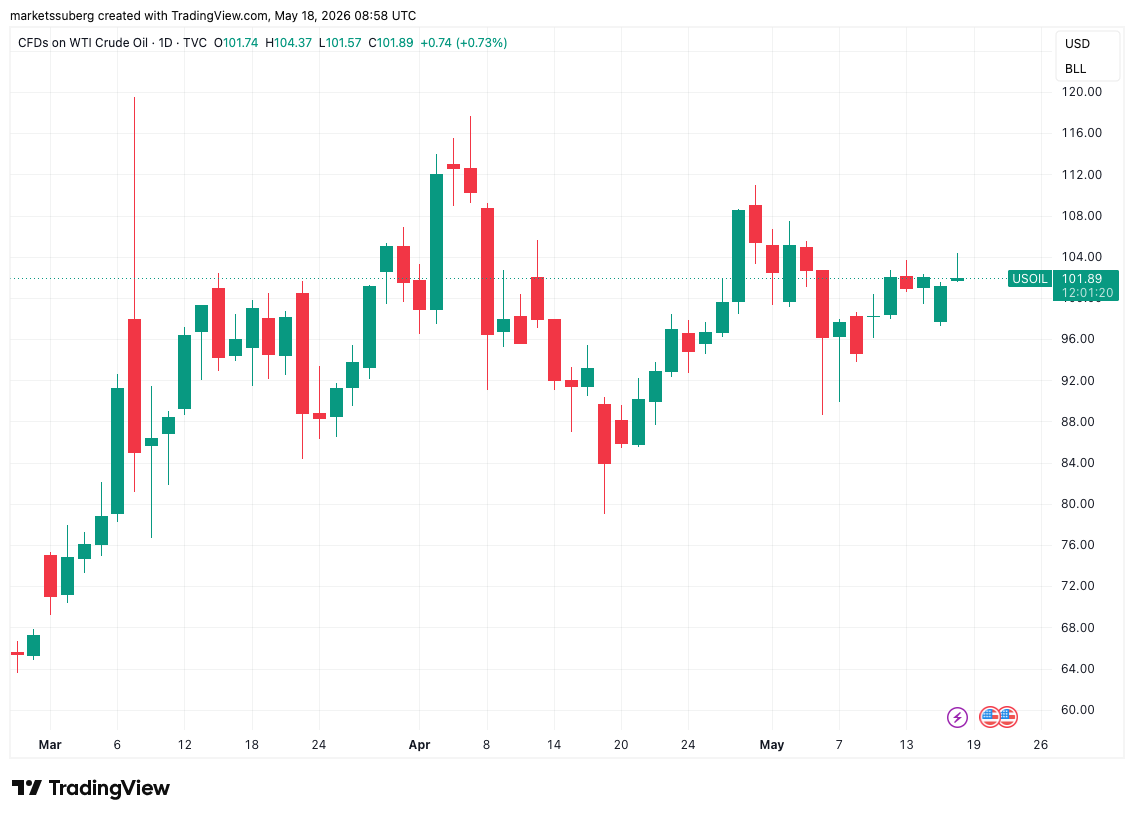
CFDs on WTI crude oil one-day chart. Source: Cointelegraph/TradingView
Like others, Mosaic tied high oil prices to surging US inflation prints.
“While a spike in energy prices are helping drive inflation higher, the most recent reports continue a trend of growing price pressures,” it continued.
US bond markets, meanwhile, continue to sum up the about-turn in market sentiment, as “unsustainable” yield growth wipes out the odds of interest-rate cuts by the Federal Reserve.
“On Friday, the 30-year Treasury yield jumped above the 5% level which is the high tested several times over the past couple years. A sustained breakout could have serious implications at a time when federal debt and deficit spending is surging,” Mosaic warned.
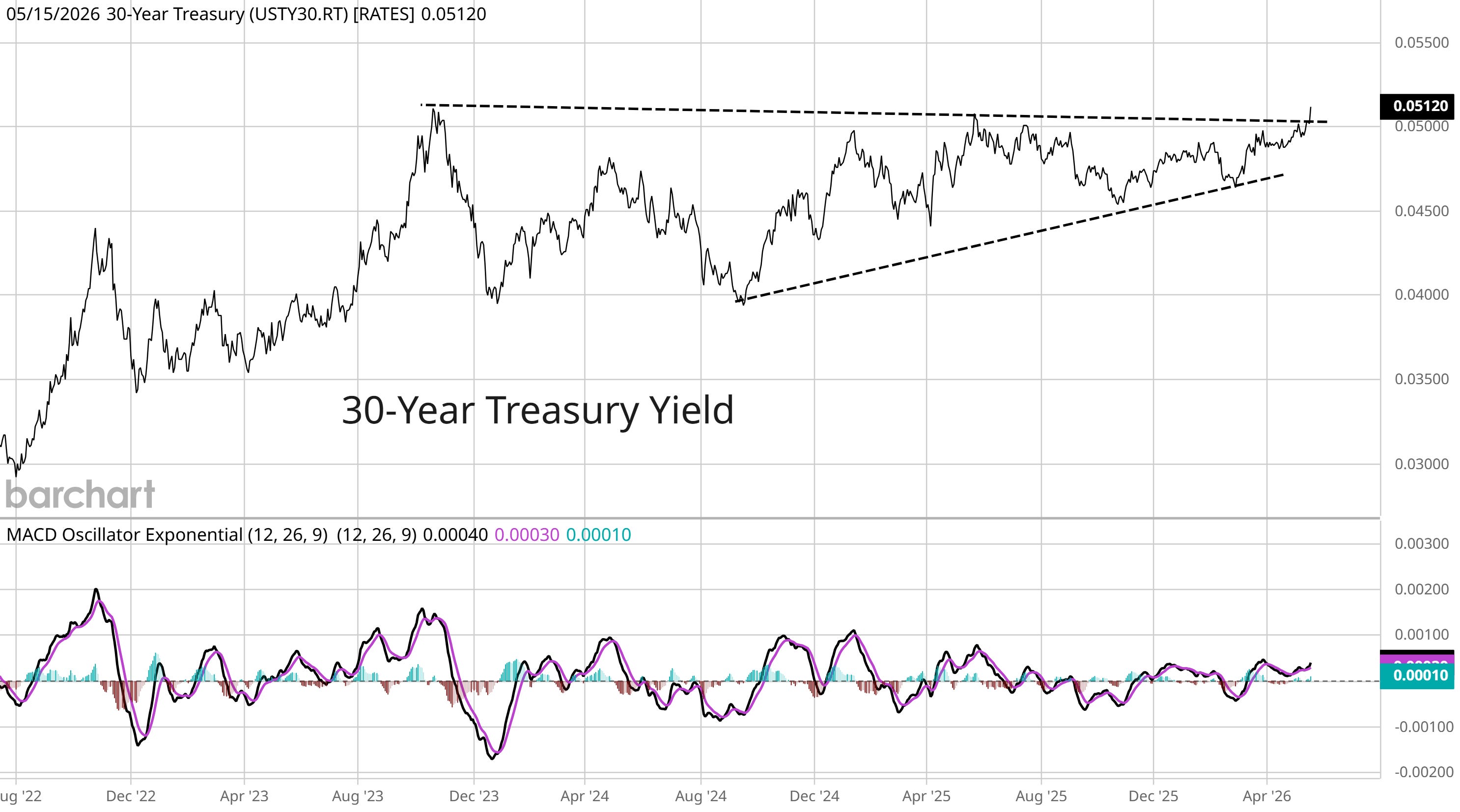
US 30-year treasury yield chart. Source: Mosaic Asset Company
Kobeissi described the US bond market as “collapsing in real time.”
“And, in a sudden turn of events, the odds of rate cuts have collapsed to 2% this year and US inflation is nearing 4%+,” it noted on X.
PMI, Nvidia earnings give crypto bulls hope
Amid the chaos, a silver lining could come in the form of manufacturing data.
The latest S&P Manufacturing Purchasing Managers Index (PMI) report, due out on Thursday, should ideally continue a breakout that began earlier in 2026.
Bitcoin and risk assets reacted positively to the development, which ended several years of PMI contraction.
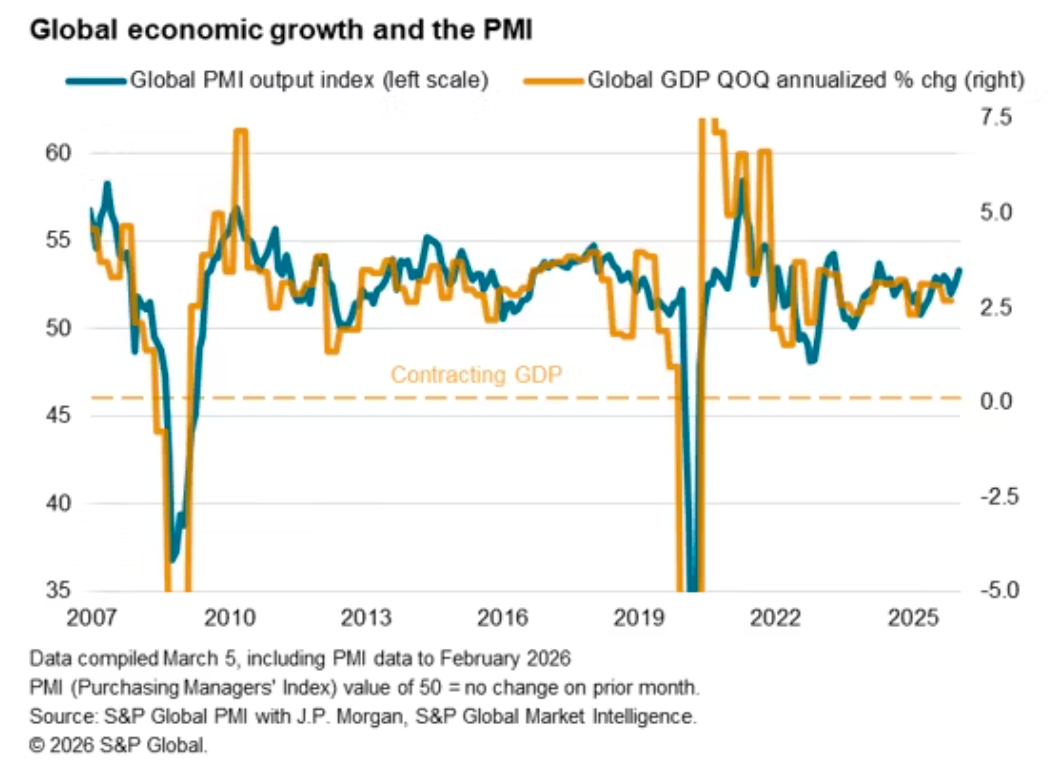
Global PMI versus GDP data (screenshot). Source: S&P Global
Major tech earnings are also lining up to potentially offer markets a boost in the event that they surpass expectations. Nvidia will report on Wednesday — something that Kobeissi even calls the “biggest earnings event of the quarter.”
Commenting on the outlook for market volatility, independent macro and market strategist Michael J. Kramer cautioned that bulls may ultimately suffer.
“NVIDIA once again finds itself heavily overloaded with call positioning, and unless the stock sees a meaningful pullback ahead of earnings that helps reengage put demand, I think the most likely outcome is another post-earnings sell-off,” he wrote in an X thread on Sunday.
Kramer predicted a surge in implied volatility toward Friday’s options expiry event.
“So unless NVIDIA is able to truly blow traders away with its results, the stock likely faces the usual ‘sell-the-news’ reaction, or, as I like to call it, the mechanical unwind,” he reiterated.
Bitcoin whales brush off hawkish Fed signals
In its latest market overview, onchain analytics platform CryptoQuant examined the relationship between Fed policy and the actions of Bitcoin whales.
These large-scale investors, often tied to “smart money” and a key yardstick for long-term market trajectory, could be signalling that the outlook is not as bad as sentiment shows.
“Tracking their moves offers us a backdoor view into how the biggest players are reading the room, which in turn helps us stress-test and refine our own market thesis,” contributor Joohyun Ryu wrote in a QuickTake blog post this week.
“To cut straight to the chase, the good news is that whale wallet balances haven’t shown any dramatic shifts.”
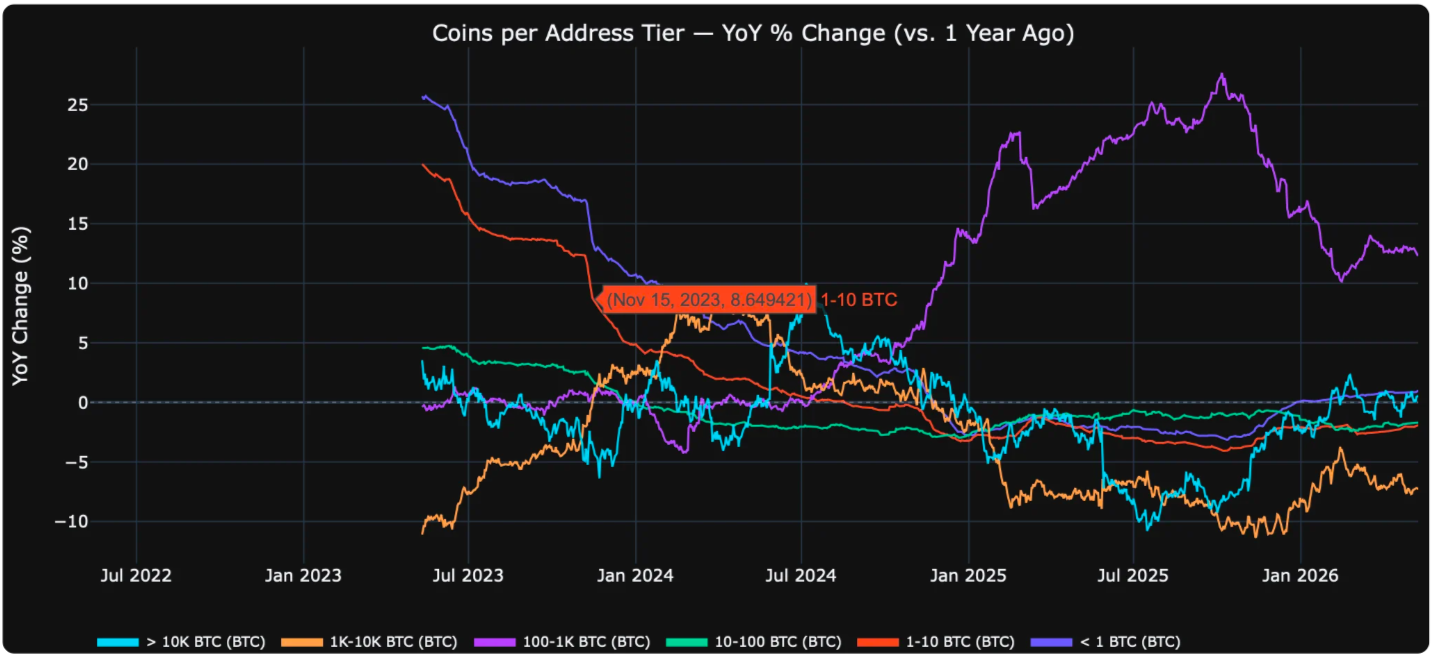
BTC holdings per address tier (screenshot). Source: CryptoQuant
Analyzing whale holdings, Joohyun argued that despite the odds of rate cuts disappearing for both 2026 and 2027, there appears to be no real cause to reduce risk exposure. Some cohorts are even adding to their holdings.
“On top of that, the ultimate mega-whales—those holding over 10K—are finally seeing their bags recover to levels we haven’t seen since last year,” he continued.
“Judging by these trends, it looks like the whales are betting that the market has officially bottomed out. That said, this isn’t a full-blown buying frenzy just yet, so it’s still wise to proceed with caution.”
Traditionally, financial tightening and an inflationary environment pressure crypto prices — a phenomenon most recently seen during the 2022 bear market.
Long-term holders lose their nerve
For the time being, however, sell-side pressure remains a key threat to Bitcoin.
Related: Bitcoin price history suggests 77% odds of new all-time high within a year
Specifically, CryptoQuant notes a pronounced uptick in exchange inflows from wallets that bought BTC between six and 12 months ago.
“Bitcoin is not facing a simple short-term correction, but a structurally driven crisis fueled by cascading leverage liquidations and deep spot-market fear.,” contributor Easy OnChain warned.
“On-chain data shows a clear ‘cascading dumping’ pattern, where capitulation from long-term holders triggers panic selling among short-term investors.”
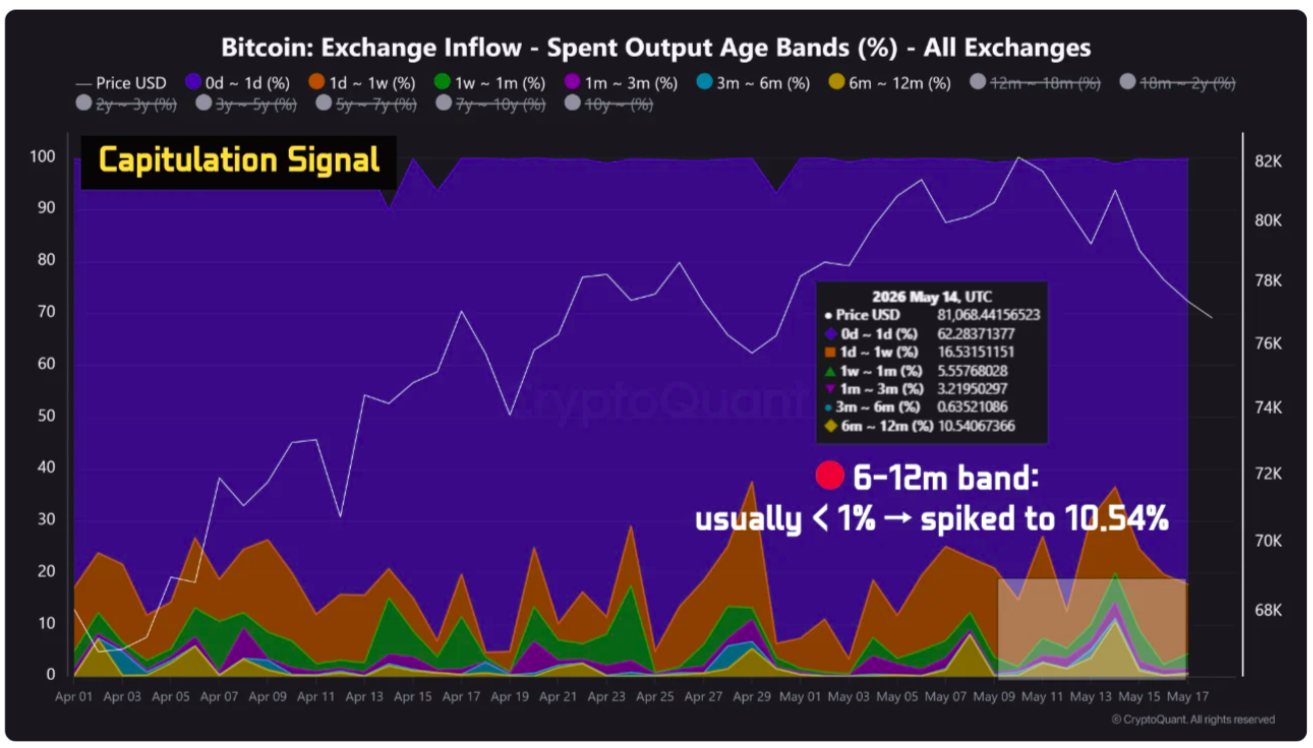
Bitcoin exchange inflows data (screenshot). Source: CryptoQuant
The former cohort, hodling for up to 12 months, has accounted for 10.54% of exchange inflows since May 14 — more than 10 times normal levels.
For CryptoQuant, this signals “large-scale capitulation.”
“Historically, this reflects investors locking in major losses and exiting the market, creating severe spot-market selling pressure,” Easy On Chain continued, noting contagion spreading to speculators.
“The current decline is therefore an internally driven market crisis caused by derivative liquidations, large-scale long-term holder capitulation, and cascading panic from short-term participants,” it added.
“Until this toxic supply is fully absorbed and sentiment stabilizes, a rapid V-shaped recovery remains unlikely.”
Crypto World
AFX launches sovereign Layer 1, providing an optimized execution environment for on-chain perp DEXes
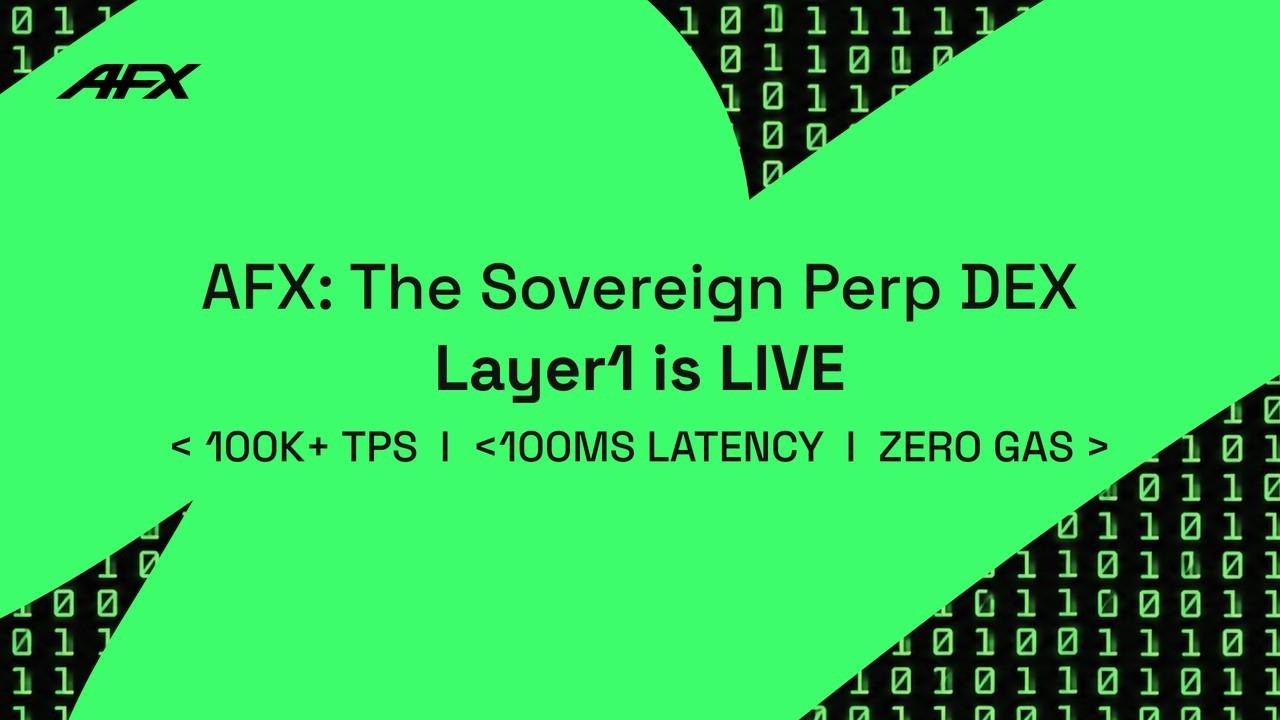
Road Town, BVI, May 18, 2026 — AFX, a sovereign Layer 1 purpose-built for decentralized derivatives trading, has officially commenced the operation of its L1 Mainnet, signaling a definitive end to the era of trade execution compromised by general-purpose blockchain congestion. Engineered for the world’ s most demanding participants, AFX introduces the Sovereign Trading Layer—a dedicated financial environment where the non-custodial transparency of a Perp DEX meets the uncompromising speed and depth traditionally reserved for institutional-grade centralized entities.
At launch, the protocol supports a high-liquidity suite of perpetual markets across both digital and traditional macro assets, featuring BTC, ETH, Gold (XAU), and Crude Oil (CL), with up to 40x leverage to ensure peak capital efficiency from the first block.
The architectural foundation of AFX represents a radical departure from legacy decentralized platforms that remain tethered to the high latency and structural bottlenecks of shared networks. By operating on a custom-built execution layer powered by DAG-based consensus and an ABCI modular architecture, AFX transforms the perpetual trading experience, achieving a specialized environment where execution is decoupled from consensus. This synergy provides a dedicated mempool optimized exclusively for high-frequency order flow and protocol-level MEV resistance, allowing for a 100ms median latency and a capacity exceeding 100,000 transactions per second.
Crucially, the AFX Mainnet introduces a Zero Gas execution model, removing the friction of network fees and allowing data-driven discipline, rather than gas costs, to dictate market success.
The Mainnet launch simultaneously debuts the Pro-Trader Suite, an institutional-caliber engine designed for the “0.1%” of traders who prioritize precision. This suite features a Hyper-Efficiency Margin Engine that mandates a mere 1.25% maintenance margin—delivering four times the capital efficiency of industry incumbents—while providing native support for the real-time re-utilization of unrealized profits. Furthermore, as the first decentralized derivatives exchange to offer native FIX protocol support, AFX provides Tier-1 quantitative firms a seamless, plug-and-play gateway to decentralized liquidity, bridging the gap between sophisticated algorithmic trading and on-chain sovereignty without the need for extensive code refactoring.
Beyond technical dominance, AFX is redefining the social contract of decentralized finance through a community-first economic model. In a deliberate move to preserve total sovereignty, the protocol was launched without venture capital, private rounds, or predatory unlock schedules, ensuring that the network’ s evolution is driven purely by its active participants. This commitment is solidified by a 100% Revenue Pass-through model, where the entirety of the network’ s generated value is directed back to the ecosystem’ s contributors and traders.
The AFX Mainnet is now live, offering a sanctuary for those who demand the transparency of a Perp DEX with the sovereign precision of a dedicated L1. Traders are invited to experience the next stage of on-chain evolution at https://app.afx.xyz/trade.
About AFX
AFX is a high-performance sovereign L1 purpose-built for decentralized derivatives. By synthesizing the rapid execution of a centralized exchange with the immutable sovereignty of the blockchain, AFX delivers a professional-grade Perp DEX environment characterized by sub-100ms finality, institutional liquidity, and unmatched capital efficiency.
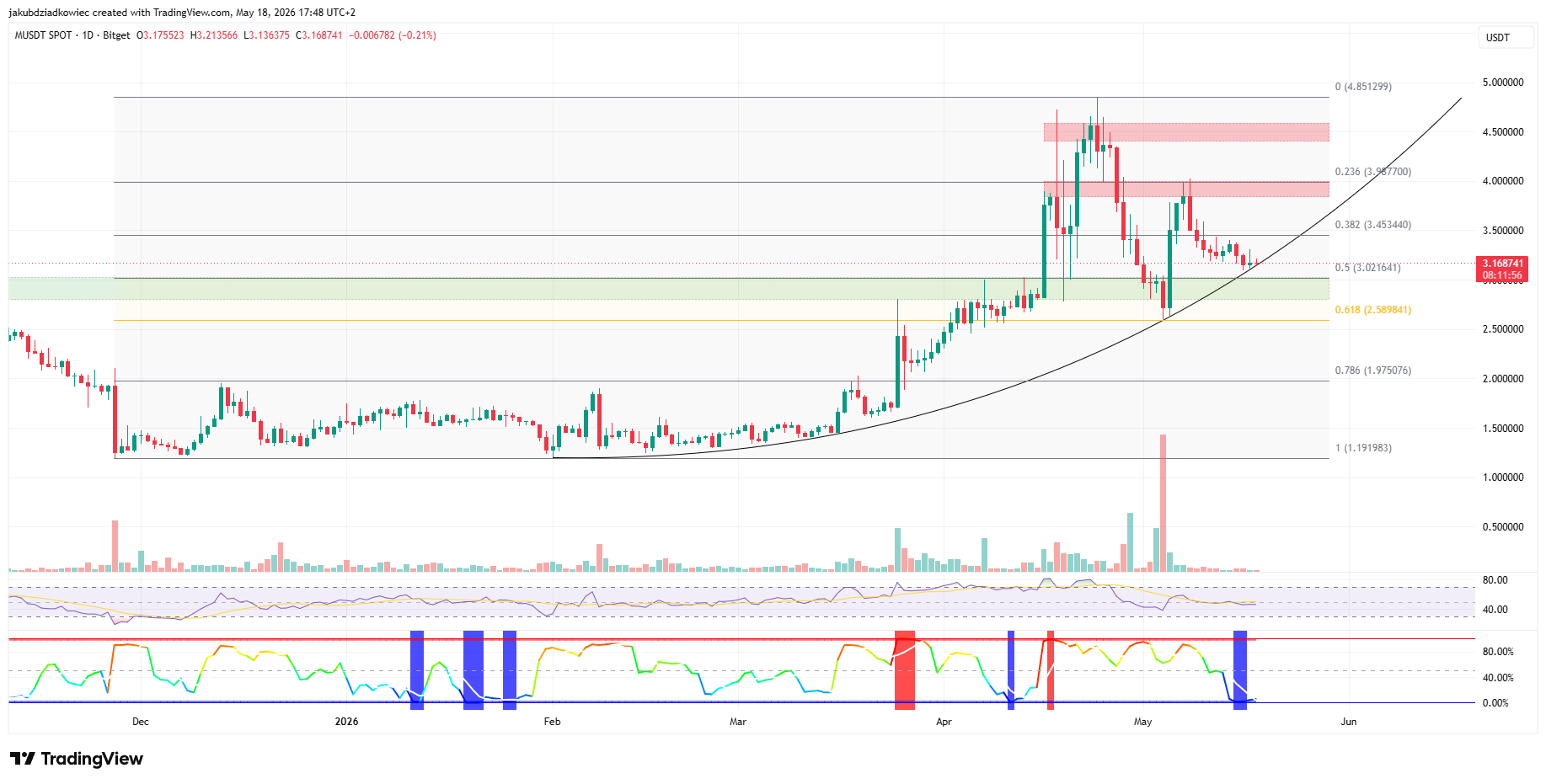
MemeCore (M), 币安人生 (BinanceLife), and Gigachad (GIGA) sit at decisive technical levels heading into the third week of May. Daily charts show each token compressing or consolidating after weeks of volatile price action.
Each setup tells a different story. One token coils above a key Fibonacci floor, another nears a triangle breakout, and the third holds gains after a sharp weekly rally.
MemeCore Compresses Above $3.02 Fibonacci Support
MemeCore (M) trades near $3.16 after a 2.16% decline over the past seven days. The token sits just above the 0.5 Fibonacci retracement at $3.02 on the daily chart.
The Relative Strength Index (RSI) prints at roughly 50, indicating neutral momentum. Meanwhile, volatility, as measured by the BBWP indicator, has collapsed to extreme lows, suggesting an accumulation phase.
Price has also bounced off an ascending exponential curve that has held every dip since February 1. A previous BeInCrypto rebound report tracked the same Fibonacci structure during the prior leg up.

Two horizontal supply zones remain in play above. The first sits near $4.00, with a heavier band stretching to $4.50.
A deeper correction would shift attention to the 0.618 Fibonacci retracement at $2.59. That level would serve as the first bearish target if the exponential curve cracks.
BinanceLife Coils Inside a Triangle Targeting $0.68
币安人生 (BinanceLife) trades at $0.43 after a 5.54% advance over the past week. In contrast with MemeCore, BinanceLife has been trending higher since the March 29 low.
The token printed an all-time high at $0.5595 in April. After pulling back to the 0.382 Fibonacci retracement at $0.36, the price resumed posting higher highs and higher lows.
Daily candles now coil within a horizontal triangle close to resolution. The earlier 3,000% surge reported by BeInCrypto set the stage for the current consolidation.

A break above $0.46 resistance would open a measured move toward $0.68 as the first bullish target. Strong support sits at the previous January 14 swing high near $0.26, which coincides with the 0.618 Fibonacci level.
The RSI hovers near 61, leaning neutral to bullish. Volatility remains compressed, reinforcing the case for a directional move once the triangle resolves. Broader BNB meme coin flows could determine the direction.
Gigachad Consolidates Below $0.0047 After Weekly Rally
Gigachad (GIGA) trades at $0.00435 after a sharp 13.91% weekly gain. However, the token has slipped 5.08% over the past 24 hours and now sits just below resistance at $0.0047.
A clean break above $0.0047 could open the path toward $0.0057, with a second resistance near $0.0072. Therefore, the next move from this consolidation will likely set the short-term tone.
The setup echoes earlier meme coin sector-watchlist coverage that tracked similar pauses after fast rallies. If the rally stalls, the first support area sits near $0.0035, marked by the November 17 and December 2025 lows.

A deeper flush would expose $0.0024, which capped price during the February to May accumulation range. The RSI prints near 70, holding firmly in bullish territory.
Volatility has cooled from recent extremes, suggesting a phase of reactivation rather than exhaustion. The next directional move will likely follow either a $0.0047 breakout or a retest of the $0.0035 floor.
The post Top 3 Meme Coins to Watch in the Third Week of May 2026 appeared first on BeInCrypto.
US investment bank Goldman Sachs sharply reduced its exposure to cryptocurrency exchange-traded funds (ETFs) in the first quarter of 2026.
No XRP-linked ETFs appeared in Goldman Sachs’ Q1 Form 13F filing with the US Securities and Exchange Commission.
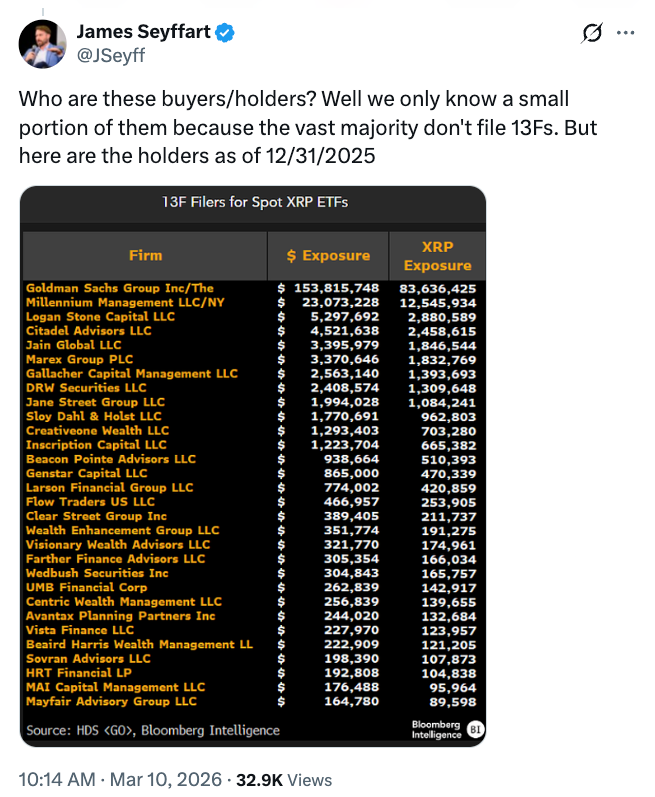
In its Q42025 13F filing, Goldman Sachs reported holding nearly $154 million worth of XRP-related ETFs from Bitwise, Franklin Templeton, Grayscale and 21Shares.
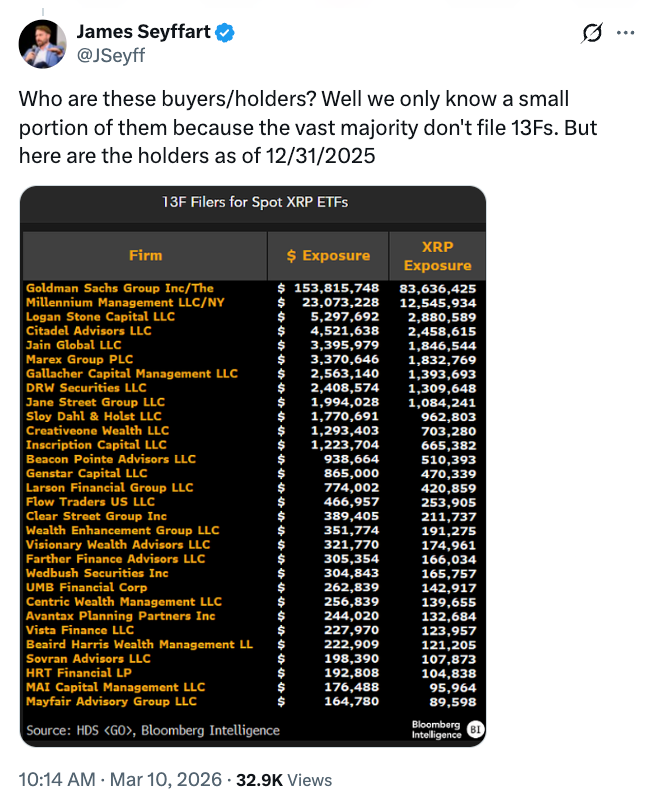
Goldman Sachs was the largest institutional holder of XRP-related ETFs as of Dec. 31, 2025. Source: James Seyffart
Quarterly 13F filings are closely watched by crypto investors because they provide a rare look into how major institutional asset managers are allocating capital across digital-asset investment products. The bank pulled back from XRP products, even as broader institutional interest in digital-asset ETFs remains intact.
Early pullback from new crypto ETFs
Goldman Sachs no longer reported any holdings in Solana-linked ETFs either.
The bank previously disclosed positions in Solana-linked ETFs, including the Grayscale Solana Trust ETF (GSOL), the Bitwise Solana Staking ETF (BSOL) and the Fidelity Solana Fund (FSOL).
Both XRP- and Solana-linked ETFs launched in late 2025, when issuers began rolling out a new wave of crypto funds beyond Bitcoin (BTC) and Ether (ETH).
Solana ETFs began trading in late October 2025, with additional funds rolling out in November. The first spot XRP ETFs hit the market in mid-November as issuers raced to bring new altcoin products to investors.
Goldman Sachs trims Bitcoin ETF exposure, but still holds more than $700 million
While no longer reporting ETF exposure to XRP and Solana, Goldman Sachs continued to hold significant positions in Bitcoin and Ether ETFs, along with equity tied to crypto companies.
The bank held about $690 million in BlackRock’s iShares Bitcoin Trust ETF (IBIT) and another $25 million in the Fidelity Wise Origin Bitcoin Fund (FBTC), even after reducing both positions by roughly 10% during the quarter.
Goldman Sachs also cut its position in the iShares Ethereum Trust (ETHA) by about 70%, leaving it with roughly 7.2 million shares valued at around $114 million.
Related: JPMorgan piles into BlackRock’s Bitcoin ETF in Q1 2026
In crypto equities, Goldman Sachs increased its exposure to several names, led by a 249% jump in Circle Internet Group (CRCL) and a 205% rise in Galaxy Digital (GLXY), while also adding to positions in Coinbase Global (COIN), Robinhood Markets (HOOD) and PayPal Holdings (PYPL) during the quarter.
At the same time, it reduced stakes in major mining and infrastructure names, including BitMine Immersion Technologies (BMNR), Bit Digital (BTBT) and Riot Platforms (RIOT). It reduced positions in Strategy (MSTR) and IREN (IREN).
Magazine: XRP ‘probably going to $12,’ Bitcoin ETFs add $1B: Market Moves
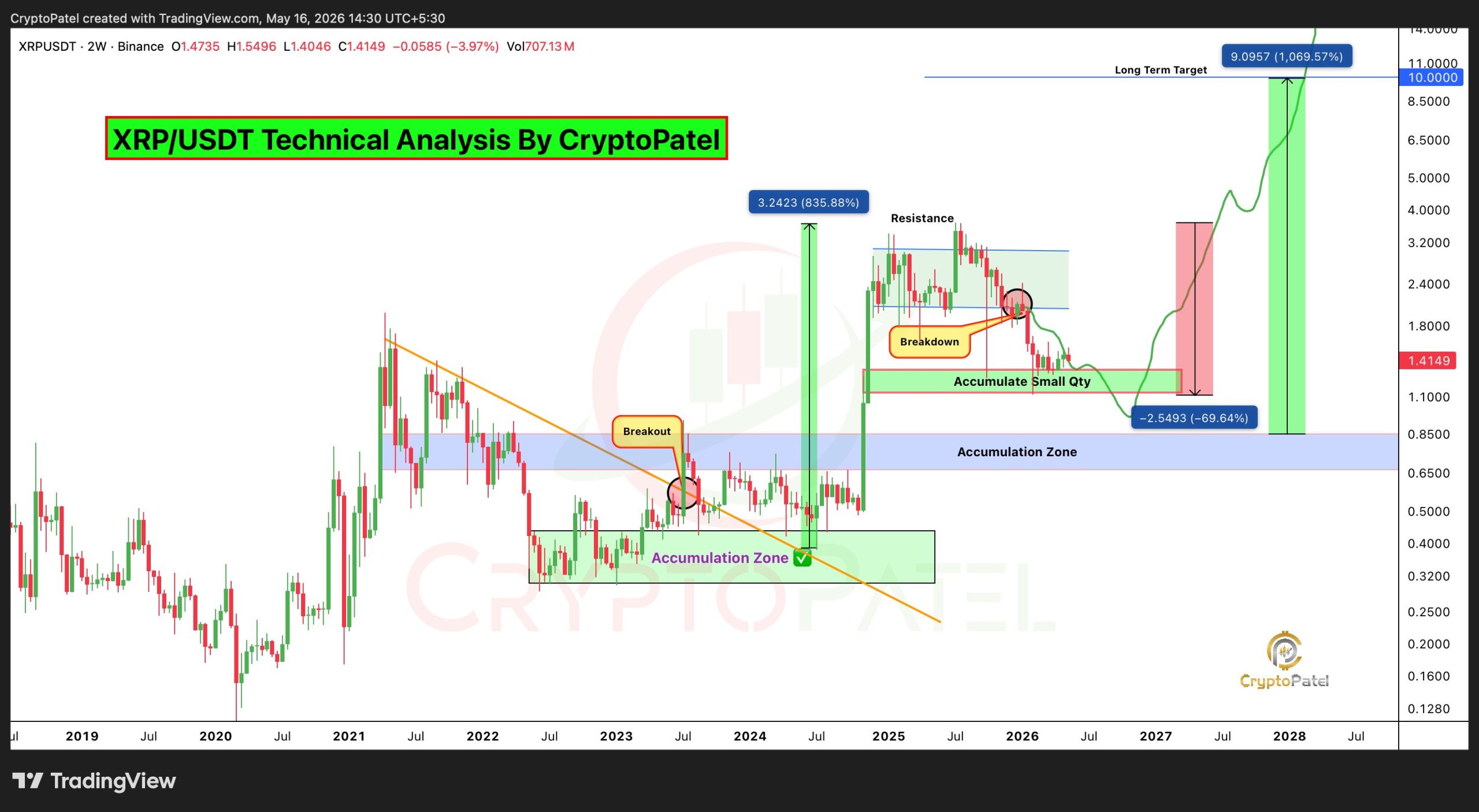
XRP (XRP) may go on a 10x–15x rally from its “quiet accumulation” zone, according to analyst Crypto Patel, who says the muted price action resembles the calm before its major breakout in late 2024.
Key takeaways:
- XRP’s lack of retail hype may lead to a rally toward $5, $10 and $15 targets.
- XRP’s current $1.00–$0.70 demand zone is similar to its 2022–2024 base, which preceded an 835% rally.
Lack of retail hype hints at XRP boom toward $15
In his Sunday post, Patel highlighted the $1.00–$0.70 range as a potential long-term accumulation zone, arguing that XRP’s muted sentiment and lack of retail hype could precede a larger upside move.
His chart showed XRP pulling back after failing to break the $3.20–$3.50 resistance area, with price now drifting toward a green demand zone that he views as a potential “massive opportunity.”
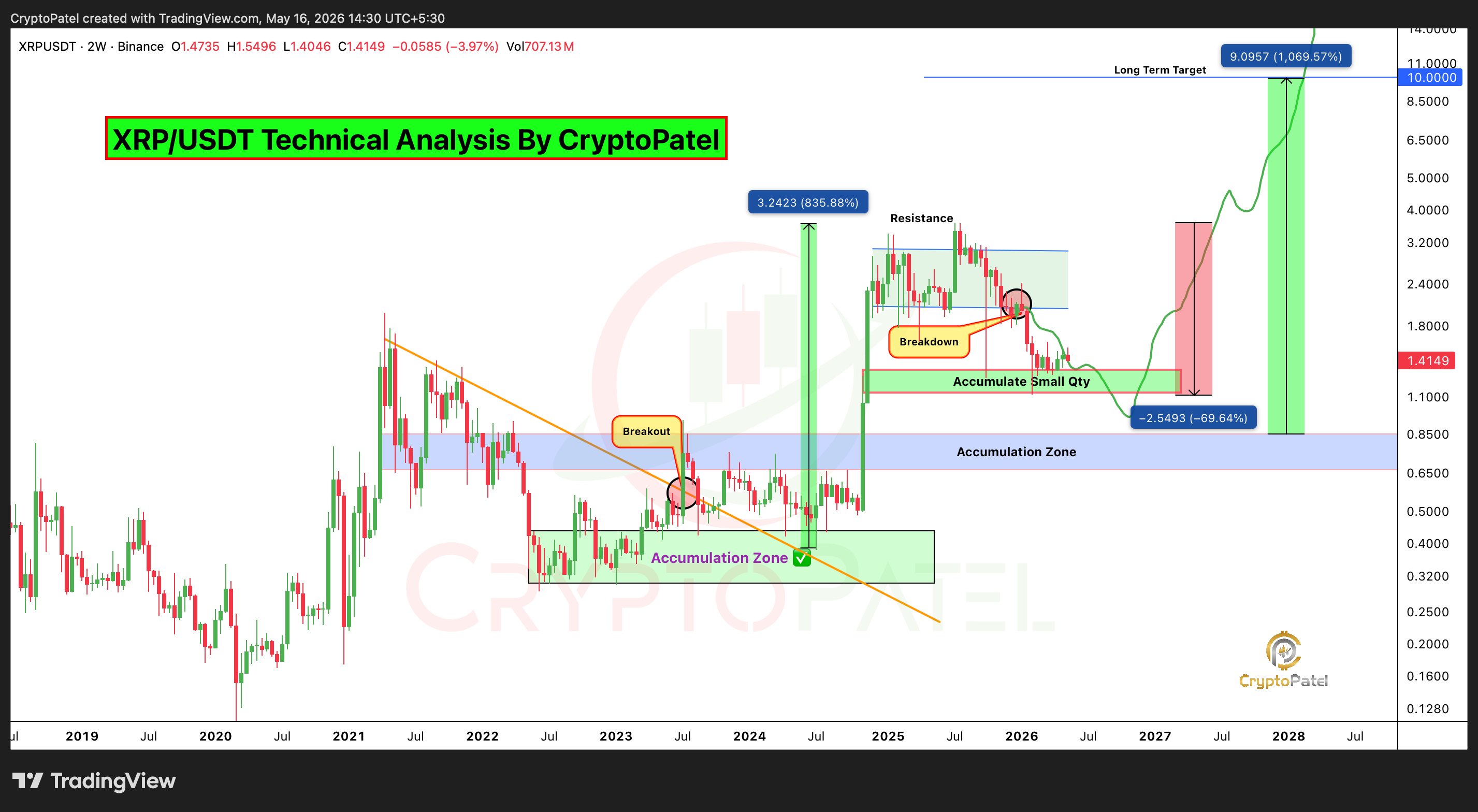
XRP/USD two-week chart. TradingView/Crypto Patel
The analyst projected upside targets at $5, $10, and $15, implying roughly 10x–15x potential from the lower end of the accumulation range if XRP repeats its 2022–2024 cycle-style expansion.
That comparison is central to Patel’s bullish case.
In the previous cycle, XRP spent months building a base around the $0.32–$0.40 area before breaking above a multi-year descending trend line near $0.55–$0.60 in November 2024.
The breakout also cleared the broader $0.65–$0.85 resistance band, marked in blue on the chart, followed by an 835% rally toward $0.40 over the next two months.
CLARITY Act may push XRP into a multi-year bull market
The late 2024 rally had a clear fundamental trigger.
Donald Trump’s re-election as US president in November 2024 boosted risk appetite across crypto markets, as traders viewed his incoming administration as far more supportive of digital assets than the previous administration.
In 2026, a similar potential catalyst is emerging with the CLARITY Act, which has advanced in the Senate.
The bill aims to create a clearer US market-structure framework for crypto by defining when digital assets fall under securities or commodities rules.
Related: Italy’s largest bank more than doubles crypto holdings to $235M in Q1: Report
Jason Yanowitz, co-host of the Empire podcast at Blockworks, named XRP as one of the altcoins that may enter a multi-year bull market if the CLARITY Act becomes law.
Analyst Michaël van de Poppe said he’ll stay “fully allocated toward altcoins” for his personal crypto portfolio.
XRP network metrics see the highest one-day growth since March
On-chain data from Santiment adds another layer to XRP’s bullish setup, showing that the recent recovery coincided with a sharp rebound in network activity.
On Saturday, the XRP Ledger recorded its strongest 24-hour activity levels since March, with 48,453 active addresses, the highest since March 30, and 3,317 new addresses, the highest since March 19.
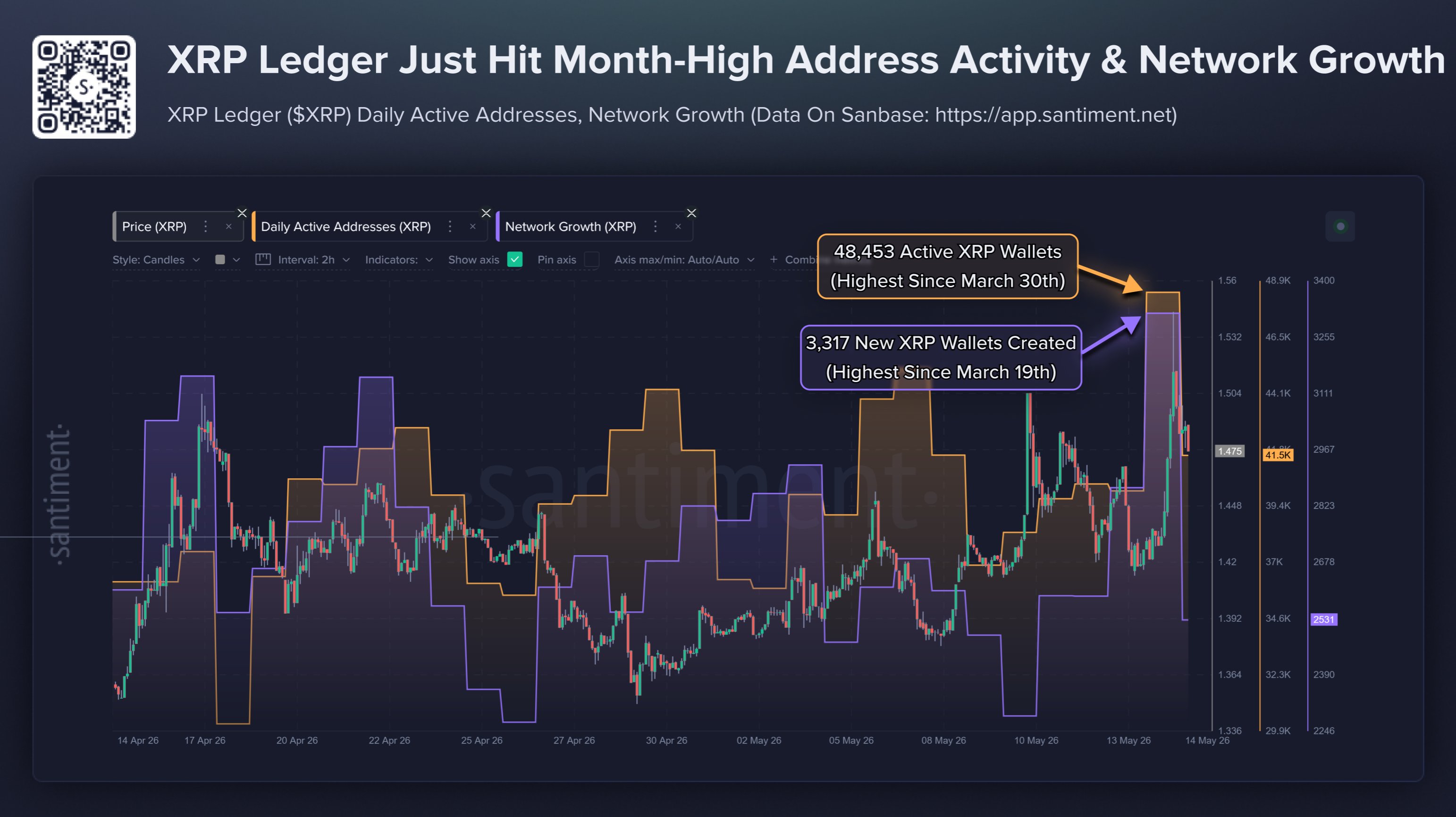
XRP Ledger daily active addresses and network growth. Source: Santiment
“Higher adoption helps justify higher prices,” Santiment wrote, noting that the activity spike could support XRP’s “mid- and long-term price growth” if it proves sustainable.
Earlier this week, the XRP network also witnessed a rise in the number of whale wallets, with Santiment noting that they were accumulating the token at record levels.
XRP chart triangle setup risks drop toward $1
XRP’s short-term chart shows a symmetrical triangle forming after months of lower highs and higher lows.
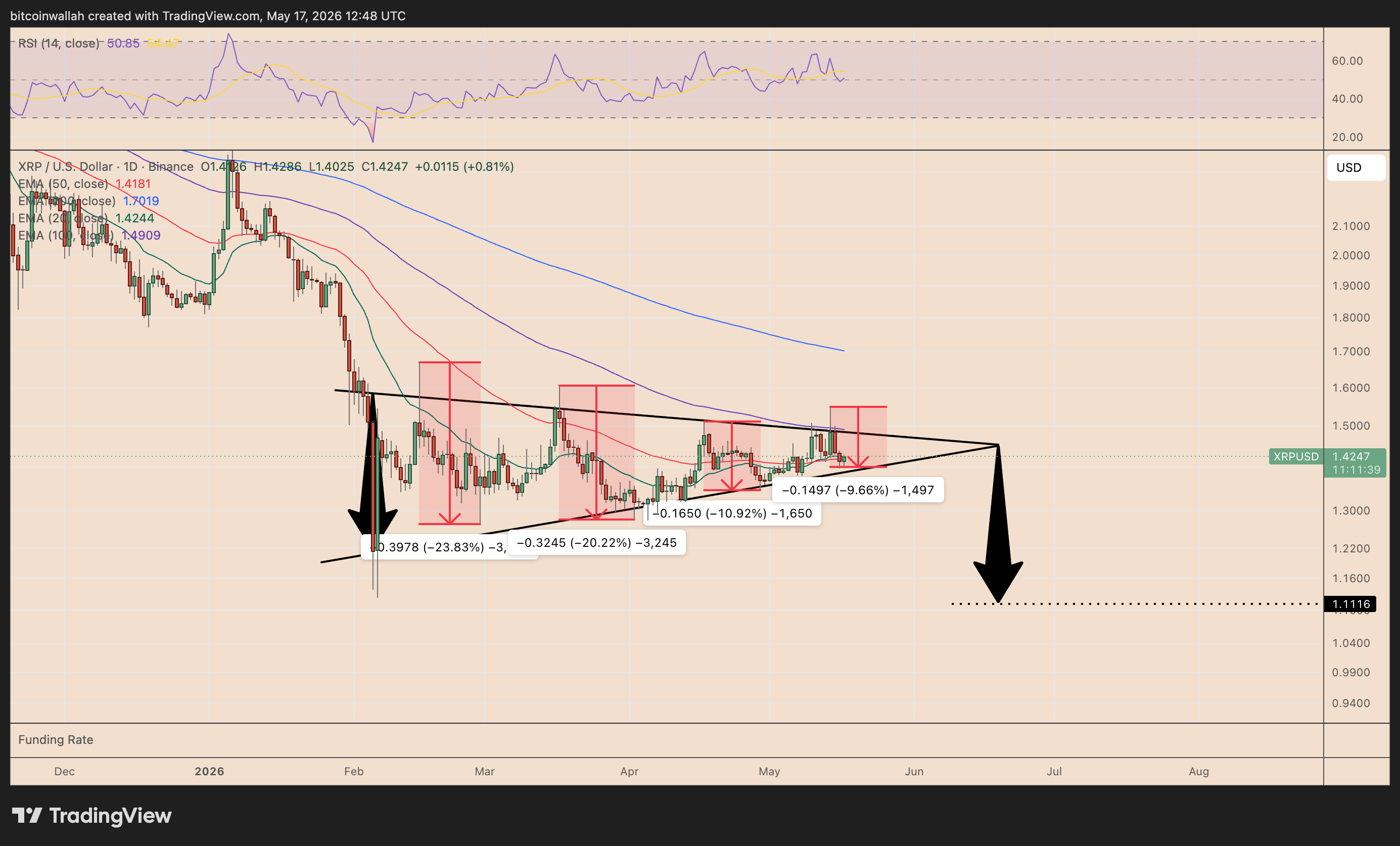
XRP/USD daily chart. Source: TradingView
The latest rejection near the upper trend line suggests bulls still lack enough momentum to confirm a breakout.
If XRP breaks below the triangle’s lower trend line, the setup could flip bearish and open the door to a measured move toward the $1.00–$1.10 support area, down approximately 20% from the current prices.

Standard Chartered has announced that its offer to acquire the business of Zodia Custody has been accepted by shareholders.
The deal, announced Monday, will consolidate Standard Chartered’s digital asset custody operations while separating a standalone infrastructure platform for institutional clients.
Zodia Solutions will be established as an independent entity under SC Ventures, backed by several banking investors, including existing Zodia Custody shareholders, and will provide “bank-grade infrastructure” to financial institutions, including Standard Chartered, as they expand digital asset services.
Zodia Custody was originally launched in 2020 by Standard Chartered and Northern Trust as a regulated crypto custody platform for institutional investors.
The bank said the transaction will “drive value by unlocking revenue and cost synergies” while enabling a more comprehensive offering to digital asset custody clients globally.
Related: Standard Chartered takes stake in crypto market maker GSR

Standard Chartered to acquire Zodia Custody’s custody business. Source: Standard Chartered
Margaret Harwood-Jones, global head of financing and securities services at Standard Chartered, said in the release that the deal would accelerate the growth of Standard Chartered’s global digital asset custody portfolio.
The companies said they do not expect the transaction to disrupt existing custody clients, who will continue to receive services as usual.
A Standard Chartered spokesperson declined to comment further.
Broader bank push into digital asset custody
In April, Bloomberg reported that Standard Chartered was considering bringing parts of Zodia Custody in-house by merging the custody business into an existing division, while leaving Zodia to operate as a software-as-a-service platform.
The announcement formalizes that strategy amid a broader push by major banks to secure trust bank charters and other regulatory structures to custody crypto directly for clients.
BNY Mellon, for example, launched its Digital Asset Custody platform in the US as far back as 2022, enabling selected clients to hold and transfer Bitcoin (BTC) and Ether (ETH) alongside traditional assets on a single platform.
In February 2026, Morgan Stanley applied for a US de novo national trust bank charter. The charter would allow it to custody certain digital assets for clients within a bank-regulated framework.
Magazine: Singapore isn’t a ‘crypto hub’ — it’s something better: StraitsX CEO


Mark Cuban has proposed a federal tax on artificial intelligence (AI) tokens at less than 50 cents per million. He said the levy would push large model operators toward efficiency while raising billions in annual revenue.
The Dallas Mavericks owner said his idea mirrors the regulatory path crypto once resisted. Critics including libertarian-leaning founders and AI builders have pushed back sharply.
Cuban Echoes the Crypto Regulation Arc
Cuban said early crypto supporters treated any rule as unacceptable. They later gravitated toward PACs and structured advocacy once growth demanded legal clarity. He tied that arc to the AI debate.
“This is exactly what EVERYONE said about crypto. Any regulation is bad. I got crucified on here for saying that the industry needed regulation to expand it to normies,” wrote Cuban.
The software billionaire investor framed the proposal as a sales-tax-style charge on commercial providers.
Open-source models and local inference would sit outside its scope. Crypto firms have walked a similar path, with lobbying quadrupling in recent years.
Revenue and Energy Drive the Argument
Cuban estimated the levy could yield about $10 billion a year at the start. He said the figure could expand sharply as inference demand grows. Revenue could fund federal debt reduction or programs responding to AI disruptions.
Energy concerns sit at the center of his case. Data centers running large language models already draw heavily on US grids. Cuban said the tax would push providers toward efficiency gains that exceed their tax outlay.
Critics Call It Government Overreach
Anduril founder Palmer Luckey said the measure would tax American firms while pushing customers toward foreign models. He warned of new infrastructure for federal tracking of AI usage.
The proposal will not advance without congressional appetite, which currently looks thin.
Whether AI providers eventually lobby for clearer rules, as crypto firms did, may shape the next phase of the debate.
The post Shark Tank Billionaire Mark Cuban Proposes Federal AI Token Tax appeared first on BeInCrypto.
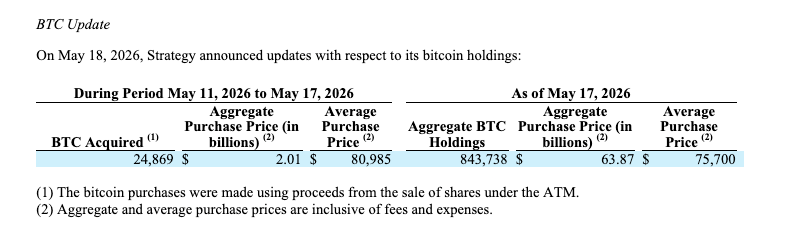
Michael Saylor’s Strategy, the world’s largest public Bitcoin holder, made another massive BTC acquisition last week as the crypto asset hovered around $80,000.
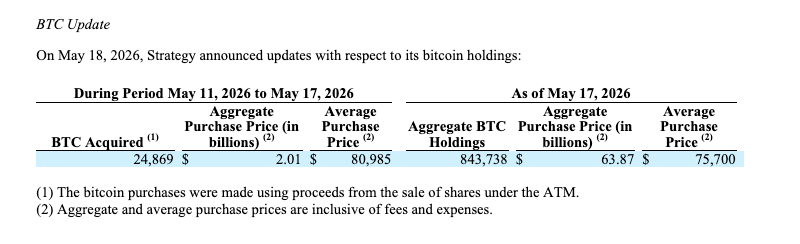
Strategy acquired 24,869 Bitcoin (BTC) for $2.01 billion between May 11 and 17, according Monday’s 8-K filing with the US Securities and Exchange Commission.
Source: SEC
The purchases were made at an average price of $80,985 per BTC, raising Strategy’s cost basis to $75,700.
The company now holds 843,738 BTC, acquired for about $63.87 billion. At the time of publication, the holdings were valued at roughly $65.3 billion, according to CoinGecko.
STRC sales account for 97% of the entire purchase
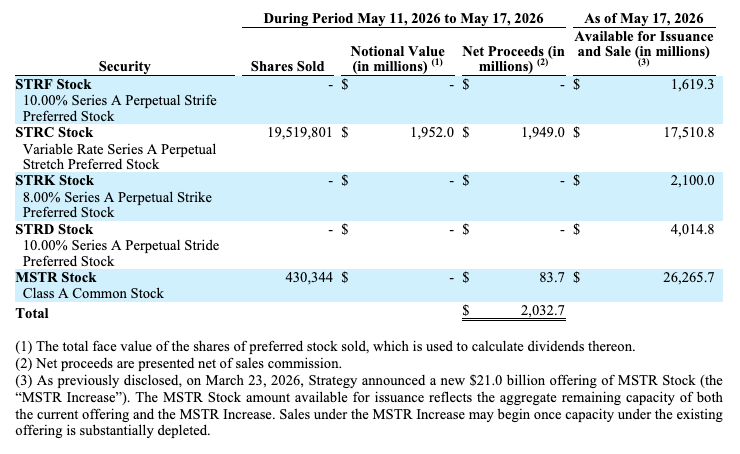
Strategy funded nearly all of its latest Bitcoin purchase through sales of its STRC perpetual preferred stock, which accounted for about 97% of total proceeds.
According to the SEC filing, Strategy raised roughly $1.95 billion from the sale of about 19.5 million STRC shares.
In comparison, Strategy’s Class A common stock (MSTR) contributed a smaller share of funding, generating about $83.7 million in net proceeds from the sale of 430,344 shares.
Source: SEC
The outcome was broadly in line with expectations from STRC Live, which reported heavy STRC activity during the week, including a record trading day of 15.1 million shares, with estimated purchases of around 15,466 BTC.
The structure mirrors previous large bitcoin buys this year, including a 34,164 BTC purchase, Strategy’s third-largest on record, which was also largely financed through preferred securities rather than common equity.
Related: Strategy resumes Bitcoin acquisitions with $43M BTC buy
Strategy co-founder Saylor previously signaled that the company would add to its Bitcoin holdings by posting a chart showing Strategy’s purchase history with 109 Bitcoin acquisition events since 2020.
Its 843,738 BTC now far outpaces BlackRock, the world’s largest asset manager, which holds around 817,000 BTC on behalf of its clients.
The purchases came a week after Saylor raised the possibility of selling Bitcoin during Strategy’s recent earnings call, framing it as a way to better protect the asset’s long-term value.
He said that sticking too rigidly to a “never sell” Bitcoin approach could, over time, work against the very asset the company is built to accumulate and hold.
Magazine: Bitcoin ETFs bleed $1B, Aave’s $71M ETH unfreeze bid delayed: Hodler’s Digest, May 10 – 16
Bitcoin Depot, one of the largest Bitcoin ATM operators in the US, filed for Chapter 11 bankruptcy protection as the company moved to wind down operations and sell its assets.
In a Monday announcement, Atlanta-based Bitcoin Depot said it started voluntary Chapter 11 proceedings in the US Bankruptcy Court for the Southern District of Texas, citing mounting regulatory pressure and financial strain.
CEO Alex Holmes said the company strengthened anti-fraud protections in recent years, including stricter identity checks and lower transaction limits, but argued that growing compliance demands and enforcement actions made the business model “unsustainable.”
The filing marks one of the biggest collapses in the crypto ATM sector to date and highlights the increasing pressure facing companies that provide cash-to-crypto services in the US.
Thousands of Bitcoin ATMs taken offline
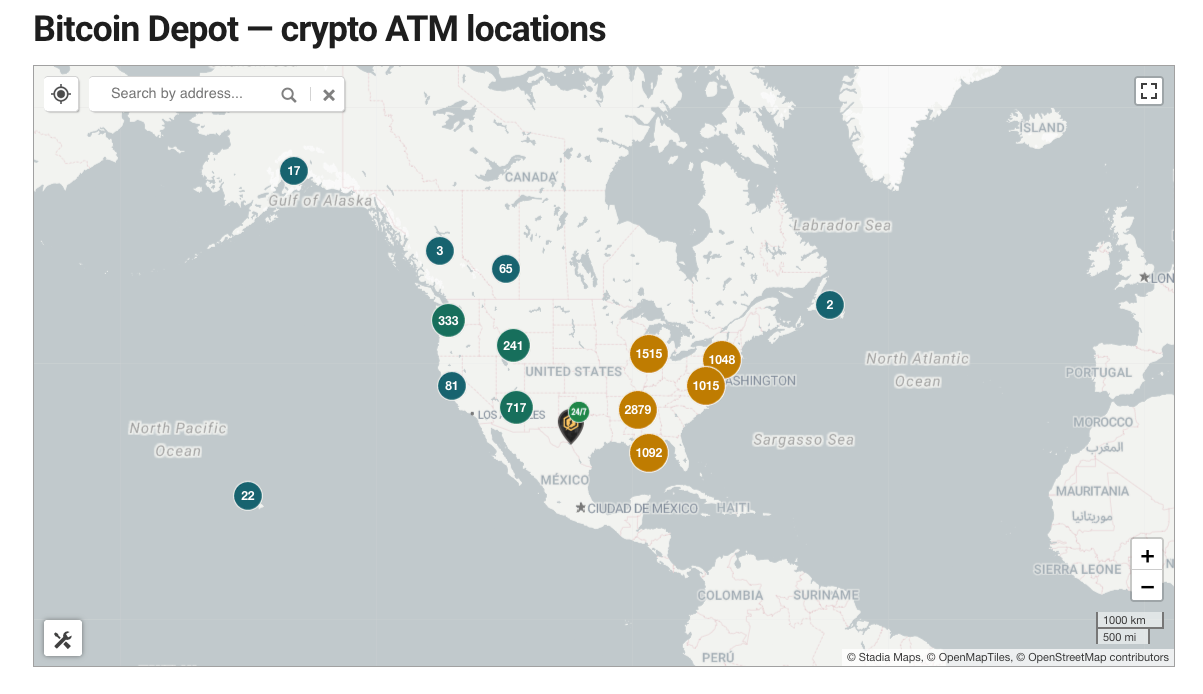
Bitcoin Depot said its network of Bitcoin ATMs has already been taken offline as part of the court-supervised restructuring process. The company operated more than 9,000 kiosk locations globally as of August 2025 and held one of the largest market shares in North America.
The company said the bankruptcy process is intended to support an “orderly wind-down” while allowing management to pursue a sale of its assets.
Bitcoin Depot’s first-day bankruptcy hearing is scheduled for Tuesday at 7:00 pm UTC, according to court information published on Kroll’s restructuring portal. The company appointed law firm Vinson & Elkins as legal adviser, while Portage Point Partners will oversee restructuring efforts.
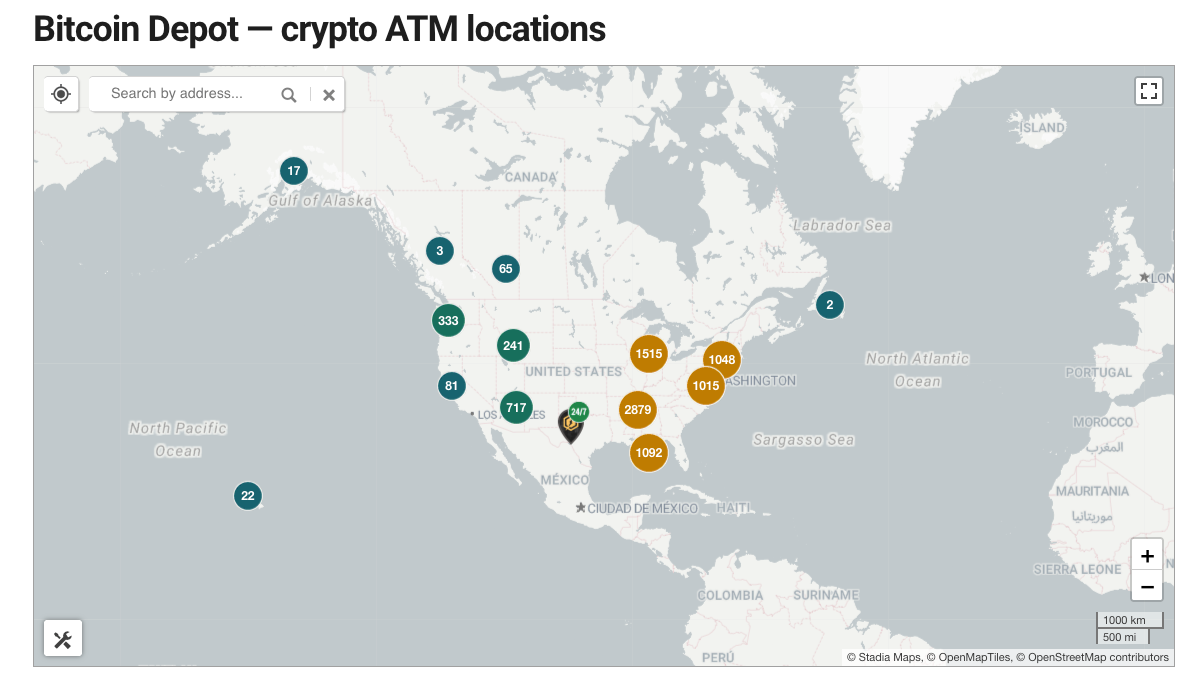
Bitcoin Depot’s crypto ATM locations. Source: CoinATMRadar
Bitcoin Depot’s Canadian entities are also included in the restructuring process, with separate proceedings expected to begin in Canada. The company added that its remaining non-US entities will shut down under local laws.
Regulatory pressure weighs on the crypto ATM industry
Crypto ATMs have become a popular on- and off-ramp, allowing users to buy Bitcoin with cash or withdraw cash by selling it.
However, regulators in several US states and Canada have been scrutinizing the sector, citing complaints tied to scams and fraud.
Operators in the sector have also faced lawsuits, while multiple jurisdictions have proposed blanket bans on crypto ATMs.
Bleak outlook for crypto ATM operators
Bitcoin Depot’s collapse may signal broader trouble ahead for the crypto ATM sector in the US as regulators tighten oversight of cash-to-crypto services.
“Bitcoin Depot’s bankruptcy is likely a preview of what the broader crypto ATM industry will face in the US over the next several years,” Roshan Dharia, CEO of Echo Base and a restructuring adviser, told Cointelegraph.
Dharia said the traditional crypto ATM business model relied on high transaction fees and relatively limited regulatory scrutiny to offset steep operating costs tied to compliance, cash handling, fraud remediation and revenue-sharing agreements with retail partners.
Related: Canada proposes crypto ATM ban over scams and money laundering
“That equation is breaking down as states increasingly impose consumer protection standards that compress fees, expand operator liability for scam-related activity, and raise expectations around transaction monitoring and reimbursement,” he said, adding:
“The result is that many crypto ATM operators may no longer be able to generate sufficient margin to support a nationwide network at scale.”
Bitcoin Depot shares plunged more than 70% in premarket trading following the bankruptcy announcement, according to TradingView data. Since debuting on the Nasdaq under the ticker “BTM” in July 2023, the company’s stock has fallen roughly 95% to about $2.93.
Magazine: How crypto laws changed in 2025 — and how they’ll change in 2026

Trump’s visit to China triggered volatility in global financial markets. XRP/BTC could continue to rise after the US-China summit
The 24 best movies for toddlers, and where to watch them

UK weather: Is a heatwave forecast for the Late May Bank Holiday weekend?

Manchester United reach agreement with Casemiro over contract clause amid transfer speculation

US brings back mandatory military draft registration

Steven Gerrard disagrees with Gary Neville over ‘shock’ Chelsea and Arsenal claim | Football


-

 Crypto World3 days ago
BloFin War of Whales 2026 Grand Prix opens registration for $5M trading championship
-

 Fashion3 days ago
Weekend Open Thread: Theory – Corporette.com
-

 Crypto World3 days ago
E-Estate Announces 1 Year Live: Washington DC Summit as Real Estate Tokenization Enters Its Next Phase
-

 Tech4 days ago
Tech Moves: Microsoft AI leader jumps to OpenAI; former AI2 exec joins Meta; and more
-
Crypto World6 days ago
Bitcoin Suisse expands with Digital Asset License and Investment Business Act Registration Approval in Bermuda
-

 Politics6 days ago
Pakistan to enter Chinese capital market as war inflation bites
-

 Crypto World6 days ago
Bitcoin Suisse expands with Digital Asset License and Investment Business Act Registration Approval in Bermuda
-
 Crypto World5 days ago
Google’s Gemini AI Predicts Incredible Solana Price by the End of 2026
-

 Business3 days ago
H&R Real Estate Investment Trust (HR.UN:CA) Q1 2026 Earnings Call Transcript
-

 Tech3 days ago
Google reimburses Register sources who were victims of API fraud
-

 Sports3 days ago
Napoleonic enters 2026 Doomben 10,000 field via Abounding withdrawal
-

 NewsBeat6 days ago
Comment on Keir Starmer surviving the day as Prime Minister like a turd that wont flush
-

 Fashion6 days ago
The Best-Kept Makeup Secret for a More Defined Face
-
 Entertainment4 days ago
Zara Larsson Has Blunt Response To Chris Brown Diss
-

 Politics6 days ago
Palestine’s flag becoming a regular sight at European football stadiums
-

 Politics7 days ago
The Trial of Majid Freeman, Verdict
-
 Tech6 days ago
Why AI is making typography a boardroom conversation
-
 Crypto World5 days ago
Two AI Tokens Lead May Rally, But Risks Are Rising
-

 Crypto World6 days ago
Senate Approves Kevin Warsh to Federal Reserve Board Seat
-

 Politics6 days ago
The 81 MPs (so far) who have demanded tick-like Starmer out
You must be logged in to post a comment Login