

Crypto World
Bitcoin Battles ‘Collapsing’ Bond Markets as Week Starts With Trip to $76,500

Bitcoin (BTC) starts a new week under pressure as support levels fade and macro gloom intensifies.
Key points:
- Bitcoin falls below a key 21-week trend line after the weekly close, but hopes of a “bear trap” rebound remain.
- US-Iran war rhetoric continues to push oil higher, pressuring crypto markets.
- Those tensions could still be countered by strong PMI and Nvidia earnings data in the coming days.
- Bitcoin whales are acting as if the bottom is already in, per new analysis.
- Despite this, a surge in exchange inflows from a key investor cohort raises alarm over “capitulation.”
BTC price analysis sees relief bounce after sub-$77,000 dip
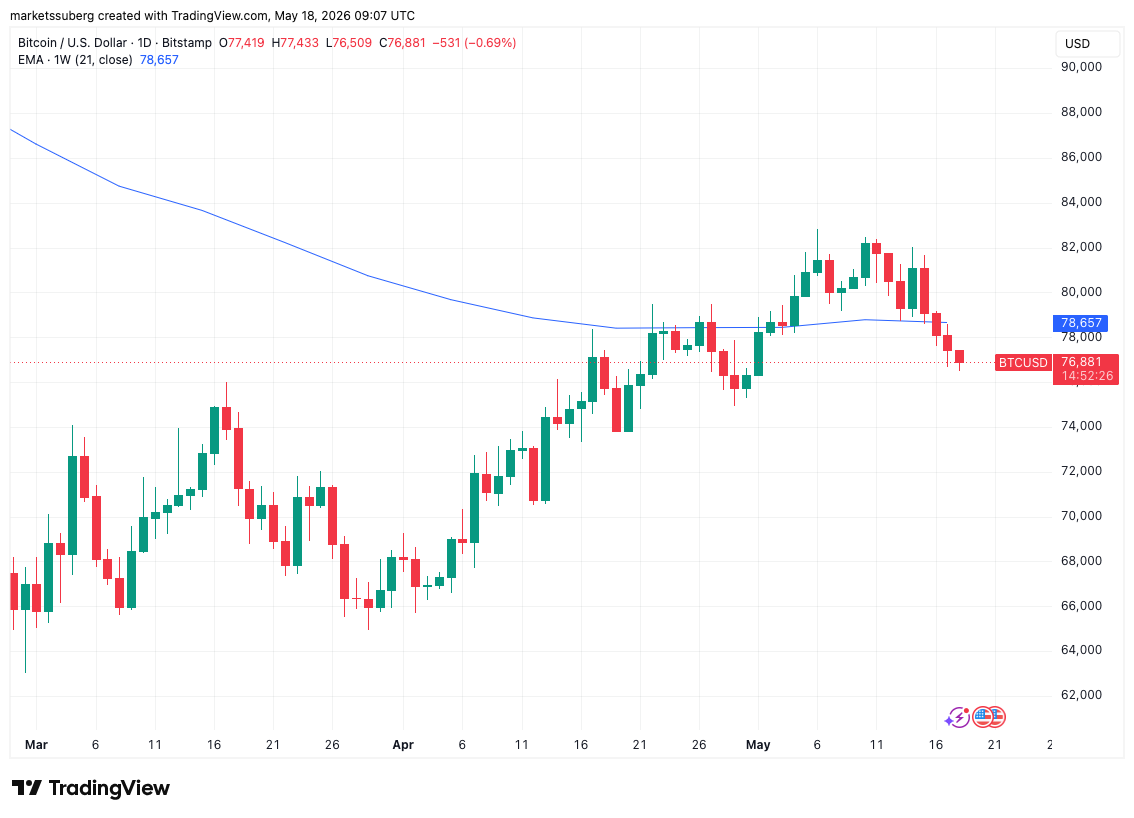
Bitcoin felt the pressure as the new weekly candle began, dropping to $76,500 — its lowest levels since May 1, per data from TradingView.
After several support retests, BTC/USD began to fall through recently recovered ground, which included the 21-week exponential moving average (EMA) at $78,660.
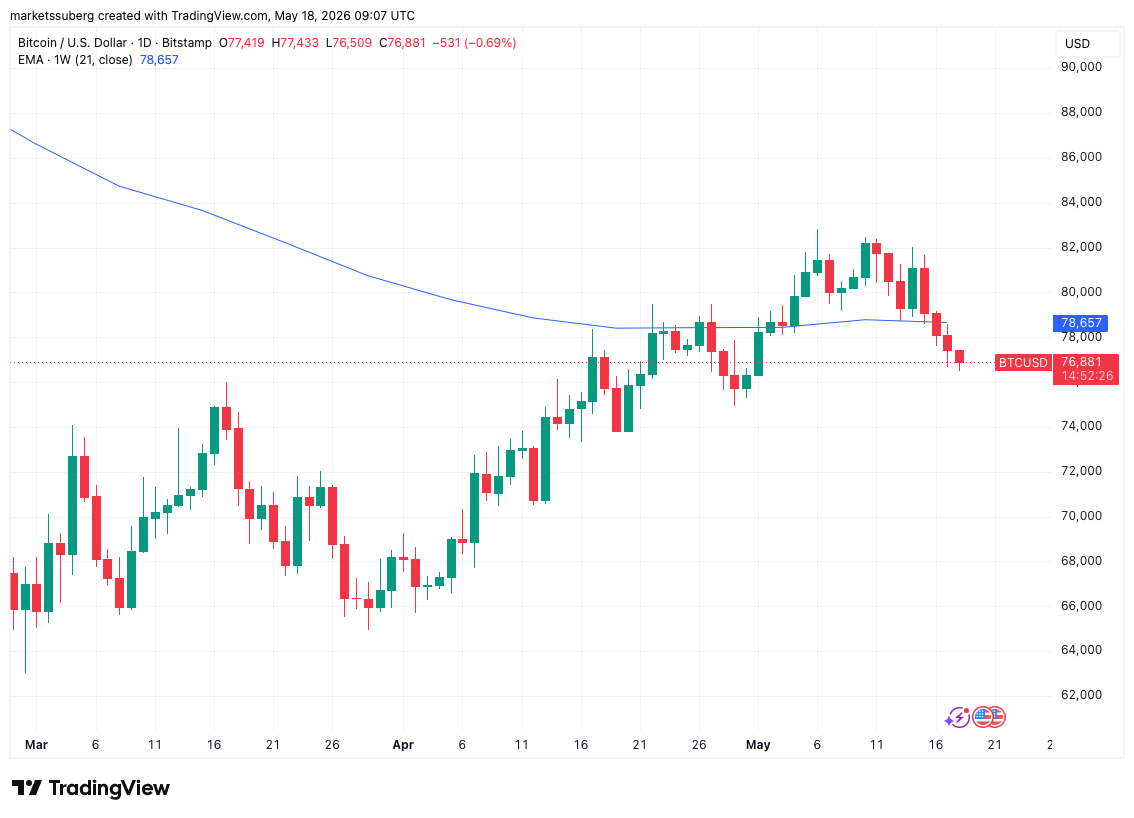
BTC/USD one-day chart with 21-week EMA. Source: Cointelegraph/TradingView
With it, price fell back below the bull market support band.
“Another weekly close at it for now, but to confirm a proper breakout you’d need to see a bounce now,” trader Daan Crypto Trades wrote in X analysis before the trip toward month-to-date lows.
“If this ends up falling back below that $75K-$76K area and closes there on the weekly, then this was just a big deviation/dead cat bounce in my eyes.”
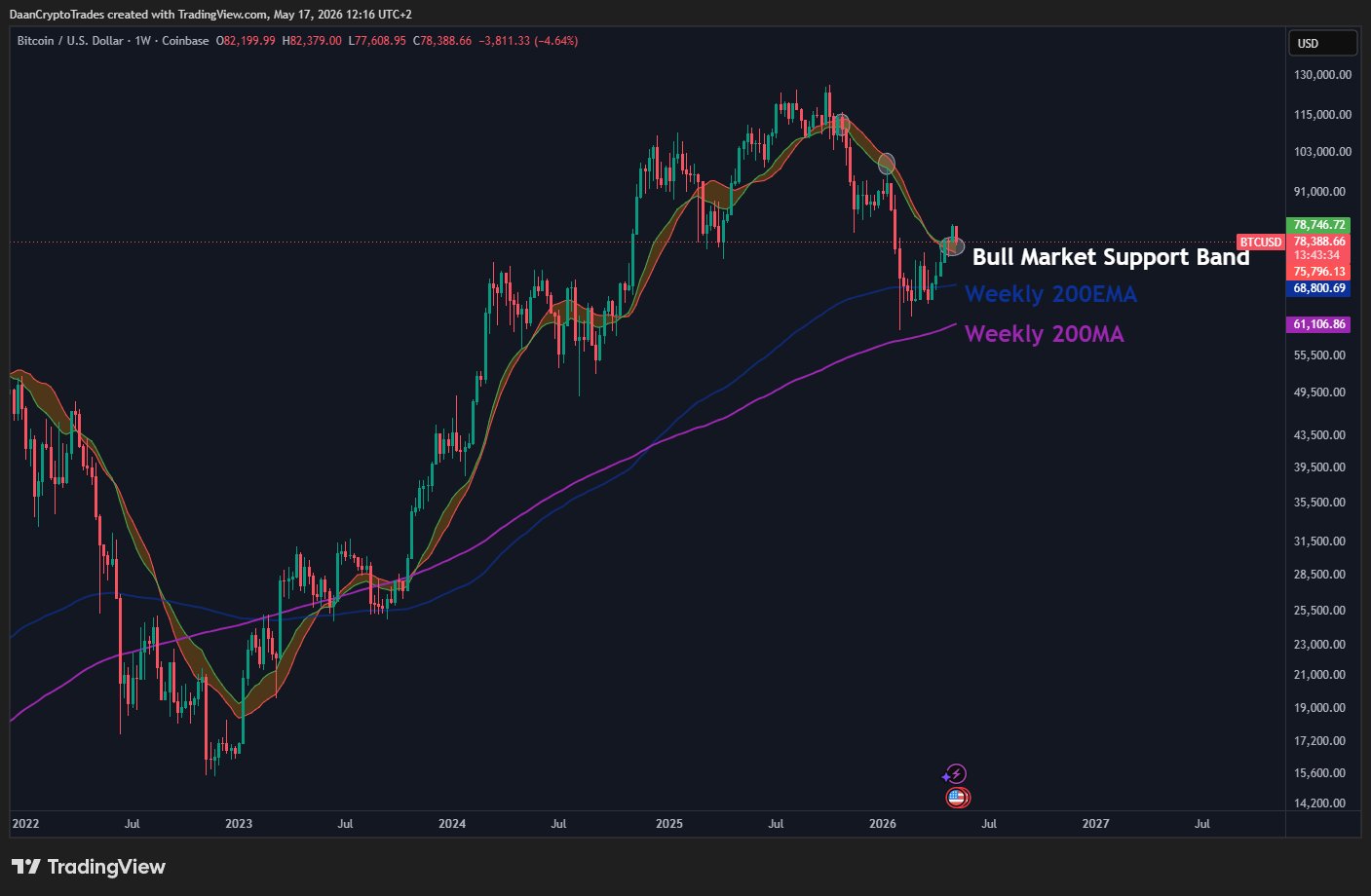
BTC/USD one-week chart. Source: Daan Crypto Trades/X
The downside cost BTC long positions, with cross-crypto long liquidations for the 24 hours to the time of writing passing $670 million.
Data from CoinGlass also shows potential liquidations building either side of spot price, providing fuel for liquidity grabs both up and down.
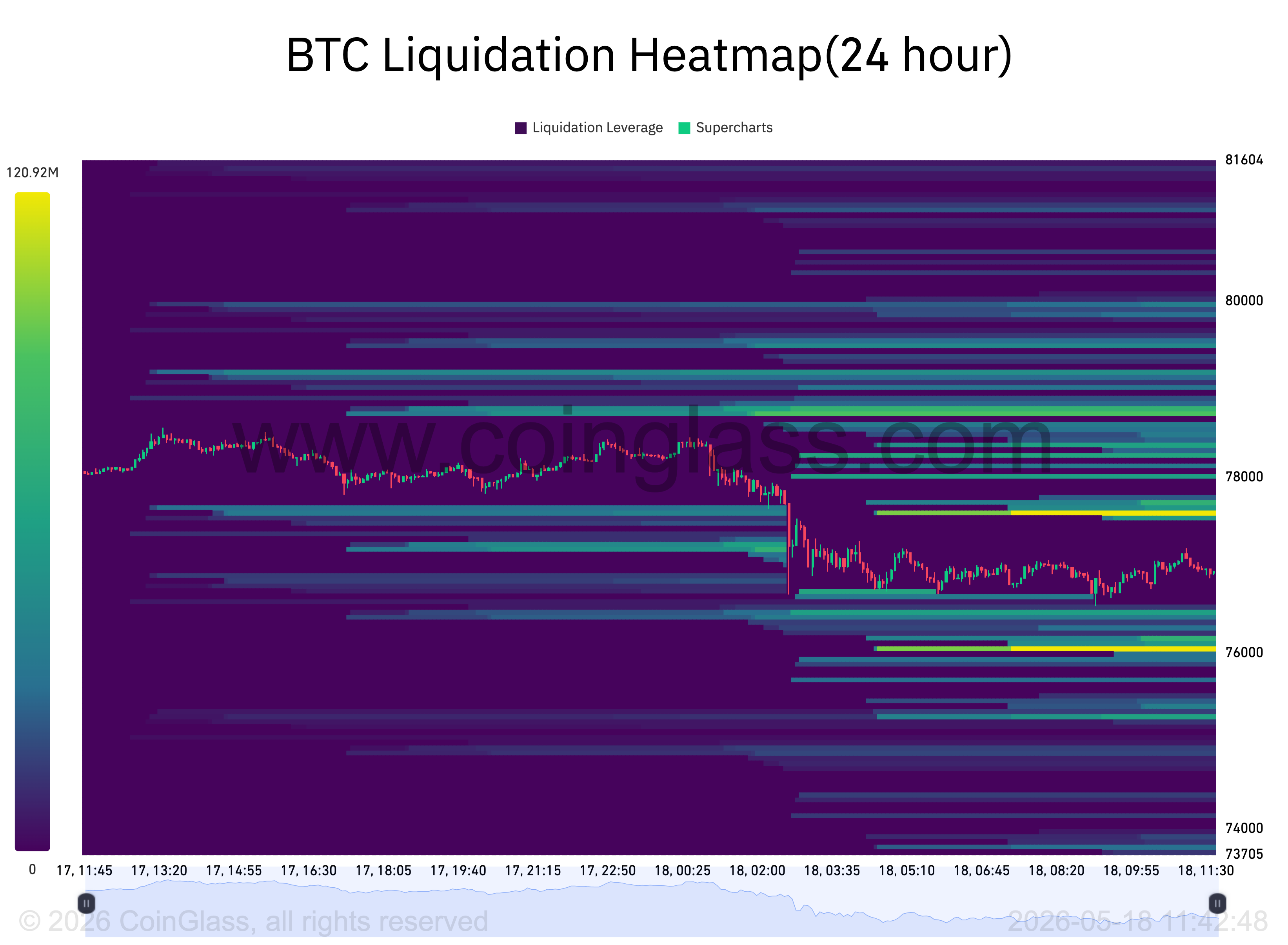
BTC liquidation heatmap. Source: CoinGlass
Commenting, trading account Cryptic Trades saw a bounce coming next due to the magnitude of liquidated longs.
“$BTC has just tapped into the prior Breakout Zone at $75K-$76K,” it told X followers.
“Expecting a bounce here, as the longs I covered in my prior alert also got flushed.”
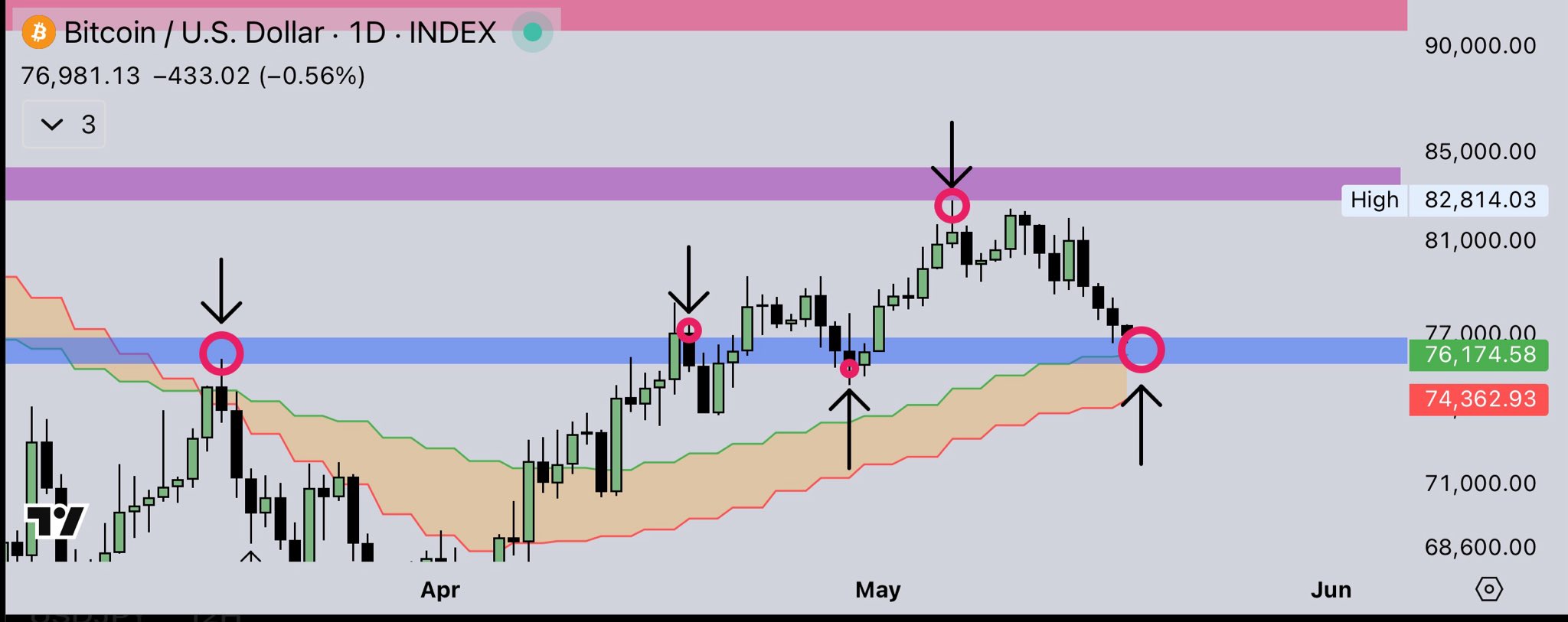
BTC/USD one-day chart. Source: Cryptic Trades/X
At the weekend, Cryptic Trades suggested that any downmove would have the markings of a classic “bear trap,” given rising open interest and negative funding rates.
“This shows us that bears are DOUBLING DOWN right now and betting on a breakdown,” it wrote.
“It also shows that even though the market structure remains intact, bears are shorting as if a breakdown already happened. That’s generally how bear-traps are formed.”
US bond markets “collapsing in real time”
While light on US macro data, the coming week is already shaping up to be a tricky one for crypto traders.
Tensions over the US-Iran war are returning, with the prospect of the Strait of Hormuz oil route fully opening still absent.
In a post on Truth Social over the weekend, US President Donald Trump wrote that the “clock is ticking” for Iran, without giving specific details.
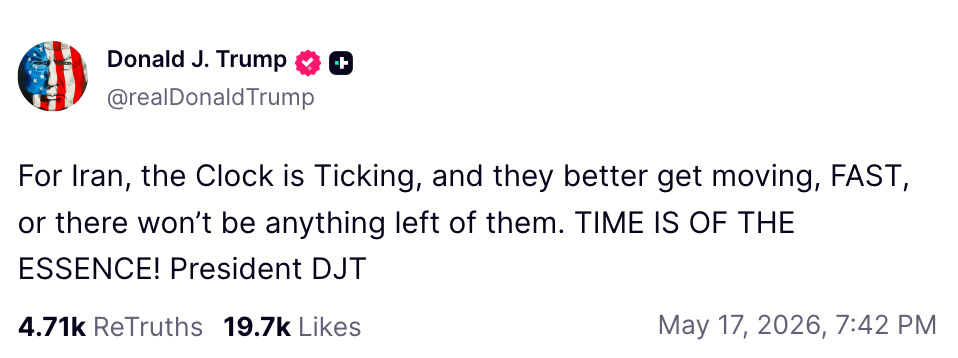
Source: Truth Social
Additional reports claimed that Trump was convening a security meeting to discuss “military options in Iran,” per trading resource The Kobeissi Letter.
Oil futures reacted sharply at the weekly open, with WTI crude reaching near two-week highs of $104.45.
“The impact on energy prices from the war in the Middle East is pushing inflation to its highest level in years,” analytics resource Mosaic Asset Company commented in the latest edition of its regular newsletter, The Market Mosaic.
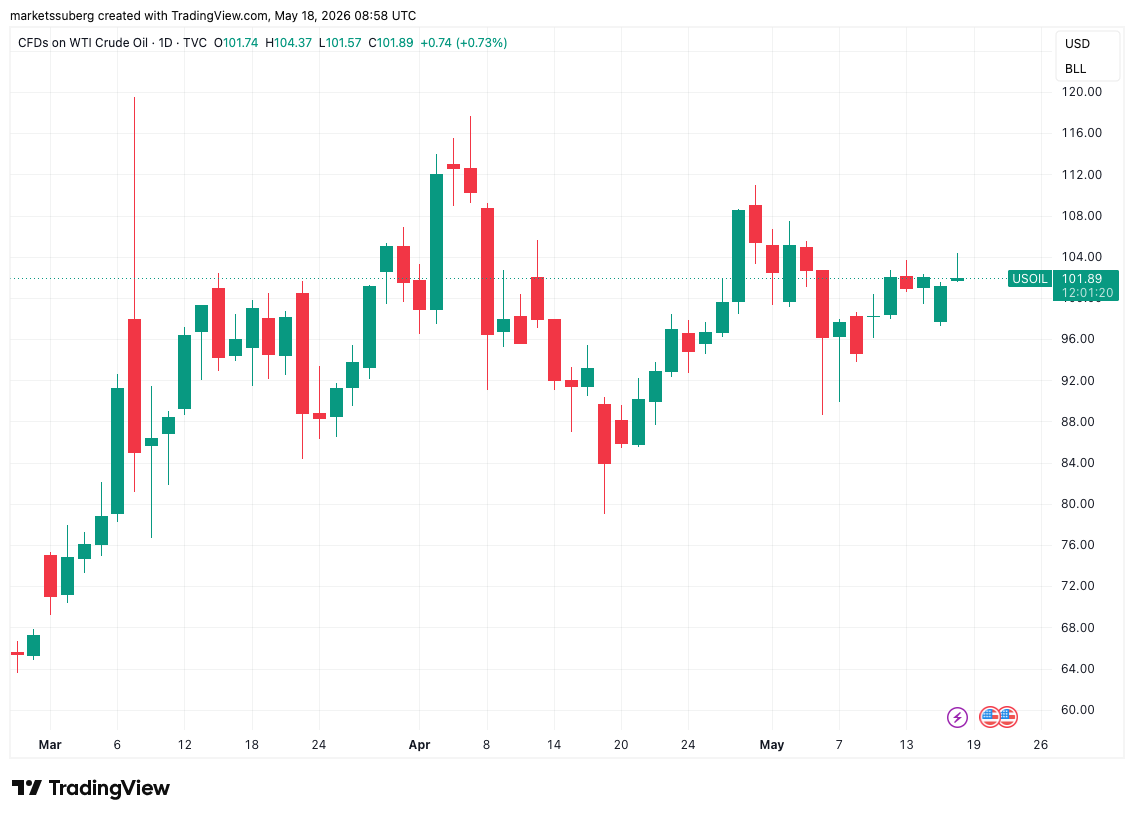
CFDs on WTI crude oil one-day chart. Source: Cointelegraph/TradingView
Like others, Mosaic tied high oil prices to surging US inflation prints.
“While a spike in energy prices are helping drive inflation higher, the most recent reports continue a trend of growing price pressures,” it continued.
US bond markets, meanwhile, continue to sum up the about-turn in market sentiment, as “unsustainable” yield growth wipes out the odds of interest-rate cuts by the Federal Reserve.
“On Friday, the 30-year Treasury yield jumped above the 5% level which is the high tested several times over the past couple years. A sustained breakout could have serious implications at a time when federal debt and deficit spending is surging,” Mosaic warned.
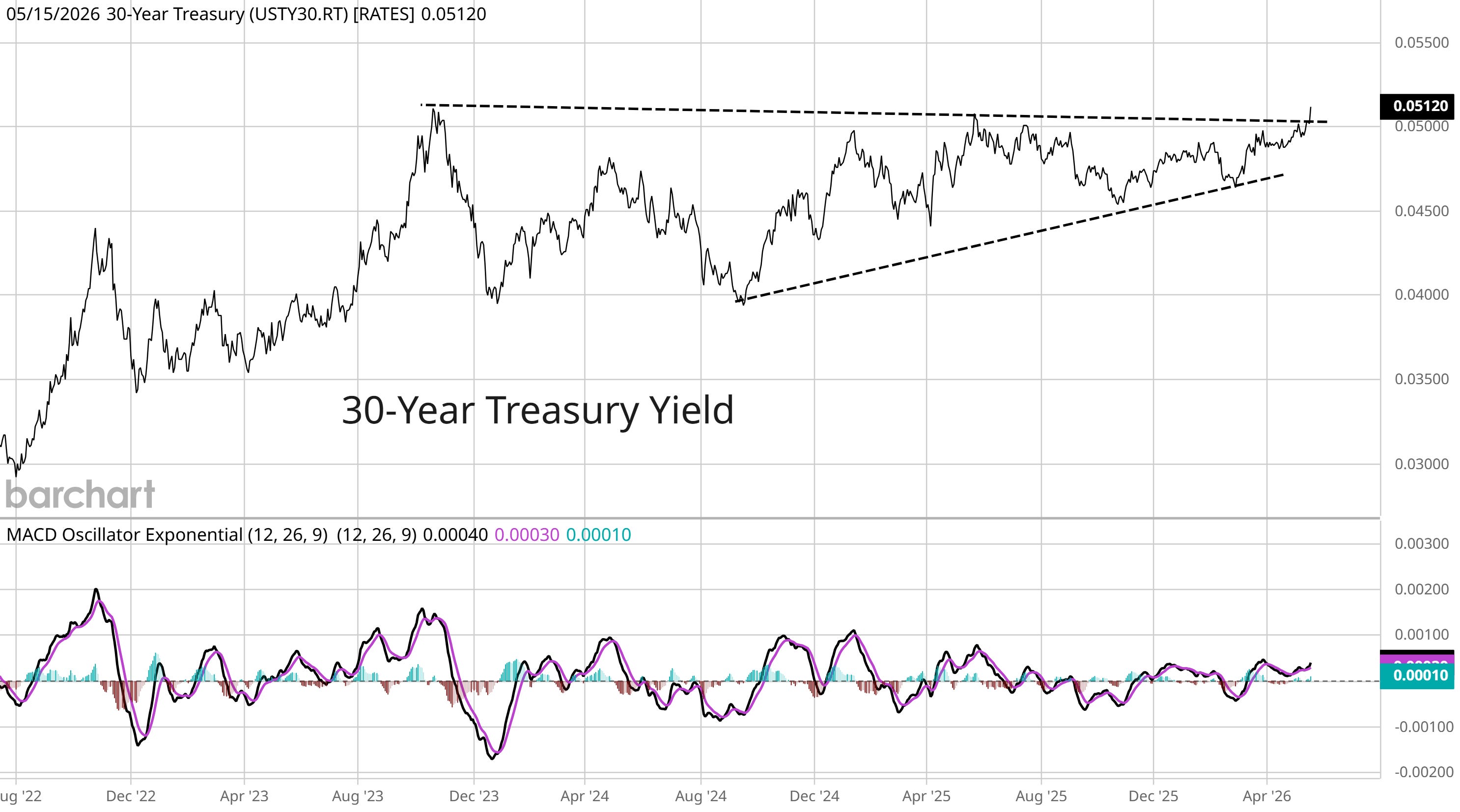
US 30-year treasury yield chart. Source: Mosaic Asset Company
Kobeissi described the US bond market as “collapsing in real time.”
“And, in a sudden turn of events, the odds of rate cuts have collapsed to 2% this year and US inflation is nearing 4%+,” it noted on X.
PMI, Nvidia earnings give crypto bulls hope
Amid the chaos, a silver lining could come in the form of manufacturing data.
The latest S&P Manufacturing Purchasing Managers Index (PMI) report, due out on Thursday, should ideally continue a breakout that began earlier in 2026.
Bitcoin and risk assets reacted positively to the development, which ended several years of PMI contraction.
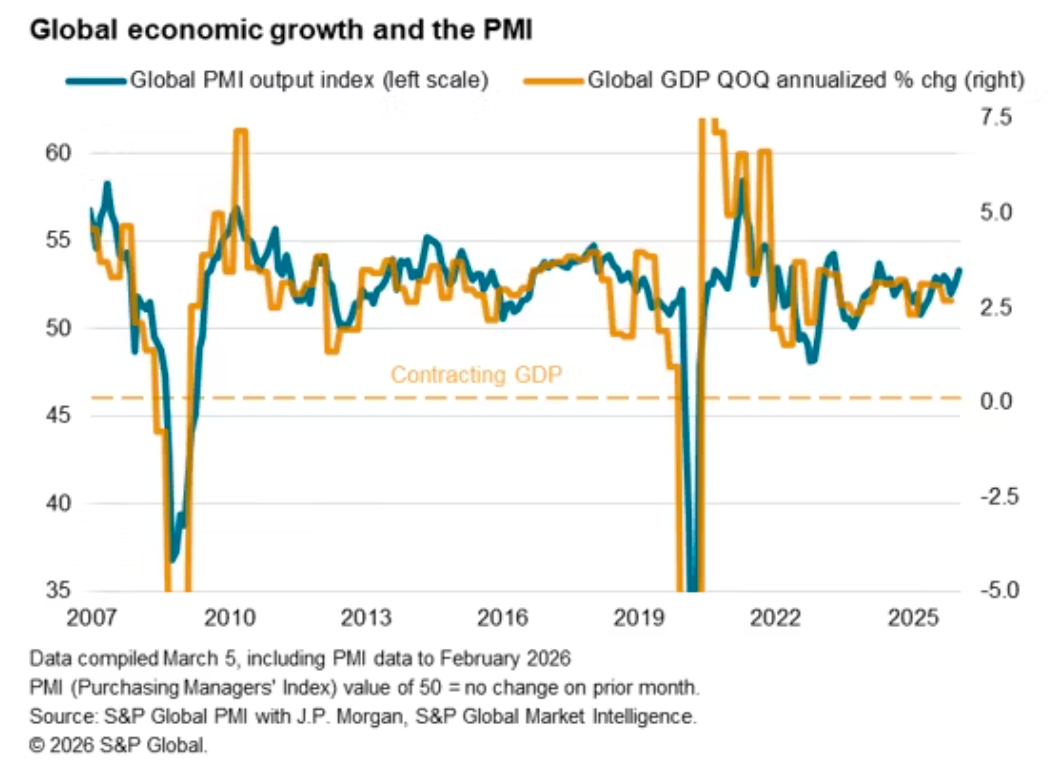
Global PMI versus GDP data (screenshot). Source: S&P Global
Major tech earnings are also lining up to potentially offer markets a boost in the event that they surpass expectations. Nvidia will report on Wednesday — something that Kobeissi even calls the “biggest earnings event of the quarter.”
Commenting on the outlook for market volatility, independent macro and market strategist Michael J. Kramer cautioned that bulls may ultimately suffer.
“NVIDIA once again finds itself heavily overloaded with call positioning, and unless the stock sees a meaningful pullback ahead of earnings that helps reengage put demand, I think the most likely outcome is another post-earnings sell-off,” he wrote in an X thread on Sunday.
Kramer predicted a surge in implied volatility toward Friday’s options expiry event.
“So unless NVIDIA is able to truly blow traders away with its results, the stock likely faces the usual ‘sell-the-news’ reaction, or, as I like to call it, the mechanical unwind,” he reiterated.
Bitcoin whales brush off hawkish Fed signals
In its latest market overview, onchain analytics platform CryptoQuant examined the relationship between Fed policy and the actions of Bitcoin whales.
These large-scale investors, often tied to “smart money” and a key yardstick for long-term market trajectory, could be signalling that the outlook is not as bad as sentiment shows.
“Tracking their moves offers us a backdoor view into how the biggest players are reading the room, which in turn helps us stress-test and refine our own market thesis,” contributor Joohyun Ryu wrote in a QuickTake blog post this week.
“To cut straight to the chase, the good news is that whale wallet balances haven’t shown any dramatic shifts.”
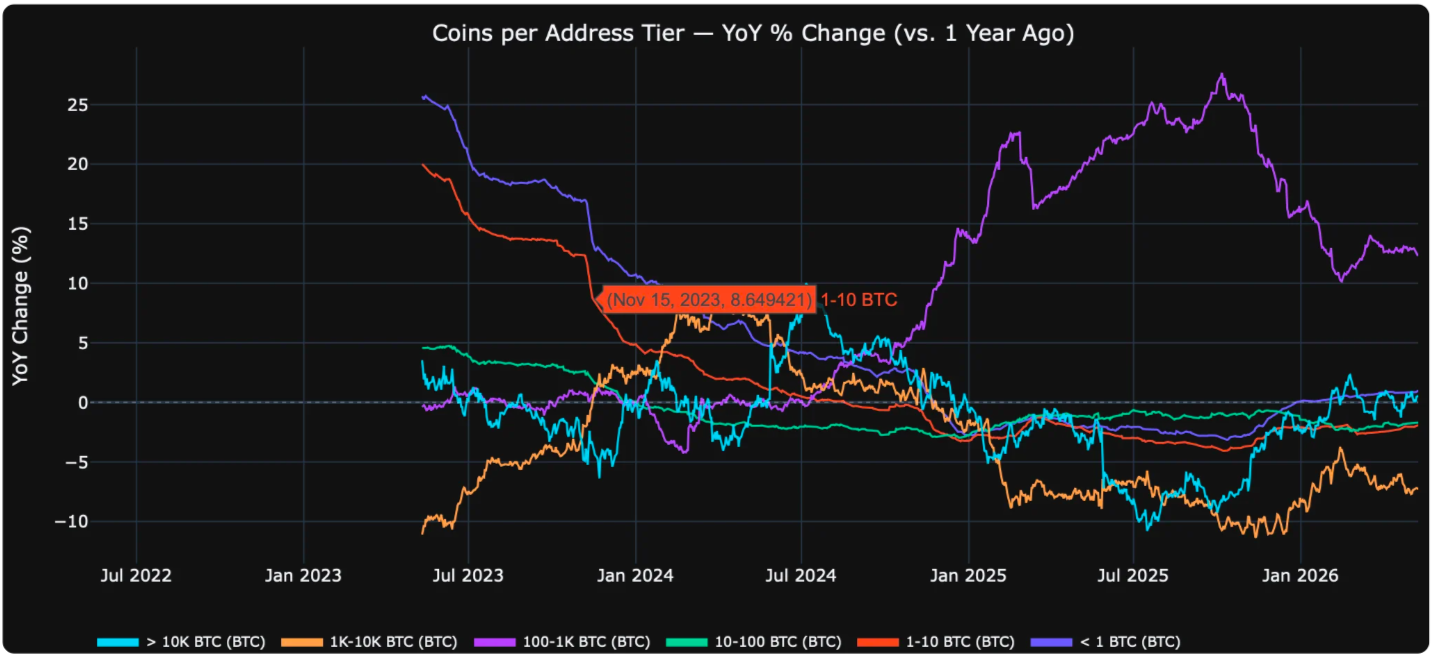
BTC holdings per address tier (screenshot). Source: CryptoQuant
Analyzing whale holdings, Joohyun argued that despite the odds of rate cuts disappearing for both 2026 and 2027, there appears to be no real cause to reduce risk exposure. Some cohorts are even adding to their holdings.
“On top of that, the ultimate mega-whales—those holding over 10K—are finally seeing their bags recover to levels we haven’t seen since last year,” he continued.
“Judging by these trends, it looks like the whales are betting that the market has officially bottomed out. That said, this isn’t a full-blown buying frenzy just yet, so it’s still wise to proceed with caution.”
Traditionally, financial tightening and an inflationary environment pressure crypto prices — a phenomenon most recently seen during the 2022 bear market.
Long-term holders lose their nerve
For the time being, however, sell-side pressure remains a key threat to Bitcoin.
Related: Bitcoin price history suggests 77% odds of new all-time high within a year
Specifically, CryptoQuant notes a pronounced uptick in exchange inflows from wallets that bought BTC between six and 12 months ago.
“Bitcoin is not facing a simple short-term correction, but a structurally driven crisis fueled by cascading leverage liquidations and deep spot-market fear.,” contributor Easy OnChain warned.
“On-chain data shows a clear ‘cascading dumping’ pattern, where capitulation from long-term holders triggers panic selling among short-term investors.”
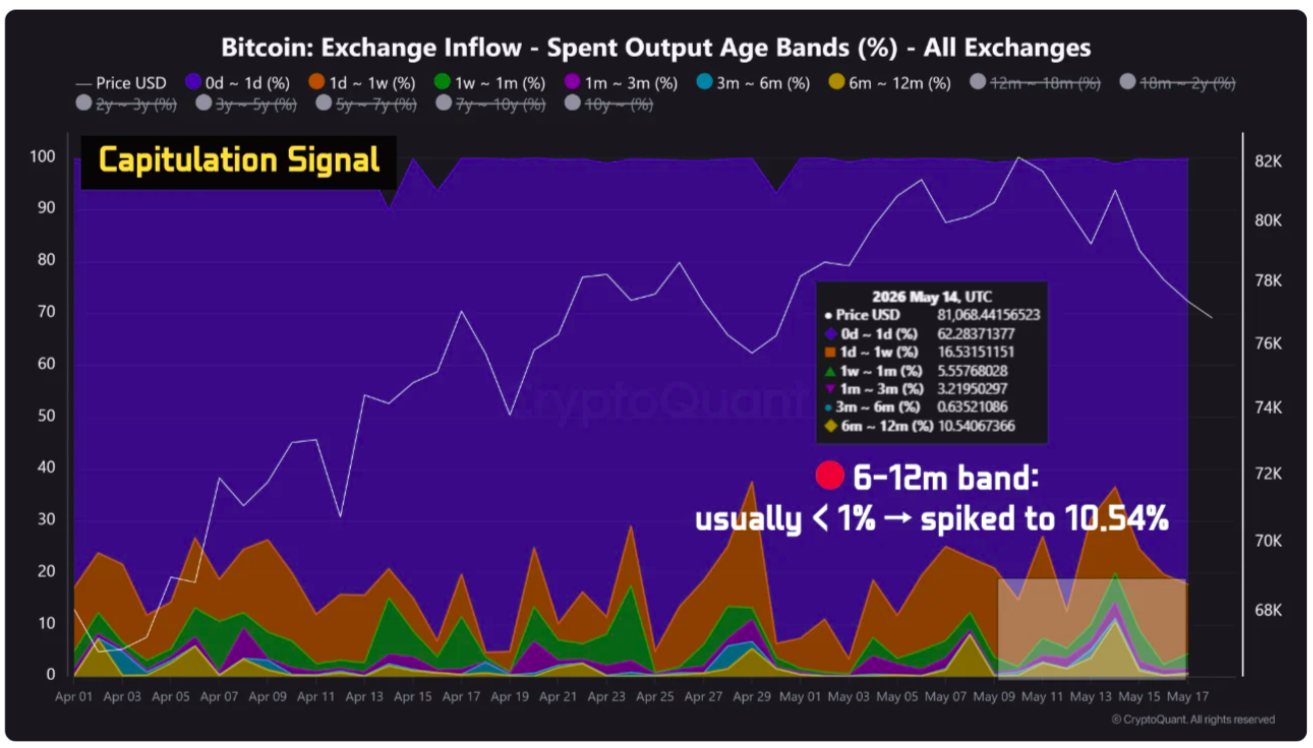
Bitcoin exchange inflows data (screenshot). Source: CryptoQuant
The former cohort, hodling for up to 12 months, has accounted for 10.54% of exchange inflows since May 14 — more than 10 times normal levels.
For CryptoQuant, this signals “large-scale capitulation.”
“Historically, this reflects investors locking in major losses and exiting the market, creating severe spot-market selling pressure,” Easy On Chain continued, noting contagion spreading to speculators.
“The current decline is therefore an internally driven market crisis caused by derivative liquidations, large-scale long-term holder capitulation, and cascading panic from short-term participants,” it added.
“Until this toxic supply is fully absorbed and sentiment stabilizes, a rapid V-shaped recovery remains unlikely.”



CACEIS, the custody banking arm of Crédit Agricole, is in exclusive talks to acquire French crypto investment platform Meria, according to a BlockStories report.
Summary
- CACEIS is reportedly targeting Meria to expand beyond crypto custody into brokerage and staking services.
- Meria’s MiCA license gives the French platform stronger regulatory access across Europe’s crypto market.
- The talks show banks are buying crypto-native firms as MiCA raises compliance pressure across Europe.
The deal has not been formally announced by either company.
Meria, formerly known as Just Mining, was co-founded by Owen Simonin, known online as Hasheur. The company serves about 150,000 users and manages roughly €350 million in assets under management, according to the report. Its main services include crypto brokerage and staking products.
A bank push into crypto services
CACEIS already has a digital asset business line focused on custody. The company says its crypto services target asset managers, institutional investors, and other clients seeking regulated access to digital assets. Its parent group, Crédit Agricole, is one of France’s largest banking groups.
CACEIS also holds French and European crypto permissions. The AMF’s public record says CACEIS Bank has been authorized to provide crypto-asset services under MiCA through the Article 60 notification route. That allows the group to offer services such as custody, order reception, and transfer of crypto-assets.
Meria adds retail reach and staking
A Meria deal would give CACEIS access to a crypto-native platform with a retail user base and staking expertise. BlockStories reported that staking is one of the activities of interest to CACEIS, as Meria serves both retail and institutional clients in that area.
The reported talks come shortly after Meria received MiCA CASP authorization in France. A market intelligence listing shows Meria SAS as a France-based MiCA Crypto-Asset Service Provider authorized by the AMF on June 22. That timing gives the platform added value as Europe’s new licensing regime takes full effect.
MiCA changes the deal market
The talks reflect a wider shift in Europe’s crypto market. The MiCA transition period ended on July 1, forcing many crypto firms to secure CASP licenses or stop serving users under the old national regimes.
MiCA gives licensed firms a European passport, but it also raises compliance costs. As previously reported, France and other EU markets have seen a divide between firms that secured authorization and those still working through the process. That gap may push banks and larger regulated firms to buy licensed crypto platforms instead of building everything internally.
Banks move closer to regulated crypto
The reported Meria talks also fit a broader pattern of regulated finance moving into digital assets. As crypto.news reported, Coinbase opened its Luxembourg MiCA hub as the EU deadline approached. The exchange used Luxembourg as its base for serving customers across the bloc under one licensing setup.
Other firms have taken similar steps. As reported by crypto.news, Ripple moved closer to full MiCA compliance through Luxembourg CASP approval, while B2C2 secured MiCA approval to expand regulated crypto trading across Europe.


The National Organization of Black Law Enforcement Executives has endorsed the Digital Asset Market Clarity Act, giving the crypto market structure bill its first formal public backing from a major law enforcement group.
Summary
- NOBLE became the first major law enforcement group to formally back the CLARITY Act.
- The endorsement challenges warnings from police and prosecutor groups over Section 604 language.
- The bill still needs Senate floor time and 60 votes before reaching final passage.
Journalist Eleanor Terrett reported the endorsement in a July 2 post on X, citing a letter sent to Senate leaders John Thune and Chuck Schumer.
NOBLE National President Reneé Hall signed the letter. According to Terrett, the group said the bill “contains several provisions” that could give law enforcement new tools while keeping existing criminal authorities in place. The endorsement arrives as Senate talks continue over crime, oversight, and developer protections in the bill.
Endorsement breaks from other groups
NOBLE’s position differs from earlier warnings by several police and prosecutor groups. Four U.S. law enforcement organizations raised concerns that Section 604 may weaken crypto crime investigations. Their concerns centered on the Blockchain Regulatory Certainty Act language inside the CLARITY Act.
Section 604 would protect some non-custodial developers and software providers from automatic money transmitter treatment. Critics argue that the language may make it harder to trace illicit finance in decentralized systems. Supporters say the section protects software builders who do not control user funds and should not be treated like banks or brokers.
DOJ pushback adds to debate
The debate widened after the Department of Justice pushed back on claims that the bill would create broad enforcement gaps. As crypto.news reported, the DOJ challenged law enforcement claims and said criticism of the bill’s crime-fighting language was not accurate.
NOBLE’s letter now gives supporters another argument as they seek Senate votes. The group said the bill does not change federal criminal tools used in money laundering, unlicensed money transmission, conspiracy, sanctions, and other cases. That point directly addresses one of the main objections raised by other law enforcement groups.
Senate clock remains tight
The endorsement comes as the bill faces a narrow window in the Senate. The CLARITY Act’s path depends on a pre-August vote because the chamber has limited floor time before recess. If the bill misses that window, its realistic path could move into 2027.
The bill also needs 60 votes on the Senate floor. As previously reported, the Senate math requires Democratic support because Republicans cannot pass the measure alone. That makes law enforcement concerns important, especially for senators focused on illicit finance, consumer protection, and national security.
Industry keeps pressure on lawmakers
Industry groups are also pressing senators to act. Stand With Crypto urged supporters in a July 2 post on X to call for a vote when the Senate returns from recess on July 13. The group argued that delay could push builders, jobs, and capital outside the U.S.
Every day without clear rules, innovation drifts overseas.
When the Senate is back from recess on July 13, Senators can vote YES on the Clarity Act to keep American builders, jobs, and capital here at home instead of heading abroad.
The window is narrow. Tell your Senators to… — Stand With Crypto🛡️ (@standwithcrypto) July 2, 2026
The CLARITY Act would create a market structure framework for digital assets and define roles for the SEC and CFTC. The bill would classify digital assets, set registration paths, and add compliance rules for crypto firms.

A pseudonymous defendant has asked a New York court to dismiss a lawsuit seeking ownership of 39,069 dormant Bitcoin addresses, arguing that Bitcoin addresses are simply public data and cannot be sued under the state’s jurisdictional rules.
In a motion filed Thursday, the defendant—using the name “John Doe 33”—contends that the plaintiff’s theory of “finding” and claiming abandoned property fails because a Bitcoin address is not a legal person or entity. The filing also challenges the effort to treat on-chain addresses as recoverable under New York lost-property law.
Key takeaways
- The motion argues that Bitcoin addresses are data strings that cannot be the subject of a lawsuit, rather than legal entities that courts can exercise jurisdiction over.
- The plaintiffs’ lost-property claim is framed as legally defective because the addresses were always publicly visible on the blockchain.
- Even if ownership were determined, recovering the Bitcoin would still require access to the corresponding private keys.
- Blockchain-linked reporting cited in the case suggests the defendant may control a long-dormant wallet holding roughly 5,000 BTC.
Why the court fight centers on “addresses” rather than keys
The lawsuit, filed in May by plaintiff “Noah Doe” along with two Wyoming-based LLCs identified as ABC Company and XYZ Company, targets what it describes as abandoned Bitcoin associated with 39,069 dormant addresses. The plaintiffs allege the Bitcoin tied to those addresses is abandoned property, which they reported to the New York Police Department before asserting claims under New York lost-property law.
In the motion to dismiss, John Doe 33 argues the complaint is legally defective for a threshold reason: Bitcoin addresses are not “persons” or legal entities and therefore cannot be sued. The filing further claims that the plaintiffs cannot establish that an address was “found,” as required by lost-property concepts, because the relevant address information has been publicly viewable on the blockchain since the coins were received.
For investors and builders, the procedural dispute matters because it goes beyond a single wallet list. It asks whether traditional legal frameworks for identifying owners and claiming property can map onto the blockchain’s structure—where addresses are public identifiers and control is enforced through private keys rather than through legal status.
The alleged “abandoned” wallets include famous names
The complaint lists 39,069 Bitcoin addresses that include wallets widely associated with well-known Bitcoin labels, such as addresses attributed to Bitcoin creator Satoshi Nakamoto and to the Mt. Gox hacker. The addresses collectively are reported—via an estimate attributed to Sani, founder of Bitcoin analytics platform Timechain Index—to hold roughly 3.7 million BTC, valued at about $234 billion at the time of that estimate.
That scale is a key reason the case has attracted attention. A ruling could influence how courts treat claims that attempt to convert blockchain identifiers into claimable “property” within existing state laws.
At the same time, the filing acknowledges a practical hurdle that remains independent of any jurisdictional debate: even if the court were to rule on ownership of the assets associated with the addresses, the plaintiffs would still need the private keys to move any Bitcoin. Without those keys, the Bitcoin remains inaccessible regardless of how a court characterizes ownership or abandonment.
Defendant says they control a long-dormant wallet
Separate from the legal arguments, the motion’s credibility is bolstered—at least in part—by blockchain data cited in public commentary. According to an X post on Friday by Alex Thorn, head of research at Galaxy Digital, blockchain information suggests John Doe 33 controls a wallet that received 5,000 BTC in April 2014 and has remained untouched for more than 12 years.
Thorn indicated the wallet’s current value is above $300 million at prevailing market prices, and he characterized the defendant as a “real holder” with meaningful standing rather than a bystander who could be targeted without any real ability to defend the claim.
Thorn also wrote that the filing helped avoid what had been described as a “near-certain” default judgment, while simultaneously challenging jurisdictional and statutory defects raised by the plaintiffs’ approach.
Dormancy data underscores why recovery questions persist
Beyond the specific defendants and plaintiffs, the broader question of what happens to lost or inaccessible Bitcoin continues to drive legal scrutiny. Bitbo data cited in the reporting indicates that about 3.5 million BTC, valued around $215 billion, have been dormant for at least 10 years, while another 6.6 million coins—worth roughly $406 billion—have been dormant for over five years.
Those figures highlight a persistent imbalance in how on-chain “time” translates to legal rights. Blockchain dormancy may signal lost control, but it does not automatically yield a mechanism for third parties to access private keys. This case, therefore, tests whether legal systems can bridge the gap between public address records and the cryptographic controls that govern ownership in practice.
For readers tracking regulation and legal precedent in crypto, the important development is not only who named which addresses, but how courts handle the mismatch between legal concepts like “found property” and the blockchain reality that addresses are public labels—while control is determined privately.
As the New York case progresses, the key questions to watch are whether the court agrees that addresses cannot be sued as entities, and—if the case survives procedural challenges—what standard it may apply to abandonment and recoverability when private keys are necessary to access any funds.


Chris Larsen has reportedly backed a derivatives startup founded by the son of US Senator Kirsten Gillibrand as lawmakers continue negotiating the CLARITY Act, a crypto market structure bill expected to shape the industry’s regulatory framework.
Summary
- Chris Larsen reportedly invested in a startup founded by Senator Kirsten Gillibrand’s son as CLARITY Act negotiations continue.
- The reported investment comes while lawmakers debate ethics rules tied to the crypto market structure bill.
- Senate Republicans are seeking Democratic support to pass the CLARITY Act before the legislative window narrows.
According to a Thursday report by Politico, Ripple co-founder and executive chair Chris Larsen was among the investors supporting the American Perpetuals Exchange Corp. (APEC), a derivatives platform founded by Theodore Gillibrand. The report said the company raised roughly $30 million, with most individual investors contributing between $5,000 and $10,000, though Larsen’s exact investment amount was not disclosed.
The reported investment comes while Senator Gillibrand remains involved in Senate negotiations over ethics provisions tied to the Digital Asset Market Clarity (CLARITY) Act. The proposed legislation is expected to affect digital asset companies operating in the United States, including Ripple.
Larsen remains closely watched by the XRP community
Separately, Larsen has remained under close observation by XRP investors because of his large cryptocurrency holdings and past wallet activity. Blockchain data previously showed wallets linked to the Ripple executive becoming active before notable political and market events.
Crypto.news reported in May that Larsen controls an estimated 2.58 billion XRP across eight wallets tracked on XRPScan, making him one of the largest known individual XRP holders. The publication also noted that dormant wallets linked to Larsen resumed activity in January 2025, transferring more than $109 million worth of XRP to exchanges including Coinbase, Bitstamp and Bybit.
Later, blockchain investigator ZachXBT reported that Larsen-linked addresses moved another 50 million XRP, with roughly $140 million eventually reaching exchanges while XRP traded near record highs.
In the meantime, Democratic lawmakers have continued pressing Republicans to include stronger ethics language in the CLARITY Act, citing President Donald Trump’s connections to the cryptocurrency industry.
The Senate has only a limited window to complete work on the CLARITY Act before lawmakers leave Washington again. Following the Independence Day recess, senators are scheduled to return on July 13 before another month-long state work period begins in August, narrowing the available time to pass the legislation before the US election period is expected to slow congressional activity.
Republican lawmakers, who hold a narrow Senate majority, have indicated they expect the bill to pass the chamber during July. Senator Cynthia Lummis said in June that negotiations were still covering ethics provisions, decentralized finance, and illicit finance issues. Because the legislation requires 60 votes in the Senate, Republican lawmakers will need Democratic support for the measure to advance.


Bitcoin options traders faced another large expiry on July 3, with 31,000 BTC contracts settling at a notional value of about $1.9 billion.
Summary
- Bitcoin options expiry keeps $60K support in focus as traders demand short-term downside protection.
- Ether options show heavier put demand, pointing to stronger hedging needs around the $1,700 area.
- Weak ETF flows and cautious derivatives positioning keep crypto’s Q3 outlook under pressure.
GreeksLive said in a July 3 update that the batch had a put-call ratio of 0.7 and a maximum pain point of $61,000.
The same update showed 135,000 ETH options expiring with a notional value of about $230 million. Ether’s put-call ratio stood at 1.29, while its maximum pain level was $1,650. The higher put ratio showed stronger demand for downside protection in ETH than in BTC.
Bitcoin reclaims $60K, but risks remain
Bitcoin moved back above the $60,000 level this week, but options data still showed a defensive market. GreeksLive said BTC gamma exposure was concentrated around $60,000, while ETH gamma exposure was centered near $1,700. Those zones may keep short-term price action tied to key strike levels.
In a separate market note, GreeksLive said BTC’s 25-delta skew remained negative across short-term maturities. The firm said puts continued to trade at a premium to calls, with the strongest demand focused on near-term contracts. That suggests traders are hedging immediate downside risk rather than changing long-term expectations.
ETF flows add pressure to sentiment
The cautious options setup follows several weeks of weak spot demand. Bitcoin recently reclaimed $60,000 after softer U.S. macro expectations and easing oil prices helped risk assets recover. However, the same report noted that U.S. spot Bitcoin ETF outflows continued to weigh on the rebound.
Previously, crypto.news reported that Bitcoin struggled to break above $60,000 as options flows and ETF selling kept buyers cautious. The report said U.S. spot Bitcoin ETFs saw nearly $1.79 billion in weekly outflows, their largest withdrawal of 2026.
Earlier expiries showed the same pattern
The July 3 expiry was smaller than last week’s end-of-quarter event, when BTC and ETH faced about $11 billion in expiring options. That larger settlement kept the $60,000 to $62,000 BTC range under close watch as traders tracked hedging flows around major strikes.
As previously reported, another June expiry put the same $60K support zone in focus. GreeksLive said at the time that downside dealer exposure was concentrated near $60,000 to $62,000. The latest data shows that level remains important even after BTC’s mild recovery.
Q3 outlook stays defensive
GreeksLive said in its July 3 post that the crypto market’s Q3 outlook remained weak as attention shifted toward U.S. stocks, artificial intelligence, semiconductors, and tokenized U.S. stock products. The firm also said Bitcoin’s “long-term downtrend has not yet ended,” pointing to selling pressure from large holders and ETFs.
CoinGlass options data also showed total BTC options open interest falling after the large quarterly expiry. Lower open interest can reduce market depth in options, but it does not remove hedging pressure when traders keep paying for puts.
Disclosure: This article does not represent investment advice. The content and materials featured on this page are for educational purposes only.
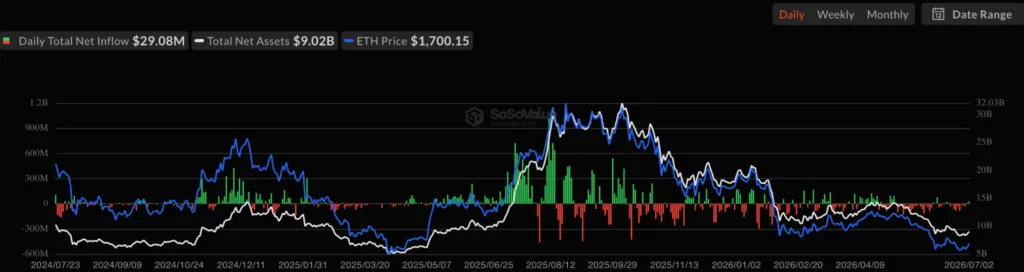
Ethereum price traded near $1,715 on July 3, according to crypto.news price data, after rising more than 6% over 24 hours.
Summary
- Ethereum reclaimed $1,700 as ETF inflows returned, but exchange netflows still warn of selling pressure.
- Monthly TD Sequential signals suggest seller exhaustion, while MACD and RSI show early recovery momentum.
- Binance withdrawal spikes point to accumulation, but rising open interest keeps volatility risk elevated.
The move pushed ETH back above the $1,700 area, a level traders have watched closely after weeks of selling pressure.
The rebound came as U.S. spot Ethereum ETFs returned to inflows. On July 2, spot Ethereum ETFs recorded total net inflows of $29.08 million, according to SoSoValue data. BlackRock’s ETHA led the group with $29.74 million in net inflows, while Grayscale’s ETHE recorded outflows of $2.75 million.
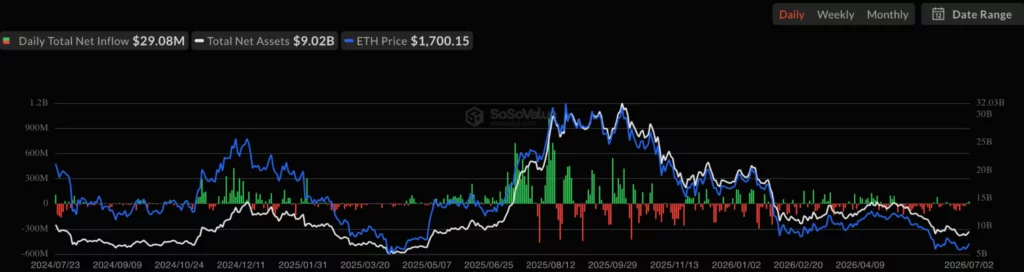
The token had already been eyeing a $1,700 breakout after July 1 ETF inflows returned. That earlier shift helped ease pressure around the $1,500 support region, but ETH still needed a stronger move above $1,700 to improve its short-term chart.
The next area to watch is $1,800. A clean move above that level could show that buyers are gaining control after the recent drawdown. Failure to hold $1,700 may return focus to $1,650 and then the lower support region near $1,500.
Ethereum Technical indicators improve
Ethereum’s short-term indicators are showing better momentum. The MACD histogram is positive near 19.33, while the MACD line sits around -49.01 and above the signal line near -68.34. That confirms the recent bullish crossover has gained strength.
The broader signal is not fully bullish yet because both MACD lines remain below the zero line. This means downside pressure has eased, but the token has not confirmed a full trend reversal. Traders usually look for MACD follow-through toward the zero line before calling a stronger recovery.
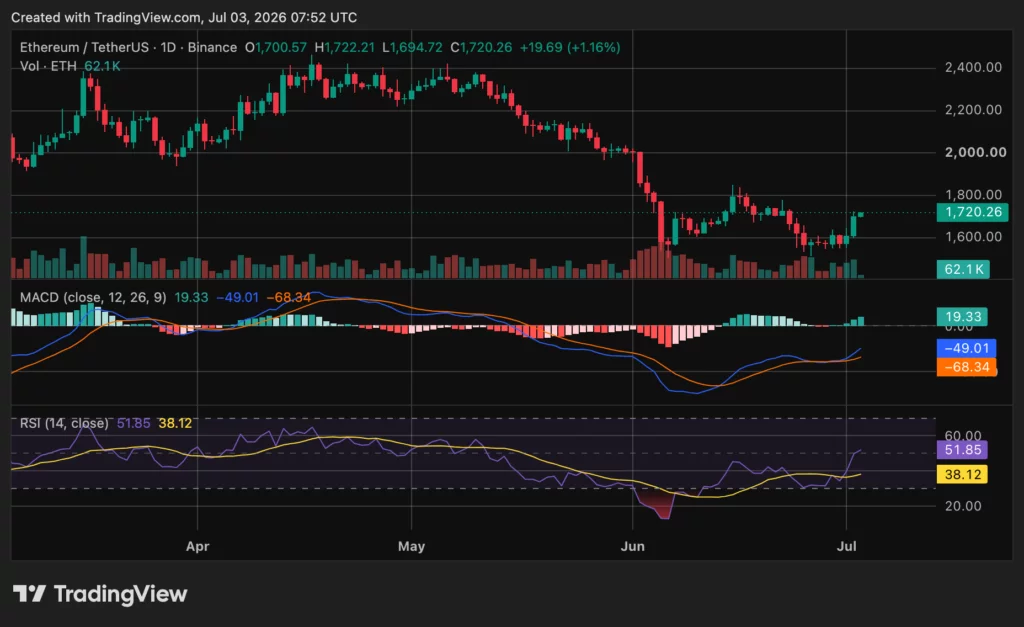
The RSI also improved. It stood near 51.85, above its moving average near 38.12. This move above 50 shows buyers are starting to regain control after a weak June.
Crypto analyst Ali Charts said the token has printed a monthly TD Sequential buy signal. In his view, the signal suggests seller exhaustion on a higher timeframe. He also said ETH is approaching a long-term support area near $1,100, which he described as the bottom boundary of Ethereum’s multi-year channel.
Ali Charts pointed to $3,000 as a mid-range recovery target if that lower channel holds. He also placed the broader channel ceiling near $5,000. Those levels are long-term technical targets, not short-term price calls.
ETH/BTC setup draws attention
Ethereum’s performance against Bitcoin is also drawing attention. Crypto Rover said an ETH/BTC golden cross is forming, with the 50-week moving average moving toward a cross above the 100-week moving average. He said the last similar signal in 2021 came before ETH outperformed Bitcoin.
That setup matters because ETH has lagged Bitcoin during the broader market decline. A stronger ETH/BTC pair would show that capital is rotating back toward Ethereum rather than only following Bitcoin’s rebound.
Derivatives data also shows rising activity. According to Coinglass data, ETH volume rose 14.48% to $44.74 billion, while open interest increased 10.64% to $24.54 billion. Options volume climbed 30.19% to $1.41 billion, and options open interest rose 6.67% to $4.43 billion.
Rising open interest can support stronger price moves when buyers lead the market. It can also raise liquidation risk if leveraged positions build too quickly. For that reason, the current derivatives setup points to more volatility rather than a clean bullish trend.
On-chain signals remain mixed
CryptoQuant analyst Darkfost said Binance ETH withdrawal transactions hit their highest level in three years. Binance reportedly logged more than 166,000 withdrawal transactions in one day as ETH rebounded from the $1,500 area.
Exchange withdrawals can point to accumulation when users move coins into self-custody. They can also show funds moving into DeFi for yield. Darkfost said some withdrawals may also reflect confusion around MiCA rules that took effect on July 1, even though withdrawals were not frozen.
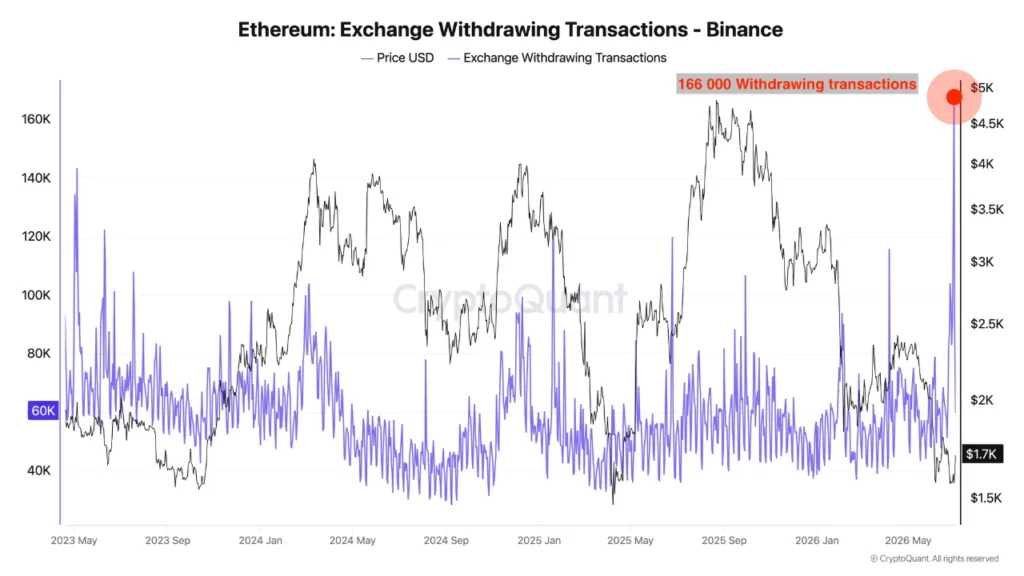
Another CryptoQuant analyst, PelinayPA, gave a more cautious reading. The analyst said Binance ETH exchange netflow remained positive at +12,938 ETH, meaning more ETH was moving into the exchange than leaving it. Positive netflow can create selling risk because coins on exchanges are easier to sell.
That contrast keeps the short-term outlook balanced. Withdrawal transactions suggest some users may be accumulating. Positive netflow and rising open interest suggest selling pressure and leverage have not disappeared.
Institutional activity adds support
Ethereum also has support from corporate and institutional activity. As crypto.news reported, Ethereum Institutional launched with backing from BitMine, SharpLink, Joe Lubin, and other contributors to support adoption by banks, asset managers, custodians, and financial firms.
BitMine has continued building its Ethereum treasury. As previously reported, BitMine added 27,084 ETH, lifting its holdings to more than 5.7 million ETH, or about 4.7% of Ethereum’s supply.
SharpLink has also kept buying during weakness. The company bought another 10,000 ETH for $16.1 million as Ethereum tested lower support.
Disclosure: This article does not represent investment advice. The content and materials featured on this page are for educational purposes only.


BTSE has officially entered Indonesia’s regulated crypto market through the launch of BTSE Indonesia after completing the rebranding of local exchange NVX.
Summary
- BTSE has launched a regulated cryptocurrency exchange in Indonesia through a joint venture and the rebranding of NVX.
- The OJK license allows the platform to offer IDR deposits, withdrawals, trading pairs, and other regulated digital asset services.
- The launch comes as Indonesia continues tightening oversight of its cryptocurrency sector with new compliance rules for market participants.
According to an official announcement issued on July 3, the new platform has been established as a joint venture between BTSE Group and PT Aset Kripto Internasional, combining BTSE’s trading infrastructure with local operations focused on customer growth, partnerships, marketing, and sales.
Operating under a license issued by Indonesia’s Financial Services Authority (OJK), BTSE Indonesia is authorized to function as a Digital Financial Assets and Crypto Assets Trading Operator (PAKD). The approval places the exchange among the limited number of regulated entities permitted to offer cryptocurrency trading services in the country while complying with anti-money laundering requirements and customer asset protection rules.
With the regulatory approval in place, BTSE Indonesia can work with Indonesian banks and payment providers to support Indonesian rupiah (IDR) deposits, withdrawals, currency conversions, and IDR trading pairs. The company said the license also creates a path to introduce additional regulated products, including futures trading, subject to rules issued by Indonesian authorities.
Under the partnership, BTSE Group will provide the exchange’s trading engine, liquidity, and underlying technology, while the Indonesian entity will manage local commercial operations using its market knowledge and domestic business relationships.
“Indonesia has everything it takes to be Asia’s next major crypto hub; the population, the demand, and now the regulatory framework. What it needs now is the right combination of global infrastructure and local expertise. That’s exactly what this joint venture delivers,” said Jeff Mei, Chief Operating Officer of BTSE Group.
According Stephanie Kusnadi, Chief Strategy Officer of BTSE Indonesia, added the integration with BTSE gives the company access to global exchange technology while allowing it to continue operating as a platform built around local regulatory requirements and user needs.
Indonesia continues tightening crypto oversight
The launch comes as Indonesia continues introducing new rules for its digital asset industry. In June, the OJK issued Financial Services Authority Regulation No. 6 of 2026, requiring social media influencers who recommend cryptocurrencies and other digital financial assets to obtain competency certification unless they already hold another qualifying license.
Under the same regulation, influencers may promote only digital assets listed on authorized exchanges, while promotional campaigns must be conducted through licensed financial services businesses that remain responsible for the content. The new requirements place additional compliance obligations on digital asset firms operating in Indonesia’s regulated market.
Last month, Cardano’s ADA collapsed below $0.14, the lowest level since the end of 2020. Meanwhile, its market capitalization briefly plummeted to roughly $5 billion, leaving the asset temporarily out of crypto’s top 20 club.
The bulls, though, managed to halt the free fall and even stage an impressive comeback. Here’s what happened and the possible catalysts behind the resurgence.
Green Week for ADA
As of press time, the token is worth almost $0.17, representing a 17% increase over the past 7 days. Perhaps the most evident reason pushing ADA higher is the broader market rebound following de-escalation news out of the Middle East.
Bitcoin (BTC) soared to $62,000, while Ethereum (ETH) surged past $1,700 amid reports that Iran and the USA are set to hold the next round of direct talks in the third week of July after the funeral of the supreme leader Ali Khamenei.
Another catalyst could be the excitement surrounding a Cardano upgrade scheduled to go live on July 6. Namely, this is the RealFi Phase 1 Testnet, described as “the first public step toward next-generation stablecoin infrastructure” on the project.
“Crypto’s clearest success story has scaled as money. But not as capital. Hundreds of billions of dollars sit idle in stablecoins: No utility. No impact on the real economy. We think that’s a problem worth solving – and the Testnet is where we start. During Phase 1, participants can explore the platform, use its core features, and share feedback that will directly shape the protocol. This is collaborative infrastructure-building in public, and we want you involved,” the announcement reads.
Speaking about the upcoming effort was Cardano’s founder, Charles Hoskinson, who called it “the largest upgrade” in the project’s history.
Numerous analysts noted ADA’s revival, arguing it has more fuel left to post further gains. X user Sssebi claimed the token “is on fire” and envisioned a short-term pump to $0.20, while Nehal predicted a jump to $0.23, provided the price holds above $0.16.
Not so Fast
ADA’s recovery shouldn’t be seen as a guaranteed start of a new bull run, as the crypto market remains quite unstable and vulnerable to another severe pullback.
The asset’s Relative Strength Index (RSI) reinforces the bearish outlook. The technical analysis tool, which ranges from 0 to 100, has risen above 70, indicating that ADA is in overbought territory and due for a possible correction. Conversely, ratios below 30 are considered buying opportunities.

The post Why is Cardano (ADA) Up 15% in a Week? appeared first on CryptoPotato.


The artificial intelligence sector is currently dealing with a severe training data bottleneck, especially as centralized technology monopolies are locking out early stage developers from high-quality information pipelines. Decentralized data infrastructure platform Perceptron is trying to address this structural bottleneck by deploying a decentralized infrastructure layer that crowdsources web information through everyday user devices.
Summary
- Perceptron is using idle consumer bandwidth to collect publicly available web data and provide lower cost AI training datasets.
- The platform says its network spans more than 150 countries and rewards contributors while verifying data quality before it is supplied to enterprise clients.
- Perceptron has launched a $10 million AI Data Fund to help developers access data infrastructure and accelerate the development of AI models.
Modern day media is entirely focused on highlighting how leading names in the artificial intelligence space are constantly deploying next-generation hardware systems to buff up their raw computing power. But one of the least talked about operational constraints is the quality of the training data that makes up the core foundation of any functional AI model.
The problem is that with the vast majority of open-web content already thoroughly harvested, aggressive corporate control over public application programming interfaces has locked the remaining foundations of dataset collection behind exorbitant multi-million dollar paywalls. It has essentially become a prohibitively expensive exclusive privilege for a handful of massive tech monopolies.
For the tech giants that are currently leading the AI race, securing these high cost information pipelines aren’t much of a financial challenge, but what about the underfunded innovators? Without the necessary budgets, early-stage startups are left struggling to build competitive products.
“OpenAI pays approximately $60 million to $100 million per year to companies like Reddit and Twitter in order to be able to access data through APIs,” Perceptron Co-Founder & CEO, Peter Anthony told crypto.news during a recent interview.
“Many new AI projects out there don’t have budgets to be able to spend $60 million to $100 million to be able to access data. If you build the best model in the world, it’s pretty useless if it doesn’t have access to good quality data. You could be the smartest kid at school, but if you’re not able to access any books, you don’t really have very much information to present.”
Anthony realized that this market asymmetry leaves room for alternative infrastructure that would serve the independent market segment, which eventually led him to co-found Perceptron, a platform which plans on using idle consumer bandwidth to solve “the data bottleneck problem” AI is suffering from right now.
“The majority of the world’s data has already been accessed and scraped, but there’s a lot of data that’s kind of hidden behind different places that are not yet accessible, so we’re gathering data and positioning ourselves to be able to provide data for AI companies at a reduced cost,” Anthony explained.
Harvesting the idle bandwidth
But what is this idle bandwidth that Perceptron plans to leverage? Anthony explained that this is the unrecognized economic asset that everyday users constantly produce through routine digital browsing, only to watch major corporations extract and profit from it.
“Right now, every time you and I use the internet on our phones, our computers, we’re generating data. That data gets collected, packaged into massive datasets by companies like Google, and sold for millions, sometimes billions of dollars. Yet you and I never see a cent of that value.”
What Perceptron has done is to completely flip this extractive model on its head. They have built a network spanning more than 150 countries comprising roughly 800,000 nodes, and these nodes are powered by individual users who are simply running a browser extension on Chrome or an application on their Android devices.
While these endpoint installations don’t scrape private digital files or provide the firm with sensitive personal telemetry, it instead secures localized geographic perspectives, which Anthony described as “different vantage points” on the open web, which can then be extracted in small pieces and combined into one meaningful dataset.
“It’s very important that we focus on the fact that it’s not using individuals’ data, it’s not tapping into your own personal data and information, but let’s say right now you’re in Malawi. When you’re looking at a particular website, I could go and look at the same website, but chances are, because I’m in Dubai, we’re going to see a different kind of set of results. All we’re gaining from this situation is being able to use your computer to look at something like a normal web page, or whatever it might be.”
To illustrate, Anthony noted that if a corporate client requires a dataset of healthcare-related social media posts from the US, Perceptron can coordinate across its global node mesh to extract individual public posts without interfacing with restrictive enterprise APIs.
Because this data is already freely accessible to the public via any standard web browser, routing the collection through individual terminal nodes legally sidesteps commercial paywalls. Once these minor data packets are retrieved, the network transfers the unrefined data back to a centralized server where specialized artificial intelligence models scrub and audit the information for quality control.
“By doing this, we can cut down the cost significantly that is currently being charged by a lot of the big centralized companies like Google.”
Powered by an economic loop that incentivizes quality network participants
The next question is why would anyone volunteer their hardware to a network like this, and the answer is straightforward, a shared value loop ensuring that these nodes earn points for their passive connectivity that are scheduled to convert into native crypto tokens down the line.
According to Anthony, this distributed model ”will enable them to earn points” that act as a direct metric of their network contribution, and therefore “whenever there’s revenue generated by the company, tokens will get fed back into the ecosystem” to sustain a cyclic economic loop.
“There will also be tokens set aside that are used for buying back tokens,” he added.
However, not everyone running a node essentially qualifies for consistent rewards, as there’s the ever-present challenge of quality control, which can compromise dataset integrity if left unchecked.
Perceptron addresses this by routing gathered packets back to a centralized server, where automated algorithms systematically evaluate the inputs against target benchmarks before releasing any compensation.
Further, Anthony said that the startup recently acquired a company specializing in transaction and payment verification software to structurally automate this validation process.
To further engage network participants while also driving the creation of data sets, Perceptron also plans to launch a structured Data Questing platform, which will allow contributors to turn active human effort into unique training inputs.
“We aim to effectively be able to build datasets and create datasets that are currently not available through centralized processes,” Anthony added.
The end goal
Over the long haul, Anthony said he would like to see the network transition to a business intelligence-focused model that is able to provide deep-layer analytics for enterprise clients.
“The difference is that traditional datasets are static, they’re collected once and quickly become outdated. But there’s an enormous amount of data being generated every time you interact with anything online, and right now, most of it is simply going to waste,” Anthony said.
“One single server trying to monitor all these different users can’t really gather meaningful intelligence at that scale. What we need is a shift toward distributed business intelligence, so we can actually improve services across things like e-commerce, trading, and much more.”
Perceptron has also launched a $10 million AI Data Fund, through which the platform expects to fund independent developers and support the deployment of “actual projects that are providing real services.” Under the terms of the program, selected engineering teams receive five weeks of dedicated data infrastructure assistance and up to 5 TB of real-world data free of charge to accelerate the optimization of early-stage AI models.
“The goal is to support projects as they grow and their data requirements increase. We can become one of their go-to providers, it’s both an investment in the broader ecosystem and a way for us to build consistent, long-term revenue,” Anthony noted.
As of publication time, Anthony said Perceptron is already actively supplying diverse data products to a variety of commercial enterprises. The network provides extensive image datasets to text-to-video generative platforms, including a company called Everlyn AI, to train models to accurately synthesize visual content.
Beyond that, the project is also moving past standard image compilation, as the platform has entered the sentiment analysis sector by tracking public discourse across Twitter, YouTube, and digital asset markets. Analyzing this public sentiment helps crypto firms and exchanges build tracking tools that give early signals to preempt sudden price swings.
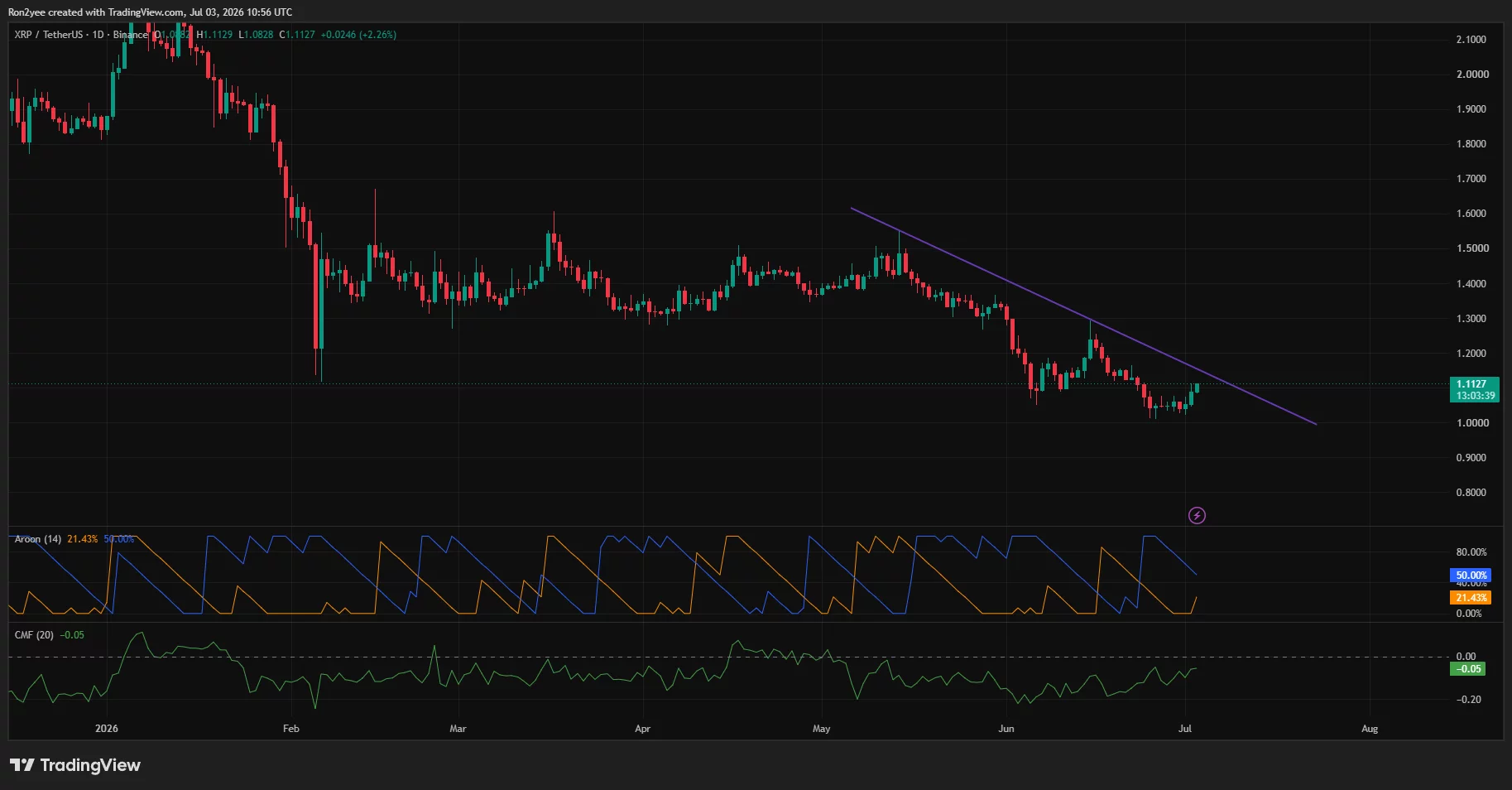
XRP price has climbed to a three-day high after Ripple’s European expansion and a fresh Supertrend buy signal revived bullish sentiment.
Summary
- XRP price climbed to a three-day high as Ripple’s European expansion and stronger market sentiment boosted buying.
- A breakout above a month-long downtrend and a fresh Supertrend buy signal strengthened the bullish outlook.
- Short liquidation clusters above $1.11 could fuel further gains, while $1.05 remains a key support level.
According to data from crypto.news, XRP (XRP) price rose as much as 3% to an intraday high of $1.11 on July 3, extending its recovery from around $1.02 on July 1. The latest rebound follows Ripple’s regulatory progress in Europe, improving macro sentiment, and a bullish technical reversal that has encouraged buyers to return after weeks of sustained selling pressure.
Since July 1, the market has continued to price in the company’s European expansion after Ripple Payments launched under preliminary Crypto-Asset Service Provider approval through the European Union’s Markets in Crypto-Assets framework.
The development arrived just as some competing platforms scaled back parts of their European offerings to comply with MiCA rules, strengthening Ripple’s position in one of crypto’s fastest-growing regulated markets.
At the same time, investors largely dismissed concerns surrounding Ripple’s monthly 1 billion XRP escrow release after recognizing that most of the unlocked tokens are traditionally returned to escrow rather than sold into the market.
Bitcoin’s stabilization above the $61,000 area has also provided a more supportive backdrop for altcoins after weeks of heavy selling pressure. Risk appetite improved further as easing geopolitical tensions helped push crude oil prices to multi-month lows while softer U.S. economic data reinforced expectations that the Federal Reserve could begin easing monetary policy later this year.
These macro developments have encouraged investors to rotate back into higher-beta digital assets after June’s defensive positioning.
Technical breakout puts $1.12 and $1.15 into focus
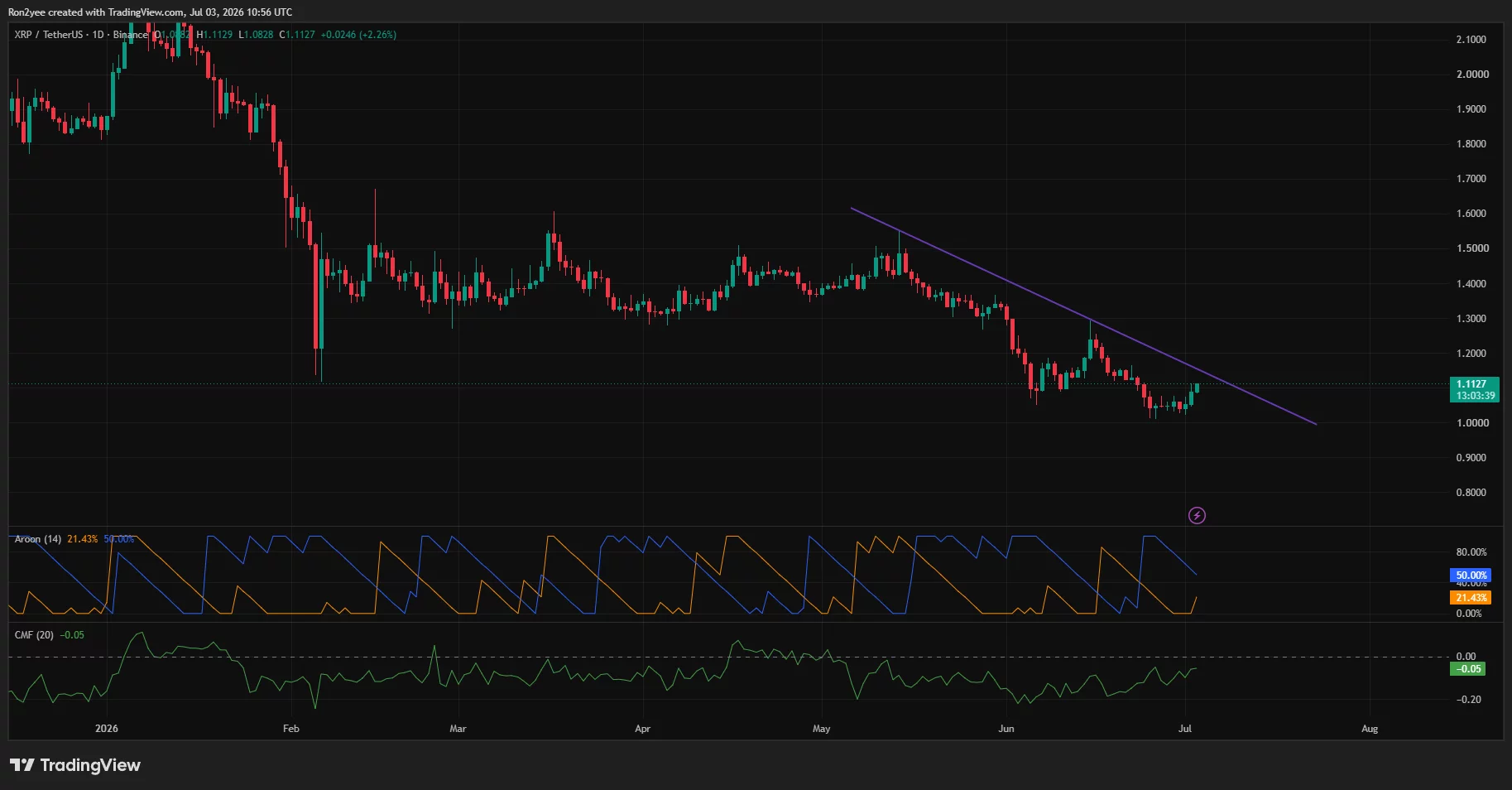
XRP’s technical structure has improved materially over the past two sessions. On the 1-day chart, price has broken above a descending trendline that had capped every rally since late May, ending more than a month of lower highs. The breakout has carried XRP back toward the $1.12 resistance area after reclaiming the psychologically important $1.10 level.
The 4-hour chart reinforces that bullish shift. XRP has reclaimed its Supertrend indicator near $1.05, while the MACD has completed a bullish crossover with expanding positive histogram bars. Price has also cleared horizontal resistance around $1.075 and is now approaching the next overhead supply zone near $1.125.
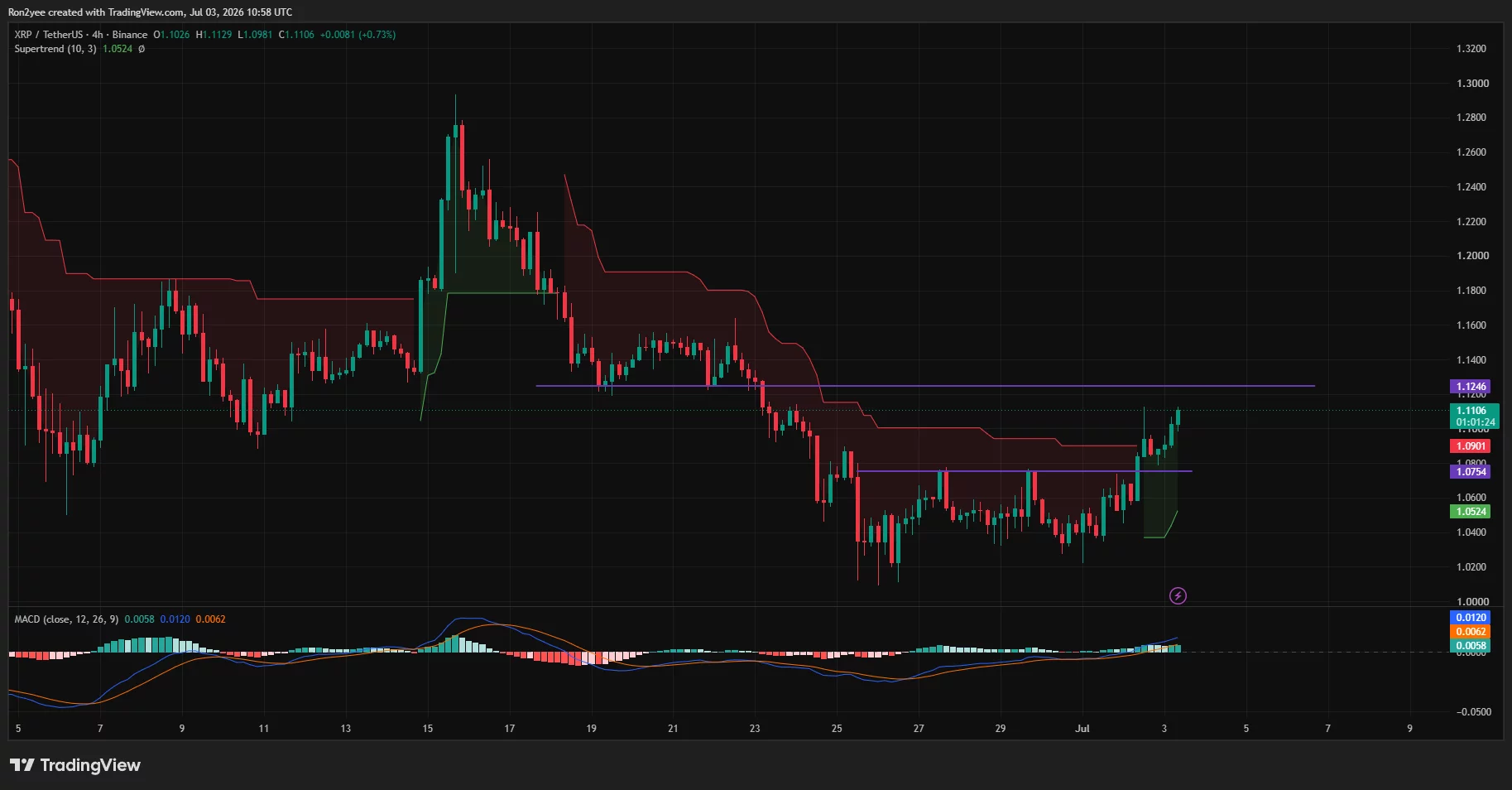
A decisive move above that barrier could expose the $1.15 region, while the Supertrend support near $1.05 and former resistance at $1.075 now serve as the first downside cushions.
Commenting on the setup, analyst Ali Martinez wrote in a July 3 X post:
“The SuperTrend indicator has just flashed a buy signal on XRP for the first time since mid-June. The last buy signal preceded a 14% rally.”
Martinez also noted that the indicator had correctly identified the previous 19% and 16% declines, adding weight to the latest reversal signal.
Derivatives positioning has also shifted in favor of bulls. CoinGlass liquidation data shows one of the largest short liquidation clusters sitting just above the current price between roughly $1.11 and $1.12.
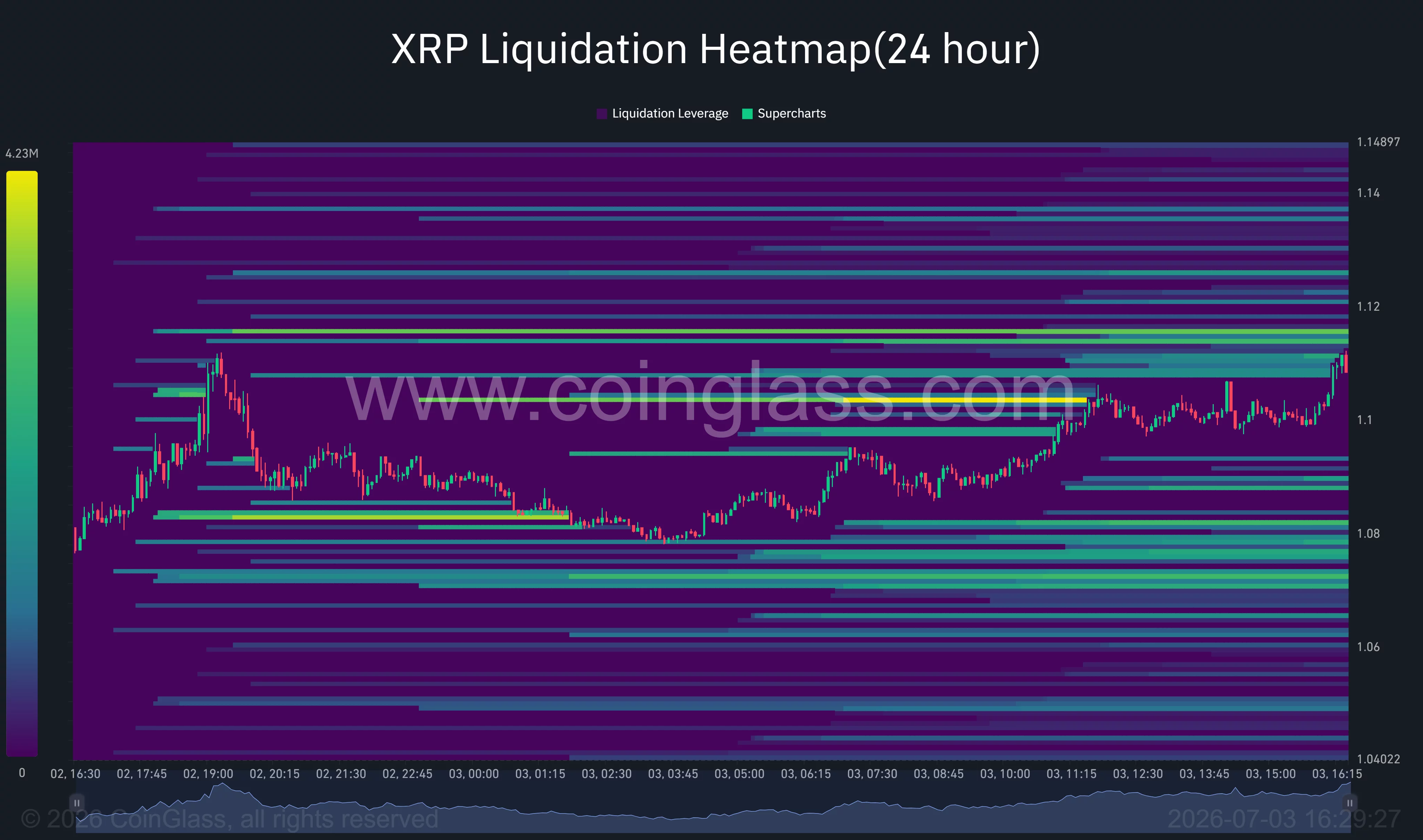
XRP has already begun pushing into that liquidity pocket, increasing the probability of additional forced buying if resistance breaks. Beyond that zone, another concentration of leveraged positions sits closer to $1.14, creating a potential path for an extended short squeeze should momentum continue.
On-chain sentiment has strengthened alongside the technical recovery. Sharing data from Santiment, Whale Factor highlighted that XRP’s average trading returns have fallen to their lowest level in roughly 12 years, leaving both short-term and long-term holders underwater.
Historically, deeply negative MVRV readings have often coincided with major accumulation periods before meaningful recoveries. As Whale Factor summarized, “The more frustrated the crowd the faster the snap back when sentiment turns.”
Key risks remain despite the improving trend
The recovery still faces several hurdles before a sustained uptrend can be confirmed. The $1.12-$1.15 region contains multiple layers of technical resistance and dense leveraged positioning that could trigger renewed selling if buyers fail to force a breakout.
Any deterioration in Bitcoin’s price, a resurgence in geopolitical tensions that lifts energy prices, or stronger-than-expected U.S. economic data that delays Federal Reserve rate cuts could quickly reduce appetite for altcoins.
On the charts, a fall back below $1.075 would weaken the current breakout, while a loss of the Supertrend support near $1.05 would place the recent bullish thesis under pressure and raise the risk of another retest of the $1.00 psychological support.
Disclosure: This article does not represent investment advice. The content and materials featured on this page are for educational purposes only.

France’s CACEIS nears deal for MiCA-licensed Meria

Oral Microbiome Diversity Is Now Linked to Mortality Risk

A brief history of human pain

No Jackpot Winner as $257 Million Prize Rolls Over to $269 Million Monday Draw

Renter of Home in Anne Heche Crash Denies Settlement With Son

Weekend Open Thread: Staud – Corporette.com

Caleb Hammer Turned Financial Help Into Public Embarrassment…

Bitcoin & XRP Bottom for 2026? #xrp #bitcoin #btc #cryptocurrency #crypto #trading #ripple #xlm

Bitcoin kya hai? How Bitcoin works and why is it so popular? | Dhruv Rathee
-

 Tech6 days ago
Claude Code turned every engineer into three. Now companies need more product thinkers
-

 Crypto World4 days ago
Strategy authorizes up to $1.25B in Bitcoin sales under new capital plan
-

 Tech6 days ago
Bluekit phishing kit adopts browser-in-the-middle for login theft
-

 Fashion7 hours ago
Weekend Open Thread: High Hopes
-

 Politics13 hours ago
The House | “Reframing the debate from a binary discussion of winners and losers”: Yuan Yang reviews ‘We Are Not Machines’
-

 News Videos5 days ago
MAJOR BITCOIN & MARKET UPDATE!!!! (MUST WATCH ASAP!!!)
-

 Tech4 days ago
Anonymous researcher drops 0-day ‘exploitarium’ repo
-

 Crypto World6 days ago
Coinbase, Circle Deepen Crypto Stock Losses Despite Resilient S&P 500
-

 Business4 days ago
Australia treasurer says alleged access of prime minister’s bank data ’incredibly concerning’
-

 Crypto World7 days ago
Kraken's xStocks Opens Bending Spoons IPO Registration to EEA Retail
-

 Tech7 days ago
Russian hackers now target Signal backup recovery keys
-
 Business4 days ago
The AI boom won’t burst all at once. It will pop in ‘rolling bubbles’: Macquarie
-

 Sports2 days ago
Broncos roster: OL Ben Powers (No. 74) entering final year of contract
-

 Tech6 days ago
Silicon Valley paid to kill AI regulation, now it wants the rules back
-

 NewsBeat3 days ago
Presenter Caroline Flack’s brother Paul Flack dies aged 55
-

 Crypto World2 days ago
Binance stock trading tops $1B in first month after launch
-

 Tech6 days ago
OpenAI mulls delaying IPO over valuation concerns
-
 NewsBeat2 days ago
New exhibition reflects five decades of movement between island of Ireland and GB
-

 Crypto World2 days ago
Alibaba-affiliate Ant Group enters the humanoid robot market with 12 deals
-

 News Videos4 days ago
How to Build INSANE Live Financial Dashboards With Claude
You must be logged in to post a comment Login