

Crypto World
Capital B Acquires 192 Bitcoin to Reach 3,135 BTC in Total Holdings

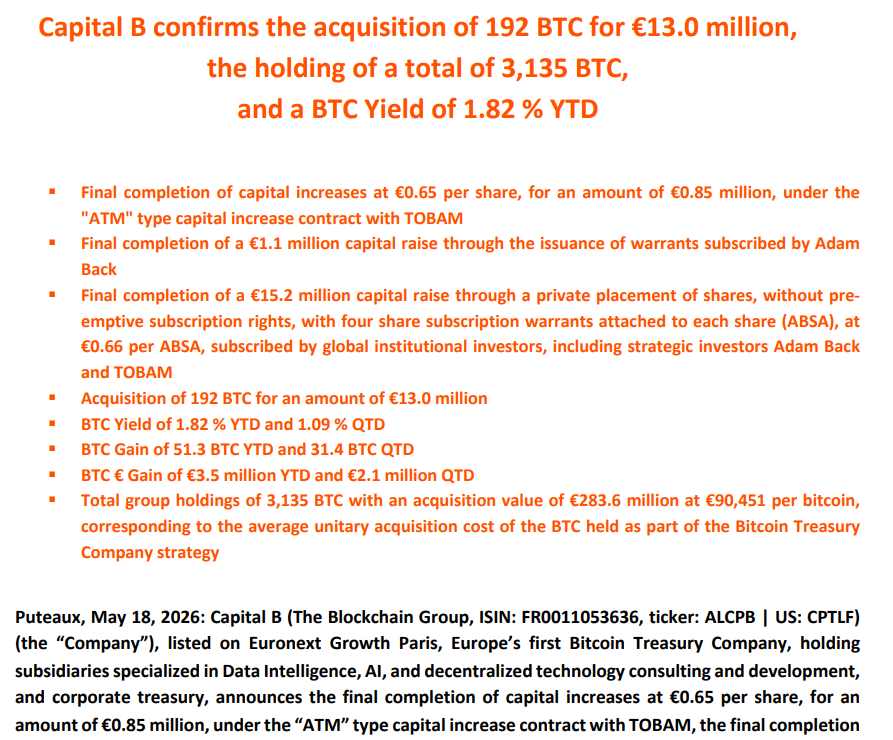
France-listed Bitcoin treasury company Capital B announced Monday that it acquired 192 BTC for 13 million euros ($15.2 million), bringing its total holdings to 3,135 BTC.
Capital B purchased its latest tranche at an average price of about $78,948 per Bitcoin, Alexandre Laizet, Bitcoin strategy director at Capital B, said on X.
The acquisition comes a week after the company announced a $17.8 million raise from strategic investors, including Blockstream CEO Adam Back and Paris-based asset manager TOBAM. Capital B also raised $1.28 million from Back on May 4.
Capital B is one of four crypto treasury companies to publicly disclose Bitcoin purchases in May so far.
Strategy, the largest publicly traded Bitcoin holder, announced it acquired $43 million last Monday, while Strive added $33 million in BTC on May 4 and The Smarter Web Company purchased $4.9 million in BTC.
The purchase reflects continued interest in Bitcoin treasury strategies by a handful of public companies, even as Bitcoin remains well below its October 2025 all-time high.
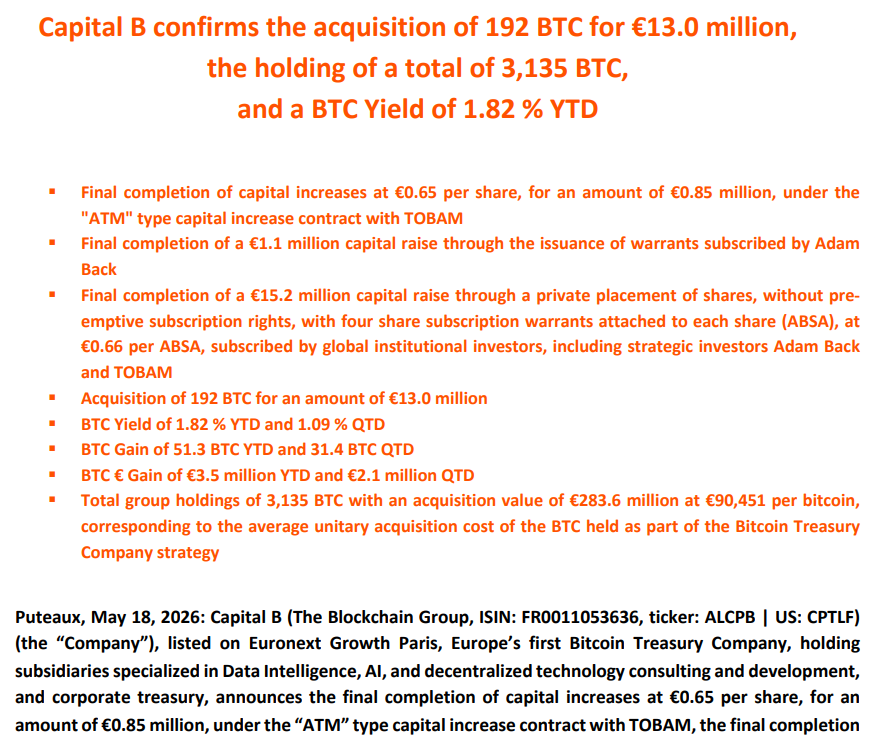
Capital B acquired 192 BTC. Source: Capital B
Capital B shares fall after Bitcoin acquisition announcement
Capital B shares fell around 2.4% after the announcement Monday and traded at about 0.62 euros at the time of writing.
The company’s shares are down 17% year-to-date and more than 68% over the past year, according to data from Yahoo Finance.
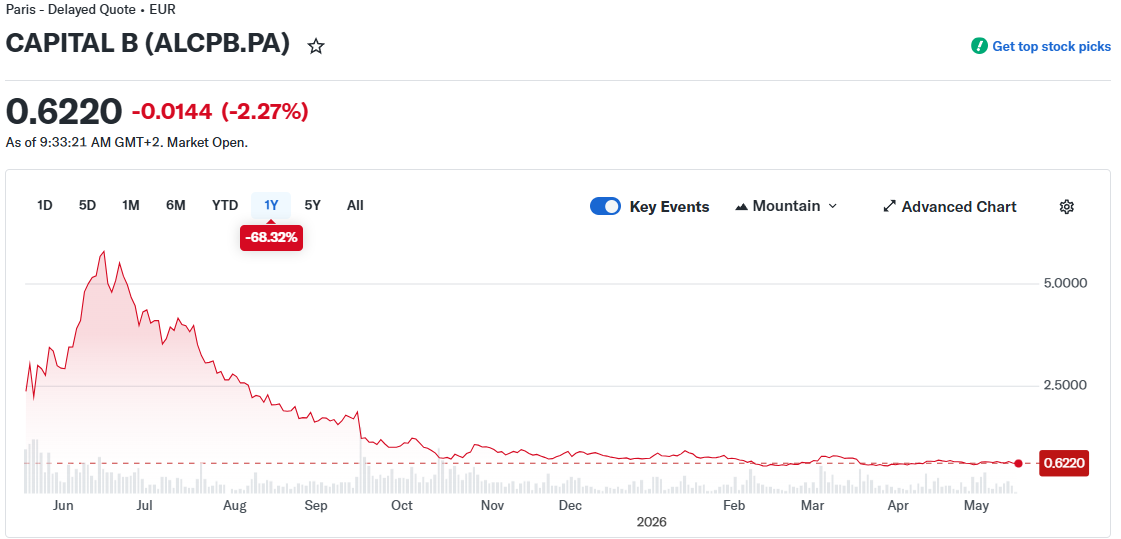
Capital B shares price in euros, 1-year chart. Source: Yahoo Finance.
Capital B ranks as the 25th-largest Bitcoin treasury firm by holdings and as Europe’s second-largest following Germany’s Bitcoin Group SE, which holds 3,605 BTC, currently worth about $277 million, according to BitcoinTreasuries data.
Related: Strategy’s Bitcoin engine faces $28B STRC ceiling: Delphi Digital
Some Bitcoin treasury firms turn defensive amid downturn
Other Bitcoin treasury companies are seeking to reduce the balance sheet risks associated with Bitcoin, which is currently down 39% from its $126,198 all-time high.
On April 24, Nasdaq-listed Bitcoin treasury company Nakamoto announced an actively managed Bitcoin derivatives program aimed at generating recurring income from volatility and hedging part of its corporate BTC holdings against downside exposure. The company reported it sold 284 Bitcoin (worth about $20 million at the time) in a March 30 filing.
In February, Genius Group reported the sale of its remaining treasury holdings of 84 BTC for about $5.7 million to repay an $8.5 million debt obligation.
Magazine: Bitcoin vs. the quantum computer threat — Timeline and solutions (2025–2035)



Israeli prosecutors on Friday indicted Eli Lavon, a 21-year-old US citizen, for allegedly spying on behalf of Iranian intelligence in exchange for roughly $1,379 in crypto. The case shows Iran’s alleged crypto recruitment playbook maturing into gig work for espionage.
Lavon is reportedly the first American indicted in Israel’s spy wave, which counts at least 60 defendants since 2023. In many cases, small payments rather than ideology appear to drive recruits.
A Job Ad, Three Phones, and $1,379
According to the indictment, Lavon answered a Telegram job advertisement in November 2025 while visiting family in the US. A handler working for Iranian intelligence began assigning tasks once he returned to Israel.
He allegedly filmed an abandoned building and a grocery store in Jerusalem. He also left dead drops, including a USB drive wrapped in a 50 shekel note.
The crypto arrived in small batches, first hundreds of dollars, then about $518 from a second handler. The output had real military value, however. Several sites filmed by alleged recruits in this wave were later struck by Iranian missiles.
Arrested on June 9, Lavon faces two counts of contact with a foreign agent and 14 counts of communicating information to the enemy.
“This indictment illustrates how foreign intelligence agencies attempt to exploit the digital sphere to identify, recruit, and operate individuals from within Israel…” Ronit Shentzer Yaakobi of the Jerusalem District Attorney’s Office said in a statement.
Follow us on X to get the latest news as it happens
Crypto Recruitment Moves From Spying to Sabotage
The playbook no longer stops at surveillance. HAYI, a group that surfaced online in March, has claimed 17 arson and sabotage incidents across seven European countries. Analysis suggests it may be a “fabricated front” run by Iran-linked operatives using paid, disposable recruits.
British police have detained at least 28 people over the London attacks alone. A Belgian teenager was reportedly paid to stage an Antwerp arson later claimed by HAYI. Another teen charged over a London synagogue fire told investigators he did not know what the building was.
Each element mirrors gig work. Tasks arrive through consumer apps, payment clears per job, and recruits stay ignorant of the wider operation. Researchers describe the tactic as hybrid warfare because paid intermediaries blur any link to state planners.
The economic factors set this model apart from traditional terrorism financing. When OFAC sanctioned 134 ISIS-K wallets on July 1, analysts traced roughly $1.4 million into them since 2023. Lavon’s alleged payroll was about a thousandth of that, and Tether still froze 131 sanctioned wallets within a day.
Large networks, in other words, have become visible. Courts have secured terrorism financing convictions on onchain records, and probes into Iran-linked crypto networks chased billion-dollar flows.
A $500 gig payout offers far less signal, a gap that US lawmakers have barely addressed in their debate on illicit finance loopholes.
Whether blockchain surveillance built for large transfers can adapt to micro-payments may decide how quickly such networks unravel.
The post Iran’s Alleged Crypto Spy Paid Just $1,379 for Israel Secrets appeared first on BeInCrypto.


South Korean crypto exchange Upbit has rejected claims that it is participating in the issuance of Open USD after being listed among more than 140 organizations associated with the proposed stablecoin.
Summary
- Upbit says it is not participating in Open USD issuance despite Dunamu being listed by Open Standard.
- Samsung, Shinhan, and K-Bank have also said they have not formally agreed to join the stablecoin initiative.
- Unfinished South Korean stablecoin rules continue to delay firm commitments from potential participants.
According to a statement issued by Upbit, the exchange has not agreed to issue or help launch the dollar-backed stablecoin, despite its operator, Dunamu, appearing on Open Standard’s published list of participating businesses. The company said it had only expressed a willingness to consider joining the OpenStandard ecosystem if it expands in the future.
The clarification follows similar statements from several South Korean companies that were also named by Open Standard earlier this week. Those responses have raised new questions about how many organizations have formally committed to the project after Open Standard introduced OUSD as a stablecoin backed by the U.S. dollar.
South Korean firms deny formal participation
Following Samsung Electronics’ earlier response, more companies have now distanced themselves from Open Standard’s announcement. As reported by crypto.news, Samsung said it had not held formal discussions with the project and did not know what role it was expected to play.
Dunamu, Shinhan Bank and K-Bank also confirmed they had received inquiries from Open Standard but said they were still reviewing the proposal and had not approved participation.
Those statements differ from Open Standard’s announcement on Tuesday, which described more than 140 organizations, including Visa, Mastercard, BlackRock, Google, Samsung Electronics and Dunamu, as businesses that had “signed up to use” OUSD.
The project also described many of those companies as founding partners that would participate in governance and share income generated from the stablecoin’s reserve assets.
Open Standard has also said participating businesses would be able to mint and redeem OUSD without paying fees or facing volume limits. According to the project’s announcement, earnings generated from reserve assets would be distributed among participating companies.
Regulatory uncertainty continues to cloud commitments
Outside the consortium debate, industry figures have questioned parts of Open Standard’s proposal. Circle CEO Jeremy Allaire previously raised concerns about whether free, unlimited minting and redemption could be maintained over time.
Separately, ARK Invest research director Lorenzo Valente described the announcement as a “giant” letter of intent, suggesting many of the listed relationships may still be preliminary rather than finalized.
South Korea’s regulatory position has added another layer of uncertainty. The country has not yet passed the Digital Asset Basic Act, leaving unresolved who will be allowed to issue stablecoins and what role different businesses can legally perform within such networks.
As crypto.news previously reported, lawmakers have continued debating whether stablecoin issuance should be limited to banks or extended to qualified non-bank companies. Until those rules are finalized, questions remain over licensing requirements, reserve management standards and the responsibilities of companies joining stablecoin ecosystems.
With several listed organizations now publicly stating that discussions remain preliminary, Open Standard’s published consortium has come under closer scrutiny as companies continue evaluating whether to participate once South Korea’s regulatory framework becomes clearer.

Belgian authorities have arrested a 19-year-old man they say was a central figure in a European phishing and money-laundering operation that netted more than €500,000 by targeting victims with fake government emails and phone calls. The suspected scheme relied on remote-access software to carry out fraud, and investigators say cryptocurrencies were used to move and launder the proceeds.
According to a Federal Judicial Police report cited by Belgian law enforcement, the arrest took place in Antwerp at an Airbnb, where a second suspect was also found. The investigation began in March 2026, when regional authorities escalated phishing as a priority.
Key takeaways
- Belgian police say the suspected phishing crew used fake government communications to trick victims into installing remote-access software.
- The operation allegedly involved money mules and cash carriers before converting proceeds into cryptocurrencies.
- Investigators characterize crypto as serving multiple roles in phishing—both as part of laundering workflows and as an enabling tool.
- Broader industry data cited in the report reinforces that phishing and social engineering remain leading drivers of crypto theft.
- Recent warnings about malicious ads on Google highlight how attackers are continuing to target users through mainstream search advertising.
Arrest in Antwerp and a laundering pipeline using crypto
In the Belgian case, the Federal Judicial Police reported that the suspected mastermind was detained in an Airbnb in Antwerp. A second suspect was discovered at the location as well, and the primary suspect was subsequently brought before an investigating judge, who issued an arrest warrant.
While authorities did not detail the full operational workflow in the cited report, they described the alleged criminal method: victims were contacted via fake government emails and phone calls designed to induce them to install remote-access software. That is a classic social-engineering pattern in phishing campaigns, because it converts a digital entry point into remote control capabilities.
Police also said the network used intermediaries—money mules and cash carriers—to process and move funds before laundering. The critical addition for the crypto angle is that investigators allege the gang ultimately laundered proceeds through cryptocurrencies, demonstrating how digital assets can be integrated into stages of criminal finance rather than remaining isolated as a payment layer.
Why this matters for crypto users and compliance
The Belgian arrest underscores a recurring reality for the crypto ecosystem: many of the highest-impact losses do not begin with vulnerabilities in smart contracts or protocol code. Instead, fraudsters frequently use human-targeted tactics to obtain access to accounts, wallets, or other assets—and then use crypto to obscure trails.
From an investor and operator standpoint, this has practical implications. It suggests that even if a platform’s underlying technology is secure, users may still face outsized risk through phishing campaigns that impersonate trusted entities. It also points to why transaction monitoring and compliance controls remain relevant even when the entry attack is “off-chain.”
For builders and exchanges, the lessons tend to be operational rather than technical: account security, verification processes for high-risk requests, user education, and fraud response playbooks can all influence outcomes when scams target individuals rather than software.
Phishing and social engineering still dominate crypto losses
The broader threat landscape aligns closely with the Belgian case. Phishing and social engineering scams are described as major contributors to crypto theft, including in reported loss figures for early 2026.
According to Hacken, phishing and social engineering accounted for $306 million of the $482 million lost in the first quarter of 2026. That data, as presented in the source reporting, frames phishing as the most prevalent mechanism behind real-world losses—even as decentralized finance security debates often focus on exploits and protocol failures.
Attackers have long exploited predictable human behavior: creating urgency, impersonating authority figures, and using convincing messaging to bypass caution. The persistence of those tactics is why the crypto community continues to treat user manipulation as a top-tier security concern, not a fringe risk.
Malicious Google ads and evolving tactics
Recent warnings show that phishing campaigns are not limited to email and direct calls. On May 25, onchain analyst “b-block” warned that scammers used Google to run malicious phishing ads impersonating decentralized exchange Uniswap, reportedly stealing more than $400,000 from victims. The warning adds another layer to the problem: threat actors may be leveraging established advertising ecosystems to reach users at scale.
In parallel, DeFiLlama said fake ads on Google are a common source of phishing attacks. Separately, Crypto cybersecurity group Security Alliance reported in April that there was a significant uptick in phishing activity on Google Search in March. Together, these points indicate that mainstream discovery channels—search ads and ad placements—can become a distribution method for crypto scams.
Blockchain security company CertiK’s Skynet report also highlighted phishing and social engineering among leading tactics used by malicious actors associated with North Korea-linked operations. The source further notes that CertiK attributed the 2022 Ronin Bridge exploit to a spearphishing campaign that involved a fake LinkedIn recruiter and a malware-laden PDF—an example of how phishing can lead into broader compromise chains.
What to watch next
With Belgian authorities tying phishing directly to crypto laundering techniques, and with multiple reports indicating phishing remains the largest share of reported losses, the next signal to track is whether law enforcement actions and platform security measures reduce scam distribution channels—especially ads and impersonation attempts—or whether attackers continue to shift to new mainstream touchpoints faster than users can adapt.

The world’s largest crypto exchange has run into serious trouble with EU financial regulators, and the uncertainty has triggered concern among its user base.
Despite its issues in Europe, however, Binance has strengthened its global presence after officially entering the Philippines.
The Push in Asia
Several hours ago, Binance’s co-founder and chief customer service officer, Yee He, revealed the news on her personal X account. She cited a document stating that the Securities and Exchange Commission (SEC) has granted final approval to Blockshoals Technologies Inc. to begin testing its financial products and services within the watchdog’s regulatory sandbox.
Under the crypto-asset intermediary model, the Blockshoals Stratbox will give Filipino users access to a range of offerings provided through its global CASP partner Binance.
The development was also highlighted by Binance’s founder, Changpeng Zhao (CZ), who shared He’s post and said: “Real liquidity for Philippines.”
Some users described the expansion into the Asian country as a solid win for crypto adoption, while others were less supportive, claiming the news is only meant to shift attention away from the company’s problems in the European Union.
No MiCA License… for Now
The exchange recently decided to withdraw its MiCA license application from the Hellenic Capital Market Commission (HCMC) in Greece, leaving it without the necessary approval to operate in the EU after July 1.
Binance assured its local users that their assets are safe and asserted that Europe remains an important region for its operations, adding that it hopes to obtain the permit in the coming months. Meanwhile, some clients have revealed on X that they have received withdrawal instructions from the company, while others appear unaffected for the moment.
Adding to its regulatory challenges in Europe, a group of 1,700 UK investors has filed a collective lawsuit in London’s High Court targeting Binance and CZ. The claimants argue that the exchange offered unregulated products and led to severe financial losses. The lawsuit also accuses Binance of failing to provide adequate protection for its clients.
The post Major Binance Announcement Concerning Many Users: Details appeared first on CryptoPotato.


Gnosis Pay has revealed that a software flaw dating back to October 2023 enabled the $1.5 million exploit of its card safe infrastructure, while confirming that all affected users have been fully reimbursed.
Summary
- Gnosis Pay traced its $1.5 million hack to a Zodiac software flaw that had existed since October 2023.
- The company reimbursed all affected users, restored services within days, and continues recovering about $300,000.
- The incident adds to growing scrutiny of crypto security as firms and governments respond to rising cyber threats.
According to a postmortem published by Gnosis Pay on Friday, the vulnerability was traced to version 3.4.0 of the Zodiac smart contract framework and had remained undiscovered since Oct. 30, 2023.
The company said the weakness was exploited on June 1, allowing attackers to gain control of about $1.5 million in digital assets held across its decentralized self-custodial payment network.
The report states that Gnosis Pay’s monitoring systems, operated by treasury manager NOCA, detected the first unauthorized transfer at 06:17 UTC on June 1. Engineers identified the root cause within two hours of the initial alert, after which the company suspended card services, temporarily halted its bridge to Gnosis Chain, and shared attacker wallet addresses with stablecoin issuers to help trace the stolen funds. Gnosis Pay also notified external projects that could have been exposed to the same vulnerability.
Funds restored after staged recovery
Following the incident, Gnosis Pay restored customer access in several phases. The company said the first affected accounts regained access to their balances and payment cards by the night of June 3 after new card-safe modules had been deployed. Installation continued over the following days, restoring service for 99% of users by June 6, while the remaining accounts were recovered shortly afterward.
Gnosis Pay said it absorbed the financial losses itself, leaving customers with no losses from the exploit. According to the postmortem, the attackers stole mostly GNO, EURe, USDC.e, and several other digital assets. The company added that roughly $300,000 worth of assets had not yet been recovered and recovery efforts remain ongoing.
The report also disclosed that 5,281 wallets holding at least $1 were affected by the exploit. Gnosis Pay published the attacker’s wallet address used during the incident, identifying it as 0x5a7…7a35, while explaining that the exploit targeted two components within its card safe infrastructure, the Delay Module and the Roles Module.
Smart contract exploits continue to pressure crypto platforms
The disclosure comes as security incidents continue to affect crypto infrastructure providers. As crypto.news reported earlier, Humanity Protocol recently confirmed it is repositioning toward enterprise artificial intelligence products after a $36 million exploit accelerated an internal restructuring that had already been under consideration for several months.
During an interview, Humanity Protocol founder Terence Kwok said the company had been reviewing its long-term direction for six to nine months before the breach. He explained that the exploit sped up those plans, while adding that digital identity will remain central because enterprise AI systems will require reliable ways to verify people and credentials.
Meanwhile, concerns over crypto-related cybercrime have also reached government leaders. Earlier, G7 leaders issued a joint statement after their summit in Evian-les-Bains, France, calling for coordinated action against North Korea’s cryptocurrency thefts and cybercrimes.
The statement linked the issue to long-standing concerns that stolen digital assets have helped finance Pyongyang’s nuclear and ballistic missile programs under international sanctions, a claim repeatedly supported by Western governments and blockchain analytics firms.

XRP just recorded higher trading volume than Bitcoin on Upbit. The altcoin now trades above a recently reclaimed resistance level.
As a result, analysts are watching whether XRP holds enough momentum to challenge the next major zone. The surge in activity places the $1.15 level squarely at the center of trader attention.

Renewed Interest in XRP?
Trading volume measures the amount of an asset exchanged over a specific period. Rising volume is often seen as a sign of increasing market participation. It typically reflects stronger investor interest across both retail and institutional trading channels.
The altcoin generated roughly 113.18 million XRP in trading volume on Upbit over the past 24 hours. As a result, the token surpassed Bitcoin and became one of the exchange’s most actively traded digital assets.
The move drew immediate attention across South Korean crypto markets.
The timing is notable for the token. XRP recently moved above $1.10. That area had repeatedly capped previous recovery attempts.
Moreover, holding above the zone has improved the short-term technical structure and reinforced expectations of continued buying interest.
Analysts note that the latest move built a more constructive market setup. XRP is now attempting to form a sequence of higher lows and higher highs. That pattern is commonly associated with strengthening bullish momentum across major crypto assets.
The breakout has clearly attracted attention. However, traders remain focused on whether the token can maintain support above former resistance levels. As a result, sustained demand will likely be necessary to maintain the current upward trend.

Why the $1.15 Level Is Drawing Attention
The next major area under observation sits between $1.14 and $1.15. This range combines short-term selling pressure with a widely monitored long-term moving average. It now represents a potentially significant obstacle for the token.
A successful move above $1.15 could strengthen confidence among market participants. Furthermore, it would likely shift attention toward higher price levels. Conversely, failure to break through the area may lead to additional consolidation before another attempt.
Analysts also note the importance of XRP holding above $1.09 during any short-term pullback. In technical analysis, a former resistance level that becomes support often confirms a more sustainable breakout. That flip strengthens the broader bullish case.
Beyond $1.15, the next notable target remains the $1.20 to $1.30 zone. That area has repeatedly rejected previous rallies. Furthermore, it remains one of the most important resistance regions on the entire XRP chart.
Supporting the bullish narrative, XRP remains above its breakout level as market activity continues to expand. The token is currently trading around $1.11 after surging 2.25% over the last 24 hours, according to BeInCrypto data.
Buyers appear to have maintained control since the move above the resistance level.
Subscribe to our YouTube channel to watch leaders and journalists provide expert insights
The latest recovery also follows a period of prolonged weakness. XRP’s monthly RSI recently reached its most oversold reading on record. That extreme prompted some observers to consider the possibility of a broader trend reversal across the coming sessions.
The post XRP Trading Volume Tops Bitcoin on Upbit appeared first on BeInCrypto.

President Donald Trump is privately weighing clemency for Sean “Diddy” Combs while Sam Bankman-Fried (SBF) remains shut out. The SBF pardon application sits untouched even as Trump signed six emissions-related pardons on Friday.
Sources say a Friday White House meeting focused on Clean Air Act cases only. High-profile requests remain under private discussion.
Diddy Clemency Talks Reach the Oval Office
Sources told CBS News that Trump has been privately discussing clemency requests, including one from Combs. The music mogul is serving just over four years at Fort Dix after his 2025 conviction on two prostitution-related transportation counts.
Jurors acquitted him of sex trafficking and racketeering conspiracy. Trump told the Times in January that Combs had written him a letter seeking a pardon, though he said he was not considering it then.
However, Combs was not expected on the pardons team’s Friday list. Reports in May said Trump was weighing 250 pardons to mark America’s 250th birthday.
Friday’s signings deepen an established pattern instead. Trump pardoned Wyoming mechanic Troy Lake last year over similar emissions charges, and a June 29 executive order told the EPA to deprioritize tampering enforcement.
Trump confirmed the new pardons in a Friday post on Truth Social.
“It is my Great Honor to have just signed Pardons for six people who were persecuted by the Biden Administration, and were in, or being sent to, prison, for ‘fixing their car.’ … I AM SETTING THEM ALL FREE, RIGHT NOW!”
Follow us on X to get the latest news as it happens
Where Does the SBF Pardon Stand?
The FTX founder filed a formal pardon application with the Justice Department on June 8, requesting relief after completing his 25-year sentence. The petition remains pending.
Trump has shown no movement on it. In the same January interview, he said he had no intention of pardoning Bankman-Fried. A federal appeals court then crushed his retrial bid in June, leaving the sentence intact.
The contrast with Changpeng Zhao (CZ) is instructive. Trump granted the Binance founder a full pardon on October 21, 2025. CZ had served four months for an anti-money laundering compliance failure, while Binance paid $4.3 billion to settle.
SBF’s case reads differently in Washington. Prosecutors put the FTX fraud at $8 billion, and Senators Cynthia Lummis and Ruben Gallego introduced a resolution opposing any pardon.
Even strong recoveries have not softened that stance. The FTX Recovery Trust has returned roughly $10 billion, with smaller claims recovering up to 120% of 2022 values.
Meanwhile, his market takes from prison revived pardon chatter this week without changing his legal position.
The pattern suggests a firm line in Trump’s clemency thinking. Convictions he frames as regulatory overreach win relief quickly, while large-scale customer fraud stays frozen.
Whether the July Fourth window produces additional names could show how far that distinction stretches.
The post Trump Could Pardon Diddy: Is There a Chance for Sam Bankman-Fried? appeared first on BeInCrypto.
Crypto World
Defendant Files to Dismiss New York Lawsuit Seeking Ownership of 39,069 Bitcoin Wallets
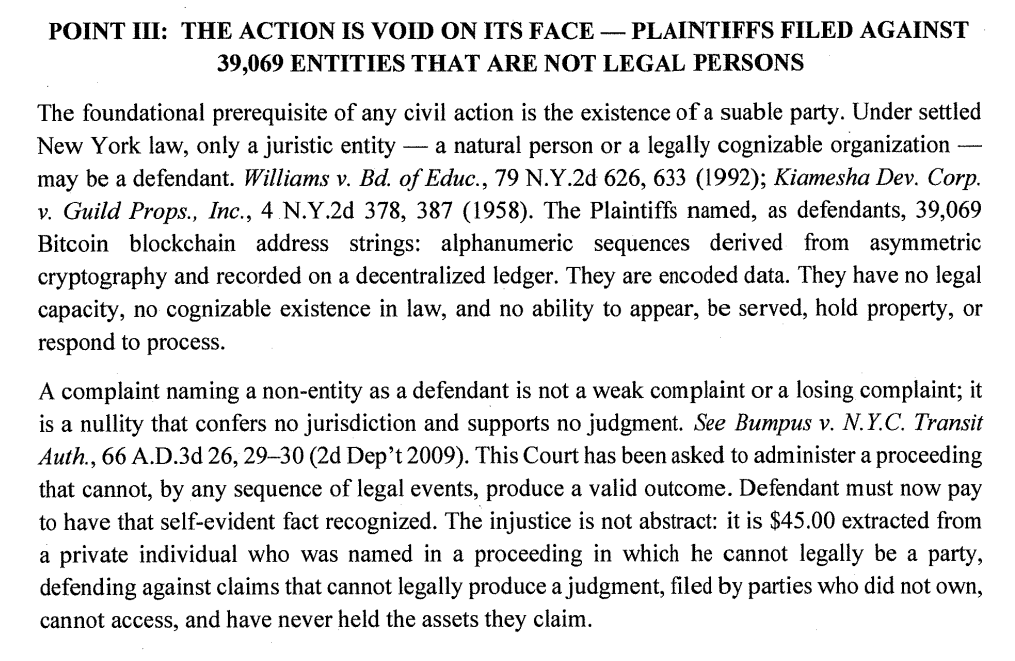
A pseudonymous defendant has moved to dismiss a New York lawsuit seeking ownership of 39,069 dormant Bitcoin addresses, arguing that Bitcoin addresses are merely data strings that cannot be sued.
The defendant, identifying themselves as “John Doe 33,” filed a notice of appearance and motion to dismiss on Thursday, claiming they control one of the dormant wallets named in the lawsuit.
According to the motion, the lawsuit is legally defective because Bitcoin address strings are neither persons nor legal entities subject to the court’s jurisdiction. The filing argues that a public Bitcoin address cannot itself be “found” under New York’s lost-property law because it has always been publicly visible on the blockchain.
The filing challenges the lawsuit filed in May by plaintiff “Noah Doe” and two Wyoming-based LLCs, ABC Company and XYZ Company. The plaintiffs claim the Bitcoin tied to the listed addresses constitutes abandoned property that they reported to the New York Police Department and claimed under New York lost-property law.
Regardless of how the court rules on ownership, it remains unclear how the plaintiffs could recover any Bitcoin without possessing the private keys needed to access the wallets.
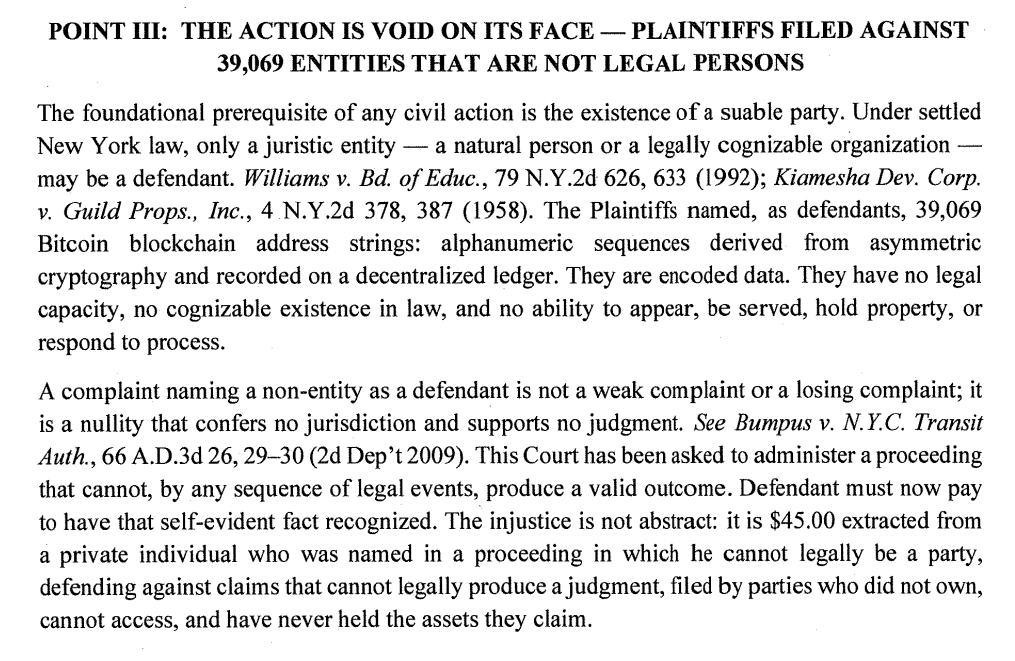
Defendant files a motion to dismiss the case seeking ownership of 39,069 Bitcoin wallets. Source: iapps.court.state.ny.us
The complaint lists 39,069 Bitcoin addresses, including wallet addresses widely associated with Bitcoin creator Satoshi Nakamoto and the Mt. Gox hacker. The listed wallets collectively hold an estimated 3.7 million BTC (worth about $234 billion), according to Sani, founder of Bitcoin analytics platform Timechain Index.
Related: Bitcoin miner MARA spent $4.3M on CEO security in 2025 as crypto attacks rise
Defendant appears to control $300 million Bitcoin wallet
Blockchain data suggests that “John Doe 33” controls a wallet holding 5,000 BTC received in April 2014 that has remained untouched for more than 12 years, making it worth more than $300 million at current prices, according to a Friday X post from Galaxy Digital head of research Alex Thorn.
“That’s ~100x the median defendant address. This is a real holder with real standing choosing to fight, not a bystander.”
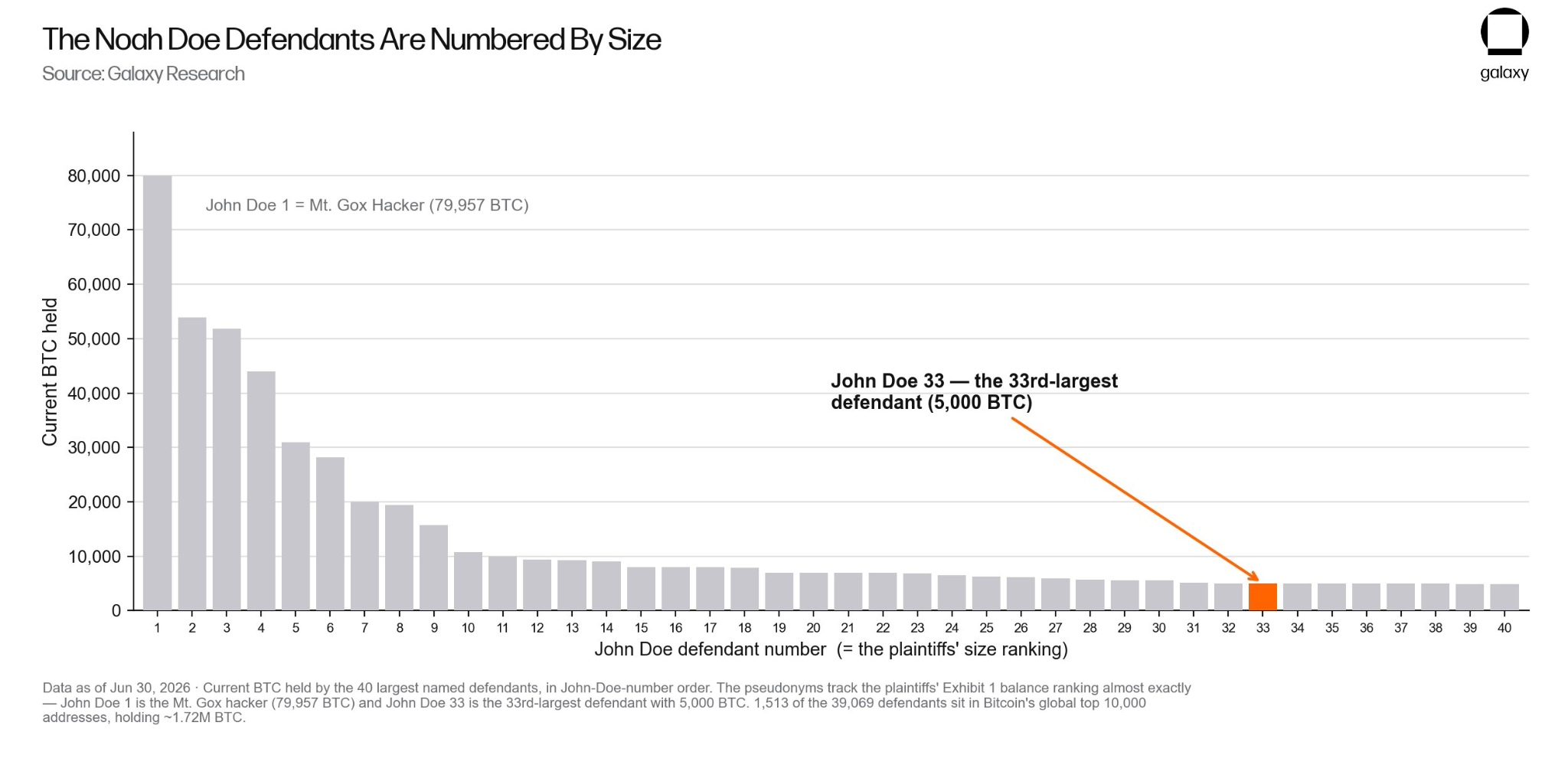
Source: Alex Thorn
Thorn added that the filing prevented what had been a “near-certain” default judgment and challenged jurisdictional and statutory defects in the plaintiffs’ case.
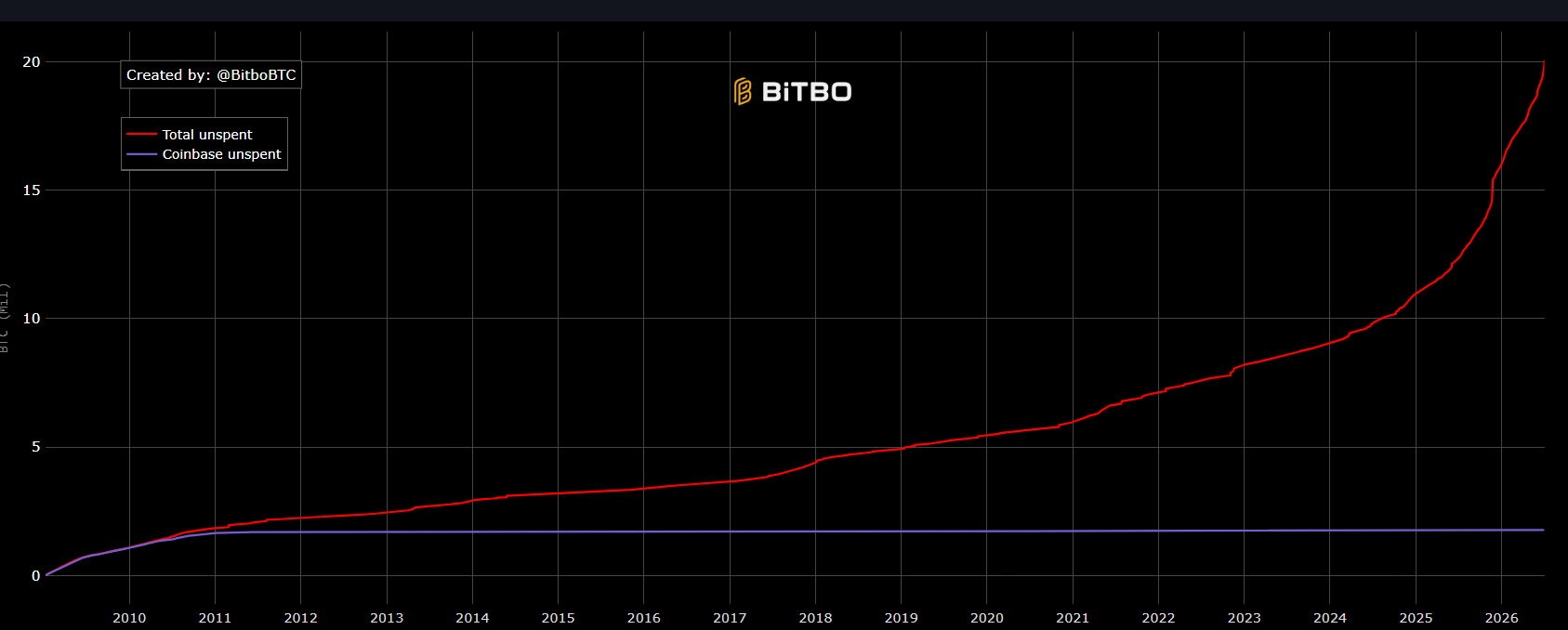
The supply of Bitcoin has been dormant for the past five and 10 years. Source: Bitbo
There are currently 3.5 million BTC, worth about $215 billion, that have been dormant for the past 10 years and another 6.6 million coins, worth around $406 billion, that have been dormant for over five years, Bitbo data shows.
Magazine: How crypto laws changed in 2025 — and how they’ll change in 2026

TLDR
- European regulator expands MiCA registry with 37 additional crypto service providers.
- Major financial institution Standard Chartered receives EU crypto authorization.
- Total licensed crypto asset service providers in EU reaches 280.
- Cyprus emerges as top contributor with six newly approved CASPs.
- EU regulatory framework transitions from development to active enforcement phase.
Europe’s securities watchdog has expanded its MiCA-compliant crypto registry with 37 additional firms following the conclusion of the transition window. This expansion brings the total number of authorized providers to 280. The development marks a pivotal shift from regulatory development to active market oversight.
European Crypto Registry Receives Significant Update
ESMA released its initial registry revision following the conclusion of MiCA’s transitional window on Wednesday. The Friday announcement included companies that successfully obtained crypto-asset service provider authorization. Consequently, the registry now offers enhanced transparency regarding licensed European Union operators.
ESMA’s previous registry update, issued on June 26, documented 243 crypto-asset service providers. The current revision increased this figure to 280. This expansion means 37 additional companies have entered the European Union’s structured crypto regulatory framework.
Notable additions to the registry include Standard Chartered, FalconX, Sygnum Europe, and Ronin EM. Furthermore, the electronic money token section welcomed Crédit Agricole’s CACEIS division. Notably, ESMA did not document any new asset-referenced token issuers during this update cycle.
Major Bank Secures European Crypto Authorization
Standard Chartered emerged as one of the most prominent additions in ESMA’s recent registry expansion. Luxembourg’s financial authorities granted the banking institution MiCA authorization on June 25. This approval establishes a compliant pathway for the bank’s cryptocurrency operations throughout Europe.
The financial institution simultaneously obtained an Electronic Money Institution license from Luxembourg authorities. This credential enables electronic money issuance and payment processing services. Combined, these authorizations facilitate custody operations, token-related services, and payment-integrated digital asset activities.
Standard Chartered indicated these licenses align with its broader European digital asset strategy. The institution has previously expanded digital asset custody capabilities across Asian and Middle Eastern markets. MiCA provides a unified regulatory structure for comprehensive EU market participation.
Mediterranean Nation Dominates Recent Authorization Cycle
Cyprus emerged as the frontrunner in the latest ESMA registry expansion, contributing six newly authorized crypto-asset service providers. France, Italy, and Malta each contributed five companies. The Czech Republic and Spain registered four providers respectively.
Luxembourg contributed three new registrations, while the Netherlands added two companies. Germany, Liechtenstein, and Latvia each registered one licensed provider. This geographic distribution demonstrates how individual national authorities contribute approvals to the centralized ESMA registry.
Cyprus has now issued 21 MiCA authorizations through its securities regulatory body. Germany maintains the overall leadership position with 58 authorizations under BaFin supervision. Nevertheless, smaller jurisdictions remain competitive by offering streamlined and transparent licensing procedures.
Regulatory Framework Transitions to Enhanced Oversight
The most recent ESMA registry update reveals inconsistent advancement across MiCA’s different categories. The asset-referenced token registry remains without any approved issuers. The non-compliant entities roster stayed static at 162 companies.
This disparity indicates that service provider licensing is advancing more rapidly than certain token issuance approvals. Exchanges, brokers, custodial services, and financial institutions now have established pathways. However, token issuers continue facing more stringent requirements and extended approval processes.
The registry now functions beyond a simple compliance database. It influences market access decisions, counterparty verification processes, and institutional risk assessment procedures. ESMA has transformed MiCA into an operational gateway for European Union crypto market participation.

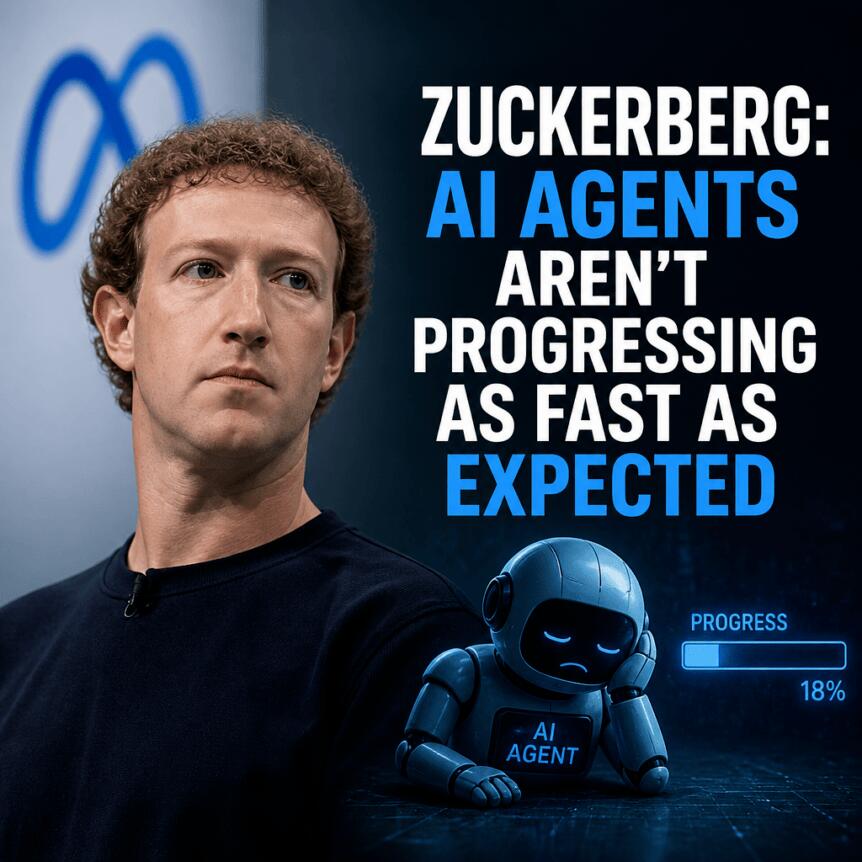
Meta CEO Mark Zuckerberg has sounded a note of caution on the pace of “agentic” AI development, telling employees that progress on autonomous agents has not accelerated as quickly as expected despite heavy investment by major technology and crypto firms.
Speaking during a company meeting on Thursday, Zuckerberg said the “trajectory of the agentic development over at least the last four months hasn’t really accelerated in the way that we expected,” Reuters reported after reviewing a recording of the call. He added that the broader bet on agent adoption “hasn’t come to fruition yet,” even as leadership pushed harder into agent-focused infrastructure earlier this year.
Key takeaways
- Zuckerberg said Meta’s agentic AI progress has not matched expectations over the past four months, according to Reuters.
- Meta executives accelerated agent-focused infrastructure plans in January due to concerns they were moving too slowly.
- Meta still expects returns from its AI spending within three to six months, Zuckerberg said.
- Meta expanded its Meta Business Agent globally for businesses across Instagram, Messenger, and WhatsApp.
- Blockchain data suggests AI-agent transaction activity remains limited, including only about $2 million in x402-facilitated volume over the last 30 days, per Artemis.
Meta’s AI agents: expectations versus delivery
Zuckerberg’s remarks highlight a growing mismatch between the industry’s timeline for autonomous AI agents and how quickly real-world systems can scale and deliver value. While agentic AI has captured attention from both software giants and crypto-adjacent companies, Zuckerberg indicated that even within a company widely positioned for rapid experimentation, momentum has been slower than planned.
Reuters reported that Zuckerberg pointed to a lack of acceleration in the “last four months,” despite a push intended to close perceived speed gaps. He acknowledged that an aggressive January push into agentic infrastructure was driven by fears that Meta wasn’t advancing “fast enough,” while also framing the current state as not yet reaching the level of adoption leadership expected.
At the same time, Zuckerberg said he believes Meta’s AI investments will start paying off within the next three to six months. That timeframe matters for investors and teams because it signals management still expects near-term results—even if the broader agent ecosystem remains behind schedule.
Business Agent rollout across Meta’s messaging and social apps
Meta’s comments came alongside new product deployment. On Thursday, the company expanded its Meta Business Agent globally, aiming to bring agent capabilities to businesses operating across Instagram, Messenger, and WhatsApp.
According to Meta, the Business Agent is designed to handle customer inquiries, make product recommendations, and close sales without requiring human intervention. For businesses, the appeal is straightforward: agent systems can reduce response times and staffing pressure while enabling commerce flows inside channels where customers already interact.
Zuckerberg also previously said in March that he was building a personal AI agent to support CEO decision-making, reinforcing Meta’s view that agent tooling can move beyond customer-facing automation into internal workflows.
Crypto’s agent payments thesis faces measured on-chain activity
Zuckerberg’s reality check lands amid a crypto industry that has largely embraced the idea that AI agents could become major users of blockchain payments. Executives including Coinbase CEO Brian Armstrong and Circle CEO Jeremy Allaire have previously predicted that AI agents may become dominant users of blockchain-based payment rails in the coming years, as noted in coverage referenced by Cointelegraph.
In support of that narrative, several integrations have been announced in recent months. Cointelegraph previously reported that Amazon Web Services integrated Coinbase’s x402 payments protocol into Amazon Bedrock AgentCore in May, enabling agents to transact using the USDC stablecoin. Other examples cited include a Visa-supported virtual card for AI agents from Oobit launched in April for purchases in USDt (USDT).
However, the gap between “capability” and “usage” is showing up in on-chain volume. Artemis data cited by Cointelegraph suggests that AI-agent transaction activity facilitated through the x402 protocol remains comparatively small: only $2 million in trading volume over the past 30 days.
This matters because the crypto payments story around autonomous agents depends not just on integrations being possible, but on consistent demand emerging from actual agent behavior. Low volume can indicate early-stage adoption, experimentation without sustained deployment, or limitations in how agents currently interact with payment endpoints.
What to watch next for agentic AI and stablecoin payments
Zuckerberg’s comments suggest the industry may need to plan for a slower-than-hoped transition period as agentic systems mature and as businesses learn where automation genuinely outperforms human-led workflows. At the same time, Meta’s investment outlook—expecting payback within three to six months—signals continued pressure to convert AI spending into operational results.
For the blockchain segment, the next checkpoint should be whether on-chain payment volume tied to agent infrastructure increases materially from current levels, and whether new business-facing deployments like Meta Business Agent lead to measurable downstream demand for stablecoin payment rails.

Jensen Huang's signed leather jacket could sell for up to $60,000 at charity auction

Plan for new 3km sewer pipeline into River Wear moves ahead

ASKUL Corporation 2026 Q4 – Results – Earnings Call Presentation (OTCMKTS:ASKLF) 2026-07-03


-

 Tech6 days ago
Claude Code turned every engineer into three. Now companies need more product thinkers
-

 Crypto World4 days ago
Strategy authorizes up to $1.25B in Bitcoin sales under new capital plan
-

 Politics10 hours ago
The House | “Reframing the debate from a binary discussion of winners and losers”: Yuan Yang reviews ‘We Are Not Machines’
-

 News Videos5 days ago
MAJOR BITCOIN & MARKET UPDATE!!!! (MUST WATCH ASAP!!!)
-

 Tech6 days ago
Bluekit phishing kit adopts browser-in-the-middle for login theft
-

 Tech4 days ago
Anonymous researcher drops 0-day ‘exploitarium’ repo
-

 Crypto World6 days ago
Coinbase, Circle Deepen Crypto Stock Losses Despite Resilient S&P 500
-

 Fashion4 hours ago
Weekend Open Thread: High Hopes
-

 Business4 days ago
Australia treasurer says alleged access of prime minister’s bank data ’incredibly concerning’
-

 Crypto World7 days ago
Kraken's xStocks Opens Bending Spoons IPO Registration to EEA Retail
-

 Tech6 days ago
Russian hackers now target Signal backup recovery keys
-
 Business4 days ago
The AI boom won’t burst all at once. It will pop in ‘rolling bubbles’: Macquarie
-

 Sports2 days ago
Broncos roster: OL Ben Powers (No. 74) entering final year of contract
-

 NewsBeat3 days ago
Presenter Caroline Flack’s brother Paul Flack dies aged 55
-

 Tech6 days ago
Silicon Valley paid to kill AI regulation, now it wants the rules back
-

 Crypto World2 days ago
Binance stock trading tops $1B in first month after launch
-

 Tech6 days ago
OpenAI mulls delaying IPO over valuation concerns
-
 NewsBeat2 days ago
New exhibition reflects five decades of movement between island of Ireland and GB
-

 Crypto World2 days ago
Alibaba-affiliate Ant Group enters the humanoid robot market with 12 deals
-

 News Videos4 days ago
How to Build INSANE Live Financial Dashboards With Claude
You must be logged in to post a comment Login