The most affordable Wildcat Lake notebook currently listed online is the Chuwi UniBook, priced at $449 before tax. It runs Windows 11 and is powered by the Core 3 304 processor, which features five CPU cores clocked at up to 4.3GHz, a single Xe GPU core running at up to… Read Entire Article Source link
ICE, the owner of the New York Stock Exchange, is partnering with index provider Ornn to launch cash-settled futures contracts tied to GPU computing costs. The move comes days after rival CME Group announced its own compute futures, signalling that Wall Street is racing to turn AI computing power into a standardised, tradable commodity.
Advertisement
Intercontinental Exchange, the parent company of the New York Stock Exchange, is preparing to launch futures contracts tied to the cost of computing power, marking the latest sign that Wall Street sees AI infrastructure as the next great commodity market.
ICE announced on Monday that it will team with Ornn, a financial-infrastructure firm whose index products track GPU computing costs in real time, to develop the new contracts. The futures will be US dollar-denominated, cash-settled, and referenced against Ornn’s indexes covering a variety of major GPU types. The plans remain subject to regulatory approval.
What ICE and Ornn are building
The partnership pairs one of the world’s largest exchange operators with a startup that has quietly built the plumbing for compute price discovery. Ornn, formally Ornn AI Inc, publishes the Ornn Compute Price Index, which tracks live traded spot prices for GPU compute across hardware types including Nvidia’s H100, H200, and B200 chips. The index, now available on the Bloomberg Terminal, draws on real transaction data from live GPU markets and has attracted more than 400 data centre operators, investors, and AI companies to its platform.
The 💜 of EU tech
Advertisement
The latest rumblings from the EU tech scene, a story from our wise ol’ founder Boris, and some questionable AI art. It’s free, every week, in your inbox. Sign up now!
Trabue Bland, senior vice president of futures markets at ICE, framed the move as a response to a market that has outgrown its informal pricing mechanisms. The compute market, he said, is “in desperate need of a globally accepted pricing mechanism and risk management tool” as AI shifts from research labs to becoming a central driver of the global economy.
The contracts will settle in cash rather than through physical delivery, a structure familiar from energy and financial futures. For AI companies planning large model training runs or cloud providers locking in capacity, the instruments would offer a way to hedge against the kind of volatile compute costs that have accompanied Big Tech’s $650 billion capex surge in 2026.
A two-horse race with CME
ICE is not alone in spotting this opportunity. CME Group, the world’s largest derivatives exchange, announced its own compute futures contracts on 12 May, partnering with Silicon Data to build products based on daily GPU benchmark rental rates. CME’s contracts will reference the Silicon Data H100 Rental Index, which tracks the cost of renting high-end GPUs used for AI training workloads.
Advertisement
The fact that two of the world’s most established futures exchanges have moved on compute within days of each other signals that institutional conviction in compute-as-commodity has reached a tipping point. It mirrors the early days of energy futures in the 1980s, when competing exchanges raced to establish benchmark contracts for crude oil and natural gas. The exchange that captures the most liquidity early on will likely set the reference price for the industry, just as ICE Brent and CME WTI did for oil.
The competitive dynamic also extends beyond the big two. Architect Financial Technologies partnered with Ornn in January to launch exchange-traded perpetual futures on GPU and RAM prices through its AX platform, and prediction market Kalshi has offered contracts allowing users to wager on Nvidia GPU compute prices. But ICE and CME bring something the newer entrants lack: deep institutional liquidity, regulatory credibility, and the clearing infrastructure that large-scale GPU-as-a-service providers and their customers will demand.
Why compute needs a futures market
Kush Bavaria, co-founder and CEO of Ornn, put the scale of the problem bluntly. Compute, he said, “has grown into a trillion-dollar market, yet it still lacks the pricing and risk-transfer infrastructure that every other major commodity relies on.”
That gap has real consequences. GPU rental prices have been wildly volatile, with Ornn’s own index showing the Nvidia Blackwell spot rental price surging 48% between mid-February and mid-April 2026, from $2.75 to $4.08 per GPU-hour. For AI companies whose training runs can cost tens of millions of dollars, that kind of price swing can blow through budgets with little warning. Cloud providers, data centre operators, and the lenders financing billions of dollars in AI infrastructure buildouts face similar exposure.
Advertisement
A functioning futures market would allow these participants to lock in forward prices, transfer risk to willing counterparties, and plan capital expenditure with greater certainty. It would also generate transparent price signals that the broader market currently lacks, giving investors, analysts, and policymakers a clearer view of where compute costs are heading.
Broader implications for the AI economy
The emergence of compute futures reflects a deeper structural shift. As AI moves from an experimental technology to core economic infrastructure, the inputs that power it are being financialised in much the same way that energy, metals, and agricultural products were in previous decades. The surging demand for advanced semiconductors has already reshaped chip supply chains and driven record capital investment across the technology sector.
Futures contracts add a new layer to this ecosystem. They create standardised benchmarks that can underpin lending decisions, insurance products, and investment strategies tied to AI infrastructure. A bank financing a new data centre, for instance, could use compute futures to assess the facility’s projected revenue against forward GPU prices, much as energy lenders use oil futures to evaluate drilling projects.
There are complications, of course. Unlike oil sitting in a tank, compute is what traders call a flow commodity, one that is consumed in real time and cannot be stored. Ornn has addressed this by designing its futures with Asian-style settlement, meaning contracts settle on the arithmetic average of daily index values across the contract’s tenor rather than on a single expiry-day price. This structure aligns the financial instrument with the way compute is actually purchased and consumed.
Advertisement
Whether ICE or CME ultimately captures the lion’s share of this market will depend on liquidity, the breadth of GPU types covered, and which index providers gain the most institutional trust. But the direction of travel is clear. Computing power, the resource that underpins everything from energy-hungry AI data centres to autonomous vehicle development, is being transformed from a bespoke procurement headache into a standardised, tradable financial asset. For an industry accustomed to negotiating GPU access through opaque, bilateral deals, that is a significant change.
We do know that Booz Allen Hamilton is making much more money than it originally projected. In the contract, the company estimated that it would make $87 million in the first five years, and a total of about $182 million over 10 years if the contract was extended, which it has been.
According to their invoices, Booz Allen Hamilton billed for more than $140 million in the first four years of the contract. The Forest Service didn’t return our FOIA request for more recent numbers, but one analyst, Canadian sales strategist Blair Enns, projected that they could make $620 million by the time their contract expires in September 2028.
The uptick in traffic is one reason for that. But the model has also changed since 2016. That year there were less than 3 million reservations through the site; in 2023 there were roughly 9 million. BAH says there are now 5,800 facilities and more than 128,000 sites and activities to reserve. More facilities have shifted to using Rec.gov’s system, and things that were free, or didn’t exist, are now run through Rec.gov, where they come with a charge. That includes things like free Christmas tree–cutting permits for fourth graders (now with a $2.50 fee!) and timed entry tickets to national parks, introduced in 2021, which are nominally free but have a $2 processing fee. Booz Allen Hamilton gets a percentage of every permit application fee, even if you don’t win a permit.
That might be news to you, because it’s not clearly delineated on the site. As one former ranger, Betsy Walsh, told me, she often talked to people who were surprised. “People want to support the parks, so they’re fine with fees,” says Walsh, who worked at several parks before being let go from her job at Thomas Edison National Historical Park during the 2025 DOGE layoffs. “But you’re not supporting the parks. You’re supporting a private company.”
Advertisement
It’s not transparent. And in the past few years, several groups have gone to court alleging that it’s not legal, either.
In 2022, a Nevada hiker named Thomas Kotab sued the Bureau of Land Management, arguing in his complaint that the $2 fee for visiting Red Rock Canyon National Conservation Area violated FLREA, which says public participation is required for setting fees and that it needs to be clear how much money stays on the landscape. The BLM moved to dismiss the case, but the district court ruled in Kotab’s favor on the public-participation aspect of his claim. The fees, however, were never changed.
The next year, seven plaintiffs filed a class-action suit, Robyn Wilson et al. v. Booz Allen Hamilton Inc., in the U.S. District Court for the Eastern District of Virginia, alleging that the company was “forcing American consumers to pay Ticketmaster-style Junk Fees to access National Parks and other federal recreational lands.” BAH filed a motion to dismiss, alleging the plaintiffs didn’t understand the contract. “To be sure,” its memorandum asserted, “certain federal agencies charge reservation fees to the users to help cover the government’s costs of operating Recreation.gov, including the USDA’s payments to Booz Allen. But those fees are charged by the agencies in their ‘sole discretion.’” More than six months after filing their lawsuit, the plaintiffs filed a motion to voluntarily dismiss their case. Their lawyers did not reply to requests for comment.
Microsoft is launching three new Intel-powered Surface devices for businesses: the Surface Pro 12, Surface Laptop 8, and a smaller 13-inch Surface Laptop model. These new machines come equipped with newer Intel chips, a few business-focused upgrades, and notably higher starting prices. “The high pricing of these three new Surface devices is a sign of things to come for whatever consumer models Microsoft is planning this year,” notes The Verge. From the report: This time around Microsoft is refreshing its Surface Pro and Surface Laptop models with Intel’s latest Core Ultra Series 3 processors first, ahead of similar models with Qualcomm’s new Snapdragon X2 processors later this year. The new Surface Pro 12, or as Microsoft calls it the Surface Pro for Business 13-inch (12th Edition), will be available for businesses today, starting at an eye-watering $1,949.99. The base model will include an Intel Core Ultra 5 processor, 16GB of RAM, 256GB of storage, and the regular 13-inch PixelSense LCD display.
Businesses will have to pay extra for models with Intel’s Core Ultra 7 processor, up to 64GB of RAM, and up to 1TB of storage. The top spec Surface Pro 12 with a Core Ultra 7, 64GB of RAM, and 1TB of storage will be priced at $4,399.99, and there are also OLED screen options and models with 5G connectivity. The Surface Pro 12 5G starts at $2,249.99, with a Core Ultra 5, 16GB of RAM, and 256GB of storage. […] Microsoft is also launching two new versions of the Surface Laptop for businesses today. The Surface Laptop 8, or Surface Laptop for Business 13.8 or 15-inch (8th Edition) as Microsoft calls it, will also be available with a range of Intel’s Core Ultra Series 3 chips. It launches alongside a smaller 13-inch model, which is confusingly labeled the Surface Laptop for Business 13-inch (1st Edition).
The 13.8-inch model starts at $1,949.99, and includes Intel’s Core Ultra 5 processor, 16GB of RAM, and 256GB of storage. While Surface devices for businesses have typically had higher pricing than consumer models, the $1,949.99 starting price for a Surface Laptop 8 is almost double the original price of the Surface Laptop 7. RAMageddon really has come for Microsoft’s Surface Pro and Surface Laptop devices, after recent price increases meant the existing consumer models are now $500 more expensive than their original starting price. The max configuration for the 13.8-inch Surface Pro 8 will include a Core Ultra 7, 64GB of RAM, and 1TB of storage for $4,299.99. A similar version of the 15-inch model (with an x7 processor) will be priced at $4,499.99.
Bastion is a Historical European Martial Arts academy reviving the fighting arts of medieval times
Inside a quiet industrial estate along Jalan Pemimpin, a group of Singaporeans spend their evenings studying centuries-old combat manuals and crossing swords in full protective gear.
They train at Bastion, a Historical European Martial Arts (HEMA) academy dedicated to “reviving the fighting systems” of medieval Europe.
Founded in 2017 by husband-and-wife duo Lucien Lee and Langley Qu, the academy has grown from a small Reddit meet-up into what they say is the largest full-time HEMA school in Southeast Asia, with about 150 active students today.
Four people showed up to their first session
Image Credit: @bastionhema, @bai_ren via Instagram
Unlike modern fencing, HEMA seeks to reconstruct historical combat from surviving manuscripts dating back hundreds of years. At Bastion, most lessons draw from German-speaking regions of the Holy Roman Empire between the 14th and 16th centuries.
“The techniques we use come from historical treatises, fighting manuals and manuscripts left behind by medieval masters,” said Lucien, 36.
Advertisement
On a nearby table sits a facsimile of one such manuscript, its pages filled with illustrations and handwritten Middle High German text. Beside it lies a translated English version used by instructors and students.
“The historical aspect is a huge part of what we do,” said Langley, 42. “For us, this is almost like a time machine to bring history back to life.”
Image Credit: Vulcan Post
The couple first discovered HEMA in Swansea, Wales, more than a decade ago. Lucien, who had long been interested in martial arts, found a local HEMA club while the two of them were studying there. Langley initially intended only to observe, but their instructor had other plans.
“The instructor basically told me, ‘It’s free if you sit and watch, and it’s free if you try, so why wouldn’t you try?’” she said.
When the pair returned to Singapore after completing their studies three years later, they wanted to continue training but found only a small local HEMA scene. So Lucien turned to Reddit, posting an invitation for anyone interested to try the sport at a void deck.
Advertisement
Four people showed up.
“That was basically our trial run,” said Langley. “We wanted to create the kind of community that we ourselves would have wanted.”
The pair later incorporated Bastion and promoted trial sessions on Facebook, attracting about 30 participants in the first intake.
For the first year, training sessions were still held at void decks and other makeshift spaces before they eventually secured their dedicated premises at Jalan Pemimpin. Over the years, several hundred people have trained at the academy, with some students from the original Reddit sessions still attending classes today.
Advertisement
The tools of the trade
Image Credit: @bastionhema, @bai_ren via Instagram
Training at Bastion uses a range of weapons for Historical European Martial Arts, including foam, nylon and steel swords. The steel blades used for sparring are blunted, with flattened tips.
Participants are also required to wear full protective gear, including fencing masks, padded jackets, heavy gloves, and limb protection, depending on the intensity and material of the weapon used. Safety, the founders said, is built into every layer of training, from compulsory basics classes to structured drills that teach control before free sparring is introduced.
(Left): Steel swords and training weapons used for sparring at Bastion; (Right): Full protective gear worn during Historical European Martial Arts sessions, including fencing masks, padded jackets and gloves./ Image Credit: Bastion
Much of Bastion’s equipment is imported from specialist makers in Europe, where HEMA has a longer-established supply ecosystem. But bringing those weapons into Singapore was not always straightforward.
On their return from the UK, the couple brought back 11 swords in their luggage, prompting a lengthy inspection at Changi Airport. Officers from the Singapore Police Force were brought in to assess what exactly they were dealing with.
“They all came down and we explained what we do,” said Lucien. “After about two hours of discussion, they cleared everything.”
At the time, the weapons required careful handling under Singapore’s regulations for controlled items, meaning every import had to be justified as training equipment rather than offensive weapons. The couple said transparency with authorities was key from the start.
Advertisement
“There’s no reason to hide what we do,” Lucien added. “These are training tools. They’re blunt, flexible, and designed for sport.”
More recently, Langley shared that the rules have become clearer. Training swords used for martial arts and sporting purposes are now generally allowed as long as they meet safety requirements and are used in controlled environments.
This change also brings HEMA equipment in line with other martial arts weapons, including those used in disciplines such as wushu, which are treated under similar conditions. While imports have become smoother, the academy said all equipment is still subject to customs checks and must comply with existing rules.
Building something that lasts
Image Credit: @bastionhema, @bai_ren via Instagram
Running a full-time HEMA academy in Singapore, however, comes with challenges beyond importing equipment.
For Lucien and Langley, one of the biggest constraints is space. Because students train with long weapons that require a safe striking distance, the academy needs a large, open hall with high ceilings—a rare setup in land-scarce Singapore.
Advertisement
“You can’t just do this anywhere,” said Lucien. “The space really determines what you can or cannot run.”
At their current location, running the academy costs around S$30,000 to S$40,000 a month, with rent forming a significant portion of that.
Image Credit: @bastionhema via Instagram
Today, Bastion operates around 50 classes a week, with sessions held on weekday evenings and throughout the weekends. Each class typically has eight to 10 students.
Despite the scale, Bastion remains highly structured in its teaching approach. Students advance through a structured curriculum, and those who stay long enough may eventually find themselves on the other side—teaching the very classes they once started in.
“We need them to understand how we teach before they can teach,” said Langley.
Advertisement
The academy’s student base is diverse, though working adults under 40 make up the largest group. Others include National Servicemen, university students and older hobbyists. Some are drawn in by martial arts or fencing, while others discover HEMA through fantasy media such as The Lord Of The Rings, Game Of Thrones or role-playing games like Dungeons & Dragons.
What keeps many of them returning, the founders said, is not just the sport itself, but the community built around it.
Beyond training, Bastion regularly organises social events such as movie nights, holiday gatherings and post-training meals. The founders said this helps create a space where students can bond outside of sparring.
“People come in for many reasons,” said Langley. “But they stay because they feel part of something.”
Advertisement
That sense of belonging has also shaped how the academy approaches competition. While some students do take part in local and overseas tournaments, Bastion does not position itself as competition-focused.
“We always tell them it’s not about winning at all costs,” said Lucien. “It’s about learning, testing yourself and engaging with others in the same space.”
Looking ahead, the couple hope to expand Bastion as interest grows, though space remains a limiting factor. A second location is something they are exploring, but not rushing into.
In the meantime, the academy has been reaching beyond its walls—running workshops in schools and youth organisations, where students get their first taste of HEMA and its historical roots.
Advertisement
For Lucien and Langley, the wider ambition is to shift how Singaporeans think about martial arts altogether.
“When people think of martial arts, they usually think of Asia,” said Langley. “But every culture had its own fighting traditions.”
For the founders, Bastion is not just about swords or sparring, but about reviving a lesser-known part of history—and building a community around it.
“As long as people are curious,” said Lucien, “there will always be something to discover in it.”
Sony’s 1000 Series wireless headphones are turning 10, which is one of those “wait, how old am I now?” moments that sneaks up and punches you in the ribs. A decade after Sony turned the ANC headphone category into a street fight with Bose, the WH-1000XM6 now sits at the top of the line as the company’s most advanced active noise cancelling model yet. But Sony clearly wants to tilt the table again with the new 1000X The ColleXion, a 10th anniversary release aimed at reminding everyone who helped make premium ANC headphones a daily travel essential.
The market is blood sport at the very top, with Sony, Bose, Apple, Beats, and Sennheiser all fighting for a massive slice of a category worth billions. Hop on any flight, walk through any airport lounge, or sit in a crowded coffee shop, and you will see the evidence clamped to people’s heads. ANC is no longer a luxury feature. It is the battlefield.
Sony The ColleXion in Platinum (off white).
But for some of us, noise cancelling is not the only box that matters. The Sony WH-1000XM6 took a hit in my review for comfort and style, even if it still ranked near the top for sound quality and ANC performance. That tradeoff matters at this level, especially when you are wearing them for hours and not just trying to silence a crying baby at 35,000 feet.
I pointed readers toward alternatives in the same price range that give up some noise cancelling for better ergonomics and design. Brands like Focal, Master & Dynamic, and Bowers & Wilkins, along with the ever-present Apple AirPods Max, all play in this space. They do not match Sony on ANC, but they counter with better materials, stronger visual identity, and in some cases, better long-term comfort. At this price, that is not a minor detail. That is the whole argument.
Sony 1000X The ColleXion Takes the Fight Above the XM6
Today’s release of the Sony 1000X The ColleXion moves the 1000 Series into more premium territory, with Sony clearly aiming beyond noise cancellation alone. The ColleXion starts with a more substantial physical design. Sony has specified stainless steel for the headband, yokes, buttons, and jack housing, along with leather ear cups and bands that are wider and deeper than the XM6 while still keeping the ear cups relatively compact.
Advertisement
The headband is designed to distribute its 320 gram weight for longer listening sessions, while the pads are intended to improve passive isolation without turning comfort into a parole hearing. Available in platinum white or black, the stainless trim gives the headphone a more upscale visual identity than the XM6 without turning it into jewelry with Bluetooth.
The ColleXion comes with a uniquely designed color matched carrying case, analog 3.5mm cable and USB-C charging cable.
This is not just an XM6 in a nicer shell. Sony has reworked the internals with thicker copper circuit boards, fewer board layers to help reduce resistance, a new V3 chipset, and a redesigned 40mm unidirectional carbon fiber diaphragm driver. The goal is lower distortion, faster transient response, and more DSP headroom than Sony has previously offered in a wireless headphone.
The added processing power brings DSEE Ultimate support, along with new music and gaming spatial modes in addition to the cinema mode already associated with the 1000 Series. Bluetooth 6.0 support adds LC3 and LDAC connectivity, while battery life lands at a claimed 24 hours, which is down from the XM6 but still enough for a full day of use unless your travel schedule was planned by someone who thinks Newark is a personality test.
Even the case has been rethought, with a new carry handle and magnetic closures designed to feel more secure and convenient. The style is more befitting to the fashion accessory that some will inevitably see it as. At launch, the ColleXion will be available in Black and Platinum (off-white) colorways.
Sony has not provided impedance, sensitivity, or frequency response specs, so anyone looking for those numbers will have to wait. What is clear is that The ColleXion is Sony’s attempt to answer the premium build and style argument without giving up the ANC DNA that made the 1000 Series such a force in the first place.
The Bottom Line
At $649, the Sony 1000X The ColleXion becomes Sony’s new wireless headphone flagship and moves directly into the path of Apple, Focal, Bowers & Wilkins, Master & Dynamic, and every other brand selling premium materials with premium attitude. What makes it different is that Sony is not walking away from the 1000 Series formula. It is adding stainless steel, leather, a new 40mm carbon fiber driver, V3 processing, DSEE Ultimate, Bluetooth 6.0, LC3, LDAC, a uniquely styled carry case and new spatial modes to a platform already known for elite ANC.
Advertisement
Advertisement. Scroll to continue reading.
What is missing? Sony has not provided impedance, sensitivity, or frequency response specs, and the claimed 24 hour battery life is lower than the XM6. At 320 grams, comfort also needs to be proven over longer sessions. Shipping has begun, with store availability starting May 19, 2026, and we hope to have a review sample in the next few weeks for a more complete evaluation. If The ColleXion really does push the XM6 formula forward in comfort, style, and performance, it could become an early Editors’ Choice favorite for 2026. Sony clearly wants the crown back polished, heavier, and more expensive.
from the get-some-actual-probable-cause,-you-mooks dept
Judge Beryl Howell has now told ICE at least twice: it’s not allowed to grade its own papers.
Since Trump’s return to office, the federal government has been engaged in a months-long purge of anyone who looks a bit foreign. ICE has increasingly relied on administrative warrants to do everything including enter homes to effect arrests of people who’ve only allegedly engaged in civil violations.
Don’t let the word “warrant” fool you. No judge has signed off on these so-called warrants, and they’re certainly not capable — constitutionally-speaking — of granting ICE officers the legal authority to effect arrests of people who would normally just be given a summons, much less allow them to enter people’s homes.
But that was the way things went for several months before dozens of courts and hundreds of decisions told ICE otherwise. With courts ordering ICE to stop arresting people without judicial warrants, ICE had to walk back its aggression a bit. But only a bit. What’s being addressed by a second order by this same DC federal court is representative of ICE’s day-to-day activities around the nation.
Advertisement
This court had already ordered ICE to cease its warrantless arrests of immigrants it couldn’t actually show might pose a flight risk if not locked up. Even policy clarification issued by acting ICE head Todd Lyons in the wake of dozens of courtroom losses failed to change anything in DC. The most reasonable explanation for this apparently deliberate “failure” to comply with court orders and the Constitution is that no one in ICE actually believes Todd Lyons will ever hold any ICE officer accountable.
Judge Howell’s order [PDF] says ICE and its current director are playing word games in hopes of keeping the arrest rate up, defining “escape risk” so loosely it would be almost impossible for any migrant accosted by federal officers to be considered anything else than immediately arrestable.
Plaintiffs raise no issue with the Lyons Memo’s initial definition of “escape risk” to mean whether “an immigration officer determines [an individual] is unlikely to be located at the scene of the encounter or another clearly identifiable location once an administrative warrant is obtained,” Lyons Memo at 4 (emphasis added)—and therefore the sufficiency of this definition to reflect the meaning in the statutory text of “likely to escape” is assumed for purposes of resolving this motion.
Subsequent descriptions in the Memo, however, drop the italicized phrase thereby effectively limiting the immigration officer’s analysis to whether an individual “is likely to remain at the scene of the encounter.”
This is a deliberate move by ICE and its leadership, dropping a phrase that would strongly suggest migrants who are attending court-ordered check-ins or otherwise working their way towards naturalization/asylum aren’t “escape risks” because they clearly desire to remain involved in the naturalization process. But ICE has racked up a whole lot of arrests at immigration courts because that’s a place lazy, opportunistic officers are guaranteed to come across undocumented migrants.
Advertisement
The end result of this one-two punch is exactly what one would expect it to be. And it definitely doesn’t look constitutional. It looks like a purge enabled by the administration’s constant refusal to play by the rules. (All emphasis mine.)
Indeed, historically, federal civil immigration enforcement did not rely on costly mass arrests and detention centers to address the issue of law-abiding noncitizens without legal status in this country, but rather issued summonses to bring them before immigration authorities. As the Supreme Court has made clear, “it is not a crime for a removable alien to remain present in the United States,” and “[i]f the police stop someone based on nothing more than possible removability, the usual predicate for an arrest is absent.” Arizona v. United States, 567 U.S. 387, 407 (2012).
[…]
The current administration’s apparent reliance on arrests as a routine method of immigration enforcement is a departure from statutory text and historical understanding…
And while a lot of the reasoning sides with the government (due mostly to the court deciding to grant it an assumption of good faith that this administration definitely doesn’t deserve), Judge Howell still says there’s a lot going on here that could — and should — result in a permanent injunction forbidding this flagrant disregard for civil rights.
Advertisement
To be clear, this memorandum opinion does not render any final conclusions about the legality of the challenged policy and practice, which is left for future proceedings after discovery and briefing on dispositive motions. The determination, at this juncture, that certain factors outlined in the Lyons Memo are compliant with the preliminary injunction order is not to say that those factors would survive APA review at final judgment with the benefit of a full record. Nor does this determination suggest that every warrantless civil arrest predicated on consideration of those factors would satisfy the probable cause requirement under 8 U.S.C. § 1357(a)(2). Indeed some of the Form I-213s and the accompanying declarations in the record contain, simultaneously, dubious reasons for finding escape risk and highly concerning facts about the arrest[s].
And there will be more on the record. The judge grants the plaintiffs’ expanded discovery request while simultaneously reiterating that the court’s previous order needs to actually be followed by ICE, rather than just alluded to in policy memos that appear intended to give the agency and its officers as much plausible deniability as possible.
Microsoft has confirmed user reports that the Teams team collaboration app is displaying non-dismissible location prompts on some macOS systems.
According to affected Teams users, these non-dismissible prompts have been appearing on macOS devices over the past week, asking for permission to use their location “for things like GPS and Wi-Fi.”
“I have been getting this message on macOS since May 14, 2026. At first, it would go away after the first click of ‘Don’t Allow,’” one user said. “Today, I have clicked ‘Don’t Allow’ at least twenty times in a row, and the dialog keeps coming right back. I checked for a Microsoft Teams update, but there isn’t one.”
Earlier today, Microsoft acknowledged this known issue in a new incident report (TM1315837) and blamed it on a recent macOS security update that prevents the operating system from retaining users’ location-permission selections.
Advertisement
“We’ve identified that a recent macOS security update doesn’t store users’ location permission selections for Teams as expected, resulting in repeated location prompts,” it said.
“We’re working with Apple to better understand the change and identify a resolution. In parallel, we’re investigating a potential fix within Teams to mitigate the repeated prompts.”
Microsoft added that the issue affects only certain Microsoft Teams users on Mac who have enabled location access in their Teams settings.
Until a fix is available, impacted users are advised to work around the issue by manually enabling location access for Microsoft Teams within macOS settings.
Advertisement
To do that, go to System Settings > Privacy & Security > Location Services, locate “Microsoft Teams” and “Microsoft Teams ModuleHost,” toggle them on and off, then set them back to the desired setting.
While it has yet to share which regions are affected and how many users are impacted by this incident, Microsoft says the first reports surfaced on May 11.
Microsoft has also flagged this incident as an advisory, a label commonly used to describe service issues involving limited scope or impact.
Automated pentesting tools deliver real value, but they were built to answer one question: can an attacker move through the network? They were not built to test whether your controls block threats, your detection rules fire, or your cloud configs hold.
This guide covers the 6 surfaces you actually need to validate.
It will hold a public farewell campaign ahead of its closure
Snow City, Singapore’s first indoor snow centre, will close on Sept 30 after 26 years, the Science Centre Board (SCB) said in a media release on May 19.
The SCB added that the closure reflects its commitment to “keeping its offerings fresh and relevant amid shifting visitor interests and an evolving attractions landscape,” while aligning with SCB’s science education mission and future plans.
Snow City’s staff will be supported closely during this transition. SCB said the attraction’s eight full-time employees have been offered redeployment opportunities within the organisation.
“For employees who choose to pursue opportunities elsewhere, SCB will provide outplacement assistance and severance support in accordance with applicable employment terms and prevailing Ministry of Manpower guidelines,” it added.
Advertisement
It added that Snow City will honour its contractual obligations to all vendors.
Located in Jurong East, Snow City will hold a public farewell campaign called One Last Snowfall ahead of its closure.
From Jun to Sept, visitors can access limited-time experiences and offers, including a one-hour snow play and bumper car package. During this farewell period, prices drop to S$19 for adults and S$16 for children—down from the usual S$27 and S$23.
More details on the farewell campaign will be shared soon via Snow City’s and Science Centre Singapore’s websites and social media channels.
Advertisement
Read other articles we’ve written on Singaporean businesses here.
When the World Wide Web surged into existence during the 1990s, we were introduced to the problem of how to actually find something in this ever-ballooning construction zone that easily outpaced even the fastest post-WW2 urban sprawl. Although domain names provided a way to find servers using DNS rather than having to mash in IP addresses, you still somehow had to know the relevant URL.
A range of solutions were thought up over time, ranging from printed Yellow Pages type guides, to online curated lists of resources, as well as things like web rings where one website would link to a relevant similar website. This was the time when word-of-mouth was also very relevant, with people proudly announcing their own website on Geocities or other hosting service.
Search engines already existed long before the WWW became the hot new thing during the 1990s, but it was the WWW that would really push them to their limits. As anyone who used search engines for the WWW can attest, they had many issues. Often you’d end up using multiple search engines to find something, and despite fierce competition between web search engines to become the starting page for their browser, actually finding things on the WWW remained a tough problem.
Since a web search engine ‘just’ has to index the WWW and match a search query against the results, why was this such a hard problem that persisted until Google apparently cracked the code?
Advertisement
Unplanned Sprawl
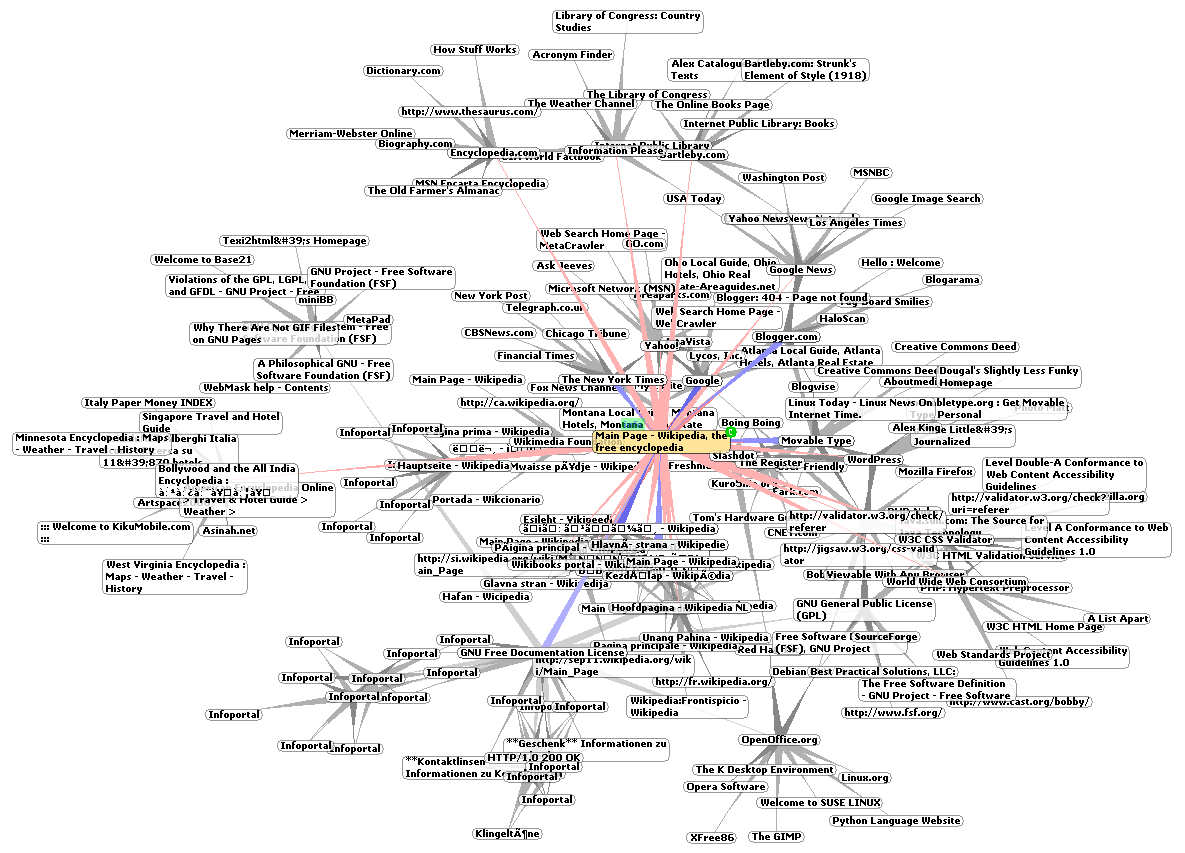
URLs branching off from the main Wikipedia page in 2004. (Credit: Chris 73, Wikimedia)
A nice thing about the WWW is that it was designed to be accessible to all, requiring only an Internet connection and thus opening up the possibility of setting up your own webserver. This unsurprisingly led to a very rapid growth of pages on the WWW, with content appearing, being modified and sometimes vanishing at an ever-increasing pace, making it extremely hard to keep up with.
This is however not how things started when the World Wide Web was created in 1989. Before its opening to the public in 1993 the pace of growth was slow enough that a manually maintained index was maintained. This was kept up until late 1992, with the last version of said index still online on the W3 website.
Over the course of a short few years, the WWW would change the face of the world forever alongside a surge of IBM-compatible PCs, exploding multimedia content, all the dot-com hype and perhaps best of all endless ‘free’ hosting services as long as you didn’t mind an advertising banner plastered above your personal homepage’s content.
Even internet service providers (ISPs) would often offer their own hosting service, along with endless n00b-friendly tools to make something resembling a website for whatever hobby you fancied. In addition to proving that one can absolutely argue about style and the prevalence of colorblindness, this would also serve to balloon the number of websites at an exponential rate.
Whether or not the WWW killing off the Gopher-based internet was a bad thing remains the topic of debate, though it’s beyond question that Gopher integrated search functionality into its protocol, mirroring a file system.
Advertisement
Infinite Library Indexing
Without any provisions in the HTTP protocol of the WWW, the only realistic way for search engines to create an index of the ever-expanding and changing WWW is to perform so-called web crawling. This means going through every known document, following any links found in them, and making sure to revisit any documents in case their contents got changed since the last visit.
The first complication here is that since the search engine’s database is the only real index for the web, initial discovery is purely organic, starting from a certain number of URL seeds in what is called the crawl frontier. This forms an integral part of a web crawler.
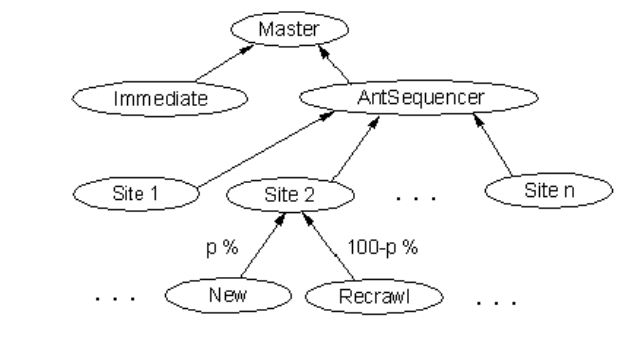
The Structure of Queues that Feed the URL Stream in the WebFountain Crawler (Credit: Edwards et al., 2001)
Development of the algorithms and architecture behind these crawlers formed a major part of the early WWW, with IBM researchers on the WebFountain project in 2001 estimating a grand total of about 500 million pages, with – as they put it – web crawlers caught between the comfortable cushion of Moore’s Law and the hard place of the web’s exponential growth. Today this number is probably closer to forty billion pages.
Although the Google Search web crawler was already pretty good back in 2001, WebFountain improved on it by using a distributed system, with ‘ants’ working through their own list of URLs to crawl, as described in the development paper by Jenny Edwards et al.
Beyond the basic recursive following of links in a document there are many confounding factors, such as when to recrawl a URL, which very much depends on how often the content on it is expected to be updated. Here one dives into the territory of statistics, as depending on the type of site we can make an educated guess on how often it is expected to be updated. For example, a government’s historical news pages are unlikely to see frequent updates, whereas the front page of a news site can see updates practically every few minutes.
Advertisement
Inverted Indexing
As complex the topic of web crawling is, the fun part begins when you have pruned all duplicate documents and stripped all the irrelevant fluff that’s not text to be indexed. In order to make the resulting search index at all searchable before the heat death of the Universe you cannot simply do a full text search on every single document whenever someone enters a search query.
Instead an index is constructed whereby certain keywords are mapped to documents. This inverted index is generally implemented as a hash table or similar data structure where it provides a quick access into the full text documents, not unlike the keyword index in the back of a book, or the more elaborate concordance of yesteryear. These latter works also provide a keyword index, but add accompanying text to provide immediate context to further save time.
Creating an inverted index is a fairly labor-intensive process, with a new document often used for a forward index that decomposes the text into its keywords prior to updating (or creating) the inverted index. As with all of such text processing related tasks and data structures in general there are many ways to go about it, with some fun curveballs thrown into the mix such as parsing languages that do not separate words with spaces, like Japanese.
All of which is to say that implementing a search engine is easy, but making it performant, accurate and efficient at the same time is a minor nightmare. This is basically why search engines took so long to stop being so terrible, as the engineers behind them were trying to solve many rather complex problems, presumably with the C-suite and investors breathing down their necks during the dot-com days.
Advertisement
Search Battles
Over on the Wikipedia entry for ‘Search engine‘ we find a pretty good timeline of web search engines, along with their current status. Perhaps unsurprisingly none of the 1993-era ones made it, but 1994’s WebCrawler somehow crawled into the modern age, along with Lycos. Much like 1990’s Archie search engine and similar for the Gopher web, many of these early search engines simply couldn’t compete in the rapidly changing years leading up to the new millennium.
This was also the era in which some figured that the WWW simply needed to become more ‘3D’ with virtual environments using VRML, bringing it closer to sci-fi like that portrayed in Snow Crash or Tron. Perhaps unfortunately the WWW remained the domain of mostly text and images, although most recently the flood of JavaScript frameworks appear to want to turn once simple HTML documents into full-blown desktop-like applications, all probably to the delight of web crawler engineers.
Meanwhile some search engines figured that they could lift along on the hard work of others, with so-called meta search engines collating the results from multiple search engines to save people the trouble of querying them individually. Here 1996’s Dogpile is still going strong.
Some search engines are missing from the list, such as Marginalia, which boasts the use of open source software for its indexing and crawling, while focusing on non-commercial content. There is also the ever excellent Frog Find that provides a bridge between modern search engines and systems that really cannot run the latest web browser.
Advertisement
Today’s Survivors
The search engine landscape remains a brutal one today, with us having to recently say farewell to Jeeves, of Ask Jeeves fame, most recently seen carrying the Ask.com name. Personally I didn’t really Ask Jeeves much back in the day, instead mostly using AltaVista (RIP) and probably Lycos and a few others that I do not recall off the top of my head.
Having Google Search burst on the scene by 2000 was definitely quite the event, which was certainly when the web search game improved. Looking back it probably was less that Google Search was simply better, but more that it pushed hard just being a search engine, whereas the others were still very much stuck in that early WWW mindset of being a portal to the web.
To a certain extent this is understandable, as search engines aren’t a charity and running the associated hardware as well as the required bandwidth costs a lot of money. Despite this it would seem that we still have a rather thriving web search engine landscape, even if ChatGPT, Claude and kin are trying to become the very last ‘site’ you will ever need. This even as their little web crawlers are still doing the same crawling as has been done since the birth of the WWW.
Two former OpenAI employees and a group of AI safety nonprofits are warning that Elon Musk’s AI lab, xAI, could become a liability for prospective investors in SpaceX, which is preparing to file what’s expected to be the largest initial public offering in Wall Street History.
In a letter directed to investors published on Tuesday, the ex-staffers highlighted what they describe as “unpriced risks” related to xAI that could complicate SpaceX’s reported plans to raise up to $75 billion as part of its IPO. The rocket company’s private valuation shot up to over $1 trillion after it acquired xAI last year. Musk claimed his rocket company could launch data centers into space for his AI lab, but the letter’s authors argue that xAI’s poor record on safety issues could complicate how investors view the combined company as it gets ready to submit its IPO prospectus filing.
One of the letter’s signatories and coauthors is a new nonprofit called Guidelight AI Standards, which was cofounded by former OpenAI safety researcher Steven Adler and former OpenAI policy advisor Page Hedley. The group, which is backed by private donors, aims to improve the safety practices of frontier AI companies. Other AI safety nonprofits also signed on, including Legal Advocates for Safe Science and Technology, Encode AI, and The Midas Project.
Hedley tells WIRED in an interview that he believes xAI has the worst safety practices “nearly across the board” compared to other frontier AI developers, including OpenAI, Google DeepMind, and Anthropic. As a result, he argues, SpaceX may face a greater risk of regulation and litigation than other AI labs.
Advertisement
The letter’s authors argue that SpaceX should make several disclosures to investors, including whether xAI intends to continue developing frontier AI models. SpaceX recently struck a deal to sell a significant portion of its GPU capacity to Anthropic, and the letter claims the agreement “leaves it unclear whether xAI is still a frontier-AI competitor inside a larger holding company.” If xAI continues to develop frontier AI models, the authors say that it should be required to publish a public safety and governance plan.
SpaceX and xAI did not immediately respond to WIRED’s request for comment.
The letter also outlines examples of how xAI has not kept up with industry standard safety practices, such as publishing detailed frameworks for mitigating risks around its AI models being used in cyber attacks. The authors also outline specific safety incidents at xAI that they say warrant additional scrutiny. Among the most notable include when xAI’s flagship AI chatbot, Grok, spontaneously brought up white genocide in its responses. In another case, xAI allowed Grok to generate thousands of sexualized images of women and children, which spread widely across Musk’s social media platform X. The latter case prompted at least 37 US attorneys general to send a letter demanding that Musk’s AI lab take steps to protect women and children on its platform.
Hedley says the number of safety incidents xAI has experienced and the regulatory attention they received is “far out of proportion to its market share.” As lawmakers grow increasingly alarmed by the cyber capabilities of advanced AI models like Anthropic’s Claude Mythos, new security regulations may be on the horizon. The Trump administration is reportedly already weighing an executive order that would give US intelligence agencies more oversight over AI models.
Advertisement
“It takes serious investment to reign in [AI safety] risks, and it seems that xAI has historically under invested here,” says Adler. The letter cites reporting from the Washington Post that said xAI had just “two or three” people working on safety as of January. “A question investors should be wondering is if xAI stays at the frontier, how costly might it be to, in fact, manage these [risks] responsibly? If they don’t, what might be the consequences?”

































































You must be logged in to post a comment Login