

Crypto World
Perpetuals launches UpsideOnly, a ‘risk-free’ AI trading platform


Perpetuals launches UpsideOnly, an AI-powered ‘risk-free’ market prediction platform
Perpetuals.com Ltd, a Nasdaq-listed fintech group, has introduced UpsideOnly, a market prediction platform that lets users submit forecasts across equities, crypto, commodities and forex without staking personal capital. The company says it will execute trades with its own funds based on a proprietary AI model and distribute profits to users whose predictions help generate successful trades.
Perpetuals describes the service as a human-AI collaboration: participants contribute signals and the platform’s algorithm, BayesShield AI, applies those signals to make trading decisions. According to the company, BayesShield was trained on more than 22 billion retail trades, a dataset the firm says informs real-time signal refinement.
How UpsideOnly works
Users register and make directional predictions on various markets without depositing trading capital. Perpetuals evaluates those signals and, when its AI assigns sufficient probability to a forecast, the firm trades with its own capital. If a trade is profitable, the firm shares some portion of the gains with the users whose signals contributed to the decision. If a trade loses, Perpetuals absorbs the loss and users take no financial hit from the trade itself.
The product offers optional refundable deposits of $1 or more. Perpetuals says those deposits are not used for trading but are held in U.S. Treasury securities with an external fiduciary and are designed to deter bots. Users who place a deposit reportedly receive higher payout levels, reflecting the platform’s view that small deposits improve signal quality.
What the company claims and what to watch
Perpetuals positions UpsideOnly as a corrective to what it characterizes as an unfair retail trading ecosystem. The company argues that letting users contribute insight rather than capital aligns incentives differently from conventional retail broker models, where many individual traders lose money.
Key company claims include the scale of the training data behind BayesShield and the platform’s multi-asset coverage. Perpetuals also notes regulatory connections: an affiliate, PM MTF Ltd., operates under an EU multilateral trading facility regime and the firm cites compliance frameworks such as MiFID II, MiCA, DORA and EMIR for its European operations.
Market and regulatory implications
UpsideOnly sits at the intersection of several fast-evolving fintech trends: AI-driven trading, crowd-sourced forecasting and novel consumer products that blur the line between prediction markets and brokerage services. That mix could draw heightened regulatory attention.
Regulators will likely scrutinize how UpsideOnly is classified under securities, derivatives and gambling laws. The firm itself flags potential risks that the product could be characterized under gaming, sweepstakes or commodity-derivatives regimes, a point that reflects the legal complexity of monetizing user predictions when a firm executes trades on the back end.
Consumer protection authorities may also probe disclosure, the robustness of anti-abuse measures, and whether the model could incentivize risky behaviour from participants who do not face downside. The presence of refundable deposits intended to deter bots may not be sufficient, in regulators’ view, to address market manipulation or wash-trading risks without additional controls and transparency.
Business model and sustainability questions
At its core, the UpsideOnly model transfers trading downside to Perpetuals while offering users upside participation. That places a premium on three elements: the predictive edge of BayesShield, effective risk management at the firm level, and the durability of the signal sourcing mechanism.
Model performance and data limits. The company cites a very large retail trade dataset, but past performance and backtests do not guarantee future returns. Machine learning models trained on historical retail behaviour can be vulnerable to regime shifts, data biases and overfitting. The platform’s long-term profitability depends on whether the AI can identify persistent edges after costs and the profit split to users.
Capital and risk appetite. Perpetuals must bankroll losing streaks and market shocks, which could strain capital if the platform scales quickly or encounters rare adverse events. The firm’s Nasdaq listing gives it public-market access to capital, but sustained losses or drawdowns could prompt investor scrutiny.
Gaming the system. Prediction marketplaces and incentive systems attract strategic actors. Participants who try to exploit payout mechanics or coordinate signals could degrade signal quality and create losses. The refundable deposit is a modest deterrent and may reduce automated accounts, but it is not a comprehensive anti-abuse solution.
Industry context
UpsideOnly is part of a broader wave of products attempting to democratize alpha and repackage trading as an experience anchored by gamified inputs or social signals. The difference here is the explicit claim that retail users are shielded from trading losses because the firm executes trades with its own balance sheet.
That arrangement recasts users as signal providers rather than capital providers. Economically, that is similar to some prediction markets and algorithmic investment strategies that pay contributors for valuable information. Whether the economics scale as user volumes rise will be an important test of the concept.
Bottom line
Perpetuals’ UpsideOnly brings together crowd intelligence and an AI model trained on large retail datasets to offer participants exposure to trading gains without direct downside. The architecture raises meaningful questions about regulatory treatment, model risk, and capital sustainability. Market participants and regulators will be watching closely to see whether Perpetuals can convert user signals into repeatable returns while managing the operational, legal and financial risks inherent in underwriting trading losses.
Bloomberg has also reported on the launch, and Perpetuals has made its executive team available for interviews. The company cautions that “risk-free” refers specifically to user trading losses and does not eliminate operational or other platform risks.



Polymarket partnered with Nasdaq Private Market to enable trading on private company valuations, IPO timing, and secondary share prices, with early markets on OpenAI, Anthropic, Stripe, and other unicorns.
The Bank of England is stepping up its focus on digital money, with Deputy Governor Sarah Breeden highlighting tokenization as a potential way to reduce costs, speed settlement and increase competition.
Speaking at London’s City Week on Tuesday, Breeden said tokenization — the representation of assets and money on digital ledgers — could improve the efficiency and functionality of payments and financial markets, provided that trust and interoperability are preserved.
Breeden stressed that central bank money will remain the foundation, or “anchor,” of the monetary system, even as private-sector innovations such as tokenized deposits and regulated stablecoins gain traction.
She said the central bank is working with industry, government and regulators to build a framework that supports innovation without undermining financial stability.
“Alongside traditional bank deposits, people should be able to pay with tokenized bank deposits, regulated stablecoins and, potentially, a retail central bank digital currency (CBDC),” she said, according to a transcript of the speech. “More competition, from a wider range of technologies and business models, should lower costs and improve functionality for users.”
The BoE’s CBDC Academic Advisory Group said in January that “retail CBDC is not strictly required to preserve uniformity, but may play a valuable supporting role, particularly as transactional use of cash declines.”
Related: Crypto awareness tops 80% among young people in UK: Coinbase survey
BoE moves to modernize settlement infrastructure
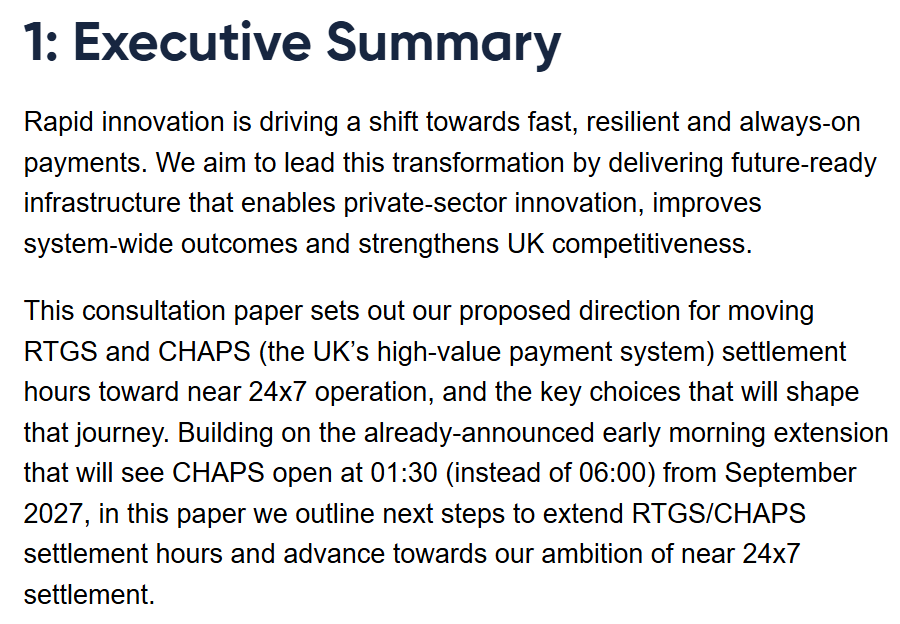
The UK is taking additional steps to prepare its financial system for tokenized assets. On Monday, the BoE proposed extending the operating hours of its core settlement infrastructure to near 24/7 availability.
In the proposal, the central bank said longer operating hours would help support cross-border payments and securities settlement as tokenization and other digital asset technologies continue to evolve.
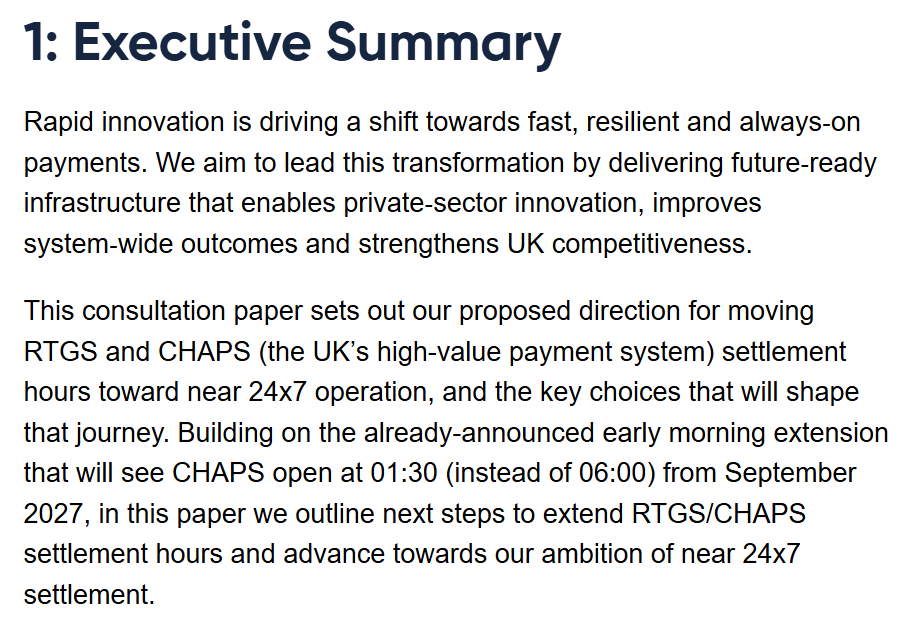
An excerpt of the BoE’s proposal to extend settlement hours. Source: Bank of England
The proposal follows Breeden’s comments earlier this month that the Bank was reconsidering its approach to pound-sterling-denominated stablecoins, including whether to ease limits on how much consumers can hold. The review is intended to reduce friction for early adopters as policymakers seek to strengthen the UK’s position as a competitive hub for digital assets.
The Bank of England has softened is stance on stablecoins in recent months as officials engage more closely with industry groups and revisit earlier proposals that would have imposed stricter reserve and backing requirements.
Related: Stablecoin industry opposes Bank of England’s unhosted wallet ban

Key Highlights
- WMT shares reached a record $134.71, marking a 37% surge over the last 12 months
- Market volatility suggests potential 5% price movement following Thursday’s quarterly results
- First-quarter sales projected at $174.94 billion, reflecting ~6% annual growth; earnings per share forecast at 66 cents
- Digital commerce revenue anticipated to have expanded approximately 22% during the period
- Wall Street consensus price target hovers above $140, with nearly all analysts maintaining bullish stances
Shares of Walmart reached an unprecedented peak of $134.71 during Monday’s trading session, as market participants gear up for the retail giant’s first-quarter financial disclosure scheduled for Thursday’s pre-market hours.
The retail behemoth’s equity has climbed approximately 20% year-to-date, positioning it among the top-performing major retail stocks in 2024.
Current derivatives market activity indicates traders are bracing for potential share price fluctuations of up to 5% by week’s end. A bullish scenario would propel WMT beyond $139—surpassing its previous February benchmark. Conversely, a bearish outcome could see shares retreat below the $127 threshold.
This upcoming financial report marks the inaugural earnings presentation under CEO John Furner’s leadership, following his appointment in February. The earnings call will provide Furner with a platform to articulate his strategic vision for the corporation.
Analyst consensus anticipates first-quarter revenue reaching $174.94 billion, representing nearly 6% year-over-year expansion, per Visible Alpha data. Adjusted earnings per share are forecasted at 66 cents, five cents higher than the comparable period last year.
Same-store sales are estimated to have increased 3.8%, while online sales are expected to have surged around 22%.
Wall Street’s Perspective
Analyst outlook remains overwhelmingly positive toward Walmart’s prospects. Among the 11 analysts monitored by Visible Alpha, 10 recommend buying shares while one maintains a neutral stance. The consensus price objective stands marginally above $140.
UBS continues to recommend buying with a $147 price target, while TD Cowen elevated its outlook to $150, maintaining its purchase recommendation. KeyBanc reaffirmed its Overweight designation, highlighting the company’s competitive positioning gains.
Oppenheimer anticipates strong quarterly performance but predicts Walmart will maintain its current full-year projections, considering potential sustained pressure from elevated energy prices.
Morgan Stanley suggests Walmart stands to gain as budget-conscious consumers gravitate toward value-oriented options amid economic pressures.
The Consumer Price Factor
Escalating costs have inadvertently benefited Walmart. As American households increasingly prioritize value, customer traffic and purchase volumes have demonstrated resilience at Walmart compared to premium-positioned competitors.
This reporting period arrives amid persistent inflation and elevated energy expenses, partially attributed to ongoing Iran war tensions. Financial disclosures from Walmart and peer retailers this week could illuminate consumer spending patterns under current economic conditions.
Walmart has consistently increased its dividend payout for 31 straight years. The equity currently commands a P/E multiple of 49.11, which InvestingPro identifies as elevated compared to its intrinsic value assessment.
The retailer’s current market capitalization stands at $1.07 trillion.



The next global power competition is not being fought over missiles alone. It’s being fought over money, and right now, China is moving aggressively to shape the future of it, argues Gooden.
A coalition of privacy and internet freedom advocates led by the Tor Project has announced a new crypto funding campaign to support censorship-resistant digital infrastructure.
The first-of-its-kind Web3 crowdfunding campaign for internet freedom tools will support 10 nonprofit projects working across privacy, censorship circumvention, secure communications and public-interest digital infrastructure, according to the campaign leaders, Tor Project and Funding the Commons.
The campaign, which kicks off May 19, accepts crypto contributions in Bitcoin (BTC), Ethereum (ETH), Zcash (ZEC), Monero (XMR) and Golem (GLM).
The campaign comes as privacy advocates argue that internet freedom is being eroded on a global scale. Internet shutdowns, including long-term systemic censorship, affected more than half of the world’s population in 2025.
Meanwhile, governments around the world are “increasingly exerting control over the technology that people depend on to access the free and open internet,” Freedom House reported.
Quadratic funding model for fairness
An initial $115,000 matching pool supported by Cake Wallet, Zcash Community Grants, Logos and Octant will amplify donations made through June 18 using a “participatory matching model” to reward broad community participation rather than large single donors.
The campaign uses quadratic funding, a model that rewards breadth of participation over donation size, meaning 10 donors giving $10 each outweigh one donor pledging $100.
The model increases support for projects backed by broader community participation, “giving more people a meaningful voice in how funds are distributed,” the coalition said.
Related: Privacy advocates slam reCAPTCHA update they say locks out de-Googled phones
“Quadratic funding is one of Web3’s answers to how critical infrastructure gets funded: Institutional money follows community signals, not the other way around,” said David Casey, director of Funding the Commons.
The Tor Project is a nonprofit with a mission to advance human rights and freedoms online by encrypting internet traffic through free and open-source tools such as Tor Browser.
Global internet freedom declines
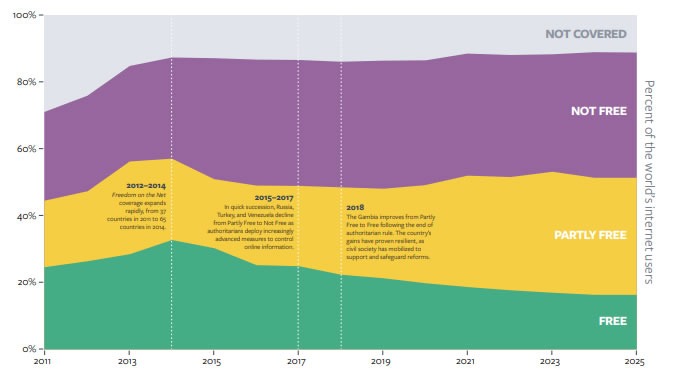
Global internet freedom has declined for 15 consecutive years, with conditions deteriorating in almost 40% of the 72 countries assessed in Freedom House’s 2025 Freedom on the Net study.
Asia was the primary hotbed for digital censorship, with governments in 10 Asian countries, including China, India, North Korea, Thailand and Myanmar, imposing more than 50 new restrictions and affecting roughly 2 billion people.
Internet freedom in the West is also under greater threat, with the US withdrawing from the Freedom Online Coalition — an alliance explicitly committed to defending human rights and openness on the internet — in January.
Netizens are increasingly turning to virtual private networks, or VPNs, to circumvent censorship, but more than a dozen countries actively block or criminalize VPN use, while many others impose partial restrictions.
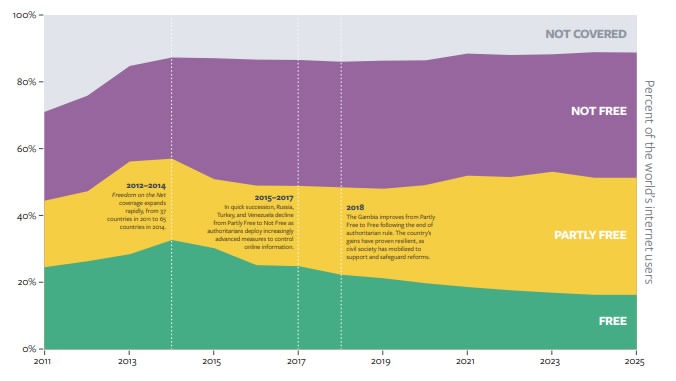
The erosion of internet freedom over the past 15 years. Source: Freedom House
In January, Iran imposed a nationwide internet blackout to suppress mass protests over the economic crisis, leading to a surge in usage of Bitchat, a decentralized peer-to-peer Jack Dorsey project that enables communication over Bluetooth.
Magazine: Guide to the top and emerging global crypto hubs: Mid-2026

Key Highlights
- Shares of Agilysys climbed 15% to $80.41 following a fourth-quarter earnings beat of $0.13 per share
- The hospitality software provider delivered its 17th straight quarter of record-setting revenue, with subscription sales climbing 24% annually
- Management’s FY2027 revenue outlook of $365M–$370M exceeded the Street’s $363.59M estimate
- Needham maintained its Buy rating with a $120 target; Oppenheimer boosted its price objective to $100
- The partnership with Marriott International for PMS deployment is projected to contribute more substantially to results in FY2027
Shares of Agilysys closed at $80.41 on Tuesday, gaining 15% during the session, following the release of fourth-quarter financial results that exceeded analyst projections on all key metrics.
Earnings per share registered at $0.63, surpassing the Street’s $0.50 estimate by $0.13. Revenue totaled $82.95 million, topping the anticipated $81.56 million and representing an 11.7% increase compared to the year-ago period.
This performance extends the company’s streak to 17 consecutive quarters of achieving record revenue levels.
Subscription-based revenue expanded 24% during the quarter. Looking ahead to FY2027, executives projected subscription growth of “at least” 30%, marking the third consecutive year of accelerating growth in this segment.
Management issued FY2027 revenue guidance in the range of $365M–$370M, surpassing the analyst consensus forecast of $363.59M.
Wall Street’s Take
Needham & Company maintained its Buy recommendation and $120 price target on Agilysys — suggesting approximately 71% potential upside from current trading levels.
Oppenheimer analyst Brian Schwartz increased his price objective to $100 from $90 while reaffirming an Outperform rating. He characterized the company’s business momentum as entering a “noticeable uptrend” in 2026 that should persist throughout FY2027.
“If the company keeps beating-and-guiding above, similar to F4Q26, then the stock should keep working,” Schwartz wrote.
BTIG analysts, maintaining a Neutral stance without a specific price target, attributed Tuesday’s stock surge primarily to management’s “impressive” subscription revenue projections. They indicated continued interest in the investment story while seeking a more attractive entry point.
Among Wall Street firms covering the stock, four maintain Buy ratings, two have Hold recommendations, and one rates it a Sell. The average price target across all analysts stands at $131.40.
Marriott Partnership Progressing
Investors are closely monitoring Agilysys’ strategic partnership with Marriott International, which involves implementing its cloud-native property management system across luxury, premium, and select-service hotel properties throughout the United States and Canada.
Initially unveiled in late 2022, the partnership is now expected to “start contributing more meaningfully” to the company’s financial performance, according to Oppenheimer’s updated guidance analysis.
CEO Ramesh Srinivasan stated during Monday’s earnings conference call that “the Marriott PMS project continues to make good progress and is on plan.”
BTIG’s financial model projects baseline subscription revenue growth of 23%, 22%, and 20% for FY2027, FY2028, and FY2029 respectively. The Marriott collaboration is anticipated to contribute incremental growth of 7%, 11%, and 9% on top of those baseline figures.
Tuesday’s surge represents the strongest single-day gain for Agilysys since October 28, 2025. Prior to this rally, shares had declined approximately 15% over the preceding twelve months amid broader software sector weakness stemming from concerns about AI-driven disruption.
Before Tuesday’s advance, the stock traded within a 52-week range of $61.50 to $145.25, with its 200-day moving average positioned at $94.99.
Institutional ownership accounts for 88% of outstanding shares, with multiple investment funds increasing their positions in recent reporting periods.

Regional hire reflects push for localised market insights and education
eToro has appointed Nagham Hassan, a UAE-based market commentator and content creator, as its market analyst for the Middle East and North Africa. The move expands the trading platform’s in-region research and communications capability, with Hassan expected to cover equities, commodities and crypto markets and to support investor education efforts across MENA.
Hassan brings several years of experience in the crypto sector and has produced educational content on digital assets through her YouTube channel. She has also appeared as a commentator in business and financial media, positioning her as a visible local voice on market developments.
Why the hire matters for eToro and MENA markets
For global trading platforms, hiring local analysts is increasingly important as markets in the Gulf and wider MENA region attract more attention from retail and institutional investors. Local analysts can provide context on regional macro drivers, regulatory developments and market sentiment that may not be visible from a distant headquarters.
Regional insights and market education: eToro has emphasised investor education as a core part of its service. Bringing on an analyst based in the UAE, which has positioned itself as a financial and digital asset hub, aligns with efforts to deliver timely commentary and explain market moves in formats accessible to local audiences.
Cross-asset coverage: Hassan’s remit will span traditional and digital assets. That mirrors broader industry trends where platforms and research teams are integrating crypto coverage alongside stocks and commodities to meet user demand for multi-asset perspectives.
Context: UAE as a base for regional market coverage
The UAE has actively sought to attract financial-services firms and crypto businesses through regulatory frameworks and licensing regimes in centres such as the Abu Dhabi Global Market. eToro operates in the region under local authorisations, a factor that likely influenced the decision to station an analyst in the UAE.
Local market commentators can help clients interpret regulatory updates, monetary policy shifts and geopolitical developments that influence asset prices across the region. That capability becomes more valuable as retail participation grows and as institutional investors increase allocations to emerging-market and digital assets.
What this means for investors and the platform
Investors in MENA can expect more regionally focused content and commentary from eToro, which may include market briefs, educational videos and analysis tailored to local market schedules and regulatory contexts. For eToro, the hire is a way to deepen engagement with users in a competitive market for retail trading and crypto adoption.
Competition and differentiation: Localised research and education are a differentiator in markets where platforms compete on trust, compliance and community. eToro will be measured on the quality and relevance of the insights it provides, and on its ability to translate those insights into product features and educational offerings that meet regional needs.
Industry implications and risks
The appointment underscores a broader trend of digital trading firms recruiting regional talent to interpret fast-moving markets. That said, platforms must balance proactive commentary with regulatory responsibilities. In the region, licences and oversight vary by jurisdiction, and firms operating in MENA are increasingly subject to local rules governing financial promotions and investor protections.
Risk disclosure remains central: eToro and other multi-asset platforms routinely remind users that investing involves risk and that leveraged products such as CFDs can result in rapid losses. Analysts working for regulated firms therefore operate within a framework that requires careful presentation of market views and an emphasis on investor education rather than personalised advice.
Looking ahead
eToro’s hire of a UAE-based analyst reflects the platform’s intention to strengthen its regional presence at a time of elevated interest in both traditional and digital assets across MENA. Observers will be watching for the types of content and services that follow, and whether localised insights translate into higher user engagement or new product initiatives tailored to the region.
As digital asset ecosystems and regulatory approaches evolve in the Middle East, having analysts embedded in the region can help platforms respond faster to market developments and communicate more effectively with local investors.
For media enquiries, eToro has indicated it can provide regional commentary through its communications channels.
Key Insights
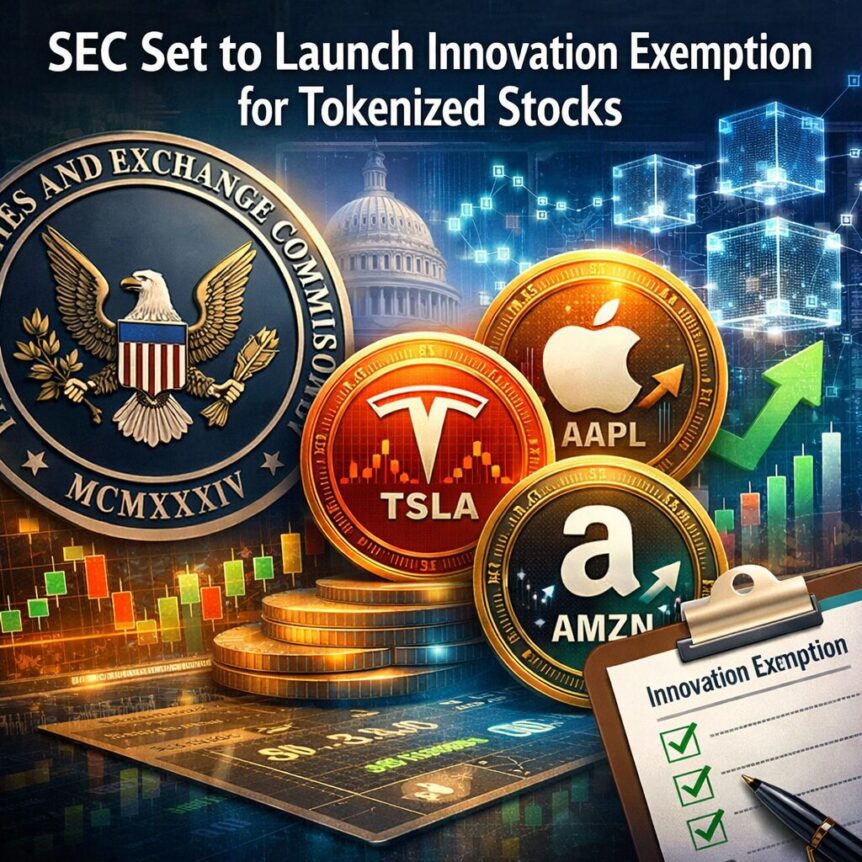
- SEC May Launch an Innovation Exemption for Tokenized Stock Trading Next Week
- Tokenized Equities Could Trade 24/7 Without Traditional Shareholder Rights
- DTCC, Nasdaq, and NYSE Continue Expanding Blockchain-Based Settlement Systems
SEC Advances Tokenized Stock Trading Framework
The U.S. Securities and Exchange Commission is preparing a regulatory framework for tokenized stock trading, according to a Bloomberg report published on May 19. The proposal could allow blockchain-based versions of publicly traded shares to trade on crypto platforms under lighter compliance requirements.
The framework may arrive through an “innovation exemption” that the SEC could release as early as next week. Under the proposal, crypto platforms offering tokenized securities would not need to follow every traditional registration rule. SEC Chair Paul Atkins has supported clearer digital asset regulations instead of relying on enforcement actions.
The reported structure would allow third parties to issue digital tokens tied to the value of public company shares. However, those tokens would not represent direct ownership in the companies. Investors would not receive voting rights, dividends, or participation in corporate decisions.
BREAKING: The SEC is set to release its so-called “innovation exemption” for tokenized stocks which will pave the path for trading digital versions of securities, per Bloomberg.
Details include:
1. In a “surprise move,” the SEC is leaning toward allowing the trading of…
— The Kobeissi Letter (@KobeissiLetter) May 18, 2026
Wall Street Firms Expand Blockchain Settlement Efforts
Major financial institutions continue increasing their involvement in tokenized stock trading and blockchain settlement systems. The Depository Trust and Clearing Corporation recently announced plans to begin limited production trades for tokenized assets in July. A broader rollout is expected in October.
The organization processes most U.S. securities transactions, making its participation important for institutional adoption. Nasdaq received SEC approval in March for rule changes supporting tokenized share trading while maintaining traditional ownership rights.
Meanwhile, the New York Stock Exchange secured SEC approval in April for its own blockchain settlement initiative. Its parent company, Intercontinental Exchange, also partnered with OKX to develop 24/7 on-chain settlement infrastructure.
Tokenized Equities Market Continues Rapid Growth
The tokenized equities sector has expanded quickly over recent months. Data from RWA.xyz shows the market now holds about $1.4 billion in distributed value across more than 2,200 assets. The sector grew roughly 30% during the last 30 days.
Monthly transfer volume has also climbed to $3.24 billion, while the number of holders increased by 25% to around 265,000 users. Supporters of tokenized stock trading argue blockchain systems can reduce settlement delays, lower transaction costs, and expand global market access.
At the same time, regulators and market participants continue examining investor protection concerns. Since tokenized shares may not provide standard shareholder rights, questions remain about accountability and legal protections during disputes or market disruptions.
The SEC’s latest move reflects broader efforts in Washington to establish formal digital asset regulations. The Republican-led Senate Banking Committee recently advanced crypto legislation as lawmakers continue shaping policies for blockchain-based financial products.
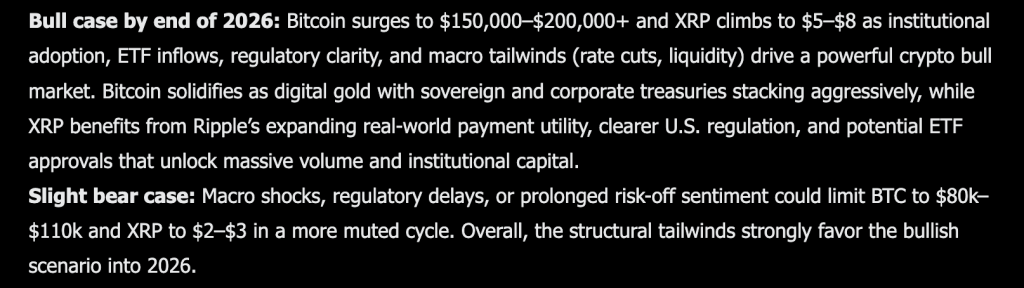
Nobody asked Elon Musk Grok AI to pick favorites. It predicts both Bitcoin and XRP in the same breath, and the price prediction it landed on for each are not conservative by any measure.
Bitcoin at $150,000 to $200,000. XRP at $5 to $8. Both by end-2026. Both driven by the same macro tailwind hitting 2 very different assets at once.
Grok’s framework treats this cycle as a convergence event rather than a single-asset story.
Bitcoin is solidifying its digital gold narrative with sovereign wealth funds and corporate treasuries stacking aggressively, while XRP is benefiting from Ripple’s expanding real-world payment utility, clearer US regulation, and ETF approvals unlocking institutional capital at scale.
The AI sees institutional adoption, ETF inflows, regulatory clarity, and rate cuts as 4 forces pulling simultaneously on both assets, which is what makes the dual prediction compelling. These are not correlated bets on the same thesis. BTC is a reserve asset story.
XRP is a payment infrastructure story. Grok is saying both win in this environment, just for different reasons.
The bear case applies to both equally. Macro shocks, regulatory delays, or prolonged risk-off sentiment could limit BTC to $80,000 to $110,000 and XRP to $2 to $3 in a more muted cycle.
Grok closes with its verdict: structural tailwinds strongly favor the bullish scenario into 2026.
Discover: The best pre-launch token sales
Bitcoin Price Prediction: Grok AI Bitcoin Predicts Is $150,000–$200,000. The Chart Shows Exactly How Far Away That Is
Bitcoin price is trading at $76,695 on the daily, sitting at the apex of a rising channel that has been building since the February low of $61,000.
The yellow circle on the chart marks the current decision point: price is pressing against the upper trendline of the channel right now and the next few daily closes determine whether this is a breakout or another rejection back into the range.
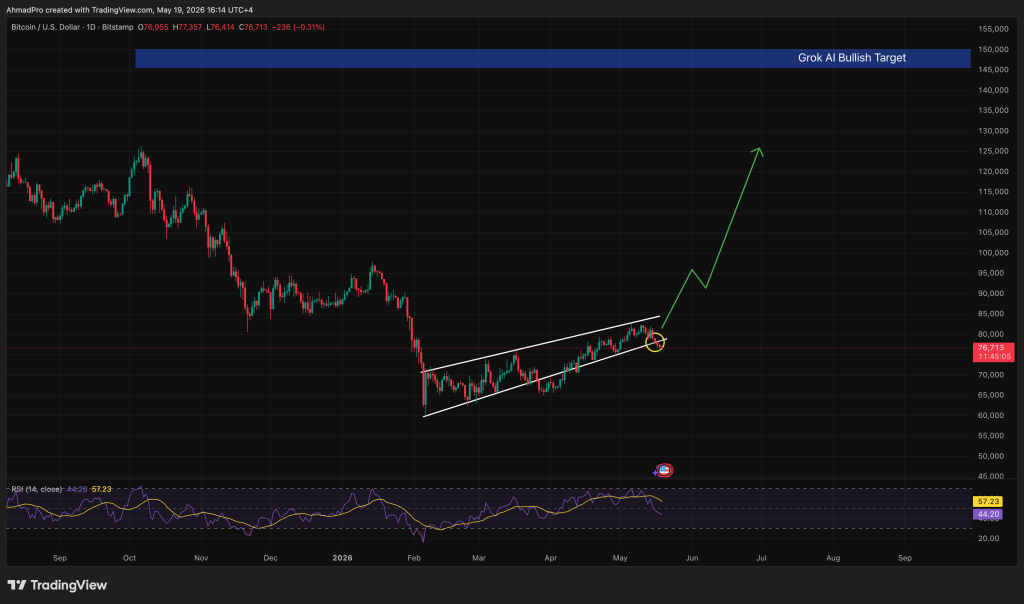
The Grok AI bullish target zone is labeled on the chart at $145,000 to $150,000, which represents the lower end of the prediction range and sits well above every resistance level currently visible.
Getting there requires clearing 2 major supply zones: $82,000 to $84,000 first, the remnant of the pre-crash consolidation, and then $96,000 to $98,000, the October 2025 highs. The chart projection shows a move from the channel breakout toward $95,000, a brief pullback toward $88,000, then continuation into the Grok target zone.
Support at $72,000 to $74,000 is the lower channel boundary that has held every dip since February. Lose it and the recovery thesis resets fast.
Discover: The best crypto to diversify your portfolio with
XRP Price Prediction: Grok AI Sees XRP at $5–$8, For Now, $1.60 Is Still the Gate
XRP price is trading at $1.37144 on the daily, and the pullback from the recent $1.50 push has brought price back toward the lower end of the 4-month range.
The chart structure has not broken but the momentum has clearly faded, and with support at $1.20 not far below current price the setup demands attention rather than complacency.
The chart has the full bull case mapped in sequence: resistance at $1.60, then targets at $2.40, $3.10, and $3.64. Each level is a checkpoint.
None of them are accessible until $1.60 breaks first. Grok’s $5 to $8 range sits above all of them, meaning the chart targets are waypoints on the journey rather than the destination itself.
The projected path shows a bounce from current levels toward $1.60, a minor pullback, then a sharp move toward $2.40 and continuation higher through the remaining targets.
Support at $1.20 is the red zone on the chart and the last meaningful floor before the bull thesis breaks down entirely. At $1.37 current price is sitting uncomfortably close to that level with no strong bounce structure visible yet.
RSI on the daily is at 42.87 with the signal line at 53.14, signal line well above RSI in the same pattern seen across multiple assets today.
Short-term momentum has turned negative while the average lags behind. RSI approaching the low 40s from above typically either finds a floor and reverses or continues toward oversold territory, and at $1.37 with $1.20 support below, the next 3 to 5 daily closes are the most important price action XRP has seen since the February crash.
Grok’s dual prediction needs BTC to lead and XRP to follow. Both charts are at decision points right now.
The post Elon Musk Grok AI Predicts Incredible XRP Price and Bitcoin Price by End of 2026 appeared first on Cryptonews.
Bitcoin (BTC) consolidated near month-to-date lows on Tuesday as surging US bonds punished stocks and safe havens.
Key points:
- Bitcoin joins risk assets feeling the pressure from skyrocketing US bond yields.
- Catalysts, such as high oil prices, continue to impact market sentiment with the US-Iran war stakes still high.
- Bitcoin is now at a “crucial level of support,” the latest market analysis warns.
US 30-year yields reach highest since 2007
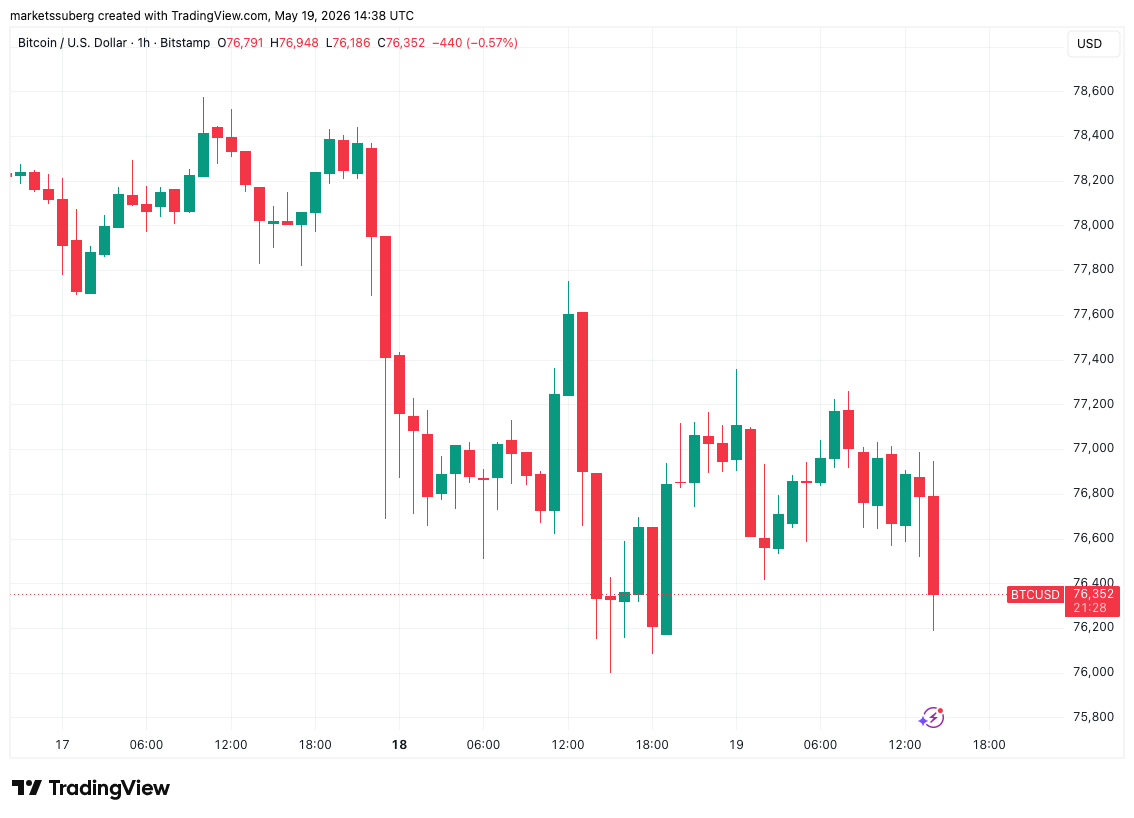
Data from TradingView showed BTC/USD lingering below $77,000 around the Wall Street open while preserving the previous day’s floor.
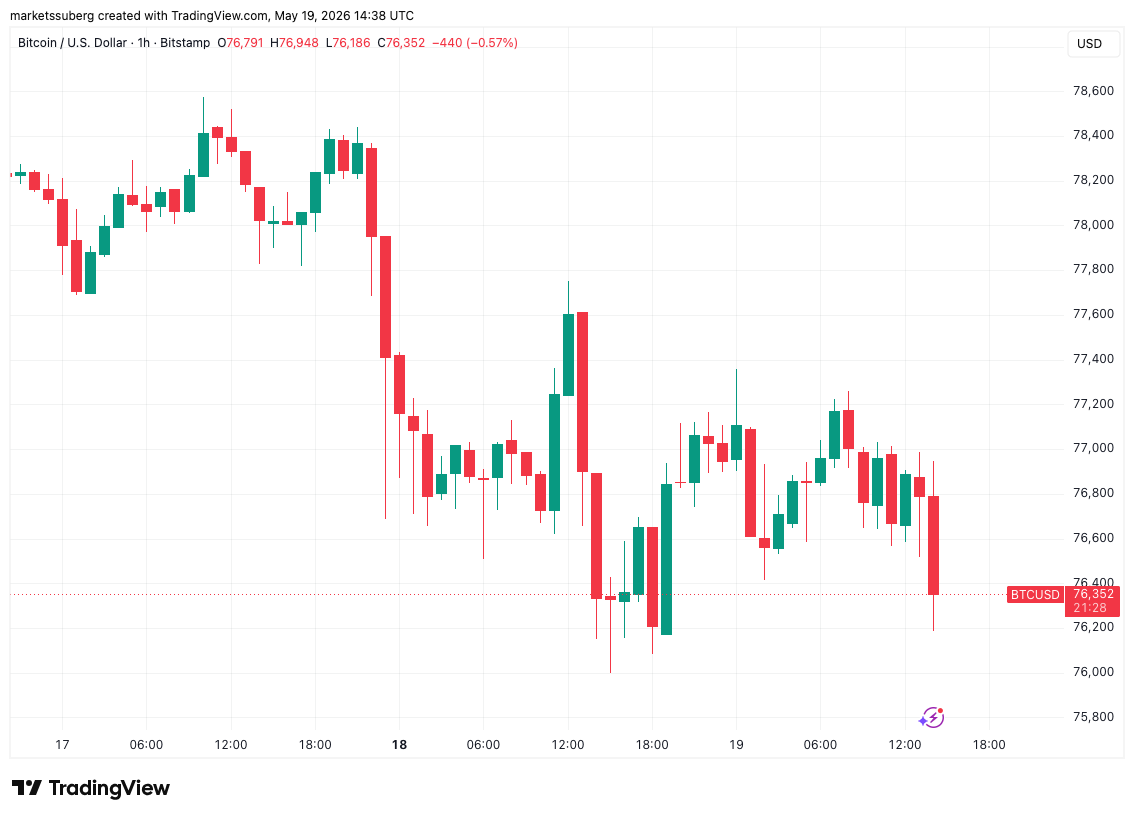
BTC/USD one-hour chart. Source: Cointelegraph/TradingView
Macro headwinds on the day continued to focus on US bond markets, with the 30-year yield hitting its highest levels since July 2007.
This sparked downside pressure on stocks, along with gold and silver. XAU/USD fell below $4,500 to reach its lowest levels since late March.
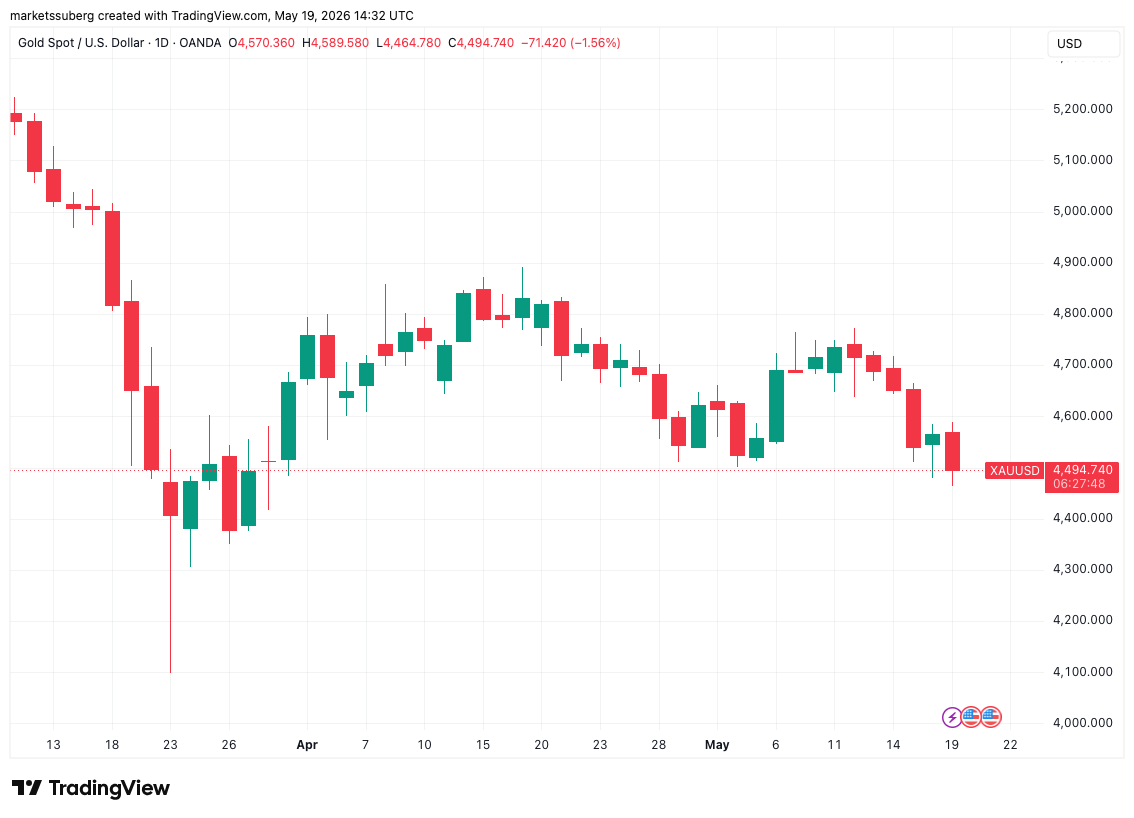
XAU/USD one-day chart. Source: Cointelegraph/TradingView
Commenting, Ole S. Hansen, head of commodity strategy at Saxobank, said that bonds reflected demand for “greater compensation for holding longer-dated debt amid war-driven energy inflation and mounting concerns over widening budget deficits.”
“This development has sent gold below USD 4,500 support, highlighting the current market reaction function driven by oil, inflation expectations, bond yields, and central bank rate expectations,” he wrote in a reaction on X.
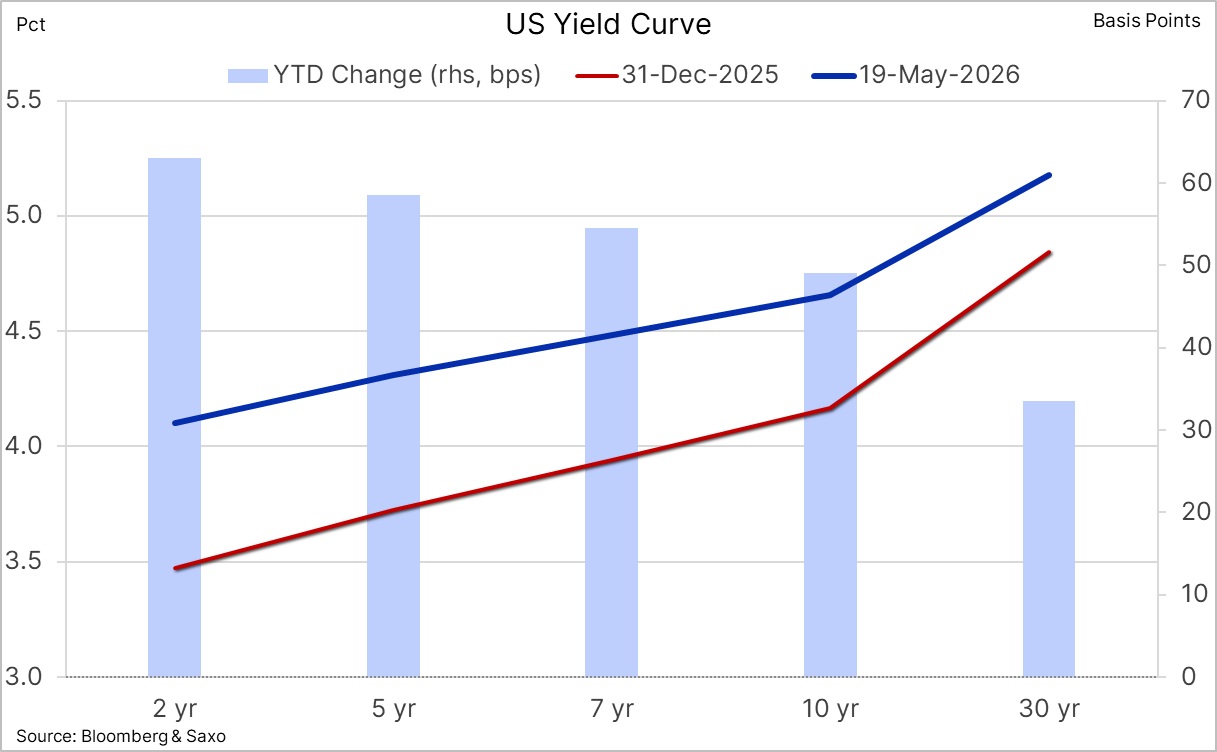
US yield curve data. Source: Ole S. Hansen/X
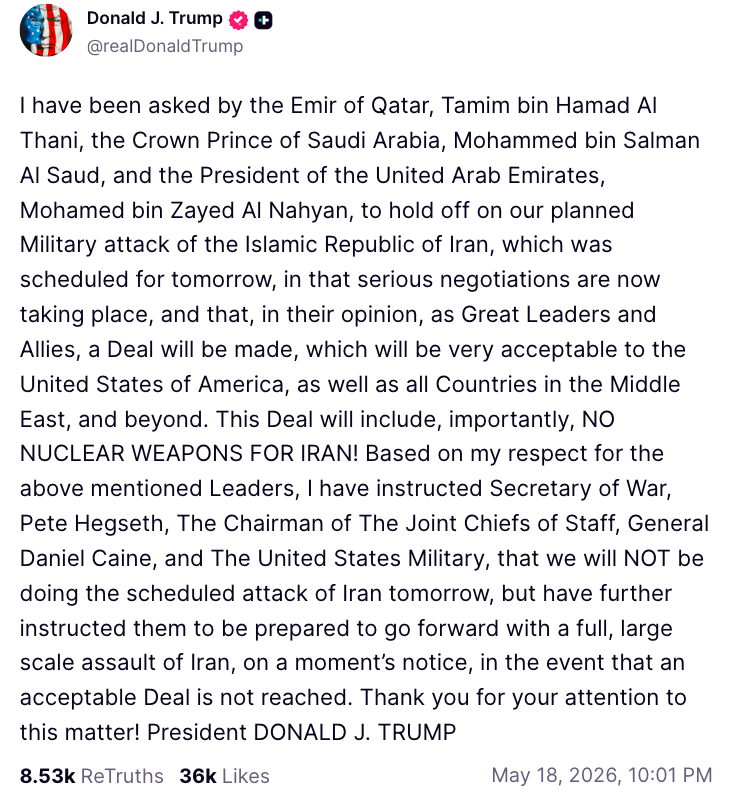
News that US president Donald Trump had canceled strikes on Iran offered markets little relief.
In a post on Truth Social, Trump added that gulf countries should be “prepared to go forward with a full, large scale assault of Iran, on a moment’s notice, in the event that an acceptable Deal is not reached” on the conflict.
Source: Truth Social
Bitcoin analysis sees “crucial” support holding
In crypto circles, the outlook became gloomier. Trader and analyst Michaël van de Poppe warned of a double BTC price headwind of high bond yields and high oil prices.
Related: BTC price ‘bull trap’ at $76.5K? Five things to know in Bitcoin this week
“Neither of these are progressive for risk-on assets (including Bitcoin), which means that we clearly need to see those reverse in order to see strength pouring back into the ecosystem,” he told X followers.
Van de Poppe said that Bitcoin itself did not “look great.”
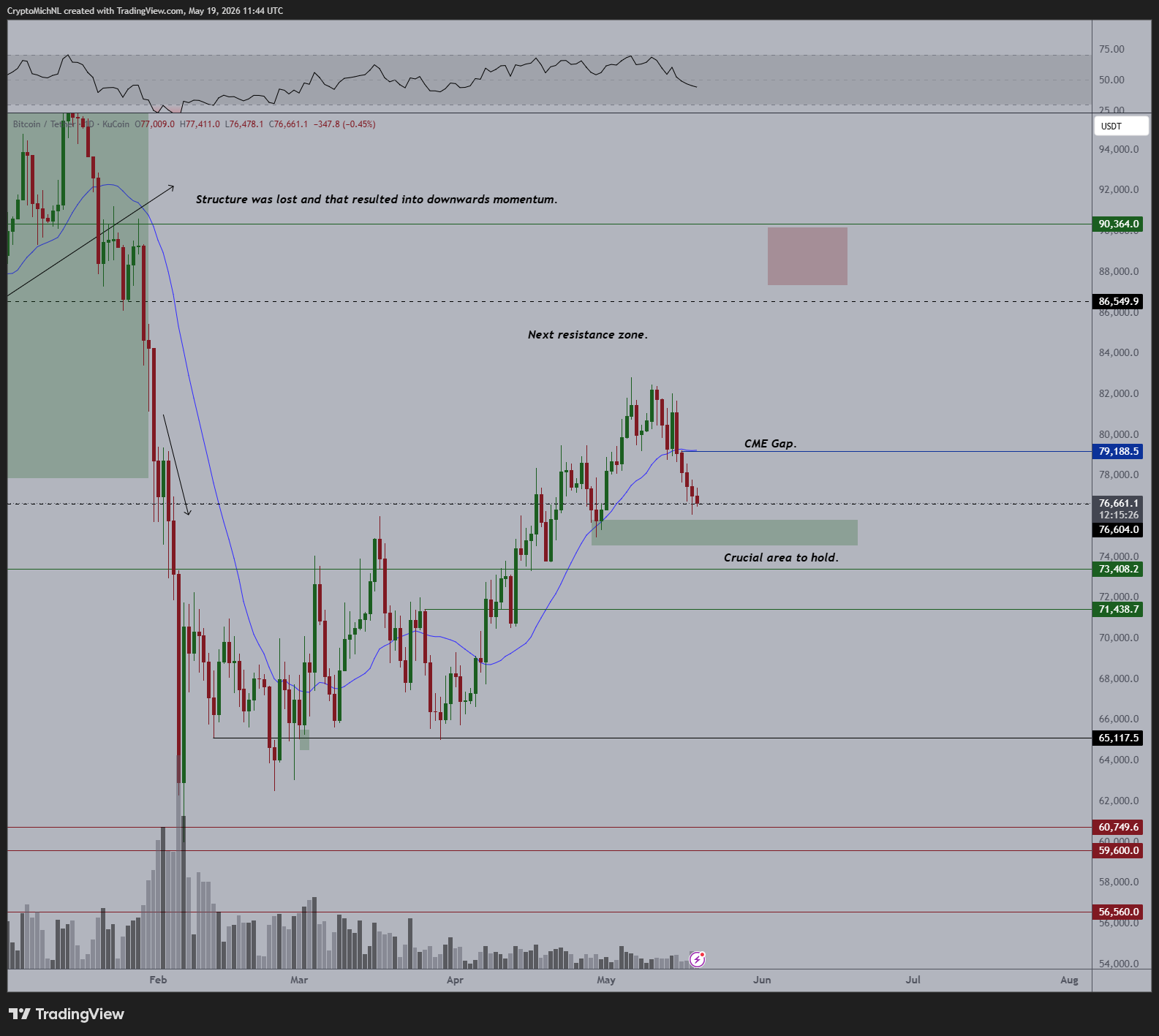
“Bitcoin is at a crucial level of support and it seems to be that it’s going to be holding,” a previous X post stated.
“Anything lower of $75,000-76,000 might signal that the accumulation needs to take longer.”
BTC/USDT one-day chart. Source: Michaël van de Poppe/X

Carlos Alcaraz to miss Wimbledon as injury problems persist

Average Age of UK Entrepreneurs Holds at 43 for 25 Years, New Data Reveals

Polymarket Launches Prediction Markets on Private Company Valuations With Nasdaq Data

Manchester United reach agreement with Casemiro over contract clause amid transfer speculation

US brings back mandatory military draft registration

Steven Gerrard disagrees with Gary Neville over ‘shock’ Chelsea and Arsenal claim | Football


-

 Crypto World4 days ago
BloFin War of Whales 2026 Grand Prix opens registration for $5M trading championship
-

 Fashion4 days ago
Weekend Open Thread: Theory – Corporette.com
-

 Crypto World4 days ago
E-Estate Announces 1 Year Live: Washington DC Summit as Real Estate Tokenization Enters Its Next Phase
-

 Tech4 days ago
Tech Moves: Microsoft AI leader jumps to OpenAI; former AI2 exec joins Meta; and more
-
Crypto World6 days ago
Bitcoin Suisse expands with Digital Asset License and Investment Business Act Registration Approval in Bermuda
-

 Politics7 days ago
Pakistan to enter Chinese capital market as war inflation bites
-

 Crypto World7 days ago
Bitcoin Suisse expands with Digital Asset License and Investment Business Act Registration Approval in Bermuda
-

 Crypto World5 days ago
Google’s Gemini AI Predicts Incredible Solana Price by the End of 2026
-

 Business4 days ago
H&R Real Estate Investment Trust (HR.UN:CA) Q1 2026 Earnings Call Transcript
-

 Tech4 days ago
Google reimburses Register sources who were victims of API fraud
-

 Sports4 days ago
Napoleonic enters 2026 Doomben 10,000 field via Abounding withdrawal
-

 NewsBeat7 days ago
Comment on Keir Starmer surviving the day as Prime Minister like a turd that wont flush
-
 Entertainment5 days ago
Zara Larsson Has Blunt Response To Chris Brown Diss
-
 Crypto World6 days ago
Two AI Tokens Lead May Rally, But Risks Are Rising
-

 Fashion7 days ago
The Best-Kept Makeup Secret for a More Defined Face
-

 Politics7 days ago
Palestine’s flag becoming a regular sight at European football stadiums
-

 Fashion3 days ago
On the Scene at Gucci’s Cruise Show in New York City: Mariah Carey, Kim Kardashian, Lindsay Lohan, Iman, and More!
-

 Crypto World4 days ago
BeInCrypto 100 Institutional Awards Nomination: KAST for Best Digital Assets Neobank and Best Digital Assets Fintech
-
 Tech6 days ago
Why AI is making typography a boardroom conversation
-

 Politics7 days ago
The 81 MPs (so far) who have demanded tick-like Starmer out
You must be logged in to post a comment Login