

Crypto World
Solana Co-founder Toly Backs New Perpetuals DEX to Challenge Hyperliquid's Dominance

Anatoly Yakovenko argues Solana needs its own atomically composable perpetuals DEX as Hyperliquid pursues regulatory clarity in Washington.

NVIDIA shares found themselves at the centre of debate over the future of the Kyber NVL144 system. On 6 July, CNBC, citing research firm SemiAnalysis, reported that the project could be delayed by more than a year—from 2027 to 2028—due to manufacturing issues involving a specialised printed circuit board (PCB). NVIDIA firmly denied the claims, helping the stock recover more than 1%.
Sentiment was also supported by a Goldman Sachs note, which described NVIDIA’s forward P/E ratio of 21.7 as attractive compared with its historical average (estimated by secondary sources at around 72). According to SemiAnalysis, a delay could provide competitors such as AMD and Google with a temporary opportunity to narrow the technology gap. However, the market’s reaction suggests investors are, for now, placing greater confidence in NVIDIA’s denial than in the reported production concerns.
Technical Outlook
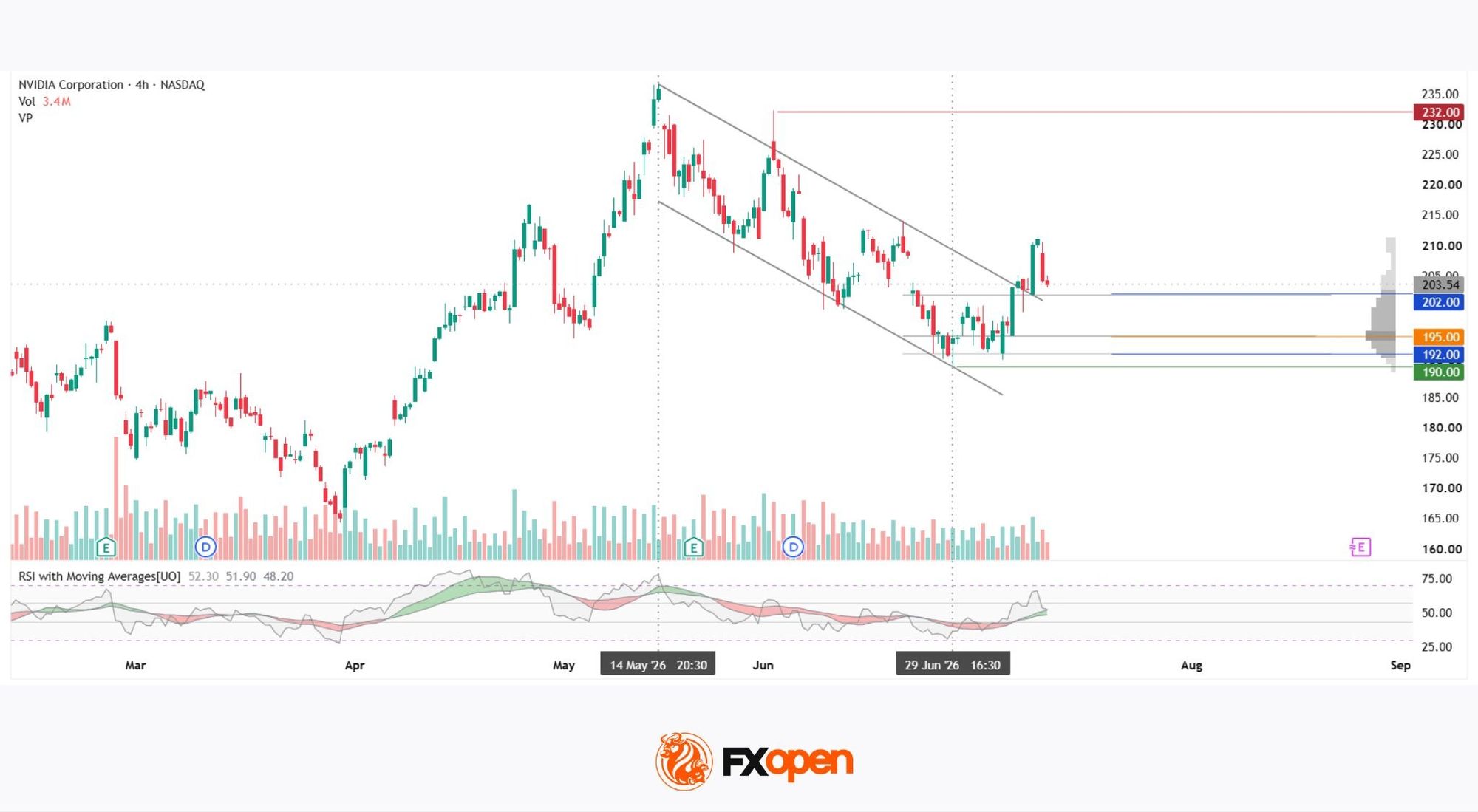
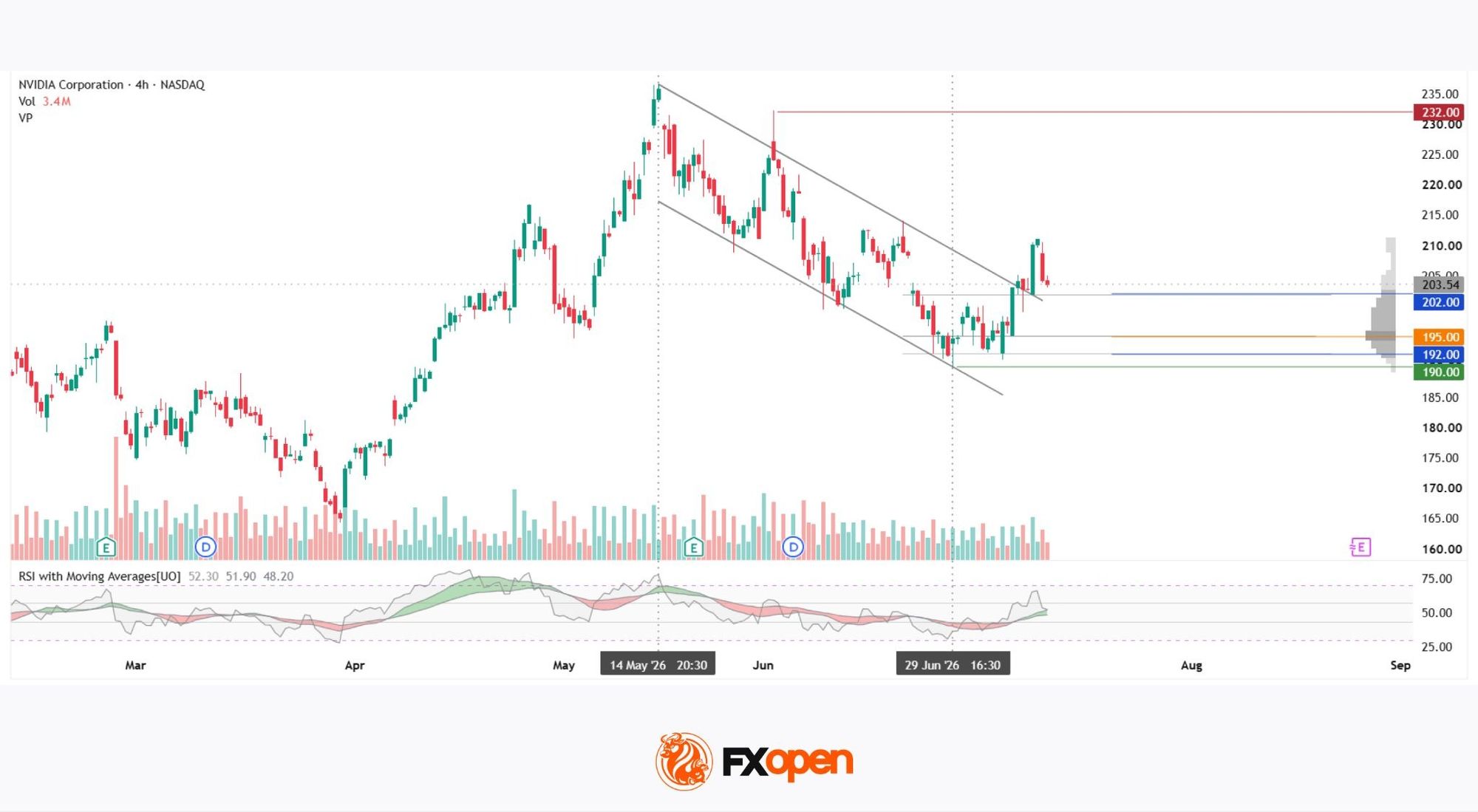
On the H4 chart, NVIDIA (NVDA) had been trading within a descending corrective channel that developed after the mid-May peak near $236. Recently, however, the price attempted to break above the channel’s upper boundary. Combined with a move above the upper edge of the current Market Profile at $202, this increases the possibility that the corrective structure is beginning to reverse.
If the bullish scenario unfolds, the next significant resistance levels could be located around $215 and $232. Below the current price, the Point of Control (POC) remains near $195, followed by two important support levels: the lower boundary of the Market Profile at $192 and the green support zone around $190.
It is also worth noting that vertical trading volume declined noticeably during the second half of the corrective channel, which may indicate weakening market participation. As a result, the move above the Market Profile could prove temporary unless supported by stronger buying activity. Meanwhile, the RSI + MAs indicator currently reads 52, 52, and 48, with all three lines clustered in neutral territory and not yet providing confirmation of the potential upside breakout.
Summary
The break above the descending channel is technically encouraging, but without stronger volume confirmation it could still prove to be a temporary move within a broader correction. The stock’s next directional move will likely depend on whether the debate surrounding the Kyber NVL144 project develops further or gradually fades from investors’ attention.
Buy and sell stocks of the world’s biggest publicly-listed companies with CFDs on FXOpen’s trading platform. Open your FXOpen account now or learn more about trading share CFDs with FXOpen.
This article represents the opinion of the Companies operating under the FXOpen brand only. It is not to be construed as an offer, solicitation, or recommendation with respect to products and services provided by the Companies operating under the FXOpen brand, nor is it to be considered financial advice.
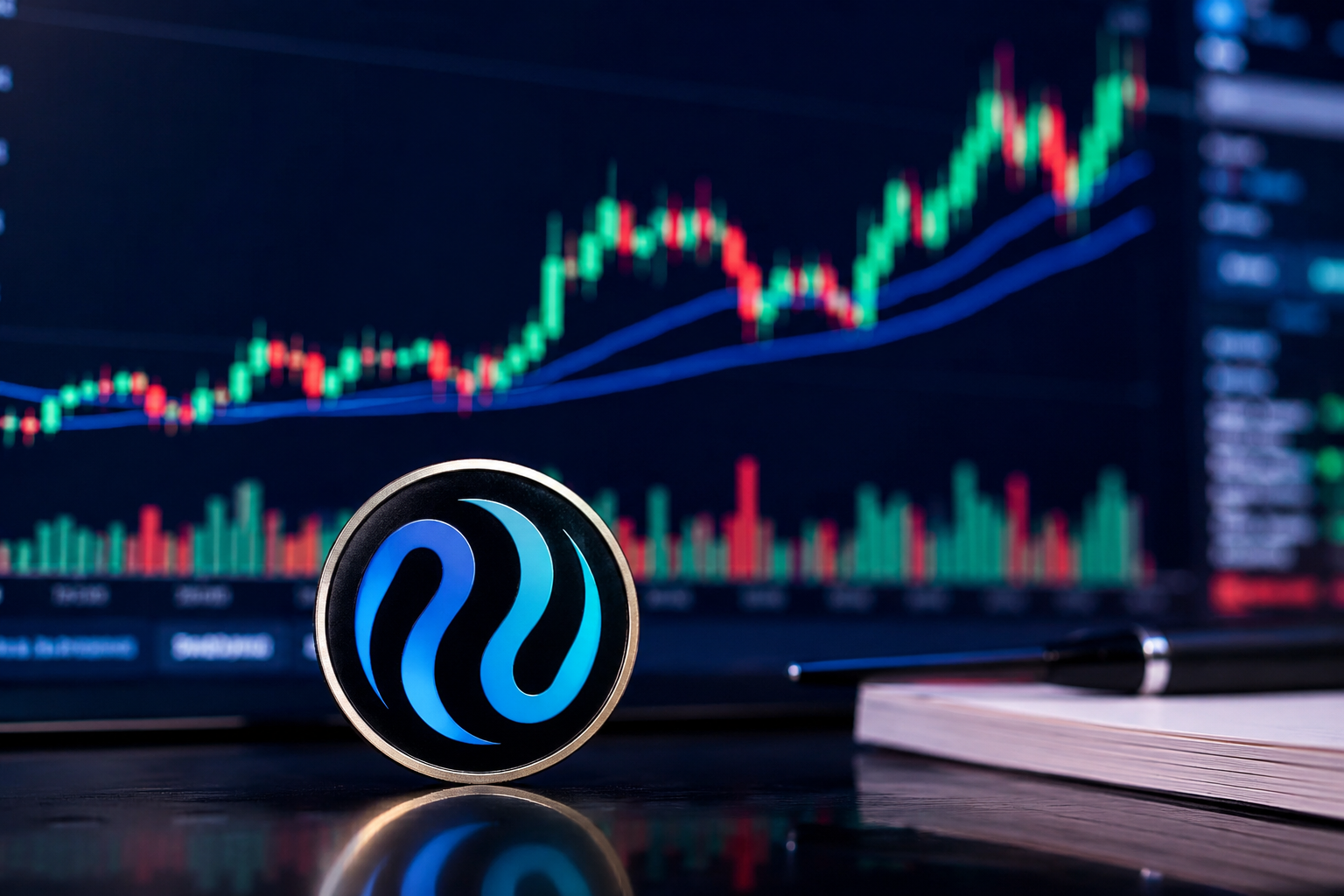

- Injective (INJ) climbed 5.1% after breaking above key technical resistance.
- Strong volume supports a potential move toward $5.30.
- Analysts highlight improving momentum despite macro risks.
Injective is posting one of the strongest short-term performances among major altcoins today.
While much of the cryptocurrency market remained subdued, INJ climbed more than 5% over the past 24 hours, supported by a decisive technical breakout and a sharp increase in trading activity.
The move has shifted focus to the next key resistance level at $5.30.
At the same time, improving on-chain metrics and renewed optimism among market analysts have added to the growing interest in the token.
Technical breakout puts $5.30 in focus
At press time, INJ traded around $5.02 after gaining 5.1% over the previous 24 hours.
The latest rally was largely driven by a breakout above the 30-day simple moving average near $4.85.
Buyers also pushed the token through the 50% Fibonacci retracement level around $5.06, a level that had capped previous recovery attempts.
The surge also stood out because it occurred while Bitcoin was slightly weaker during the same period, indicating that the latest advance was driven primarily by Injective’s own technical setup rather than broad market strength.
Unlike many short-lived price spikes, this breakout was accompanied by stronger participation from traders.
Daily trading volume rose by more than 26% to approximately $86.9 million, suggesting that the move was supported by fresh buying interest rather than weak liquidity.
The next level attracting attention now is the 38.2% Fibonacci resistance around $5.30.
Holding above the $4.85 breakout zone would keep that target in focus, while losing this level could expose the token to another test of support near $4.50.
On-chain activity continues to support the network
The recent price action also comes alongside several encouraging developments within the Injective ecosystem.
The network has processed more than $34 billion in derivatives trading volume, highlighting continued activity across its decentralised finance infrastructure.
At the same time, Injective has strengthened its stablecoin ecosystem through native USDC support, making it easier for users and developers to access on-chain liquidity.
Another closely watched metric is the Community Buyback mechanism.
More than 7.1 million INJ have now been permanently removed from circulation through the program, reinforcing the network’s long-term deflationary model.
The latest CoinGecko report puts Injective’s growth into perspective.
Top 10 L1 by protocol revenue, $34B+ in derivatives volume, native USDC, and 7.1M+ $INJ burned through the Community Buyback.$INJ keeps proving its strength with real onchain activity. @injective pic.twitter.com/Fe39MnS5Hm
— LOST CAT (@0x_Eligible) July 14, 2026
Protocol revenue has also remained among the strongest across Layer-1 blockchain networks, reflecting sustained activity rather than growth driven purely by speculation.
Although there were no major partnership announcements or protocol upgrades directly linked to the latest price increase, these on-chain metrics continue to provide additional context for the token’s recent resilience.
Analysts point to improving market structure
Market participants have also been watching several technical assessments published over the past few days.
Veteran financial trader Matthew Dixon said the broader cryptocurrency market could still form a meaningful low later in the year, but identified Injective as one of the stronger-looking altcoins.
According to Dixon, INJ established an important bottom between $2.60 and $2.80 before advancing toward the $6.80 to $7.00 area in what he described as a possible five-wave structure.
More importantly, the subsequent correction failed to create new lows and remained above major Fibonacci retracement levels, a pattern he considers healthier than that seen in many competing altcoins.
Dixon highlighted several important support levels for traders to monitor, including $4.57, $4.32, and $4.14. He also noted that the Relative Strength Index, or RSI, was hovering near 53, indicating that momentum was rebuilding instead of weakening.
Dixon added that if Bitcoin experiences another broad market decline of roughly 20%, Injective could revisit $3.75, with $3.40 representing a more extreme downside scenario during a wider market sell-off.
A separate chart shared by FurkanConsensus also pointed to improving long-term structure. The analyst identified a recurring liquidity and accumulation zone on the weekly chart that has repeatedly preceded major price moves.
Historical examples highlighted by FurkanConsensus include a rally of around 300% after a March 2023 retest of the zone and another advance of roughly 160% following about 70 days of accumulation between March and April 2026.
FurkanConsensus also noted that not every visit to the level immediately led to gains, citing November 2022, when the token briefly touched the area before declining further.
$INJ 1W Chart
I’m not sure, but it looks like the lines on the $INJ chart have been playing out pretty well. I also discovered a new level, which I’ve marked with the green line because it appears price has consistently visited this area for liquidity and accumulation.
Now… pic.twitter.com/VM3o26thZK
— FurkanConsensus 🦇🔊🍉 (@FurkanConsensus) July 13, 2026
Injective short-term outlook remains tied to key support
Despite the recent breakout, the next few trading sessions are likely to determine whether the move develops into a broader recovery.
Maintaining support above $4.85 would leave the door open for another attempt at $5.30, especially if trading volume remains elevated.
A successful move above that resistance could strengthen bullish momentum further.
However, traders should also watch broader market conditions closely.
The reaction to the latest US inflation data and Bitcoin’s ability to hold its own support levels may continue to influence sentiment across the altcoin market.
Crypto World
Crypto consolidates after selloff as South Korea’s market meltdown drives crypto volumes higher
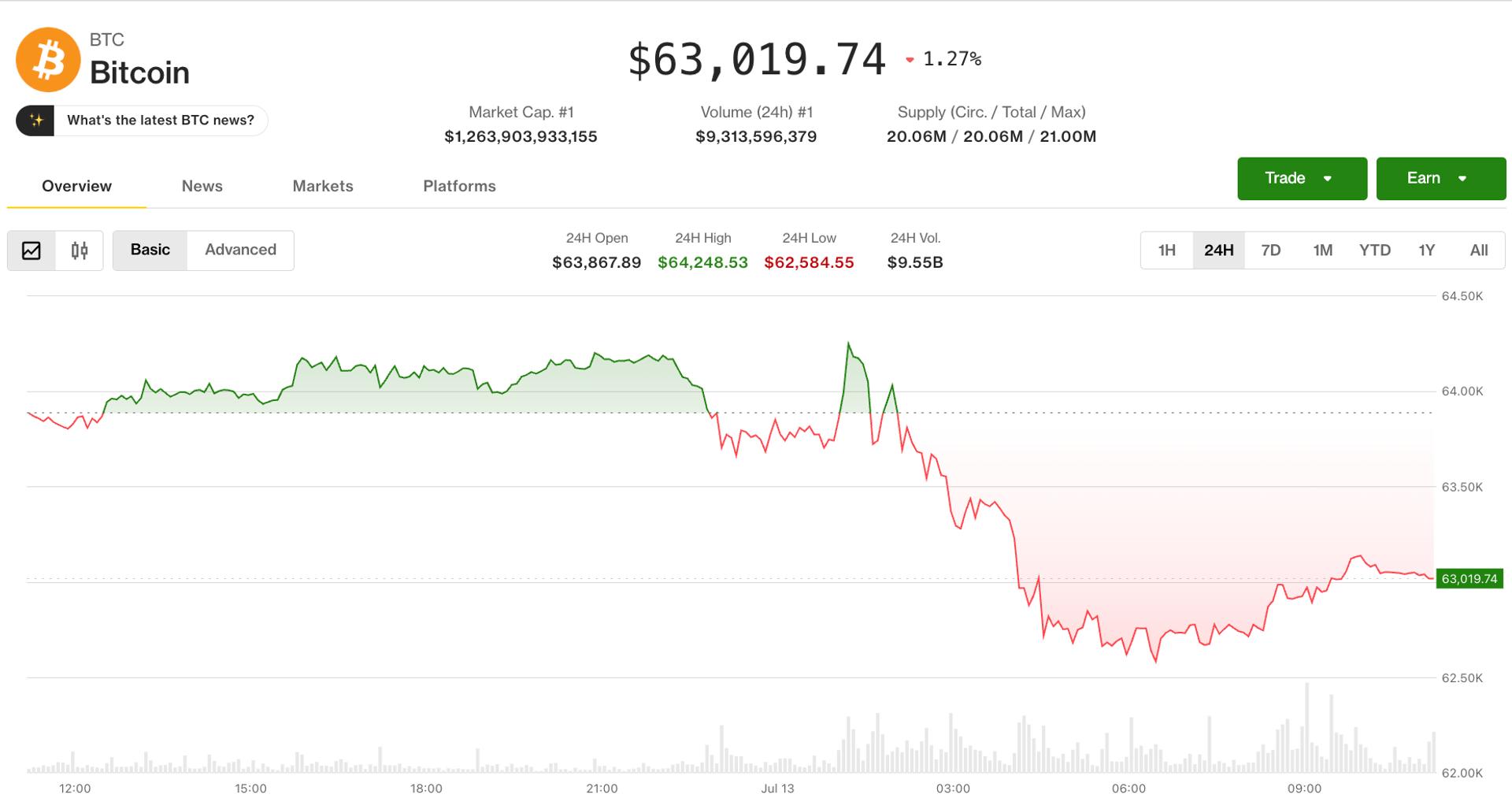
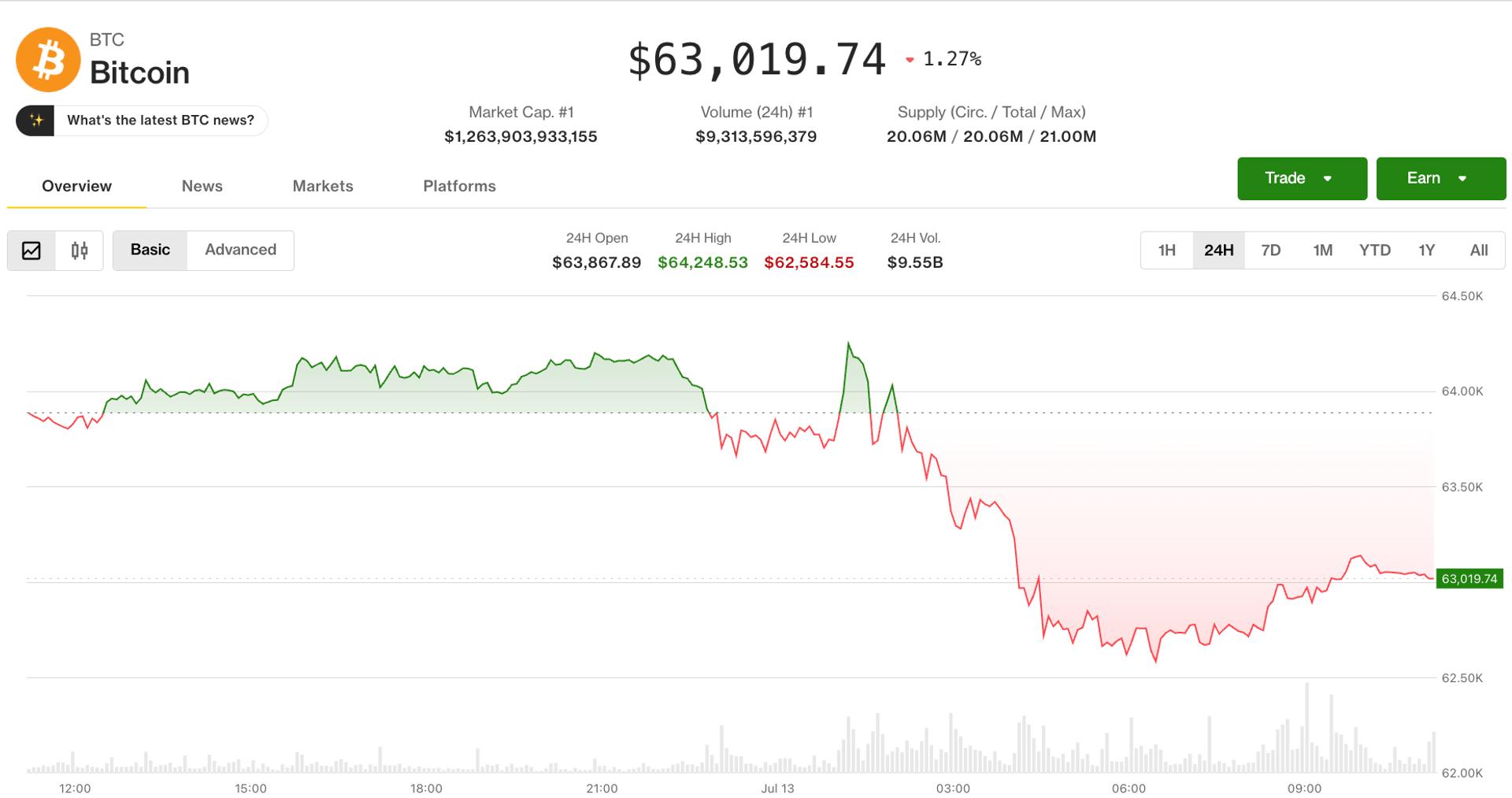
Bitcoin consolidated following Monday’s selloff, trading at $62,600 after tumbling from $64,400 to $61,800 over the course of 24 hours.
Ether (ETH) tracked the larger cryptocurrency, trading in a relatively tight $1,770-$1,790 range. Trading volume across ETH pairs increased by 2.2% to $8.95 billion over the past 24 hours, suggesting a healthy balance of buyers and sellers rather than opposed to apathy.
Lighter (LIT) rebounded from Monday’s downturn, rising by 5.7% since midnight UTC as it looks to stage another rally following a 200% surge since May.
U.S. equities were mixed, with Nasdaq 100 index futures adding 0.31% while S&P 500 index futures fell by 0.12%, reflecting uncertainty after U.S. President Donald Trump said Iran would be hit by “very heavy” strikes on Tuesday.
Gold extended its decline from January’s record high to languish around $4,020 per ounce, falling about 28% since Jan. 29.
Derivatives positioning
- Bitcoin derivatives positioning remains broadly unchanged. Open interest (OI) held at $17.1 billion; the three-month annualized basis stayed at 3.8%; and annualized funding rates ran between 0%–8% across multiple venues — with Bybit’s earlier negative outlier now brought into line.
- No meaningful leverage was added in either direction, and no stress signals emerged in the funding structure.
- Options positioning remains call-biased, but continues to moderate. The 24-hour call/put ratio sits at 58/42, softer than yesterday’s 64/36, and the one-week delta skew has compressed further to ~15% from 26% a week ago.
- The at-the-money term structure stays in contango (front end ~31–32%, long end ~43%), and Deribit’s implied volatility index, DVOL, at 37.43 is near multiyear lows. Low-stress, mild call bias, but the options premium is quietly fading.
- Coinglass data shows $283 million in 24-hour liquidations, with a 74-26 split between longs and shorts. BTC ($66 million) and ETH ($50 million) were the leaders in terms of notional liquidations.
- The Binance liquidation heatmap indicates $61,300 as a core liquidation level to monitor in the event of a price drop.
Token talk
- Ethena (ENA) mirrored LIT’s surge on Tuesday, rising by 5.7% to lead the altcoin market. Unlike LIT, however, ENA is in a deep downtrend dating back to September, since when it has lost more than 90% of its value.
- There were also encouraging signs in the AI sector on Tuesday, with NEAR rising 3.3% and FET gaining 1.7%.
- JUP and WLFI continued to show weakness amid dwindling trading volume, falling by 1.5% and 0.5%, respectively.
- CoinMarketCap’s “Altcoin Season” indicator paints a more positive picture with a reading of 54/100. It spent most of June below 50/100.
- One potentially bullish driver of altcoin price action could be the deep selloff in South Korea’s stock market. The benchmark KOSPI index has dropped 10% since Friday, leading to an inverse correlation with the country’s crypto exchanges.
- Wu Blockchain reported that Upbit trading volume surged by 1,426% following KOSPI’s plight, indicating a potential unwind of the machine chip trade that saw investors ditch crypto at the tail end of last year.
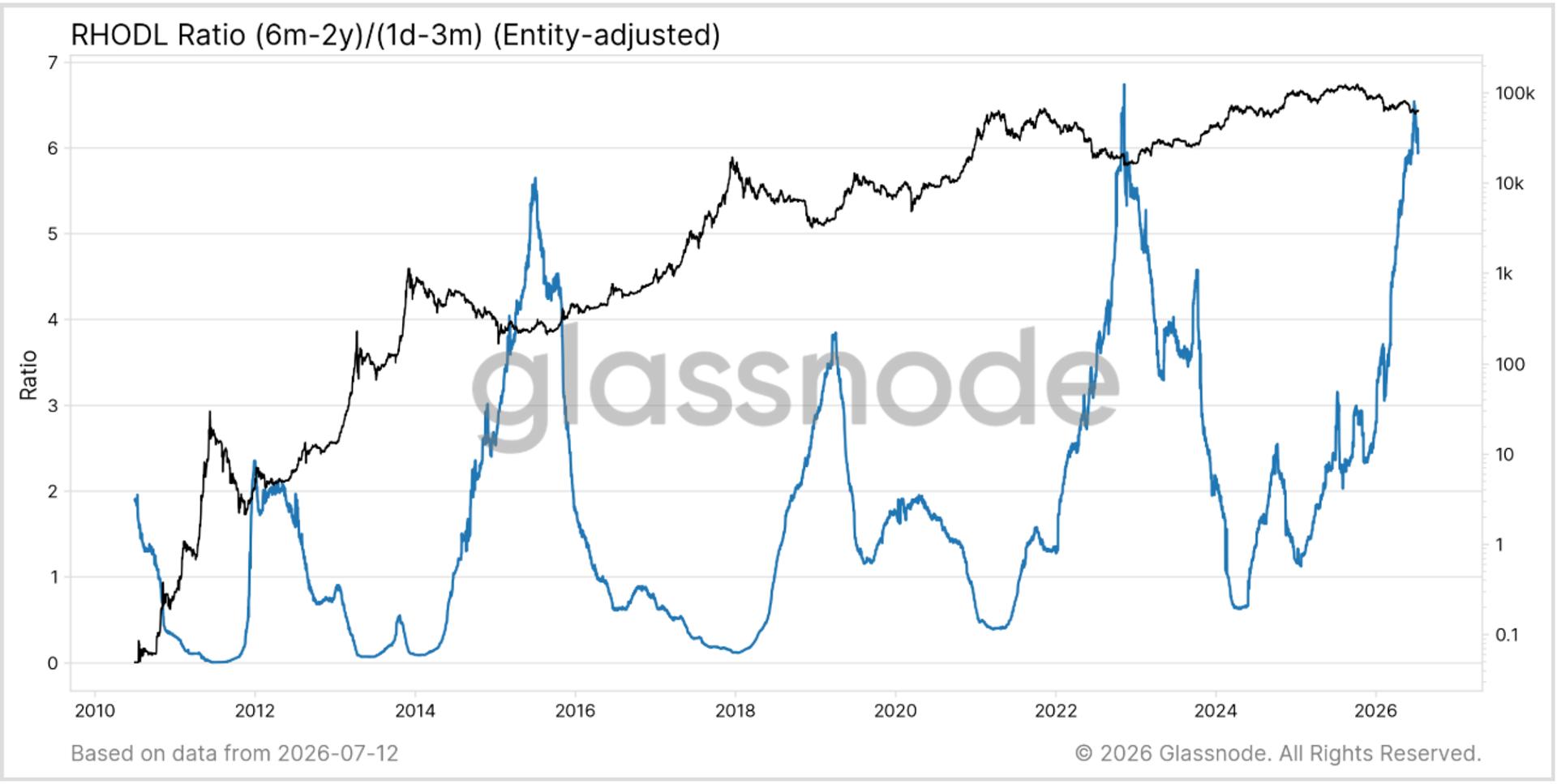
Bitcoin is currently down roughly 50% from its October 2025 all-time high of approximately $124,000. Trading near $62,000, it has spent the past five months grinding sideways between $60,000 and $80,000, leaving the market in a state of apathy.
But a closely watched onchain metric suggests this quiet period may be setting the stage for a significant move.
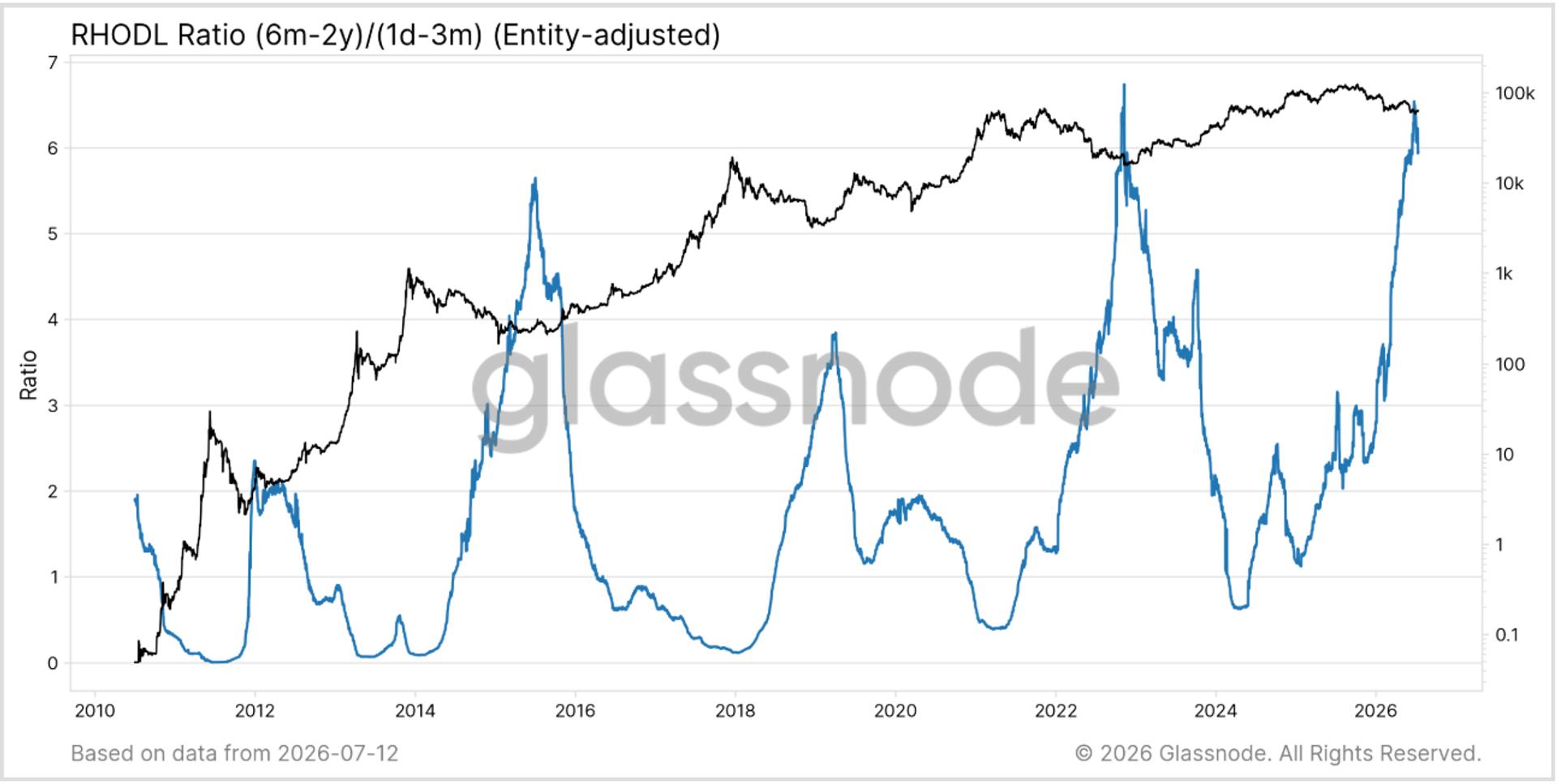
Glassnode’s RHODL Ratio, which compares the wealth held by long-term holders with that of newer market participants, reached 6.5 in early July, its second-highest reading in Bitcoin’s history. It has since begun to decline and is now below 6. Crucially, this compression is occurring while the price stagnates, rather than collapses.
In 2022, the ratio rolled over alongside a violent selloff. The collapse of FTX sent Bitcoin tumbling to around $15,000. The situation in 2026 looks different. Bitcoin continues to trade near $60,000, while coins change hands without signs of panic.
This suggests a gradual transfer of supply from long-term holders, many of whom accumulated throughout 2023 and 2024, to a new cohort of buyers who view current prices as a discount.


South Korea has reaffirmed plans to expand its blockchain and digital asset sector in the second half of 2026, pairing new blockchain initiatives with legislation for stablecoins, tokenized government bonds, and spot crypto ETFs.
Summary
- South Korea has renewed its blockchain roadmap with plans for stablecoin rules, tokenized government bonds, and spot crypto ETFs.
- Authorities will introduce the Digital Asset Basic Act and establish a legal framework for cross border stablecoin transactions.
- Blockchain projects remain part of the government’s economic strategy even as AI and semiconductor investment receive stronger policy support.
South Korea’s Ministry of Economy and Finance said after Monday’s State Council meeting that blockchain development will remain part of the country’s economic growth strategy, even as artificial intelligence receives more policy attention.
Among the measures outlined for the second half of the year, the ministry said it will support large-scale blockchain pilot projects and encourage new technologies to improve the country’s digital asset ecosystem. The plan also includes moving ahead with the proposed Digital Asset Basic Act, which is expected to establish a legal framework for digital assets, including business conduct rules and standards for Korean won-pegged stablecoins.
Alongside the legislation, authorities said they will create a legal foundation for cross-border stablecoin transactions and back amendments to the Capital Markets Act that would allow South Korea to launch its first spot cryptocurrency exchange-traded funds.
Tokenized bonds and blockchain infrastructure move forward
As part of efforts to expand blockchain use in financial infrastructure, the ministry said a pilot programme for tokenized government bonds linked to an institutional central bank digital currency project will begin in 2027. The Bank of Korea will also study how the CBDC can interoperate with other blockchain networks.
The latest roadmap builds on earlier government-backed blockchain projects already under development. Earlier this month, Gyeonggi Province confirmed an eight-month proof-of-concept programme that will begin in August to test a blockchain-based stablecoin for regional currency and government payments.
According to blockchain media outlet NexBlock, the pilot is being led by blockchain security company ZKrypto and will run until February 2027. During its first stage, the project will test stablecoin issuance, circulation and settlement before later evaluating fraud prevention, privacy protections and public benefit payments. ZKrypto said the system will use zero-knowledge proofs to prevent double spending while proof-of-reserves technology will verify reserve assets throughout the trial.
The ministry also said it will examine ways to manage and trade Global Voluntary Carbon Market credits on blockchain platforms in cooperation with international organisations.
AI receives larger share of government investment
While blockchain remains part of the country’s digital economy plans, the government’s second-half strategy places stronger emphasis on artificial intelligence.
The ministry designated physical AI, AI data centres, and semiconductors as South Korea’s three national “Mega Projects.” Under the plan, the government will invest 800 trillion won (about $535.6 billion) to build semiconductor fabrication facilities in the country’s southwest, creating a second manufacturing base alongside existing plants in the capital region.
Officials also said memory chip production capacity is expected to double within five years. At the same time, South Korea plans to establish a global AI hub to attract international organisations and multilateral development banks while expanding large-scale AI data centre infrastructure.
The roadmap keeps blockchain development on the government’s agenda through new legislation, financial infrastructure pilots and tokenisation projects, while placing larger public investment behind the country’s AI and semiconductor industries.
Crypto World
Crypto.com Exchange’s Managing Director: Institutions Are Moving Beyond Bitcoin to Rewire Finance On-Chain (Interview)
Institutional crypto adoption is entering a new phase – one that is defined a lot less by passive exposure and more by direct participation in on-chain market formation, tokenized assets, and real-time settlement infrastructure.
In the following interview with the new Managing Director of the Crypto.com Exchange, Iskandar Vanblarcum, we discuss the forces that drive that shift, the barriers still holding institutions back, and why real-world assets (RWAs), collateral utility, and regulated prediction markets could reshape the global financial landscape as we know it.
You’ve said the next era of finance will be “rebuilt on-chain.” From your conversations with institutional clients, what has changed most in their attitude toward digital assets over the past 12–18 months?
This is a pivotal moment for institutional involvement in the digital assets space. What’s changed in the last 12- 18 months is the steady maturation of our industry, alongside the development of specific and focused regulation governing the sector. Attitudes are also changing as more institutions recognize the value of blockchain technology and cryptocurrencies, and how their portfolios and businesses can benefit from reduced friction, faster settlement, 24/7 access, deep liquidity, and ultra-low-latency infrastructure, just to name a few.
Institutional adoption of crypto has often been framed around Bitcoin exposure, ETFs, or custody. Are we now entering a phase where institutions are looking more seriously at on-chain market infrastructure itself, rather than just crypto as an asset class?
Yes, this is an interesting shift that we’re seeing. We are witnessing a deep, structural integration where institutions are moving away from simply gaining passive price exposure to actively utilizing decentralized infrastructure. This is evident as institutions integrate tokenized real-world assets, like BlackRock’s BUIDL, directly as active trading collateral. Firms are also adopting real-time blockchain settlement networks, such as Lynq, to optimize capital efficiency through “Yield-in-Transit” technology. Additionally, traditional banks like Nedbank are utilizing blockchain rails to create resilient, low-cost cross-border payment ecosystems. Ultimately, the distinction between traditional assets and digital infrastructure is disappearing as institutions leverage blockchain’s 24/7 programmability to rewire legacy markets.
What are the main barriers still preventing larger institutions from increasing their allocation or activity in digital assets: regulation, liquidity, counterparty risk, internal mandates, reputational concerns, or something else?
Institutions demand a high regulatory standard of operation and strict security and compliance frameworks. There are still challenges around fragmented global regulatory frameworks and the legal classification of certain products, which may be holding some investors back. We have spent years building and investing in an institutional-grade platform, but institutions will also need to invest heavily in specialized infrastructure to manage evolving compliance standards and technological vulnerabilities before they can build trust and deploy capital safely.
The Crypto.com Exchange has highlighted real-world asset offerings as part of your remit. Which categories of tokenized RWAs do you believe have the strongest near-term institutional demand: money-market funds, bonds, equities, commodities, private credit, or something else?
We are laser-focused on the Exchange’s Real-World Asset offerings. This is a key area for the industry right now, and offering BUIDL-as-collateral was an important milestone. The next play is perpetual markets on real-world exposures like equities, commodities, metals, and pre-IPO names, offering all of this 24/7 on-chain and backed by institutional-grade infrastructure. The Crypto.com Exchange is well on its way to delivering on this, and I’m looking forward to spearheading the development of these products and services even further.
Tokenized RWAs are often described as a bridge between traditional finance and crypto. In practical terms, what do institutions need from an exchange venue before they are comfortable trading, using, or posting tokenized assets as collateral?
As an institutional-grade exchange, you have to offer a combination of compliant, industry-leading product offerings, unparalleled security, robust infrastructure, solid custody services, and strong banking partnerships globally for on- and off-ramps. All asset classes—including equities, commodities, bonds, funds, art, and real estate—will progressively be tokenized on the blockchain. Bringing these assets on-chain directly resolves legacy market inefficiencies by unlocking 24/7 tradability, rapid real-time settlement, lower transaction costs, and enhanced global liquidity. But you have to have the foundational infrastructure in place to handle the levels of Institutional capital that are flowing into tokenized assets.
The Crypto.com Exchange recently integrated BlackRock’s tokenized fund BUIDL as collateral for margin trading, according to the appointment announcement. How important is collateral utility in making tokenized assets institutionally relevant, rather than simply tokenized versions of existing products?
This was a landmark moment that perfectly illustrates the rapid convergence of traditional finance and digital assets. It signals a definitive shift toward a future where financial markets operate entirely on-chain, transforming how capital is managed and deployed. It’s a testament to the growing demand for tokenized securities and proves that the future of finance will be defined by the programmability, speed, and 24/7 nature of digital infrastructure. The integration serves as a blueprint for how TradFi asset issuers like BlackRock can effectively merge with regulated centralized crypto platforms like Crypto.com Exchange and decentralized on-chain access to create a more efficient financial system.
Your new role also includes expanding regulated prediction markets and event contracts. What makes these products attractive to institutional clients, and how do you see them fitting alongside traditional derivatives, macro-hedging tools, or portfolio risk strategies?
Prediction markets are quickly becoming one of the most in-demand financial instruments and can serve as an alternative way to trade and offset risk for institutional investors. We are where derivatives were in the 1980s – institutional capital knows they belong in the portfolio, and they are looking for a regulated, secure platform to access these contracts. This is where the opportunity lies for the Crypto.com Exchange. For example, it was the first major crypto platform globally to secure a full stack of U.S. CFTC derivatives licenses – and prediction markets in the U.S. come firmly within CFTC oversight. You combine compliant products, security, access to collateral and custody services, on top of deep liquidity and other financial services, all in one platform, and this is a really attractive offer to those institutions looking to use a reputable and established brand for their entry into the event contracts space.
The post Crypto.com Exchange’s Managing Director: Institutions Are Moving Beyond Bitcoin to Rewire Finance On-Chain (Interview) appeared first on CryptoPotato.
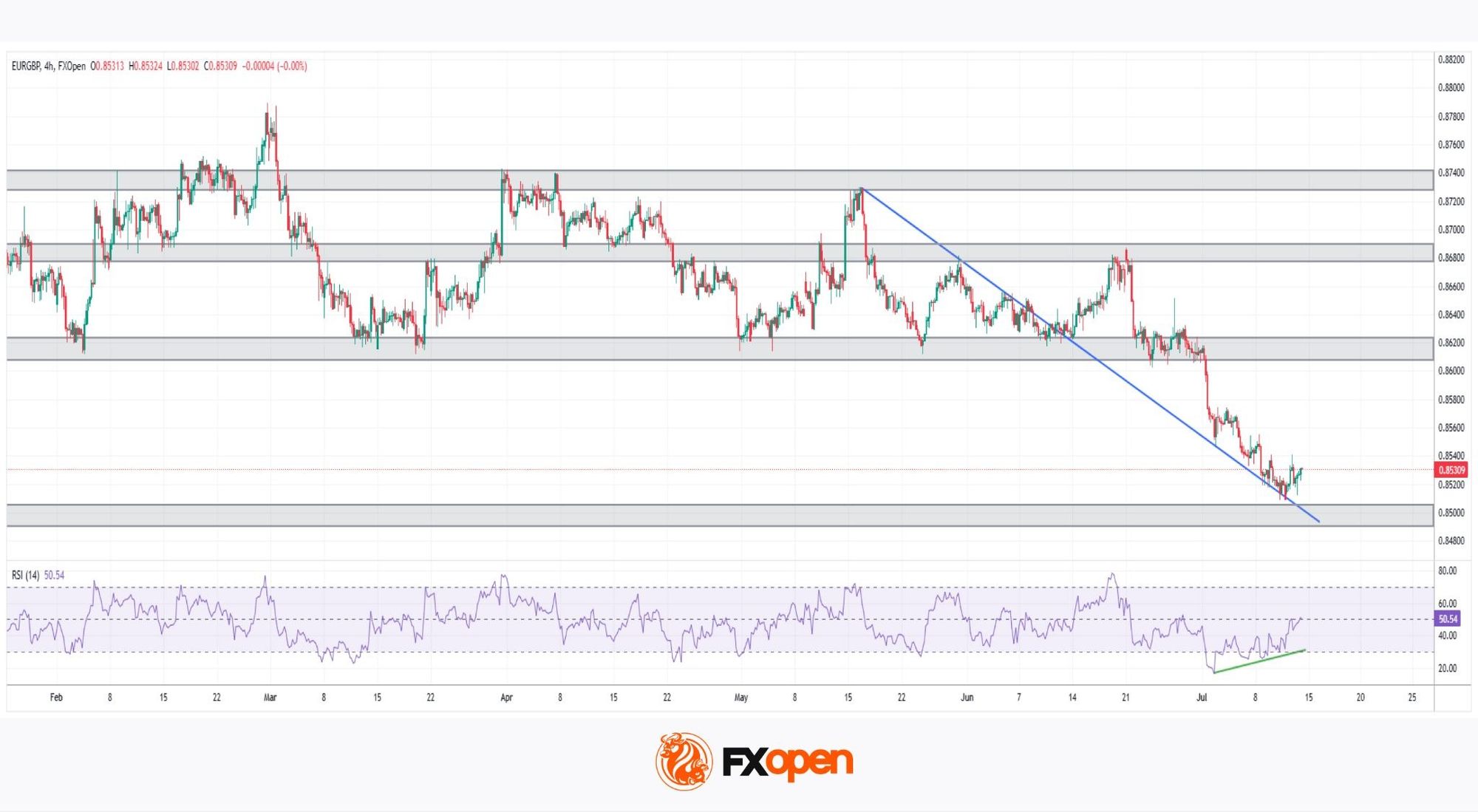
EUR/GBP has slid to its weakest level in a year, as the two currencies continue to follow increasingly divergent paths. The ECB’s June hike—its first since 2023—was meant to signal renewed hawkishness, but the very next inflation print undercut that narrative: price growth cooled from 3.2% to 2.8%, enough for markets to now assign an 88% probability that policymakers will simply hold steady at their July 23 meeting. In other words, the euro’s tightening story may already be running out of road.
The pound, by contrast, is benefiting from a rare double tailwind. Domestically, much of the political uncertainty that had weighed on sterling appears to be fading as investors look past recent leadership turmoil, while falling mortgage rates and a sharp drop in diesel prices are easing cost-of-living pressure at home. On the policy side, traders are increasingly convinced the Bank of England still has room to hike before year-end, with odds now sitting near 76%—a stark contrast to the ECB’s apparent pause.
Put simply, the euro’s hawkish window looks to be closing, while the pound is gaining traction on two fronts at once. That divergence is exactly what’s driving EUR/GBP toward these lows—and it’s worth asking how much further it can run.
EUR/GBP Technical Analysis
As the H4 chart shows, prices spent months trading lower from the April highs. In mid-June, the pair broke above the descending trendline. Since then, that same trendline has flipped into support, and price now appears to be testing it again from above.
Bullish Scenario
Adding weight to this reading is a bullish RSI divergence: while price printed a fresh low in early July, the RSI itself formed a higher low, hinting at fading downside momentum beneath the surface. If buyers step in and defend the reclaimed trendline along with the 0.8500 psychological zone, this divergence could gain real technical credibility. It would open the door for a corrective bounce with scope to extend meaningfully higher towards the former support, now resistance, near the 0.8600 zone. There, price could face an important test. A break above this level could open the way towards the 0.8680–0.8700 zone, a historic equilibrium area for the pair.
Bearish Scenario
However, if sellers manage to push back through this trendline, decisively flipping it back into resistance, the bullish divergence would quickly lose much of its relevance and credibility. In that case, the focus would shift immediately to the psychological 0.8500 support. A confirmed break below it could signal that the broader downtrend remains firmly intact, likely triggering a fresh leg lower and exposing the pair to new multi-month lows last seen over a year ago.
With price balanced right on this reclaimed trendline, and momentum quietly diverging from price, EUR/GBP’s next move could prove decisive either way.
Trade over 50 forex markets 24 hours a day with FXOpen. Take advantage of low commissions, deep liquidity, and spreads from 0.0 pips (additional fees may apply). Open your FXOpen account now or learn more about trading forex with FXOpen.
This article represents the opinion of the Companies operating under the FXOpen brand only. It is not to be construed as an offer, solicitation, or recommendation with respect to products and services provided by the Companies operating under the FXOpen brand, nor is it to be considered financial advice.

Amidst the current crypto market volatility, with XRP hovering around $1.06 after sharp corrections from previous highs, a bold new forecast has emerged that could redefine investor expectations. Grok AI Predicts that XRP is poised for a monumental rally, potentially achieving three-digit prices by the end of 2026.
XRP has weathered significant selling pressure, trading well below its prior peaks near $3.65. Yet its core utility as a fast and low-cost bridge asset for global payments continues to deliver real-world value through Ripple’s On-Demand Liquidity network and the XRP Ledger’s efficient design.
Growth in tokenized real-world assets on the XRPL has already surpassed $4 billion, while institutional interest in cross-border settlements continues to grow. These fundamentals position XRP for powerful rebounds once broader market sentiment turns positive. With improving regulatory clarity and potential pro-crypto legislation on the horizon, Grok AI Predicts substantial upside ahead as we move through the rest of 2026 and beyond.
Don’t Miss Out on Our $1,000 USDT Airdrop on ByBit
Grok AI Predicts Explosive 3-Digit Targets and $1,000 Bull Case for XRP
XRP’s fundamentals are stronger than ever, driven by unmatched efficiency in cross-border payments and expanding use cases on the XRP Ledger. Tokenization activity continues to accelerate, and banks worldwide are exploring faster settlement solutions that favor XRP over legacy systems.

Regulatory tailwinds are also aligning, and the resolution of previous legal matters has removed major obstacles, while new clarity measures and pro-crypto policies are expected to unlock greater institutional adoption throughout 2026. In a detailed analysis, Grok AI predicts that in a full bull market with widespread adoption of XRP for remittances and tokenized assets, three-digit prices become realistic by year-end.
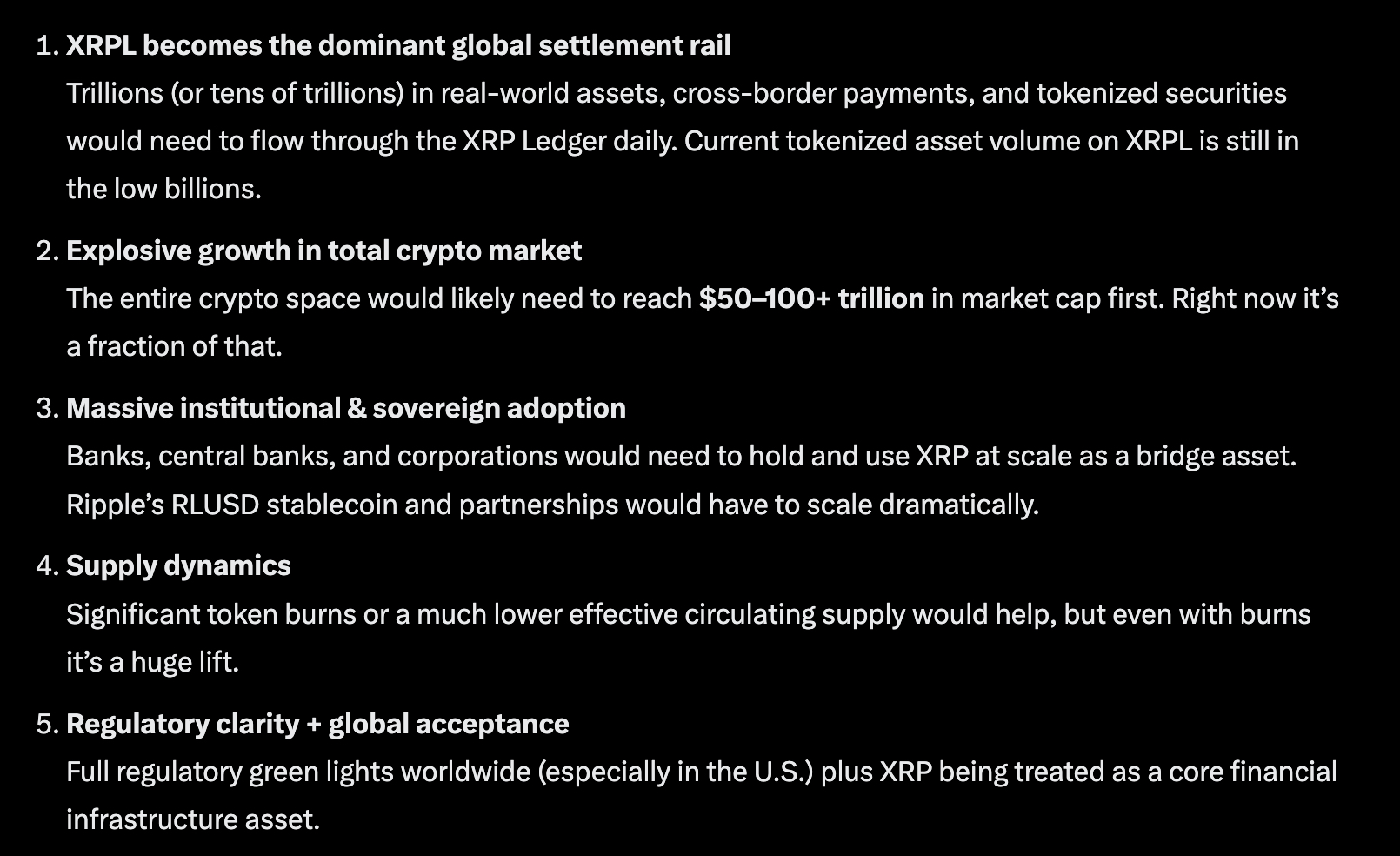
Even more explosive is the $1,000 bull case highlighted by analysts such as Pumpius, who sees this level as almost certain by 2027 under optimal conditions of bank integration, regulatory support, and altcoin season rotation. From current levels near $1.06, reaching $100 would deliver roughly 94x returns, while the extreme $1,000 scenario represents nearly 1,000x upside for those positioned early.
Discover: The Best Token Presales
Bitcoin Hyper Catching the Attention of XRP Holders as the Next 100x
Bitcoin Hyper is catching the attention of XRP holders seeking the next asymmetric opportunity to multiply gains alongside expected moves in their primary holding. As the fastest Bitcoin Layer 2 chain, it solves Bitcoin’s long-standing scalability issues with advanced rollup technology. It is delivering near-instant transactions, ultra-low fees, and full support for DeFi, meme coins, staking, and dApps directly on the Bitcoin network.
The presale price currently sits at approximately $0.0137 per HYPER token, with over $32.9 million already raised toward a higher target. The sale is in its final stages, with limited time remaining before the next price increase. Participants can also stake immediately for rewards up to 36%.
XRP holders who benefit from the strong outlook on their core position can further amplify returns by securing exposure to this high-utility Bitcoin L2 at ground-floor pricing. Bitcoin Hyper is positioned to power real-time Bitcoin activity and ecosystem growth that many expect to explode in 2026 and beyond.
Explore the Bitcoin Hyper presale now: Buy HYPER before the presale closes, and it becomes the leading solution for scalable Bitcoin transactions.
Research Bitcoin Hyper at the official presale page.
Discover: The Best Crypto to Diversify Your Portfolio
The post Elon Musk Grok AI Predicts 3 Digits XRP Price This 2026 appeared first on Cryptonews.
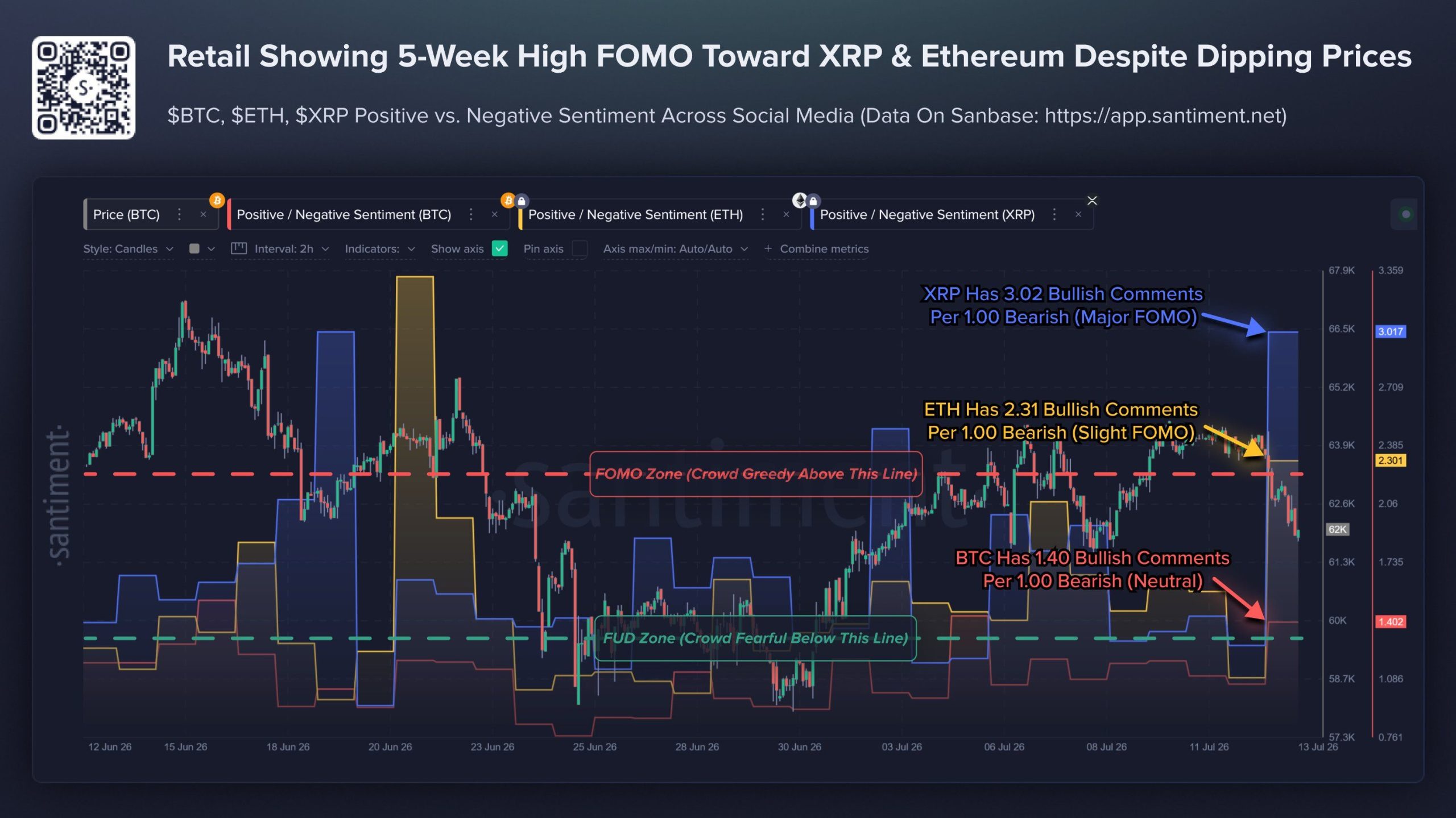
XRP (XRP) and Ethereum (ETH) both flashed a contrarian bearish signal, as social sentiment turned euphoric. Yet their derivatives markets told opposite stories, with XRP funding negative and Ethereum funding positive.
The split matters because elevated bullish chatter often precedes short-term pullbacks. When it aligns with negative funding, as on XRP, the crowd and leveraged traders sit on opposite sides of the same trade.
XRP and Ethereum’s Sentiment Signal
Santiment tracked the ratio of positive to negative commentary across social platforms. The metric weighs bullish posts against bearish ones for each asset.
On Monday, XRP led with 3.02 bullish comments for every bearish one. Ethereum followed at 2.31, placing it in mild FOMO territory.
Follow us on X to get the latest news as it happens

Bitcoin (BTC) sat calmer at 1.40, closer to neutral. All three opened stronger before fading through the session.
The reading carries a contrarian edge. Heavy bullish sentiment during a dip can raise near-term downside risk rather than confirm strength. Santiment framed the pattern directly.
“Crypto typically moves opposite to what the crowd is loudly expecting,” it said. “BTC’s more neutral sentiment may actually be healthier, since rallies usually have more room when the crowd hasn’t fully piled into the ‘higher prices next’ trade yet.”
The Funding Divergence
Funding rates show how leveraged traders are positioned. Positive rates mean longs pay shorts, while negative rates mean shorts pay longs.
XRP funding turned negative on Monday, at -0.0033%. Traders were paying to hold short positions.

Ethereum funding stayed positive, at 0.0049%. In addition, Bitcoin funding rates held positive.

The contrast is the catch. XRP’s bullish crowd is loud, but its derivatives market leans short. Traders are paying to bet against the optimism.
Ethereum shows no such split. Its social optimism aligns with positive funding, meaning the crowd and leveraged traders lean the same way.
That leaves XRP with the more conflicting setup. If the token rallies, short sellers could be forced to cover their positions, triggering a short squeeze that accelerates gains. Conversely, if bearish bets prove correct, the elevated optimism could unwind as bullish traders retreat.
XRP also posted the steeper weekly decline, falling 7.22% over the past seven days, while Ethereum slipped 1.09% over the same period.
The conflicting signals leave XRP at a crossroads. Whether the bearish positioning in derivatives or the strong bullish social sentiment ultimately prevails could shape the token’s next move.
Subscribe to our YouTube channel to watch leaders and journalists provide expert insights
The post XRP and Ethereum Share a Bearish Signal, But There’s a Catch appeared first on BeInCrypto.


A solo Bitcoin miner used a Bitaxe device to mine Bitcoin block 957,382 and claim 3.1382 BTC, worth about $200,000. The machine reportedly ran for eight hours through Public Pool before submitting the winning share.
Summary
- A $150 Bitaxe mined one Bitcoin block and earned its operator roughly $200,000 in rewards.
- The device averaged 995 GH/s, making the successful block discovery an extremely unlikely solo-mining event.
- Solo miners found 24 blocks during the past year as network difficulty eased in July.
The payout included the 3.125 BTC block subsidy and about 0.0132 BTC in transaction fees. Public Pool called it the second block found by a single Bitaxe through its hosted service. Blockchain records confirm block 957,382.
Low-power Bitaxe beats industrial-scale odds
The miner averaged about 995.2 gigahashes per second, or just under one terahash per second. That represents a tiny share of Bitcoin’s network computing power, measured in hundreds of exahashes per second. CoinDesk estimated that a machine running at that rate would find a block about once in 18,000 years on average.
The estimate describes probability, not a fixed waiting period. Every valid hash can solve the next block. The Bitaxe Gamma documentation says the device uses one BM1370 chip, the same chip found in Bitmain’s larger Antminer S21 Pro machines. Its typical performance sits near 1.2 TH/s with low power use.
Public Pool lets the miner keep the reward
The winning machine connected through Public Pool, a solo-mining service that does not divide rewards among participants like a standard pool. In a normal pool, miners combine computing power and receive smaller payments based on contributed work.
Solo mining provides no payment unless the machine finds a valid block. A successful operator can claim the full subsidy and transaction fees. Public Pool said, “Block #2 on hosted Public-Pool. By a lone Bitaxe.” One successful hash created the entire payout.
Solo Bitcoin block wins rise in 2026
Solo miners found 24 Bitcoin blocks during the past 12 months, a 41% increase from the previous year, according to CoinDesk. Twelve arrived during 2026. Other recent winners used CKPool, rented computing power or small groups of home mining equipment.
As previously reported by crypto.news, a solo miner earned about $271,000 in December 2025 after finding block 928,351. Another received roughly $282,000 that month despite odds estimated near one in 30,000.
The increase in successful blocks does not make solo mining predictable. Bitaxe devices can sell for between $60 and $150, but their expected income remains extremely low. Most users could run identical machines for years without finding a block.
Mining difficulty falls as operators face pressure
Bitcoin’s mining difficulty fell 5% to 127.17 trillion at block 957,600 on July 11. The adjustment followed slower block production and lower network hashrate. Bitcoin changes difficulty every 2,016 blocks to keep average block times near ten minutes.
The reduction followed a 10.09% drop in June. As reported by crypto.news, lower Bitcoin prices and machine shutdowns weakened mining competition. Miners have also redirected power toward artificial intelligence and high-performance computing services as margins remain tight.
Lower difficulty slightly improves the odds for active miners, including home devices. It does not remove the gap between a one-terahash Bitaxe and industrial facilities operating millions of times more computing power.
The $200,000 payout remains a rare event rather than evidence of reliable income from a $150 miner. Bitcoin lets small operators compete for the same reward, while probability favors miners controlling far greater hashrate.

NVIDIA: Kyber NVL144 Dispute Weighs on the Stock

Naomi Watts Never Forgets to Apply This Milky Sunscreen

Tuesday’s Workwear Report: Marceline Cardigan


-

 Fashion5 days ago
Loro Piana Fall 2026 Enters Houston’s Art Scene
-

 Fashion3 days ago
Weekend Open Thread: Nutriplenish Leave-In Conditioner
-
 Sports5 days ago
2026 Genesis Scottish Open Thursday TV coverage: Round 1
-

 Sports7 days ago
Joshua Pacio ‘more complete’ ahead of ONE rematch vs Malachiev
-

 Tech6 days ago
Anthropic brings Claude Cowork to mobile and web as usage data shows most users aren’t coding
-

 Sports4 days ago
Super Eagles star Moses Simon opens up on Liverpool transfer regret
-
Sports7 days ago
We have punished the disrespect
-

 Tech5 days ago
Character.AI enters the microdrama arena with its own productions, but there’s a twist
-
 Crypto World7 days ago
Claude AI Created Something Anthropic Never Designed
-

 Crypto World7 days ago
Nasdaq arthritis company holding Moshe Hogeg crypto hits all-time low
-

 Tech7 hours ago
Get Your ESP32 Sunny Side Up With This Solar Dev Board
-

 News Videos6 days ago
Crypto Just Entered Its Most Important 6-Month Candle (Could Decide Everything!)
-
 Tech6 days ago
Keychron is stepping outside keyboards with a $349 Thunderbolt 5 dock aimed at power users
-
 Business6 days ago
ASX 200 Slides Over 0.6% as Rare Earths and Lithium Stocks Tumble Amid Global Semiconductor Sell-Off Today
-
 NewsBeat5 days ago
Major update after Huntingdon train attack as man enters plea
-
 Business6 days ago
Will Trent shares rebound after Q1 update triggers 13% crash? Here’s what technical charts indicate
-
 Tech7 days ago
OpenAI teams with Work Louder to launch Codex-native keyboard, weeks after CEO of Apps told staff ‘not to be distracted by side quests’
-

 Business6 days ago
SpaceX Shares Slide Nearly 6% Amid Post-IPO Volatility and Starship Test Focus
-
 Crypto World7 days ago
TeraWulf’s $19B Anthropic Lease Turns Bitcoin Miner Into AI Landlord
-
 Sports6 days ago
39-year-old Djokovic wins five-hour thriller to enter Wimbledon semis | Other Sports News
You must be logged in to post a comment Login