

Crypto World
Bitcoin Faces Correction as Institutional Demand Weakens Amid Macro Pressure: Bitfinex


The United States and the broader global economy are facing an increasingly fragile macroeconomic backdrop. U.S. inflation has risen to 3.8% year-over-year, per April consumer price index (CPI) data, and real wages have turned negative with long-term Treasury yields climbing to multi-year highs.
Amid a hostile macro environment, bitcoin (BTC) has pulled back and erased the gains from its early-month rally. This correction is further driven by weakening institutional demand and outflows from spot exchange-traded funds (ETFs).
Weakening Institutional Demand
According to this week’s Bitfinex Alpha report, the U.S. macro backdrop has shifted toward a “higher-for-longer inflation environment.” Market expectations for Federal Reserve rate cuts have been removed, with rate hikes becoming a more likely scenario as the year progresses.
With the possibility of renewed tightening rising, bitcoin is losing momentum and becoming more vulnerable to exogenous shocks and to a high-for-longer interest rate regime. Unfortunately, this development comes at a time of deteriorating liquidity conditions – the worst since February.
Analysts said the two primary engines of marginal demand, which are spot ETFs and yield-bearing products like Strategy’s STRC, are currently under duress. ETFs ended their six-week inflow streak last week, recording almost $1 billion in net outflows. On-chain capital flows currently sit at $2.8 billion, far below the $10 billion historically associated with durable bull phases.
“As market sentiment transitions from acute fear toward persistent uncertainty, analysts say the validity of the current recovery now hinges almost entirely on whether fresh net capital continues entering the market,” analysts explained.
Market Vulnerable to Further Downside
As Bitfinex warned two weeks ago, the Bitcoin market is not positioned for sustained upside. Despite the rally toward $82,000, institutional conviction has remained insufficient to absorb macro shocks and rate volatility, leaving the market vulnerable to further correction. Bitcoin is already trading at a two-week low, reflecting a significant structural problem that could worsen due to hostile macro conditions.
At the time of writing, BTC was trading around $76,700, roughly 6.5% below its weekly opening of $82,160. While the asset is testing levels near the monthly open, analysts expect the price to fluctuate between $72,000 and $80,000. Net capital flows, as measured by the Realized Cap 30-Day Net Position Change, will determine whether the broader recovery structure remains intact in the coming weeks.
The post Bitcoin Faces Correction as Institutional Demand Weakens Amid Macro Pressure: Bitfinex appeared first on CryptoPotato.


Vitalik Buterin, the co-founder of Ethereum, has responded to increasing concerns that AI-based bug hunting will overwhelm developers and create non-stop exploitation opportunities on blockchains.
According to him, in the near future, the use of this technology might actually make crypto systems more secure. He says that AI-assisted formal verification may become one of the strongest defenses against security failures in crypto and internet infrastructure.
AI Could Strengthen Security Instead of Breaking It
Formal verification is the practice of writing mathematical proofs about software that a computer can automatically verify instead of people reviewing them. This concept has been available for decades; however, it has never caught on because generating such proofs manually was rather tedious for software developers, so many of them never bothered.
Now, Buterin is saying that AI has changed this equation, and instead of developers writing the proofs themselves, they can ask an AI to write both the code and accompanying proofs. They then simply check that the final statement proved is actually the thing they wanted to prove.
The developer described a scenario where AI models become powerful enough to automate finding bugs in existing code and then asked what that would mean for systems where a single flaw can cost users everything.
His answer was that formal verification, done end-to-end, lets you mathematically prove that a piece of code behaves exactly as intended, so that a sufficiently powerful AI looking for flaws would be looking at code that has already been proven not to have them.
He also called out specific Ethereum infrastructure projects where this approach is already being attempted. One of them is Arklib, which is working toward a fully formally verified STARK implementation. Another is evm-asm, which is building an EVM written in low-level RISC-V assembly and verifying its correctness against a human-readable reference implementation.
On the question of which AI models are actually useful for this, Buterin said he found Claude and Deepseek 4 Pro both sufficient for writing Lean proofs.
He also flagged Leanstral, a smaller open-weights model fine-tuned specifically for Lean, as capable of running locally and outperforming much larger general-purpose models on formal verification benchmarks.
But There Are Limitations
Despite his enthusiasm for formal verification, Buterin also devoted a substantial part of his essay to explaining the ways it has failed in practice.
This includes bugs in verified compilers; libraries where only part of the code was proven, and the unproven parts turned out to be the problem; and specifications that were technically proven but simply did not capture what the developer actually wanted to guarantee.
However, his broader framing is that formal verification is not a replacement for all security practices but one powerful tool in a longer-running trend toward fewer bugs per line of code.
The background is relevant here, considering that on the day Buterin’s post appeared, the crypto sector was reeling from a third major exploit in just four days after a hacker made off with more than $76 million worth of crypto from the cross-chain bridge of the Echo Protocol.
Days earlier, reports emerged regarding a hack on THORChain, which cost the platform more than $10 million.
Another attack happened after that one, targeting the Verus-Ethereum Bridge, whereby a hacker took advantage of the lack of a validation check to steal $11.58 million. That is the kind of specific, localized flaw that a formal proof check may have caught.
The post Vitalik Buterin Says AI Could Strengthen Crypto Security appeared first on CryptoPotato.


The crypto asset manager argued the market is mispricing Hyperliquid as a niche derivatives exchange instead of a fast-growing “super-app” for global trading markets.

Massachusetts Senator Elizabeth Warren has publicly challenged a key federal regulator over the expansion of crypto-related custody services under a banking charter. In a letter to OCC Comptroller Jonathan Gould, Warren contends that the Office of the Comptroller of the Currency has approved at least nine national trust charters for crypto companies that appear to exceed the narrow activities permitted by law under the National Bank Act. The dispute spotlights how the line between crypto custody and traditional banking is being negotiated in U.S. regulation, with potential implications for consumer protection, bank safety and soundness, and the separation of banking from commerce.
Warren said she expects the OCC to disclose the full set of charter approvals or conditional approvals issued since December 2025, including entities such as Coinbase, Crypto.com’s parent company, Ripple, Stripe, BitGo, Circle, Fidelity Digital Assets, Protego Holdings, and Paxos, along with communications between OCC officials and U.S. President Donald Trump, his family, or White House staff. She frames these applicants as effectively crypto banks pursuing regulatory arbitrage—seeking to reap the benefits of a national trust charter while avoiding the safeguards that accompany conventional bank charters. The senator warned that the approach could undermine consumer protections, threaten banking system stability, and blur the boundary between banking and commerce.
Cointelegraph requested comment from the OCC regarding the letter and the broader use of national trust charters for crypto firms; the publication reported that the OCC did not immediately respond to a request for comment. The exchange underscores the sensitivity of the issue as regulators weigh how to apply traditional banking laws to a rapidly evolving crypto custody landscape.
Separately, Kraken’s parent company Payward filed an application with the OCC on May 8 for a national trust charter. If approved, the Payward National Trust Company would provide fiduciary custody and related services primarily for digital assets. A national trust charter permits custodial and fiduciary activities without engaging in deposit-taking or commercial lending, potentially placing such firms under a different regulatory posture than traditional banks and LLCs offering standard depository services.
The evolving custody framework matters not just for a handful of firms pursuing charters, but for the broader crypto ecosystem that interacts with traditional financial infrastructure. National trust charters are designed to enable certain non-depository fiduciary activities while permitting services akin to trust and custodial functions. However, critics argue that granting crypto-focused fiduciary authority outside a full banking license can reduce the visibility of risk controls and oversight that are central to conventional bank regulation. Warren’s letter questions whether these charters align with the National Bank Act and whether the OCC’s approach creates a pathway for crypto participants to offer bank-like services without the corresponding safeguards.
Key takeaways
- The OCC faces congressional scrutiny over its approval of national trust charters for crypto firms, with Senator Elizabeth Warren requesting the full list of approved or conditionally approved applications since December 2025.
- Naming specific entities—including Coinbase, Crypto.com’s parent company, Ripple, Stripe, BitGo, Circle, Fidelity Digital Assets, Protego Holdings, Paxos—and noting potential communications with Trump and White House officials, Warren frames these actions as efforts to expand crypto custody beyond traditional banking safeguards.
- A national trust charter enables fiduciary custody and related services without mandatory deposit-taking or commercial lending, raising questions about regulatory parity and oversight concentration for crypto custody providers.
- Kraken’s Payward applied for a national trust charter on May 8, signaling growing industry interest in a custody-focused charter that could shape how exchanges and other crypto firms interact with the U.S. banking system.
- The developments occur amid broader policy debates on crypto regulation in the United States, including discussions around the CLARITY Act and potential alignment or friction with international frameworks like the EU’s MiCA, as lawmakers consider how to ensure consumer protection and financial stability while fostering innovation.
National trust charters and the regulatory boundary
A national trust charter is designed to authorize a bank-like fiduciary role—allowing a chartered entity to provide custodial and other fiduciary services—without engaging in the full spectrum of depository or commercial lending activities typically associated with traditional banks. In practice, holders of such charters may operate under a lighter regime for certain activities, while remaining subject to specific fiduciary standards, anti-money laundering (AML) and know-your-customer (KYC) requirements, and periodic supervisory examinations. Critics, however, argue that extending trust-like powers to crypto firms risks creating regulatory gaps if supervisory expectations and capital or liquidity standards diverge from those applied to conventional banks.
The tension highlighted by Warren’s letter centers on whether OCC’s approvals were appropriately scoped and whether the underlying activities of the named entities truly fit within the narrow confines of permissible banking-related fiduciary services. By demanding the full record of approvals and communications, Warren signals concern about potential regulatory arbitrage—where firms might tailor activities to fit a charter category that offers favorable oversight or fewer constraints than a traditional bank charter would entail. The inquiry also raises questions about whether these charters would adequately address issues such as consumer protections, prudential risk management, and the treatment of stablecoins and other crypto assets under a federated U.S. banking framework.
The OCC’s stance on crypto-related charters is part of a broader U.S. regulatory mosaic that includes federal and state authorities, as well as policy debates on how best to supervise digital assets that interact with banking rails. The landscape is further complicated by ongoing legislative proposals and executive actions that aim to clarify which activities qualify for a banking or trust charter and how AML/KYC regimes should be tailored to crypto custodians. The outcome of these debates will influence how crypto firms structure their custody offerings and whether they seek full depository charters, specialized trust charters, or other regulatory designations.
Policy context and enforcement dynamics
The current episode sits at the intersection of hotly debated policy questions about how to regulate crypto custody and whether existing banking laws adequately address the unique risk profiles of digital assets. Senator Warren has been a persistent critic of what she views as regulatory policy that could entangle public institutions with private crypto interests or create incentives for polices with perceived conflicts of interest. In parallel, she has advocated for provisions in the crypto market structure framework, including elements of the CLARITY Act, to inject greater clarity and safeguards into the regulatory process. Her comments also reflect broader concerns about the potential influence of political relationships on regulatory outcomes, an issue she has highlighted in relation to firms linked to former President Trump and the crypto industry.
From a regulatory oversight perspective, the situation underscores the challenge of applying a consistent framework to crypto custody providers that seek to operate as banks or trust entities without the typical deposit-taking license. Regulators are weighing how to ensure robust AML/KYC controls, clear fiduciary responsibilities, and resilience against operational and cyber risks, while not stifling innovation or driving activity offshore. The discourse also intersects with international policy trends, including the European Union’s MiCA framework, which aims to harmonize crypto regulation across member states and establish distinct regimes for issuers, service providers, and stablecoin arrangements. How U.S. regulators position charters for crypto custodians in relation to MiCA-style frameworks and cross-border supervision will have implications for global banking relationships and correspondent banking access for crypto firms.
The governance and enforcement dimension is also evolving as individual institutions pursue charter applications in a climate of heightened scrutiny. Kraken’s bid illustrates that incumbent and new-entrant firms alike view a national trust charter as a pathway to formalize custody services under U.S. supervisory reach. Yet supervisors will need to articulate how such charters align with supervisory expectations, risk controls, and capital adequacy standards appropriate for fiduciary activities tied to digital assets. The interplay of these factors will likely shape future licensing decisions, capital planning, and AML/KYC program design across the crypto custody ecosystem.
Impact on industry, compliance, and regulatory strategy
For crypto platforms, the potential availability of national trust charters could alter the calculus of risk management, product design, and customer onboarding. Exchanges and custodians may pursue custody-focused offerings that emphasize fiduciary services, while limiting exposure to deposit-taking activities. This could influence the way stablecoins and other crypto assets are integrated with traditional payment rails, banking partners, and settlement mechanisms. However, as Warren’s inquiry suggests, there remains a critical need for clear, publicly available disclosures that delineate the scope of each charter approval, the activities authorized, and the corresponding compliance expectations.
From a compliance perspective, the prospect of a growing cohort of crypto firms operating under national trust charters raises questions about consistency of supervision across institutions, the applicability of AML/KYC standards, and the monitoring of fiduciary risk in asset custody. Regulators may need to establish or reinforce supervisory benchmarks, including governance requirements, stress testing for custody operations, cyber risk controls, and incident reporting protocols. The outcome will influence how banks and non-bank financial institutions interact within the U.S. financial system, including access to correspondent banking relationships and participation in integrated custody ecosystems for institutional clients.
For policymakers and industry watchers, the developments emphasize the importance of a coherent policy framework that can adapt to the evolving use cases of digital assets while maintaining robust consumer protections and market integrity. The discussion around national trust charters intersects with ongoing debates on licensing criteria, cross-border regulatory alignment, and the extent to which crypto firms should bear the same or equivalent regulatory burdens as traditional financial institutions. Observers will be watching how the OCC responds to Warren’s requests, what additional disclosures or safeguards emerge, and whether any charter approvals will be conditioned or restructured to reduce potential risks to the financial system.
Closing perspective
As regulators confront the rapid expansion of crypto custody activities, the balance between fostering innovation and maintaining rigorous oversight remains delicate. The current episode illustrates how congressional scrutiny, agency policy, and industry initiatives are converging around the question of what constitutes appropriate banking and fiduciary authority for digital asset firms. The next steps—including OCC responses to requests for full charter records, the fate of Kraken’s charter application, and any clarifying legislative or regulatory actions—will shape the regulatory landscape for crypto custody and its integration with traditional financial infrastructure.
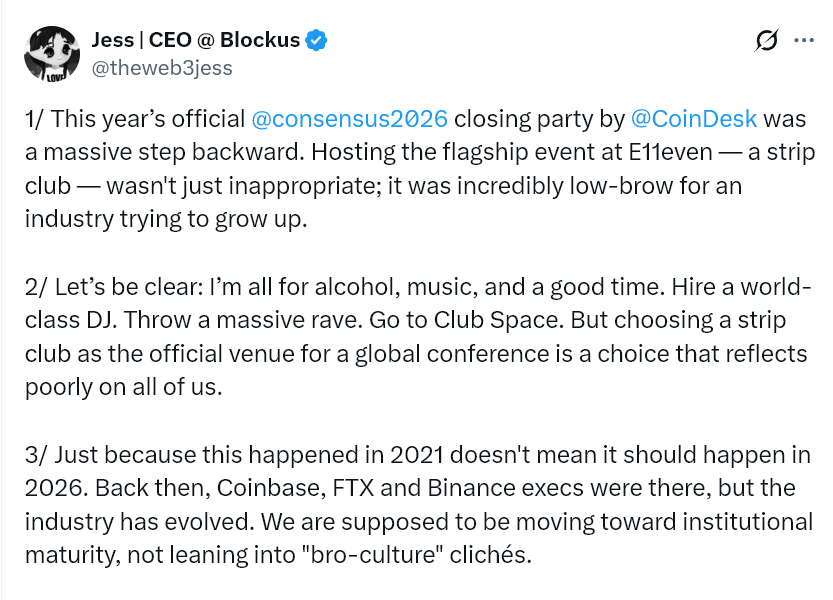
Consensus 2026 will be remembered less for what happened on its main stage and more for what happened after hours. The choice of E11even, a Miami strip club, as the official closing party venue sent shockwaves through Crypto Twitter, igniting a debate about professionalism, culture, and who the industry is really building for.
Beneath the controversy, however, the same event highlighted the widening gap between crypto’s retail base and an industry increasingly catering to institutional investors.

Lanyards at a Strip Club
Jess Zhang arrived at E11even reluctantly. She was originally going to opt for another plan, but at the behest of other partners, she changed her mind at the last minute. She walked in around midnight, during the peak of the party.
Almost immediately, she sensed she should have stuck with her original instinct. Most attendees’ faces spelled confusion, and the ambiance exuded awkwardness.
Zhang, CEO of Blockus and a member of the crypto industry since its peak non-fungible token (NFT) days, summarized it plainly:
“It was just like a dingy strip club,” she said in conversation with BeInCrypto. “People were in business casual, they had their conference lanyard on, they just looked very confused.”
She was not alone in that assessment. Amanda Wick, a former federal prosecutor turned crypto compliance consultant who was also in attendance, questioned how an industry actively courting institutional legitimacy could still default to this kind of entertainment.
“When will the crypto industry figure out not to use strip clubs as entertainment at supposedly professional events?” she wrote on LinkedIn shortly after.
The broader context also puts the choice of event at odds with the stage the crypto market is currently at.
Following widespread criticism of the event, the “Association for Women in Crypto” posted several open letters to the event’s sponsors.
Wall Street Takes the Main Stage
The day of the conference featured some prominent entities that only a couple of years ago had never set foot in the sector. Among the 15,000 different names, JPMorgan Chase, Citigroup, and other big banks stood out.
The morning after the E11even afterparty, Morgan Stanley announced crypto trading on its E*Trade platform with fees more competitive than those of Coinbase.
Beyond the events in Miami, crypto exchange-traded funds (ETFs) have grown in popularity, while exchanges like Nasdaq and the New York Stock Exchange (NYSE) announced plans to build their own platforms for tokenized stocks.
“We should be leveling up as an industry, so this shouldn’t be a venue for the official closing party,” Zhang said.
More importantly to her, however, was another contradiction made apparent during the event’s afterparty.
Institutional Gains, Retail Pains
Despite unprecedented institutional interest in crypto in recent months, prices across the board have plateaued or fallen. The economic strain on founders and developers has become hard to ignore.
For Zhang, that reality was also impossible to miss at the afterparty.
“The floor was very dry, there was nearly no money being spent at all. People weren’t tipping the dancers,” she said.
Zhang also recalled a video that circulated on Crypto Twitter shortly after, showing a man apparently pocketing dollar bills meant for the dancers.
“It felt metaphorical of the bear market and the institutionals taking from us,” she said, referring to builders and retailers.
She contrasted the scene sharply with her last visit to the same club in 2021, when now-defunct exchange FTX hosted a similar event during a historic bull run. Back then, the atmosphere was celebratory, almost cabaret-like. The club accepted crypto payments and had its own NFT project.
This time, none of that energy was present. And that sentiment wasn’t limited only to Consensus.
Survival Mode Beyond Consensus
Across some of the most prominent crypto events of 2026, what stood out to attendees were quieter-than-usual auditoriums and a palpable sense of unease.
Owen Healy, a Web3 recruiter and regular event attendee, observed this firsthand at EthCC in Cannes, France.
With a front-row seat to the industry’s job market, he noted that anxiety was widespread, cutting across companies that, from the outside, still appeared to be doing well. Few were willing to admit it openly, he said, for fear of the professional consequences.
“From the start, it was obvious we were in a bear market. Fewer side events, fewer booths, fewer attendees and fewer items of swag to take home,” Healy said in an X post. “As a recruiter, I felt sad leaving. It was scary how many attendees expressed deep concern regarding their careers. Many attendees were recently let go and many more felt it was only a matter of time.”
Paris Blockchain Week told a different story. Men in suits had largely replaced the crypto faithful, and the mood lifted accordingly– but only for those in the right rooms. For Healy, it crystallized a divide that had been building for some time.
“As things stand, we’ve two industries in one — efficient finance doing well and alternate finance not so well,” he wrote.
For many digital asset companies, that divide has made conference attendance a harder sell.
From Big Booths to Lean Budgets
For companies that built their brands on the back of crypto’s retail boom, the shift has prompted a fundamental rethink of where to put their money.
Koinly, a global crypto tax platform, is one of them. The company was an early and heavy investor in conference sponsorships, using events as a core growth engine during its formative years.
That era, according to CEO Robin Singh, is now behind them. He described the move away from large-scale conference sponsorships as a result of the broader crypto industry’s evolution toward institutionalization.
“The era of large activation booths, major sponsorship packages, and large-scale giveaways has largely been replaced by a more focused approach to capital allocation,” Robin Singh said, adding, “Today, there is a much greater emphasis on deploying acquisition spend efficiently, improving onboarding, maintaining high-quality customer support, and continuing to expand the product through the new features and integrations we regularly release.”
The shift points to something larger than conference economics. The industry is reordering itself, and not everyone is making the cut.
Zhang saw that reordering up close at Consensus. VIPs were sequestered in private events at the Ritz Carlton while everyone else was funneled into a strip club.
“It reflected a general new trend in crypto that’s very bad,” she said. “There’s just segregation into the haves and the have-nots. The institutional, the suits, VIP events that aren’t even public or talked about. And then the have-nots are the retailers, and there’s not much for them.”
Though the industry finally has the institutional credibility it spent years chasing, those who arrived long before the suits did have yet to see that validation translate into anything tangible.
The post How a Strip Club at Consensus 2026 Showed the Crypto Market’s Sad Reality appeared first on BeInCrypto.
Crypto World
Ethereum Price Primed for Quantum Narrative: Citi Says ETH Could Survive While Bitcoin Struggles

Ethereum price is falling by almost 8% this week, but Citi’s research notes could change how big money views the ETH/BTC relationship. The bank’s research cuts deeper than the quantum computing argument. Governance, not just cryptography, could decide which crypto survives Q-Day.
In a widely circulated research note this week, Citi analysts warned that recent quantum computing breakthroughs have compressed the timeline for practical attacks on digital assets, and Bitcoin carries structurally greater exposure than Ethereum.
Bitcoin transactions expose the sender’s public key on-chain until confirmed, creating a window for a quantum attacker to exploit private keys and redirect funds.
Citi’s analysis states the real vulnerability is not just technical on a technical level. Bitcoin’s conservative, consensus-driven governance makes rapid migration to quantum-resistant cryptography slow and politically contested, while Ethereum’s history of regular protocol upgrades gives it structural flexibility.
Separately, Citi has raised its Ethereum year-end price target to $4,500, with a 12-month projection of $5,440. That combination of quantum resilience and rising institutional targets is moving ETH into a bullish narrative.
— Cointelegraph (@Cointelegraph) October 2, 2025
 LATEST: Citi sets a 12-month target of $181K for $BTC and $5,440 for $ETH. pic.twitter.com/zPr6YojbVu
The implications for near-term price action are significant. If institutional capital begins rotating on quantum risk differentiation ETH’s technical setup becomes a lot more interesting.
Discover: The best crypto to diversify your portfolio with
Realistically, How Far Can the Ethereum Price Goes?
Ethereum is currently consolidating in the $2,100 support that acts as a major floor. A sustained close above $2,500 would signal the beginning of a larger breakout phase, with Citi’s year-end target of $4,500 as the initial institutional benchmark.
The bull case is straightforward: quantum narrative accelerates institutional rotation into ETH, spot ETH ETF inflows pick up through Q3, and DeFi/tokenization activity drives fee revenue that justifies higher multiples. Under that scenario, Citi’s bull-case projection of $5,000 comes into view by mid-2026.

However, Citi’s $4,500 year-end target assumes steady ETF demand and continued Layer-2 adoption without a major macro shock.
ETH needs to see a meaningful uptick in spot buying, not just derivatives activity, to confirm any move through $3,000 is sustainable rather than a liquidity squeeze. Recent institutional outlooks remain broadly bullish on ETH into 2026, though the quantum angle adds a new variable that price models haven’t historically incorporated.
Discover: The best pre-launch token sales
Bitcoin Hyper Targets Early Mover Upside as Quantum Narrative Hits BTC
If Citi’s quantum risk framing gains traction, the pressure will land squarely on Bitcoin’s limitations. BTC is known for slow transaction speeds, high fees, and a governance structure that resists rapid cryptographic upgrades.
Bitcoin’s recent price struggles already reflect institutional uncertainty about its near-term ceiling, with Citi trimming its BTC 12-month target while lifting ETH’s. The rotation narrative is forming. The question is where early capital moves.
Bitcoin Hyper ($HYPER) is positioning directly against Bitcoin’s structural weaknesses as the first-ever Bitcoin Layer 2 with Solana Virtual Machine (SVM) integration, delivering faster smart contract execution than Solana itself at a fraction of BTC’s native cost.
The project has raised north of $32 million at a current presale price of $0.0136, with staking incentives live for early participants. The SVM integration is the differentiator: it brings Ethereum-grade programmability to the Bitcoin ecosystem without sacrificing Bitcoin’s security base, a direct architectural response to the governance rigidity Citi just flagged.
Research Bitcoin Hyper here before the next price increase.
The post Ethereum Price Primed for Quantum Narrative: Citi Says ETH Could Survive While Bitcoin Struggles appeared first on Cryptonews.

According to Cointelegraph, Japan’s ruling Liberal Democratic Party (LDP) has greenlit a policy pathway to accelerate automated financial infrastructure through artificial intelligence and blockchain technology. The policy proposal, issued by the LDP Policy Research Council as part of the “Next Generation AI and Onchain Finance Initiative,” envisions using blockchain to settle payments across retail and wholesale channels, while enabling AI to autonomously execute economic activities. It also calls for clarifying the legality of yen-pegged stablecoins as part of a broader regulatory framework.
In a translated statement accompanying the publication, the council asserted that expanding blockchain adoption will be pivotal to constructing the infrastructure required to keep Japan at the forefront of AI-enabled finance. The document underscored the potential to deepen international cooperation, particularly with Asian economies that maintain strong economic ties with Japan, should Japan lead in creating a secure and trusted on-chain payments infrastructure.
“In Japan, the expanded adoption of blockchain technology will play a crucial role in establishing the necessary infrastructure to ensure that the nation remains ‘chosen by AI’,” the council stated, adding: “If we can take the lead among nations in establishing a secure and trusted payment infrastructure for on-chain transactions, we can anticipate deepening cooperation in various forms — such as by providing expertise and services — particularly with Asian countries that share strong economic ties with Japan.”
On the public record, LDP member Seiji Kihara reflected on the plan via X, describing the release as laying out the “big picture” of the initiative. He emphasized that the critical work now lies in the follow-up steps needed to translate the vision into concrete policy and implementation efforts.
Key takeaways
- The LDP Policy Research Council approved a forward-looking framework to integrate AI and on-chain finance, outlining use cases for autonomous AI-driven economic activity and on-chain payment settlements in Japan’s retail and wholesale sectors.
- The initiative places a spotlight on clarifying the legal status of yen-pegged stablecoins within Japan’s financial infrastructure, signaling a push to define digital currency instruments within existing regulatory boundaries.
- The plan positions Japan to seek regional leadership in secure, trusted on-chain payments, with potential collaboration and service provision to Asian partners that are economically entwined with Japan.
- Regulatory backdrop continues to evolve: Japan’s government earlier amended a law to classify crypto assets as financial instruments, following a period of consideration around guidelines that could enable crypto-backed exchange-traded funds.
- Industry dynamics in the domestic crypto market may be shifting toward consolidation, as evidenced by SBI Holdings’ indication of interest in acquiring a stake in Bitbank, a move with implications for market structure and regulatory oversight.
Policy framework for AI-enabled on-chain finance
The initiative represents a deliberate attempt to map a national blueprint for AI-enabled, blockchain-based financial infrastructure. By envisioning a system in which blockchain settlement mechanisms underwrite retail and wholesale transactions, and AI autonomously executes economic activities, the LDP aims to reduce friction in payments and broaden the scope of programmable finance. The emphasis on on-chain settlement is notable for potential implications across settlement latency, interoperability, and operator liability—areas that typically attract scrutiny from regulators and compliance teams as digital assets gain traction in mainstream finance.
The document also contemplates a clarified legal environment for yen-linked stablecoins. While not a full endorsement of any particular instrument, the emphasis on certainty around legal status is aimed at addressing risk vectors that concern banks, payment providers, and exchanges seeking to participate in a regulated ecosystem. In this context, the plan aligns with broader policy conversations about how digital currencies interface with traditional monetary frameworks and payment rails.
The leadership’s framing of the initiative as a collaborative path to “be chosen by AI” underscores Japan’s intention to position itself as a testing ground for secure, trusted on-chain operations. The aspirational tone reflects a governance approach that seeks to balance innovation with regulatory clarity—an essential consideration for financial institutions, technology providers, and market participants seeking clarity on permissible activities, licensing requirements, and cross-border compliance expectations.
As part of the broader regulatory landscape, observers may note that Japan has been methodically adjusting its stance on digital assets. In April, the government amended a law to classify crypto assets as financial instruments, following earlier signals about potential guideline changes that could enable crypto-linked exchange-traded funds (ETFs) in the near term. While the specific contours of any future ETFs remain under consideration, the trend signals a move toward formal recognition of digital asset instruments within Japan’s financial regulatory framework. For exchanges and asset managers, these developments—together with the LDP plan—could influence licensing trajectories, product approvals, and the scope of permissible client disclosures and risk controls.
Industry consolidation and market structure implications
Concurrent with the policy discourse, corporate activity within Japan’s crypto sector is shifting. On May 1, SBI Holdings disclosed that it was weighing a stake acquisition in Bitbank, one of the country’s digital-asset platforms. If negotiations advance and receive the necessary approvals, the move would constitute a notable consolidation: a major financial services player seeking to acquire or integrate a digital asset exchange. Market participants, incumbents, and regulators alike will be watching how such moves interact with the evolving regulatory regime—particularly regarding licensing, AML/KYC regimes, governance standards, and consumer protections for exchange users.
The consolidation narrative, set against a backdrop of regulatory clarity and a push for more sophisticated financial infrastructure, could influence competitive dynamics, capital allocation, and partner ecosystems for banks, payment processors, and other fintechs operating in Japan. It also raises questions for cross-border firms and foreign participants seeking to operate in Japan’s crypto market, underscoring the importance of aligned compliance programs, transparent governance practices, and robust risk management frameworks to navigate any shifts in market concentration.
Closing perspective
Japan’s LDP policy initiative marks a deliberate step toward integrating AI and blockchain into a formal financial infrastructure plan, with explicit attention to regulatory clarity around stablecoins and on-chain settlement. As the government advances this agenda, market participants should monitor the regulatory dialogue, licensing developments, and potential cross-border cooperation that could reshape the competitive landscape for digital assets and financial technology in Japan and the broader Asia-Pacific region.


Iran’s parliament is reviewing a bill that would obligate the state to pay €50 million (about $58 million) to anyone who kills US President Donald Trump, Israeli Prime Minister Benjamin Netanyahu, or US Central Command (CENTCOM) leader Admiral Brad Cooper.
Lawmaker Ebrahim Azizi announced the proposal on Iranian state television, framing it as retaliation for the February 28 strikes that killed former Supreme Leader Ayatollah Ali Khamenei. The legislation is titled “Reciprocal action by military and security forces of the Islamic Republic.”
Reciprocal Action Bill Targets Three Leaders
Azizi chairs the parliament’s National Security and Foreign Policy Committee. He told state TV that the named officials must be “subjected to reciprocal action” and described the act as a religious duty for any “Muslim or free person.”
“Just as our Imam was martyred, the president of the United States must be dealt with by any Muslim or free person,” the Jerusalem Post reported, citing Azizi.
Parliamentarian Mahmoud Nabavian confirmed the bill is heading to a vote and warned of a “devastating” response if Iran’s new Supreme Leader, Ayatollah Mojtaba Khamenei, is targeted next.
The proposal has not yet cleared committee review. Any passed law would still need Guardian Council approval before taking effect.
Could Crypto Rails Enter the Picture?
Iran is among the world’s most heavily sanctioned economies, raising questions about how a state-backed reward of this size would actually be delivered.
Tehran has previously leaned on alternative settlement channels, including digital assets, to move value outside the dollar system.
The “Blood Covenant” group, which researchers say operates under regime tolerance, reportedly raised more than $40 million in pledged bounties on Trump after US strikes on Iranian nuclear sites last June.
The funding mechanics of that effort have not been fully disclosed.
Follow us on X to get the latest news as it happens
Whether crypto rails could carry any future state-linked payout remains speculative. The bill specifies no payment method, but Iran’s documented stablecoin use for sanctioned trade keeps the question open.
Trump and Tehran Trade Public Threats
Daniel Cohen, a research fellow at the International Institute for Counter-Terrorism in Israel, told the Jerusalem Post that the bill looks more like propaganda than operational planning.
He described the move as “psyops” aimed at signalling defiance after the February strikes weakened Tehran’s leadership.
Cohen warned that open, state-endorsed rhetoric could still inspire lone actors even without a functioning payout.
Trump has matched Tehran’s rhetoric with his own. In a January 2026 interview, he framed any Iranian attempt on his life as a trigger for total retaliation.
“I have very firm instructions, anything happens, they’re going to wipe them off the face of this earth,” The Hill reported, citing Trump.
The Justice Department charged an Iranian national in 2024 over an alleged Revolutionary Guard plot against Trump. Defense Secretary Pete Hegseth said in March that an Iranian official planning a separate attempt was killed in a US airstrike.
Whether the bill clears parliament will signal how far Iran’s hardline establishment is willing to formalize threats that until now have lived in clerical statements and unofficial fundraising.
The next committee session is the moment to watch.
Subscribe to our YouTube channel to watch leaders and journalists provide expert insights
The post Iran Parliament Weighs $60 Million Bounty Bill Targeting Trump and Netanyahu appeared first on BeInCrypto.
Crypto World
Zerohash pursues new funding at more than $1.5 billion valuation after Mastercard drops investment plans


Crypto infrastructure providers are drawing renewed investor interest as Wall Street deepens its push into digital assets.
Crypto World
Even a mountain of T-bills won't save Tether and Circle from a sudden liquidity crisis, expert says


The head of digital assets and tokenization at one of Germany’s largest asset managers said that USDT and USDC are not stablecoins, from his perspective.


Lolli launched automatic Bitcoin cashback for users who link eligible debit or credit cards, partnering with commerce network Kard.
Summary
- Lolli partnered with Kard to enable automatic Bitcoin cashback for its 600,000 account holders on linked Visa and Mastercard debit and credit cards across Kard’s merchant network.
- Users earn Bitcoin rewards automatically on qualifying purchases with no extensions, codes, or checkout changes required, with rewards deposited directly to their Lolli wallet.
- Bitcoin earned can be withdrawn via the Lightning Network or used within the Thesis Bitcoin stack, including spending through Bitrefill and other integrations.
Lolli announced on Tuesday that it has partnered with independent commerce media network Kard to launch card-linked Bitcoin cashback rewards for its more than 600,000 accounts.
Users who link eligible Visa or Mastercard debit or credit cards through the Lolli app automatically earn Bitcoin on qualifying purchases at thousands of merchants — including Dropbox, Hydro Flask, and Stanley 1913 — with no extensions, codes, or checkout steps required.
“Lolli’s audience is one of the most distinctive consumer cohorts in the rewards space,” said Kard CEO Ben Mackinnon. “We’re excited to power infrastructure that lets them earn bitcoin in the background of their everyday spending, and to give our merchants a meaningful new channel into that audience.” The move marks Lolli’s biggest product upgrade since its acquisition by Bitcoin venture studio Thesis last July.
Lolli Bitcoin cashback removes friction from earning rewards
Cards are linked through Plaid inside the Lolli app, with Bitcoin rewards from qualifying purchases sent automatically to the user’s Lolli wallet. Rewards can then be withdrawn via the Lightning Network or used within the broader Thesis Bitcoin stack, including spending through Bitrefill. The feature requires no browser extension and works on both online and in-person purchases at any participating merchant.
Thesis co-founder Matt Luongo said the partnership fulfils the original acquisition goal: “Our users link a card once, and bitcoin shows up in their wallet from spending they were already going to do.” Lolli has previously raised $28.3 million in total funding.
Kard’s commerce media network reaches over 47 million cardholders and uses first-party transaction data to match offers to spending patterns. As crypto.news documented in its best crypto cards guide, consumer appetite for crypto-linked payment products has grown steadily in 2026 alongside broader regulatory clarity.
Why card-linked rewards expand Bitcoin adoption
Most Bitcoin cashback products require users to either spend crypto directly or use a dedicated crypto-branded card. Lolli’s model asks users only to link an existing card and shop normally, with Bitcoin accumulating passively in the background. That design removes every barrier to Bitcoin acquisition for users who want exposure without managing wallets or changing spending habits.
The Bitcoin price at roughly $77,000 at time of writing means cashback earned today represents a real-time market acquisition, with the potential for appreciation over time.
Separately, Revolut’s launch of its first physical crypto card this week, as crypto.news reported, underlines the broader trend of fintech platforms competing to make Bitcoin and crypto rewards a standard feature of everyday consumer spending in 2026.

Declan Rice hits back at Man City fans in leading Arsenal title celebrations | Football

Son of Mango boss arrested over father's fatal fall from cliff
Vitalik Buterin Says AI Could Strengthen Crypto Security

Manchester United reach agreement with Casemiro over contract clause amid transfer speculation

US brings back mandatory military draft registration

Steven Gerrard disagrees with Gary Neville over ‘shock’ Chelsea and Arsenal claim | Football

Schools Hidden Financial Secrets: They Don’t Want You to Know #BossAtHeart #FinancialLiteracy

9 Daily Habits of Rich People | Success & Money Mindset #Success #Wealth

LIVE CRYPTO CLARITY ACT FINAL VOTE (BIG BANKS VS CRYPTO)
-

 Crypto World4 days ago
BloFin War of Whales 2026 Grand Prix opens registration for $5M trading championship
-

 Fashion4 days ago
Weekend Open Thread: Theory – Corporette.com
-

 Crypto World4 days ago
E-Estate Announces 1 Year Live: Washington DC Summit as Real Estate Tokenization Enters Its Next Phase
-
Crypto World7 days ago
Bitcoin Suisse expands with Digital Asset License and Investment Business Act Registration Approval in Bermuda
-

 Tech5 days ago
Tech Moves: Microsoft AI leader jumps to OpenAI; former AI2 exec joins Meta; and more
-

 Politics7 days ago
Pakistan to enter Chinese capital market as war inflation bites
-

 Crypto World7 days ago
Bitcoin Suisse expands with Digital Asset License and Investment Business Act Registration Approval in Bermuda
-
 Crypto World5 days ago
Google’s Gemini AI Predicts Incredible Solana Price by the End of 2026
-

 Tech4 days ago
Google reimburses Register sources who were victims of API fraud
-

 Business4 days ago
H&R Real Estate Investment Trust (HR.UN:CA) Q1 2026 Earnings Call Transcript
-

 Sports4 days ago
Napoleonic enters 2026 Doomben 10,000 field via Abounding withdrawal
-
 Entertainment5 days ago
Zara Larsson Has Blunt Response To Chris Brown Diss
-

 Politics7 days ago
Palestine’s flag becoming a regular sight at European football stadiums
-
 Crypto World6 days ago
Two AI Tokens Lead May Rally, But Risks Are Rising
-

 Fashion7 days ago
The Best-Kept Makeup Secret for a More Defined Face
-

 Crypto World4 days ago
BeInCrypto 100 Institutional Awards Nomination: KAST for Best Digital Assets Neobank and Best Digital Assets Fintech
-

 Fashion3 days ago
On the Scene at Gucci’s Cruise Show in New York City: Mariah Carey, Kim Kardashian, Lindsay Lohan, Iman, and More!
-
 Tech7 days ago
Why AI is making typography a boardroom conversation
-

 Politics7 days ago
The 81 MPs (so far) who have demanded tick-like Starmer out
-
 Crypto World7 days ago
Senate Approves Kevin Warsh to Federal Reserve Board Seat
You must be logged in to post a comment Login