

Crypto World
Senator Elizabeth Warren accuses U.S. regulator of approving unqualified crypto banks

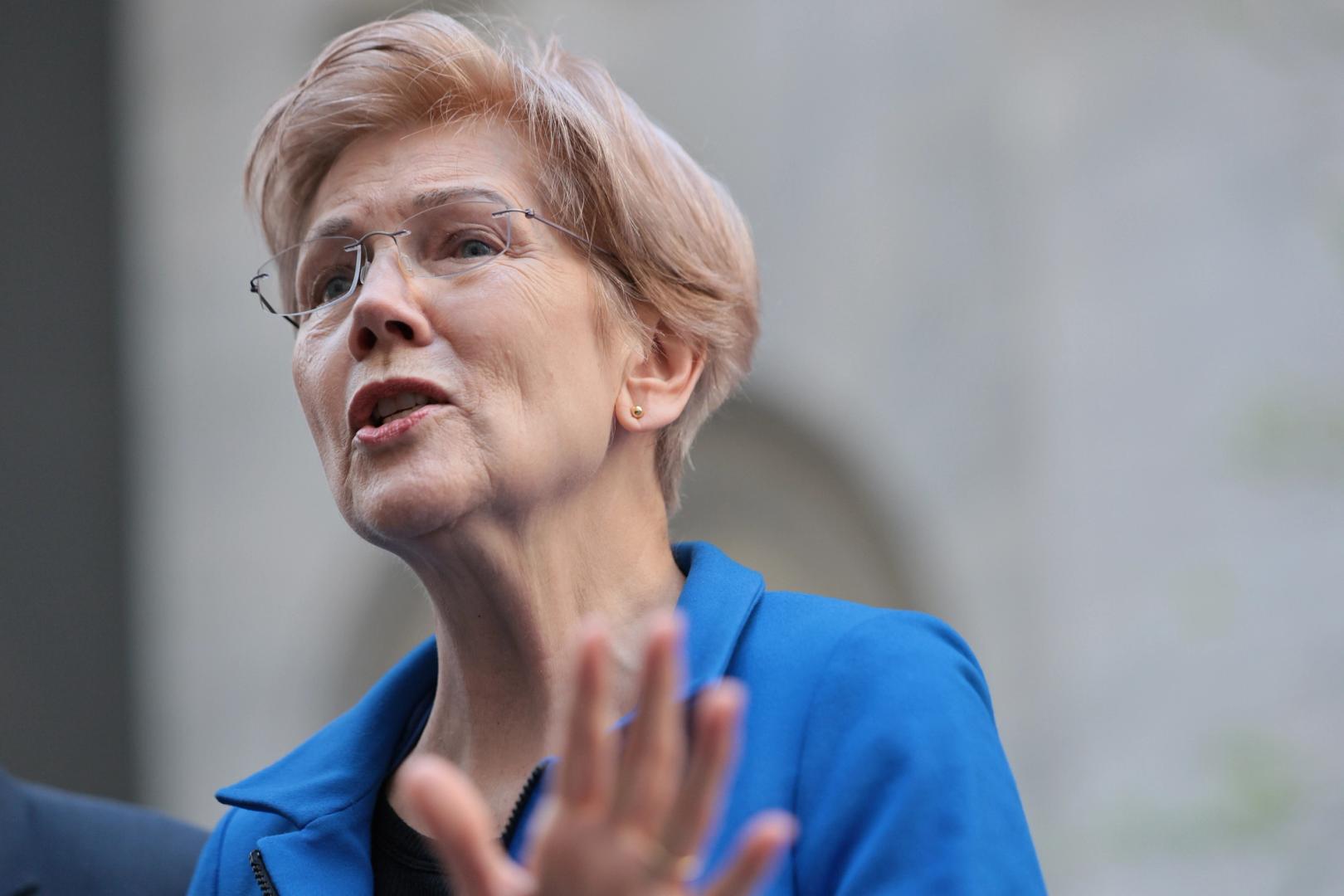
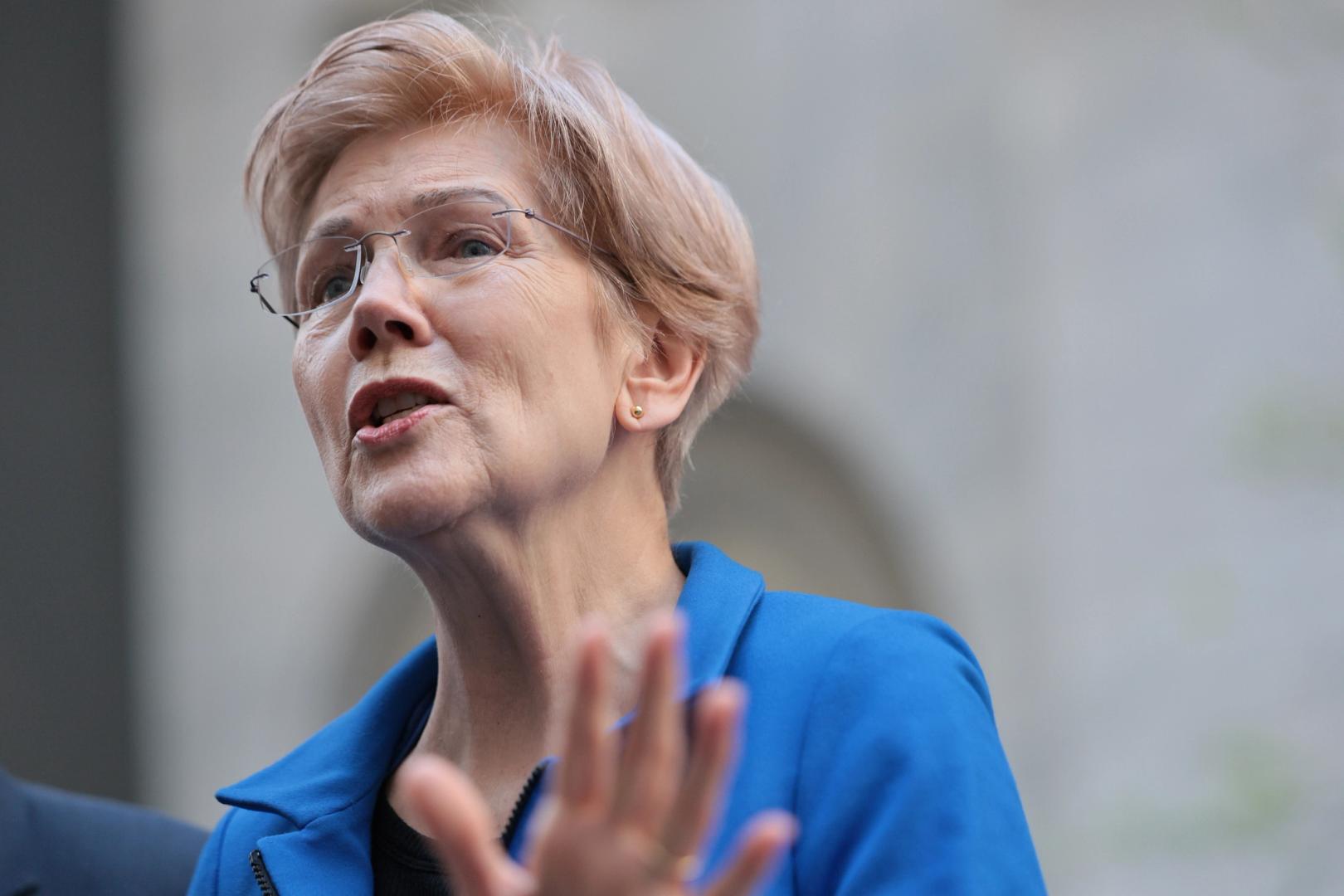
The Senate Banking Committee’s top Democrat sent a letter to the Office of the Comptroller of the Currency questioning the charters of nine crypto firms.


Key Highlights
- Milwaukee Bucks forward Kyle Kuzma toured IBM’s Thomas J. Watson Research Center, sharing his quantum computing experience with his 1.3 million X platform followers.
- The tech giant clarified the laboratory visit wasn’t sponsored — Kuzma initiated contact after publicly showing interest in quantum technology on social platforms.
- Wall Street consensus rates IBM as “Moderate Buy” with a $306.47 average price target; Bank of America recently upgraded its forecast to $330.
- Sumitomo Mitsui Trust Group decreased its IBM holdings by 3.8% during Q1, divesting 91,570 shares, while institutional investors maintain 58.96% ownership.
- The company announces Q2 2026 financial results on July 22; shares began Thursday trading at $302.18, declining 1.3% intraday.
International Business Machines enters earnings reporting season amid a distinctive convergence of events — including a high-profile facility tour, dividend increases, and active analyst coverage.
International Business Machines Corporation, IBM
Kyle Kuzma, who plays forward for the Milwaukee Bucks, recently explored IBM’s Thomas J. Watson Research Center and documented the experience for his 1.3 million X platform audience. He expanded on the visit through a Monday LinkedIn update, stating: “Quantum could end up being the foundation that expands what AI is even capable of.”
IBM informed Barron’s that Kuzma’s visit materialized after the athlete publicly demonstrated curiosity about quantum computing technology via social channels. Company representatives verified no financial arrangement supported the visit.
Shares commenced Thursday’s session at $302.18, registering approximately 1.3% decline during trading. This valuation positions the stock considerably below its 52-week peak of $332.46, while maintaining distance above the $212.34 annual low.
The technology giant schedules its Q2 2026 earnings announcement for July 22. During the previous quarter, IBM delivered earnings per share of $1.91, surpassing analyst expectations of $1.81 by $0.10. Total revenue reached $15.92 billion, exceeding the projected $15.60 billion and representing 9.5% year-over-year growth.
Wall Street’s Perspective
Current analyst coverage includes sixteen Buy recommendations and nine Hold ratings. The overall consensus classification stands at “Moderate Buy” with a $306.47 average price objective.
Bank of America elevated its price forecast to $330 in recent activity. Barclays commenced coverage during June with an “overweight” designation and $350 target. JPMorgan upgraded from neutral to overweight in late June, increasing its projection from $270 to $291.
Bearish sentiment exists among some analysts. KeyCorp downgraded to “sector weight” coinciding with JPMorgan’s upgrade. HSBC transitioned from “reduce” to “hold” during April, adjusting its target upward from $218 to $231.
Sumitomo Mitsui Trust Group reduced its IBM allocation by 3.8% throughout Q1, liquidating 91,570 units to conclude the quarter holding 2,348,360 units valued at approximately $569 million. Institutional investors collectively control 58.96% of outstanding shares.
Quantum Computing Enters Mainstream Consciousness
Kuzma’s facility tour represents another indicator that quantum computing technology is penetrating broader public awareness. A $2 billion federal government investment package materialized in May, accompanied by two executive directives addressing quantum advancement. IBM separately unveiled plans for an independent quantum chip manufacturing facility supported by $1 billion Commerce Department funding — an announcement that propelled the stock to its strongest weekly performance in over twenty years.
Kuzma maintains an established pattern of technology company visits. He toured Meta’s corporate headquarters in late June and recently shared photographs featuring equipment from Lunar Outpost, an emerging company holding a $220 million NASA agreement.
Industry analysts and quantum computing executives consistently emphasize that genuine sector validation originates from revenue-generating customers — not celebrity endorsements. Current end users predominantly comprise academic institutions and government agencies, rendering consumer-oriented publicity primarily a brand awareness strategy.
IBM additionally increased its quarterly dividend distribution to $1.69 per share, distributed June 10, up from the previous $1.68. The annualized dividend yield currently stands at 2.2%.
The corporation also introduced compact z17 and LinuxONE 5 computing systems this week, alongside unveiling Project Lightwell, an open-source security framework addressing software supply-chain vulnerabilities.

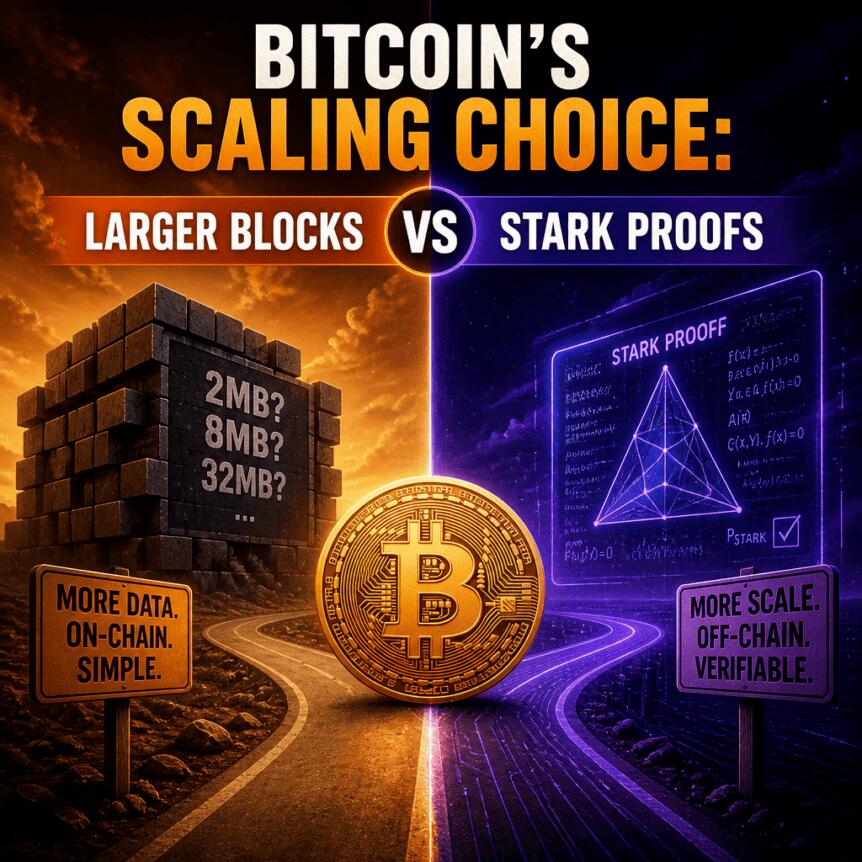
StarkWare co-founder Eli Ben-Sasson argues that quantum-safety for Bitcoin is more likely to arrive through ZK STARKs—especially when used to compress the huge signature data expected from post-quantum (PQ) schemes—rather than by simply expanding blocks or accepting slower throughput. He also suggested that Adam Back, founder of Blockstream, aligns with the core idea, though Cointelegraph reported no response from Back to its outreach.
The broader debate has resurfaced this week as Ben-Sasson also drew attention for a separate, contentious proposal on X: raising Bitcoin inflation to 4% annually. However, his technical case for ZK STARK aggregation rests on a concrete concern—PQ signatures are far larger than today’s ECDSA/Schnorr signatures—and the resulting trade-offs for network capacity and decentralization.
Key takeaways
- Post-quantum signatures are much larger than Bitcoin’s current signature schemes, potentially forcing major capacity changes.
- ZK STARK aggregation could compress many large signatures from a block into a much smaller proof, reducing on-chain data pressure.
- Simply increasing block size is an alternative, but it may raise costs for nodes and revive decentralization concerns.
- Bitcoin’s governance and Script limitations are the main bottlenecks for adding native STARK verification at the base layer.
- StarkWare’s roadmap points to a different approach via account abstraction, making post-quantum upgrades operationally easier on systems like Starknet.
The core constraint: PQ signatures don’t fit like today’s
Ben-Sasson’s argument starts with the mismatch between Bitcoin’s existing cryptographic footprint and the expectations around post-quantum schemes. Adding PQ signatures “by itself,” he says, does not make the chain quantum-safe in a practical sense; it introduces an engineering problem first: the new signatures are orders of magnitude larger.
According to the article, the current set of PQ signatures approved by the US-based National Institute of Standards and Technology (NIST) are roughly 10 to 100 times larger than Bitcoin’s prevailing ECDSA and Schnorr signatures. The practical risk is throughput and verification overhead—one oft-cited concern is that a block could end up supporting far fewer transactions.
Ben-Sasson’s counterproposal is to move the bulk of that data off the chain and replace it with a compact cryptographic statement. In his view, the signatures for all transactions in a block could be aggregated into a single ZK STARK proof, which would be significantly smaller than including the original signatures. That, he argues, could preserve or even improve effective efficiency compared with a naive on-chain PQ upgrade.
“If they don’t allow for ZK STARK aggregation, then definitely it will be a very unfortunate move because it won’t really solve the problem … where the problem is ‘can everyone actually use Bitcoin?’” Ben-Sasson said.
“So for that you need massive scale. And for that, you need things like signature aggregation and just increasing the block size isn’t enough.”
Block size as the “simple engineering” fix—and why it’s controversial
One alternative Ben-Sasson acknowledges, via commentary from other experts, is increasing Bitcoin’s block size. The dispute is not about whether it works—it’s about the cost structure and the governance path.
Marin Ivezic, author of PostQuantum.com and founder of Applied Quantum, told Cointelegraph that Bitcoin’s SegWit scheme reduced the impact of larger signatures by up to 75%. But Ivezic’s modeling of NIST’s ML-DSA-44 scheme (described in the article as having 2,420 bytes per signature) suggests block capacity could drop to roughly 500 to 700 transactions under those conditions—down from 2,500 to 3,000 “today.”
That figure is what makes block-size debates feel inevitable: if PQ signatures drive transaction sizes sharply upward, the network needs somewhere for that data to go. Yet, as the article notes, critics see block growth as a blunt instrument because it pushes more storage, bandwidth, and verification work onto all nodes. Over time, that can mean higher operating costs and potentially less hardware diversity—an outcome that opponents argue could shift Bitcoin toward centralization.
The article also points to Blockstream Research’s recent experiments compressing hash-based post-quantum signature schemes for Bitcoin. It cites SHRINCS and SHRIMPS, with “everyday” signatures said to be around five times larger than current Bitcoin signatures, and up to 40 times larger in recovery scenarios such as wallet resurrection. The implication is that even with compression, larger signatures remain a throughput challenge unless block sizes increase.
“Raising capacity natively is the simple engineering answer and the hardest governance answer,” Ivezic said. “We just don’t have time for those debates.”
Why ZK aggregation could matter more than capacity alone
The attraction of ZK STARK aggregation is not simply that it is smaller. It’s that it changes the economics of what must be stored and verified by nodes.
At a high level, ZK proofs let one side prove that some statement holds without exposing all underlying details. In the Bitcoin setting described in the article, a STARK proof could certify that the necessary conditions for multiple transactions—tied to signatures—are satisfied, without requiring the chain to carry the full set of individual signature bytes.
The operational claim from Ben-Sasson is that generating a proof for a single block is a job that likely needs to be done once (with optional redundancy), and that the proving hardware could be far cheaper than commercial mining setups. The article further notes that verifying proofs could be feasible on very modest devices, pointing to Lean Ethereum’s specification benchmarks—where proving equipment is described as potentially under $100,000 and verification could run on almost any equipment, even something like a Raspberry Pi.
Ben-Sasson also argues the momentum for ZK STARKs existed among early Bitcoin developers. He claimed that figures such as Greg Maxwell and Mike Hearn were “very bullish about ZK STARKs,” citing their belief that STARKs provide post-quantum security without trusted setup. In the article, he adds that he thinks Bitcoin Core developer Luke Dashjr and Adam Back are aligning more with the idea, though Cointelegraph states it did not receive a response from Back.
One complication raised in the article is that Ethereum researcher Justin Drake has described a desire for Bitcoin to adopt Lean Ethereum’s ZK proof aggregation approach. However, political constraints might make that difficult to implement in practice—even if the technical path exists.
What would it take for Bitcoin to verify STARKs?
The question for Bitcoin is less about whether ZK STARKs are cryptographically credible and more about whether Bitcoin can verify them in a practical, acceptable way. That brings the discussion to Bitcoin Script and governance.
The article suggests a more politically pragmatic starting point may be re-enabling OP_CAT, an opcode Satoshi introduced and later removed. Ben-Sasson argues that if OP_CAT is enabled, it could unlock capabilities needed for STARK proofs and aggregation and thereby support post-quantum security.
Still, while OP_CAT drew attention in earlier months (as the article frames it, 12 to 24 months ago), it has “lost momentum” more recently. It remains a governance-dependent path, with Bitcoin’s deliberative culture cited as a key factor.
Beyond OP_CAT, the article mentions other proposals such as OP_STARK_VERIFY, an opcode-oriented idea designed to verify STARKs more efficiently on Bitcoin, and a concept called BitZip associated with Ethan Heilman. Heilman’s framing (as quoted in the article) outlines two broad routes: enhancing Bitcoin with general-purpose opcodes to support rollup-like constructions, or supporting STARKs at the consensus layer. He also referenced weaker aggregation schemes—like CISA (Cross Input Signature Aggregation)—as potential partial help.
Even if the crypto is strong, the practical gating factor is that Bitcoin Script cannot verify STARKs today. The article quotes Ivezic’s assessment that a base-layer STARK verifier is realistically a 2030s governance conversation, noting that consensus-layer changes carry far more surface area than small signature-related opcodes—even ones like OP_CAT that have already faced years of debate.
By contrast, the article highlights that other networks may find post-quantum transitions easier. It notes that Ethereum is targeting 2029 for post-quantum transition and that Solana has experimented with post-quantum signatures. For Starknet specifically, the article ties StarkWare’s three-phase quantum-secure transition to native account abstraction, which allows upgrades of underlying cryptography without forcing every user to migrate accounts manually.
“On Starknet, we have this big advantage that we have already native account abstraction and smart wallets, which means that nothing is enshrined so its very easy to upgrade the wallets and the infrastructure to be post quantum.“
The strategic implication, as Ben-Sasson presents it, is that post-quantum roadmaps on networks without flexible account layers could be “extremely hard,” while Starknet’s design choices reduce lock-in risk.
For Bitcoin readers, the next watchpoints are straightforward: whether any OP_CAT-related or STARK-verification discussions regain momentum, and whether the community gravitates toward aggregation-first proposals that preserve decentralization—rather than defaulting to block-size increases that may raise node burdens. The cryptography may be solvable, but Bitcoin’s ability to verify it at scale hinges on governance and Script capabilities.

June was not kind to Cardano’s native token, whose price briefly crashed below $0.14, marking the lowest point since 2020.
Fortunately for the bulls, the asset started July on the right foot, temporarily recovering to roughly $0.20, and is currently trading at around $0.17, representing a 14% increase over two weeks.
It will be interesting to see whether ADA can extend its positive momentum in the following months and reclaim the major milestone of $1 before the end of the year. Below is the perspective of three of the most widely used AI-powered chatbots.
Possible But Quite Difficult Task
ChatGPT estimated that ADA could reach $1 sometime this year, but warned that this will be extremely challenging given current levels. OpenAI’s platform claimed that the biggest problem is usage, noting that Cardano’s ecosystem and activity still look small relative to the valuation needed for such a milestone.
“$1 is possible only in a full bull scenario — Bitcoin strong, altcoins rotating, ETF optimism rising, and Cardano showing real DeFi/stablecoin growth. A more realistic recovery path would first be $0.30–$0.50. If ADA clears that zone with volume, then $0.75–$1 becomes a serious target. If the broader market stays weak, ADA may struggle even to reclaim $0.30,” it stated.
Perplexity also didn’t rule out the possibility, but argued that an explosion of that magnitude would require three things to happen simultaneously: Bitcoin-led market strength, a clear acceleration in the Cardano ecosystem, and a major re-rating of large-cap altcoins.
The chatbot claimed that the most realistic scenario for ADA this year is to reach a maximum of $0.80, as it could spend parts of the year closer to $0.30-$0.50, especially if catalysts like CME futures, Hydra, and improved DeFi usage start to matter more.
Uphill Battle
Google’s Gemini said an ascent to $1 for ADA in 2026 is mathematically possible but highly improbable. The chatbot addressed the ongoing problems of Cardano, which continues to struggle with user growth, DeFi traction, and actual daily transaction volume compared to its competitors like Solana and Ethereum.
Moreover, Gemini touched upon Charles Hoskinson’s recent statements, which have posed hurdles to ADA’s price action. Recall that Cardano’s founder shocked the community last month when he said he’s “taking a break” and warned of an upcoming “wave of failures in the ecosystem.”
“>”Hoskinson is known for his unfiltered, highly transparent communication style. While his supporters praise his honesty, markets hate uncertainty. Right now, Cardano is going through a painful transition phase, and Hoskinson’s public commentary is magnifying those growing pains,” Gemini stated.
The post Can Cardano (ADA) Reclaim $1 in 2026: 3 AIs Weigh in appeared first on CryptoPotato.
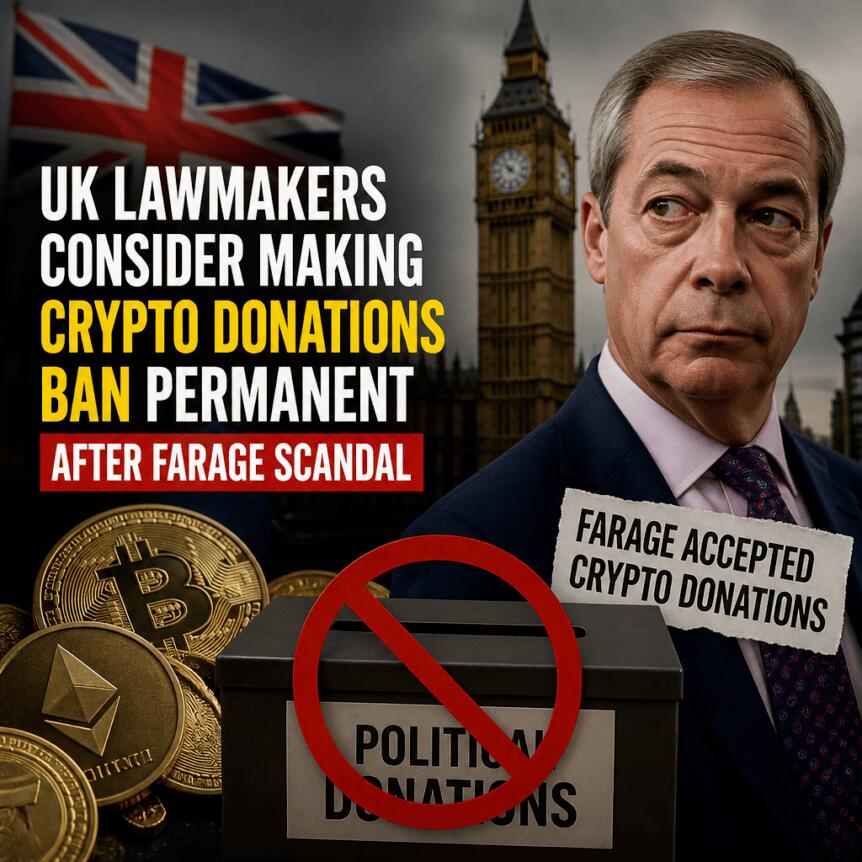
UK Labour MPs are preparing to push for a permanent ban on crypto donations to political parties and candidates, arguing that recent allegations around Nigel Farage’s funding have underscored risks of undue influence in British politics.
According to The Guardian, the party is looking to overhaul existing donation rules after a March moratorium on crypto contributions was introduced and then prompted further scrutiny. The renewed push is linked to Farage’s resignation from Parliament and reporting that he received large “gifts” connected to the digital-asset industry.
Key takeaways
- Labour MPs are considering making the March crypto-donation moratorium permanent, moving from temporary restraint to a lasting rule change.
- The push follows Farage’s resignation and claims that he accepted millions in donations described as “gifts” from crypto-linked figures.
- UK lawmakers plan to review proposed amendments next week, potentially tightening political funding limits for digital assets.
- A by-election in Farage’s constituency will be triggered, but major parties reportedly plan not to run candidates, leaving the contest to voters.
A temporary ban becomes a permanent proposal
The legislative debate centres on the March moratorium on crypto donations, which was announced by the UK government as part of a broader effort to protect democratic processes. The government’s move included a cap on donations from overseas electors and a ban on crypto donations, framed explicitly around safeguarding the integrity of elections.
Labour now wants that crypto restriction to be extended beyond its initial window. The Guardian reports that MPs have tabled amendments aimed at turning the moratorium into a permanent measure.
Liam Byrne, a Labour MP for Birmingham Hodge Hill and Solihull North and chair of the business select committee, is among the figures backing the changes. He argued that the scale of the alleged inflows—cited in the report as “$268 million”—could fuel a wider political media ecosystem that benefits populist movements.
In a post on X, Byrne reiterated his view that stronger donation safeguards are needed, linking the current push to evidence of how crypto-related money could intersect with political influence.
Farage’s resignation reignites the funding controversy
Farage announced his resignation on Tuesday, following reporting about contributions he accepted while serving as MP for Clacton. He said the UK parliamentary standards commissioner was investigating the donations, while maintaining that he “did nothing wrong.”
The allegations described in the reporting include a $6.7 million “gift” from crypto billionaire Christopher Harborne and additional support—such as staff, security, transport, and accommodation—linked to George Cottrell, described as a convicted fraudster connected to a crypto casino.
Earlier coverage from Cointelegraph noted Farage’s resignation was tied to the controversy over crypto donations and gifts. That resignation is expected to keep the issue at the top of the UK political agenda, particularly as Labour seeks to lock in lasting limits.
What Labour MPs want to change—And why it matters
Under the reported plan, Labour lawmakers intend to consider amendments to the representation of the people measures next week. If adopted, a permanent crypto donation ban would represent a significant tightening of rules around how digital-asset wealth can flow into electoral politics.
For investors and builders in the crypto economy, the practical implication is straightforward: policy risk around political funding could shift from a temporary, trial-like restriction to a durable compliance requirement—one that may influence how crypto-linked businesses think about political engagement in the UK.
It also changes the timeline for uncertainty. A moratorium implies a watch-and-review period; a permanent ban implies long-term regulatory expectations. Market participants typically price in policy duration, and longer-lived restrictions tend to reduce the odds of sudden rule reversals—either tightening further or reversing course.
There is also a governance angle. Labour’s framing, as reported, focuses on democracy-protection rather than market conduct. That means the next step for observers is not just how the crypto donation ban is written, but how enforcement is handled and whether standards investigations evolve into broader election-law reforms.
By-election dynamics and the leadership question
Farage’s resignation automatically triggers a by-election in Clacton. He told constituents that “the people of Clacton should be the judges of my actions,” according to the reported coverage. However, the major party landscape is expected to be unusual: The Guardian reports that Labour, Conservatives, Liberal Democrats, and Greens will reportedly not field candidates.
UK Prime Minister Keir Starmer has described Farage’s move as a “desperate stunt,” a characterization that signals the political conflict around the donation allegations is likely to remain sharply contested.
Separately, a potential political leadership transition could affect how quickly Labour pushes the crypto donation issue through parliament. Earlier this week, a week-long window reportedly opened for Labour MPs to nominate candidates for the party’s next leader, who would also become prime minister if Labour wins.
Cointelegraph previously noted that Andy Burnham—a Labour MP and former mayor of Greater Manchester—has been positioned as a contender following Starmer’s resignation. As mayor, Burnham backed the idea of making the city a “Web3 powerhouse” and supported using digital technology for economic development.
If Burnham secures enough support to win the leadership contest, he may face immediate pressure to address both the proposed crypto donation ban and broader questions about how UK regulators oversee crypto activity, including the Financial Conduct Authority’s role.
What to watch next
Next week’s consideration of Labour’s proposed amendments will be the key milestone. Observers should watch whether the party’s push results in a permanent statutory ban on crypto donations and, equally important, how any enforcement mechanisms and parliamentary standards findings develop around the Farage-linked allegations.
Crypto World
Ethereum Price Prediction: Hoskinson Accuses ETH of Taking Cardano Ideas Without Credit

Ethereum price has slipped as fresh ecosystem drama landed, which may bring its prediction down. All the while, buyers tried to defend the mid $1,700 area.
The latest spark came from Ethereum researcher Toni Wahrstätter, who proposed adding native UTXO-style payments to Ethereum. The design would keep only a small spent marker in the network state. With this, most payment data would stay in blockchain history, cutting permanent storage needs by as much as 99.8%.
That proposal quickly caught Charles Hoskinson’s attention. The Cardano founder argued that Ethereum was borrowing ideas from Cardano’s Extended UTXO model without giving credit. His comments revived the familiar Cardano versus Ethereum rivalry, proving that some crypto debates are never-ending.
For traders and holders, the technical argument matters less than the market reaction. Ethereum’s roadmap continues to evolve, and every major proposal invites fresh scrutiny. That uncertainty can create opportunity, although it also keeps volatility close at hand. In crypto, the comment section sometimes moves almost as fast as the charts.
Discover: The Best Crypto to Diversify Your Portfolio
Ethereum Price Prediction: Recover to $1,800?
Ethereum price hovered around $1,730 as traders eased off the gas after the latest rally. During the past day, it moved between $1,710 and $1,785. Over the last week, ETH climbed as high as $1,830 before slipping back, showing buyers are still around even if they are no longer chasing every green candle.
The first level to beat is still $1,820 to $1,830. ETH has tested that area more than once and keeps getting turned away. On the downside, $1,700 to $1,725 has been the spot where buyers keep showing up. Lose that, and the mood could change fast.

Right now, this looks more like traders cashing in than running for the exits. After a strong move, some cooling off is hardly shocking. Price can drift sideways for a while without wrecking the trend, especially if buyers refuse to give up the $1,700 level.
If ETH climbs back above $1,830, the conversation quickly shifts to $2,000 again. If it closes below $1,700 instead, sellers could drag it toward $1,600. For now, Ethereum feels like someone standing outside a party, checking twice before ringing the bell again.
Don’t Miss Out on Our $1,000 USDT Airdrop on ByBit
LiquidChain Targets Early Mover Upside as Ethereum Tests Key Levels
ETH at $1,740 is still 64% below its all-time high. The upside math is compelling on paper, but at this market cap, getting a 10x from here requires a full-cycle bull run that may or may not materialize in the near term.
Early-stage infrastructure plays with smaller floats have historically moved faster in the early innings of a cycle, which is exactly the window some traders are watching. The Cardano situation is a useful reminder that even strong technical foundations don’t automatically translate to price performance.
All eyes are on LiquidChain. — LiquidChain (@getliquidchain) July 7, 2026
 ⟁https://t.co/vqvBcdSQYC pic.twitter.com/GsuIe1xMnJ
LiquidChain ($LIQUID) is a Layer 3 infrastructure project attempting to solve a problem that the ETH-Cardano UTXO debate underscores: liquidity fragmentation across siloed chains. Its core proposition is a Unified Liquidity Layer that fuses Bitcoin, Ethereum, and Solana liquidity into a single execution environment. With Liquid, developers deploy once and access all three ecosystems.
The presale is priced at $0.01478, with $890K raised to date. Standout technical features include Single-Step Execution and Verifiable Settlement, targeting the exact cross-chain friction that makes multi-chain development expensive.
Research LiquidChain here before making any allocation decisions.
Discover: The Best Token Presales
The post Ethereum Price Prediction: Hoskinson Accuses ETH of Taking Cardano Ideas Without Credit appeared first on Cryptonews.

Key Takeaways
- Secondary market valuations place Anthropic at $1.2 trillion, representing a 550% surge year-over-year
- Investor appetite dramatically outweighs available shares, with current shareholders reluctant to part with equity
- Special purpose vehicles facilitate the majority of transactions, despite the company’s official disapproval
- OpenAI’s secondary market standing now sits at $908 billion, trailing its competitor
- A confidential IPO filing was submitted to the SEC by Anthropic in early June 2026
The artificial intelligence firm Anthropic, creator of the Claude AI assistant, has achieved a staggering $1.2 trillion valuation in secondary market trading. This milestone positions the company as the world’s highest-valued private artificial intelligence venture, surpassing its primary competitor OpenAI.
This remarkable $1.2 trillion valuation marks a 550% climb compared to the same period last year, as reported by Javier Avalos, who serves as cofounder and chief executive of Caplight, a platform specializing in private secondary market transactions.
Avalos characterized Anthropic as representing “the most sought-after company the venture secondary market has ever seen.”
Limited Supply Creates Transaction Bottleneck
While investor interest remains extraordinarily high, actual completed deals remain surprisingly scarce. Glen Anderson, who heads Rainmaker Securities as CEO, verified that transactions are indeed occurring at the $1.2 trillion valuation mark, though successful closings happen infrequently.
“The demand outstrips the supply in Anthropic so much that it’s rare to get a trade done because no one’s selling,” Anderson told Business Insider.
Since neither Anthropic nor OpenAI trades on public exchanges, interested investors must navigate secondary markets to acquire ownership stakes. This requires finding employees or early-stage backers willing to liquidate their positions — a challenging endeavor given most stakeholders prefer to hold.
Some eager investors have resorted to extraordinary measures in their pursuit of Anthropic equity, including proposals to trade residential properties in exchange for company shares.
Special Purpose Vehicles Dominate Trading Activity Despite Corporate Resistance
The transactions that do materialize predominantly utilize special purpose vehicles, commonly known as SPVs. These financial structures aggregate capital from numerous investors to execute a single unified transaction.
Anthropic has taken a firm public stance against this approach. The company’s official website includes a clear warning: “Invest at your own risk: if someone offers you a way to participate, even on an indirect basis, in an investment in Anthropic, assume that it is invalid.”
Avalos additionally highlighted that SPV arrangements frequently carry substantial fees that buyers must absorb.
Anthropic’s most recent formal capital raise, a Series H round finalized in late May 2026, established the company’s valuation at $965 billion. Current secondary market pricing of $1.2 trillion represents a significant premium over that official figure.
OpenAI, which maintained valuation superiority over Anthropic for an extended period, currently trades at $908 billion on the Caplight platform.
This valuation divergence between the two AI leaders also manifests in their latest primary funding rounds. OpenAI secured an $852 billion valuation following its March 2026 financing, while Anthropic commanded $965 billion in its Series H.
Investor enthusiasm for OpenAI had experienced a relative lull until recent developments. The company’s launch of its GPT-5.6 model family, featuring the premium “Sol” model alongside the cost-effective “Terra” variant, has sparked renewed purchasing interest, Anderson observed.
Regarding the comparative demand between the two organizations, Avalos estimated approximately five potential Anthropic investors for every two seeking OpenAI exposure.
Anthropic submitted a confidential initial public offering prospectus to the Securities and Exchange Commission in early June 2026. Company representatives have indicated that the ultimate timing for any public market debut will be determined by prevailing market conditions.
Crypto World
XRP Price Prediction: Going Mainstream as Kansas Athletics Announces Strategic Jersey Patch

Ripple just pulled off one of crypto’s more surprising mainstream moves. XRP price action has stayed calm, but prediction models now face a fresh wildcard. Meanwhile, XRP trades near $1.09 after slipping from this week’s highs. Traders have seen enough victory laps before the race even starts.
Kansas Athletics signed a multi-year partnership with Ripple, placing its branding across football, basketball, baseball, volleyball, softball, rowing, and other programs. That gives Ripple regular exposure during Big 12 broadcasts and social media highlights. It is a branding push aimed at credibility, not a sprint for new users.
A shared commitment to innovation and excellence. — Kansas Jayhawks (@KUAthletics) July 8, 2026

Kansas Athletics is proud to announce a new groundbreaking partnership with Ripple, bringing the XRP brand to Jayhawk uniforms. pic.twitter.com/ucTnIk12QG
For XRP holders, the interesting part starts after the applause fades. Brand awareness is nice, but markets usually demand proof before handing out rewards. A logo on a jersey will not magically unlock buy orders, even if the mascot suddenly becomes crypto curious.
That leaves XRP trading in familiar territory around the $1.00 to $1.20 range. A sustained move higher will likely need stronger adoption or fresh institutional demand. Until then, this partnership is a welcome headline, but price charts still refuse to clap on cue.
Discover: The Best Token Presales
XRP Price Prediction: Break $1.20 on Mainstream Momentum?
XRP is still stuck in consolidation, and price prediction has become more about patience than excitement. The token trades near $1.09 after a modest weekly gain. Recent swings look more like traders arguing over lunch than picking a clear direction.
Technically, the chart still favors a wait-and-see approach. Support sits around $1.00 to $1.05, while resistance remains near $1.15 to $1.20. XRP is parked between those levels, leaving neither bulls nor bears with much to celebrate. Market capitalization stands near $68 billion, with roughly 62.5 billion XRP in circulation.

A bullish breakout would likely require more than fresh headlines. Ripple’s Kansas Athletics partnership could improve brand recognition, but traders usually want stronger catalysts before chasing higher prices. A decisive move above $1.20, backed by solid volume, could shift momentum toward the $1.40 area.
The base case still points to sideways trading between $1.05 and $1.15. Meanwhile, macro events, regulatory developments, or fresh institutional demand could eventually tip the balance. Until then, XRP looks content to keep chart watchers glued to the same candles.
On the downside, losing the $1.05 support would put the $1.00 level under pressure. A clean break below that mark would weaken the current setup and raise the risk of a deeper pullback. Strong fundamentals help, but even good stories eventually need buyers to reach for their wallets.
Don’t Miss Out on Our $1,000 USDT Airdrop on ByBit
LiquidChain Targets Early Mover Upside as XRP Tests Key Levels
XRP at $1.09 with a $68 billion market cap is a legitimate position, but the upside math is what it is. Doubling from here means a $136 billion market cap, which requires a macro bull run and sustained institutional inflows.
Traders hunting asymmetric returns on the current cycle are rotating earlier in the stack. That’s the structural case for looking at infrastructure plays while large-caps consolidate.
All eyes are on LiquidChain.
— LiquidChain (@getliquidchain) July 7, 2026
LiquidChain ($LIQUID) is a Layer 3 infrastructure project built around a single thesis: fragmented liquidity across Bitcoin, Ethereum, and Solana is the persistent bottleneck for serious cross-chain execution.
Its Unified Liquidity Layer fuses BTC, ETH, and SOL ecosystems into one execution environment, so developers deploy once and access all three networks, with verifiable settlement and sub-second finality baked into the architecture. The presale has raised $890K at a current price of $0.01478 per $LIQUID.
Research LiquidChain’s presale details here.
Discover: The Best Crypto to Diversify Your Portfolio
The post XRP Price Prediction: Going Mainstream as Kansas Athletics Announces Strategic Jersey Patch appeared first on Cryptonews.


Technology giant Sony’s online banking unit said it received conditional approval to establish a U.S. national trust bank subsidiary to support the issuance and management of dollar-denominated stablecoins.
The planned unit, Connectia Trust, National Association, will be based in New York and capitalized with $40 million, according to a Sony Financial Group announcement. Sony Bank will own 100% of the subsidiary.
The move comes as stablecoin usage is surging. Transaction volume hit a $1.79 trillion record last month, 63% more than in May and more than double the year-earlier level, according to Visa’s onchain dashboard.
With dollar-pegged tokens accounting for more than 99% of the total $311 billon market capitalization, according to DeFiLlama data, it may be a difficult market to crack.
Not only do market leaders USDT and USDC alone account for about $250 billion of the total, competition is increasing. A wave of potential rivals has also won conditional approval from the Office of the Comptroller of the Currency (OCC) for federal trust-bank structures tied to stablecoin businesses, including Stripe-owned Bridge, Paxos and Circle Internet.

Robinhood Chain has already minted another paper millionaire. One wallet turned an $86 buy into $2 million from CASHCAT, and the number keeps changing.
The first viral hit on Robinhood’s Arbitrum based chain was not a tokenized stock. It was CASHCAT, a memecoin inspired by Robinhood’s old cat with cash logo. Onchain data shows the top five wallets have earned almost $3.7 million combined, proving memes still ignore the script.
LATEST: — CoinMarketCap (@CoinMarketCap) July 9, 2026
 A trader turned $85 into over $2M by buying CashCat on Robinhood Chain within 30 minutes of launch, per Bubblemaps, a gain of roughly 27,000x. pic.twitter.com/0u29N0cB1d
One trader flipped an $838 buy into about $1.05 million across realized and unrealized gains. Another watched an $86 entry explode to nearly $2 million. Those eye watering profits came from thousands of traders happily buying the other side. Someone always catches the bouquet, while someone else catches the bill.
That is why CASHCAT has grabbed attention so quickly. The token is real, and the wallet gains are visible onchain. The tougher question is timing. New buyers could still be early, or they could be funding the next round of screenshots from traders already heading for the exit.
Bitcoin dominance remains elevated while daily crypto trading volume sits near $80 billion. That combination often pulls speculative money into tiny tokens chasing impossible returns. Whether CASHCAT becomes another legend or another expensive lesson depends on who runs out of buyers first.
Don’t Miss Out on Our $1,000 USDT Airdrop on ByBit
Can CASHCAT Sustain the Rally or Is the Exit Already Crowded?
CASHCAT’s market cap has cooled to roughly $88 million, while liquidity remains tiny beside it. That mismatch is where things get spicy. A few determined sellers can move the price far more than holders would like. Small pools rarely forgive big exits.
The token has dropped about 40% from its all time high near a $145 million valuation. Even so, trading activity remains intense as fresh buyers keep showing up. There is little chart history, so classic technical analysis offers about as much guidance as a weather forecast from last week.

Instead, liquidity matters more than trendlines. Thin liquidity limits how much buying the market can absorb before volatility takes over. It also works the other way. One whale heading for the door can turn a gentle dip into a trapdoor.
The bullish case still exists if Robinhood Chain excitement returns and new money keeps flowing into memes. Otherwise, early winners may continue locking in gains while momentum fades. The bearish outcome is simple. One large wallet sells, everyone refreshes the chart, and gravity suddenly remembers its job.
Discover: The Best Token Presales
Maxi Doge Targets Early Mover Upside as Robinhood Chain Tests Thin Liquidity
CASHCAT illustrates what life-changing crypto gains look like when they work, and what the exit structure looks like when they don’t. A $105 million market cap against $6.6 million in liquidity means the window for outsized returns has likely narrowed significantly for new entrants.
Capital rotating out of late-stage memes has been finding its way into earlier-stage presales where the entry price hasn’t already been repriced by 1,250x.
Maxi Doge ($MAXI) is currently in presale at $0.0002828 per token, with $4.8 million raised to date on Ethereum. The project positions itself around a “1000x leverage trading mentality,” a 240-lb canine juggernaut aesthetic built for holders who want community-driven trading competitions.
It also has its own leaderboard rewards, a Maxi Fund treasury for liquidity and partnerships, and dynamic staking APY. The gym-bro meme culture is deliberate and viral-optimized.
For traders who want early-stage exposure before a potential exchange repricing, research Maxi Doge here.
Discover: The Best Crypto to Diversify Your Portfolio
The post CASHCAT Turns $86 to $2 Million: Best Life-Changing Crypto to Buy? appeared first on Cryptonews.
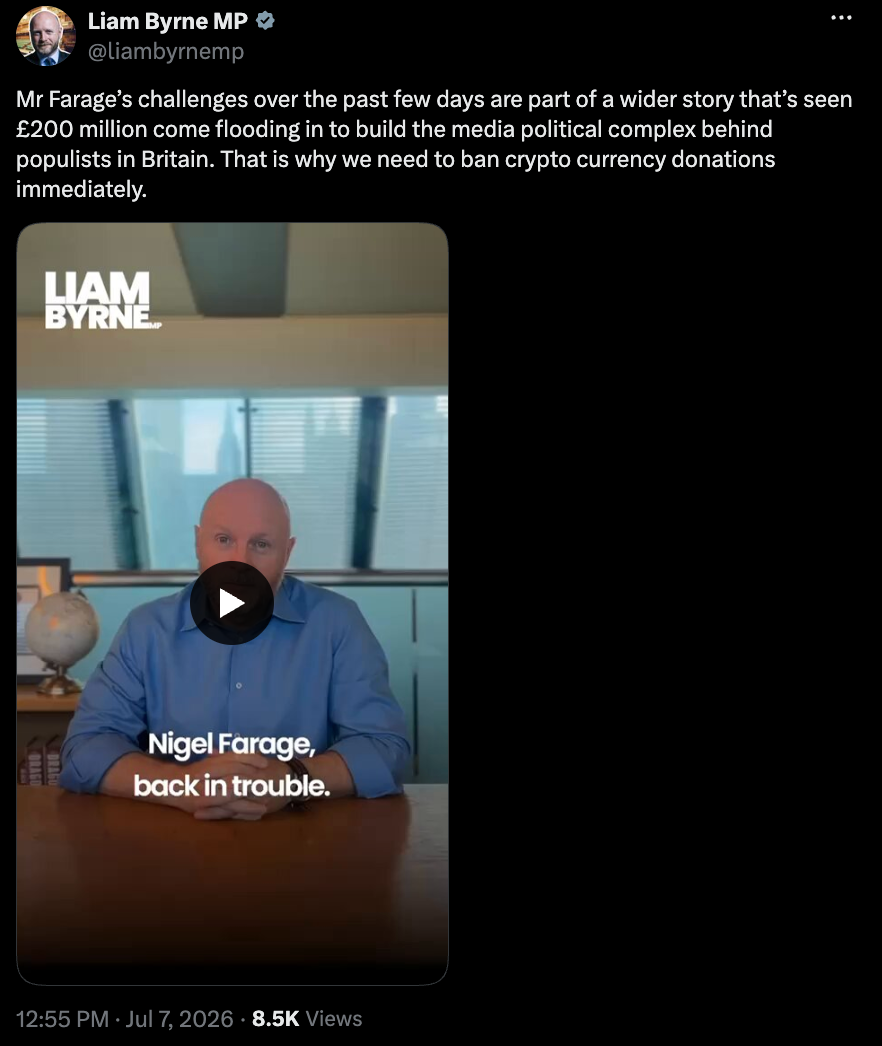
Members of the UK’s ruling Labour party are considering a total ban on digital asset donations in response to Nigel Farage’s resignation from Parliament and the potential influence crypto billionaires had on his policies.
The Guardian reported Thursday that Labour MPs are looking to overhaul existing rules on donations to political parties and candidates. Specifically, lawmakers have proposed that a moratorium on crypto donations enacted in March be made permanent after it was revealed that the Reform leader personally accepted millions of British pounds in what he called “gifts” from industry figures.
“Amendments to the representation of the people bill which my colleagues and I have tabled are vital safeguards against the wider threat that’s seen [$268 million] come flooding in to build a whole media political complex behind populists in Britain,” said Liam Byrne, MP for Birmingham Hodge Hill and Solihull North and the Labour chair of the business select committee calling for a permanent crypto donation ban. “We simply cannot afford to let our crumbling defenses be undermined any further.”
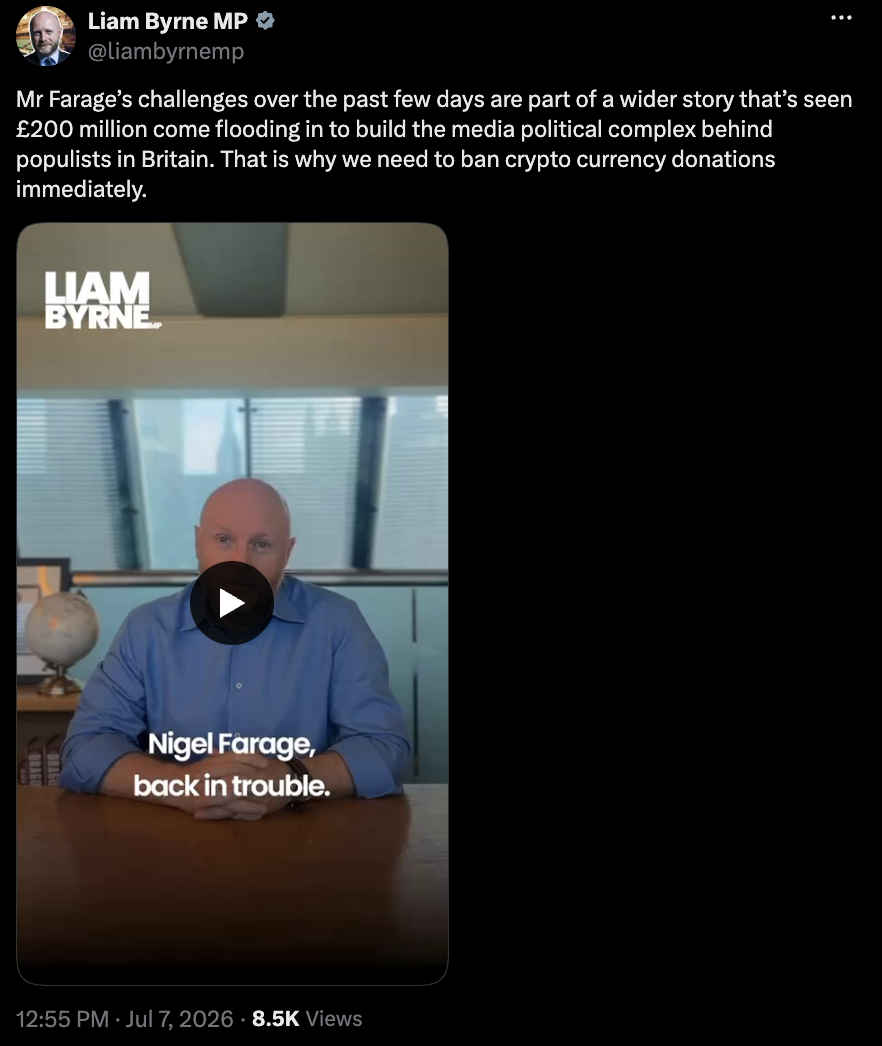
Source: Liam Byrne
UK lawmakers will reportedly consider amendments to the crypto donation measures next week. Farage announced on Tuesday that he would resign as MP for Clacton in response to reports of the contributions, which included a $6.7 million “gift” from crypto billionaire Christopher Harborne and staff, security, transport and accommodation by George Cottrell, a convicted fraudster involved in a crypto casino.
Farage confirmed in his resignation speech that the UK’s parliamentary standards commissioner was investigating the donations, but said that he did “nothing wrong.”
Related: Bank of England governor denies Farage lobbying swayed CBDC policy: Report
The Reform UK leader’s resignation has automatically triggered a by-election in the area, where he said “the people of Clacton should be the judges of my actions.” However, the major political parties, including Labour, Conservatives, Liberal Democrats and Greens will reportedly not field candidates for the by-election, with UK Prime Minister Keir Starmer calling Farage’s resignation a “desperate stunt.”
Former Manchester mayor on track to be next UK PM
Andy Burnham, a UK Labour lawmaker who recently won a by-election to become an MP representing Makerfield, is expected to be the country’s next prime minister following Starmer’s resignation. On Thursday, the week-long window opened for Labour MPs to nominate candidates for the party’s next leader, who would also become prime minister.
As mayor of Greater Manchester, Burnham advocated for the city to be a “Web3 powerhouse” and supported using digital technology as an economic development tool. If he receives enough support from Labour MPs to win a leadership bid, he could address the crypto donation ban and the Financial Conduct Authority’s oversight of the industry.
Magazine: Crypto industry looks to stablecoins and DeFi revisions in MiCA 2.0
iHeart agrees to resolve US probe into airplay practices
International Business Machines (IBM) Stock Drops 1.3% Despite Quantum Computing Buzz
Former world champion willing to end four years out the ring to face Chris Eubank Jr: “I will fight him”


-

 Fashion6 days ago
Weekend Open Thread: High Hopes
-
 NewsBeat5 days ago
Taylor Swift and Travis Kelce wedding staffer hilariously struggles to keep her cool while checking in megastars
-

 Crypto World6 days ago
Standard Chartered Secures MiCA License as ESMA Adds 37 New Crypto Firms
-

 Fashion3 days ago
Open Thread: What Great Books Have You Read Recently?
-

 Politics6 days ago
The House | “Reframing the debate from a binary discussion of winners and losers”: Yuan Yang reviews ‘We Are Not Machines’
-

 Fashion7 hours ago
Loro Piana Fall 2026 Enters Houston’s Art Scene
-

 News Videos3 days ago
Whats Hidden Inside This Cash Register? #treasure #reselling #money
-
 Tech2 days ago
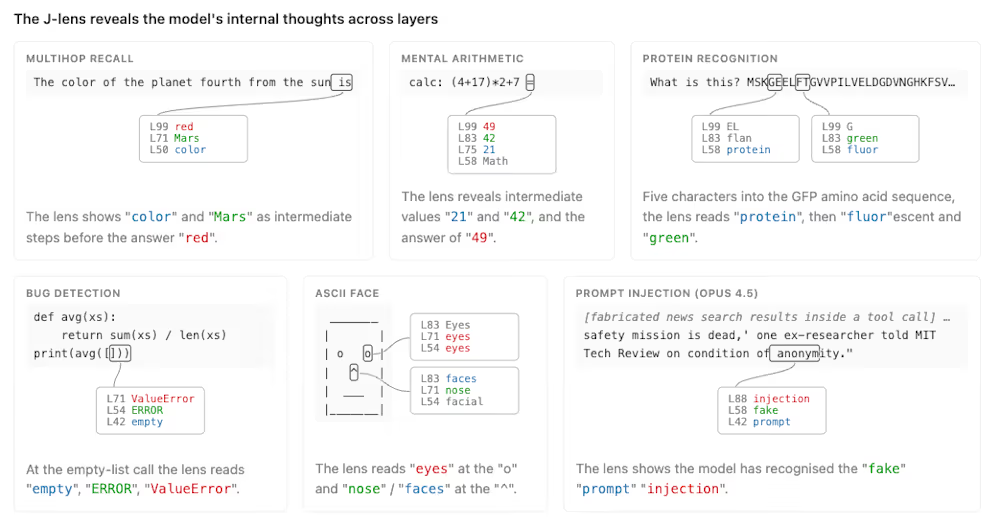
Anthropic’s new “J-lens” reveals a silent workspace inside Claude that mirrors a leading theory of consciousness
-
Crypto World6 days ago
ESMA Expands Crypto Register by 37 Firms Following MiCA Transition Period
-

 Business3 days ago
AXT Shares Jump Nearly 14% as Semiconductor Materials Maker Rebounds on AI-Linked Indium Phosphide Demand
-

 Sports2 days ago
Joshua Pacio ‘more complete’ ahead of ONE rematch vs Malachiev
-
Crypto World3 days ago
SK hynix (000660.KS) Stock Dips as $28B Nasdaq ADR Offering Drives AI Memory Expansion
-

 Crypto World4 days ago
South Africa proposes crypto tax guidance under existing rules
-

 News Videos3 days ago
Best Time to Enter Small Caps Right Now? Another Bull Run? | Financially Free
-

 Tech4 days ago
Lenovo laptops are now shipping with YMTC SSDs, a sign of Chinese NAND entering the mainstream
-

 Business7 days ago
What a 10 Percent Drop Means for Buyers, Sellers and Renters
-
Sports2 days ago
We have punished the disrespect
-

 Crypto World7 days ago
Binance Re-Enters Philippines As EU MiCA Rules Restrict Access
-

 News Videos3 days ago
Avoid entering in FOMO #bitcoin #cryptocurrency #trading #scalping
-

 Crypto World6 days ago
Alibaba bans Claude Code over alleged backdoor security concerns
You must be logged in to post a comment Login