

Crypto World
ETH Insider Explains Wave of 2026 Ethereum Foundation Departures


A long-time Ethereum investor and community figure has pushed back against growing alarm over the string of departures from the Ethereum Foundation (EF), arguing that the organization’s commitment to the network is as firm as ever.
Ryan Berckmans, who has worked full-time in the Ethereum space for eight years, offered one of the more detailed community-level defenses of the EF’s current direction since the exits started mounting this year.
Departures Caused by Differences of Opinion
According to Berckmans, people are misreading the situation.
“The EF departures are not because the people departing feel differently about Ethereum and our trajectory vs. the people staying at EF or vs. community folks like me,” he wrote.
What actually drove them, in his view, was a mix of internal disagreements over sub-strategies rather than any loss of faith in Ethereum itself, plus a deliberate generational shift.
“Some folks disagreed. Some tiny number were asked to leave for Reasons. Some few others left immediately due to Reasonable Net Feelings. Some more are leaving because the Wheel is Turning,” he explained.
Further, Berckmans added that new, younger contributors are ready to step into leadership across teams and departments. He also addressed a persistent piece of community frustration, that the EF and Vitalik Buterin do not care about ETH’s price, calling it a misconception.
According to him, they care deeply, but across a much longer time horizon than most community members track.
“They want to know, ‘How will Ethereum remain dominant after quantum computers?’ and, ‘How will Ethereum be the world’s economic hub for trillions in assets and thousands of L2s across a hundred countries?’”
His conclusion was that these are questions that can only get asked if you believe the outcome is achievable, and the EF’s programs in response to them are “gigabullish.”
Four Prominent Contributors Left in Just Four Weeks
The wave of exits has included Carl Beek, Julian Ma, Barnabé Monnot, Tim Beiko, Trent Van Epps, Josh Stark, and former co-Executive Director Tomasz Stańczak.
Stańczak’s departure, in particular, drew quite a lot of attention, considering that it came just 11 months after he’d taken the role. In addition, the exits have been concentrated, with four of the more prominent ones landing within roughly four weeks of each other in April and May.
Meanwhile, a detailed analysis by crypto researcher Nick Sawinyh pointed to unconfirmed claims circulating online that staff were asked to formally align with the Foundation’s new mandate. However, the EF has not publicly confirmed those claims, and none of the departing contributors cited the mandate as their reason for leaving.
People are also focusing on the coming Glamsterdam upgrade to Ethereum that is still under test. The protocol update includes changes tied to scaling and validator infrastructure, although some anticipated features, including FOCIL and native account abstraction, have already been delayed to a later upgrade cycle.
Despite this, many Ethereum backers believe that the entire ecosystem can now take leadership changes in stride without posing a risk to the network as a whole. One of them, author William Mougayar, described the Foundation’s shrinking role as a deliberate attempt to remove Ethereum’s remaining central point of control rather than a sign of institutional decline.
The post ETH Insider Explains Wave of 2026 Ethereum Foundation Departures appeared first on CryptoPotato.



Steakhouse Fi has expanded its lead to approximately $1 billion over the next largest Morpho vault curator, marking a significant shift in the competitive curator ecosystem.


Dollar stablecoin supply has held at 99% of the global market as non-dollar tokens stall at 0.24% share.
Summary
- Non-dollar stablecoins grew from $261 million in 2021 to $771 million by April 2026, but their market share has actually declined.
- Dollar stablecoin issuers benefit from $15.4 billion in tokenized US Treasuries, a reserve advantage non-dollar rivals cannot match.
- Qivalis, a pan-European banking consortium, tripled its membership to 37 banks in May 2026 but a euro stablecoin launch is not expected until late 2026.
The European Central Bank noted in late 2025 that dollar stablecoin tokens account for approximately 99% of total stablecoin supply in circulation. Non-dollar supply has grown sharply over five years but its market share has edged down, not up.
The combined supply of euro, Canadian dollar, yen, Singapore dollar and other non-USD stablecoins reached $771 million in April 2026, up from $261 million in May 2021, yet their share of the total market sits at just 0.24%.
The gap reflects a structural problem, not a regulatory one. Dollar stablecoin issuers can plug into US Treasury markets as a reserve base, with tokenized US government debt standing at roughly $15.4 billion on-chain. Tokenized non-US government bonds total just $1.4 billion.
That yield and liquidity advantage allows dollar issuers to fund distribution and partnerships that non-dollar rivals cannot afford to match.
Why the European push is not closing the gap
“This infrastructure is essential if Europe is to compete in the global digital economy whilst preserving its strategic autonomy,” said Howard Davies, chairman of Qivalis’ supervisory board.
Qivalis, a pan-European banking consortium, expanded to 37 banks across 15 countries in May 2026, more than tripling its membership. Its euro stablecoin is not expected to launch until the second half of 2026.
A separate group of twelve European banks selected Fireblocks for a competing MiCA-compliant euro stablecoin earlier this year. Nine banks including UniCredit and ING are also targeting a second-half 2026 debut. Multiple regulated euro stablecoin projects are in motion, but none has yet reached meaningful scale or liquidity.
What it would take to shift the balance
The primary obstacle is not regulation. Most fiat currencies lack international liquidity in the first place, meaning only a handful can realistically support a global stablecoin.
The dollar, euro, yen, sterling and Swiss franc are among the few with deep enough foreign exchange markets to support cross-border crypto use.
S&P Global Ratings has projected that the euro stablecoin market could grow from roughly $895 million today to as much as 1.1 trillion euros by 2030. Reaching that figure would require a combination of institutional adoption, regulatory clarity, and the kind of deep liquidity infrastructure that took dollar stablecoins years to build.
Crypto World
Galaxy Research Alex Thorn Raised CLARITY Act Odds to 75%, Is August the Most Important Month in Crypto History?

Galaxy Digital’s head of firmwide research Alex Thorn raised his probability estimate for the CLARITY Act becoming law in 2026 to 75%, up sharply from the 50/50 call he held as recently as April.
The trigger was a 15-9 Senate Banking Committee vote on May 14 that produced the first meaningful bipartisan signal the bill has seen.
Two Democrats crossing the aisle does not guarantee passage. But it moved Thorn’s model by 25 percentage points, and that gap is the story.
Discover: The best pre-launch token sales
How the CLARITY Act Gets to a Signature, and Why 75% Is Not 100%
The mechanism here is worth understanding precisely. The CLARITY Act still requires 60 Senate floor votes to clear a filibuster, followed by House reconciliation and a presidential signature.
Thorn’s updated timeline, published in Galaxy Research’s weekly brief on May 16, runs as follows: Senate Banking and Agriculture committee reconciliation in early June, Senate floor consideration by mid-June, final Senate passage before the end of June, House reconciliation through July, and a potential Trump signature the week of August 3.

The White House is pushing a more aggressive July 4 target. Congress has roughly nine weeks of Senate floor time before the August 10 recess, after which substantive legislation rarely advances in a midterm cycle. That nine-week window is the entire margin.
What changed in Thorn’s model was not just the vote count, it was the character of the votes. Ruben Gallego of Arizona and Angela Alsobrooks of Maryland joined all 13 committee Republicans to advance the bill.
The Tillis-Alsobrooks stablecoin yield compromise, which resolved a structural dispute over whether stablecoin holders could earn interest, removed the specific risk Thorn had flagged as most likely to kill bipartisan momentum. The bill reaching the Senate floor is no longer a theoretical outcome, it is the base case.
Not everyone is at 75%. Kristin Smith, president of the Solana Policy Institute, put passage probability at 60%. “In theory, we have everything we need,” Smith said. “A lot can go wrong.” Polymarket traders priced 2026 passage at 68% as of May 18, up from 46% at the start of the month but still below Thorn’s estimate.
Senator Elizabeth Warren’s continued opposition on anti-money-laundering and ethics grounds remains unresolved on the floor, and the ethics language restricting senior officials’ digital asset holdings has created friction among some offices seeking carve-outs that could complicate the final vote count.
JUST IN:
Senator Elizabeth Warren says the crypto Clarity Act will "blow up the economy."
"It pushes more of the economy into crypto!" pic.twitter.com/4LbDiU2hUV— Watcher.Guru (@WatcherGuru) May 14, 2026
Thorn’s framing situates the stakes beyond the near term. He described the CLARITY Act and the companion GENIUS Act as the kind of foundational U.S. crypto legislation that has “laid the foundation for 100 years of US capital markets dominance.”
Andreessen Horowitz has drawn the same comparison to the Securities Act of 1933. Whether or not that framing holds, it reflects the legislative ambition behind the bill, and explains why a Senate committee vote is producing market-moving probability shifts.
Discover: The best crypto to diversify your portfolio with
The post Galaxy Research Alex Thorn Raised CLARITY Act Odds to 75%, Is August the Most Important Month in Crypto History? appeared first on Cryptonews.
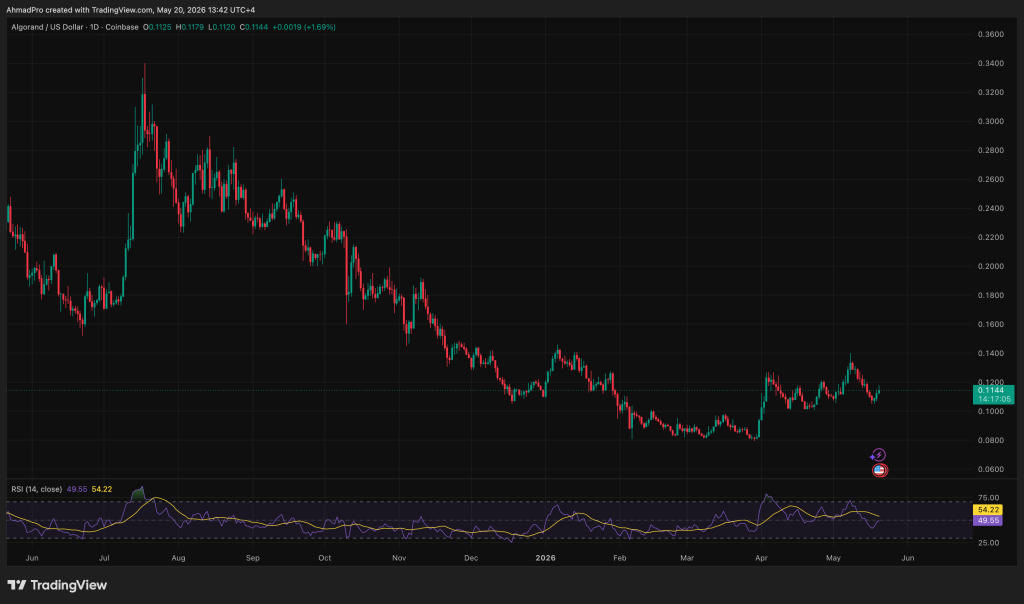
Algorand (ALGO) token is now fully tradable on Robinhood for U.S. retail users, ending a multi-year freeze that traced directly to the SEC’s 2023 enforcement wave.
The listing restores a domestic retail gateway for one of the tokens most visibly caught in the crossfire of the agency’s campaign to classify crypto assets as unregistered securities.
The regulatory overhang was explicit. In June 2023, the SEC’s complaint against Coinbase named ALGO specifically as an unregistered security, citing Algorand’s early token sales and promotional activity as evidence of an investment contract.
That single filing triggered a wave of U.S. platform restrictions. Robinhood’s U.S. app quietly shifted ALGO to view-only status, displaying price data while blocking trades.
Robinhood Europe, operating under EU frameworks where ALGO is treated as a standard crypto asset, had already offered full ALGO spot trading throughout that period.
The divergence between the same company’s U.S. and European product lines was the clearest possible illustration of how much regulatory jurisdiction shapes retail access.
Discover: The best pre-launch token sales
What the Robinhood Listing Actually Changes for Algorand (ALGO)
The directional signal here is unambiguous. When a major U.S. retail brokerage, one that previously restricted a token citing compliance risk, restores full trading access, it reflects a recalibrated internal legal assessment.
Robinhood’s platform reaches millions of retail users across all 50 states, and the decision to support ALGO under its existing New York State Department of Financial Services license is a statement about where the platform now places the token on the regulatory risk spectrum.
The broader regulatory environment has shifted materially since 2023. The post-Gensler SEC has retreated from the enforcement-first posture that produced the ALGO security classification, and the CLARITY Act reaching the Senate floor signals that legislative frameworks are advancing to replace the old guidance-by-lawsuit approach.
Robinhood’s move fits that arc; it is listing an asset that remains in legal gray territory technically, but where the practical enforcement risk has diminished enough to clear internal compliance thresholds.
Robinhood’s Bitstamp acquisition adds another layer. Bitstamp, now branded “Bitstamp by Robinhood”, has operated active ALGO/USD markets for years, meaning the infrastructure and liquidity rails for ALGO already existed within Robinhood’s corporate footprint before the U.S. retail launch.
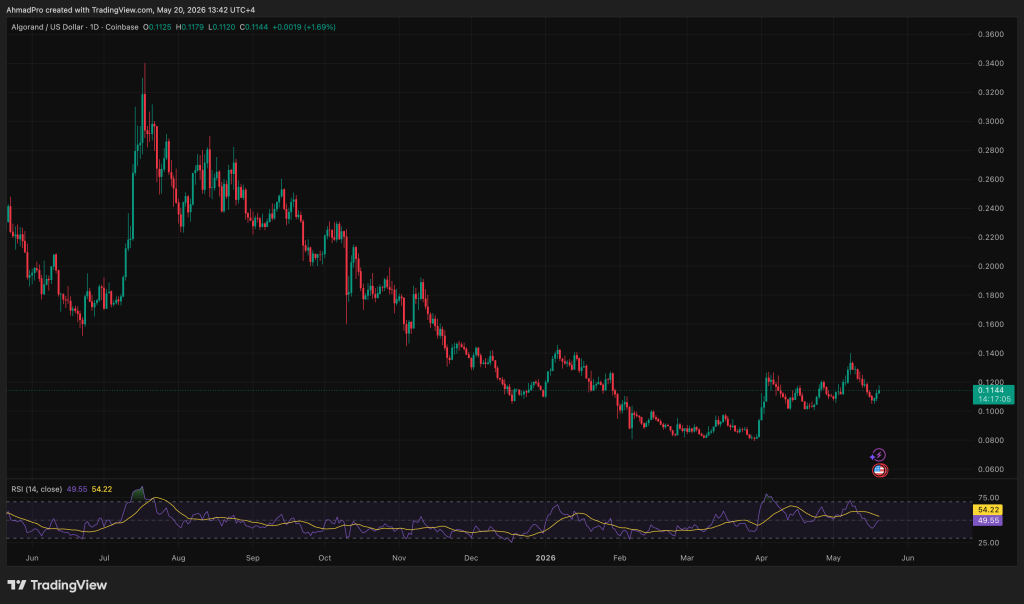
This was an alignment exercise as much as a new listing. Community threads on r/Algorand have framed the development as a “validation” step, with the consensus being that rebuilding presence on major U.S. retail brokerages is a prerequisite for ALGO recovering meaningful domestic retail volume.
Discover: The best crypto to diversify your portfolio with
The post Algorand Officially Debuts on Robinhood US: A Boost for Retail Accessibility appeared first on Cryptonews.


Former CFTC chair Timothy Massad says a US CBDC ban cannot stop behind-the-scenes infrastructure work.
Summary
- Timothy Massad told a London summit on May 19 that global tokenization trends make a US digital dollar ultimately inevitable.
- Massad pointed to Project Agora, a BIS initiative involving seven central banks, as evidence of quiet US participation in CBDC infrastructure.
- The Federal Reserve’s chief payments executive said a digital dollar is not currently under the Fed’s remit, but acknowledged it would be if introduced.
Former CFTC chair Timothy Massad told London’s Digital Money Summit on May 19 that a US digital dollar is ultimately inevitable. He said the CBDC ban is politically sensitive but does not reflect activity behind closed doors.
“We don’t have a central bank president who is going to get out there and speak about wholesale or retail CBDC, but that does not mean that we are not looking at how to create one,” Massad said.
Why Massad says the CBDC ban is a political facade
Mark Gould, the Federal Reserve’s chief payments executive, said a digital dollar is not currently within the Fed’s remit. Gould acknowledged it would be the central bank’s responsibility if one were ever introduced.
Massad pointed to Project Agora as evidence of continued US engagement. The BIS initiative involves the Federal Reserve Bank of New York and six other central banks, testing tokenized deposits alongside wholesale central bank money on a programmable platform.
House Republicans pushed on May 19 to make the CBDC ban permanent inside a major housing bill. Trump originally signed an executive order in early 2025 prohibiting federal agencies from developing a CBDC.
What the US risks by staying out
Massad argued that global tokenization activity is forcing the US to build equivalent digital settlement infrastructure. His concern is that stepping back from international experiments could cost the US influence over global digital payment standards.
His position aligns with analysis crypto.news has tracked questioning whether private stablecoins can preserve dollar dominance. Massad served as CFTC chair from 2014 to 2017 and has long pushed for faster US action on digital currency infrastructure.
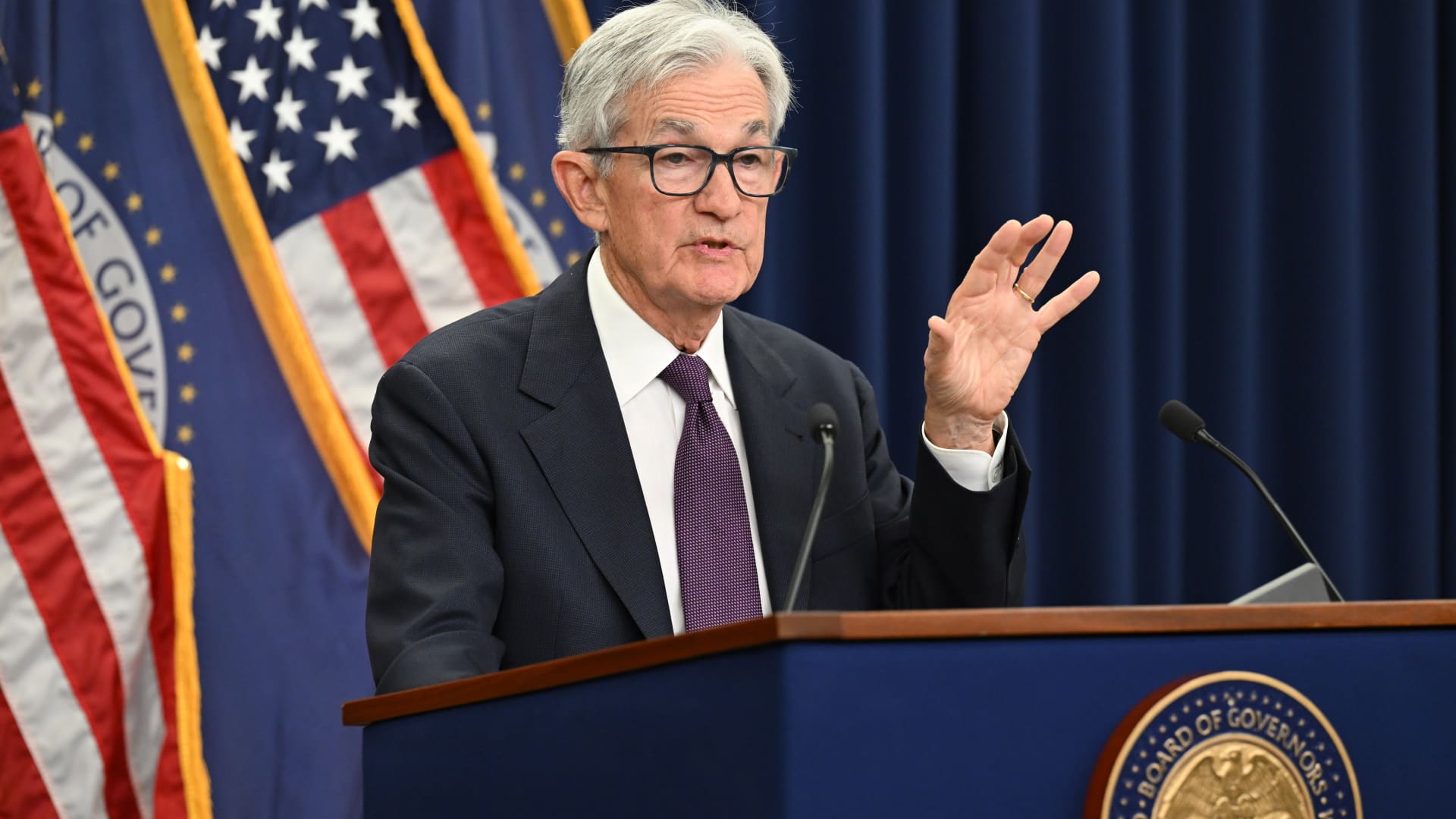
U.S. Federal Reserve Chair Jerome Powell attends a press conference in Washington, D.C., the United States, on April 29, 2026.
Li Rui | Xinhua News Agency | Getty Images
A majority of Federal Reserve officials at their most recent meeting anticipated that interest rate increases would be necessary if the Iran war continued to aggravate inflation, according to minutes released Wednesday.
Though the rate-setting Federal Open Market Committee again voted to keep its benchmark rate targeted between 3.5%-3.75%, the meeting featured four “no” votes, the most since 1992, and an apparently heightened level of disagreement about where policy should go.
At issue was the impact that the Iran war would have on prices and how that would work its way into monetary policy. Officials differed on how long the war’s impact would last and whether the post-meeting statement should continue to reflect a bias toward cutting rates as the more likely next move.
While several meeting participants said it would be appropriate to lower when it’s clear that inflation is moving back to the Fed’s 2% or when the labor market weakens, “A majority of participants highlighted, however, that some policy firming would likely become appropriate if inflation were to continue to run persistently above 2 percent.”
Three of the four “no” votes came from regional presidents who advocated policymakers keep their options open for increases amid an inflation surge. The group agreed with keeping the benchmark fed fund rates steady, but objected to the inclusion of language that referenced “additional adjustments” to rates. The phrasing is widely believed to infer the next move would be a cut.
The minutes noted that “many participants indicated that they would have preferred removing the language from the post-meeting statement that suggested an easing bias regarding the likely direction of the Committee’s future interest rate decisions.”
In Fed parlance, though, “many” does not constitute a majority, so the phrasing remained in the statement.
Officials broadly agreed that the Iran conflict would have “significant implications” for the Fed as it pursued its dual goals of full employment and stable prices, though they debated how long the impact on inflation would last.
“The vast majority of participants noted an increased risk that inflation would take longer to return to the Committee’s 2 percent objective than they had previously expected,” the document stated.
Warsh’s challenge
The meeting took place against an intriguing backdrop: It was the last time Jerome Powell presided over the committee, and it came amid escalating inflation pressures coming primarily from the war as well as other factors that have officials cautious over the future of policy.
Former Governor Kevin Warsh now takes over the helm, following a lengthy campaign that involved as many as 11 candidates. President Donald Trump chose Warsh and was explicit that he expects the Fed to be cutting rates.
Market pricing, though, has pointed to a higher probability that the committee’s next move will be a hike, either by late 2026 or early 2027.
Inflation had been trending towards the Fed’s 2% goal through 2025 and into the early part of this year. However, the war has changed the dynamic, with soaring energy prices sending most inflation measures above 3%.
Policymakers generally look through supply shocks like the oil surge as temporary. However, even core inflation, which excludes food and energy, has been climbing as well. Goldman Sachs expects that the Fed’s chief inflation forecasting measure will post an annual rate of 3.3% in April when that figure is released next week.
Warsh’s challenge, then, will be to convince his colleagues that improvements in productivity, led by artificial intelligence enhancements, will be disinflationary and counter the momentary impact of higher energy costs.
One of those colleagues will be Powell himself, who has chosen to stay on the Board of Governors. Powell has two years remaining on that term and said in April that he would stay on “for a period of time to be determined” while echoing a prior statement that he would stay until “this investigation is well and truly over.” No other Fed chair has stayed on the board in nearly 80 years.
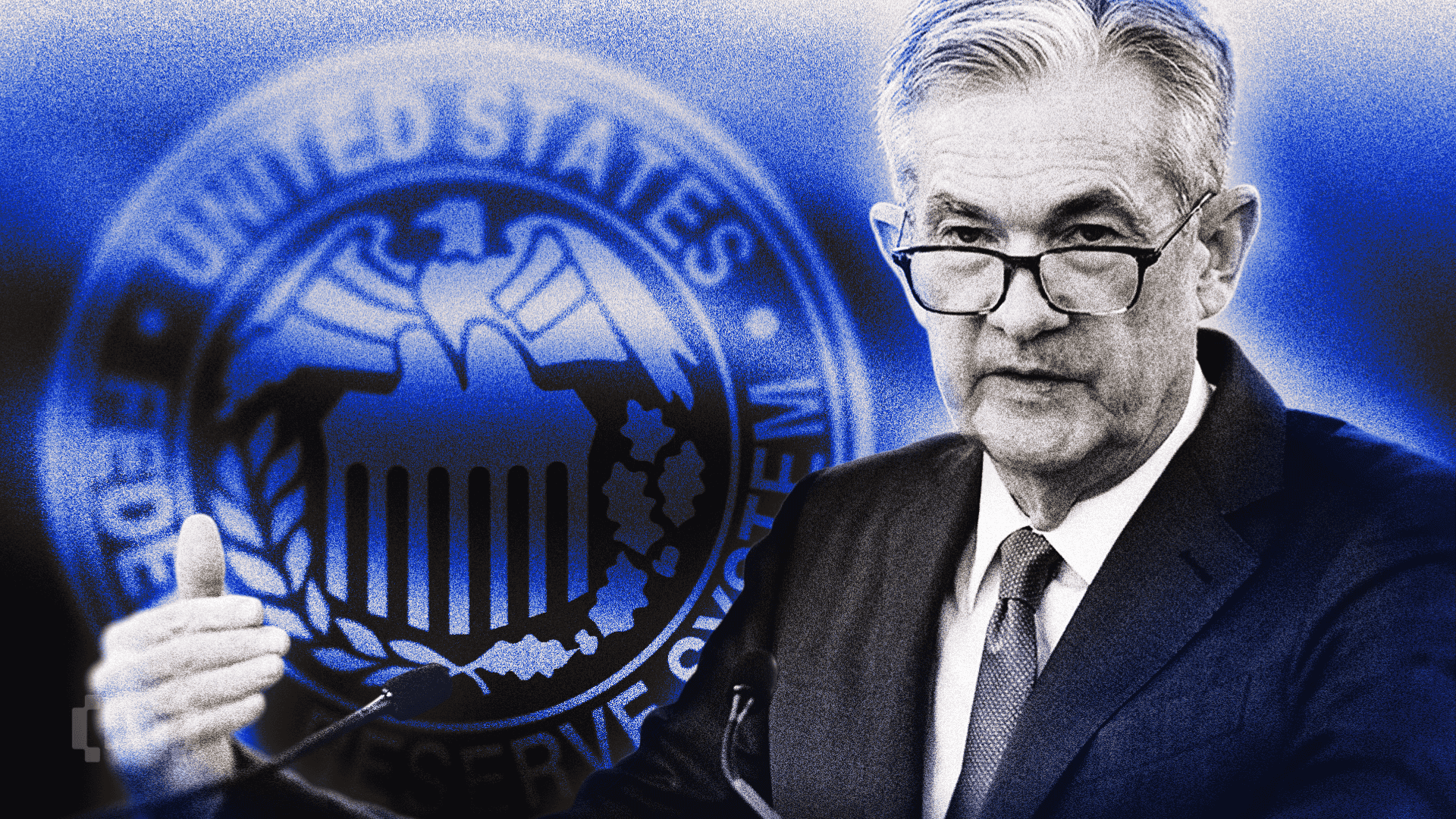

The latest Federal Reserve minutes revealed a more hawkish tone than markets expected, reinforcing fears that interest rates could stay elevated longer and potentially pressure Bitcoin and broader risk assets.
Minutes from the April 28–29 meeting showed that many policymakers wanted to remove the Fed’s easing bias entirely, while a majority signaled additional rate hikes could become necessary if inflation remains persistent.
Four Dissents Highlight Growing Fed Divide
Officials pointed to rising energy prices, tariffs, and geopolitical instability tied to the Middle East conflict as major inflation risks.
The Fed ultimately kept rates unchanged at 3.50%–3.75%, but the meeting exposed one of the deepest policy divisions in years.
The meeting produced four dissents, the highest number since 1992.
Stephen Miran favored a 25-basis-point rate cut, warning policy may become overly restrictive as labor market risks grow. Meanwhile, Beth Hammack, Neel Kashkari, and Lorie Logan opposed retaining language suggesting future easing.
Officials also warned inflation expectations could become “de-anchored” if price pressures remain elevated.
The post Fed Minutes Signal Higher-for-Longer Rates as Bitcoin Faces Pressure appeared first on BeInCrypto.

TLDR
- A Kraken and Coinbase user lost about $6.7 million after attackers drained crypto from both exchange accounts.
- The stolen assets included Ethereum, Bitcoin, and cbBTC withdrawn in a short and coordinated series of transactions.
- On-chain analyst Specter traced the stolen funds to new wallet addresses across the Ethereum and Bitcoin networks.
- Attackers moved about $5.3 million of the stolen crypto through Tornado Cash to obscure transaction trails.
- Early reports suggested a physical attack, but later analysis indicated no evidence of coercion.
- The method used to access the victim’s exchange accounts has not been confirmed.
A crypto user has lost about $6.7 million after attackers drained accounts linked to Kraken and Coinbase. The stolen assets included Ethereum, Bitcoin, and cbBTC, according to blockchain tracking data. The incident involving Kraken has raised fresh concerns about exchange account security and targeted attacks.
Kraken Account Drained Alongside Coinbase Holdings
Attackers withdrew large amounts of crypto from the victim’s accounts within a short period. The activity affected both Kraken and Coinbase balances simultaneously.
On-chain analyst Specter reported that 1,554 ETH, worth about $3.3 million, left the Kraken account. The attackers also withdrew 10.5 BTC during the same period.
At the same time, the Coinbase account saw withdrawals of 34.1 cbBTC worth roughly $2.6 million. These movements occurred quickly and followed a coordinated pattern.
Specter tracked the stolen funds to newly identified wallet addresses on Ethereum and Bitcoin networks. The analyst shared that the assets moved rapidly after the initial withdrawals.
Early reports suggested a possible physical attack on the account holder. However, Specter later stated the case likely did not involve physical coercion.
The exact method used to access the accounts remains unclear at this stage. No official statement from Kraken or Coinbase has detailed the breach vector.
Stolen Crypto Moves Through Tornado Cash
Blockchain data shows that attackers began laundering funds shortly after the theft. They routed a large portion through Tornado Cash, a privacy mixer on Ethereum.
Specter said about $5.3 million had already passed through Tornado Cash. The transfers occurred in multiple transactions to obscure tracking.
The use of mixers complicates efforts to trace stolen crypto across the blockchain. Investigators often face delays when funds move through such services.
The case adds to ongoing reports of phishing and malware targeting exchange users. Attackers often exploit compromised credentials to gain account access.
Kraken and Coinbase both offer two-factor authentication and withdrawal protection features. However, advanced attacks continue to bypass these safeguards in some cases.
Security experts advise users to enable all available protections and monitor account activity closely. They also recommend avoiding suspicious links and unknown software.
As of the latest update, the stolen funds remain in circulation after passing through Tornado Cash. Authorities and analysts continue to track related wallet activity.

Crypto World
Market Spotlight: Nvidia (NVDA) Earnings, ASML Rally, Strategy (MSTR) Target Hike, and Target’s (TGT) Strong Quarter
Market Summary
- Nvidia releases quarterly results after market close, with Wall Street projecting $1.78 EPS and $79.2B revenue—representing roughly 80% annual growth
- Market veteran Jim Cramer noted Nvidia’s historical pattern of post-earnings rallies followed by sustained selling pressure from profit-taking
- ASML shares climbed 6.7% following UBS naming it the leading European semiconductor stock with a €1,900 price objective
- Strategy received a $400 price target upgrade from TD Cowen, maintaining Buy status with upside potential exceeding 140%
- Target surpassed earnings projections with $1.71 EPS compared to $1.46 consensus, while boosting annual sales outlook
Nvidia: Market’s Most Anticipated Quarterly Report
[[LINK_START_0]]Nvidia[[LINK_END_0]] commands unprecedented attention as traders await its quarterly disclosure following today’s closing bell. The artificial intelligence semiconductor giant faces elevated expectations from the investment community.
Wall Street consensus points to approximately $1.78 in per-share earnings alongside roughly $79.2 billion in total revenue. These figures would mark year-over-year revenue expansion approaching 80%.
The data-center segment represents the critical metric investors will scrutinize. Demand for AI-focused processors from hyperscale cloud providers, artificial intelligence research firms, and major corporations has fueled Nvidia’s explosive expansion over recent reporting periods.
Market participants are particularly focused on several key areas: gross profit margins, order momentum for Blackwell architecture chips, ramifications of expanded China export controls, and forward guidance projections.
Can Strong Results Sustain Upward Momentum?
Jim Cramer highlighted a recurring trend worth monitoring. He observed that Nvidia’s earnings track record frequently features immediate post-announcement gains, subsequently followed by persistent selling waves as traders capitalize on strength.
His analysis suggests that even exceptional results might fail to propel shares higher when market expectations already price in near-perfection.
Competitive dynamics remain front and center for investors. Custom silicon initiatives from major cloud platforms, AMD’s growing presence, and proprietary chip development by technology giants all factor into market calculations.
Should Nvidia provide robust forward guidance while effectively addressing concerns surrounding Chinese market access and margin sustainability, the broader AI investment thesis could receive validation. Conversely, post-results weakness might ripple across semiconductor stocks and technology-heavy indexes.
ASML: European Chip Leader Rallies on Analyst Endorsement
ASML advanced 6.7% after UBS designated the company as its premier European semiconductor selection. The firm elevated its price objective to €1,900 from €1,600.
UBS anticipates ASML’s earnings performance will consistently exceed consensus forecasts extending through 2027 and 2028, propelled by sustained demand for cutting-edge semiconductor manufacturing equipment.
ASML’s Central Role in AI Infrastructure
ASML manufactures extreme ultraviolet lithography systems, which represent indispensable technology for fabricating the world’s most sophisticated processors. Without these specialized machines, chipmakers cannot produce the advanced semiconductors required for AI computing.
Escalating artificial intelligence demand translates to chipmakers requiring expanded manufacturing capacity. This dynamic positions ASML at the strategic center of global semiconductor production infrastructure.
The substantial 6.7% price movement demonstrates investors recognize opportunities beyond domestic AI chip manufacturers. Capital is flowing toward the comprehensive international supply chain enabling chip production.
Strategy: TD Cowen Maintains Optimistic Bitcoin Treasury Stance
Strategy captured market attention following TD Cowen’s price target elevation to $400 from $395 while maintaining Buy guidance. This projection suggests upside potential surpassing 140% from previous closing levels.
Strategy maintains substantial Bitcoin reserves and employs leverage combined with capital-raising activities to expand its cryptocurrency holdings. While the company retains its software operations, market valuation primarily reflects its Bitcoin treasury position.
Substantial Upside Accompanied by Elevated Volatility
TD Cowen’s upgraded outlook reflects conviction in Strategy’s Bitcoin accumulation strategy. However, the equity remains among the market’s most volatile instruments.
Bitcoin price declines typically trigger sharp Strategy share drops. Conversely, cryptocurrency rallies tend to attract aggressive momentum purchasing activity.
For market participants seeking leveraged Bitcoin exposure through traditional equity markets, Strategy continues commanding significant attention.
Target: Results Exceed Expectations Amid Lingering Investor Skepticism
Target disclosed first-quarter adjusted earnings reaching $1.71 per share, surpassing the $1.46 Wall Street estimate. Revenue totaled $25.44 billion, exceeding the $24.66 billion projection.
Comparable sales metrics showed improvement, supported by increased customer traffic. Target additionally raised its full-year sales growth guidance, suggesting its operational turnaround strategy may be generating positive momentum.
Tempered Market Response Despite Quarterly Beat
Notwithstanding the earnings beat, share price reaction proved subdued. Investors maintain caution regarding consumer spending durability and whether Target’s first-quarter momentum can persist throughout the fiscal year.
Profit margins and broader retail sector headwinds remain focal concerns. A single strong quarterly performance proves insufficient to completely restore investor confidence following an extended challenging period for the retailer.
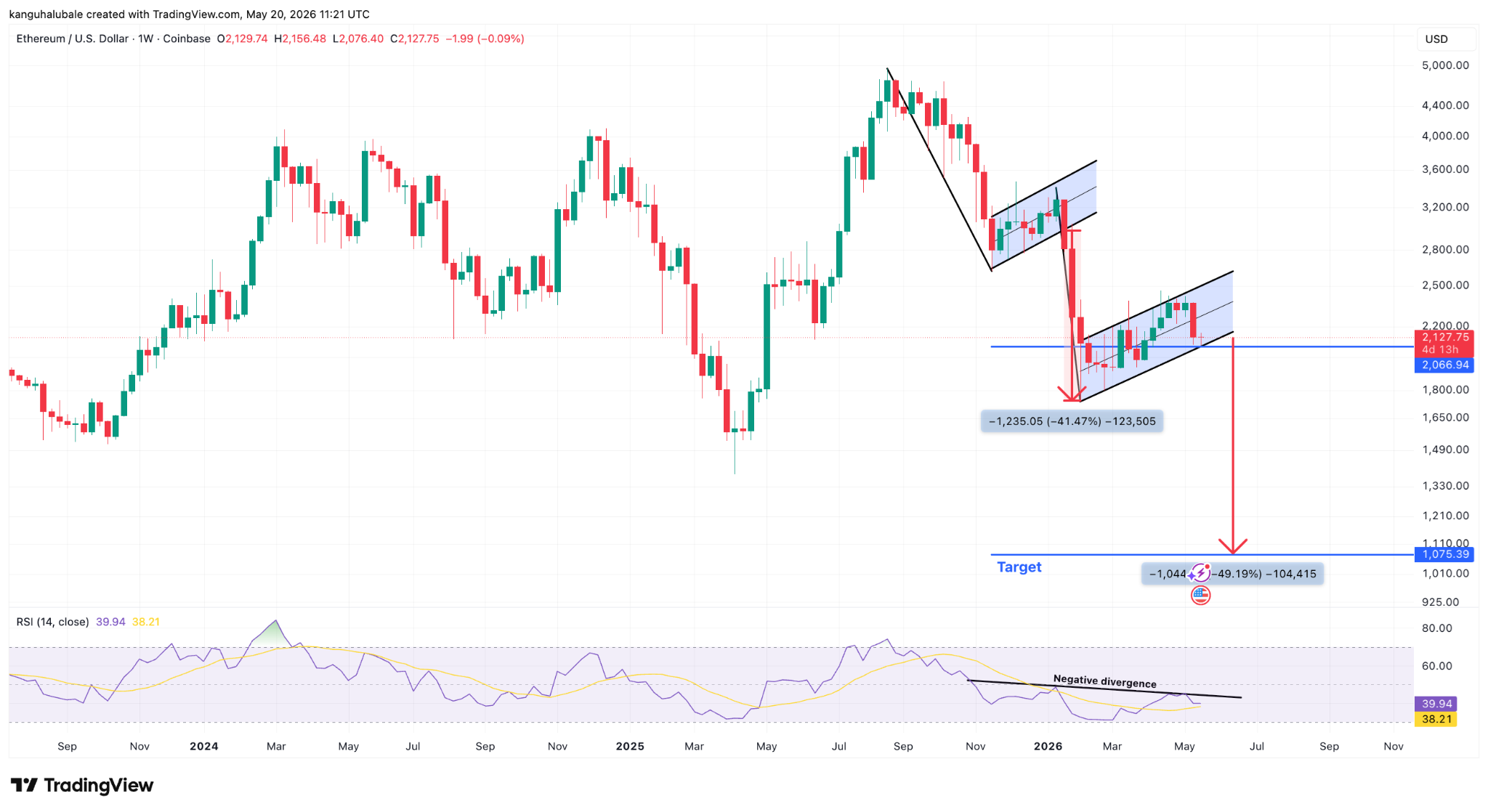
Market analysts say Ether’s (ETH) price may drop to $1,000 if a breakdown from a bearish chart pattern is confirmed.
Key takeaways:
- Ether’s bear flag targets 50% ETH price drop to $1,075.
- Ether risks over $1.70 billion in long liquidations if the price breaks below $2,000.
- Whale accumulation weakens as major ETH holders reduce exposure.
Ether’s bear flag targets $1,000 ETH price
Ether’s downtrend could accelerate if the price breaks below the lower trend line of a bear flag at $2,000 on the daily chart, where a similar breakdown in January led to a 41.5% ETH price drop.
Related: Ether taker volume turns negative for first time in two months: Will ETH fall under $2K next?
A bear flag pattern is a bearish continuation setup that forms after the price consolidates inside an up-sloping channel following a sharp price drop.
The measured target of the flag, derived from the previous downtrend’s height added to the breakdown point at $2,000, is $1,075, down 49% from the current price.
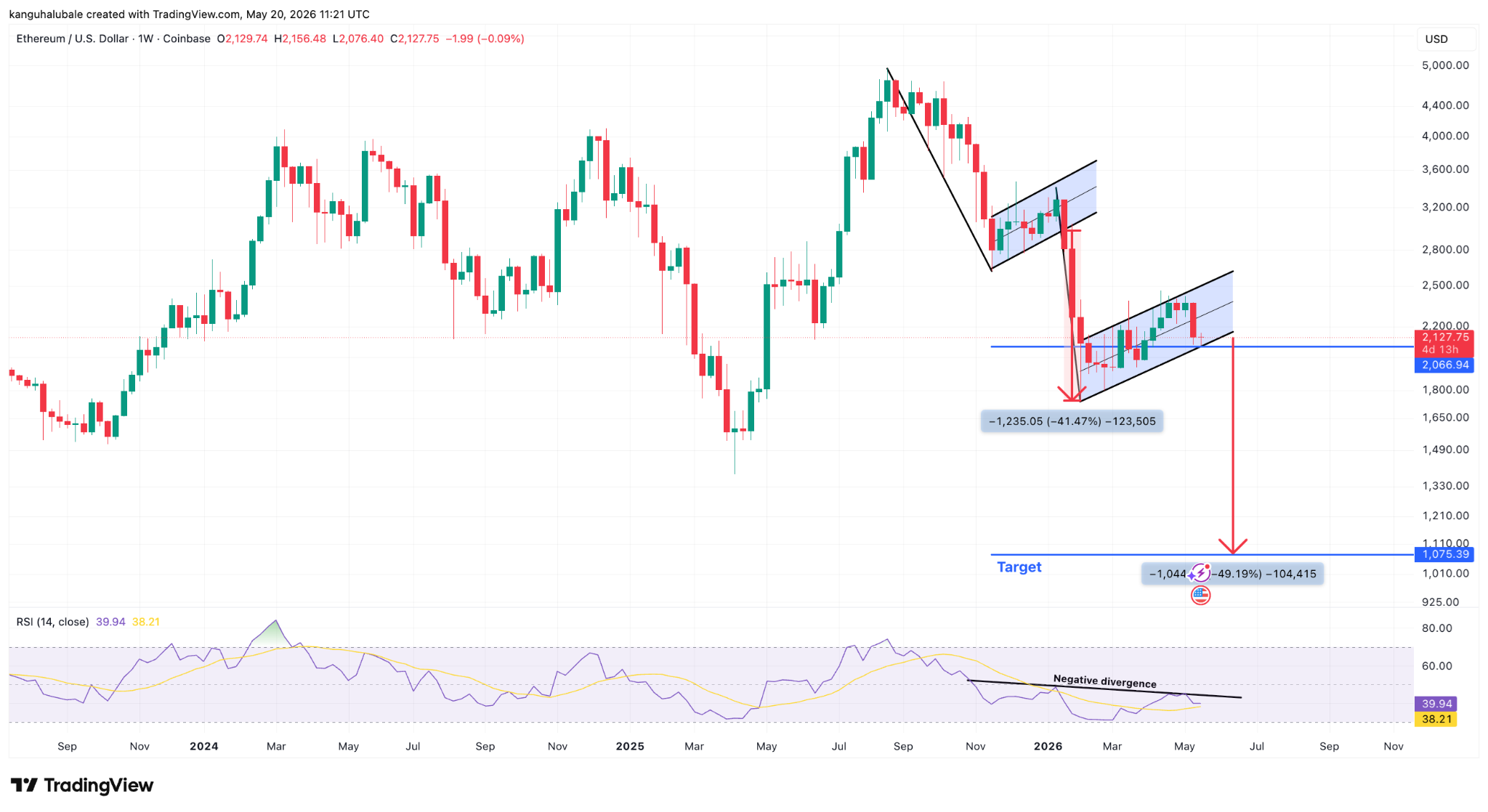
ETH/USD weekly chart. Source: Cointelegraph/TradingView
“$ETH is about to break the bear flag pattern,” analyst Coin Signals said in a Monday post on X, adding that if the price fails to hold above the lower trend line at 2,000, a “sell-off to $1800 or a new low” would follow.
Fellow analyst Keith Alan told his followers to be “prepared for the nasty scenario,” involving the confirmation of a death cross between the 21-day simple moving average (SMA) and 50-day SMA, and validation of a bear flag in the daily time frame.
“Momentum indicators also show deterioration on both daily and weekly RSI timeframes,” the analyst said in a recent article on X.
“Failure to establish support, however, opens the door to a sequence of progressively lower technical support levels” toward the measured target of the bear flag structure around $1,300, he added.
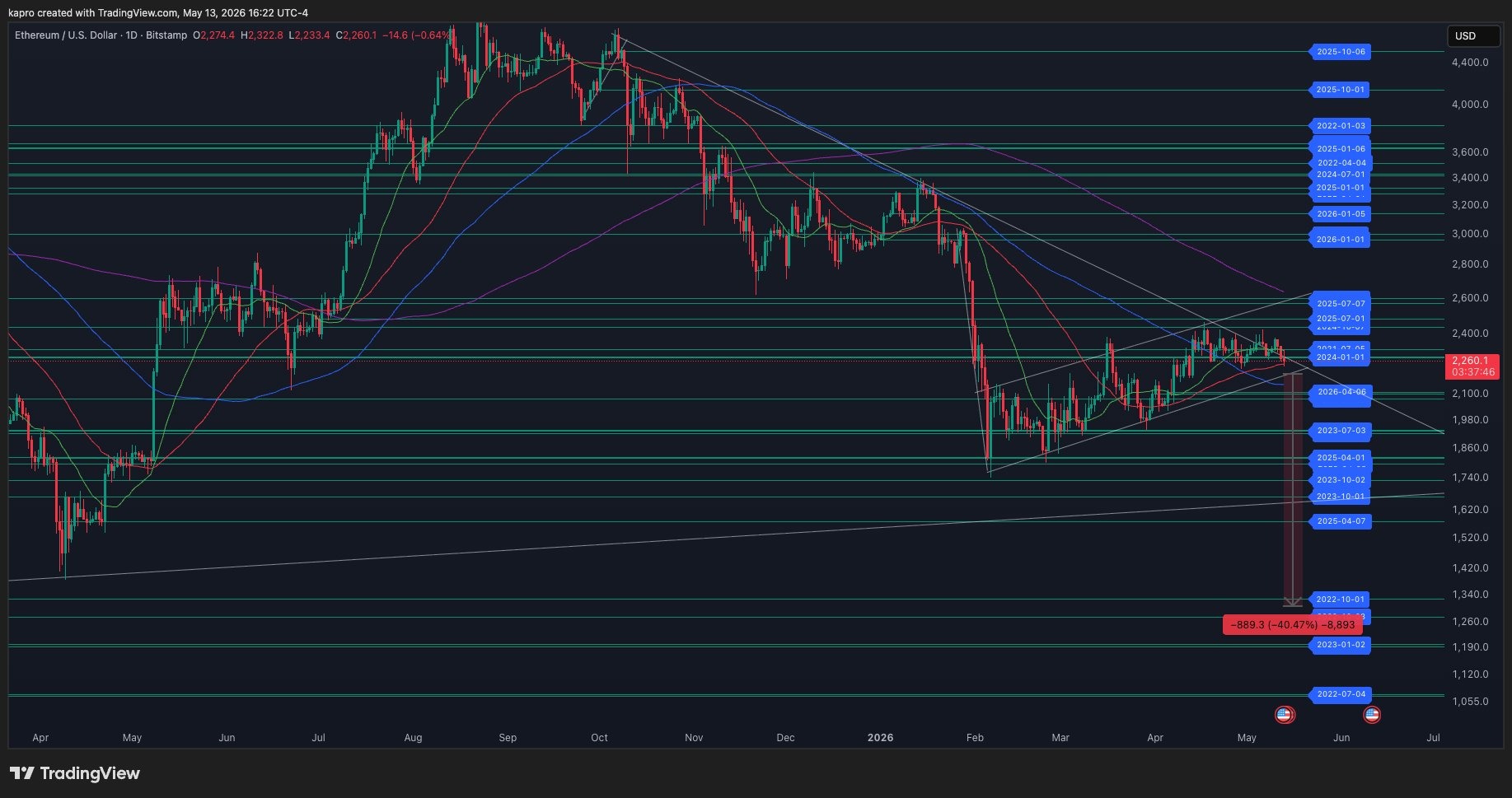
ETH/USD daily chart. Source: X/Keith Alan
Fellow analyst Crypto Patel said that ETH’s validation of a rising wedge pattern was underway, with a downside target of $1,500.
“Ethereum has lost a key rising trendline. As long as the price stays below it, weakness can continue.”
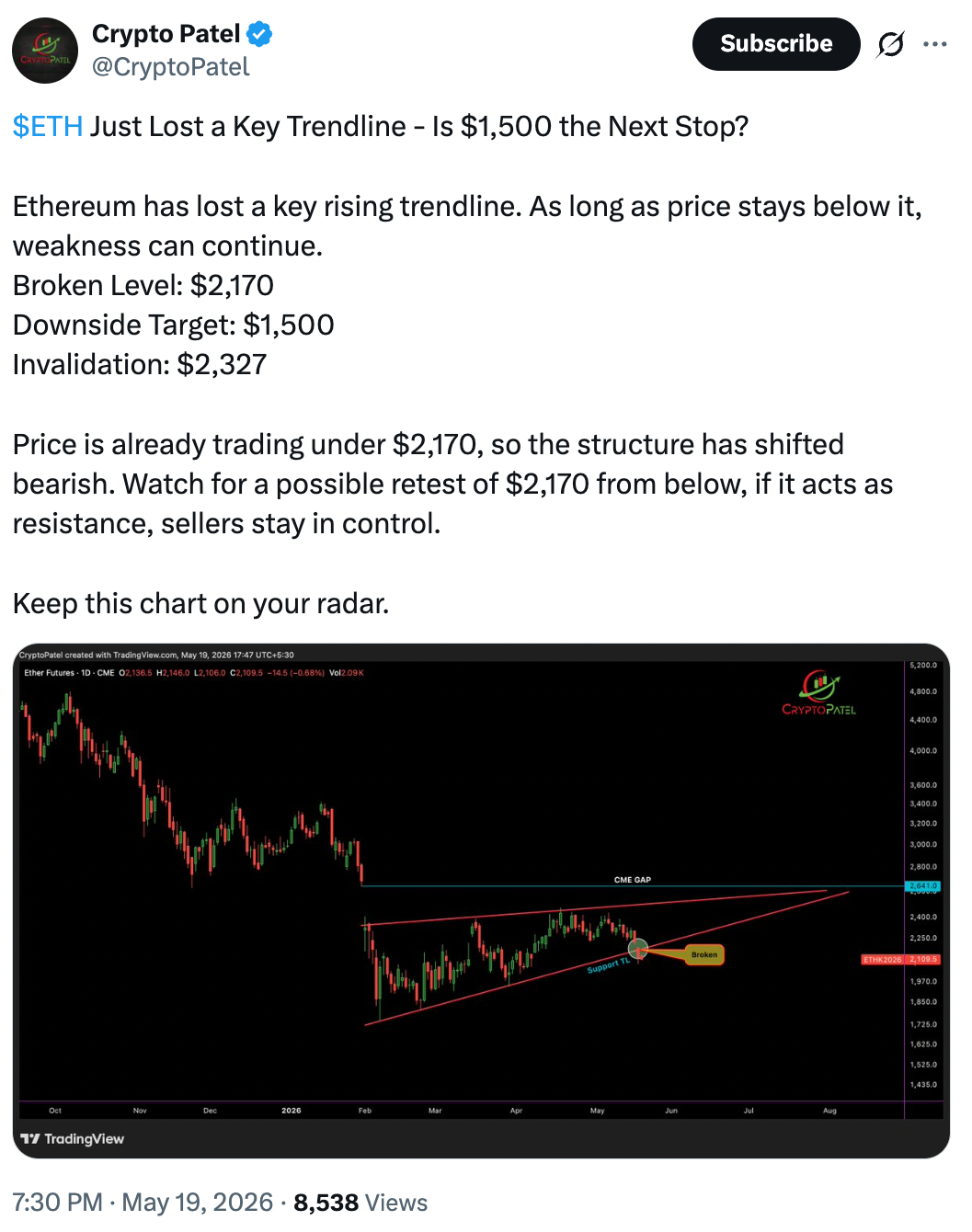
ETH/USD daily chart. Source: X/Crypto Patel
Meanwhile, Ethereum’s liquidation map shows that a correction below $2,000 would trigger over $1.70 billion worth of leveraged long ETH liquidations across all exchanges, according to CoinGlass data.
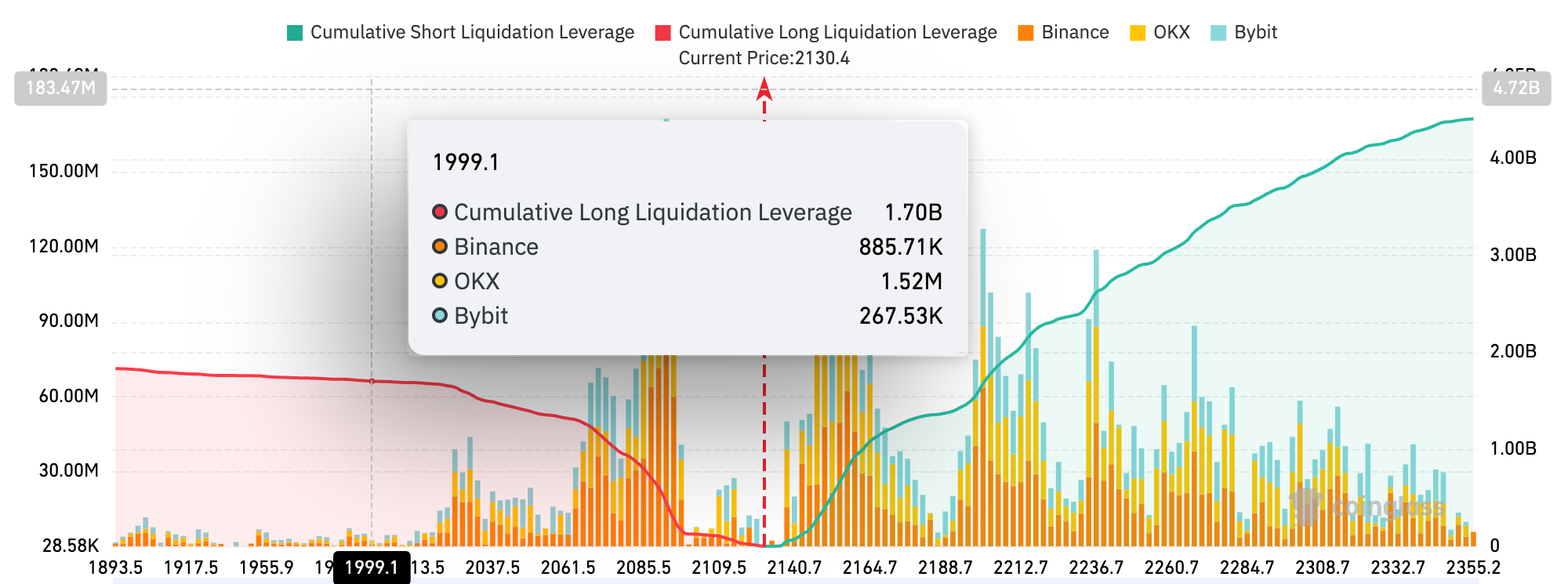
ETH exchange liquidation map. Source: CoinGlass
Ethereum whale accumulation drops
Ether’s latest rebound to $2,400 did not trigger broad-based accumulation across major wallet cohorts, Glassnode data showed.
For instance, the number of mega-whale wallets holding more than 10,000 ETH has declined sharply to a 10-month low of 1,050, with the 30-day change dropping to as low as -70, levels last seen in early February.
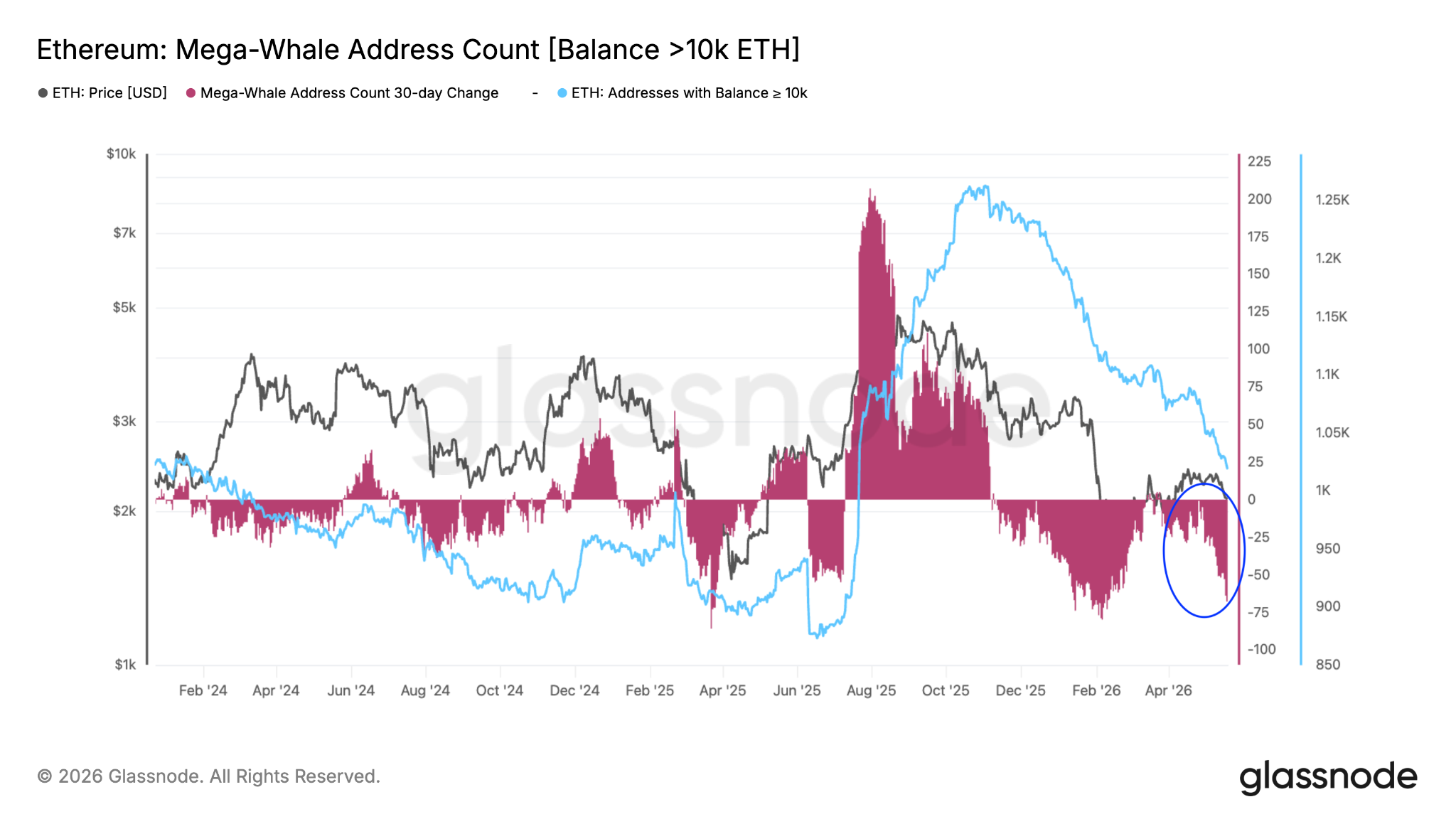
Ethereum mega-whale address count balance (>10K ETH). Source: Glassnode
In other words, large players are taking advantage of recent liquidity to de-risk, reflecting a lack of mid-term confidence.
The picture looks similar among smaller wallet cohorts.
Ethereum wallets holding 1,000 to 10,000 ETH have also been declining, falling to a nine-month low of 4,750 on May 8. The 30-day change remains negative, hovering around -50 at the time of writing.
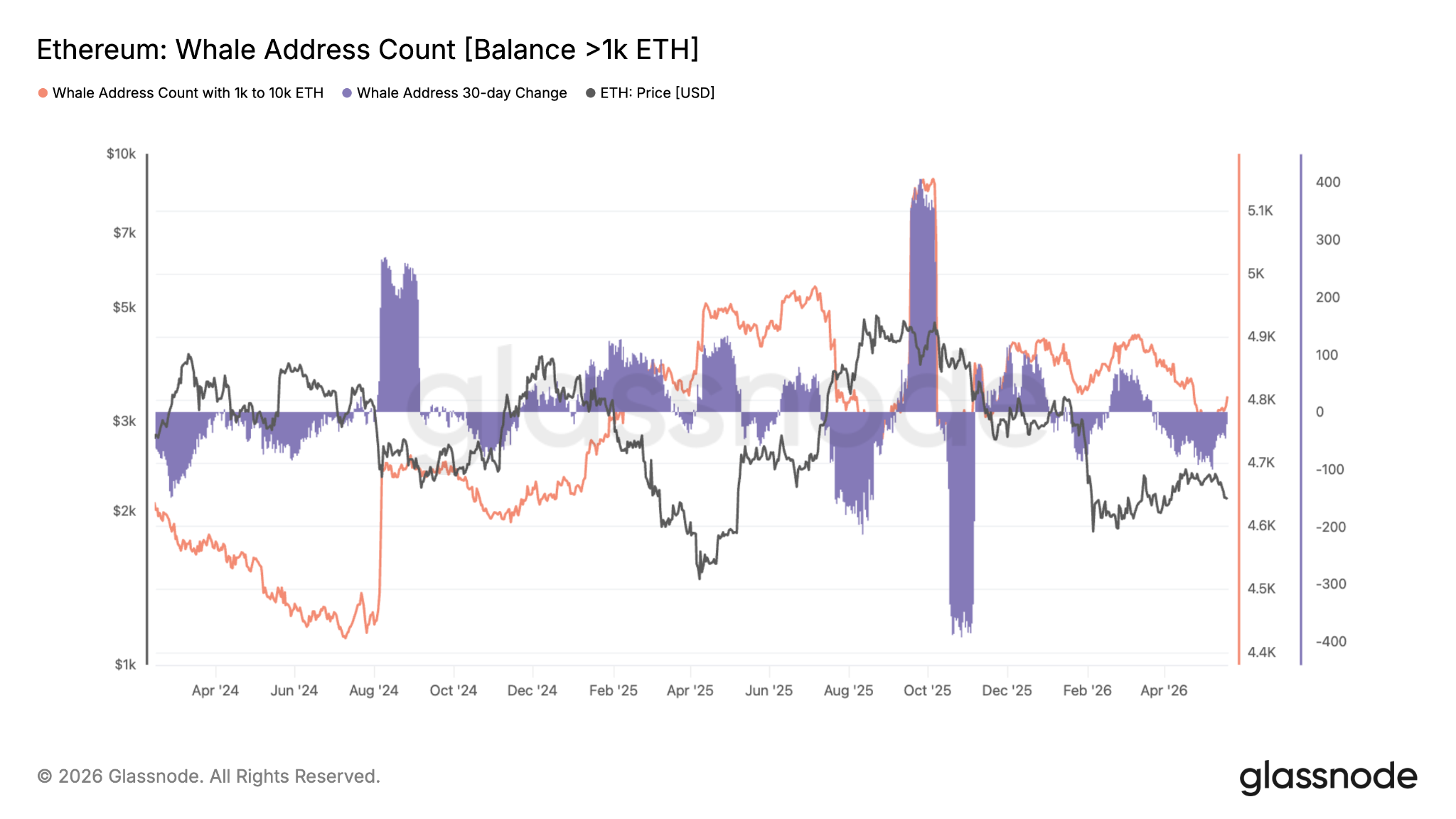
Ethereum whale and shark address count balance. Source: Glassnode
Taken together, the data suggest ongoing distribution and weak conviction across key ETH holder cohorts, reinforcing the risk of a deeper drop if $2,000 breaks.
This reduction in whale counts aligns with the recent inflows into exchanges, indicating the path of least resistance remains down in the immediate future and selling pressure mounts.

Star Wars’ Most Iconic Villain Was Inspired By Ultimate Hollywood Cowboy

Freiburg vs Aston Villa LIVE: Europa League final latest score, match stream, goal updates and fan reaction
JPMorgan sees biotech sector at inflection point, resumes coverage on 14 Firms


-

 Crypto World5 days ago
BloFin War of Whales 2026 Grand Prix opens registration for $5M trading championship
-

 Fashion5 days ago
Weekend Open Thread: Theory – Corporette.com
-

 Crypto World5 days ago
E-Estate Announces 1 Year Live: Washington DC Summit as Real Estate Tokenization Enters Its Next Phase
-

 Tech6 days ago
Tech Moves: Microsoft AI leader jumps to OpenAI; former AI2 exec joins Meta; and more
-

 Tech5 days ago
Google reimburses Register sources who were victims of API fraud
-
 Crypto World6 days ago
Google’s Gemini AI Predicts Incredible Solana Price by the End of 2026
-

 Business5 days ago
H&R Real Estate Investment Trust (HR.UN:CA) Q1 2026 Earnings Call Transcript
-
 Entertainment6 days ago
Zara Larsson Has Blunt Response To Chris Brown Diss
-

 Sports5 days ago
Napoleonic enters 2026 Doomben 10,000 field via Abounding withdrawal
-
 Crypto World7 days ago
Two AI Tokens Lead May Rally, But Risks Are Rising
-

 Crypto World5 days ago
BeInCrypto 100 Institutional Awards Nomination: KAST for Best Digital Assets Neobank and Best Digital Assets Fintech
-

 Fashion4 days ago
On the Scene at Gucci’s Cruise Show in New York City: Mariah Carey, Kim Kardashian, Lindsay Lohan, Iman, and More!
-
 Crypto World5 days ago
Bitcoin Battles US Bond Nerves With BTC Price Dip Toward New May Lows
-
 Crypto World5 days ago
Wall Street’s Boldest Gold Prediction Has Russians Rushing to Buy
-

 Crypto World5 days ago
ICE and CME urge US regulators to curb Hyperliquid energy trading
-

 Fashion4 days ago
Trending Western Style Vests Perfect for Summer
-

 Politics6 days ago
DWP PIP Timms review continues to be an absolute farce
-

 Entertainment5 days ago
David Letterman Returns to Late Show, Blasts Cancellation
-

 Fashion4 days ago
Amazon Sundays: Memorial Day Hosting
-

 Crypto World5 days ago
IREN closes $3 billion convertible notes deal amid AI infrastructure expansion
You must be logged in to post a comment Login