

Crypto World
SpaceX Unveils Larger-Than-Expected Bitcoin Stash

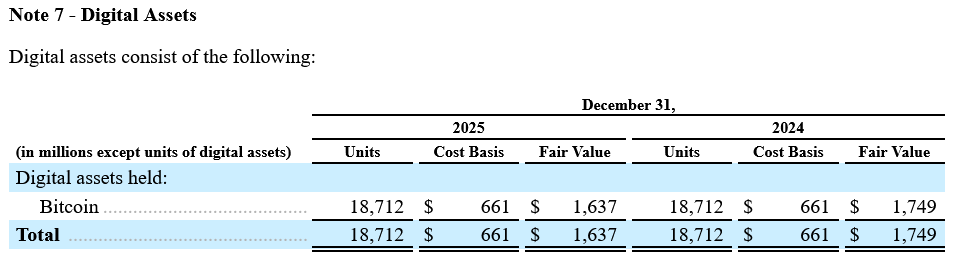
Elon Musk’s aerospace company SpaceX reported holding 18,712 Bitcoin worth $1.45 billion in a recent filing, over 10,000 coins more than blockchain tracking firms had estimated.
In the company’s S-1 registration statement, filed as part of its bid to become a public company on June 12, SpaceX revealed it purchased Bitcoin (BTC) at an average of $35,320 per coin. Its reported holdings would make it the seventh-largest among public companies.
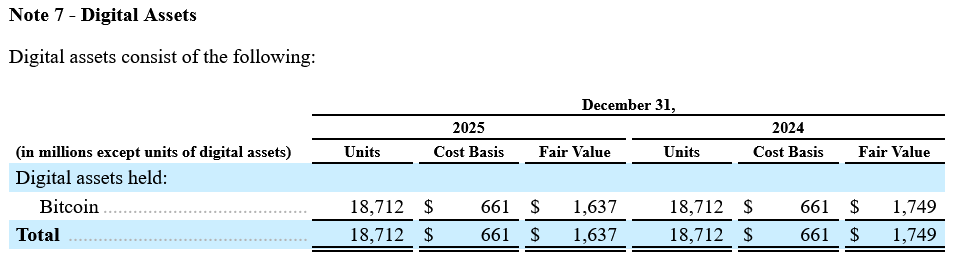
SpaceX’s Bitcoin holdings as of Dec. 31, 2025. Source: SEC
SpaceX is poised to become the biggest IPO in capital markets history, aiming to raise around $75 billion with an estimated valuation of $1.75 trillion to $2 trillion. Buying its stock would give investors a way to gain exposure to Bitcoin, alongside the company’s aerospace and AI businesses.
SpaceX Bitcoin accumulation began five years ago
SpaceX began buying Bitcoin in early 2021, around the same time that Musk’s Tesla started investing in the cryptocurrency.
The latest SEC filing shows that SpaceX has considerably more Bitcoin than Tesla, which holds 11,509 Bitcoin. It also surpasses estimates from BitcoinTreasuries.NET and crypto analytics firm Arkham, which estimated SpaceX’s Bitcoin holdings at only 8,285 Bitcoin.
Related: Saylor’s Strategy scoops $2B Bitcoin, holdings reach 843,738 BTC
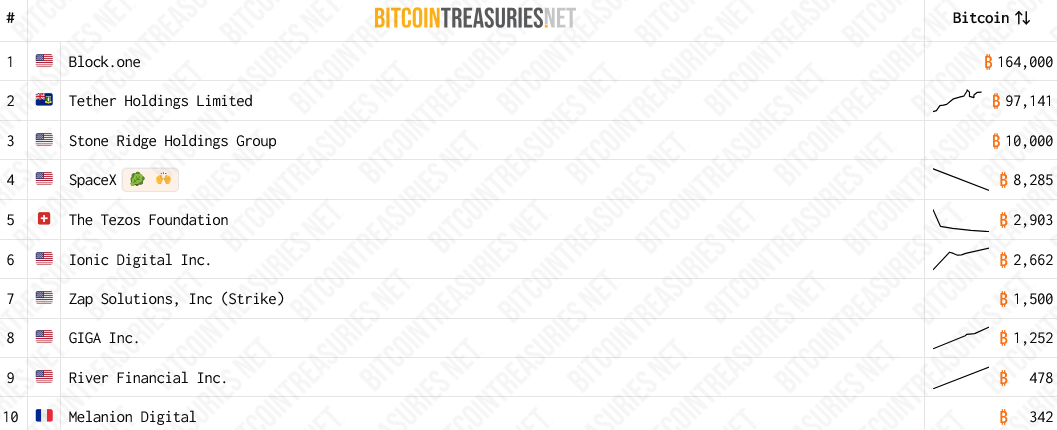
BitcoinTreasuries.NET data shows that SpaceX only holds 8,285 Bitcoin on its balance sheet. Source: BitcoinTreasuries.NET
SpaceX chasing largest addressable market in “human history”
SpaceX is one of few private companies with large valuations looking to go public in 2026, along with AI firms OpenAI and Anthropic.
Going public could unlock billions of dollars in capital for the company to fund projects like Starlink, orbital data centers and potentially Mars colonization.
In the filing, SpaceX said it is targeting the largest actionable total addressable market in “human history,” estimating a $28.5 trillion opportunity spanning AI, space and connectivity.
Magazine: eToro founder timed Bitcoin top perfectly due to belief in 4 year cycles

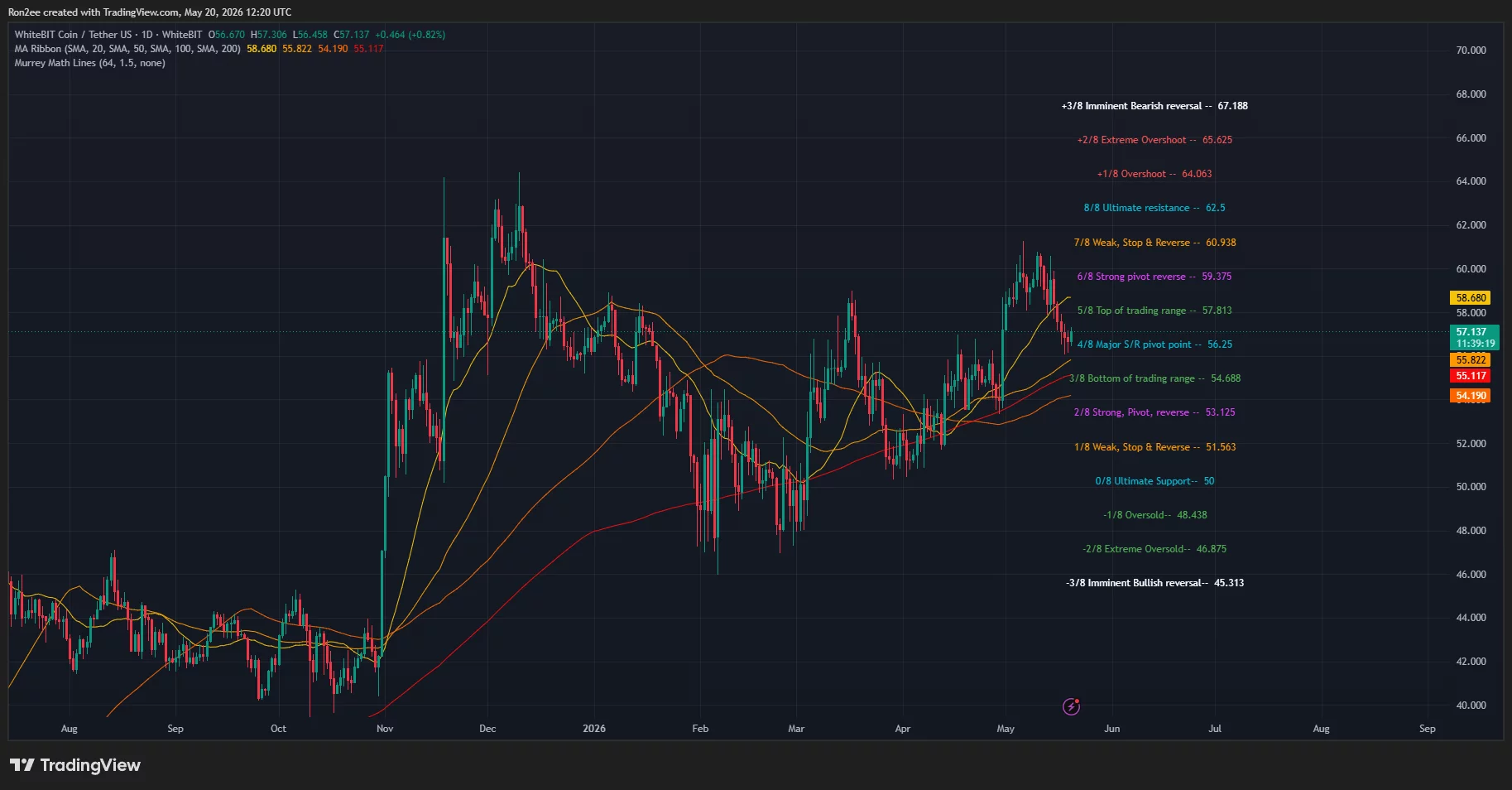
WhiteBIT Coin rallied sharply earlier this month after WhiteBIT announced the launch of its dedicated United Kingdom trading platform, but the token has since pulled back toward a major support-resistance pivot zone that could determine its next directional move.
Summary
- WhiteBIT Coin pulled back toward the key $56.25 Murrey Math S/R pivot after failing to hold gains above the $60.9 resistance zone.
- WhiteBIT launched its dedicated UK trading platform with GBP funding and Faster Payments integrations for local retail and institutional users.
- Major moving averages between $54 and $56 are forming a key support cluster that traders are watching for a potential bullish rebound.
According to data from crypto.news, WhiteBIT Token (WBT) price was trading near $57.1 at press time after retreating from a recent local high around $60.8. The token is now hovering close to the key 4/8 Murrey Math support and resistance pivot near $56.25, an area that has repeatedly acted as both support and resistance over the past several months.
The pullback comes shortly after WhiteBIT officially launched whitebit.uk, a localized trading platform designed specifically for UK users. The exchange said the expansion would allow retail and institutional traders to access GBP funding through Faster Payments Service integrations, spot trading, lending products, and API connectivity.
WhiteBIT described the move as part of its broader expansion into regulated global markets as competition among centralized exchanges intensifies across Europe and the United Kingdom.
“Entering the UK market marks an important milestone,” said Volodymyr Nosov, founder of W Group.
The launch also arrives as crypto adoption in the UK continues growing. According to Financial Conduct Authority data cited by WhiteBIT, roughly 8% of UK adults currently hold crypto assets, while 73% of users rely on centralized exchanges for trading access.
Despite the strong fundamental backdrop surrounding the platform expansion, traders are now closely watching whether WBT can defend the current technical support zone and resume its broader uptrend.
Can WhiteBIT Coin defend the $56 support zone?
The daily chart shows WBT approaching one of its most important technical levels in months.
After rallying from near $50 in April, WhiteBIT Coin surged toward the 7/8 Murrey Math resistance level around $60.9 before facing rejection. Since then, the token has entered a corrective phase, gradually sliding back toward the 4/8 pivot support near $56.25.
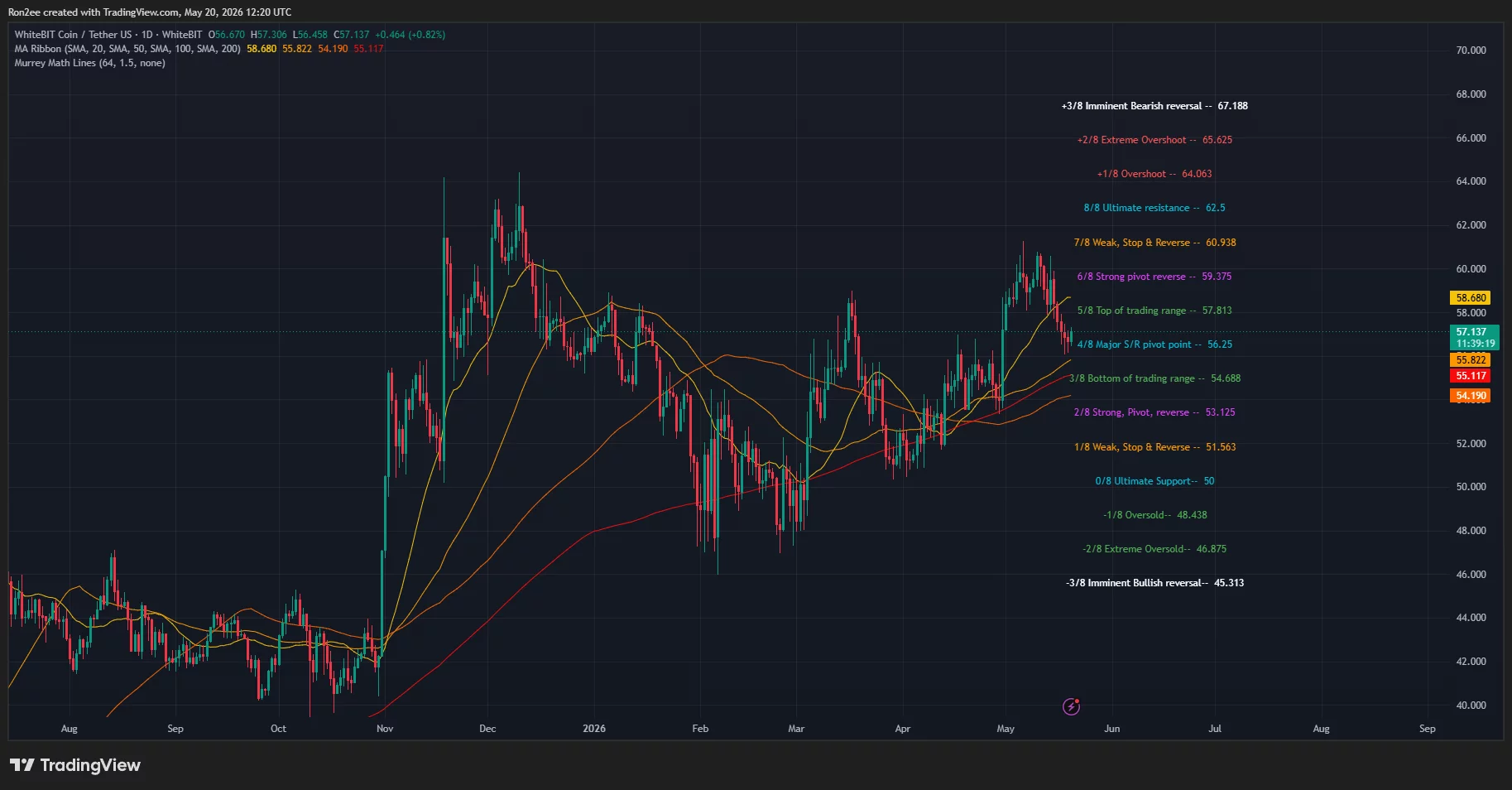
That level carries additional importance because it closely aligns with several major moving averages clustered underneath the current price action.
The 20-day moving average currently sits around $58.68, while the 50-day and 100-day moving averages stand near $55.82 and $54.19 respectively. The 200-day moving average remains lower near $55.11.
This concentration of dynamic support levels between $54 and $56 could create a strong demand zone if bulls attempt to defend the current pullback.
Historically, WBT has reacted strongly around this Murrey Math midpoint region. The same level acted as resistance during March before eventually flipping into support during the May breakout rally.
From a market structure perspective, the token still maintains a pattern of higher lows on the daily timeframe despite the recent correction. As long as WBT holds above the $54–$56 region, the broader bullish structure technically remains intact.
A successful rebound from current levels could allow bulls to retest the 6/8 strong pivot near $59.37, followed by the recent swing high close to $60.9. If momentum accelerates, traders may then look toward the 8/8 Murrey Math resistance zone around $62.5.
That area also coincides with the upper resistance range that capped rallies during late 2025.
However, failure to defend the current pivot region could shift short-term momentum back toward sellers.
If WBT loses the 100-day and 200-day moving average cluster near $54–$55, the next major downside target could emerge near the 2/8 Murrey Math support around $53.12. A deeper correction could then expose the psychologically important $50 support zone.
The recent rejection near $60.9 also resembles a potential lower high relative to the December 2025 peak near $63, meaning bears may attempt to regain control if broader crypto market sentiment weakens.
Could the UK expansion become a long-term catalyst for WBT?
Beyond short-term price fluctuations, the UK launch could strengthen WhiteBIT’s long-term ecosystem positioning.
The exchange has spent the past two years aggressively expanding its global footprint through regulatory approvals, institutional services, and regional infrastructure rollouts.
WhiteBIT currently promotes itself as one of Europe’s largest crypto exchanges by traffic and has increasingly targeted regulated jurisdictions as institutional participation in crypto markets grows.
The company has also emphasized security and compliance as key differentiators. WhiteBIT says it holds CCSS Level 3 certification and ranks among the top exchanges globally in cybersecurity metrics.
Its institutional division additionally offers market-making infrastructure, liquidity support, token listing services, and over-the-counter trading solutions for corporate clients.
For WBT specifically, continued ecosystem expansion could help strengthen demand for the token over time.
WhiteBIT Coin functions as the native asset of the broader WhiteBIT ecosystem and is integrated across trading fee discounts, staking functionality, blockchain infrastructure, and platform utilities.
According to exchange materials, WhiteBIT now supports hundreds of digital assets and hundreds of trading pairs while continuing to expand fiat on-ramp capabilities.
The UK expansion may also improve liquidity access for European traders through direct GBP rails, potentially increasing platform activity if adoption trends remain strong.
Still, macro conditions across the crypto market remain an important variable.
Many altcoins have recently struggled to sustain breakout momentum as traders rotate capital toward Bitcoin following renewed ETF-driven flows and rising institutional demand. A broader market slowdown could therefore weigh on WBT regardless of platform-specific developments.
At the same time, exchange tokens historically tend to outperform during periods of rising trading activity and expanding user adoption.
That dynamic helped fuel strong rallies in several exchange-linked assets during previous crypto market cycles, especially when accompanied by ecosystem growth, new geographic expansion, and increasing institutional participation.
For now, WhiteBIT Coin appears to be sitting at a technically decisive area.
A strong rebound from the current support cluster could reinforce the broader bullish trend and reopen the path toward the $60–$62 resistance range. But if sellers break the $54 support region, traders may begin positioning for a deeper retracement toward the $50 zone instead.
Disclosure: This article does not represent investment advice. The content and materials featured on this page are for educational purposes only.

The world’s largest crypto exchange by total users, trading volume, and other metrics will perform a wallet maintenance today, May 21.
The procedure will halt some important functions, yet it is projected to be wrapped up in short order.
Prepare for Disruption
The upgrade is scheduled for May 21, and to support the process, Binance will temporarily suspend deposits and withdrawals on the Ethereum network. The maintenance is expected to take about an hour, after which operations will resume.
“Deposits and withdrawals for token(s) on the aforementioned network will be reopened once the upgraded network is deemed to be stable. No further announcement will be posted,” the announcement reads.
The exchange assured that token trading will remain fully operational throughout the maintenance and promised to handle all technical requirements on behalf of users.
Such upgrades are nothing unusual and typically cause no serious implications for clients. Last month, the company performed a similar wallet maintenance, and deposits and withdrawals on the Ethereum network were unavailable for approximately 60 minutes. Notably, there were no reports of major issues.
Over the past few years, Binance has implemented such measures to support improvements across different ecosystems, including Cardano, BNB Chain, and others. In the summer of 2025, it performed a live upgrade to its wallet infrastructure and paused deposits and withdrawals across all networks for approximately 15 minutes.
Other Recent Binance Updates
Besides the upcoming wallet maintenance, the exchange has been busy with listings and delistings to respond to the latest market trends and to scrap tokens that no longer meet the necessary criteria.
Just a few days ago, it introduced the BTC/USD1 perpetual contract with up to 100x leverage and the CBRS/USDT perpetual contract with up to 10x leverage.
At the same time, it said goodbye to Automata (ATA), Harvest Finance (FARM), Enzyme (MLN), Phoenix (PHB), and Syscoin (SYS), explaining that these tokens fell short of its required standards, such as adequate trading volume and liquidity, strong team commitment, network safety, and others. Unsurprisingly, the news prompted a substantial price decline for the affected coins.
In addition, Binance launched seven new official WhatsApp channels dedicated to users in India, Ukraine, Kazakhstan, Mexico, Peru, Colombia, and Russian-speaking clients. These groups are designed for one-way communication and act as gateways for clients in these particular regions, some of which are among the exchange’s strongholds.
The post Binance Will Temporarily Suspend ETH Deposits and Withdrawals: Details Inside appeared first on CryptoPotato.


Crypto liquidity is scattered across exchanges and pairs, creating a structural “liquidity tax” of slippage, spread drag, and inconsistent execution that hits traders, tokens, and venues.
Summary
- Crypto trading is split across hundreds of venues with isolated order books, where the same trade can fill smoothly on one exchange and blow out spreads on another.
- During volatile moves, thinner exchanges see books vanish, spreads spike, and market orders slam price, turning small inefficiencies into a compounding performance drag.
- Projects and exchanges increasingly rely on professional market makers as a coordination layer to smooth out depth, tighten spreads, and keep liquidity usable across venues.
Crypto trading activity is spread across hundreds of exchanges, liquidity venues, market makers, and trading platforms. On the surface, that level of competition looks healthy. In practice, it has created one of the biggest structural problems in digital asset markets: fragmented liquidity.
Instead of liquidity being concentrated in a handful of deep and efficient markets, it is dispersed across disconnected exchanges with different order books, inconsistent spreads, uneven depth profiles, and varying execution quality. The result is a market in which pricing and trade execution can differ dramatically depending on where activity occurs.
This fragmentation affects almost every corner of the crypto ecosystem. Traders deal with inconsistent execution and slippage, exchanges compete to maintain liquidity depth, and token projects face credibility challenges when trading conditions vary significantly between venues. As crypto markets mature and more exchanges compete for order flow, liquidity fragmentation is becoming increasingly difficult to ignore.
Why fragmentation creates trading inefficiencies
The effects of fragmentation become most visible during execution.
The same mid-sized order that fills efficiently on one exchange with tight spreads and minimal market impact can result in significantly worse execution on another venue with a thinner order book. During volatile trading sessions, these gaps become even more pronounced, especially when liquidity rapidly disappears from smaller exchanges.
This issue becomes even more severe during periods of heavy volatility. Order books on smaller exchanges can thin out within seconds, spreads widen aggressively, and market orders begin moving prices far more than expected. Recent market conditions have shown how quickly liquidity can deteriorate during sharp price swings, particularly on smaller exchanges with thinner order books.
For active traders and institutional participants, even relatively small inefficiencies compound quickly. Thin books increase slippage, widen spreads, and reduce execution consistency. During periods of heightened volatility, liquidity conditions can deteriorate rapidly during volatile market conditions, particularly on exchanges with thinner order books and weaker depth profiles.
Over hundreds or thousands of trades, the difference between deep and shallow liquidity environments becomes meaningful. What initially appears to be a small pricing inefficiency can gradually become a significant drag on performance, particularly for larger traders managing consistent order flow across multiple exchanges.
Liquidity fragmentation also creates pricing inconsistencies between venues. Since exchanges operate independently with different market participants and liquidity conditions, prices can diverge much more easily than in traditional financial markets with a centralised liquidity infrastructure.
This is one of the reasons why professional crypto market making has become such an important part of digital asset trading infrastructure. Market makers continuously quote buy and sell orders across multiple venues, helping maintain tighter spreads and healthier depth on both sides of the order book.
Without this coordination layer, execution inefficiencies and pricing gaps across exchanges would likely worsen during periods of volatility. This becomes particularly important during large market moves, when thinner exchanges often struggle to maintain stable liquidity conditions.
Research has increasingly highlighted that liquidity remains uneven across crypto markets. An institutional report on how trading depth is actually distributed across crypto highlighted large discrepancies between reported trading volume and true executable liquidity across many venues.
This disconnect between perceived liquidity and actual executable depth has become one of the more important structural issues in crypto market infrastructure, particularly as institutional trading activity continues to grow.
The exchange competition problem
Competition among exchanges has further accelerated fragmentation.
Over the past several years, new exchanges have launched aggressively across different regions and market segments. Most compete on similar positioning: broader token access, faster listings, lower fees, or specialised trading features. While this has expanded access to digital assets, it has also spread liquidity thinner across the ecosystem.
For highly liquid pairs like BTC/USDT or ETH/USDT, the largest exchanges still maintain sufficient depth to support large trading activity with relatively stable execution. Outside of those major pairs, however, liquidity quality deteriorates quickly.
A mid-cap token may appear on dozens of exchanges simultaneously while only a handful of venues hold meaningful trading depth. The remaining exchanges may display enough liquidity to appear active on market aggregators, but not enough to absorb moderate trading activity without significant price movement.
This creates a misleading perception of market health. Topline trading volume figures can appear impressive while actual executable liquidity remains limited. In many cases, depth deteriorates rapidly once trades move beyond relatively small sizes, exposing how unevenly liquidity is distributed across the market.
This gap between reported activity and true liquidity quality has become a growing focus among institutional traders, exchanges, and other professional market participants. As more sophisticated capital enters crypto markets, liquidity consistency is becoming just as important as raw trading volume.
Why projects care about liquidity consistency
For token projects, fragmentation creates both operational and reputational challenges.
A token may show strong aggregate trading volume across multiple exchanges, but if liquidity quality differs significantly between venues, institutional participants quickly notice. Professional traders are increasingly evaluating markets based not only on volume, but also on execution quality, spread stability, and the ability to move size efficiently during volatile periods.
Institutional participants typically look beyond simple volume metrics. They evaluate order book depth, spread consistency, slippage on larger orders, and liquidity resilience during market instability.
If a token consistently trades in thin or unpredictable environments, it becomes more difficult for larger participants to build or exit positions efficiently. That directly affects how the market perceives the asset. Poor liquidity conditions increase perceived risk, particularly for funds and larger trading firms that require reliable execution quality before allocating meaningful capital.
The operational side is also highly fragmented. Each exchange has different fee structures, API environments, listing standards, trading pair dynamics, and liquidity expectations. Managing liquidity quality across multiple venues simultaneously requires ongoing coordination and constant monitoring of trading conditions.
Most token teams simply lack the internal infrastructure to manage that process on their own. This is one reason why many projects work with professional market makers to support healthier liquidity conditions across multiple exchanges simultaneously.
The role of market makers
Market makers effectively act as a coordination layer between fragmented trading venues.
By continuously placing buy and sell orders across multiple exchanges, they help reduce spread inconsistencies, improve order book depth, and create more stable execution environments. Their role becomes particularly important during periods of volatility, when thinner exchanges can quickly lose liquidity and experience severe execution problems.
In practical terms, this means traders are more likely to receive consistent execution, even on smaller or less-liquid venues. Without that liquidity support, many order books would struggle to absorb even moderate trading activity. Spreads would widen more aggressively, slippage would increase substantially, and price gaps between exchanges would become even less efficient.
For exchanges, healthier liquidity conditions improve trading quality and user retention. For projects, stronger execution environments help support market confidence and improve accessibility across venues. Better liquidity consistency also helps reduce the perception that trading quality varies dramatically depending on where users access the asset.
Importantly, market makers are not creating artificial demand. Their role is primarily operational. They help maintain functional trading environments by improving liquidity availability, supporting tighter spreads, and increasing execution reliability during trading activity.
As crypto markets continue maturing, this infrastructure layer is becoming increasingly important. Liquidity quality is no longer viewed as a secondary market issue. It is becoming a core component of how exchanges, projects, and traders evaluate the health of trading environments.


Drift Protocol said its insurance fund was not affected by the recent attack and that users who staked into the fund will be able to withdraw their shares normally once the protocol is brought back online.
Summary
- Drift said the insurance fund was not impacted because the protocol was paused before liquidation or bankruptcy losses were finalized.
- Users with insurance fund stakes will be able to withdraw their shares after the platform recovers.
- The protocol said its own insurance fund assets will help support a restart and user recovery effort.
Drift said in an official post on X that users who staked into the Insurance Fund will be able to withdraw their corresponding shares once the protocol is restored. The protocol added that the fund itself was not affected by the attack because Drift was paused before any losses could be completed through “normal liquidation or bankruptcy processes.”
That distinction matters because Drift’s own documentation defines the Insurance Fund as the first backstop for maintaining exchange solvency in the event of bankruptcies. More detailed staking documentation says users can unstake from the fund, although withdrawals are subject to a cooldown period of 13 days.
The update follows one of the biggest Solana DeFi breaches of the year. In April, crypto.news reported that the Drift hack drained about $285 million through a compromised administrator key in what security researchers described as a social engineering attack rather than a smart contract flaw.
Why the fund was spared
Drift’s explanation is straightforward: the insurance mechanism exists to absorb insolvency created by liquidations and bankruptcies, not to retroactively cover an external exploit that was halted before those internal loss pathways finished playing out. In its latest statement, the team said that because the protocol was paused early enough, the Insurance Fund never became part of the loss cascade tied to the vulnerability.
That aligns with outside reporting on the incident. Elliptic estimated the exploit at $286 million and said Drift suspended deposits and withdrawals during the attack, while Chainalysis described the breach as a privileged-access compromise that led to roughly $285 million in losses over a matter of minutes.
The protocol had already signaled that the fund was being secured as a precaution. Reporting from Binance cited Drift as saying the insurance fund assets were unaffected and were being withdrawn to enhance protection after the exploit.
Recovery and restart plan
Drift now says assets from the protocol’s own Insurance Fund will be used to support the system restart and broader user recovery, and that it plans to publish the relevant on-chain addresses so the community can track how the funds are used. That is a notable shift from simply ring-fencing the fund toward actively deploying part of it in the recovery process.
The insurance fund is only one part of Drift’s broader rebuilding effort. In April, multiple outlets reported that the protocol had lined up as much as $147.5 million in support for affected users, including up to $127.5 million from Tether and another $20 million from partners, while later recovery plans pointed to recovery tokens tied to verified losses, as covered by CoinMarketCap and RootData.
For users, the immediate takeaway is narrower and more important: insurance fund stakes were not wiped out in the exploit, and normal withdrawals are expected to resume after Drift’s recovery process is complete.
The European Commission has opened a review of its landmark crypto regulation, signaling that the European Union is considering updates to its landmark digital asset framework just two years after it took effect.
The commission on Wednesday launched a public consultation seeking feedback from the crypto industry and the wider public on whether the EU’s Markets in Crypto-Assets Regulation (MiCA) should be updated. The consultation will remain open until Aug. 31.
The commission said crypto markets and the global regulatory environment have “continued to evolve” since MiCA took effect in 2024, prompting officials to assess whether the current framework remains “fit for purpose.”
The move marks an important regulatory development in the EU, with some industry observers already referring to potential future updates to the framework as “MiCA 2.”
Stablecoin interest ban included in regulatory review
The targeted consultation under MiCA is a detailed questionnaire designed to assess how the regulation is functioning in practice and where adjustments may be needed.
It seeks feedback on ongoing classification challenges, particularly the blurred boundary between crypto assets and traditional financial instruments under EU law, including wrapped tokens, synthetic assets and tokenized fund interests.
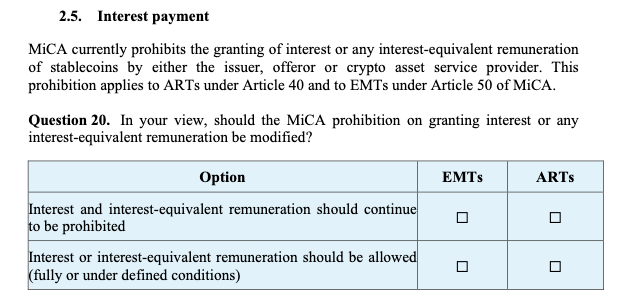
A key focus is stablecoins, including a reassessment of MiCA’s prohibition on interest or interest-like remuneration. The commission is asking whether this restriction should be maintained or revised, alongside broader questions on reserve requirements, liquidity management, redemption rights and the thresholds used to determine “significant” tokens.
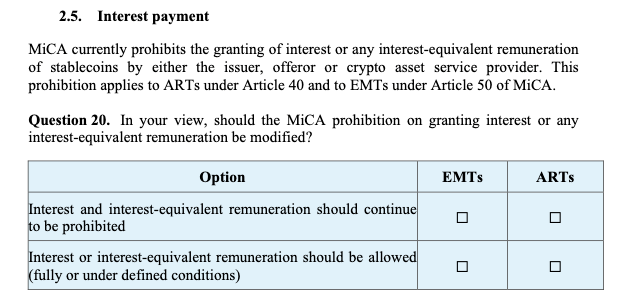
An excerpt from the targeted consultation on the MiCA review. Source: EC
Beyond stablecoins, the consultation also examines emerging risk areas, including decentralized finance (DeFi), staking, lending, non-fungible tokens, and crypto asset service providers (CASPs), as well as issues around market integrity, investor protection and potential simplification of compliance rules.
Related: Euro stablecoin project Qivalis adds 25 banks ahead of launch
The inclusion of DeFi and tokenized financial assets is particularly notable as both areas remain largely outside MiCA’s scope.
EU probes whether consumers actually trust crypto
The public consultation document shows the commission is not only reviewing whether MiCA works as a legal framework, but also whether ordinary consumers understand and trust digital assets under the new rules.
Many of the questions focus on user awareness of Bitcoin (BTC), Ether (ETH), stablecoins, DeFi and tokenized assets.
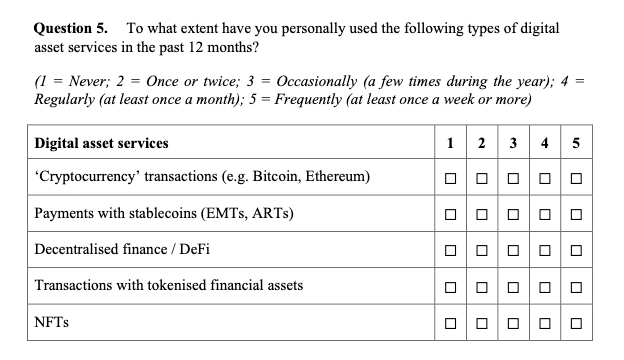
An excerpt from the public consultation on the MiCA review. Source: The EC
It also explores what would increase consumer confidence in crypto services, including stronger protections, clearer rules, improved supervision and easier access through regulated banks and payment providers.
The review comes as MiCA approaches a key transitional deadline in July 2026, after which CASPs must be fully authorized under the EU framework or cease operations.
Magazine: How crypto laws changed in 2025 — and how they’ll change in 2026
Bitcoin longs on Bitfinex surged to 80,636 BTC on May 20, the highest level since December 2023.
Summary
- Bitfinex margin long positions rose to 80,636 BTC on May 20, up roughly 10% since the start of 2026 despite Bitcoin falling 13% in the same period.
- Bitcoin has declined for five consecutive trading days, sliding from above $80,000 to near $76,000 amid broader market weakness.
- The so-called Bitfinex whale has historically expanded long positions during weakness and reduced them near local market tops.
Leveraged traders on Bitfinex continued buying into Bitcoin’s sell-off, with margin long positions rising to 80,636 BTC on May 20 according to TradingView data.
The figure marks the highest level since December 2023 and represents a roughly 10% increase since the start of 2026. Bitcoin has fallen 13% year to date even as these long positions climbed.
The latest pullback saw Bitcoin slide from above $80,000 to approximately $76,000 over five consecutive losing sessions between May 15 and May 19.
It marks the second longest losing streak of the year, with the asset attempting its first daily green candle in six days at the time of writing. Bitcoin is now trading approximately 35% below its October 2025 all-time high of $126,000.
What the Bitfinex whale data signals
Historically, the so-called Bitfinex whale has acted as a contrarian indicator. Large leveraged long positions on the exchange have frequently expanded during market weakness and been reduced closer to local tops and trend reversals. The pattern does not guarantee a price floor, but it has attracted attention from analysts who track whale positioning as a leading signal.
Bitcoin is currently approaching a key technical zone. The asset is testing both the True Market Mean and the short-term holder cost basis near $78,000, with the 200-day moving average sitting above $81,000. Reclaiming that level would be seen by many traders as a first step toward structural recovery.
Why some traders are not convinced a bottom is in
Rising margin longs during a sustained price decline can also signal that a clear price floor has not yet occurred. When leveraged long positions accumulate, the market becomes vulnerable to a cascade of liquidations if prices continue falling, amplifying downside pressure rather than absorbing it.
Crypto.news has tracked analyst commentary throughout 2026 that consistently pointed to $78,000 to $81,000 as the key zone for Bitcoin to reclaim before a sustained recovery becomes probable.
The divergence between rising margin exposure and falling prices reflects an ongoing standoff between dip buyers and sellers. The Bitcoin price page tracks real-time movements as that standoff plays out.


Jane Street has rejected new insider trading claims centred on a private Telegram channel during the 2022 Terra collapse.
Summary
- A Manhattan complaint accuses Jane Street of using a Telegram channel to exit $192 million of TerraUSD before UST lost its dollar peg.
- The suit names co-founder Robert Granieri and trader Michael Huang alongside a former Terraform intern who allegedly relayed non-public information.
- Jane Street called the complaint a transparent attempt to extract money and said it will defend vigorously against the claims.
A Manhattan federal complaint alleges Jane Street used a private Telegram channel to exit $192 million in TerraUSD before its May 2022 collapse. The suit claims the firm made approximately $134 million betting against the token as Terra’s ecosystem unraveled.
The case was filed by the administrator winding down Terraform Labs and also names Jane Street co-founder Robert Granieri and trader Michael Huang. The complaint alleges a former Terraform intern who later joined Jane Street relayed non-public information through the private channel, enabling the firm to sell ahead of the depeg.
The Telegram backchannel at the centre of the insider trading complaint
On May 7, 2022, Jane Street allegedly sold 85 million UST minutes after Terraform withdrew 150 million from a key Curve pool. Crypto.news has reported on the broader lawsuit, filed in February 2026 by court-appointed administrator Todd Snyder.
“This suit is a transparent attempt to extract money when it is well-established that the losses suffered by Terra and Luna holders were the result of a multi-billion dollar fraud perpetrated by the management of Terraform Labs,” a spokesperson said.
Jane Street asked a Manhattan court in April 2026 to dismiss the case with prejudice, arguing its trading was based on public information. The motion also cited the Wagoner rule, which limits a bankruptcy estate’s ability to sue third parties for losses tied to its own wrongdoing. The court has not yet ruled.
Why the case matters for crypto market regulation
The lawsuit draws on a 2023 ruling that UST and Luna qualified as securities. That precedent strengthens the legal footing for the securities fraud claims against Jane Street.
Terraform’s administrator also separately sued Jane Street in February 2026 over the initial front-running allegations tied to the Curve pool withdrawal.
Do Kwon, Terraform’s co-founder, has pleaded guilty to conspiracy and wire fraud and is serving a 15-year prison sentence. Administrator Todd Snyder previously stated that Jane Street’s trades hastened Terraform’s collapse by draining liquidity and accelerating market panic.
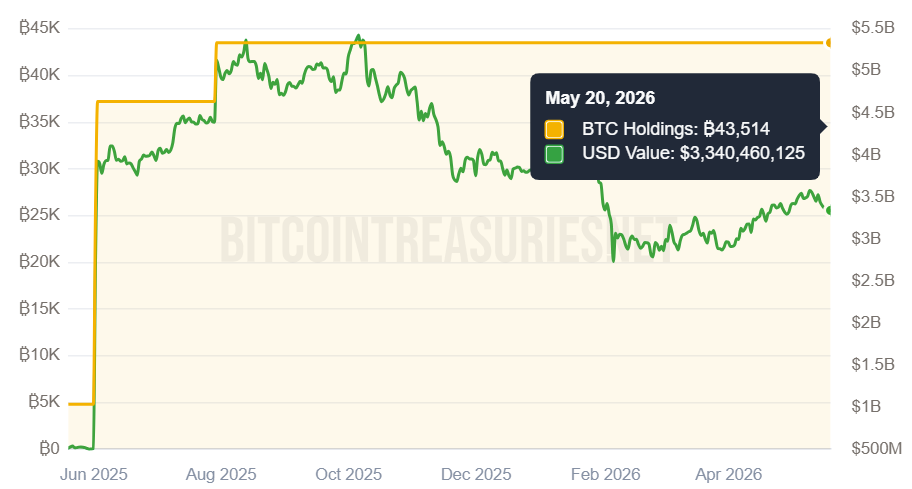
Tether has acquired SoftBank Group’s stake in Twenty One Capital, the Bitcoin treasury company that is expanding into lending, mining and capital markets services, in a move that gives the stablecoin issuer greater control over one of the largest publicly traded Bitcoin holders.
In an announcement on Wednesday, Tether said it purchased SoftBank’s roughly 26% stake for an undisclosed amount. SoftBank was one of the earliest backers of Twenty One Capital, which launched in 2025 as a Bitcoin (BTC) treasury company backed by Cantor Fitzgerald and led by Jack Mallers.
Neither controlling shareholder Tether nor Twenty One Capital disclosed the size of Tether’s stake. As part of the ownership change, SoftBank’s representatives will step down from Twenty One Capital’s board of directors.
The transaction further consolidates ownership under Tether, which deepens the stablecoin issuer’s influence over the company’s strategy and governance.
The ownership changes come as publicly traded Bitcoin treasury companies face greater pressure during periods of market weakness. When Bitcoin prices fall, the value of their core asset declines, reducing net asset value and making it more difficult to raise fresh capital without diluting existing shareholders.
Twenty One Capital’s Bitcoin treasury is worth roughly $3.34 billion. Source: BitcoinTreasuries.NET
Related: Michael Saylor floated Bitcoin sales idea to avoid ‘impairing’ the asset
Twenty One Capital shares rise but volatility remains
Separately, Twenty One Capital outlined plans to move beyond a pure Bitcoin treasury model and become a broader Bitcoin-focused financial services company. It intends to combine its treasury operations with Bitcoin lending, mining and capital markets activities
Shares of Twenty One Capital were up 4% at last look on Wednesday morning following the news.
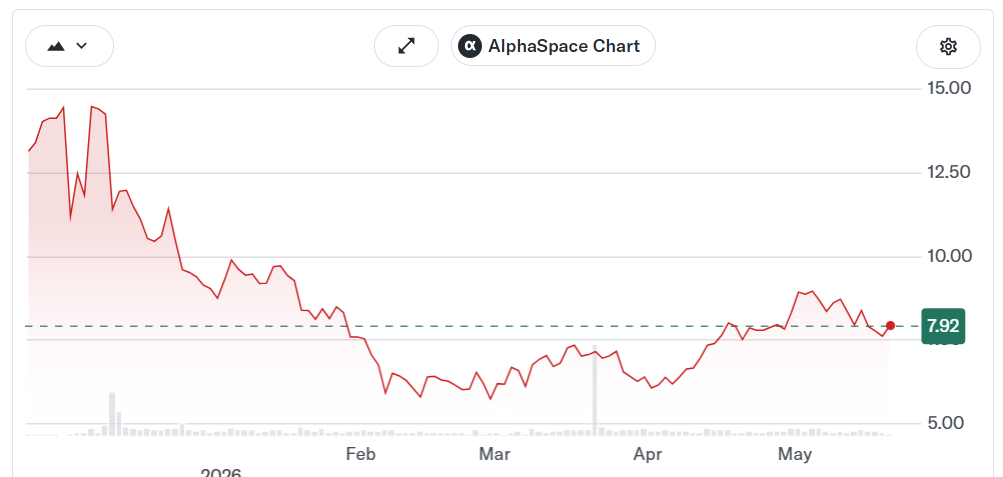
Twenty One Capital’s stock performance. Source: Yahoo Finance
Today’s gains clawed back some of the 37% decline investors have seen since XXI stock began trading on the New York Stock Exchange in December following its business combination with Cantor Equity Partners.
Earlier developments had already pointed to possible changes at the company. As Cointelegraph reported in April, Tether said it intended to vote in favor of a proposed merger between Twenty One Capital and Mallers’ Bitcoin payments company Strike. The plan also contemplated merging the combined entity with Bitcoin miner Elektron Energy.
Related: Crypto Biz: Bitcoin treasuries break ranks as BTC dips below $70K

Crypto-aligned political action committees (PACs) backed by industry participants secured a string of wins in three U.S. state primaries on Tuesday, signaling a potential blueprint for crypto politics ahead of the 2026 midterms. The Fairshake network and its affiliates deployed sizable media spend to back a slate of candidates, with the funding stream largely anchored by Ripple Labs and Coinbase. The groups are coordinating through vehicles such as Defend American Jobs (supporting Republicans) and Protect Progress (for Democrats perceived as pro-crypto).
In Georgia and Kentucky, four Republican candidates and one Democrat won their respective primaries for U.S. Senate and House seats, while a Republican in Alabama advanced to a runoff. The successes underscore the willingness of crypto-affiliated committees to pursue both partisan angles in pursuit of policy-friendly outcomes.
“Fairshake’s 6-0 sweep tonight was a clear victory for pro-crypto leaders across the country,” Fairshake spokesperson Geoff Vetter told Cointelegraph. He added, “This powerful bipartisan mandate is being heard across America from Georgia to Alabama to Kentucky.”
According to Federal Election Commission filings, Protect Progress spent more than $4.2 million to back Jasmine Clark, who is running in Georgia’s 13th Congressional District. Defend American Jobs reported substantial media expenditures on Republican candidates: $455,000 for Clay Fuller in Georgia’s 14th district, $709,000 for Houston Gaines in Georgia’s 10th district, $431,000 for Jim Kingston in Georgia’s 1st district, and $7.2 million for Kentucky’s U.S. Senate seat. In Alabama, Barry Moore was backed with $7.4 million from Defend American Jobs in his run for the U.S. Senate, setting up a runoff against state Attorney General Steve Marshall and Republican candidate Jared Hudson after no candidate secured a majority in the primary.
Fairshake and its crypto industry backers are positioning their spending as a long-term strategy. A spokesperson indicated the aim is to mobilize support for pro-crypto leadership in 2026, with the group forecasting continued, substantial media expenditures to counter anti-crypto positions. The organization has reported a war chest of about $193 million, a figure far larger than its $130 million outlay in 2024 for media and advertising to influence congressional races. This scale reflects a broader strategy to shape policy conversations around regulation, taxation, and market structure in ways favorable to the industry.
Related reporting notes broader patterns in crypto PAC activity, including prior efforts that did not achieve expected influence. For example, Fairshake spent roughly $8 million opposing Illinois Lieutenant Governor Juliana Stratton in a U.S. Senate primary, yet Stratton won with more than 40% of the vote, illustrating the challenges of converting large media spend into decisive electoral outcomes.
Texas runoff tests crypto‑PAC influence
In Texas, Protect Progress has intensified its media investment to bolster Democratic candidate Christian Menefee in the race to unseat incumbent Al Green in Texas’ 18th Congressional District. Federal Election Commission filings indicate Protect Progress allocated more than $4.1 million to support Menefee and reported more than $2.8 million in media buys opposing Green, who has expressed anti-crypto views and supported votes against several crypto policy proposals, including the GENIUS Act (stablecoins) and the CLARITY Act (digital asset market structure).
Preliminary runoff dynamics in Texas reflect the complexity of crypto PAC strategy at the state level: Protect Progress previously spent more than $1.5 million opposing Green ahead of a March primary, but neither candidate secured a majority, triggering the upcoming runoff. The Texas contest adds to a broader narrative about crypto-aligned funding influencing candidate positioning on policy, regulatory oversight, and fintech innovation at the state level.
These developments appear within a wider regulatory frame. While the primary focus is electoral, the activity intersects with ongoing U.S. regulatory scrutiny of crypto markets—the SEC, CFTC, and DOJ remain central to enforcement and policy shaping. Observers note that such PAC activity can have implications for licensing, KYC/AML compliance, and cross-border policy alignment, particularly as U.S. states experiment with their own digital-asset frameworks while federal agencies assess uniform standards. In a comparative sense, regulatory trajectories abroad—such as the European Union’s MiCA framework—underscore a global significance to political economy decisions around crypto policy.
Historical context, risk considerations, and compliance implications
The crypto industry’s growing involvement in electoral politics reflects a strategic effort to influence policy direction in a landscape of evolving rules and enforcement priorities. The scale of spending—multimillion-dollar media buys and targeted district focus—highlights both opportunity and risk for participating firms. While such campaigns can advance policy priorities, they also elevate compliance considerations, including disclosure requirements, attribution practices, and the potential for heightened scrutiny from regulators and the public. Institutions engaging in or monitoring these activities should weigh the governance implications, including how such spending aligns with internal compliance frameworks and risk appetites in relation to regulatory expectations.
Looking ahead, the 2026 midterms loom as a critical inflection point. The continued deployment of pro-crypto messaging through PACs could influence candidate selection, committee assignments, and policy coalitions on issues such as stablecoin regulation, market structure, and the integration of crypto with traditional financial institutions. Analysts and compliance teams should monitor fundraising disclosures, media strategies, and endorsements to gauge how this activity may shape regulatory debates at both state and federal levels. The evolving policy environment will likely require ongoing assessment of political risk, licensing considerations, and cross-border regulatory alignment as the sector navigates a complex and rapidly changing framework.
Closing perspective: As crypto policy remains unsettled, the alignment of industry funding with specific candidates and district-level policy priorities will continue to draw attention from regulators, financial institutions, and legal professionals seeking to understand how electoral dynamics translate into practical regulatory outcomes and enforcement focus.


Senator Lummis says a Clarity Act Senate floor vote could come before August, with passage odds at 75%.
Summary
- Galaxy Research raised its 2026 Clarity Act passage probability to 75% following the Senate Banking Committee’s 15-9 bipartisan vote on May 14.
- Senator Lummis said she would love a June floor vote but called that timeline “probably pretty optimistic,” with August now the realistic target.
- Seven Democratic votes are needed to clear the 60-vote filibuster threshold, with an elected officials ethics provision as the key sticking point.
A Senate floor vote on the Clarity Act could come within 30 days, with Galaxy Research raising its 2026 passage probability to 75% following last week’s 15-9 bipartisan Senate Banking Committee vote.
Senator Cynthia Lummis struck a measured tone. “Nobody is popping the champagne quite yet. There’s still a lot of work to do,” she said. On timing she was direct: “I would love to have this bill on the floor in June. That’s probably pretty optimistic.”
What still has to happen before a Senate floor vote
The bill must first be merged with a Senate Agriculture Committee version that differs on CFTC jurisdiction provisions. After reconciliation, the combined text needs 60 Senate floor votes to clear a filibuster.
Crypto.news has tracked the compressed legislative calendar throughout 2026, with the Memorial Day recess now passed as an earlier hard deadline. Galaxy Research head of research Alex Thorn estimates a signing during the week of August 3 in the optimistic scenario.
What a Clarity Act signing would mean for crypto markets
Galaxy Research’s 75% probability is the highest institutional estimate on record for the bill. White House crypto adviser Patrick Witt said Clarity Act passage would deliver roughly 90% of what the crypto industry needs from Congress.
Analysts at Standard Chartered have estimated passage could unlock $4 to $8 billion in additional XRP ETF inflows alone. The XRP price page tracks market reaction against the legislative backdrop in real time.
Why the ethics provision is the last major obstacle
Two Senate Democrats voted yes in the Banking Committee, but reaching 60 floor votes requires seven more Democratic crossovers. The primary sticking point is a conflict-of-interest provision covering elected officials participating in crypto markets.
Cody Carbone of the Digital Chamber told reporters a deal on the ethics provision would likely be completed before the bill goes to the floor. “I imagine the deal will be completed before this goes to the floor, because they’ll want to only bring it to the floor if they feel confident they’ve got 60,” he said.

Will WhiteBIT Coin rebound as price tests key S/R zone after UK platform launch?
Angelina Jolie's new drama “Couture” reflects her real-life health challenges
Binance Will Temporarily Suspend ETH Deposits and Withdrawals: Details Inside


-

 Crypto World5 days ago
BloFin War of Whales 2026 Grand Prix opens registration for $5M trading championship
-

 Fashion5 days ago
Weekend Open Thread: Theory – Corporette.com
-

 Crypto World5 days ago
E-Estate Announces 1 Year Live: Washington DC Summit as Real Estate Tokenization Enters Its Next Phase
-

 Tech6 days ago
Tech Moves: Microsoft AI leader jumps to OpenAI; former AI2 exec joins Meta; and more
-

 Tech5 days ago
Google reimburses Register sources who were victims of API fraud
-
 Crypto World7 days ago
Google’s Gemini AI Predicts Incredible Solana Price by the End of 2026
-

 Business5 days ago
H&R Real Estate Investment Trust (HR.UN:CA) Q1 2026 Earnings Call Transcript
-
 Entertainment6 days ago
Zara Larsson Has Blunt Response To Chris Brown Diss
-

 Sports5 days ago
Napoleonic enters 2026 Doomben 10,000 field via Abounding withdrawal
-

 Crypto World5 days ago
BeInCrypto 100 Institutional Awards Nomination: KAST for Best Digital Assets Neobank and Best Digital Assets Fintech
-

 Fashion4 days ago
On the Scene at Gucci’s Cruise Show in New York City: Mariah Carey, Kim Kardashian, Lindsay Lohan, Iman, and More!
-
 Crypto World5 days ago
Bitcoin Battles US Bond Nerves With BTC Price Dip Toward New May Lows
-
 Crypto World5 days ago
Wall Street’s Boldest Gold Prediction Has Russians Rushing to Buy
-

 Crypto World5 days ago
ICE and CME urge US regulators to curb Hyperliquid energy trading
-

 Politics6 days ago
DWP PIP Timms review continues to be an absolute farce
-

 Fashion5 days ago
Trending Western Style Vests Perfect for Summer
-

 Entertainment6 days ago
David Letterman Returns to Late Show, Blasts Cancellation
-

 Crypto World5 days ago
IREN closes $3 billion convertible notes deal amid AI infrastructure expansion
-

 Fashion4 days ago
Amazon Sundays: Memorial Day Hosting
-
 Crypto World6 days ago
Lido Finance Selects Chainlink CCIP as the Official Cross-Chain Infrastructure for wstETH Security
You must be logged in to post a comment Login