

Crypto World
Why did Harvard dump its Ethereum ETF after one quarter?

Harvard Management Company exited its Ethereum ETF position after one quarter and cut its Bitcoin ETF stake, new SEC filings show.
Summary
- Harvard sold $87M Ethereum ETF stake after one quarter, ending ETHA exposure during Q1 filing.
- The endowment also cut its Bitcoin ETF holdings, reducing IBIT shares from 5.35M to 3.04M.
- Ethereum Foundation exits and ETH price weakness add pressure to the wider institutional ETF story.
The Q4 filing showed Harvard held 3,870,900 shares of BlackRock’s iShares Ethereum Trust, valued at $86.82 million. The Q1 filing no longer lists the Ethereum fund among Harvard’s reported public equity holdings.
Meanwhile, the sale came less than a quarter after Harvard first reported the ETHA position. The Q1 filing instead shows 3,044,612 shares of BlackRock’s iShares Bitcoin Trust, valued at $116.97 million.
That marks a reduction from 5,353,612 IBIT shares at the end of Q4, when the Bitcoin ETF position was valued at $265.81 million. The filing does not explain why Harvard sold ETHA or reduced IBIT. 13F reports also do not show intraday trades or private positions.
Bitcoin exposure remains in Harvard portfolio
Harvard’s move does not show a full crypto ETF exit. The endowment still held more than $100 million in IBIT as of March 31, even after selling about 2.31 million shares during Q1.
The cut places Harvard among institutions that trimmed crypto ETF risk during a weak period for digital assets. Related coverage found a mixed institutional picture, with Abu Dhabi’s Mubadala adding IBIT shares while Dartmouth added Solana ETF exposure.
Ethereum pressure adds market context
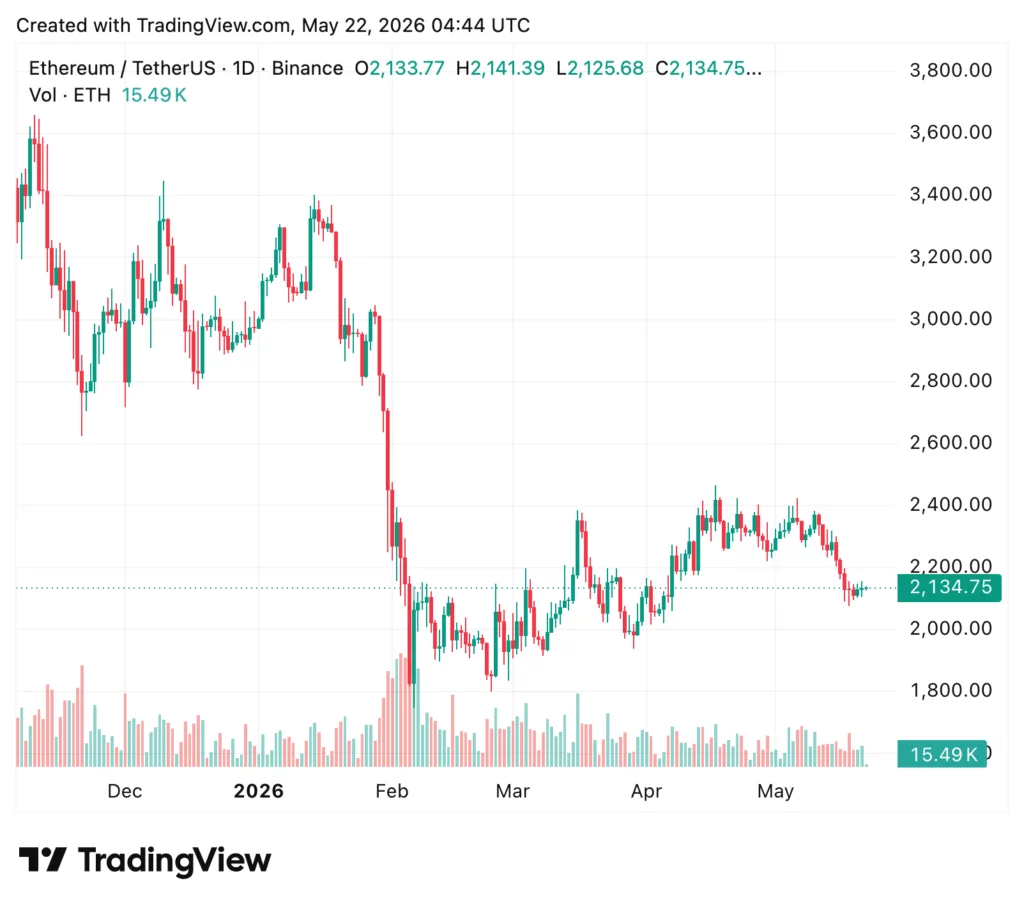
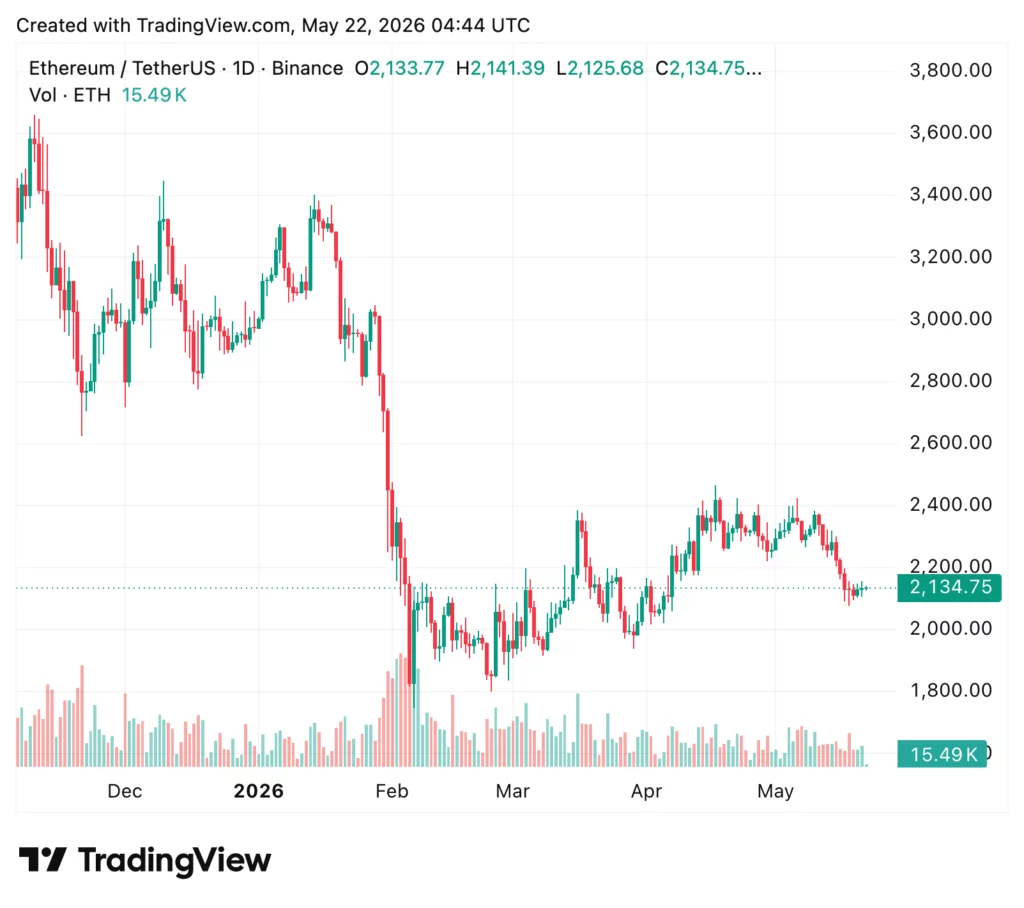
Ethereum has been under pressure since reaching an all-time high near $4,954. According to crypto.news data, Ethereum traded near $2,137 on May 22, leaving the asset down by more than 50% from that peak.
The Ethereum Foundation has also faced debate after several departures and a new mandate. In March, the foundation said Ethereum must remain censorship resistant, open source, private, and secure. Those goals drew support, but some community voices questioned whether the foundation should pay more attention to tokenomics and ETH’s market position.
Laura Shin described the core goals as “great” and “worth fighting for,” but raised doubts about the EF’s stance toward competition. She said the foundation seemed to “sit back on its laurels” while rivals fought for market share.
ETF filing shows wider institutional split
The filing adds another data point to a wider shift in crypto ETF holdings. Some institutions have continued using ETFs for Bitcoin exposure, while others have rotated, reduced risk, or tested altcoin products.
A recent crypto.news report also said JPMorgan warned that Ethereum upgrades may not be enough to lift ETH if network demand and token burns remain weak. For Harvard, the filing only confirms portfolio changes. It does not prove a long-term view on Ethereum, Bitcoin, or crypto ETFs.



The reported attempt to kidnap the wife of The Sandbox co-founder Sébastien Borget has shifted attention to the physical side of crypto security.
Summary
- Neighbors stopped the abduction before attackers fled, with two suspects later arrested in an Uber.
- France has recorded dozens of crypto-linked kidnappings, pushing police toward prevention platforms and tighter protocols.
- Security experts urge privacy, family awareness, multi-signature wallets, and stronger physical safeguards against wrench attacks.
The attack took place on May 20 at Borget’s home in Seine-et-Marne, France, according to Le Journal du Dimanche. The report said one suspect arrived dressed as a delivery worker before five masked accomplices entered the courtyard and tried to force Borget’s wife into a car.
Neighbors heard her cries and intervened. Four suspects fled in a vehicle, while two others escaped on foot and later ordered an Uber. Police from the Meaux Anti-Crime Brigade stopped the ride-hail car soon after. Officers allegedly found a fake handgun, cable ties, and balaclavas.
Crypto motive remains under police review
JDD reported that early evidence suggested the attempted kidnapping “would be linked to cryptocurrencies.” That wording leaves the motive under investigation, and authorities have not said the case is closed.
Borget’s wife was not injured, according to the report. Two suspects were taken into custody, while four others remained wanted.
Related coverage noted that French police had recorded 41 crypto-linked abductions since Jan. 1, making France a key center of the latest wrench-attack wave.
France moves from warnings to prevention
The case came as France prepared new measures against crypto kidnappings. An earlier market update said Interior Ministry representative Jean-Didier Berger had announced a prevention platform for digital asset holders and was working with Interior Minister Laurent Nuñez on a wider plan.
French authorities have also pursued suspects more aggressively. Prosecutors had charged at least 88 people over alleged wrench attacks by late April, including ten minors. Authorities also warned crypto holders and their relatives to reduce online exposure, which can help criminals identify targets.
Wrench attacks are becoming global
The problem is not limited to France. TRM Labs said recent wrench attacks have appeared in the United States, Canada, the United Kingdom, and other markets. The firm said attackers often target crypto executives, traders, and family members because crypto transfers can be fast, hard to reverse, and tied to public wealth signals.
Security firms now advise crypto holders to treat privacy as part of custody. TRM Labs recommends limiting public disclosure of holdings, improving home and travel security, using multi-signature wallets, and educating family members.
Jameson Lopp’s public list of physical Bitcoin and crypto attacks also includes the May 20 Borget case and says the tracker is not complete because many attacks go unreported.

Around 20,500 Bitcoin options contracts will expire on Friday, May 22, with a notional value of roughly $1.5 billion. This event is smaller than usual, so it is unlikely to have any impact on spot markets.
Crypto markets have been in decline all week, with around $50 billion leaving the space as Bitcoin continues to weaken. Positive news appears to have zero impact as investors remain under macroeconomic rain clouds.
Bitcoin Options Expiry
This week’s batch of Bitcoin options contracts has a put/call ratio of 0.69, meaning that there are more sellers of longs than shorts. Max pain is around $79,000, according to Coinglass, which is a little higher than current spot prices, so some could be out of the money on expiry.
Open interest (OI), or the value or number of Bitcoin options contracts yet to expire, remains highest at the $80,000 strike price on Deribit, with $1.65 billion, but short sellers still have $1.2 billion in OI at $60,000. Total BTC options OI across all exchanges has been steadily climbing this month and is at $37.6 billion, according to Coinglass.
Options Expiry Alert.
At 08:00 UTC tomorrow, over $1.8B in crypto options are set to expire on Deribit.bitcoin:native : $1.53B notional | Put/Call: 0.69 | Max Pain: $79,000
ethereum:native : $264M notional | Put/Call: 1.03 | Max Pain: $2,200BTC traders continue targeting… pic.twitter.com/fv5dDrPx6M
— Deribit (@DeribitOfficial) May 21, 2026
Traders have been using the recent rebound to establish defensive positions for the final ten days of the month, said crypto derivatives provider Greeks Live this week.
“Overall, the market is positioning itself to defend against price pullbacks but does not anticipate a market collapse.”
It added that May and June have long been viewed as unfavorable trading months, and in May, major investors have been “steadily increasing their defensive positions: buying effective protection, selling margin calls at the tail end, and controlling costs.”
In addition to today’s batch of Bitcoin options, around 123,000 Ethereum contracts are also expiring, with a notional value of $263 million, max pain at $2,200, and a put/call ratio of 1. Total ETH options OI across all exchanges is around $6.9 billion.
“ETH positioning has shifted from strongly call-biased last week to nearly balanced, suggesting conviction has cooled as traders await fresh catalysts,” said Deribit.
Spot Market Outlook
Crypto markets have retreated again today, with total capitalization dropping to $2.67 trillion. Bitcoin failed to break above $78,000 and fell back to an intraday low of $76,750 before a minor recovery on Friday morning. It appears to have resumed its downtrend, which is dragging the rest of the market down with it.
Ether and the rest of the altcoins have been mostly flat over the past 24 hours, with very little activity after a largely bearish week.
The post Crypto Traders Brace for $1.5B Bitcoin Options Expiry Today appeared first on CryptoPotato.


Disclosure: This article does not represent investment advice. The content and materials featured on this page are for educational purposes only.
AI day trading bots are reshaping stock trading in 2026 with faster signals, automation, and real-time analysis.
Summary
- BulkQuant joins leading AI day trading bot platforms as traders seek faster stock analysis tools in 2026.
- AI-assisted stock trading platforms like BulkQuant aim to simplify intraday market monitoring and execution.
- BulkQuant targets beginner traders with AI-driven stock monitoring and strategy execution support tools.
Stock day trading in 2026 is becoming more data-driven, faster, and more difficult to manage manually. Intraday price movements can be influenced by earnings updates, inflation reports, Federal Reserve expectations, AI-sector momentum, ETF flows, analyst ratings, and sudden changes in market liquidity. For traders watching multiple tickers, the challenge is not only finding opportunities, but also reacting with discipline when markets move quickly.
This is one reason AI-assisted trading tools are attracting more attention. Some platforms help traders scan stocks in real time. Others focus on technical alerts, strategy testing, broker execution, or custom algorithm development. These tools are often described as AI day trading bots, but their functions can vary widely.
A useful day trading bot does not simply promise speed. It should help traders build a clearer workflow: monitoring stocks, filtering signals, testing rules, managing alerts, and supporting execution decisions. At the same time, traders should remember that AI tools do not remove market risk. Intraday trading can lead to losses, especially when strategies are poorly tested or used during volatile conditions.
This guide looks at eight AI day trading bot platforms for stocks in 2026, including BulkQuant, Trade Ideas, TrendSpider, StockHero, Tickeron, SignalStack, Alpaca, and QuantConnect. The goal is not to declare one platform as suitable for everyone, but to compare how each tool may fit different trading styles.
Quick comparison: AI day trading bot platforms for stocks in 2026
| Platform | Primary Use Case | Automation Focus | Suitable For |
| BulkQuant | AI-assisted trading workflow | Market monitoring and strategy execution support | Beginners and users exploring simplified automation |
| Trade Ideas | Real-time stock scanning | AI-driven intraday alerts and trade ideas | Active day traders |
| TrendSpider | Technical analysis automation | Chart alerts, strategy triggers, and webhook workflows | Technical traders |
| StockHero | No-code stock bot building | Bot setup, paper testing, and broker-connected workflows | Traders who prefer no-code tools |
| Tickeron | AI stock signals and pattern recognition | AI robots, forecasts, and signal discovery | Signal-based traders |
| SignalStack | Alert-to-order workflow | Connecting alerts to broker orders | Traders with existing signal systems |
| Alpaca | Trading API infrastructure | Custom execution and market data access | Developers and algo traders |
| QuantConnect | Algorithmic research and testing | Backtesting, research, and live strategy deployment | Advanced traders and quants |
1. BulkQuant — AI-assisted trading workflow and strategy execution support
BulkQuant is included in this list for traders who want to explore AI-assisted market monitoring and simplified trading workflow support. Instead of focusing only on stock alerts or chart signals, BulkQuant presents itself as a platform that helps users access AI-driven strategy tools across different markets, including stocks, crypto, and forex.
For stock day traders, the appeal of a platform like BulkQuant is its attempt to reduce some of the repetitive work involved in monitoring market conditions. Intraday trading often requires traders to follow price movement, react to changing volatility, control position exposure, and avoid emotional decision-making. A system that organizes these steps into a more structured workflow may be useful for users who do not want to build everything manually.
BulkQuant may be especially relevant for users who are new to AI-assisted trading tools and want a simpler entry point. Rather than requiring users to code strategies or configure complex technical indicators from the beginning, the platform focuses on accessibility, market monitoring, and strategy execution support.
That said, traders should still review the platform carefully before using real capital. Important details include risk controls, account terms, supported markets, cost structure, withdrawal rules, and how the platform handles strategy execution. Trial access or promotional credits can help users explore the interface, but they should not be interpreted as proof of future performance.
Where BulkQuant may fit
BulkQuant may suit traders who want:
- A more guided AI-assisted trading workflow
- Exposure to stock trading automation tools
- Market monitoring support
- Strategy execution features
- A beginner-friendly interface
- Access to multiple asset classes from one platform
BulkQuant is not necessarily the right choice for traders who want full control over every line of strategy logic. Developers or highly technical traders may prefer platforms such as Alpaca or QuantConnect. But for users who want a more accessible way to explore trading automation, BulkQuant is one of the platforms worth reviewing.
New users can register and receive rewards
2. Trade Ideas — real-time AI stock scanning for active traders
Trade Ideas is widely known among active stock traders for real-time market scanning and AI-assisted trade discovery. It is not designed as a simple one-click trading tool. Instead, it helps traders identify stocks that may be moving, forming setups, or matching certain intraday conditions.
For day traders, scanning speed is important. During the first hour of the trading session, hundreds of stocks may show unusual volume, price gaps, momentum changes, or breakout attempts. Manually watching every ticker is unrealistic. Trade Ideas helps users filter the market more efficiently and focus on stocks that meet specific conditions.
Its AI assistant, Holly, is often discussed as one of the platform’s better-known features. The tool can generate trade ideas and signal-based suggestions, but users still need to evaluate whether those ideas match their own strategy, risk tolerance, and trading plan.
Where Trade Ideas may fit
Trade Ideas may be useful for traders who want:
- Real-time stock scanning
- Intraday trade alerts
- AI-generated stock ideas
- Entry and exit signal references
- A research-heavy workflow for active trading
Compared with BulkQuant, Trade Ideas generally requires more active decision-making from the trader. It may be better suited to users who already understand day trading setups and want a faster way to discover opportunities.
The platform may feel overwhelming for beginners because it is built around active market participation. Traders need to know how to interpret alerts, manage risk, and decide whether a signal is worth acting on.
3. TrendSpider — Technical analysis automation and strategy alerts
TrendSpider focuses on technical analysis automation. It is useful for traders who rely on chart patterns, trendlines, indicators, price levels, and multi-timeframe conditions.
Instead of manually drawing levels or constantly checking whether a stock has reached a technical setup, traders can use TrendSpider to automate parts of the chart-monitoring process. This can be especially helpful in day trading, where timing matters, and conditions can change quickly.
TrendSpider also supports alert-based workflows. Traders can create alerts based on technical criteria, and those alerts may be connected to other execution tools through webhooks. This makes the platform useful for traders who already have a defined strategy and want to reduce manual chart watching.
Where TrendSpider may fit
TrendSpider may suit traders who want:
- Automated technical analysis
- Chart-based alerts
- Multi-factor trade conditions
- Strategy testing features
- Webhook-supported workflows
- A structured approach to technical setups
TrendSpider is not necessarily a beginner-first platform. It is most useful when the trader already understands technical analysis and knows which conditions they want to monitor. Automating a weak or unclear strategy will not improve the strategy itself.
For traders who are comfortable with charts and want more automation around technical signals, TrendSpider can be a practical part of an intraday trading workflow.
4. StockHero — No-code bot building for stock traders
StockHero is designed for traders who want to create stock trading bots without writing code. This makes it different from developer-first platforms such as Alpaca or QuantConnect.
For users who have a basic trading idea but do not want to build a system from scratch, StockHero provides a more visual way to create and test bot logic. Traders can set up strategies, connect supported brokers, and test ideas through paper trading before considering live use.
Paper trading is particularly important for day trading. A strategy that looks promising in theory may behave differently in live conditions because of spreads, slippage, delayed reactions, or sudden price reversals. Testing a bot in a simulated environment can help users understand how the rules behave before exposing real capital.
Where StockHero may fit
StockHero may be useful for traders who want:
- No-code bot creation
- Paper trading and strategy testing
- Broker-connected trading workflows
- A more visual way to build automated stock strategies
- A middle ground between manual trading and coding
StockHero still requires user judgment. Traders need to define strategy rules, review bot behavior, and understand when a setup may not be suitable for live trading. The platform can reduce technical barriers, but it does not remove the need for risk management.
5. Tickeron — AI stock signals and pattern recognition
Tickeron focuses on AI-generated stock signals, pattern recognition, trading robots, forecasts, and market idea discovery. It may appeal to traders who want AI-assisted research rather than a complete trading workflow.
For day traders, signal discovery can be useful because it helps narrow down the market. Instead of manually searching through many stocks, traders can review AI-generated signals and pattern-based ideas. This may help users find potential setups faster, especially during active trading sessions.
However, signal-based platforms should be used carefully. A signal is not the same as a trading plan. Traders still need to consider entry timing, position size, stop-loss levels, broader market conditions, and whether the trade fits their strategy.
Where Tickeron may fit
Tickeron may suit traders who want:
- AI-generated stock signals
- Pattern recognition tools
- Forecast-style market ideas
- Trading robot categories
- Decision support for stock research
Tickeron may be less suitable for users who want simplified execution support or a more guided trading workflow. It is better understood as an AI-assisted research and signal platform.
For traders who like to compare multiple signals and use them as part of a broader decision process, Tickeron may be worth reviewing.
6. SignalStack — Alert-to-order automation for existing trading systems
SignalStack is different from most other platforms in this list. It is not mainly an AI stock picker or charting platform. Instead, it helps traders connect alerts from other platforms to live broker orders.
This can be useful for traders who already have a signal source. For example, a trader may use TradingView, TrendSpider, or another alert system to identify a setup. SignalStack can help convert that alert into an order workflow, reducing the delay between signal and execution.
For day trading, this matters because timing can affect results. If a trader receives an alert but takes several minutes to place an order manually, the setup may change. An alert-to-order tool can help create a more consistent execution process.
Where SignalStack may fit
SignalStack may suit traders who want:
- Alert-to-order automation
- Broker-connected execution workflows
- No-code order routing from alerts
- Faster response to existing trading signals
- A bridge between chart alerts and trade execution
SignalStack should not be confused with a complete AI trading bot. It does not replace strategy development or signal generation. Traders still need a reliable source of trade logic, clear risk parameters, and a plan for monitoring execution.
It may be most useful for traders who already have a working alert system and want to reduce manual steps in the execution process.
7. Alpaca — API infrastructure for custom stock trading bots
Alpaca is a developer-focused trading API platform. It is not a ready-made AI day trading bot for beginners, but it can be used as infrastructure for building custom trading systems.
Developers and algorithmic traders may use Alpaca to connect strategy logic, market data, and order execution. This gives users more flexibility than many no-code tools, but it also requires more technical skill.
For AI-assisted stock trading, Alpaca can serve as the execution layer. A trader or developer may build a machine learning model, signal engine, or rule-based intraday strategy, then connect it to Alpaca for order placement.
Where Alpaca may fit
Alpaca may suit users who want:
- Trading API access
- Custom bot development
- Market data integration
- Paper trading environments
- Developer control over strategy logic
- Broker execution infrastructure
Alpaca is not ideal for traders who want a simple interface and guided setup. Users need to handle coding, testing, error management, order logic, risk controls, and monitoring.
For developers, however, Alpaca can be a flexible foundation for building AI-assisted or rule-based stock trading systems.
8. QuantConnect — Algorithmic research and strategy testing
QuantConnect is designed for algorithmic trading research, backtesting, and live strategy deployment. It is one of the more advanced platforms in this list and is generally better suited to users with coding or quantitative trading experience.
For day traders, QuantConnect can be useful because it allows users to test intraday strategies before using them in live markets. Traders can research momentum systems, mean reversion strategies, opening range breakouts, volatility filters, or other systematic approaches.
The platform gives users significant control, but that control comes with complexity. A trader needs to understand data quality, strategy assumptions, backtesting limitations, execution behavior, and live trading risks.
Where QuantConnect may fit
QuantConnect may suit users who want:
- Algorithmic strategy research
- Historical backtesting
- Custom trading models
- Live strategy deployment
- Multi-asset strategy development
- A more technical quant environment
QuantConnect is not the easiest choice for beginners. It may be more appropriate for traders who already understand coding, data analysis, and systematic strategy design.
For advanced users, however, it can be a powerful environment for testing and refining stock day trading systems.
How to choose an AI day trading bot for stocks
Choosing an AI day trading bot should depend on a trading style, technical ability, and risk tolerance.
A beginner may prefer a platform with simpler onboarding, clearer workflow support, and fewer technical barriers. In that case, BulkQuant or StockHero may be easier to review than developer-heavy platforms.
An active trader who already understands intraday setups may prefer Trade Ideas for scanning or TrendSpider for technical alerts.
A trader who already has alerts but wants faster execution may consider SignalStack.
A developer or quant trader may be more interested in Alpaca or QuantConnect because these platforms offer more control over strategy logic and execution design.
The key is to avoid choosing a platform only because it uses the word “AI.” Traders should ask practical questions:
- Does the platform provide signals, execution, or both?
- Can strategies be tested before live use?
- Are risk controls clearly explained?
- Does the platform support the trader’s broker or preferred workflow?
- Is the user expected to build the strategy manually?
- Are fees, limitations, and order behavior transparent?
- Does the platform match the trader’s experience level?
A good tool should support a trading process, not replace basic judgment.
What makes a useful AI day trading bot in 2026?
A useful AI day trading bot should help traders manage speed, structure, and risk. In fast markets, the value of automation is not just about placing trades quickly. It is about creating a repeatable workflow.
Important features include:
Real-time market monitoring
Day traders often need to track many stocks at once. AI-assisted scanning tools can help filter the market and highlight stocks that match certain conditions.
Clear signal logic
A trading tool should help users understand why a signal appears. Black-box signals may be difficult to evaluate, especially for beginners.
Testing tools
Paper trading, backtesting, or trial access can help users observe how a strategy behaves before using real funds.
Execution support
Some traders need alerts, while others need order-routing tools. The right choice depends on whether the user wants research support or execution workflow support.
Risk controls
Stop-loss rules, exposure limits, position sizing, and drawdown awareness are important for intraday trading. A platform that ignores risk management may encourage poor trading habits.
Usability
A platform may be powerful but still unsuitable for a beginner. Traders should choose tools that match their knowledge level.
Transparency
Users should understand costs, limitations, supported markets, account rules, and how the platform handles trades or alerts.
Risks of using AI day trading bots
AI day trading tools can support faster analysis and more structured workflows, but they also introduce risks.
False signals
Intraday markets are noisy. A stock may appear to break out and then reverse quickly. AI tools and technical scanners can still misread short-term price action.
Overtrading
Automation can make it easier to take too many trades. Without strict rules, this may increase transaction costs and losses.
Slippage
The price shown when a signal appears may differ from the actual execution price, especially during volatile periods.
Overfitting
A strategy may perform well in historical tests but fail in live trading because market conditions change.
Technical issues
API errors, broker delays, platform outages, or incorrect settings can affect execution.
User misunderstanding
Some traders may rely too heavily on automation without understanding order types, drawdowns, position sizing, or market conditions.
For these reasons, traders should test carefully, start small, review performance regularly, and avoid treating any AI trading bot as a guaranteed solution.
Platform-by-platform summary
| Platform | How Traders May Use It | Key Consideration |
| BulkQuant | Explore AI-assisted market monitoring and strategy execution support | Review risk settings, terms, and platform workflow before live use |
| Trade Ideas | Scan stocks quickly and review AI-generated intraday ideas | Better suited to active traders who can interpret signals |
| TrendSpider | Automate technical analysis and chart-based alerts | Requires understanding of technical setups |
| StockHero | Build and test no-code stock trading bots | Strategy logic still depends on the user |
| Tickeron | Review AI-generated stock signals and pattern ideas | Signals should be evaluated, not followed blindly |
| SignalStack | Connect alerts to broker order workflows | Requires a separate signal source |
| Alpaca | Build custom trading bots through APIs | Requires coding and technical risk management |
| QuantConnect | Research, backtest, and deploy algorithmic strategies | More suitable for advanced users |
FAQs
What are AI day trading bots for stocks?
AI day trading bots for stocks are software tools that may help traders scan markets, generate signals, automate alerts, test strategies, or support order execution. Some tools are beginner-friendly, while others are designed for developers or advanced traders.
Can AI day trading bots remove trading risk?
No. AI tools do not remove market risk. Stock prices can move unpredictably, and automated systems can still produce losses. Traders should use risk controls, test strategies, and avoid relying entirely on any tool.
Is BulkQuant suitable for beginners?
BulkQuant may be worth reviewing for beginners who want a more accessible AI-assisted trading workflow. It focuses on market monitoring, strategy execution support, and simplified access, but users should still review all terms, risks, and platform settings before trading.
Which platform is better for active day traders?
Active day traders may prefer Trade Ideas for real-time stock scanning or TrendSpider for technical analysis automation. The better choice depends on whether the trader relies more on market scanning or chart-based setups.
Which platform is better for developers?
Developers may prefer Alpaca or QuantConnect. Alpaca provides API infrastructure for building custom trading systems, while QuantConnect offers a more advanced environment for backtesting and algorithmic strategy research.
Are no-code trading bots useful?
No-code trading bots can be useful for traders who want to test rule-based strategies without programming. However, users still need to understand trading logic, risk controls, and market behavior.
Final thoughts
AI day trading bots are becoming part of the modern stock trading workflow, but they are not all built for the same type of user. Some platforms help traders find intraday ideas. Some automate chart alerts. Some support order execution. Others provide infrastructure for custom algorithmic systems.
BulkQuant may be considered by users who want a more accessible AI-assisted trading workflow with market monitoring and strategy execution support. Trade Ideas and TrendSpider may appeal to more active traders who prefer scanning and technical analysis. StockHero may fit users who want no-code bot creation, while Tickeron focuses more on AI-generated signals. SignalStack, Alpaca, and QuantConnect are more specialized tools for execution workflows, API-based systems, and advanced algorithmic research.
The right platform depends on the trader’s experience level, preferred workflow, technical ability, and risk tolerance. In 2026, the more practical approach is not to look for a tool that claims to do everything, but to choose one that supports a clear, disciplined, and testable trading process.
Disclosure: This content is provided by a third party. Neither crypto.news nor the author of this article endorses any product mentioned on this page. Users should conduct their own research before taking any action related to the company.


U.S. lawmakers have introduced ARMA, a new bill that seeks to create a Treasury-run Strategic Bitcoin Reserve with a 20-year holding rule.
Summary
- ARMA would create a Treasury-run Bitcoin reserve and separate stockpile for other federal digital assets.
- The bill would keep federal Bitcoin locked for 20 years, unless sold to reduce debt.
- Lawmakers also want quarterly audits, proof-of-reserve reports, and reviews of budget-neutral Bitcoin acquisition methods ahead.
Rep. Nick Begich introduced the American Reserve Modernization Act of 2026 alongside co-lead Rep. Jared Golden. Begich’s office said the bill would create a Strategic Bitcoin Reserve within the U.S. Treasury and a separate Digital Asset Stockpile for non-Bitcoin assets held by the federal government.
The bill builds on the Strategic Bitcoin Reserve framework created by executive order in March 2025. That order directed Treasury officials to manage government Bitcoin obtained through forfeiture and other lawful proceedings, while also creating a stockpile for other seized digital assets.
Bitcoin holdings face 20-year lock
ARMA would require Bitcoin held in the reserve to remain there for at least 20 years. Begich’s office said the bill also protects the right of Americans to own, transfer, and self-custody digital assets.
The proposal also calls for quarterly proof-of-reserve reports, third-party audits, congressional oversight, and a full accounting of federal digital asset holdings. It directs a study into budget-neutral acquisition methods that would avoid higher taxes, deficit spending, or new national debt.
Lawmakers cite need for federal policy
Golden said the U.S. already holds Bitcoin but lacks a clear policy for managing it. He said “digital currencies are not the fringe phenomenon they once were,” adding that Congress had not set federal rules for what the government should do with those assets.
Begich said ARMA would protect taxpayer interests, support financial sovereignty, and extend private property rights into the digital space. Other supporters framed the bill as a way to stop the government from selling strategic digital assets without a long-term plan.
Bill follows White House reserve push
The bill arrives after renewed White House attention on the reserve. Recent crypto.news coverage noted that Patrick Witt, from the President’s Council of Advisors for Digital Assets, said officials were working through the legal structure needed to manage government-held Bitcoin.
Fox Business reported that Begich wants the U.S. to hold about 1 million Bitcoin, equal to roughly 5% of Bitcoin’s fixed supply. The proposal builds on earlier BITCOIN Act language for up to 200,000 BTC a year over five years.
For now, ARMA remains a bill, not law. Its next steps depend on committee action, House support, and Senate alignment with broader crypto legislation. The proposal places Bitcoin reserve policy back in Washington’s crypto debate as lawmakers weigh custody, debt, and property-rights rules.
Two of the six men accused of attempting to kidnap the wife of Sébastien Borget, the co-founder of The Sandbox, were arrested after calling an Uber to flee the scene, according to local reports.
One of the attackers, disguised as a delivery driver, allegedly convinced Borget’s wife to open the gate at their home in the Île-de-France region in northern France. Then five masked accomplices rushed into the courtyard and tried to force her into a nearby car, Le Journal du Dimanche reported Thursday.
Neighbors intervened, forcing the attackers to flee. Four escaped in the vehicle, while two others fled on foot and ordered an Uber, which was then intercepted by the Meaux Anti-Crime Brigade, according to Le Journal du Dimanche. The two suspects were allegedly found with a replica handgun, cable ties and balaclavas.
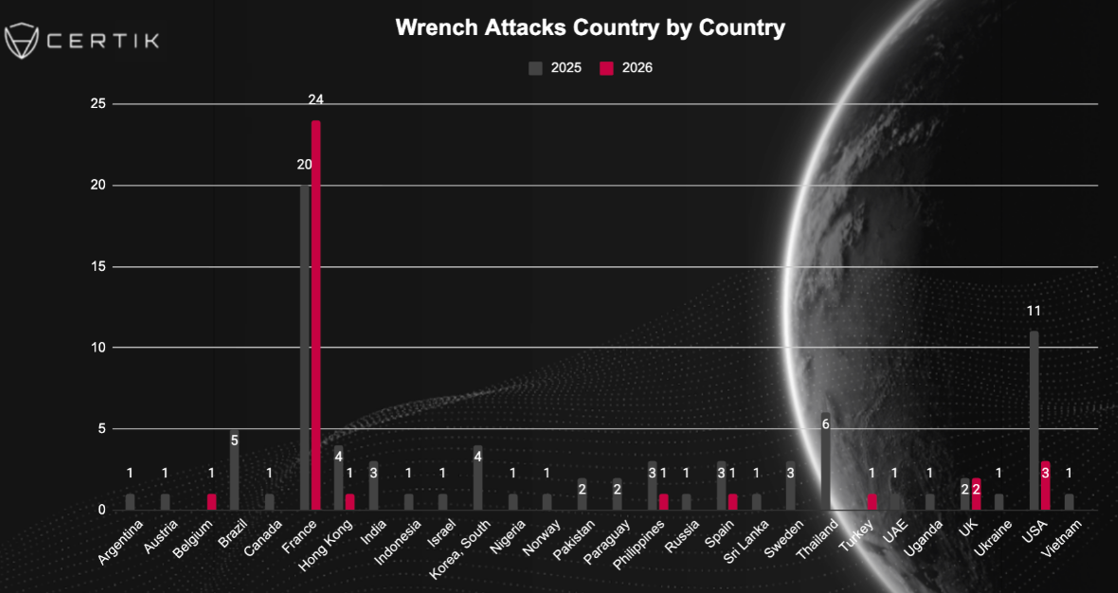
Preliminary police investigations have linked the attack to crypto. It comes amid a rise in crypto wrench attacks since 2025, with Web3 security company CertiK flagging Europe as a hotspot in a report earlier this month, with most attacks occurring in France.
CertiK added that most of these attacks are carried out by “complete amateurs” recruited through messaging apps like Telegram or Snapchat, with orchestrators located outside the country.
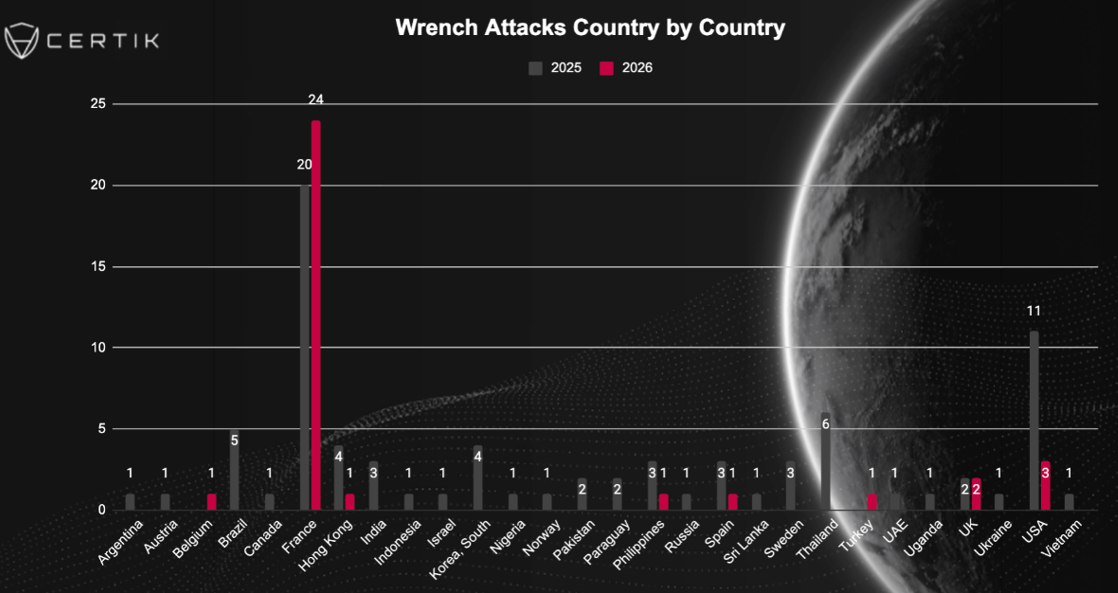
Countries across Europe, particularly France, have recorded a large number of wrench attacks this year. Source: CertiK
Four suspects still on the run
Borget’s wife was reportedly uninjured, and the four other members of the group are still on the run.
Blockchain intelligence company TRM Labs reported in May last year that wrench attacks have been on the rise because of the perceived pseudonymity of crypto transactions, the public visibility of wealth, and the ease with which bad actors can gather personal data online.
Related: Law enforcement freezes $41M connected to $150M crypto Ponzi collapse
The firm also said it is becoming common for bad actors to target family members of crypto holders. Last May, four men tried to abduct the daughter and grandchild of French exchange executive Pierre Noizat in Paris. In the same month, French police rescued the kidnapped father of a crypto entrepreneur who was being held for ransom.
Casa chief security officer Jameson Lopp has recorded 38 crypto-wrench attacks so far this year, according to his list of incidents dating back to 2014.
Magazine: Bitcoin ETFs bleed $1B, Aave’s $71M ETH unfreeze bid delayed: Hodler’s Digest, May 10 – 16
Crypto World
California Governor Acts on AI Workforce Disruption as Silicon Valley Sheds 114,000 Jobs


California Governor Gavin Newsom signed a “first-in-the-nation executive order” on Thursday to tackle artificial intelligence (AI) workforce disruption.
The order directs California to prepare workers, small businesses, and communities for economic impact from AI.
What the California Governor’s Order Covers
The order convenes a broad group of universities, economists, labor specialists, state agencies, and industry executives. They will draft new policies and track signals of where AI is cutting jobs.
The goal is to help California workers, not just tech firms, share in AI’s productivity gains. The policy menu includes new severance rules, employment insurance, and transition payments for displaced workers.
Other ideas under study include worker-owned company structures, universal basic capital programs, and broader job training. The order also seeks better hiring and payroll data so the state can spot layoff trends sooner.
“California has never sat back and watched as the future happened to us… Today is just the first step as we rewrite policy and direction, creating a future of work that works for all,” Newsom said.
Follow us on X to get the latest news as it happens
The Employment Development Department (EDD) will build a public dashboard tracking AI impact by sector. The Labor and Workforce Development Agency must recommend updates to the California Worker Adjustment and Retraining Notification (WARN) Act within 180 days.
The order also creates an AI playbook for job training and a single online portal for exploring government services.
Why California Is Acting Now
The action arrives as tech layoffs accelerate across Silicon Valley. Layoffs.fyi has tracked more than 114,000 job cuts at 150 tech companies in 2026.
ClickUp slashed 22% of its staff on Thursday. CEO Zeb Evans tied the cuts to his vision of a “100x organization.” Intuit announced 3,000 layoffs the same week.
Meta cut 8,000 jobs this week. Standard Chartered also plans to slash more than 15% of corporate function roles by 2030.
California, home to 33 of the world’s top 50 private AI companies, sits at the center of the disruption.
Subscribe to our YouTube channel to watch leaders and journalists provide expert insights
The post California Governor Acts on AI Workforce Disruption as Silicon Valley Sheds 114,000 Jobs appeared first on BeInCrypto.

The former chief risk officer of Silvergate Bank has publicized her 2024 settlement with the U.S. Securities and Exchange Commission, noting that the decision to settle came as a strategic choice to avoid a protracted court battle. The SEC accused the bank’s crypto-compliance framework of failing to adequately address anti-money-laundering concerns and the monitoring of crypto customers. Fraher’s settlement included a civil penalty and a multi-year corporate governance ban, reflecting the regulatory severity faced by a crypto-friendly lender in the aftermath of the industry’s upheavals.
In her first public remarks since the agreement, Fraher asserted that no regulator demonstrated that Silvergate’s AML controls had failed and that she chose settlement to “move forward.” The disclosure follows the SEC’s decision earlier this week to rescind a longstanding gag provision that had limited comment from certain enforcement actions participants, enabling Fraher to speak more openly about the matter.
The settlement counted a civil penalty of $250,000 and a five-year ban from serving as an officer or director of a public company. Fraher’s account also highlighted her personal experience with enforcement pressure, describing how she, like others in the industry, faced actions such as de-banking and abrupt termination of credit lines—tactics she characterized as aggressive maneuvers aimed at compelling compliance.
Fraher’s comments provide rare public perspective on Silvergate’s wind-down, a process that culminated in voluntary closure of a bank seen as crypto-friendly in the wake of the FTX collapse. Her account follows the SEC’s relaxation of the gag rule on the same week, a move that regulatory observers said could broaden the scope of post-enforcement dialogue.
Source: Kate Fraher
Fraher has framed the wind-down as a strategic response to a broader regulatory environment, rather than a consequence of a liquidity crisis triggered by market stress. While the bank experienced a deposit outflow reported around 70%, she insisted the decision to wind down was driven by the escalating administrative and regulatory climate that, in her view, rendered operating a crypto-adjacent business untenable.
Among industry commentators, the case has been associated with the hypothesis of intensified, regime-wide pressure on crypto banking, sometimes dubbed by observers as “Operation Chokepoint 2.0”—a label describing the alleged tightening of access to traditional banking services for digital-asset enterprises. The phenomenon was not unique to Silvergate; other crypto-friendly institutions faced difficulties in 2023 as the FTX turmoil rippled through the sector. Signature Bank and Silicon Valley Bank both dissolved in the first months of 2023, with contemporaneous pressure on lending platforms and related crypto services contributing to liquidity challenges across the ecosystem.
Fraher’s recounting of Silvergate’s experience contrasts with the narrative that the bank’s decline stemmed solely from a run on deposits tied to broader market volatility. She argued that the FTX collapse, while a factor, did not single-handedly precipitate the wind-down; rather, the broader policy and regulatory constraints surrounding the digital asset industry rendered continued operation impractical for the institution. By early 2023, she said, the company had restructured with adequate capital levels and a leaner workforce to sustain operations, suggesting a path toward resilience under a different regulatory regime.
Key takeaways
- Fraher’s SEC settlement in 2024 included a $250,000 civil penalty and a five-year ban from serving as a company officer or director, with claims focusing on AML-mitigation disclosure rather than a proven AML-control failure.
- Fraher asserts the decision to settle was a strategic move to avoid a lengthy court battle, not an admission of AML misconduct; she emphasizes the personal and professional toll of enforcement actions.
- The wind-down of Silvergate is framed by Fraher as a consequence of heightened regulatory pressure on the digital asset sector, rather than solely market-driven liquidity events; industry observers have linked this climate to broader enforcement and regulatory tightening.
- The relaxation of the enforcement gag rule, now publicly commentable, shifts the dynamic of post-settlement discourse and raises considerations for future regulatory communications and compliance risk management.
Settlement context and regulatory significance
From Fraher’s account, the 2024 agreement with the SEC did not hinge on a demonstrable failure of AML programs, but rather on a broader calculus about ongoing litigation risk and corporate stability. The civil penalty and governance ban underscore the SEC’s willingness to impose penalties and long-term leadership constraints in cases involving alleged investor-misleading disclosures related to compliance controls. For banks and fintech lenders operating in the digital-asset space, the episode signals that regulatory scrutiny is not limited to traditional lending activities but extends to communications about risk and compliance frameworks.
According to Cointelegraph, the episode highlights the evolving intersection of crypto banking, regulatory enforcement, and corporate governance expectations. The case exemplifies how enforcement actions can be shaped by a combination of procedural leverage, settlement incentives, and the perceived necessity of averting protracted litigation that could disrupt ongoing regulatory objectives. For regulators, the emphasis on AML/KYC frameworks and monitoring protocols remains a central policy instrument; for institutional actors and compliance teams, the decision to settle—and the accompanying publicity—can influence risk governance and communications strategy going forward.
Operational dynamics and the broader policy landscape
Silvergate’s wind-down occurred in a period of intense policy scrutiny of crypto-enabled financial services. The deposit outflow cited in public discussions was substantial, yet Fraher contends that the bank’s exit from the market reflects regulatory headwinds as much as liquidity pressures. The broader sequence—FTX’s collapse in November 2022, followed by waves of regulatory actions against other crypto banks—has prompted renewed consideration of licensing, capital adequacy, and the feasibility of crypto-friendly banking models within the United States.
The situation sits at the nexus of several regulatory domains: AML/KYC enforcement, corporate governance standards for financial institutions, and the evolving oversight framework for crypto assets. While the EU moves to unify and codify crypto regulation under MiCA, U.S. authorities continue to pursue a more segmented, enforcement-forward approach that intertwines securities law, banking regulations, and consumer protection. The contrasting regulatory tracks underscore differing global policy trajectories and operational implications for crypto firms seeking cross-border activity, licensing, or banking access.
Gag rule and constraints on public discourse
Fraher’s remarks advocate for the restoration of open communication in enforcement contexts. She credited the SEC’s shift on the gag rule as essential to enabling a more transparent conversation about the real-world consequences of regulatory actions. The change, described as addressing constitutional concerns by proponents, has particular relevance for compliance teams and legal departments navigating post-settlement disclosures and risk communications. The broader implication is a potential rebalancing of enforcement narratives, influencing how institutions assess and articulate regulatory risk to investors, counterparties, and staff.
Closing perspective
The Silvergate episode, anchored by Fraher’s public comments, highlights the legal, regulatory, and operational fragilities at the intersection of crypto banking and enforcement. As policymakers weighing AML/KYC standards, licensing regimes, and cross-border safeguards continue to shape the landscape, institutions must adapt governance, risk, and communications frameworks to reflect a more litigious and policy-driven environment. The next milestones to watch include further regulatory guidance on crypto banking interfaces, potential updates to enforcement disclosures, and the ongoing dialogue around the balance between enforcement rigor and legitimate market innovation.

A renewed bipartisan push in Washington seeks to codify a strategic Bitcoin reserve, introducing the American Reserve Modernization Act of 2026 (ARMA). The legislation envisions creating a Strategic Bitcoin Reserve and a Digital Asset Stockpile for other federally held cryptocurrencies, with the assets managed by the U.S. Treasury. Sponsor Rep. Nick Begich and 16 co-sponsors say ARMA would target the accumulation of roughly 1 million Bitcoin over five years, using budget-neutral methods.
ARMA builds on the BITCOIN Act, first introduced in July 2024 and updated in March 2025. In a Sunday interview, Patrick Witt of the President’s Council of Advisors for Digital Assets described ARMA as “Version 2” of the BITCOIN Act, and noted the White House has spent considerable time examining the legal implications of a Bitcoin reserve.
“It’s a breakthrough as far as getting everything in place, legally sound, properly safeguarding the assets.”
The United States currently holds 328,372 Bitcoin worth more than $25.5 billion — the most of any nation-state — though portions of those holdings have been sold in the past through court-ordered actions. “The US is already one of the largest holders of Bitcoin in the world. But Congress has never set a federal policy on what to do with that asset,” said Rep. Jared Golden, one of the 16 co-sponsors of the bill.
Under ARMA, Bitcoin would be held for a minimum of 20 years unless it is sold to reduce the national debt, which topped $39 trillion on Wednesday. Like the BITCOIN Act, ARMA would acquire up to 1 million Bitcoin over five years through budget-neutral strategies, meaning the program would avoid drawing from taxpayers’ funds. Proponents argue that a formal federal framework could anchor global competitiveness in digital assets and clarify ownership and custody rules for the government’s holdings.
As digital assets continue to rise in importance, lawmakers say a policy like ARMA could help set long-term strategic priorities. Rep. Mike Carey argued that a structured approach could strengthen the United States’ position on the world stage, ensuring the country remains competitive as digital assets expand in scope and significance.
Matt Cole, CEO and chairman of Strive, described ARMA as the “single most important crypto legislation” to emerge from Washington, signaling a potential turning point in how the U.S. treats digital assets at the federal level.
Key takeaways
- ARMA would establish a Strategic Bitcoin Reserve and a Digital Asset Stockpile to be held by the U.S. Treasury.
- The bill targets the acquisition of up to 1 million Bitcoin over five years using budget-neutral methods, without drawing from taxpayer funds.
- Bitcoin would be held for at least 20 years unless sold to reduce the national debt, which stands above $39 trillion.
- ARMA would implement enhanced transparency, including quarterly proof-of-reserve reporting and independent audits of the Bitcoin reserve.
- The legislation has 16 congressional sponsors and follows the earlier BITCOIN Act, signaling a renewed federal policy interest in digital assets.
A refreshed framework for a Bitcoin reserve
The essence of ARMA is to formalize how the government could own, manage, and disclose holdings of Bitcoin and other digital assets. By creating a dedicated reserve and a stockpile, the bill aims to provide a clear governance structure for federal holdings, reducing legal ambiguity and improving asset safeguarding. Proponents argue that a formal policy would help align the United States with evolving financial technologies and could offer a counterweight to geopolitical volatility in digital asset markets.
ARMA’s budget-neutral approach is a recurring theme, intended to avoid direct taxpayer outlays while still enabling the Treasury to amass a significant stake in Bitcoin. The policy design mirrors earlier proposals, such as the BITCOIN Act, but with added emphasis on legal clarity and asset protection. As the debate continues, negotiators will likely weigh how to balance custody responsibilities with the broader goals of national finance and security.
Policy implications and market signals
Considering the U.S. position as the world’s largest public holder of Bitcoin, ARMA could mark a meaningful shift in how the nation engages with digital assets. The current holdings, referenced as the largest among nation-states, have been subject to change through court-ordered actions over time. A formal federal framework could reduce ad hoc actions by courts or agencies and establish a consistent policy for both custody and disposition of assets in pursuit of debt reduction or other fiscal aims.
The bill’s supporters emphasize that codifying a reserve could help the U.S. remain competitive as digital assets mature. Rep. Carey highlighted the strategic importance of digital assets and suggested that such a framework could reinforce America’s long-term economic posture on the global stage. The White House has signaled ongoing consideration of the reserve’s legal architecture, a process Witt described as a necessary step to ensure constitutional and statutory alignment before any deployment of assets.
Transparency, audits, and digital property rights
A notable feature of ARMA is the push for enhanced transparency around the government’s digital asset holdings. Quarterly proof-of-reserve reports, along with independent third-party audits, would be published for the Bitcoin reserve, according to Begich. Beyond visibility, the bill also seeks to protect property rights by affirming that the federal government may not impair individuals’ rights to own or self-custody digital assets. Critics of government-held assets have long debated custody risk and the potential for political influence over the reserve; ARMA’s advocates frame transparency and clear custodial rules as essential for public trust.
The broader policy conversation around ARMA intersects with ongoing developments in the digital asset space, including battles over custody, reserve transparency, and the appropriate role of government in influencing financial markets through ownership of technology-enabled assets. As observers watch the legislative path, questions remain about implementation specifics, budget mechanics, and how the reserve would interact with existing monetary and fiscal authorities in times of stress.
Overall, ARMA signals a sharpening focus on strategic digital assets as a matter of national policy. If it progresses, the bill could redefine not only how the United States thinks about reserves and debt stewardship but also how investors and builders assess the credibility and stability of public-sector involvement in crypto markets.
Readers should watch for committee action and potential amendments that could shape the reserve’s size, governance, and interaction with other federal programs. The debate is far from settled, and the coming months will reveal how far lawmakers are prepared to go in formalizing a national digital-asset framework.
Crypto services company Blockchain.com confidentially filed for a US initial public offering (IPO), becoming the latest digital asset player to pursue a public listing as crypto firms return to equity markets.
The company said it submitted a draft S-1 registration statement to the US Securities and Exchange Commission (SEC) related to a proposed offering of Class A ordinary shares. Pricing and the number of shares have not yet been determined.
According to Thursday’s announcement, the proposed IPO remains subject to market conditions and SEC review. Confidential S-1 filings allow companies to begin the IPO process and receive regulatory feedback before publicly disclosing financial and offering details.
Founded in 2011, Blockchain.com said it has more than 95 million wallets, over 43 million verified users and has processed more than $1.1 trillion in crypto transactions. The company offers consumer trading and wallet services alongside institutional products.
The filing follows several expansion efforts this year, including a deeper push into African markets and the launch of perpetual futures trading through its self-custodial wallet via the Hyperliquid protocol.
Related: SpaceX reveals larger-than-expected Bitcoin holdings in IPO filing
Crypto IPO plans shift with market conditions
Several major crypto companies have explored public listings over the past year, though some plans have shifted alongside changing market conditions.
Crypto trading platform Backpack Exchange said in February that it plans to move toward a potential US IPO, with its forthcoming Backpack token structured to unlock in stages ahead of a public listing. The company said some token holders may eventually be able to exchange staked tokens for company equity.
In January, digital asset custodian Copper was reported to be weighing a potential IPO. However, reports this week suggest the company is now be exploring a sale instead of pursuing a listing.
Kraken, one of the largest private crypto exchanges and a long-rumored IPO candidate, saw its public listing plans fluctuate over the past year. Parent company Payward confidentially filed for a US IPO in November 2025 before reports in March suggested the company had paused its plans amid weaker crypto market conditions.
Kraken co-CEO Arjun Sethi later said in April that the company was still pursuing a public listing, though it was reported in May that the debut could be delayed until 2027 following a round of layoffs at the company.
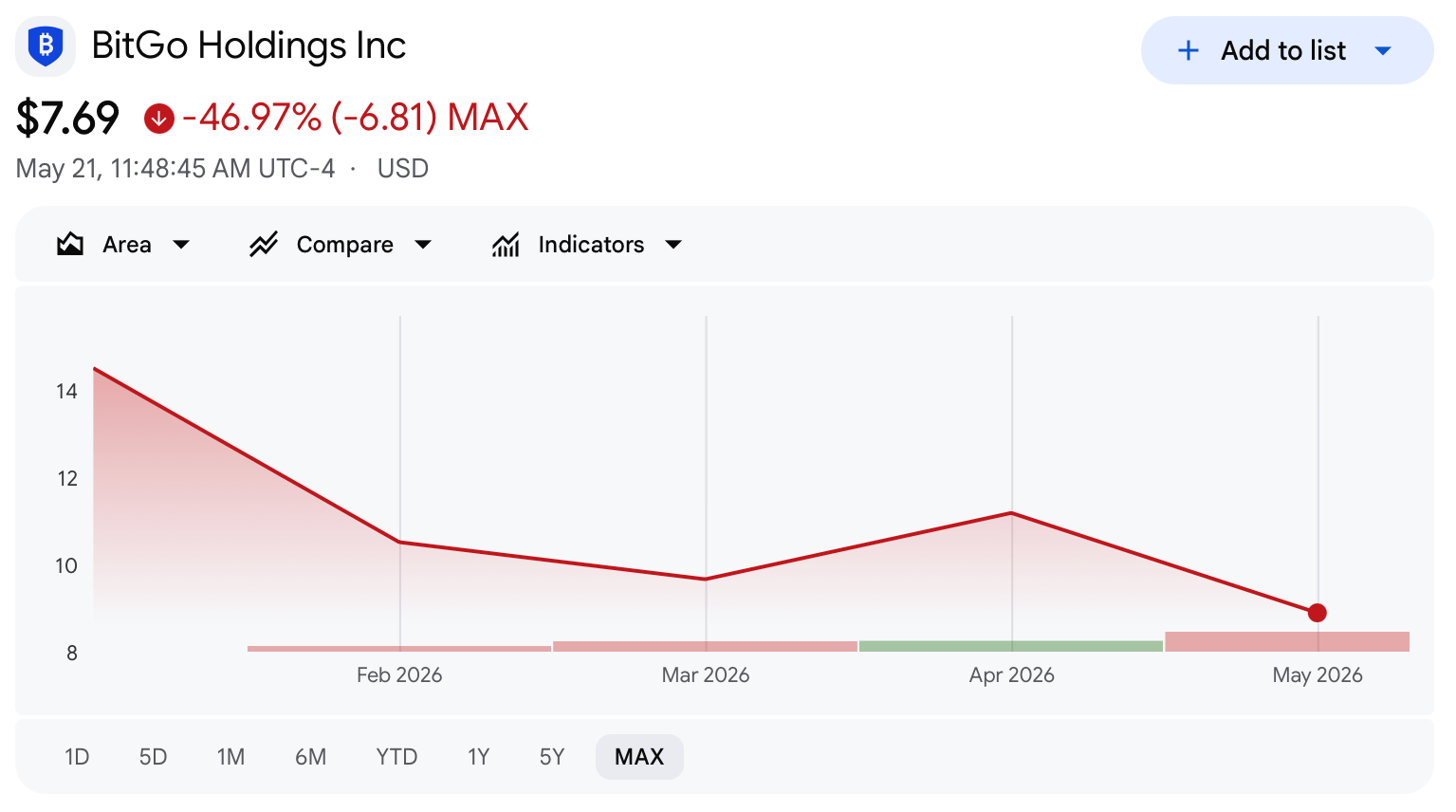
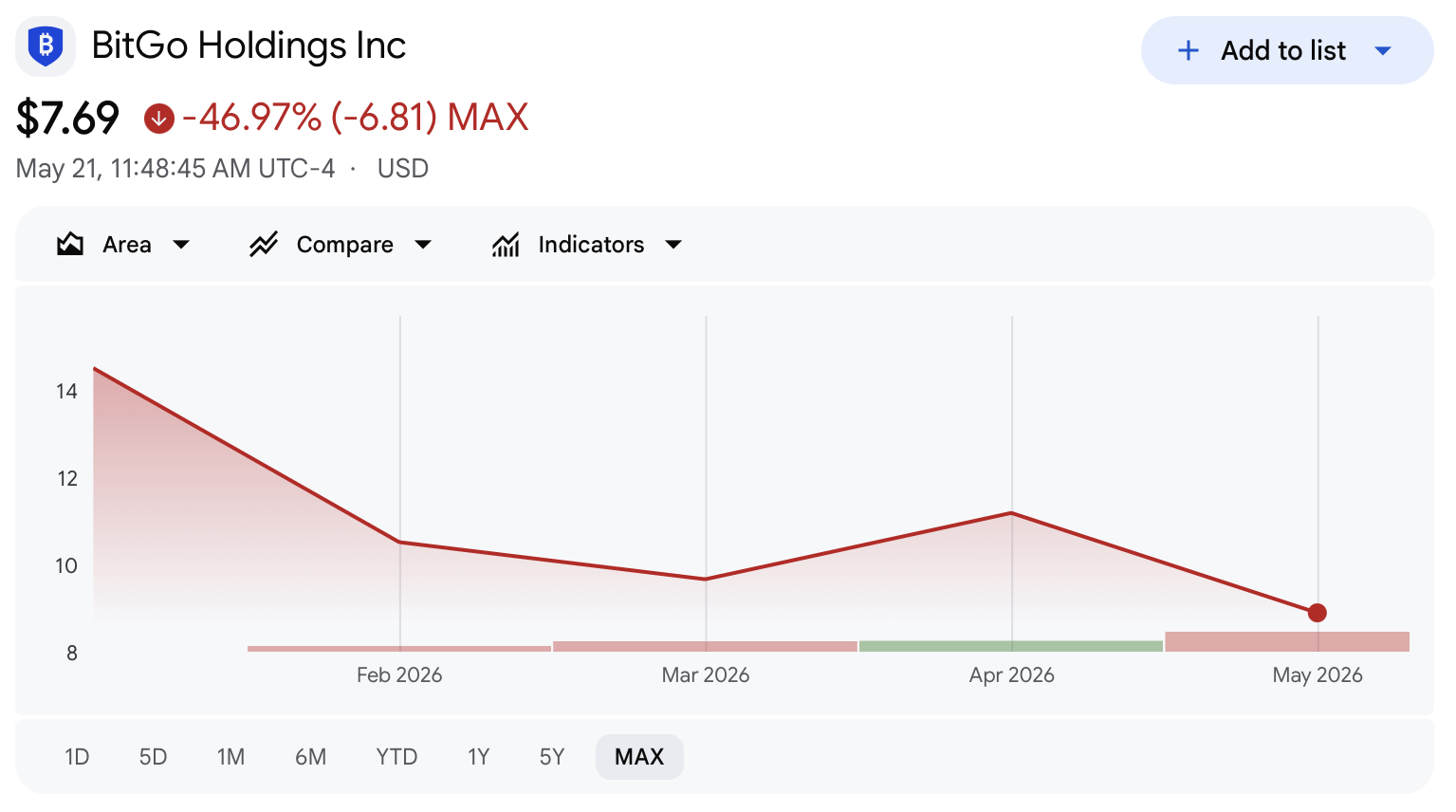
While crypto companies continue to weigh, delay or cancel public listings, BitGo completed one of the largest crypto IPOs of 2026 in January, pricing shares at $18 and raising about $213 million in its NYSE debut at a valuation exceeding $2 billion.
Since launch, the stock has fallen about 57% to around $7.66 per share amid the broader downturn in crypto markets, according to Google Finance data.
Source: Google Finance
Magazine: 5 tech predictions the mainstream media got horribly wrong


Everclear and ZERO Network announced shutdowns this week, marking the latest casualties of accelerating closures in the Decentralized Finance (DeFi) space in 2026.
The announcements come amid a broader market downturn that has pressured crypto companies.
Everclear and ZERO Cite Different Pressures
In a post on X, Everclear said the project was built around a solver model for rebalancing cross-chain funds. The segment never gained enough commercial depth, with users heavily focused on price. Monthly volume reached $500 million, but that activity did not produce sustainable revenue.
Everclear pivoted to a business-to-business-to-consumer (B2B2C) model over the past six months, signing on several major industry partners. The team said it underestimated partner onboarding timelines, and the runway ran out before deals went live.
“If funds remain after all liabilities are settled, we are exploring a buyback of existing tokens — the sum of the buy back’s potential sum might be in the range of $50–200k. We will share full details and mechanics before anything is finalized. The buyback is not certain,” the post read.
Follow us on X to get the latest news as it happens
ZERO Network framed its closure as a strategic refocus by Zerion on its wallet and application programming interface (API). The team stated that bridging into ZERO has been disabled, while bridging out remains open until July 31.
“The vision we set out to build hasn’t changed. How we deliver it is evolving. The team, the talent, and everything we learned from ZERϴ is being channeled into building the best wallet and data API experience in crypto, across every chain,” the team added.
The firms join a growing list of protocols shutting down in 2026. Syndicate Labs wound down on May 21 after five years, citing fundamental shifts in the rollup market.
Fantasy.top also added itself to the list, telling users it would close at the end of June after two years of operations. The closures span from infrastructure layers to consumer-facing apps, signaling broad DeFi consolidation.
Subscribe to our YouTube channel to watch leaders and journalists provide expert insights
The post Everclear and ZERO Network Shutdowns Add to Growing List of 2026 DeFi Closures appeared first on BeInCrypto.

Canadiens’ quick study on Hurricanes leads to dominant Game 1 win

Flipper One Brings Linux Computing Straight Into Your Pocket

Bitcoin Approaches an Important Level


-

 Crypto World6 days ago
BloFin War of Whales 2026 Grand Prix opens registration for $5M trading championship
-

 Fashion6 days ago
Weekend Open Thread: Theory – Corporette.com
-

 Crypto World6 days ago
E-Estate Announces 1 Year Live: Washington DC Summit as Real Estate Tokenization Enters Its Next Phase
-

 Tech6 days ago
Google reimburses Register sources who were victims of API fraud
-

 Business7 days ago
H&R Real Estate Investment Trust (HR.UN:CA) Q1 2026 Earnings Call Transcript
-

 Entertainment7 days ago
David Letterman Returns to Late Show, Blasts Cancellation
-

 Sports6 days ago
Napoleonic enters 2026 Doomben 10,000 field via Abounding withdrawal
-

 Crypto World6 days ago
BeInCrypto 100 Institutional Awards Nomination: KAST for Best Digital Assets Neobank and Best Digital Assets Fintech
-
 Crypto World6 days ago
Bitcoin Battles US Bond Nerves With BTC Price Dip Toward New May Lows
-

 Crypto World6 days ago
ICE and CME urge US regulators to curb Hyperliquid energy trading
-
 Crypto World6 days ago
Wall Street’s Boldest Gold Prediction Has Russians Rushing to Buy
-

 Fashion6 days ago
Trending Western Style Vests Perfect for Summer
-

 Fashion5 days ago
On the Scene at Gucci’s Cruise Show in New York City: Mariah Carey, Kim Kardashian, Lindsay Lohan, Iman, and More!
-
 Crypto World6 days ago
IREN closes $3 billion convertible notes deal amid AI infrastructure expansion
-

 Politics6 days ago
Watch: far-right flag-fanatics run over victim, attack locals – Setup By the Left wing for your entertainment
-

 Fashion7 days ago
Creative Ideas for Custom T-Shirts
-

 Fashion5 days ago
Amazon Sundays: Memorial Day Hosting
-
 Fashion7 days ago
Philip Jones Wedding Jewellery For Women
-

 Crypto World12 hours ago
Blockchain.com files with SEC for U.S. IPO
-

 Crypto World6 days ago
Crypto Market Structure Bill Clears Committee; Senate Vote in Focus
You must be logged in to post a comment Login