






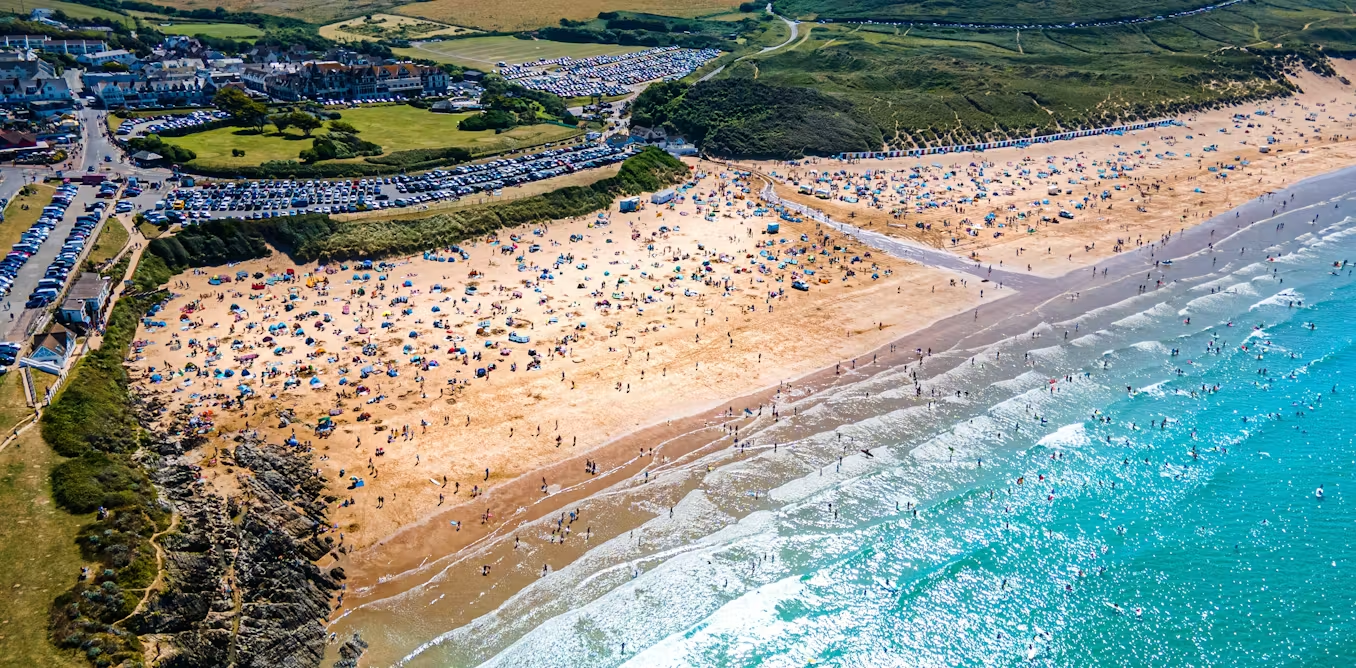
For decades, the British summer holiday has carried one basic assumption: if you want reliable sun, you leave the UK. Spain, Greece, Turkey, Portugal and Italy have offered what Britain could not always guarantee: warmth, blue skies and the feeling of a proper summer break.
But climate change is beginning to alter the financial logic of that decision. This does not mean the UK should celebrate warmer summers. Heat brings serious risks: drought, wildfire, water stress, pressure on health services and damage to infrastructure.
Yet for households facing higher living costs, expensive travel and growing awareness of carbon emissions, the summer holiday is becoming more than a lifestyle choice. It is becoming a household finance decision, a regional economic decision and a climate-risk decision.
The warning signs are now difficult to ignore. The Met Office confirmed that summer 2025 was the UK’s warmest on record, with a mean temperature of 16.10°C between June and August. It is also estimated that a summer as hot or hotter than 2025 is now around 70 times more likely because of human-caused greenhouse gas emissions. This does not mean every British summer will be hot or dry. But it does mean that warm-weather tourism at home is becoming more plausible than it was for previous generations.
The financial scale of outbound tourism is substantial. According to the Office for National Statistics, UK residents made an estimated 94.6 million visits abroad in 2024 and spent about £78.6 billion overseas. Spain alone received an estimated 17.8 million visits from residents of Great Britain in 2024, followed by France and Italy. These figures show how deeply foreign summer travel is embedded in our lifestyles and the wider leisure economy.
DacologyPhoto/Shutterstock
International travel clearly has personal and cultural value. People travel to see family, experience different cultures, rest, celebrate and escape routine. But from a household finance perspective, foreign holidays also involve costs that are often underestimated: flights, luggage charges, airport parking, transfers, travel insurance, exchange-rate costs, mobile roaming, higher peak-season accommodation prices and the financial risk of disruption.
Climate change adds another layer of uncertainty. Heatwaves, wildfires, floods and airport disruption can quickly turn a holiday into a financial loss. A family may budget for flights and hotels, but not for cancelled excursions, delayed returns, medical expenses in extreme heat, or additional accommodation if travel plans are disrupted. Climate risk is therefore no longer only a concern for governments, insurers or infrastructure investors. It is entering ordinary household decisions, including where families spend their summer break.
Sustainable staycations
This is where the UK staycation becomes more important. Staying in Britain is not automatically cheap and it is not automatically sustainable. In popular destinations such as Cornwall, Devon or the Lake District, a peak-season cottage can cost well over £1,000 for a week, depending on location, property size and school-holiday timing. A long car journey is not necessarily low carbon. Popular coastal towns can become overcrowded, placing pressure on housing, water, waste, roads and local services. But a well-planned domestic holiday can reduce several financial and environmental costs at once.
First, it can reduce exposure to volatile travel costs. Families may avoid airfare inflation, exchange-rate uncertainty and some of the expenses linked to overseas travel. They may also have more flexibility to travel outside the most expensive weeks, take shorter breaks, or adjust plans if weather conditions change.
Second, domestic tourism keeps more spending inside the UK economy. Money spent in local guesthouses, restaurants, cafes, farm shops, museums and small attractions circulates through regional economies. This matters especially for coastal and rural areas where seasonal tourism supports employment and small businesses.
VisitBritain’s 2024 domestic overnight tourism data shows that British residents took 106 million overnight trips in Britain, although trip volume fell compared with 2023. Spending, adjusted for inflation, increased by 3% in Britain, partly reflecting higher costs per trip. This is important: domestic tourism has economic value, but affordability is already a constraint.

pio3/Shutterstock
Third, staying closer to home can reduce the carbon cost of leisure. Aviation’s climate impact is not limited to carbon dioxide. Aviation accounts for about 2.5% of human-made global CO₂ emissions, but its climate impact also includes non-CO₂ effects such as contrails and nitrogen oxides. Replacing a short-haul flight with rail, coach, or a shorter domestic journey will not solve climate change, but it can reduce the footprint of a decision made by millions of households every year.
Britain cannot simply wait for warmer summers and call it an opportunity. If domestic tourism grows without planning, it could create new costs: overcrowded beaches, higher local rents, water shortages, waste pressures and congestion. A sustainable staycation economy needs investment in public transport, affordable accommodation, shaded public spaces, water refill points, wildfire awareness, coastal protection and better visitor management.
There is also a fairness issue. If domestic holidays become fashionable but unaffordable, the benefits will be uneven. The goal should not be luxury staycations for wealthier households. It should be a broader model of climate-conscious leisure that allows more families to rest and travel without excessive financial strain or environmental cost.
The message to households should be practical rather than judgemental. A foreign holiday is not wrong. People travel abroad for many good reasons, including family, culture, rest and escape. But the old idea that a summer holiday requires a flight is becoming less convincing. As UK summers become warmer and overseas travel becomes more exposed to climate and cost shocks, staying in Britain may increasingly make financial and environmental sense.
A warmer UK summer is not good news in itself. It is a warning. But it also forces a practical question: if sunshine is becoming more available at home, can Britain build a tourism model that keeps more money in local economies, reduces emissions, and protects households from the rising financial risks of climate change?











































You must be logged in to post a comment Login