Connect with us
DAPA Banner
DAPA Coin
DAPA
COIN PAYMENT ASSET
PRIVACY · BLOCKDAG · HOMOMORPHIC ENCRYPTION · RUST
ElGamal Encrypted MINE DAPA
🚫 GENESIS SOLD OUT
DAPAPAY COMING

NewsBeat

Topshop ‘returning to Oxford Street five years after closing iconic store’

Published

on

Daily Mirror

The retailer shut its Oxford Street site in January 2021 after its parent company Arcadia Group collapsed into administration in November 2020

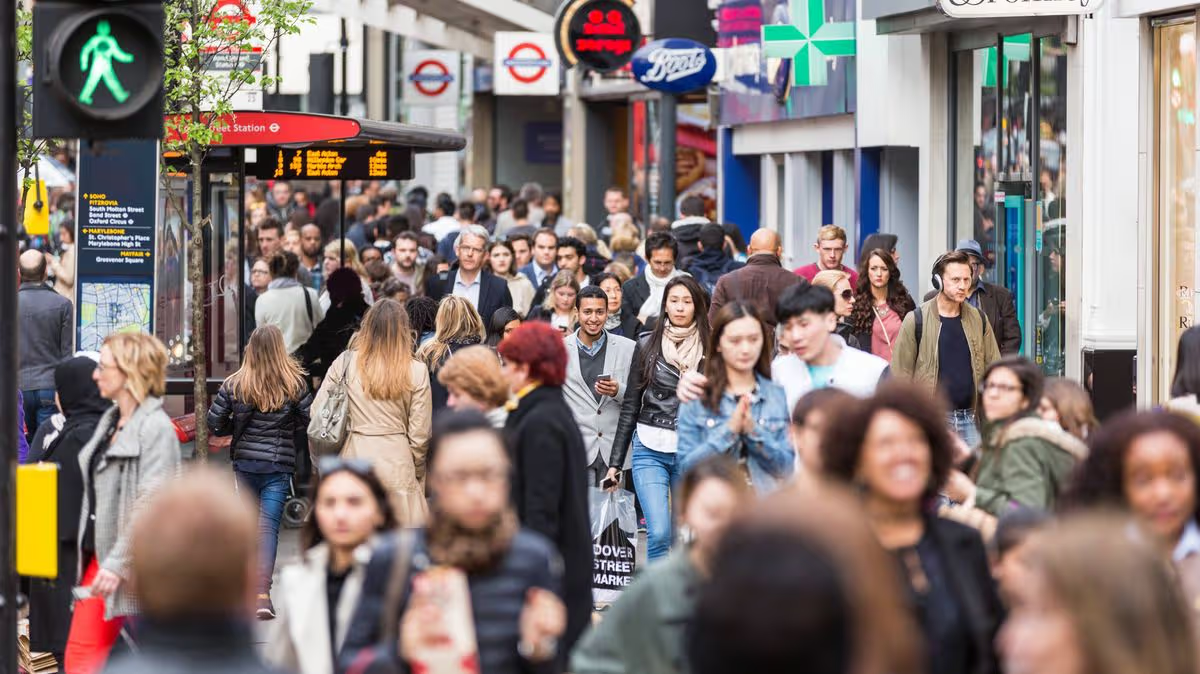
Topshop is reportedly set to return to Oxford Street five years after closing its flagship store.

Advertisement

The iconic fashion retailer shut its Oxford Street site in January 2021 after its parent company Arcadia Group collapsed into administration in November 2020.

Topshop was later snapped up by ASOS, alongside Miss Selfridge, for a combined price of £330million – but the deal did not include stores.

But in a new update, it has been reported that Topshop is planning to open its first standalone store in Oxford Street within the next 12 months, according to Drapers.

Topshop officially returned to Oxford Street in London last year with a launch in department store Liberty, but this will be the first time it has opened a standalone store in the famous London shopping district.

The fashion brand is also now available in all John Lewis’ 32 department stores, with Topman available in seven stores, as well as on the John Lewis website.

Topshop managing director Michelle Wilson previous said of Topshop: “The conversations we’ve had with customers around the relaunch is that people are desperate to see Topshop back in stores.”

Advertisement

Topshop once had 300 stores in the UK.

ASOS sold a 75% stake in Topshop and Topman in September 2024 for around £135million to create a joint venture with Heartland, the holding company of Danish billionaire Anders Holch Povlsen.

It was later confirmed that the Topshop.com and Topman.com websites were being relaunched.

Speaking to Drapers at the time about future plans for physical stores, Ms Wilson said: “That’s something that we’re working on all the time.”

Advertisement

Topshop isn’t the only brand preparing a high street return. Russell & Bromley has reopened its store in Richmond after being rescued from administration.

The luxury shoe chain was bought out of administration by Next, who paid £2.5million for its brand and intellectual property, and a further £1.3million for a portion of its current stock.

The deal only included three Russell & Bromley stores – in Chelsea, Mayfair and Bluewater in Kent – resulting in its remaining 33 branches being closed down.

Russell & Bromley was founded in 1880 by George Bromley and Elizabeth Russell in Eastbourne. It currently employs more than 450 people and is now run by Andrew Bromley.

Advertisement

Next has also bought brands such as Cath Kidston, Joules and Seraphine and Made.com in recent years.

Source link

Continue Reading
Click to comment

You must be logged in to post a comment Login

Leave a Reply

NewsBeat

Whippet suffers life-threatening injuries at dog field sandpit

Published

on

Cambridgeshire Live

The owner of the whippet said that the dog ‘is extremely lucky to be alive’ – and the sandpit has since been removed

An Ely woman said her whippet suffered life-threatening injuries at a dog field. Georgia Hewer-Heppethwaite, known as Georgia Nevada, 28, hired out Ely Dog Field in Little Downham for her whippet, Beans, on April 29.

Advertisement

Beans was running through the hired dog field when he fell into a closed sandpit and injured his neck. Beans jumped out of the sandpit and “started screaming like a visceral sound I’ve never heard before,” Georgia said.

“It was horrific. I just saw my husband sprinting towards him,” she added. The pair, who said it felt “like a dream” used a jumper to stop the bleeding while the vet was called. Beans was immediately taken to a nearby vet who waited outside to rush him into surgery.

Beans was in surgery for several hours. Georgia said: “He is extremely lucky to have survived. He suffered a hole in his neck just under the size of a ping pong ball.”

“We were told by the surgeons and vets that if we didn’t stop the bleeding and get him to the vet as quickly as we did, it would have been fatal,” she added.

Advertisement

When the accident occurred, the pair “were all over the place” but now they have “moved passed the initial emotion of it”. They called for better signage of the sand pit, which they described as a “hazard”.

Georgia, who has felt “really uneasy, upset and concerned”, wanted to see changes made to the sandpit to prevent other dogs from getting hurt. She said: “They had other dogs in the next morning.”

In response to the incident, the owners of the field said: “Ely Dog Field remains deeply saddened that any dog should ever be injured in any capacity and send our very best wishes to the dog for a continued recovery.”

Advertisement

Georgia said that “it is a beautiful dog park” but if owners are hoping to take their dogs there, she had warned them to “avoid that area”. “I feel like they have a responsibility as dog owners to make it safe”, she continued.

In a statement on Friday, May 22, a spokesperson for Ely Field Park said: “The sandpit has now been removed as we move forward following the recent incident. Our priority remains providing a positive and enjoyable space for our customers and their dogs.”

Ely Dog Field added that they “immediately provided all assistance that [they] could to support the owners that evening”, after being made aware of a dog being “seriously injured” while at the field.

Advertisement

The statement added: “We were very pleased to receive an update the following day confirming that the beautiful dog had returned home from the vets.

“In line with correct procedure, we followed due process and notified our insurers, who then took over all communication regarding the matter. The insurance company reviewed photos, videos, and a significant amount of documentation and concluded that we are not liable.”

Source link

Advertisement
Continue Reading

NewsBeat

Fighter jet ‘shoots down UFO’ in newly declassified Pentagon video | News US

Published

on

Fighter jet 'shoots down UFO' in newly declassified Pentagon video | News US

To view this video please enable JavaScript, and consider upgrading to a web
browser that
supports HTML5
video

The Pentagon has released a fresh batch of previously classified UFO files and videos.

Advertisement

Among the 222 newly disclosed files is a clip in which a jet shoots down a suspected Unidentified anomalous phenomenon (UAP) over Lake Huron in February 2023.

Other documents declassified by Donald Trump’s administration relate to a series of sightings in a secret facility in Sandia, New Mexico, between 1948 and 1950.

The files contain 209 sightings of UAPs, including ‘green orbs’, ‘discs’, and ‘fireballs’ reported near the military base.

A picture from a newly released clip showing four suspected UAPs near Iran in August 2022 (Picture: US Department of War)

They also detail findings of residual copper powder in areas where the suspected UFOs were sighted.

Advertisement

Some of the reports became part of Project Grudge, a short-lived investigation into UFOS between February and December 1949.

A newly-released CIA file details a sighting at the Saray Shagan weapons testing range in the USSR, now Kazakhstan.

Section 14 outlines an ‘airborne, luminous, bright green, unidentified object’ which was spotted in the summer of 1973.

Advertisement

To view this video please enable JavaScript, and consider upgrading to a web
browser that
supports HTML5
video

It described ‘concentric circles forming around the phenomenon over a period of several minutes’ before dissipating.

Advertisement

Another video, likely recorded on a mobile phone, shows a luminous phenomenon near Karaganda International Airport in Kazakhstan in March 2022.

Other files include recordings of astronauts flagging potential UAPs.

A luminous object pictured by a phone camera at Karaganda airport in Kazakhstan in 2022 (Picture: US Department of War)

In one clip, Scott Carpenter, the Aurora 7 pilot, described white particles in view that appear to move at ;random and ‘look exactly like snowflakes’ during the fourth manned spaceflight in 1962.

He said the particles were ‘reflective’ and flying faster than his spacecraft.

US defence secretary Pete Hegseth said: ‘The Department of War is in lockstep with President Trump to bring unprecedented transparency regarding our government’s understanding of Unidentified Anomalous Phenomena.

Advertisement

‘These files, hidden behind classifications, have long fueled justified speculation — and it’s time the American people see it for themselves. This release of declassified documents demonstrates the Trump Administration’s earnest commitment to unprecedented transparency.’

Two weeks ago, the Pentagon released the first tranche of documents relating to alleged sightings of unidentified objects, including a chilling FBI report about ‘aliens’ and wild claims that Nazis built a UFO.

Get in touch with our news team by emailing us at webnews@metro.co.uk.

For more stories like this, check our news page.

Advertisement

Source link

Advertisement
Continue Reading

NewsBeat

Why warmer UK summers could make staycations the money-smart choice

Published

on

Why warmer UK summers could make staycations the money-smart choice

For decades, the British summer holiday has carried one basic assumption: if you want reliable sun, you leave the UK. Spain, Greece, Turkey, Portugal and Italy have offered what Britain could not always guarantee: warmth, blue skies and the feeling of a proper summer break.

But climate change is beginning to alter the financial logic of that decision. This does not mean the UK should celebrate warmer summers. Heat brings serious risks: drought, wildfire, water stress, pressure on health services and damage to infrastructure.

Yet for households facing higher living costs, expensive travel and growing awareness of carbon emissions, the summer holiday is becoming more than a lifestyle choice. It is becoming a household finance decision, a regional economic decision and a climate-risk decision.

The warning signs are now difficult to ignore. The Met Office confirmed that summer 2025 was the UK’s warmest on record, with a mean temperature of 16.10°C between June and August. It is also estimated that a summer as hot or hotter than 2025 is now around 70 times more likely because of human-caused greenhouse gas emissions. This does not mean every British summer will be hot or dry. But it does mean that warm-weather tourism at home is becoming more plausible than it was for previous generations.

Advertisement

The financial scale of outbound tourism is substantial. According to the Office for National Statistics, UK residents made an estimated 94.6 million visits abroad in 2024 and spent about £78.6 billion overseas. Spain alone received an estimated 17.8 million visits from residents of Great Britain in 2024, followed by France and Italy. These figures show how deeply foreign summer travel is embedded in our lifestyles and the wider leisure economy.

St Ives in Cornwall is a popular tourist hotspot.
DacologyPhoto/Shutterstock

International travel clearly has personal and cultural value. People travel to see family, experience different cultures, rest, celebrate and escape routine. But from a household finance perspective, foreign holidays also involve costs that are often underestimated: flights, luggage charges, airport parking, transfers, travel insurance, exchange-rate costs, mobile roaming, higher peak-season accommodation prices and the financial risk of disruption.

Climate change adds another layer of uncertainty. Heatwaves, wildfires, floods and airport disruption can quickly turn a holiday into a financial loss. A family may budget for flights and hotels, but not for cancelled excursions, delayed returns, medical expenses in extreme heat, or additional accommodation if travel plans are disrupted. Climate risk is therefore no longer only a concern for governments, insurers or infrastructure investors. It is entering ordinary household decisions, including where families spend their summer break.

Advertisement

Sustainable staycations

This is where the UK staycation becomes more important. Staying in Britain is not automatically cheap and it is not automatically sustainable. In popular destinations such as Cornwall, Devon or the Lake District, a peak-season cottage can cost well over £1,000 for a week, depending on location, property size and school-holiday timing. A long car journey is not necessarily low carbon. Popular coastal towns can become overcrowded, placing pressure on housing, water, waste, roads and local services. But a well-planned domestic holiday can reduce several financial and environmental costs at once.

First, it can reduce exposure to volatile travel costs. Families may avoid airfare inflation, exchange-rate uncertainty and some of the expenses linked to overseas travel. They may also have more flexibility to travel outside the most expensive weeks, take shorter breaks, or adjust plans if weather conditions change.

Second, domestic tourism keeps more spending inside the UK economy. Money spent in local guesthouses, restaurants, cafes, farm shops, museums and small attractions circulates through regional economies. This matters especially for coastal and rural areas where seasonal tourism supports employment and small businesses.

VisitBritain’s 2024 domestic overnight tourism data shows that British residents took 106 million overnight trips in Britain, although trip volume fell compared with 2023. Spending, adjusted for inflation, increased by 3% in Britain, partly reflecting higher costs per trip. This is important: domestic tourism has economic value, but affordability is already a constraint.

Advertisement
drone shot of saltwater swimming pool in coastal cliffs

Bude sea pool, north Cornwall.
pio3/Shutterstock

Third, staying closer to home can reduce the carbon cost of leisure. Aviation’s climate impact is not limited to carbon dioxide. Aviation accounts for about 2.5% of human-made global CO₂ emissions, but its climate impact also includes non-CO₂ effects such as contrails and nitrogen oxides. Replacing a short-haul flight with rail, coach, or a shorter domestic journey will not solve climate change, but it can reduce the footprint of a decision made by millions of households every year.

Britain cannot simply wait for warmer summers and call it an opportunity. If domestic tourism grows without planning, it could create new costs: overcrowded beaches, higher local rents, water shortages, waste pressures and congestion. A sustainable staycation economy needs investment in public transport, affordable accommodation, shaded public spaces, water refill points, wildfire awareness, coastal protection and better visitor management.

There is also a fairness issue. If domestic holidays become fashionable but unaffordable, the benefits will be uneven. The goal should not be luxury staycations for wealthier households. It should be a broader model of climate-conscious leisure that allows more families to rest and travel without excessive financial strain or environmental cost.

The message to households should be practical rather than judgemental. A foreign holiday is not wrong. People travel abroad for many good reasons, including family, culture, rest and escape. But the old idea that a summer holiday requires a flight is becoming less convincing. As UK summers become warmer and overseas travel becomes more exposed to climate and cost shocks, staying in Britain may increasingly make financial and environmental sense.

Advertisement

A warmer UK summer is not good news in itself. It is a warning. But it also forces a practical question: if sunshine is becoming more available at home, can Britain build a tourism model that keeps more money in local economies, reduces emissions, and protects households from the rising financial risks of climate change?

Source link

Advertisement
Continue Reading

NewsBeat

Cooling poverty is making extreme heat more dangerous for millions

Published

on

Cooling poverty is making extreme heat more dangerous for millions

Imagine walking along Ipanema beach on a summer afternoon. The sand is golden, there’s a cooling sea breeze, the shade of a parasol and a cold drink in hand. Now look up.

Clinging to the hillside just a few hundred metres away is Vidigal, one of Rio’s favelas in the Brazilian city. Here, thousands of people live in a heat trap with metal roofs, no parks and no formal public transport networks.

In nearby sprawling suburbs, families face the same suffocating nights and concrete pavements radiate heat long after sunset. If there are no cool public spaces to retreat to, no water fountains or drinking water sources to guarantee relief, extreme heat is inescapable.

Rio is far from alone. Last summer, Europe sweltered. Spain recorded highs of 46°C. Portugal hit 46.6°C. France experienced its second-hottest June since 1900. In the US, more than 150 million people faced extreme heat warnings. In south Asia, west Africa and Latin America, extreme heat is not just seasonal.

Advertisement

But the consequences of heat are not evenly distributed. They vary between countries, regions and neighbourhoods. Differences in demographics, infrastructure and capacity to adapt all shape how badly people are affected.

Our new study shows that this “systemic cooling poverty” is widespread yet unequal across 28 – predominantly developing – countries.

Heatwaves hit downtown Sao Paulo in Brazil.
Nelson Antoine/Shutterstock

Across the 3 billion people represented by our sample, nearly 600 million are experiencing severe levels of systemic cooling poverty. People in south Asia and sub-Saharan Africa bear the heaviest burden.

Advertisement

Yet countries facing similar extreme heat can highlight different outcomes. Indonesia and Bangladesh both face exposure to hazardous humid heat affecting almost their entire populations, but Indonesia’s stronger physical infrastructure and healthcare translate into lower levels of systemic cooling poverty.

In cities, vulnerability is shaped by physical infrastructure (buildings, streets, pipes and green spaces) and social infrastructure (services, institutions and support networks), both of which are distributed unequally. Poorer residents typically have less access to air conditioning, tree-shaded streets and parks, and insulated housing.

Cooling capacity is not just a matter of technology. Framing air conditioning as the answer to extreme heat is problematic. Access to air conditioning is extremely unequal across and within countries – most of the world’s population simply does not have it.

Air conditioning is also energy-hungry. It raises annual household electricity bills by more than a third on average. This strains power grids when demand for energy peaks. Increased demand for electricity accelerates the climate change driving the heat crisis, pushing outdoor temperatures even higher. The production and disposal of units carries its own environmental toll, with hazardous materials risking release into soil, water and air.

Advertisement

The biggest factors determining whether heat becomes dangerous are the conditions people are born into and live in.

Where you live, how your neighbourhood is built, whether there are trees or public drinking water nearby, how well ventilated your home is, whether your workplace offers protection, and whether public services respond to rising temperatures all shape survival. So do age, health, income, gender identity and discrimination, which can determine whose suffering is recognised and whose remains hidden.

Responses to heat are shaped by the social and physical environments people inhabit. In many places, air conditioning has displaced ancestral knowledge and intergenerational practices for living with heat, including ways of building, moving, eating, and resting developed over centuries. Losing those practices can leave people more exposed and less resilient.

Since 2020, as part of our cooling poverty project we have interviewed 80 people living in Rio’s low-income suburbs and favelas. Nineteen of these residents kept online heat diaries: writing records, collecting photos, drawings, memes and voice notes, of their daily encounters with extreme heat.

Advertisement

Caregivers had to change their routines so domestic labour could be carried out in the cooler hours of dawn and dusk. Street vendors moved locations or abandoned certain routes.

For one resident with mobility impairments, cold showers, the most immediate cooling strategy, are not possible: “I would love to take four cold showers a day, but I have some logistic issues related to my condition.” Because they depend on air conditioning, their electricity bills triple in summer. For others, the beaches and waterfalls some people escape to remain out of reach: “I would love to go, but I can’t because of accessibility issues”.

For trans women residents, social discrimination closes off the very spaces (parks, squares, shops) where others find shade or a moment of cool. And because public bathrooms mean risking harassment, many limit how much they drink. Heat, for them, becomes a bodily danger with no safe exit.

Systemic cooling poverty is not about whether a person can afford air conditioning, but rather how surrounding infrastructure, institutions and design, expose someone to harmful heat and then fail to protect them from heat. It extends beyond the home to workplaces, schools and healthcare systems, where heat can have serious consequences for health, productivity and wellbeing. It reaches further into the systemic causes that determine who suffers most: inequality, discrimination, patriarchy, ableism and racism.

Advertisement

Heat vulnerability is not an accidental outcome. Urban planning decisions that remove green space, housing policies that allow poorly ventilated buildings, labour laws that leave outdoor workers unprotected, public health systems that fail among the most exposed all contribute.

Thermal justice

Reframing cooling poverty changes how researchers think about solutions. Thermal justice does not only mean reducing exposure to heat. It also means doing so fairly, and holding accountable the people and institutions whose policies and planning decisions have made some neighbourhoods hotter and some households less able to keep cool.

By asking “who designed these conditions?”, we can understand who has the power to change them.

Effective responses require coordinated action across urban planning, public health, housing and labour regulation: expanding access to safe water, retrofitting buildings and planting trees alongside reducing discrimination.

Advertisement

But the people most affected need to help design solutions. Their experiences reveal what heat actually feels like, day after day. By understanding and assessing systemic cooling poverty, we can identify how best to achieve thermal justice for those most at risk from extreme heat.

Source link

Advertisement
Continue Reading

NewsBeat

US website sorry over Caitriona Balfe video edit error of Outlander star ‘calling Shotts an armpit’

Published

on

Daily Record

Gold Derby edited an interview clip of Caitríona Balfe which appeared to make the actress label the whole Lanarkshire town her “worst location shoot”, angering residents.

Outlander star Caitríona Balfe has received an apology from a US-based entertainment website who admitted her comments apparently branding a Scots town an ‘armpit’ was due to a video editing error. The leading actress appeared to label the whole Lanarkshire town as her “worst location shoot” in an interview alongside co-star Sam Heughan.

The viral clip angered Shotts residents and former MSP Alex Neil. However on Saturday it emerged Gold Derby had edited the video to remove a clarification from the actress, who played Claire Fraser in the drama, saying she was not referencing the whole town.

A statement from the site said: “A recent social video from Gold Derby featuring Outlander stars Caitríona Balfe and Sam Heughan has been removed from our social accounts due to an editing mistake, which unintentionally altered the meaning of one of Balfe’s responses. During a segment titled ‘And the Award Goes to…,’ Balfe replied to the prompt of ‘Worst Location Shoot’ by naming the town of Shotts, Scotland, but later clarified that she meant the specific shooting location in Shotts and not the entire town.

Advertisement

“During the course of editing the video, Balfe’s clarification was removed by mistake. Gold Derby deeply regrets the error and sincerely apologizes to Catrione Balfe, the people of Shotts, and everyone involved.”

In a filmed exchange with Dumfries and Galloway-born Heughan – who played her heartthrob husband Jamie Fraser for a decade – Balfe said: “We filmed at a place in Season 8, I think it’s called Shotts. An armpit… and I’m very sorry.”

Heughan then comments: “Oh…sorry Scotland.”

Advertisement
Content cannot be displayed without consent

However In the actual video clip, she said: “Sorry, Shotts. It’s a particular place in Shotts. I just want to be specific.

“It’s not the town — the little village. It was just… They found an old dump that was also kind of a swamp, and we were there for over a week, and our sets kept getting attacked, and it was just not my favorite place.”

Sources told the Record the Outlander crew had set up a base at a Shotts factory unit in 2024. They were there to film in the area for several months as Balfe made her directing debut on the second episode of the final season back that year, titled “Prophecies”.

But local sources claim the team departed after a matter of weeks after they “ran into difficulties” at the filming location at Hartwood Hill near Shotts. The source said: “The set quad bike was stolen and set fire to and they struggled further to secure the set.

Advertisement

“They also had a lot of difficulties with the ground being impenetrable.” Before knowing the comment was edited, Mr Neil invited Balfe back to the town to show her what it really has to offer.

The ex-MSP said: “There’s no denying the social problems facing Shotts because, like many other ex mining communities, no government has invested in these communities, so they’ve been allowed to run down physically. But the point is, in these communities the people have a heart of gold, they’re very good, decent hard working people who are trying to make the best of their lives and make ends meet in very difficult circumstances.

“Far from being the ‘armpit’ – which suggests the place stinks – the people are actually lovely people in Shotts. She is probably totally ignorant of its history.

“I would say to her, come back to Shotts. I’d be happy to show her around and introduce her to the people of Shotts so she gets an impression of the real Shotts instead of a fleeting visit and reaching a conclusion from what was probably a very limited experience of Shotts.”

Advertisement

After hearing that Balfe wasn’t talking about the whole town, Mr Neil said: “I’m delighted to hear she didn’t mean Shotts in general and I’m sorry the website edited her comments the way it did. I’m glad she’s received an apology for it.

“However my offer still stands. I’d be happy to welcome her to Shotts and show her around and meet the locals.”

Get more Daily Record exclusives by signing up for free to Google’s preferred sources. Click HERE.

Source link

Advertisement
Continue Reading

NewsBeat

Wildfire risk is now spreading to cool climates like the Scottish Highlands and Irish uplands

Published

on

Wildfire risk is now spreading to cool climates like the Scottish Highlands and Irish uplands

The most destructive wildfire season on record in Europe was in 2025, with more than one million hectares burned and tens of thousands of people displaced by fires across the continent.

For people in Ireland and Britain, the type of destructive wildfires that ravage southern Europe each summer can seem like a distant problem. But these fires are not confined to the dry Mediterranean landscapes of Spain, Portugal and Greece. In recent years, they have started to extend into regions more commonly associated with rain-soaked hills and bogs.

In 2026, this trend has continued with major wildfires breaking out across Scotland, Northern Ireland and Ireland.

As fires spread across the Highlands and Moray in Scotland this April, public warnings focused heavily on dry weather, campfires and accidental ignitions. In Northern Ireland, cautions were issued as firefighters battled several large gorse fires across the Mourne Mountains and other upland ares.

Advertisement

Similar warnings were issued nationally in Ireland over the Easter bank holiday weekend, when the public was urged to avoid lighting fires or bringing barbecues into the countryside. The threat of wildfires is only expected to ramp up this summer as temperatures rise further.

These are important messages. But focusing only on how fires start risks missing a slower and less visible transformation already unfolding across many upland landscapes. The real wildfire story in places like Ireland and Scotland is not just about climate or how fires start. It is also about how rural upland landscapes themselves are changing.

Changing farming styles

Recent research explores how decades of agricultural policy reform under the EU’s common agricultural policy, alongside falling farming populations and declining active land management, are reshaping vegetation patterns across Ireland’s uplands.

Historically, many upland landscapes were actively managed through livestock grazing, cutting and controlled patch burning. These practices helped maintain open landscapes and reduced the build-up of highly flammable vegetation.

Advertisement

But that balance has shifted. Reduced grazing pressure and changing land management practices are contributing to the expansion of highly flammable vegetation such as gorse, heather and purple moor grass.

While lower grazing pressure can bring biodiversity benefits and support natural regeneration, it can also increase the amount and proliferation of flammable vegetation across the landscape, known as fuel loads and fuel continuity. In practice, this means larger and more connected stretches of vegetation that allow fires to spread more rapidly and across greater distances.

A forest fire in rural Wales.
Groomee/Shutterstock

This is especially concerning in upland areas where the average age of people working on farms is rising, and active land management is declining. Rural depopulation and labour shortages mean fewer people are available to manage what is known as commonages in Ireland and common grazing in Scotland. That means less maintenance of grazing systems and a reduction in the small, controlled vegetation burns that historically decreased wildfire risk by clearing vegetation and creating firebreaks. As one upland farmer in County Kerry recently described it to me: “It’s a bomb waiting to go off.”

Advertisement

Increasing flammability

Climate change is intensifying these risks. Hotter, drier conditions increase the likelihood that vegetation will dry out, increasing flammability. But climate alone does not explain why some landscapes burn more severely than others.

Wildfire risk is also shaped by what is growing on the land, how landscapes are managed, and whether fuel loads are reduced or allowed to accumulate over time. Experts responding to the recent Scottish fires also highlighted the role of vegetation build-up, prolonged dry conditions and changing land management in shaping fire behaviour, warning that historically wetter regions may face increasing wildfire risks in the future.

Similar patterns have already emerged across parts of southern Europe, where rural depopulation and land abandonment have contributed to increasingly severe wildfire regimes.

Recent research from Italy has shown abandoned land, declining grazing and reduced active land management have contributed to fuel accumulation, and to the build-up of dense, continuous vegetation – conditions associated with increasingly large and severe wildfires. While the climates and landscapes of Ireland and Scotland differ from the Mediterranean, similar long-term changes are beginning to emerge here.

Advertisement


À lire aussi :
The Pennine hills are full of holes – here’s how they’re helping fight climate change


This creates a difficult tension for policymakers and conservationists. Reduced grazing pressure and natural regeneration can support biodiversity recovery in upland systems. Yet these same changes may also increase wildfire risk where vegetation becomes dense, continuous and unmanaged. The challenge is therefore not choosing between farming or conservation, but finding ways to support landscapes that can sustain biodiversity, rural livelihoods and wildfire resilience together.

Wildfire risk in Ireland and Scotland can no longer be understood simply as a problem of careless ignitions or extreme weather. It runs much deeper than that. It is increasingly tied to long-term changes in how upland landscapes are farmed, governed and managed.

If future policy is serious about reducing wildfire risk, it must look beyond seasonal warnings and begin addressing the deeper forces reshaping our uplands.

Advertisement

Source link

Continue Reading

NewsBeat

Mum speaks of heartbreak following daughter’s death 15 days after her arm went numb

Published

on

Manchester Evening News

Alicia-Adele was diagnosed with an incurable brain tumour after waking up with a numb arm

A mum said she had “no inkling” her daughter was suffering from an incurable tumour after she told her she had woken up with a numb arm.

Alicia-Adele, from Caerphilly, Wales, first complained of numbness in her arm before telling her mum, Amanda Axiak, that she was struggling to walk. The 11-year-old was later diagnosed with an aggressive and incurable brain tumour and died 13 days later – just 15 days after her first symptoms appeared.

Her mum, Amanda Axiak, described being in complete shock at the diagnosis, adding that hearing the news was an “out-of-body experience”. She said: “I almost collapsed. I felt like I had an out-of-body experience. My world had ended that day.

Advertisement

Click here to get the biggest stories straight to your inbox in our Daily Newsletter

“She was perfect. There was nothing wrong with her whatsoever – no headaches, nausea, fever, nothing.”

The schoolgirl first complained about her arm feeling numb to her mum, but Amanda thought nothing of it at first, thinking she may simply have slept awkwardly or over-exerted herself when playing netball. Amanda said: “We were all getting ready for work, college and school. I was doing my makeup when Alicia-Adele came in and said, ‘Mam, I’ve got a bit of a numb arm. It just doesn’t feel right’.”

However Amanda’s concerns began to grow when Alicia-Adele messaged her, whilst at school, saying her symptoms had worsened. Amanda recalls: “She told me, ‘My face feels a bit numb on one side.’ I didn’t like that.”

Advertisement

The mum advised Alicia-Adele to speak to her school’s first aid team. However later that afternoon Amanda received another call from her daughter. Amanda said: “That’s when she said, ‘I’m struggling to walk. “Her leg had started to go numb.”

Amanda immediately contacted her GP surgery. She said: “Within seconds, the doctor phoned me back and said, ‘You need to go straight to the Grange University Hospital because it sounds like stroke symptoms.”

Alicia-Adele’s parents took her to hospital that afternoon and doctors decided to keep her in overnight so she could undergo an MRI scan on Friday. However, on Saturday (April 12), the family were given the devastating news that she had been diagnosed with an inoperable and incurable diffuse midline glioma, commonly known as DIPG – an aggressive childhood brain tumour. The illness is the leading cause of brain tumour deaths in children, with the average prognosis being just eight to 12 months, Wales Online reports.

Advertisement

Amanda said: “They said to me in the hospital they would have picked this up in an eye test but I’d taken her for an eye test at an optician in Caerphilly in March, the month before, and there had been nothing. We had no inkling that this was happening.”

Fifteen days after Alicia-Adele’s first symptoms appeared, and just thirteen days after her family learned the devastating truth about her illness, she passed away. Amanda said: “It ripped us apart. It changed the way I saw the world.

“I’d be walking down the street and see children, and I’d shudder, because I’d think: that child’s world – or that family’s world – could end within days, and they’d have no idea.”

Following Alicia-Adele’s diagnosis, Amanda has now been campaigning for change and is hoping to push the newly elected Welsh Senedd to take action to improve outcomes for brain tumour patients in Wales. She said: “I’m trying to turn heartbreak into hope.

“I want to change things for other families, because if I can do something that helps even one family, then I know Alicia’s life wasn’t in vain. As long as my heart beats, so does hers.”

Dr Karen Noble, director of research and policy at Brain Tumour Research, said: “There are more than 120 different types of brain tumour, and symptoms can differ greatly depending on where the tumour is located. Common symptoms can include headaches, dizziness, coordination problems, changes in vision or hearing, nausea, or changes in the way somebody walks. But many of these symptoms are vague and can easily be attributed to other conditions.

“In Alicia-Adele’s case, there were very limited symptoms, which is why it came as such a shock to the family. We also know that many patients visit their GP several times with symptoms like headaches before a diagnosis is made. Around 40% of brain tumours are diagnosed in accident and emergency departments because they can be so difficult to detect through non-specific symptoms alone.”

Advertisement

She added that one of the biggest challenges for doctors was the lack of rapid diagnostic tools that could help identify when seemingly ordinary symptoms might point to something far more serious. Dr Noble also outlined the key priorities which campaigners such as Amanda are calling on the Welsh Government to act upon.

She said: “Increased investment is essential. The only way we are going to find a cure, and develop better treatments for brain tumours, is by deepening our understanding of the science, the biology and the mechanisms behind these diseases.

“We also know there is a severe lack of clinical trials in Wales. When someone is diagnosed with a brain tumour, it’s vital that we understand not only the type of tumour they have, but also its specific mutations. Even when patients are diagnosed with the same tumour type – such as the diffuse midline glioma Alicia-Adele had – every tumour can have its own unique molecular makeup.

Advertisement

“The more we understand about the genetics and molecular characteristics of a tumour, the more opportunities there may be to access emerging treatments, many of which are available through clinical trials.”

She adds: “That’s why we need more clinical trials in Wales, particularly for brain tumours. We also need broader access to genomic testing, so we can identify patients who may be eligible for trials that are not traditionally associated with brain cancer.

“For example, a clinical trial may be designed for lung cancer patients with a particular mutation, but if that same mutation is found in a brain tumour patient, that treatment could potentially benefit them too. We need systems in place to ensure those opportunities are accessible. So our three main asks are clear: increased investment in brain tumour research, better access to genomic testing to fully understand tumour biology, and greater access to clinical trials for patients in Wales.”

The Welsh Government has issued the following statement, on how it will proceed with research: “Research supported through Health and Care Research Wales has enabled studies across a range of conditions, including brain cancer – from improving our understanding of the disease to exploring new treatments.

Advertisement

“This new government’s Cancer Plan for Wales will place a strong emphasis on research, innovation and improving access to clinical trials so more patients can benefit from new treatments, including for brain cancer. We are also planning a Wales Cancer Conference next year to bring together experts and share best practice in cancer care.

“We also recognise how vital properly stored tissue is for diagnosis, research and access to new treatments. We are committed to strengthening legal safeguards so that high-quality methods of tissue preservation become standard, giving patients and families greater confidence and improving access to cutting-edge care.”

Amanda has also been working with Brain Tumour Research to launch the Alicia-Adele’s Angel fundraising group. Amanda said: “I came up with the name ‘Alicia-Adele’s Angels’, because she herself is an angel but also because of her always wanting to be a paediatric doctor. I think ‘angels’ is what Alicia would have classed her patients. It couldn’t have been a more poignant name.”

Advertisement

The mum has already taken part in a number of fundraising runs for the cause and has raised over £4,000 for Brain Tumour Research. You can still donate to Alicia-Adele’s Angels here.

Source link

Continue Reading

NewsBeat

How South African infectious disease specialists identified the hantavirus outbreak on a cruise ship

Published

on

How South African infectious disease specialists identified the hantavirus outbreak on a cruise ship

JOHANNESBURG (AP) — When South African infectious disease specialist Lucille Blumberg checked her email on the morning of May 1, while the country was celebrating the Labor Day holiday, an urgent message caught her attention.

A U.K.-based colleague had written about a passenger from a cruise ship sailing thousands of miles away in the Atlantic Ocean who had been evacuated and admitted to a Johannesburg hospital with suspected pneumonia. Others aboard the vessel were also sick.

The colleague, who monitors diseases in remote British overseas territories in the South Atlantic Ocean, asked Blumberg to follow up on the passenger, who had been evacuated from the ship in one of the territories, Ascension Island.

Blumberg and other experts at South Africa’s National Institute for Communicable Diseases were suddenly thrown into the race to identify the cause of an outbreak aboard the Dutch cruise ship MV Hondius.

Advertisement

“Even though it was a public holiday, we moved, we moved really fast,” Blumberg told The Associated Press. “It was busy. There were many conversations. There were online discussions, and there was laboratory testing happening at the time.”

Within 24 hours, they had determined that the man’s illness was caused by hantavirus, a rare rodent-borne virus.

A process of elimination to identify the disease

The elderly British man had arrived at a private hospital in Johannesburg days earlier and was seriously ill, but health workers weren’t sure of the underlying cause.

By the time he was evacuated from the ship, two elderly Dutch passengers who had been on board the MV Hondius cruise liner had already died, but there had been little alarm. Ascension Island health authorities had reported a cluster of illnesses on the ship that appeared to be pneumonia to the World Health Organization.

Advertisement

At first, Blumberg and her colleagues thought it might be Legionella, a bacterium that causes a serious form of pneumonia, Legionnaires’ disease. Or maybe bird flu.

“I called my infectious disease colleagues, and we had a caucus, and we discussed the usual ones,” Blumberg said. “Legionella is well described in outbreaks in hotels and on cruise ships, and influenza certainly is. These people had visited islands where avian influenza is well documented.”

Tests on all those were negative. The experts also ran an extensive panel of tests for other respiratory diseases. Also, all negative.

The team then began looking more closely at where the ship came from — Argentina — and the fact that passengers on board were avid bird watchers and had reportedly been to parts of South America where there were birds, but also rodents.

Advertisement

Collaboration with experts in South America and the US

That pushed the South African disease experts toward another theory: the rare, rodent-borne hantavirus infection, which is found in parts of South America.

“It’s a well-described, not common, but it’s a well-described virus in Chile and Argentina,” Blumberg said. She added that their work was aided by collaboration with hantavirus experts from South America and the United States, facilitated by the WHO, the U.N. health agency.

“You can get onto a Zoom (call) online and ask your questions and get advice. This is not something every day. So that was quite extraordinary,” Blumberg said.

By then, it was Saturday morning. Blumberg called the head of the only laboratory in South Africa that can test for hantavirus.

Advertisement

“I said, we want to do hanta, and she said, ‘yeah, I’m coming.’”

The tests, carried out on the sick man’s blood samples, came back positive for hantavirus that afternoon. The team did a second set of tests to be sure, Blumberg said.

Finally, there was a ‘wow moment’

Those positive tests, which also identified the Andes strain of hantavirus, allowed the WHO to inform the cruise ship what it was dealing with and announce an outbreak on board. While hantavirus is not easily spread from person to person, the WHO says the Andes virus can be transmitted between people.

The test results also led Blumberg to rush to collect blood samples from a Dutch woman — one of the first two cruise passengers to die — who had disembarked from the ship with her husband’s body on the island of St. Helena and flown to South Africa, where she died.

Advertisement

A posthumous hantavirus test on her was also positive.

“It was a bit of a wow moment,” Blumberg said. “And at least once you know what you’re dealing with, it’s much easier to respond.”

The British man who was the first confirmed case of hantavirus infection from the cruise ship is improving in hospital, South Africa’s health ministry has said. Meanwhile, the ship has arrived at the Dutch port of Rotterdam, where it was disinfected, and the remaining crew members disembarked.

“I’ve been doing outbreaks for 25 years. That’s what we do. We do them every day,” she said. “I think the important thing was to respond immediately to a question that clearly was urgent and then to take it from there.”

Advertisement

___

AP coverage of the cruise ship hantavirus outbreak: https://apnews.com/hub/hantavirus

Advertisement

Source link

Continue Reading

NewsBeat

Zoe Balls addresses Strictly presenting snub and explains why she’s relieved

Published

on

Wales Online

Zoe Ball has spoken out after Emma Willis, Josh Widdicombe and Johannes Radebe have been named as the new Strictly hosts.

Zoe Ball signs off from the BBC Radio 2’s Breakfast Show for final time

The BBC has officially announced the new presenting team for Strictly Come Dancing, with Emma Willis, Josh Widdicombe, and Johannes Radebe taking over after long-serving hosts Tess Daly and Claudia Winkleman stepped aside.

Advertisement

BBC Radio presenter Zoe Ball, who was amongst those considered for the role, has now said she’s relieved not to have secured the position, reports the Express.

She told The Sun: “I screen tested with Josh and he is hilarious. He is going to be so good. Emma is just gorgeous, and I love Johannes, so they are going to ace it. And I don’t have to have a facelift, so I’m quite happy.”

Speaking at The Podcast Show 2026 alongside her Dig It podcast co-presenter Jo Whiley, she continued: “For Jo and I, it’s hell. We both hate being in vision, that’s why we really loved doing radio.

“Then they started filming that. They film everything. And as we get older, we’re like, ‘dim the lights!’ We’d happily never be filmed again.”

Advertisement

Fellow radio broadcaster Sara Cox, who also auditioned unsuccessfully, revealed on her Tuesday BBC Radio 2 Teatime programme: “I tried out for Strictly.

And I will say I tried out for it two days after I got offered my number one, all-time, dream job of the Radio 2 Breakfast Show.

Advertisement

“So I was like, ‘Oh, I’ll go along and try for Strictly as well, why not, and what next? News at Ten?’ So I went along, and it was the most gorgeous experience. I got into a car that was taking me to a secret destination.”

“It was all hush-hush, and it was basically a bit like, you know, when you can go and play the Crystal Maze interactive game? It was like that. I was like, ‘Great, I’m going to be a Strictly presenter for an hour!’ The whole thing was really great fun.”

This Morning presenter Rylan Clark has also commented on Strictly, posting on social media: “Just wanted to say, as it was reported I was in ‘The Race’ for Strictly.

Advertisement

“The biggest congrats to my Emma and equal congrats to Johannes and Josh. You’re all going to have the best time. Made up for you’s.

“This wasn’t my time, sadly, but I am extremely grateful to even have been considered. I’m taking the news really well (see ) but genuinely looking forward to the new series with you three x (sic).”

Strictly Come Dancing will return to BBC One later this year, with the exact date still to be announced.

Advertisement

Source link

Continue Reading

NewsBeat

Donegal vs Kerry Recap as the Ulster champions withstand late fightback to deny the Kingdom

Published

on

Belfast Live

National Football League Division One: Donegal 1-22 Kerry 1-18

Donegal waited six months to get another crack at Kerry and they were full value for a four-point win over the All-Ireland champions in Ballyshannon on Sunday.

A crowd of youngsters surrounded the Kerry bus on its arrival to Fr Tierney Park. They were hoping to spot Gaelic football’s MVP. They were to be disappointed. David Clifford wasn’t on the bus due to a bout of flu.

Advertisement

Scorer of 0-9 in last summer’s All-Ireland SFC final between the counties, it was one less headache for Jim McGuinness.

Paudie Clifford, Donegal’s tormentor-in-chief in Croke Park, was also absent with Sean O’Shea almost single-handedly keeping Kerry in touch with four two-point frees.

Dáire Ó Baoill’s goal before half-time and back-to-back two-pointers from Michael Langan put Donegal in command, but those O’Shea frees and a late goal from substitute Donagh O’Sullivan left four points between the sides – a margin of defeat that flattered the visitors.

The Ballyshannon venue was bursting at the seams by the time David Coldrick threw the ball in – all 9,000 tickets for this rematch were sold out 24 hours beforehand.

Advertisement

There was plenty of needle in the early stages – Conor O’Donnell and Tadhg Morley were wrestling moments after the off.

The sides traded scores for much of the first quarter with Young Footballer of the year Finnbarr Roarty scoring a brace of points playing in a more advanced role than in 2025.

Shane O’Donnell won a ton of possession for the home side with the raiding Peadar Mogan adding a classy point while Conor O’Donnell was on target with 0-3 in the first half.

After Donegal goalkeeper Gavin Mulreany had scored a 45 after Shane Murphy’s restart went wrong, the Ulster champions finally made their midfield dominance count with a goal before half-time.

Advertisement

Shea Malone won the break and, with options off both shoulders, he passed to Shane O’Donnell when Dáire Ó Baoill was unmarked inside. The St Eunan’s ace spotted Ó Baoill and delivered a perfect pass with the Gweedore clubman able to round Murphy and slot the ball into the Kerry net.

Mogan’s second from play on the cusp of half-time left Donegal 1-8 to 0-7 ahead at the break.

Michael Langan added a brace of cracking two-pointers on the restart with Hugh McFadden also scoring a two with Kerry increasingly reliant on O’Shea’s dead-ball prowess to keep them in touch.

A huge roar greeted Michael Murphy’s introduction midway through the half with Oisin Gallen also marking his introduction with a point.

Advertisement

Having trailed by nine points, Kerry finished on top with O’Shea moving to 0-11 with Armin Heinrich also chipping in with a good score.

The scrappiest of goals for Kerry gave them a brief, late lifeline with O’Sullivan finding the net after Donegal failed to clear their lines.

The Kingdom tried in vain to engineer another goal to snatch a draw, but it was Murphy who had the final say with a point in the final minute to ensure the Ulster champions were victorious.

Two points on the first Sunday of February won’t atone for that loss in the fourth Sunday of July and Jack O’Connor knows his hand will only get stronger as the season progresses.

Advertisement

Donegal: G Mulreany 0-1 (0-1 45); C McColgan; B McCole, P Mogan 0-2; K Gallagher, C McGonagle, F Roarty 0-3; H McFadden 0-2 (1tp), M Langan 0-4 (2tps); D Ó Baoill 1-2, S O’Donnell, C Moore 0-1; C O’Donnell 0-3 (0-1f), J McGee, S Malone 0-1.

Subs: R McHugh for Gallagher (49), Michael Murphy 0-2 (0-1f) for Malone (44), T Carr for Ó Baoill (62), O Gallen 0-1 for S O’Donnell (62), K Muldoon for C O’Donnell (68).

Kerry: S Murphy; E Looney, J Foley, D Casey; A Heinrich 0-1, M Breen, T Morley; S O’Brien, C Trant; J O’Connor, S O’Shea 0-11 (4tpfs, 0-1 45, 0-1m), M Burns; K Spillane, T Kennedy, T Brosnan 0-6 (2tps, 0-1f).

Subs: L Smith for O’Brien (19), C Keating for Breen (HT), D Lyne for Spillaine (42), D O’Sullivan 1-0 for Burns (52), R Murphy for Trant (55).

Advertisement

Referee: D Coldrick (Meath)

Source link

Continue Reading

Trending

Copyright © 2025