The Pentagon released a second batch of UAP files, including 50 videos and documents showing unexplained objects over the Middle East, Syria, Iran, and in NASA recordings. Despite the reports, the agency stresses that it has found no evidence of extraterrestrial origin. The Guardian reports: In one video from the Middle East in 2019, taken “likely from an infrared sensor aboard a US military platform operating within the US Central Command area of responsibility,” according to the Pentagon, three UAP are captured flying in formation over the Persian Gulf. Another formation of four unidentified objects is seen flying past vessels on the water off Iran in a video from 2022.
Footage taken over Syria in 2021 shows a mysterious object racing away at speed akin to instantaneous warp-speed acceleration from science fiction movies. Few of the objects seem to resemble flying saucers, discs or other traditionally perceived forms for UAP, although one October 2022 clip taken at an undisclosed location shows a cigar-shaped entity racing over what appears to be a residential area.
None of the videos are accompanied by explanations, and the Pentagon’s all-domain anomaly resolution office (AARO) has previously stated it has no evidence to suggest any of the thousands of objects seen on video, or described in written testimony, is of extraterrestrial origin. In its May 8 release, a statement from the defense department said the public “can ultimately make up their own minds about the information contained in these files.” Additionally, the information is collated from a diverse range of sources, including government agencies including several military branches, the FBI, the state department and Nasa. “Many of these materials lack a substantiated chain-of-custody,” the Pentagon notes
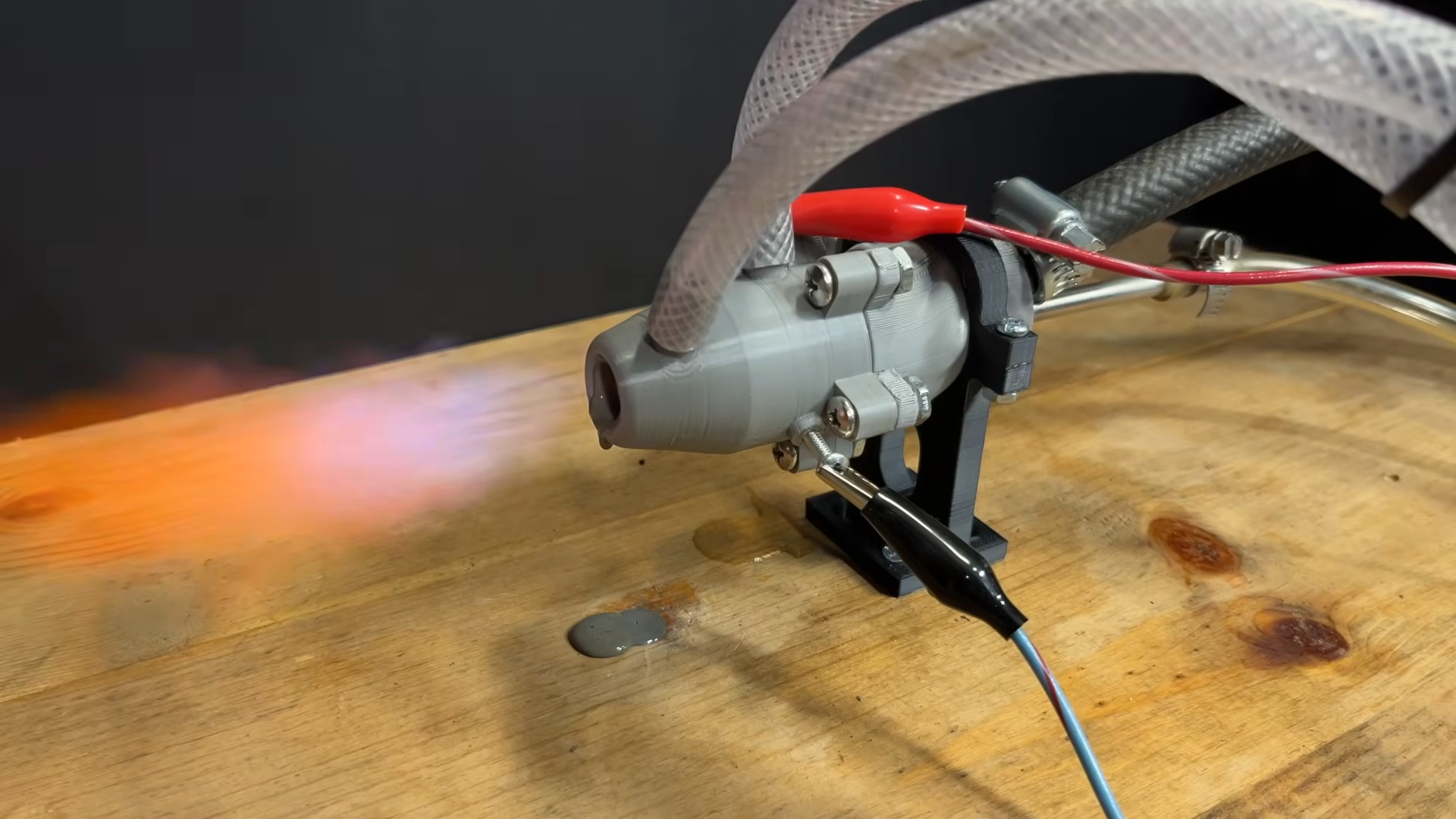
Consumer-grade 3D printers are useful for lots of things, but they kind of fall down when it comes to making stuff that survives high temperatures. [Mr. More Gooder] wasn’t deterred from a rocket build using FDM printed parts though, instead relying on water cooling to try and beat this practical limit.
The concept is simple enough—[Mr. More Gooder] printed a propane-burning combustion chamber and nozzle out of plastic that you’d totally expect to melt when the flames started. Thus, the nozzle was given fittings to allow water to be continually pumped through to try and drag away enough heat to let the rocket survive more than a few seconds. Unfortunately, during testing the uncooled combustion chamber quickly melted. A redesign with water cooling throughout performed a little better, until the water jacket began to leak into the main chamber and extinguished the flames. Melted plastic could be seen dripping out of the nozzle shortly after ignition, too.
Even if the nozzle did hold up for a longer period of time, it’s worth noting this is probably not a viable route towards a flight-ready engine. Mostly because you would need a huge supply of water to keep the components cool which would add a great deal of weight to any such build. There’s a reason NASA doesn’t recycle old drink bottles to make rocket engines, after all.
When someone searches Google, you can see exactly where you rank. When someone asks ChatGPT for a software recommendation, you have no idea whether your brand comes up at all. That gap is widening, and most rank-tracking tools were not built to close it.
This article contains affiliate links. If you make a purchase through these links, we may earn a commission at no extra cost to you.
A growing share of product research and buying decisions now starts with an AI assistant rather than a search engine. The brands showing up in those responses are gaining ground quietly, without leaving any trace in the dashboards marketing teams check every morning. Traditional SEO tools measure a world that is changing faster than most tool roadmaps can follow. Position one in Google still matters. But for an increasing number of queries — “what is the best project management tool for a remote team?” or “which SEO platform do agencies prefer?” — the first answer a potential customer sees comes from a large language model, not a search results page.
Moz, which has tracked search behaviour for over 20 years, has responded directly to this shift. Its AI SEO Toolkit, built into Moz Pro, adds three tools designed to close the gap between traditional SEO and LLM visibility, without requiring a separate platform or a second login.
Advertisement
The centrepiece is the AI Visibility dashboard. You enter your brand name, specify which terms count as mentions, add up to three competitors, and the tool begins tracking how your brand appears in responses from ChatGPT and Gemini. The dashboard shows not just whether you are mentioned, but where in the response you appear. This matters because an AI answer is not a ranked list of ten links where position three is still visible. It also plots your share of mentions against competitors on the same timeline, so you can see whether a content push, a product launch, or a press mention shifted how often an AI recommends your brand rather than a rival’s.
The other two tools in the toolkit are built to feed that outcome. AI Research surfaces the conversational prompts users are asking AI assistants about your category, paired with organic search data: monthly volume, keyword difficulty, and intent. This is the research layer, telling you which questions to answer before you know whether you are answering them. AI Content Brief then converts that research into a structured brief covering content type, target audience, locale, a sample summary, and a suggested content structure. The three tools form a loop: identify the prompts that matter, brief content to answer them, then track whether your brand earns visibility in the AI responses that follow.
What makes the timing relevant is that most competitors are not measuring this yet. The brands establishing presence in LLM-generated answers now are the ones that will be difficult to dislodge when AI-assisted search becomes the default rather than the exception. The window for building that presence without fighting for ground is still open, but it will not stay that way indefinitely.
AI Visibility is available on Moz Pro’s Medium plan and above. A free trial lets you set up your dashboard, enter your competitors, and see where your brand currently stands in AI-generated responses before committing to a plan.
If you’re a PlayStation customer who lives in the US, you may be eligible to claim part of an upcoming $7.85 million settlement payout. The case centers on an allegation that Sony “unlawfully eliminated competition and monopolized the market for [its] digital games” by no longer selling game-specific vouchers that let PlayStation owners buy digital games from different online shops.
The class-action lawsuit Caccuri v. Sony Interactive Entertainment alleged that Sony’s actions caused “consumers to pay more for certain digital games than they otherwise would have paid on the PlayStation Store.” It alleges that this action is a violation of antitrust laws, as it forces PlayStation customers to buy from a single storefront at an inflated price.
Put simply, the lawsuit alleges that Sony limited the sale of digital games on other marketplaces, funneling customers into its own PlayStation Store. Some of these games include PlayStation exclusive titles, such as The Last of Us, as well as third-party games like Mass Effect Trilogy and Resident Evil 4.
Advertisement
The lawsuit was initially settled in 2024, but the settlement was rejected twice during the approval process — most recently in July 2025 (PDF), when the presiding judge said the proposed plan “[did] not provide an estimated recovery or a range of potential recovery for class members.” The approval process was reinitiated in April.
Sony denied that it engaged in any wrongdoing or that settlement class members were damaged by its actions, and the court has not decided if the company violated any laws. Despite this, the court has preliminarily approved the $7.85 million settlement payment, subject to the court’s final approval hearing.
The settlement website is live now. The hearing is scheduled to take place on Oct. 15, and it’s meant to confirm the settlement sum, allocate up to 25% of the funds for attorneys’ fees and create a plan to distribute the rest of the money to eligible class members.
If you fit all of the criteria to be part of the Sony PlayStation game-voucher settlement, you’re automatically a class member in this lawsuit and will be able to collect a portion of the settlement money — added directly to your PlayStation Network account wallet — sometime after the final approval hearing.
Advertisement
Gamers who have deactivated their PlayStation Network accounts can apply for the settlement payment by sending qualifying purchase information to the email address info@PSNDigitalGamesSettlement.com. Customers with deactivated accounts will receive cash payments instead of PSN account accreditation.
You can opt out of the settlement if you’d like to retain your right to sue Sony separately in regard to its game-voucher sales practices. If you don’t send a written request to the court opting out of or objecting to the settlement by July 2, you will remain part of the settlement class.
Who can be part of the Sony PlayStation settlement?
Not every PlayStation owner is automatically eligible. The money is reserved for those who purchased a digital game through the PlayStation Store during a period after Sony ceased its sales of game-specific vouchers for alternative online storefronts.
In order to join, you must meet the following qualifications:
Advertisement
Be a living individual human being in the US or its territories.
Have purchased one of the eligible digital games (PDF) through the PlayStation Store between the period of April 1, 2019 and Dec. 31, 2023.
Affected individuals are automatically part of the settlement class and will receive their compensation through their PlayStation Network account wallet, subject to approval at the final hearing, the date and time of which could change. Any updates will be posted to the settlement website.
How much will the Sony PlayStation settlement pay?
It’s unclear how much each settlement class member will receive, though we know affected parties will automatically receive compensation in the form of PlayStation account funds.
Up to a quarter of the $7.85 million settlement will be used to pay attorneys’ fees, taxes and other administrative costs. The remaining settlement money will be administered equally to every settlement class member. Settlement class members will likely see a couple of dollars added to their PlayStation accounts once the funds are fully allocated.
Crostplay2 spent six months transforming the official LEGO Wall-E set into a robot that actually moves and responds on its own. Pixar fans everywhere know the official set looks perfect on a shelf yet stays completely still once assembled. Crostplay2 decided to change that completely by adding electronics, custom parts, and precise controls that bring the little trash-compacting character to life. The finished robot drives around smoothly, tilts its head, waves its arms, plays sounds from the movie, and even lights up in different patterns, all operated from a distance with a PlayStation 4 controller.
Everything starts with the LEGO Wall-E set, which was released late last year, but Crostplay2 turned the normal design on its head. They kept the famous yellow body and rails, but made room for completely new innards. The enhanced motor configuration is the true game changer; hobby-grade power allows the tracks to move like tanks, allowing you to blast forward, spin on a dime, or simply sit and spin in circles. To make things even more interesting, the right trigger accelerates the tracks, while the left joystick gives each side more independence, allowing for some really tight turns.
LEGO SET FOR ADULTS – The WALL-E and EVE (43279) building set offers adults 18 years old and up an immersive construction challenge featuring…
4 DISNEY PIXAR CHARACTERS – Builders can create iconic robots WALL-E, EVE, M-O and Hal from the hit movie—each with authentic functionality like…
MINDFUL BUILDING EXPERIENCE – This detailed construction set lets builders practice advanced construction techniques for an immersive and relaxing…
Its brain is an ESP32, which facilitates WiFi connections and allows you to connect via Bluetooth without the need for any other components. It also includes the Bluepad32 library, which allows it to communicate with a PS4 controller like a pro, ensuring that every stick, trigger, button, and even the gyroscope function as they would on your console. The cool thing is that when you tilt the controller, the head moves with it, courtesy to a bespoke dual-rod neck created from 3D-printed pieces and rods that replaced the goofy original joint. It’s pretty smooth now, and it looks as it should be after all is said and done.
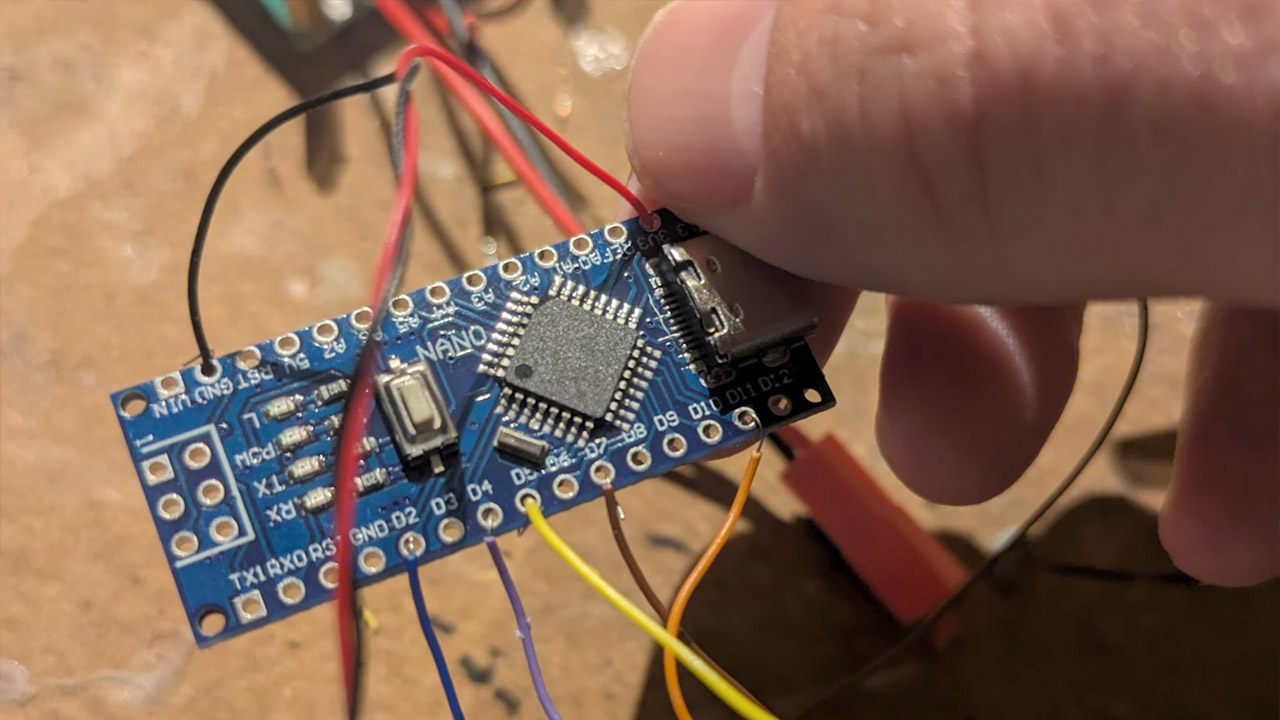
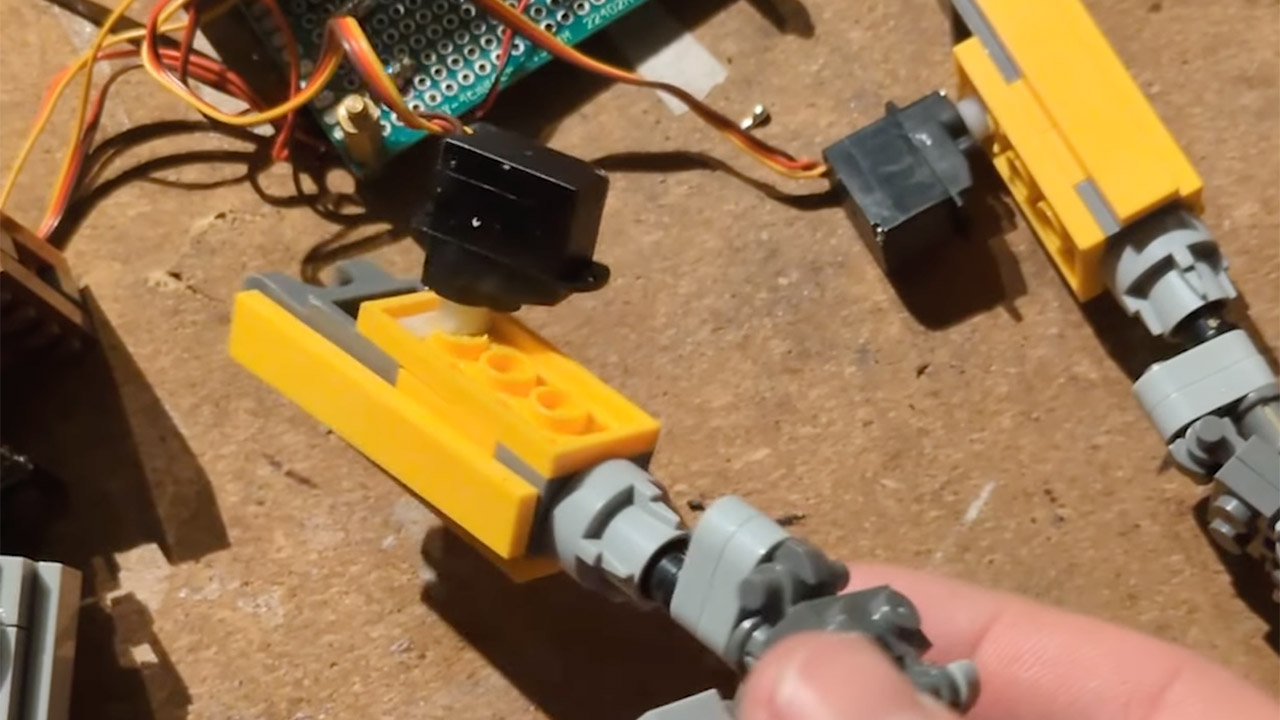
You’ll also notice a host of tiny micro servos hidden away doing their thing, such as making the arms go up and down on a timer so they don’t collide with the tracks, opening and closing the front hatch, and even adjusting the head from side to side when you press a button so it appears to be looking around. Since there weren’t enough pins on the ESP32 to handle everything, an Arduino Nano had to come in and help with the chest-mounted screen, which displays an animated solar charging graphic and tells you how much battery life you have left. Some addressable LEDs illuminate the headlights and taillights, and when the party mode is enabled, they flash all over the body like crazy. Finally, when you press the controller’s touchpad, a small speaker plays some brief and beautiful sound clips from the film.
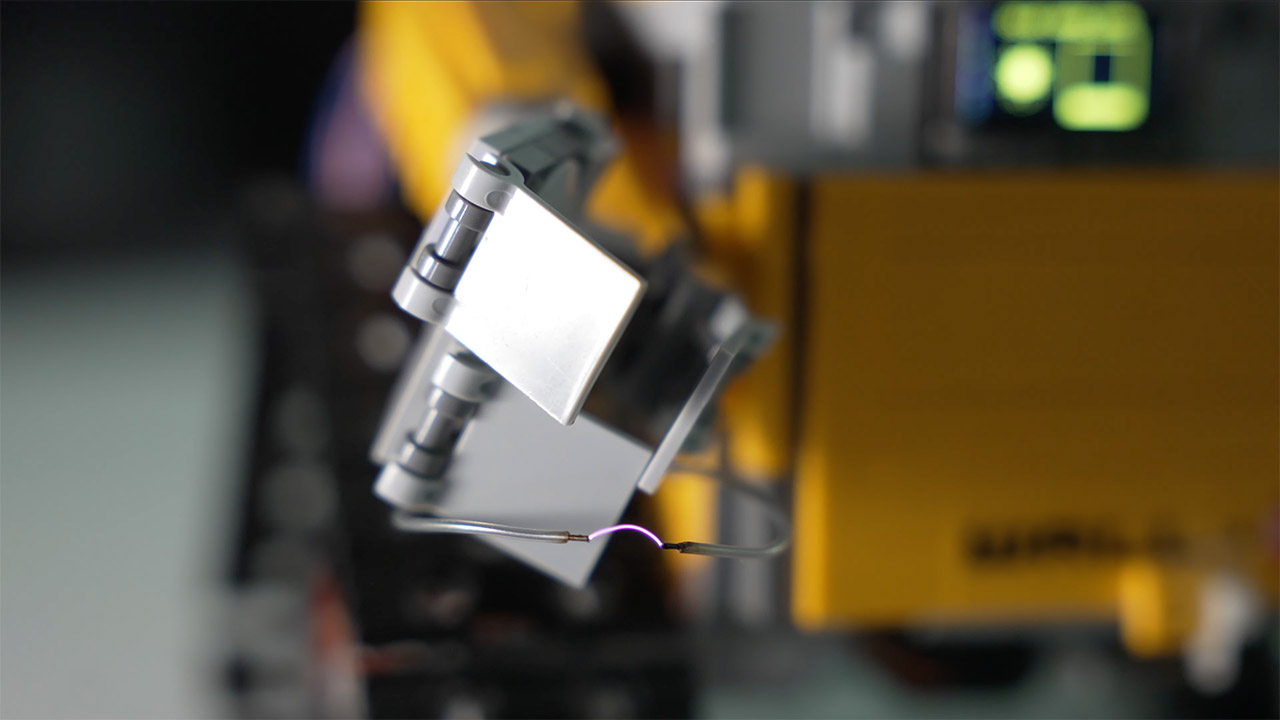
One of the most useful features is that Crostplay2 designed and printed custom mounts and gears that really work with LEGO, as normal bricks weren’t going to suffice for extra power. Thanks to those carefully printed components, the complete device seems very clean from the outside. Prioritizing safety, a small isolation switch was included to protect the motor drivers during firmware upgrades after some questionable input during the early stages of development fried a couple of boards. Crostplay2 also included a tiny 2,000-volt taser module, which allows you to create some real drama, complete with visible electrical arcs, when you want that extra burst of personality to match the movie’s daring vibe. [Source]
South Korea’s deputy PM says AI wealth must reach the public, citing Samsung’s near-strike and Hyundai’s Atlas robot rollout as warnings.
South Korea’s Deputy Prime Minister Bae Kyung-hoon said the wealth created by artificial intelligence must benefit the wider public, warning that the labour tensions that nearly shut down Samsung Electronics this week are not an isolated event but a preview of what the AI era will produce. Speaking to CNBC on Friday, Bae said that as AI generates unprecedented corporate profits, the question of how that wealth is distributed, and whether the technology worsens inequality, is now a matter of national policy.
“In the age of AI, more of these super-large companies will continue to emerge,” Bae said. “In that process, labour-management conflicts may continue to arise, and when they do, it will be important to resolve them wisely through dialogue.”
The reference was unmistakable. Samsung’s largest labour union had been preparing an 18-day strike that South Korea’s prime minister warned could cost $668 million per day. The walkout was suspended on Wednesday after government-mediated negotiations produced a tentative deal. Workers had demanded that 15% of Samsung’s operating profit be allocated to bonuses and formalised in employment contracts. Samsung had offered 10%. The union is voting on the proposed agreement from Friday to 27 May.
The dispute was not abstract. Samsung’s Q1 2026 operating profit reached ₩57.2 trillion, an eightfold year-on-year increase, driven almost entirely by high-bandwidth memory chips for AI infrastructure. The Lee family’s wealth doubled to $45.5 billion in twelve months. Samsung’s share price has risen nearly 144% year to date. SK Hynix is up almost 200%. The Kospi index has gained more than 86% in 2026, surpassing last year’s 75% rise. The wealth is real, concentrated, and visible.
Advertisement
Bae, who also serves as South Korea’s minister for science and technology, pointed at automaker Hyundai as another pressure point. The company is integrating Boston Dynamics’ Atlas robots into its manufacturing processes, a deployment that Bae said has generated “many concerns and worries” about the impact on workers. Hyundai acquired a controlling stake in Boston Dynamics in 2021 and announced its AI robotics strategy at CES 2026, positioning itself to lead what it calls a “human-centred robotics era.” The framing is aspirational. For workers on the production line, the concern is more immediate.
The political context adds urgency. On 12 May, South Korean presidential official Kim Yeong Beom proposed on Facebook to distribute excess tax revenue generated from Korea’s AI and semiconductor sectors directly to citizens. The post triggered turmoil in markets, with Samsung and SK Hynix shares dropping sharply before an official reportedly clarified that the proposal was Kim’s personal opinion and not a subject of formal government discussions. The fact that even a speculative post about redistributing AI wealth could move billions in market capitalisation illustrates how sensitive the question has become.
Bae framed Seoul’s goal as building an “AI-inclusive society, a society where no one is left behind in the AI era.” The language echoes similar commitments from European and American policymakers, but South Korea’s position is unusual. The country’s economy is more dependent on semiconductor manufacturing than any other advanced nation. Chips accounted for 37% of South Korea’s total exports in April. Samsung and SK Hynix together represent a disproportionate share of the Kospi’s gains. The AI boom is not one sector among many for South Korea. It is the sector.
When asked whether the concentration of market gains in two companies represented a vulnerability, Bae argued that Samsung and SK Hynix sit atop a broader ecosystem of suppliers and service companies that also benefit. He said South Korea is now trying to establish a competitive advantage in physical AI, the category that encompasses robots, autonomous vehicles, and industrial systems capable of sensing, reasoning, and acting in real-world environments. “Semiconductors and AI infrastructure provide the fundamental foundation,” Bae said. “On top of that, Korea is trying to build out the full spectrum of AI capabilities, including various hardware equipment, software, and related services.”
Advertisement
The tension between AI-driven productivity and workforce displacement is global. Detroit’s Big Three automakers have cut 20,000 white-collar jobs while posting hundreds of AI positions. Salesforce cut 4,000 support staff after deploying AI agents. The pattern is consistent across industries and geographies: AI makes companies more profitable and workforces smaller, and the question of who captures the gains is becoming the defining political issue of the technology’s adoption.
South Korea’s version of this question is sharper than most because the gains are so concentrated. Two companies, in one sector, in one country, have seen their combined market value increase by hundreds of billions of dollars in six months. The workers who run the fabrication lines that produce the memory chips powering the AI boom nearly walked off the job this week. Bae’s statement that “the benefits of AI must also go to the public” is an acknowledgement that the market alone will not solve the distribution problem. Whether Seoul’s policy response matches the scale of its rhetoric will be tested every time the next Samsung contract cycle arrives, and every time a Hyundai factory installs another Atlas robot.
Early iPhone 20 leaks indicate a screen that curves gently along every edge of the device. This wraparound approach could eliminate the typical bezels and give the front a continuous look with no visible breaks. When combined with a full glass back, the entire handset may feel like one smooth slab held in the hand.
According to reports, this is part of a larger plan for the 2027 release, which will commemorate the twentieth anniversary of the first iPhone. According to several supply chain insiders who use social media, curved display prototypes are currently in the testing phase. The early manufacturing stages may encounter some challenges, but it is evident that they are making considerable work toward developing the panels that Samsung will manufacture specifically for them.
People in the know mention a simpler rear camera configuration on some models; a prevalent theme is two lenses side by side in a small horizontal strip. We’ve heard that one of the new camera sensors is designed to pick up a lot more light and detail in images, offering users better overall results. Of course, ordinary models are expected to retain a small notch for the front camera, whilst a special edition may take it a step further by totally concealing the selfie camera and face recognition features beneath the display.
Battery life appears to be a significant improvement, as Apple is rumored to be transitioning to silicon-anode technology, which allows you to pack more energy into the existing battery while also stretching out the time between top ups. This transition away from lithium-based cells will not make the phone any larger or heavier. Inside the handset, we can expect to see the new, next-generation A21 processor paired with some fancy new high bandwidth RAM, which will aid in the performance of some of the more demanding AI technologies running on the phone. Some speculate that the chip’s manufacturing process may alter, although nothing has been proven as of yet.
It appears that the chassis may also change significantly. There is a lot of discussion about employing materials other than titanium and aluminum, such as new alloys that can withstand higher temperatures and are lighter. That will have to be weighed against the fact that the frame must hold the curved glass while remaining strong enough to handle daily wear and tear. Physical buttons may disappear and be replaced by touch-sensitive surfaces on the sides. These would function by recognizing pushes via vibrations, similar to a laptop trackpad, making it very easy to distinguish between a light or forceful touch. [Source]
It’s been a long, long time coming, but remakes of two all-time classic puzzle adventure games hit PS5 and PS VR2 this week. Cyan Worlds released this version of Myst on Meta Quest headsets in 2020; PC, Mac and Xbox in 2021; and iOS in 2022. PlayStation had been an outlier until now. It’s available for Sony’s console and VR headset (usually $35, 20 percent of for PlayStation Plus members until May 26)
The remake of the sequel, Riven, debuted on PS5, PS VR2, Xbox Series X/S and the Microsoft Store on PC as well (also $35, but with a limited-time discount). The PS5 Pro versions of both games have “better view distance, foliage, textures, post-processing and shading,” per the PlayStation Blog.
I’ve never played Myst, but Riven was one of the first games I had on PC as a kid. I remember it looking very pretty back then, unlike any game I’d seen before.
Advertisement
Alas, I never made much progress. If I recall correctly, I couldn’t figure out what some of the various handles and levers I found in the opening section actually did and I quickly gave up. Perhaps I’d have more success in Riven (and Myst) now, even if puzzle games aren’t necessarily my forte.
Speaking of being an idiot as a child, I spent a lot of time playing Bubsy in: Claws Encounters of the Furred Kind when I was young. I really liked it at the time, but in hindsight that game is not good. I mention this because Bubsy 4D — the first Bubsy game since 2019 and the first one in 3D in 30 years — dropped this week.
The quippy bobcat is back thanks to Fabraz (Demon Tides) and publisher Atari. In this platformer, Bubsy sets out on a mission to recover a Golden Fleece from the technologically enhanced sheep that stole it — I’m not going to try to explain the lore beyond that.
Advertisement
Bubsy has some new tools at his disposal, like being able to roll into a ball form and move faster. That should help players who want to finish levels as quickly as possible as claw their way up the online leaderboards.
There’ll be a nostalgia factor for a lot of players here. Honestly, it’s strangely comforting to me that Bubsy sounds as annoying as ever.
Thick as Thieves is a game that we’ve had our eye on for a while, and it’s had an interesting journey toward hitting Steam this week ($5). This was originally planned as a multiplayer heist game from a team that includes two stalwarts of the immersive sim and stealth genres in Thief and System Shock 2 veteran Paul Neurath and Deus Ex creator Warren Spector. The idea was that players would battle each other to steal valuable items in a 1910s setting that featured magic and nascent technology.
However, during development, OtherSide Entertainment pivoted after realizing that the solo and two-player co-op mode was more fun than the original vision of competitive heists. The developers said they may add a PvPvE mode down the line.
To begin with, Thick as Thieves features two thieves, two maps (which can be altered by adjusting the difficulty settings), 16 contracts and half-a-dozen pieces of gear. At the outset, the campaign is said to last for around four hours.
Advertisement
Amanita Design’s latest game is Phonopolis, which looks utterly gorgeous in this trailer. It’s a puzzle adventure set in a 3D world made from hand-painted cardboard. The developers animated it at 12fps to mimic the style of stop-motion films.
Here, the residents of the dystopian city of Phonopolis are bossed around by a leader who issues commands via loudspeakers. But one young resident is immune to these orders and starts to fight back against The Man. As Felix, you can rebel by manipulating the loudspeakers to solve puzzles with the help of other characters. You’ll be shifting the environment around as well.
Phonopolis is hitting all the right notes for me and I’m eager to check it out. It’s available on Steam, GOG and Epic Games Store. It’ll usually run you $25, but there’s a 10 percent discount until June 3.
We may receive a commission on purchases made from links.
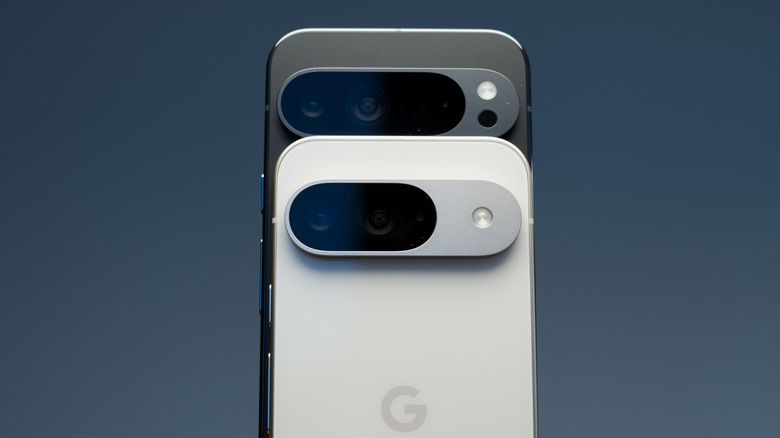
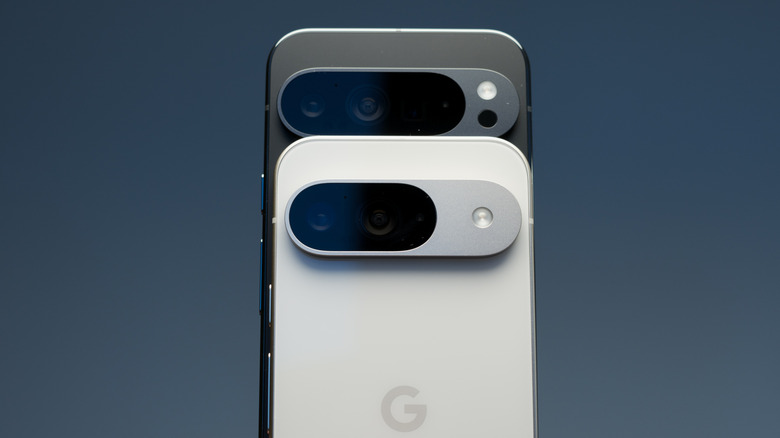
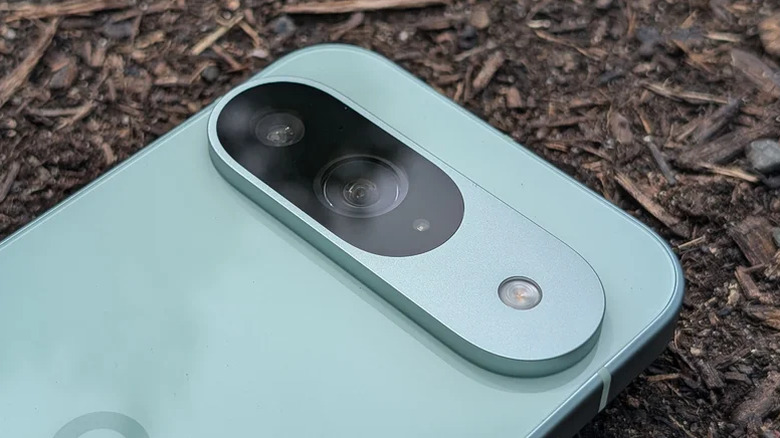
Google’s Pixel series turned 10 with the launch of the Pixel 10 in 2025. For the most part, it seems like Google has found its identity in the smartphone space. You get that distinct camera visor look with all Pixel smartphones, the cleanest Android experience, day-one software updates, and a camera system that holds up remarkably well against the Samsungs and iPhones of the world. Priced at $800 for the 128GB model, the Pixel 10 offers a great display, solid performance, and a capable set of cameras.
If you’re looking for a more budget-friendly option, the Pixel 10a that we reviewed is also a great buy at $500. You get all the essentials, including a 120Hz display, but you are relegated to the previous generation Tensor G4 chip of the Pixel 9, so why not just consider that? If you can snag one on discount, the Pixel 9 is still a decent device to purchase in 2026. It’s currently available on Best Buy for the same price as the Pixel 10a.
Advertisement
Last generation’s model still offers a clean software experience, long-term support, and solid cameras. However, if you’re okay with slightly less amazing cameras and open to trying out a different flavor of Android, you can do better for the price, especially if performance and battery life are top priorities.
Advertisement
Why the Pixel 9 still holds up
Karlis Dambrans/Shutterstock
The Pixel 9 was launched in August 2024. That doesn’t seem like that long ago, but in smartphone years, it is still considered last generation hardware. Fortunately, Google’s excellent commitment to software updates makes even older flagships feel relevant for much longer. Like the iPhone, Google’s Pixel smartphones receive up to seven years of OS updates and security patches. This means the Pixel 9 should theoretically be supported all the way up to Android 20 in 2029, given that it launched with Android 14 out of the box.
In our review of the Pixel 9, we mentioned how it still managed to capture impressive photos despite dropping the telephoto lens of the costlier Pixel 9 Pro. While Pixels are typically not known for having the best endurance, we reported decent battery life, with the phone lasting all day with regular use. You also get a sprinkle of AI features with Gemini built-in, which offers a more complete experience compared to Apple Intelligence found on the similarly priced iPhone 17e.
You get a 6.3-inch OLED 120Hz display and a glass sandwich build with an aluminum frame going all around. Compared to the Pixel 10a, you are getting a more premium experience here. Unfortunately, the base variant comes with 128GB of storage space, but considering even the newer Pixel 10 ships with the same capacity, the compromise doesn’t sting quite as much.
Advertisement
Features the Pixel 9 is missing
Chris Burns/SlashGear
There are certain things to consider when picking up a previous-generation smartphone. For starters, the Pixel 9 doesn’t have built-in magnets for wireless charging. Pixelsnap is a hardware addition available on newer Pixel smartphones that lets you use MagSafe-compatible accessories without a specially designed case. However, the Pixel 10a also doesn’t have Pixelsnap, so it shouldn’t be a deciding factor at this price point.
You are also losing an extra camera sensor with the Pixel 9. The Pixel 10 sports a 5x telephoto lens that will yield better zoom shots. While we’ve touted long-term software support as a reason to pick up a Pixel 9, it’s worth noting that Google launched it with Android 14, despite Android 15 being unveiled the same year. It’s unclear if Google will count Android 14 as one of the Pixel 9’s seven promised OS upgrades, which would technically mean the phone would receive one fewer Android update than what buyers might have anticipated.
Lastly, while the Tensor G4 is a capable chip, its prowess fades in comparison to what the latest from Snapdragon or even MediaTek has to offer. To add insult to injury, some of the most powerful smartphones around don’t even cost that much more than a brand-new Pixel. The bottom line is that the Pixel 9 is a good buy, as long as you’re not looking for the latest features or planning to put it through intensive workloads.
GitHub has said it found about 3,800 internal repositories accessed in the breach and stressed that these contained its own code rather than customer projects. The attackers, a group calling itself TeamPCP, claim the number is closer to 4,000 and are actively attempting to sell the stolen data. Read Entire Article Source link
Watch Leinster vs Bordeaux live streams in the 2025/26 Investec Champions Cup final as the two unbeaten sides clash in what should be a highly competitive game at the San Mamés Stadium in Bilbao.
Eight years after their last title and four final defeats, Leinster have another opportunity to secure a fifth European crown. Unbeaten in this year’s competition, the Blues held off a late fightback from Toulon in the semi-finals to reach their fourth Champions Cup final in five seasons. Leo Cullen’s side must now overcome their previous heartache and dethrone the defending champions. It’s a tough ask, but there is plenty of belief in the camp and a determination to add a fifth star to the shirt.
Like their final opponents, Bordeaux have won every game of this year’s competition, including a convincing victory over Bath to reach the final for the second straight year. Yannick Bru’s side have looked unstoppable, conquering all before them thanks in large part to the brilliant trio of star winger Louis Bielle-Biarrey and half-backs Maxime Lucu and Matthieu Jalibert. Full of confidence, they’ll have full belief that they can become just the sixth side to successfully retain the Champions Cup.
Advertisement
Read on for our guide on where to watch Leinster vs Bordeaux live streams online, on TV and potentially for free wherever you are.
Can I watch Leinster vs Bordeaux for free?
Leinster vs Bordeaux is free-to-air on ITV4 and via its streaming service, ITVX in the UK and on France 2 and France TV in France.
Traveling abroad right now? You can use a VPN to watch the 2025/26 Investec Champions Cup final for free as if you were right at home. NordVPN is our top pick of the options.
Advertisement
Leinster vs Bordeaux team news
TBC
How to watch Leinster vs Bordeaux using a VPN
A VPN is a handy piece of software that can make your device appear as if it’s back in your home country, so you can unlock your usual service. The best VPN right now? We recommend NordVPN – it does everything and comes with 4 months extra free right now.
Advertisement
How to watch Leinster vs Bordeaux live streams in the US
In the US, Leinster vs Bordeaux is being shown on FloRugby. A subscription costs $39.99/month or $155/year.
Visiting the US from the UK? Use NordVPN to tap into your free Leinster vs Bordeaux coverage.
How to watch Leinster vs Bordeaux live streams in the UK
(Image credit: Future)
As mentioned above, the Champions Cup final will be shown for free on ITVX.
Advertisement
However, the Leinster vs Bordeaux game is also available to watch on Premier Sports 1 in the UK.
A subscription costs £17.99/month, but if you’re willing to commit to a year you’ll pay £130.
Outside the UK? You’ll need to download a VPN, as detailed above, to tap into your 2025/26 Investec Champions Cup coverage from abroad.
Advertisement
How to watch Leinster vs Bordeaux live streams in South Africa
Leinster vs Bordeaux is available to watch on subscription service SuperSport in South Africa.
You’ll need a DStv access package to tune in, with prices starting at R99/month.
Abroad right now? Just use a VPN to watch from anywhere in the world.
Advertisement
How to watch Leinster vs Bordeaux live streams in Canada
(Image credit: Other)
FloRugby is the only place to watch this 2025/26 Investec Champions Cup final in Canada.
A monthly subscription costs US$39.99/month, but you’ll get more bang for your buck by committing to a year, which works out at US$12.99/month.
Visiting Canada from the UK or France? Use NordVPN to watch the Leinster vs Bordeaux game for free.
Advertisement
How to watch Leinster vs Bordeaux live streams in Australia
Fans based in Australia can live stream Leinster vs Bordeaux via the Investec Champions Cup’s dedicated streaming platform EPCR TV.
A Weekend Pass costs €14.99, and an individual Match Pass is available for €7.99.
Leinster vs Bordeaux kicks off at 2.45pm BST / 9.45am ET / 6.45am PT / 11.45pm AEST on Saturday, May 23.
Advertisement
Can I watch Leinster vs Bordeaux on my mobile?
Of course, most broadcasters have streaming services that you can access through mobile apps or via your phone’s browser.
You can also stay up-to-date with all things Investec Champions Cup on the official EPCR Champions Cup social media channels on X (@ChampionsCup), YouTube (@ChampionsCup) and Instagram (@EuropeanRugbyChampionsCup).
We test and review VPN services in the context of legal recreational uses. For example: 1. Accessing a service from another country (subject to the terms and conditions of that service). 2. Protecting your online security and strengthening your online privacy when abroad. We do not support or condone the illegal or malicious use of VPN services. Consuming pirated content that is paid-for is neither endorsed nor approved by Future Publishing.































































You must be logged in to post a comment Login