What actually makes a good pair of budget earbuds? I’ll say it’s sound quality, mixed with simplicity, with a sprinkle of some useful features. In my years of reviewing tech, there has been just one brand that’s been following this recipe perfectly, and that’s OPPO. Their Enco earbuds, as people would say these days, hit the spot, and I’m a fan, so much so that I’m still daily driving the Enco Buds 3 Pro+ from the last review. A few days back, the Chinese maker announced the all-new Enco Air 5 Pro, promising even better 55dB ANC, Bluetooth 6.0 support, and LHDC 5.0.
As expected, OPPO sent over the 5 Pro a couple of weeks back. Since then, I’ve made them my primary set of earbuds, taking them to the gym every day, using them while working, and also on a short flight to Delhi to test their ANC capabilities. Spoiler alert: They are my new favorite pair of earbuds. Here’s why.
OPPO Enco Air 5 Pro Review
Hisan Kidwai
Advertisement
Summary
The OPPO Enco Air 5 Pro are probably the easiest-to-recommend earbuds I’ve ever tested, simply because they don’t put a foot wrong. The design has been refined to feel even more premium, and the case no longer picks up smudges. Comfort is top-tier across all ear sizes. The sound feels super balanced, with clear vocals and controlled mids and highs. Not to mention the awesome ANC, which can dampen any aircraft noise without issues, helping you zone out into the music. Controls are intuitive and easy to understand for just about everyone.
Advertisement
Design & Comfort
If you remember the previous Enco Air 3 Pro+, they were a pretty handy pair of earphones. They weren’t too big, and the matte finish looked pretty at first. But over the past few months, I’ve noticed permanent smudge marks on them that won’t go away. Very fortunately, that won’t be the case for the Enco 5 Pro. OPPO has redesigned almost every part, and I’m a fan. You still get the pill-shaped case, but OPPO has trimmed the dimensions. It’s now even more portable, which is great news.
Next on the redesign list is the finish. It’s a soft-touch black powder coat that feels really nice in the hand. It only picks up small smudges, and they can be wiped away with a wet towel in seconds. The opening/closing mechanism is still super satisfying, meaning I was using it as a fidget toy. Thankfully, OPPO hasn’t done away with the physical pairing button, so you won’t have to perform finger gymnastics to pair with a new phone.
Comfort has always been tricky for me. I have small ears, so anything that’s bulky just slips out after a few minutes. That’s exactly why I couldn’t daily drive the Noise Master Buds 2. Surprisingly, OPPO is the only brand that’s stayed in my ears just fine, and I’m glad to report the same about the Enco Air 5 Pro. They are lightweight and supremely comfortable, meaning I could wear them on a long flight without any hiccups and carry them out while doing my daily chores, forgetting they are in my ears.
OPPO has also bundled a couple of differently sized tips, so if the pre-applied ones feel small or large, you can experiment with others. The buds are IP55 certified, meaning they’ll withstand a sweaty gym session without a hitch, but submersion will be a problem; keep an eye out for that.
Sound Quality & ANC
The OPPO Enco Air 5 Pro comes with 12mm Titanium-Coated Diaphragm drivers and support for LHDC 5.0, and Bluetooth 6.0. All my testing was done on the Ultimate Sound preset, but there are a couple of other presets available, along with a full equalizer, which we will talk about soon. To put the Enco 5 Pro through its paces, I started my listening session with Michael Jackson’s “Billie Jean” and “Heartless” by The Weeknd. The earbuds are tuned to be balanced, irrespective of what song you listen to. The Hi-Fi vocals sound clear without distortion at higher volumes, and the background drums on Heartless have a little thump, which is always appreciated. The highs don’t screech your ears, and OPPO has even managed to hit the treble on point.
I also found that all the instruments have very good separation, but if you’d like them placed all around you, OPPO has its Live Audio feature. I’m not the biggest fan of this tech, but I’d be lying if I said the experience was bad. The Enco Air 5 Pro places different elements perfectly around you. For all my movie fanatics, I watched a couple of episodes of Better Call Saul with the earbuds connected to my Mac. The latency wasn’t an issue, as the dialogue was in sync with the lips and the audio quality was clean. Calls have been improved quite a bit compared to the predecessor, with crisper audio and better noise reduction.
As far as ANC is concerned, its biggest test is flights. That rumble of the jet engine can get annoying fast, and I absolutely don’t like it. Since I was due to attend an event in Delhi, I took the 5 Pro with me, and the experience did not disappoint. At 55dB of ANC, I’d say the buds canceled about 85% of the jet engine rumble, without any music on. That’s really good compared to the 3 Pro+, which were around the 40% mark. With any music on at around half volume, most engine noise disappears, and the experience is the same as if you were sitting in your living room. It is important to note that high-pitched noises, such as a couple arguing, will still make their way through.
OPPO claims about 13 hours of battery life on a single charge for the earbuds, and while my 8 hours is less than the claimed number, it’s still plenty good, especially with ANC turned on at all times. The case provides a couple of extra charges, so the total output should be around 24-25 hours, depending on your use case. Still, battery life is great overall.
Advertisement
Controls & Companion App
Controls can, at least for me, make or break the experience. Thankfully, the Enco Air 5 Pro gets this right, which has some of the best controls I’ve tested so far. Headlining it all is the new volume adjustment settings, which lets you slide up/down on both earbuds to raise or lower the volume. It works super effectively and doesn’t mess up the fit much. Beyond that, you get the basics like double-tap to play/pause the music, triple-tap to skip forward/rewind, and tap and hold to turn on ANC. All of these are customizable to your liking.
The earbuds can be controlled via the HeyMelody app or directly from the Bluetooth settings page if you’re using an OPPO or OnePlus phone. The app is slick and responsive, and this time OPPO has debuted the new Spotify Tap feature. For those unaware, it connects to your Spotify app and plays a song according to your taste whenever you tap your earbuds. I’m an Apple Music user, but I do see the appeal. There’s also Sound Space, which includes different white noises, like waves crashing on the shore, morning sunshine, and night camping. All of which can help you better concentrate at work or sleep better. Last but not least, a full 10-band equalizer lets you tune the sound output precisely to your liking. I did try it, but since I’m no musician, I left it in OPPO’s hands with the different presets.
Verdict
At ₹4,999, the OPPO Enco Air 5 Pro are probably the easiest-to-recommend earbuds I’ve ever tested, simply because they don’t put a foot wrong. The design has been refined to feel even more premium, and the case no longer picks up smudges. Comfort is top-tier across all ear sizes. The sound feels super balanced, with clear vocals and controlled mids and highs. Not to mention the awesome ANC, which can dampen any aircraft noise without issues, helping you zone out into the music. Controls are intuitive and easy to understand for just about everyone. They get a solid recommendation from me and should absolutely be on your radar.
The annual tech showcase highlights next-gen AI, cloud, and future-ready ICT solutions while uniting ecosystem partners to build the foundation for the nation’s AI era
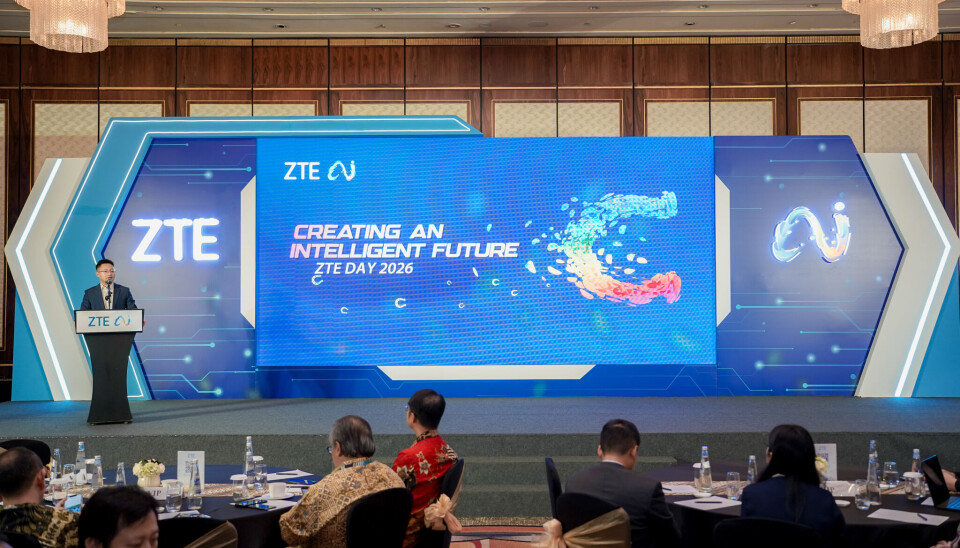
Partner Content ZTE Corporation (0763.HK / 000063.SZ), a global leading provider of integrated information and communication technology solutions, held ZTE Day Indonesia 2026 in Jakarta, as its annual technology showcase event, bringing together industry leaders, technology partners, and digital ecosystem players to discuss the future of AI, intelligent infrastructure, and digital transformation in Indonesia.
ZTE reinforced its commitment to accelerating Indonesia’s digital economy growth through intelligent and future-ready ICT solutions
As industries increasingly adopt AI, cloud technologies, and data-driven operations, the demand for smarter, adaptive, and future-ready digital infrastructure continues to accelerate. Responding to this momentum, ZTE Day Indonesia 2026 highlighted how AI, intelligent networks, cloud infrastructure, and next-generation connectivity are becoming key foundations for national digital competitiveness and future economic growth.
The event showcased a broad range of integrated ICT innovations spanning artificial intelligence (AI), intelligent computing, cloud infrastructure, optical transport, enterprise networking, Wi-Fi 7, and next-generation connectivity technologies designed to support enterprises, operators, and industries navigating the AI era.
Advertisement
Liu Sen, President Director of ZTE Indonesia, stated that Indonesia is currently entering an important phase of digital transformation, where progress will increasingly depend on strong collaboration between technology providers, infrastructure players, and partners across the digital ecosystem.
“Indonesia is currently entering an important phase of digital transformation, where AI, cloud technologies, and intelligent connectivity will become the key foundations of future digital economic growth. Through ZTE Day Indonesia 2026, we aim to demonstrate how technology innovation can be implemented to support the development of smarter, more efficient, and sustainable digital infrastructure. We believe that cross-industry collaboration will play a crucial role in building a strong digital foundation to support Indonesia’s vision of becoming a leading digital economy,” said Liu Sen.
Beyond showcasing technology innovations, ZTE Day Indonesia 2026 also emphasized the growing importance of ecosystem collaboration in supporting Indonesia’s AI-ready digital landscape.
During the exhibition showcase, ZTE presented a series of its latest innovations, including nubia’s latest AI smartphone, high-performance AI server solutions, optical transport technologies, AI-powered network management systems, and Wi-Fi 7 enterprise connectivity solutions.
Advertisement
ZTE also demonstrated its comprehensive end-to-end digital ecosystem capabilities through solutions covering RAN, microwave, transport network, core network, fixed network, and big video solutions. These innovations reflected the company’s commitment to supporting operators, enterprises, and industries in addressing the evolving demands of the digital era.
As part of ZTE Day Indonesia 2026, the ZTE Open Day Afternoon Session featured keynote presentations from Prof. Viciano Lee of Sertis Indonesia, Sami Muhammad Salman from Whale Cloud Technology Indonesia, Mohan Albert, Director of CTO Group at ZTE, and Chok Shin Lip, Partner Solution Architect Director at Alibaba Cloud Intelligence.
The keynote sessions explored the growing role of AI, cloud technologies, intelligent infrastructure, and ecosystem collaboration in supporting enterprise transformation and accelerating Indonesia’s digital economy development.
The event also hosted a panel discussion titled “Connecting the Ecosystem: Intelligent Connectivity for Enterprise Integration & Value Innovation”, featuring industry leaders including Eric Arianto, Chief Technology & Network Officer of Linknet, Irawan Delfi, Network Development Division Head of Fiberstar, and Sigit Dwi Cahyo, Head of Technology Planning and Product of Tower Bersama Group. The panel explored the importance of intelligent connectivity, fiber infrastructure readiness, and ecosystem integration in supporting enterprise digitalization, service innovation, and the growing demand for seamless digital experiences across industries.
Advertisement
Panel discussion titled “Connecting the Ecosystem: Intelligent Connectivity for Enterprise Integration & Value Innovation”
Another panel discussion titled “Building the Foundation: Digital Infrastructure for Indonesia’s AI Era”, moderated by Vincent Han, featured industry leaders including Abieta Billy from DCI Indonesia, Muljadi Muhali from Fortress Digital Services, and Marlo Budiman from DSST Mas Gemilang. The second panel emphasized the importance of strengthening digital infrastructure readiness, enhancing data center capabilities, and fostering industry collaboration to support the growing adoption of AI technologies and Indonesia’s broader digital transformation agenda.
Panel discussion titled “Building the Foundation: Digital Infrastructure for Indonesia’s AI Era”
Through keynote sessions, panel discussions, interactive product demonstrations, and networking activities, ZTE Day Indonesia 2026 provided customers, partners, and industry stakeholders with deeper insights into AI implementation, intelligent digital infrastructure, and real-world applications of next-generation technologies across industries.
ZTE Day Indonesia 2026 showcased the latest AI, cloud, and intelligent connectivity innovations to support Indonesia’s digital transformation
Image Playground will generate images based on provided photos and other inputs, but the results leave a lot to be desired
Generative AI is not Apple’s strong suit, but Image Playground, the tool responsible for horrific AI avatar generation and Genmoji, should see significant improvements with the OS 27 cycle.
Apple announced Apple Intelligence features that had to be delayed in 2024, and one of them should have been Image Playground. While the other AI tools were of passable usefulness and quality, the image generation tool still leaves a lot to be desired.
According to the “Power On” newsletter from Bloomberg, the Image Playground app should see a “big boost” from Apple’s upgraded Apple Foundation Models. It’s an obvious statement given that Gemini is being distilled into Apple’s models, and one of Gemini’s specialties is image generation.
Advertisement
However, even as Apple’s image generation feature improves, its models will still likely lag behind competing options by some margin. Users that want more oomph behind their image generation in Image Playground will be able to use third-party models of their choosing.
Image generation is bad AI
While the results are often unfortunate, Image Playground is more of a proof-of-concept than a useful tool in its current form. Apple presented it as a way to turn your mom into an AI-slop superhero for what would be a simply terrible birthday message.
While no one on Earth should use Image Playground for that function, it can be somewhat entertaining the same way other gen AI models have been. Using it to see how it might interpret a specific person or prompt can be amusing, but the output isn’t something anyone could or should rely on for anything beyond a giggle in an iMessage group chat.
The only good thing about Image Playground output (when using Apple’s models) is that it’s either on device or in Private Cloud Compute servers that run on renewable energy. While generative slop is loaded with moral quandaries, that’s one area Image Playground doesn’t suffer from.
Advertisement
Genmoji is the true winner in Image Playground. While it isn’t a function I’ve used much, it has enough guardrails that it can make some decent results.
Even if Image Playground is able to one day achieve Pixar or Ghibli-level results with on-device AI, there’s the argument that all gen AI is bad for humanity. One area of image generation Apple will no doubt stay away from is the ability to produce photorealistic output, which can lead to problems like deepfakes.
OS 27 getting new Apple Foundation Models
iOS 27 is expected to make Genmoji more proactive in the system by suggesting premade options in the text suggestion box. Shared Genmoji become available to the people you send them to, so everyone can get some use out of that weed emoji.
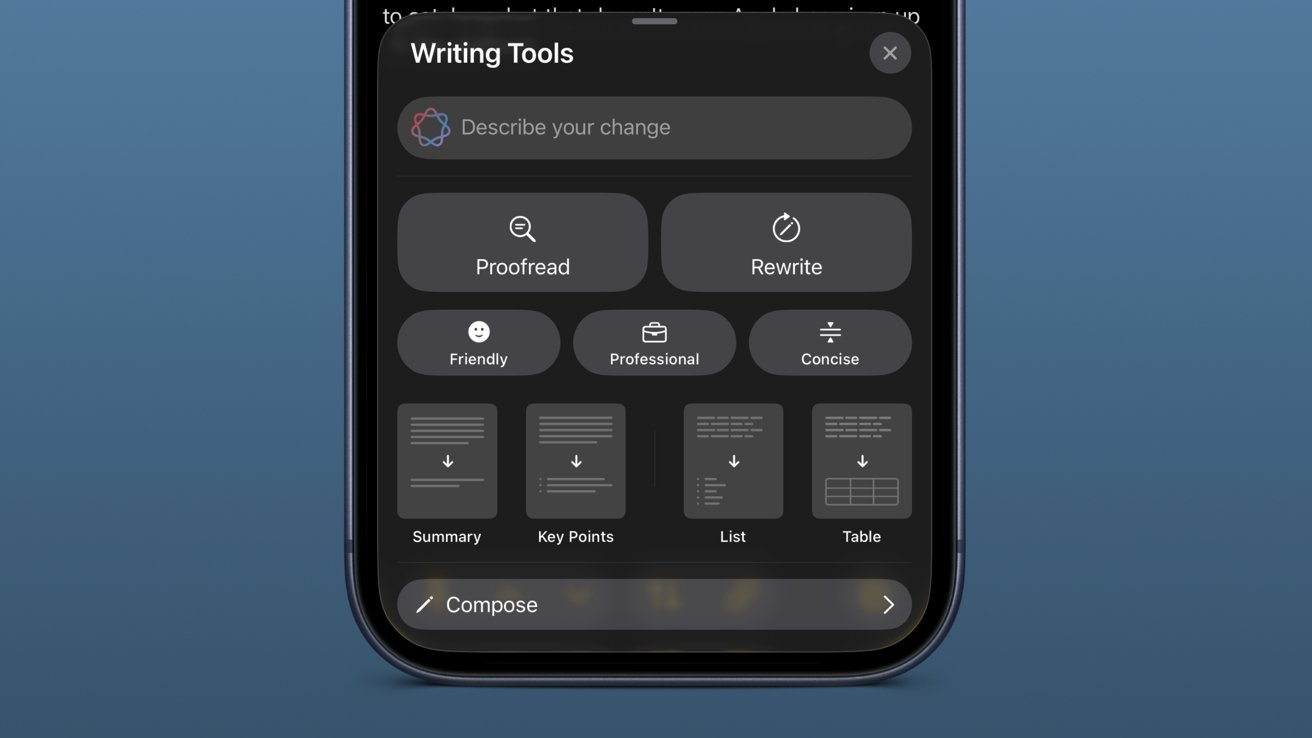
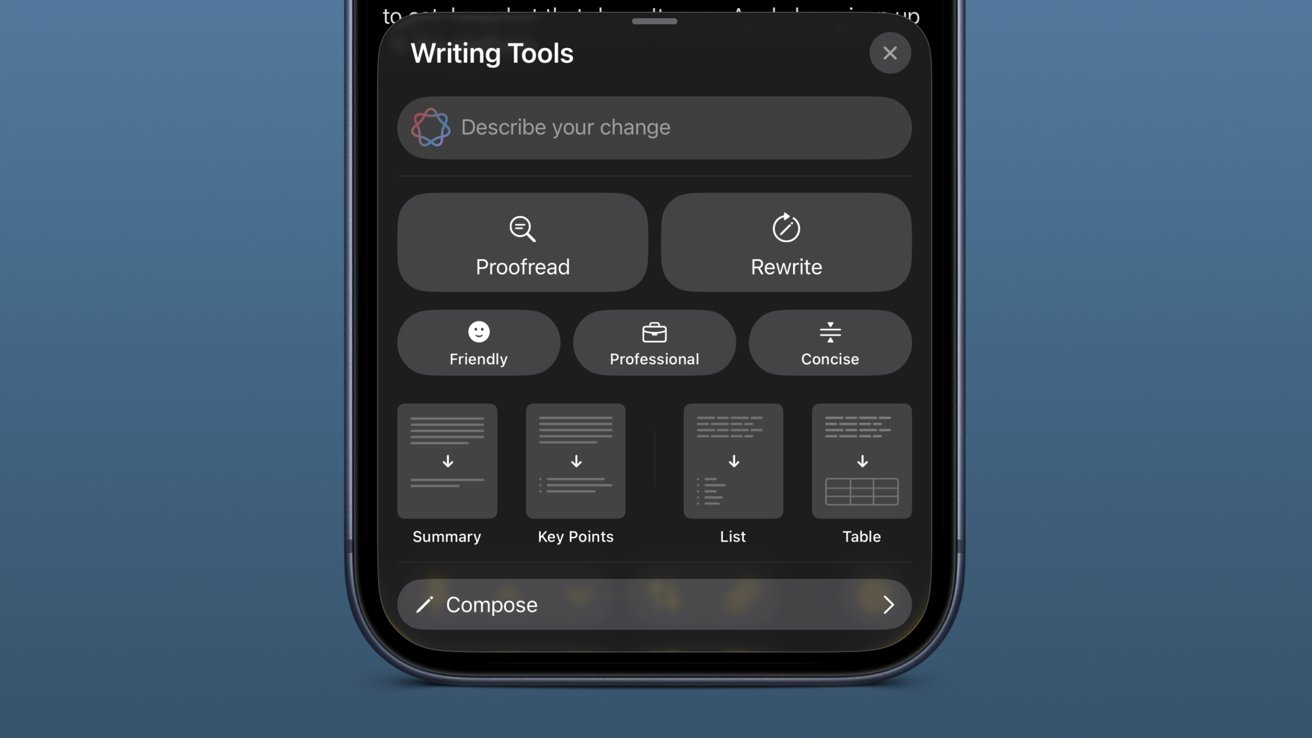
Writing Tools are one of Apple’s better AI features
Advertisement
Apple’s weakest offerings in AI are its generative functions, however, they’re fully optional and easily ignored. There is no doubt Apple will continue to pursue better image generation, but if that’s something you want to do, you might want to stick to other apps.
That said, Image Playground could prove much better in OS 27 and earn its place as a useful toolset. The app itself is fine, but Image Playground also exists outside of the app as an extension interface in places like Notes and Freeform.
If Apple can make Image Playground a useful tool that can run on devices with Apple’s arguably somewhat ethical AI models, then I welcome it. Though improvements could mean turning the tool into a plagiarism machine, which will create a whole different set of issues.
People that want to perform these functions are going to seek out tools that offer them. If gen AI must exist to meet consumer expectations, then Apple should have a good offering.
Advertisement
These fake images that lack artistic ingenuity or integrity are getting created no matter what. So, if some of them can be made with ethically sourced AI, local models running on a device’s battery, or on private servers powered by renewable energy, I’d say it is a net positive.
The ability to choose third-party models for Image Playground through a system API will prove interesting. However, once you’ve sent your data to that third-party, all bets are off from an ethical and privacy-oriented standpoint.
At least you can make a plagiarized Ghibli avatar for social media instead of paying a human to make one for you, I guess.
Cisco has released security updates to address a maximum-severity Secure Workload vulnerability that allows attackers to gain Site Admin privileges.
Formerly known as Cisco Tetration, Cisco Secure Workload helps admins reduce their network’s attack surface through zero trust microsegmentation and stop lateral movement to keep business applications safe.
Tracked as CVE-2026-20223, the security flaw was found in Secure Workload’s internal REST APIs, and it enables unauthenticated attackers to access resources with the privileges of the Site Admin role.
“This vulnerability is due to insufficient validation and authentication when accessing REST API endpoints. An attacker could exploit this vulnerability if they are able to send a crafted API request to an affected endpoint,” Cisco explained in a Wednesday advisory.
Advertisement
“A successful exploit could allow the attacker to read sensitive information and make configuration changes across tenant boundaries with the privileges of the Site Admin user.”
Cisco says there are no workarounds for this security flaw, has released software updates to patch it for on-premises customers, and has already addressed it in the cloud-based Cisco Secure Workload SaaS deployment.
Cisco Secure Workload Release
First Fixed Release
3.9 and earlier
Advertisement
Migrate to a fixed release.
3.10
3.10.8.3
4.0
4.0.3.17
The company also added that its Product Security Incident Response Team (PSIRT) has not found evidence that the vulnerability has been exploited in the wild before publishing this week’s advisory.
The U.S. Cybersecurity and Infrastructure Security Agency (CISA) added the CVE-2026-20182 flaw to its Known Exploited Vulnerabilities Catalog on May 14 and ordered federal agencies to secure affected devices within three days, by May 17.
Over the past five years, CISA has flagged 91 Cisco vulnerabilities as actively exploited, six of which have been used by various ransomware gangs.
Automated pentesting tools deliver real value, but they were built to answer one question: can an attacker move through the network? They were not built to test whether your controls block threats, your detection rules fire, or your cloud configs hold.
This guide covers the 6 surfaces you actually need to validate.
CEO eyes margin gains by keeping headcount flat – bold for a company selling HR software to employers
Workday is hoping to boost its revenue
and margins by using AI agents instead of hiring
people, according to its CEO.
After announcing revenue growth, Aneel Bhusri – the company co-founder who was reinstated as CEO in February – said his aspiration is to keep headcount
the same while sustaining growth and increasing margins by harnessing AI.
Advertisement
“I’d love to see us continue the growth
that we had in Q1, but keep headcount as close to flat for the year as possible
because we are getting the benefits of using our own products and other AI
tools. That’s where I’m hopeful and believe that we’re going to have additional
margin expansion as we get those benefits. That’s different than what my view
was coming in three months ago.”
In its Q1 results ended April 30, Workday recorded net profit of $222 million versus $68 million in the prior year, when the bottom line was hit by restructuring expenses. Revenue generated for the three months was $2.54 billion, up 13.5 percent year-on-year.
The results beat market expectations and Workday forecast higher margins for the rest of the year, sending its share price up 10 percent in
after-hours trading.
Bhusri’s aspiration to keep headcount flat
while increasing revenue and margins follows a roller-coaster ride of public statements on employment
plans.
Advertisement
In February 2025, Workday announced
an 8.5 percent cut to its global workforce – 1,750 positions – as it “intended to prioritize its investments and continue advancing Workday’s ongoing focus on durable growth,” an SEC
filing said.
In June 2025, CFO Zane
Rowe told an investment conference that the SaaS biz planned to rehire the same number
of people, although with different roles. “We will be hiring back. We wanted to
make sure everyone understood that this is not us reducing,” he said.
Nonetheless, in September 2025, then CEO
Carl Eschenbach seemingly reversed the plan, telling investors it was “consolidating
and streamlining the organization model” and did not “need more
headcount to drive the business forward.”
Shareholders may be delighted that Workday
can now expand without having to increase the size of its workforce. But for a company that
relies on organizations hiring people to create demand for its HR software, it seems like a strange example to set. ®
A Chinese cyber-espionage campaign has been targeting telecommunications providers with newly discovered Linux and Windows malware dubbed Showboat and JFMBackdoor, respectively.
The operation has been active since at least mid-2022 and targeted organizations across the Asia Pacific and parts of the Middle East. It was attributed to the Calypso threat group, also tracked as Red Lamassu.
According to researchers at Lumen’s Black Lotus Labs and PwC Threat Intelligence, the threat actor set up and used multiple telecom-themed domains to impersonate their targets.
The Showboat Linux malware
The Linux implant Calypso uses in these attacks, dubbed Showboat/kworker, is a modular post-exploitation framework built to for long-term persistence after initial compromise. The initial infection vector is unknown.
Advertisement
According to a report today from Black Lotus Labs, once Showboat is deployed on a target system, it starts collecting information about the host and sends it to a command-and-control (C2) server.
The malware can also upload or download files, hide its own process, and establish persistence via a new service.
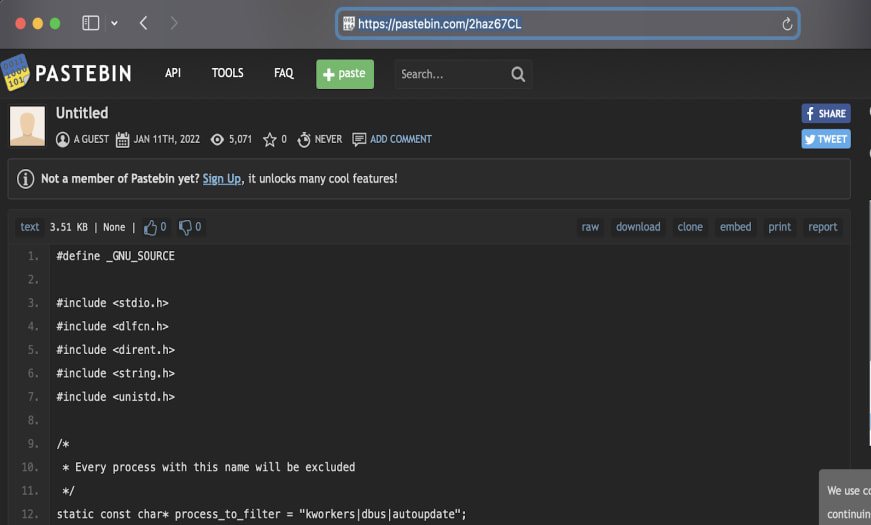
“One notable feature is the ‘hide’ command, which enables a process to conceal itself on a host machine by retrieving code stored on external websites such as Pastebin or online forums for use as a ‘dead drop’, Lumen’s Black Lotus Labs researchers explain.
Pastebin page used in the attacks Source: Lumen
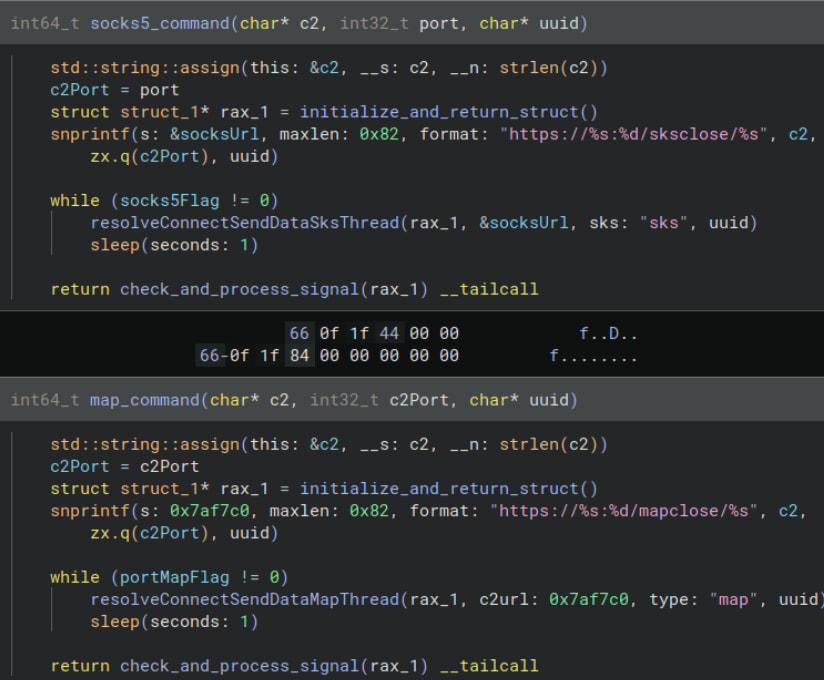
Its most notable function is acting as a SOCKS5 proxy and port-forwarding pivot point, serving as a foothold on compromised endpoints and enabling the attackers to move to other systems on the internal network.
SOCKS5 and portmap functionality Source: Lumen
The JMFBackdoor Windows malware
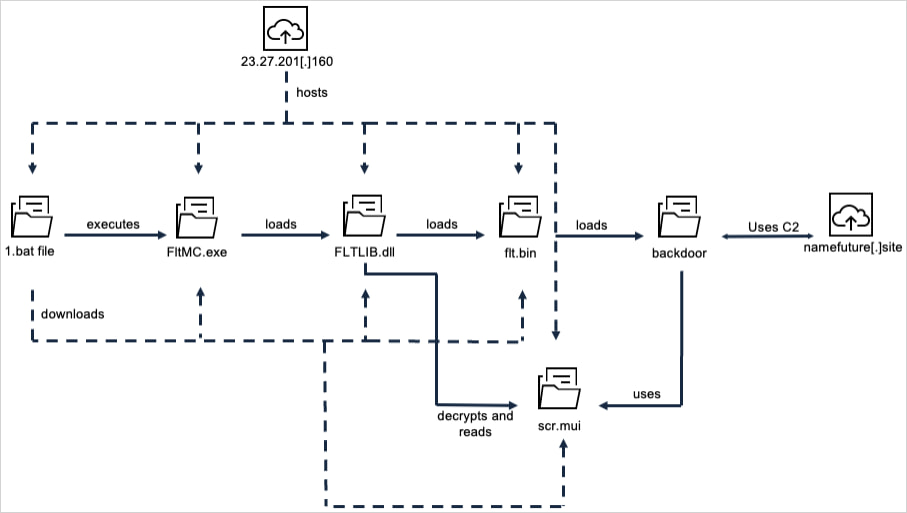
Researchers at PwC Threat Intelligence analyzed Red Lamassu’s infection chain on Windows and noted that it starts with the execution of a batch script that drops payloads to stage a DLL-sideloading procedure (fltMC.exe + FLTLIB.dll). Ultimately, the final payload called JMFBackdoor is loaded.
The Windows attack chain Source: PwC
According to the researchers, JFMBackdoor is a full-featured Windows espionage implant that has the following capabilities:
Reverse shell access — Remote command execution on the infected machine.
File management — Upload, download, modify, move, and delete files.
TCP proxying — Uses the victim system as a network relay into internal systems.
Process/service management — Start, stop, create, or kill processes and services.
Registry manipulation — Modify Windows registry keys and values.
Screenshot capture — Take screenshots of the victim’s desktop and encrypt them for exfiltration.
Encrypted configuration management — Store/update malware settings in encrypted configs.
Self-removal and anti-forensics — Hide activity, remove persistence, and delete traces.
Infrastructure analysis suggests that the hackers follow a partially decentralized operational model, in which multiple clusters share similar certificate-generation patterns and tooling but target distinct victim sets.
Lumen concludes that the tooling is likely shared across multiple China-aligned threat groups, each targeting different regions and using the same malware ecosystem.
Advertisement
Automated pentesting tools deliver real value, but they were built to answer one question: can an attacker move through the network? They were not built to test whether your controls block threats, your detection rules fire, or your cloud configs hold.
This guide covers the 6 surfaces you actually need to validate.
In this week’s “Sunday Reboot,” Apple shoots soccer with iPhones, Epic Games misses the mark with its messaging, and Plex’s astounding price rise.
Sunday Reboot is a weekly column covering some of the lighter stories within the Apple reality distortion field from the past seven days. All to get the next week underway with a good first step.
This week, Apple faced protests over the closure of the Apple Towson Town Center store, the first unionized store. It also elected to continue the never-ending lawsuit with Epic Games via the Supreme Court, and it turns out some server schematics were stolen in the May cyberattack of Foxconn.
Fortnite returns to iPhone with a misguided celebration
The lawsuit between Epic Games and Apple has been excruciatingly long, painfully expensive, and seems like it just won’t end. And yet, somehow, Epic has taken what should’ve been a happy promotional event and made it melodramatic.
Advertisement
Fortnite, the game that started the whole lawsuit shenanigans, is back in the App Store in most countries. That’s a big thing for Epic to go on about, and it did, complete with an Apple-like social media ad.
This is something we can expect from Epic Games. It’s a big song and (video-based) dance, promoting its moneymaker by shaking its moneymaker
This is great for gamers, but it is overshadowed by two things. First, that Australia is excluded from the revival due to cases still being processed in the country.
The second and more unfortunate thing, is the press release that Epic created. One that ominously says “The Final Battle Approaches.”
Advertisement
This is in reference to how the U.S. federal court will “force” Apple to be transparent over its App Store fees. Epic believes that regulators around the world “will not allow Apple junk fees to stand.”
It goes on to say it will continue to challenge Apple on its alleged anticompetitive practices, like banning alternative stores and payment systems.
It’s an astoundingly contrasting approach, depending on where you view it from. Gamers get a bright and colorful celebration, while simultaneously, there’s the highly corporate and completely stark threat.
If we’re talking from a Star Wars perspective (a property that is being incorporated into Fortnite at the time of publication,) Epic is somehow trying to be the Rebel Alliance and the Empire at the same time.
Advertisement
Separately, they work fine. Bring them together, and it all feels a bit off.
Epic could’ve just stuck with the jovial messaging and kept quiet about what it wanted to do in the courtroom for another time. And it should’ve.
Given Epic chief Tim Sweeney’s public posting habits, we would’ve inevitably heard something about that side of things eventually.
Inevitable: MLS uses iPhone 17 Pro to broadcast a game
On May 21, it was announced that the iPhone 17 Pro would play a very important part in Apple TV‘s coverage of the LA Galaxy vs Houston Dynamo FC MLS game the following Saturday.
Advertisement
All shots from the game would be shot live on the iPhone 17 Pro, from team warmups to scoring goals. Apple said it would bring “dynamic new perspectives that bring viewers closer to the action,” because an iPhone is so much smaller than a regular camera.
Apple TV shot its first MLS game entirely on an iPhone – image credit: Apple
While this may sound like the usual broadcast crew were waving iPhones around, everyone knows deep down that there’s more to it than that. With its extensive use in commercial projects, you can count on the use of specialist rigs and lens setups to augment the capabilities of the iPhone.
The fact that the iPhone is being used for a live soccer match is also entirely unsurprising. It was an inevitability.
Advertisement
It’s been used for some coverage during Friday Night Baseball back in September 2025, so Apple TV’s team has some experience already.
Away from the pitch, there’s also feature film work, including the iPhone 15 Pro Max for the Danny Boyle horror “28 Years Later.”
It’s also been used in a few ways for live broadcasts. The BBC used them for livestreams during the 2024 UK General Election, while NBC used two iPhones and an iPad for the “Today Show” during COVID times.
Replacing every camera for a sports broadcast with iPhones is an interesting move. It’s also a big advertising play by Apple, since it shows others what the iPhone is capable of doing.
Advertisement
Even so, it’s something that we all knew would happen eventually.
Per-Plex-ing sticker shock
Everyone is very aware that inflation is a thing. Over time, the cost of products and services trends upward, making things gradually more expensive.
Sometimes, those price rises are high but not too much to swallow. Other times, they can be beyond belief.
On May 19, Plex said that it was raising the price of its Lifetime Plex Pass from its current $249.99 price to $749.99. That’s a $500 increase, which is almost a MacBook Neo.
Advertisement
The lifetime Plex Pass is not great value at $749.99
That is a considerably massive increase, which Plex justified by saying it needs to sustain long-term development. The new price “reflects the real, ongoing value of the software we’re committed to building and maintaining for years to come.”
It almost sounds justifiable until you start working out the math.
The current Plex Pass costs $69.99 per year, ignoring any price rises that may apply to that plan in the future. You would have to be using Plex for more than ten years under the annual Plex Pass to pay the equivalent of the Lifetime Plex Pass cost, post rise on July 1.
Advertisement
Given that not a lot of software survives a decade of market forces anyway, it seems like a hard deal to really accept as a consumer. It’s questionable whether there will still be a Plex service available to use in ten years time.
Indeed, there’s more incentive for consumers to pay for the annual Plex Pass, simply because of choice. After five years, they could easily switch to another platform entirely, saving some $375 in the process from not having to pay Plex more.
What the sticker shock upgrade should do is give consumers the opportunity to think about their options.
A big one is Jellyfin, which requires a bit of effort and some knowledge to get up and running. It’s free and open-source, and what you pay with is your own sweat.
Advertisement
Of course, free is a very attractive price point, and extremely hard for Plex to compete against.
Plex may well have good intentions to keep the software development of its platform going for years to come. To a consumer, it probably seems insane.
Last week’s Sunday Reboot covered Liquid Glass getting an award, Tim Cook being taken to China one more time, and Cats and HomeKit.
Marshals, a new Yellowstone spinoff starring Luke Grimes as Kayce Dutton, is airing on CBS right now. You can also tune in with Paramount Plus. The Yellowstone sequel series sees Grimes’ former Navy SEAL join an elite unit of US Marshals to bring range justice to Montana, according to a synopsis from CBS.
The show includes Yellowstone actors Gil Birmingham as Thomas Rainwater, Mo Brings Plenty as Mo and Brecken Merrill as Tate. Spencer Hudnut is the showrunner of Marshals — formerly known as Y: Marshals — and Taylor Sheridan is an executive producer.
Advertisement
When to watch new Marshals episodes on Paramount Plus
Episode 13 of Marshals airs on CBS on Sunday, May 24. Viewing options for Paramount Plus customers vary by subscription tier. You can watch the episode live if you have Paramount Plus Premium, which includes your local CBS station. If you subscribe to Paramount Plus Essential, you can watch the installment on demand the following Monday, but not live on Sunday.
Episode 13, Wolves at the Door: Premieres on CBS/Paramount Plus Premium on May 24 at 8 p.m. ET/8 p.m. PT/7 p.m. CT. Streams on Paramount Plus Essential on May 25.
You can also watch CBS and the finale of Marshals without cable with a live TV streaming service such as YouTube TV, Hulu Plus Live TV or the DirecTV MyNews skinny bundle. In addition to offering a lower-cost option, Paramount Plus lets you watch the other three Yellowstone spinoffs: the prequels 1883 and 1923 and the sequel Dutton Ranch.
James Martin/CNET
Advertisement
After a price increase in early 2026, the ad-supported Essential version runs $9 per month or $90 per year. The ad-free Premium version runs $14 per month or $140 per year. Paying more for Premium gives you downloads, the ability to watch more Showtime programming than Essential and access to your live, local CBS station.
The Gulfstream family of aircraft is commonly used by A-listers for private jets. The manufacturer boasts a fleet of aircraft ranging from the G300, with a range of 3,600 nautical miles and high-speed cruise capabilities of Mach 0.84, to the G800, with a dramatically increased range of 8,200 nautical miles and the ability to hit Mach 0.90. Gulfstream prides itself on creating luxurious aircraft for business travel, and the Gulfstream IV in particular is one of the more iconic models in its catalog. It’s not one of the newer ones, though, with production beginning in the 1980s. The civilian jet is capable of flight at up to Mach 0.80, and boasts a range of approximately 4,150 nautical miles. On its introduction, it debuted twin Tay 611-8 engines from Rolls-Royce, offering a total of 27,700 pounds of thrust.
1993’s GIV SP (Special Performance) model upgraded elements like the brakes and wheels, as well as giving fliers more freedom to customize the model and carry more weight. Some celebrities prefer newer private jets like the Gulfstream G650, but the IV and its SP variant are still quite popular. Though it’s no longer produced, it continues to have a sizable celebrity following, with some superstars from a range of fields, from the biggest actors to the most celebrated athletes, owning one or previously having owned one. From Floyd Mayweather to Oprah Winfrey, let’s take a look at these stars and the planes they fly in.
Advertisement
Tom Cruise
Fred Duval/Shutterstock
Tom Cruise has everything you could ask for in a private jet owner. For one thing, the “Mission Impossible” superstar is absurdly wealthy. According to AOL in April 2026, his net worth stands at approximately $600 million, and he signed a deal that month for $135 million to return to the role of Maverick in the upcoming third Top Gun movie. This is perhaps the highest-paid Hollywood role ever, and underscores the fact that Cruise is quite the airplane enthusiast, just like Maverick himself.
The model has a Jacuzzi and a private little cinema room, Forbes reported in 2012, and was reportedly an ostentatious wedding gift (costing a cool $20 million) for Cruise’s third wife Katie Holmes. Though the pair are no longer married, they certainly spent considerable time in the air while they were together. In 2007, The Sunday Times reported that while they lived together in Beverley Hills, Holmes was playing the role of Jackie Truman in the movie “Mad Money,” which was being filmed about 1,500 miles away in Louisiana. That’s quite a commute, but then-husband and avid aviator Cruise had stepped in by taking her there in his Gulfstream IV. This being Tom Cruise, he didn’t simply accompany her on the flight but took on the pilot’s role himself.
Advertisement
Oprah Winfrey
Kathy Hutchins/Shutterstock
Oprah Winfrey’s gigantic net worth, according to Forbes, stands at $3.4 billion. She bought her first private aircraft, a Gulfstream IV, in 1991, for $25 million. She did so after an encounter with a fan at a commercial airport, she told The Hollywood Reporter in 2019. The fan had accused her of being unfriendly, not offering a warm embrace as she famously does on her show. “I stood up and I gave her a hug and then I went to the phone and called my lawyer,” she stated. “This is going to be my last time waiting four hours in the Chicago O’Hare Airport.’”
The Gulfstream model was used by Oprah for some years, with an incident in December 2005 in which the aircraft was just beginning a flight from Santa Barbara Municipal Airport in California when it was seemingly struck by a bird and grounded until its windshield underwent essential repairs. Later that month, it was concluded that the cause of the damage was different. John Ahlman, Battalion Chief with the Santa Barbara City Fire Department, reported, according to Today, “There was no bird involved, but the pilot did tell my captain that he felt it was a fatigue thing with the glass.” Whether she was unsettled by the experience or simply wanted a different aircraft, she replaced her first Gulfstream with a Bombardier Aerospace Global Express XRS in 2006.
Later, Oprah would add other aircraft to her fleet. They would include, Jettly goes on, several newer Gulfstream models. Throughout the 2010s, she would acquire a G550, a member of the G650 family, and the G700. The latter was added to Oprah’s repertoire in 2024, a model that costs in the region of $70 million and was engineered to be fully customizable to the owner’s requirements.
Advertisement
Floyd Mayweather
YES Market Media/Shutterstock
In 2018, the BBC reported that Floyd Mayweather reclaimed his crown as the highest-paid athlete on the planet. With a $275 million paycheck for his much-awaited bout as Conor McGregor, it’s no surprise at all that Money Mayweather has a private jet fleet of his own. He owns a Gulfstream IV registered as N305DG, which he demonstrated in an Instagram post from jetsace in October 2024. “Carbon fiber, come check this out,” Mayweather Jr. says from the tarmac, beckoning the camera closer and declaring the aircraft to be “not bad for a high school dropout.”
The exterior, naturally, is fully emblazoned with the former boxer’s brand. His name, Mayweather, is emblazoned across its body in bright red, with both nose and tail featuring the TMT logo. The Money Team, true to its name, represents the finer things, and this Gulfstream is just one private jet Mayweather has owned. He also has a Gulfsteam G650, and the famed “Air Mayweather” features a roomy interior, bright, opulent styling, and more than a few nods to Mayweather’s perfect boxing record. The Sun shared a showcase from Mayweather in 2018, gleefully revealing his attention to detail: Even the pilot’s uniform features a proud “50-0” legend on the sleeve. Needless to say, there have also been some very expensive cars in Floyd Mayweather’s collection.
Advertisement
Dan Bilzerian
Prodip Guha/Getty Images
Actor and poker player Dan Bilzerian isn’t a man to shy away from the limelight. In September 2014, he shared the fact that he had bought a Gulfstream IV. The announcement was posted on Instagram, accompanied by a dramatically-lit nighttime photograph of the aircraft. His father, apparently, was not so impressed. Bilzerian joked on the post, “I told my Dad I bought this G4, he said ‘congratulations son, by your age I had 3.’”
The plane, as is common with private jets, was soon detailed to take his tastes into account. Registration numbers, a little like vanity plates on cars, can be customized somewhat to suit their owner, and Bilzerian left his own mark on his model with the registration N701DB, emblazoning his own name upon it.
With that complete, there was another important registration job to take care of. Bilzerian’s GOAT Airways, tying in with his branding in other business ventures, was used to register the aircraft, and so the tail of the aircraft was emblazoned with the goat design. Bilzerian posted on Facebook in November 2014 that this was added during a weekend stay in Los Angeles. In 2020, the model was outfitted in a sleek all-black look. Having been originally manufactured in 1987, perhaps it’s no surprise that Bilzerian felt it was time for a new look.
Advertisement
Alex Rodriguez
Debby Wong/Shutterstock
Former MLB star Alex Rodriguez made $275 million in his decade with the New York Yankees alone, and according to Times of India, his shared net worth with Jaclyn Cordeiro stands at approximately $353 million. When A-Rod travels for appearances, to support his business concerns, and so on, he has done so in a Gulfstream IV, among other aircraft.
The baseball maestro has, in fact, owned multiple Gulfstream IVs. In February 2009, the New York Post reported that a 1987 model co-owned by A-Rod and his pilot, Craig Frost, had been put up for sale. The pair sought $16-$20 million for it. The whole affair, however, did not dampen Rodriguez’s enthusiasm for the plane, which is clear when you consider how he outfitted his second Gulfstream IV. Sports Illustrated was given a window into the luxury that awaits, reporting in June 2019 that it boasts “10 plush seats and a bed, as well as endless healthy snacks arrayed next to a single white orchid, WiFi, delicious shrimp cocktail and salmon filets served on green-rimmed Limoges china, and a smooth sound system that plays Rodriguez’s favorite bands.”
It’s undeniably luxurious, but Rodriguez’s plush plane is also a necessity. Because of business commitments, the magazine goes on, he was spending approximately three weeks out of every year in flight, and it would have been difficult for a celebrity of his status to navigate busy public airports that much.
For a long time, the laptop buying advice was simple enough. Windows had a more versatile portfolio that brought you affordable, mid-range, high-end, and even gaming options, while MacBooks were known as the easy premium recommendation.
But owing to the pricing circus caused by memory shortages and component price hikes, the equation makes no sense anymore.
Apple has always had an aspirational pull with its products, including the Mac. The appeal was the sleek hardware, the tighter software experience, and an ecosystem that makes you feel comfortable after getting in. Pricing was the one aspect that pushed people back towards Windows. Don’t get me wrong, Windows does have its strong points. But for many people, the argument was always the same. The Mac is nice, but look at what you can get on the PC side for less money.
Apple MacBook NeoNadeem Sarwar / Digital Trends
In 2026, this doesn’t hold true anymore. The MacBook Neo has changed the entry point for Apple’s laptop lineup. The Mac now starts from $599 with an A18 Pro chip, a 13-inch Liquid Retina display, and macOS Tahoe. It ships with 8GB of unified memory and starts with 256GB of storage, which are still obvious constraints in 2026. And yet, the value it offers is much better than its competitors at this price range.
Windows laptops are getting squeezed
The Windows side is dealing with a very big problem. Memory prices have become a serious pressure point across the PC industry. Windows laptop makers such as HP, Dell, Asus, and others are hiking prices because of the global memory chip shortage. And the worst part is, the memory prices might not fall until next year. The current RAM crunch is making Apple look like the sensible laptop choice.
After years of pushing Windows 11 and Copilot, both of which require at least 16GB of RAM, the company is selling its very own Surface Laptop with 8GB for $1,299. In comparison, the brand-new M5 MacBook Air only costs $1,099, and Apple packs 16GB of RAM in it.
M5 MacBook AirApple
Still no answer to the MacBook Neo
At $599 in the US, Apple suddenly has a Mac that sits in a space Windows should have owned comfortably. Just pit it against the 13-inch Surface Laptop, and the massive price gap alone would win any arguments. Aside from a few rare models, the MacBook Neo stays uncontested.
You get a clean aluminum design, a sharp 13-inch display, long battery life, Apple Intelligence support, and enough everyday performance for students, families, and basic creative work. Sure, the Surface has advantages like touch, better battery claims, and stronger multicore performance, but that’s the same kind of argument people have made against the MacBook when Windows was cheaper. What mattered the most was what a buyer was willing to compromise on for the price. The only difference now is that I find myself defending the MacBook.
Chuwi UnibookChuwi
Apple is now the practical choice
The MacBook Neo is not without trade-offs. It is not the machine for heavy video editors, serious multitaskers, or anyone who refuses to buy an 8GB laptop in 2026. But it gives mainstream buyers the thing Apple usually reserved for higher price brackets, which is a proper Mac experience at a price that no longer feels absurd.
Meanwhile, the Windows market is getting squeezed. Memory costs are rising; every new laptop is much more expensive than the previous-gen models, and the budget-to-midrange space barely exists. Still, MacBooks aren’t the right choice for everyone. Windows maintains a solid lead in gaming, repair variety, hardware choice, and much more. Yet, in 2026, Apple’s cheapest MacBook now looks like the laptop you don’t have to justify with emotions, only math.
There is a category of production incident that engineering teams are not tracking yet — because it doesn’t fit any existing postmortem template.
The agent initiated an action. The action was technically correct given the agent’s context. The context was incomplete. The infrastructure cascaded. And, by the time the incident review happened, three teams were arguing about whether it was an agent failure or an infrastructure failure, because the frameworks for thinking about these two things have never been connected.
The scale of this exposure is no longer theoretical. Seventy-nine percent of organizations now have some form of AI agent in production, with 96% planning expansion. Gartner predicts 33% of enterprise software will include agentic AI by 2028, but separately warns that 40% of those projects will be canceled due to poor risk controls.
What neither statistic captures is the failure mode happening between those two numbers: Agents that are running, that are not canceled, and that are quietly generating infrastructure events no one has categorized as risk.
Advertisement
I’ve spent six years building infrastructure automation systems at enterprise scale, first at Cisco (leading AI-driven lifecycle platforms deployed across 20-plus global enterprise customers), then at Splunk (designing AI-assisted root cause analysis and observability workflows across thousands of enterprise environments).
During that time I also filed a patent on intent-based chaos engineering methodology. And across all of it, I kept watching organizations make the same structural mistake: Treating autonomous agents and chaos engineering as separate disciplines. They are not. They are the same discipline, and the gap between them is quietly generating the next wave of major production incidents.
The judgment call that agents skip
To understand why this matters, you need to understand what’s actually broken in how enterprises govern chaos today, before you add agents to the picture.
Most mature engineering organizations have invested in chaos engineering programs. Game days, blast radius controls, SLO-gated experiments. When a human engineer initiates a chaos experiment, the sequence has a critical property: A human is making a judgment call about whether the system has capacity to absorb the perturbation right now. They check dashboards. They look at the error budget burn rate. They assess whether dependencies are stable. It’s imperfect and often intuitive, but there is at least a person in the loop asking the right question before anything runs.
Advertisement
When you introduce an autonomous remediation agent, one that can restart services, reroute traffic, scale resources, or modify configurations in response to detected anomalies, that question disappears. The agent sees an anomaly. The agent takes an action. The action is a chaos event. No SLO burn rate check. No blast radius calculation. No human judgment about whether right now is the right moment to introduce additional stress into a system that may already be under pressure from three other directions.
Here is the specific failure mode I have watched play out. A remediation agent detects elevated latency on a microservice and responds by restarting the service cluster; a reasonable action given its training data and its narrow view of the incident. What the agent doesn’t know: Three other services are in the middle of handling peak traffic. The shared connection pool is already at 87% utilization. A dependent database is running a background index rebuild. The restart triggers a thundering herd against the recovering service.
What started as a latency spike the agent was designed to fix becomes a cascade the agent was never designed to model. The blast radius of that agent action was not the service restart. It was everything downstream of the restart, in a system state the agent had no complete picture of.
Nobody’s chaos engineering program had tested for that specific combination. Nobody’s blast radius calculation had included the agent as an actor. Because we don’t think of agents as chaos injectors. We should.
Advertisement
According to the AI Incidents Database, reported AI-related incidents rose 21% from 2024 to 2025. That count almost certainly understates the actual exposure, because most organizations have no incident classification that captures an autonomous agent action as the initiating cause of a cascade. The incident gets logged as a service restart, a connection pool saturation, or a latency event. The agent is invisible in the postmortem.
Absorb capacity is a resource; most systems don’t treat it that way
The underlying problem is that enterprise systems have no shared language for absorb capacity — the real-time estimate of how much additional stress a system can take before it breaches its SLO commitments. Chaos engineering programs manage it implicitly, through human judgment and static thresholds that fire after a limit has already been crossed. Agents don’t manage it at all.
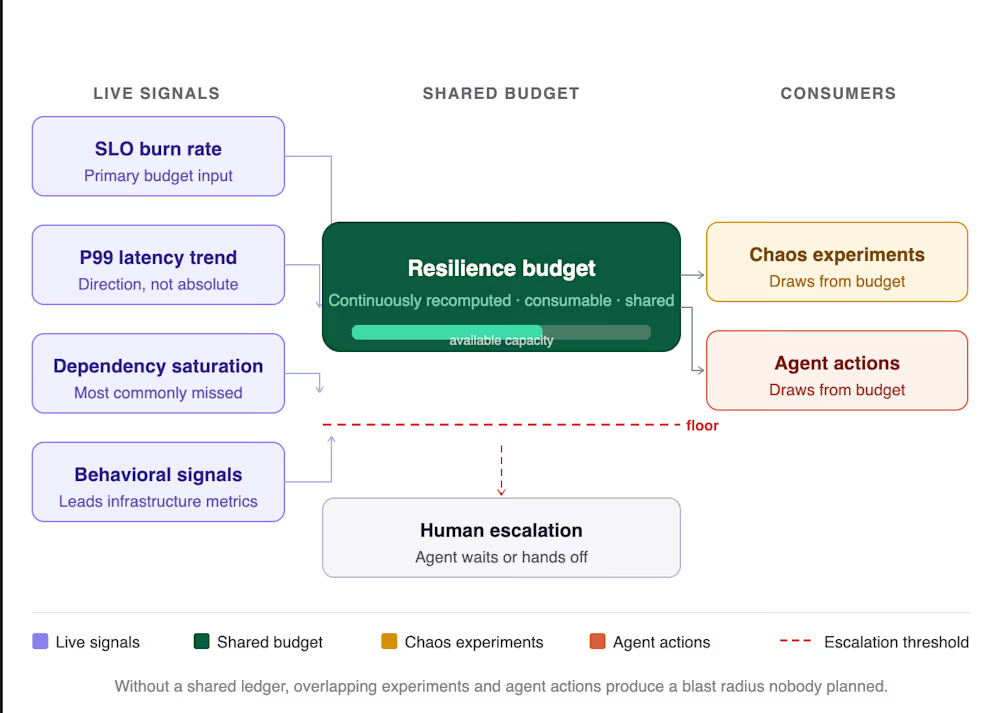
Through structured primary research with site reliability engineering (SRE) and platform engineering practitioners across organizations including Intuit and GPTZero, I’ve been developing a resilience budget model. The core idea is to treat absorb capacity as a continuously recomputed, consumable resource rather than a static threshold you try not to breach.
A resilience budget draws on four live signal classes.
Advertisement
SLO burn rate is the primary input, because it directly encodes the distance between current system behavior and the commitment that actually matters. If a system is burning its monthly error budget at five times the expected rate, the resilience budget is near zero regardless of what CPU utilization looks like.
P99 latency trend matters more than absolute latency, because a service trending upward over forty minutes tells you something different than a service that has been stable at the same absolute value.
Dependency saturation state is the most commonly missed signal; a chaos experiment or an agent action that assumes a shared connection pool is freely available when it’s sitting at 87% will produce failure modes that nobody designed for.
Application behavioral signals, session completion rates, API call pattern shifts, conversion degradation, and surface system stress earlier than infrastructure metrics do, because users feel the degradation before Prometheus reports it.
What makes this a budget rather than a threshold is that it is consumable. Every chaos experiment draws from the available capacity. Every agent action draws from it. In multi-team organizations where multiple experiments and multiple agents may be acting simultaneously, the budget is shared.
Without a shared ledger of consumption, two teams running experiments against overlapping dependencies produce a combined blast radius that neither team planned. Add autonomous agents acting completely outside the ledger, and the accounting collapses.
Image provided by author.
Where language models help, and exactly where they fail
Several engineering organizations are now running experiments using large language models (LLMs) to generate chaos hypotheses from dependency graphs and incident postmortem corpora. The results are directionally useful. Language models surface plausible failure modes that experienced SREs recognize as worth testing, and they generate hypotheses faster than manual processes, particularly when working from rich postmortem history.
Advertisement
The limit is dependency graph staleness, and it is a hard limit. A hypothesis generated from a graph that doesn’t reflect last month’s service extraction, or a new shared library dependency added two sprints ago, will propose an experiment with incorrect blast radius assumptions. The problem is not that the model makes a mistake, it’s that the model doesn’t know it’s making one. It will be confidently incorrect about a system boundary that no longer exists, and in chaos engineering, confident incorrectness in production means an unplanned outage.
Stanford’s Trustworthy AI Research Lab found that model-level guardrails alone are insufficient: Fine-tuning attacks bypassed leading models in the majority of tested cases. The implication for chaos hypothesis generation is direct, a model that cannot reliably hold its own safety boundaries cannot be trusted to accurately model the blast radius of an action it has never seen in a dependency graph it has not verified.
When hypothesis generation draws instead from postmortem corpora, the staleness problem shrinks considerably. Postmortems describe failures that actually occurred in the system at a specific moment in time. The signal is inherently validated by production reality. This is the tractable near-term AI application in this space, and it is genuinely useful for organizations with mature incident documentation practices.
What AI cannot do, and should not be asked to do, is make the execution decision when signals are ambiguous. That judgment requires awareness of things that live entirely outside any monitoring system: Pending deployments that changed the dependency landscape an hour ago, on-call staffing levels on a holiday weekend, a customer commitment that makes any additional risk unacceptable until Monday.
Advertisement
A model without access to that context should not be making that call. This is not a temporary limitation pending a more capable model. It is a structural constraint of what machine observability can represent, and building an agent architecture that ignores it is building one that will eventually make a consequential decision with incomplete information — and no human in the loop to catch it.
What this means for how enterprises govern agents in production
The governance implication is straightforward to describe and harder to implement than it sounds. Every autonomous agent action that touches infrastructure needs to register against the same live signal layer that governs chaos experiments. The same SLO burn rates, latency trends, dependency saturation states that a human engineer would check before initiating an experiment should gate what an agent is permitted to do and when. If the resilience budget is below a defined floor, the agent waits or escalates. It does not act.
Agent actions also need to be modeled as experiments, not just logged as events. When an agent restarts a service, the question isn’t only whether the restart completed successfully. It’s whether the blast radius of that action was proportionate to the available absorb capacity, and what cascading effects it produced across dependencies. That is chaos engineering data. It belongs in the budget model, feeding the next decision the agent or the team needs to make.
And when signals are genuinely ambiguous, when the budget score is unclear, when a recent deployment has changed the topology in ways the agent’s context window doesn’t capture, when dependency states are in flux, the execution decision needs to go to a human. Not as a permanent limitation on agent autonomy, but as a hard engineering requirement for the current state of the technology.
Advertisement
A circuit breaker that hands ambiguous cases to a human is not a weakness in the agent architecture. It is the thing that makes the architecture trustworthy enough to actually run in production. Intent-based verification formalizes exactly this: Defining what correct agent behavior looks like before deployment, then continuously probing whether those boundaries hold under live system conditions.
The organizations that operate autonomous agents reliably at scale are not the ones with the most sophisticated models. They are the ones that understood, before something went badly wrong, that every agent action is a chaos event and built their governance layer accordingly.
The practical first step is unglamorous: Audit every autonomous agent currently touching infrastructure, map its action surface against your live SLO burn rate signals, and define explicit floor conditions below which the agent is required to wait or escalate. That audit will surface agents acting entirely outside your resilience accounting.
Most organizations running agents at scale today have several. Find them before production does.
Advertisement
Sayali Patil has spent 6-plus years at Cisco Systems and Splunk building the reliability and automation systems that keep enterprise AI infrastructure running at scale.
Welcome to the VentureBeat community!
Our guest posting program is where technical experts share insights and provide neutral, non-vested deep dives on AI, data infrastructure, cybersecurity and other cutting-edge technologies shaping the future of enterprise.
Read more from our guest post program — and check out our guidelines if you’re interested in contributing an article of your own!






















































You must be logged in to post a comment Login