

Entertainment
The Real Message of Planet of the Apes Has Always Been Right in Front of Our Face

What makes us human? According to Stanley Kubrick‘s 2001: A Space Odyssey, it’s our ability to use tools that separate us from our simian ancestors. In his sci-fi epic, Kubrick boils down the entire story of humankind from its inception as apes, discovering how to utilize tools to overpower their natural enemies, all the way to humanity’s inevitable rebirth, deep into the space age. However, scientists have long since decided that this theory about the cornerstone of human civilization is false. In fact, many animals use tools, not just humans. Then what makes us humans unique? Perhaps surprisingly, the sci-fi film series that succeeds in getting the answer right is Planet of the Apes.
Since the original 1968 film, and the novel that inspired it, Planet of the Apes has been a powerful allegory for the human race’s treatment of “the other,” and our tendency to blow up the paradise we inhabit as a result. Therefore, what makes us human, when compared to our ancestral apes, is not our use of tools and weapons of mass destruction, but rather, our ability to develop such plans in the first place. In short, language is the cornerstone of our species. It’s notable that in the original film, Taylor (Charlton Heston) finds himself in a world where apes are well-spoken, but more importantly, humans are portrayed as mute and therefore primitive. Language is often how we take pride in our national and regional identities, but it’s also resulted in incessant conflict, as the recent reboot trilogy explores.
‘Rise of the Planet of the Apes’ Gives Apes the Gift of Language

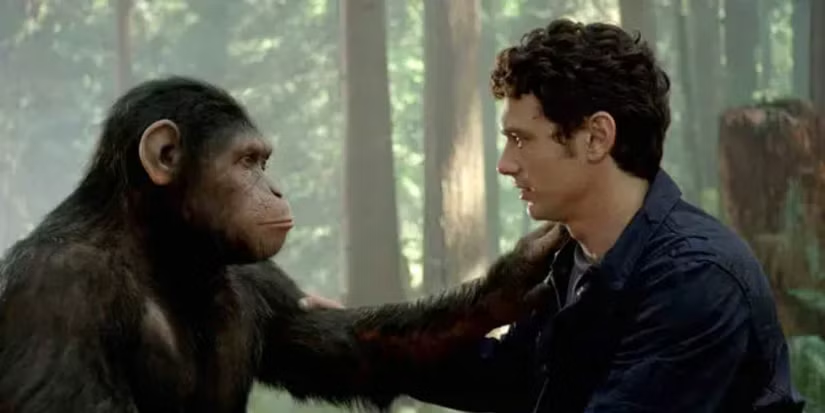
2011’s Rise of the Planet of the Apes serves as both a prequel and a reboot to the original series of films. It changes certain details within the canon, but ultimately tells the story of how Earth became the ape-governed world discovered in the 1968 movie. The film focuses on Caesar (Andy Serkis), a chimpanzee born with an experimental cure for Alzheimer’s passed down from his test-subject mother. Caesar embarks on a startling evolution, becoming fluent in sign language thanks to his human guardian, Will (James Franco). The science-fiction premise that this film poses is essentially just Caesar’s linguistic journey.
Gifted with exceptional intelligence, Caesar is depicted as being just as conscious as humans. It’s not long before the cruelty of man, particularly against apes, leads Caesar to inspire a revolution, and it’s through language that Caesar not only forms his small army of apes, but it’s also how he declares to the humans that they refuse to be oppressed any longer. Caesar’s “No” in the face of cruelty from Dodge Landon (Tom Felton) remains one of the most bone-chilling moments of the franchise, and that is precisely why.

Set ten years after the events of the previous film, 2014’s Dawn of the Planet of the Apes establishes a world in turmoil. Caesar’s tribe of liberated apes continues to inhabit the Muir Woods near San Francisco, while the experimental Alzheimer’s cure has resulted in a virus that has eliminated countless humans. A small group of surviving humans led by Dreyfus (Gary Oldman) live in the city, and the film establishes an uneasy peace between them and the apes. It’s clear that both species have resorted to hunting and gathering to survive, and with fluent communication within both camps, apes and humans are on equal footing at last. The trouble begins when the humans wish to work on a dam within the apes’ territory, and it’s clear that neither side wishes for this to result in conflict.
Dawn of the Planet of the Apes is where the series gets to explore the true implications of language, and the burden of intelligence that comes with it. Among both camps are those willing to trust the other (Caesar and Jason Clarke‘s Malcolm) and those whose pride and pessimism risk peace in favor of victory (Dreyfus and Toby Kebbell‘s ape Koba). This film displays that, with complex language comes philosophy, and individual ideologies inevitably branch off. Caesar soon comes to the sobering realization that anyone equipped with the tools of language has the potential to make the same mistakes as humans. Going into the trilogy’s final installment, Caesar becomes a bitter ape, uncertain whether his species is any more worthy of that power than its predecessors.
‘War for the Planet of the Apes’ Takes Language Away from the Humans
More years have passed by the time we are reintroduced to this world in 2017’s War for the Planet of the Apes. When Caesar’s family is murdered by a rogue human army, we’re introduced to a version of Caesar far more cynical than we’ve ever known before. As per 1968’s Planet of the Apes, It’s revealed that the simian virus has evolved to deprive infected humans of their ability to speak, leaving them a primitive shell of their former selves. Disgusted by the idea of humans as the next generation’s speechless animals, an army Colonel (Woody Harrelson) urges his men to euthanize their infected loved ones and wage war on the apes.
Like Caesar, the Colonel’s greatest power is his ability to influence people through speech. The Colonel’s manipulation tactics even result in getting specific apes to work for him. Caesar’s mission this time is much darker than in previous stories, with hate in his heart for the Colonel. Caesar eventually realizes that killing the Colonel would only succeed in fulfilling the destiny that he fears so much. When the Colonel is infected by the virus, he recognizes just how much power he has lost by losing his speech. The Colonel decides to kill himself, rather than become a voiceless primate. This marks the official hand-off between humans and apes, with the planet of humans finally becoming the planet of the apes; not by apes killing humans, but rather, by the apes gaining language and humans losing their greatest tool as a species.
The Planet of the Apes Franchise Represents the Cyclical Nature of Life

With Kingdom of the Planet of the Apes attempting to further fill in the gaps between the original films and the prequel trilogy, the overall symbolism of the franchise begins to become clearer. Language represents power and intelligence; the ability to communicate effectively, whether through spoken language — or even gestures — is closely linked to characters’ social status throughout the entirety of the franchise. The films explore themes of oppression, hierarchy, and prejudice through the lens of language, highlighting how these linguistic differences can shape power dynamics.
Planet of the Apes fully succeeds in its symbolism because of its ability to tell this story naturally throughout several decades in-universe. Whereas a franchise like Star Wars has a tendency to box itself in — telling stories where audiences already know the beginning and ending points and often the fates of the characters themselves — Apes has a more ambiguous middle period to play with, and audiences get to watch the story unfold organically.
One of the most harrowing, but also familiar aspects of the franchise is the cyclical nature of its story. History tends to repeat itself, a lesson humans begrudgingly continue to learn. Through Planet of the Apes, audiences can watch humanity’s failures in real-time, equating them to the evolutionary cycle that has known Homo sapiens as the top of the food chain since their existence. From the 1968 original to the recent release of Kingdom of the Planet of the Apes, this franchise relies entirely on exploring language and how this difference between the apes and humans is integral to the new world they both find themselves in.

Continue Reading

The Indy 500 recognized late NASCAR driver Kyle Busch days after his death.
“As the drivers exit turn four … on lap 18, we remember Kyle Busch,” an announcer said during the Sunday, May 24, race, while being honored on the Indianapolis Motor Speedway’s scoring pylon.
The moment was shared via INDYCAR on FOX’s official X account, with a caption that read, “A tribute to Kyle Busch on Lap 18 of the Indy 500.”
Driver Romain Grosjean also honored Busch on Sunday while driving a No. 18 car on behalf of Dale Coyne Racing. The vehicle featured the same font that Busch used while driving for Joe Gibbs Racing in NASCAR.

The racing world continues to pay tribute to NASCAR legend Kyle Busch after his shocking and untimely death. “A silent garage pays its respect as the No. 33 @RCRracing Chevrolet unloads at @CLTMotorSpdway,” the official NASCAR social media account wrote via X on Saturday, May 23, alongside a video showing the late driver’s team unloading […]
On Wednesday, May 20, Busch reportedly “became unresponsive” while testing in a Chevrolet racing simulator at Charlotte Motor Speedway in Concord, North Carolina, according to the Associated Press. News broke the following day that Busch had been hospitalized.
“Kyle has experienced a severe illness resulting in hospitalization,” the Busch family said in a statement shared on Thursday, May 21. “He is currently undergoing treatment and will not compete in any of his scheduled activities this weekend at Charlotte Motor Speedway. We ask for understanding and privacy as our family navigates this situation.”
Hours before his death, a 911 call obtained by TMZ revealed that Busch was at a training facility in North Carolina when he suffered a medical emergency.
“I’ve got an individual that’s shortness of breath, very hot. [He] thinks he’s going to pass out, and he’s producing a little bit of blood, coughing up some blood,” the caller said, noting that Busch was still “awake” and conscious. “He’s on the bathroom floor right now.”
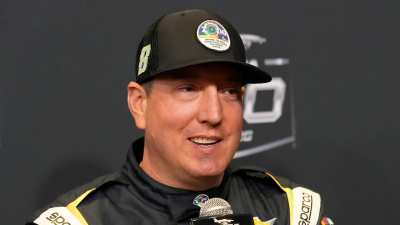
The NASCAR world is reeling following the death of the two-time Cup Series champion Kyle Busch, known to fans as “Rowdy.” The athlete died on May 21, 2026, at the age of 41 after being hospitalized with what his family described as a “severe illness.” The fierce competitor leaves behind his wife, Samantha Busch, and […]
NASCAR confirmed on Thursday that the athlete died at age 41. He is survived by his wife, Samantha Busch, and their two children.
“We are saddened and heartbroken to share the news of the passing of Kyle Busch, a two-time Cup champion and one of our sport’s greatest and fiercest drivers,” NASCAR said in a statement via X. “We extend our deepest condolences to the Busch family, Richard Childress Racing and the entire motorsports community.”


On Saturday, May 23, a rep for the family confirmed to NBC News that Kyle died of pneumonia that progressed “into sepsis, resulting in rapid and overwhelming associated complications.”
Kyle’s final race was the NASCAR All-Star Race on May 17 at Dover International Speedway. He finished in 17th place. “You never know when the last one is,” he told reporters after the race.
He was set to race at the Coca-Cola 600 at Charlotte Motor Speedway on Sunday, but pulled out due to his hospitalization.

It’s getting to that time of the year, and we can all feel it. The nights are getting longer, and the temperatures are getting lower. All you want to do when you get in after a long day’s work is curl up in a blanket and chuck on an easy-to-watch show that fills you with a warmth that the outside world is lacking. If you don’t want to binge Gilmore Girls, Community, or Gavin & Stacey for the billionth time, there’s no need to waste time scrolling through multiple streaming services, only to give up and go back to your usual shows. Instead, check out this comforting sci-fi series that has over 70 episodes to keep you company throughout these warmer months: Eureka.
The 2006 series slowly became a streaming hit for SyFy, averaging 3.2 million viewers during its second season and being nominated for an Emmy for Outstanding Special Visual Effects for a Series in 2007, and it’s easy to see why. With its fascinating premise and small-town vibe, Eureka is a show that never feels ordinary or boring. Its case-of-the-week narrative structure also makes it perfect for binge-watching.
Like all great shows, Eureka offers more than wacky jokes and impressive set designs. It explores themes of family and the dangers of over-ambitious science, yet never drags down or overwhelms its viewers.
‘Eureka’ is Set in the Strangest Town You’ve Ever Seen
One of the best things about comfort shows is that they typically work on a case-of-the-week basis, and that means the viewer can enjoy each episode in a microcosm, feeling as if they are not committing to any complex narrative that requires attention to all details for later, while secretly becoming more and more connected with the characters until they are obsessed. Shows like Doctor Who have also had success with this in the sci-fi realm, yet Eureka takes a slightly different direction. Rather than taking the protagonist to different worlds each episode, it keeps them grounded in one town, bringing the chaos to them.
The central premise of Eureka is that, while driving his runaway daughter, Zoe (Jordan Hinson), back home, US Marshal Jack Carter (Colin Ferguson) winds up in a town named Eureka and learns this is a top-secret town where the country’s best scientists work on outlandish and society-defining experiments. After the sheriff of this town is injured, Jack is hired to replace him after helping with a case for the pilot episode, throwing him into a world of quantum physics and wacky scientists.
Because the show takes place in this small town, there is a relaxed tone surrounding the show, as all the characters know each other very well, and Jack gets to learn about this town along with the audience as an outsider, which means that as Jack becomes more comfortable, so does the viewer. While everyone is welcoming, with Jack even striking up a few love interests along the way, including Allison (Salli Richardson-Whitfield), an agent of the Department of Defense, there are still nefarious forces at work in the town that seek to expose their deepest secrets, acting as the overarching plot that unfurls throughout each season.
‘Eureka’ Is Full of Colorful Characters
When it comes to any show that can run for over 70 episodes, the characters are just as important to the premise. Viewers don’t want to spend hours and hours with boring people, and Eureka makes sure to imbue every character with a unique and intriguing nature that reflects the town’s eccentricity. While the characters might seem like they have small-town jobs, everyone’s backstory feels like it could be a show in its own right. With the sheriff’s deputy, Jo (Erica Cerra), actually being a badass former U.S. Army Ranger with an affinity for guns, Henry (Joe Morton), being the town mechanic as well as a space shuttle engineer, and Jim (Matt Frewer) being a seemingly crazy hunter who is really one of the greatest biological containment specialists in the world, there is no limit to the creativity Eureka displays in crafting its characters. This creates a sense of acceptance within the town, as those who might be considered oddballs in the outside world, like Allison’s son Kevin (Trevor Jackson), who is mostly non-verbal and has autism, find their differences embraced and encouraged in Eureka.
While the supporting characters fill out this world and make it so special, it is Ferguson’s Jack Carter who truly feels like the comforting factor in Eureka. Playing the role of the straight-man archetype, Jack Carter is perhaps the most “normal” character in the show by society’s standards. He isn’t a genius, and many of his jokes don’t land with other characters. Yet, he has a kind nature, and his true skill is his ability to empathize. When a boy goes missing in the pilot episode, and everyone else scrambles to look for him, Jack figures out the boy isn’t missing but hiding after being scared by his father’s experiment-gone-wrong.
Ferguson plays the character with a sense of realism because he, too, finds the town a wonderful yet mind-boggling place, poking fun at the show’s premise in a way that allows the audience to engage with it, rather than dismiss it as too silly. In a similar way that fans feel safe when around The Doctor, whether it is David Tennant or Ncuti Gatwa‘s version, because of his moral compass and competency, viewers feel at ease in Jack’s presence.
‘Eureka’ Explores Poignant Themes With Emotional Nuance
That isn’t to say that everything is perfect about Jack, or in his life, and this is where Eureka shines as not just another show to throw on while you doom-scroll, but a comforting watch that invites the audience to think about important aspects of life. The show has a strong focus on family and the love it creates. Jack’s main problem at the start of the show is his relationship with his daughter, as she is rightfully angry at him for leaving her mother and not being more present in her life, even if his job is important.
Eureka doesn’t want the viewer to condemn Jack, since it tries hard to make him so likable, but it points out how, just because someone thinks they’re doing the right thing, it doesn’t mean they aren’t hurting someone. As Jack and Zoe’s father-daughter relationship develops, the audience sees Jack challenged in what he values more, his family or his job, and whether his job can also involve his family.

46 Years Later, ‘Star Wars’ Greatest Quote Was Rewritten in This Sci-Fi Spin-Off
Turns out ‘Rogue One’ and’ A New Hope’ aren’t the only Star Wars movies that this spin-off improved.
At the heart of Eureka is also the exploration of how science can go too far, with both pure-hearted and sinister intentions, since almost all the conflict in the show is generated from failed and even successful experiments. The audience can delve into the deeper themes and how they comment on our own lives, or they can furiously study the characters and their dynamics throughout the show. And because the show makes sure it isn’t overly complex or intellectual, it also invites the viewer to simply enjoy the quirky mysteries that Jack investigates.
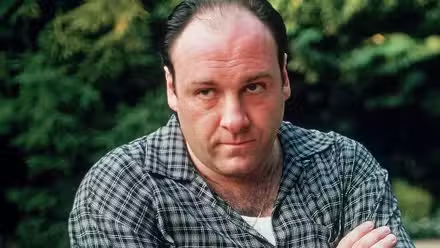
After creating a juggernaut series like Mad Men, Matthew Weiner was likely given carte blanche by any studio or network to realize his most ambitious project to date. As a part of the Sopranos writing staff, Weiner pushed the envelope for dramatic cable television to transcendent heights during the medium’s heyday in 2007 with his award-winning AMC show about the inner world of advertising executives in New York in the 1960s.
After Mad Men‘s conclusion in 2015, Weiner returned three years later on Prime Video with another lavish period drama featuring a star-studded cast, including Mad Men alum Christina Hendricks and John Slattery, and a reported $50 budget across eight episodes. The Romanoffs left viewers and critics underwhelmed when it aired in 2018, but in an era where shows about royal families like The Crown grow in popularity every year, Weiner’s misfired one-season anthology drama about delusional heirs to royalty is ready for a reappraisal.
What Is ‘The Romanoffs’ About?
Across eight episodes of its lone season, The Romanoffs chronicles separate stories about people who believe they are descendants of the titular Russian royal family and its leader, Nicholas II, the nation’s last monarch until the Russian Revolution in 1917. The dense, all-star cast features the likes of Aaron Eckhart, Corey Stoll, Isabelle Huppert, Amanda Peet, Diane Lane, Kathryn Hahn, Noah Wyle (surprisingly not playing a medical professional), and many more recognizable character actors. Each episode is a standalone narrative, roughly the length of a short feature film, with the lone connective tissue being the shared sense of pride and royalty from these families across all walks of life in the present day. The show portrays a variety of people and environments, including hotel owners, suburban middle-class workers with pent-up rage and alienation, Mexican gossip columnists uncovering a malpractice scandal, and, in its most meta episode, an actor starring in a miniseries about the Romanov family.
Brings a whole new meaning to the phrase “sleeping with the fishes.”
The sheer ambition and scope of Mad Men pales in comparison to The Romanoffs, a show that took advantage of Amazon’s foray into the movie and television industry. As a commercial titan, Amazon offered seemingly endless budgets to visionary creatives to fulfill the aspirations deemed uncommercial by the studios. Weiner’s series, which remains his last screenwriting credit as of 2026, evokes a sense of unbridled freedom that is both admirable and troublesome. Across each story about people who become empowered and obsessed with their false notion of royal heritage, grandeur runs through the entire anthology, during both its lighthearted and sobering moments. More than the spiritual presence of the Russian family, episodes of The Romanoffs are connected by a sense of eternal longing and deep-seated frustration about being trapped in gilded cages, making it a proper companion piece to Mad Men.
‘The Romanoffs’ Is Worthy of a Second Look

Despite its illustrious cast and an immensely revered showrunner, most people have probably forgotten about The Romanoffs due to its short-lived run. In fairness, the series falling out of favor and fading from our collective subconscious isn’t surprising, as this eight-part anthology about dense themes told through a heavy-handed lens can become tiring. “Self-indulgence” was a term that found its way into many reviews at the time, and the series’ aggressive confrontation of privilege, heritage, and insatiable human desires only validates these critiques. Where Mad Men was always focused, Weiner bit off more than he could chew with The Romanoffs. As is often the case with many anthology shows or movies, after some time, you wish you were just honing in on one of these stories. Here, Weiner tries to interconnect episodes, but any grand thesis ultimately comes up flat.
Having said that, The Romanoffs is exquisitely crafted, putting all big-budget blockbusters to shame. Weiner and his production team stretched their $50 million budget to its maximum; every set and costume is bursting with rich texture, a remarkable feat for a contemporary series. At the very least, Weiner has an impeccable eye for visual detail, as each setting, from New York City to Mexico City to Austria, is used as a perfect backdrop. There is an inherent sadness permeating this epic treatise on the disillusionment of life in modern America, and its heartbroken characters cling to their flimsy royal lineage for validation. Commentary on the empty void of life that is crucial to Mad Men is played for operatic effect. However, the key ingredient of The Romanoffs is that its characters wish to belong inside a great Russian novel, only to experience the true mundane, unceremonious perils of life.
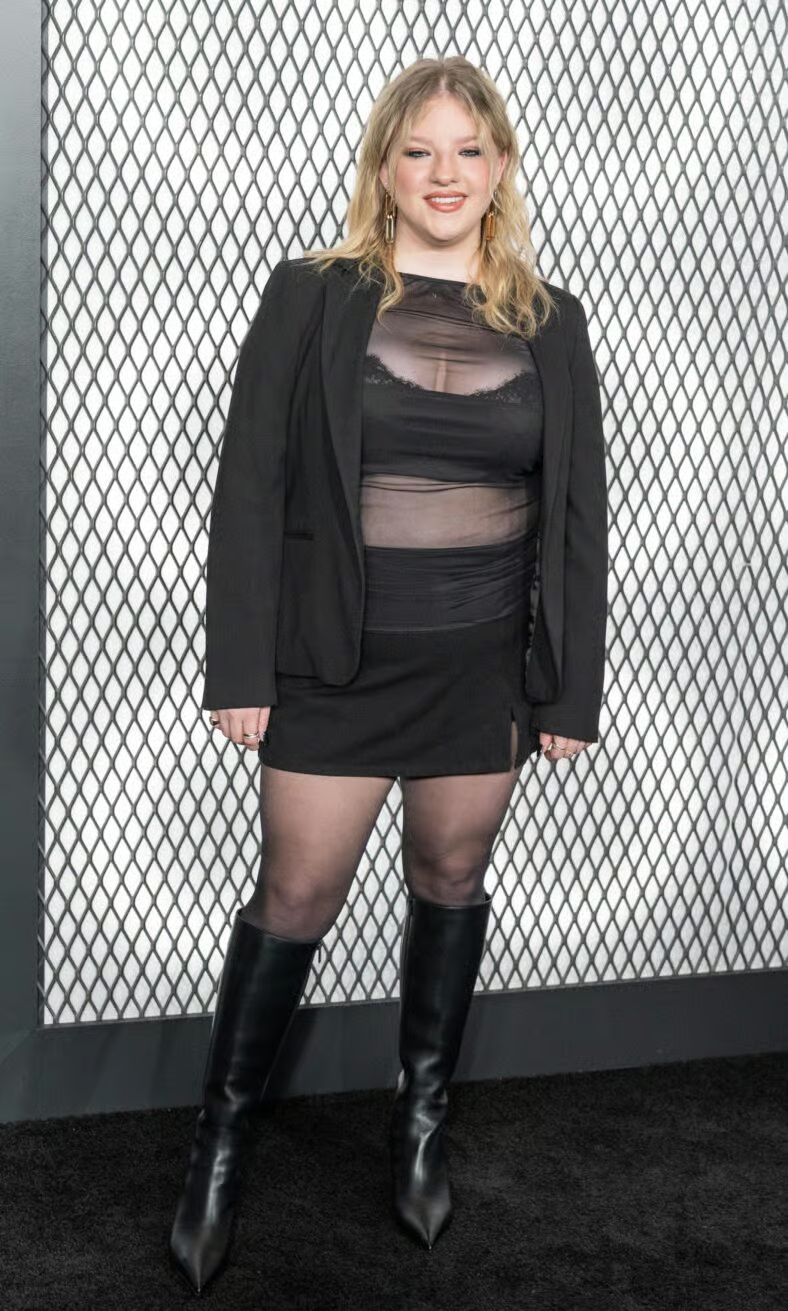
Actress Francesca Scorsese, the youngest daughter of acclaimed filmmaker Martin Scorsese, is pushing back against online criticism after receiving cruel comments from trolls on social media. The content creator directly addressed the backlash, responding to negative remarks and defending herself.
Francesca followed in her father’s footsteps, making a career for herself in entertainment. While she has worked behind the scenes and directed some projects, she has recently nabbed an acting role in the upcoming season of Prime Video’s “Mr. & Mrs. Smith.”
On May 23, Francesca Scorsese took to TikTok to express her frustration over some cruel comments she received on a recent post. According to the 26-year-old filmmaker, she got hateful remarks on the comments section of a video she reposted announcing her recent addition to the Amazon Prime series “Mr. & Mrs. Smith.”
“It has some of the worst comments I have ever seen about me,” Francesca said. While she said she has gotten some flak over the years for being a “nepo baby,” the level of hate she has gotten recently was “something else.”
As for the nepo baby comments, she noted she’s aware of the opportunities she’s been presented because of her father, Martin Scorsese, but Francesca is still “going hard and being passionate and creating and doing the work.”
The Actress Calls Out Trolls Who ‘Seek Out Negativity’

Francesca continued, “If you go on people’s videos and you seek out negativity, you are a very, very sad person.” She then enumerated some of the harsh comments, saying that she was compared to a fridge and Ms. Piggy, while others said she was “incredibly ugly and fat.”
“I get it. I’m not the most beautiful girl in the world. I’m not the skinniest girl in the world. I’m chubby, I know it. But like, what the f-ck does it matter?” she said, telling her haters to go out on the streets and look around. “I don’t understand how hard it is to be a kind human being,” she added.
Francesca said she’s also speaking on behalf of other women who have received awful comments on their videos, urging users who have written hateful comments to look at themselves in the mirror. The actress has deactivated her X account due to the hateful comments, and she’s realizing that TikTok is becoming just as toxic.
Francesca Scorsese Talks About Living In Her Father’s Shadow

Francesca said that the amount of trolls online is astounding, and she doesn’t understand how they make it their mission to make people “feel like sh-t.” “This is the kind of thing that causes people to lose their lives, like, your words have power behind them,” she said.
The filmmaker said she’s “fine” and has been dealing with harsh comments for many years, partly because of who her father is. “I know I have a huge, you know, figure, my father to live up to, and like, that always overshadows me as a person,” Francesca said, adding that she only wants TikTok to be a “better place.”
Francesca’s post was met with support from her followers, with many praising her beauty, talent, and kindness.
Martin Scorsese Is Francesca’s Biggest Supporter
Martin was 56 years old when Francesca was born in 1999, and in a 2012 interview, he shared how his daughter inspired his 2011 adventure film “Hugo.” The renowned director said his young daughter’s imagination sparked the creation of “crazier stories,” which helped his filmmaking. “She’s a lifesaver,” he exclaimed.
In 2014, Martin penned an open letter to Francesca, sharing his reflections on filmmaking and the importance of artistic integrity.
Francesca studied filmmaking at the New York University Tisch School of the Arts, graduating with her bachelor’s degree in 2023. Her thesis, “Fish Out of Water,” was screened at film festivals and received positive remarks from critics.
Francesca said that Martin has been her mentor, best friend, and biggest supporter. Their close relationship is highlighted on TikTok videos, wherein the actress has her father participate in viral trends, such as quizzes and lip-sync challenges.
Francesca Scorsese’s Latest Project
Francesca has directed a few projects, her latest being an episode of “Martin Scorsese Presents: The Saints.” She has also had a few acting roles, appearing in cameos in her father’s films “The Aviator” and “The Departed.” In 2020, Francesca appeared in the series “We Are Who We Are,” followed by a role in the 2024 indie film “Christmas Eve in Miller’s Point.”
In early May, Deadline announced that Francesca was added to the cast of “Mr. & Mrs. Smith” Season 2, the spy drama series from Prime Video co-created by Donald Glover. Not much is known about the upcoming season’s storyline, but filming is underway.
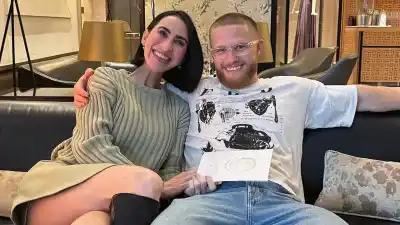
Influencer Jeff Nippard is opening up about his mental health struggles after the death of his fiancée, Stephanie Buttermore.
“I’ve been staying in my friend’s basement for the past few weeks and he has a barbell and a dumbbell down there, so I’ve been getting back to my roots with some basic strength training again. A part of me likes having a minimal set up like this because the constraints force me to get creative,” Nippard wrote via Instagram on Sunday, May 24, alongside videos of him exercising. “Working out during grief has been one of those things that I really don’t want to do but I’m glad I did once it’s done.”
He continued, “My depression has been bad, so my strength is down a lot and for the first time I can remember, I have no real desire to workout. That said, I do find that if I just say to myself, ‘Go in and lift the empty bar up and down 10 times, that’s better than nothing’ … at least I get moving. After that, if I still want to stop, I will. If it feels fine, I’ll keep going. I usually end up finishing the workout anyway because it usually does feel better once it’s started.”
Nippard shared that he’s also “taken some time away from social media and YouTube.”

Stephanie Buttermore’s fiancé, bodybuilder Jeff Nippard, was all smiles with the influencer weeks before her death. In an Instagram post shared on February 14, Nippard placed his arm around Buttermore as the pair sat on a couch and posed for the camera. In another image, Nippard showed a close-up of their colorful food. “Relationshipmaxxing with […]
“It’s a break that I felt I needed, so thank you for understanding,” he wrote. “I really appreciate all the support during this time and I hope you guys are doing well 🙏🏻.”
News broke in March that Buttermore died.
“It is with profound sorrow that we share the sudden passing of Jeff’s fiancée and partner of 10 years, Stephanie,” an Instagram statement from Nippard’s team read at the time. “As many of you know, Stephanie meant the world to Jeff.”
The statement continued, “She will be remembered for her warmth and compassion, her love for her family and her Ph.D research on ovarian cancer. We kindly ask for privacy as we navigate this tragic loss. Thank you for your understanding and support during this difficult time.”
One month later, Nippard broke his silence on Buttermore’s death by sharing that he had spent time with his late fiancée’s “family and closest friends to celebrate her life and share memories with each other.”
“When I think about Stephanie, I keep coming back to how loving and kind she was. She really made the world a better place,” he wrote via Instagram in April. “I’m not sure if many of you know this, but during her PhD, she studied a protein called RHAMM, and found out that it could help detect ovarian cancer early. There’s a copy of her PhD dissertation in my bio if you’d like to read it. It’s one of the first things that made me fall in love with her.”
He continued, “On her YouTube channel, she helped people feel less alone, especially when it comes to struggling with food and body image. Her journey helped so many people be more accepting of themselves, and I love her so much for doing that. She always put her family first and she had an especially loving bond with her mom. We built this backyard garden in her honour (purple was her favourite colour) and it means so, so much to me.”
Nippard shared that he had read “many” messages in the past weeks, noting that the “support has helped us all.”
“Stephanie’s mom loves hearing stories about the difference her daughter made. We talk almost every day and it’s been incredibly difficult but we’re making it together,” he concluded. “If you were a fan of Stephanie, then I’m a fan of you. I hope she made your life better in some way. She made my life amazing and I’m so grateful for the time we had ❤️.”
:max_bytes(150000):strip_icc():format(jpeg)/Marshalls-Luke-Grimes-052426-e4b24e55652544f281308e4d29402d80.jpg)
The “Yellowstone” spinoff’s season 1 finale unmasks the real villain in our heroes’ midst.
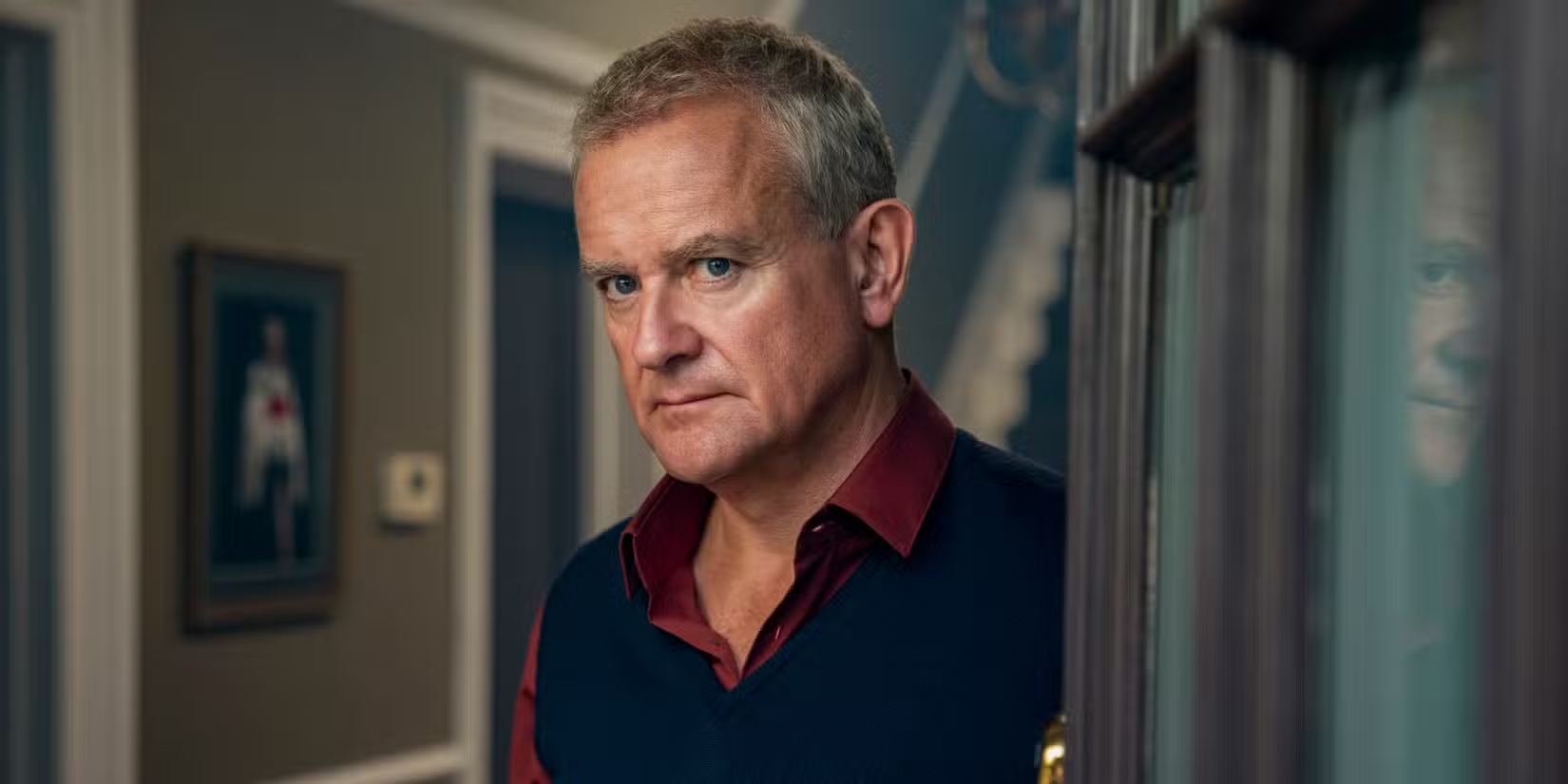
Though Netflix has been churning out hit-or-miss thrillers over recent years, it delivered a particularly deadly cat-and-mouse chase in 2022. Except here, there are three different rugrat tabbies and a suit-donned mouse with secrets hidden in its basement. Director Babak Anvari follows up his raw Under the Shadows and jarring Wounds with a tense and unpredictable piece that keeps us gripping the edge of our seats. I Came By succeeds in its measured portrayal of a serial killer, cruising in the wake of Hugh Bonneville‘s stately grandeur and ominous twists as a well-respected judge, Hector Blake. While the film begins as a typical scurry into the theme of “not knowing what happens behind closed doors,” it quickly turns its heel into a more interesting and thrilling social commentary on how powerful people can get away with anything.
‘I Came By’ Quickly Becomes Unpredictable
I Came By opens up in Toby’s (George MacKay, known for his role in 1917) POV, a socially conscious graffiti artist who leaves his tag of “I Came By” in the houses of the elite. We can deduce that the reason for doing so is to make the residents feel like they are still vulnerable to the socioeconomic environment outside, and thus, the private location of these tags becomes ironically notorious in the newspapers. We spend some time watching Toby try to convince his partner, Jay (Percelle Ascott), to do one last mission together, with the target being Hector Blake, a judge renowned for his charitable work with immigrants but condemned by Toby for owning illegal ivory antiques. However, as a soon-to-be father, Jay is trying to clean up his act and refuses (he also believes owning ivory isn’t a despicable enough of an act for him to potentially endanger his life), leaving Toby to creep into Hector’s mansion alone, only to discover a terrible secret in the basement.
At this point in the film, we are lulled into a familiar rhythm, probably recognizing the hints that led us to the outrageous plot twist of Don’t Breathe. As such, we immediately recognize Hector as someone we wouldn’t want to mess with, but we aren’t prepared for the first act twist. With Toby squarely placed in the forefront as the main character, we gradually empathize with his crusade for (sometimes petty) social injustice and identify with his contentious relationship with his mother, Lizzie (Kelly MacDonald). So, when he finds a bound and bruised prisoner in Blake’s basement and returns to the house on another night to free him, we wonder how we are not even halfway through the film. I Came By quickly upends any expectations we had for the film, immediately ending Toby’s life with a solid blow to the back of his head. The story continues to twist and turn, diving into unanticipated places and being merciless about who survives and who doesn’t, leaving Hector looming over it all with a murderous gleam in his charitable eyes.
The Realism in ‘I Came By’ Creates a Tense Atmosphere

Though the plot itself is not necessarily believable, there are undercurrents of chilling realism that become striking and effective. Between the pockets of calculating and succinct violence are slower-paced and almost mundane sequences of the reactions of loved ones. As soon as Toby disappears, Lizzie contacts Jay in hopes of discovering his whereabouts, only to resort to visiting the police station. The underrated MacDonald delivers a heartfelt and desperate performance here; her frustration about not being taken seriously and her concern for her son resonate with us. Though she and Toby have a typical teenage-mother relationship, there is still something troubling about watching Lizzie find secret compartments in her son’s drawers, wondering if she ever knew him at all.
Once she does reach the police station, though the acts themselves aren’t particularly realistic, we are met with a timeless story of the public feeling failed by the law. There is a well-worn display of initial police indifference, as Lizzie’s complaints are dutifully filed, but she is immediately dismissed with placating remarks rather than any real concern. Though detective Ella (Franc Ashman) does connect the missing person report to the strange 911 call from Hector’s house, it is the office’s treatment of Lizzie that becomes realistically sullen, offering limited compassion or hope. It is what leads Lizzie to conduct her own investigation, as her resolve deepens and her concern for her son wins over any logical stream of thought. This depicts how a history of social injustice mixed with such callous treatment leads to people operating out of the bounds of legality, and thus resulting in devastating consequences in this particular case.
When Ella does meticulously scour over Hector’s mansion, she incredulously finds no evidence of abduction or murder in Hector’s basement, despite stumbling upon the secret rooms. When she tries to arrest him for having these hidden compartments and accusations, a mere phone call to his dear friend in high places hastily releases him. From having the foresight to sanitize and incinerate all evidence of his crime to being able to use his privilege as a get out of jail for free card, Hector becomes a slimy and unnerving possibility of how wealth can be used. The film becomes a hyperbole about how people in positions of power are able to skirt around the law, even with the public eye trained on them. The fact that his charities revolve around immigration, and his victims of choice are immigrants, is yet another exaggeration of hypocrisy frequently seen in elite circles. Alongside the unbearable tension of watching a realistic police investigation take place is the dramatic reiteration of political and social power that is seen in real life.
Hugh Bonneville Is a Chilling Serial Killer in ‘I Came By’
Of course, none of this could be conveyed if it weren’t for the stellar performance by Bonneville, who steals the show with his daring charisma that fluidly shifts into something more sinister. Bonneville would feel particularly at home in this high-class role after his major role in the Downton Abbey period drama as Robert Crawley. As Robert, he is protective of his family and adheres to tradition, which translates to his role in I Came By, albeit in a twisted way. Hector is naturally fiercely protective of his secrets and his reputation, which allows him to work freely, and on top of this, he embodies the traditional picture of the elite exploiting his resources and the masses for the worse. Beneath his stately grandeur, which Bonneville inherently borrows from his previous character, he also has the opportunity to imbue malevolence into his performance.
Every time he interacts with someone, Hector seems so painfully normal; it is jarring to reconcile him with the depravity he engages with. From news broadcasts where his charming smile and charitable words capture everyone’s attention to his disarming conversations with the police officers, where he manages to placate their suspicions with an innocent eye, there is something markedly winning about Hector. His split in demeanor is particularly highlighted in his monologue when he tries to entrap another asylum seeker. He talks about how his father abandoned him and his mother to pursue a relationship with someone who was an immigrant, starting the story in a charming and wistful way that gradually devolved into an unsettling spite. Undertones of bitter rage and sadism sweep beneath his words, booming throughout the room in a wicked symphony of pomp and psychopathy.
Though it could be said that Bonneville’s acting prowess overshadows the rest of the cast, his dominant presence actually adds to the social exploration of I Came By. Compared to Hector, Toby is reduced to a naive and one-dimensional character, touting the tired personality trait of enacting social justice in order to stifle his own insecurities. However, this adds to the effect of his simplistic and wide-eyed world view, suggesting that though he dealt in kneading out the vulnerabilities of the privileged, he himself didn’t necessarily comprehend just how powerful the world he antagonized was. His tags are suddenly rendered fleeting and obsolete, simply hollow gestures that cannot stand up against the deep roots the elite has in society. As such, with Hector’s shadow domineering over the film, it offers a bleak portrayal of meaningless attempts to alleviate social inequalities.
‘I Came By’ Uses Realism to Highlight Social Injustice

Apart from Bonnevile, the most memorable and distinct aspect of I Came By is its shifting POVs, as each character is out-manoeuvered and expelled by Hector, forcing another character to take the former’s place. The film strips us of the comfort of a “hero” or a “chosen one,” and instead reflects the pitiless reality of how many serial killers manage to evade detection for so long. Characters become disposable in I Came By, though each gets us closer to Hector’s retribution before becoming his next victim. It adds to the chess-like feel of the movie, as strategies and valiant impulses pick away at the impenetrable barrier surrounding Hector, but sacrifices are necessary in the larger raging war against him. So the next protagonist takes up the mantle and uses their own methods to face-off against the culpable judge, accomplishing as much as they can until their inevitable doom (which they don’t expect, since no one really anticipates their own death).
With the protagonist of the film becoming so flexible, it becomes even more damning that Hector remains standing for so long, simply because he has the resources to back his activities and the willingness and capacity to cross lines without facing dire consequences. Realism pours into this aspect of the story as it doesn’t use the narrative devices of “punishing” and “rewarding” certain behaviors and ethics. Instead, it is a bleak outlook on how unfair advantages that are generally out of people’s control chalk up the wins and losses of a battle. Hector has the home advantage, the cash backing him, a vice-like grip on the law and an overarching disdain for human life that allows him to essentially operate with impunity — picking off his trifling enemies one-by-one almost contemptuously. Once again, the film exhibits a dramatic re-enactment of the exploitation of the masses, as they become a replaceable part of an overarching system, with elite figures like Hector pulling the strings.
Social injustice pervades every corner of this deliberately paced film, from the violent outbursts to the tantalizing pressure that continually builds. Even when the three cats try and hunt down the mouse, the tension and stress caves-in around them, unable to infiltrate the suave stronghold of wealth surrounding the mouse. Building in intensity, Anvari finally rewards our patience when the cathartic final act rolls around. Yet however gratifying the ending is, with all the lives lost, we are left with the haunting question of who the real winner here is. Which matters more: taking down the enemy or the losses along the way? As such, I Came By uses distinctive strokes of realism and unpredictability to create a captivating mural of social injustice, further criticizing how privilege becomes the perfect cover.

I Came By
- Release Date
-
August 31, 2022
- Runtime
-
110 minutes
- Director
-
Babak Anvari
- Writers
-
Babak Anvari, Namsi Khan

Actor Alec Baldwin is about to be a grandfather to two! His eldest daughter, Ireland Baldwin, the only child he shares with his ex-wife, Kim Basinger, is ready to welcome her second child with her boyfriend, RAC. The couple previously welcomed their daughter, Holland, in May 2023.
On May 23, only a few days after her first daughter turned 3, Ireland took to Instagram to reveal her pregnancy with a playful video. The video showed her replacing a bottle of wine with sleeping pills, pulling out baby pajamas, and holding up a strip of sonogram images.
She dropped a red heart emoji in the caption as fans and famous friends offered their congratulations. “Congratulations to the whole family!! Another little one to love,” one fan commented. “Congratulations, Ireland! That is awesome news. Love how you made the announcement,” another follower wrote. “Congratulations! I’m due Thanksgiving and the Unisom tablets speak to me,” a third fan chimed in.
Ireland’s First Child Holland Turns 3
Only one week ago, Ireland shared an adorable carousel of images featuring her first child, Holland, who was about to celebrate her third birthday. One picture featured Ireland about to cut into a giant pink cake decorated with colorful sprinkles. Another featured a large stack of pizza boxes from the Costco food court placed in a shopping cart.
Other photos featured a pony ride, coloring sheets, and two cakes placed side by side on a table that was covered with a charcuterie board. “Tomorrow my little baby turns 3. Today we celebrated her,” Ireland wrote in the caption next to a pink heart emoji. Many fans and friends wished her a happy birthday. One follower wrote, “Lovely! PS Costco pizza for a party really is clutch. Good job, mama.”
Ireland Baldwin Gives Insight Into Her Relationship With Hilaria Baldwin

Alec Baldwin was married to Kim Basinger from 1993 to 2002. In 2012, he married Hilaria Baldwin. Together, they share seven children, often referred to as the “Baldwinitos.” They welcomed their eldest daughter, Carmen, in 2013. Two years later, they welcomed Rafael. Their son Leonardo was born the following year, and their son Romeo was born in 2018. Their son Eduardo was born in 2020, but their daughter, Maria Lucia, was born via surrogate around the same time. Their youngest daughter, Ilaria, was born in 2022.
Since becoming a grandfather, Alec has worked to improve his relationship with Ireland. As a result, she has formed a stronger bond with Hilaria since becoming a mom herself. In September 2025, she shared a lengthy Instagram post, in which she explained that people would be quite “surprised” if they knew Hilaria the way that she did.
Ireland Baldwin Reveals How She ‘Bonded’ With Hilaria Baldwin
In the Instagram post, Ireland shared a photo of her holding up a dog, while Hilaria held up her newborn baby. In the caption, she warned that the post may “come out of left field since I don’t post about her or any family members much.” However, she admitted that she wanted to address the comments that she saw on social media.
One rumor was that she was “only playing nice” with her father’s family in order to get an inheritance. “I’m not getting an inheritance. I have 7 siblings,” Ireland joked. Things took a serious turn when Ireland admitted that Hilaria had “a far more complex and chaotic upbringing than she lets on and I think that’s why we’ve maybe bonded in some ways?”
“She didn’t always feel safe and seen. Sometimes, she is too loyal to a fault. She is eccentric and totally bat sh-t crazy (in a fun way) but she saved my dad’s life,” she continued, likely referring to the 2021 “Rust” shooting incident. Cinematographer Halyna Hutchins was fatally shot and director Joel Souza was injured when a live round was discharged from a firearm that Alec was using as a prop on the set of the Western film.
Ireland Says That Hilaria Is The Reason For Her ‘Close Relationship’ With Her Father
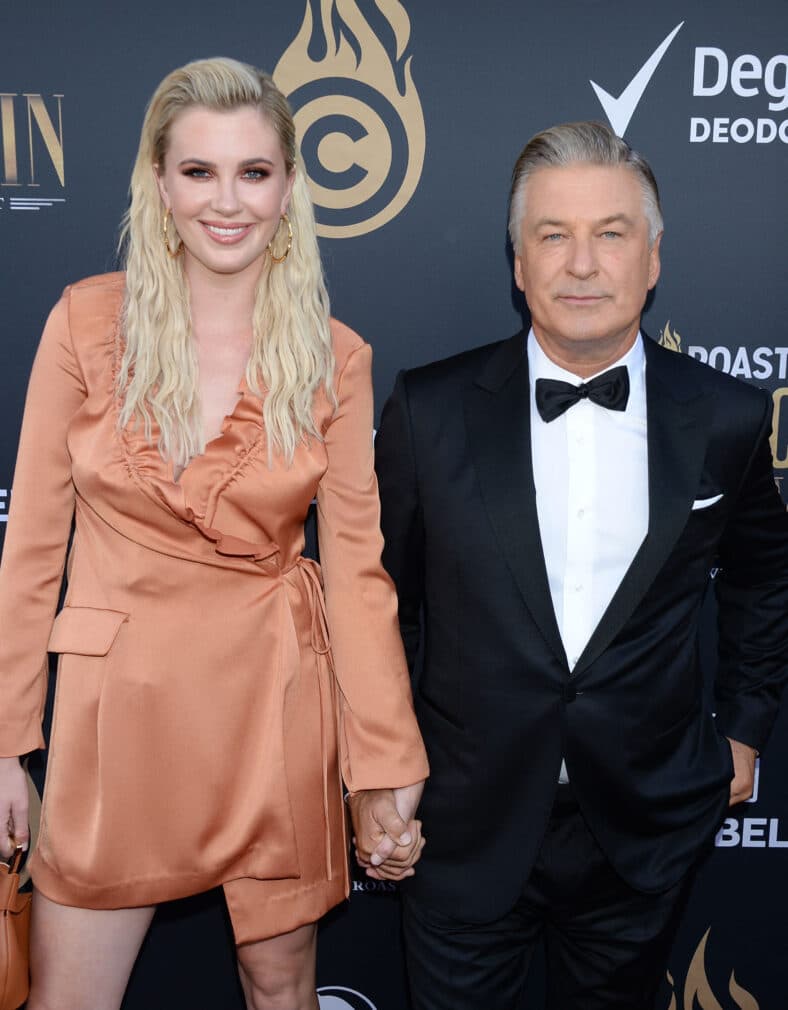
Ireland praised Hilaria for turning “his health around” and for showing him “the forgiveness and kindness that he needed.” She went on to say that she “also recognizes and nourishes the parts of my father that are the most compassionate and wonderful. She’s taught him that he doesn’t need to suffer inside of his own head and stay stuck in his own past.”
“Hilaria is the reason I am able to have the close relationship with my father that I do,” she continued. “She is the reason I get to have siblings/a big family that I’ve always wanted. She has always respected me, accepted my flaws, embraced me, and has always shown me kindness. I met her as a teenager and I needed her as an example.”
“I still very much look up to her now,” Ireland wrote, calling her a “gem” and saying that she “deserves all the love.”
:max_bytes(150000):strip_icc():format(jpeg)/kate-mansi-general-hospital-2026-031126-8dd14b41d1ab43628d0e8ef9457b6408.jpg)
Kate Mansi joined the ABC soap opera in 2023.
Entertainment
Bryan Cranston’s “Malcolm in the Middle ”costar Jane Kaczmarek reacts to his daughter's success on “The Pitt ”
:max_bytes(150000):strip_icc():format(jpeg)/Jane-Kaczmarek-Taylor-Dearden-052426-8dac2568089747808c91d9dccc401fbf.jpg)
Taylor Dearden, Cranston’s daughter, became a breakout hit as Dr. Melissa “Mel” King on medical drama “The Pitt.”

Tech47 seconds ago
Today’s NYT Strands Hints, Answer and Help for May 25 #813

NewsBeat3 minutes ago
Spring bank holiday opening times at Wickes, B&Q, Dunelm, Home Bargains, B&M and The Range

Business4 minutes ago
SaltLight Capital Q1 2026 Co-Investor Letter


-

 Crypto World3 days ago
Blockchain.com files with SEC for U.S. IPO
-

 Fashion2 days ago
Holiday Weekend Open Thread – Corporette.com
-

 Crypto World3 days ago
Bitcoin Accumulation Weakens as BTC Realized Losses Hit $600M
-

 Business3 days ago
Dell Technologies DELL Stock Surges 15% on AI Server Momentum and Analyst Upgrades in 2026
-

 Crypto World3 days ago
Space X IPO Is ‘Bad News’ for Tech Stocks: But What About Bitcoin?
-

 Politics2 days ago
Makerfield: a tale of two social-media histories
-

 Crypto World3 days ago
MicroStrategy’s Saylor Says Miners No Longer Set Bitcoin Price, Another Force Has Taken Over
-

 Crypto World2 days ago
Robinhood crypto COO Tanya Denisova exits
-

 Business11 hours ago
NYT Strands Answers May 24 2026 Revealed for Puzzle No. 812 Theme Summer Essentials
-

 Tech3 days ago
WhatsApp ads could make Irish debut after discussions with DPC
-
 Tech3 days ago
A 0.12% parameter add-on gives AI agents the working memory RAG can’t
-

 Crypto World3 days ago
AI infrastructure race heats up as IREN pitches full-stack strategy, WhiteFiber lands $160M deal
-

 Business3 days ago
Trump Invests $1M-$5M in Kura Sushi USA Chain With 27 California Locations
-

 Tech3 days ago
You Can Now Add ChatGPT To PowerPoint
-
 Crypto World6 days ago
Revolut Launches Dogecoin Debit Card Across UK and EU
-
 NewsBeat4 days ago
Charity run by Reform leader Malcolm Offord accused of ‘law breaking’ over Scottish registration
-

 Sports3 days ago
2026 CJ Cup Byron Nelson leaderboard: Brooks Koepka finds putting stroke in Round 1
-
 Crypto World3 days ago
Trump Media’s Bitcoin Stash Shrinks Again as 2,650 BTC Lands on Crypto.com
-
Business3 days ago
Goldman Sachs reinstates Ageas stock coverage with neutral rating
-

 Crypto World4 days ago
Exa Labs raises $250 million in funding led by a16z
You must be logged in to post a comment Login