

Crypto World
Brent Crude Slides 4% as President Trump Signals Patient Iran Strategy

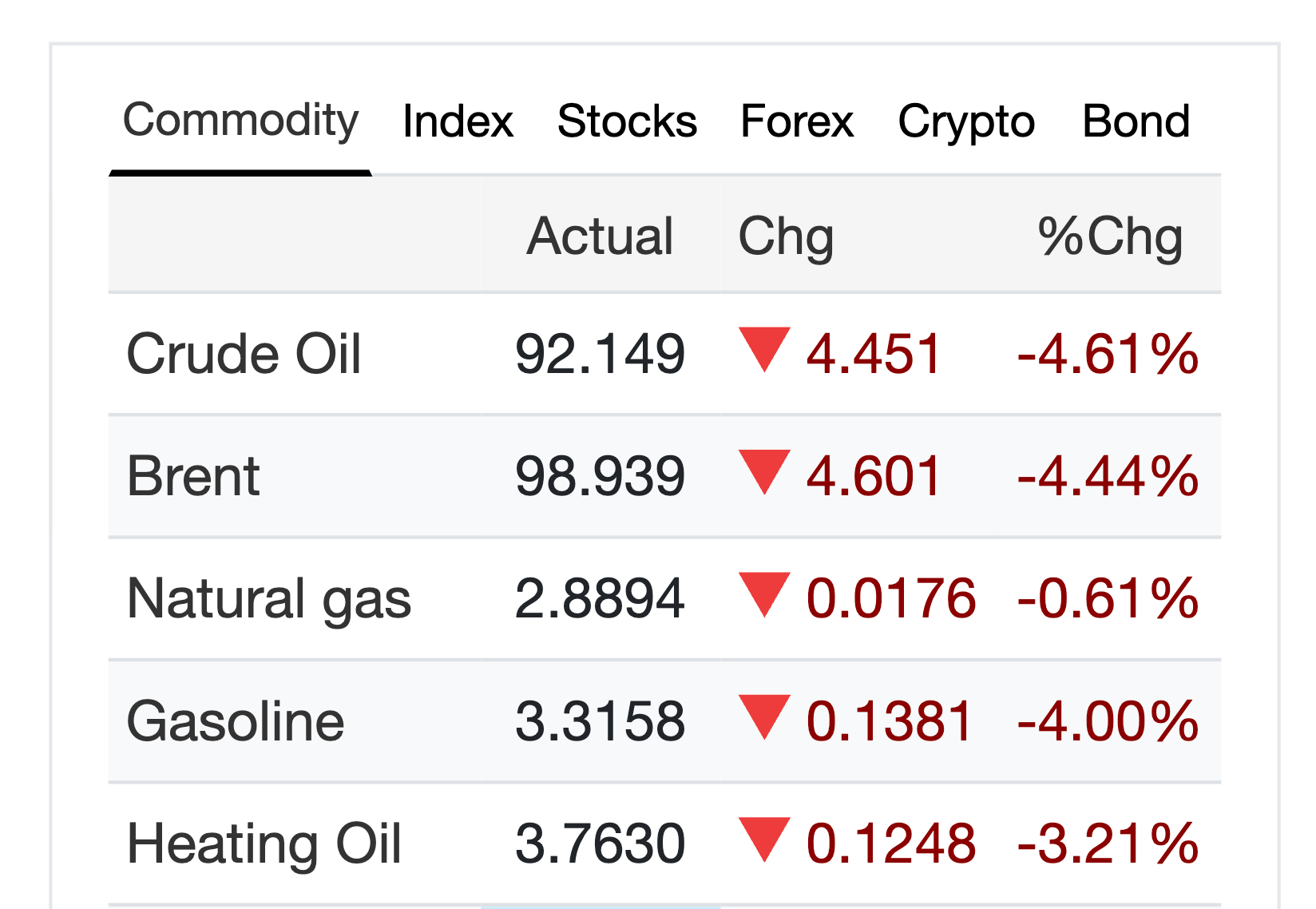
Oil prices tumbled more than 4% after President Donald Trump signaled orderly progress in Iran nuclear talks but told his team not to rush a deal.
West Texas Intermediate crude dropped 4.61% to $92.1, while Brent slid 4.44% to $98.9. The selling rippled across the broader energy complex.
Gasoline futures fell 4% to $3.3, and heating oil dropped 3.2% to $3.7. Natural gas slipped 0.61% to $2.88.

Trump’s Iran Post Reset the Oil Risk Premium
Oil had climbed sharply through the conflict, with Brent breaching $110 earlier in May. Notably, major de-escalation signals have knocked prices down.
Trump’s post leaned into patience over urgency. He thanked Middle East allies for their cooperation and floated the possibility of Iran eventually joining the Abraham Accords.
Follow us on X to get the latest news as it happens
Asian Stocks Rally and Crypto Edges Up as Risk Premium Fades
While energy markets moved south, risk assets moved in the opposite direction. Japan’s Nikkei 225 breached 65,000 on Monday for the first time. South Korea’s KOSPI rose 0.41% in early sessions.
Crypto markets posted modest gains as well. BeInCrypto Markets data showed that the broader market added 0.2% over 24 hours. Bitcoin (BTC) held near $77,000 after recovering from a low of $74,277.
With no deal yet and the blockade still in place, traders heading into the coming session will look for formal confirmation. A reopened Strait could ease Brent further. Any breakdown in talks would restore the geopolitical risk premium that has driven oil prices for the past three months.
Subscribe to our YouTube channel to watch leaders and journalists provide expert insights
The post Brent Crude Slides 4% as President Trump Signals Patient Iran Strategy appeared first on BeInCrypto.


Bitcoin price is still flying low below $80,000, holding a cautious prediction during its recovery stance, as fresh on-chain data from Glassnode puts a staggering figure on the table. $469 billion in BTC is theoretically exposed to quantum computing attacks.
The number is enough to rattle confidence, but the full picture is more nuanced. Glassnode’s latest research confirms BTC’s demand is not collapsing. The price floor, however, is not yet confirmed.
Published at the end of this week, Glassnode’s blockchain analysis identified 6.04 million BTC, or 30% of the entire circulating supply, already having their public cryptographic keys exposed on-chain. At current prices, this represents around $500 billion in potentially vulnerable holdings.
The exposure breaks into two categories: 1.92 million BTC in structural exposure (legacy pay-to-public-key outputs, early Satoshi-era coins, Taproot outputs) and 4.12 million BTC in operational exposure caused by address reuse.
The mechanism of risk is Shor’s algorithm, or a quantum computing method that could, in theory, derive a private key from a known public key, making any coin with an exposed public key immediately targetable without requiring a new transaction.
Critically, many structurally exposed coins may be permanently immovable, which limits the real-world attack surface somewhat. But the operational exposure category of 4.12 million BTC is both large and, in principle, avoidable.
Discover: The Best Crypto to Diversify Your Portfolio
Bitcoin Price Prediction: Is Quantum The Reason Behind BTC Downtrend?
At the current price, BTC sits in a compression zone between two well-defined technical boundaries. Near-term resistance is pegged at $78,000, with a clean break above that level needed to confirm momentum resumption.
Support is layered with its immediate defense at $74,000, and a higher-timeframe structural base at $80,000.

ETF inflows returning is the most important variable right now. Institutional flows drove this entire cycle’s upside; their return stabilizes spot demand at scale. On-chain analyst Willy Woo has said BTC is “currently attempting a bottom,” though he flagged the next three to six weeks as the decisive window.
This caution is warranted with Middle East tensions and U.S. macro data that remain live catalysts. Both metrics could invalidate any technical setup overnight.
Discover: The Best Token Presales
Bitcoin Tests Critical Resistance as Hyper Continues Recording Presale Milestones
Bitcoin upside to its all-time high is real on paper, but it’s a huge move from current levels. It is also dependent on macro cooperation, ETF flows, and no quantum-narrative-driven panic.
For those who want Bitcoin ecosystem exposure without waiting on that entire journey, the infrastructure layer beneath Bitcoin is where leverage on the thesis actually lives.
Bitcoin Hyper ($HYPER) is positioned squarely in that gap. It’s the first Bitcoin Layer 2 with Solana Virtual Machine (SVM) integration that delivers smart contract execution at speeds that exceed Solana, while settling on Bitcoin’s security layer.
The project has raised more than $32 million in its presale, with tokens currently priced at just $0.0136. A Decentralized Canonical Bridge handles BTC transfers natively, and staking is live with a high 36% APY for early participants.
The core use case is simple: Bitcoin is slow, expensive, and not programmable. Bitcoin Hyper targets all three limitations at once.
The post Bitcoin Price Prediction: Half a Trillion Dollars on the Line, Says Glassnode appeared first on Cryptonews.
The U.S. Securities and Exchange Commission has reportedly delayed plans to introduce a proposed exemption for tokenized stock trading after exchanges and market participants raised concerns over investor protections and how blockchain-based ownership would function in practice.
Summary
- SEC has reportedly delayed its tokenized stock exemption proposal after exchanges raised concerns over shareholder rights and ownership verification.
- Hester Peirce said the proposed framework would likely support only issuer-backed digital versions of publicly traded equities.
- Crypto executives, including Securitize CEO Carlos Domingo, backed the delay and warned against rushing tokenized stock rules.
According to a Bloomberg report published Friday, SEC staff had already reviewed a draft framework tied to the agency’s proposed “innovation exemption,” which was expected to be released earlier this week before discussions slowed.
People familiar with the matter told Bloomberg that feedback from stock exchange officials and other market participants centered on whether tokenized equities could preserve the same legal and economic rights attached to traditional shares.
Questions were also raised over how ownership records would be verified on semi-pseudonymous blockchains and whether unauthorized firms could issue stock-linked tokens without approval from the underlying public companies.
Under the proposal reviewed by the SEC, platforms offering tokenized equities would need to ensure investors retain rights typically associated with common stock, including dividend access and shareholder voting privileges.
Earlier in the week, SEC Commissioner Hester Peirce had already signaled
that any exemption under consideration would likely remain narrow in scope.
In comments posted to X on Thursday, Peirce said she expected the framework to support only “digital representations” of equity securities that already trade in public secondary markets.
SEC discussions narrow focus to issuer-backed equities
At the same time, the latest delay has drawn support from several crypto industry executives who argued that the SEC should avoid rushing a framework for tokenized securities.
Carlos Domingo, the CEO of tokenization platform Securitize, wrote on X that regulators should ensure the exemption “applies to the right instruments,” adding that delaying the proposal would be preferable to introducing rules that create operational or legal problems.
Separately, Tom Farley, the CEO of crypto exchange Bullish, said on X that the SEC appeared to be recognizing that only public companies themselves should be permitted to issue blockchain-based versions of their shares.
Behind the discussions, the SEC has continued drawing a distinction between different forms of tokenized securities. In guidance released in January, the agency classified such products into “custodial” and “synthetic” categories.
Custodial tokenized securities are issuer-backed shares held through regulated intermediaries and provide investors with shareholder rights tied to the underlying stock. Synthetic tokenized securities, by contrast, only offer price exposure to equities without transferring ownership of the underlying shares.
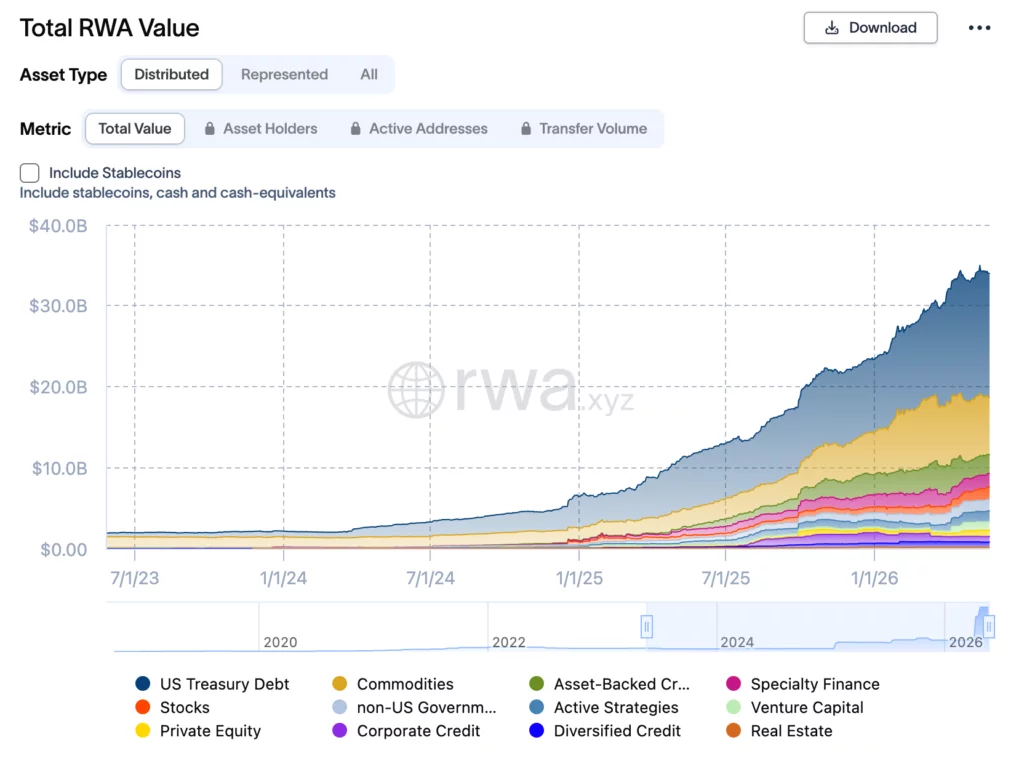
Growing interest in tokenization from Wall Street firms and crypto companies has coincided with the SEC taking a more crypto-friendly stance under the Trump administration. Data from RWA.xyz shows that tokenized real-world assets have reached roughly $34 billion, including about $1.55 billion tied to tokenized equities.
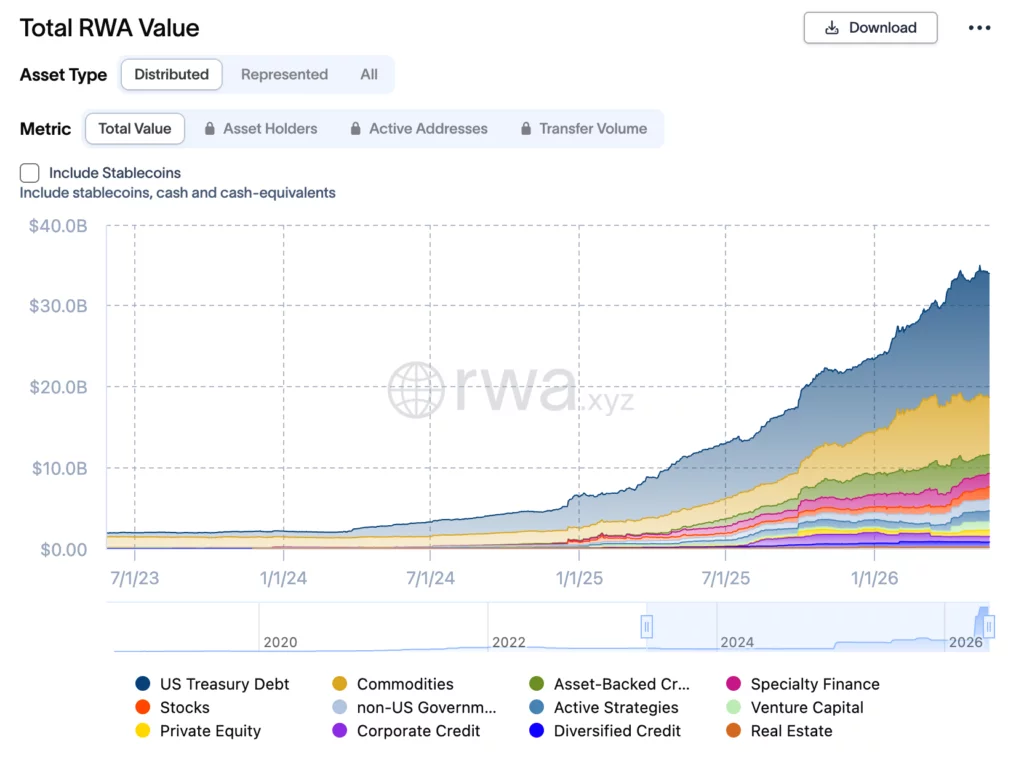
Total RWA market value. Source: RWA.xyz
Despite that growth, adoption has remained below earlier industry projections. According to a McKinsey & Company report published in 2024 tokenization could grow into a multi-trillion-dollar market by the end of the decade.
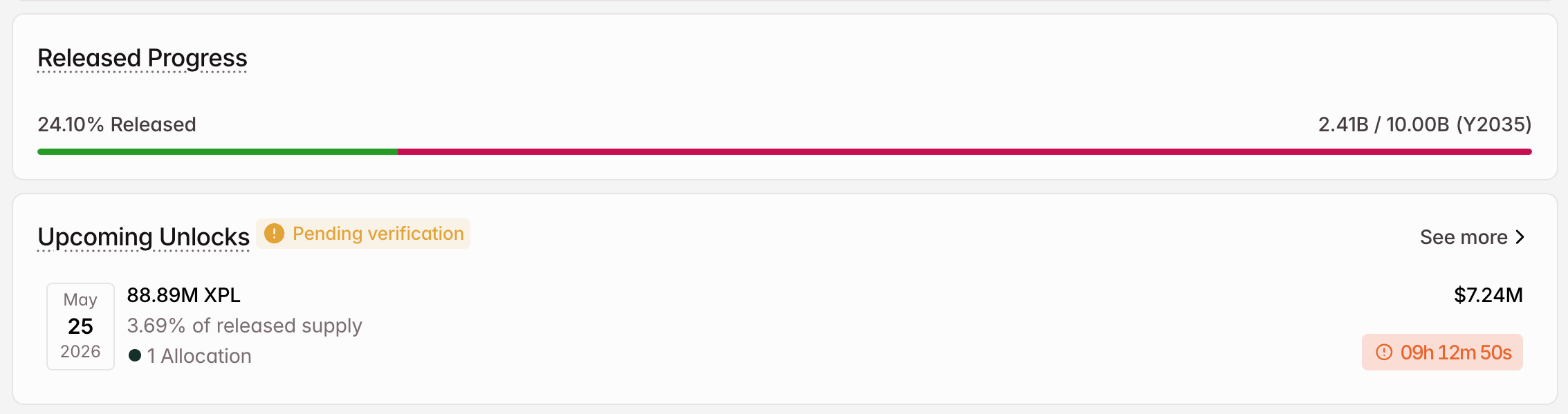
The crypto market will welcome tokens worth more than $655 million in the final week of May 2026. Three major projects, Huma Finance (HUMA), Plasma (XPL), and Sahara AI (SAHARA), will release previously restricted tokens into circulation.
Token unlocks are crucial events in the crypto market, influencing liquidity, price volatility, and overall investor sentiment. So, here’s a breakdown of what to watch.
1. Huma Finance (HUMA)
- Unlock Date: May 26
- Number of Tokens to be Unlocked: 458.75 million HUMA
- Released Supply: 2.29 billion HUMA
- Total supply: 10 billion HUMA
Huma Finance is a PayFi (Payment Finance) network. It enables global payment institutions to settle transactions 24/7 using stablecoins and on-chain liquidity.
On May 26, the protocol will unlock 458.75 million tokens. The tokens are worth $11.64 million and account for 20.04% of the released supply.

The team will split the released supply three ways. Investors will receive 171.67 million altcoins. Furthermore, the team and advisors will get 160.83 million HUMA. Finally, Huma Finance will allocate 126.25 million altcoins to the protocol treasury.
2. Plasma (XPL)
- Unlock Date: May 25
- Number of Tokens to be Unlocked: 88.89 million XPL
- Released Supply: 2.41 billion XPL
- Total supply: 10 billion XPL
Plasma is a Layer 1 blockchain platform built to enhance the efficiency and scalability of stablecoin transactions. It enables zero-fee USDT transfers, supports custom gas tokens, enables confidential payments, and delivers the throughput required for global-scale adoption.
Plasma will release 88.89 million crypto tokens on May 25. The XPL stack is worth $7.24 million. Moreover, the tokens account for 3.69% of the released supply.

The team will direct all of the 88.89 million XPL to the ecosystem and growth.
3. Sahara AI (SAHARA)
- Unlock Date: May 26
- Number of Tokens to be Unlocked: 132.93 million SAHARA
- Released Supply: 3.27 billion SAHARA
- Total supply: 10 billion SAHARA
Sahara AI is a full-stack, AI-native blockchain platform built to democratize the development and monetization of artificial intelligence. The network combines data services, AI tools, and a marketplace into one ecosystem.
On May 26, Sahara AI will unlock 132.93 million SAHARA. The supply is worth $4.56 million. The tokens represent 4.06% of the released supply.

Sahara AI will direct 53.02 million tokens to ecosystem development. In addition, the team will allocate 48.67 million SAHARA to airdrops and 31.25 million tokens for community incentives.
In addition to these, other prominent unlocks that investors can look out for in the final week of May include Venom (VENOM), Sophon (SOPH), Sign (SIGN), and more.
The post 3 Token Unlocks to Watch in the Final Week of May 2026 appeared first on BeInCrypto.
Nasdaq has moved closer to offering cash-settled bitcoin index options, a move set to democratize crypto risk management and eliminate legacy operational barriers.
Last week, the U.S. Securities and Exchange Commission granted Nasdaq PHLX conditional approval to list European-style options under the ticker QBTC. These will be cash-settled, European-style options tracking the CME CF Bitcoin Real Time Index (BRTT).
Cash-settled means the options are settled in U.S. dollars. At expiration, the exchange credits or debits the cash difference between the strike price and the final index value and no actual bitcoin is delivered or received.
For the average market participant, the new product, still pending approval from the Commodity Futures Trading Commission (CFTC), removes operational friction. QBTC options will trade on the same Nasdaq platform as popular technology stocks, allowing participants to execute hedging strategies and bitcoin volatility bets directly through their existing brokerage accounts without needing a separate futures or derivatives account.
By contrast, CME’s bitcoin options, which have been available since 2020, are also cash-settled but track Bitcoin futures rather than the spot index. They also require a dedicated derivatives account, adding operational complexity.
The story doesn’t end there.
Each Nasdaq QBTC option contract delivers exposure equivalent to exactly 1 BTC, using a 1/100th index scaling factor with a standard $100 multiplier. By comparison, the CME’s standard Bitcoin option is sized at 5 BTC, often representing hundreds of thousands of dollars in notional exposure.
This much smaller contract size opens the door for precise hedging by smaller institutional managers and more affordable volatility trading for retail participants.
Options are derivative contracts that give the purchaser the right to buy or sell the underlying asset at a predetermined price on a later date. A call option gives the right to buy and represents a bullish bet, while a put offers protection against price slides.
Think of it like paying a small non-refundable deposit to lock in the right to buy/sell a house at today’s price anytime over the next few months. If property prices rise/fall, you can still purchase/sell at the pre-agreed price and benefit from the gain. If you change your mind, you simply walk away, losing only the initial deposit.
Crypto options, led by bitcoin contracts, have seen explosive growth in recent years, as institutionalization of the market triggered demand for sophisticated risk management and yield-enhancing strategies.
Crypto World
Huawei unveils new smartphone chips this fall as rivalry with Nvidia and Apple heats up

Tingbo He, president of Huawei semiconductor, presents at an industry conference in Shanghai on May 25, 2026.
Huawei
SHANGHAI — Chinese tech giant Huawei on Monday touted a new approach to developing advanced semiconductors despite U.S. sanctions, as Nvidia struggles to sell its high-end chips in China.
Huawei said it developed a new engineering approach called “LogicFolding” to manufacture its Kirin smartphone chips this fall.
That breakthrough comes as Nvidia faces U.S. export restrictions in China and Apple contends with renewed competition from Huawei in the world’s second-largest consumer economy.
Huawei’s Mate 60 smartphone, launched in 2023, included 5G connectivity powered by an advanced chip that helped the company regain market share from Apple.
While U.S. restrictions have kept Nvidia from selling its most advanced chips to China in recent years, Beijing has pushed to support homegrown technology instead. Last week, Nvidia CEO Jensen Huang told CNBC the U.S. chipmaker had “conceded” the Chinese market to Huawei.
“For Nvidia, this means the window to sell advanced chips such as the H200 into China is narrowing,” said George Chen, partner and co-chair of digital practice at The Asia Group.
“This trajectory will likely heighten concerns in Washington, where Huawei remains emblematic of U.S. export restrictions,” he said.
Huawei said that by 2031, its new chip technology could deliver capabilities equivalent to 1.4-nanometer process technology — while global chip leader TSMC has begun volume production of 2-nanometer chips.
Nanometer processes refer to chip manufacturing technology, with smaller nodes typically enabling faster and more efficient semiconductors.
Paul Triolo, head of technology, Asia and Americas, at DGA Group, was skeptical of Huawei’s 1.4-nanometer claim.
“A stacked/folded design can produce effective density gains, but it does not mean Huawei has solved the full process, yield, power, thermal, and device-performance problems associated with true 1.4 nm-class manufacturing,” he said.
Academic ambitions
Huawei is also seeking greater academic recognition for its semiconductor research. On Monday, the company described its findings as the “Law of Tau,” or “τ scaling,” and claimed it addresses challenges faced by the semiconductor industry.
Semiconductor development has, for decades, relied on “Moore’s Law,” an observation that the number of transistors would double roughly every two years — delivering more computing power while lowering costs. However, even Nvidia’s Huang has said Moore’s Law is no longer applicable to future chip development.
“Huawei is turning an engineering strategy into a quasi-‘law,’” Triolo said.
The new principle “is more a systems-level optimization doctrine: shorten wires, stack logic, improve memory semantics, and co-design chips, packages, software, and clusters,” he said.
Still, challenges remain around heat management and manufacturing at scale, Triolo said.
Huawei’s new chip architecture expands the layout from one layer to two, significantly increasing power efficiency, according to Tingbo He, president of Huawei’s semiconductor business.
This structure allows transistors to interact with each other at more points, He, who is also a director of the company’s scientist committee, said at the Institute of Electrical and Electronics Engineers’ International Symposium on Circuits and Systems.
However, she acknowledged that challenges remain, as Huawei is only just beginning a decade-long development path for the new technology.

Crypto markets have remained flat over the past day, but had a weekend boost after US President Trump hinted that a “largely negotiated” deal with Iran was imminent.
“It also appears further progress has been made toward a 60-day ceasefire extension for the Iran War,” said the Kobeissi Letter.
This week will see key inflation reports, which could put further pressure on the economy and the central bank.
Economic Events May 25 to 29
US markets are closed on Monday for Memorial Day, but there is likely to be some movement in stock futures and crypto as investors digest any US-Iran peace deal agreements.
In his latest statement, Trump was typically evasive.“If I made a deal with Iran, it will be a good and proper one,” he said, countering comments from Sunday suggesting it was almost finalized.
According to Axios, the White House no longer expects an agreement with Iran to be announced on Monday and thinks it could take “several more days.”
Tuesday kicks off the economic data for the week with May’s consumer confidence report, which will reflect the increase in inflation.
Thursday is the big data day, with April’s Personal Consumption Expenditures Price Index (PCE) and first-quarter GDP data.
“Headline spending will be lifted by higher gasoline prices, but otherwise we are likely to see some weakness,” said ING economist James Knightley in a note.
The PCE figures “will do little to ease inflation concerns in an environment where freight costs are rising appreciably in response to higher motor fuel costs,” he added.
Key Events This Week:
1. US-Iran Agreement Details – Expected Today
2. US Markets Closed, Memorial Day – Monday
3. May Consumer Confidence data – Tuesday
4. April PCE Inflation data – Thursday
5. US Q1 2026 GDP data – Thursday
6. April New Home Sales data – Thursday
We…
— The Kobeissi Letter (@KobeissiLetter) May 24, 2026
New home sales for April and weekly jobless claims data are also due this week, but focus will primarily be on the POTUS and a deal with Iran.
Crypto Market Outlook
Crypto market capitalization has not moved over the past 24 hours, but Bitcoin and its brethren quickly recovered from Saturday’s dump.
BTC fell to $76,000 in late Sunday trading but rapidly recovered to reclaim $77,000 during the Monday morning Asian session. Weekly resistance currently lies at $78,000, an area that could be broken if positive news on a deal emerges this week.
Ether prices continue to weaken, with the asset falling below $2,100 on Monday morning.
The altcoins remain mostly flat with minor gains for Hyperliquid, Zcash, and Monero.
The post 3 Things That May Move Bitcoin and Crypto Markets This Week appeared first on CryptoPotato.


Coinbase CEO Brian Armstrong published an eight-point list naming tokenized assets, stablecoins, artificial intelligence (AI), and sound money as areas he says the global financial system still needs updates.
Armstrong framed the items as work for both technology builders and policymakers.
Coinbase Agenda Lands With Tokenization Surging
The post arrived as tokenized real-world assets (RWAs) crossed $34.9 billion in May 2026, according to data from RWA.xyz. The figure shows growth of roughly 200% over the past year.
Armstrong called for putting real estate, stocks, bonds, and funds onchain. He argued the shift would enable instant settlement, fractional ownership, and broader distribution to global investors.
He also pushed for continuous global markets with pooled liquidity. The Coinbase chief said 24/7 trading could improve capital efficiency and expand access to leveraged products.
Follow us on X to get the latest news as it happens
Stablecoins, AI Compliance and Regulation Round Out the List
Meanwhile, stablecoin payments also featured in the post, including transfers between autonomous AI agents. Coinbase already operates x402, a stablecoin payment protocol that has processed over 75.4 million transactions in the past 30 days.
On AI, Armstrong said the technology could sharpen credit decisions, fraud detection, and more.
“AI-powered risk, credit, compliance, and advice – Better decisions, less fraud, and broader access to capital. Everyone gets access to a great financial advisor,” he said.
Moreover, Armstrong urged risk-based regulation rather than blanket rules. The Coinbase CEO also pointed to sound money, self-custody, and lower-cost capital formation as the remaining priorities, framing all eight as outstanding work.
Subscribe to our YouTube channel to watch leaders and journalists provide expert insights
The post Coinbase CEO Says Financial System Needs Update Across 8 Areas appeared first on BeInCrypto.
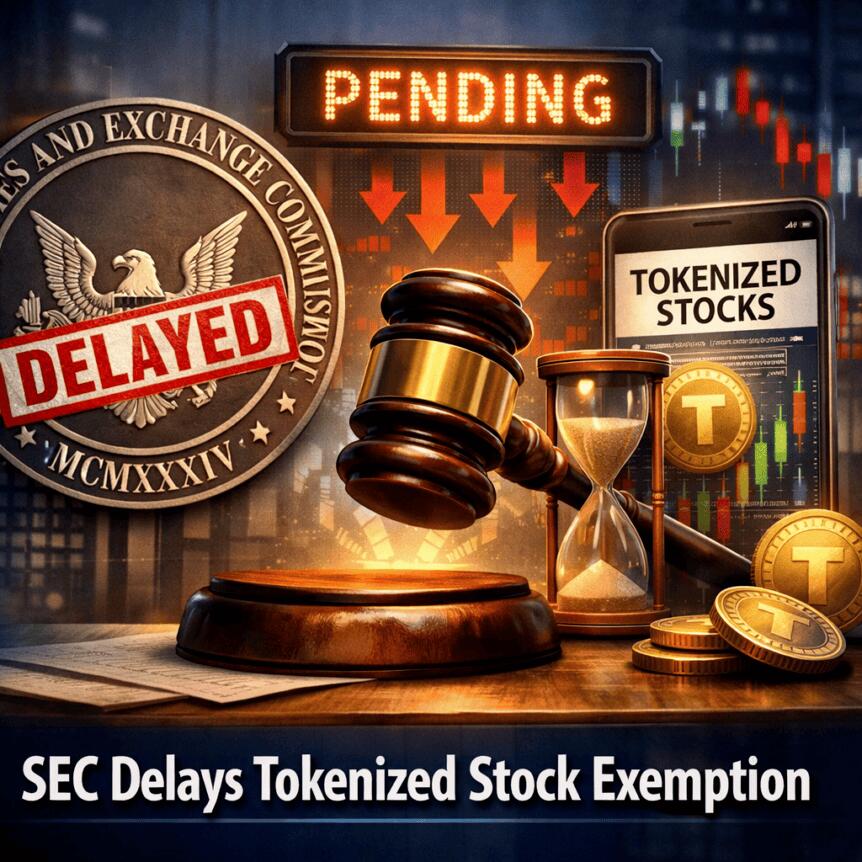
The U.S. Securities and Exchange Commission is delaying the rollout of an “innovation exemption” that would let platforms trade tokenized versions of U.S. stocks, according to people familiar with the matter. Bloomberg reported on May 22, 2026, that the agency has not yet decided to alter its proposed framework, despite broad feedback from market participants.
Under the draft rule, venues offering tokenized stocks would be required to guarantee holders the same rights as traditional shareholders—dividends and voting rights—raising questions about how to verify ownership and prevent unauthorized third-party issuers on semi-anonymous blockchains. The pause follows input from hundreds of market participants on the specifics of implementation.
Key takeaways
- The SEC reportedly postponed the “innovation exemption” for tokenized stocks; no final decision to change the proposal has been made.
- Any platform offering tokenized equities would be obliged to deliver real shareholder rights, prompting concerns about unauthorized issuers and on-chain ownership verification.
- Industry voices urged a careful approach, with prominent executives arguing that delays are prudent to ensure the exemption targets the right instruments.
- Public-token representations are viewed through two models: custodial tokens with full ownership rights and synthetic tokens that track price exposure without underlying ownership.
- Market data shows tokenization of real-world assets reaching $34 billion, including $1.55 billion in tokenized equities, though overall adoption has lagged earlier projections.
Deliberations amid a state of flux
The Bloomberg report underscores that the SEC’s innovation exemption—intended to govern crypto-based stock representations—remains under consideration, with a final decision still pending. The commission has reportedly received input from hundreds of market participants on how best to implement the rules, but officials have not committed to adjusting the proposal’s scope.
The core issue is straightforward in description but thorny in practice: ensuring tokenized shares carry the same rights as traditional stock, including the right to receive dividends and to vote. At the same time, regulators are wary of how ownership would be verified on blockchains that are at least semi-anonymous, and of the risk that third parties could issue tokens tied to public companies without authorization. The balance between protecting investors and enabling a new layer of market infrastructure remains delicate as the rulemaking unfolds.
Industry reaction and regulatory context
Industry participants have largely welcomed the SEC’s decision to pause and reassess. Carlos Domingo, CEO of Securitize, a leading tokenization platform, emphasized the importance of alignment between the exemption’s scope and the instruments it covers. In a post to X, he wrote that it is crucial the exemption applies to the right instruments, adding, “Better delay it than get it wrong and unleash all sort of problems.”
“Better delay it than get it wrong and unleash all sort of problems.”
The push to move carefully echoes broader tensions in the sector. Tom Farley, CEO of crypto exchange Bullish, summarized a similar sentiment on X, suggesting that the market needs to recognize that public companies remain the issuers of stock representations and praising the SEC for taking time to get it right.
These reactions come as the SEC’s approach to crypto-powered financial products has evolved since the Trump administration, a period that has coincided with a notable uptick in Wall Street interest in tokenization and related concepts such as stablecoins. The commission has signaled a willingness to explore regulated structures for digital assets, even as it exercises caution on premature or misaligned products.
The discussion around tokenized securities has also been colored by remarks from the agency’s commissioners. In particular, Commissioner Hester Peirce indicated that any exemption should be narrow in scope and would likely support “digital representations” of equity securities that resemble what investors already access in the secondary market. Her observations highlight the ongoing debate about how far tokenization can realistically extend into traditional equity markets without compromising investor protections.
Earlier this year, the SEC clarified that tokenized securities could take one of two forms: custodial tokens, where issuer-sponsored shares are held by regulated intermediaries with full shareholder rights, and synthetic tokens, which offer price exposure without granting actual ownership of the underlying shares. That distinction remains central to how the proposed exemption might operate in practice and to how the sector designs compliant products.
Tokenization progress and market expectations
Beyond the regulatory question, industry data paints a mixed picture of progress. RWA.xyz, a data service tracking tokenized real-world assets, reports that about $34 billion worth of such assets have been tokenized across various use cases, including roughly $1.55 billion in tokenized equities. While that suggests meaningful activity, the pace and scale have not matched some early forecasts. Banks and consulting firms previously projected tokenization could become a multi-trillion-dollar market by the end of the decade, with Citi and McKinsey among the forecast leaders; those projections have yet to materialize in the way some hoped.
The present pause, then, is not just a procedural hiccup but a test of whether tokenization can mature under a framework that preserves investor rights while preventing misissuance and governance confusion. The SEC’s willingness to solicit broad feedback and to delay action signals a methodical approach: even as market participants push for faster adoption, regulators appear intent on getting the architecture right before broader rollout.
Looking forward, observers will be watching for the SEC’s next moves on the exemption’s scope, the exact standards for custodial versus synthetic tokenized securities, and how platforms will verify ownership and consent from public companies involved. As the industry waits for a more definitive rule, the balance between innovation and protection remains the central theme shaping the trajectory of tokenized equities.
What remains uncertain is how quickly regulators will translate stakeholder input into a final framework that works in a live market. In the near term, the key questions are whether the exemption will cover a narrow set of instruments or broaden to a wider class of digital representations, and how issuers, platforms, and investors will navigate the practicalities of on-chain ownership, voting, and dividends. The next weeks and months will be instrumental in setting the tempo for tokenized equities and the broader tokenization push across asset classes.


Kalshi has backed a new advocacy group, Americans for Fair Markets, as the prediction market industry faces rising pressure from casinos, sportsbooks, state regulators, and Congress.
Summary
- Kalshi-backed Americans for Fair Markets will lobby for federal prediction market rules and consumer protections.
- The launch comes as Congress now probes Kalshi and Polymarket over insider trading control systems.
- State gambling cases keep pressure on platforms seeking CFTC-led oversight of event contracts nationwide.
The group launched with Taylor Budowich, a former deputy White House chief of staff, as strategic advisor.
Americans for Fair Markets plans to shape federal policy for prediction markets and federally regulated exchanges. Kalshi said the group will support paid and earned campaigns against what it called “false narratives about prediction markets” from sportsbook and casino interests.
The group also said it will support consumer rules for regulated platforms. Its stated priorities include know-your-customer checks, bans on insider trading, full CFTC funding, and limits on contracts tied to war, death, terrorism, and assassination.
Former Trump aide joins the policy push
Taylor Budowich’s role gives the group a direct link to Republican political circles. Budowich most recently served as deputy White House chief of staff under Susie Wiles, according to Kalshi’s announcement.
John Bivona, Kalshi’s head of government relations and an AFM board member, framed the launch as a response to powerful gaming interests.
“We’re not going to be outspent or out-organized by entrenched interests protecting their monopolies,” he said.
Additionally, the launch came as the U.S. House Committee on Oversight and Government Reform opened an investigation into Kalshi and Polymarket. The committee asked both firms for records on user checks, geographic limits, and suspicious trading controls.
The probe follows concerns that users with non-public government information could profit from event contracts. Related reports also cited suspicious trades tied to geopolitical events and a case involving a U.S. Army master sergeant accused of using classified information to earn more than $409,000.
CFTC and states remain divided
Kalshi wants federally regulated prediction markets to remain under the Commodity Futures Trading Commission. State regulators argue that some event contracts, especially sports-linked markets, fall under local gambling laws.
As reported by crypto.news, that conflict widened after Kalshi and Polymarket lost emergency bids in Nevada and Washington. A Ninth Circuit panel ruled that a federal derivatives defense does not automatically move state gambling cases into federal court.
Prediction markets expand beyond retail trading
Related reports show Kalshi has also been moving toward larger financial use cases. Bernstein pointed to Kalshi’s first bespoke block trade as a step toward institutional event-risk trading, while Clear Street added a regulated access route for larger clients.
Kalshi has also appeared in reports about crypto perpetual futures and media data deals. Earlier coverage noted that Fox would stream Kalshi’s real-time probabilities across Fox News, Fox Business, Fox Weather, and Fox One after similar integrations with CNN and CNBC.


Kalshi has backed a new lobbying group for prediction markets called Americans for Fair Markets, which has tapped former deputy White House chief of staff Taylor Budowich as its strategic advisor.
Kalshi said on Friday that the organization is positioning itself against sportsbooks and casinos, which it claims are “focused on protecting their monopolies and seeding lies about prediction markets to policymakers.”
Americans for Fair Markets, which Kalshi said was launched with its support, would join a broader lobbying push that includes the Coalition for Prediction Markets, an advocacy group for prediction markets launched in December 2025, backed by Coinbase, Crypto.com, and Robinhood.
Kalshi said the organization aims to shape federal policy on prediction markets and would run paid campaigns on what it claimed were “false narratives about prediction markets.”
The launch of the group came on the same day that the US House launched a probe into Kalshi and its main rival, Polymarket, over how the companies were handling insider trading, as prediction markets come under increased scrutiny in the US and abroad.
Budowich’s appointment as an advisor comes as US President Donald Trump has expressed mixed takes on prediction markets. Trump said last month that he was “not happy” with prediction markets over well-timed Iran war bets.
However, Trump, whose son Donald Trump Jr. invested in Polymarket and joined the company’s advisory board and is an adviser to Kalshi, softened his stance days later, saying the US would “get left out in the cold” if it didn’t allow the platforms.
Kalshi said that Americans for Fair Markets will support the Commodity Futures Trading Commission in regulating prediction markets.
The CFTC and state regulators have faced off over competing claims for jurisdiction, with states claiming prediction markets are violating local gambling laws, while the CFTC has claimed sole jurisdiction over the platforms.
Related: Kalshi valuation doubles to $22B after $1B funding round
Americans for Fair Markets said it would also focus on backing federally regulated platforms with consumer protections such as know-your-customer requirements, insider trading bans and restrictions on markets tied to violence or terrorism.
“We’re not going to be outspent or out-organized by entrenched interests protecting their monopolies,” John Bivona, Kalshi’s head of government relations who was appointed as a board member for the new lobby group.
“Millions of Americans have shown they want regulated, open, and fair prediction markets — and we’re going to make sure they have access to them,” he added.
Magazine: Polymarket seeks Japan entry, Harvard dumps entire ETH position: Hodler’s Digest

All The It Girls Are Wearing Capris – Here Are 17 Styles to Shop

XRP JUST SECURED $100 TRILLION??!. ($100T MC = $1,818.18)

Rubio’s India trip focuses on trade, the Quad and sightseeing


-

 Crypto World4 days ago
Blockchain.com files with SEC for U.S. IPO
-

 Fashion3 days ago
Holiday Weekend Open Thread – Corporette.com
-

 Crypto World3 days ago
Bitcoin Accumulation Weakens as BTC Realized Losses Hit $600M
-

 Business3 days ago
Dell Technologies DELL Stock Surges 15% on AI Server Momentum and Analyst Upgrades in 2026
-

 Crypto World3 days ago
Space X IPO Is ‘Bad News’ for Tech Stocks: But What About Bitcoin?
-

 Politics2 days ago
Makerfield: a tale of two social-media histories
-
 Crypto World3 days ago
MicroStrategy’s Saylor Says Miners No Longer Set Bitcoin Price, Another Force Has Taken Over
-

 Crypto World2 days ago
Robinhood crypto COO Tanya Denisova exits
-

 Business12 hours ago
NYT Strands Answers May 24 2026 Revealed for Puzzle No. 812 Theme Summer Essentials
-

 Tech3 days ago
WhatsApp ads could make Irish debut after discussions with DPC
-
 Tech3 days ago
A 0.12% parameter add-on gives AI agents the working memory RAG can’t
-

 Crypto World3 days ago
AI infrastructure race heats up as IREN pitches full-stack strategy, WhiteFiber lands $160M deal
-

 Tech3 days ago
You Can Now Add ChatGPT To PowerPoint
-

 Business3 days ago
Trump Invests $1M-$5M in Kura Sushi USA Chain With 27 California Locations
-
 Crypto World6 days ago
Revolut Launches Dogecoin Debit Card Across UK and EU
-
 NewsBeat4 days ago
Charity run by Reform leader Malcolm Offord accused of ‘law breaking’ over Scottish registration
-

 Sports3 days ago
2026 CJ Cup Byron Nelson leaderboard: Brooks Koepka finds putting stroke in Round 1
-

 Crypto World3 days ago
Trump Media’s Bitcoin Stash Shrinks Again as 2,650 BTC Lands on Crypto.com
-
Business3 days ago
Goldman Sachs reinstates Ageas stock coverage with neutral rating
-

 Crypto World4 days ago
Exa Labs raises $250 million in funding led by a16z
You must be logged in to post a comment Login