

Crypto World
Legal Battle Over 39,069 Inactive Bitcoin Wallets Unfolds in New York Court


Key Takeaways
-
Legal action in New York targets nearly 40,000 inactive Bitcoin addresses
-
Court case applies traditional abandoned property statutes to cryptocurrency holdings
-
Legal proceedings challenge fundamental principles of Bitcoin self-custody
-
Plaintiff claims discovery of wallets through proprietary algorithmic methods
-
Case establishes precedent for how courts handle long-dormant digital assets
A groundbreaking legal proceeding in New York has thrust the issue of inactive Bitcoin wallets into the spotlight, creating a potential landmark case for cryptocurrency property rights. A plaintiff identified as Noah Doe has initiated court proceedings seeking legal ownership of 39,069 Bitcoin addresses that have shown no activity for extended periods. This unprecedented case forces courts to grapple with how traditional property abandonment statutes apply to decentralized digital currencies.
Legal Framework Behind the Bitcoin Wallet Claim
On May 1, 2026, Doe submitted his legal petition to the Supreme Court of New York, invoking New York Personal Property Law Article 7-B as the statutory foundation. The legal strategy characterizes these digital holdings as discovered property rather than misappropriated or exchange-managed funds.
The petition lists Doe alongside two Wyoming-incorporated entities as co-plaintiffs. Their objective is securing a declaratory judgment that would establish legal ownership rights over the contested wallets and any cryptocurrency they contain. The core argument maintains that ownership should transfer due to the absence of legitimate claimants stepping forward.
According to the filing, Doe identified 42,001 potentially abandoned wallets using a proprietary algorithmic system he developed. Following protocol for found property, he notified the New York Police Department. Through subsequent verification efforts, 2,932 wallets were removed from consideration, leaving 39,069 addresses at the center of the legal dispute.
Technical and Legal Challenges in the Bitcoin Ownership Case
This legal challenge centers on fundamental issues of notification, possession, and statutory abandonment. Bitcoin wallets operate through cryptographic private keys, meaning courts cannot simply reassign cryptocurrency through conventional judicial orders. Any favorable ruling would carry symbolic and legal significance without enabling direct technical transfer.
Documentation shows Doe attempted blockchain-based notification by embedding messages via OP_RETURN transactions in June 2025. These on-chain communications pointed wallet controllers toward abandonment documentation and a formal claims procedure. A mandatory public notification window then extended through October 10, 2025.
Technical scrutiny has identified potential weaknesses in the notification approach. Blockchain analysts have observed that certain notices targeted P2PKH address formats, while the actual cryptocurrency resides in P2PK outputs. This technical discrepancy could undermine arguments that legitimate owners received adequate notification.
Broader Implications for Cryptocurrency Self-Custody
The targeted addresses include wallets associated with early-stage miners and other historically significant holders. Investigation has connected some listed addresses to cryptocurrency from the Satoshi Nakamoto era and potentially to assets linked to the Mt. Gox security breach. The complete inventory of contested addresses spans 901 pages of court documentation.
This litigation presents fundamental challenges to cryptocurrency self-custody principles. Extended periods of wallet inactivity could indicate lost cryptographic keys, deceased owners, or deliberate long-term storage strategies—not necessarily legal abandonment. Doe’s position maintains that proper notification combined with owner silence creates grounds for ownership transfer.
Traditional property law faces unprecedented challenges when applied to Bitcoin, which operates without centralized control or administration. While courts might bind regulated entities like exchanges if contested funds eventually move through their platforms, the [[LINK_START_2]]Bitcoin[[LINK_END_2]] protocol itself cannot reallocate cryptocurrency without the corresponding private keys.



NEW YORK and HONG KONG — Cyannova Capital (“Cyannova” or the “Company”), a New York-based investment firm, announces its inaugural investment fund, Cyannova Capital, LP, at its private industry reception held in Hong Kong. The fund is positioned as event-driven capital and operates as a resource integration platform, strategically leveraging the momentum of a significant global investment cycle fueled by the convergence of energy, computing, automation, and space-based infrastructure.
By leveraging a global network spanning North America, the Middle East, and Asia, Cyannova focuses on providing long-term support to its portfolio companies. Cyannova is targeting high-growth sectors that expand human productivity, including AI, renewable energy, robotics, and the emerging space economy.
At the reception, Cyannova announced that it entered into a strategic cooperation framework agreement with Butong Group (6090.HK), an emerging tech-driven lifestyle solutions provider. “Cyannova’s platform is built to do more than just deploy capital,” said Mr. Wang, Chairman of the Board of Butong Group. “Butong is proud to be one of Cyannova’s first strategic partners. They are integrating global resources to help companies scale across borders.”
Gathering over 200 business elites and strategic partners at the reception, Cyannova formally introduced its vision. The gathering featured technical fireside discussions on data center financing and the future of space-based data systems, underscoring Cyannova’s commitment to frontier technologies. The event further solidified the firm’s strategic footprint through signing ceremonies with two key partners, demonstrating its ability to foster meaningful cooperation across international markets.
“The reception was an important event to establish our credibility within the Hong Kong and broader Asia market,” said Alessandro Bianchi, Managing Director at Cyannova Capital. “The quality of the relationships formed and the strategic partners attending this event underscore the demand for a crossover investment platform focused on innovative companies. Cyannova is excited about the team we have put together, the investment themes we have chosen, and the geographies we are targeting. We are very excited to start deploying capital in the second half of 2026.”
For media inquiries, please contact:
This announcement is for informational purposes only and should not be construed as investment advice or a solicitation to invest.
About Cyannova
Cyannova Capital is a New York–based investment management firm focused on energy, computing infrastructure, robotics, and space economy. Cyannova manages a crossover investment strategy fund spanning public and private markets. The firm partners with growth-stage to later-stage companies, supporting their growth through capital and strategic insights, connecting them with new markets, strategic partners, and enabling technologies, thereby enhancing long-term investment value.
About Butong Group
Butong Group (06090.HK) is an emerging, tech-driven lifestyle company dedicated to designing, developing, and manufacturing premium nursery and family living products for global consumers. Operating primarily under its flagship brand, BeBeBus, the Group delivers high-performance, aesthetically refined solutions across key family scenarios, including travel gear, sleep systems, feeding essentials, and child care. Leveraging its proprietary advanced materials, in-house research and development, and sustainable intelligent manufacturing, Butong Group transforms functional parenting utilities into highly integrated technology experiences, driving original value and elevating everyday lifestyle standards for modern elite families worldwide.

Cyannova Capital and Butong Group (6090.HK) enter into a strategic cooperation framework agreement.

John Riggins, CEO of Moon Inc speaks at the reception event where Cyannova Capital announces its global launch.

However, this model cuts both ways. On one hand, it lets companies raise capital on a wave of market optimism. On the other, it forces them to absorb the volatility of the underlying asset when prices fall.
For a public company, the situation is even more complicated. Accounting obligations mean financial losses quickly become public, and any asset movements against that backdrop attract intense scrutiny.
The recent discussion around Trump Media & Technology Group (TMTG) shows exactly that. Amid paper losses on its crypto strategy, the company moved 2,650 BTC to Crypto.com, having previously withdrawn applications to launch its own cryptocurrency ETFs.
The market absorbed this news fairly calmly, but the obvious question remains: is this part of a trading strategy, or preparation for a forced sale of digital assets?
Behind the $200 million move
Trump Media was not created as a financial or investment entity, but rather as a technology holding company. Its flagship product is Truth Social — a social network launched after Donald Trump was banned from major platforms.
In March 2024, the company went public through a SPAC merger. Until the following spring, TMTG remained strictly within the social media sphere, and only then did management decide to pivot, beginning the formation of a cryptocurrency reserve.
For these purposes, the company raised approximately $2.3 billion through equity sales and the issuance of zero-coupon convertible secured notes.
Initially, the organization stated that it wanted to establish a Bitcoin reserve, with Crypto.com and Anchorage Digital serving as its custodial partners. In practice, the model turned out to be broader than initially declared.
The company invested in the Cronos (CRO) token, which is affiliated with the aforementioned Crypto.com, and filed applications to launch several cryptocurrency ETFs at once.
However, the cryptocurrency strategy has apparently failed to pay off.
As of December 31, 2025, Trump Media disclosed holdings of 9,542 BTC with a cost basis of $1.131 billion and a fair value of $836.4 million, alongside 756 million CRO with a cost basis of $113.9 million and a fair value of $68 million.
The company’s first-quarter 2026 report made the financial pressure even more evident. TMTG kept the same BTC and CRO balances on its books, but their fair value dropped to $647 million and $53 million, respectively.
Separately, TMTG disclosed an unrealized loss on digital assets of nearly $244 million (including pledged assets). Meanwhile, the company’s net loss is estimated at $405.9 million.
A few days after the report’s publication, the company also withdrew its applications to launch ETFs. Then, in late May, addresses linked by Arkham to Trump Media transferred 2,650 BTC to Crypto.com infrastructure — amounting to over $200 million at the market prices at the time of writing.
Some interpret such transactions as preparation for a sale or, at the very least, securing liquidity for over-the-counter (OTC) deals. However, the U.S. Securities and Exchange Commission (SEC) does not require companies to disclose public wallet addresses, which makes it difficult for outsiders to independently verify their intentions.
Companies often use such transfers to post collateral for fiat-denominated loans. In particular, TMTG said in its quarterly report that it had pledged 4,260 BTC as collateral for its convertible notes.
Another 2,000 BTC was transferred to a third-party partner as insurance for options trading. That partner also received the right to move those assets freely at its own discretion.

Excerpt from Form 10-Q. Source: SEC.
A TMTG representative also said the Bitcoin had been “transferred, but not sold,” describing the move as part of a broader trading strategy.
The market reacted fairly calmly to both the loss data and the transfer of Bitcoin to the exchange. That is likely because such an adverse scenario had already been priced in.
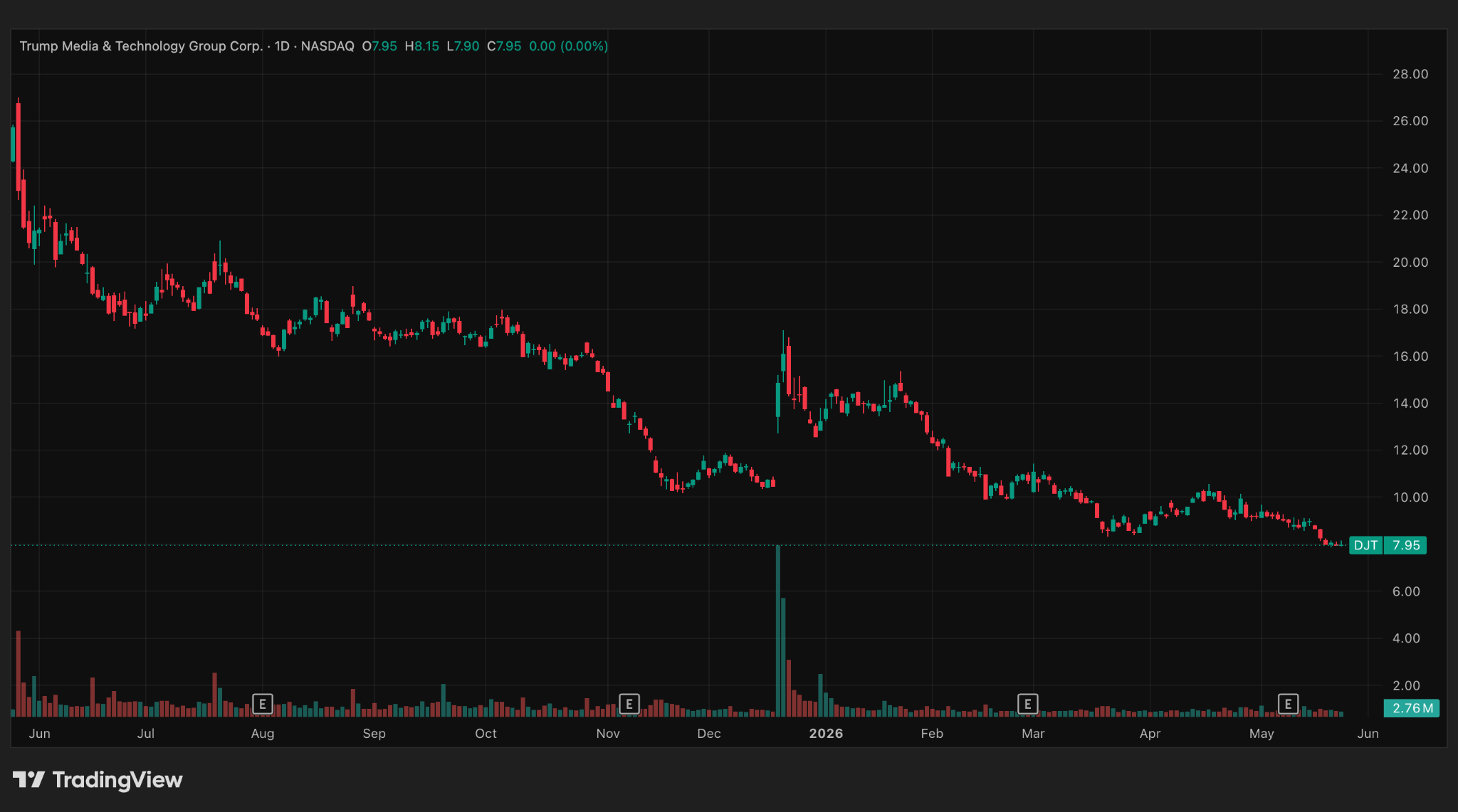
Since the beginning of 2026, the stock price of Trump Media & Technology Group (DJT) has fallen by nearly 40%. Source: TradingView.
From the outset, many analysts expressed skepticism over Trump Media’s ability to secure a foothold in an overheated crypto ETF market dominated by giants like BlackRock and Fidelity.
The situation was further compounded by the fact that TMTG’s proposed products featured virtually no structural differences from those of its competitors, relying instead primarily on marketing and the political brand.
The illusion of onchain transparency
The Trump Media case exposes a systemic issue: despite the transparency of the blockchain, tracking the actual state of corporate crypto reserves remains exceptionally difficult. A large onchain transfer can represent either a forced liquidation or a routine operational process with no underlying intention to divest the assets.
However, public company status dictates its own rules. To prevent panic among traditional investors, management is forced to explain nearly every movement of funds. Under these conditions, clear and timely communication becomes just as vital as the financial strategy itself.
Furthermore, such precedents bring a major regulatory dilemma to the surface. Should the SEC require public companies to disclose their blockchain addresses to enable a full independent audit? Or are wallets a trade secret, the disclosure of which would make executing corporate trading strategies impossible? This question remains unanswered for now.
As for TMTG specifically, the company’s crypto business does not yet look like a sustainable operation with clear economics. The deal with Crypto.com’s parent structure and the sudden withdrawal of ETF applications increasingly resemble an ad hoc search for a model to monetize a political brand, rather than a calculated, long-term strategy.
Ultimately, the main intrigue is not whether the company will sell its Bitcoin. The question is broader. Can such a structure, in principle, withstand the pressure of an aggressive crypto strategy over the long haul?
TLDR:
- Brian Armstrong says real-world asset tokenization enables instant settlement and fractional ownership globally.
- Armstrong calls for 24/7 global trading with pooled liquidity to remove time-zone barriers for all investors.
- Stablecoin payments and AI-powered financial tools are central to Armstrong’s next-generation finance roadmap.
- Sound money and innovation-friendly regulation are essential to completing Armstrong’s eight-point financial reform vision.
Coinbase CEO Brian Armstrong has outlined eight critical areas where the global financial system still needs reform.
These areas range from real-world asset tokenization to sound money principles. Armstrong shared his views publicly, drawing attention from crypto advocates and traditional finance observers alike.
His remarks point to a broader vision for a financial system that is more open, automated, and globally accessible to everyone.
Tokenization and Trading Lead Armstrong’s Reform Agenda
Real-world asset tokenization sits at the top of Armstrong’s list of necessary financial upgrades. He envisions putting real estate, stocks, bonds, and funds on-chain.
This move would enable instant settlement, fractional ownership, and wider distribution of assets globally. The reform would open investment opportunities to people previously excluded from traditional markets.
Armstrong also called for 24/7 global trading as another key upgrade to the financial system. He argued that pooling global liquidity across every asset class would improve capital efficiency.
Better leverage options and around-the-clock access would benefit both retail and institutional traders. This shift would remove time-zone barriers that currently limit market participation worldwide.
On payments, Armstrong pointed to stablecoins as the foundation for next-generation global transfers. He noted that near-instant, low-cost transactions are already possible using existing stablecoin infrastructure.
His remarks also addressed agentic payments, where AI systems transact autonomously on behalf of users. This area is growing quickly as AI adoption accelerates across financial services.
Armstrong further noted that AI-powered tools could transform risk assessment, credit decisions, and compliance monitoring. He said broader access to AI-driven financial advice would benefit underserved populations.
Everyone, he argued, deserves access to a quality financial advisor, not just the wealthy. Better fraud detection through AI would also make the system safer for all participants.
Self-Custody, Capital Formation, and Sound Money Round Out the Vision
Brian Armstrong also stressed the need for innovation-friendly regulation as a prerequisite for meaningful reform. He called for a shift away from one-size-fits-all rules toward risk-based frameworks.
These frameworks should encourage competition rather than protect incumbent financial institutions. Regulatory clarity, he added, is essential for startups building the next generation of financial tools.
Expanded access through open protocols and self-custodial wallets also featured in Armstrong’s outlined priorities.
He argued that reducing middlemen would make financial services more accessible to smartphone users everywhere.
Self-custody gives individuals direct control over their assets without relying on centralized institutions. This model aligns with the decentralized principles that underpin the broader crypto ecosystem.
Armstrong also highlighted low-cost capital formation as a tool to increase startup activity globally. He wants anyone with a viable idea to raise funds without excessive barriers or costs.
Sound money rounded out his list, with Armstrong describing it as a refuge from inflation. He said the job remains unfinished until all eight upgrades work reliably for everyone worldwide.
Crypto World
Dubai Pushes Toward a Cashless Future as Digital Payments Near 90% of Transactions by 2026

Dubai is rapidly accelerating its transformation into one of the world’s leading cashless economies, with authorities aiming for nearly 90 percent of all transactions across both public and private sectors to become fully digital by the end of 2026.
The initiative, known as the “Dubai Cashless Strategy,” was originally announced in October 2024 during a meeting of Dubai’s Executive Council chaired by Sheikh Hamdan bin Mohammed bin Rashid Al Maktoum. The long-term vision is ambitious: positioning Dubai among the top five cashless cities globally while strengthening its status as a global fintech and innovation hub.
Rather than eliminating money itself, the strategy focuses on replacing physical cash transactions with digital alternatives such as banking apps, contactless cards, QR payments, smart wallets, and AI-powered payment technologies.
According to Dubai Finance, the transition could contribute more than AED 8 billion annually to the emirate’s economy by improving efficiency, reducing operational costs, accelerating commerce, and increasing financial inclusion.
Why Dubai Is Moving Toward a Cashless Economy
Dubai’s push toward a digital-first financial ecosystem is part of a broader strategy to modernize infrastructure, support fintech innovation, and create a more connected economy.
Digital payments offer several advantages for governments, businesses, and consumers:
- Faster and more seamless transactions
- Reduced cash handling and operational costs
- Improved transparency and security
- Better integration with smart city infrastructure
- Enhanced financial tracking and analytics
- Greater convenience for residents and tourists
The strategy also aligns with the UAE’s wider ambitions around artificial intelligence, blockchain adoption, smart governance, and digital transformation.
For years, Dubai has positioned itself as a global testbed for emerging technologies. The move toward becoming a largely cashless society represents another major step in that direction.
Digital Payments Are Already Becoming the Standard
Recent developments show that the transition is already underway across multiple sectors.
One of the clearest examples came with the announcement from Parkin that cash payments at parking meters would begin to be phased out starting June 1, 2026. Drivers are now encouraged to pay using the Parkin app, SMS services, or nol cards instead of physical coins.
This may appear like a small operational change, but it reflects a much larger transformation happening throughout the emirate.
Consumers in Dubai are increasingly relying on:
- Apple Pay and Google Pay
- Contactless debit and credit cards
- Banking apps
- QR-based payment systems
- Instant transfer solutions
- Smart mobility payment integrations
The government is also encouraging businesses to modernize payment infrastructure through partnerships and fintech-focused initiatives.
In 2025, Dubai International Financial Centre (DIFC) and Dubai Finance launched workshops and programs designed to help businesses transition toward digital payment systems while introducing AI-driven financial technologies.
What This Means for Tourists Visiting Dubai
The cashless transition will not only impact residents and businesses, but also millions of tourists visiting Dubai every year.
The Central Bank of the UAE has already introduced initiatives aimed at simplifying digital payments for international visitors.
One of the most notable projects is the Tourist Identity initiative, which will allow tourists to instantly open digital bank accounts upon arrival in the UAE. Visitors will gain access to digital debit cards and essential banking services within minutes, significantly reducing the need to carry physical cash.
Tourists will also be able to access the UAE’s domestic card network, Jaywan, and use the Aani instant payment system for transfers and purchases.
Additionally, airlines including Emirates and flydubai have already partnered on initiatives encouraging digital payment adoption among international travelers.
The result is a smoother and more integrated payment experience across hotels, retail stores, transportation systems, restaurants, entertainment venues, and tourist attractions.
Potential Impact on Fintech, Crypto and Web3
While the Dubai Cashless Strategy itself is focused primarily on digital payments rather than cryptocurrencies, the initiative could indirectly accelerate growth across the broader fintech and Web3 ecosystem.
A population increasingly comfortable with digital wallets, instant payments, and app-based financial services creates an environment naturally more open to innovation in areas such as:
- Stablecoins
- Tokenized payments
- Digital identity systems
- Blockchain infrastructure
- Embedded finance
- AI-powered financial services
Dubai has already established itself as one of the world’s most crypto-friendly jurisdictions, attracting exchanges, blockchain startups, Web3 companies, and fintech entrepreneurs from around the globe.
As digital financial behavior becomes more deeply integrated into everyday life, the gap between traditional fintech and blockchain-based finance may continue to narrow.
A Glimpse Into Dubai’s Future
Dubai’s vision goes beyond simply reducing the use of physical cash.
The broader objective is to build a fully interconnected digital economy where payments, transportation, government services, tourism, commerce, and financial services operate seamlessly together.
If the strategy succeeds, paying with cash in Dubai could eventually become the exception rather than the norm.
From parking and public transport to restaurants, shopping malls, and government services, the emirate is steadily moving toward a future where nearly every transaction happens instantly through digital channels.
For residents, businesses, investors, and tourists alike, Dubai’s transition toward a cashless society may become one of the defining economic and technological shifts shaping the city over the coming decade.

Huawei may have just challenged one of the biggest assumptions driving the AI boom, that advanced chips will remain scarce, expensive, and dominated by Western companies like Nvidia and TSMC.
At the 2026 IEEE International Symposium on Circuits and Systems in Shanghai, Huawei introduced a new semiconductor approach called the Tau (τ) Scaling Law alongside a chip architecture known as LogicFolding.
Huawei Pushes Alternative Path Around US Sanctions
The company claims the technology could eventually produce chips with 1.4nm-equivalent transistor density by 2031 without relying on restricted Western lithography equipment.
The announcement immediately fueled debate across tech and financial markets because Nvidia’s massive valuation has largely been supported by the idea that advanced AI computing power will stay difficult and costly to manufacture.
US sanctions imposed since 2019 blocked Huawei from accessing advanced semiconductor manufacturing tools, including ASML’s extreme ultraviolet lithography machines.
Those restrictions were designed to slow China’s progress in AI and advanced computing.
Instead of relying entirely on smaller transistor sizes, Huawei’s new approach focuses on reducing signal delay through vertical chip stacking and shorter internal connections.
According to Huawei, LogicFolding increases transistor density and efficiency while improving chip performance without requiring the world’s most advanced fabrication equipment.
The company said the first commercial products using the technology will appear in Kirin smartphone chips launching later this year. Huawei also plans to integrate the architecture into its Ascend AI chips before 2030.
“If China can produce advanced computing power cheaply and at massive scale, the scarcity premium that justifies Nvidia’s valuation disappears entirely,” analyst Bull Theory highlighted.
The comparison echoes last year’s DeepSeek AI disruption, when Chinese developers released lower-cost AI models that challenged assumptions around expensive compute requirements.
Nvidia Still Holds Major Global Advantages
Despite the excitement surrounding Huawei’s announcement, analysts caution that Nvidia’s dominance remains intact for now.
“…the chipmaker’s AI dominance was unmatched because, unlike its capital-strained rivals, it had the resources to outpace them,” Reuters reported, citing Chris Rossbach of J Stern.
Huawei has not yet released independent benchmarks proving its new architecture can compete with Nvidia’s highest-end AI chips in large-scale training environments.
Manufacturing yields, power efficiency, heat management, and memory integration also remain unresolved challenges.
Nvidia continues to dominate the global AI market through its CUDA software ecosystem, partnerships with Taiwan Semiconductor Manufacturing Company, and leadership in hyperscale AI infrastructure outside China.
Still, the development highlights how US sanctions may have accelerated China’s push toward semiconductor self-sufficiency rather than permanently freezing the country out of advanced computing.
The coming years will likely determine whether Huawei’s architectural breakthrough becomes a genuine alternative to Nvidia’s hardware dominance or remains primarily a domestic Chinese solution.
The post Huawei Cracks the AI Chip Scarcity Story Behind Nvidia’s Massive Valuation appeared first on BeInCrypto.


Prometheum has launched new infrastructure allowing broker-dealers and RIAs to offer tokenized securities through traditional brokerage accounts.
Summary
- Prometheum launched new broker-dealer and RIA infrastructure on May 25 allowing traditional Wall Street firms to offer tokenized securities to investors at scale.
- Co-CEO Aaron Kaplan said crypto has solved tokenisation but not distribution, leaving $24 billion in on-chain securities without a mainstream investor channel.
- Prometheum operates a network of SEC-registered and FINRA-member broker-dealers supporting the full lifecycle of blockchain-based securities from issuance through settlement.
Prometheum launched new infrastructure on May 25 allowing broker-dealers and registered investment advisers to offer tokenized securities and crypto assets through traditional brokerage accounts. The company positions the launch as a bridge between blockchain-based securities and the conventional financial system.
“Crypto has solved tokenization, but it hasn’t solved distribution,” said Aaron Kaplan, co-founder and co-CEO of Prometheum. “There are tens of billions of dollars of tokenized securities already issued on blockchain rails, but almost no mainstream distribution channel to reach investors at scale.”
Why the distribution problem matters more than issuance
More than $24 billion in securities products have already been issued on blockchain networks according to RWA.xyz data. Crypto.news has tracked the rapid growth of tokenised Treasuries from $380 million in 2023 to $13.4 billion by April 2026, with tokenised equities emerging as the fastest-growing sub-sector.
The challenge Kaplan identifies is structural. Issuers can now tokenize securities relatively easily, but reaching mainstream investors requires access to regulated brokerage accounts, settlement infrastructure, and investor onboarding that most blockchain-native platforms do not provide.
Prometheum’s network of SEC-registered and FINRA-member broker-dealers provides correspondent clearing, custody, execution, and recordkeeping for third-party broker-dealers, enabling their clients to access on-chain securities within existing legal frameworks.
What Prometheum’s infrastructure adds to the tokenization market
Crypto.news has reported on BlackRock filing a second tokenised fund application with the SEC through Securitize, signalling institutional demand for regulated tokenization infrastructure is growing from both issuer and distribution sides. The Prometheum approach targets the distribution gap that well-resourced issuers still face, since retail brokerage access to on-chain securities remains limited to a small number of registered platforms.
Crypto.news has also covered Securitize’s plans to launch natively tokenized public stocks with full on-chain settlement. Whether Wall Street brokerage firms adopt Prometheum’s infrastructure will depend partly on whether the Clarity Act’s passage reduces regulatory uncertainty enough to justify the compliance investment.
The Cardano governance structure is facing challenges, and ADA is currently trading between $0.24 and $0.26, stuck in a consolidation phase. The next 30 days could significantly impact its price.
Founder Charles Hoskinson is conducting a governance review, analyzing over 11,000 DAOs to reshape Cardano’s model ahead of its 2027 governance cycle. A funding proposal for quantum-security research is likely to be rejected, with about 87% of Delegated Representatives opposed.
Hoskinson has criticized the Cardano Foundation’s structure as “undemocratic” and is advocating for a membership overhaul. Governance uncertainty is increasingly influencing ADA’s market narrative as crucial votes approach.
Discover: The Best Crypto to Diversify Your Portfolio
Can Cardano Price Break $0.30 Before the Governance Vote Deadline?
ADA is currently trading in the $0.23–$0.26 range, consolidating after a brief spike on governance headlines. Support is holding in the low $0.24s, a level that has absorbed selling pressure across multiple sessions.
Resistance sits at the $0.27–$0.29 zone, a band that has capped three prior rally attempts in recent weeks. Volume remains subdued, suggesting neither buyers nor sellers are ready to commit at current prices, which is often more telling than a clean breakout.
Technically, momentum indicators are neutral-to-cautious. The price is treading water between key moving averages, with no clear directional conviction from the tape. Analyst commentary across social and trading platforms frames ADA as a governance story first, a technical setup second.
Three scenarios are in play.
Bull case: The IOG treasury proposal is modified, or a Pentad summit produces a credible coordination signal, ADA clears $0.30 and targets the mid-$0.30s on renewed sentiment.
Base case: Governance uncertainty drags on through June, ADA grinds sideways between $0.24–$0.26, awaiting a catalyst that doesn’t arrive quickly.
Bear/invalidation: The $0.24 support breaks on heavy selling a retest of the $0.20 zone becomes the path of least resistance. The June 8 vote is the binary event to watch.
Broader market conditions add another variable; BTC and ETH trends are pulling large-caps in tandem, leaving ADA little room to decouple on fundamentals alone.
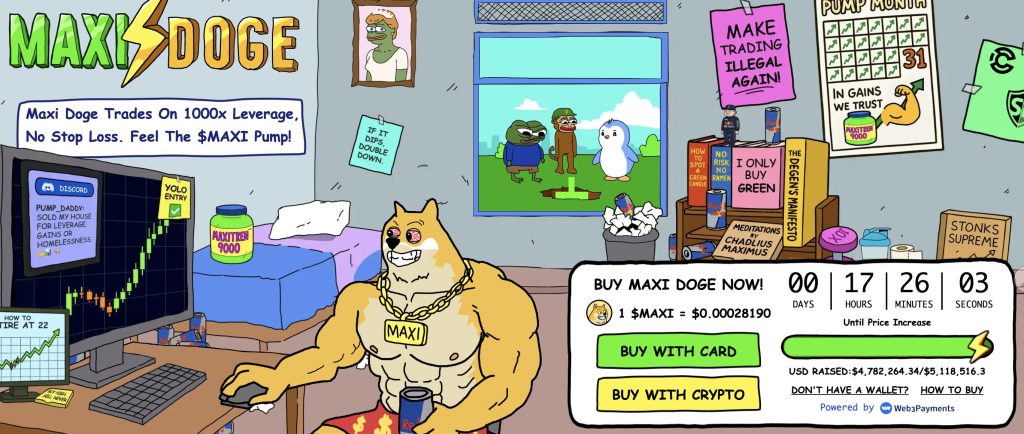
Maxi Doge Targets Early Mover Upside as ADA Tests Key Levels
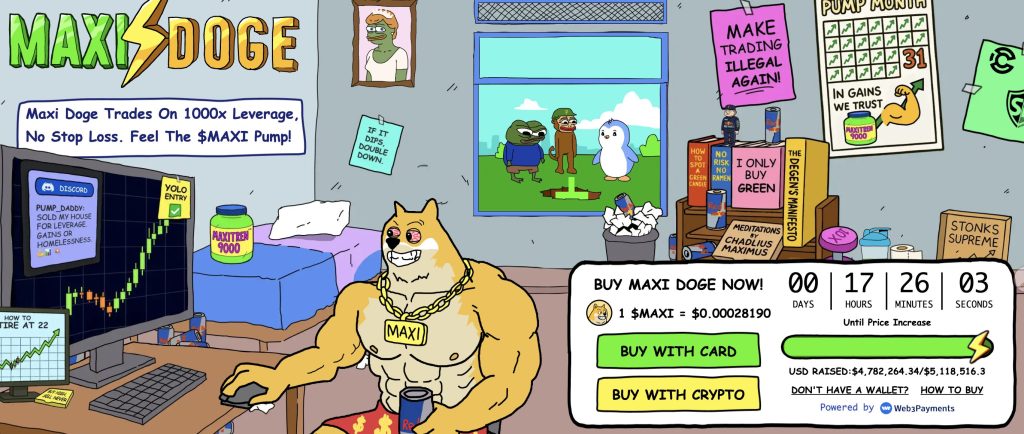
Cardano’s upside, even in a bull scenario, is capped by a multi-billion-dollar market cap and a governance crisis that won’t be resolved in days.
Traders hunting asymmetric exposure are looking earlier in the cycle, where price discovery hasn’t happened yet. That appetite is exactly what early-stage presales are built for. The risk profile is different. So is the potential.
Maxi Doge ($MAXI) is a meme token built on Ethereum (ERC-20) around a simple, aggressive identity: 1000x leverage trading culture, gym-bro intensity, and community-driven competition.
The presale has raised $4,784,513.50 at a current price of $0.000282, with staking rewards distributed daily via smart contract at a dynamic APY.
Standout features include holder-only trading competitions with leaderboard rewards, a Maxi Fund treasury allocated to liquidity and partnerships, and a pipeline for futures platform integration.
Visit the Maxi Doge Presale Website Here.
Discover: The Best Token Presales
This article is for informational purposes only and does not constitute financial, legal, or tax advice. Cryptocurrency investments are highly volatile. Always conduct your own research before making any investment decisions.
The post Cardano Drama: Infighting Heats Up as Hoskinson Steps In appeared first on Cryptonews.

Coinbase CEO Brian Armstrong said the financial system still requires major upgrades, as he emphasized that significant technological innovation and policy work will be needed to achieve them.
In a post on X, Armstrong flagged several areas where he believes the industry must evolve, including the tokenization of real-world assets (RWA), 24/7 global trading, stablecoin-powered payments, AI-driven financial services, and innovation-friendly regulation.
Shift Toward Tokenized Real-World Assets
Armstrong stated that tokenizing assets such as real estate, stocks, bonds, and funds on blockchain networks enables instant settlement, fractional ownership, and broader distribution. Financial institutions are increasingly exploring tokenization as a way to modernize settlement processes, asset ownership, and investor access while remaining compliant with existing legal and financial frameworks.
The IMF said in an April 2 note that tokenization represents a fundamental reconfiguration of financial architecture. Industry forecasts also estimate that the RWA tokenization market could reach $5 trillion by 2030, driven largely by tokenized treasuries.
Chainlink’s Sergey Nazarov previously said that the migration of real-world assets onto blockchain networks is continuing regardless of movements in crypto prices. He also pointed to the growth of on-chain perpetual markets tied to commodities such as silver, and added that these markets are becoming increasingly competitive with traditional financial systems.
Armstrong also called for 24/7 global trading with pooled liquidity, improved leverage, and greater capital efficiency. In terms of payments, he said stablecoins could support near-instant and low-cost global transfers, including agentic payments.
AI-Powered Finance
The Coinbase CEO further highlighted the role of AI-powered systems in improving risk management, credit, compliance, fraud prevention, and financial advice while expanding access to capital. Interestingly, Coinbase has already slashed around 14% of its workforce as it moved toward becoming a more AI-focused company. Armstrong had earlier said AI tools were allowing smaller teams to complete work faster, automate tasks, and operate more efficiently across the company.
On regulation, the exec argued for a move away from one-size-fits-all frameworks toward risk-based rules that encourage innovation and competition. He also advocated for open protocols and self-custodial wallets to expand financial access to anyone with a smartphone.
Armstrong additionally pointed to easier capital formation for startups and described “sound money” as a refuge from inflation when discipline weakens in fiat currencies.
The post Coinbase CEO Reveals What Still Needs to Change Before Finance Truly Evolves appeared first on CryptoPotato.
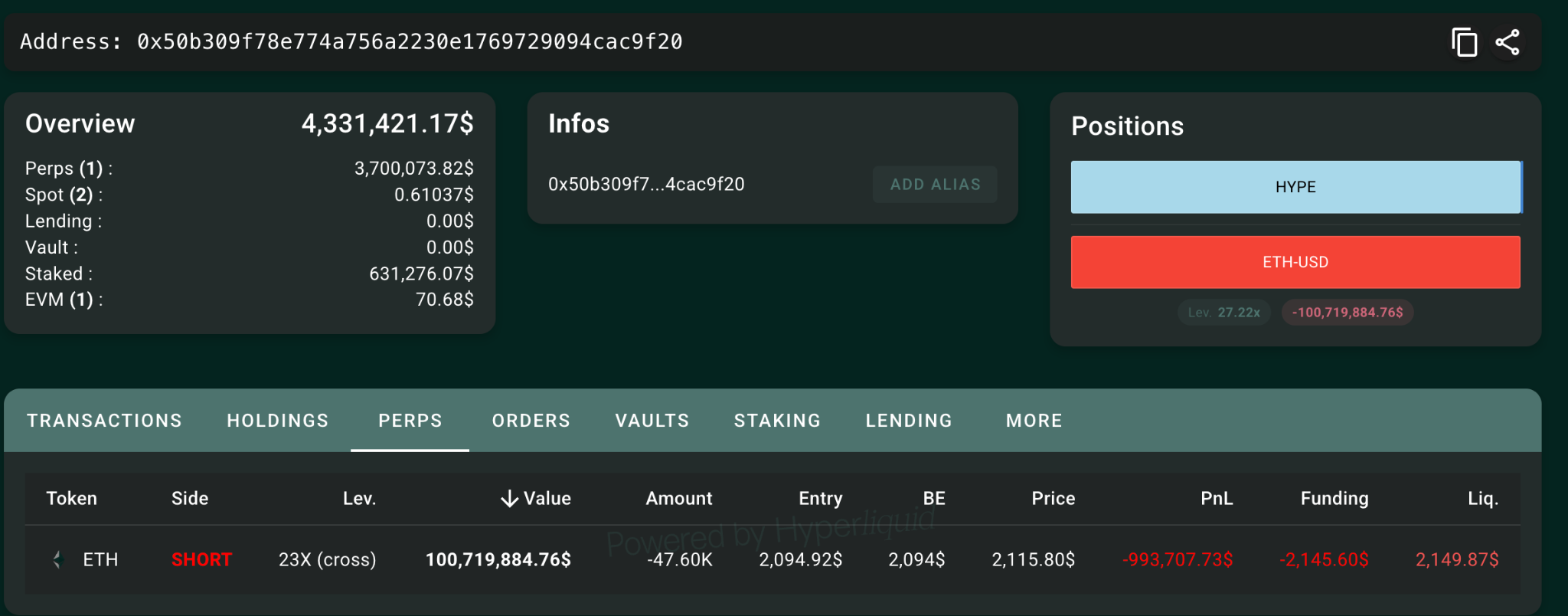
A crypto whale opened a leveraged Ether (ETH) short position worth more than $100 million, even as Ethereum co-founder Vitalik Buterin pledged fewer token sales via the Ethereum Foundation.
Key takeaways:
- The whale may face over $1 million in potential losses as the ETH price rebounds toward short liquidation levels.
- Buterin says the Ethereum Foundation will “sell less ETH” despite offloading over 60,000 ETH earlier this year.
ETH whale faces over $1 million in potential losses
As of Monday, the wallet ‘0x50b…’ held a 47,600 ETH short position worth about $100.72 million, according to Hypurrscan data. The trade used roughly 23x cross-margin leverage, with an entry price near $2,094.92.
ETH was trading around $2,115, leaving the position with an unrealized loss just shy of $994,000. The trader had also paid roughly $2,145 in funding, adding to the cost of maintaining the bearish bet.
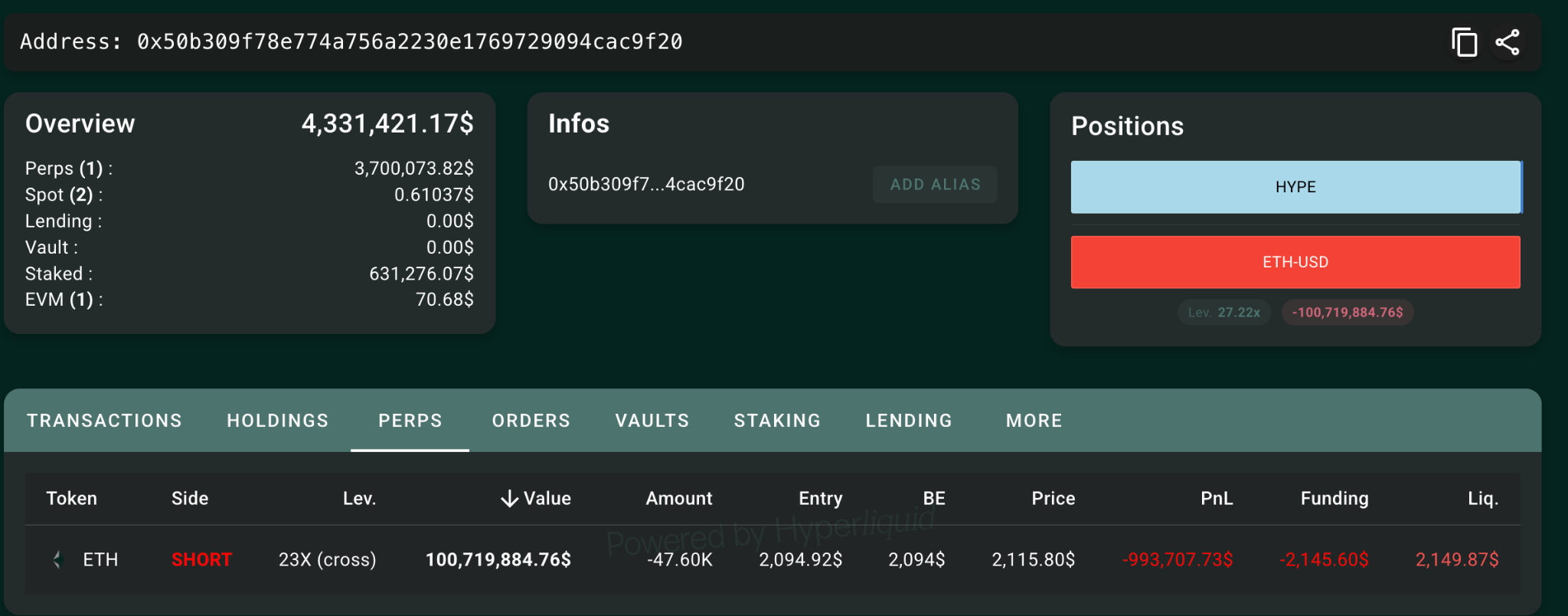
Ethereum whale’s short position data. Source: Hypurrscan.IO
The position’s liquidation price sat near $2,150, leaving little room for error. A modest ETH move higher could push the whale’s losses past $1 million and potentially wipe out the short.
That puts the whale in a vulnerable position if Ethereum continues to rebound from its weekend low at around $2,000, especially as global risk sentiment improves due to signs of easing US–Iran tensions.
Related: Ethereum traders warn of ‘nasty’ ETH price drop if $2K support breaks
Still, the size of the trade shows that some large traders remain willing to bet aggressively against ETH despite recent attempts by Ethereum’s big names to calm market concerns.
Ethereum Foundation to “sell less ETH,” says Vitalik Buterin
Co-founder Vitalik Buterin pledged that the Ethereum Foundation will “sell less ETH” as part of a broader effort to make the organization leaner, more focused and longer-lasting.
The commitment appeared in a lengthy X post where Buterin defended the foundation’s direction after a wave of researcher departures.
He said the EF is choosing “longevity over breadth,” meaning it will reduce spending, narrow its mission and avoid acting like Ethereum’s central command structure.
The Ethereum Foundation has faced repeated backlash over token sales, with critics arguing that sustained selling can pressure ETH during weak market conditions.
The Foundation sold about 20,000 ETH in 2026, raising more than $45 million, according to data resource Arkham Intelligence. while still holding around 103,000 ETH in liquid treasury assets, and another 70,000 ETH staked.
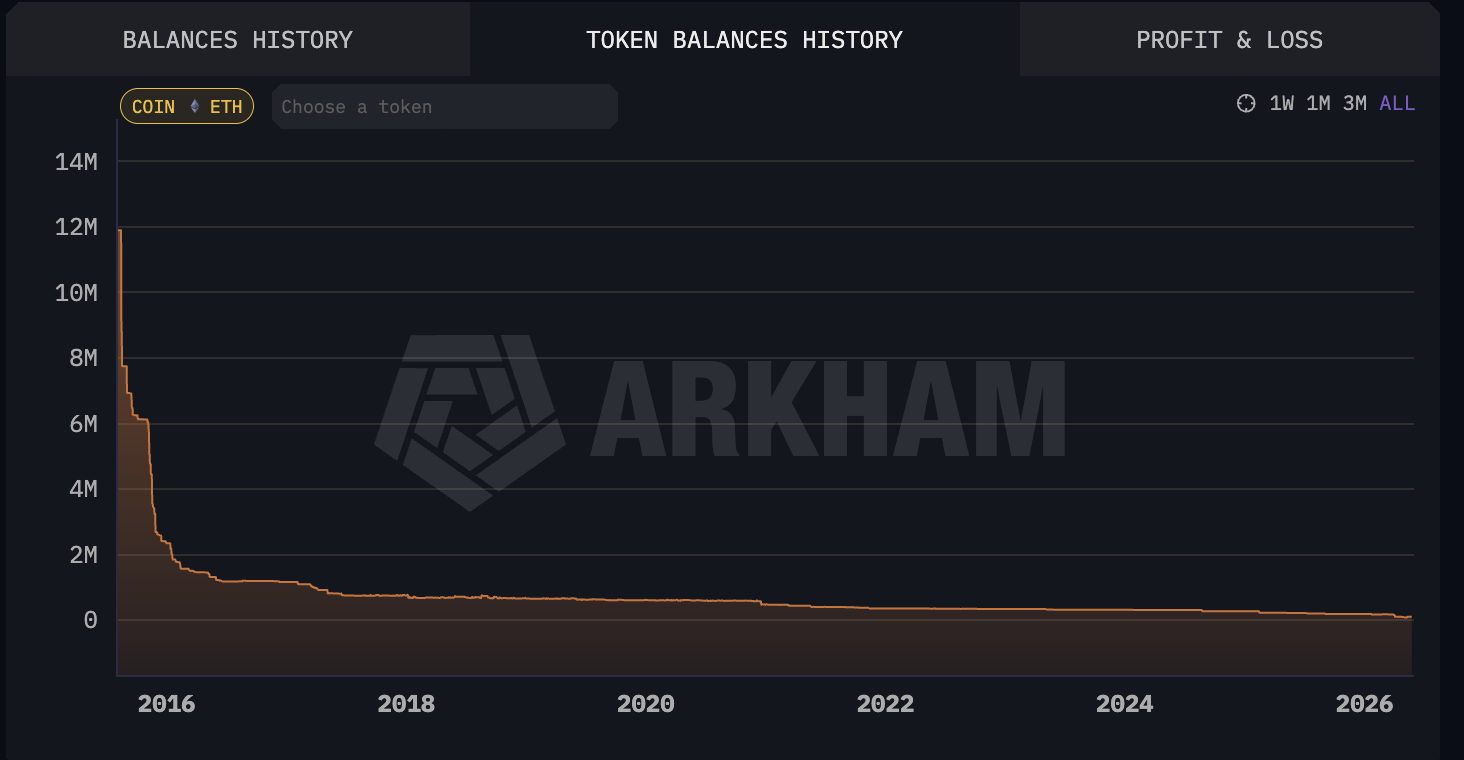
Ethereum Foundation’s ETH balance. Source: Arkham Intelligence
Nevertheless, Buterin’s reassurance comes as institutional conviction in Ethereum appears to be weakening.
In 2026, several large holders trimmed ETH exposure amid weak price action and a multi-year slump versus Bitcoin.
Harvard Management Company reportedly exited its $87 million Ethereum ETF position after just one quarter, while Goldman Sachs cut its ETH ETF holdings by roughly 70%, leaving about $114 million invested.
Spot Ethereum ETFs have continued to bleed capital, recording more than $295 million in net outflows in May and over $945 million in withdrawals so far in 2026.
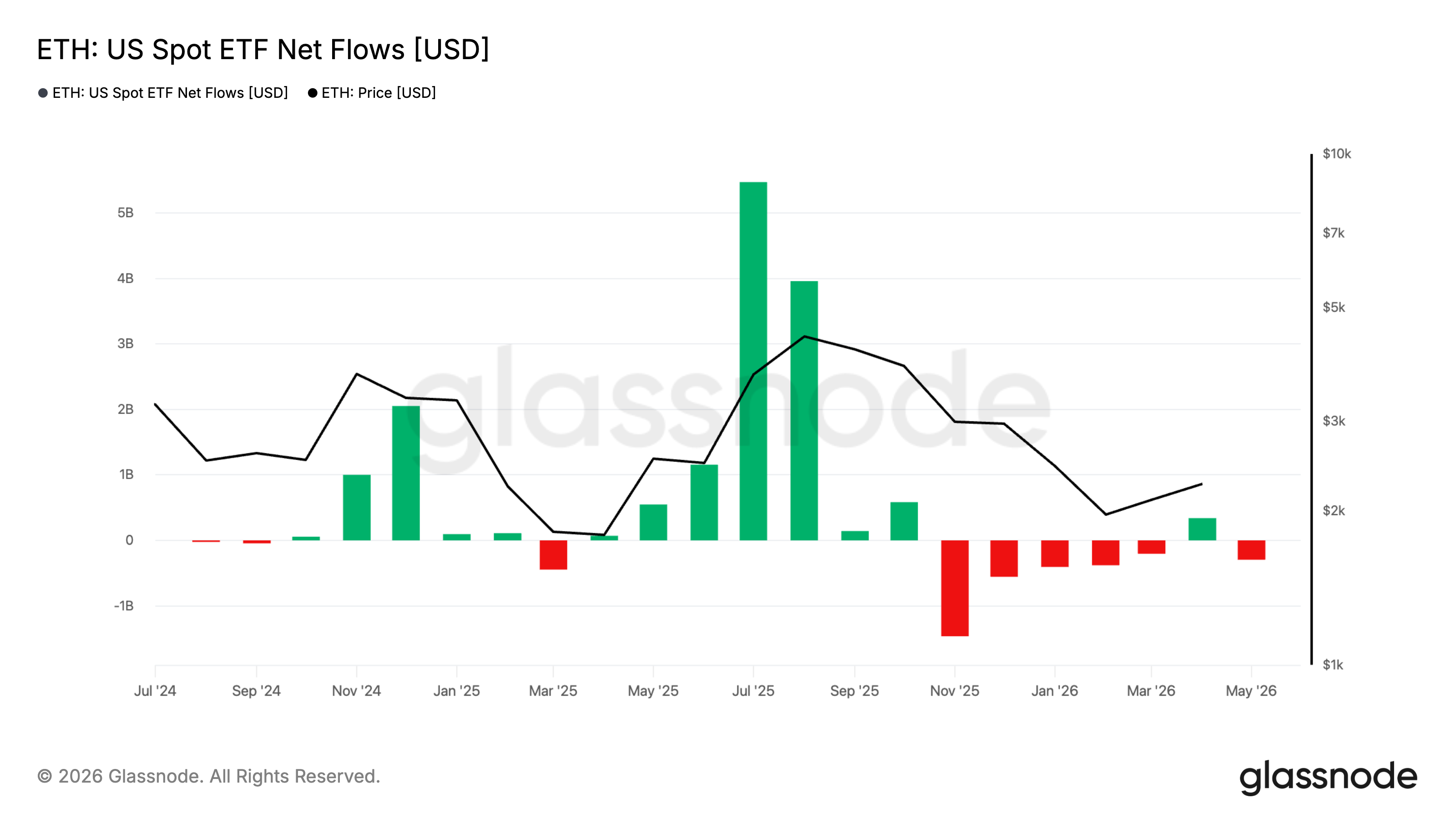
ETH US spot ETF net flows. Source: Glassnode
Bankless co-founder David Hoffman, one of Ethereum’s most visible long-time advocates, said he sold all his personal ETH holdings, adding symbolic weight to concerns that even Ethereum-native investors are reassessing their conviction.

Source: X
However, some analysts, including Tanaka, continue to view Ethereum as a strong long-term buy, arguing that its core on-chain economy remains difficult for rival blockchains to match.
Ethereum still anchors much of crypto’s real activity, hosting roughly $43 billion in DeFi liquidity, more than $165 billion in stablecoins, and about 55% of tokenized assets tracked across public blockchains, according to Token Terminal data.
Ledger added native support for the $ADI token tied to ADI Foundation’s ADI Chain network, a UAE-linked, layer-2 focused on stablecoins and tokenized real-world assets.
ADI Chain is backed by Abu Dhabi-based Sirius International Holding, a subsidiary of International Holding Company, and backs the DDSC stablecoin ecosystem launched with First Abu Dhabi Bank. According to the company, the network is designed for institutional use cases including cross-border payments, treasury operations and trade settlement.
The integration allows users to store and manage $ADI through Ledger Wallet and the company’s hardware signing devices. ADI Foundation describes ADI Chain as infrastructure for regulated stablecoins and tokenized assets, with $ADI used as the network’s native gas token.
The announcement follows a recent 110 million dirham ($30 million) DDSC transfer disclosed by International Holding Company, which the company described as one of the largest publicly disclosed stablecoin transactions executed in the United Arab Emirates.
Related: UAE central bank says financial system stable amid missile and drone attacks
Euro-backed stablecoins expand despite limited market share
While dollar-backed stablecoins dominate the market, euro-denominated tokens account for more than 80% of the non-US dollar stablecoin sector, according to a March report from Dune Analytics commissioned by Visa. The report estimated the broader non-dollar stablecoin market at roughly $1.2 billion in supply, compared with a total stablecoin market exceeding $300 billion.
Dune said non-dollar stablecoins now process around $10 billion in monthly transfer volume, with euro-backed tokens increasingly used for payments, remittances, payroll and treasury operations. The report also pointed to growing adoption following the bloc’s Markets in Crypto-Assets Regulation (MiCA), which introduced a formal framework for crypto asset service providers across the European Union.
However, an April report from advocacy group Blockchain for Europe claimed that MiCA’s strict reserve and interest rules have made euro stablecoins safer but less commercially competitive than US dollar-backed alternatives. The report cited DeFiLlama data showing euro stablecoins account for less than 1% of global stablecoin volume despite the euro’s broader role in international markets.
This month, the European Commission opened a review of MiCA rules governing stablecoins, reserve requirements and interest-bearing token products as officials reassess how the framework is functioning in practice.
Meanwhile, European institutions are accelerating efforts to develop local-currency stablecoin infrastructure. On May 20, euro stablecoin consortium Qivalis said it expanded to 37 member institutions after adding 25 banks across 15 countries ahead of a planned launch later this year. The group said the initiative is aimed at building a regulated euro-denominated alternative to US dollar-backed stablecoins.
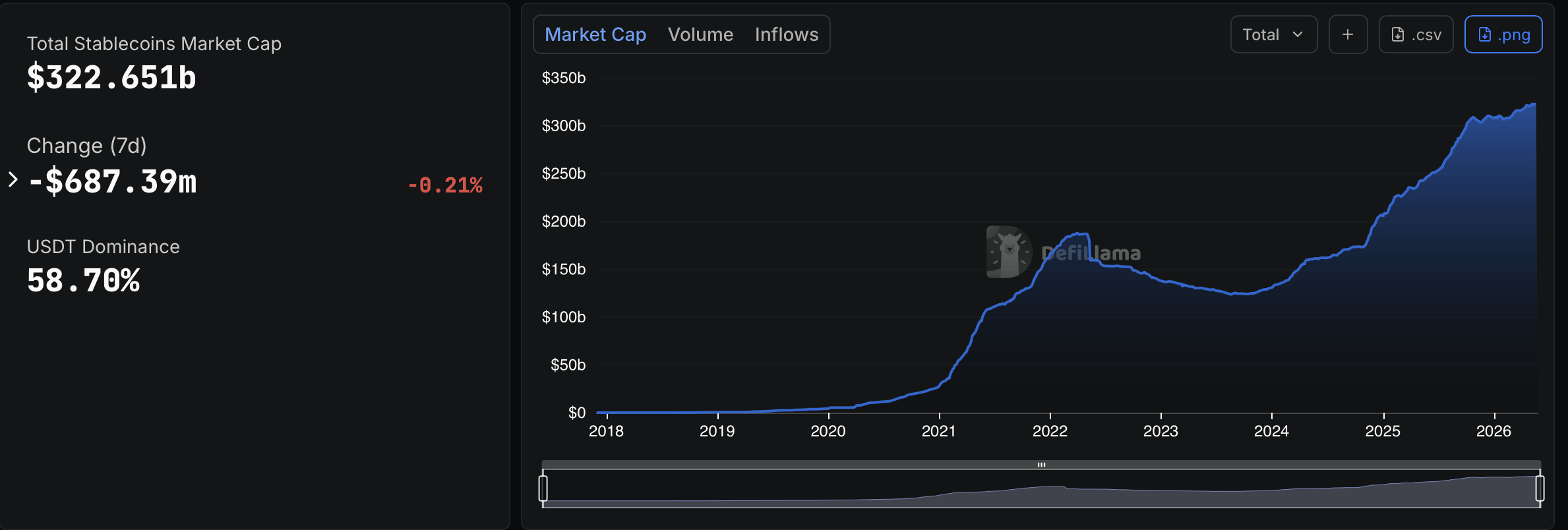
Stablecoin market cap. Source: DefiLlama
Magazine: ETH bears growling, Tom Lee’s buying, XRP to ‘explode’: Market Moves
5 Phones That Beat The Samsung Galaxy S26 Ultra’s Battery Life
NXP Semiconductors’ SWOT analysis: stock navigates semiconductor upcycle

Cyannova Capital announces global launch at its first strategic reception in Hong Kong


-

 Crypto World4 days ago
Blockchain.com files with SEC for U.S. IPO
-

 Fashion3 days ago
Holiday Weekend Open Thread – Corporette.com
-

 Business3 days ago
Dell Technologies DELL Stock Surges 15% on AI Server Momentum and Analyst Upgrades in 2026
-

 Crypto World4 days ago
Bitcoin Accumulation Weakens as BTC Realized Losses Hit $600M
-

 Crypto World3 days ago
Space X IPO Is ‘Bad News’ for Tech Stocks: But What About Bitcoin?
-

 Politics3 days ago
Makerfield: a tale of two social-media histories
-

 Crypto World2 days ago
Robinhood crypto COO Tanya Denisova exits
-
 Crypto World4 days ago
MicroStrategy’s Saylor Says Miners No Longer Set Bitcoin Price, Another Force Has Taken Over
-

 Business1 day ago
NYT Strands Answers May 24 2026 Revealed for Puzzle No. 812 Theme Summer Essentials
-

 Crypto World3 days ago
AI infrastructure race heats up as IREN pitches full-stack strategy, WhiteFiber lands $160M deal
-
 Tech3 days ago
A 0.12% parameter add-on gives AI agents the working memory RAG can’t
-

 Tech4 days ago
WhatsApp ads could make Irish debut after discussions with DPC
-

 Tech4 days ago
You Can Now Add ChatGPT To PowerPoint
-

 Business4 days ago
Trump Invests $1M-$5M in Kura Sushi USA Chain With 27 California Locations
-

 Sports4 days ago
2026 CJ Cup Byron Nelson leaderboard: Brooks Koepka finds putting stroke in Round 1
-
 NewsBeat4 days ago
Charity run by Reform leader Malcolm Offord accused of ‘law breaking’ over Scottish registration
-

 Crypto World4 days ago
Trump Media’s Bitcoin Stash Shrinks Again as 2,650 BTC Lands on Crypto.com
-
Business4 days ago
Goldman Sachs reinstates Ageas stock coverage with neutral rating
-

 Crypto World5 days ago
Exa Labs raises $250 million in funding led by a16z
-

 Crypto World7 days ago
SEC to propose tokenized stock framework as Wall Street efforts deepen: Bloomberg
You must be logged in to post a comment Login