

Crypto World
XRP slips below $1.35 after triangle breakdown puts focus on $1.30 support

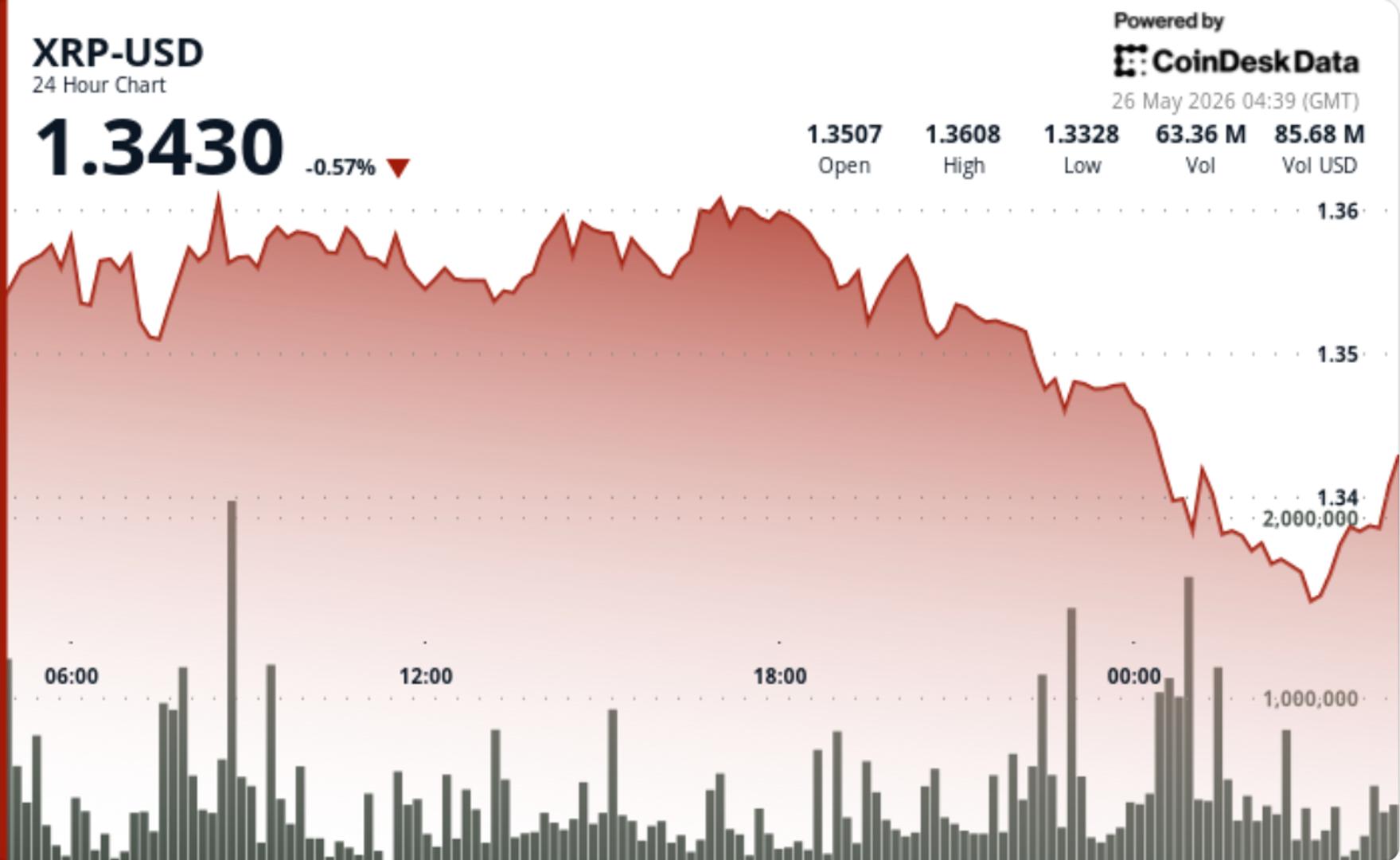
XRP spent weeks tightening into a narrow range, but the market finally started leaning lower after another failed push above resistance near $1.36. The move matters because repeated tests of support tend to weaken buyers over time, and XRP is now drifting back toward the same $1.30 area traders have treated as the line between consolidation and broader breakdown risk.
News Background
• Analysts remain split on XRP’s structure, with some calling the latest move a confirmed triangle breakdown while others still frame it as late-stage compression before a larger breakout.
• CME Group is preparing to launch 24/7 XRP-linked futures trading later this month, adding another layer of institutional exposure to the token.
• Whale activity also cooled sharply during the period, with large transaction counts falling more than 57% over nine days.
Price Action Summary
• XRP fell from $1.3457 to $1.3366 during the 24-hour session while trading inside a relatively tight 1.9% range.
• The largest move came after a failed breakout attempt near $1.3620, where elevated volume quickly reversed into selling pressure.
• XRP later broke below the $1.35 level and consolidated near session lows around $1.336 into the close.
Technical Analysis
• The breakdown below $1.35 reinforced short-term bearish momentum after weeks of tightening price action.
• XRP is now trading beneath several key moving averages, while resistance near $1.36 continues to reject upside attempts.
• Some analysts view the recent move as a confirmed symmetrical triangle breakdown with downside risk toward $1.14.
• Others still argue the broader structure resembles compression rather than outright collapse, especially while XRP remains above the critical $1.30 support area.
What traders should watch
• $1.30-$1.31 is now the key support zone. Losing it would likely accelerate downside momentum.
• $1.35 becomes the immediate resistance area XRP needs to reclaim to stabilize near-term structure.
• CME’s upcoming XRP futures launch could increase volatility and improve liquidity once trading begins later this month.



Decentralized platform Hyperliquid is now competing with established betting platforms such as Polymarket, but with a differentiated mechanism for resolving bets.
The leading decentralized exchange has expanded its HIP-4 outcome contracts beyond crypto price milestones into real-world events. This native prediction-market infrastructure allows users to trade macro contracts, such as inflation data and interest-rate decisions, directly alongside their standard crypto perpetuals out of a single account.
Outcome markets mark a notable expansion for the decentralized derivatives venue, which built its business around crypto perpetual futures and initially tested the product using price‑outcome contracts settled against its own market data.
Hyperliquid first tested the product on exchange‑native outcomes, such as whether bitcoin would trade above a specific level by a fixed time using Hyperliquid’s own reference prices. The latest rollout expands that model into real‑world macro events, or offchain outcomes, like U.S. inflation and Federal Reserve decisions, directly competing with prediction market platforms like Polymarket.
Native resolution
What sets it apart is that HIP‑4 brings dispute resolution and settlement in‑house, rather than depending on an external oracle network like Polymarket.
Here’s why it matters. Offchain events introduce a new problem: determining truth.
Polymarket handles this through UMA, an external oracle protocol that uses an optimistic dispute system. A proposed settlement stands unless challenged, at which point UMA tokenholders vote on the final result. That model has faced criticism following controversial resolutions, prompting accusations that large tokenholders could influence outcomes.
Hyperliquid uses a more vertically integrated model. Validators themselves ingest external information through automated newsfeed software, determine whether markets should launch, and vote on settlement outcomes.
Multi-purpose platform
The launch also fits into Hyperliquid’s broader effort to evolve into a multi‑asset trading venue. FalconX said in a recent report that the exchange’s expanding product stack could position it as a challenger not just to crypto‑native rivals but also to traditional exchanges.
“For example, you could pair a HIP‑3 perps position on NVDA with outcome markets that NVDA will miss or beat earnings,” CoinDesk previously reported.
Hyperliquid’s outcome markets are structured as fully collateralized contracts rather than leveraged bets, thereby limiting losses to the amount paid upfront. Traders buy “Yes” or “No” positions tied to a defined event, with contracts settling at either 1 USDC or zero USDC depending on the result. If a trader buys a “Yes” contract at 0.65 USDC, their maximum loss is limited to that upfront amount, unlike perpetual futures, where leverage can trigger liquidations.
That makes the product sit somewhere between a prediction market and a simplified binary options contract.
If Hyperliquid’s outcome markets gain traction, traders could eventually use the same venue to express directional crypto views, hedge macro risks, and speculate on event outcomes without moving collateral between platforms.
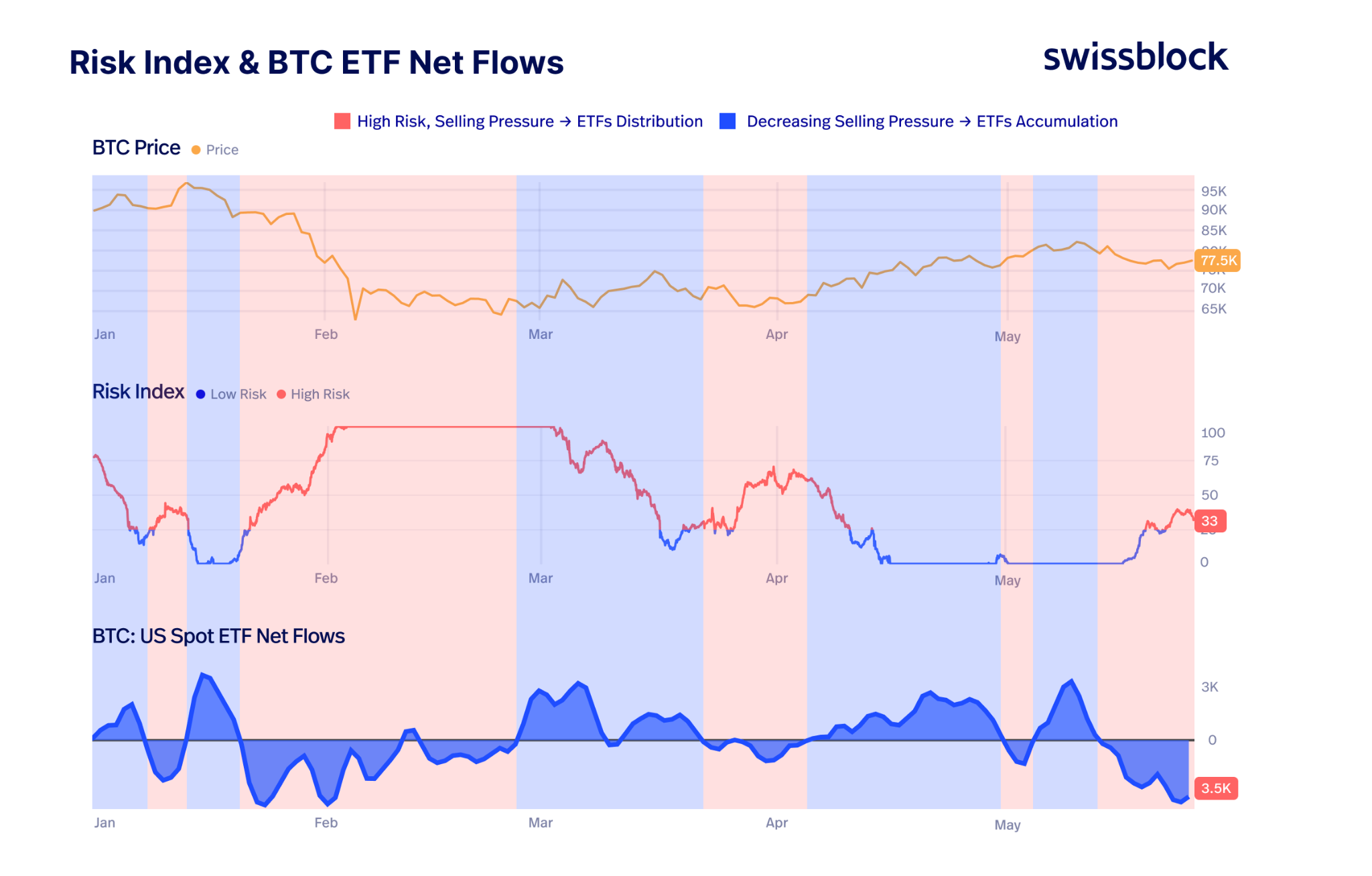
Bitcoin is sliding into a high-risk environment due to continued institutional selling, primarily from US spot exchange-traded funds, according to crypto analytics platform Swissblock.
Swissblock said on Tuesday that its Bitcoin risk index was at a high risk score of 33 out of 100, adding that “every time the Risk Index signals that selling pressure is structurally overwhelming the market, what sits underneath is institutional distribution.”
The platform’s proprietary risk index was developed to gauge the overall risk level in the Bitcoin market by measuring the relative balance between selling pressure and buying pressure, helping to assess how “risky” it currently is to buy or hold Bitcoin.
After strong accumulation in March and April, May has flipped back into distribution, and the risk index is now “moving into high-risk territory while ETF flows are deteriorating simultaneously,” said Swissblock.
It added that spot Bitcoin ETF demand is no longer absorbing selling pressure effectively, and without strong ETF support underneath, “the risk index can continue accelerating higher.”
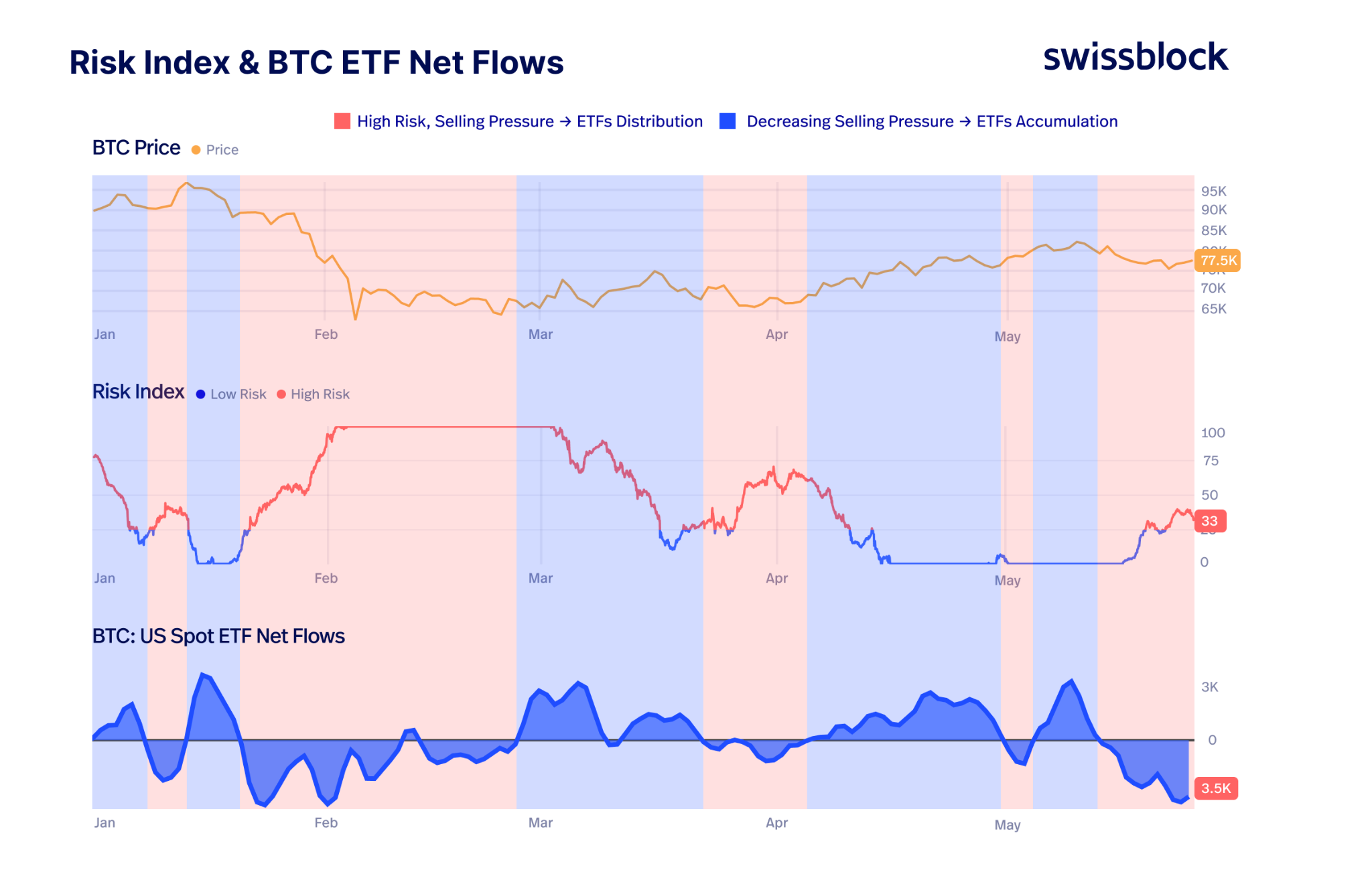
Bitcoin risk index accelerates with increasing ETF outflows. Source: Swissblock
Related: $1.26B Bitcoin ETF outflows spark ‘contrarian’ buy signal: Santiment
On-chain analytics provider Glassnode reported on Monday that US Bitcoin ETFs have recorded net outflows on nearly every trading day since May 7, showing “a persistent institutional sell signal now running for more than two weeks.”
“This steady drip of outflow continues to add to the supply side without a visible demand offset,” it said.
Jeff Ko, chief analyst at CoinEx, told Cointelegraph on Tuesday that the broader crypto market “remains in a holding pattern.”
“Spot ETF flows have posted more than $2 billion in outflows over the past two weeks, highlighting that institutional risk appetite is still sensitive at the margin,” he added.
Bitcoin dips as US strikes Iran
Risk was accelerated even further on Tuesday morning amid multiple reports that the US had launched fresh strikes on Iran despite the two countries recently making progress on a peace deal.
US Central Command said the strikes targeting Iranian missile sites and boats attempting to place mines were in “self-defense” and were to protect US troops from threats posed by Iranian forces.
Bitcoin reacted with a 1% decline, falling from over $77,000 to just below $76,500 on Coinbase, according to TradingView, but it has remained range-bound for almost four months.
Ko said that “despite Washington’s latest ‘self-defence’ operation, the very short-term market reaction may still lean risk-on, particularly as investors appear to be looking through the geopolitical noise and focusing on the possibility of a US-Iran peace deal.”
Magazine: Polymarket seeks Japan entry, Harvard dumps entire ETH position: Hodler’s Digest
Fundamental backdrop
In late April 2026, Japan’s Ministry of Finance moved from verbal warnings to direct action, carrying out a currency intervention worth roughly ¥5.5 trillion ($35 billion) — the first since July 2024. The move was triggered by the yen weakening beyond the psychologically significant level of 160 against the dollar.
Additional context comes from the divergence in monetary policy between the ECB and the Bank of Japan: the European regulator continues to leave the door open to tighter policy amid rising inflation expectations, while Tokyo maintains a cautious normalisation path without providing clear guidance on the timing of its next move.
Technical picture
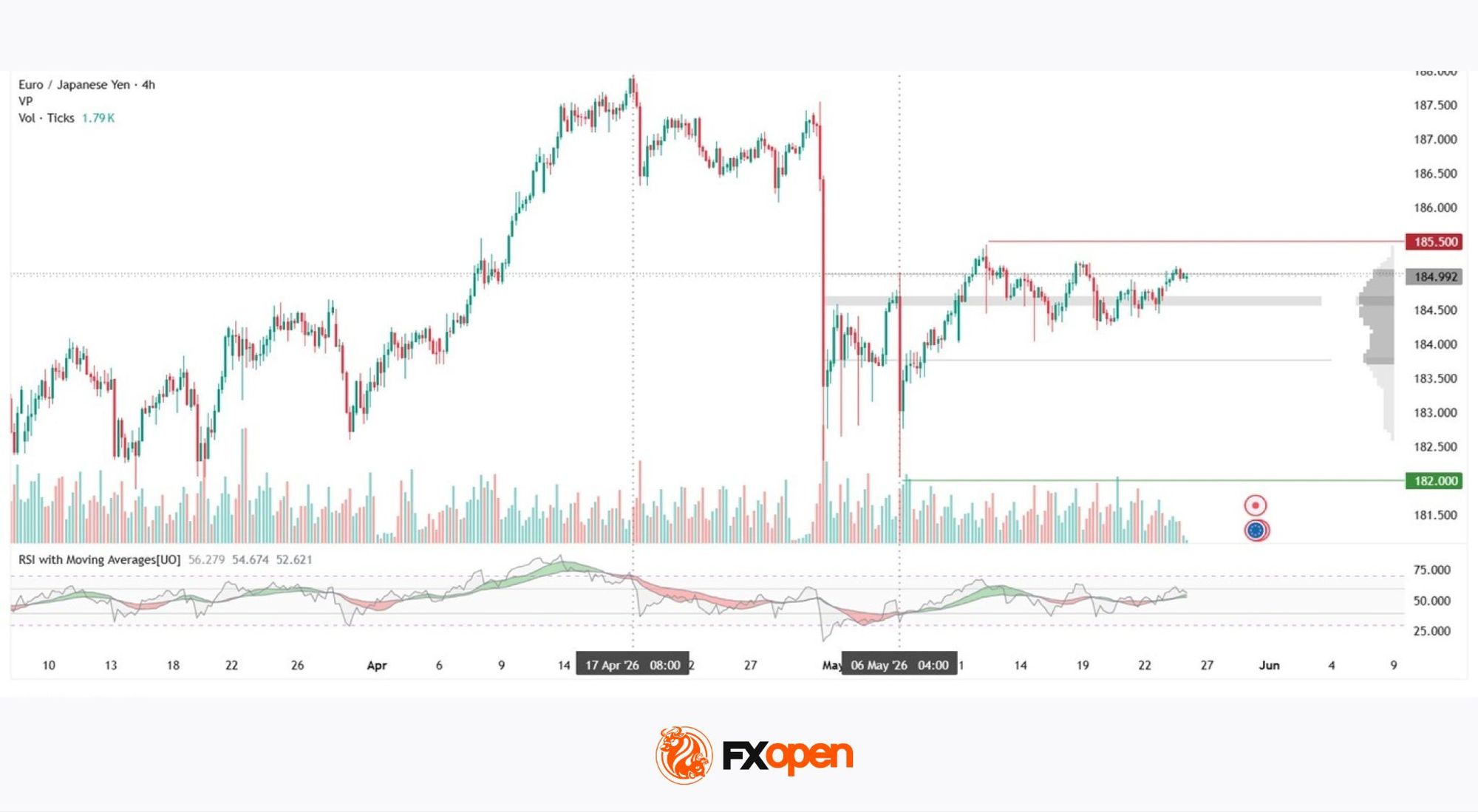
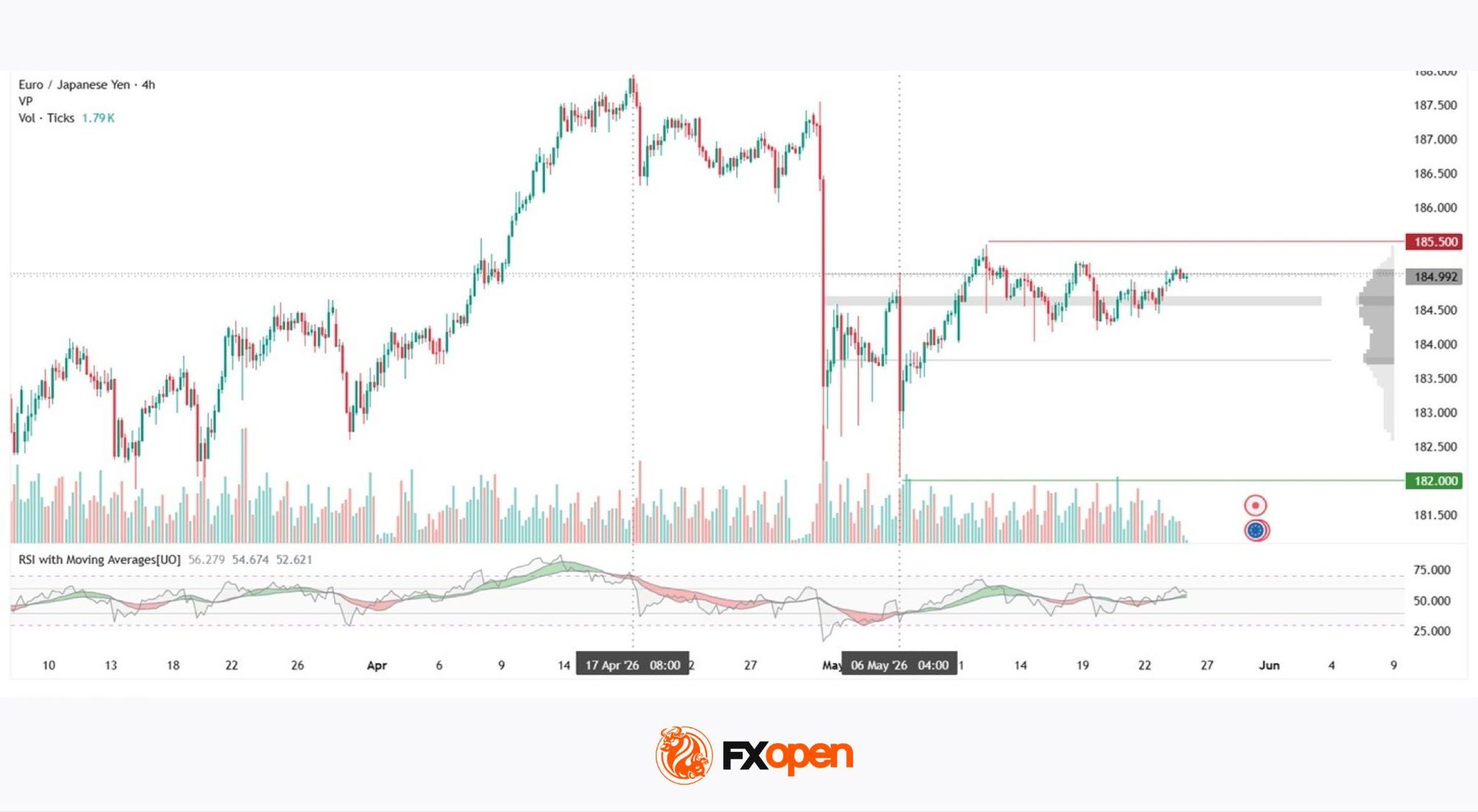
After reaching a local peak near 188 in mid-April, the EUR/JPY pair experienced two impulsive declines. The first occurred on 30 April, when the candlestick recorded an abnormal spike in vertical volume — a direct consequence of the Japanese Ministry of Finance intervention, which saw the yen strengthen by roughly 3% during the session. A second bout of sharp selling pressure followed in early May.
As a result, a horizontal profile formed with boundaries at 183.800–185.000, while the point of control is concentrated within the 184.50–184.70 range.
The price is now testing the upper boundary of the profile — an area where sellers have already shown activity on two separate occasions. The 182 region has held since February and could once again come into focus if pressure resumes: both May sell-offs reversed precisely from this zone, failing to break lower. Meanwhile, the 185.500 area could act as resistance should the current advance continue.
RSI + MA readings stand at 57 / 55 / 53 respectively — all three lines remain in neutral territory, with no clear signs of momentum.
Key takeaways
The current situation is shaped by the clash between interest-rate differentials and the willingness of the Japanese authorities to intervene again if necessary. For now, with RSI offering no directional impulse, the point of control and the profile boundaries remain the key reference levels for assessing the current trading range.
Trade over 50 forex markets 24 hours a day with FXOpen. Take advantage of low commissions, deep liquidity, and spreads from 0.0 pips (additional fees may apply). Open your FXOpen account now or learn more about trading forex with FXOpen.
This article represents the opinion of the Companies operating under the FXOpen brand only. It is not to be construed as an offer, solicitation, or recommendation with respect to products and services provided by the Companies operating under the FXOpen brand, nor is it to be considered financial advice.

Bitcoin prices slid back below $76,500 on Tuesday morning, down 1.5% from its intraday high of $77,700 on Monday.
The move followed reports that the United States had resumed strikes on Southern Iran, targeting missile sites and boats attempting to place mines.
The strikes were carried out “to protect our troops from threats posed by Iranian forces,” but the military was “using restraint during the ongoing ceasefire,” said US Central Command in a statement.
Deal or No Deal?
Just hours before, President Trump posted on Truth Social that negotiations with Iran are “proceeding nicely.”
“It will only be a Great Deal for all or no Deal at all — Back to the Battlefront and shooting, but bigger and stronger than ever before — And nobody wants that!”
Over the weekend, Trump claimed that a deal was “largely negotiated,” leading to hopes that it would be finalized this week.
Crude oil prices, which dipped below $90 for the first time this month on Monday, were back up around 2% as the conflict resumed.
Jeff Mei, chief operations officer at the BTSE exchange, remained optimistic. “We believe that if US attacks on Iran are limited, it’s unlikely that Bitcoin will fall lower than the $70k mark,” he said.
“However, if the conflict looks like it may be sustained over a longer period of time, Bitcoin could very well drop back to the $60k floor reached at the beginning of the conflict.”
Jeff Ko, chief analyst at CoinEx, agreed, telling CryptoPotato on Tuesday that technically, $70,000 remains the “next defended floor for Bitcoin,” while $65,000 would be the “next key stress level” if the macro or geopolitical backdrop deteriorates further.
“That said, I think Bitcoin’s ability to absorb recent macro shocks has actually been quite constructive,” he added.
“The asset has not broken down despite the geopolitical uncertainty, which suggests the market is consolidating rather than entering a full risk-off phase.”
Is BTC About to Fall Further?
Macro trader Jason Pizzino remained bearish, opining on X that Bitcoin looks to be getting ready to test the lows again, like it does every bear market.
“Falling volume, lack of social interest (search volume), and a structure reminiscent of further weakness,” he said.
Bitcoin looks to be getting ready to test the lows again like it does every bear market (or 4-year cycle).
Falling volume, lack of social interest (search volume), and a structure reminiscent of further weakness.
The perma bears will be calling lower and lower prices, while the… pic.twitter.com/KwowfhSWzb
— Jason Pizzino
(@jasonpizzino) May 26, 2026
BTC was trading at $76,480 at the time of writing, with further losses looking imminent.
The post Bitcoin Dips on Renewed US Strikes on Iran: Is the Peace Deal Off? appeared first on CryptoPotato.
Ether treasury company Bitmine Immersion Technologies has been included in a preliminary list for potential inclusion in the Russell 3000 index, a move that chairman Tom Lee hinted could provide tailwinds for the company’s stock.
FTSE Russell, a subsidiary of the London Stock Exchange Group, published a preliminary index inclusion list for the Russell 3000 on Friday, its index tracking the 3,000 largest companies in the US.
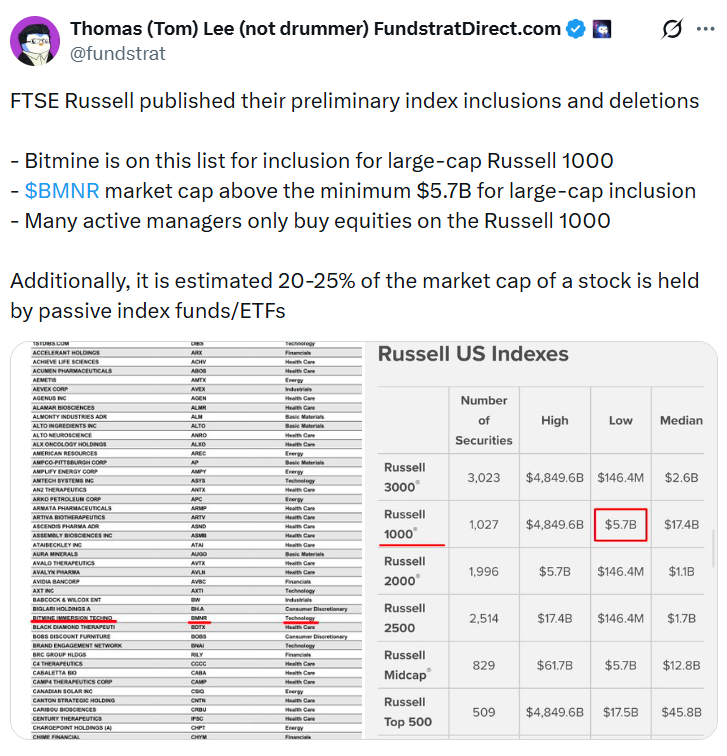
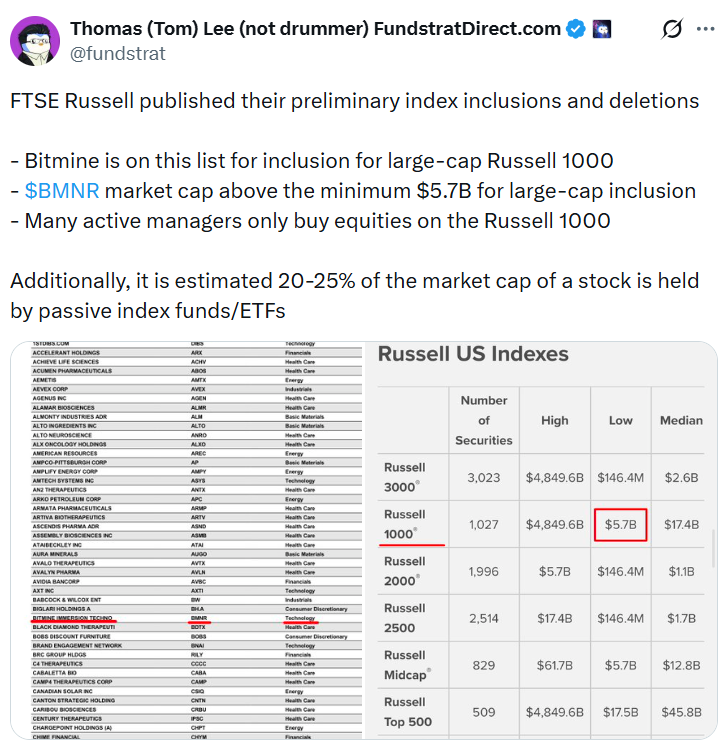
Lee said in an X post Saturday that Bitmine could be included in the Russell 1000, an index tracking the largest 1,000 US companies, due to the index’s minimum market capitalization threshold of $5.7 billion. Bitmine’s market cap was $10.15 billion as of market close on Friday.
Lee said that “many active managers only buy equities on the Russell 1000,” adding that it is estimated that up to 25% of the market cap of a stock included in the index is held by passive index funds or exchange-traded funds.
Source: Tom Lee
Bitmine’s inclusion in the Russell 1000 would place it in the same index as major US large-cap equities, including tech giants Nvidia Corporation, Microsoft, and Apple and could trigger automatic buying by passive funds, providing traditional investors with indirect exposure to its Ether holdings.
FTSE Russell will provide further list updates on, June 5, June 12 and June 18, and the newly reconstituted indexes take effect after the US market close on June 26.
Bitmine stock down 30% year to date
Shares in Bitmine Immersion Technologies (BMNR) are down over 30% year-to-date and closed trading on Friday at $18.88. The company announced plans to build an Ether treasury in July 2025. By July 3, its stock had spiked to more than $135. The company disclosed holdings of 163,142 Ether worth about $500 million on July 14 of the same year.
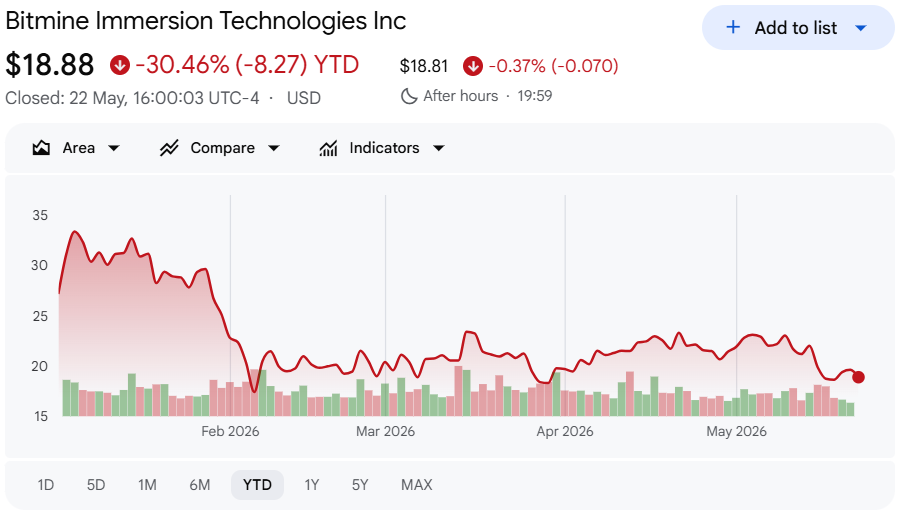
Bitmine’s stock is down over 30% year-to-date. Source: Google Finance
As of last week, Bitmine held 5.28 million Ether, or about 4.37% of Ethereum’s total supply, with the company’s ultimate goal to hold 5% of the token’s circulating supply of 120.7 million. To hit its target of over 6 million Ether, Bitmine needs around 756,538 more in its stash.
Related: Ether pullback was ‘attractive opportunity’ for 71,672 ETH buy: Bitmine’s Lee
Ether is down over 57% from its all-time high of $4,946, according to CoinGecko. BitMine also has an estimated $7.3 billion in paper losses due to the price drop.
However, Lee previously argued that Ether’s steep drawdown may offer another buying opportunity and said last Monday that the company has staked most of its stash, with annualized staking revenues of $289 million.
Magazine: Polymarket seeks Japan entry, Harvard dumps entire ETH position: Hodler’s Digest, May 17 – 23


XRP traded near $1.35 as Santiment’s sentiment ratio fell to 1.1, putting $1.30 support and a short-term rebound setup in focus.


Ondo Finance founder Nathan Allman has died, the company said in a post on X on Tuesday, without disclosing the cause.
“It is with profound sadness that we announce the unexpected passing of Nathan Allman, Ondo’s founder. Our hearts are with his family and loved ones,” the company said. “Nate’s brilliance, humility, and drive shaped every part of what Ondo is today. His belief in the power of technology to create a more open, accessible financial system lives on in everything we build.”
Ian De Bode, Ondo’s longtime president who has led strategy, product, and day-to-day operations for over two years, will serve as CEO. De Bode has the full confidence of the leadership team, the company said.
Allman, a Brown University graduate, founded Ondo in 2021 after working on Goldman Sachs’ digital assets team. Under his leadership, Ondo became a pioneer in tokenized real-world assets, growing total value locked to $3.5 billion.
Major products launched during his tenure include USDY, a yield-bearing stablecoin, OUSG, a tokenized U.S. Treasury fund, and tokenized equities through Ondo Global Markets.
The company said it would continue building what Allman started as the most meaningful way to honor him.
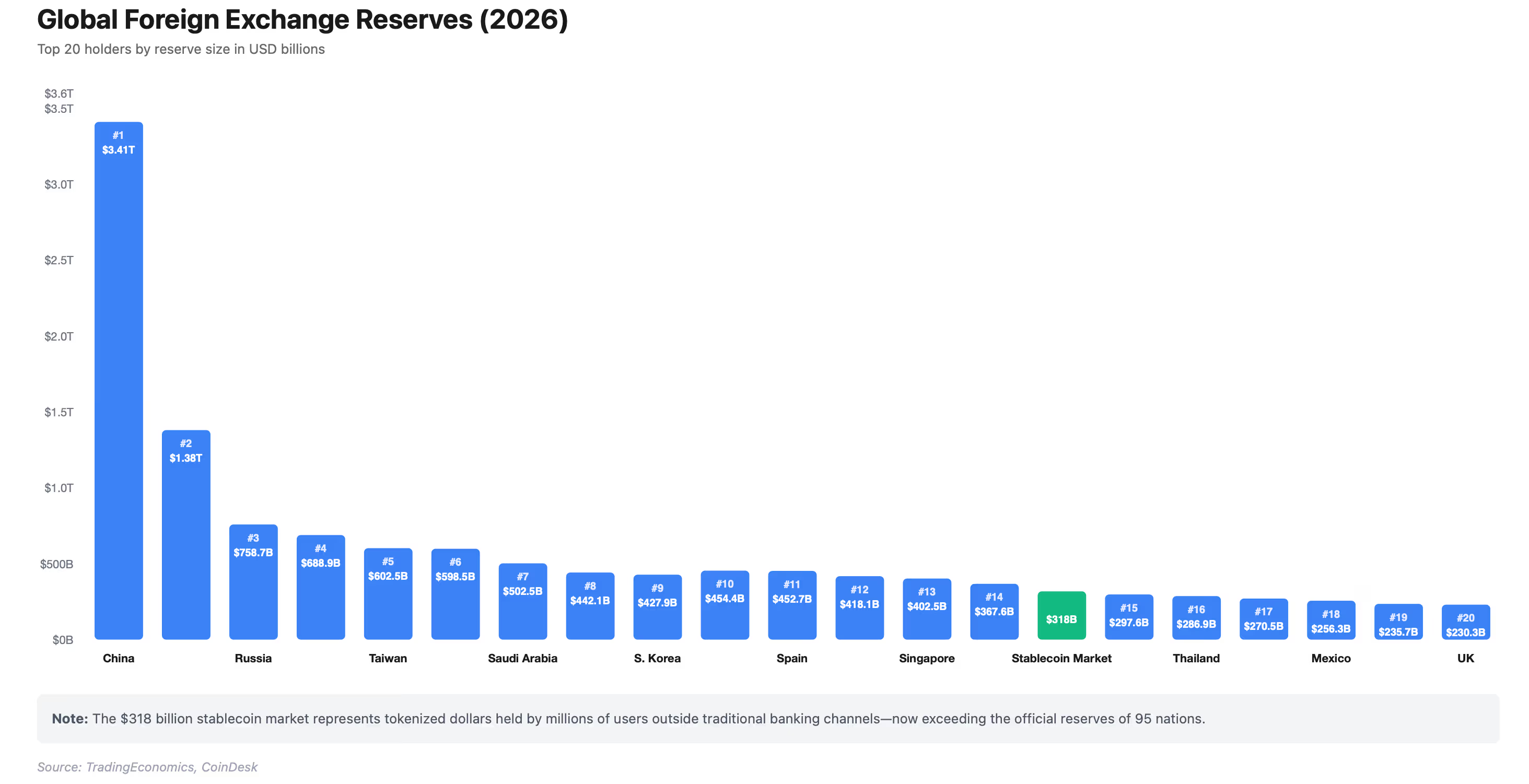
The combined market value of all stablecoins has hit a record high of $322 billion, dwarfing the foreign exchange reserves of 95 countries, including several developed countries.
As of now, their combined market cap is bigger than the FX reserves of Poland, Thailand, Mexico, and developed economies such as the United Kingdom, Canada and even the oil-exporting giant United Arab Emirates.
In essence, the amount of dollars and other fiat currencies held by users outside traditional banking channels now exceeds the official FX reserves, a sovereign protective cover against external economic shocks, of most nations.
Stablecoins are tokenized versions of fiat currencies issued on blockchain. Their values are pegged 1:1 to the U.S. dollar or other currencies such as the euro, yen, Swiss franc and others. Their combined market cap has grown multi-fold in recent years, with most activity concentrated in dollar-pegged coins such as tether and USD Coin (USDC).
The growth is evidence of how fast capital is migrating to blockchain rails.
Foreign exchange (FX) reserves are the dollars, euros, yen, and gold that central banks hold as a buffer to stabilize their currencies, pay foreign debts, and finance energy and other imports. Only 14 nations, led by China, Japan, Russia, India, Taiwan and Germany, hold more FX reserves than the market value of stablecoins.

Double-edged sword
Stablecoins are widely used for trading cryptocurrencies. They allow users to exit volatile tokens without converting back to fiat currencies. For DeFi protocols, they serve as the settlement layer, and for cross-border payments, they provide a faster, cheaper way to move money across borders while bypassing legacy banking channels.
“The use of stablecoins in cross-border payments has grown, notably in corridors where legacy correspondent banking is slow or costly,” a recently released Bank of International Settlements report said. “Cross-border stablecoin flows have grown substantially since 2022, with particularly pronounced activity in regions experiencing high inflation and exchange rate volatility.”
But the ease of moving money comes with a risk.
Stablecoin transactions can trigger capital outflows, leaving already vulnerable current account deficit countries exposed to fiat-currency depreciation.
“Increases in stablecoin flows are associated with subsequent domestic currency depreciation, deviations from covered interest parity and widening wedges between stablecoin-implied and official exchange rates in segmented markets (Aldasoro et al (2026)),” the BIS said.
“These patterns are consistent with stablecoins enabling circumvention of capital controls and providing a relatively frictionless mechanism for EMDE residents to shift savings into dollar-denominated instruments,” the bank added.


Commonwealth Bank of Australia CEO Matt Comyn warned that artificial intelligence (AI) will impact jobs across many industries.
The executive argued that AI will reshape work across the economy, and that downplaying its impact on jobs will not protect workers.
CBA CEO: Pretending AI Won’t Cost Jobs Doesn’t Protect Workers
In an opinion article, Comyn noted that the future of work remains highly uncertain, both in the near term and over the coming decade.
He explained that while certain tasks are likely to become automated and some positions may shrink, other roles are expected to expand.
He also pointed out that many jobs could retain their overall structure even as their skills and responsibilities evolve. According to Comyn, it is far easier to predict which aspects of current work may vanish than to anticipate the entirely new forms of employment that could emerge.
“This will mean real change for people. At CBA, as in many large organisations, some work will be done by smaller teams. At the same time, some career paths will steepen as people use AI to take on more complex work sooner. This will create opportunities for many people, but it will be demanding for everyone. Pretending otherwise does not protect workers. It only ensures they are surprised later,” the executive wrote.
2026 Layoffs Add to AI Job Cut Wave
The statement comes as AI-driven job cuts continue across the tech industry. In April, Bloomberg reported that CBA will eliminate around 120 roles, following a separate round of layoffs announced two months earlier that affected roughly 300 employees.
Meanwhile, website-building platform Wix is reportedly preparing to cut 20% of its workforce, impacting around 1,000 employees across Israel and international operations, according to reports in the Hebrew media.
Follow us on X to get the latest news as it happens
US tech layoffs reached 52,050 in Q1, a 40% jump year over year, according to Challenger, Gray & Christmas. Global tracker TrueUp logged more than 144,000 cuts in 2026, with California already preparing for AI displacement.
Comyn’s warning and the job cuts suggest AI restructuring is moving from individual roles to broader workforce reshaping.
Subscribe to our YouTube channel to watch leaders and journalists provide expert insights
The post CEO of Australia’s Largest Bank Sees AI Workforce Consequences Across the Economy appeared first on BeInCrypto.
This article was updated with a post from Lookonchain.
Ethereum price has slipped into a bearish rounded top structure as institutional outflows, leveraged shorts, and weakening momentum pressure the token below $2,150.
Summary
- Ethereum price has formed a bearish rounded top pattern after failing repeatedly near $2,400, with analysts warning of a possible drop toward $1,900.
- U.S. spot Ethereum ETFs recorded nine straight sessions of outflows, with roughly 114,871 ETH worth $244.79 million exiting funds in one week.
- A trader opened a $100 million leveraged ETH short position as liquidation heatmaps showed heavy resistance clustered around the $2,150 level.
According to data from crypto.news, Ethereum (ETH) price was trading near $2,115 at press time after falling nearly 12% over the past seven days. The token briefly rebounded from the psychological $2,000 support zone as traders continued rotating capital into Bitcoin while risk appetite across altcoins weakened.
Part of the recent selling pressure emerged immediately after the U.S. Senate Banking Committee advanced the CLARITY Act on May 19. Instead of fueling a sustained rally, the regulatory breakthrough triggered a major sell-the-news reaction across Ethereum markets as traders locked in profits following weeks of speculative positioning ahead of the vote.
Institutional sentiment deteriorated further after JPMorgan published a bearish report warning that Ethereum’s future upgrades, including Glamsterdam and Hegotá, could continue weakening the network’s fee-burning mechanism.
Analysts at the bank argued that falling Layer-2 transaction costs were reducing ETH burn activity enough to keep the asset structurally inflationary rather than deflationary, a thesis that damaged confidence among large investors.
At the same time, spot Ethereum ETFs in the United States recorded their tenth consecutive trading session of net outflows on Friday. Data compiled by SoSoValue shows that over the past week, roughly $215 million exited the funds. The persistent selling streak removed a major source of buy-side liquidity just as Bitcoin continued attracting institutional inflows.
On-chain data also signaled weakening conviction among large holders. Whale addresses holding significant ETH balances reportedly dropped from around 1,100 to nearly 1,030 during the correction period.
Meanwhile, the ETH/BTC ratio slid toward 0.027, its lowest level this year, highlighting Ethereum’s underperformance relative to Bitcoin as investors increasingly favored the safer large-cap asset.
Outside crypto markets, easing tensions between the United States and Iran briefly improved sentiment across risk assets after both sides reportedly discussed a temporary ceasefire framework and partial reopening of the Strait of Hormuz.
Oil prices retreated 5$ to $91 on Monday following the headlines, reducing immediate inflation concerns and helping Ethereum stabilize above $2,000 after several sessions of aggressive liquidation-driven selling.
Is Ethereum forming a major bearish reversal pattern?
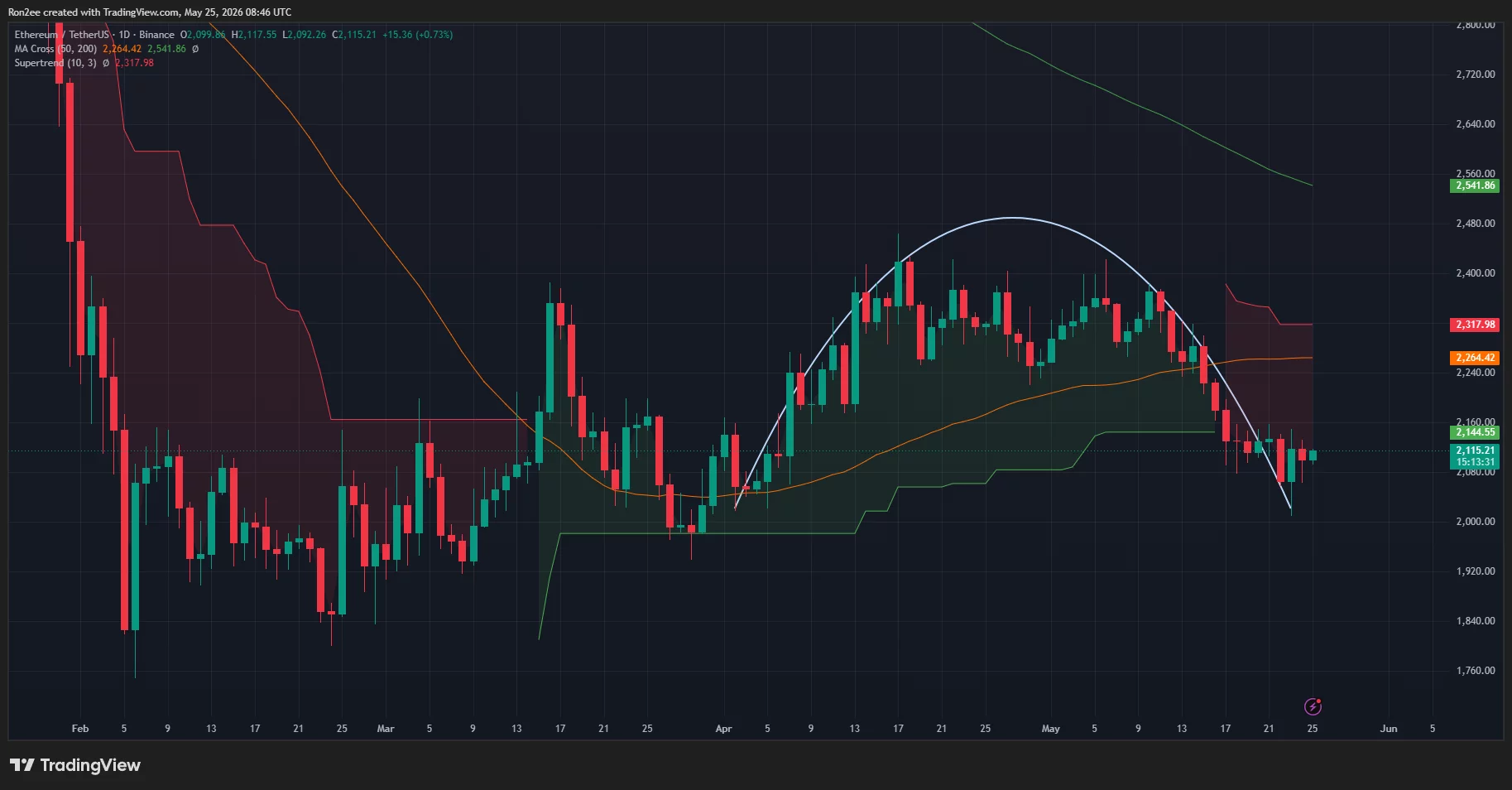
On the daily chart, Ethereum has formed what appears to be a bearish rounded top pattern stretching from mid-April into late May. The structure developed after ETH failed multiple times to sustain momentum above the $2,400 region, gradually transitioning from higher highs into a curved distribution pattern before breaking lower.
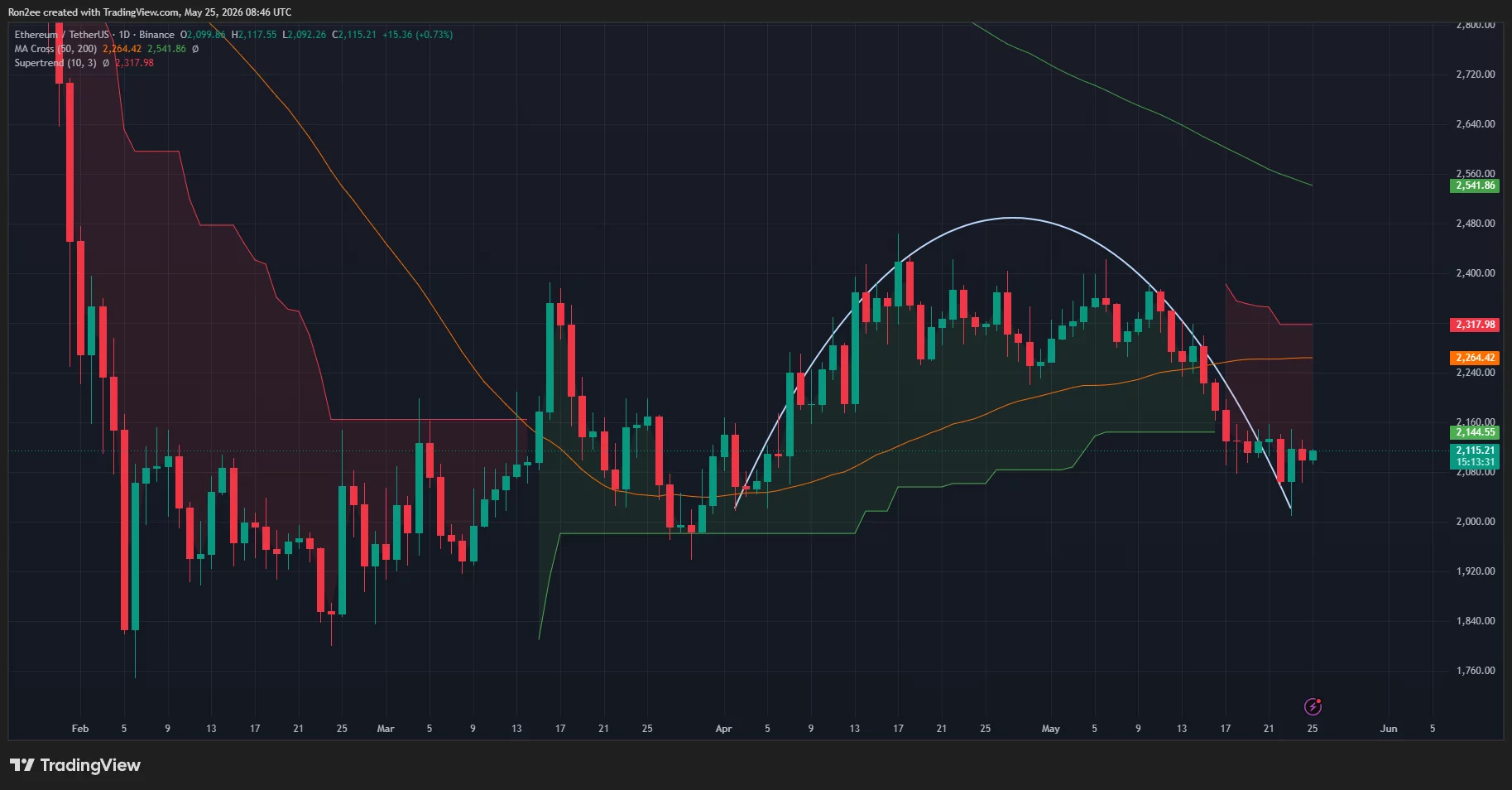
The rounded top neckline around $2,150 has now flipped into immediate resistance. Ethereum attempted to reclaim that level during the latest rebound but sellers quickly rejected the move, reinforcing bearish control over short-term price action.
Technical indicators continue leaning negative. Ethereum remains below the Supertrend resistance near $2,318 while also trading under the 50-day moving average around $2,264. The longer-term 200-day moving average near $2,541 continues sloping downward, showing that the broader trend remains weak despite temporary relief rallies.
A breakdown projection from the rounded top pattern points toward a possible move into the $1,850–$1,900 range if sellers regain momentum. That target aligns with the lower support zone visible on the chart from February’s consolidation period.
Meanwhile, liquidation data from CoinGlass shows heavy leverage concentration between $2,150 and $2,170, creating a major liquidity barrier directly above current price levels. Bright liquidation clusters in that region suggest many short positions could be forced out if ETH successfully reclaims resistance, potentially triggering a short squeeze toward $2,250.
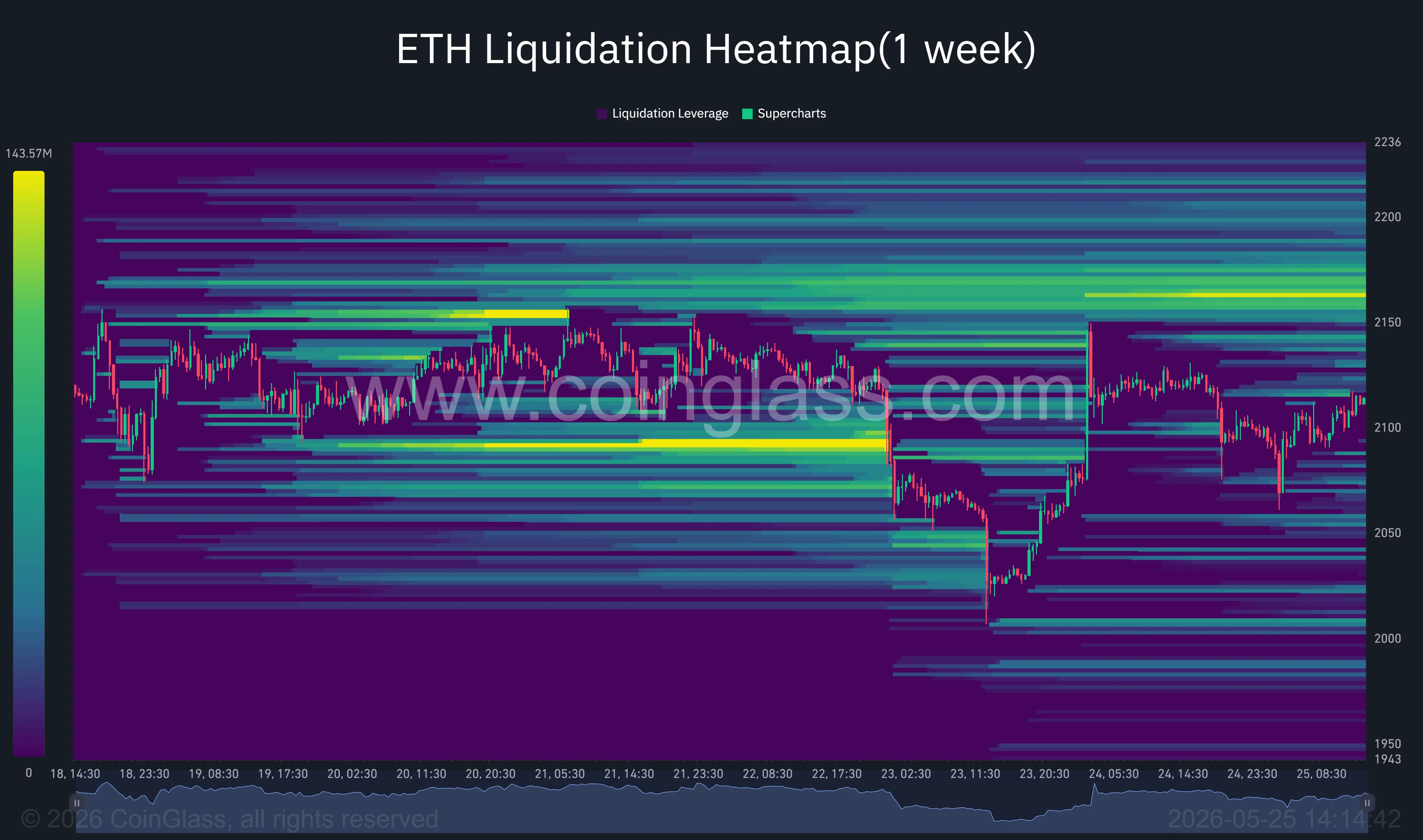
Still, downside liquidity remains substantial below $2,050 and near the $2,000 psychological level. A decisive breakdown beneath those zones could accelerate long liquidations and intensify volatility across perpetual futures markets.
Blockchain tracking platform Lookonchain revealed that a trader recently opened a massive 23x leveraged Ethereum short position worth more than $100 million. According to the post, the position involved roughly 47,600 ETH with a liquidation price near $2,149, placing the trade directly around Ethereum’s current resistance cluster.
Analyst Ted Pillows also warned that Ethereum remains trapped below a critical supply zone.
“ETH bounced back from the $2,000 support level but got rejected from the $2,150 resistance zone,” he wrote on X. “If Ethereum manages to reclaim the $2,150 zone, it could rally quickly towards $2,250. A failure to reclaim means $2,000 will be retested soon.”
Funding rates across major derivatives exchanges have also started turning negative again, suggesting traders are increasingly positioning for downside continuation. Open interest has remained elevated despite the recent correction, a sign that leveraged bets are still heavily active in the market.
What could invalidate Ethereum’s bearish setup?
Despite mounting bearish signals, Ethereum has not yet confirmed a full trend collapse. Bulls continue defending the $2,000 region aggressively, and repeated rebounds from that area indicate that spot demand remains active at lower levels.
Any sustained move back above $2,150 would weaken the rounded top structure significantly. Such a breakout could force leveraged shorts to unwind rapidly, especially given the dense liquidation clusters sitting above resistance. In that scenario, Ethereum could revisit the $2,250 and $2,400 levels relatively quickly.
Furthermore, progress in U.S.-Iran negotiations or a sharper decline in crude oil prices could improve overall risk appetite and reduce inflation fears tied to energy markets. This would likely benefit crypto assets broadly, particularly large-cap tokens like Ethereum that remain sensitive to institutional flows.
Federal Reserve expectations remain another major variable. Traders are still closely watching incoming U.S. inflation and labor market data for clues on future interest rate policy. Any signals supporting earlier rate cuts could weaken the dollar and revive demand for speculative assets.
Stablecoin activity on Ethereum continues providing one bullish structural backdrop as well. The network still dominates global stablecoin settlement volume, and elevated issuance levels suggest underlying blockchain activity has not collapsed despite price weakness.
For now, however, Ethereum remains stuck between heavy resistance near $2,150 and fragile support at $2,000. A decisive move outside that range will likely determine whether the current structure evolves into a deeper crash or another short-term recovery rally.
Disclosure: This article does not represent investment advice. The content and materials featured on this page are for educational purposes only.

Roy Keane takes aim at Bruno Fernandes again with ‘donkey’ dig at Man Utd star | Football

Hyperion unveils southern hemisphere's first 3D-printed USV

Hyperliquid takes a swing at Polymarket with macro outcome bets


-

 Crypto World5 days ago
Blockchain.com files with SEC for U.S. IPO
-

 Fashion4 days ago
Holiday Weekend Open Thread – Corporette.com
-

 Business4 days ago
Dell Technologies DELL Stock Surges 15% on AI Server Momentum and Analyst Upgrades in 2026
-

 Crypto World4 days ago
Bitcoin Accumulation Weakens as BTC Realized Losses Hit $600M
-

 Crypto World4 days ago
Space X IPO Is ‘Bad News’ for Tech Stocks: But What About Bitcoin?
-

 Politics4 days ago
Makerfield: a tale of two social-media histories
-

 Crypto World3 days ago
Robinhood crypto COO Tanya Denisova exits
-

 Crypto World4 days ago
MicroStrategy’s Saylor Says Miners No Longer Set Bitcoin Price, Another Force Has Taken Over
-

 Business2 days ago
NYT Strands Answers May 24 2026 Revealed for Puzzle No. 812 Theme Summer Essentials
-
 Tech4 days ago
A 0.12% parameter add-on gives AI agents the working memory RAG can’t
-

 Crypto World4 days ago
AI infrastructure race heats up as IREN pitches full-stack strategy, WhiteFiber lands $160M deal
-

 Tech4 days ago
WhatsApp ads could make Irish debut after discussions with DPC
-

 Tech4 days ago
You Can Now Add ChatGPT To PowerPoint
-

 Business4 days ago
Trump Invests $1M-$5M in Kura Sushi USA Chain With 27 California Locations
-
 NewsBeat5 days ago
Charity run by Reform leader Malcolm Offord accused of ‘law breaking’ over Scottish registration
-

 Sports4 days ago
2026 CJ Cup Byron Nelson leaderboard: Brooks Koepka finds putting stroke in Round 1
-

 Crypto World5 days ago
Exa Labs raises $250 million in funding led by a16z
-
Business4 days ago
Goldman Sachs reinstates Ageas stock coverage with neutral rating
-

 Crypto World4 days ago
Trump Media’s Bitcoin Stash Shrinks Again as 2,650 BTC Lands on Crypto.com
-

 Crypto World4 days ago
Verus Bridge Hacker Returns $8.5M ETH, Keeps $2.8M as Bounty
You must be logged in to post a comment Login