

Crypto World
Phishing Scammers Net $400K With Fake Uniswap Google Ads

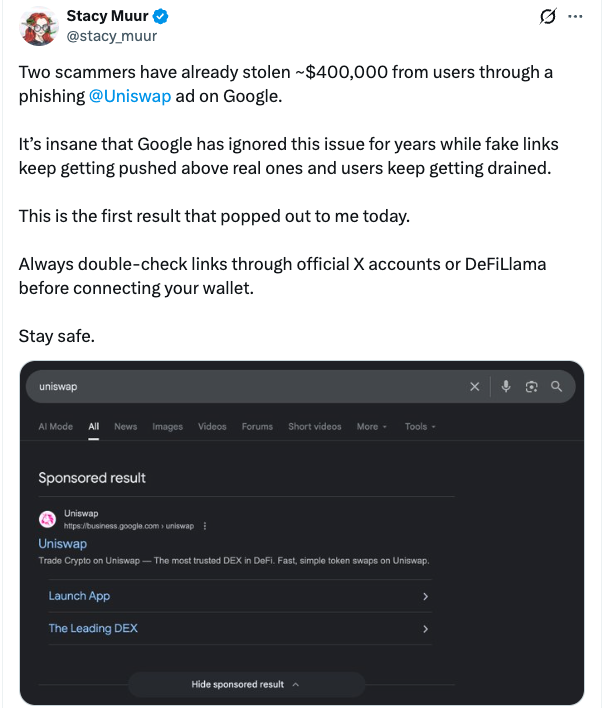
Scammers have been using Google to deploy malicious phishing advertisements impersonating the crypto protocol Uniswap, which has reportedly netted the attackers at least $400,000.
The on-chain analyst “b-block” posted to X on Monday that a website impersonating decentralized finance exchange Uniswap was draining funds from multiple wallets and the scammers were holding at least $400,000.
Stacy Muur, founder of Web3 marketing agency Green Dots, said that the scammers had stolen the funds from users through a phishing ad on Google that impersonated Uniswap, and shared a screenshot of a sponsored result from the search engine.
“It’s insane that Google has ignored this issue for years while fake links keep getting pushed above real ones and users keep getting drained,” she said.
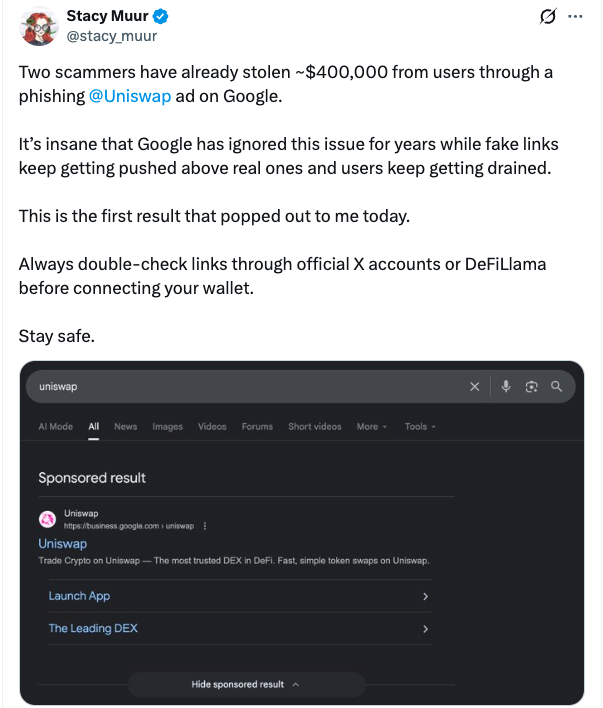
Source: Stacy Muur
The two flagged addresses held a combined 146 ETH worth around $306,000, at the time of writing, according to Etherscan.
DeFiLlama said that “fake ads on Google are a common source of phishing attacks.” The crypto non-profit group Security Alliance (SEAL) reported in April that there was a “significant uptick” in phishing activity on Google search in March.
SEAL said that attackers pay Google or hack legitimate advertiser accounts to run convincing fake ads impersonating popular crypto protocols to lure users. Threat actors outbid legitimate crypto exchanges and protocols to achieve a superior position within the “Sponsored results” section on Google Search.
SEAL blocked over 356 malicious advertisement links, a number which is “representative of a steady volume of attacker-deployed Google Ads each week for more than a year,” it added. “The campaign is not slowing down, and we are receiving more reports from affected users.”
Related: ‘TrapDoor’ malware targets crypto dev tools in supply chain attack
The phishing ads used legitimate-looking URLs to bypass Google’s automated checks, while a hidden secondary iframe loads the malicious payload, also invisible to Google’s detection.
Victims land on convincing clones of real crypto apps, with all network traffic secretly routed through attacker-controlled servers, explained SEAL, reporting that $1.27 million in total funds were stolen between March 13 and 30.
In early May, it was reported that attackers were abusing Google Ads and legitimate shared chats from AI chatbot Claude in an active “malvertising” campaign targeting Mac users.
Facebook is also a hotbed of fake ads and scams, according to Malwarebytes, which reported in February that scammers were running paid ads that looked like official Microsoft promotions.
Victims were directed to near-perfect clones of the Windows 11 download page, where malware designed to steal crypto and credentials was deployed.
Magazine: Polymarket seeks Japan entry, Harvard dumps entire ETH position: Hodler’s Digest

Crypto World
Istanbul Blockchain Week 2026: Institutions Have Arrived, and the Conversation Moved to Infrastructure
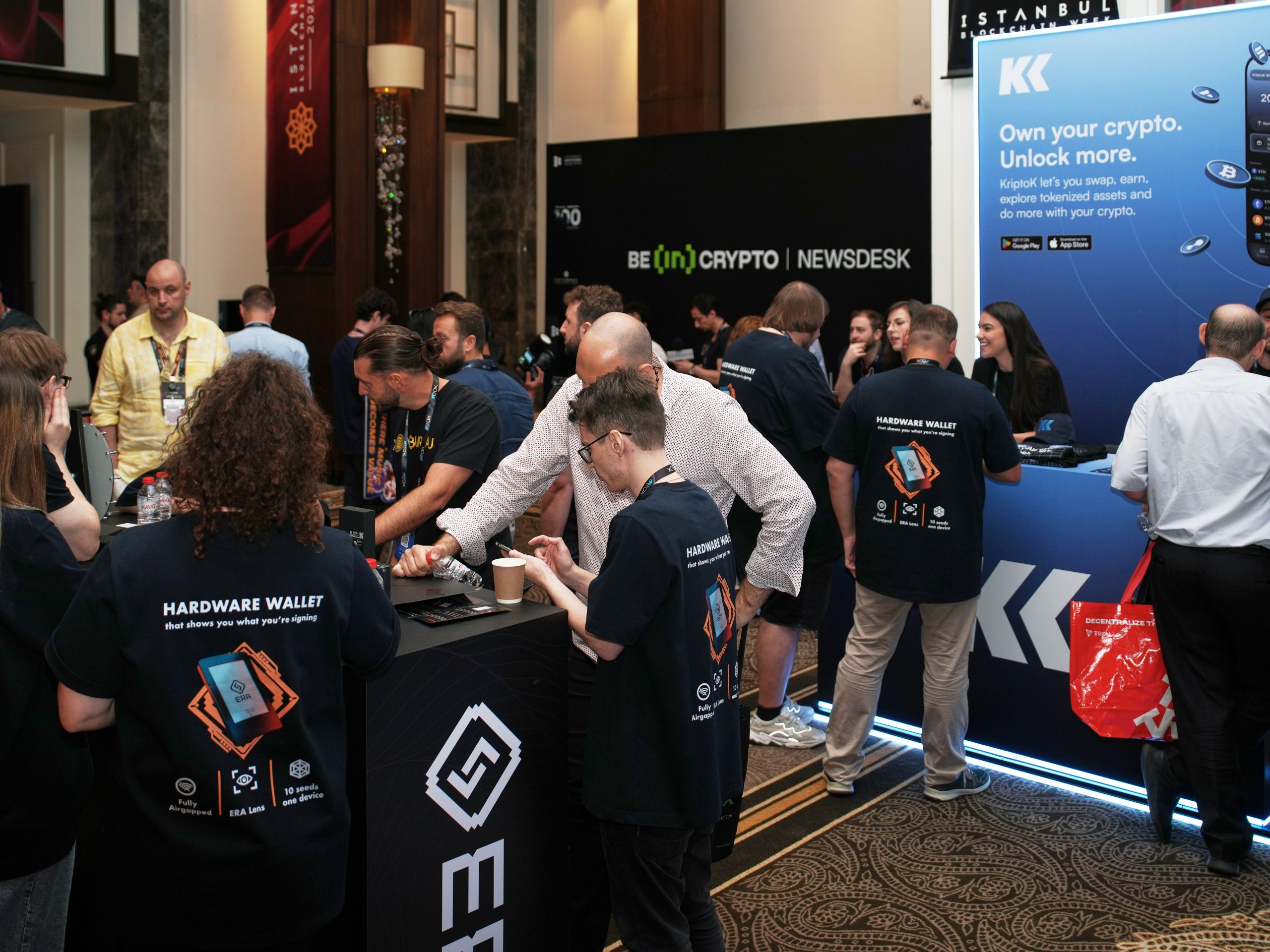
BeInCrypto attended Istanbul Blockchain Week 2026 as official Web3 media partner, across two days at the Hilton Bomonti. The tone this year was mature and institutional. Retail speculation and meme coins were absent from the agenda. The talk was about infrastructure, regulatory compliance, and how to bring traditional finance on-chain without repeating the last cycle’s mistakes.
Türkiye runs the largest crypto market in the Middle East and North Africa, with close to $200 billion in annual on-chain activity by Chainalysis’ count, around four times the UAE. The inaugural Istanbul Institutional Markets Summit (IISM) sat at the center of the program, and its panels set the themes for the week: custody, compliance, stablecoin utility, and tokenization.

Custody and the Rulebook
IISM opened with the conditions traditional finance attaches to entering crypto. Speakers named three non-negotiables: strict custodian regulation, full custodial insurance, and Big Four audits. BitGo MENA Managing Director Nick Coombs argued for folding trading, storage, and security into one platform rather than leaving clients to assemble it themselves. Across the summit, the framing held: regulation is treated as the thing that brings institutional capital in, not the thing that keeps it out.
The legal detail came from the IISM digital asset regulation panel, with updates on the IT and wallet infrastructure criteria TÜBİTAK now requires for platform authorization. The base is the 2024 amendments to Capital Markets Law No. 6362. The difference from Europe is structural. Turkish rules will mandate a separation between trading platforms and custody institutions, where the EU’s MiCA allows combined models. Regulators are also avoiding early definitions, choosing to classify assets case by case from whitepapers and actual use. Panelists expect the Turkish market to fragment over the coming years into specialized entities, with custody handled separately, much as traditional banking is structured.

Fundraising Discipline
A token should launch only when the ecosystem actually needs one. That was the line from the fundraising panel, moderated by Marc Johnson with Vineet Budki of Sigma Capital, Ben Lakoff of Bankless Ventures, Brendan Ma of Arbitrum, and Tobias Bauer of TBV. Issuing tokens to raise money quickly, the pattern that leaves founders rich and projects abandoned, does lasting damage to the industry’s credibility. And because a token invites public scrutiny and changes how a company runs overnight, launching one without real user adoption, value accrual, or equity behind it is close to meaningless.
The advice for the next six months was concrete. Founders should hold a long-term plan over a short-term one, and both founders and investors need more patience than a maturing market makes easy. Investors should not chase a project on hype right after launch, before the product is understood. Founders should be selective about whose capital they accept. And strict lock-up and vesting terms on both sides remain the tool that aligns incentives and keeps early sell-offs from breaking a project before it works.
Stablecoins Over Volatility
At IISM, stablecoins came up as more useful to institutions right now than volatile assets. The cited use cases were central counterparty settlement, capital mobilization, and lower-cost cross-border payments, where speed and reduced friction beat traditional rails. The existence of many competing stablecoins was treated as normal, comparable to holding different fiat currencies, though the preference leaned toward integrated infrastructure over fragmented platforms.
The Turkish State as Builder
The local signal came from the government itself. Buğra Ayan, who heads the IT department at the Presidency’s Directorate of Communications, gave a keynote on putting customized in-house language models to work in public service. One model now runs inside CİMER, the state communication center, sorting and prioritizing 15,000 daily applications and surfacing urgent ones within seven minutes, without writing replies to citizens.
Ayan also described running AI agents directly on-chain through OpenCLI, and noted the directorate was the first state institution to acquire a blockchain domain, with post-quantum encryption already on its roadmap. Beyond finance, officials pointed to tokenizing yield-bearing assets and agricultural supply chains as near-term opportunities, while warning that past fraud cases dressed up as agri-tech are a reason to move carefully.

Istanbul, On Record
Beyond the stages, BeInCrypto sat down with founders, investors, and operators for a set of on-camera conversations.
- Tobias Bauer, Co-founder and General Partner at TBV: On what separates a token worth launching from one that should not ship, and where early-stage capital is going. Watch the interview.
- William Campbell, Advisory Lead at USDKG: On asset-backed stablecoins and institutional demand for collateral you can point to. Watch the interview.
- Travis Wright, Chief Web4 Officer at MultiBank Group: On tokenization, real-world assets, and an established financial group moving on-chain. Watch the interview.
- Vineet Budki, CEO and Managing Partner at Sigma Capital: On capital formation in 2026 and the discipline returning to the market. Watch the interview.
The Throughline
Istanbul Blockchain Week 2026 read as a working session rather than a showcase. The questions were about custody standards, regulatory structure, and settlement, the same ground BeInCrypto has covered through 2026 from Paris onward. What set Istanbul apart was the Turkish state treating itself as a builder in the system rather than only its regulator.
The post Istanbul Blockchain Week 2026: Institutions Have Arrived, and the Conversation Moved to Infrastructure appeared first on BeInCrypto.

Key takeaways
- ADA remains under pressure after last week’s 30% sell-off
- The coin could dip lower if the bearish trend in the market persists.
Cardano (ADA) continues to struggle on Wednesday, trading near $0.1600 and extending losses following last week’s sharp 30% decline.
The cryptocurrency remains under intense selling pressure as investor confidence weakens and retail participation fades.
Despite the bearish backdrop, on-chain data suggests that selling activity from long-term holders may be approaching exhaustion, potentially laying the groundwork for a future recovery.
Dormant supply spike suggests capitulation among long-term holders
Recent on-chain data from Santiment shows a significant surge in dormant ADA supply re-entering circulation during early June.
Several spikes in dormant supply spent exceeded 20 billion ADA, culminating in a massive 40.6 billion ADA movement on June 9, the largest recorded spike during the current sell-off.
This wave of activity indicates that long-term holders who had previously remained inactive chose to move or sell their holdings amid market weakness.
The surge also interrupted the growth in the average age of ADA wallets, confirming that dormant addresses became active again.
While further selling from long-term holders remains possible, such spikes are often viewed as capitulation events that signal the exhaustion of selling pressure and frequently precede market bottoms.
Retail sentiment toward Cardano has deteriorated significantly following last week’s decline.
Derivatives data highlights the decline in speculative demand. According to CoinGlass, Cardano futures Open Interest (OI) has dropped to $348.55 million, its lowest level since November 2024. This extends a steady decline from $585.35 million recorded on May 12.
A falling OI typically signals that traders are closing leveraged positions and becoming more risk-averse, reducing the likelihood of a strong recovery in the near term.
ADA price analysis: Can Cardano stay above $0.1500?
Cardano is trading slightly below $0.1600, maintaining a bearish trajectory after reaching a short-term peak of $0.1745 on Monday.
Technical indicators continue to favor sellers. The Relative Strength Index (RSI) at 39 is approaching the oversold territory, indicating severe selling pressure.
The Moving Average Convergence Divergence (MACD) remains below the zero line, confirming that bearish momentum remains dominant.
While oversold conditions could trigger occasional relief rallies, there is currently no strong evidence of a trend reversal.
If the rally resumes, ADA could surge past Monday’s high of $0.1745 before hitting the $0.2000 psychological level.
A move back above the $0.2205–$0.2275 zone would be needed to weaken the prevailing bearish outlook.

However, if the selloff persists, ADA could drop below Saturday’s low of $0.1486, with the major long-term support at $0.1000 also a target.
A break below $0.1486 could expose ADA to a deeper decline toward the $0.1000 region.
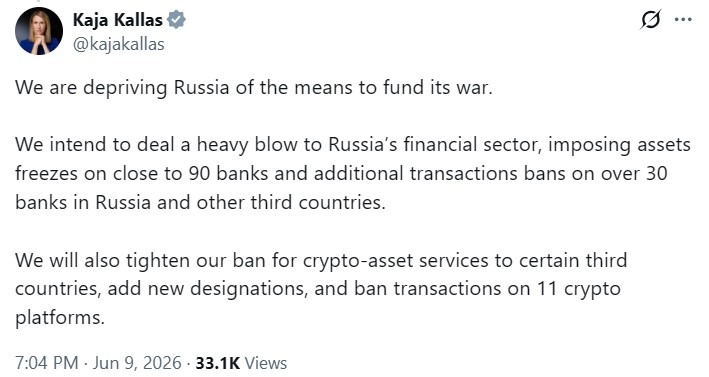
The European Union proposed banning transactions on 11 crypto platforms as part of its 21st sanctions package against Russia.
Kaja Kallas, vice president of the European Commission and the EU’s high representative for foreign affairs and security policy, outlined measures targeting banks, weapons manufacturers, oil traders, refineries and other entities outside the bloc.
“We will also tighten our ban for crypto-asset services to certain third countries, add new designations, and ban transactions on 11 crypto platforms,” Kallas said in a post on X.
The proposal would widen the EU’s sanctions campaign beyond Russian banks and energy revenues to crypto firms accused of helping Moscow circumvent restrictions imposed over its war in Ukraine.
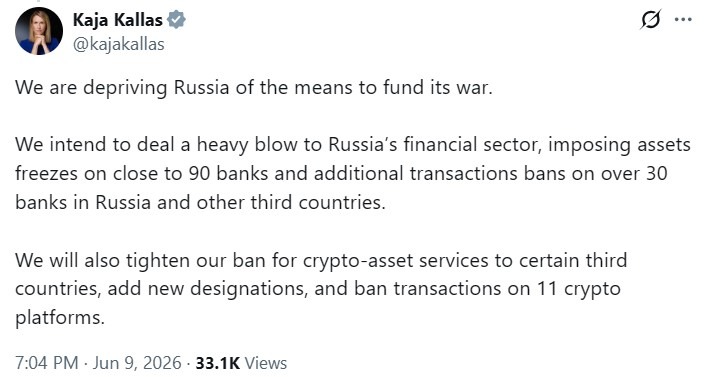
Source: Kaja Kallas
The Commission did not identify the 11 crypto platforms in its public statements. Cointelegraph sought clarification on which platforms would be affected, but the Commission did not provide additional details before publication.
European Commission President Ursula von der Leyen said the package includes bans on 31 additional Russian banks and 20 entities in third countries, including banks, crypto platforms and oil traders.
She said the targets had served sanctioned Russian individuals and entities or helped circumvent EU measures.
EU proposal follows UK sanctions against HTX
The EU proposal follows the United Kingdom’s May 26 sanctions against Huobi Global S.A., the Panamanian company behind HTX, over alleged support for Russia-linked financial networks.
UK authorities said there were reasonable grounds to suspect HTX had supported the Russian government through financial services and funds facilitated by A7 Limited Liability Company and Garantex, both sanctioned entities.
Related: MiCA architect says EU should prioritize tokenization over DeFi rules
HTX has denied the allegations, saying the sanctioned entity is separate from the online exchange. A Global Ledger report later said HTX processed about $21.06 billion in high-risk crypto flows between 2021 and May 2026. Of that total, at least $7.64 billion was linked to Russian high-risk entities and darknet markets, including Garantex, its successor Grinex, A7A5 and Hydra.
The UK sanctions drew criticism from blockchain researchers, who warned that broad exchange-level tainting could freeze legitimate users and make crypto compliance tools less effective at tracing illicit funds.
Magazine: Vietnam preps crypto pilot, HK pushes tokenization: Asia Express

Peter Tuchman, the New York Stock Exchange veteran known as the Einstein of Wall Street, says the GPU boom looks like Bitcoin’s early mining era. He argues investors should trace AI’s supply chain instead of chasing headline names.
The trader, who moves between $500 million and $1 billion in stock daily, also cautioned against hype-driven investing.
Why the GPU Boom Looks Like Early Bitcoin Mining
Tuchman, the longest-serving trader on the NYSE floor, described GPUs as a scarce resource, much like bitcoin in its first mining wave.
Hobbyists once mined the asset from basements. Today, he sees GPU entrepreneurs building marketplaces for limited computing power.
The scarcity is measurable. Nvidia disclosed over $500 billion in Blackwell and Rubin chip orders through 2026 last October, a figure CEO Jensen Huang lifted to $1 trillion through 2027 at GTC in March.
The parallel runs in both directions. Several miners became AI powerhouses after converting their facilities into data centers, including IREN through its $9.7 billion Microsoft deal.
Meanwhile, Bitcoin miner stocks increasingly track AI infrastructure spending rather than coin prices. Bitcoin (BTC) itself traded near $61,205 on Wednesday, down 2.4% over 24 hours.
Energy sits at the center of that trade. The IEA expects data center power demand to more than double to 945 TWh by 2030, near Japan’s annual usage.
Huang has said power supply will decide how far AI can scale. Tuchman echoed the point, citing generators, grid capacity, and data center buildouts as the next frontier.
Follow us on X to get the latest news as it happens
Follow the AI Supply Chain, Not the Hype
Tuchman calls this the secondary and tertiary trade. Component makers, rare earth suppliers, and energy producers trade as independent public companies.
Studying them, he suggests, lets investors position before the crowd arrives.
He paired the advice with a warning drawn from the meme stock era, when many retail buyers purchased at the top.
“FOMO, hype and hope are not sustainable trading strategies,” Tuchman said on the School of Hard Knocks podcast, recalling traders still holding GameStop from its $483 peak in January 2021.
The caution rests on four decades of pattern recognition. Tuchman worked the floor through Black Monday in 1987, the dot-com collapse, and the 2008 financial crisis.
Each crash, he noted, arrived with the market at record highs. He is not alone in urging discipline.
Billionaire investor Bill Ackman compared the rush into chips and energy stocks to dot-com era crowd behavior, though he calls AI a boom rather than a bubble.
However, Chinese exports beat forecasts in May on AI-driven demand, a sign the buildout retains momentum. Questions about an AI bubble have still trailed Nvidia’s record earnings.
Capital and policy continue to pour in. OpenAI’s confidential IPO filing and Washington’s AI ownership plan both signal how much money now rides on the sector’s plumbing.
Tuchman’s framework treats AI as infrastructure rather than a lottery ticket.
Whether the GPU buildout follows Bitcoin mining’s path toward consolidation may become clearer as energy deals and chipmaker earnings land in the coming quarters.
The post The Einstein of Wall Street Reveals AI’s Hidden Winners appeared first on BeInCrypto.
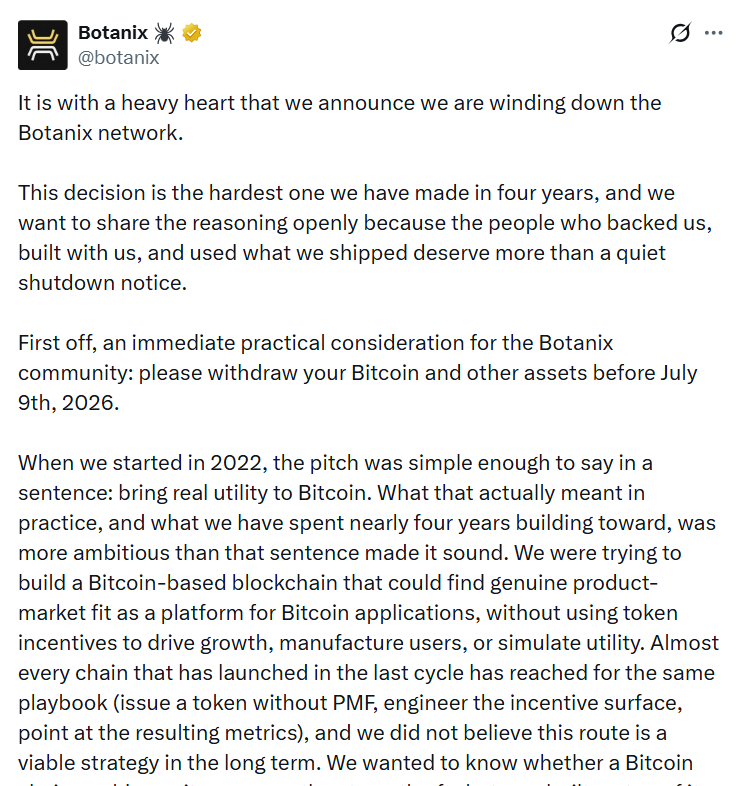
Botanix, a Bitcoin scaling network that set out to bring “real utility” to BTC without token incentives, is winding down after four years in operation.
In a Tuesday post on X, Botanix told users to withdraw all Bitcoin and other assets by July 9, after which remaining assets will be swept and “be unrecoverable.”
The decision comes despite integrations with major crypto infrastructure providers, including Chainlink, Fireblocks and Galaxy, and the launch of a consumer-facing Bitcoin neobank app.
Botanix’s Spiderchain architecture combines an Ethereum Virtual Machine-compatible chain with proof-of-stake-style consensus.
That structure allowed it to offer Ethereum-like programmability for Bitcoin while relying on a set of validators and a dynamic federation, rather than purely on Bitcoin’s own consensus for security and settlement.
In its shutdown notice, the team said the technology and products worked but failed to achieve sustainable product-market fit or economics.
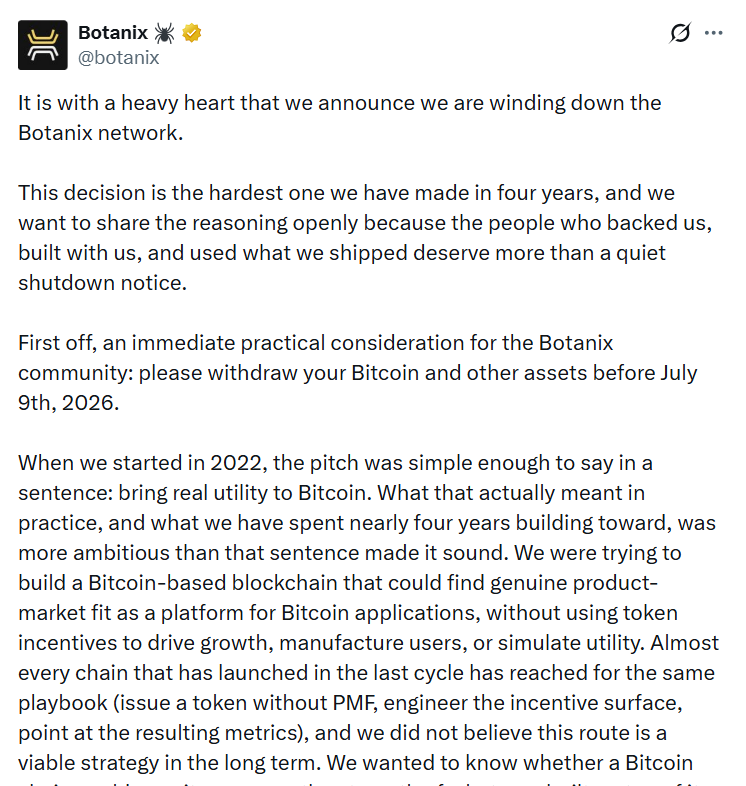
Botanix shut-down notice. Source: Botanix
Botanix said most users still treat Bitcoin primarily as a reserve asset and yield vehicle rather than something they want to use frequently in onchain applications, and that existing demand for Bitcoin-backed decentralized finance (DeFi) is largely being met by wrapped BTC on Ethereum.
Related: Bitcoin payments held back by tax policy, not scaling tech: Crypto exec
The team also cited a broader concentration of attention and trading volume on large exchanges, trading platforms and traditional financial intermediaries, which left infrastructure-heavy networks like Botanix struggling to generate enough fee revenue to cover their costs.
Users have until July 9 to withdraw assets
Botanix has warned that anyone who does not remove their Bitcoin and other assets by July 9 will lose access, highlighting the practical risks for retail users when experimental DeFi platforms are wound down.
The shutdown comes as other projects seek to extend Bitcoin’s programmability, including Stacks and Rootstock, which operate independent blockchains linked to Bitcoin, and newer efforts such as Citrea that use different mixes of Bitcoin anchoring, proof-of-stake-style designs and token incentives
Citrea co-founder and chief executive Orkun Mahir Kılıç told Cointelegraph Botanix’s experience is less an indictment of Bitcoin DeFi than of “a cloning-first approach” that largely replicated existing EVM protocols without offering long-term BTC holders a distinct value proposition.
He argued that Citrea is instead focused on applications that “fundamentally require Bitcoin’s specific architecture and trust-minimized settlement,” rather than competing as one more general-purpose chain, pointing to use cases like private payments and Bitcoin-native capital markets rather than generic lending and trading forks.
Cointelegraph reached out to Botanix for comment but did not receive a response by publication.
Magazine: Bitcoin will not hit $1M by 2030, says veteran trader Peter Brandt
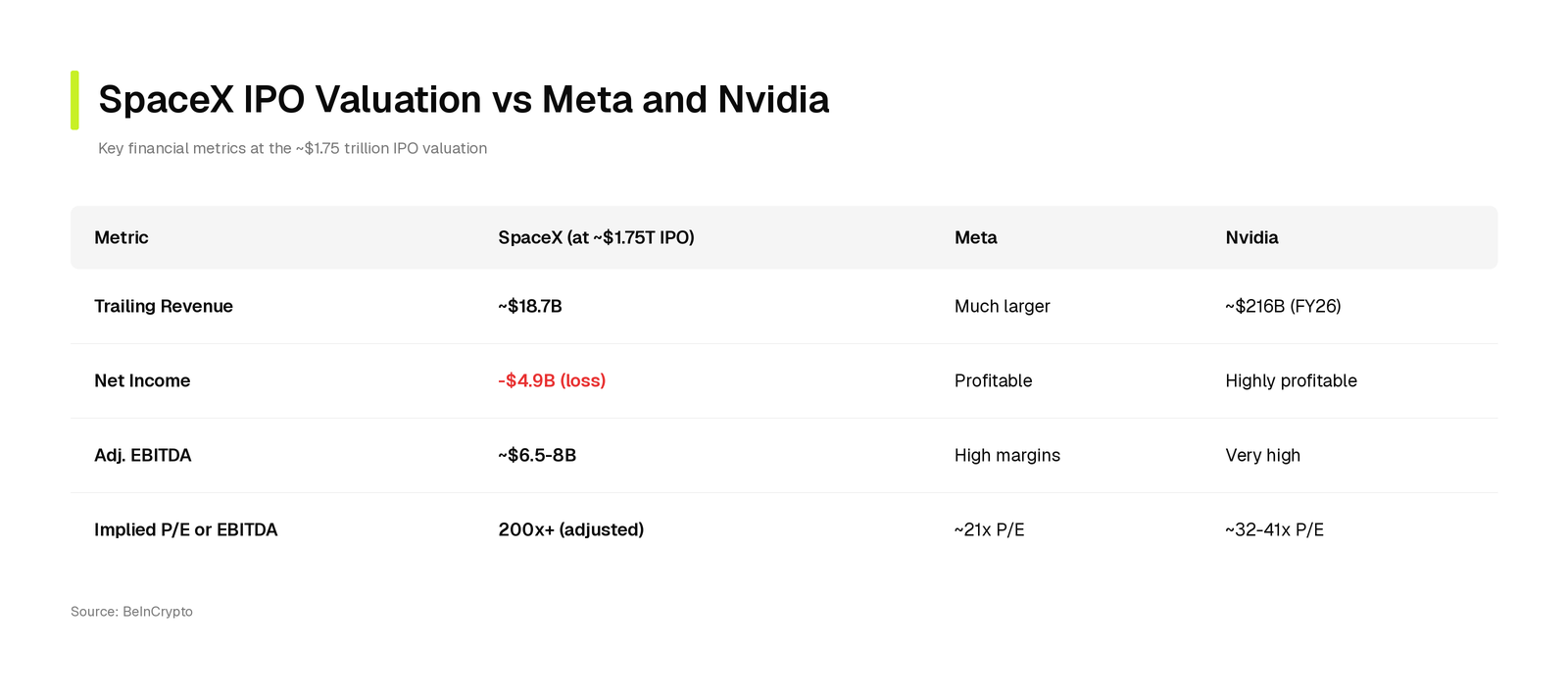
Veteran New York Stock Exchange floor trader Peter Tuchman predicts the SpaceX IPO could open near $1,000, more than seven times its $135 offer price, when the rocket maker debuts this week.
Tuchman still calls the valuation frothy at roughly 100 times earnings. He urges investors to watch the opening trade before committing money.
SpaceX IPO Hype Meets a 100x Multiple
In an interview on the School of Hard Knocks podcast, Tuchman broke down the offering days before SpaceX lists on Nasdaq.
The company fixed its price at $135 per share, targeting a $75 billion raise at a $1.77 trillion valuation.
Tuchman, who trades up to $1 billion daily on the NYSE floor, expects scarcity to overwhelm that price on day one.
“It’s going to come out at 135. I would bet it opens at a thousand… just because there’s such a limited supply. So many people want it. It is the flavor of the freaking moment.”
Reported demand of roughly $150 billion, double the raise, supports his read. Fidelity also cut its entry minimum to $2,000, widening retail access to the deal.
The veteran still questions the price tag. By his math, SpaceX comes out near 100 times earnings, while Meta trades at 11 times and Nvidia at 18 times.
“A 100 times earnings to come out is… a little bit frothy at best like a really good cappuccino at Starbucks. It’s way out there.”
He added that “Elon Musk has apparently rewritten the rules on the lockdown,” meaning some insiders cannot sell until Musk allows it. Investors have raised similar questions about the structure.

Follow us on X to get the latest news as it happens
Wait for the Open, Tuchman Says
Tuchman refuses to call the debut a buy. The stock “could go to 2,000 and it could go to 50,” he warned.
“This is my best recommendation without recommending anything is to let it open, watch what happens, see it.”
Waiting may cost a few dollars, he conceded, but momentum matters more than bottom dollar. As he put it, “you don’t want to catch a falling knife.”
Other space stocks could also move on the listing.
The post SpaceX IPO Could Open at $1,000 Despite ‘Frothy’ Valuation, NYSE Veteran Predicts appeared first on BeInCrypto.

Disclosure: This article does not represent investment advice. The content and materials featured on this page are for educational purposes only.
Bitcoin Cash, Litecoin, and DOGEBALL enter focus as investors seek utility, transparency, and resilience amid market uncertainty.
Summary
- A recent report highlighting investor losses after a crypto-related collapse has renewed focus on risk management and the importance of evaluating projects beyond market hype.
- DOGEBALL is being promoted as a Layer-2 blockchain ecosystem combining payments and gaming, with features such as crypto-to-fiat transfers, play-to-earn gaming, and a token-based transaction model.
- The project markets its presale using projected returns based on future listing prices.
The crypto market is moving very fast. A recent NDTV report shared a big warning for everyone. It showed how President Donald Trump and his family made $500 million from a crypto deal right before AI Financial Corp crashed.
That sudden crash left normal investors with massive losses. This news teaches us a major lesson for those who are looking for the top crypto to buy now. Hype can disappear in one night. Because of this, smart buyers are moving away from risky coins. They are choosing tokens with real daily use, clear math, and true safety. This easy guide looks at the data behind Bitcoin Cash, Litecoin, and a new asset called DOGEBALL to help make a smart choice.

What is DOGEBALL?
DOGEBALL is a highly useful crypto network. It is built on its own fast blockchain called DOGECHAIN, which is an Ethereum Layer 2 system. It mixes online gaming with global payments. These fields are known as GameFi and PayFi. Unlike tokens that rely only on hype, this project fixes real daily problems.
Its main service is called DOGEPAY. It lets users send crypto anywhere in the world, and the person getting it receives local cash straight into their bank account. It works with over 30 global currencies. The transactions take under a second, there are zero foreign exchange fees, and do not need slow banks or payment apps.
People are joining this project because it offers safety and high demand. The DOGEBALL token is the main fuel used to pay all network transaction fees. This setup creates constant buying pressure. The token also runs a play-to-earn gaming world with a $1,000,000 total prize pool. The top player can win up to $500,000 and cash out instantly into real money. The smart contract has a perfect 100% security audit score. This makes it a very stable and safe digital asset for your portfolio.
High yield math: Analyzing the DOGEBALL presale growth potential
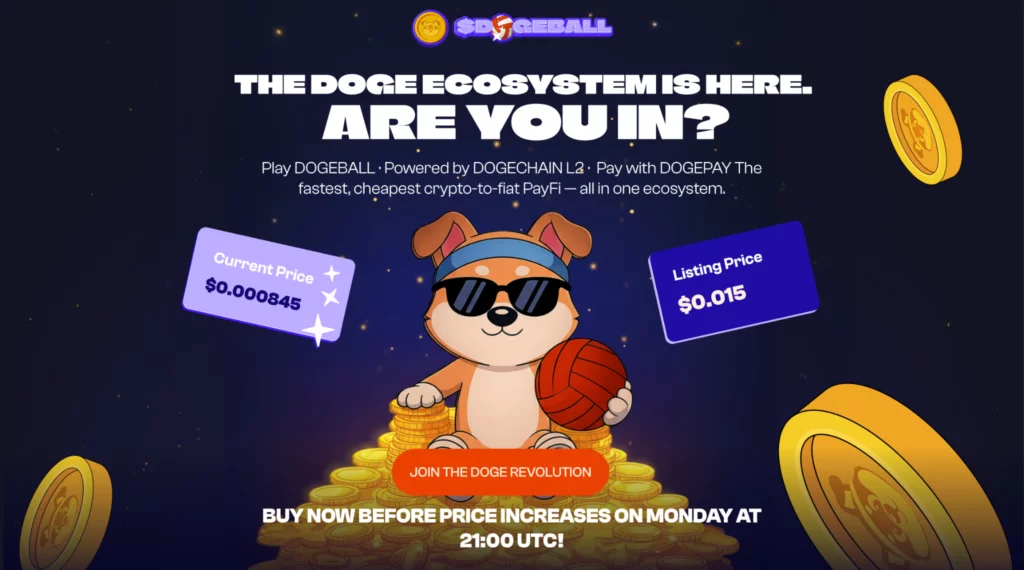
The DOGEBALL crypto presale 2026 is built to reward people who get in early. The project has already raised more than $302,000 from over 1,050 buyers. On Monday, May 11, 2026, the team permanently burned 4,000,000,000 tokens. That removed 20% of the presale supply to make the remaining tokens scarcer. The crypto presale has 22 stages in total. Each stage lasts a maximum of 7 days and ends every Monday at 21:00 UTC. When the stage ends, unsold tokens are burned and the price goes up.
Buying at the current Stage 7 price of $0.000845 gives investors a huge mathematical advantage. The token will launch on big crypto exchanges at $0.015.
Let us look at the basic return on investment (ROI) calculation:
- Current Stage Price: $0.000845
- Planned Launch Price: $0.015
- Expected Launch Gain: 1,675.14%
These gains can be grown even more by using the special bonus code DB30. This code gives a 30% bonus on tokens. For example, putting $1,000 into the project today gets around 1,183,431 tokens. By typing the code DB30, the total amount jumps to 1,538,460 tokens. When the token hits the exchange at the $0.015 launch price, the investment becomes worth $23,076. That is a total profit of 2,207.6%. Prices go up every single Monday at 21:00 UTC. This means today is the best chance to buy at this low price before the next weekly increase.
How to join the DOGEBALL presale right now
Joining the presale is easy and takes less than five minutes. Follow these quick steps to get tokens before the price steps up:
Step 1: Get a Crypto Wallet
Download a free digital wallet like MetaMask or Trust Wallet on a phone or computer.
Step 2: Add funds to the Wallet
Buy or transfer Ethereum (ETH), USDT, or BNB into the new digital wallet.
Step 3: Link to the Website
Go to the official DOGEBALL website and link the wallet using the live presale widget.
Step 4: Use the Code and Buy
Type in how much to buy. Enter the code DB30 to get 30% extra tokens, and click confirm.
Bitcoin Cash: Stable performance with limited growth
Bitcoin Cash is a well-known coin used for daily payments, but its fast growth has slowed down. According to the latest price prediction data from CoinCodex, Bitcoin Cash is in a flat trend. Its long-term moving average has been pointing downward since late May 2026. This shows that the market is hitting a wall.
The coin faces tough resistance around the $540 to $550 price levels. CoinCodex charts show that the token is expected to trade between $439.79 and $642.10 over the coming months. It is still a safe network for sending decentralized payments. However, its chance for massive short-term gains is very small. It cannot scale microtransactions as fast as newer Layer 2 systems.
Litecoin: Slow recovery in a quiet market
Litecoin is often called the silver to Bitcoin’s gold, but it is dealing with short-term price drops. CoinCodex market data shows that Litecoin recently fell from 14,408.40 PKR down to 11,819.97 PKR. That is a quick 17.96% drop in value in early June 2026. The network is now working to find a steady price floor.
Market experts state that Litecoin’s relative strength index is sitting in a completely neutral zone. This means that while the coin is safe from huge crashes, it does not have the momentum to spike upward quickly. It lacks built-in features like automatic crypto-to-bank cash-outs. This makes it less exciting for buyers who want large returns.
Conclusion: Finding the top crypto to buy now
For those who want the top crypto to buy now, they should avoid overhyped projects that can crash. Legacy networks like Bitcoin Cash and Litecoin are safe, but they offer small, slow returns. The DOGEBALL presale gives a clear and transparent entry point at just $0.000845 today. Because the exchange launch price is locked at $0.015, early buyers can lock in large predictable gains before public trading opens. Do not wait and miss out on this rate. Use the code DB30 right now to claim a 30% token bonus before the price jumps this Monday at 21:00 UTC.
For more information, visit the official website, Telegram, and X.
FAQs for top crypto to buy now
What is the best crypto to invest in right now?
DOGEBALL is an excellent choice because it pairs a low-priced crypto presale with massive real utility. Its Layer 2 system runs an app that sends crypto straight to global bank accounts as fiat cash, creating constant market demand.
Which crypto has 1000x potential?
Early presale coins with real utility have the best upside. Buying DOGEBALL at $0.000845 before its $0.015 exchange debut gives a strong head start. Regular weekly supply burns keep cutting down the total token numbers to drive value.
Which crypto has the most potential?
Tokens that fix real financial problems hold the most potential. DOGEBALL removes expensive middlemen and cuts global wire fees to zero. This operational use attracts real businesses and users, giving it an advantage over hype coins.
What is the best way to double $1000?
Putting money into the DOGEBALL presale is a highly efficient move. Entering the presale at today’s low price and applying the bonus code DB30 instantly increases the token count by 30% for a much higher launch value.
Which coin has the best future?
Coins built on specialized, high-speed blockchains have the strongest future. DOGEBALL runs on a custom Ethereum Layer 2 called DOGECHAIN. This setup means near-zero gas fees and instant speeds, making it perfect for long-term global growth.
Disclosure: This content is provided by a third party. Neither crypto.news nor the author of this article endorses any product mentioned on this page. Users should conduct their own research before taking any action related to the company.
The team behind the cryptocurrency project has made several important achievements lately, and more updates are expected in the coming weeks.
Despite the progress, PI’s price remains close to its all-time low, down 27% over the past 30 days.
The Latest Upgrades and What’s Next?
Perhaps the most notable development related to Pi Network’s ecosystem is the recent transition to protocol v24. The Core Team announced the news on June 5, describing it as “one of the most challenging migrations.”
The upgrade primarily focuses on improving the underlying infrastructure that supports node operations and mainnet activity. Protocol v25 is next on the roadmap, with June 18 set as a deadline. It is important to note that the team said this update takes longer to complete, warning of a potential delay.
Moreover, Pi Network has made progress in the gaming field after CiDi Games (a Pi Network Ventures portfolio company) introduced four new games for Pioneers: Coin Whack, Fruit Stack, Gemnova, and RainbowCubes.
Pi2Day Incoming
Another date Pi Network users are perhaps eagerly awaiting is June 28. The day is known across the community as Pi2Day because 6/28 represents the mathematical value 2π.
The team has a habit of announcing major news on PiDay (March 14), and we have yet to see whether it will do the same later this month. Some X users are already speculating that the community may witness ecosystem updates or the launch of new features; however, nothing is official yet.
Special Focus on AI
Earlier this week, Pi Network said that users willing to help grow the ecosystem can invite vibe coders to bring their AI-created applications to the project’s real distribution network through Pi App Studio.
Those willing to participate should follow four key steps. First, they must identify communities of active vibe coders on social media platforms, then join and contribute to the relevant base. Later on, Pioneers are required to introduce Pi Network as a distribution network to coders and submit the designated link via the “Vibe Coder” button in the Pi mining app.
“Any creator can benefit from what Pi ecosystem has to offer: a large, engaged community of 60M+ Engaged Pioneers, plus infrastructure including global payments, Pi Wallet, Pi Ad Network, and social network access,” the message reads.
PI Price Outlook
The token remains among the worst-performing cryptocurrencies, with its valuation hovering just north of $0.12. This represents a 27% decline on a monthly scale and a staggering 96% crash from the all-time high registered in February last year.
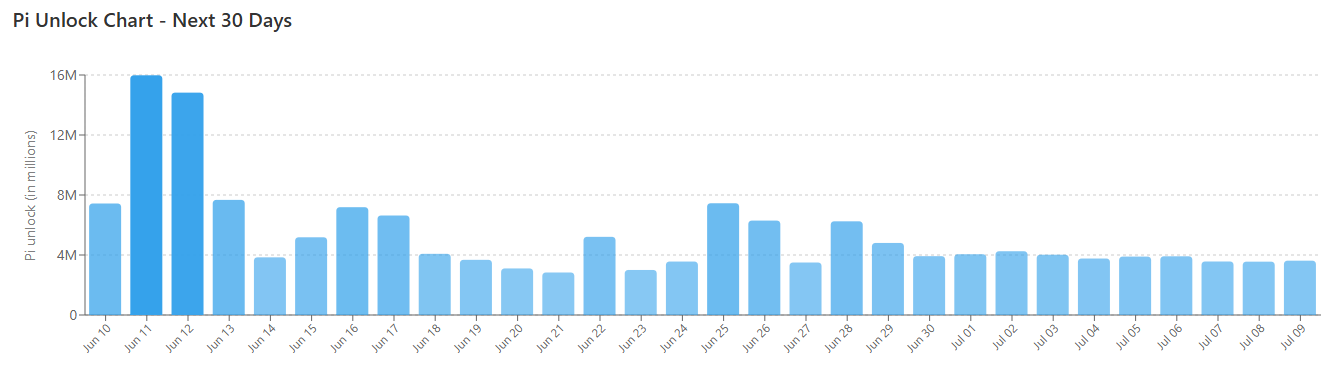
Lately, there’s been a rise in coins flowing from self-custody to exchanges, while the upcoming token unlocks remain significant. This combination is seen as bearish and is likely to negatively impact the price.
Not long ago, X user Erick Crypto said that PI’s Relative Strength Index (RSI) has reached oversold levels: a development which is typically a precursor to a rebound. He set $0.12 as a key support level, arguing that if buyers step in, “we could see a recovery move from these depressed levels.”
The post Pi Network News and PI Price Update Today: June 10 appeared first on CryptoPotato.


Bitcoin layer-2 network Botanix is being wound down a year after its mainnet went live.
The project cited market conditions and broader indifference within the cryptocurrency industry towards establishing greater utility on the Bitcoin network, in a post on X on Tuesday.
“It did not work,” Botanix summed up. “At least not in this market and not in this timeline.”
The aim of Botanix was to bring Ethereum-equivalent functionality to the Bitcoin network, allowing applications and smart contracts to be effectively copied and pasted onto the world’s first blockchain. The project raised $14.4 million across two funding rounds in 2023 and 2024. Despite this, its total value locked (TVL) at closure was a mere $119,500, according to data from DeFiLlama.
Botanix was one of many layer-2s and protocols to emerge in recent years, aiming to expand Bitcoin’s utility and help it evolve beyond being just a store of value.
The idea was that holders of bitcoin don’t have to just let their asset sit idle and hope for price appreciation. They can also use decentralized finance to generate income on the side. This could involve staking tokens on other blockchain networks or using smart contract-enabled DeFi tools, such as lending or decentralized exchanges (DEXs).
Botanix post-mortem
However, it didn’t go as planned, at least not for Botanix.
The protocol highlighted that “making Bitcoin programmable, productive and integrated into real financial activity isn’t where real-world users sit right now.”
This post-mortem may raise questions about the broader viability of the Bitcoin development sector, which includes other layer-2s like Rootstock or rollups like Citrea, during an extended period of muted sentiment in the crypto market.
CoinDesk reached out to these two projects for comment, but none were received as of press time.
BTC has lost more than 50% of its value since hitting its all-time high of nearly $125,000 last October, which may leave investors wondering why they should be interested in developing bitcoin’s use when it’s not currently serving its more basic function of storing value very effectively.
“It’s possible that bitcoin’s role as a reserve asset is simply where it settles. If that’s true, there will never be a market for what we are building and no amount of time or capital would change that,” Botanix said.
A simpler route to combining the secure store of wealth offered by BTC with the programmability and utility of other blockchain networks may lie in synthetic or “wrapped” bitcoin tokens. These are tokens that represent BTC on a 1:1 basis that can be traded and staked on networks like Ethereum.
The most established of these is wBTC, which was introduced in 2019, but more recently, Coinbase and Circle have developed their own synthetic bitcoin tokens to appeal to institutional investors and traders.
“For lending, yield, leveraged exposure, wBTC on a mature general-purpose L2 is genuinely sufficient,” Botanix said.
“Users have voted with their behaviour, and the verdict is that the trust assumptions of a wrapped representation on Ethereum are acceptable to almost everyone who wants Bitcoin-denominated DeFi.”


With its stock down 42% year-to-date and 85% over the past 12 months, Metaplanet, Japan’s largest bitcoin (BTC) treasury company, is looking to restore investor confidence.
On Monday, its CEO Simon Gerovich broadcasted, “when mNAV is below 1.0x we will strongly consider repurchasing common shares.”
The acronym mNAV refers to the premium that investors pay for Metaplanet’s common stock relative to its BTC holdings. It stands for multiple-to-Net Asset Value, a colloquial and imprecise phrase borrowed from the common use of the NAV term by managers of publicly-traded funds.
Metaplanet is the largest public company in Japan to follow the same model as Strategy (formerly MicroStrategy) in pivoting to a digital asset treasury (DAT) focus.
The $1.8 billion company has amassed 40,177 BTC worth $2.5 billion.
Because the value of its BTC exceeds its market capitalization, its mNAV is below 1x. Gerovich, alongside many other shareholders, are obviously disappointed in that reality.
Read more: Jim Chanos was right about Strategy — just not patient enough
Metaplanet’s mNAV soared above 3x as recently as July 2025 but now trades at a basic mNAV of just 0.72x. Even after boosting up the metric to account for its cash and debt via enterprise value, its enterprise value mNAV is just 0.91x.
An mNAV above 1.0x means investors pay more for the company’s stock than its holdings are worth, a signal of confidence that management will use their business to accrete BTC per share over time.
A reading below 1.0x means the opposite — that investors would rather own BTC directly.
Metaplanet was once the best-performing stock in the world. Now it’s worth less than the BTC sitting on its own balance sheet. Its CEO wants to remind everyone that it’s allowed to buy back shares.
Metplanet’s BTC cost basis is $104,107
The company is carrying an unrealized loss of about $1.4 billion on its BTC holdings that it purchased at prices far above current prices: $97,593 per BTC according to BitcoinTreasuries, or as bad as $104,107 according to its analytics dashboard.
The financial pain is evident. BTC is trading at $61,600 at writing time.
Back in 2024, investors happily overpaid many times for Metaplanet stock above what its holdings were worth, treating the stock as leveraged BTC moonshot with a Tokyo listing.
Its common stock hit a 52-week high of ¥1,930 yen last June and traded at an all-time high mNAV of 22.5x in July 2024.
Those same shares closed at ¥237 yesterday, down 87% below that peak. Its mNAV, even using today’s more generous enterprise value variant, is down 96% since July 24, 2024.
Metaplanet announced its authorization to buyback stock on October 28, 2025, alongside an authorization to repurchase up to 150 million shares, funded by a $500 million BTC-backed credit line.
June’s statement reiterated that authorization rather than expanding it. Gerovich also cautioned that the post “should not be interpreted as an indication that we are currently conducting, or will conduct, buybacks at any specific time.”
Got a tip? Send us an email securely via Protos Leaks. For more informed news and investigations, follow us on X, Bluesky, and Google News, or subscribe to our YouTube channel.

Caitlin Clark drove $2.2B CBA deal, WNBA legend Nancy Lieberman says

Code in the iOS 27 Beta Points Straight to Apple’s Foldable iPhone Ultra

New stained glass window at Merchant Adventurers Hall, York



-

 Fashion5 days ago
Weekend Open Thread: Evereve – Corporette.com
-
 Crypto World5 days ago
Jensen Huang Approves Samsung, SK Hynix, and Micron for NVIDIA (NVDA) HBM4 Memory Supply
-

 Crypto World2 days ago
Anatomy of the June crypto crash: Fed, Iran, Saylor
-
 Entertainment3 days ago
The Best Mystery Series of All Time Is Surging on Streaming 30 Years After It Ended
-

 NewsBeat3 days ago
Alexander Zverev wins the French Open to finally earn a 1st Grand Slam title
-

 Tech4 days ago
Suspicious Polyfill login prompts pop up on Toshiba, Muji websites
-
 Crypto World4 days ago
Senator Cynthia Lummis Calls CLARITY Act the Most Consequential Financial Legislation of This Generation
-

 Tech3 days ago
Microsoft unveils seven homegrown AI models in new bid for ‘long term self-sufficiency’
-

 Tech5 days ago
Microsoft launches MXC, an OS-level sandbox for AI agents, with OpenAI and Nvidia already on board
-

 Business5 days ago
(VIDEO) Justin Bieber Delivers Surprise Happy Birthday Serenade to Diners at Los Angeles Mexican Restaurant
-
 Business3 days ago
The Pain Points Taking a Fragile Tech Rally Down a Notch
-
Crypto World5 days ago
LBank Surpasses 25 Million Users Worldwide as AFA Partnership Continues to Drive Global Growth
-

 Crypto World3 days ago
Trump’s AI Ownership Plan Could Benefit Anthropic at OpenAI’s Expense
-

 Tech5 days ago
Meta steals a tactic from Tesla and builds data centers in tents
-

 Tech4 days ago
Von der Leyen’s AI envoy pick draws conflict-of-interest fire
-
 Sports21 hours ago
Bangladesh beat Australia after 20 years in ODIs, register only their second win over six-time world champions | Cricket News
-
 Crypto World2 days ago
Eli Lilly (LLY) Stock Surges 4% Following Breakthrough Sleep Apnea Trial Results
-

 Business2 days ago
High Stakes for Wembanyama as New York Pushes for 3-0 Lead
-

 Tech4 days ago
Hackers now exploit SolarWinds Serv-U flaw to crash servers
-

 Tech3 days ago
Notion restores access to Anthropic after service disruption
You must be logged in to post a comment Login