

Business
Rayner Urges Starmer to Ban Social Media for Under-16s


Angela Rayner has broken cover to urge Sir Keir Starmer to push ahead with a blanket ban on social media for children under the age of 16, intensifying pressure on a prime minister already wrestling with one of the most politically charged decisions of his premiership.
The former deputy prime minister told Sir Keir to “just make a decision and do it”, arguing that the case for prohibiting under-16s from accessing platforms such as Instagram, TikTok, Snapchat and X had become “so clear” that further delay was indefensible. Her intervention, made on Alastair Campbell’s The Rest Is Politics podcast, lands as Whitehall closes a government consultation on Tuesday that has been weighing an Australian-style ban on under-age social media use.
For Britain’s small and medium-sized businesses — particularly the legions of owner-managers who have come to depend on social platforms as their shop window, sales channel and marketing department rolled into one — the stakes could scarcely be higher. Any move to restrict access for under-16s would force a wholesale rethink of age-assurance technology, advertising targeting and content moderation, with costs that will land disproportionately on smaller operators.
A cabinet split, an open consultation and a prime minister in two minds
Although Westminster speculation is mounting that Sir Keir will eventually back a full ban as a piece of “low-hanging political fruit”, Labour is visibly divided over the proposal. Andy Burnham, the Greater Manchester mayor, and Wes Streeting, the health secretary, are both said to have cooled on a blanket prohibition, favouring tougher functional regulation over a hard age cut-off.
The doubts are being fed by early evidence from the southern hemisphere. Five separate studies have suggested that at least 60 per cent of Australian children aged under 16 are either ignoring the ban outright or have already found ways around it. Data published by the Australian regulator confirms that between 60 and 64 per cent of children still using the major platforms reported no action being taken against their accounts, a figure detailed in the official eSafety Commissioner’s social media age restrictions update.
Mr Campbell, Tony Blair’s former director of communications, told the podcast he could not understand the government’s hesitation. “I don’t understand why the government isn’t just doing it in relation to stopping social media till you’re 16,” he said. “I think the country’s kind of decided on this, and yet we’ve just got this bloody, seemingly never-ending process going on.”
Ms Rayner agreed, framing the delay as symptomatic of a wider drift. “It just makes people feel ‘just make a decision and do it’,” she said. “Why can you not just make a decision when it seems so clear that that’s what you need to do? It’s this active state that is exactly what we need to be.”
Bereaved families urge caution before any announcement
On Tuesday, Sir Keir is scheduled to meet parents who have lost children as a result of their experiences online. But campaigners have warned the prime minister against a politically expedient announcement that runs ahead of the evidence.
Ian Russell, whose daughter Molly took her own life aged 14 after being inundated with online content depicting self-harm and suicide, said: “Any government announcement now would make a mockery of the consultation. They need to see the results before making up their mind. They also need to follow the evidence and go beyond a ban if they wish to be effective rather than performative.”
The alternative model gaining ground inside Whitehall is a ban on so-called “functionalities” — a more surgical approach that would oblige social media firms to switch off features such as endless scrolls, recommender algorithms aimed at children, autoplay, livestreaming and “streaks” that reward daily logins. That approach would chime with the direction already set out in Ofcom’s tougher rules on harmful algorithms aimed at young users under the Online Safety Act. The regulator’s own protection of children codes of practice already require platforms to deploy more than 40 practical safety measures during 2026, including age assurance and content controls covering suicide, self-harm and eating disorders.
What the policy means for british business
Polling suggests parental and backbench appetite for an Australian-style ban remains strong, and at least one Whitehall source briefed The Sun on Sunday that the policy was “free and popular”, the kind of legacy announcement Sir Keir could realistically push past restive Labour MPs.
For SMEs, the implications cut well beyond Westminster theatre. Compliance costs flowing from the Online Safety Act are already reshaping how UK businesses operate online, with fines of up to 10 per cent of global turnover concentrating minds in boardrooms. A statutory ban would extend that compliance perimeter sharply, potentially curtailing advertising inventory aimed at family audiences and forcing smaller direct-to-consumer brands to redraw acquisition strategies built around teen-skewed platforms.
Sir Keir has consistently maintained an “open mind” on the question, pointing to the genuine benefits children derive from access to the internet and stressing his preference for stripping out addictive design features rather than banning access outright. Crucially, the government has already legislated for the flexibility to introduce any agreed change, up to and including a full ban, without bringing fresh primary legislation before Parliament.
“We’ll go through the consultation, but I think I’ll be absolutely clear: things will not stay as they are,” the prime minister said. “This is going to change. I don’t think the next generation would forgive us if we didn’t act now.”
Whether that change arrives as a hard age cap or a more nuanced architectural fix, business owners would be wise to start war-gaming both scenarios now. The political pressure from within Sir Keir’s own cabinet suggests a decision is no longer a matter of if, but when — and how broadly the net will be cast.

Amy Ingham
Amy is a newly qualified journalist specialising in business journalism at Business Matters with responsibility for news content for what is now the UK’s largest print and online source of current business news.


Running a children’s home in England means living under a level of scrutiny that most businesses never experience. Ofsted’s oversight is relentless, and rightly so.
The stakes are extraordinarily high. Yet despite how central inspection is to the sector, a surprising number of myths persist about how the process actually works.
These misconceptions aren’t harmless. They lead providers to drop their guard at the wrong moment, misread their compliance obligations, or waste energy preparing for inspections that aren’t coming while being caught off guard by ones that are.
Let’s set the record straight.
Myth 1: “Outstanding homes barely get inspected”
This is perhaps the most dangerous myth in the sector. The logic sounds reasonable – if a home has already proven it’s excellent, surely Ofsted focuses its attention elsewhere?
Not so. Every registered children’s home in England receives at least one full inspection every year, regardless of its previous grade. Outstanding, Good, Requires Improvement, Inadequate – the minimum annual full inspection applies to all. There is no inspection holiday for high performers.
What a strong previous judgement can influence is whether a home also receives an interim inspection within that same regulatory year, but it certainly doesn’t remove the home from Ofsted’s calendar.
Myth 2: “You’ll know when inspectors are coming”
Some providers still operate as though inspection is an event they can prepare for in the weeks before it arrives. This is a fundamental misunderstanding.
All Ofsted inspections of children’s homes are unannounced. There is no notice period. Inspectors prepare internally the day before, but the home itself receives no warning. The first you’ll know about a full inspection is when the inspector arrives at your door.
This is precisely why inspection readiness cannot be a project; it has to be a culture. Homes that perform well under inspection are the ones running to the same standard on a quiet Tuesday in February as they are the week after a previous visit.
Myth 3: “If no one has complained, we won’t get a monitoring visit”
Monitoring visits are often misunderstood as something triggered solely by complaints or serious incidents. In reality, Ofsted uses a much broader range of intelligence to decide when to make an additional visit.
Regulation 44 and Regulation 45 reports are completed by the independent person and typically by a member of the home’s management team respectively. These key monitoring tools feed directly into Ofsted’s risk picture. Notifications of specific incidents, changes in staffing, or patterns in missing episodes can all prompt a monitoring visit without any formal complaint ever being made.
Monitoring visits are also unannounced and, while they don’t produce an overall grade, a standard progress outcome is given and Ofsted’s findings can influence the next full inspection.
Myth 4: “How often does Ofsted inspect depends mainly on your rating”
When people ask how often does Ofsted inspect, the instinct is to assume the answer is a simple sliding scale linked to your grade. In practice, Ofsted’s approach is risk-based, and rating is only one input.
Factors including the profile of children currently placed, how accurately the home identifies and manages individual risks, recent notifications and safeguarding concerns, and intelligence gathered from a range of sources all shape Ofsted’s decisions. A home rated Good that has recently seen a pattern of serious incidents may attract more scrutiny than an Inadequate home that is demonstrably improving.
Understanding this helps providers think about compliance differently – not as a performance put on for inspectors, but as an ongoing discipline in risk management and documentation.
Myth 5: “The inspection framework stays the same year to year”
Given how much operational pressure providers are already under, it’s tempting to assume that once you understand the framework, it stays fixed. It doesn’t.
The Social Care Common Inspection Framework (SCCIF) for children’s homes has evolved significantly in recent years, with substantial changes coming into effect from April 2026. These updates are specifically designed to encourage homes to accept children with higher and multiple needs which has been a long-standing tension in the sector where providers have historically been reluctant to take more complex placements for fear of the impact on their Ofsted rating.
Staying current with framework changes isn’t optional. What inspectors are looking for, how they weigh specific findings, and how interim inspections work can all shift between regulatory years.
What this means in practice
The common thread running through all of these myths is the same: inspection is not a discrete event that happens to you once a year. It is a continuous regulatory relationship.
Providers who understand this build their quality assurance, their supervision practices, their record-keeping, and their risk management around year-round standards rather than inspection preparation. They are the ones who consistently perform well when inspectors do arrive.
The homes that struggle are often not the ones doing bad work. They’re the ones whose good work isn’t visible, documented, or embedded in the way inspectors need to see it.

Ies Holdings stock hits all-time high at 701.51 USD


I analyze securities based on value investing, an owner’s mindset, and a long-term horizon. I don’t write sell articles, as those are considered short theses, and I never recommend shorting.I was initially interested in a career in politics, but after reaching a dead-end in 2019 and seeing the financial drain this posed, I choose a path that would make my money work for me and protect me from more setbacks. This brought me to study value investing, in order to grow wealth with risk management in mind.From 2020 to 2022, I worked in a sales role at a law firm. As the top-grossing salesman, I eventually managed a team and contributed to our sales strategy. I spent much of my free time reading books and annual reports, steadily building my vault of knowledge about public companies. This period has since been useful in helping me assess a company’s prospects by its sales strategy. I particularly get excited when the product seems to sell itself.From 2022 to 2023, I worked as an investment advisory rep with Fidelity, primarily with 401K planning. My personal study before that allowed me to pass my Series exams two weeks ahead of schedule, and I once again found myself excelling at the job. I learned a few useful things from this more formal setting, but my main frustration was that I was still a value investor, and Fidelity’s 401K planning was based on modern portfolio theory. Lacking a way to change positions internally, I chose to walk away after a year.I gave writing for Seeking Alpha a try in November of 2023, and I’ve been here since. As I spent those years saving aggressively and building up my base of capital, I also actively invest now. My articles are how I share the opportunities that I seek for myself, and my readers are effectively walking this road alongside me.
Analyst’s Disclosure: I/we have no stock, option or similar derivative position in any of the companies mentioned, and no plans to initiate any such positions within the next 72 hours. I wrote this article myself, and it expresses my own opinions. I am not receiving compensation for it (other than from Seeking Alpha). I have no business relationship with any company whose stock is mentioned in this article.
Seeking Alpha’s Disclosure: Past performance is no guarantee of future results. No recommendation or advice is being given as to whether any investment is suitable for a particular investor. Any views or opinions expressed above may not reflect those of Seeking Alpha as a whole. Seeking Alpha is not a licensed securities dealer, broker or US investment adviser or investment bank. Our analysts are third party authors that include both professional investors and individual investors who may not be licensed or certified by any institute or regulatory body.

The meaning of home has changed dramatically in recent years. Buyers are no longer looking only for location, size, and price. They are also thinking about comfort, health, efficiency, privacy, flexibility, and how a home supports daily life.
Across major real estate markets, especially in lifestyle-driven cities like Los Angeles, residential demand is increasingly shaped by two powerful forces: smart technology and wellness-focused living.
A modern home is no longer just a place to live. It is a place to work, recharge, entertain, raise a family, protect privacy, and support a better quality of life.
Buyers Want Homes That Support Daily Well-Being
Wellness has become one of the most important lifestyle priorities for many homeowners. This does not always mean luxury spas or dramatic architectural features. Often, it begins with the basics: natural light, clean air, quiet interiors, outdoor space, thoughtful layouts, and a sense of calm.
Homes that feel bright, open, and peaceful can create a stronger emotional response during showings. Buyers may not always describe it in technical terms, but they often know when a property feels healthy and comfortable.
In Los Angeles neighborhoods such as Glendale, Studio City, Sherman Oaks, Encino, Toluca Lake, and Calabasas, buyers often look for properties that offer a balance between city access and personal retreat. A home that provides privacy, greenery, flexible space, and indoor-outdoor flow can stand out quickly.
Smart Home Features Are Becoming Expected
Technology is no longer a bonus in many homes. It is becoming part of the standard buyer expectation.
Features such as smart thermostats, security systems, video doorbells, energy-efficient lighting, automated shades, EV charging readiness, and app-controlled climate systems can add convenience and perceived value.
For some buyers, especially younger professionals and families, smart home features make a property feel more current and easier to manage. For luxury buyers, they can support privacy, comfort, and efficiency.
However, technology alone does not create value. The best smart home features are those that improve daily living without making the home feel complicated. Buyers want convenience, not confusion.
The Rise of Flexible Living Spaces
One of the biggest shifts in residential real estate is the demand for flexible spaces.
Today’s buyers often want rooms that can serve multiple purposes. A guest bedroom may also function as a home office. A garage may become a gym or creative studio. A formal dining room may be used as a workspace, playroom, or media area.
This flexibility matters because modern lifestyles are less predictable than before. People work from home, run businesses remotely, host guests, care for family members, and spend more time inside their homes.
In competitive real estate markets, properties that offer adaptable layouts often appeal to a wider range of buyers.
Indoor-Outdoor Living Remains a Major Advantage
In Southern California, indoor-outdoor living continues to be one of the strongest lifestyle features a home can offer.
Patios, balconies, courtyards, gardens, pools, outdoor kitchens, and shaded seating areas can significantly influence buyer interest. These spaces support wellness, entertaining, relaxation, and the California lifestyle many buyers are seeking.
Even a small outdoor area can become a meaningful selling point if it is presented well. A private patio with thoughtful landscaping may be more memorable than a larger but poorly designed yard.
For sellers, this means outdoor spaces should not be treated as an afterthought. They should be staged and marketed as an extension of the home.
Energy Efficiency Is Becoming More Important
As utility costs and environmental awareness continue to influence buyer decisions, energy-efficient features are becoming increasingly valuable.
Buyers may pay attention to:
- Updated windows
- Solar potential
- Efficient HVAC systems
- Smart thermostats
- Insulation quality
- LED lighting
- Water-conscious landscaping
- EV charger compatibility
While not every buyer prioritizes sustainability equally, many appreciate homes that feel more efficient and future-ready.
In markets where buyers compare multiple properties, these features can help a home feel more practical and responsible.
Local Lifestyle Still Drives the Final Decision
Even with wellness features and technology, location remains central to real estate decisions. The difference is that buyers now evaluate location through a lifestyle lens.
They want to understand how a neighborhood will support their routines. Is it close to parks, cafés, schools, studios, hiking trails, shopping, or major work centers? Does it feel quiet or energetic? Is it better for entertaining, family life, privacy, or convenience?
This is especially important in Los Angeles, where nearby neighborhoods can offer very different lifestyles. Beverly Hills, Burbank, Glendale, Encino, Sherman Oaks, Studio City, and Toluca Lake each attract buyers for different reasons.
For buyers and sellers navigating these lifestyle-driven decisions, local guidance matters. Tooyn Homes provides a boutique real estate experience focused on neighborhood knowledge, thoughtful marketing, and helping clients make confident decisions in the Los Angeles market.
Sellers Should Highlight More Than Features
A common mistake in real estate marketing is listing features without explaining their lifestyle value.
For example, a smart thermostat is not just a device. It represents comfort and energy control. A backyard is not just outdoor space. It represents relaxation, entertaining, and privacy. A home office is not just an extra room. It represents flexibility and productivity.
Successful marketing connects features to benefits.
Instead of simply saying a property has large windows, strong marketing should communicate natural light, openness, warmth, and atmosphere. Instead of only mentioning a remodeled kitchen, it should show how the space supports gathering, hosting, and daily living.
Buyers respond more strongly when they can imagine how a home will improve their life.
Wellness and Technology Work Best Together
The strongest modern homes often combine wellness and technology naturally.
A property with smart climate control, abundant natural light, quiet bedrooms, security features, efficient systems, outdoor space, and flexible rooms can feel both comfortable and future-ready.
This combination appeals to buyers because it supports real daily needs. It offers convenience without sacrificing warmth. It offers modern function without losing emotional appeal.
In many cases, the best homes are not the most complicated or the most heavily upgraded. They are the homes that feel intuitive, balanced, and easy to live in.
The Future of Real Estate Is Human-Centered
Technology will continue to influence residential real estate, but the most important factor will remain human experience.
Buyers want homes that support health, comfort, privacy, productivity, and connection. Sellers who understand this shift can position their properties more effectively. Agents who understand both market data and lifestyle psychology can create stronger outcomes for their clients.
The future of real estate is not only about smarter homes. It is about homes that help people live better.
As buyers become more selective, properties that combine thoughtful design, wellness, technology, and neighborhood lifestyle will continue to stand out in competitive markets.

Through the bonus share, Fredun’s strategic intent is to reward shareholders for their sustained confidence and long-term commitment to the company’s growth vision. The move signals management’s confidence in the structural earnings growth and long-term scalability of the business with multiple high-growth engines firmly in place, the company’s filing to the exchanges said.
This includes branded generic exports to 52 countries, domestic Fredun Gx formulations, an integrated pet healthcare platform (Freossi, Wagr and One Pet Stop), nutraceuticals, and cosmeceuticals (Bird N Beauty) — the Company is well-positioned to sustain its growth trajectory.
The inauguration of its 5th GMP-certified manufacturing facility in April 2026 provides significant capacity headroom to support the next phase of scaling across all verticals.
This move not only aligns with the company’s consistent value creation philosophy but also reinforces its commitment to delivering long-term, inclusive wealth creation for shareholders.

The smallcap pharma company is into pharmaceutical formulation manufacturing, diversified across generics, cosmeceuticals, nutraceuticals, mobility, and animal healthcare products.
The Board of Directors, at its meeting held on May 25, 2026, wherein the audited financial results for Q4 and FY26 were approved, has recommended the issuance of bonus shares in the ratio of 2:1, i.e. In FY26, Fredun reported total revenues of Rs 639.12 crore, with an Earnings Before Interest, Taxes, Depreciation and Amortisation (EBITDA) of Rs 94.79 Cr along with a profit after tax (PAT) of Rs 33.21 crore.Commenting on the development, Managing Director Fredun Medhora said, “The recommendation of a 2:1 bonus issue reflects the strong momentum we have built and our confidence in sustaining this growth trajectory. With robust performance across revenue and profitability, and continued progress in diversifying into higher-value segments such as nutraceuticals, cosmeceuticals and pet healthcare, we are strengthening the quality and scalability of our business”. This bonus is a way of sharing our progress with shareholders while reinforcing our commitment to consistent, long-term value creation, he added.
(Disclaimer: The recommendations, suggestions, views, and opinions given by the experts are their own. These do not represent the views of The Economic Times.)
Business
Innovative Aerosystems: Looks Fairly Priced With Lower Intermediate Growth Ahead (NASDAQ:ISSC)


Investment research, primarily oriented towards uncelebrated/under-covered stocks and ETFs, across North America, Latin America, Europe and Asia. Seeks to combine both fundamental and technical disciplines while making an investment/trading proposition.
Analyst’s Disclosure: I/we have no stock, option or similar derivative position in any of the companies mentioned, and no plans to initiate any such positions within the next 72 hours. I wrote this article myself, and it expresses my own opinions. I am not receiving compensation for it (other than from Seeking Alpha). I have no business relationship with any company whose stock is mentioned in this article.
Seeking Alpha’s Disclosure: Past performance is no guarantee of future results. No recommendation or advice is being given as to whether any investment is suitable for a particular investor. Any views or opinions expressed above may not reflect those of Seeking Alpha as a whole. Seeking Alpha is not a licensed securities dealer, broker or US investment adviser or investment bank. Our analysts are third party authors that include both professional investors and individual investors who may not be licensed or certified by any institute or regulatory body.

NEW YORK — Modine Manufacturing Company shares surged more than 24% on Tuesday, reaching $323.25 in morning trading after the Wisconsin-based thermal management specialist announced a landmark multi-year capacity agreement worth up to $4 billion with a major data center customer.
The deal, announced early Tuesday, covers Airedale by Modine cooling solutions through 2029 and underscores the company’s deepening role in supporting the explosive growth of artificial intelligence infrastructure. The agreement provides Modine with long-term revenue visibility as hyperscale operators continue investing heavily in advanced thermal management systems to handle the intense heat generated by high-performance AI servers.
Modine, a leader in heat transfer and cooling technologies, has positioned itself at the center of the AI buildout. Its data center solutions have seen rapid demand growth, with the company’s Climate Solutions segment reporting strong organic expansion in recent quarters. The new contract represents one of the largest single commitments in the company’s history and signals confidence from a key strategic partner in Modine’s ability to scale production.
The stock’s dramatic move reflects investor enthusiasm for companies directly benefiting from the artificial intelligence megatrend. Data centers require sophisticated cooling systems to maintain optimal operating temperatures, and Modine’s liquid cooling and high-efficiency air cooling technologies are increasingly critical as power densities rise with next-generation chips.
Analysts have grown increasingly bullish on Modine’s prospects. The company has consistently raised its full-year guidance, with management highlighting accelerating data center revenue and margin expansion. Recent quarterly results showed Climate Solutions revenue growing more than 50%, including robust organic gains driven by AI-related demand.
The latest agreement further solidifies Modine’s transition from traditional automotive and industrial markets toward higher-margin, technology-driven segments. While the company maintains a diversified portfolio, data center cooling has emerged as a primary growth engine, with management targeting over $1 billion in annual data center revenue this year.
Modine’s strategic pivot has been well-received by the investment community. Several Wall Street firms have raised price targets and earnings estimates in recent months, citing structural tailwinds in the AI infrastructure market. The company’s ability to secure long-term capacity commitments provides earnings predictability that was previously lacking in its more cyclical businesses.
The surge also comes amid broader strength in industrial and technology stocks tied to AI infrastructure spending. Investors have shown willingness to reward companies with clear exposure to data center expansion, even at elevated valuations, as long as growth trajectories remain robust.
For Modine, the $4 billion agreement validates years of investment in research and development and manufacturing capacity. The company has expanded its production footprint to meet surging demand, including new facilities and technology upgrades focused on liquid cooling solutions that are becoming industry standard for high-density AI deployments.
Management has emphasized disciplined execution and operational efficiency as it scales. Gross margins in the data center business have shown meaningful improvement, contributing to overall profitability gains. The company continues targeting further margin expansion through cost optimization and product mix shifts toward higher-value solutions.
The stock’s performance this year has been exceptional, with shares more than doubling as investors rotated into AI-related industrial names. Tuesday’s move pushes Modine to new all-time highs, reflecting sustained momentum and growing conviction in its long-term outlook.
Market observers note that while the valuation has expanded significantly, the growth profile justifies premium multiples. Data center spending is expected to remain elevated for years as companies build out AI capabilities, creating a multi-year runway for suppliers like Modine.
Challenges remain, including potential supply chain constraints and competition from larger players. However, Modine’s specialized expertise and established customer relationships provide competitive advantages in a market where reliability and performance are paramount.
The company’s upcoming earnings report, scheduled for later this week, will be closely watched for further confirmation of its guidance and momentum. Analysts anticipate another strong quarter, with revenue and earnings continuing to track well above prior-year levels.
For investors, Modine represents exposure to one of the most compelling secular growth stories in industrial technology. The combination of AI demand, capacity expansion and margin improvement creates a compelling investment thesis, though volatility remains a consideration given the stock’s rapid appreciation.
Tuesday’s trading volume was significantly elevated as the stock broke through previous resistance levels. The move suggests broad participation from both institutional and retail investors drawn to the company’s AI infrastructure narrative.
As markets digest the latest gains, attention will turn to execution on the new contract and potential additional wins in the data center space. Modine’s ability to deliver on its ambitious targets will determine whether current enthusiasm translates into sustained shareholder value.
The company’s transformation highlights broader shifts in industrial markets, where traditional manufacturers are adapting to serve the technology infrastructure needs of the digital age. For Modine, this evolution has created substantial opportunities that are now materializing in both revenue growth and market recognition.
With shares at record levels, some investors may question whether the rally has room to run. However, most analysts maintain that the structural changes in the industry and Modine’s competitive positioning support higher valuations than in previous business cycles.
The latest surge adds another chapter to what has been a remarkable period for Modine shareholders. The stock’s performance underscores the market’s appetite for high-quality growth stories in strategically important sectors, even as broader economic uncertainties persist.
As the trading day continues, Modine shares will likely remain in focus. The significant move highlights the stock’s sensitivity to positive news flow and broader sentiment around artificial intelligence infrastructure spending.
The industrial technology sector’s momentum appears intact, with Modine leading gains on strong contract momentum. Investors will continue monitoring developments in AI adoption, supply chain dynamics and competitive positioning as the year progresses.

According to Bloomberg data, Taiwan’s market cap rose to around $4.95 trillion, marginally ahead of India’s $4.92 trillion, making Taiwan the world’s fifth-largest equity market after the US, mainland China, Japan and Hong Kong.
The rally in Taiwan has been driven overwhelmingly by TSMC, which now accounts for nearly 42% of the benchmark Taiwan index.
TSMC shares have surged around 49% this year as investors globally poured money into semiconductor and AI-linked companies amid strong demand for advanced chips.
The AI-driven rally has disproportionately benefited technology-heavy markets such as Taiwan and South Korea, while India has faced pressure from high oil prices, foreign investor outflows and slower earnings growth in some sectors.
Global investors have sold nearly $24 billion worth of Indian equities this year as capital shifted toward AI-linked opportunities in Asia, particularly semiconductor manufacturers.
Indian equities have also faced pressure from elevated valuations, a weakening rupee and rising energy prices linked to geopolitical tensions in West Asia.The benchmark Nifty is down around 8% this year, putting it on track for its first annual decline in over a decade.
India’s weight in the MSCI Emerging Markets Index has also fallen to around 12% from nearly 19% last year.
Despite the decline in market cap rankings, India’s broader economic fundamentals remain significantly larger than Taiwan’s.
India’s economy is estimated at around $4.15 trillion compared with Taiwan’s roughly $977 billion economy, according to IMF estimates.
Pandey’s comments also indirectly highlight one of the key structural differences between the two markets.
While Taiwan’s stock market is highly dependent on a single global technology leader, India’s market capitalisation is spread across financials, energy, consumer companies, industrials, telecom, pharmaceuticals, IT services and manufacturing businesses.
Market experts say this diversification provides greater resilience during sector-specific volatility, although it may also limit the kind of concentrated gains seen in AI-driven markets.
Taiwan’s rally has also received support from regulatory changes.
The island’s financial regulator recently increased the investment limit domestic funds can allocate to a single stock from 10% to 25% for companies with benchmark weightings above 10%.
Currently, only TSMC qualifies under that rule.
JPMorgan had earlier estimated the move could attract more than $6 billion of additional inflows into Taiwan’s equity market.
For India, however, the challenge remains balancing valuations, earnings growth and foreign investor sentiment at a time when global capital is increasingly chasing AI-linked opportunities.
Business
Pending Home Sales Climb Unexpectedly, Prompting Americans to Rethink Real Estate Strategies

WASHINGTON — Pending home sales in the United States rose 1.4% in April, surprising economists and investors who had anticipated continued weakness in the housing market amid persistently high mortgage rates.
The National Association of Realtors reported the increase Monday, marking a modest rebound in contract signings for existing homes. The data suggests some buyers are moving forward with purchases despite borrowing costs remaining elevated above 6.5% for 30-year fixed mortgages in recent weeks.
The unexpected uptick has sparked fresh debate about whether real estate remains the most reliable path to long-term wealth or if alternative investments now offer stronger returns with less friction. For decades, homeownership has been viewed as a cornerstone of the American dream, providing both shelter and an appreciating asset. Yet shifting economic conditions are forcing many to reconsider that assumption.
Economists had forecasted a decline in pending sales for April, given mortgage rates that have hovered near multi-year highs. The actual increase points to pockets of resilience among buyers who may have locked in rates earlier or are betting on potential future declines in borrowing costs. However, the overall market remains constrained by limited inventory and elevated prices in many metropolitan areas.
Home price growth has slowed significantly from the rapid appreciation seen during the pandemic-era boom. Distressed sales and foreclosure bargains, once common during previous downturns, remain rare as homeowners with low-rate mortgages hold onto properties. This lack of supply continues to support prices even as demand fluctuates.
The housing market’s mixed signals come at a time when Americans face broader financial decisions. With stock markets showing volatility and alternative investments like small businesses gaining attention, real estate’s traditional advantages — leverage through mortgages, tax benefits and historical appreciation — are being weighed against new realities.
Small business ownership, for instance, can deliver higher cash flow and personal control but requires substantial upfront capital, operational expertise and tolerance for risk. Many investors are evaluating whether directing resources toward entrepreneurship or diversified portfolios might outperform traditional property holdings in the current environment.
Real estate professionals acknowledge the challenges. High mortgage rates have priced out some first-time buyers, while existing homeowners hesitate to sell and lose their favorable loan terms. This dynamic has created a stalemate that benefits neither buyers nor sellers fully.
The April data offers a glimmer of hope for the industry. Pending sales serve as a leading indicator for future closings, typically materializing one to two months later. A sustained increase could signal improving conditions heading into the traditionally busy summer buying season.
Yet analysts caution against overinterpreting a single month’s data. Broader trends show the housing market adapting to higher rates rather than returning to pre-pandemic norms. Affordability remains a significant barrier, particularly in coastal and major metropolitan markets where prices have far outpaced wage growth.
Federal Reserve policy continues to influence the sector. While recent signals suggest potential rate cuts later in 2026, any delay could keep mortgage rates elevated and suppress activity. Investors are closely monitoring central bank communications for clues about the timing and pace of monetary easing.
The rise in pending sales also reflects changing buyer demographics. Millennials and younger generations, long shut out of homeownership, are entering the market in greater numbers as they achieve career stability. However, many still face student debt and high living costs that complicate saving for down payments.
Real estate investment trusts and other publicly traded property companies have shown mixed performance this year. Some sectors, such as industrial and data centers, have benefited from structural shifts in the economy, while traditional residential and office properties face headwinds.
For individual Americans, the decision between real estate and other investments has grown more complex. Rental properties can generate steady income but require active management and carry risks related to maintenance, vacancies and local regulations. Stocks and bonds offer liquidity and diversification but lack the tangible security of physical assets.
Financial advisers recommend a balanced approach. While real estate has historically delivered strong long-term returns, concentrating too heavily in property can expose investors to local market downturns and interest rate sensitivity. Diversification across asset classes remains a core principle for managing risk.
The April pending sales data arrives as the broader economy shows resilience. Low unemployment and steady consumer spending have supported housing demand, even as inflation concerns linger. Yet regional variations are pronounced, with Sun Belt markets seeing stronger activity than slower-growth areas in the Northeast and Midwest.
Homebuilders have responded to high rates by focusing on entry-level and affordable housing projects. Incentives such as rate buydowns and seller concessions have helped move inventory, though overall construction remains below levels needed to ease the national housing shortage.
The unexpected sales increase could influence Federal Reserve thinking. Stronger housing activity might signal that the economy can withstand higher rates longer than anticipated, potentially delaying rate cuts. Conversely, sustained weakness could add urgency to easing policy.
For prospective buyers, the current environment demands careful planning. Locking in rates through purchase programs or exploring adjustable-rate mortgages requires thorough risk assessment. First-time buyers, in particular, should consider their long-term plans and financial buffers before committing.
Sellers face their own calculations. Those with low-rate mortgages must decide whether to list properties and face higher rates on new purchases or remain in place. This hesitation contributes to low inventory and supports prices in desirable locations.
The housing market’s evolution reflects deeper societal shifts. Remote work has altered location preferences, while generational wealth transfers and changing family structures influence buying patterns. Understanding these dynamics is essential for making informed decisions.
As Americans weigh real estate against other opportunities, the April data provides a data point rather than a definitive trend. The coming months will reveal whether the modest rebound signals genuine recovery or merely a temporary fluctuation in a market still adjusting to higher borrowing costs.
For now, the conversation continues. Real estate retains its appeal as a tangible asset with leverage potential, but competing investments offer different advantages in an increasingly complex financial landscape. Navigating these choices requires careful analysis of personal circumstances, risk tolerance and long-term goals.
The latest housing numbers serve as a reminder that markets rarely move in straight lines. Unexpected resilience in pending sales highlights the adaptability of buyers and the enduring draw of homeownership, even in challenging conditions. How this plays out will shape wealth-building strategies for millions of Americans in the years ahead.


Company investing $170 million toward two-phase project.

Man lured young boy to flat before sexually abusing him

The Biggest Myths About How Often Ofsted Inspects Children’s Homes

bitcoin on sidelines as markets surge on Iran peace hopes


-

 Crypto World5 days ago
Blockchain.com files with SEC for U.S. IPO
-

 Fashion4 days ago
Holiday Weekend Open Thread – Corporette.com
-

 Business4 days ago
Dell Technologies DELL Stock Surges 15% on AI Server Momentum and Analyst Upgrades in 2026
-

 Crypto World4 days ago
Bitcoin Accumulation Weakens as BTC Realized Losses Hit $600M
-

 Crypto World4 days ago
Space X IPO Is ‘Bad News’ for Tech Stocks: But What About Bitcoin?
-

 Politics4 days ago
Makerfield: a tale of two social-media histories
-

 Crypto World3 days ago
Robinhood crypto COO Tanya Denisova exits
-

 Business2 days ago
NYT Strands Answers May 24 2026 Revealed for Puzzle No. 812 Theme Summer Essentials
-

 Crypto World4 days ago
MicroStrategy’s Saylor Says Miners No Longer Set Bitcoin Price, Another Force Has Taken Over
-

 Crypto World4 days ago
AI infrastructure race heats up as IREN pitches full-stack strategy, WhiteFiber lands $160M deal
-

 Tech5 days ago
WhatsApp ads could make Irish debut after discussions with DPC
-
 Tech4 days ago
A 0.12% parameter add-on gives AI agents the working memory RAG can’t
-

 Tech5 days ago
You Can Now Add ChatGPT To PowerPoint
-

 Business4 days ago
Trump Invests $1M-$5M in Kura Sushi USA Chain With 27 California Locations
-
 NewsBeat5 days ago
Charity run by Reform leader Malcolm Offord accused of ‘law breaking’ over Scottish registration
-

 Sports5 days ago
2026 CJ Cup Byron Nelson leaderboard: Brooks Koepka finds putting stroke in Round 1
-

 Crypto World6 days ago
Exa Labs raises $250 million in funding led by a16z
-
Business4 days ago
Goldman Sachs reinstates Ageas stock coverage with neutral rating
-
 Crypto World4 days ago
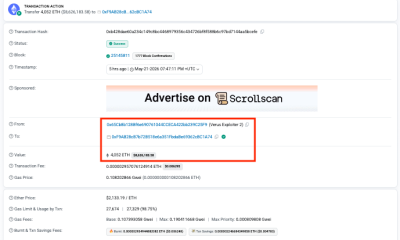
Verus Bridge Hacker Returns $8.5M ETH, Keeps $2.8M as Bounty
-

 Tech1 day ago
Microsoft’s quiet Claude Code retreat and the real cost of enterprise AI
You must be logged in to post a comment Login