Connect with us
DAPA Banner
DAPA Coin
DAPA
COIN PAYMENT ASSET
PRIVACY · BLOCKDAG · HOMOMORPHIC ENCRYPTION · RUST
ElGamal Encrypted MINE DAPA
🚫 GENESIS SOLD OUT
DAPAPAY COMING

Business

B&Q owner says sales slow as ‘late start’ to spring holds back shoppers

Published

on

Business Live

London-listed Kingfisher said it was ‘mindful’ of the consumer environment

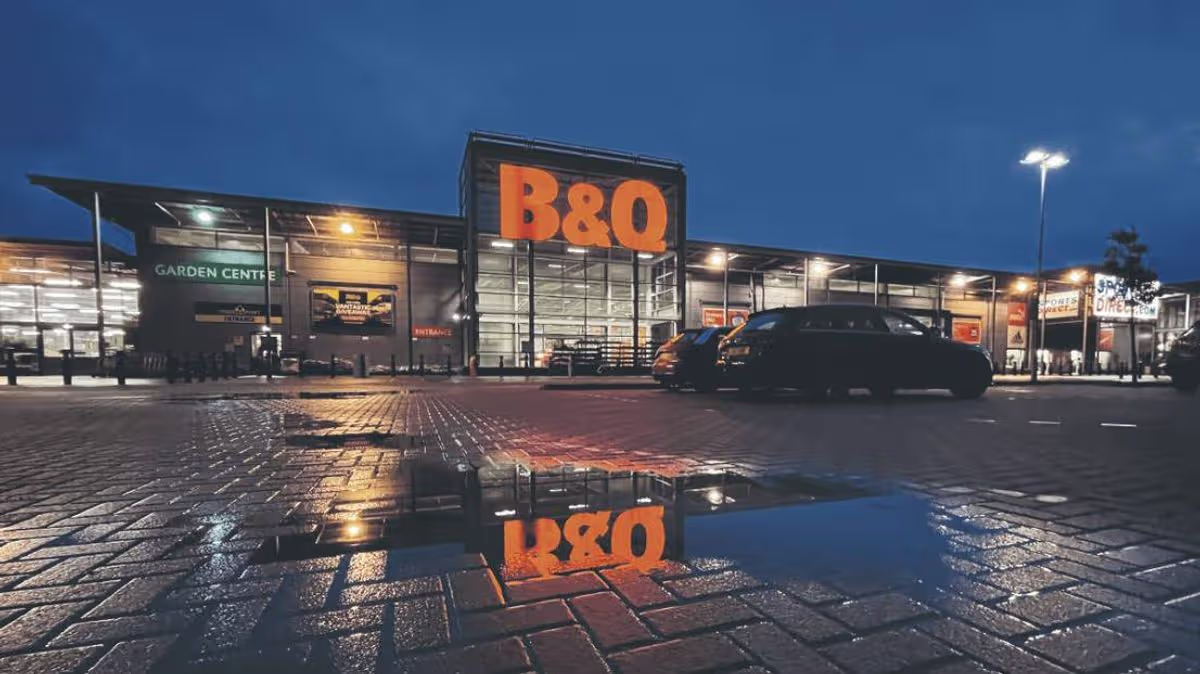
B&Q and Screwfix dragged up Kingfisher's sales (Stu Forster/Getty Images)

A B&Q store(Image: Stu Forster/Getty Images)

B&Q owner Kingfisher has reported a slowdown in sales in recent months as the DIY giant blamed a late start to spring for fewer visitors and people still holding back on bigger buys.

Advertisement

The London-listed business, which also owns Somerset-based Screwfix, said it was “mindful” of the consumer environment but hailed a “resilient” start to the year.

Total sales for the group declined by 0.9% to £3.3bn between February and April, compared like-for-like with the same period last year.

In the UK and Ireland, sales at B&Q fell by 4.1%, which the company said reflected a late start to spring, resulting in fewer people coming into shops and affecting spending on its seasonal and some core items.

“Big-ticket” spending – meaning more costly home purchases – was dragged down by fewer bathroom sales, but the firm said this was partly offset by strengthening new kitchen ranges.

Advertisement

Nevertheless, the Screwfix brand continued to strengthen with sales jumping by 4.1% year on year. The brand has been taking a bigger share of the market and has been buoyed by online and trade initiatives.

The retail group is expecting earnings to grow this year, saying it is on track to make adjusted profits of between £565m and £625m for the current financial year.

Thierry Garnier, Kingfisher’s chief executive, said it was a “resilient” start to 2026, “even as a late start to spring impacted footfall and seasonal demand”.

“E-commerce and trade sales both delivered double-digit growth, underlining the momentum in our key growth drivers,” he said.

Advertisement

“While mindful of the consumer environment, we remain absolutely focused on delivering our strategy, disciplined gross margin and cost management, and consistent shareholder returns.”

Continue Reading
Click to comment

You must be logged in to post a comment Login

Leave a Reply

Business

‘India more diversified:’ Sebi chief Tuhin Kanta Pandey comments on Taiwan’s market ascent

Published

on

'India more diversified:' Sebi chief Tuhin Kanta Pandey comments on Taiwan's market ascent
Tuhin Kanta Pandey on Monday said India continues to remain a diversified equity market despite Taiwan overtaking it in overall stock market value, noting that the Taiwanese market is heavily concentrated around a handful of companies led by chip giant Taiwan Semiconductor Manufacturing Company. “India is a diversified market, but Taiwan has concentrated stocks and a higher market cap driven by a few companies,” the Sebi chairman said. His comments come after Taiwan overtook India in total stock market cap, driven largely by a sharp rally in TSMC amid the global artificial intelligence boom.

According to Bloomberg data, Taiwan’s market cap rose to around $4.95 trillion, marginally ahead of India’s $4.92 trillion, making Taiwan the world’s fifth-largest equity market after the US, mainland China, Japan and Hong Kong.

The rally in Taiwan has been driven overwhelmingly by TSMC, which now accounts for nearly 42% of the benchmark Taiwan index.

TSMC shares have surged around 49% this year as investors globally poured money into semiconductor and AI-linked companies amid strong demand for advanced chips.

Advertisement

The AI-driven rally has disproportionately benefited technology-heavy markets such as Taiwan and South Korea, while India has faced pressure from high oil prices, foreign investor outflows and slower earnings growth in some sectors.


Global investors have sold nearly $24 billion worth of Indian equities this year as capital shifted toward AI-linked opportunities in Asia, particularly semiconductor manufacturers.
Indian equities have also faced pressure from elevated valuations, a weakening rupee and rising energy prices linked to geopolitical tensions in West Asia.The benchmark Nifty is down around 8% this year, putting it on track for its first annual decline in over a decade.

India’s weight in the MSCI Emerging Markets Index has also fallen to around 12% from nearly 19% last year.

Despite the decline in market cap rankings, India’s broader economic fundamentals remain significantly larger than Taiwan’s.

India’s economy is estimated at around $4.15 trillion compared with Taiwan’s roughly $977 billion economy, according to IMF estimates.

Advertisement

Pandey’s comments also indirectly highlight one of the key structural differences between the two markets.

While Taiwan’s stock market is highly dependent on a single global technology leader, India’s market capitalisation is spread across financials, energy, consumer companies, industrials, telecom, pharmaceuticals, IT services and manufacturing businesses.

Market experts say this diversification provides greater resilience during sector-specific volatility, although it may also limit the kind of concentrated gains seen in AI-driven markets.

Taiwan’s rally has also received support from regulatory changes.

Advertisement

The island’s financial regulator recently increased the investment limit domestic funds can allocate to a single stock from 10% to 25% for companies with benchmark weightings above 10%.

Currently, only TSMC qualifies under that rule.

JPMorgan had earlier estimated the move could attract more than $6 billion of additional inflows into Taiwan’s equity market.

For India, however, the challenge remains balancing valuations, earnings growth and foreign investor sentiment at a time when global capital is increasingly chasing AI-linked opportunities.

Advertisement
Continue Reading

Business

Pending Home Sales Climb Unexpectedly, Prompting Americans to Rethink Real Estate Strategies

Published

on

Real Estate

WASHINGTON — Pending home sales in the United States rose 1.4% in April, surprising economists and investors who had anticipated continued weakness in the housing market amid persistently high mortgage rates.

The National Association of Realtors reported the increase Monday, marking a modest rebound in contract signings for existing homes. The data suggests some buyers are moving forward with purchases despite borrowing costs remaining elevated above 6.5% for 30-year fixed mortgages in recent weeks.

The unexpected uptick has sparked fresh debate about whether real estate remains the most reliable path to long-term wealth or if alternative investments now offer stronger returns with less friction. For decades, homeownership has been viewed as a cornerstone of the American dream, providing both shelter and an appreciating asset. Yet shifting economic conditions are forcing many to reconsider that assumption.

Economists had forecasted a decline in pending sales for April, given mortgage rates that have hovered near multi-year highs. The actual increase points to pockets of resilience among buyers who may have locked in rates earlier or are betting on potential future declines in borrowing costs. However, the overall market remains constrained by limited inventory and elevated prices in many metropolitan areas.

Advertisement

Home price growth has slowed significantly from the rapid appreciation seen during the pandemic-era boom. Distressed sales and foreclosure bargains, once common during previous downturns, remain rare as homeowners with low-rate mortgages hold onto properties. This lack of supply continues to support prices even as demand fluctuates.

The housing market’s mixed signals come at a time when Americans face broader financial decisions. With stock markets showing volatility and alternative investments like small businesses gaining attention, real estate’s traditional advantages — leverage through mortgages, tax benefits and historical appreciation — are being weighed against new realities.

Small business ownership, for instance, can deliver higher cash flow and personal control but requires substantial upfront capital, operational expertise and tolerance for risk. Many investors are evaluating whether directing resources toward entrepreneurship or diversified portfolios might outperform traditional property holdings in the current environment.

Real estate professionals acknowledge the challenges. High mortgage rates have priced out some first-time buyers, while existing homeowners hesitate to sell and lose their favorable loan terms. This dynamic has created a stalemate that benefits neither buyers nor sellers fully.

Advertisement

The April data offers a glimmer of hope for the industry. Pending sales serve as a leading indicator for future closings, typically materializing one to two months later. A sustained increase could signal improving conditions heading into the traditionally busy summer buying season.

Yet analysts caution against overinterpreting a single month’s data. Broader trends show the housing market adapting to higher rates rather than returning to pre-pandemic norms. Affordability remains a significant barrier, particularly in coastal and major metropolitan markets where prices have far outpaced wage growth.

Federal Reserve policy continues to influence the sector. While recent signals suggest potential rate cuts later in 2026, any delay could keep mortgage rates elevated and suppress activity. Investors are closely monitoring central bank communications for clues about the timing and pace of monetary easing.

The rise in pending sales also reflects changing buyer demographics. Millennials and younger generations, long shut out of homeownership, are entering the market in greater numbers as they achieve career stability. However, many still face student debt and high living costs that complicate saving for down payments.

Advertisement

Real estate investment trusts and other publicly traded property companies have shown mixed performance this year. Some sectors, such as industrial and data centers, have benefited from structural shifts in the economy, while traditional residential and office properties face headwinds.

For individual Americans, the decision between real estate and other investments has grown more complex. Rental properties can generate steady income but require active management and carry risks related to maintenance, vacancies and local regulations. Stocks and bonds offer liquidity and diversification but lack the tangible security of physical assets.

Financial advisers recommend a balanced approach. While real estate has historically delivered strong long-term returns, concentrating too heavily in property can expose investors to local market downturns and interest rate sensitivity. Diversification across asset classes remains a core principle for managing risk.

The April pending sales data arrives as the broader economy shows resilience. Low unemployment and steady consumer spending have supported housing demand, even as inflation concerns linger. Yet regional variations are pronounced, with Sun Belt markets seeing stronger activity than slower-growth areas in the Northeast and Midwest.

Advertisement

Homebuilders have responded to high rates by focusing on entry-level and affordable housing projects. Incentives such as rate buydowns and seller concessions have helped move inventory, though overall construction remains below levels needed to ease the national housing shortage.

The unexpected sales increase could influence Federal Reserve thinking. Stronger housing activity might signal that the economy can withstand higher rates longer than anticipated, potentially delaying rate cuts. Conversely, sustained weakness could add urgency to easing policy.

For prospective buyers, the current environment demands careful planning. Locking in rates through purchase programs or exploring adjustable-rate mortgages requires thorough risk assessment. First-time buyers, in particular, should consider their long-term plans and financial buffers before committing.

Sellers face their own calculations. Those with low-rate mortgages must decide whether to list properties and face higher rates on new purchases or remain in place. This hesitation contributes to low inventory and supports prices in desirable locations.

Advertisement

The housing market’s evolution reflects deeper societal shifts. Remote work has altered location preferences, while generational wealth transfers and changing family structures influence buying patterns. Understanding these dynamics is essential for making informed decisions.

As Americans weigh real estate against other opportunities, the April data provides a data point rather than a definitive trend. The coming months will reveal whether the modest rebound signals genuine recovery or merely a temporary fluctuation in a market still adjusting to higher borrowing costs.

For now, the conversation continues. Real estate retains its appeal as a tangible asset with leverage potential, but competing investments offer different advantages in an increasingly complex financial landscape. Navigating these choices requires careful analysis of personal circumstances, risk tolerance and long-term goals.

The latest housing numbers serve as a reminder that markets rarely move in straight lines. Unexpected resilience in pending sales highlights the adaptability of buyers and the enduring draw of homeownership, even in challenging conditions. How this plays out will shape wealth-building strategies for millions of Americans in the years ahead.

Advertisement
Continue Reading

Business

Barilla expanding New York facility

Published

on

Barilla expanding New York facility

Company investing $170 million toward two-phase project.

Continue Reading

Business

Gloucestershire Wildlife Trust slammed over unpaid UK conservation ‘career’ role

Published

on

Business Live

The charity is currently advertising for someone to join its land management team on a fixed-term basis

Vivid European Peacock butterfly resting on lush green leaves

Vivid European Peacock butterfly resting on lush green leaves(Image: Flynn Robinson / Pexels)

A Gloucestershire charity says it is “working to change” after being slammed online for advertising an unpaid voluntary role as the “perfect opportunity” for someone looking to pursue a career in the UK conservation sector.

Gloucestershire Wildlife Trust (GWT) is looking for a so-called ‘wild trainee’ to join its land management team for 21 hours a week on a fixed-term basis for nine months, with the chance to extend for a year.

According to the job advert on the charity’s website, the candidate will receive a personal training plan and “tailored internal and certified external training”, but will need their own transport and will not receive a salary.

“As well as a wide range of experience across the work of the Wildlife Trusts, [the role is] designed to give you the professional skills you need to get your first job in the sector,” the advert reads.

Advertisement

“With individual support you will have opportunities to get involved in all aspects of GWT’s work. Initially focussing on practical habitat management across our nature reserves and project sites, you’ll gain experience in many aspects of UK wildlife conservation, while absorbing practical knowhow from your experienced and friendly mentor.

“Throughout the year you will also gain technical and soft skills with other GWT teams, including Ecological Evidence, Farm Advice, Engagement & Learning and Communications to give you wider experience and an overview of the career opportunities available in the UK Nature sector.”

But dozens of people have criticised the charity, which says it is an equal opportunity employer, for not offering a salary.

One Facebook user wrote: “Wow that is such a lot of expected hours for a voluntary position. I’d absolutely LOVE to do this in order to retrain. No doubt this’ll go to someone lucky enough to have the Bank of Mum & Dad at their disposal then.”

Advertisement

While another said: “I realise there is little to no money in conservation work, and unpaid work experience placements are part of the ‘culture’, but asking people to work for nothing really does reinforce the stereotype of conservation as an upper-middle class pursuit, as others have said.”

And one person wrote: “So many places now expect a person to feel so grateful to have a job that they’ll work for free… If you want a trainee to arrive at work healthy, fed, rested and eager to learn then i suggest you pay them! You will surely miss out on some amazing people simply because they cannot afford to work for free.”

GWT told Business Live it takes concerns “like this seriously” and said it was “actively working” to try to leverage more funding for its Wild Trainees programme to provide salaried opportunities.

“Similar to many other charities, we have been hit hard by operational costs and increases in budgets,” a spokesperson said.

Advertisement

“We are constantly on the lookout for government schemes that could support apprenticeships and paid internships and remain disappointed that this has not been prioritised by the current administration.

“Currently, our Wild Trainee programme is designed to provide meaningful opportunities that support individuals towards paid employment.”

GWT told Business Live its scheme offers access to mentoring, training and development, including first aid training, and covers expenses such as travel mileage and lunch.

“[It is a] chance to gain experience across different areas of the sector in a more flexible way and with more depth than with a traditional paid entry-level role,” the spokesperson said.

Advertisement

“We appreciate concerns raised about accessibility, and cover expenses such as travel and lunch, and provide flexible, part-time hours to enable trainees to balance this opportunity alongside other commitments. We appreciate this still doesn’t go as far as we would aspire to and we are working to change this.”

GWT said its Wild Trainee programme had “high success” with many participants going on to gain access to permanent job roles in the sector.

“As a charity, we aim to maximise opportunities for nature and communities, and training programmes like this are one way we invest in developing future conservation professionals,” the organisation added.

Latest documents on Companies House, show GWT’s total income for the year to the end of March 2025 was £6.1m – a 12 per cent increase on the previous year and the highest recorded to date. Although the charity’s expenditure was £6.4m, at the time it held free reserves, after emergency and designated funds, of £243,499.

Advertisement

According to the government’s charity commission website, GWT currently has 109 employees, 11 trustees and 650 volunteers.

It also pays one person within the organisation between £90,000 and £100,000 a year, although no trustees receive any remuneration, payments or benefits from the charity.

Continue Reading

Business

Macquarie maintains outperform rating on MKIF as regulatory changes expand investment capacity

Published

on


Macquarie maintains outperform rating on MKIF as regulatory changes expand investment capacity

Continue Reading

Business

Ferrari Luce marks company’s first all-electric vehicle

Published

on

Ferrari Luce marks company's first all-electric vehicle

Ferrari, the iconic Italian sports car brand, has unveiled its first fully electric vehicle, but the car is going to be out of most people’s price range.

The Wall Street Journal reported that the starting price would be 550,000 euros in Italy, which amounts to around $640,000.

Advertisement

Fox News Digital reached out to the auto company on Tuesday.

FERRARI BRINGS BACK LEGENDARY TESTAROSSA NAME WITH 1,050-HORSEPOWER PLUG-IN HYBRID BEAST

Ferrari Luce

The Luce is Ferrari’s first all-electric vehicle. (Ferrari)

“The Ferrari Luce is the first electric Ferrari from the Maranello marque,” a press release declares.

The vehicle can go from 0-100 kilometers per hour, which is about 62 miles per hour, in just 2.5 seconds, and from 0-200 kilometers per hour, which is about 124 miles per hour, in 6.8 seconds, according to the car company.

Advertisement

AMERICANS DITCH EVS FOR BIGGER VEHICLES AS AUTO TRENDS REVERSE

Ferrari Luce

Ferrari’s Luce electric vehicle reportedly has a hefty price tag. (Ferrari)

Ferrari places the estimated range at 530 kilometers, with the release saying “in excess of 530 km,” which equates to around 329 miles.

“The electric power source enables a radically new architecture that generously accommodates four doors and five seats. This is the second four-door Ferrari, and the first with five seats,” the company noted.

HYUNDAI RECALLS OVER 421,000 VEHICLES TO FIX SOFTWARE BUG CAUSING UNEXPECTED BRAKING

Advertisement
Ferrari Luce

The Ferrari Luce has a 2.5 second 0-100 km/h time, according to the company. (Ferrari)

GET FOX BUSINESS ON THE GO BY CLICKING HERE

“With Ferrari Luce, we are once again redefining the limits of what is possible. Today, we are not simply unveiling a new car, we are inaugurating a chapter that turns our vision into reality, strengthening Ferrari’s tradition of anticipating and shaping the future,” Ferrari President John Elkann said, according to the May 25 release.

Continue Reading

Business

Flowers Foods to focus on lowering costs

Published

on

Flowers Foods to focus on lowering costs

Weak first quarter contributes to decision to lower dividend.

Continue Reading

Business

Rayner Urges Starmer to Ban Social Media for Under-16s

Published

on

Rayner Urges Starmer to Ban Social Media for Under-16s

Angela Rayner has broken cover to urge Sir Keir Starmer to push ahead with a blanket ban on social media for children under the age of 16, intensifying pressure on a prime minister already wrestling with one of the most politically charged decisions of his premiership.

The former deputy prime minister told Sir Keir to “just make a decision and do it”, arguing that the case for prohibiting under-16s from accessing platforms such as Instagram, TikTok, Snapchat and X had become “so clear” that further delay was indefensible. Her intervention, made on Alastair Campbell’s The Rest Is Politics podcast, lands as Whitehall closes a government consultation on Tuesday that has been weighing an Australian-style ban on under-age social media use.

For Britain’s small and medium-sized businesses — particularly the legions of owner-managers who have come to depend on social platforms as their shop window, sales channel and marketing department rolled into one — the stakes could scarcely be higher. Any move to restrict access for under-16s would force a wholesale rethink of age-assurance technology, advertising targeting and content moderation, with costs that will land disproportionately on smaller operators.

A cabinet split, an open consultation and a prime minister in two minds

Although Westminster speculation is mounting that Sir Keir will eventually back a full ban as a piece of “low-hanging political fruit”, Labour is visibly divided over the proposal. Andy Burnham, the Greater Manchester mayor, and Wes Streeting, the health secretary, are both said to have cooled on a blanket prohibition, favouring tougher functional regulation over a hard age cut-off.

The doubts are being fed by early evidence from the southern hemisphere. Five separate studies have suggested that at least 60 per cent of Australian children aged under 16 are either ignoring the ban outright or have already found ways around it. Data published by the Australian regulator confirms that between 60 and 64 per cent of children still using the major platforms reported no action being taken against their accounts, a figure detailed in the official eSafety Commissioner’s social media age restrictions update.

Advertisement

Mr Campbell, Tony Blair’s former director of communications, told the podcast he could not understand the government’s hesitation. “I don’t understand why the government isn’t just doing it in relation to stopping social media till you’re 16,” he said. “I think the country’s kind of decided on this, and yet we’ve just got this bloody, seemingly never-ending process going on.”

Ms Rayner agreed, framing the delay as symptomatic of a wider drift. “It just makes people feel ‘just make a decision and do it’,” she said. “Why can you not just make a decision when it seems so clear that that’s what you need to do? It’s this active state that is exactly what we need to be.”

Bereaved families urge caution before any announcement

On Tuesday, Sir Keir is scheduled to meet parents who have lost children as a result of their experiences online. But campaigners have warned the prime minister against a politically expedient announcement that runs ahead of the evidence.

Ian Russell, whose daughter Molly took her own life aged 14 after being inundated with online content depicting self-harm and suicide, said: “Any government announcement now would make a mockery of the consultation. They need to see the results before making up their mind. They also need to follow the evidence and go beyond a ban if they wish to be effective rather than performative.”

Advertisement

The alternative model gaining ground inside Whitehall is a ban on so-called “functionalities” — a more surgical approach that would oblige social media firms to switch off features such as endless scrolls, recommender algorithms aimed at children, autoplay, livestreaming and “streaks” that reward daily logins. That approach would chime with the direction already set out in Ofcom’s tougher rules on harmful algorithms aimed at young users under the Online Safety Act. The regulator’s own protection of children codes of practice already require platforms to deploy more than 40 practical safety measures during 2026, including age assurance and content controls covering suicide, self-harm and eating disorders.

What the policy means for british business

Polling suggests parental and backbench appetite for an Australian-style ban remains strong, and at least one Whitehall source briefed The Sun on Sunday that the policy was “free and popular”, the kind of legacy announcement Sir Keir could realistically push past restive Labour MPs.

For SMEs, the implications cut well beyond Westminster theatre. Compliance costs flowing from the Online Safety Act are already reshaping how UK businesses operate online, with fines of up to 10 per cent of global turnover concentrating minds in boardrooms. A statutory ban would extend that compliance perimeter sharply, potentially curtailing advertising inventory aimed at family audiences and forcing smaller direct-to-consumer brands to redraw acquisition strategies built around teen-skewed platforms.

Sir Keir has consistently maintained an “open mind” on the question, pointing to the genuine benefits children derive from access to the internet and stressing his preference for stripping out addictive design features rather than banning access outright. Crucially, the government has already legislated for the flexibility to introduce any agreed change, up to and including a full ban, without bringing fresh primary legislation before Parliament.

Advertisement

“We’ll go through the consultation, but I think I’ll be absolutely clear: things will not stay as they are,” the prime minister said. “This is going to change. I don’t think the next generation would forgive us if we didn’t act now.”

Whether that change arrives as a hard age cap or a more nuanced architectural fix, business owners would be wise to start war-gaming both scenarios now. The political pressure from within Sir Keir’s own cabinet suggests a decision is no longer a matter of if, but when — and how broadly the net will be cast.


Amy Ingham

Amy is a newly qualified journalist specialising in business journalism at Business Matters with responsibility for news content for what is now the UK’s largest print and online source of current business news.

Advertisement

Continue Reading

Business

Ferry frustrations and housing concerns in Gorey

Published

on

Ferry frustrations and housing concerns in Gorey

Café owners and others in Gorey tell the BBC a new freight pricing model is driving up costs.

Continue Reading

Business

Long-Term Unemployment Hits 10-Year High as Reeves’s Tax Rises Bite

Published

on

Unemployment fell to pre-pandemic levels at the start of the year, with record job vacancies leading to warnings of potential staff shortages.

The number of Britons stuck out of work for more than a year has surged to its highest level since 2016, with small employers warning that successive tax rises and the looming Employment Rights Act are quietly choking off the next generation of hires.

Fresh figures from the Office for National Statistics show that 474,000 people are now classified as long-term unemployed — meaning they have spent more than twelve months out of work. It is the highest tally since January 2016 and an unwelcome milestone for a labour market that, until recently, had been a rare bright spot in Britain’s stuttering recovery.

The deterioration has been sharp. Since Labour swept to power in July 2024, an additional 129,000 people have tipped into long-term joblessness, a sobering measure of how Chancellor Rachel Reeves’s £26bn raid on employer National Insurance has rippled through payrolls, particularly in the SME-heavy retail and hospitality sectors that are the backbone of high streets up and down the country.

A cooling labour market with a long tail

For owner-managers, the headline statistic is alarming because of what economists call “scarring”. The longer a candidate is out of work, the steeper the climb back becomes — skills atrophy, networks fray and confidence drains. That, in turn, blunts productivity, erodes the tax base and dulls consumer spending, the very engine many small firms rely on.

Stephen Evans, chief executive of the Learning and Work Institute, did not mince his words. “Even if some of the rise is cyclical because of the weak economy, the risk is that should the economy pick up they’ll find it more difficult to get back to work,” he said. “Nipping long-term unemployment in the bud really is massively important for the prospects of the economy, as well as for those individuals.”

Advertisement

Evans was particularly exercised about the under-25s, where, he argued, even brief spells of unemployment can leave a lasting dent on lifetime earnings and career prospects, a concern echoed in our earlier reporting on how Reeves’s tax rise has stalled hiring across the SME economy.

Young workers bear the brunt

The figures bear him out. The unemployment rate for 16-to-24-year-olds has climbed to 16.2 per cent, its highest level since January 2015, and the number of 18-to-24-year-olds in long-term unemployment has more than doubled since 2016. The Institute for Fiscal Studies estimates that almost 640,000 people in that age band are now claiming out-of-work benefits, up from 556,000 at the end of 2022.

Fergus Jimenez-England, an economist at the National Institute of Economic and Social Research, said young people were bearing the brunt of the chill. “There is a risk that labour market entrants become discouraged should they fail to find work quickly enough,” he warned, raising the spectre of a fresh wave of economic inactivity as discouraged jobseekers retreat to the benefits system.

The warning chimes with mounting evidence that Britain’s youth jobless crisis is deepening as AI and higher taxes hit hiring, with entry-level roles among the first to be axed when employers tighten the purse strings.

Advertisement

SME hiring budgets squeezed from every angle

For small businesses, the maths has rarely been more punishing. Employer National Insurance contributions have been ratcheted up, the National Living Wage has climbed again, and the Employment Rights Act has piled fresh compliance costs onto firms that often lack a dedicated HR function.

Andrew Wishart, an economist at Berenberg, summed up the corporate mood with characteristic bluntness. “By making companies more cautious about hiring, higher employer National Insurance, minimum wage and the strengthening of worker protections in the Employment Rights Act have probably raised the structural rate of unemployment.”

The result is plain to see in the official data: vacancies recently slumped to a five-year low and UK unemployment hit a 12-month high as job vacancies declined. Retail and hospitality — sectors that traditionally absorb school-leavers and second-jobbers — have shed more than 150,000 roles in the year to April 2026, according to ONS payroll data.

A political headache and a policy puzzle

The figures landed awkwardly in Westminster. Helen Whately, the shadow work and pensions secretary, accused ministers of allowing welfare to become “a long-term alternative to work”, arguing that prolonged spells out of employment exact a toll “not just on the unemployed and their families, but also on the taxpayer”.

Advertisement

Pat McFadden, the Work and Pensions Secretary, pointed to the ongoing fallout from the Iran conflict as “casting a shadow on the labour market”, while insisting that 416,000 more people are now in work compared with a year ago. “Boosting opportunity and tackling youth unemployment in every area remains our priority,” he said.

For Britain’s 5.5 million small and medium-sized businesses, however, the political back-and-forth offers cold comfort. With margins compressed by higher wage and tax costs, and with the structural rate of unemployment apparently drifting upwards, the prospect of a meaningful rebound in hiring before the next Budget looks slim.

The danger, as Evans put it, is that today’s cyclical squeeze hardens into tomorrow’s structural problem — and that a generation of young workers ends up paying the price long after the current economic chill has lifted.


Jamie Young

Jamie Young

Jamie is Senior Reporter at Business Matters, bringing over a decade of experience in UK SME business reporting.
Jamie holds a degree in Business Administration and regularly participates in industry conferences and workshops.

When not reporting on the latest business developments, Jamie is passionate about mentoring up-and-coming journalists and entrepreneurs to inspire the next generation of business leaders.

Advertisement

Continue Reading

Trending

Copyright © 2025