





Connect with us
DAPA Banner
DAPA Coin
DAPA
COIN PAYMENT ASSET
PRIVACY · BLOCKDAG · HOMOMORPHIC ENCRYPTION · RUST
ElGamal Encrypted MINE DAPA
🚫 GENESIS SOLD OUT
DAPAPAY COMING

Business

How Smart Living and Wellness Are Changing the Future of Residential Real Estate

Published

on

How Smart Living and Wellness Are Changing the Future of Residential Real Estate

The meaning of home has changed dramatically in recent years. Buyers are no longer looking only for location, size, and price. They are also thinking about comfort, health, efficiency, privacy, flexibility, and how a home supports daily life.

Across major real estate markets, especially in lifestyle-driven cities like Los Angeles, residential demand is increasingly shaped by two powerful forces: smart technology and wellness-focused living.

A modern home is no longer just a place to live. It is a place to work, recharge, entertain, raise a family, protect privacy, and support a better quality of life.

Buyers Want Homes That Support Daily Well-Being

Advertisement

Wellness has become one of the most important lifestyle priorities for many homeowners. This does not always mean luxury spas or dramatic architectural features. Often, it begins with the basics: natural light, clean air, quiet interiors, outdoor space, thoughtful layouts, and a sense of calm.

Homes that feel bright, open, and peaceful can create a stronger emotional response during showings. Buyers may not always describe it in technical terms, but they often know when a property feels healthy and comfortable.

In Los Angeles neighborhoods such as Glendale, Studio City, Sherman Oaks, Encino, Toluca Lake, and Calabasas, buyers often look for properties that offer a balance between city access and personal retreat. A home that provides privacy, greenery, flexible space, and indoor-outdoor flow can stand out quickly.

Smart Home Features Are Becoming Expected

Advertisement

Technology is no longer a bonus in many homes. It is becoming part of the standard buyer expectation.

Features such as smart thermostats, security systems, video doorbells, energy-efficient lighting, automated shades, EV charging readiness, and app-controlled climate systems can add convenience and perceived value.

For some buyers, especially younger professionals and families, smart home features make a property feel more current and easier to manage. For luxury buyers, they can support privacy, comfort, and efficiency.

However, technology alone does not create value. The best smart home features are those that improve daily living without making the home feel complicated. Buyers want convenience, not confusion.

Advertisement

The Rise of Flexible Living Spaces

One of the biggest shifts in residential real estate is the demand for flexible spaces.

Today’s buyers often want rooms that can serve multiple purposes. A guest bedroom may also function as a home office. A garage may become a gym or creative studio. A formal dining room may be used as a workspace, playroom, or media area.

This flexibility matters because modern lifestyles are less predictable than before. People work from home, run businesses remotely, host guests, care for family members, and spend more time inside their homes.

Advertisement

In competitive real estate markets, properties that offer adaptable layouts often appeal to a wider range of buyers.

Indoor-Outdoor Living Remains a Major Advantage

In Southern California, indoor-outdoor living continues to be one of the strongest lifestyle features a home can offer.

Patios, balconies, courtyards, gardens, pools, outdoor kitchens, and shaded seating areas can significantly influence buyer interest. These spaces support wellness, entertaining, relaxation, and the California lifestyle many buyers are seeking.

Advertisement

Even a small outdoor area can become a meaningful selling point if it is presented well. A private patio with thoughtful landscaping may be more memorable than a larger but poorly designed yard.

For sellers, this means outdoor spaces should not be treated as an afterthought. They should be staged and marketed as an extension of the home.

Energy Efficiency Is Becoming More Important

As utility costs and environmental awareness continue to influence buyer decisions, energy-efficient features are becoming increasingly valuable.

Advertisement

Buyers may pay attention to:

  • Updated windows
  • Solar potential
  • Efficient HVAC systems
  • Smart thermostats
  • Insulation quality
  • LED lighting
  • Water-conscious landscaping
  • EV charger compatibility

While not every buyer prioritizes sustainability equally, many appreciate homes that feel more efficient and future-ready.

In markets where buyers compare multiple properties, these features can help a home feel more practical and responsible.

Local Lifestyle Still Drives the Final Decision

Even with wellness features and technology, location remains central to real estate decisions. The difference is that buyers now evaluate location through a lifestyle lens.

Advertisement

They want to understand how a neighborhood will support their routines. Is it close to parks, cafés, schools, studios, hiking trails, shopping, or major work centers? Does it feel quiet or energetic? Is it better for entertaining, family life, privacy, or convenience?

This is especially important in Los Angeles, where nearby neighborhoods can offer very different lifestyles. Beverly Hills, Burbank, Glendale, Encino, Sherman Oaks, Studio City, and Toluca Lake each attract buyers for different reasons.

For buyers and sellers navigating these lifestyle-driven decisions, local guidance matters. Tooyn Homes provides a boutique real estate experience focused on neighborhood knowledge, thoughtful marketing, and helping clients make confident decisions in the Los Angeles market.

Sellers Should Highlight More Than Features

Advertisement

A common mistake in real estate marketing is listing features without explaining their lifestyle value.

For example, a smart thermostat is not just a device. It represents comfort and energy control. A backyard is not just outdoor space. It represents relaxation, entertaining, and privacy. A home office is not just an extra room. It represents flexibility and productivity.

Successful marketing connects features to benefits.

Instead of simply saying a property has large windows, strong marketing should communicate natural light, openness, warmth, and atmosphere. Instead of only mentioning a remodeled kitchen, it should show how the space supports gathering, hosting, and daily living.

Advertisement

Buyers respond more strongly when they can imagine how a home will improve their life.

Wellness and Technology Work Best Together

The strongest modern homes often combine wellness and technology naturally.

A property with smart climate control, abundant natural light, quiet bedrooms, security features, efficient systems, outdoor space, and flexible rooms can feel both comfortable and future-ready.

Advertisement

This combination appeals to buyers because it supports real daily needs. It offers convenience without sacrificing warmth. It offers modern function without losing emotional appeal.

In many cases, the best homes are not the most complicated or the most heavily upgraded. They are the homes that feel intuitive, balanced, and easy to live in.

The Future of Real Estate Is Human-Centered

Technology will continue to influence residential real estate, but the most important factor will remain human experience.

Advertisement

Buyers want homes that support health, comfort, privacy, productivity, and connection. Sellers who understand this shift can position their properties more effectively. Agents who understand both market data and lifestyle psychology can create stronger outcomes for their clients.

The future of real estate is not only about smarter homes. It is about homes that help people live better.

As buyers become more selective, properties that combine thoughtful design, wellness, technology, and neighborhood lifestyle will continue to stand out in competitive markets.

Advertisement
Continue Reading
Click to comment

You must be logged in to post a comment Login

Leave a Reply

Business

Why is EVE Energy stock surging today?

Published

on


Why is EVE Energy stock surging today?

Continue Reading

Business

ASX 200 Slips Marginally to 8,911.4 as Investors Pause After Recent Rally on Iran Peace Optimism

Published

on

Australia Housing Market 2026: Two-Speed Boom Persists as Prices Hit

SYDNEY — The S&P/ASX 200 index closed slightly lower at 8,911.4 on Monday, easing 2.6 points or 0.03%, as investors took profits following strong gains last week and weighed mixed signals from global commodity markets despite ongoing positive sentiment around the US-Iran peace agreement.

The modest decline came after the benchmark index posted solid advances in recent sessions, driven by relief over the reopening of the Strait of Hormuz and expectations of steadier energy prices. Monday’s quiet trading reflected a pause in momentum as market participants assessed the durability of the diplomatic breakthrough and its implications for Australia’s resource-heavy economy.

The All Ordinaries index also edged lower, closing at 9,112.7 after losing 3.8 points or 0.04%. Trading volume was moderate, with financial and mining stocks showing mixed performance while defensive sectors provided some support.

Profit-Taking and Sector Dynamics

Advertisement

Mining stocks, a key driver of the Australian market, showed varied results. Major iron ore and copper producers faced some pressure amid fluctuating commodity prices, though longer-term demand expectations for metals critical to the energy transition remained supportive. BHP Group and Rio Tinto traded in a tight range as investors monitored developments in China, Australia’s largest trading partner.

Financial stocks provided a counterbalance, with the major banks benefiting from stable bond yields and expectations of resilient domestic lending conditions. Commonwealth Bank of Australia and other lenders posted modest gains, reflecting confidence in the sector’s defensive qualities amid global uncertainty.

Energy shares reacted to lower oil prices following the Iran deal, with some producers trimming earlier gains as the market priced in increased global supply. Consumer and healthcare stocks offered stability, appealing to investors seeking shelter in a session lacking clear directional catalysts.

Global Influences and Economic Backdrop

Advertisement

The session unfolded against a backdrop of improving global risk sentiment after the US-Iran ceasefire. President Donald Trump’s announcement authorizing the reopening of the Strait of Hormuz helped ease concerns over energy supply disruptions, supporting broader market confidence. However, the limited follow-through on Monday suggested investors were adopting a wait-and-see approach pending further details on the agreement’s implementation.

Australia’s economy continues to demonstrate resilience, supported by strong employment data and moderating inflation. The Reserve Bank of Australia has maintained a steady policy stance, providing a relatively predictable environment for businesses and households. Nevertheless, challenges persist, including a softening housing market and cost-of-living pressures that continue to influence consumer behavior.

Commodity prices remain a critical factor for the ASX. Iron ore has shown stability despite Chinese economic headwinds, while copper benefits from long-term demand tied to renewable energy and infrastructure projects. Gold prices hitting record highs provided some positive spillover for local producers.

Analyst Perspectives

Advertisement

Market commentators described the small decline as healthy consolidation rather than a reversal of recent positive momentum. “After strong gains driven by geopolitical relief, some profit-taking is natural,” one Sydney-based strategist noted. “The market is digesting the Iran news while awaiting more concrete signals on global growth and domestic data.”

Analysts remain generally constructive on the Australian equity outlook, citing attractive valuations in the resources sector and stable banking earnings. However, they caution that volatility could return if the Iran agreement encounters implementation hurdles or if Chinese economic data disappoints.

The ASX 200’s performance this year has been supported by commodity strength and resilient corporate earnings. Monday’s session did little to alter the broader uptrend, with the index remaining near recent highs.

Investor Sentiment and Trading Activity

Advertisement

Institutional investors appeared cautious, with limited large-scale repositioning evident in the session’s flows. Retail participation was steady but not elevated, reflecting a lack of urgent catalysts beyond the weekend’s geopolitical news.

Foreign exchange markets saw the Australian dollar trade in a narrow range against the US dollar, reflecting balanced views on commodity prices and global risk appetite. Bond yields were little changed as investors awaited further economic signals.

The modest move in the ASX 200 contrasted with stronger gains on Wall Street, where US indices reached record levels on the same Iran-related relief. This divergence highlights Australia’s sensitivity to both commodity cycles and global risk sentiment.

Corporate and Sector News

Advertisement

Several companies released updates that influenced individual stock movements. Mining firms provided production guidance, while banks reported on lending trends amid a competitive mortgage market. Technology and consumer stocks reacted to earnings reports and retail sales data.

The resources sector continues to anchor the Australian share market, but diversification efforts by major companies into areas such as potash and nickel are gradually reshaping earnings profiles. Technology adoption across industries is also creating new growth opportunities for local firms.

Outlook for Australian Markets

Looking ahead, investors will focus on upcoming domestic economic releases, including inflation data and retail sales figures. The Reserve Bank of Australia’s policy path remains a key consideration, with markets pricing limited near-term rate changes.

Advertisement

Globally, attention remains on the Iran agreement’s implementation and its impact on energy markets. Any positive developments could provide further support for commodity-linked stocks, while setbacks might introduce renewed volatility.

Analysts expect the ASX 200 to maintain a constructive bias in the near term, supported by attractive valuations and commodity tailwinds. However, they warn that external shocks or disappointing Chinese data could interrupt the current positive trend.

For long-term investors, the Australian market continues to offer exposure to essential commodities and a stable financial system. Dividend yields remain appealing, particularly for income-focused portfolios navigating uncertain global conditions.

Monday’s small decline in the S&P/ASX 200 represents a pause rather than a reversal, as markets consolidate gains from last week’s relief rally. The index’s resilience near recent highs suggests underlying strength, though investors will remain vigilant for signals from both domestic data and international developments.

Advertisement

As 2026 progresses, the ASX 200’s performance will continue to reflect Australia’s dual role as a resources powerhouse and a stable developed economy. The latest session underscores the market’s sensitivity to global events while highlighting opportunities in sectors positioned for long-term structural growth.

Continue Reading

Business

PGIM Jennison Energy Infrastructure Fund Q1 2026 Commentary (Mutual Fund:PRPZX)

Published

on

PGIM Jennison Energy Infrastructure Fund Q1 2026 Commentary (Mutual Fund:PRPZX)

Electric transmission tower with glowing electricity flowing, electrical power transmit from high voltage substation infrastructure to city, energy usage monitoring dashboard interface 3d rendering

Black_Kira/iStock via Getty Images

Performance Recap

Energy infrastructure equities performed very strongly in 1Q26, far outpacing the broad market, though underperforming the broad energy sector. After experiencing a reversal in 2Q25, and having a generally solid year in 2025, the energy sector has performed

Continue Reading

Business

Natural Gas Services Group, Inc. (NGS) Flatrock Compression, Ltd., – M&A Call – Slideshow

Published

on

OneWater Marine Inc. (ONEW) Q1 2026 Earnings Call Transcript

Natural Gas Services Group, Inc. (NGS) Flatrock Compression, Ltd., – M&A Call – Slideshow

Continue Reading

Business

Housing wait list structure to change

Published

on

Housing wait list structure to change

The state government will try to reform the social housing wait list amid concerns the most desperate people are unable to access a home.

Continue Reading

Business

HCL Tech shares jump 3% after buying stake in Sarvam AI for Rs 1,427 crore

Published

on

HCL Tech shares jump 3% after buying stake in Sarvam AI for Rs 1,427 crore
Shares of IT major HCL Tech gained 3% to their day’s high of Rs 1,150 on the BSE on Tuesday after the IT services company emerged as the lead investor in a fresh funding round for Sarvam AI, India’s largest pure-play artificial intelligence startup.

HCL Tech has invested Rs 1,427 crore, or approximately $150 million, in Sarvam AI, securing a 10.46% stake in the company. The investment was part of a Series B funding round of around $300 million, which values the startup at nearly $1.5 billion.

Besides HCL Tech, investors including Nvidia, Prosperity7, Activate and Glade Brook collectively contributed around $100 million in the funding round, while Bessemer invested $50 million. Sarvam AI is also backed by early investors such as PeakXV and Khosla Ventures.

As part of the partnership, HCL Tech will support Sarvam AI’s research and development efforts focused on next-generation frontier AI agentic models, coding models and cybersecurity applications. The funding will also help the startup gain access to large-scale computing infrastructure and expand deployments across key industry sectors.

Advertisement

Also read: Oil Price Today (June 16): Crude oil rebounds after 5% plunge as traders await US-Iran peace deal details. Where are prices headed?According to HCL Tech, the investment will help it develop industry-specific, client-focused language models and AI solutions for its global customer base. The company expects these offerings to deliver strong price-to-performance results and strengthen its enterprise AI capabilities across industries.


The partnership will also allow HCL Tech to leverage and further develop Sarvam AI’s multilingual capabilities in India and international markets, supporting both sovereign AI initiatives and enterprise deployments. In addition, the company aims to accelerate the development and adoption of sovereign AI solutions for governments, regulated sectors and enterprises seeking localised, secure and compliant AI deployments.

HCL Tech Q4 snapshot

IT major HCL Technologies reported a 4.2% growth in its consolidated net profit for the March-ended quarter at Rs 4,488 crore versus Rs 4,307 crore in the year-ago period. The profit after tax (PAT) is attributable to the owners of the company.
The revenue from operations in Q4FY26 stood at Rs 33,981 crore, 12% higher than Rs 30,246 crore posted in the corresponding quarter of the last financial year.Separately, HCL Tech has guided for revenue growth of 1% to 4% for the financial year 2027 compared with the financial year 2026. The outlook factors in a 50-basis-point impact from client-specific issues and a 2% to 3% impact from AI-led deflation.

HCL Tech shares

Shares of the company are down 32% YTD and about 35% in the last 1 year.

Sensex, Nifty today: Catch all the LIVE stock market action here
(Disclaimer: Recommendations, suggestions, views and opinions given by the experts are their own. These do not represent the views of The Economic Times)

Continue Reading

Business

Minderoo, big funders unite to create refugee lending facility

Published

on

Minderoo, big funders unite to create refugee lending facility

Some of Australia’s largest philanthropic organisations, including the Forrests’ Minderoo Foundation, have banded together to launch a lending facility for refugee-led businesses.

Continue Reading

Business

Ex-senator Rod Culleton challenges COVID-19 fine in Federal Court

Published

on

Ex-senator Rod Culleton challenges COVID-19 fine in Federal Court

Former senator Rod Culleton has compared himself to billionaire Clive Palmer as he fights against a fine over breaching COVID-19 quarantine restrictions.

Continue Reading

Business

Council decision paves the way for one of country’s biggest employment parks

Published

on

Business Live

Project approved despite claims move will ‘concrete Westhoughton over’

Bolton council has approved a masterplan to manage the development of the huge site

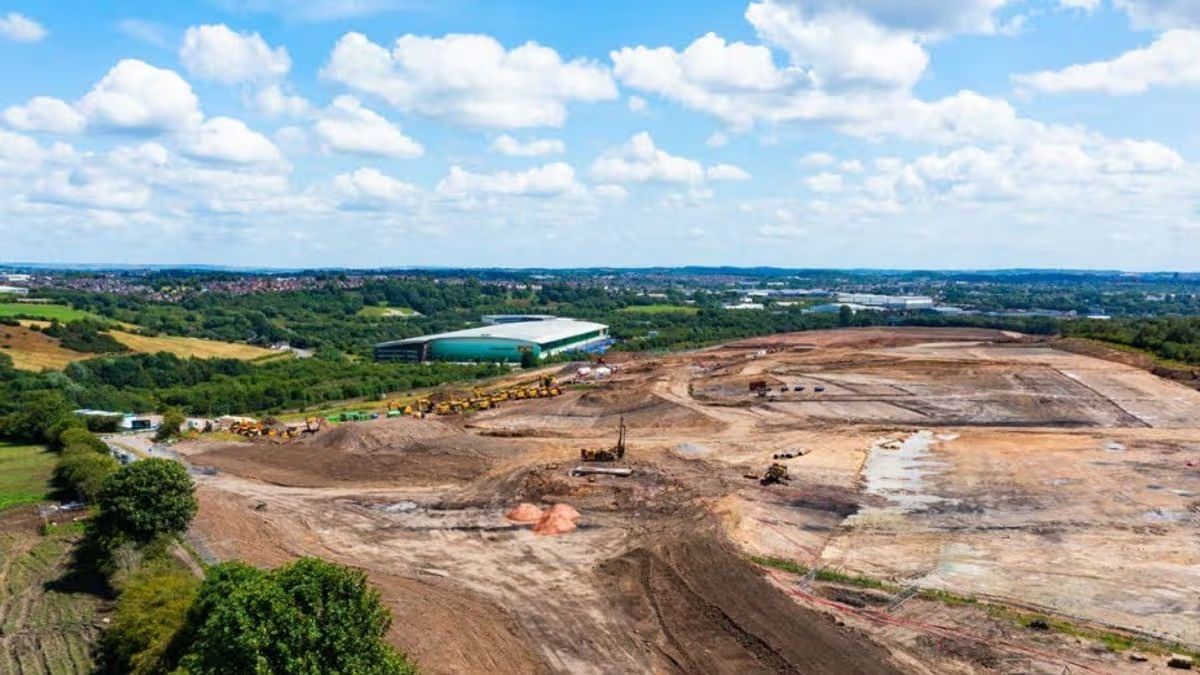
Bolton council has approved a masterplan to manage the development of the huge site (Image: Bolton council has approved a masterplan to manage the development of the huge site (Pic: Bolton council planning portal))

A vision to transform an area close to the M61 into one of the UK’s biggest employment destinations has been approved.

Advertisement

Bolton council’s West of Wingates masterplan sets out the criteria and design expectations for the massive development on the western edge of Westhoughton, which when completed will support up to 6,000 jobs.

The allocation provides for around 440,000 sqm of industrial and warehousing floorspace.

Phase 1 planning permission for the project, next to the A6 on Chorley Road, was granted January 2024 is under construction.

Bolton council’s cabinet meeting heard that some councillors had ‘significant concerns about the road network’ around the site.

Advertisement

Another campaigner claimed the move will ‘concrete Westhoughton over’ with ‘green fields dug up over the next few years and thousands of extra vehicles per day’.

The cabinet meeting heard form executive member Nadeem Ayub who described the masterplan as providing a framework for ‘a high quality exemplar employment site’.

He added: “The decision on whether the site should be developed has already been made under the Places for Everyone plan. It has been allocated for employment use.

“The principle of development , the amount of floorspace was done after a full public consultation.

Advertisement

“This document is not a decision on whether to develop it’s about how to develop well.

“The document sets out a vision for a high quality exemplar employment site and puts forward eight design principle that every future application will be tested against.

“It protects landscape features and green corridors.”

Horwich & Blackrod First councillor David Grant told the meeting that it was ‘good that we are creating jobs but the highway network always seems to take a backward step’.

Advertisement

He added: “Coming from a neighbouring ward I still have significant concerns about the road network, particularly the motorway roundabouts, the Beehive roundabout – all are at capacity, all are still being developed.

“There doesn’t seem to have been any offer of improvements to those junctions. One minor accident or issue and the entirety of Horwich comes to a standstill.

“By adding a significant employment zone on the outskirts of that area will only add to people coming down the A6 and increasing the issues.”

The West of Wingates site in Westhoughton

The West of Wingates site in Westhoughton (Image: The West of Wingates site in Westhoughton (Pic: Bolton Council planning portal))

Campaigner David Wilkinson was a councillor in Westhoughton for more than three decades before losing his seat last month.

Advertisement

Reacting to the decision he said: “The decision means over 400 acres of green fields will dug up over the next few years and thousands of extra vehicles per day.

“It’s one of the biggest industrial estates in the country.

“Phase II was included in Place for Everyone passed by Bolton Council in March 2024 it also included the development of Hulton Estate by Peel.

“It also removed green belt protection for hundreds of acres on the Phase II site at Wingates making easier to build.

Advertisement

“So the Labour, Tory and Independent councillors on Bolton council who voted for it, voted to concrete Westhoughton over.”

Bolton Council says that it worked with developers, the Harworth Group, and various public bodies as part of the consultation, as well as councillors and MPs in and around Westhoughton to produce the masterplan planning document.

An eight-week public consultation period ran from November 2025 to January 22 this year.

Planning application for the next phases of the West of Wingates development are expected to be submitted by Harworth Group in the coming months.

Advertisement
Continue Reading

Business

GIC shares decline 6% as Rs 3,088 crore OFS opens at 9% discount

Published

on

GIC shares decline 6% as Rs 3,088 crore OFS opens at 9% discount
Shares of General Insurance Corporation of India (GIC) declined 6% to their day’s low of Rs 366 on the BSE on Tuesday as the government’s offer for sale (OFS) to divest up to 5% stake in the state-run insurer opens today at a floor price of Rs 352 apiece, implying a 9% discount to the stock’s previous closing price.

In an exchange filing released on Monday, GIC announced that the government aims to sell up to 3.51 crore shares, representing a 2% equity stake, as part of the base offer which opens for non-retail investors today (June 16). The government can also exercise the oversubscription option to additionally sell another 5.26 crore shares, representing another 3% stake in the company for the OFS that opens for retail investors and employees on Wednesday (June 17).

This collectively brings the total offer size to 8.77 crore shares, or a 5% equity stake in the general insurance company. At the floor price of Rs 352 per share, this would be worth more than Rs 3,087.74 crore.

Also Read | Nilesh Shah bats for minimum qualifying criteria for F&O trading after Maharashtra man kills family, self over Rs 1.8 cr loss

Advertisement

The latest stake sale comes as the government recently ramped up its disinvestment efforts. Recently, the government offloaded some of its stake in Coal India, NHPC, NLC India and other PSU companies.


The government planned to sell 10% of its stake in the insurer ‌in tranches to meet the market regulator’s minimum public shareholding norm, Reuters reported in 2024. ⁠Of this, the government already sold a 3.4% shareholding in September 2024.

GIC shareholding pattern

The President of India owned more than 82% stake in GIC as of March 31, 2026, according to data on the company’s shareholding pattern on NSE. Life Insurance Corporation of India (LIC) meanwhile held around 10% stake, while 22 mutual funds held around 1.5% stake.
Around 2.07 lakh retail investors collectively owned a 1.4% stake in the company.

GIC share price

GIC shares have fallen around 1% in one week but are up nearly 2% in 2026 so far. The shares of the company have rallied 103% in three years and 92% in five years.The company has a market capitalisation of more than Rs 67,588 crore.

Also Read |
M-Cap of Vedanta’s split cos jumps 67% to Rs 3.5 lakh crore

(With inputs from agencies)

(Disclaimer: Recommendations, suggestions, views and opinions given by the experts are their own. These do not represent the views of The Economic Times)

Advertisement
Continue Reading

Trending

Copyright © 2025