

Business
Form 144 Ouster For: 26 May




Nomura Science And Technology Fund Q1 2026 Commentary
SYDNEY — The S&P/ASX 200 index advanced modestly on Wednesday, climbing 12.1 points or 0.14 percent to reach 8,669.9 by mid-afternoon trade, reflecting cautious optimism among investors amid mixed global signals and steady domestic economic indicators.
The benchmark index showed resilience in afternoon trading on May 27, 2026, as select resource and financial stocks provided support despite broader market hesitation. At 2:34 p.m. AEST, the gain placed the index near recent trading ranges, building on incremental progress seen in prior sessions amid ongoing geopolitical developments and commodity price movements.
Trading volume remained steady as participants assessed the latest inflation data and corporate earnings flows. Materials and financial sectors contributed positively, while energy and technology shares displayed varied performance. The modest uptick followed a period of volatility influenced by international events, including Middle East tensions and U.S. market trends from the previous session.
Market Drivers and Sector Performance
Resource stocks benefited from stable iron ore and copper prices, with several miners posting gains. Financial services firms, including the major banks, offered support as investors weighed potential Reserve Bank of Australia policy signals. Recent employment data showing softer-than-expected figures has reinforced expectations that the RBA may hold rates steady after earlier hikes.
The materials sector stood out with notable strength in several constituents. Companies exposed to base metals and precious resources saw buying interest as global demand indicators remained constructive. Energy stocks faced some pressure from fluctuating oil prices, which had risen earlier in the week on geopolitical concerns but showed signs of stabilization.
Broader market breadth was mixed, with roughly half the index constituents trading higher. Defensive sectors such as healthcare and consumer staples provided stability, while discretionary retail and technology names traded with caution amid global growth concerns.
Analysts noted that the Australian market continues to navigate a complex environment. Geopolitical risks in the Middle East, including U.S. actions and diplomatic efforts, have influenced commodity flows and investor risk appetite. Domestically, focus remains on inflation trends, with the latest CPI readings providing some relief after earlier accelerations.
Economic Backdrop and Policy Outlook
Australia’s economy has shown resilience despite global headwinds. The labor market data released recently indicated cooling conditions, which market participants interpret as reducing immediate pressure for further monetary tightening. The RBA’s cash rate stands at elevated levels following hikes earlier in 2026, and investors are closely monitoring upcoming inflation prints for clues on future policy direction.
Commodity exports remain a cornerstone of Australian growth. Iron ore, coal and liquefied natural gas prices continue to influence the terms of trade. While China’s demand has been uneven, signs of stabilization in key sectors have supported related ASX listings. Gold prices hitting periodic highs also provided a tailwind for mining shares.
The Australian dollar traded around recent levels against the U.S. dollar, reflecting balanced views on relative interest rate paths between the RBA and the U.S. Federal Reserve. Currency movements have implications for multinational earners and import costs across the economy.
Corporate Highlights and Earnings Influence
Several companies reported updates that moved individual share prices. Resource firms with strong production outlooks attracted buyers, while banks benefited from steady lending metrics despite higher borrowing costs. Dividend-focused investors continued to favor stable yield names in the current environment.
Market strategists highlight that Australian equities have lagged some global peers year-to-date, partly due to sector composition heavy in financials and resources versus technology-heavy indices elsewhere. However, attractive valuations in certain segments have drawn selective buying.
Global Context Shaping Local Sentiment
Overseas developments continue to set the tone. U.S. markets showed mixed results overnight, with some indices reaching records amid artificial intelligence optimism and corporate earnings strength. European shares also posted gains on hopes of tariff delays and diplomatic progress.
Oil price fluctuations have been particularly influential. Brent crude movements in response to Middle East events have affected energy stocks and broader inflation expectations. A potential easing of tensions could support risk assets, while escalation risks remain a key concern for traders.
Asian markets presented a varied picture, with some regional bourses gaining on stimulus expectations while others faced pressure from trade dynamics. This patchwork of international cues contributed to the ASX 200’s restrained session.
Technical Outlook and Investor Strategies
From a technical perspective, the S&P/ASX 200 has been trading within a defined range in recent weeks. The current level near 8,670 sits above some short-term support but below recent peaks. Analysts watch the 8,700–8,800 zone as potential resistance, with downside support around 8,500.
Institutional investors have maintained balanced positioning, with some increasing exposure to domestic cyclicals while hedging against external shocks. Retail participation remains active through exchange-traded funds tracking the benchmark.
Longer-term, structural factors such as superannuation flows, population growth and the energy transition continue to shape Australian equity prospects. Sectors aligned with decarbonization and critical minerals have drawn sustained interest.
Looking Ahead
As the trading day progresses, attention turns to any late corporate announcements and offshore leads from U.S. futures. Thursday’s session will likely focus on further inflation data and commodity updates. The index’s ability to hold above key levels could signal building momentum into the end of the month.
Market watchers emphasize the importance of diversification in the current climate. While modest gains like Wednesday’s provide encouragement, volatility linked to geopolitics and central bank decisions remains elevated. Investors are advised to monitor upcoming economic releases closely.
The S&P/ASX 200’s performance reflects Australia’s position as a resource-rich, trade-exposed economy navigating global uncertainties. With the index showing tentative recovery signs, participants remain focused on sustainable growth drivers and policy responses that could influence the second half of 2026.
Broader All Ordinaries index moved in tandem, underscoring widespread but measured participation across listed companies. As markets digest the day’s developments, the modest advance underscores a wait-and-see approach typical of uncertain times.

Renowned Margaret River winery Cape Mentelle will remain in liquor giant Endeavor Group’s portfolio amid a major sell down of wine assets.
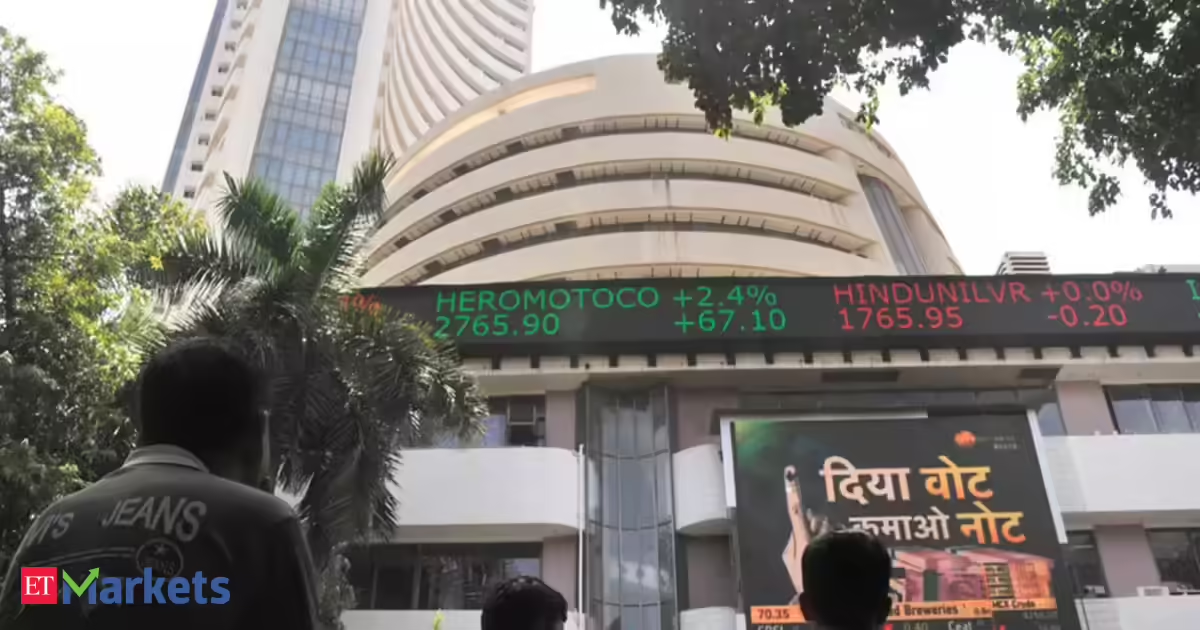
Sensex declined around 70 points to open near 75,940, while Nifty 50 fell over 33 points or 0.14% to begin the session at 23,880 on Wednesday. This came even as India VIX, which measures volatility in market, dropped more than 3% to 16.13 in the early morning trading hours.
HDFC Bank, Infosys, Axis Bank, Asian Paints, Kotak Mahindra Bank, HCL Tech and Reliance Industries shares were the top losers on Sensex, falling up to 1%. Bucking the trend, Sun Pharma shares rose more than 1% to lead gains, while ITC, Bharat Electronics (BEL), ICICI Bank and others followed.
Nifty Midcap 100 and Nifty Smallcap 100 indices recorded marginal gains. Nifty Metal index gained nearly 0.5% to lead gains, while Nifty Oil & Gas declined 0.2%. Around 1,433 stocks advanced on NSE, while 760 declined and 163 remained unchanged.
“With S&P 500, Nasdaq and Nikkei setting new records and KOSPI and Taiex getting bought on declines, the bull rally in these markets is showing no signs of losing steam. So long as this trend continues, the Indian market will remain on the back foot weighed down by FII selling,” said VK Vijayakumar, Chief Investment Strategist at Geojit Investments.

He added that the market appears to be ignoring the concentration risk associated with the ongoing AI trade. “We don’t know how long this will last and when India will turn attractive to FIIs again. This will certainly happen but the timing is unknown,” he said.
There are some positive developments from the Q4 results, according to the analyst. “Overall the results have turned out to be better-than-expected. Midcaps have outperformed largecaps. A significant trend is that profit growth has outpaced revenue growth. The sluggish revenue growth is indicative of the weak demand conditions in the economy. Fairly-valued financials have good prospects. Segments like pharmaceuticals with inelastic demand and good exports are showing great resilience since this segment will continue to do well even during tough times for the economy,” Vijayakumar said.US-Iran tensions rise
US and Iran appear to be closing in on the much-awaited deal to end the war in the Middle East and open up the Strait of Hormuz, but tensions simmer as the US conducted strikes on Iran. Tehran on Tuesday said that the US had violated a ceasefire by striking targets near the contested Strait of Hormuz, potentially complicating efforts to bring the war to a close.
Iran’s foreign ministry said US strikes in Iran’s southern Hormozgan province, where Iranian media reported sounds of explosions early on Tuesday, represented a “gross violation” of the ceasefire in place for nearly seven weeks. The US said its attacks were defensive in nature, targeting missile sites and boats attempting to lay mines.
Israel meanwhile pounded Lebanon with more than 120 air strikes on Tuesday in one of the heaviest days of bombing in weeks, Lebanese security sources said. Iran has sought an end to Israeli attacks in Lebanon as part of any peace deal.
US Secretary of State Marco Rubio said it could take “a few days” to negotiate a deal to halt the conflict, after both sides had previously indicated progress on an initial agreement that would end hostilities and restart shipping through the Strait. That initial agreement would give negotiators 60 days to tackle more complex issues including Iran’s nuclear program.
(Disclaimer: Recommendations, suggestions, views and opinions given by the experts are their own. These do not represent the views of The Economic Times)

The advertising watchdog said the adverts featuring top footballers had a strong appeal to under-18s.


Exclusive-Samsung plans $1.5 billion chip testing plant in Vietnam, document shows

Too Much Work to Do? Have Your Digital Twin Handle It

Edited excerpts from a chat:
What role can multi-asset allocation funds play during periods of elevated uncertainty and market volatility like the one we are going through today?
With West Asia tensions, oil volatility, and uneven global growth, multi-asset funds can play a useful role in helping investors stay invested through uncertainty. The idea is to balance risk across asset classes that do not move in the same direction all the time.
A lot of people who are already invested in equity funds often buy gold funds/ETFs separately. Where does multi-asset funds fit in one’s portfolio?
Many investors already hold equity and gold separately, but a multi-asset fund offers a more disciplined and convenient way to bring those exposures together. It also takes care of rebalancing, which is important when markets become noisy and investor emotions tend to run high.
How do you see the interest rate cycle evolving globally and in India, and what implications could this have for asset allocation?
The global rate cycle is still evolving, but inflation risks have not gone away, especially if crude oil remains volatile. In this backdrop, a balanced asset allocation approach makes sense, with equity, debt, and gold all playing their respective roles.
How do you decide when to increase or reduce exposure to equities within a multi-asset framework?
Within a multi-asset framework, equity exposure is adjusted based on valuations, earnings visibility, and the broader macro backdrop. We continue to prefer quality businesses with strong balance sheets, pricing power, and the ability to weather external shocks.
What kind of equity sectors or themes are you constructive on despite concerns around the impact of soaring crude oil on the Indian economy?
Even with concerns around higher crude, we remain constructive on businesses with domestic demand visibility and limited sensitivity to input-cost pressure. Select financials, capital goods, and export-oriented names continue to offer opportunities, though valuation discipline remains key.
Ever since gold peaked out in the current cycle, how has your allocation changed? What is your current asset allocation mix in the fund?
Gold has once again shown why it remains an important part of a diversified portfolio. In periods of geopolitical stress and market uncertainty, it can help provide stability and act as a hedge against risk.
For investors entering markets at current levels, what would be the ideal portfolio strategy over a 3–5 year horizon?
For investors entering the market now, a phased approach is preferable to trying to time the perfect entry. Over a 3–5 year horizon, a diversified portfolio with systematic investing can help investors stay disciplined and participate in long-term wealth creation.
If you had to make the case for multi-asset investing in one line for 2026, what would it be?
In 2026, multi-asset investing is about staying invested, staying diversified, and staying resilient in a world that can be disrupted quickly by oil, policy, and geopolitics.

Among listed brokers such as Billionbrains Garage Ventures (Groww), Angel One, IIFL Capital Services and Anand Rathi Share & Stock Brokers, standalone revenues rose between 3% and 23% in the March quarter from Oct-Dec, while standalone profit after tax grew 11% to 43%.
Motilal Oswal Financial Services‘ revenues fell 23% sequentially, while it reported a loss of ₹48.9 crore in the quarter.
The consolidated profit after tax of BSE and NSE rose 33% and 19%, respectively, while revenues grew 26% and 27% during the quarter. “We saw a strong fourth quarter performance across listed exchanges and brokers, supported by a favourable base effect after last year’s decline in derivatives volumes,” said Ashish Nanda, chief digital business officer, Kotak Securities. “Higher market volatility around the Budget period, strong commodity trading activity as gold and silver prices peaked, and elevated VIX levels amid the US-Iran conflict also drove volumes higher.”
 Agencies
core and more: Favourable base effect, higher market volatility, commodity trading and rising margin trading funding income boost March quarter show
Industry officials said the improvement in earnings was also aided by diversification beyond core broking income, particularly through distribution and margin trading funding (MTF). “Brokers have aggressively scaled MTF books,” said Roop Bhootra, whole-time director at Anand Rathi Share and Stock Brokers.
“MTF provides leveraged cash equity exposure with broker-funded margins, generating interest income (with brokerage revenue) that hedges against volatility in broking income and offsets any F&O moderation,” Bhootra said.
Higher trading activity, particularly in options, also supported earnings momentum. The March quarter saw strong revenue growth led by higher options trading activity, as traders shifted from futures after the STT hike announcement, even before the new rates took effect, said Pranay Aggarwal, director and CEO of Stoxkart.NSE had earlier said that its average daily traded volume for equity options (premium value) rose 43% in March compared with the December quarter. Aggarwal said brokers are evolving into ‘pseudo-NBFCs’.
“Products like algo trading, where brokers charge brokerage and subscription or API fees, are gaining traction. Brokers are also expanding into wealth management, insurance, online FDs and other offerings to reduce the seasonality and volatility of pure-play broking income,” he said.
Stock performance has been mixed so far in 2026.

Their holdings were nearly half or 46% of India’s annual gold imports. The country’s gold import fell by nearly 5% year-on-year to 721 tonnes in FY26, according to the commerce ministry data.
AgenciesBright Yellow: Holdings of Muthoot, Manappuram and IIFL Fin at end of March exceed the reserves of several major central banks
The rise in gold holdings in FY26 was driven by IIFL Finance, which added 19 tonnes of yellow metal during the year. The company’s gold loan business was hit by regulatory action in FY25. The RBI had barred the company from issuing fresh gold loans for over six months starting March 2024. Following the lifting of restrictions, its gold holdings recovered to around 60 tonnes in FY26, broadly in line with levels seen in previous years.
The gold holding of Muthoot Finance, the largest player in gold financing, fell by seven tonnes or 3.2% year-on-year to 209 tonnes in FY26. Antu Eapen Thomas, senior research analyst, Geojit Investments attributes the fall to sharp increase in gold prices during the year. “Higher prices enable borrowers to secure the same loan amount by pledging a smaller quantity of gold,” Eapen said.
The third listed gold loan company Manappuram Finance reported a record 63 tonnes of gold holding in FY26, up seven tonnes or 11.7% from the previous year. “Manappuram has stepped up gold loan financing, especially after the microfinance sector started showing higher delinquencies,” Eapen said.
At the end of March 2026, the RBI held 880.5 tonnes of gold, similar to the year-ago level of 879.6 tonnes. Of this, 680 tonnes were stored domestically, 197.7 tonnes with the Bank of England and the Bank for International Settlements (BIS), and 2.8 tonnes in gold deposits.

107 Longstanton homes plan slammed with ‘no idea of impact’

Nomura Science And Technology Fund Q1 2026 Commentary

Coinbase’s Base gives AI agents new crypto wallet powers


-

 Crypto World5 days ago
Blockchain.com files with SEC for U.S. IPO
-

 Fashion4 days ago
Holiday Weekend Open Thread – Corporette.com
-

 Business5 days ago
Dell Technologies DELL Stock Surges 15% on AI Server Momentum and Analyst Upgrades in 2026
-

 Crypto World5 days ago
Bitcoin Accumulation Weakens as BTC Realized Losses Hit $600M
-

 Crypto World4 days ago
Robinhood crypto COO Tanya Denisova exits
-

 Crypto World5 days ago
Space X IPO Is ‘Bad News’ for Tech Stocks: But What About Bitcoin?
-

 Politics4 days ago
Makerfield: a tale of two social-media histories
-

 Business2 days ago
NYT Strands Answers May 24 2026 Revealed for Puzzle No. 812 Theme Summer Essentials
-

 Tech2 days ago
Microsoft’s quiet Claude Code retreat and the real cost of enterprise AI
-

 Crypto World5 days ago
MicroStrategy’s Saylor Says Miners No Longer Set Bitcoin Price, Another Force Has Taken Over
-

 Tech5 days ago
WhatsApp ads could make Irish debut after discussions with DPC
-

 Crypto World5 days ago
AI infrastructure race heats up as IREN pitches full-stack strategy, WhiteFiber lands $160M deal
-
 Tech5 days ago
A 0.12% parameter add-on gives AI agents the working memory RAG can’t
-

 Tech5 days ago
You Can Now Add ChatGPT To PowerPoint
-
 Crypto World2 days ago
Nvidia (NVDA) CEO Calls on Super Micro to Strengthen Export Controls Amid Smuggling Probe
-
 NewsBeat6 days ago
Charity run by Reform leader Malcolm Offord accused of ‘law breaking’ over Scottish registration
-

 Business5 days ago
Trump Invests $1M-$5M in Kura Sushi USA Chain With 27 California Locations
-

 Tech2 days ago
Westone Audio and Etymotic Acquired by Fidelity Collective in Major IEM Market Move
-

 Sports5 days ago
2026 CJ Cup Byron Nelson leaderboard: Brooks Koepka finds putting stroke in Round 1
-

 Crypto World6 days ago
Exa Labs raises $250 million in funding led by a16z
You must be logged in to post a comment Login