TL;DR
The Netherlands blocked IBM spinoff Kyndryl from acquiring Solvinity, the cloud provider that hosts the Dutch digital identity system DigiD. It is the first US acquisition the Dutch Investment Screening Bureau has ever prohibited.





The Netherlands blocked IBM spinoff Kyndryl from acquiring Solvinity, the cloud provider that hosts the Dutch digital identity system DigiD. It is the first US acquisition the Dutch Investment Screening Bureau has ever prohibited.
TL;DR
The Dutch government has imposed a “complete prohibition” on the acquisition of Solvinity, a Dutch cloud provider, by Kyndryl, the American IT infrastructure company spun out of IBM in 2021. The deal, valued at roughly €100 million, would have given a US-headquartered firm control over the platform that runs DigiD, the digital identity system used by millions of Dutch residents to access tax, healthcare, pension, and government services.
Willemijn Aerdts, the Dutch minister for the digital economy, announced the decision on Monday in a letter to parliament. The government said the acquisition poses a possible “risk to the public interest” based on the recommendation of the Bureau for Investment Screening, which evaluated the deal under the Netherlands’ foreign investment screening framework.
It is the first time the bureau has blocked a US acquisition since it began operating. The decision was not close. The screening body recommended a full prohibition rather than imposing conditions.
Solvinity does not just host DigiD. The company also operates the infrastructure behind MijnOverheid, the government’s citizen communications portal, and Digipoort, the gateway for business-to-government digital services. Together, these platforms form a core layer of the Netherlands’ public digital infrastructure. Solvinity runs them from a government data centre under strict security requirements.
The concern is the US CLOUD Act. The 2018 law gives American law enforcement and intelligence agencies the authority to compel US-headquartered companies to hand over data stored on their servers anywhere in the world, regardless of the host country’s data protection laws. If Kyndryl owned Solvinity, the Dutch government’s digital identity data would theoretically fall within the reach of US authorities.
Kyndryl told Politico, which first reported the decision, that it was “extremely disappointed.” The company had announced the deal in November 2025 and framed it as a way to expand its sovereign cloud capabilities for regulated European customers. The Dutch competition authority, ACM, cleared the deal on antitrust grounds in February 2026. But the investment screening process, which runs separately, reached a different conclusion.
The decision sits within a broader European push to reduce dependence on American technology providers. Trump-era tariffs and sanctions have accelerated the shift. AWS, Microsoft Azure, and Google Cloud together control more than half of Europe’s cloud market. The European Commission is expected to present its Tech Sovereignty Package on 27 May, a day after the Dutch decision, with proposals that could restrict the use of US cloud platforms for sensitive government data across the EU.
The EU has already begun putting money behind the strategy. Brussels awarded a €180 million sovereign cloud contract to four European provider groups in April, closing a procurement process that will let EU institutions purchase sovereign cloud services for up to six years. One of the four winners, S3NS, is a joint venture between Thales and Google Cloud, underscoring how difficult it is to build genuinely independent infrastructure.
The Netherlands has form on this. In October 2025, the Dutch government invoked a Cold War-era law to seize control of Nexperia, a semiconductor manufacturer owned by China’s Wingtech, citing threats to European economic security. That case involved hardware. The Solvinity block involves data. The principle is the same: the Netherlands is willing to intervene when foreign ownership of critical infrastructure creates a national security risk, regardless of the acquirer’s country of origin.
For Kyndryl, the block is a commercial setback. The company, which reported $15.1 billion in revenue in its most recent fiscal year, has been trying to grow its European cloud and managed services business. Solvinity’s government contracts and security credentials made it an attractive target. Without the deal, Kyndryl loses a foothold in the Dutch public sector.
For the Netherlands, the calculation is that the risk of a US company controlling the platform behind the national digital identity system outweighs the commercial benefits of the acquisition. DigiD is used for everything from filing taxes to accessing medical records. The data it handles is among the most sensitive any government holds. Handing that to a company subject to the CLOUD Act is a risk the Dutch government has decided it will not take.
The decision will be watched across Europe. If the EU’s Tech Sovereignty Package follows through on restricting US cloud platforms for government data, the Dutch block on Kyndryl-Solvinity will look less like an outlier and more like a preview of what is coming for every American technology company doing business with European public institutions.

I’ve spent years messing with in-game brightness sliders, GPU filters, HDR modes, and monitor presets to tinker with my experience on my favorite games. Of course, I’d always go with the original artists’ intent first, but replaying these titles with new filters does freshen up the atmosphere.
This is why I was particularly impressed by BenQ’s new MOBIUZ gaming monitors. During a recent visit to BenQ’s Taiwan HQ, I got a hands-on look at the company’s latest AI-powered game filter tech, and it immediately made more sense than I expected. The company isn’t just slapping on the “AI” sticker onto a gaming display. What you are getting here is custom touches to change up your experience by pulling from BenQ’s game art database that automatically tunes brightness, contrast, and color balance to match the game’s visual style. The fun part is that your performance doesn’t take a hit.

When you use GPU-side filters, such as Nvidia’s Game Filters, your graphics card is still involved in the post-processing pipeline. Those tools can make a game look sharper, moodier, or more vivid, but they can also come with a performance cost depending on the setup. BenQ takes a different route by moving this job to the display itself. Its Smart Color system works through the Color Shuttle software and uses an AI chipset with BenQ’s MOBIUZ Game Color Database.
So rather than applying a GPU-level filter to the rendered frame, it adjusts the monitor’s own output using game-specific visual profiles. In practice, you can make a game look richer or more balanced without worrying that the filter itself is quietly eating into your frame rate. Considering how precious those extra fps can be for a lot of PC gamers, the visual filter makes sure you don’t lose any of it.

The part I liked during the demo was that BenQ is not treating this like an old-school FPS/RPG/Racing preset menu. Those have existed forever, and most of them are either too aggressive or too generic. Color Shuttle is built around a game art database with more than 120 profiles. BenQ says it uses deep learning to understand color grading, lighting, and artistic direction across different game styles. Once Smart Color is enabled, it can detect what you are playing and switch to a suitable profile automatically.
You can also tweak those settings yourself, including familiar BenQ tools like Color Vibrance and Light Tuner that let you shift the image toward your preference. Again, “better colors” has always been a subjective thing. One player may want a horror game to look darker and moodier, while another may prefer better shadow visibility. Someone else may want open-world games to look more cinematic. BenQ’s system gives you a starting point, then lets you tune from there.

One of the best parts of Color Shuttle is cloud sharing. You can save custom presets, upload them, and share them with other players. Other users can then download those setups for their own compatible monitors. This gives the feature a social side. Imagine downloading a profile for a specific game because another player has already found a better balance for night scenes or other scenes.
But that also explains why the internet connection is part of the story. Color Shuttle connects to BenQ’s Game Color Database, and the cloud side is used for saving and sharing profiles. The AI tuning is not the same thing as cloud gaming or streaming, but the ecosystem still depends on BenQ’s online database and community layer.
Still, there are some limitations. Color Shuttle is currently a Windows 10/11 app, and console users need to save presets to the monitor’s Gamer modes through a PC before using them elsewhere. Regardless, I like where BenQ is going here. A lot of AI gaming features feel too heavy or too tied to expensive GPU upgrades. Smart Color is smaller, but also more practical.

404 Media remembers how a Florida police office looked up his ex-girlfriend’s license plate in the Flock automated license plate reader system at least 69 times in 2024 — even searching for her mom’s license plate at least 24 times. The police office was charged with stalking and hacking-related offenses, serving one day in prison with five years of probation — but his case “was not a one-off.” [Alternate link via Bruce Schneier]
Local news reports from around the country repeatedly detail police abusing the Flock surveillance system in order to stalk their partners or ex-partners. The contours of each story are much the same, with the police officer in question using their access to the system to repeatedly track a specific person over the course of weeks or months. The cases highlight the fact that Flock can be used to track the whereabouts of individual people, that police do not get a warrant in order to use the system, and that, if they have access to the system, they have the technical ability to look up any license plate they want for any reason they want. An April study by the civil rights group Institute for Justice found that at least 18 police officers have been caught around the country using Flock to stalk a romantic interest in the last few years; another database, called the ALPR Abuse Library, has documented 20 specific cases of “stalking/targeting” around the country.
The known cases of police stalking are almost certainly a vast underreporting of the overall abuse, because they largely include only cases in which the behavior was so egregious that it led to police officers being fired, arrested, or both. Flock told 404 Media that it is “aware of 15 incidents of abuse, each surfaced because of the transparency and accountability features deliberately built into our platform…. There are also 140,000 monthly active users of Flock, so the relatively rare instances of abuse, while obviously wrong and awful, are exactly that — rare,” a Flock spokesperson told 404 Media. [One in 10,000.] “Humans are fallible; unlike most tools society provide law enforcement, Flock ensures that in the instances when our technology is misused, the evidence used to hold responsible parties accountable, is right there in our system. We also encourage all our customers to have a usage policy, regular training, and to implement our Audit Assistance tool, which proactively flags unintended use….”
But it is also the case that Flock has strenuously fought against lawsuits and potential regulations that are seeking to require police to get a warrant to use the system. And many cases of abuse have not been detected by police departments themselves but by those private citizens, journalists, and stalking victims who have found patterns of abuse in public records files they have obtained from their local police departments. In most cases of Flock-related stalking reviewed by 404 Media, the abuse occurred over the course of months or years, and the victims were subjected to dozens or hundreds of lookups. Other abuse cases have been discovered using the website HaveIBeenFlocked.com, a website that compiles Flock searches released via public records requests and turns them into a searchable database. Flock has repeatedly tried to get that website taken down, as we have previously reported.
Whether you’re for it, against it or indifferent to it, the social media ban for under-16-year-olds is due to come into force next year.
Regardless of how that might work, the ban is not a substitute for parental controls on devices and your home network. With two kids of my own, here’s what I’ve learned.
Parental controls are there as a safeguard to protect kids from the harms that the internet has to offer. As kids get older, the number of restrictions you have will reduce, but you’ll still most likely want something in place.
All restrictions should be clearly stated and you should talk to your kids about why restrictions are in place and what you expect from them when they’re using devices. Then, you can put restrictions in place.
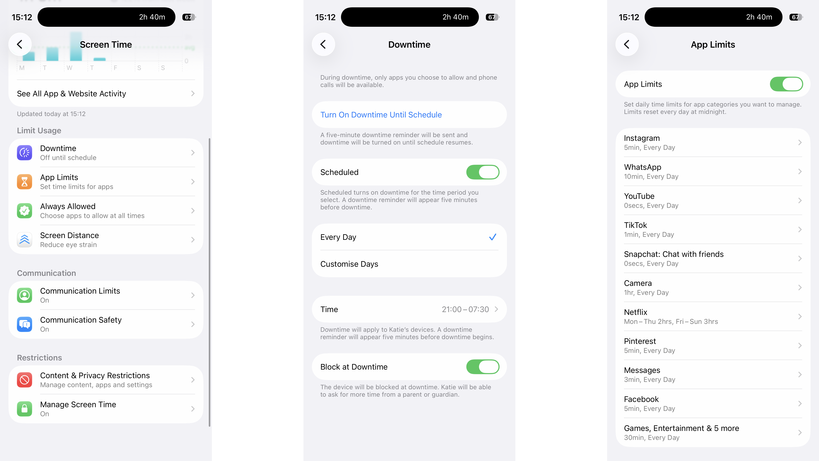
Whether or not your kids have Apple or Android phones, there are free parental controls available for both platforms: Screen Time for iOS and Family Link for Android.
These both need to be tied to a child’s account, but once installed, they both give a similar set of controls: you can make kids request apps before installing them, you can set app time limits, control the contacts they can add, and you can put phones into downtime to prevent use (either manually or scheduled).

Family Link for Android phones is available on iOS and Android, but for Screen Time you need another Apple device.
If your kids have Amazon tablets or Kindles, then parental controls are available there, too, controllable through the parents’ dashboard online. Again, you get a similar level of control, including time limits.
The one thing that’s annoying about Amazon’s parental controls are that they stop a child joining a different Wi-Fi network, and you have to do this with a parent’s profile on the device itself. On the one hand, this is a safety feature, but if a child goes off to stay with grandparents, for example, they can’t connect to Wi-Fi without you being present.
Windows has its own controls, with Microsoft Family Safety. MacOS devices can use Screen Time, just like the phones.
Game consoles have their own set of controls that you need to set up individually.
Most social networks have parental controls of varying quality, but require that any account your child sets up be monitored by you as a parent using the provided controls.
My advice is to always set every device up with the controls available, but to try and restrict the number of manufacturers you have.
For example, if your child has an iPhone and an iPad, the same settings and time limits apply to both; if they have an Android tablet, a Windows PC, and an iPhone, you have to set limits and controls on each.
It’s essential, in my view, to have parental controls running on your home network. I use Eero at home and have Eero Plus. With this, I can create profiles for each child and associate their devices.
Each profile can have its own scheduled downtime, turning off at bedtime, for example, and you can filter the internet in an appropriate way for different-aged children. Eero also allows me to block specific services across all devices, say turning off Discord, YouTube or Snapchat.

But be careful. To identify a device, Eero (and other routers) use a device’s MAC address. Phones and tablets can create a private MAC address, which can change frequently. It’s for privacy to stop public hotspots spying, but when a MAC address changes, your router thinks it’s a new device.
Disable this setting on your child’s devices (turning it off or setting it to Fixed, rather than Rotating) and, if your router supports it, turn on notifications for new devices. That way, you’ll get a pop-up on your phone if the router spots a new device, which covers MAC address changes and any children bringing other unlocked devices home.

Also be aware of devices with more than one network connection. A PC with Wi-Fi and Ethernet will appear as two different devices, and you need to add both to a profile for full protection.
Home network controls should not be used in place of on-device controls, but alongside them. When your child leaves home with a device, such as an iPhone, they’re no longer protected or restricted by the home network. Make sure mobile devices are set up with restrictions similar to those on your home network, so your kids remain protected when they’re using a mobile connection or on another network.
Most parental controls will require a PIN or password when you want to make changes, so don’t use the same ones that you’d use on your own phone, as your kids probably know what this is. I use random PINs and passwords, and save them in a secure note on my phone.
Just because a phone’s locked down or restricted in a certain way, it doesn’t mean that your kids can’t get around the controls you have. Take Snapchat, for example: kids can simply log in on someone else’s phone or via a web browser, bypassing time limits that you might have set.
If a service that your child has access to has the option of two-factor authentication (where you need a code to login), set this up, but add the code to your phone, such as through the Google Authenticator app. Sign out of all sessions on the service on your child’s phone, and then sign them back in. They’ll need the authentication code to do so, so it’s fine to give out that one-time code.
However, now if they try and log in via another phone or the web, they’ll need a code that they can’t get, so you can ensure that they’re safe. This doesn’t stop them from creating new accounts on many services.
It’s also worth blocking web access to services on their phone and your home network, just for safety. For example, if you have time limits on WhatsApp, you’ll want to block WhatsApp.com, as the web version allows a child to pair their account and switch to a web browser when they run out of time.

Blocking social media sites’ web addresses prevents kids from bypassing time controls in apps or creating new accounts to circumvent restrictions.

In this week’s “Sunday Reboot,” Beats subverts the World Cup, and GymKit and Malcolm’s gym are updated in opposite ways.

Sunday Reboot is a weekly column covering some of the lighter stories within the Apple reality distortion field from the past seven days. All to get the next week underway with a good first step.
This week, current Apple CEO Tim Cook warned of price increases, Brazil adopted EU-style App Store rules, and supply chain assembler Tata is accused of contaminating the water supply in India. Also, leakers are worried we could have another colorgate issue this fall.
Continue Reading on AppleInsider | Discuss on our Forums

Researchers at Nanjing Forestry University and Tsinghua University have demonstrated a new method for converting plastic waste directly into usable jet fuel, with estimated production costs ranging from $1.0 to $1.8 per kilogram.
The work comes as airlines, governments, and fuel producers continue searching for alternatives that could reduce dependence on conventional fossil-derived jet fuel.
While the technology remains under further development, the researchers say their approach combines favourable fuel characteristics with economics that appear competitive on paper.
The study, published in Nature Energy, shows a tandem reactor system using hydro-pyrolysis and hydrogenolysis can convert plastic waste into jet-fuel-range hydrocarbons.
The researchers note plastic material first enters a reactor operating at 460 °C, where it is broken into smaller molecular compounds.
Those intermediate products then pass into a second stage operating at 160 °C, where a specially designed catalyst converts them into cycloalkane-rich aviation fuel suitable for further evaluation.
Professors Yadong Li and Dingsheng Wang explained that controlling the final product mix had long remained a challenge in plastic conversion research.
“The problem that kept pulling us back was selectivity,” they said, noting that conventional approaches often produce broad and difficult-to-control distributions of chemical products.
The team concentrated on atomically dispersed ruthenium, or Ru, sites supported on cobalt-aluminum oxide materials.
After evaluating multiple catalyst configurations, they found that isolated Ru sites delivered significantly different reaction behaviour compared with conventional alternatives.
They reported that the catalyst achieved hydrogenation performance more than 100 times greater than a commercial Ru/C catalyst during a key processing stage.
The study arrives amid continuing efforts to expand sustainable aviation fuel production as airlines face pressure to lower emissions.
Aviation remains one of the more difficult sectors to decarbonize because aircraft require energy-dense liquid fuels that can operate under demanding flight conditions.
The group also reported successful catalyst preparation and testing at gram scale, while stating that both catalyst manufacturing and hydrogenation processes appear capable of scaling further.
The researchers said the resulting fuel demonstrated attractive performance characteristics while also offering potentially favourable economics.
“A techno-economic analysis put the competitive minimum selling price at $1.0–1.8 per kilogram,” Li and Wang said, describing the estimate as competitive.
For comparison, conventional fossil-based jet fuel currently costs roughly $1.00–$1.30 per kilogram, although prices change with global oil markets and refinery conditions.
Given the volatility tied to global oil markets, the conflict in Iran, and tensions across other oil-producing regions, a price-competitive alternative becomes increasingly difficult to ignore.
Future work will focus on kilogram-scale catalyst production and continuous feeding systems intended to improve operational efficiency.
Via Techxplore

Follow TechRadar on Google News and add us as a preferred source to get our expert news, reviews, and opinion in your feeds.

Claude Guillemot, co-founder of French video game company Ubisoft, died Friday at the age of 69.
According to French media (via Bloomberg), Guillemot died in a plane crash in the French resort town of La Baule. He was one of two people aboard the plane, both of whom died.
Guillemot founded Ubisoft with his four brothers in 1986. Since then, the company has published the Assassin’s Creed, Far Cry, Prince of Persia, and Tom Clancy video game franchises, as well as many other titles. The family retains control of Ubisoft, and Guillemot’s brother Yves is still CEO.
Guillemot was also chairman of Guillemot Corp., which makes gaming and audio accessories.
“Ubisoft was deeply saddened to learn of the death of Claude Guillemot, co-founder of the group and chairman of Guillemot Corp., in an accident,” Ubisoft said in a statement. “Our thoughts are with his family and loved ones during this difficult time. No further statements will be made at this time.””

Prince also worked on Wolfenstein and Duke Nukem games.

Video game composer and sound designer Bobby Prince has died. An obituary states that Prince died on June 16 at the age of 81 following an illness. Developer id software shared the news of Prince’s passing.
Rest in peace to the video game music pioneer Bobby Prince.
Your music lives on forever. pic.twitter.com/8LAT6CGZ5Y— id Software (@idSoftware) June 19, 2026
Prince was perhaps best known for his pioneering work on the Doom series. The Library of Congress inducted his soundtrack for the original game into the National Recording Registry just last month.
“Despite the limitations of the 1993-era sound card drivers, Prince composed the perfect riff-shredding accompaniment for the game’s demon-slaying journey to hell and back,” the Library of Congress stated. “Taking advantage of his knowledge of MIDI, Prince even worked to ensure that the sound effects he created could cut through the music by assigning them to different MIDI frequencies.”
Prince also worked on games such as Wolfenstein 3D, Rise of the Triad and Duke Nukem 3D. In 2006, the Game Audio Network Guild honored Prince with a lifetime achievement award.
“Everyone at Romero Games is deeply saddened to learn of the passing of Bobby Prince,” Doom co-designer and id Software co-founder John Romero wrote on X. “He left an incredible mark on games and on my life.”

If you’ll excuse the pun, skillets seem to always be a hot topic.
More than in other sections of cookery, there is a continual quest to find the best one, or at least the best one you can afford. I’ve seen cycles of fetishization come and go for copper, cast-iron, and carbon steel.
At the Mall of New Hampshire in the 1980s, I remember watching a miraculous cooking-store demonstration of omelettes effortlessly sliding out of a Teflon pan. Then, only a few years ago, the industry pretty much dropped the whole Teflon category like a hot potato due to the pans’ propensity to give off harmful fumes if they get too hot. Less durable ceramic immediately filled the void, and we’re already realizing how quickly it can lose its nonstick magic.
All this time, stainless-steel pans have been waiting in the wings. They are durable, and lighter and less fussy than cast iron and carbon steel. They’re not nonstick, but that’s often fixed with a pat of butter. They sear well, and with a bit of TLC, they’re built for a lifetime of hard work.
All-Clad has been one of the great brands in stainless for years, but I wondered if other slightly more expensive skillets were worth a look, particularly as some are new to the market and others have been flying under the radar. Along with a 10-inch All-Clad, I called in similar-sized pans from Hestan, Viking, and Heritage Steel. Testing all these sounded like fun at first, but things got weird and stayed weird for a while, and only with a bunch of hands-on data gathering and time at the stove did I understand which pans I could recommend.
A smart and easy cheat for someone like me is to use All-Clad’s 10-inch D3 Fry Pan as a baseline. (“Fry pan” and “skillet” are used interchangeably in this category.) The D3 has been an America’s Test Kitchen and Wirecutter darling for years, with advocates seeking out traits like uniform heating across its surface, a comfortable handle, and cladding (layers of different metals). It’s $170 with a lid and $150 without, which is a good chunk of change, but it feels like a fair price for buy-it-for-life durability.
I own and love one of All-Clad’s 4-quart D5 Essential Pans, which is like a high-sided skillet, and it has a perfectly flat cooking surface. But the cooking surface on the D3 skillet All-Clad sent to me for this story was a bit domed–high in the center and low around the outside—not horribly so, but surprising to me, and among the dozen or so pans I called in, it was among the furthest out of whack. I also noticed that the rivets that hold the handle to the pan weren’t fully squished on there. It felt fine and didn’t wobble, but an All-Clad representative confirmed this wasn’t right. They sent another pan, and the rivets were as they should be on that one, but the bottom was pretty much the same. I learned that this amount of doming is within All-Clad’s tolerance range, but not within mine. What can I say? I like flat pans, I thought, looking wistfully at my perfect D5.
I had a similar level of trouble with another pan I had high hopes for. The new 10-inch Viking Pure Glide Pro, which I had seen at my favorite trade show, has a textured titanium layer for the cooking surface above an aluminum core and stainless-steel bottom layer. Impressively, this combination of materials created a capable nonstick competitor that I’d be a lot more excited about if it was part of a better, sturdier pan. The Viking had some temperature management issues that I’ll get to in a moment, and it either warped or arrived warped to the point that heating oil would form a moat around the center of the pan. If Viking fixes this, the Pure Glide Pro has the potential to be a hell of a pan, but it’s not there yet.

Recorded from the show floor at AXPONA 2026, this episode features Kendall Costello, Sales Operation Analyst at Loewe, and Amir Hejazi, Senior Engineer at Loewe. Topics covered include details about Loewe’s latest Stellar TVs and Leo headphone lineup, along with their return to the U.S. market. The conversation focuses on design priorities, key features, and how Loewe is positioning its products in a competitive premium market, with insight into how engineering and product strategy come together across both categories.
Sponsors: Thank you SVS for sponsoring this episode, along with Audeze for supplying all guests LCD-S20 Headphones, and Loewe and T10 Bespoke for sharing lounge space at AXPONA 2026.
This episode was recorded on April 12, 2026 (the third day of AXPONA 2026).

The BMPS Grand Finals have just concluded, and what an action-packed three days they were. We saw the rise of new titans like Divine Gaming, who, up until today, were the favorites to win the title. Sadly, veteran GodLike had other plans, who just had a stellar day in every single match. Another big surprise was the return of OG, who also qualified for the EWC in Paris by defeating SouL in the overall team standings. Here’s what the final BMPS rankings look like.
| Rank | Team | WWCD | Finish Points | Position Points | Total Points |
|---|---|---|---|---|---|
| 1 | GODL | 2 | 104 | 58 | 162 |
| 2 | DIVINE | 2 | 96 | 56 | 152 |
| 3 | VS | 2 | 79 | 54 | 133 |
| 4 | GDR | 1 | 93 | 35 | 128 |
| 5 | TAG | 2 | 95 | 28 | 123 |
| 6 | iQOOxOG | 1 | 78 | 41 | 119 |
| 7 | iQOOxTT | 1 | 78 | 38 | 116 |
| 8 | VASISTA | 2 | 76 | 37 | 113 |
| 9 | iQOOORGE | 2 | 68 | 43 | 111 |
| 10 | NBE | 1 | 73 | 34 | 107 |
| 11 | iQOO8BIT | 0 | 73 | 30 | 103 |
| 12 | GENS | 0 | 70 | 29 | 99 |
| 13 | iQOOSOUL | 1 | 66 | 30 | 96 |
| 14 | 7GODS | 1 | 64 | 31 | 95 |
| 15 | iQOORNTX | 0 | 67 | 19 | 86 |
| 16 | MYTH | 0 | 50 | 13 | 63 |



Zimbabwe Requires Crypto Businesses to Register Annually Under New FIU Regulations


Weekend Open Thread: Miami – Corporette.com

Crude Oil Plunges Over 4% as US-Iran Agreement Reopens Hormuz Strait

Wall Street Week Ahead: Investors see Micron earnings as pulse check of AI rally momentum


HIVE shares jump as $220M AI deal speeds Bitcoin mining pivot


Over 400 Arch Linux packages compromised to push rootkit, infostealer

The Adder At The Heart Of Intel’s 8087 FPU

Microsoft Updates Six Windows’ Apps. ‘Photos’ Gets Watermarks for Copilot Images (Off by Default)


FIFA World Cup 2026: Canada beat 9-men Qatar 6-0 to register first ever win | FIFA World Cup 2026


Soccer-U.S. defends Iran World Cup travel restrictions, says discussions ongoing


Etzioni on AI: Backlash against AI-generated text mirrors the anti-GMO movement


Today’s NYT Connections Hints, Answers for June 15 #1100
Chinese AI models are learning to detect safety tests and adjust their behaviour accordingly


Jake Chervinsky accuses CME of protecting derivatives monopoly


Weeks Of In-The-Field Testing And A Verdict


Anthropic’s Dario Amodei Urged AI Unity at G7, Even as US Banned His Models


Adobe adds its AI assistant to Premiere, Illustrator and InDesign
Ethereum Users Can Now Add Quantum-Resistant Account Protection for Just $0.07, Researchers Say


Brexit cost 6% of UK economy, Bank of England company data suggests


Renter of Home in Anne Heche Crash Denies Settlement With Son




![Mo Money Mo Problems (feat. Puff Daddy & Mase) [2014 Remaster]](https://wordupnews.com/wp-content/uploads/2026/06/1782074075_hqdefault-80x80.jpg)

You must be logged in to post a comment Login