Connect with us
DAPA Banner
DAPA Coin
DAPA
COIN PAYMENT ASSET
PRIVACY · BLOCKDAG · HOMOMORPHIC ENCRYPTION · RUST
ElGamal Encrypted MINE DAPA
🚫 GENESIS SOLD OUT
DAPAPAY COMING

Business

UK Pension Funds Still Failing British Tech Scale-Ups, Says OSE Chief Ed Bussey

Published

on

UK Pension Funds Still Failing British Tech Scale-Ups, Says OSE Chief Ed Bussey

The boss of Oxford University’s flagship spin-out fund has delivered a stinging verdict on the City’s biggest savers, accusing UK pension funds of being “way off the pace” when it comes to writing cheques for the country’s most promising technology businesses, despite successive governments promising to fix the problem.

Ed Bussey, chief executive of Oxford Science Enterprises (OSE), said reform efforts such as the Mansion House accord, under which seventeen of Britain’s largest workplace providers voluntarily pledged to put more of their members’ savings into private and high-growth companies, are simply not moving quickly enough to keep up with the pace at which Oxford-rooted businesses are scaling.

“Everyone’s diagnosed the problem, but the movement towards the solution is just way off the pace in terms of the speed at which we and others are building companies,” Bussey told Business Matters. “We’ve got companies with technology that should be thinking about $100 billion in terms of the scale of opportunity, and that’s reflected in the international capital — and particularly US capital — that is being attracted into these sorts of companies.”

A british problem with American fingerprints

The numbers tell their own story. Bussey said the vast majority of the £300 million in external capital raised by OSE’s portfolio companies last year came from American investors rather than domestic backers. Across the wider market, UK scale-ups now source as much as 80 per cent of their funding from overseas, according to figures from UK Private Capital, the trade body for the British private equity and venture industry.

“There’s nothing wrong with US money per se,” Bussey said. “But the share of UK money, particularly UK pension money, just needs to be dialled up about ten times. I think there’s a lack of understanding [within pension funds] of this space, of the opportunity, of the potential returns.”

Advertisement

His frustration was sharpened by a recent conversation with a Gulf-based backer. “One of my Gulf investors said: ‘You are sitting on our equivalent of Gulf oil.’ But UK pension funds are largely missing in action from this opportunity. The rest of the world scratches its heads when they look at this.”

It is a complaint that will sound familiar to anyone who has tracked the growing chorus calling on Britain’s pension giants to back homegrown scale-ups before the upside is shipped offshore. For all the political enthusiasm around turning the UK into the “next Silicon Valley”, the capital that ultimately reaps the rewards of British science still tends to be raised in Boston, San Francisco or Abu Dhabi — not in Edinburgh or the Square Mile.

The Mansion House promise, and its critics

Both the previous Conservative administration and Sir Keir Starmer’s Labour government have made unlocking domestic pension capital a flagship policy. The 2023 Mansion House compact set a target of 5 per cent of default fund assets in private markets. Last summer, that ambition was doubled when seventeen workplace pension providers signed up to the Mansion House accord, formally announced by the Treasury, agreeing to allocate at least 10 per cent of their default funds to private assets by 2030, with at least half of that ringfenced for the UK, releasing an estimated £25 billion into the domestic economy.

Lord Vallance of Balham, the science minister, conceded the pace had been a source of impatience but insisted momentum was building. “Is it as fast as everyone wants? No. But it’s starting and I really believe that’s going to change quite rapidly,” he said.

Advertisement

Critics, however, argue that without firmer incentives — or, more controversially, mandates, Britain’s defined contribution savers will continue to underwrite foreign infrastructure and foreign pensioners’ retirements rather than the domestic innovation economy. As Business Matters publisher Richard Alvin has previously argued, the UK’s real scale-up crisis is one of conviction as much as capital: a structural inability to back our own.

From lab bench to billion-pound business

Bussey’s broadside arrived alongside OSE’s latest annual report, which painted a far brighter picture of operational performance. Net asset value rose 17 per cent year-on-year to £1.26 billion, lifted by two landmark exits.

In September, IonQ’s $1.08 billion acquisition of quantum computing pioneer Oxford Ionics handed OSE its first unicorn exit. Before the year was out, the fund also completed the sale of cancer-drug discovery business Dark Blue Therapeutics to US biotech giant Amgen in a deal worth up to $840 million. Between them, the two transactions returned more than £283 million to OSE.

Bussey said further realisations were now firmly in view. “Within the next two to four years we’re going to hit a phase of regular realisations. We’ve proven that we can take science out of a lab and create a billion-pound company. What’s more exciting is now we’ve got line of sight to that happening on a consistent basis.”

Advertisement

For Britain’s SME ecosystem, and the universities, investors and founders trying to turn world-class research into world-class companies, the question is whether the country’s own pension savers will own a meaningful slice of that upside, or whether, once again, the wealth created in British labs will end up funding retirements on the other side of the Atlantic.


Amy Ingham

Amy is a newly qualified journalist specialising in business journalism at Business Matters with responsibility for news content for what is now the UK’s largest print and online source of current business news.

Advertisement
Continue Reading
Click to comment

You must be logged in to post a comment Login

Leave a Reply

Business

Walmart expands private brands with hardware overhaul, Mainstays Kids launch

Published

on

Walmart expands private brands with hardware overhaul, Mainstays Kids launch

Walmart is ramping up its private-brand strategy with a major overhaul of its home and hardware categories.

The retailer announced Wednesday that it is revamping its hardware department with an exclusive Greenworks Pro tool line and expanded Hyper Tough offerings. At the same time, Walmart says it is launching Mainstays Kids, its first new home brand in five years.

Advertisement

Courtney Carlson, a senior vice president at Walmart, told FOX Business that the strategy is centered on delivering more choice, innovation and value to customers.

WALMART WARNS SHOPPERS COULD FACE HIGHER PRICES AS FUEL COSTS SURGE, TAX REFUNDS DRY UP

Customers shop at a Walmart store

Customers shop at a Walmart store on May 13, 2026, in Chicago, Illinois. (Scott Olson/Getty Images / Getty Images)

“We always seek to bring the most assortment to our customers so that they have choice, variety, and so that we can provide many solutions for them,” Carlson said. “Our private brands are an important part of that strategy because what we see is that we build brands that bring unmatched quality through exclusive designs, innovation, and value to our customers.”

Continued demand from do-it-yourself (DIY) shoppers helped drive the decision to reboot the hardware department, according to Carlson.

Advertisement

“For us, it’s about investing in what we see our customers doing, and we have a lot of DIY customers,” she said.

The launch of Mainstays Kids comes as parents increasingly look for more personalized and design-focused spaces for their children, according to Carlson.

ASBESTOS FEARS SPARK URGENT RECALL OF 120K+ SQUEEZE TOYS SOLD AT WALMART, OLLIE’S

walmart store aisles shoppers

Customers shop at a Walmart store on May 13, 2026, in Chicago, Illinois.  (Scott Olson/Getty Images / Getty Images)

“What we saw is that parents really want to invest in their kids’ rooms, design in their kids’ rooms, and they see it as an extension of their own home,” Carlson said. “But they want it to be able to be really special to what their kids love.”

Advertisement

Carlson said Walmart developed the brand with extensive feedback from both parents and children throughout the design process. The retailer tested products directly with families and kids.

“We put the customer at the center and developed and designed with them the whole way through,” Carlson said.

WALMART CUTTING OR RELOCATING ABOUT 1,000 CORPORATE JOBS

Shopper carries Walmart bag

A shopper carries a Walmart bag in Montreal, Quebec, Canada, on Saturday, Nov. 15, 2025.  (Andrej Ivanov/Bloomberg via Getty Images / Getty Images)

GET FOX BUSINESS ON THE GO BY CLICKING HERE

Advertisement

The expansion of Walmart’s private-brand strategy follows the company’s broader investment in its physical footprint. Last month, Walmart announced plans to remodel more than 650 of its stores around the U.S. and open about 20 new stores in 2026 and early 2027.

The push also comes as retailers increasingly use owned brands and exclusive assortments to compete on price, differentiate their merchandise and appeal to shoppers who remain focused on value.

“This investment is intended to create jobs, help strengthen local economies, and make shopping faster and more convenient for our customers,” Walmart said at the time, adding that the new stores and remodels will drive construction jobs during the projects while creating long-term roles in retail, pharmacy and store leadership.

FOX Business’ Eric Revell contributed to this report.

Advertisement
Continue Reading

Business

Burger King deal for wind farm developer and energy firm

Published

on

Business Live

Alaska Wind Farm and Evolve Energy in ‘innovative’ agreement with BKUK

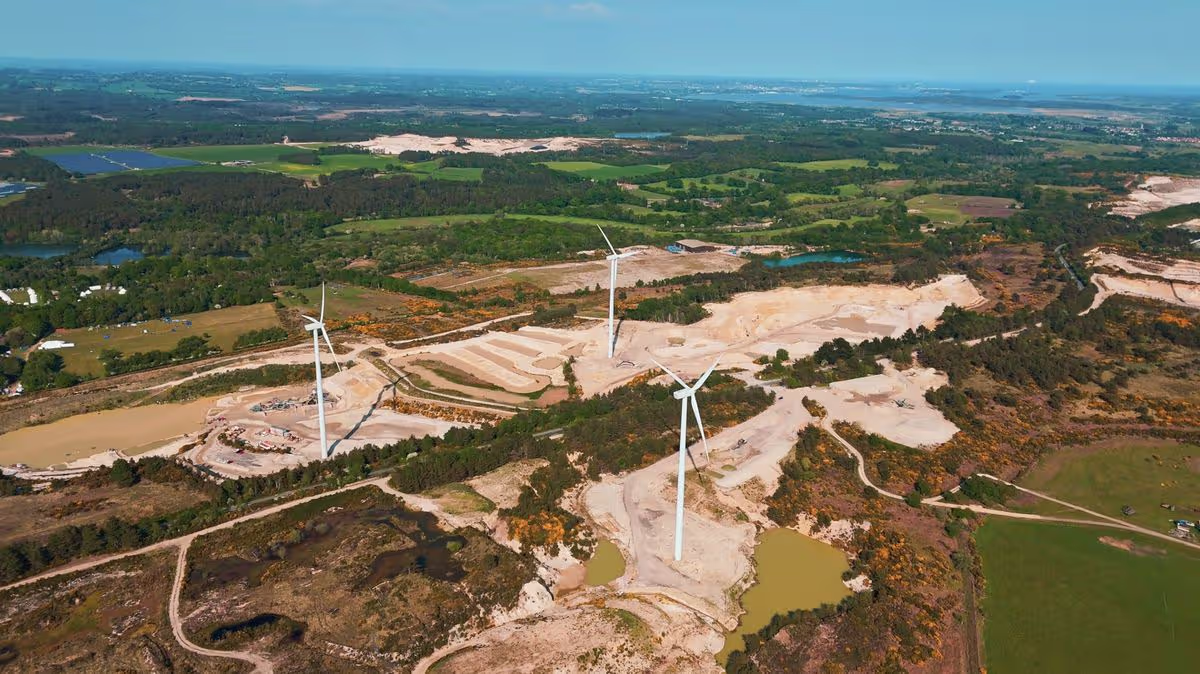
The Alaska Wind Farm at Masters Quarry in Wareham, Dorset. Evolve Energy has partnered with its operator to supply power to BKUK

The Alaska Wind Farm at Masters Quarry in Wareham(Image: Evolve Energy)

A wind farm developer and an energy supplier have teamed up to provide renewable power to Burger King restaurants in the UK.

Evolve Energy, from Lancashire, has partnered with Alaska Wind Farm LLP to supply power from the wind farm near Wareham, Dorset, to the fast food giant’s UK business BKUK. The energy will be used to power some of BKUK’s UK restaurants and to support the group’s sustainability and Net Zero goals.

The Alaska Wind Farm at Masters Quarry is made up of four refurbished 2MW Vestas V80 turbines relocated from Belgium. It generates some 17 gigawatt-hours of renewable energy a year.

The power from the scheme is now secured under a long-term Corporate Power Purchase Agreement (CPPA) with Evolve Energy. Lytham-based Evolve was introduced to the wind farm developer by BKUK’s partner Sustainable Energy First, which was advising the restaurant group on its sustainability plans.

Advertisement

James Hall, COO at Evolve Energy, said: “BKUK has been a valued customer for many years, so it was logical for us to take the unusual step of directly standing behind the CPPA as the contractual party for this impressive renewable project, exclusively matched against their demand.

“One of the most innovative aspects is the real-time, half-hourly matching of BKUK’s electricity use with the wind farm’s output, enabling non-standard cost savings while helping to reduce emissions. We’re proud to support BKUK integrate more renewable energy into its operations.”

Continue Reading

Business

Coal India shares drop 6% after OFS launch. Buy the dip or wait? Here’s what technical indicators suggest

Published

on

Coal India shares drop 6% after OFS launch. Buy the dip or wait? Here’s what technical indicators suggest
The shares of Coal India tumbled more than 6% on Wednesday after the company fixed the floor price for its Rs 5,000 crore offer for sale (OFS) at a 10% discount to the previous closing price, with analysts suggesting technical levels for investors to watch out for.

The shares of the company dropped to Rs 428.40 apiece in the morning trading hours of Wednesday. If the stock manages to hold these losses till the end of the session, then this would mark the sharpest single-day fall since June 2024.

Coal India on Tuesday announced that the government will sell 6.16 crore equity shares, representing 1% of its total paid-up equity capital, as the base offer size. The government also retains an oversubscription option to sell an additional 6.16 crore shares, taking the total potential offer size to 12.32 crore shares or 2% equity. At the floor price of Rs 412 per share, this would be worth more than Rs 5,000 crore.

Also read | Govt to offload up to 2% stake in Coal India via OFS on May 27-29; floor price at Rs 412/shareThe offer opened for non-retail investors on May 27, while retail investors, eligible employees and non-retail investors carrying forward unallotted bids can participate on May 29, after the market holiday on May 28.

Technical levels for Coal India share price

Coal India’s near-term chart has turned cautious, but it is not structurally broken, said Harshal Dasani, Business Head at INVasset PMS. He explained that the stock is reacting to a clear supply event – the government’s OFS, with the floor price set at Rs 412, at a 10% discount to the previous closing level. “That has shifted the price action from a steady uptrend into a support test,” he said.

Advertisement

For investors, the first important price band to watch now is around Rs 428 to Rs 430, according to Dasani. “If the stock absorbs supply there and closes above it, the chart can still form a higher base rather than slipping into a deeper correction,” he said.
However, a close below Rs 428 would weaken the setup and bring the OFS floor near Rs 412 into focus as the next reference point, he added. On the upside, the analyst sees the stock finding immediate resistance around Rs 455 and then at Rs 460, because that is where the stock broke down from after the supply announcement. The broader trend would need a reclaim of that band before momentum improves again, he said, adding that the 52-week high near Rs 491 remains the larger resistance marker.
“For now, Coal India remains a dividend-led, value-heavy chart facing a temporary supply overhang. The next signal is not the bounce itself, but whether the market absorbs the extra supply without significant damage to volume,” the analyst concluded.

Coal India share price

Coal India shares have fallen around 5% in one week and more than 3% in one month. Overall, the share price of the miner has gained more than 9% so far in 2026.
In the longer term, the company’s stock gained over 9% in one year, 81% in three years and 202% in five years. The company has a market capitalisation of nearly Rs 2.7 lakh crore.

(Disclaimer: Recommendations, suggestions, views and opinions given by the experts are their own. These do not represent the views of The Economic Times)

Continue Reading

Business

AppLovin Shares Soar 12% to $576 on Strong Earnings and AI Advertising Momentum

Published

on

AppLovin Shares Soar 12% to $576 on Strong Earnings and

NEW YORK — AppLovin Corporation shares surged more than 12 percent on Wednesday, climbing $62.17 to $576.41 in midday trading after the mobile technology company reported robust first-quarter results and raised its full-year guidance, highlighting continued strength in its AI-powered advertising platform and gaming business.

The significant gain reflected investor enthusiasm for AppLovin’s ability to deliver consistent growth in a competitive digital advertising market. The company has emerged as one of the standout performers in the technology sector in 2026, benefiting from increased demand for sophisticated ad optimization tools and successful titles in its gaming portfolio.

AppLovin reported first-quarter revenue of $1.28 billion, representing 38 percent year-over-year growth, exceeding Wall Street expectations. Adjusted EBITDA reached $518 million, up 52 percent from the prior year. The company also raised its full-year revenue guidance to between $5.1 billion and $5.3 billion, signaling confidence in sustained momentum.

Strong Performance Across Business Segments

AppLovin operates two main segments: Software Platform, which includes its AI-driven AXON 2.0 advertising technology, and Apps/Games. The Software Platform segment showed particularly robust growth, with revenue increasing 45 percent as more advertisers adopted its machine learning tools for campaign optimization and user acquisition.

Advertisement

The company’s gaming business also contributed meaningfully, with several titles achieving strong monetization through in-app purchases and advertising. AppLovin has successfully transitioned from a primarily gaming-focused company to a diversified mobile technology platform, reducing its reliance on individual game performance.

CEO Adam Foroughi attributed the results to the effectiveness of AXON 2.0, which uses advanced AI to improve return on ad spend for developers and marketers. The technology has helped the company capture market share in a fragmented mobile advertising industry increasingly dominated by data-driven solutions.

Market Reaction and Analyst Upgrades

The double-digit share price increase pushed AppLovin’s market capitalization higher, reflecting renewed institutional interest. Several analysts raised price targets following the earnings release, with some forecasting $600 to $650 per share over the next 12 months. Consensus ratings remain strongly bullish, with most firms citing AppLovin’s technological edge and scalable business model.

The stock’s performance stands out even within the strong technology sector, where many companies have faced pressure from economic uncertainty and fluctuating ad spending. AppLovin’s ability to deliver both top-line growth and margin expansion has differentiated it from peers.

Advertisement

Industry Context and Competitive Position

AppLovin operates at the intersection of mobile gaming and digital advertising, two sectors undergoing rapid transformation through artificial intelligence. The company’s focus on AI for ad targeting and creative optimization positions it well as brands seek higher efficiency amid rising customer acquisition costs.

Major competitors include Unity Software, IronSource (now part of Unity), and larger players like Meta Platforms and Google. However, AppLovin has carved out a specialized niche by combining proprietary technology with a portfolio of owned games that serve as both revenue generators and testing grounds for new advertising tools.

Global mobile advertising spending continues to grow steadily, driven by increased smartphone penetration in emerging markets and higher engagement with gaming and social applications. AppLovin’s international expansion, particularly in Asia and Latin America, has contributed to its recent success.

Strategic Initiatives and Future Outlook

Management highlighted several growth initiatives during its earnings call. These include further investment in AI capabilities, potential strategic acquisitions in complementary technologies, and continued development of high-quality gaming content. The company also maintains a disciplined approach to capital allocation, with share repurchases forming part of its strategy.

Advertisement

For the remainder of 2026, AppLovin expects continued strength in its Software Platform business while stabilizing its Apps/Games segment through selective releases and portfolio optimization. Analysts project mid-30 percent revenue growth for the full year, with expanding margins as AI efficiencies scale.

Risks and Considerations for Investors

Despite the positive momentum, potential risks remain. The mobile advertising market remains subject to regulatory scrutiny, particularly around privacy policies and data usage. Changes in platform policies by Apple or Google could impact user acquisition costs and advertising effectiveness.

Economic slowdowns could reduce advertiser budgets, while competition in the gaming space remains intense. Geopolitical factors and supply chain issues in semiconductor manufacturing could indirectly affect the broader mobile ecosystem.

Valuation represents another consideration. After significant gains in recent years, AppLovin trades at premium multiples compared to traditional software companies. Investors will need to monitor whether the company can sustain its growth trajectory to justify current pricing.

Advertisement

Broader Market Implications

AppLovin’s performance contributes to positive sentiment in the software and digital advertising sectors. Its success demonstrates how specialized AI applications can drive meaningful returns in competitive markets. The company’s story also illustrates the ongoing convergence between gaming and advertising technologies.

As artificial intelligence becomes more embedded in digital marketing tools, companies like AppLovin are well-positioned to benefit. Wednesday’s sharp rally suggests investors are increasingly confident in the company’s ability to navigate industry challenges while capitalizing on structural growth opportunities.

Looking ahead, AppLovin will likely remain in focus as it reports quarterly results and provides updates on its AI roadmap. For investors considering exposure to the mobile technology space, the company represents a high-growth option with proven execution capabilities in a rapidly evolving industry.

The substantial share price movement on Wednesday underscores the market’s appetite for companies demonstrating clear technological differentiation and consistent financial delivery. As AppLovin continues refining its AI capabilities and expanding its platform, it is positioned to play an increasingly important role in the future of mobile advertising and gaming.

Advertisement
Continue Reading

Business

GoGo Squeez adds protein innovations

Published

on

GoGo Squeez adds protein innovations

The children’s snack brand is adding two snack lines formulated with protein. 

Continue Reading

Business

'I fear for my son's farming future due to costs'

Published

on

'I fear for my son's farming future due to costs'

One farmer says his red diesel costs have risen from £27,000 a year to £54,000.

Continue Reading

Business

Bone broth company unveils leadership changes

Published

on

Bone broth company unveils leadership changes

Brian Hack transitions to Kettle & Fire’s president, CFO; Sam McBride steps into CEO role.

Continue Reading

Business

How you can save money on your energy bill

Published

on

How you can save money on your energy bill

Experts say action now can save money when the pinch comes this winter.

Continue Reading

Business

Boeing CEO says met requirements to increase 737 Max production

Published

on

Boeing CEO says met requirements to increase 737 Max production
Boeing to increase 737 production to 47 per month

Boeing CEO Kelly Ortberg said Wednesday that the company has met requirements set by the Federal Aviation Administration to increase its production of 737 Max aircraft to 47 jets per month.

The company is currently rolling out aircraft at a rate of 42 per month, Ortberg said at a Bernstein conference.

“We’ve passed the capstone review for rate 47, so we are now in the process of running the line at the 47-a-month rate,” Ortberg said. “It’ll probably take us a few months of stabilization there. … My guess is we continue to go up in rate. It may take a little bit longer, but we’re off and rolling now for the 47-a-month rate, and we should be there in the next couple months.”

In Boeing’s most recent earnings report last month, Ortberg said he expected the company to ramp up the production of its best-selling aircraft to 47 a month this summer. On Wednesday, he said Boeing is “highly confident” that it’s ready to meet that rate.

Advertisement

While Boeing has previously seen production as high as 57 aircraft a month, Ortberg said he doesn’t believe the company can currently sustain that rate with its safety and quality processes.

“We’d like to get someday to a 63-a-month rate, and so we’re looking forward to that,” Ortberg said. “The market will support those higher rates.”

Still, he acknowledged Boeing has “work to do” to get to a point where the company can further ramp up its production rates of the 737 Max aircraft. As the company looks toward reaching a 52-per-month production rate, Ortberg said that process could take at least six months, if not longer, if the newly approved rate goes into effect in July or August.

“I think the whole world’s watching to make sure we make 47 and 52,” he added.

Advertisement

— CNBC’s Meghan Reeder contributed to this report.

Choose CNBC as your preferred source on Google and never miss a moment from the most trusted name in business news.
Continue Reading

Business

Wealth manager Fairstone Group set to acquire more than 20 firms by year-end

Published

on

Business Live

‘I said in January that I expected a busy first full year as CEO and that has certainly been the case so far’

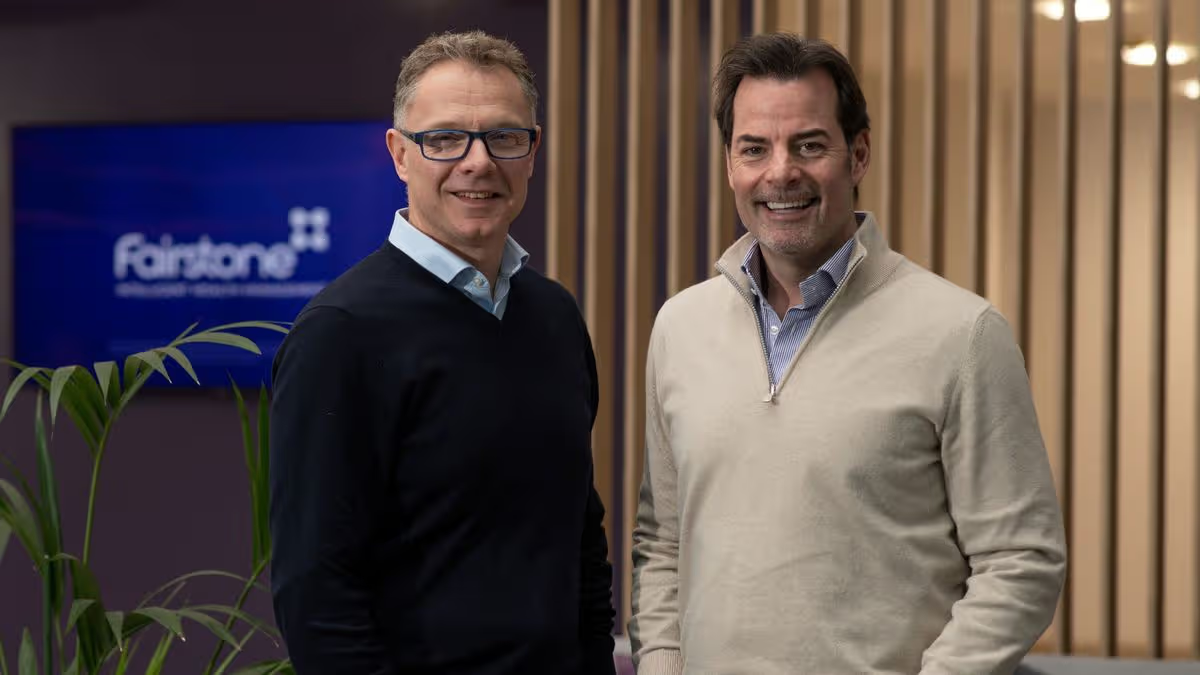
Steve McNicol and Steven Cooper at Fairstone Group.

Steve McNicol and Steven Cooper at Fairstone Group.(Image: Fairstone Group)

A North East wealth manager expects to have acquired more than 20 companies into the group by the end of the year, as a result of its established buy-out model.

Directors at Sunderland-based Fairstone Group have hailed a busy year in which it added “substantially” to the business, acquiring eight companies in Northern Scotland, Northern Ireland, the South of England, the West Country, the East Midlands and the North East. It said the acquisitions expand and strengthen its geographic footprint across the UK.

The transactions included Fairstone’s largest purchase to date, the acquisition of West Midlands wealth management and corporate financial planning specialist Prosperity Wealth in February.

All eight firms acquired in the first quarter came into Fairstone, based in Doxford International Business Park in Sunderland, via the Downstream Buy-Out (DBO) model. They have collectively pumped more than £2bn of client assets under management into the group.

Advertisement

And directors revealed 13 more full acquisitions will be made later this year. Fairstone’s DBO model sees the business act as an investment partner, providing the centralised resource, technology, and capital to support the ongoing growth of ambitious financial firms ahead of a future sale. Once fully integrated, partner firms are then able to sell to Fairstone.

Fairstone CEO Steven Cooper said: “I said in January that I expected a busy first full year as CEO and that has certainly been the case so far. In just the first quarter of the year, we have added substantially to the business, not only in terms of the bare figures of client assets under management, but also in terms of our strategic presence and the depth and breadth of the services which we can offer our clients.

“For example, bringing Prosperity on board has added substantially to our expertise in areas such as corporate financial planning and employee benefits. These are things which not only benefit those clients who Prosperity have brought with them to Fairstone, but also to our existing and future clients right across the country.

“Every one of the eight firms who became part of Fairstone during Q1 brings something new to the business and strengthens the group as we look to help many more people achieve their financial goals and face the future with confidence.”

Advertisement

The eight firms acquired so far this year initially joined the DBO programme between two and four years ago, enabling staff and processes to become fully integrated into Fairstone before becoming part of the group.

Fairstone now operates from more than 50 locations, employing over 1,350 operational staff and regulated advisers. It oversees £23bn in assets under management on behalf of over 125,000 clients.

Like this story? For more deals news you can visit our dedicated page for the latest news and analysis here.

Advertisement
Continue Reading

Trending

Copyright © 2025