

Crypto World
Bitcoin retests support below $75,000 as downside pressure holds



- Bitcoin price fell to below $75,000 on Wednesday, touching $74,600.
- ETF outflows and broader market headwinds mean downside pressure remains.
- Analysts say the current price outlook includes a “dangerous divergence”.
Bitcoin briefly dipped below the $75,000 mark on Wednesday, extending losses from recent highs.
The decline came as selling pressure persisted and spot ETF outflows continued for a seventh straight session.
BTC could rebound sharply if bulls establish sustainable support near current levels. Otherwise, analysts warn that further downside may follow amid a growing divergence between market optimism and actual capital inflows.
The crypto bellwether traded around $75,175 at the time of writing, down 1.29% over the past 24 hours and nearly 3% lower for the week.
Bitcoin tests support below $75k
The week started poorly for Bitcoin as recent gains toward $78,000 evaporated amid persistent geopolitical and macroeconomic headwinds.
On Wednesday, BTC fell to an intraday low of $74,600 during Asian trading hours, testing a support zone that has intermittently held since the asset’s latest recovery.
The move coincided with continued withdrawals from spot Bitcoin exchange-traded funds.
According to SoSoValue, Bitcoin spot ETFs recorded net outflows of $334 million on May 26.
The figure marked the seventh consecutive day of net redemptions, reinforcing downward pressure on price despite periodic spot-market buying.
Bitcoin price outlook: analysts warn of “dangerous divergence”
Market participants noted that Wednesday’s decline remained relatively orderly, with volatility lower than during previous sell-offs.
Liquidity continued to cluster in the $72,000-$76,000 range, where buyers repeatedly emerged to absorb intraday selling pressure.
Still, persistent ETF outflows and profit-taking from recent highs continue to tilt the near-term outlook to the downside.
Analysts and on-chain researchers have also raised caution flags over weakening demand dynamics.
Crypto investor and analyst Axel Adler Jr. shared concerns on X about what some market watchers describe as a “dangerous divergence” between rising optimism and fading capital inflows.
Bitcoin took 5 weeks to rebuild its structure.
It took 3 weeks to erase it.
Structure Shift: +0.78 -> -0.56 STH flows flipped to loss-taking for the first time in 6 weeks.
Now one level decides the next move:$74.5K.
Floor or trapdoor?
☕️ Morning Brief #178 👇… pic.twitter.com/92i4DG0sZ2
— Axel 💎🙌 Adler Jr (@AxelAdlerJr) May 27, 2026
That view was echoed by a CryptoQuant analyst, who argued that improving bullish sentiment has not been matched by fresh money entering the market.
“This often reflects late-stage speculative behavior: traders become optimistic after a recovery, long positioning increases, but actual capital participation fails to expand,” crypto analyst @MorenoDV wrote.
The analyst added that price strength built on weak inflows may remain vulnerable to sharp reversals.
Meanwhile, analysts at Bitfinex said Bitcoin’s current reaction to ETF outflows differs from earlier market downturns.
“The breakdown that took $BTC to 60k in February is not having the same impact on the market today. ETF outflows are running -$700M a day, close to the February prints that drove price from $100K to $70k. This time, the price is holding. An unidentified bid is absorbing it,” they wrote.
From a technical perspective, Bitcoin now appears caught between the risk of a deeper retracement toward $70,000 and the possibility of renewed bullish momentum.
If buyers regain control, recent highs in the $78,000-$83,000 range could come back into focus.

Crypto World
Falcon Finance and Anchorage Digital Bank Launch fUSD, a GENIUS-Ready Stablecoin with Rewards on Ceffu

[PRESS RELEASE – GEORGE TOWN, CAYMAN ISLANDS, May 27th, 2026]
- Issued by Anchorage Digital Bank, N.A., the first federally-chartered crypto bank in the U.S. with reserves under OCC supervision and attested monthly by Deloitte
- The GENIUS-ready stablecoin will launch on Ceffu’s institutional infrastructure with a rewards structure: qualifying institutional holders share in the economics of fUSD’s reserves, targeting an estimated 3% per year
- Rewards are paid by Falcon Finance, the commercial partner, under separate bilateral agreements with qualifying institutional holders, not by Anchorage, the issuer nor Ceffu, the custodian
- Falcon Finance will be a launch holder, deploying a portion of its own corporate reserves into fUSD from day one
With more than $320 billion in dollar stablecoins now in circulation and short-dated Treasury yields near 4%, holders collectively forgo well over $10 billion a year in potential returns — income that accrues to issuers rather than the desks holding the tokens. fUSD, launched today by Falcon Finance and Anchorage Digital Bank, N.A., is built to close that gap: a GENIUS-ready digital dollar that meets institutional compliance mandates while sharing a portion of its reserve economics with qualifying holders. The GENIUS-ready stablecoin will launch on Ceffu’s institutional custody and collateral infrastructure with a rewards structure.
Falcon Finance, the synthetic dollar protocol with $1.63 billion in USDf circulating supply and ranked among the top ten stablecoins on Ethereum by market cap, today announced the launch of fUSD, a U.S. dollar payment stablecoin issued by Anchorage Digital Bank, N.A. fUSD is GENIUS Act ready, the federal framework for payment stablecoins enacted on 18 July 2025.
The GENIUS Act restricts stablecoin issuers from paying interest or yield to holders. Anchorage Digital Bank issues fUSD but does not pay yield or rewards on the stablecoin itself. Rewards are offered by an entity separate from Anchorage Digital Bank, NA. and are tied to the stablecoin’s underlying collateral, such as U.S. Treasuries. Falcon Finance, as the name partner, operates an institutional rewards program, targeting roughly 3% per year. The rewards are available only to institutional entities that enter a contractual agreement with Falcon; no other regulated U.S. dollar stablecoin currently offers this structure to institutional holders.
fUSD is supported by Ceffu’s institutional custody and collateral infrastructure, the same platform used by leading trading firms and liquidity providers, including FalconX, Presto and Orderly. Falcon already uses Ceffu within its existing custody stack for USDf, its overcollateralized synthetic dollar. By launching fUSD on Ceffu, Falcon positions the stablecoin where professional desks, treasury desks, high-frequency trading firms, basis traders, and counterparties operating under tight compliance mandates, already manage collateral. For these desks, the most widely-used stablecoins return nothing on the balances they hold; a regulated, rewards-bearing dollar lets them improve the economics of their strategies without stepping outside their compliance requirements.
Falcon Finance will be a launch holder of fUSD, deploying a portion of its own corporate reserves into the stablecoin from launch, a signal of the firm’s confidence in the issuance framework and of how it expects institutional counterparties to engage with the product.
Andrei Grachev, Founding Partner of Falcon Finance, said: “The desks we work with operate under compliance mandates that synthetic and offshore stablecoins were never designed to satisfy, and the regulated dollars they can hold today pay them nothing. fUSD closes both gaps. It’s issued by a federally-chartered bank, backed by Treasuries, launched on the infrastructure these desks already use to manage collateral, and built so qualifying institutional holders can share in the economics of the reserves. We’re putting our own balance sheet behind it from day one.”
Nathan McCauley, CEO and Co-Founder of Anchorage Digital, said: “fUSD is built from the ground up for institutional use, and that’s only possible because of our federal bank charter. Falcon Finance is exactly the kind of partner the GENIUS framework was designed to serve: sophisticated, institutional, and choosing to operate inside U.S. regulation rather than around it.”
Ian Loh, CEO of Ceffu, said: “The integration of fUSD into Ceffu’s ecosystem delivers institutional-grade custody and collateral utility. We look forward to supporting Falcon Finance in expanding the institutional adoption and utility of stablecoins.”
Falcon Finance now operates two complementary dollar products. USDf, the overcollateralized synthetic dollar, continues to serve DeFi-native users and multi-collateral mandates. fUSD extends Falcon’s reach to federally-regulated treasury desks, compliance-constrained counterparties, and institutional collateral mandates that require a regulated, non-synthetic dollar.
About Falcon Finance
Falcon Finance is building a universal collateral layer that turns any liquid asset, including digital assets, currency-backed tokens, and tokenized real-world assets, into USD-pegged onchain liquidity. By bridging onchain and offchain financial systems, Falcon enables institutions, protocols, and capital allocators to unlock stable, yield-generating liquidity from assets they already hold.
About Anchorage Digital
Anchorage Digital is a global crypto platform that enables institutions to participate in digital assets through trading, staking, custody, governance, settlement, stablecoin issuance, and the industry’s leading security infrastructure. Home to Anchorage Digital Bank N.A., the first federally chartered crypto bank in the U.S., Anchorage Digital also serves institutions through Anchorage Digital Singapore, which is licensed by the Monetary Authority of Singapore; Anchorage Digital NY, which holds a BitLicense from the New York Department of Financial Services; and self-custody wallet Porto by Anchorage Digital. Anchorage Digital Bank also offers fiat custody services through the use of an FDIC-insured, licensed sub-custodian. Anchorage Digital is funded by leading institutions including Andreessen Horowitz, GIC, Goldman Sachs, KKR, and Visa, with a valuation of $4.2 billion. Founded in 2017 in San Francisco, California, Anchorage Digital has offices in New York, New York; Porto, Portugal; Singapore; and Sioux Falls, South Dakota. Learn more at anchorage.com, on X @Anchorage, and on LinkedIn.
About Ceffu
Ceffu is a compliant, institutional-grade custody platform offering custody and liquidity solutions that are ISO 27001 & 27701 certified and SOC2 Type 2 attested. Our multi-party computation (MPC) technology, combined with a customizable multi-approval scheme, provides bespoke solutions allowing institutional clients to safely store and manage their virtual assets.
About fUSD
fUSD is a U.S. dollar payment stablecoin issued by Anchorage Digital Bank, N.A. Subject to final applicable law, fUSD is GENIUS-ready, the federal framework for payment stablecoins. Each fUSD token is backed 1:1 by a reserve pool of cash, short-dated U.S. Treasuries, and Treasury-backed repo via eligible MMF exposure, held at Anchorage Digital Bank under federal supervision. Reserves are attested by Deloitte on a monthly and annual basis. fUSD is purpose-built for institutional trading desks, collateral mandates, and counterparties operating under federally-regulated compliance requirements.
fUSD is not a deposit, not FDIC insured, and not endorsed or guaranteed by the U.S. government.
The post Falcon Finance and Anchorage Digital Bank Launch fUSD, a GENIUS-Ready Stablecoin with Rewards on Ceffu appeared first on CryptoPotato.


HYPE ETFs have topped $100 million in cumulative net inflows within their first 10 trading sessions, giving Hyperliquid another institutional demand channel as interest in altcoin funds expands.
Summary
- HYPE ETFs crossed $100 million in cumulative net inflows within their first 10 trading sessions.
- The inflows are led by 21Shares’ THYP and Bitwise’s BHYP, two U.S. spot products tied to Hyperliquid’s native HYPE token.
- HYPE has gained nearly 50% this month, while Lookonchain reported that a trader made a $2.51 million profit over 46 days.
According to Farside Investors data, the funds added about $20 million in net inflows on Tuesday, lifting total inflows past the $100 million level. The early activity has come through two U.S. spot products tied to Hyperliquid’s native token, 21Shares’ THYP, and Bitwise’s BHYP.
HYPE funds draw early institutional demand
Farside Investors data showed that THYP and BHYP had already attracted $22.3 million in combined net inflows during their first week of trading. The same data showed that more than $11 million entered the products on a single trading day, giving the funds a fast start among recently launched altcoin investment vehicles.
Earlier this month, as previously reported by crypto.news, 21Shares launched the first U.S.-listed exchange-traded funds linked to Hyperliquid’s HYPE token. The launch included a spot product with staking exposure and a leveraged fund connected to the decentralized derivatives platform.
Bitwise also entered the market with BHYP, adding another regulated product for investors seeking exposure to HYPE without directly using crypto wallets or decentralized exchanges.
Hyperliquid’s trading activity supports ETF narrative
According to Bitwise, Hyperliquid processed $2.9 trillion in trading volume in 2025. Bitwise also said the platform accounted for about 60% of global on-chain derivatives open interest, placing it among the most active venues in decentralized trading.
ETF inflows have arrived, while Hyperliquid’s token model remains closely tied to platform activity. Hyperliquid directs nearly 99% of its revenue toward daily open-market HYPE buybacks, according to the project’s tokenomics structure.
Bitwise has also said it will use 10% of BHYP management fees to buy HYPE and stake the tokens on its corporate balance sheet. That structure gives the fund another link to the underlying token beyond investor inflows.
HYPE rises nearly 50% this month
CoinMarketCap data showed HYPE trading near $59.84 at the time of writing, down more than 1% over the past 24 hours. Even with the daily decline, the token has gained nearly 50% this month, while major crypto assets have struggled to sustain a steady advance over the same period.
The price move has also brought attention to large individual trades. According to Lookonchain, one trader created a new wallet 46 days ago and used $5 million in USDC to buy HYPE.
Lookonchain said the trader sold the full position on Tuesday for $7.51 million. The sale produced a $2.51 million profit in 46 days, according to the on-chain tracker.
The latest inflow figures show that demand for crypto ETFs is no longer limited to Bitcoin and Ethereum products. Recent launches tied to Solana, XRP, and now Hyperliquid have added more choices for investors using regulated market products.
Key points:
- Bitcoin is under pressure as net outflows from the BTC ETFs highlight a shift in institutional investor sentiment.
- Most major altcoins look weak, suggesting the bears are in control.
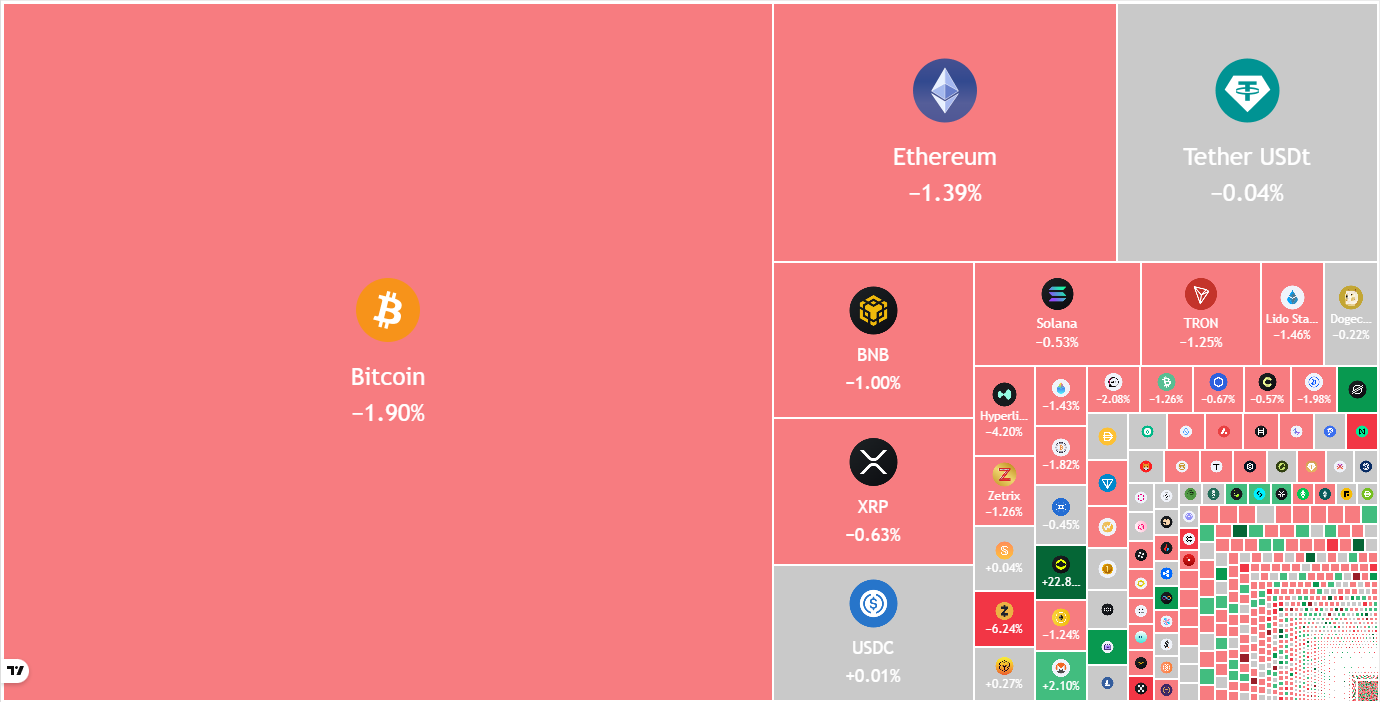
Bitcoin (BTC) fell below $75,000 on Wednesday, indicating that the bears are slowly taking charge of the crypto market. Institutional investors seem to be on a selling spree, with BTC exchange-traded funds recording net outflows of $1.88 billion since May 15, per Farside Investors’ data. Glassnode said in a post on X that persistent net outflows from BTC ETFs on nearly every trading day since May 7 add “to the supply side without a visible demand offset.”
BTC’s weakness has sent it tumbling below its long-term valuation average, according to Bitwise. The asset management firm said in a recent report that in the past, only 36% of BTC’s market-value-to-realized-value (MVRV) readings were lower than the current level of 1.42. In comparison, roughly 99% of historical Nasdaq-100 price-to-book ratios were below their present levels, signaling the widest valuation gap on record between BTC and US tech stocks.
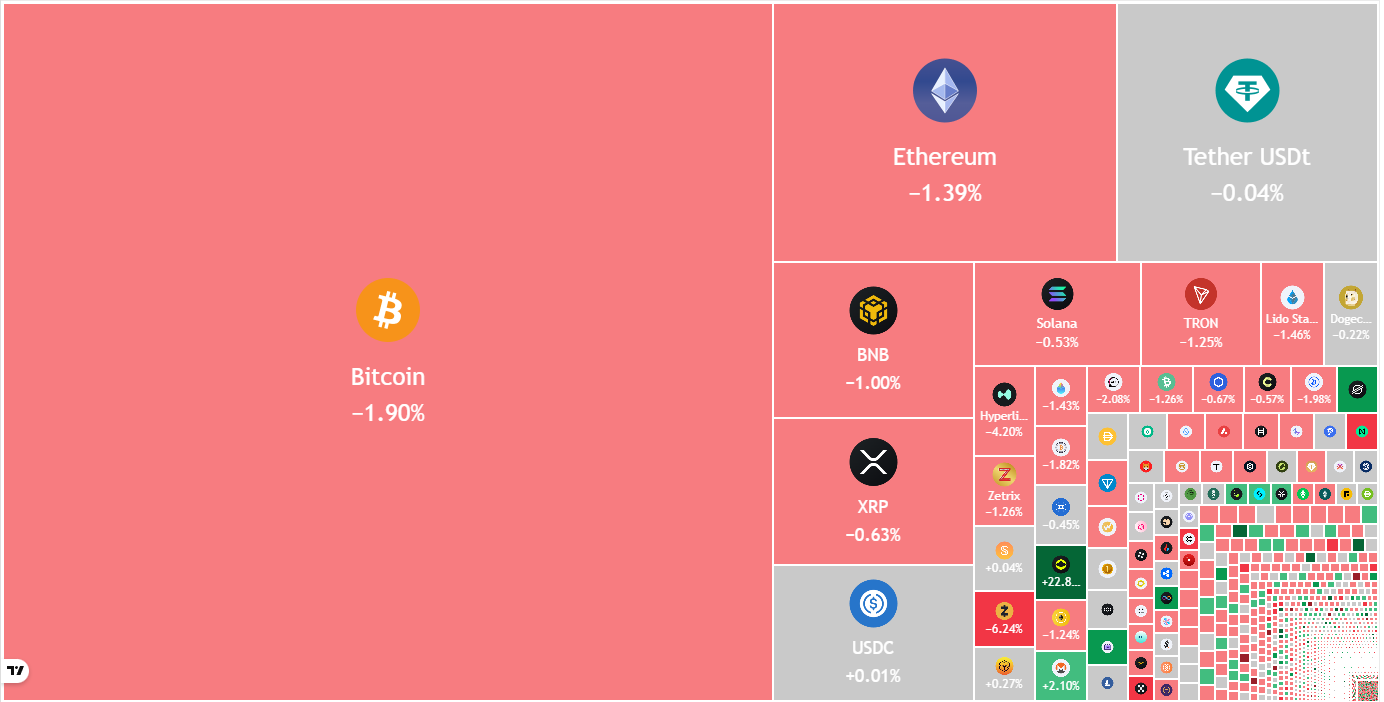
Crypto market data daily view. Source: TradingView
While others panic, a whale has used the drop as a buying opportunity. Blockstream CEO Adam Back said in a post on X that a BTC whale had hoovered up 450 “cheap Bitcoins” per day for the past eight and a half days using a time-weighted average price method.
Could BTC and select major altcoins bounce off their strong support levels? Let’s analyze the charts of the top 10 cryptocurrencies to find out.
Bitcoin price prediction
BTC turned down from the 20-day exponential moving average ($77,431) on Tuesday, signaling that the bears are selling on minor relief rallies.
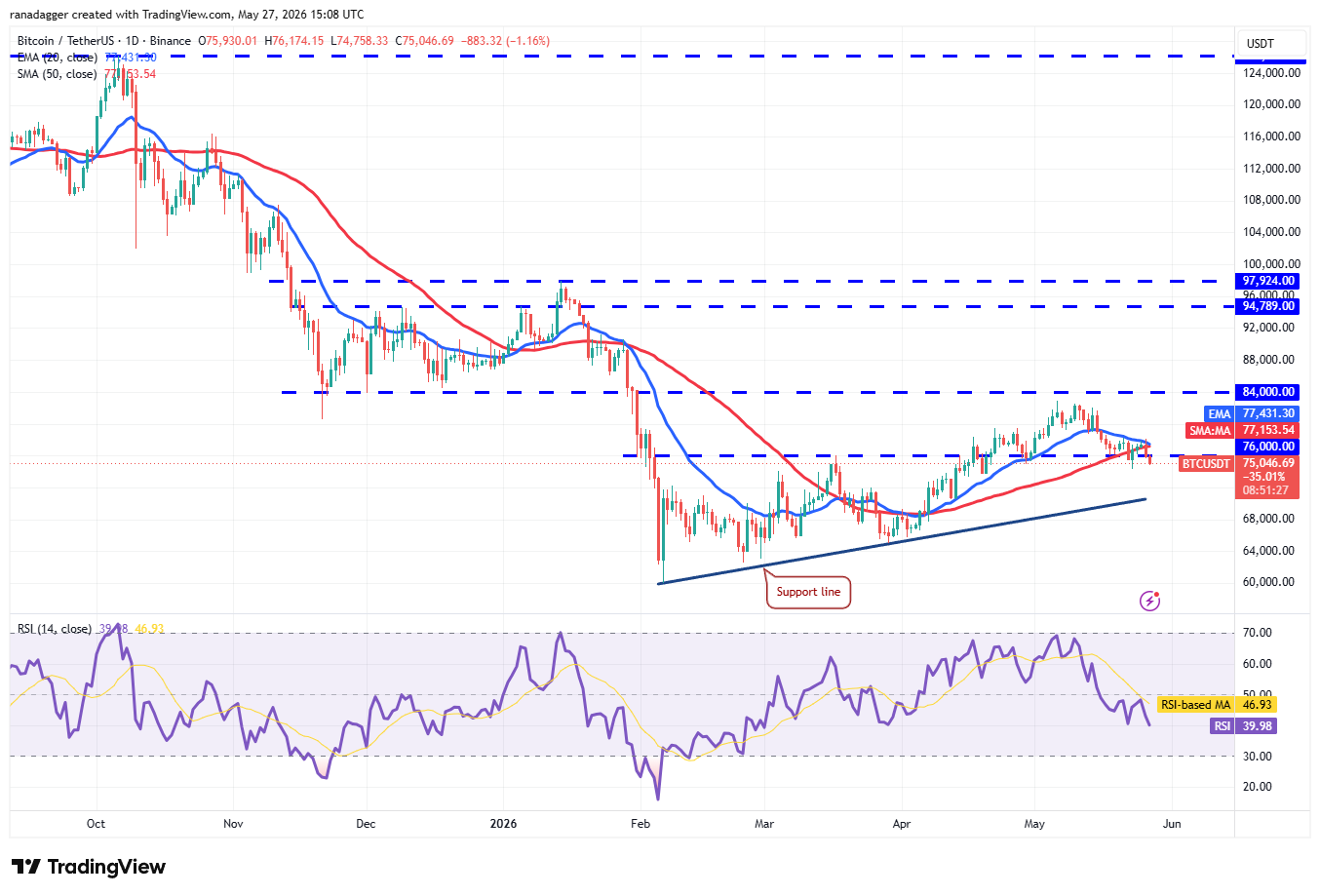
BTC/USDT daily chart. Source: Cointelegraph/TradingView
The bulls will attempt to defend the crucial $76,000 to $74,289 support zone, while the bears will strive to pull the BTC price below it. If the support zone crumbles, the short-term advantage will tilt in favor of the bears. The BTC/USDT pair may then descend to the support line near $70,500, which is likely to attract buyers.
On the contrary, if the price bounces off the support zone, the bulls will again strive to drive the pair above the 20-day EMA. If they succeed, the pair may rally to $82,000 and then to $84,000.
Ether price prediction
Buyers have failed to push Ether (ETH) back above the support line, indicating that the bears are attempting to flip the level into resistance.
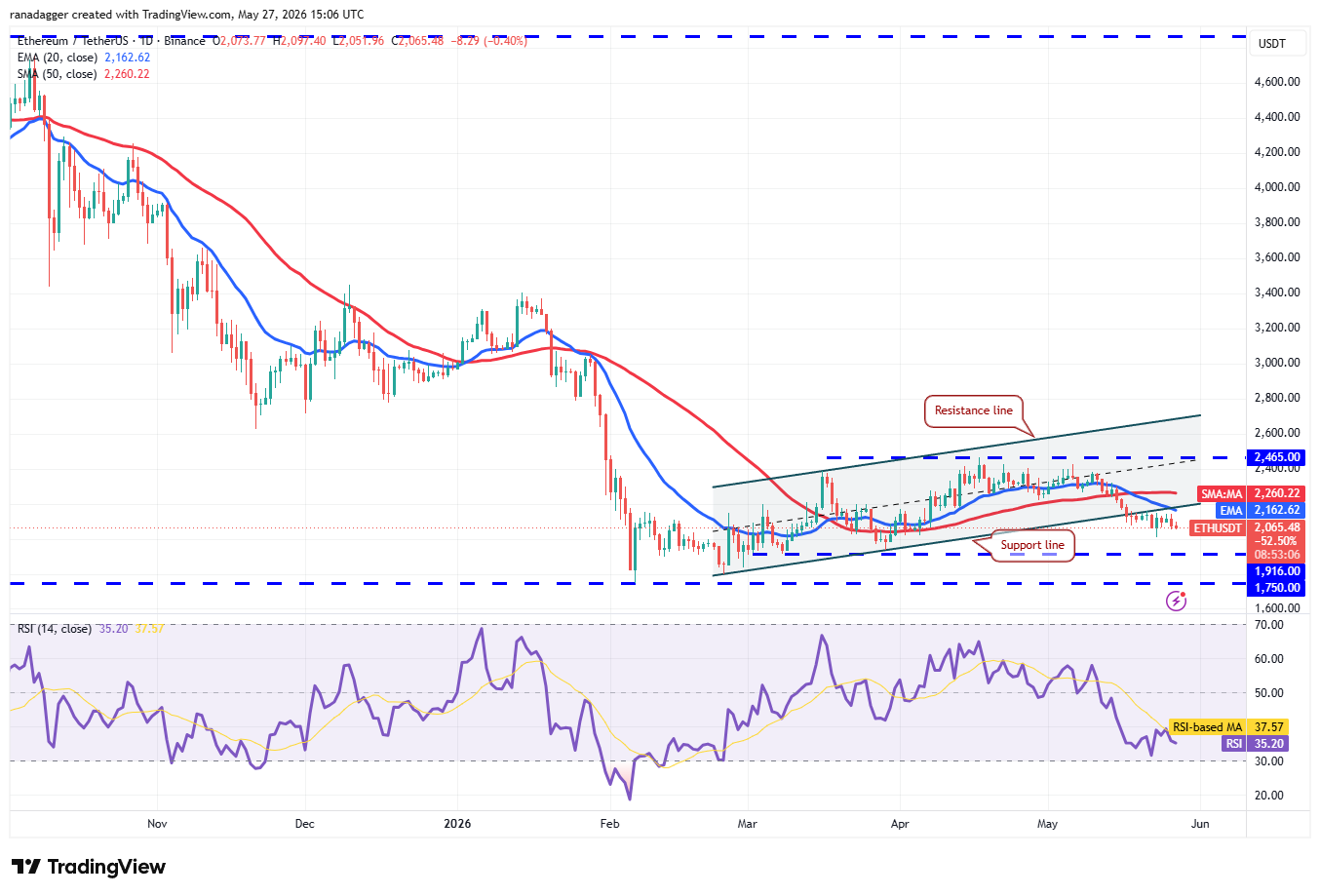
ETH/USDT daily chart. Source: Cointelegraph/TradingView
There is psychological support at $2,000, but if that level cracks, the ETH/USDT pair may decline to the $1,916-$1,750 zone.
Buyers have an uphill task ahead of them. They will have to push the ETH price above the moving averages to signal strength. If they do that, it suggests that the market has rejected the breakdown below the channel. That increases the likelihood of a rally to $2,465, then to the channel’s resistance line.
BNB price prediction
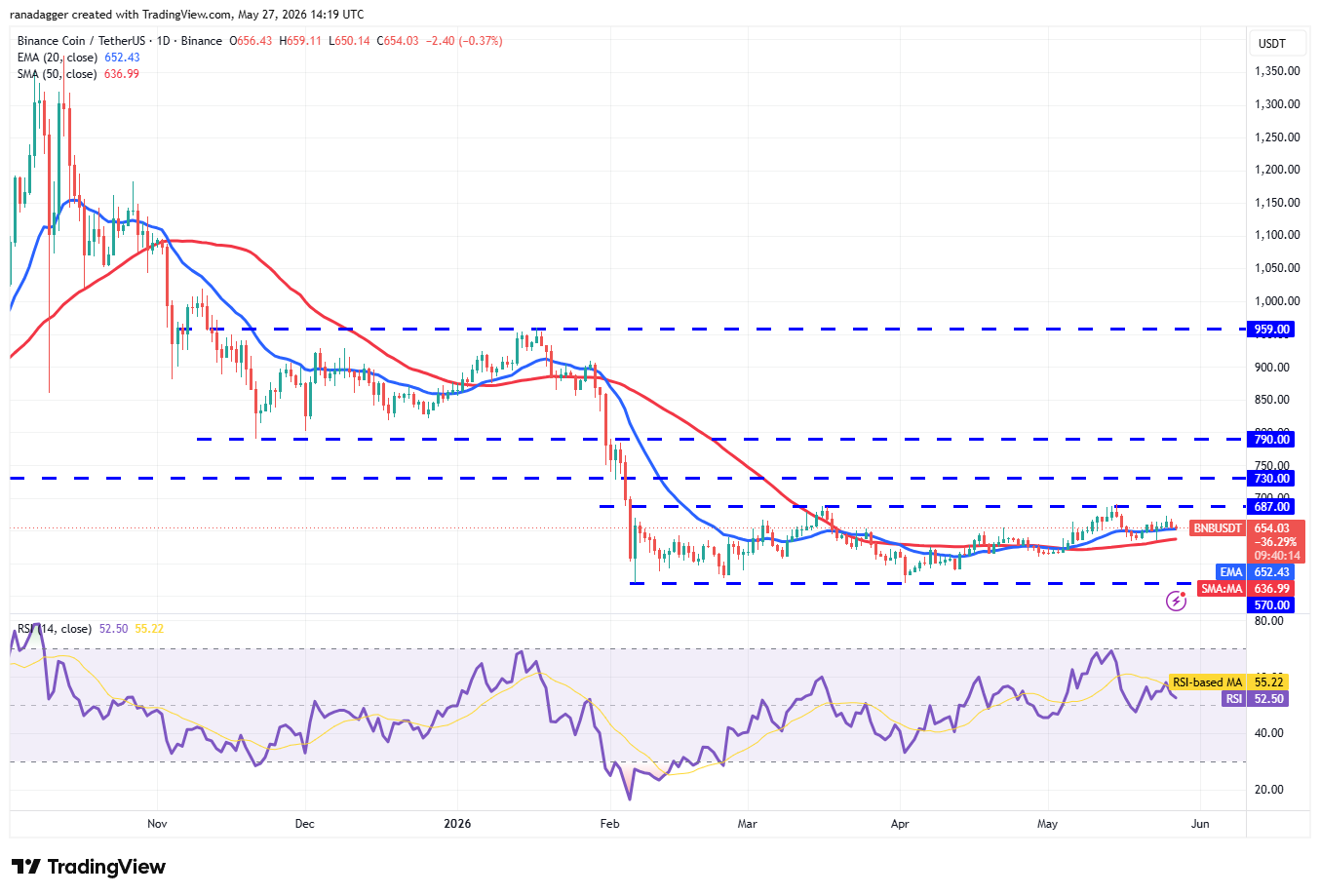
Buyers are attempting to sustain BNB (BNB) above the 20-day EMA ($652), but the bears have kept up the pressure.
BNB/USDT daily chart. Source: Cointelegraph/TradingView
If the 20-day EMA gives way, the bears will strive to strengthen their position by pulling the BNB price below the 50-day SMA ($636). If they can pull it off, the BNB/USDT pair may tumble to $610, then to $570.
Conversely, if the price rebounds off the moving averages, it suggests demand at lower levels. The bulls will then again endeavor to clear the $687 overhead hurdle. If they do that, the pair may rally to $730 and then to $790.
XRP price prediction
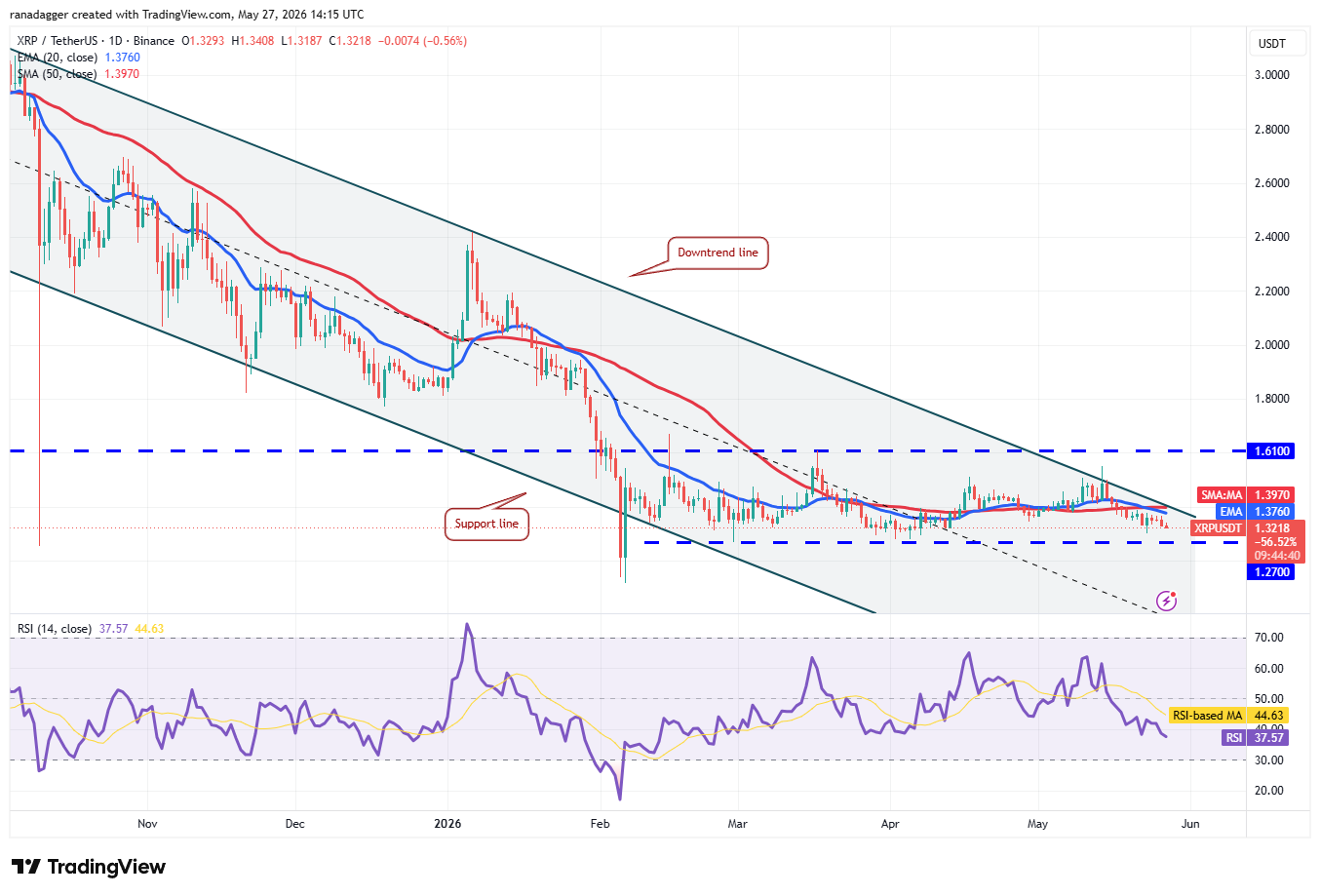
XRP (XRP) continues to gradually slide toward the $1.27 support, indicating that the bears remain in control.
XRP/USDT daily chart. Source: Cointelegraph/TradingView
Buyers are expected to mount a strong defense at $1.27, but the relief rally is likely to face selling at the 20-day EMA ($1.37) and then at the downtrend line. If the XRP price declines sharply from the 20-day EMA, it increases the likelihood of a break below $1.27. If that happens, the XRP/USDT pair may plunge to $1.11 and then to $1.
The first sign of strength will be a break and close above the downtrend line. The pair may then climb to the $1.61 resistance. Buyers will have to pierce the $1.61 level to signal a potential trend change.
Solana price prediction
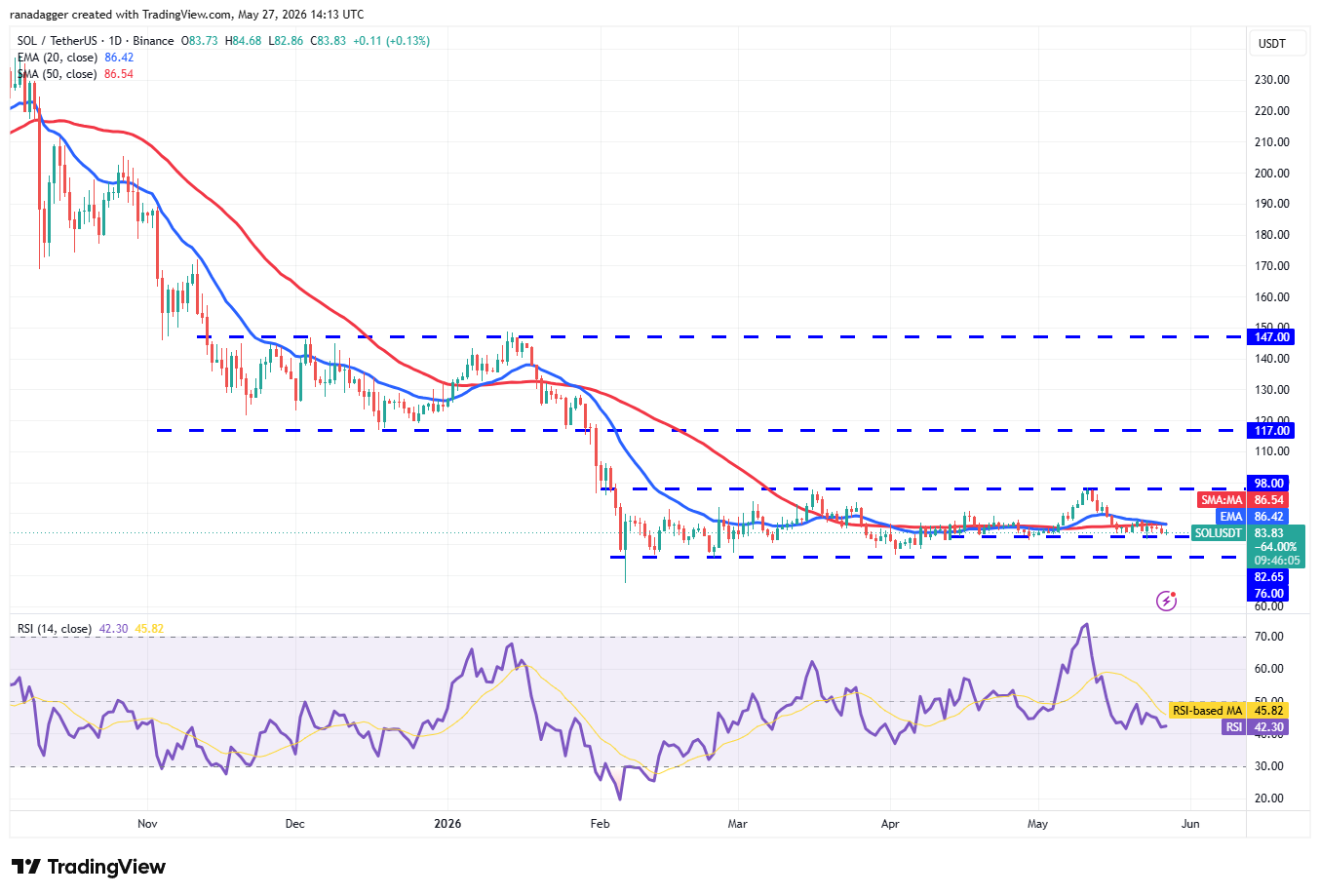
Solana’s (SOL) has been getting squeezed between the 20-day EMA ($86.42) and the $82.65 support.
SOL/USDT daily chart. Source: Cointelegraph/TradingView
The 20-day EMA has started to turn down, and the RSI is in the negative territory, indicating a slight edge to the bears. If the price breaks below $82.65, the SOL/USDT pair may plummet to the $76 support.
Alternatively, if the SOL price rises sharply from the $82.65 level and breaks above the 20-day EMA, it suggests the pair may remain within the $76 to $98 range for a while longer.
Dogecoin price prediction
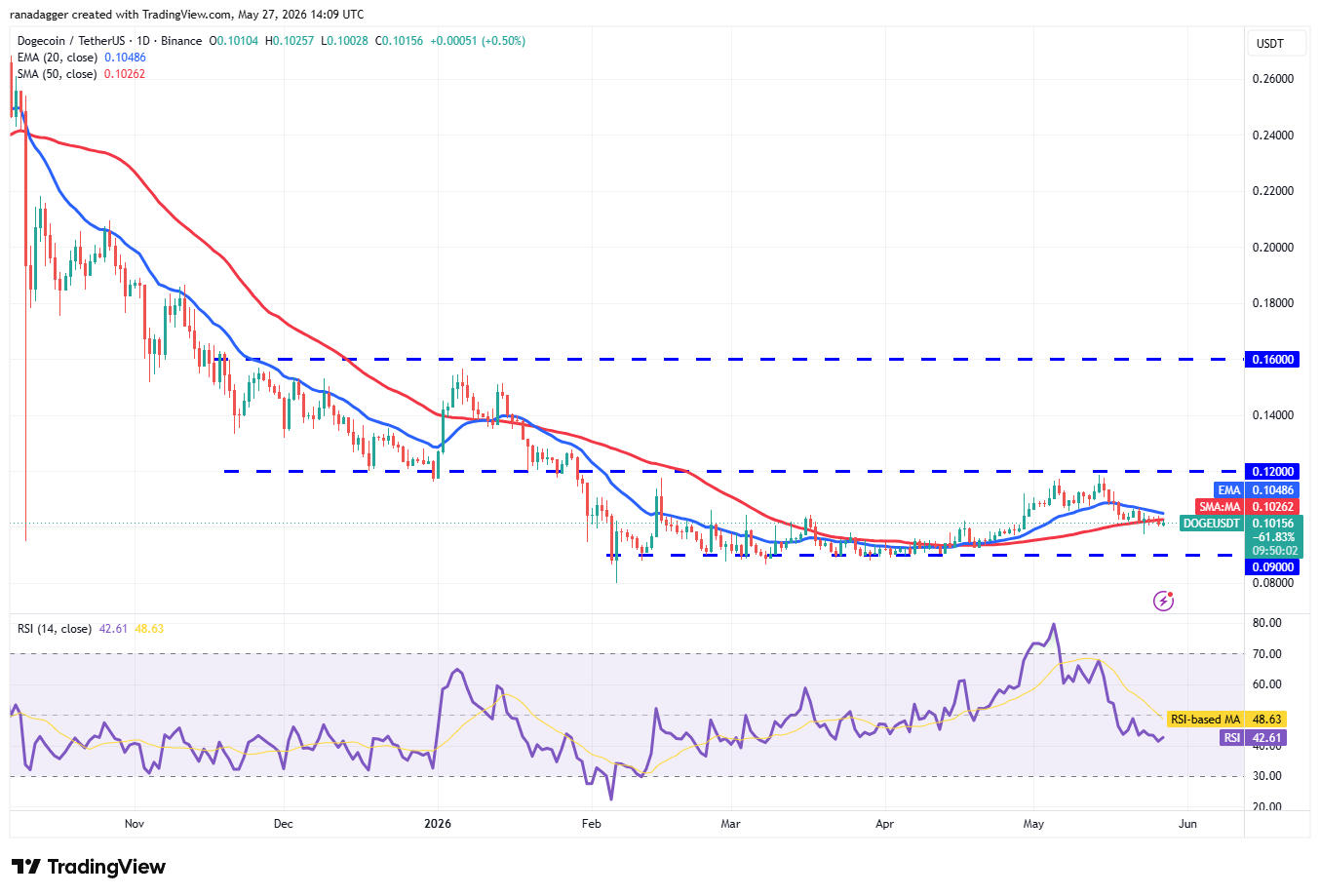
The failure of the bulls to push Dogecoin (DOGE) above the 20-day EMA ($0.10) suggests a negative sentiment.
DOGE/USDT daily chart. Source: Cointelegraph/TradingView
Sellers are attempting to sink the DOGE price below $0.10, opening the door to a retest of $0.09 support. Buyers are expected to defend the $0.09 level with all their might, as a close below it may sink the DOGE/USDT pair to $0.08.
Contrary to this assumption, if the price rises and closes above the 20-day EMA, it suggests the pair may extend its range-bound action between $0.09 and $0.12 for a few more days. Buyers will have to secure a close above $0.12 to start a new uptrend toward $0.14 and then $0.16.
Hyperliquid price prediction
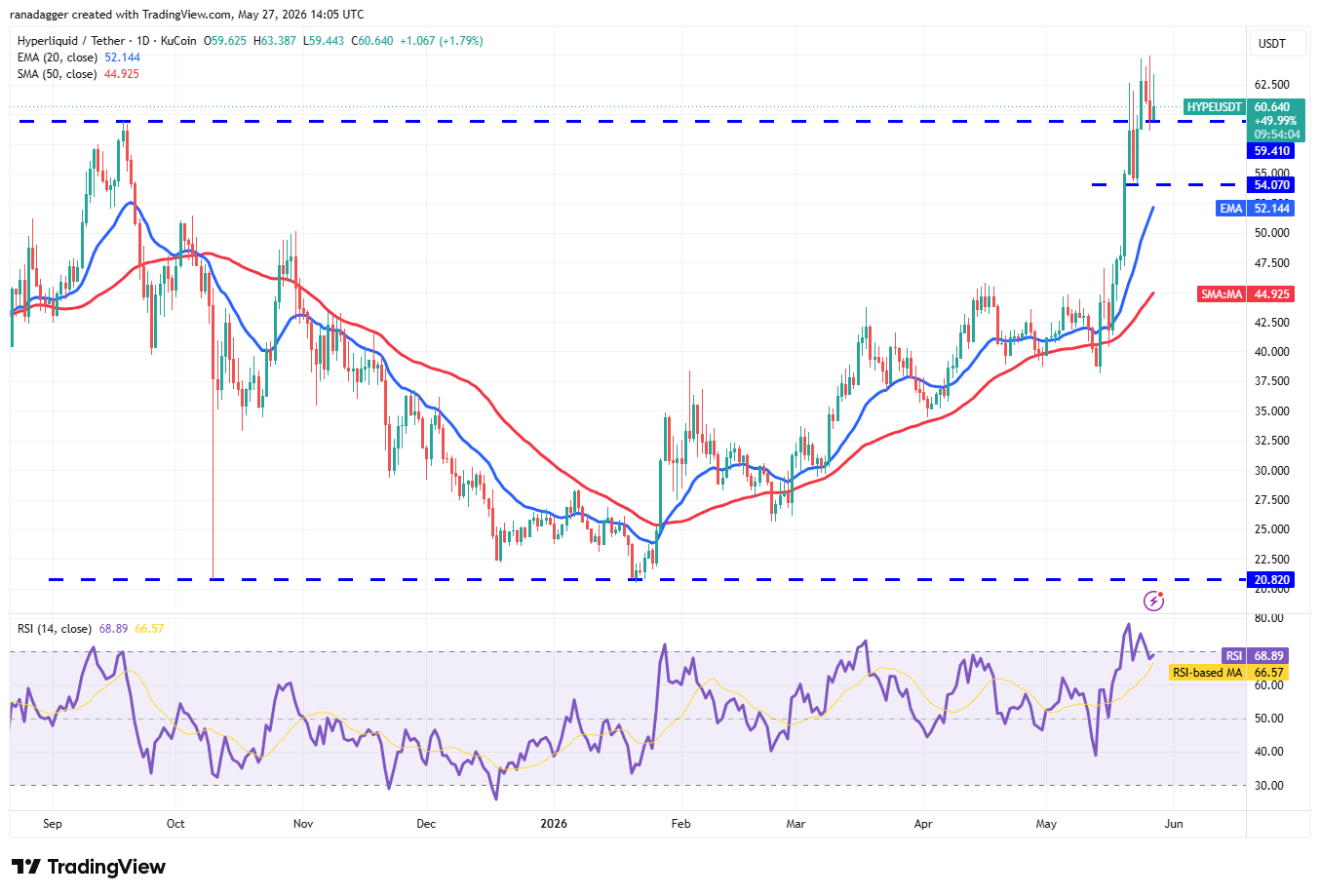
Hyperliquid (HYPE) pulled back from $64.93 on Monday, signaling profit-booking by short-term traders.
HYPE/USDT daily chart. Source: Cointelegraph/TradingView
The bulls are attempting to arrest the pullback at the breakout level of $59.41. If they succeed, it suggests that the bulls have flipped the level into support. That improves the prospects of a break above the $64.93 level. The HYPE/USDT pair may then surge toward $77.
Instead, if the HYPE price breaks below $59.41, the correction may deepen to the 20-day EMA ($52.14). Buyers are expected to fiercely defend the 20-day EMA, as a slide below it would signal the start of a deeper correction toward the 50-day SMA ($44.92).
Related: Three key XRP metrics suggest ‘explosive price expansion’ is next
Zcash price prediction
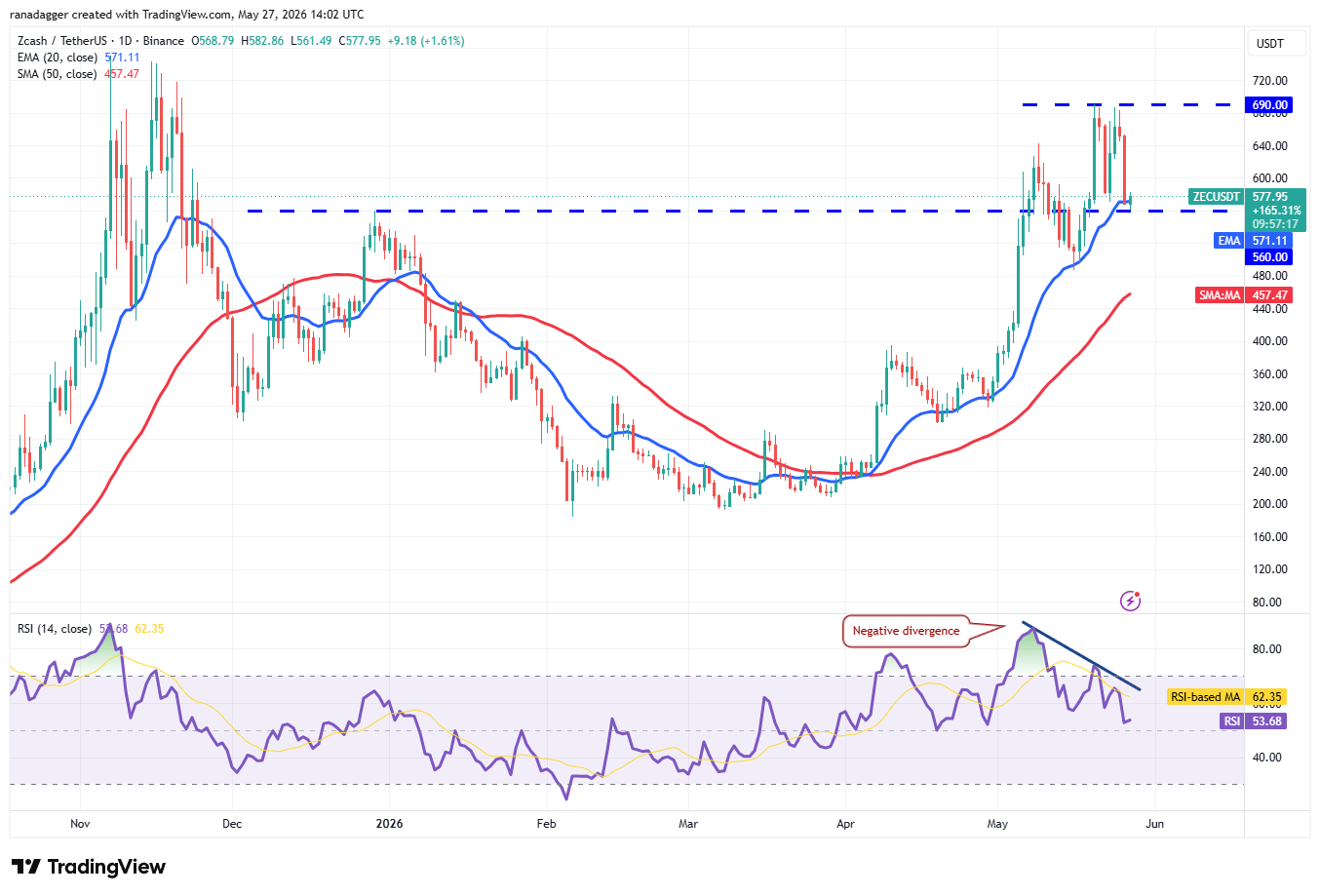
Zcash (ZEC) declined from the $690 level on Monday, indicating profit-taking by short-term traders.
ZEC/USDT daily chart. Source: Cointelegraph/TradingView
Sellers are attempting to sustain the price below the 20-day EMA ($571), opening the door to a deeper correction. If they manage to do that, the ZEC price may plummet to $486 and then to the 50-day SMA ($457).
The 20-day EMA is flattening, and the RSI has dropped toward the midpoint, indicating that the bulls are losing their grip. Buyers will have to thrust the ZEC/USDT pair above $690 to seize control.
Cardano price prediction
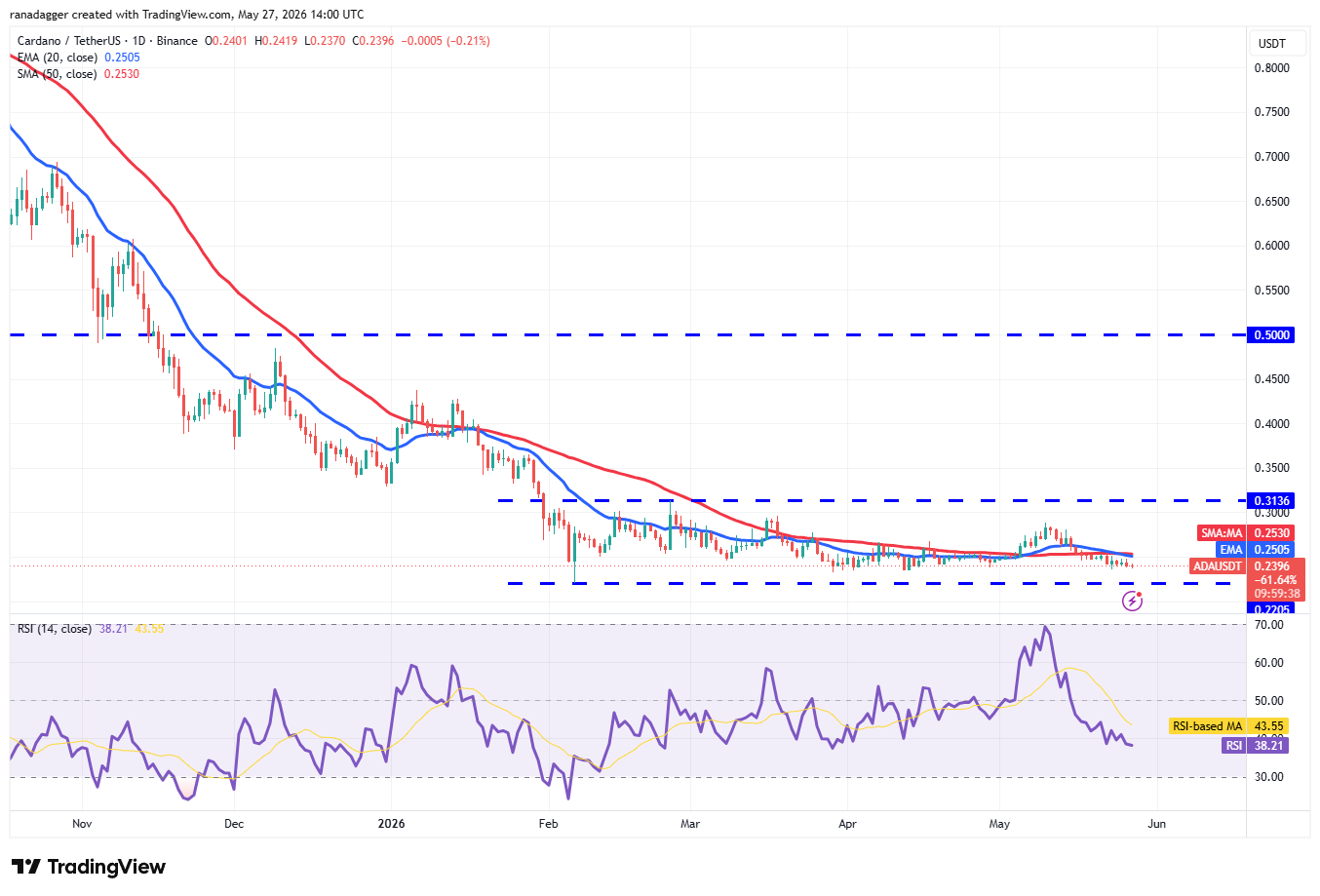
Cardano (ADA) remains below its moving averages, indicating that the bears have the advantage.
ADA/USDT daily chart. Source: Cointelegraph/TradingView
Sellers will endeavor to pull the ADA price to the $0.22 support. Any attempt by the bulls to start a recovery is expected to face strong selling at the 20-day EMA ($0.25). If the price declines sharply from the 20-day EMA, it increases the risk of a break below $0.22.
On the upside, a break and close above the moving averages suggests that the ADA/USDT pair may continue to oscillate inside the $0.22 to $0.31 range for some more time. The next trending move is expected to begin on a close above $0.31 or below $0.22.
Monero price prediction
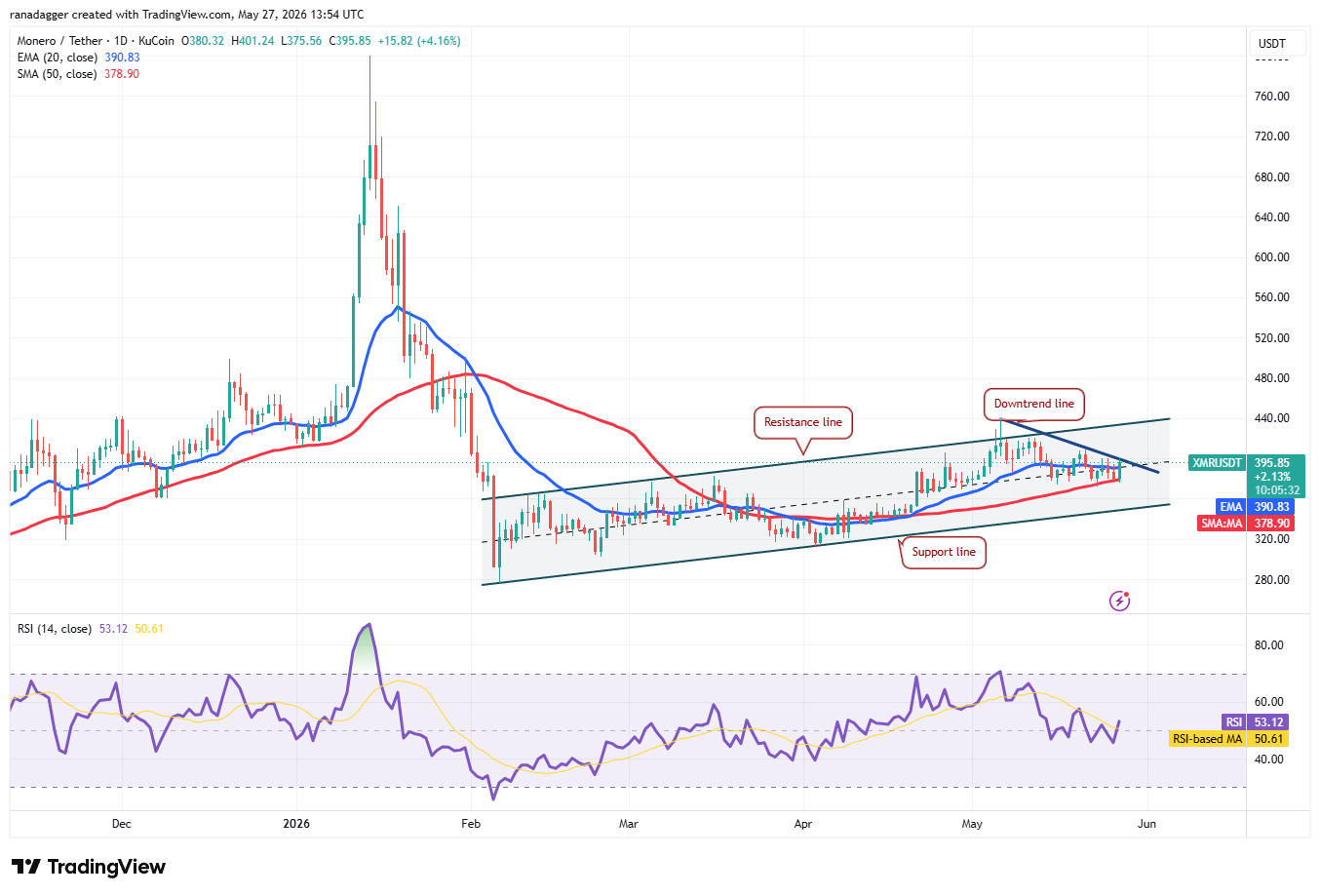
Monero (XMR) has been trading within an ascending channel, suggesting buyers have the edge.
XMR/USDT daily chart. Source: Cointelegraph/TradingView
The XMR price has bounced off the 50-day SMA ($378), indicating buying on dips. There is resistance at the downtrend line, but if the level is breached, the XMR/USDT pair may rise toward the resistance line. The bullish momentum may pick up if buyers drive and maintain the price above the resistance line.
Contrarily, if the price turns down from the downtrend line and breaks below the 50-day SMA, it suggests that the bears are selling on rallies. The pair may then drop to the support line.

Bankless co-founder David Hoffman said he sold his Ether holdings because he believes the long-standing “ETH is money” thesis has already largely played out. Despite this, he remains strongly bullish on Ethereum as a network.
According to Hoffman, the decision did not come lightly, given that he built his career, business, community, and identity around Ethereum.
Ethereum Chose the Hard Path Unlike Bitcoin
In his latest tweet, Hoffman stated that the “ETH is money” thesis depended on Ethereum succeeding across multiple layers of coordination, including decentralized leadership, governance, Layer 2 ecosystems, roadmap execution, and technological development.
Hoffman described Ethereum as “not Bitcoin,” and said that Bitcoin simplified its blockchain to maximize the value of BTC, while Ethereum pursued a more ambitious path by expanding utility across decentralized applications, finance, tokenization, and infrastructure. He even went on to add that Ethereum achieved part of that vision and earned the market capitalization it currently has, but said the opportunity for ETH to be significantly rerated higher by the market now appears to be closing.
The Bankless co-founder also explained that the broader “strong version” of crypto, which focused on decentralized finance, NFTs, DAOs, and crypto-native systems, failed to maintain long-term mainstream support outside the 2020 to 2022 period. He said crypto’s reputation later became associated with scams, grifts, and speculative behavior, which ended up weakening the social belief system required for ETH to function as money at a global scale.
He further stated that Ether’s utility increasingly benefits other forms of money, especially stablecoins and tokenized dollars, rather than ETH itself. Hoffman described Ethereum as a “giver, not a taker,” while saying that the network provides secure blockspace, tokenization infrastructure, and DeFi support at minimal cost rather than extracting maximum value for ETH holders. He said Ethereum’s architecture prioritizes applications, rollups, and ecosystem growth over ETH itself, which makes it difficult for the underlying crypto asset to fully achieve global money status without overwhelming market dominance.
Ethereum in Crisis?
Hoffman’s decision also comes at a time when bearish sentiment around Ethereum has been intensifying. A recent report by Santiment found that social media discussions have increasingly shifted from optimism toward frustration and concerns about further downside.
The analytics firm said traders have increasingly viewed ETH as “dead money” compared to stronger-performing crypto assets in 2026, as weakening ETF flows, declining on-chain activity, and growing competition from ecosystems such as Solana and BNB Chain added pressure on sentiment.
Rumors about prominent Ethereum figures reducing or exiting ETH positions, including discussions surrounding Hoffman, have also contributed to rising uncertainty in the market, especially as traders worried about insiders losing confidence in the asset.
The post “Ethereum Is a Giver, Not a Taker”: David Hoffman Explains ETH Exit appeared first on CryptoPotato.
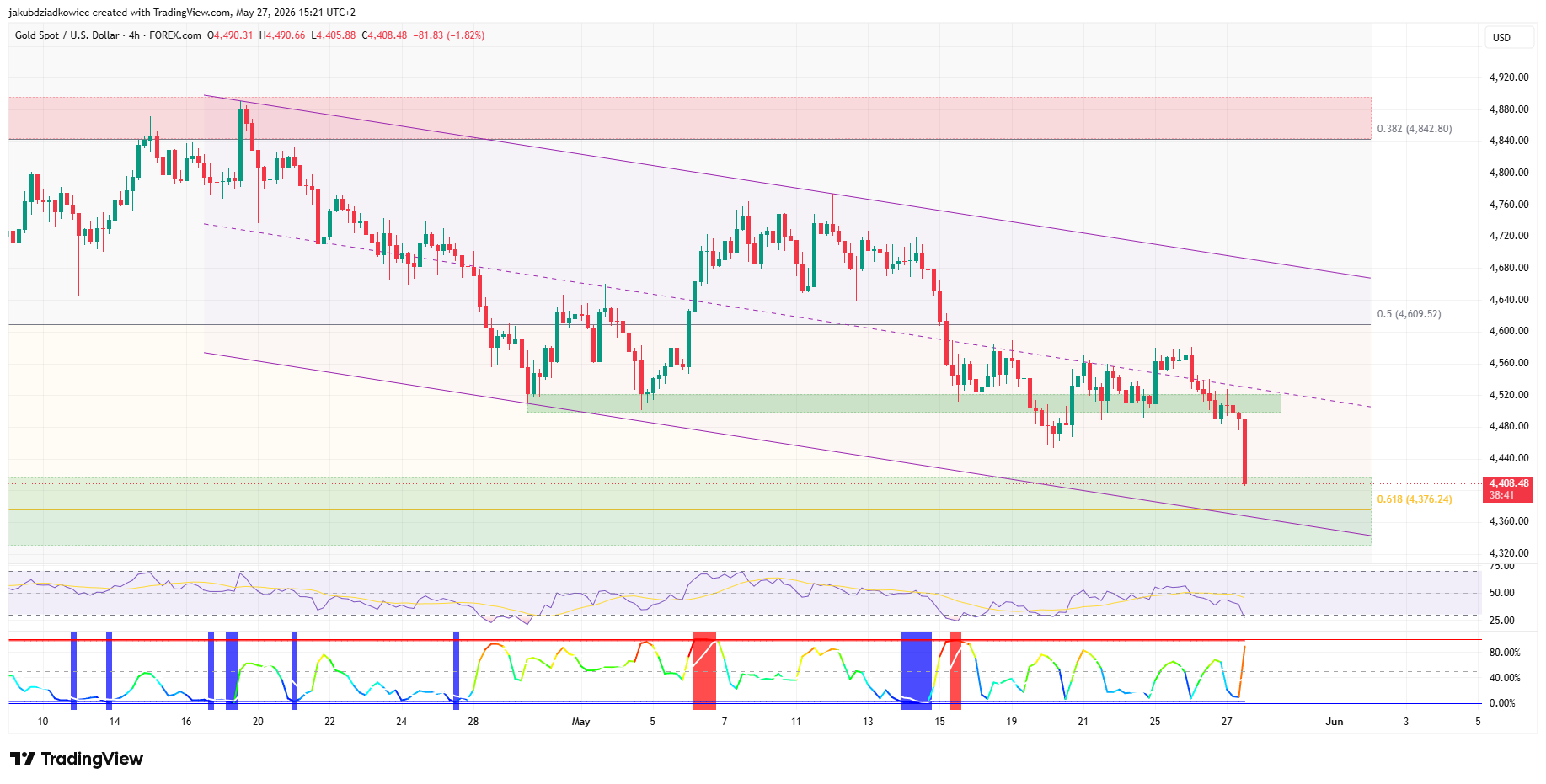
Gold (XAU) is sliding toward the $4,376 support zone as bearish momentum accelerates. The metal broke down from a parallel triangle on May 15 and trades near $4,410 after a 2% daily drop.
Both daily and 4-hour charts flash deepening bearish momentum. Relative strength index readings are pushing into oversold territory, and Bollinger Band Width Percentile expansion confirms the strength of the downtrend.
4-Hour Chart Loses Channel Midline as RSI Hits 27
On the 4-hour timeframe, gold has slipped beneath the midline of a descending parallel channel. Price now trades near the lower band of that structure, just above the 0.618 Fibonacci retracement at $4,376.
The 4-hour relative strength index has fallen to 27, planting the indicator deep inside oversold territory. Meanwhile, Bollinger Band Width Percentile readings have reached extremely volatile zones. That profile often accompanies strong directional continuation rather than reversal.

A reclaim of the $4,609 channel midline would be the first sign that the short-term bearish setup has stalled. Until then, dips into the lower band remain in line with the dominant trend. BeInCrypto flagged the same bearish setup in earlier coverage.
Daily RSI and BBWP Reinforce the Broader Downtrend
The daily timeframe shows a similar bearish structure. However, daily RSI reads 36, well above the 4-hour oversold extreme. That gap leaves room for the higher-timeframe trend to extend without triggering an immediate mean reversion bounce.
BBWP on the daily chart has just started to expand after weeks compressed inside the very low blue zone. Historically, volatility breakouts from compressed conditions tend to extend rather than fade. The pattern supports the case for continued downside on the higher timeframe.

Gold lost the lower trendline of the prior parallel triangle on May 15 and has trended lower since. Therefore, the current sell-off extends that breakdown rather than counter-trending against it. The move mirrors the channel-based breakout framework BeInCrypto highlighted earlier this month.
Gold (XAU) Price Prediction Targets $4,044 Below $4,376 Support
On the daily chart, the immediate test is the 0.618 Fibonacci retracement at $4,376. A clean break below that zone opens the path toward the 0.786 Fibonacci at $4,044. That level marks the next major support cluster on the long-term Fib map.
However, if buyers defend $4,376, the first upside target sits at $4,609. A deeper relief rally could probe long-term resistance at the 0.382 Fibonacci near $4,842. That level has capped every bounce since the February peak above $5,600. The BeInCrypto May 2026 forecast tracks the same resistance band.
Meanwhile, X analyst CelalKucuker has mapped an even more aggressive downside path. His sequence projects a year-end 2026 target of $3,500.
“Gold 5600$ 4350$ 5250$ 4000$ 5000$ 4600$ 4200$ (almost) 3500$ 2026 end of year”

The outlook aligns with the bearish projection sketched on the higher-timeframe chart. Price targets there cascade from $4,234 toward $3,475. The path contrasts sharply with the $20,000 speculation circulating in derivatives markets.
For now, the daily channel and BBWP expansion suggest the path of least resistance remains to the downside. That outlook holds until $4,376 proves it can absorb sustained selling pressure.
The post Gold Price is Turning Bearish Fast as Key Support Above $4,300 is Tested appeared first on BeInCrypto.


- Avalanche’s network has reached a new record high in distributed RWA value.
- Data shows over $1.16 billion on-chain, boosted by BlackRock.
- AVAX price looks to hold $9.00 support amid this ecosystem growth.
Avalanche price hovered $9.25 on Wednesday as bulls attempted to solidify the uptick from intraday lows of $9.10.
The declines had put AVAX price down about 4% in the past 24 hours amid wider market weakness, with most altcoins shedding gains after Bitcoin briefly slipped below $75,000.
While the pullback in BTC could continue to pressure altcoins, could AVAX bounce to above $10.00 as the project hits a new high in terms of distributed real-world assets?
Avalanche RWA ecosystem sees sharp growth
Latest data indicates that Avalanche’s RWA ecosystem has recorded fresh momentum this month, reaching a new milestone for distributed RWAs on-chain.
Distributed RWAs represent assets that use the network as a distribution layer to enable investors to subscribe, hold, and manage tokenized securities or instruments through wallets or custodians.
Rwa.xyz values Avalanche shared shows the metric has surpassed $1.16 billion, with the network posting roughly 58% growth in distributed RWA value over the past two weeks.
Much of the uptick to increased activity from large institutional issuers and managers, notably BlackRock’s additional allocations to its USD Institutional Digital Liquidity (BUIDL) Fund.

Such flows into Avalanche-based products have pushed capital onto the chain, attracted liquidity providers, and boosted ancillary services such as custody, compliance tooling, and secondary-market trading.
As a whole, these services make Avalanche an appealing distribution layer for tokenization projects.
Industry observers say the growth reflects a broader trend by which the global value of tokenized assets has expanded significantly over the last year as institutions race to capture efficiencies from programmable settlement and fractional ownership.
AVAX price outlook
The AVAX token has struggled to recapture the momentum that pushed it to highs of $33 in late 2025.
From a technical perspective, AVAX’s daily chart shows the token under short-term pressure.
The Relative Strength Index (RSI) has edged lower toward neutral territory, signaling that momentum has weakened following the recent retracement.

Key support levels to monitor include $9.00 and $8.30, which align with recent intraday lows.
A deeper support band lies near $7.40, a level that would be tested if broader risk-off selling intensifies.
On the upside, resistance could emerge around $10.40, where sellers previously capped rallies.
The $12 area offers a more significant barrier tied to moving-average confluence and prior supply.
What’s the near-term outlook?
In the near term, AVAX’s direction is likely to remain correlated with BTC price action and institutional flows into Avalanche’s RWA products.
Renewed buyer interest, particularly if institutional subscriptions continue, could propel a recovery toward resistance.
Conversely, a sustained crypto-wide pullback would increase downside risk and test the supports outlined above.


A forty-year-old Texas bank is stepping onto the national stage to challenge Wall Street’s push to get a grip on the digital asset industry.
United Texas Bank (UTB) secured approval from the Office of the Comptroller of the Currency (OCC) to convert from a state-chartered financial institution into a nationally chartered bank on May 15, Scott Beck, the president and CEO of the firm, told CoinDesk on Wednesday.
The conversion move, Beck added, is to position his crypto-friendly bank as the primary bridge between the cryptocurrency industry and traditional financial institutions and to provide digital asset services he said the UTB has years fully delivering, while “Wall Street continues to tiptoe.”
The conversion granted by the OCC came with two conditions that Beck said have now been met. “Those conditions were satisfied as of today, May 27,” he said. Since 2024, the UTB operated under a Consent Order with the Federal Reserve, which related to its Bank Secrecy Act and compliance infrastructure.
“Rather than viewing that as a setback, we treated it as a mandate to build something exceptional, and we did. The result is UTB PRISM SENTINAL, our proprietary BSA/AML compliance platform,” he said.
The milestone makes the UTB one of the first banks in the U.S. to successfully complete an OCC conversion since the passage of the Dodd-Frank Act 15 years ago, Beck added. He said the conversion also uniquely positions UTB as a bridge between crypto firms worldwide into the U.S. banking system, access that very few banks today are willing to give.
“The concept for United Texas Bank is a centralized value hub,” said the chair of UTB, a bank he himself said is unknown nationally, but widely sought out by crypto firms.
“If you’re a digital asset player, you can’t get an account at a Bank of America or a Citibank. You can come to United Texas Bank and basically have full access to the U.S. dollar,” he said, adding that his bank has been providing services to reputable crypto firms for about five years, handling over $120 billion in transactions for them yearly.
Standing with the giants
Beck explained that the strategic OCC conversion places the Dallas-based institution on par with money-center giants like Bank of America and JPMorgan Chase, granting it identical federal licensure, full trust powers and direct access to the Federal Reserve’s wire and ACH systems, while retaining the FDIC insurance it had.
However, unlike traditional Wall Street firms that are beginning to explore the crypto ecosystem, UTB already “underpins a massive chunk of global crypto liquidity, clearing $10 billion a month in U.S dollar volume for foreign banks, over-the-counter (OTC) desks and major exchanges.
UTB is not alone in the race for a competitive place within the growing crypto sector in the United States. Last week, Minnesota signed into law new rules allowing local banks to fight Wall Street for cryptocurrency profit. The state banks and credit unions joined forces with lawmakers to push legislation granting them authorization to provide crypto custody services to their clients.
For UTB, the conversion marks an ambitious operational pivot, Beck added. While crypto startups have spent years chasing limited, trust-only charters that bar them from the Federal Reserve’s payment rails, UTB’s national charter bypasses those restrictions entirely.
A U.S. first
“We are the first to move across to the national banking stage with full access to the Federal Reserve for wires and ACH,” Beck added.
By shifting away from the Texas Department of Banking and positioning itself directly under the OCC, UTB aligned its corporate structure with the executive branch of the federal government, shielding its clients from the fractured regulatory landscape that historically choked crypto firms, Beck said.
To capitalize further on its federal upgrade, the bank is launching UTB Atomic, an artificial intelligence-driven, real-time payment network engineered to bring back the round-the-clock liquidity infrastructure that collapsed when Silvergate and Signature Bank did.
In a 24/7 crypto market, traditional bank closures create massive settlement bottlenecks for institutional traders operating at 3:00 a.m.. UTB Atomic solves this by enabling instant, off-balance-sheet clearing between institutional clients while a parallel AI network, UTB Prism Sentinel, continuously conducts real-time blockchain surveillance to neutralize compliance risks, Beck explained.
“The biggest issue that faces the larger financial institutions is the ability to actually track what’s happening as the payments are coming through,” Beck said, adding that the system is purpose-built to navigate upcoming regulatory thresholds like the federal stablecoin frameworks under the GENIUS Act and Clarity Act.
With a comprehensive digital asset custody and full-service trust department slated to launch this summer, UTB aims to bridge traditional finance and crypto and positioning itself as the native financial plumbing for the next era of global commerce, Beck said.


Polymarket is encouraging more traders to verify their identities and tightening enforcement against VPN use, marking a clear shift from its long-standing permissionless trading model.
The world’s largest prediction market faces growing sanctions, legal, and regulatory pressure on its operations. House Oversight Committee investigators have requested KYC and geographic enforcement records by June 5.
What Changes for Everyday Users
According to a report from The Information, the company is pushing traders toward voluntary identity checks while clamping down on suspicious accounts.
Basic wallet-connect trading still works for most international users, who can deposit USD Coin (USDC) on Polygon without uploading personal documents.
That permissionless access is no longer guaranteed across the board. Polymarket now strictly polices VPN use, and accounts that bypass IP-based geoblocks risk suspension or permanent bans.
Traders running seven-figure positions, or rapid five-figure deposit-trade-withdraw cycles, have been documented triggering verification under internal anti-money laundering thresholds.
Users who complete a voluntary KYC or KYB form gain perks. These include direct co-location on Polymarket’s primary servers, which lowers latency for active traders.
Regulatory Pressure is Rising
The international platform remains separate from Polymarket US. The US arm requires full KYC since Polymarket acquired a CFTC-licensed exchange in 2025.
The shift followed a $1.4 million CFTC settlement in 2022 over unregistered binary options.
More than 33 countries now face full restrictions or technical blocks. These range from OFAC-sanctioned states to jurisdictions with strict gambling rules.
Stronger compliance reduces the threat of shutdowns, blocked withdrawals, and follow-on regulatory action. Privacy-focused traders, however, lose some of what made the platform distinctive.
Therefore, the message to international users is simple. Trade through a wallet in permitted countries, avoid VPN workarounds, and expect identity requests if activity stands out.
The trend points toward tighter controls, even where the front door stays open.
The post Polymarket is Blocking VPN Access With KYC: Should You Worry? appeared first on BeInCrypto.


Recently, the United Kingdom Foreign, Commonwealth, and Development Office (FCDO) sanctioned an entity called “Huobi Global S.A.” for its alleged role in “providing financial services” to firms that are “carrying on business in a sector of strategic significance to the Government of Russia.”
Specifically, it alleged that this entity was interacting with what is commonly referred to as the A7 Payment Network, which includes the A7A5 stablecoin.
Additionally, Huobi Global S.A. was allegedly interacting with the Russian cryptocurrency exchange Garantex.
Read more: UK sanctions HTX for alleged Russian sanctions violations
HTX has publicly responded to these allegations by claiming, “the listed entity Huobi Global S. A. is distinct from the online HTX exchange.”
It further claimed that “the designation does not and should not have any impact on the online HTX exchange. HTX’s global operations remain unaffected, and all user funds are safe.”
However, this update minimizes the extensive role that Huobi Global S.A. has served for HTX.
What is Huobi Global S.A.?
Huobi Global S.A. is a Panamanian incorporated entity that was incorporated on May 19th, 2023.
This entity lists Huobi Global Limited as one of its directors.
That is not the only connection to the HTX exchange, as Huobi Global S.A. is also the trademark holder for the HTX trademark in the United States.
However, the most striking connection comes from a legal filing related to Huobi Global S.A.
Read more: Justin Sun’s Poloniex added to UK regulator warning list
Specifically, on February 2nd of this year, Huobi Global S.A. filed a claim in the District Court for the District of Columbia. This claim was for Tether (USDT) tokens that had been burned and was related to the 2023 hack of HTX and the HECO bridge.
In this claim, lawyers for Huobi Global S.A. described it as the entity that “owns and operates HTX…and is the developer of the Huobi Eco Chain.”
So, mere months before HTX would publicly insist that “the listed entity Huobi Global S. A. is distinct from the online HTX exchange,” it was insisting in legal filings that it “owns and operates HTX.”
Protos has reached out to HTX for comment, but it did not immediately respond.
Got a tip? Send us an email securely via Protos Leaks. For more informed news and investigations, follow us on X, Bluesky, and Google News, or subscribe to our YouTube channel.


OpenZeppelin, a smart contract security firm whose libraries underpin most DeFi protocols, pushed back Tuesday against a viral post by its co-founder and former CTO declaring all of DeFi fundamentally unsafe, clarifying that the claims do not represent the company's position. Manuel Aráoz, who… Read the full story at The Defiant

New DWP fraud rules could see UK claimants lose payments for years

Zillow reveals hottest rental markets for summer 2026 across the U.S.
Falcon Finance and Anchorage Digital Bank Launch fUSD, a GENIUS-Ready Stablecoin with Rewards on Ceffu


-

 Crypto World6 days ago
Blockchain.com files with SEC for U.S. IPO
-

 Fashion5 days ago
Holiday Weekend Open Thread – Corporette.com
-

 Crypto World6 days ago
Bitcoin Accumulation Weakens as BTC Realized Losses Hit $600M
-

 Tech2 days ago
Microsoft’s quiet Claude Code retreat and the real cost of enterprise AI
-

 Business5 days ago
Dell Technologies DELL Stock Surges 15% on AI Server Momentum and Analyst Upgrades in 2026
-

 Crypto World4 days ago
Robinhood crypto COO Tanya Denisova exits
-

 Business3 days ago
NYT Strands Answers May 24 2026 Revealed for Puzzle No. 812 Theme Summer Essentials
-

 Politics5 days ago
Makerfield: a tale of two social-media histories
-

 Crypto World5 days ago
Space X IPO Is ‘Bad News’ for Tech Stocks: But What About Bitcoin?
-

 Business6 days ago
Trump Invests $1M-$5M in Kura Sushi USA Chain With 27 California Locations
-

 Crypto World6 days ago
MicroStrategy’s Saylor Says Miners No Longer Set Bitcoin Price, Another Force Has Taken Over
-

 Tech6 days ago
WhatsApp ads could make Irish debut after discussions with DPC
-
 NewsBeat6 days ago
Charity run by Reform leader Malcolm Offord accused of ‘law breaking’ over Scottish registration
-
Tech8 hours ago
The Samsung pay deal is the moment Korean unions changed register
-

 Crypto World5 days ago
AI infrastructure race heats up as IREN pitches full-stack strategy, WhiteFiber lands $160M deal
-
 Tech5 days ago
A 0.12% parameter add-on gives AI agents the working memory RAG can’t
-
 Crypto World2 days ago
Nvidia (NVDA) CEO Calls on Super Micro to Strengthen Export Controls Amid Smuggling Probe
-

 Tech6 days ago
You Can Now Add ChatGPT To PowerPoint
-

 Tech2 days ago
Westone Audio and Etymotic Acquired by Fidelity Collective in Major IEM Market Move
-

 Sports6 days ago
2026 CJ Cup Byron Nelson leaderboard: Brooks Koepka finds putting stroke in Round 1
You must be logged in to post a comment Login