

Crypto World
HYPE ETFs top $100M inflows as TradFi quietly piles into Hyperliquid



HYPE ETFs have topped $100 million in cumulative net inflows within their first 10 trading sessions, giving Hyperliquid another institutional demand channel as interest in altcoin funds expands.
Summary
- HYPE ETFs crossed $100 million in cumulative net inflows within their first 10 trading sessions.
- The inflows are led by 21Shares’ THYP and Bitwise’s BHYP, two U.S. spot products tied to Hyperliquid’s native HYPE token.
- HYPE has gained nearly 50% this month, while Lookonchain reported that a trader made a $2.51 million profit over 46 days.
According to Farside Investors data, the funds added about $20 million in net inflows on Tuesday, lifting total inflows past the $100 million level. The early activity has come through two U.S. spot products tied to Hyperliquid’s native token, 21Shares’ THYP, and Bitwise’s BHYP.
HYPE funds draw early institutional demand
Farside Investors data showed that THYP and BHYP had already attracted $22.3 million in combined net inflows during their first week of trading. The same data showed that more than $11 million entered the products on a single trading day, giving the funds a fast start among recently launched altcoin investment vehicles.
Earlier this month, as previously reported by crypto.news, 21Shares launched the first U.S.-listed exchange-traded funds linked to Hyperliquid’s HYPE token. The launch included a spot product with staking exposure and a leveraged fund connected to the decentralized derivatives platform.
Bitwise also entered the market with BHYP, adding another regulated product for investors seeking exposure to HYPE without directly using crypto wallets or decentralized exchanges.
Hyperliquid’s trading activity supports ETF narrative
According to Bitwise, Hyperliquid processed $2.9 trillion in trading volume in 2025. Bitwise also said the platform accounted for about 60% of global on-chain derivatives open interest, placing it among the most active venues in decentralized trading.
ETF inflows have arrived, while Hyperliquid’s token model remains closely tied to platform activity. Hyperliquid directs nearly 99% of its revenue toward daily open-market HYPE buybacks, according to the project’s tokenomics structure.
Bitwise has also said it will use 10% of BHYP management fees to buy HYPE and stake the tokens on its corporate balance sheet. That structure gives the fund another link to the underlying token beyond investor inflows.
HYPE rises nearly 50% this month
CoinMarketCap data showed HYPE trading near $59.84 at the time of writing, down more than 1% over the past 24 hours. Even with the daily decline, the token has gained nearly 50% this month, while major crypto assets have struggled to sustain a steady advance over the same period.
The price move has also brought attention to large individual trades. According to Lookonchain, one trader created a new wallet 46 days ago and used $5 million in USDC to buy HYPE.
Lookonchain said the trader sold the full position on Tuesday for $7.51 million. The sale produced a $2.51 million profit in 46 days, according to the on-chain tracker.
The latest inflow figures show that demand for crypto ETFs is no longer limited to Bitcoin and Ethereum products. Recent launches tied to Solana, XRP, and now Hyperliquid have added more choices for investors using regulated market products.



Bitcoin fell toward $63,000 on Tuesday, caught in a broad retreat from risk as investors pulled out of the technology stocks that have led markets all year.
The token traded around $63,640, down 0.9% over 24 hours and 3.3% on the week, per CoinDesk data, after touching about $65,076 on Monday and sliding through the session. The selling was marketwide. Ether fell 0.9% to $1,719 and is also down 3.3% on the week, XRP dropped 1.6% to $1.12 for a 9% weekly loss, solana lost 3.4% to $71 and dogecoin slid 6.6% over seven days.
Tron was the rare gainer, up 1.3% on the day and 4.6% on the week. Hyperliquid’s HYPE fell 4.8% on the week.
The pressure came from outside crypto. A rotation out of this year’s best-performing technology and chip shares sank global equities, with a gauge of Asian stocks falling more than 2% after a record close and South Korea’s Kospi plunging more than 6% on fears that the rally in chipmakers had run too far.

US President Donald Trump signed two executive orders on Monday to push to build a quantum computer and to focus on creating cryptography that can resist quantum attacks.
The orders aim to take a “cohesive, whole-of-government approach” to accelerate the deployment and commercialization of quantum computing and “protect sensitive technologies and work with allies to ensure adversaries cannot use QIST [Quantum Information Science and Technology] to undermine national security.”
The orders come as China ramps up its quantum computing ambitions following the announcement of its “Five-Year Plan” in March, which aims to expand investment in scalable quantum computers and the development of an integrated space-earth quantum communication network.

Source: The White House
Trump’s orders state that within 180 days, relevant agencies must update the National Quantum Strategy to support commercialization and industry partnerships.
Various agencies are also tasked with identifying implications of increasing scale and performance of commercial quantum computers, “such as the implications for the migration to post-quantum cryptography.”
Related: Researchers say quantum computers could, in theory, be ready by 2030
The order also establishes Quantum Computer for Application Development and Discovery Science (QC-ADDS), a national effort to pursue the development of a quantum computer at a scale intended to “initiate the era of quantum-enabled scientific discovery.”
Focus on post-quantum cryptography
The other executive order aims to secure the US against quantum-assisted cryptographic attacks and is more focused on upgrading to post-quantum cryptography.
“We’re going to be investing in American quantum leadership like never before to stay ahead of the pack,” Trump said.
The order directs the Office of Management and Budget and the National Cyber Director to lead an accelerated, nationwide migration to post-quantum cryptography, ensuring the nation’s data stays secure as quantum technology evolves.
“The advent of large-scale quantum computers, particularly in the hands of adversaries, will pose a significant threat to widely used cryptographic security systems,” the order said.
Major crypto blockchains such as Ethereum and Solana have already started working on post-quantum roadmaps, while the Bitcoin community is still divided on how to approach securing old coins against the quantum threat.
Magazine: Nobody knows if quantum secure cryptography will even work


Ethereum co-founder Vitalik Buterin has challenged internet users to identify an anonymous Ethereum document he says he wrote earlier this decade.
Summary
- Vitalik Buterin asked the internet to identify an anonymous Ethereum document he wrote this decade.
- The challenge tests whether AI writing analysis can weaken online anonymity for crypto contributors.
- Related coverage shows Buterin has tied AI, privacy and Ethereum security to wider online debates.
The post turns a privacy debate into a public test of AI text analysis.
Buterin said there have been claims that AI text analysis will make online anonymity hard to keep. He then wrote, “So let me cannibalize a piece of my own anonymity to do an experiment.” He asked users to find a published Ethereum document that he wrote without using his name.
The document has not been named. Buterin described it as a medium-importance Ethereum document and estimated that around 200 to 2,000 Ethereum documents are as important or more important. He added, “Find it,” while noting that he did not know how easy or hard the task would be.
Challenge puts stylometry back in focus
The test centers on stylometry, a method that compares writing style, word choice and structure to link text to an author. Researchers and investigators have used this type of analysis for years, but newer AI tools can scan far larger sets of writing faster than manual methods.
Buterin is a strong test case because he has a large public writing record. His public work includes blog posts, research notes, Ethereum discussions, social media posts and technical comments. That broad record may give AI tools more material to compare against any anonymous Ethereum text.
No one had publicly confirmed a successful identification of the document at press time. That leaves the experiment open and makes the result hard to judge until Buterin or another reliable source confirms a match.
Related Ethereum and AI debate grows
The challenge also fits with Buterin’s recent focus on AI safety and privacy. As crypto.news earlier reported, Buterin urged a local-first approach to AI, warning that cloud-based tools can expose user data and create risks from leaks, manipulation and unwanted actions.
He has also linked AI to Ethereum development. crypto.news reported in May that Buterin said AI-assisted formal verification could become the “final form” of software development. That report noted his view that AI could help Ethereum ship code with machine-checkable proofs of correctness.
The latest test looks at another side of AI. Instead of using AI to improve code or security checks, it asks whether AI can weaken anonymity by finding a writer behind a text. For Ethereum, that matters because many contributors use pseudonyms when they write, build or discuss protocol ideas.
Privacy remains central to Ethereum discussions
The experiment also comes after crypto.news reported that Buterin mapped a three-step Ethereum privacy upgrade in May. That plan focused on account abstraction with FOCIL, keyed nonces and access-layer work to reduce metadata leaks and censorship risks.
Those privacy efforts deal mainly with transactions and user activity. Buterin’s latest test moves the privacy debate into authorship. It asks whether writing style itself can become a data trail, even when a person avoids using a real name.
For now, the challenge has no confirmed answer. It may show that AI can trace pseudonymous authors through writing patterns, or it may show that anonymity still holds when the search area is large. Either outcome would add fresh context to the wider debate over AI, privacy and Ethereum’s open contributor culture.

A group of crypto lobbying organizations has urged Congress to pass a bill on crypto staking and mining taxes without changes, saying it would provide clarity on crypto rewards taxes and ensure blockchains “can be secured by Americans in America.”
The Blockchain Association, the Crypto Council for Innovation and The Digital Chamber said in a letter on Sunday to House Ways and Means Committee Chair Jason Smith and its top Democrat, Richard Neal, that the Tax Clarity for Mining and Staking Act should be passed “as introduced.”
“After years of uncertainty about how mining and staking rewards are taxed, the bill provides a durable compromise that innovators can support while addressing concerns raised by some lawmakers,” the group wrote.
The bill seeks to address what the crypto industry has long said is an unfair tax code that views mining and staking rewards as taxable income when received, which the letter argued is a “taxation of phantom income” that can cause liquidity issues.
The bill would allow miners and stakers the choice of paying taxes on crypto rewards either when they receive them or when they sell the assets, which the lobbyists wrote “ensures income is recognized while avoiding immediate taxation before taxpayers can monetize the asset.”
It was introduced earlier this month ahead of a legislative hearing, but has not advanced past the Ways and Means Committee. Democratic Representative Steven Horsford filed an amendment to limit the deferral of crypto reward taxes to five years.
Crypto Council for Innovation CEO Ji Hun Kim posted to X on Monday that Horsford’s amendment would “break” the bill and raise “negligible revenue.”
“We greatly appreciate his engagement, but there have already been significant concessions made in framing this as an election,” he added.

Source: Ji Hun Kim
The bill has seen pushback from the banking lobby, with the American Bankers Association earlier this month saying it would give “a significant advantage over nearly every other way Americans save, invest and earn returns today.”
Related: Illinois governor approves crypto transaction tax despite industry uproar
“When a company pays a dividend, shareholders receive the value of the dividend and pay tax that year,” the ABA said. “The Tax Clarity for Mining and Staking Act, would work very differently — and show clear favoritism for cryptocurrencies over other asset classes.”
The crypto lobby argued that renegotiating any agreed-upon compromise in the bill “would risk reviving the very problems the bill resolves and stalling a bipartisan result that is finally within reach.”
The bill adds to another crypto tax-focused bill before Congress, the so-called PARITY Act, which was introduced in May and directs the Internal Revenue Service to study what exemptions it can give for small crypto transactions.
The crypto industry has called on Congress to exempt small crypto transactions from tax. Kraken said in April that it sent 56 million tax forms to the Internal Revenue Service, where nearly a third were for transactions worth less than $1, while over 75% were for transactions less than $50.
Magazine: Crypto scammers face death, Aussie CGT makes Asian hubs attractive: Asia Express

Former Ethereum Foundation contributors and ETH treasury firms Bitmine and Sharplink have launched a new research and development nonprofit, Ethlabs, with the stated goal of preparing Ethereum for what they describe as the next phase of institutional adoption.
Sharplink said on Monday that Ethlabs is intended to “ready Ethereum for the next phase of institutional adoption,” positioning the organization as a long-term home for core research and development work. The initiative is backed by Sharplink and Bitmine, alongside Ethereum co-founder Joe Lubin and other Ethereum contributors.
Key takeaways
- Ethlabs is a new nonprofit focused on Ethereum core research and development aimed at supporting large-scale institutional use.
- Sharplink frames the move around growing on-chain settlement demand from stablecoins, tokenized real-world assets, and other financial activity.
- Ethlabs is co-founded by five former senior Ethereum Foundation researchers, signaling an attempt to preserve continuity in technical stewardship.
- The launch arrives amid renewed criticism around Ethereum Foundation funding capacity and leadership departures.
- Joe Lubin links the project to expanding “steward nodes” and increasing network utilization, tying research goals to practical adoption.
Why Ethlabs says it exists
In its announcement, Sharplink argued that several categories of financial activity are converging on Ethereum as a settlement layer. The company specifically pointed to stablecoins, tokenized real-world assets, funds, and “autonomous AI commerce” moving on-chain, describing Ethereum as “neutral” and “credibly permissionless” for that role.
On that basis, Sharplink said Ethlabs exists to ensure the network can absorb this demand “at scale.” The organization’s pitch is less about changing Ethereum’s direction in a political sense and more about building technical capacity—through stable funding—for research and development that supports the network’s next growth phase.
Backers and founding team
Ethlabs was co-founded by five former senior Ethereum Foundation researchers: Ansgar Dietrichs, Barnabé Monnot, Caspar Schwarz-Schilling, Josh Rudolf, and Julian Ma. The involvement of former EF researchers is notable because many ecosystem upgrades over Ethereum’s lifecycle have relied on specialized technical work that is difficult to replicate quickly.
Sharplink also said Ethlabs brings together technologists who have guided the network through “its most consequential upgrades over the past decade,” adding that the initiative provides “stable, long-term funding” in what it calls an institutional context.
Joe Lubin—Ethereum co-founder—told supporters that Ethereum “is entering its next stage of evolution.” He also said there should be “a number of steward nodes of Ethereum” aimed at growing utilization of the blockchain.
Lubin further stated that Ethlabs, by giving researchers and developers an “independent home,” will be instrumental in preparing for a “next major wave of adoption.” The language underscores an expectation that technical work and operational participation (such as steward nodes) should move in tandem.
Launch timing: funding concerns and Foundation leadership departures
Ethlabs’ debut lands shortly after warnings about Ethereum Foundation funding constraints resurfaced. In May, Vitalik Buterin said the Ethereum Foundation’s resources were limited, noting that it held only about 0.16% of the total supply of Ether (ETH).
More recently, former Ethereum Foundation contributor Trenton Van Epps warned that Ethereum could be heading toward a “slow-burning funding crisis.” The concern centered on the risk that ongoing asset selling by the Foundation could undermine long-term support for core development.
The launch also coincides with an ongoing wave of leadership exits from the Ethereum Foundation, including the reported departure of co-executive director Hsiao-Wei Wang, which was described as leaving last week in earlier coverage.
Institutional readiness vs. what remains uncertain
Ethlabs’ stated mission—ensuring Ethereum is ready to scale for major on-chain financial and settlement activity—raises a practical question for market participants: how will this new funding and organizational structure translate into concrete technical deliverables?
Sharplink’s message is clear about the direction—capacity for institutional-grade adoption—but the announcement provides limited detail on specific engineering timelines or near-term protocol milestones. For investors and developers, the next signals to watch are the organization’s published research agenda and how it coordinates with existing Ethereum ecosystem contributors, particularly in areas such as scalability, security, and the infrastructure needed for higher-throughput settlement use cases.
It is also worth noting that Ethlabs is being positioned as a stable “institutional home” for core technology work, while critics have argued that the Foundation’s financial situation may be limiting its ability to sustain that same role. However, whether Ethlabs’ model becomes a substitute for the EF or a complementary structure will likely depend on its governance, funding durability, and its ability to attract ongoing developer participation.
Ether market backdrop
The policy and funding narrative is playing out against a softer market environment for Ether. Ether is trading about 65% below its reported peak around $1,700, with those levels last seen in October 2023 and April 2025, according to the figures referenced in the announcement context.
That backdrop can matter because periods of weaker sentiment often reduce risk appetite and slow down spending across the ecosystem—making stable funding for core development more salient. Even so, the immediate relevance for users will hinge on whether research efforts lead to improvements that directly affect performance and reliability.
For now, the key question is whether Ethlabs can convert its “long-term, independent home” framing into measurable progress on Ethereum readiness for institutional settlement demand—and how that effort interacts with the Ethereum Foundation’s evolving role amid continued leadership and funding debates.


Meta will lead a $900 million (₹8,550 crore) Series H round in Indian fintech CRED, valuing the company at $4.5 billion (₹43,239 crore) post-money.
The deal combines primary and secondary share purchases. In addition, founder Kunal Shah will step down as CEO to join Meta’s global leadership team.
Meta Joins CRED Cap Table With $900 Million Minority Investment
According to the press release, Meta joins CRED’s cap table as a minority investor and will not gain access to customer data. The company stated that the Series H funding will support its growth efforts, strengthen its institutional capabilities, and reinforce its leadership position across multiple segments.
Shah will retain his personal stake in CRED despite leaving the operating role. At Meta, he will take over as head of WhatsApp, succeeding Will Cathcart, who led the messaging app for seven years before moving to a new role.
“Kunal built CRED into one of India’s most important technology companies, and he brings the kind of builder mentality and global perspective that will serve him well in running the world’s biggest messaging app,” Meta CEO Mark Zuckerberg posted.
Follow us on X to get the latest news as it happens
Miten Sampat, who has run strategy and finance since 2020, takes over as interim CEO with immediate effect. The board is building a leadership structure aimed at an eventual public listing.
Why Meta Is Betting on Indian Fintech
The investment deepens Meta’s India strategy beyond social platforms. The technology giant has expanded aggressively across the country in recent months.
In June, Meta signed a deal to lease its first AI data center in India from Reliance Industries. The 168 MW facility in Jamnagar adds to a partnership that began with Meta’s $5.7 billion investment in Jio Platforms in 2020.
Now, the latest round gives Meta a minority stake in one of India’s leading fintech platforms. CRED serves 17 million (1.7 crore) monthly members across payments, lending, insurance, and wealth products.
The fintech processes more than 40% of credit card bill payments in India. Its lending arm manages $2.5 billion (₹24,000 crore) in assets for major financial institutions.
Subscribe to our YouTube channel to watch leaders and journalists provide expert insights
The post Meta To Pour $900 Million Into CRED as Its CEO Joins Meta appeared first on BeInCrypto.
Uniswap price has held above the $3 level after a sharp three-day rally driven by Standard Chartered’s bullish coverage and a wave of short liquidations across derivatives markets.
Summary
- Uniswap price held above $3 after Standard Chartered’s $100 price target triggered a sharp rally.
- CoinGlass data shows major liquidation clusters between $3.30 and $3.85 that could fuel volatility.
- Bulls must defend the $2.93 support zone as hawkish Fed policy continues to pressure risk assets.
According to data from crypto.news, Uniswap (UNI) price traded around $3.03 on June 22, roughly 20% above its June 15 levels despite retreating from a local high near $4 reached earlier in the week.
Market sentiment improved after Standard Chartered initiated coverage of the decentralized exchange token on June 15 and projected a long-term price target of $100 by 2030, drawing renewed attention to DeFi assets after months of underperformance.
The banking giant’s forecast arrived as UNI was trading near multi-month lows below $2.50. Fresh spot demand quickly pushed the token through several overhead resistance levels and triggered a rapid repricing across futures markets.
According to CoinGlass data, UNI futures volume surged while open interest climbed sharply during the advance, highlighting aggressive positioning from traders attempting to capture the breakout.
As crypto.news previously reported, Standard Chartered analyst Geoffrey Kendrick argued that Uniswap remains one of the strongest beneficiaries of growing decentralized exchange activity and could capture a larger share of on-chain trading volumes over the coming years.
“We initiate coverage of Uniswap with a UNI-USD price forecast of USD 100 by end-2030, a 40x increase from today’s USD 2.50 level.”
Uniswap price faces major liquidation cluster above $3.30
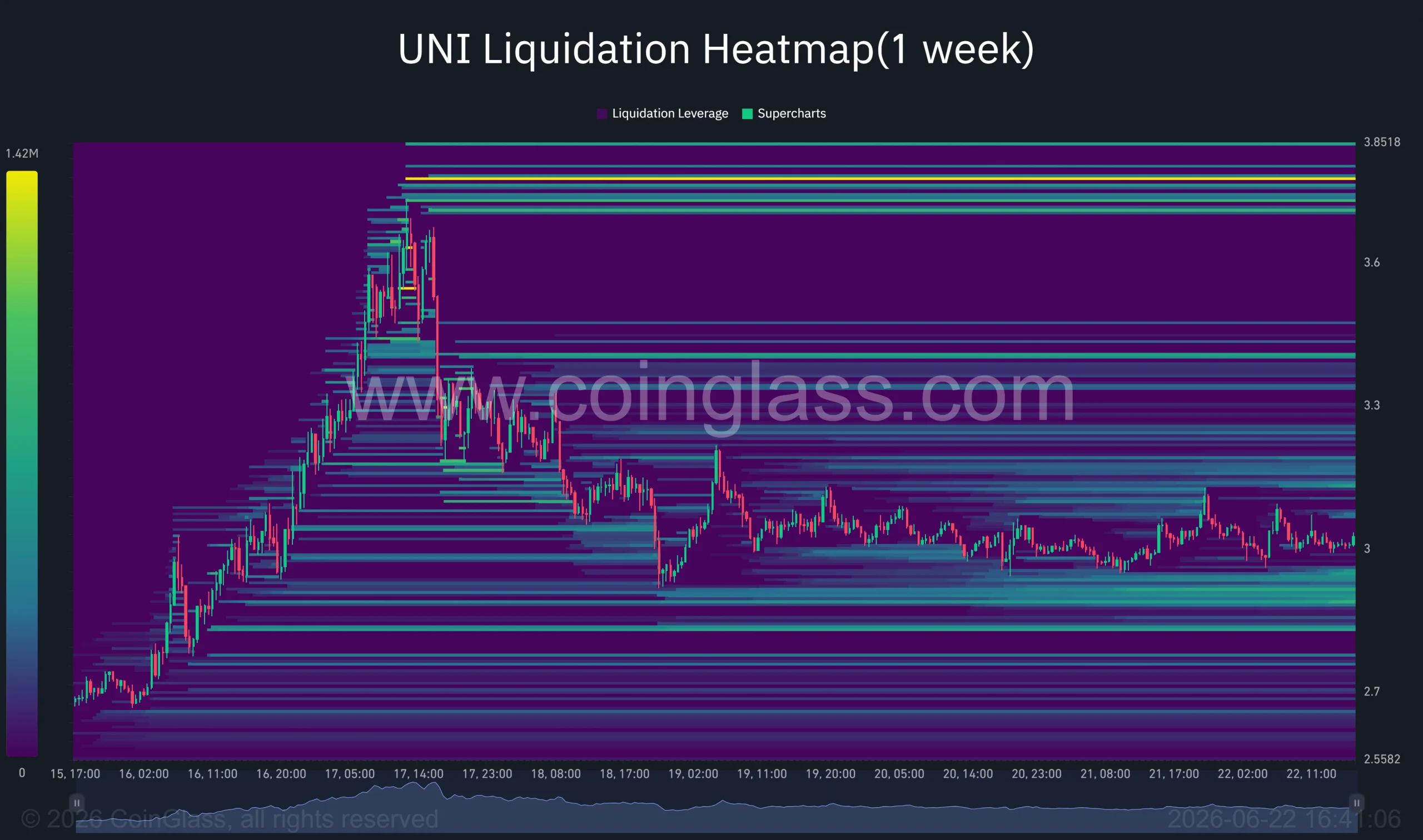
CoinGlass liquidation data shows several large leverage concentrations sitting above the current market price. The most significant cluster remains between $3.30 and $3.45, while another dense pocket of short liquidations is visible near $3.75-$3.85.
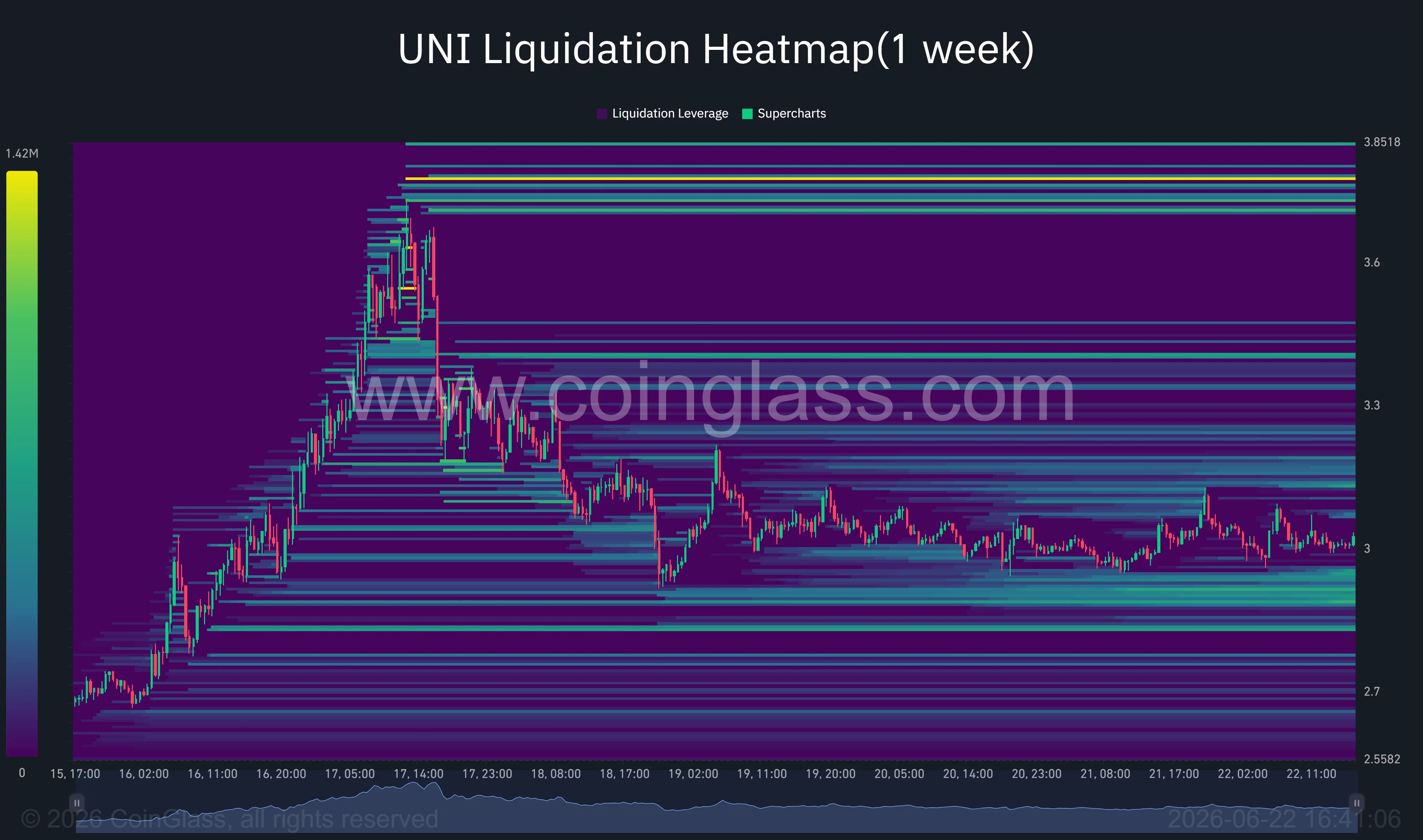
A move into those zones could force additional short covering and create another burst of volatility similar to the squeeze witnessed between June 15 and June 17.
Daily chart structure also improved after UNI reclaimed the Murrey Math support zone around $2.93. The token now trades just below the key pivot level at $3.125. A successful break above that area would expose resistance levels at $3.32, $3.51, and $3.71.
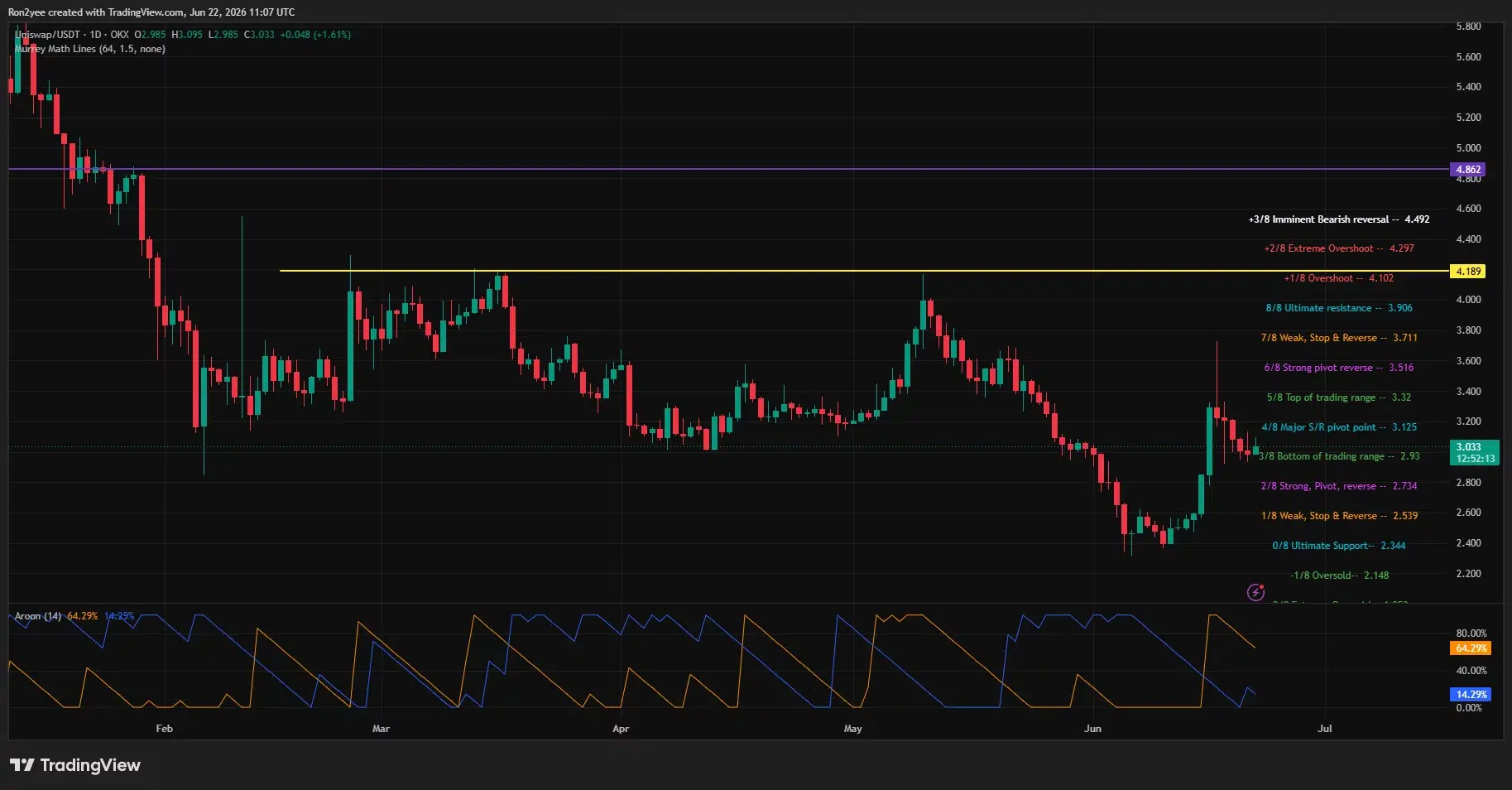
Beyond those levels, the next major overhead barrier sits near $3.90, which coincides with the strongest liquidation concentration visible on the one-week heatmap.
Momentum indicators remain constructive despite the pullback. The Aroon Up indicator remains elevated above 60%, suggesting buyers continue to control the dominant trend even after several days of consolidation around the $3 mark.
Uniswap price risks deeper pullback if $2.93 support fails
Profit-taking emerged shortly after the rally as traders locked in gains from the rapid advance. At the same time, risk appetite across digital assets weakened following the Federal Reserve’s latest policy decision under Chair Kevin Warsh, which reinforced expectations that interest rates could remain restrictive for longer than previously anticipated.
Technical downside risks remain concentrated around the $2.93 support zone. Losing that level would place the $2.73 pivot and the $2.54 support area back into focus. The liquidation heatmap also shows relatively thin leverage positioning beneath current prices, reducing the likelihood of a large liquidation-driven rebound if support fails.
For now, UNI continues to trade above the level that capped prices throughout most of June. As long as buyers defend the newly reclaimed $2.93-$3.00 range, traders are likely to keep watching the dense liquidation pockets above $3.30 for the next directional move.
Disclosure: This article does not represent investment advice. The content and materials featured on this page are for educational purposes only.
Bithumb, South Korea’s second-largest crypto exchange, will add Canton (CC) to its Korean won market on June 23.
Summary
- Bithumb will open Canton’s KRW market, giving Korean traders direct access to CC on Tuesday.
- CC momentum remains weak, with MACD bearish and RSI below neutral despite modest daily gains.
- Canton’s protocol change lowers onboarding friction after institutional partnerships expanded across Korea and Wall Street.
The exchange said deposits and withdrawals would open within two hours of the notice, while trading would start at 14:00 local time.
The exchange will support Canton through Canton Mainnet only. Bithumb set the reference price at 234 won and said it would apply its usual trading limits for new listings. It said, “Canton (CC) will be added to the KRW market,” while warning users that crypto assets carry high risk.
Under the listing rules, buy orders will face a five-minute pause after trading starts. Sell orders will also face a five-minute price band linked to the reference price. For about two hours after launch, Bithumb will allow limit orders only.
Canton attracts Wall Street and Korean attention
Canton (CC) is the native token of Canton Network, a blockchain built by Digital Asset for privacy-focused tokenization, trading and settlement. The project targets institutions that need blockchain settlement while keeping selected data private.
The network has drawn support from firms tied to traditional finance, including Goldman Sachs, Citadel Securities, Tradeweb, DTCC and BNP Paribas. As previously reported by crypto.news, Digital Asset raised $355 million in a round led by Andreessen Horowitz’s crypto fund, with other backers including Citadel Securities, Apollo, BNP Paribas, CME Ventures, Coinbase Ventures, HSBC, Optiver and the Abu Dhabi Investment Authority.
Canton has also gained attention in South Korea. crypto.news earlier reported that Shinhan Asset Management and Shinhan Investment & Securities signed separate agreements with the Canton Foundation to study Korean tokenized assets, domestic rules and global market access. Shinhan’s move placed Canton closer to South Korea’s growing tokenized finance market before Bithumb’s listing.
The network also appeared in recent stablecoin coverage. As crypto.news reported, Visa tested stablecoin settlement on Canton using Brale’s SBC token. The test looked at whether institutions could settle on-chain while keeping sensitive payment and settlement data away from public view.
Protocol update lowers onboarding friction
The listing follows a fresh Canton Network protocol update. Canton Network said, “CIP-0119 approved,” adding that transfer preapprovals now include a free 90-day base duration.
The change addresses a practical onboarding issue for new users. Canton Network said the update removes the “bootstrapping problem for new participants who needed CC to receive CC.” It also said users would face standard traffic costs only, with no extra CC fees required for onboarding.
This update arrives as exchanges and institutions study how to support Canton Coin transfers. Digital Asset’s own exchange integration guide says platforms can start with Canton Coin deposits and withdrawals, then add broader support for Canton Network tokens later.
Canton price and indicators stay soft
Canton traded at $0.153908 on June 23, based on crypto.news market data. CC rose 1.95% over 24 hours but slipped 0.31% in the past hour. The token stayed down 6.56% over seven days and 5.36% across the past month.
The same data showed 24-hour volume at $10.65 million, with price action between $0.149594 and $0.154728. Canton ranked 19th by market value, with a market cap near $5.98 billion. Its all-time high remains $0.194152, set on Feb. 3, while its all-time low stands at $0.059024 from Dec. 6, 2025.
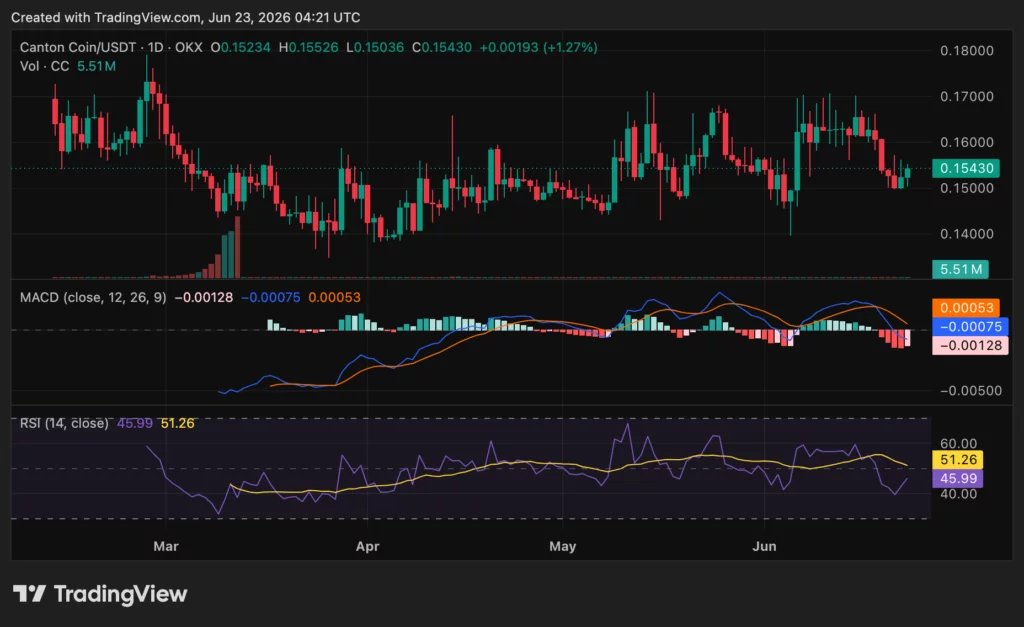
Technical indicators show weak momentum despite the Bithumb listing news. The MACD histogram stood near -0.00128, with the MACD line below the signal line. RSI stood at 45.99, below its moving average of 51.26, which shows buyers have not regained control.
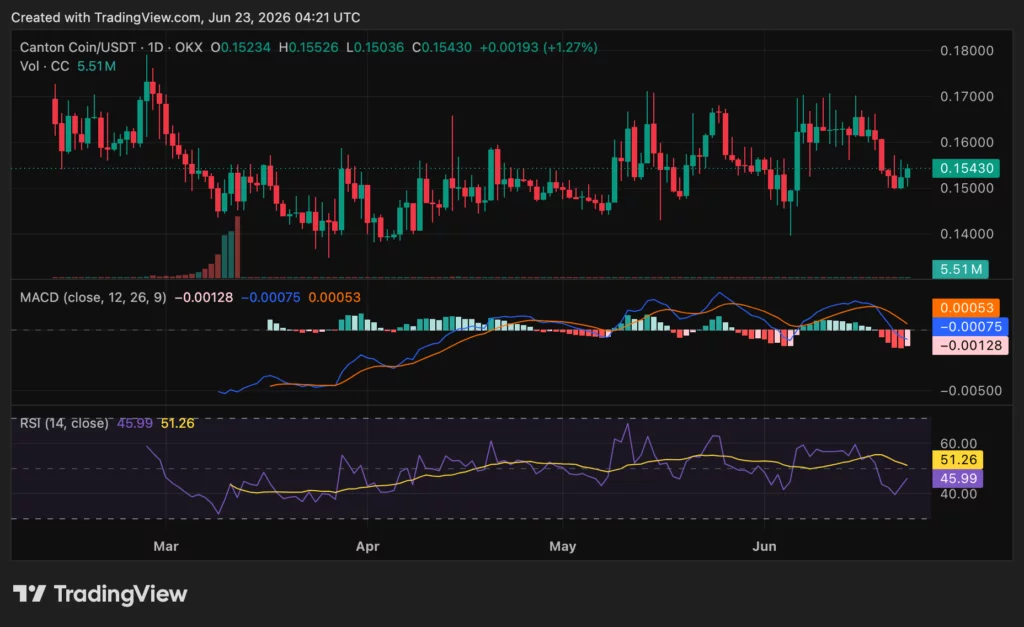
The indicators do not show heavy selling pressure. RSI remains above oversold levels, and MACD sits close to the zero line. For now, the setup points to consolidation unless RSI moves back above 50 and MACD turns positive again. Stronger spot demand would be needed to confirm a clearer shift.
Disclosure: This article does not represent investment advice. The content and materials featured on this page are for educational purposes only.
Native USDC, EURC, and CCTP Are Coming to Cronos. Expanding Stablecoin Infrastructure for a Growing Ecosystem. The blockchain industry continues to move toward a future where digital assets, traditional finance, and emerging technologies seamlessly interact. In a major step toward that vision, Circle has announced that native USDC, EURC, and Cross-Chain Transfer Protocol (CCTP) support will soon be available on the Cronos network.
This integration brings trusted stablecoin infrastructure to one of the industry’s fastest-growing blockchain ecosystems and opens new opportunities for payments, decentralized finance, AI-powered applications, and institutional adoption.
What Is Cronos?
Cronos is an EVM-compatible Layer-1 blockchain developed by Crypto.com. The network supports a broad range of blockchain use cases, including:
- Digital payments
- DeFi trading and lending
- AI-native applications
- Gaming and Web3 experiences
- Tokenized real-world assets
- Cross-border financial services
With access to Crypto.com’s extensive user base of more than 150 million registered users, Cronos has established itself as a significant blockchain ecosystem capable of supporting both retail and institutional participants.
Why Native USDC and EURC Matter
Stablecoins play a critical role in blockchain ecosystems by providing price stability, liquidity, and efficient settlement mechanisms.
The arrival of native USDC and EURC on Cronos introduces regulated, fully reserved digital currencies directly issued by Circle.
Key Benefits
1. Trusted Fiat-Backed Stability
Both USDC and EURC are designed to maintain a 1:1 value relationship with their respective fiat currencies:
- USDC is redeemable 1:1 for U.S. dollars
- EURC is redeemable 1:1 for euros
This stability makes them attractive for trading, payments, settlement, and treasury management.
2. Enhanced DeFi Liquidity
Native stablecoins can serve as foundational liquidity assets across the Cronos ecosystem.
Benefits include:
- Lower trading slippage
- More efficient capital deployment
- Improved lending and borrowing markets
- Stronger liquidity pools
- Better trading experiences for users
As liquidity deepens, developers can build more sophisticated financial products on Cronos.
3. Support for AI-Powered Transactions
As autonomous AI agents become increasingly active on blockchain networks, stable and programmable digital currencies become essential.
USDC and EURC can help facilitate:
- Agent-to-agent payments
- Automated settlements
- Machine-driven financial workflows
- AI-powered marketplaces
- Cross-platform value exchange
This creates a strong foundation for the next generation of AI-native blockchain applications.
Introducing CCTP: Seamless Cross-Chain USDC Transfers
One of the most significant aspects of the announcement is support for Circle’s Cross-Chain Transfer Protocol (CCTP).
CCTP enables native USDC to move securely between supported blockchain networks without relying on traditional wrapped assets.
What CCTP Enables
Eligible institutions, traders, and development teams will be able to:
- Transfer native USDC across supported blockchains
- Access institutional-grade payment infrastructure
- Utilize the fiat on/off ramps
- Enable full deposit and withdrawal functionality
- Integrate native USDC through APIs
- Improve capital efficiency across multiple ecosystems
For developers building multi-chain applications, CCTP significantly simplifies the movement of liquidity and settlement assets.
Powering the Future of the Cronos App
Native USDC is expected to play an important role within the Cronos App, a mobile-first trading platform designed to unify multiple financial markets.
Users will eventually be able to:
- Deposit dollars
- Trade cryptocurrencies
- Access tokenized stocks
- Participate in prediction markets
- Manage multiple asset classes from a single account
By serving as the primary dollar settlement layer, USDC can help streamline user experiences while reducing friction between traditional and digital financial systems.
Expanding Opportunities for Institutions
Institutional adoption remains one of the most important growth drivers in the blockchain industry.
The addition of native USDC, EURC, and CCTP provides businesses with access to:
- Institutional-grade trading infrastructure
- Compliant onchain settlement
- Programmable payments
- Global liquidity access
- Efficient treasury management
- Cross-border transaction capabilities
For organizations seeking regulated digital asset infrastructure, these capabilities create a more enterprise-ready environment on Cronos.
EURC and the Growing European Opportunity
While USDC has become one of the world’s most widely adopted stablecoins, EURC introduces a unique opportunity for euro-denominated blockchain activity.
EURC can support:
- European payment systems
- Business settlements
- Treasury operations
- Cross-border commerce
- DeFi markets denominated in euros
Its MiCA-aligned framework and euro redeemability make it particularly attractive for businesses and users operating within the European Union.
Native USDC vs. Bridged USDC on Cronos
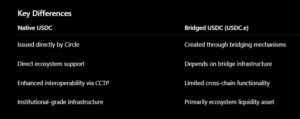
Currently, Cronos supports Bridged USDC (USDC.e), which enables users to access USDC liquidity via bridging.
With the upcoming launch of native USDC, the Cronos ecosystem plans to migrate liquidity toward the native asset gradually.

Importantly, existing USDC.e holders will not experience immediate disruption. Bridged USDC will continue operating normally and remain clearly identified throughout the ecosystem.
A Major Step Forward for Cronos
The upcoming integration of native USDC, EURC, and CCTP represents more than just a stablecoin launch. It strengthens Cronos’ foundation as a blockchain capable of supporting consumer applications, institutional finance, AI-powered systems, and global payments.
By combining trusted stablecoin infrastructure, regulated fiat-backed assets, and seamless cross-chain functionality, Cronos is positioning itself as a hub for the next generation of digital finance.
As blockchain adoption continues to accelerate, the arrival of native USDC, EURC, and CCTP could play a pivotal role in expanding liquidity, improving interoperability, and unlocking new opportunities for developers, businesses, and users across the Cronos ecosystem.
RESOURCES
REQUEST AN ARTICLE

Disclosure: This article does not represent investment advice. The content and materials featured on this page are for educational purposes only.
AI-powered crypto trading platforms are gaining traction in 2026 as investors seek automated strategies, risk controls, and data-driven market execution.
Summary
- Money Simpler is an AI crypto quant trading platform offering automated multi-asset strategies with low entry barriers.
- Platform provides AI automated trading with no coding, offering beginner friendly access and small user rewards.
- Money Simpler supports multi-asset AI strategies across crypto and forex with automated execution and risk controls.
In the volatile cryptocurrency market, manual trading is often limited by emotions, time, and energy, making it difficult to consistently capture market opportunities. As AI technology continues to integrate into the digital asset trading field, more and more investors are leveraging quantitative trading platforms to improve trading efficiency through automated execution and intelligent risk control.
Various AI-powered cryptocurrency quantitative trading platforms and automated trading tools are emerging, but they differ significantly in terms of strategy capabilities, user experience, risk management, and target audience.
This article will conduct a comparative review of the most-watched AI cryptocurrency quantitative trading platforms in 2026 to help investors find more suitable automated trading tools.
2026 best AI cryptocurrency quantitative trading platform ranking
| Rank | Platform | Best For | Ease of Use | Automation | Beginner Friendly |
| 1 | Money Simpler | Passive AI Quant Trading | ⭐⭐⭐⭐⭐ | Full | ⭐⭐⭐⭐⭐ |
| 2 | Pionex | Built-in Trading Bots | ⭐⭐⭐⭐ | Full | ⭐⭐⭐⭐ |
| 3 | Cryptohopper | Strategy Marketplace | ⭐⭐⭐⭐ | Semi | ⭐⭐⭐ |
| 4 | 3Commas | Advanced Traders | ⭐⭐⭐ | Semi | ⭐⭐⭐ |
| 5 | Coinrule | Rule-Based Strategies | ⭐⭐⭐⭐ | Semi | ⭐⭐⭐⭐ |

1. Money Simpler – Best AI cryptocurrency quantitative trading platform of 2026
Money Simpler ranked first in this evaluation, primarily due to its fully automated AI-powered quantitative trading system and extremely low barrier to entry. Compared to many platforms that require users to configure strategies or continuously manage trades, it focuses more on automated execution and operational simplicity.
The platform automatically analyzes the market and executes trades through an AI multi-strategy framework, helping users participate in the digital asset market in a simpler way. For novice investors looking to lower the barrier to entry for quantitative trading, its automated trading experience offers a significant advantage.
New user rewards: Sign up to receive a real reward of $10 and a $50 trial credit.
Key Advantages
- No coding or quantitative trading experience required
- No exchange API setup required
- No need to manually execute trading signals
- AI-powered automated trading system
- Multi-strategy trading framework
- 24/7 automated trade execution
- Automated risk control and position management
- Beginner-friendly user experience
Supported trading scenarios
- Cryptocurrency quantitative trading
- Forex, stock, and ETF trading
- Futures and commodities trading
- Multi-strategy quantitative trading
- 24/7 automated market participation
Who is it best suited for?
Beginner and long-term investors who want to reduce manual operations through AI-automated trading, without the need for programming or complex strategy configuration.
2. Pionex – The best cryptocurrency platform for using built-in trading bots
Pionex is one of the more well-known automated trading platforms in the cryptocurrency market. Its biggest feature is its built-in variety of trading robots, allowing users to utilize automated trading functions without the need for third-party tools.
The platform offers various robot solutions, including grid trading, dollar-cost averaging strategies, and arbitrage tools, suitable for investors who want to use automated tools to assist their trading. Compared to traditional manual trading, Pionex helps users reduce repetitive operations and achieve 24/7 market participation.
Key Advantages
- Built-in automated trading bots
- No third-party integrations required
- Supports popular strategies such as grid trading
- Easy-to-use trading interface
- Suitable for traders exploring automated trading
Who is it best suited for?
Cryptocurrency investors who want to use off-the-shelf trading bots and are willing to choose and adjust trading strategies according to their own needs.
3. Cryptohopper – Best suited for strategy markets and advanced custom trading.
Cryptohopper is one of the earliest automated cryptocurrency trading platforms on the market. Its core features lie in its rich strategy market and high strategy customization capabilities. Not only can users create their own trading rules, but they can also use trading strategies and signals provided by third-party developers.
Unlike platforms that emphasize simplifying the operating process, Cryptohopper is more suitable for users who want to delve deeper into trading strategies. The platform provides functions such as automatic trading, portfolio management, backtest analysis, and strategy optimization, providing more flexibility for more experienced traders.
Key advantages
- Extensive strategy marketplace
- Supports custom strategy creation
- Advanced backtesting and optimization tools
- Automated trade execution
- Highly flexible and customizable platform
Who is it best suited for?
Advanced traders who want more strategy options and customization options, and are willing to invest time in researching trading systems.
4. 3Commas – The most suitable automated trading platform for advanced strategy management
3Commas is a well-known automated trading platform in the cryptocurrency space, renowned for its rich array of trading tools and flexible strategy management features. The platform supports intelligent trading terminals, automated bots, and portfolio management tools, providing users with a high degree of strategic freedom.
Compared to platforms that focus more on simplifying operations, 3Commas emphasizes trading control. Users can customize trading rules, risk parameters, and automated execution logic to achieve more personalized trading management.
Key Advantages
- Comprehensive automated trading tools
- Supports multiple trading bot strategies
- Flexible risk management settings
- Portfolio management features
- Suitable for experienced traders
Who is it most suitable for?
Experienced professionals who are familiar with technical analysis require sophisticated and customized trading strategies, engage in high-frequency trading across multiple asset classes, and seek a high degree of strategy control.
5. Coinrule – The best platform for rule-driven automated trading
Coinrule is a platform focused on rule-driven automated trading, its core feature being the ability to create trading rules without programming. Users can build automated strategies using simple conditional logic, enabling market monitoring and trade execution.
The platform offers numerous preset templates to help users quickly establish automated trading processes. Compared to professional quantitative trading platforms, Coinrule emphasizes ease of use and strategy visualization, making it popular among novice users looking to try automated trading.
Key Advantages
- Rule-based strategy automation
- Extensive strategy template library
- Visual strategy builder
- Automated trade execution
- Flexible strategy customization
Who is it best suited for?
Investors who want to experience automated trading without coding and are willing to set their own trading rules based on market conditions.
How to choose the best AI trading robot in 2026?
When choosing an AI trading robot, investors should focus on its level of automation, ease of use, risk control capabilities, and long-term stable operation. For most ordinary investors, platforms that require no programming, complex configuration, and have automated execution capabilities are generally easier to use.
If automation and user-friendliness are paramount, Money Simpler is a platform worth considering; if more customization options are desired, other specialized trading tools can be considered.
Frequently Asked Questions (FAQ)
Are AI cryptocurrency quantitative trading platforms suitable for beginners?
Yes. Many platforms now offer automated trading features, allowing beginners with little or no quantitative trading experience to get started quickly.
Do I need programming knowledge to use AI quantitative trading?
Not necessarily. For example, Money Simpler allows users to access AI-powered automated trading without coding or complex configurations, making it a suitable option for those looking for a lower learning curve.
Can AI trading bots guarantee profits?
No. AI trading tools can help execute strategies and manage risk, but no platform can guarantee profits. Investors should always be aware of market risks and invest responsibly.
Why does Money Simpler rank first in this review?
Money Simpler stands out for its high level of automation, ease of use, and beginner-friendly experience. Its no-code approach and simplified setup process contributed to its top overall ranking in this comparison.
Conclusion
As AI-driven quantitative trading continues to develop, more and more investors are leveraging automated tools to participate in the digital asset market. Different platforms vary in their level of automation, strategy functionality, and ease of use, catering to different types of traders.
Based on the results of this evaluation, Money Simpler stands out with its fully automated AI-driven quantitative trading system, low barrier to entry, and user-friendly interface, making it one of the AI cryptocurrency quantitative trading platforms to watch in 2026.
Users who wish to learn more about the platform’s features can visit the Money Simpler official website to register an account, explore available AI-driven quantitative trading solutions, and experience the related functions offered by the automated trading platform.
Disclosure: This content is provided by a third party. Neither crypto.news nor the author of this article endorses any product mentioned on this page. Users should conduct their own research before taking any action related to the company.

KPMG chairman, partners to exit scandal-tainted firm

Bitcoin slips toward $63,000 amid tech selloff

7 Most Universally Beloved Anime of All Time, Ranked


-

 Fashion3 days ago
Weekend Open Thread: Miami – Corporette.com
-
 Tech6 days ago
The Adder At The Heart Of Intel’s 8087 FPU
-

 Entertainment2 days ago
Renter of Home in Anne Heche Crash Denies Settlement With Son
-

 Tech17 hours ago
Microsoft accidentally kills epic Outlook email threads
-

 Business2 days ago
Soccer-U.S. defends Iran World Cup travel restrictions, says discussions ongoing
-

 Politics4 days ago
BBC Reporter Discusses Cross Party Criticism Of Trumps Iran Deal
-
 Business3 days ago
Wall Street Week Ahead: Investors see Micron earnings as pulse check of AI rally momentum
-

 Tech5 days ago
AWS enters the context layer race with a graph that learns from agents, not manual curation
-

 Crypto World3 days ago
HIVE shares jump as $220M AI deal speeds Bitcoin mining pivot
-
 Crypto World3 days ago
Can Charles Hoskinson Really Rescue Cardano?
-

 Crypto World3 days ago
Jake Chervinsky accuses CME of protecting derivatives monopoly
-

 Tech10 hours ago
Nearly 7,000 fake Amazon domains registered ahead of Prime Day 2026, researchers warn
-

 Business2 days ago
MHP SE 2026 Q1 – Results – Earnings Call Presentation (OTCMKTS:MHPSY) 2026-06-20
-

 Sports4 days ago
FIFA World Cup 2026: Canada beat 9-men Qatar 6-0 to register first ever win | FIFA World Cup 2026
-
 Tech2 days ago
Signal’s Meredith Whittaker says AI chatbots ‘are not your friends’ and calls Copilot agents a backdoor
-

 Crypto World5 days ago
Anthropic’s Dario Amodei Urged AI Unity at G7, Even as US Banned His Models
-

 Politics3 days ago
Andy Burnham and the meaning of Makerfield
-

 Business4 days ago
Brexit cost 6% of UK economy, Bank of England company data suggests
-

 Tech5 days ago
Weeks Of In-The-Field Testing And A Verdict
-

 Entertainment3 days ago
Jose Alvarado Wants Taylor Swift at More Knicks Games
You must be logged in to post a comment Login