

Crypto World
Wall Street gets new crypto rival after Texas bank completes regulatory pivot



A forty-year-old Texas bank is stepping onto the national stage to challenge Wall Street’s push to get a grip on the digital asset industry.
United Texas Bank (UTB) secured approval from the Office of the Comptroller of the Currency (OCC) to convert from a state-chartered financial institution into a nationally chartered bank on May 15, Scott Beck, the president and CEO of the firm, told CoinDesk on Wednesday.
The conversion move, Beck added, is to position his crypto-friendly bank as the primary bridge between the cryptocurrency industry and traditional financial institutions and to provide digital asset services he said the UTB has years fully delivering, while “Wall Street continues to tiptoe.”
The conversion granted by the OCC came with two conditions that Beck said have now been met. “Those conditions were satisfied as of today, May 27,” he said. Since 2024, the UTB operated under a Consent Order with the Federal Reserve, which related to its Bank Secrecy Act and compliance infrastructure.
“Rather than viewing that as a setback, we treated it as a mandate to build something exceptional, and we did. The result is UTB PRISM SENTINAL, our proprietary BSA/AML compliance platform,” he said.
The milestone makes the UTB one of the first banks in the U.S. to successfully complete an OCC conversion since the passage of the Dodd-Frank Act 15 years ago, Beck added. He said the conversion also uniquely positions UTB as a bridge between crypto firms worldwide into the U.S. banking system, access that very few banks today are willing to give.
“The concept for United Texas Bank is a centralized value hub,” said the chair of UTB, a bank he himself said is unknown nationally, but widely sought out by crypto firms.
“If you’re a digital asset player, you can’t get an account at a Bank of America or a Citibank. You can come to United Texas Bank and basically have full access to the U.S. dollar,” he said, adding that his bank has been providing services to reputable crypto firms for about five years, handling over $120 billion in transactions for them yearly.
Standing with the giants
Beck explained that the strategic OCC conversion places the Dallas-based institution on par with money-center giants like Bank of America and JPMorgan Chase, granting it identical federal licensure, full trust powers and direct access to the Federal Reserve’s wire and ACH systems, while retaining the FDIC insurance it had.
However, unlike traditional Wall Street firms that are beginning to explore the crypto ecosystem, UTB already “underpins a massive chunk of global crypto liquidity, clearing $10 billion a month in U.S dollar volume for foreign banks, over-the-counter (OTC) desks and major exchanges.
UTB is not alone in the race for a competitive place within the growing crypto sector in the United States. Last week, Minnesota signed into law new rules allowing local banks to fight Wall Street for cryptocurrency profit. The state banks and credit unions joined forces with lawmakers to push legislation granting them authorization to provide crypto custody services to their clients.
For UTB, the conversion marks an ambitious operational pivot, Beck added. While crypto startups have spent years chasing limited, trust-only charters that bar them from the Federal Reserve’s payment rails, UTB’s national charter bypasses those restrictions entirely.
A U.S. first
“We are the first to move across to the national banking stage with full access to the Federal Reserve for wires and ACH,” Beck added.
By shifting away from the Texas Department of Banking and positioning itself directly under the OCC, UTB aligned its corporate structure with the executive branch of the federal government, shielding its clients from the fractured regulatory landscape that historically choked crypto firms, Beck said.
To capitalize further on its federal upgrade, the bank is launching UTB Atomic, an artificial intelligence-driven, real-time payment network engineered to bring back the round-the-clock liquidity infrastructure that collapsed when Silvergate and Signature Bank did.
In a 24/7 crypto market, traditional bank closures create massive settlement bottlenecks for institutional traders operating at 3:00 a.m.. UTB Atomic solves this by enabling instant, off-balance-sheet clearing between institutional clients while a parallel AI network, UTB Prism Sentinel, continuously conducts real-time blockchain surveillance to neutralize compliance risks, Beck explained.
“The biggest issue that faces the larger financial institutions is the ability to actually track what’s happening as the payments are coming through,” Beck said, adding that the system is purpose-built to navigate upcoming regulatory thresholds like the federal stablecoin frameworks under the GENIUS Act and Clarity Act.
With a comprehensive digital asset custody and full-service trust department slated to launch this summer, UTB aims to bridge traditional finance and crypto and positioning itself as the native financial plumbing for the next era of global commerce, Beck said.


TLDR:
- Banca Sella completes Bank of Italy notification, becoming Italy’s first MiCA-compliant crypto bank.
- The bank plans to launch digital asset custody and transfer services for select clients by end of 2026.
- Banca Sella is a founding member of Qivalis, a 37-bank European consortium developing a euro stablecoin.
- While Europe advances under MiCA, the US Clarity Act remains stalled, leaving American banks without clear crypto rules.
Banca Sella has completed the notification process with the Bank of Italy, making it the first Italian bank cleared to offer cryptocurrency-related services. The group plans to launch digital asset custody and transfer services for selected clients by the end of 2026.
This move places Banca Sella ahead of other Italian financial institutions in embracing regulated crypto offerings under Europe’s MiCA framework.
Crypto Custody and Transfer Services Launching in 2026
Banca Sella confirmed its intention to offer digital asset custody and transfer services before the end of 2026. The services will initially target specific categories of customers, according to the group’s official press release.
The bank has already built substantial technological infrastructure and blockchain expertise over recent years.
Andrea Tessera, Managing Director of Digital Banking at Banca Sella, spoke directly to this shift. “The evolution of payments towards instantaneous, interoperable and programmable models, also favored by the tokenization of money and assets, is redefining financial infrastructures at European and global level,” he stated. Banca Sella’s new services are designed to sit squarely within this transformation.
The bank has also been part of the Bank of Italy’s Fintech Milano Hub pilot program since 2022. This participation reflects a long-standing commitment to digital finance well before regulatory clarity arrived. That head start now positions the bank as a clear industry leader in Italy.
Banca Sella’s compliance with MiCA gives it a competitive edge over peers still awaiting regulatory direction. MiCA, the European Union’s comprehensive crypto regulation, provides a clear legal framework for crypto asset service providers.
Operating within this structure allows Banca Sella to move forward with confidence and legal certainty.
Qivalis Consortium and Broader Tokenization Strategy
Beyond custody services, Banca Sella is also a founding member of the Qivalis consortium. The group brings together 37 European banks with a shared goal of launching a euro-pegged stablecoin. This collaborative effort adds another layer to the bank’s digital asset strategy.
Qivalis represents a coordinated push by European banks to develop a stablecoin anchored to the euro. Such an initiative could reshape retail and institutional payments across the continent. Banca Sella’s role as a founding member reflects its long-term commitment to the space.
The bank is also monitoring the Eurosystem’s Pontes and Appia projects, both managed by the European Central Bank.
These initiatives further connect Banca Sella’s strategy to broader European financial infrastructure developments. Staying close to ECB-led projects keeps the bank aligned with regulatory and monetary trends.
Meanwhile, the United States continues to lag behind on crypto banking legislation. The proposed Clarity Act remains stalled in Congress, with approval prospects for the year looking uncertain.
Europe, through frameworks like MiCA, is setting the pace for regulated crypto adoption within traditional banking.

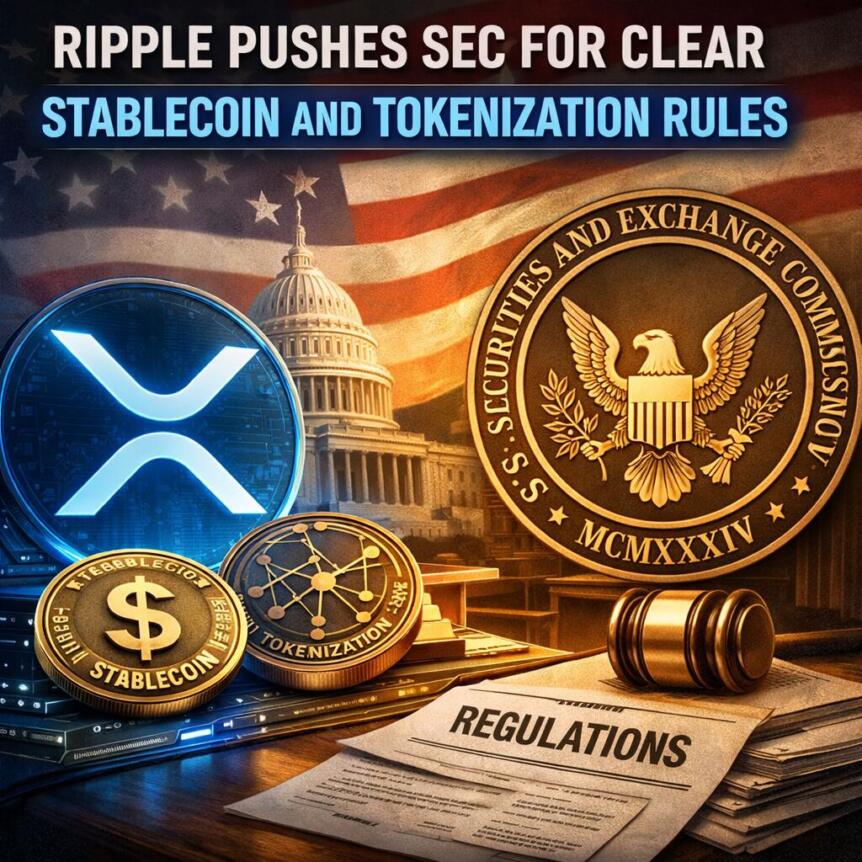
Ripple has moved its crypto policy agenda back to the SEC through a new Crypto Task Force letter. The company asked regulators to clarify stablecoin treatment, crypto non-security rules, and tokenized securities records. The proposal adds pressure on Washington to turn recent digital asset guidance into workable market rules.
Ripple Pushes Stablecoin Rule Changes
Ripple asked the SEC to update broker-dealer capital rules for payment stablecoins. The company focused on Rule 15c3-1, which governs net capital requirements for broker-dealers. It said the rule needs clearer treatment for stablecoins used as collateral on balance sheets.
The letter also addressed Rule 15c3-3, which covers customer protection and custody duties. Ripple wants the SEC to define qualified payment stablecoins under that framework. The request aims to help firms custody client stablecoins without unclear compliance exposure.
Ripple also challenged the current haircut treatment for stablecoins. It argued that some stablecoins deserve a 0% haircut when issuers support direct mint-and-burn arrangements. However, Ripple limited that request to stablecoins with strong issuer and broker-dealer links.
XRP Non-Security Status Remains Central
Ripple also asked the SEC to clarify how crypto assets classified as non-securities should receive market treatment. The company said that assets beyond Bitcoin and Ethereum need clear treatment when they meet marketability standards. This point keeps XRP near the center of the broader policy debate.
The request follows years of legal and regulatory pressure around XRP. However, recent policy shifts have reduced some uncertainty around major crypto assets. Ripple now wants that shift reflected in SEC staff guidance and broker-dealer rules.
Ripple also cited the SEC’s crypto activity FAQ as an area needing updates. The company wants the FAQ to account for non-securities that qualify as readily marketable assets. That change could support clearer balance sheet treatment for more digital assets.
Tokenized Securities Proposal Targets Market Records
Ripple also urged the SEC to recognize on-chain registries for tokenized securities. The company wants a regulated digital transfer agent to maintain the official legal record. This approach could reduce disputes between blockchain records and traditional ownership systems.
The proposal targets a key issue in tokenized finance. Firms can face uncertainty when legal ownership records differ from on-chain balances. Ripple said an authoritative on-chain registry could reduce those conflicts during market stress.
The letter also fits a wider shift in U.S. crypto policy. Regulators have advanced new categories for digital commodities, stablecoins, digital tools, and digital securities. Therefore, Ripple wants final guidance that supports tokenization, custody, and payment settlement.
Regulatory Clarity Builds Around Digital Assets
The SEC Crypto Task Force has increased dialogue with crypto firms this year. Ripple’s letter followed a prior meeting with Commissioner Hester Peirce and task force members. The company used the follow-up to turn policy discussions into specific rule requests.
The broader market has also moved toward real-world asset tokenization. Banks, exchanges, and payment firms now test tokenized settlement and blockchain-based records. Ripple has positioned RLUSD, XRP, and its payments network within that transition.
The company’s request also connects with ongoing legislative efforts in Washington. Ripple has supported clearer rules through measures such as the CLARITY Act. Its latest letter now asks the SEC to align agency guidance with that wider policy direction.
Tokenized commodities platform Streamex said it is launching a Solana-based marketplace for trading tokenized assets in partnership with Orca, a decentralized exchange built on Solana.
According to a Tuesday announcement, the trading infrastructure will allow verified accredited investors to buy and sell Streamex’s yield-bearing, gold-backed GLDY token through regulated onchain trading pools operating around the clock.
The system uses identity and compliance checks tied to Streamex’s KYC and accreditation process to restrict trading access to approved investors while enabling secondary market liquidity for regulated digital assets.
The companies said neither Streamex nor Orca will act as brokers or intermediaries for investors seeking to resell the GLDY token.
Trading takes place through permissioned liquidity pools built on Orca, where investor wallets remain frozen until users complete identity verification and accreditation checks. Investor eligibility data is also updated onchain in real time to ensure only approved participants can access the market.
Orca said its automated market maker infrastructure has processed more than $500 billion in cumulative trading volume since launch. The companies said the GLDY trading pool could serve as a model for other tokenized assets tied to stocks, bonds, real estate and commodities.
Related: Tokenized RWA market grows 420% since 2025 on regulatory clarity, access
Exchanges race to build tokenized trading rails
The launch comes amid a broader push to build regulated trading infrastructure for tokenized stocks, funds and other traditional financial assets.
Earlier this month, the US Securities and Exchange Commission approved Nasdaq’s pilot proposal to allow tokenized stocks and exchange-traded funds to trade alongside their traditional counterparts on the same exchange.
Under the proposal, tokenized securities would share the same order books, ticker symbols and shareholder rights as conventional shares. Participation in the pilot is initially limited to eligible participants and securities tied to the Russell 1000 index and some of the biggest exchange-traded funds.
Other exchanges and tokenization companies are also expanding blockchain-based market infrastructure. In March, the New York Stock Exchange signed an agreement with Securitize to develop infrastructure for tokenized stocks and ETFs tied to Intercontinental Exchange’s planned digital trading platform.
Centrifuge, a tokenization platform focused on real-world assets, recently said it plans to bring tokenized Treasurys, private credit and AAA-rated collateralized loan obligation products to the Monad blockchain for use in lending, collateral and secondary market activity.
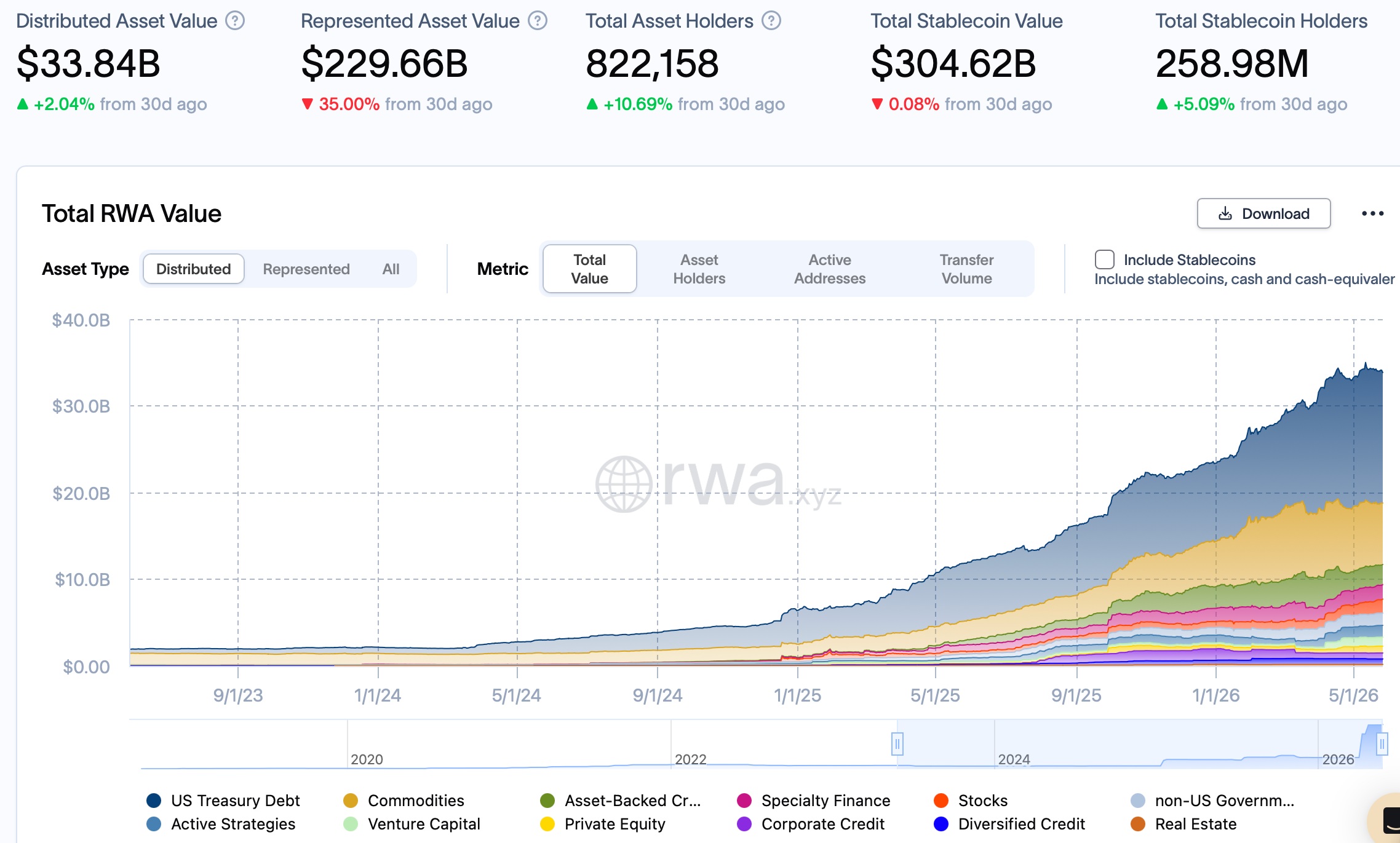
Data from RWA.xyz shows the tokenized real-world asset market has grown to roughly $34 billion, with Treasury and commodity-backed products representing some of the largest segments.
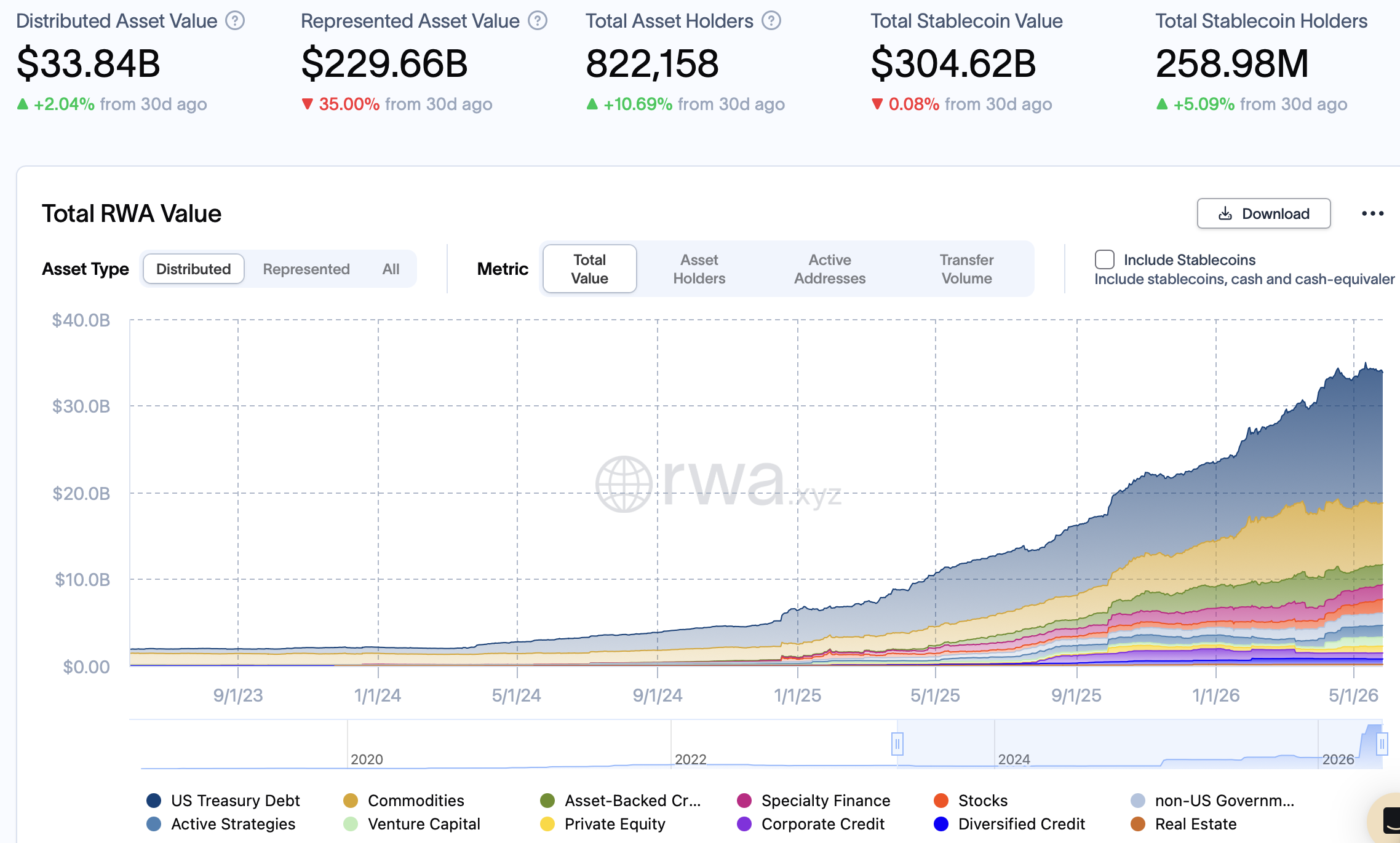
Source: RWA.xyz
Magazine: ETH bears growling, Tom Lee’s buying, XRP to ‘explode’: Market Moves

Two recently launched US exchange-traded funds linked to Hyperliquid’s HYPE token are off to a strong start.
New data suggests that the funds have reached a milestone in just 10 days of trading that Bitcoin, Ethereum, and Solana ETFs failed to match.
Strongest Crypto ETF Debut Yet
Kairos Research said spot HYPE ETFs absorbed 1.04% of HYPE’s market cap in just their first 10 trading days. The firm called it the strongest debut for any spot crypto ETF so far. To put things into perspective, spot Bitcoin ETFs reached 0.59%, while that of Ethereum stood at 0.41%, excluding GBTC and ETHE outflows.
Meanwhile, spot Solana ETFs came in at 0.31%.
21Shares’ THYP and Bitwise Asset Management’s BHYP have together pulled in more than $95 million in net inflows within weeks of launching. Bloomberg ETF analyst Eric Balchunas had previously described the timing of the launches as “perfectly timed.” THYP, which launched on May 12 on Nasdaq, became the first HYPE-related ETF available in the US market and has attracted $44 million in net inflows as of May 26. BHYP followed two days later on May 14 and has already recorded $55 million in net inflows, according to data compiled by SoSoValue.
The funds have recorded nine straight days of inflows, with no single day of outflows during the entire period. On Tuesday alone, Bitcoin and Ethereum ETFs collectively shed almost $370 million, while Solana funds recorded no flows for the day.
Sharp Monthly Gains
Strong inflows into HYPE ETFs have coincided with a steep rise in the underlying token’s price. While leading crypto assets have failed to establish a solid uptrend this month, HYPE has gained close to 50% during the same period. At the time of writing, the token is trading near $62.31.
On-chain activity revealed one trader who made a well-timed move on this run-up. According to Lookonchain, a trader created a new wallet 46 days ago and used $5 million in USDC to buy HYPE. After holding the position for over a month, they sold all their HYPE on Tuesday for $7.51 million. The trade resulted in a profit of a whopping $2.51 million in just 46 days.
The post Spot HYPE ETFs Just Crushed Bitcoin and Ethereum ETF Debuts appeared first on CryptoPotato.
Ether (ETH) remains under pressure after failing to reclaim the $2,150 resistance level. Despite the decline, ETH’s aggregate open interest has increased by roughly 350,000 ETH, suggesting new short positions are entering the market.
With more than $1.5 billion in bearish positions clustered above $2,150, a successful defense of the $2,000 support zone could trigger a sharp short squeeze and a relief rally for ETH.
Overcrowded ETH trade may lead to a relief rally
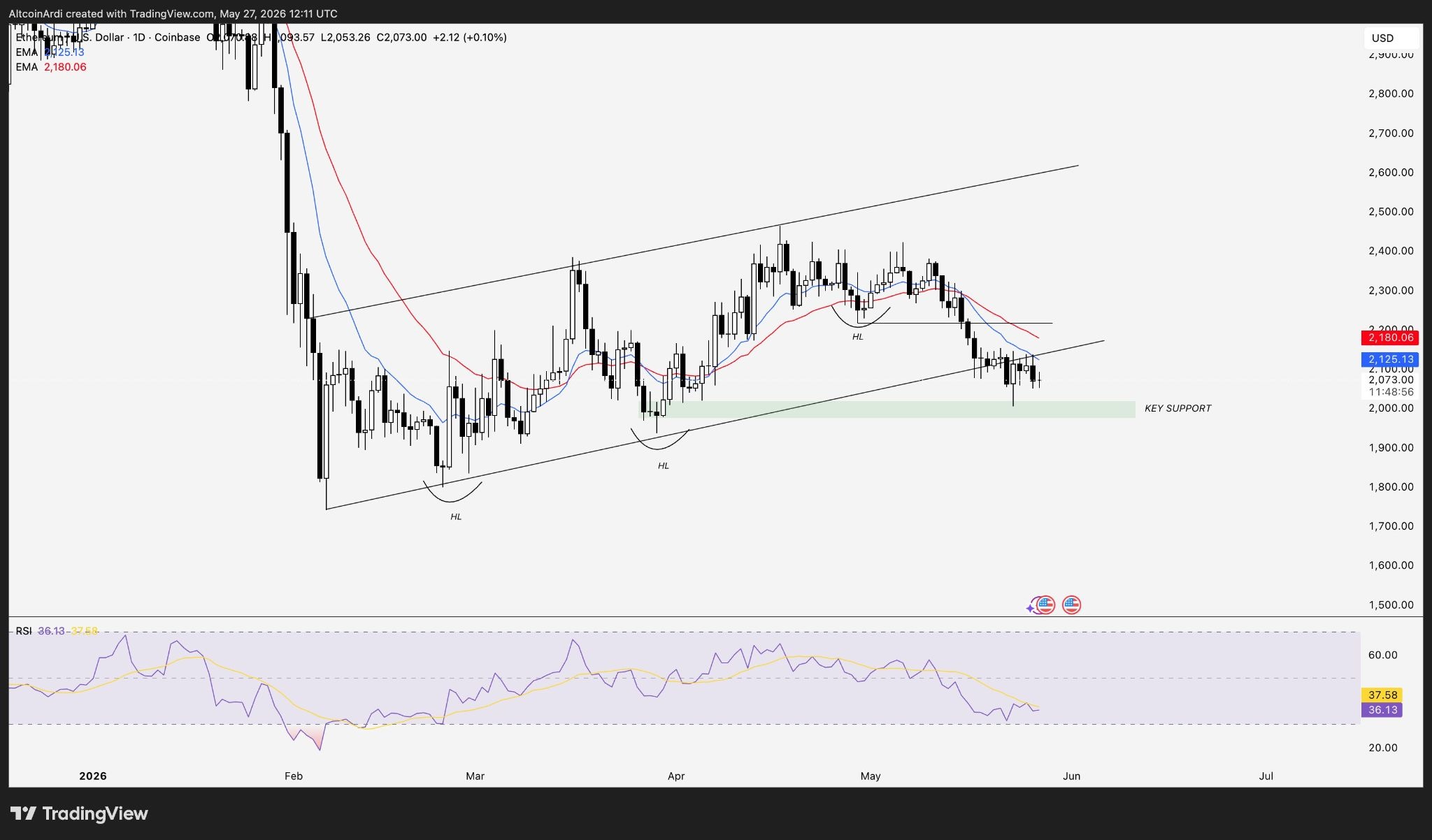
ETH has failed to reclaim $2,150 after dropping below it on May 17. The resistance capped the price from February to April, limiting a strong breakout.
With the price consolidating near $2,000, crypto trader Ardi said,
“Sub-$2,000 is coming for ETH shortly. We’ve already seen a -20% correction from the range highs, and price is now completely outside the ascending channel.”
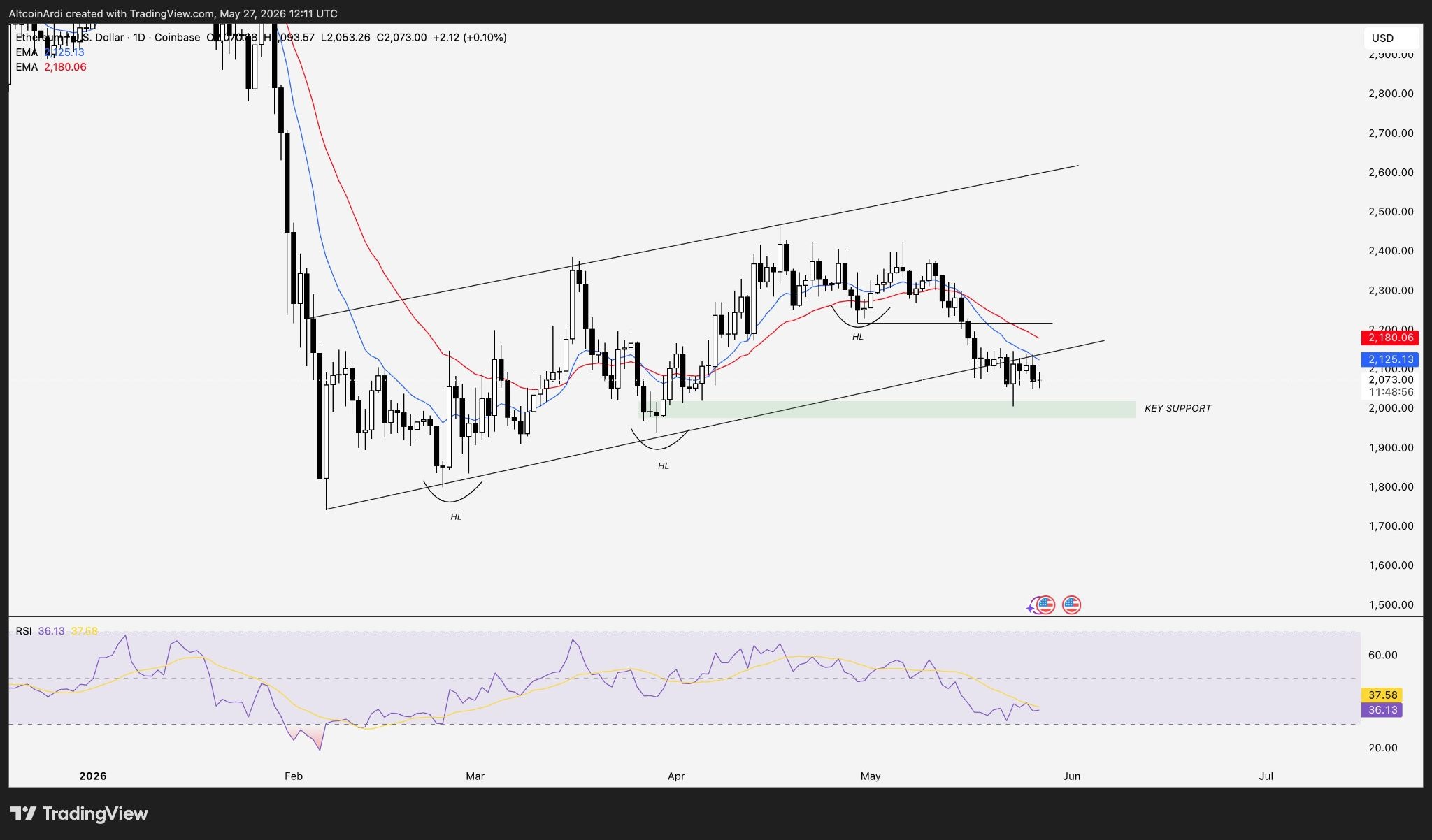
ETH/USD, one-day chart analysis by Ardi. Source: X
ETH futures data indicate a more nuanced setup during the current dip. Aggregated open interest has climbed by roughly 350,000 ETH over the past day, even as the price trended lower to $2,060. The divergence between price and OI suggests fresh short positions, rather than long liquidations, which is driving the price lower.
Aggregated funding rates remained strongly positive at 0.0049% this month, showing traders still paying to maintain long exposure despite falling prices. The combination of rising open interest and positive funding implies aggressive positioning on both sides for the time being.
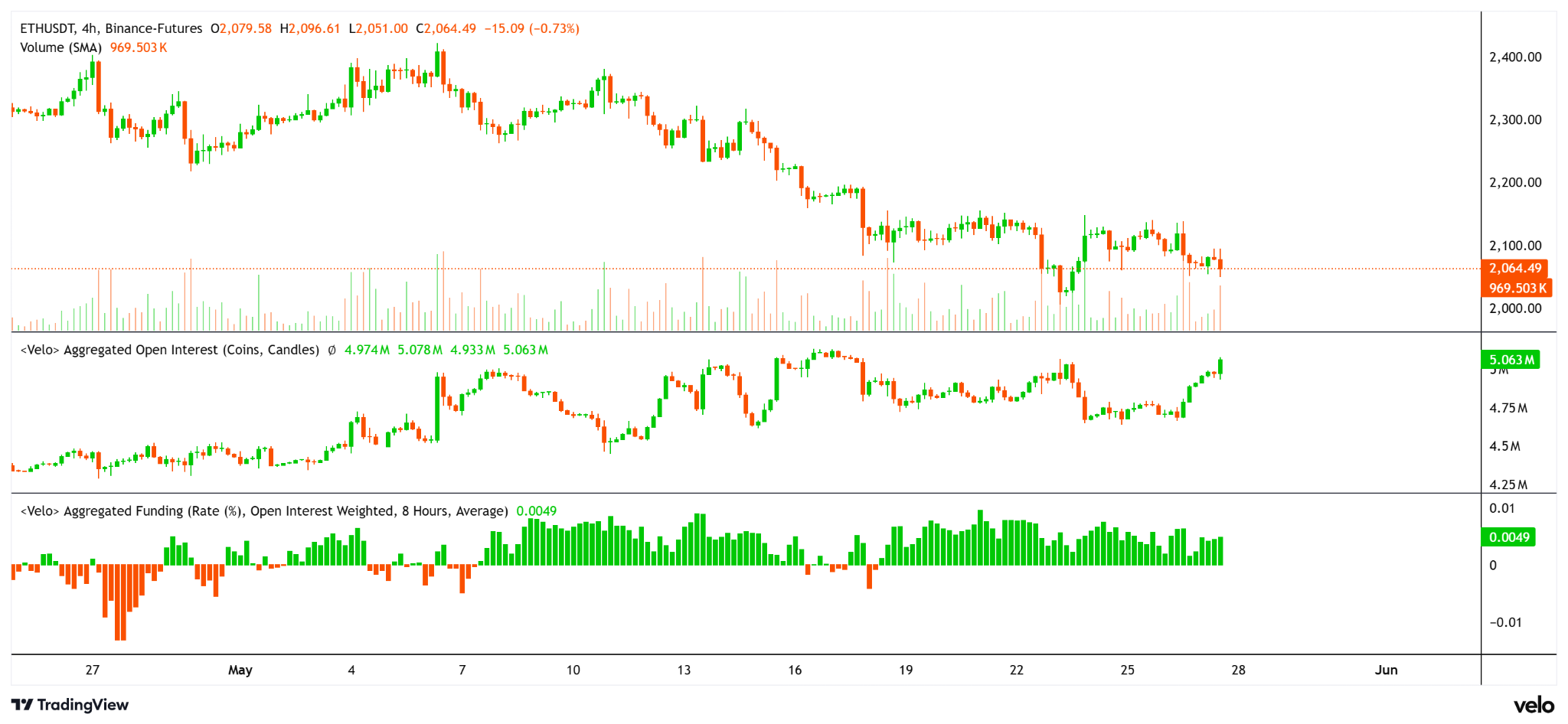
ETH price, funding rate and open interest. Source: Velo chart
This could create a liquidity hunt on both sides. $2,000 stands out as the nearest pivot zone. The long-leveraged positions-at-risk data exceed $1 billion, making it a critical level for short-term direction.
That setup leaves ETH open to a potential short squeeze. A successful defense of $2,000 could force shorts covering into the liquidity pocket above $2,150, where more than $2.1 billion in short-term liquidity is concentrated, leading to a relief rally.
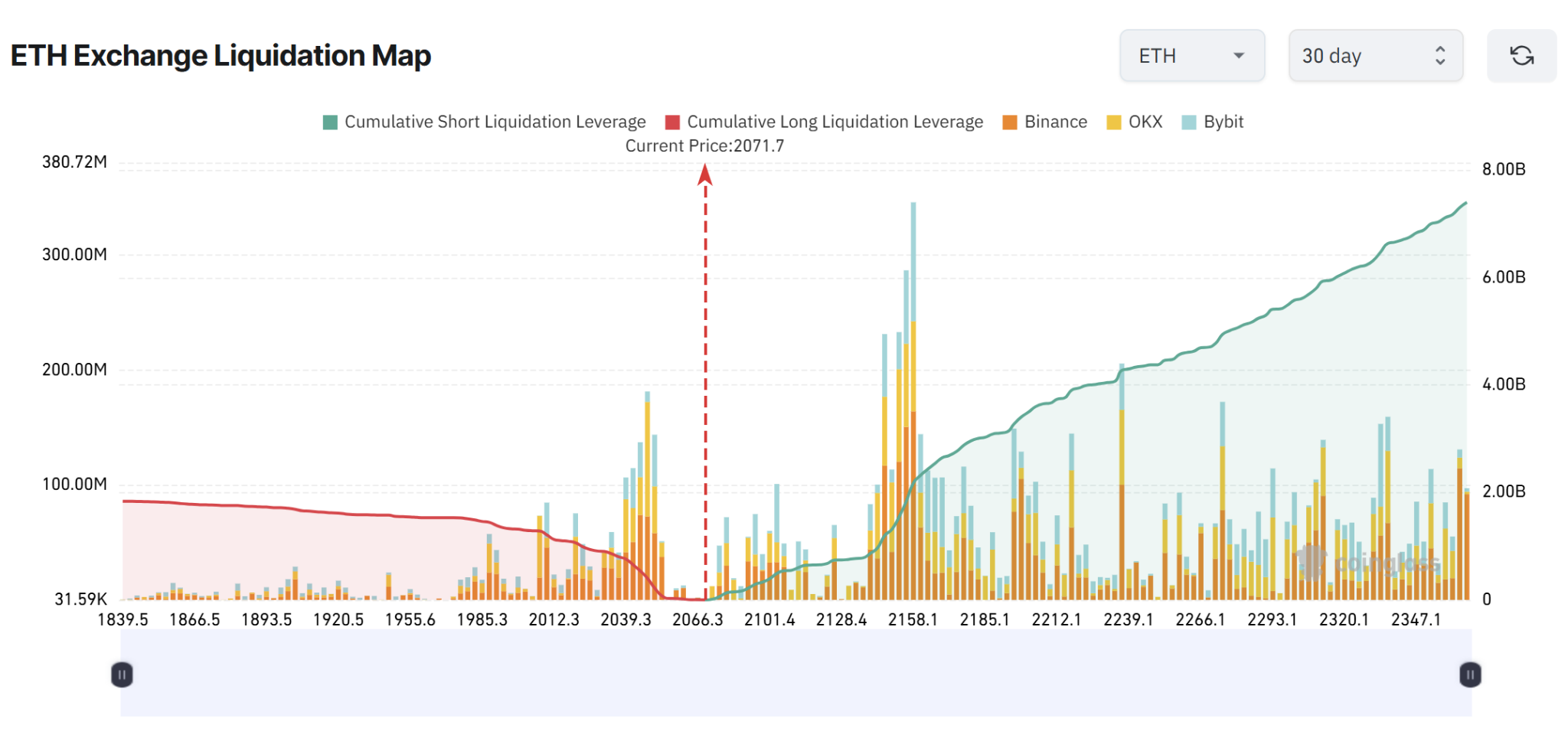
ETH liquidation map. Source: CoinGlass
Related: Tom Lee predicts supercycle amid Bitmine’s largest Ethereum buy in 2026
ETH retail participation keeps shrinking
Ether has steadily lost participation from mid-sized holders since 2023, reflecting weak conviction among the retail investors. Wallets holding between 100 and 1,000 ETH controlled roughly 16.2 million ETH during the 2023 peak, but that figure has since dropped to around 8.75 million ETH.
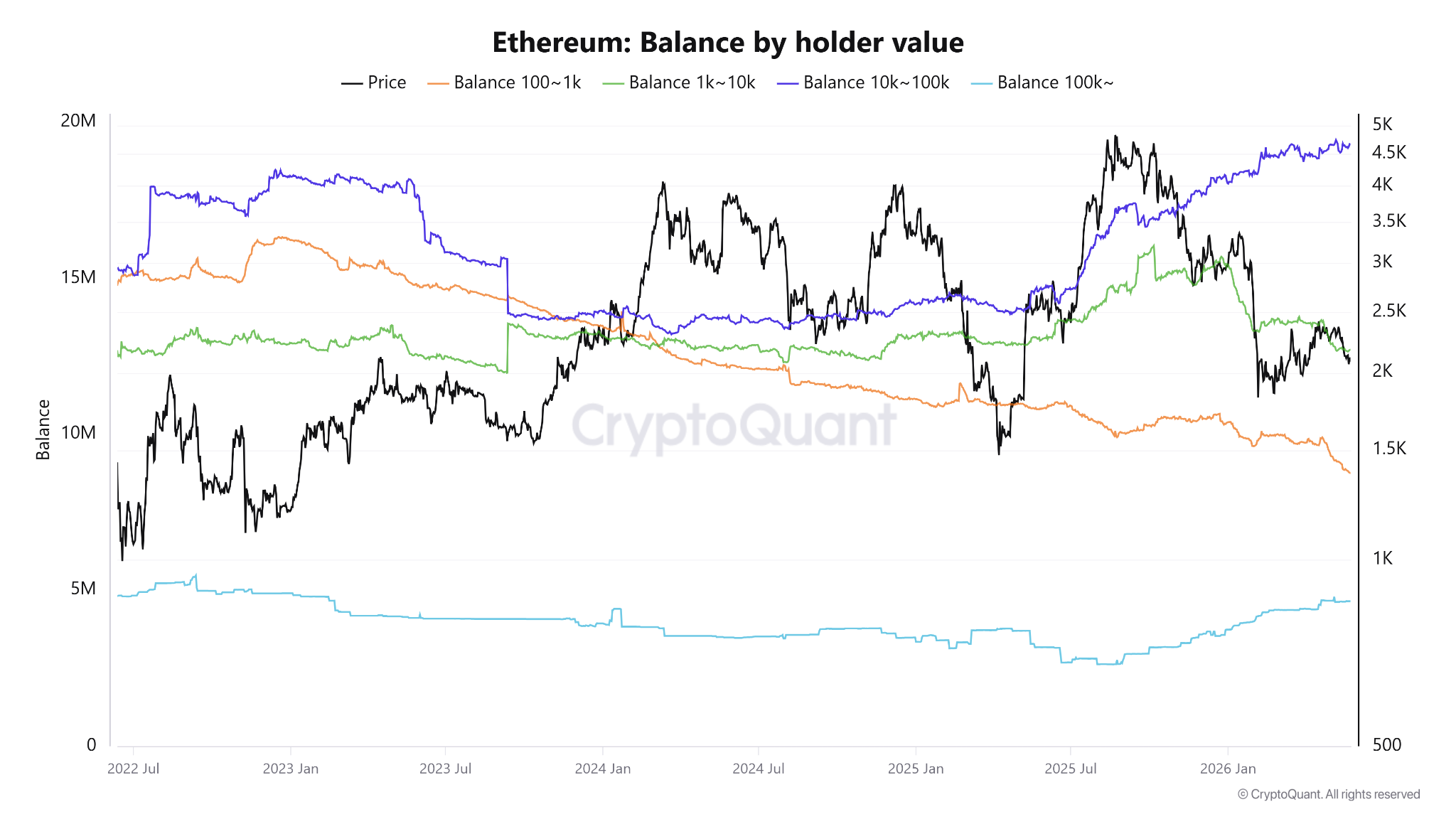
Ether balance by holder value. Source: CryptoQuant
Meanwhile, larger investors played a key role in Ethereum’s 2024 rally. Holdings among addresses with 1,000–10,000 ETH rose to 15.8 million from 12.4 million ETH before distribution began in October 2025. As of May 25, balances in this cohort had fallen back to 12.7 million ETH, indicating reduced exposure after the rally.
However, Ether’s largest holders continue to accumulate aggressively. ETH wallets holding between 10,000 and 100,000 ETH increased their balances by nearly 30% over the past year, rising to 19 million ETH from 14.7 million ETH. The trend suggests that mega-whales continue absorbing ETH supply even as participation from mid-sized holders declines.
Related: Ethereum bull David Hoffman explains why he sold his ETH


Binance co-CEO Yi He has become the first crypto-native executive ever named to Fortune’s Most Powerful Women in Business list. The 2026 ranking placed her at #64.
Her debut puts a single name from the cryptocurrency sector alongside chiefs from finance, retail, and Fortune 500 technology. The recognition arrives months after Binance formally promoted her to co-CEO in December 2025.
1. She Recruited CZ to Crypto, Not the Other Way Around
Yi He pivoted from Chinese television into the cryptocurrency sector in 2014. She joined the exchange OKCoin, now known as OKX, as a marketing executive.
From that perch, she recruited a then-little-known engineer, Changpeng Zhao (CZ), as chief technology officer. The pair later became life partners and co-founded Binance during the 2017 ICO boom.
Yi He led marketing, branding, and global user growth while CZ handled the technology stack. Most retellings of Binance’s origin reverse who pulled whom into the digital asset space.
2. She Went from Kerosene Lamps to Multibillionaire Status
Yi He was born in 1986 in a rural Sichuan village without consistent electricity or running water. She lost her father at age nine and worked promoting soft drinks at 16.
She later worked as a travel television host and, in her thirties, taught herself English to help expand Binance globally.
She reportedly holds about a 10% stake in Binance through a holding company.
“CZ reportedly owns nearly 90% of Binance, while his partner, co-founder, and the mother of his children, Yi He, controls the remaining 10%,” one user highlighted.
That position makes her one of the wealthiest women in the crypto sector, according to a Fortune profile.
3. Every New Binance Hire Works the Customer Service Line
Yi He built Binance around what she calls a user-first philosophy, and she enforces it operationally.
New employees, regardless of seniority, must spend time handling customer support tickets.
She also engages directly with users on X, Telegram, and WeChat, including responding to scam reports. Bloomberg has previously called her the most powerful woman in crypto.
Chinese-speaking communities refer to her as “一姐” (Yi Jie), or “Big Sister Yi.”
4. She Runs an Investment Arm that Bets Far Beyond crypto
Yi He leads YZi Labs, the family-office successor to Binance Labs that rebranded in January 2025. The fund deploys capital across Web3, artificial intelligence, biotech, and other frontier sectors.
YZi Labs reportedly manages more than $10 billion in assets across over 300 portfolio companies. The vehicle gives her a power base outside the exchange itself.
She co-owns the fund with CZ, with whom she has three children, but was never legally married.
5. Her co-CEO Promotion Followed Binance’s Biggest Legal Crisis
Yi spent years as a behind-the-scenes operator before her formal elevation to co-CEO in December 2025. She shares the title with Richard Teng, who handles compliance and regulatory affairs.
The promotion followed her work steering Binance through CZ’s 2023 guilty plea. That episode included a $4.3 billion U.S. settlement that nearly redrew the exchange’s future.
In her response to the Fortune recognition, Yi He framed it as a marker for the industry rather than a personal trophy.
“I’m truly humbled to be the first crypto-native executive to receive this recognition on the #FortuneMPW list. Building Binance from the very beginning has been an incredible journey, and this is a very personal moment for me,” she said.
Whether her debut becomes a one-off or the start of broader recognition for crypto leaders remains to be seen. Much will depend on how Binance handles its next compliance cycle.
“The recognition may carry my name, but it belongs to the Binance team, Binance users, Satoshi Nakamoto, and to every member of the crypto community who helped turn this industry from an idea into a global wave,” she added.
The post 5 Things to Know About Yi He, First Crypto Boss on Fortune’s Most Powerful Women List appeared first on BeInCrypto.

Six congressional runoff winners in Texas—backed by cryptocurrency-aligned political action committees (PACs)—signal a growing political footprint for crypto policy advocates. The six candidates, spanning Democratic and Republican lines, benefited from media spending and endorsements orchestrated by industry-linked groups such as Fairshake, Defend American Jobs, Protect Progress, Blockchain Leadership Fund, and Fellowship PACs. The outcome underscores a broader narrative: crypto policy is increasingly embedded in electoral considerations, with industry players signaling intent to translate wins into legislative influence.
According to regulatory filings and reporting, more than $10 million in supportive media and ads was spent by crypto-aligned PACs on the six Texas candidates. Fairshake, one of the largest industry PACs, has reported a war chest exceeding $193 million in its latest public disclosures as of January, and indicated plans to deploy funds to support pro-crypto candidates in the 2026 midterm elections. In Texas, Democrat Christian Menefee challenged incumbent Rep. Al Green in the 18th district, while Republican Ken Paxton defeated incumbent Senator John Cornyn with a margin exceeding 63%. Four additional Republican candidates—Tom Sell, Alex Mealer, Jon Bonck, and Carlos De La Cruz—also prevailed in smaller districts, benefiting from thousands of dollars in media spending directed by Defend American Jobs.
Geoff Vetter, a spokesperson for Fairshake, framed the Texas results as evidence that anti-crypto hostility can carry electoral consequences. “Rep. Green’s defeat proves that anti-crypto hostility carries real electoral consequences, making him the first Democratic incumbent this cycle to lose his seat,” Vetter stated. “Fairshake was the difference-maker in this race, and we will continue to aggressively back leaders like Rep. Menefee across the country.”
Key takeaways
- The Texas runoff results demonstrate tangible electoral gains for candidates supported by crypto-aligned PACs, underscoring the organized political footprint of the crypto policy movement.
- Regulatory and policy considerations are increasingly central to campaign strategies, with substantial media investments aimed at shaping perceptions of crypto-friendly governance.
- The fundraising and backing patterns point to a broader, long-term strategy to influence federal and state policy discussions on crypto regulation, licensing, and compliance frameworks.
- Upcoming primaries in six states on June 2 will test the expansion of crypto-linked political activity beyond Texas, including cross-party support and district-level campaigns.
Strategic implications for policy and enforcement frameworks
The Texas outcomes arrive at a moment of heightened regulatory attention in both the United States and overseas. In the United States, the regulatory landscape—spanning the Securities and Exchange Commission (SEC), the Commodity Futures Trading Commission (CFTC), and the Department of Justice (DOJ)—continues to evolve around issues such as market integrity, investor protection, and the classification of digital assets. Lawmakers and regulators are increasingly weighing how to balance innovation with robust AML/KYC controls, licensing regimes, and cross-border oversight. Within this context, the Texas results improve the perceived relevance of crypto policy positions when candidates confront voter concerns about financial innovation, consumer safeguards, and the stability of the financial system.
From a compliance perspective, the growing involvement of crypto-focused PACs raises questions about disclosure, governance, and accountability in political spending. Efforts to align campaign financing with transparent reporting and to prevent misuse of industry funds for influence-peddling remain at the forefront of regulatory scrutiny. The U.S. policy debate continues to intersect with international norms, including the European Union’s MiCA framework, which centers on harmonized requirements for crypto issuers, service providers, and stablecoins. While MiCA is an EU instrument, its existence shapes global expectations for risk management, licensing, and consumer protections that domestic firms may seek to mirror in U.S. policy discussions.
Next testing ground: six states and a governance laboratory
Looking ahead to June 2, voters in California, Iowa, Montana, New Jersey, New Mexico, and South Dakota will participate in primaries for U.S. House and Senate seats in addition to several gubernatorial races. Regulatory-minded observers are watching these contests as a practical test case for how crypto-aligned campaigns mobilize resources and influence candidate selection across diverse state contexts.
In California, the political dynamic includes a gubernatorial race conducted under the state’s jungle primary system, in which all candidates appear on a single ballot and the top two vote-getters advance to the general election, regardless of party. The industry-aligned spending narrative echoes a broader history: in 2024, Fairshake dedicated substantial resources to influence the California Senate contest surrounding Democrat Katie Porter. Porter did not win the 2024 primary, but she remains a focal point of crypto-related campaign activity as she runs for governor. As of the latest disclosures, there were no clear indications of crypto PAC spending opposing Porter or other gubernatorial contenders in the immediate term, though industry fundraising and advocacy continue to shape public discourse around policy choices for the state’s crypto sector.
Industry insiders have cautioned that the regulatory and political environment remains fluid. For instance, backers of crypto policy have pointed to dynamic enforcement priorities that could shift with changes in administration, agency leadership, and legislative agendas. In parallel, prediction-market activity and donor contributions continue to provide indicators of where campaign support may trend, albeit with inherent uncertainty. The ecosystem’s cross-market signals—framing of regulation, licensing expectations, and potential banking relationships for stablecoins and other digital assets—remain integral to both campaign strategy and corporate risk assessment.
According to publicly available filings, Protect Progress has earmarked roughly half a million dollars to support Democratic candidates across the six upcoming states, including targeted investments in California districts and New Jersey races. The distribution illustrates how crypto-aligned groups deploy resources to bolster favorable candidates in high-stakes races and how such activity intersects with state-specific regulatory climates and enforcement priorities. Observers note that these patterns have implications for how policymakers prioritize crypto-related regulations, licensing regimes, and consumer protections at both state and federal levels.
Beyond state races, the broader policy conversation continues to integrate a spectrum of regulatory concerns—from comprehensive AML/KYC compliance frameworks to the treatment of cross-border payments and the resilience of the banking system to crypto exposures. The governance implications for exchanges, custodians, and issuers—particularly around licensing, reporting obligations, and the delineation between securities and commodities—remain central to institutional stakeholders, risk teams, and compliance officers evaluating market structure risk and regulatory alignment.
As the political and regulatory landscape evolves, market participants and researchers alike will be watching how crypto-aligned PAC activity translates into concrete policy outcomes, enforcement actions, and licensing decisions that shape the operating environment for exchanges, banks, and institutional investors. The Texas results are a data point in a longer arc of policy development, where elections, advocacy, and regulatory design intersect to determine the trajectory of crypto integration into the mainstream financial system.
In the near term, observers should monitor the June primaries for signals about institutional alignment, fundraising dynamics, and the readiness of crypto-friendly candidates to secure broader political backing. The evolving interplay among campaign strategy, regulatory expectations, and market infrastructure will likely define the contours of crypto policy discourse in the months ahead.
Crypto World
DTCC taps Stellar (XLM) for tokenized securities network in latest Wall Street blockchain push


The Depository Trust & Clearing Corporation (DTCC), Wall Street’s clearinghouse, said Wednesday it plans to connect its tokenized securities platform to the Stellar (XLM) network, expanding a broader effort by Wall Street firms to move traditional financial (TradFi) assets onto blockchain rails.
Tokenized assets custodied by DTCC’s Depository Trust Company could become available on Stellar during the first half of 2027, DTCC and the Stellar Development Foundation said in a press release shared with CoinDesk.
The firms said the integration would support issuance, settlement and lifecycle management of blockchain-based versions of traditional securities. They also plan to explore use cases to tokenize “highly liquid assets” such as major indices and U.S. Treasury debt instruments.
XLM (XLM), the native token of Stellar, jumped 3% on the news before paring some of the gains. It was up 1.7% over the past 24 hours, outperforming as bitcoin and the broader crypto market pulled back.
Tokenization — the process of representing traditional assets like stocks, bonds and funds on blockchain — has become one of Wall Street’s hottest infrastructure bets. Proponents, including bank executives, say blockchain-based securities could reduce settlement delays, free up collateral and allow markets to operate beyond standard trading hours.
The push has accelerated across major financial firms and exchanges as regulators signal growing openness to onchain market structure. Nasdaq is developing infrastructure for blockchain-based shares with Kraken parent company Payward, while Intercontinental Exchange (ICE), owner of the New York Stock Exchange (NYSE), is backing tokenized securities initiatives tied to crypto exchange OKX.
DTCC, which sits at the center of U.S. market infrastructure and oversees more than $114 trillion in assets, has emerged as one of the key traditional finance players pushing into tokenization.
The company announced earlier this month that it plans to begin limited production trades of tokenized assets in July ahead of a wider rollout in October. That service follows a no-action letter the SEC granted in December 2025 allowing DTCC to tokenize a defined set of assets, including Russell 1000 stocks, ETFs and U.S. Treasuries.
The tie-up with Stellar forms part of DTCC’s “multi-chain” strategy, where tokenized assets can move across different blockchain networks instead of remaining tied to a single platform.
“This collaboration represents another step forward in DTCC’s efforts to build an open, interoperable digital infrastructure that bridges traditional and digital markets,” said Frank La Salla, President and Chief Executive Officer of DTCC.
Nadine Chakar, DTCC’s global head of digital assets, said that the firm plans to connect to “multiple layer-1 and layer-2 networks.”
Read more: Wall Street’s clearinghouse seeks ‘high-performance’ blockchains to tokenize corporate actions
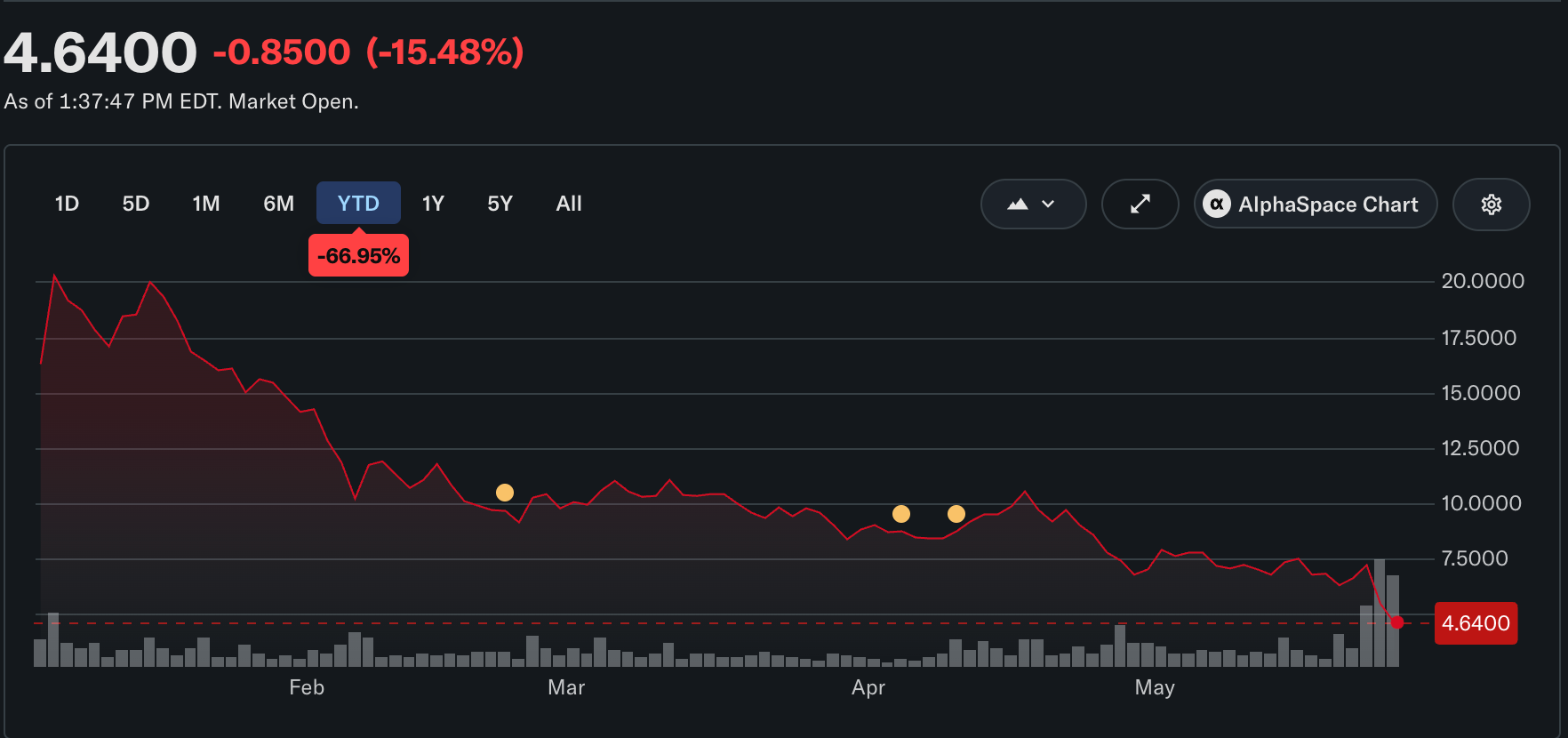
Nakamoto (NAKA) is trading down more than 10% on Wednesday just days after the Bitcoin treasury company completed a 1-for-40 reverse stock split undertaken to stay compliant with the Nasdaq stock exchange’s listing criteria.
NAKA stock is down by about 67% year-to-date (YTD) and by more than 99% since its May 2025 peak of about $34 per share, reaching a low of about $0.16 per share in April before the reverse stock split on Friday.
Nasdaq warned the company in December that its shares would be delisted after trading below $1 for at least 30 consecutive days, according to a Securities and Exchange Commission (SEC) filing.
The reverse split reduced the number of outstanding shares to about 17.4 million from about 696 million, according to the company.
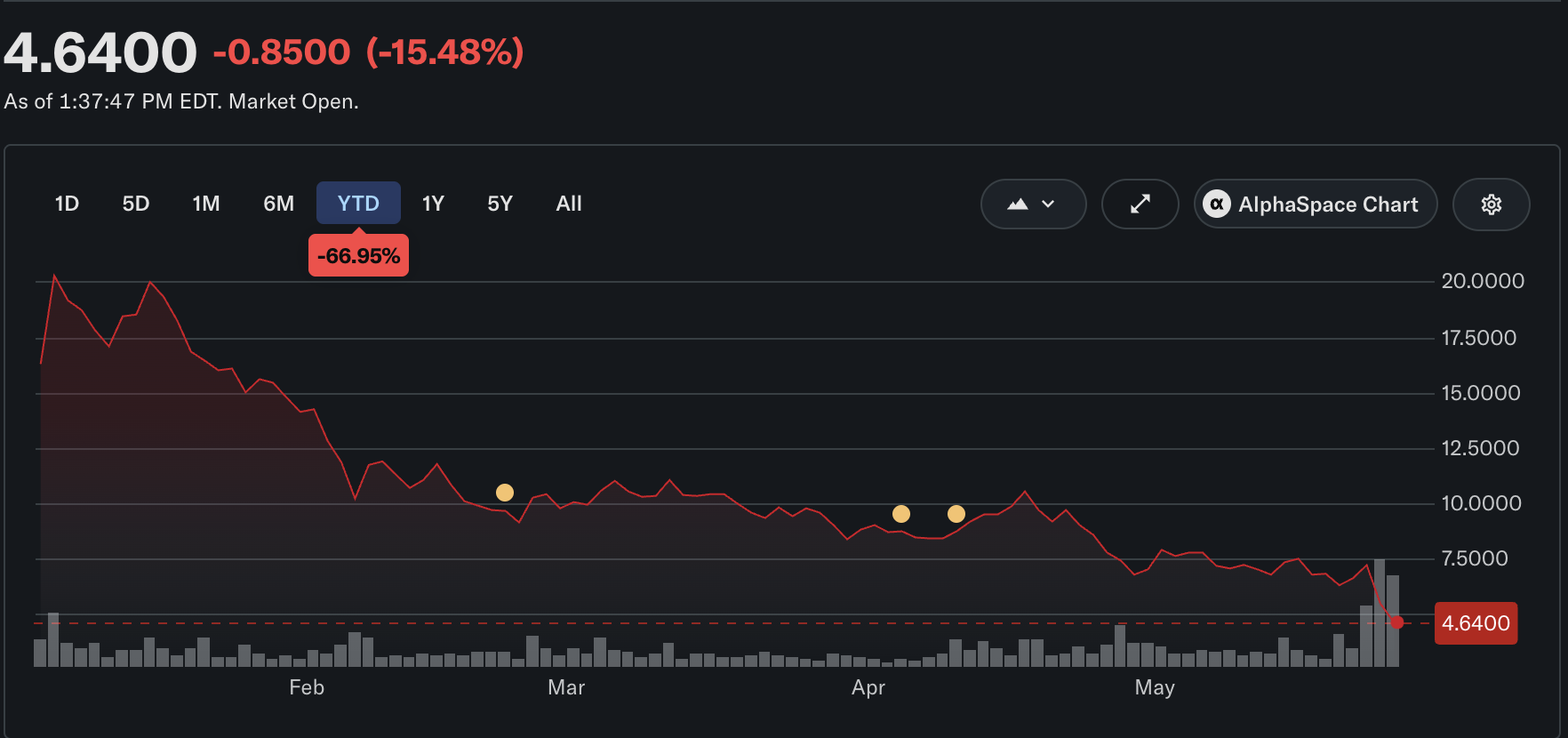
NAKA stock price is down by nearly 67% year-to-date. Source: Yahoo Finance
Cointelegraph reached out to NAKA for comment but did not receive a response by the time of publication.
The decline in NAKA’s value comes amid a broad downturn in the Bitcoin treasury sector that started in 2025; however, the company has also underperformed the industry’s top players, including Strategy (MSTR), Twenty-One Capital (XXI) and Strive Asset Management (ASST).
Related: Bitcoin firm Nakamoto records net loss in Q1 despite sixfold revenue growth
BTC treasury companies show signs of recovery, but market remains challenging
Strategy, the biggest Bitcoin treasury company as measured by its BTC holdings, is up about 2.5% YTD, and is trading at about $155 per share.
Twenty-One Capital, the second-largest publicly traded BTC treasury, with 43,514 coins, is down by more than 17% YTD, and is trading at about $7.26 per share.
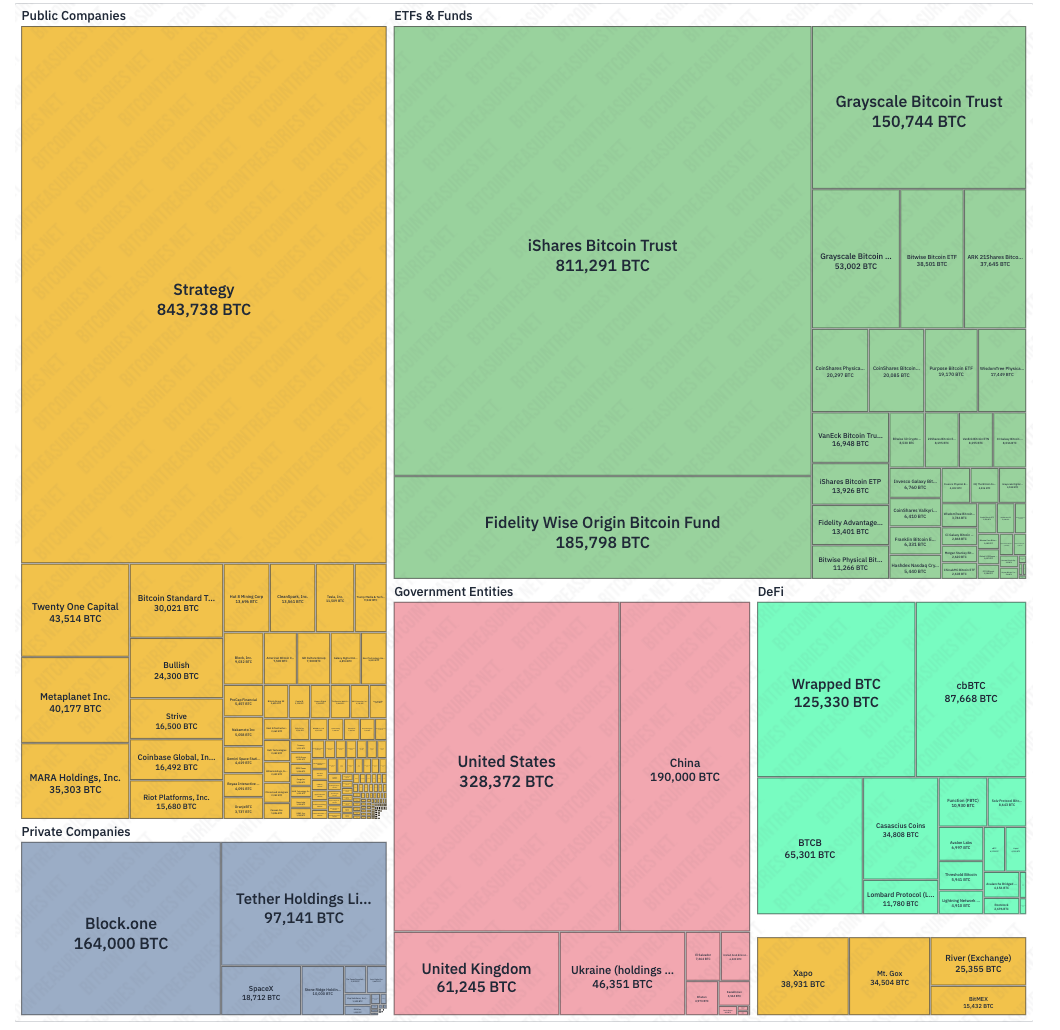
The current distribution of Bitcoin among publicly traded BTC treasury companies, private enterprises, government entities and investment funds. Source: Bitcoin Treasuries
Strive is also up by over 20% YTD, last trading at about $17.72 a share.
The digital asset treasury space is likely to experience consolidation in 2026, as bigger companies eat up smaller firms, according to venture firm Pantera Capital.
“2026 will see brutal pruning. In each major asset class, only one or two players will dominate. Everyone else gets acquired or left behind,” analysts at Pantera forecast in January.
Magazine: Bitcoin will not hit $1M by 2030, says veteran trader Peter Brandt


Aztec Labs has acquired Obsidion, the team behind ZKPassport, a privacy-preserving identity verification protocol built on zero-knowledge cryptography, according to a press release published Wednesday. Obsidion co-founders Michael Elliot and Theo Madzou join Aztec Labs along with their team. The… Read the full story at The Defiant

Bootids Meteor Shower May Explode With Meteors or Fizzle Out: How to Watch

What Anthony Gordon transfer agreement means for Man United after Marcus Rashford sacrifice

Rubio pushes US energy dominance in India as Iran war reshapes global oil flows


![PSquare - Taste the Money (Testimony) [Official Video]](https://wordupnews.com/wp-content/uploads/2026/05/1779914517_maxresdefault-80x80.jpg)

-

 Crypto World6 days ago
Blockchain.com files with SEC for U.S. IPO
-

 Fashion5 days ago
Holiday Weekend Open Thread – Corporette.com
-

 Crypto World6 days ago
Bitcoin Accumulation Weakens as BTC Realized Losses Hit $600M
-

 Tech2 days ago
Microsoft’s quiet Claude Code retreat and the real cost of enterprise AI
-

 Crypto World4 days ago
Robinhood crypto COO Tanya Denisova exits
-

 Business5 days ago
Dell Technologies DELL Stock Surges 15% on AI Server Momentum and Analyst Upgrades in 2026
-

 Business3 days ago
NYT Strands Answers May 24 2026 Revealed for Puzzle No. 812 Theme Summer Essentials
-

 Politics5 days ago
Makerfield: a tale of two social-media histories
-

 Crypto World5 days ago
Space X IPO Is ‘Bad News’ for Tech Stocks: But What About Bitcoin?
-

 Business6 days ago
Trump Invests $1M-$5M in Kura Sushi USA Chain With 27 California Locations
-
 Crypto World6 days ago
MicroStrategy’s Saylor Says Miners No Longer Set Bitcoin Price, Another Force Has Taken Over
-

 Tech6 days ago
WhatsApp ads could make Irish debut after discussions with DPC
-
 NewsBeat6 days ago
Charity run by Reform leader Malcolm Offord accused of ‘law breaking’ over Scottish registration
-
Tech9 hours ago
The Samsung pay deal is the moment Korean unions changed register
-

 Crypto World5 days ago
AI infrastructure race heats up as IREN pitches full-stack strategy, WhiteFiber lands $160M deal
-
 Crypto World2 days ago
Nvidia (NVDA) CEO Calls on Super Micro to Strengthen Export Controls Amid Smuggling Probe
-
 Tech5 days ago
A 0.12% parameter add-on gives AI agents the working memory RAG can’t
-

 Tech6 days ago
You Can Now Add ChatGPT To PowerPoint
-

 Tech2 days ago
Westone Audio and Etymotic Acquired by Fidelity Collective in Major IEM Market Move
-

 Sports6 days ago
2026 CJ Cup Byron Nelson leaderboard: Brooks Koepka finds putting stroke in Round 1
You must be logged in to post a comment Login