

Crypto World
Mastercard secures New York BitLicense to support stablecoin and digital payment infrastructure

Mastercard has received a BitLicense from the New York State Department of Financial Services (NYDFS), giving the payments giant approval to operate digital asset activities under one of the strictest crypto regulatory frameworks in the United States.
The company announced Wednesday that Mastercard Transaction Services (U.S.) LLC secured the license as part of its broader push into blockchain-based payments and settlement infrastructure.
The approval comes as major financial firms deepen their involvement in stablecoins and tokenized payments, betting that blockchain networks could lower costs and speed up global money movement.
“Clear regulatory frameworks play an important role in building trust and confidence as new forms of digital value move from experimentation toward practical application,” Jorn Lambert, Mastercard’s chief product officer, said in a statement.
New York’s BitLicense framework, introduced in 2015, requires crypto firms to meet strict standards around capital reserves, cybersecurity, compliance and consumer protection. Companies operating under the license also face ongoing regulatory oversight from NYDFS.
The regime has often been criticized by crypto firms for its high compliance costs and lengthy approval process, though supporters argue it gives institutions clearer rules for operating digital asset businesses.
Mastercard joins a relatively small list of firms to recently receive the license. Crypto financial services company Galaxy obtained a BitLicense earlier this month, following Strike’s approval in March, alongside two dozen other firms to receive a virtual currency license since the regime’s launch a decade ago.
The move aligns with Mastercard’s growing focus on stablecoin infrastructure. In March, the company agreed to acquire stablecoin payments firm BVNK for $1.8 billion, a deal analysts viewed as a sign that stablecoins are becoming part of mainstream financial infrastructure rather than remaining a niche crypto product.
Stablecoins — digital tokens pegged to fiat currencies like the U.S. dollar — are increasingly used for cross-border payments, treasury operations and business-to-business settlements because blockchain transfers can settle around the clock and often faster than traditional banking rails.
Mastercard said the BitLicense approval supports its strategy around digital currencies, including stablecoins and tokenized deposits, while maintaining the compliance and operational standards used across its global payments network.
“As digital and traditional financial systems continue to evolve, Mastercard remains focused on advancing interoperability, reliability and trust across the payments ecosystem,” the company said.



The U.S. Commodity Futures Trading Commission wants to tear up the remnants of an old dispute with crypto exchange Gemini, with the agency insisting that its own staff’s assertions about Gemini making misleading statements weren’t handled properly.
The CFTC filed a request alongside Gemini in federal court to negate a settlement secured at the start of last year, with the current agency essentially disputing the conclusions of the previous agency. After a review of the case, the CFTC “concluded the complaint should not have been filed — and would not have been under current enforcement standards,” it said in a Wednesday statement.
In January of 2025, Gemini agreed to resolve an enforcement action with a $5 million fine and other requirements, settling a matter that began in 2017. In meetings with the CFTC back then, its staff had determined that Gemini allegedly made false statements about the relative difficulty of manipulating bitcoin futures contracts and the regulator pursued an enforcement action in 2022.
If the U.S. District Court for the Southern District of New York grants the request to cancel the settlement and toss the case, the remainder of Gemini’s requirements under the agreement will be nullified — including its injunction preventing the company from making false or misleading statements to the commission in the future.
The CFTC has dramatically reversed its previous relationship with the crypto industry since the arrival of the administration of President Donald Trump just days after the Gemini settlement, and the subsequent appointment of CFTC Chairman Mike Selig, who has embraced digital assets as one of his top policy goals.
Trump has also sought to champion the industry, including specifically welcoming Gemini’s founders, the Winklevoss brothers, to White House events.
The president’s previous nominee to run the CFTC, former Commissioner Brian Quintenz, said last year in posts on X (formerly Twitter) that the Winklevoss brothers had asked him to review the settlement and suggested they were unhappy that he refused to commit to anything further than a review of the case. Trump withdrew his nomination just under three weeks later.
The president’s pro-crypto agenda was on display Wednesday in a posting on his social media platform, Truth Social, where he said, “The new Frontier of Finance is being Built in America, and ‘TRUMP’ will NEVER let Crypto down!”

TLDR:
- The CFTC admitted the 2022 complaint against Gemini should never have been filed under current standards.
- A whistleblower with known credibility issues served as the primary basis for the original complaint against Gemini.
- Agency personnel were found to have misused regulatory authority to create leverage during settlement negotiations.
- The CFTC and Gemini jointly moved to vacate prospective provisions after the civil monetary penalty was already paid.
The CFTC has joined Gemini Trust Company LLC in a motion to vacate a consent order tied to a 2022 enforcement action.
The regulator concluded that the original complaint against the crypto firm should never have been filed. After a comprehensive review, the agency found several serious problems with how the case was built and prosecuted.
The move comes amid broader shifts in federal digital asset enforcement policy across multiple government agencies.
CFTC Review Reveals Serious Enforcement Failures
The CFTC’s internal review of the Gemini case uncovered a troubling series of missteps. The complaint was largely built on testimony from a whistleblower later found to lack credibility.
Rather than targeting alleged fraudsters, the agency pursued Gemini — a company the review identified as a fraud victim itself.
The CFTC stated directly that “the complaint should not have been filed — and would not have been under current enforcement standards.”
Investigators also found that evidentiary support was withheld from a Commissioner ahead of the vote to file the complaint. This raised questions about transparency within the agency’s own decision-making process.
Litigation counsel also invoked the deliberative process privilege, blocking Gemini from accessing evidence needed for its defense.
The review found that personnel “improperly influenced the CFTC’s regulatory authority to create settlement leverage.” These findings paint a picture of an enforcement process that, in this case, went beyond its proper boundaries.
Consent Order Vacated, Prospective Provisions No Longer Apply
The parties entered into a consent order in January 2025 after the original complaint was filed in June 2022. The non-prospective provisions of that order, including the civil monetary penalty, have already been satisfied.
However, the CFTC determined that continuing to enforce the remaining injunctive and prospective provisions no longer serves the public interest.
The agency concluded that “continuing enforcement of the consent order’s prospective provisions serves neither the CFTC’s mission nor the public interest.”
As a result, both parties are now jointly asking the Southern District of New York court to vacate those outstanding provisions.
The CFTC added that applying these terms going forward “would not be equitable,” given the findings of the review.
This development fits within a wider federal reassessment of digital asset enforcement policy. Multiple agencies have revisited and resolved crypto-related cases under revised standards.
For Gemini, the outcome marks a formal acknowledgment that it should not have been a defendant in this matter at all.



BIS tokenization work has cleared its atomic settlement prototype phase and will graduate to real-value cross-border payment trials.
Summary
- Project Agora demonstrated tokenised cross-border settlement across seven central banks and more than 40 financial institutions.
- The Bank of Canada joined Wednesday, with real-value transactions set as the next testing milestone.
- The prototype preserves correspondent banking, sanctions screening, and SWIFT compatibility rather than replacing them.
BIS tokenization work has cleared its atomic settlement prototype phase and will graduate to real-value cross-border payment trials. The Bank for International Settlements confirmed the move Wednesday.
Project Agora, a public-private collaboration with seven central banks and more than 40 financial institutions, showed that tokenised commercial bank deposits can settle against tokenised central bank reserves on a shared platform with finality across jurisdictions.
Why the BIS tokenization prototype matters for global banks
The prototype demonstrated atomic settlement, where every leg of a cross-border transaction clears at the same instant or not at all. Banks involved said the design compresses correspondent flows that currently take days into seconds.
“Once you know you have everything to run the transaction, you settle it in one go,” BIS Deputy General Manager Andrea Maechler said in remarks accompanying the release. The Bank of Canada also joined the project on Wednesday.
Project Agora participants include the Bank of England, Federal Reserve Bank of New York, Bank of Japan, Banque de France, Swiss National Bank, Bank of Mexico, and Bank of Korea. The Institute of International Finance convenes the private-sector side.
“It will benefit the entire financial system,” said Tim Adams, head of the IIF, in a statement carried alongside the announcement.
How the unified ledger fits existing payment rails
The prototype keeps correspondent banking intact rather than replacing it. The 97-page final report from BIS calls correspondent banking the “backbone of global payments” and stresses that sanctions screening and anti-money-laundering controls stay inside the system.
That framing is deliberate. Project Agora is not built to disintermediate banks like crypto-native stablecoin networks aim to, but to give existing institutions faster rails compatible with SWIFT and ISO 20022. The contrast with stablecoin corridors is structural.
Smart contracts on the platform let banks embed compliance checks, conditional payment triggers, and workflow logic directly into transactions. The report flagged reduced reconciliation, fewer manual interventions, and lower operational risk as the main efficiency gains.
A separate legal analysis attached to the report found settlement finality is achievable across all seven participating jurisdictions. Further work is needed on technical and contractual requirements tailored to each legal regime.
What real-value testing changes for tokenization
The next phase will move beyond synthetic transfers and route actual money through the prototype, marking the first time a BIS Innovation Hub effort of this scale has graduated to live transactions.
Bank of Canada Senior Deputy Governor Carolyn Rogers said tokenisation “has the potential to make these payments faster, cheaper and more efficient and secure,” confirming the central bank’s participation in the next test phase.
The timing fits the broader tokenization shift among Wall Street firms. DTCC plans to roll out tokenised settlement for stocks, ETFs and Treasuries. Nasdaq and ICE are both developing blockchain-based systems for tokenised equities.
Bernstein analysts have called 2026 a “tokenization supercycle,” with stablecoin supply and on-chain Treasury demand both climbing into year-end.
A final report on Project Agora is expected in the first half of this year. The mid-2026 update will be the first checkpoint for whether real-value testing holds up at scale.


SoFi has rolled out its dollar-backed stablecoin, SoFiUSD, to users of its banking app, becoming the first U.S. national bank to offer a stablecoin directly to retail customers on a public blockchain.
The company said Wednesday that nearly 15 million members will be able to buy, sell, hold and convert SoFiUSD within the SoFi app. The stablecoin is available on Ethereum (ETH) and Solana (SOL) and is redeemable 1:1 for U.S. dollars through SoFi Bank.
The launch marks a broader push by banks into blockchain-based payments as lawmakers and regulators move closer to establishing rules for stablecoins in the U.S. Stablecoins are digital tokens designed to maintain a fixed value, usually pegged to the dollar. The market is currently dominated by crypto-native issuers Tether’s USDT and Circle’s USDC, which are widely used in crypto trading and decentralized finance.
SoFi said it sees the larger opportunity outside crypto markets.
“The use of stablecoins in traditional finance is still incredibly small today,” a SoFi spokesperson said. “Historically, stablecoins have been used for DeFi and crypto trading, but not for use cases like cross-border payments or B2B transactions.”
The spokesperson added that regulation and institutional oversight could become key advantages as banks enter the sector.
“SoFiUSD competes by offering what crypto-native issuers cannot: the trust, security and oversight that comes with being a nationally chartered bank,” the spokesperson said.
SoFi CEO Anthony Noto said the company wants to combine blockchain-based payments with regulated banking services inside a single platform.
“People no longer have to choose between blockchain technology and regulated banking products,” Noto said in a statement in December alongside the launch of SoFiUSD.
SoFi said future updates will allow users to convert SoFiUSD into tokenized deposits that may earn interest and qualify for FDIC insurance, subject to separate account terms. The company also plans to support 24/7 cross-border transfers and launch trading access through crypto exchange Bullish for institutional clients.
Full availability is expected by early June as members update the latest version of the SoFi app.


The US government moved roughly $1.9 million in altcoins seized from Alameda Research to Coinbase Prime on Wednesday. On-chain tracker Arkham Intelligence flagged the transfer.
The batch covered five tokens from wallets the Department of Justice seized in 2023. The source accounts sit at Binance, and the move has revived familiar speculation about an eventual government sale.
Is the US Government Selling?
A wallet labeled by Arkham as the US Government sent about $1.89 million in tokens to a Coinbase Prime deposit address.
The batch covered Render (RNDR), Uniswap (UNI), The Sandbox (SAND), Mask Network (MASK), and Axie Infinity (AXS).
Most of the dollar value sat in RNDR and UNI. Both tokens trade with market caps near $1.14 billion and $2.08 billion, respectively, according to BeInCrypto data.
SAND, MASK, and AXS are smaller positions worth a few hundred thousand dollars apiece.
Coinbase Prime is the exchange’s institutional arm. Hedge funds, asset managers, and government agencies use it for custody and structured sales.
Past USG transfers there have preceded both custody changes and outright liquidations, including an earlier Bitfinex bitcoin Coinbase transfer.
A Familiar Pattern From the 2023 Forfeiture
The seized stash traces back to January 2023. The Department of Justice filed civil forfeiture actions against three Alameda accounts on Binance and Binance.US.
Those accounts held over $300 million at the time. The action sat inside the wider FTX collapse case. That case has since produced more than $11 billion in court-ordered forfeitures.
The transfer fits a pattern from the same wallet. In late 2024, the federal addresses converted seized Aragon (ANT) tokens into ether.
That swap ended two years of dormancy, an Alameda earlier ANT move Arkham flagged at the time.
It also recalls an earlier FTX wallet shuffle of about $33 million in ETH, BUSD, and smaller tokens.
How Markets Read the Move
Most early reactions on X treated the transfer as routine asset management rather than an imminent sell signal. At $1.9 million, the batch is a sliver of the agency’s overall crypto position.
“Relax, it’s pocket change for the US gov. They probably just rebalancing their bags,” one user stated.
Arkham’s public US Government entity page lists 610 wallet addresses holding a combined $27 billion as of early May 2026.
Of that, 328,361 BTC, worth roughly $26.6 billion, dominates the portfolio, with ether, stablecoins, and wrapped tokens trailing far behind.
The DOJ’s Asset Forfeiture Program tends to liquidate non-core altcoins ahead of bitcoin. The agency treats BTC as a longer-hold reserve and moves it in larger, structured batches.
A Coinbase Prime altcoin policy shift last year also reshaped which tokens institutional desks can custody.
That leaves Arkham’s question unanswered.
“Are they about to sell the seized funds?” Arkham posed.
Follow us on X to get the latest news as it happens
The post US Government Moves $1.9 Million of Seized Alameda Altcoins appeared first on BeInCrypto.


Singapore authorities have charged the former CEO of collapsed crypto lender Hodlnaut Zhu Juntao with fraud, nearly four years after the firm froze withdrawals during the collapse of the TerraUSD ecosystem.
The Singapore Police Force said that Zhu faces six charges of fraud by false representation in an announcement on Tuesday. Prosecutors allege Zhu directed employees in 2022 to publish false statements on Hodlnaut’s Telegram channels and in customer emails claiming the company had no direct exposure to TerraUSD’s collapse, and had not suffered losses as a result.
Authorities also alleged Zhu repeated similar claims on his personal X account, then known as Twitter, in three posts in June 2022. If convicted, Zhu could face up to 20 years in prison, fines, or both on each charge under Singapore law.
Zhu disputed all six charges in court and was given a pre-trial conference date in June 2026, according to local media reports.
Hodlnaut was one of several crypto lenders that failed after the implosion of Terraform Labs’ algorithmic stablecoin ecosystem in May 2022. The collapse erased about $40 billion from the crypto market and contributed to failures at firms including Three Arrows Capital, Celsius and Voyager.
Reports filed during Hodlnaut’s restructuring proceedings indicated the company had channelled roughly $317 million of user funds into Terra’s Anchor Protocol, which was offering around 19.5% in annualized yield on UST deposits before the collapse, which saw UST become almost worthless.
Court-appointed judicial managers later estimated Hodlnaut lost about $189.7 million from exposure to the Terra collapse. Reports reviewed during restructuring proceedings said the company had poor internal recordkeeping and that some executives did not fully cooperate with investigators.
Singapore-based Hodlnaut, which was founded in 2019, offered customers yield-bearing crypto accounts and served more than 30,000 users globally before halting withdrawals in August 2022.
The company later entered judicial management and was ordered into liquidation by the Singapore High Court.

Crypto-linked debit and credit cards are transitioning from novelty to everyday fixtures in consumer wallets. Monthly payment volume tied to crypto cards reached $7.8 billion this month, representing roughly a 230% year-over-year surge, according to The Kobeissi Letter, a market research publication tracking crypto payment rails.
Analysts note that Visa handles about 90% of crypto-card transactions through partnerships with on-chain native players such as Jupiter Global—the payments initiative developed by the team behind the Jupiter decentralized exchange on the Solana network. The rapid growth points to a widening bridge between digital assets and real-world spending, with stablecoins playing a central role as a spendable liability.
“Crypto card adoption has rapidly accelerated in 2026 due to growing access to stablecoins as a payment rail through crypto cards. In other words, more people can now spend stablecoins like fiat by using crypto cards, further driving adoption.”
The expanding footprint of crypto cards is often framed as evidence that digital assets are becoming part of mainstream commerce without displacing incumbent payment rails such as Mastercard and Visa. The trajectory suggests crypto-centric payment products are starting to function as real wallets for everyday purchases rather than experimental add-ons for traders and enthusiasts.
Crypto cards powering everyday payments around the globe
The practical side of this evolution is visible in Europe, where OKX—the crypto exchange formerly known as OkEx—launched a stablecoin payments card in January 2026, operating on the Mastercard network. The move underscores a push to normalize stablecoins as a payment rail across established card networks.
OKX’s card data highlights a concrete picture of consumer behavior in crypto-enabled commerce. Grocery purchases topped the spend mix, accounting for about 26% of January transactions, while eateries represented 18% and online shopping 13% of total volume. The data illustrates that crypto cards are being used for day-to-day expenses rather than just high-value or discretionary purchases.
“When crypto pays for lunch, payment adoption is real. For years, critics pointed to a lack of everyday utility as crypto’s weak point: great as a speculative asset, less useful as actual money,” the OKX team said in accompanying materials.
Beyond Europe, the broader ecosystem is moving toward broader, cross-border usage. In March, Visa and Bridge — a fintech firm owned by payments giant Stripe — announced plans to roll out stablecoin-linked payment cards in more than 100 countries. The rollout began with 18 countries, including Argentina, Colombia, Ecuador, Mexico, Peru, and Chile, with ambitions to expand across the Asia-Pacific, Africa, and the Middle East regions by the end of 2026. These signals reflect a coordinated effort to connect stablecoins with global consumer wallets through major networks and seamless on-chain settlement.
The collaboration with Bridge, a Bridge-owned entity backed by Stripe’s payments infrastructure, suggests a deliberate strategy to bridge stablecoin rails with traditional card ecosystems. In practical terms, that means more wallets and financial services platforms could offer their users a familiar spend experience using digital assets, while merchants gain access to a broader base of payment methods and settlement rails.
The momentum is consistent with prior coverage of crypto payments and stablecoins, which has highlighted a trend toward integrating digital assets into everyday life without displacing established payment networks. The push from both card networks and fintechs indicates a tipping point where stablecoins and on-chain payments become ordinary, interoperable components of consumer finance rather than niche experiments.
Regional momentum meets global ambition
OKX’s European card launch is a tangible example of how crypto-native rails are being translated into fiat spend, offering a blueprint for other issuers looking to blend crypto wallets with everyday merchants. The by-the-numbers breakdown—grocery, dining, and online shopping—helps illustrate not only where crypto users are spending but also where card-issuers and networks should optimize merchant acceptance and user experience.
The Visa/Bridge plan to deploy stablecoin-linked cards in over 100 countries signals a strategic acceleration in cross-border usability. The initial roll-out targets a diverse set of markets and regulatory environments, aiming to establish a broad, usable on-ramp for stablecoins as a payment method. As this expansion unfolds, watchers will be keen to see how regional regulations, merchant adoption, and consumer trust align to sustain growth beyond early adopters.
What comes next may hinge on several variables: the pace of stablecoin liquidity and on-chain settlement efficiency, the ability of issuers to deliver user-friendly experiences, and the regulatory clarity surrounding stablecoins as payment instruments. The emerging picture suggests continued collaboration between traditional payment networks, crypto-native platforms, and fintech innovation to scale real-world crypto usage without displacing established rails.
For investors and builders, the evolving card-based usage dynamics highlight a few stakes: stablecoins as a payment rail are proving practical at scale; incumbents remain central to the ecosystem, not sidelined; and regional expansion will test how different markets balance user demand with regulatory oversight. The combination could set the stage for a broader integration of digital assets into everyday finance in 2026 and beyond.
Readers should watch the upcoming regional rollouts and merchant-acceptance improvements, as these will shape how quickly crypto cards become a routine payment option rather than a niche feature. Meanwhile, regulatory developments surrounding stablecoins and on-chain settlement will continue to influence issuer confidence and consumer trust in crypto-enabled payments.
TLDR:
- HIP-4 is the first onchain contract to combine spot, perps, and binaries in one unified portfolio.
- Binary options on Hyperliquid allow vault managers to hedge event-driven risk with a fixed payout.
- HIP-4 is projected to add roughly $25M annually to Hyperliquid’s $636M trading revenue run rate.
- HIP-4 markets at launch include daily BTC binaries and weekly ETH ranges for recurring traders.
HIP-4 introduces a new contract type on Hyperliquid, enabling users to express directional, leveraged, and event-driven views within one portfolio.
This upgrade adds binary options to the platform’s existing spot and perpetuals infrastructure. Currently, no other onchain venue combines all three contract types in a single unified account.
The development brings Hyperliquid closer to the full-service model that traditional financial venues have long kept separate from one another.
HIP-4 Expands the Toolkit Available to Vault Managers
Traditional portfolio managers have always worked with spot positions, futures, and options. Onchain vault managers, however, have only had two of those three until now. HIP-4 changes that by adding binary contracts alongside existing spot and perpetuals on Hyperliquid.
Binary contracts are not a perfect substitute for dated options. That said, they close much of the gap for practical trading purposes.
They allow vault managers to express bounded, dated, and event-driven views that spot and perp positions cannot capture.
With that in place, spot, perp, and binary risk can now net within one portfolio. This unlocks capital efficiencies that fragmented venues cannot match.
A vault manager can run event-driven income on one side and catalyst-protected longs on the other. All of this happens without leaving the platform.
To illustrate, consider a vault manager holding a token ahead of a large supply unlock. Before HIP-4, hedging that specific scenario required moving to a separate venue for the event-driven leg.
Now, all three positions sit in the same Hyperliquid account, offsetting each other through unified portfolio risk netting.
Why Payoff Shape and Revenue Both Drive Hyperliquid’s Growth
HIP-4 pays a fixed amount if an event occurs and nothing at all if it does not. Maximum loss is limited to the premium posted upfront. As a result, there is no liquidation engine or funding rate to manage throughout the position.
Perps cannot cleanly express a Fed meeting hedge or a weekly range view on ETH. HIP-4 fills that gap. Markets at launch are short-dated and recurring, including daily BTC level binaries and weekly ETH range contracts. Hyperliquid already has the trader base these markets are designed to serve.
Some speculative flow will naturally rotate from perps into HIP-4 during periods of event-driven attention. Community discussions across crypto social platforms have reflected growing interest in this shift.
Over time, though, both contract types are expected to grow alongside each other. Hyperliquid captures the flow either way.
On the revenue side, HIP-4 generates modest direct fees by design. At $3 billion monthly in volume with a 7 bps fee, the contract type adds roughly $25 million annualized. That figure is additive to Hyperliquid’s existing $636 million trading revenue run rate.
Reserve yield from retained USDC balances flows through AQAv2, with 90% routed to the Assistance Fund. Each new primitive added to the venue compounds that flywheel.
Crypto World
Bitcoin gauge tracking selling pressure moves into ‘high-risk’ zone as BTC ETF demand slumps
The institutional bid under bitcoin is running on fumes.
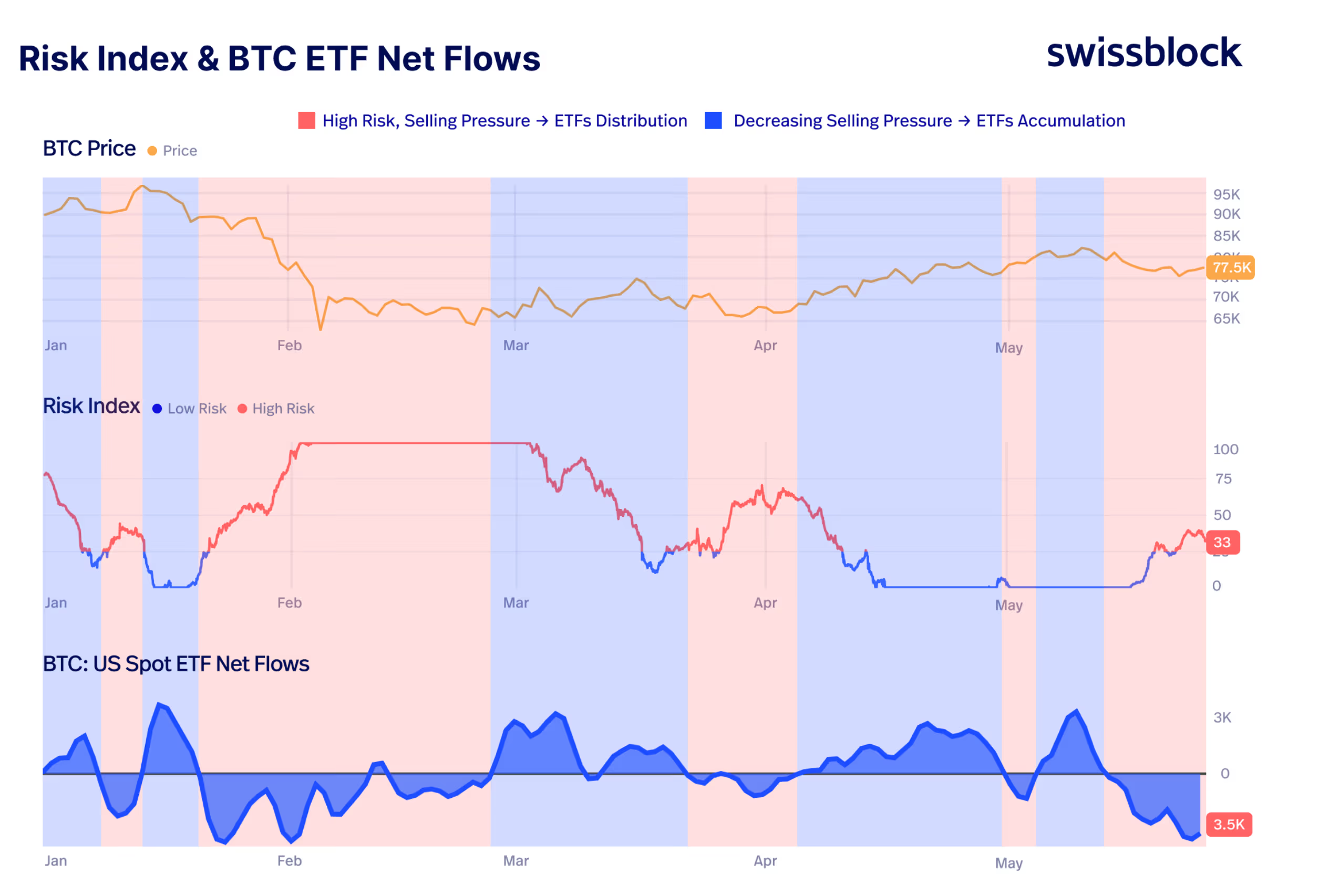
U.S. spot bitcoin ETFs have absorbed a net 4,500 BTC since the start of the year, an unusually thin number given the products were the structural buyer that powered the 2025 rally, per Swissblock data shared on X Tuesday.
March and April produced steady accumulation that helped lift bitcoin off lows near $65,000, while May has flipped the other way with just three days to go before the month ends.
“After strong accumulation in March and April, May has flipped back into distribution,” Swissblock said in its post. “The Risk Index is now moving into high-risk territory while ETF flows are deteriorating simultaneously. That tells us spot ETF demand is no longer absorbing selling pressure effectively.”

The reversal matters because the previous several rallies in bitcoin needed ETF buying to clear the supply coming from miners, long-term holders, and short-term traders taking profit.
When that bid thins, the supply has to find a different buyer or the price drops to a level where buyers show up. Swissblock’s argument is that the Risk Index, which measures structural selling pressure against absorption, can keep climbing as long as the ETF channel stays in distribution.
Bitcoin traded at $75,808 in Asian hours Tuesday, down 2.6% over the past month and sitting near the bottom of its May range. The cryptocurrency had briefly traded above $82,000 earlier in May before the producer price index print and the subsequent run of macro stress pulled it back below $80,000. ETH, XRP, and Solana were all in the red, with Zcash leading the slide at 9% down on the day.
The Swissblock reading is the latest in a run of on-chain data pointing the same way.
Apparent demand, which measures how much bitcoin the market is absorbing relative to new supply, has slid back to its weakest level since December, as CoinDesk reported Tuesday.
CryptoOnchain noted $1.74 billion in U.S. spot ETF withdrawals over the past two weeks alongside retail traders adding leverage in anticipation of a reversal, a combination that has historically preceded sharp liquidation cascades when the market moves against the crowd.
What the data does not yet tell traders is whether this is a pause or a turn.
ETF buying has dropped off before during this cycle without leading to deeper drawdowns. Meanwhile, equity markets globally are at record highs, and FXPro’s Alex Kuptsikevich said bitcoin’s 50-day and 200-day moving averages are on track to cross in the coming weeks, a setup known as a golden cross that is generally read as bullish.
But ETF demand is the channel that brought the new money in. If that channel stays in distribution, the structural case for the rally that began in April starts looking thinner.

Key Takeaways
- Bank of America maintains Buy rating on Walmart while adjusting price target from $150 down to $144
- Revised target suggests 18.7% potential gain from approximately $121, positioning the recent decline as an attractive entry point
- Company elevated full-year net sales outlook to the upper boundary of its 3.5%–4.5% forecast range
- First-quarter revenue climbed 7.3% to reach $177.8 billion; worldwide e-commerce surged 26%
- Shares tumbled 8.1% following earnings announcement and started Wednesday trading at $118.57
Bank of America remains bullish on Walmart despite the recent market turbulence.
Christopher Nardone, an analyst at the firm, maintained his Buy recommendation on Walmart (WMT) shares while adjusting the price objective to $144 from the previous $150. Based on the $121.34 valuation referenced in the firm’s analysis, this represents approximately 18.7% potential appreciation.
WMT began Wednesday’s session at $118.57. The shares have fallen considerably from their 12-month peak of $135.15, with the 8.1% post-earnings decline accounting for a substantial portion of that retreat.
The first-quarter results were genuinely impressive. Revenue reached $177.75 billion, representing a 7.4% year-over-year increase and exceeding the $174.84 billion analyst consensus. Earnings per share landed at $0.66, precisely matching projections.
Worldwide e-commerce revenue expanded 26%, and Walmart elevated its full-year net sales forecast to the upper end of its 3.5%–4.5% constant-currency projection. Second-quarter guidance anticipates 4%–5% expansion.
What triggered the market reaction? Rising expenses. Company leadership highlighted approximately $1 billion in additional freight and fuel costs, and the full-year operating profit growth forecast of 6%–8% fell short of some optimistic projections. UBS similarly reduced its price objective following the earnings release.
The Bull Case from Bank of America
Bank of America’s fundamental thesis centers on Walmart’s positioning during periods of consumer caution. When shoppers tighten their budgets, they naturally gravitate toward value retailers — precisely where Walmart dominates.
The investment firm notes that Walmart is “playing offense,” with price rollbacks climbing 20% year over year during the first quarter. Analysts anticipate Walmart will be among the final major retailers to implement price increases should fuel costs drive inflation higher during the latter half of the year.
Bank of America also emphasized Walmart’s diversified revenue channels — including advertising, marketplace commissions, and membership subscriptions — as margin protection mechanisms. These higher-margin operations have become increasingly central to the investment narrative.
The firm noted that fiscal 2026 demonstrates Walmart’s capability to navigate cost pressures. During that period, the retailer absorbed more than $1 billion in challenges from claims expenses and tariff impacts while still achieving 5.4% constant-currency operating income growth.
Institutional Ownership Trends
King Luther Capital Management expanded its Walmart holdings by 8.8% during the fourth quarter, purchasing 113,952 shares to reach a total position of 1,415,423 shares, valued at approximately $157.7 million.
Additional institutional activity showed varied patterns. Tennessee Valley Asset Management increased its stake by 466.6% in the third quarter. Fox Run Management and Life Cycle Investment Partners both established fresh positions.
Institutional investors and hedge funds combined control 26.76% of WMT shares.
Regarding insider transactions, Director C. Douglas McMillon divested 19,416 shares at $132.21 on April 23rd, while EVP John Rainey sold 20,000 shares at $127.79 during March. Aggregate insider sales over the past 90 days totaled 126,008 shares valued at roughly $15.9 million.
The Wall Street consensus recommendation stands at “Moderate Buy” with an average price objective of $138.71. Thirty-one analysts rate the stock as Buy, two assign Strong Buy ratings, and three maintain Hold positions.
Walmart’s FY2027 EPS projection ranges from $2.75–$2.85, with second-quarter guidance established at $0.72–$0.74.
The retailer is also scheduled to enter the top 10 constituents of the Russell 3000 during the June 2026 rebalancing.

U.S. CFTC files request to erase Gemini settlement that it no longer considers fair

Elena Rybakina crashes out as scorching Paris heat turns French Open into survival test | Tennis News

Nine Brits die in open water as warning issued over heatwave safety


-

 Crypto World6 days ago
Blockchain.com files with SEC for U.S. IPO
-

 Fashion5 days ago
Holiday Weekend Open Thread – Corporette.com
-

 Crypto World6 days ago
Bitcoin Accumulation Weakens as BTC Realized Losses Hit $600M
-

 Tech2 days ago
Microsoft’s quiet Claude Code retreat and the real cost of enterprise AI
-

 Business5 days ago
Dell Technologies DELL Stock Surges 15% on AI Server Momentum and Analyst Upgrades in 2026
-

 Crypto World5 days ago
Robinhood crypto COO Tanya Denisova exits
-

 Business3 days ago
NYT Strands Answers May 24 2026 Revealed for Puzzle No. 812 Theme Summer Essentials
-

 Politics5 days ago
Makerfield: a tale of two social-media histories
-

 Crypto World5 days ago
Space X IPO Is ‘Bad News’ for Tech Stocks: But What About Bitcoin?
-

 Business6 days ago
Trump Invests $1M-$5M in Kura Sushi USA Chain With 27 California Locations
-

 Crypto World6 days ago
MicroStrategy’s Saylor Says Miners No Longer Set Bitcoin Price, Another Force Has Taken Over
-

 Tech6 days ago
WhatsApp ads could make Irish debut after discussions with DPC
-
 NewsBeat7 days ago
Charity run by Reform leader Malcolm Offord accused of ‘law breaking’ over Scottish registration
-
Tech13 hours ago
The Samsung pay deal is the moment Korean unions changed register
-
 Tech6 days ago
A 0.12% parameter add-on gives AI agents the working memory RAG can’t
-

 Crypto World5 days ago
AI infrastructure race heats up as IREN pitches full-stack strategy, WhiteFiber lands $160M deal
-
 Crypto World3 days ago
Nvidia (NVDA) CEO Calls on Super Micro to Strengthen Export Controls Amid Smuggling Probe
-

 Tech2 days ago
Westone Audio and Etymotic Acquired by Fidelity Collective in Major IEM Market Move
-

 Tech6 days ago
You Can Now Add ChatGPT To PowerPoint
-

 Sports6 days ago
2026 CJ Cup Byron Nelson leaderboard: Brooks Koepka finds putting stroke in Round 1
You must be logged in to post a comment Login