Buying heavy machinery is the fun part. You find that perfect John Deere combine or Caterpillar excavator, negotiate the price, and close the deal. Then reality hits. You have a 40,000-pound piece of metal sitting in Kansas, and you need it in Oregon.
Moving heavy equipment is not like shipping a package. It involves permits, route surveys, specialized trailers, and strict safety regulations. If you choose the wrong partner, you risk damage to the machine, massive legal fines, or weeks of delay.
This guide breaks down the top 10 heavy equipment moving companies in the United States. It also explains how to calculate costs and navigate the complex world of logistics.
Criteria for Selecting Heavy Hauler
Before looking at the list, you must understand what makes a company good in this industry. Do not just look at the price tag. Cheap shipping often means cut corners.
- Safety rating: Check their FMCSA (Federal Motor Carrier Safety Administration) score. You want a carrier with low accident rates.
- Fleet diversity: Do they have Removable Gooseneck (RGN) trailers? Step decks? Multi-axle setups for super loads?
- Insurance coverage: Standard cargo insurance might cover $100,000. If you are moving a $400,000 crane, you need a carrier that offers specific high-value coverage.
- Permit handling: A professional company handles all state and county permits. You should never have to file paperwork yourself.
Best Heavy Equipment Movers in USA
Here is a look at ten of the most reliable companies operating across the country today.
1. Atlantic Project Cargo
An affiliate of Atlantic Express Corp. with over 20 years of experience, Atlantic Project Cargo is a powerhouse for both domestic and international heavy equipment logistics. Based in Florida, they stand out by offering a true one-stop-shop solution.
They handle international transportation and extra services: equipment disassembly, export rigging, crating, and complex customs brokerage (including EPA, DOT, and USDA compliance). With a network of 11 North American warehouses, specialized drayage equipment, and over 1,000 global partners, they are uniquely equipped to manage standard heavy freight and massive oversized global projects.
- Best for: International shipping, import/export logistics, and complete turnkey machinery relocation.
- Key feature: Comprehensive end-to-end service, including in-house customs brokerage and equipment disassembly.
2. Anderson Trucking Service (ATS)
ATS is a giant in the industry. Based in Minnesota, they have been operating since 1955. They are excellent for general heavy haul. If you have a standard excavator or tractor, ATS has the capacity. They have over 2,500 tractors and virtually every trailer type imaginable.
- Best for: General construction and agricultural equipment.
- Key feature: Massive network means shorter wait times for a truck.
3. Bennett Motor Express
Bennett is known for handling complex logistics. They do a lot of government and aerospace work, which means their attention to detail is extremely high. If you are moving sensitive or extremely high-value machinery, Bennett is a top choice.
- Best for: High-value, sensitive, or government-related heavy haul.
- Key feature: specialized super load teams.
4. Landstar
Landstar operates differently. They use a network of independent owner-operators. This gives them massive reach. You can find a Landstar truck in almost every corner of the US. However, because they use independent drivers, service quality can vary slightly from driver to driver.
- Best for: Flexible scheduling and reach in remote areas.
- Key feature: One of the largest available fleets in North America.
5. Lone Star Transportation
Specializing in the oilfield and construction sectors, Lone Star knows how to handle wide and long loads. They are particularly strong in the Southern and Central US. They have specialized trailers for wind energy components, which translates well to large farm silos or industrial parts.
- Best for: Very long or wide loads (wind blades, pipes, large combines).
- Key feature: Drivers are highly trained in securing irregular loads.
6. Keen Transport
Keen is a favorite for yellow iron. They have a long history of working directly with manufacturers like Caterpillar. They understand construction machinery intimately—how to dismantle it for transport and how to reassemble it. They also offer storage and painting services.
- Best for: Construction and earthmoving equipment.
- Key feature: Deep expertise in heavy machinery disassembly.
7. Barnhart Crane & Rigging
Barnhart is the go-to for the impossible moves. We are talking about moving entire bridges or massive industrial generators. If your equipment is too heavy for a standard highway, Barnhart uses hydraulic gantries, slide systems, and barge transport.
- Best for: Super heavy loads exceeding standard highway limits.
- Key feature: Innovative engineering for complex rigging.
8. Mammoet
Mammoet is a global heavy lifting powerhouse with a strong US presence. They focus on petrochemical and mining industries. If you bought a massive mining dump truck or a crane component, Mammoet has the modular transporters (SPMTs) to move it.
- Best for: Mining and industrial mega-projects.
- Key feature: Global logistics capability.
9. Daily Express
Do not let the name fool you; they don’t deliver mail. Daily Express has been hauling heavy loads since 1931. They are a solid, mid-sized carrier that focuses heavily on safety and compliance. They are often more approachable for mid-sized business owners than the massive conglomerates.
- Best for: Agricultural machinery and mid-sized construction gear.
- Key feature: personalized customer service.
10. Guy M. Turner
Based in the Southeast, this company offers a mix of crane service, rigging, and transportation. This is useful if you are buying a machine that is not drivable. They can bring the crane to load it and the truck to haul it.
- Best for: Turnkey solutions (Loading + Hauling).
- Key feature: Integrated crane and rigging division.
Calculating Shipping Costs
Pricing in heavy haul is not a flat rate. It is a calculation based on difficulty. Here is how you can estimate your budget.
Core Cost Factors
- Dimensions (LxWxH): Legal width in most US states is 8.5 feet (2.6 meters). Anything wider requires a permit. Anything over 12 feet wide often requires pilot cars (escort vehicles).
- Weight: Legal gross weight is usually 80,000 lbs (truck + trailer + cargo). If your machine pushes the total over this, you need overweight permits and more axles.
- Distance: Longer trips have a lower cost-per-mile, but a higher total cost.
Cost Estimation Table
Load Type
|
Description |
Est. Cost Per Mile |
Extra Fees |
| Legal Load |
Fits on flatbed, under 8.5ft wide |
$3.00 – $5.00 |
None |
| Oversize (Level 1) |
Up to 10ft wide |
$4.00 – $6.00 |
Permits ($50-$200 per state) |
| Oversize (Level 2) |
Over 12ft wide |
$6.00 – $10.00 |
Pilot Cars ($1.50/mile each) |
| Super Load |
Over 16ft wide or 150k lbs |
Custom Quote |
Police Escorts, Route Surveys |
Real world example:
You buy a John Deere S770 Combine in Illinois and ship it to Texas (approx. 1,000 miles).
- Machine: Wide load (requires permits).
- Base Rate: $5.00/mile x 1,000 = $5,000.
- Permits: IL, MO, AR, TX = ~$400.
- Fuel Surcharge: ~20% = $1,000.
- Total Est: $6,400.
Note: Fuel prices fluctuate weekly, drastically affecting these numbers.
Navigating Regulations and Permits
This is where DIY shipping usually fails. Every state in the US has different rules.
Pilot Car Requirements
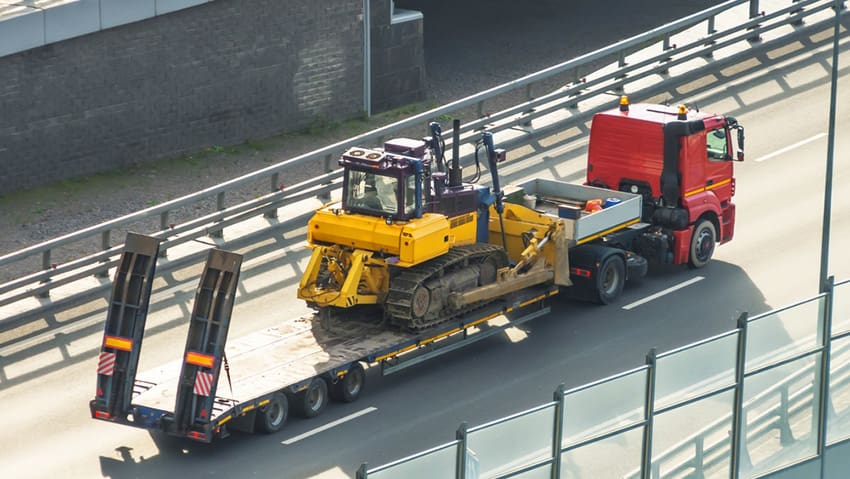
If your bulldozer has a blade that makes it 12.5 feet wide, some states require one escort vehicle behind you. Other states require one in front and one behind on two-lane roads.
Running Times
You cannot move heavy equipment whenever you want.
- Curfews: Most major cities (like Houston, Chicago, Atlanta) prohibit oversize travel during rush hour (e.g., 7:00 AM – 9:00 AM and 4:00 PM – 6:00 PM).
- Weekends: Many states prohibit oversize hauling on Sundays or holidays.
- Night travel: Generally forbidden for oversize loads unless you have special lighting and police escorts.
Route Surveys
For very tall loads (over 14.5 feet), you must pay for a pole car to drive the route beforehand. They use a physical pole to ensure you will not tear down power lines or hit bridges.
Common Trailer Types You Will Need
When booking a transport, you need to know what trailer to ask for.
- Flatbed: Good for small tractors, attachments, and parts. High deck height (approx. 5ft).
- Step Deck (Drop Deck): The deck drops down to allow for taller equipment. Good for backhoes and medium tractors.
- RGN (Removable Gooseneck): The front detaches and the trailer lays flat on the ground. You drive the equipment directly onto it. Essential for excavators, combines, and pavers.
- Lowboy: Similar to RGN, designed for very heavy, tall loads to keep the center of gravity low.
Why Logistics Can Kill a Deal
You found a great price on a tractor. But if you have to arrange the trucking, buy the insurance, coordinate the wire transfer, and hire a third-party inspector, the deal becomes a headache.
Risks of managing it yourself:
- Detention fees: If the seller isn’t ready when the truck arrives, the trucking company charges you ~$100 per hour for waiting.
- Wrong trailer: You order a Step Deck, but the machine is 6 inches too tall. The driver refuses the load. You pay a Truck Ordered Not Used (TONU) fee.
- Damage disputes: The machine arrives with a cracked windshield. The trucker says it was like that. The seller says it wasn’t. You are stuck in the middle.
Shift Toward Integrated Logistics Platforms
The companies listed above excel at moving heavy freight, but transportation is ultimately just one piece of the puzzle. Historically, buyers have had to manage equipment purchases, seller verification, and pickup coordination as entirely separate, time-consuming tasks.
Today, the heavy equipment market is shifting toward integrated ecosystems that consolidate these steps. Platforms like JumboBee illustrate this trend by embedding logistics into the purchasing process. This approach removes the friction of sourcing quotes from multiple independent trucking companies and aligns the transaction from start to finish.
Key advantages of modern equipment platforms:
- Instant logistics: Shipping estimates are provided directly on equipment listings, revealing the total landed cost (machine plus shipping) before a purchase is made.
- Verified networks: Built-in seller screening reduces the risk of dispatching trucks to unverified or incorrect locations.
- End-to-end service: Integrated platforms often coordinate the broader logistics, including disassembly, loading, customs clearance, and final delivery.
- Streamlined transactions: Equipment and transportation costs are consolidated into a single, secure payment.
Navigating brokers, permits, and wire transfers independently carries inherent risks and potential delays. Utilizing an integrated marketplace offers a more seamless, secure approach to acquiring and transporting heavy machinery.




















































You must be logged in to post a comment Login