A proposal by Belfast’s Deputy Lord Mayor will go to the City Hall Planning Committee
Two Belfast independent councillors are calling for City Hall to adopt a plan making it a requirement for developers to include community food growing procedures in certain planning applications for housing in the city.
The motion, titled “Embedding Community Food Growing in the Planning Process for New Housing Developments” states the council “recognises Belfast’s status as a Right to Food City and affirms that the planning system has an important role to play in building healthier, more sustainable and more food-resilient communities.”
The motion says that housing developments should not only provide homes, “but should also contribute to the long-term health, wellbeing, sustainability and resilience of the communities in which they are built.”
A Right to Food city is one that has formally committed to treating access to adequate and nutritious food as a legally protected human right, and believes that citizens should not be dependent on emergency charity.
Such cities in theory should be pushing for governments to be held legally accountable for ensuring citizens do not go hungry. Belfast officially became a Right to Food city in October 2023, following a successful motion at Belfast City Council by Councillor Doherty.
The Doherty motion adds: “The council notes that Belfast’s existing policy framework already recognises the importance of open space, residential amenity, placemaking, biodiversity, climate resilience, health and wellbeing, and council strategies also acknowledge the value of allotments, community gardens and local food growing.”
Advertisement
The proposal tasks council officers with making a report examining how Belfast Council, through its planning processes, could introduce a planning requirement to ensure appropriate space for community food growing in new social and private housing developments.
This would include allotments, community gardens, orchards, raised beds, edible landscaping and other forms of productive green space. The motion states: “This would represent a practical and innovative next step in giving meaning to Belfast’s status as a Right to Food City, placing food resilience, health and community wellbeing at the heart of how our city is planned and developed.”
The Deputy Lord Mayor left the SDLP following a major disagreement over a council vote on a Bobby Sands statue in April this year. Councillor Doherty said it was on a “matter of principle” after SDLP councillors left the chamber before a vote took place on a DUP motion to reopen an investigation into the erection of the statue in West Belfast.
Paul McCusker announced he left the SDLP in March 2023, citing frustration with political progress, particularly regarding his core issues of homelessness, addiction, and poverty. Not long after leaving the party, he successfully retained his council seat as an independent candidate in May 2023.
With Iran’s official cultural presence on the international stage increasingly uncertain, the 6th Iranian Contemporary Art Biennale in London, With My Roots, carries significance that extends well beyond the gallery walls.
Held at Mall Galleries from May 22–30, it brings together more than 100 Iranian artists from 17 countries, with over 180 works spanning painting, photography, sculpture, installation and video. Despite its scale, the exhibition feels intimate: a space where Iranian culture emerges not as a single story, but as a field of tensions, inheritances and unresolved attachments.
Iran’s withdrawal from the Venice Biennale earlier this year exposed how fragile national representation has become, at a moment when art and geopolitics are increasingly difficult to separate.
Against that silence, this biennale tells a different – and in many ways more urgent – story. It shows how Iranian art continues to circulate when official platforms falter, and why independent cultural infrastructures matter in moments of political and material crisis.
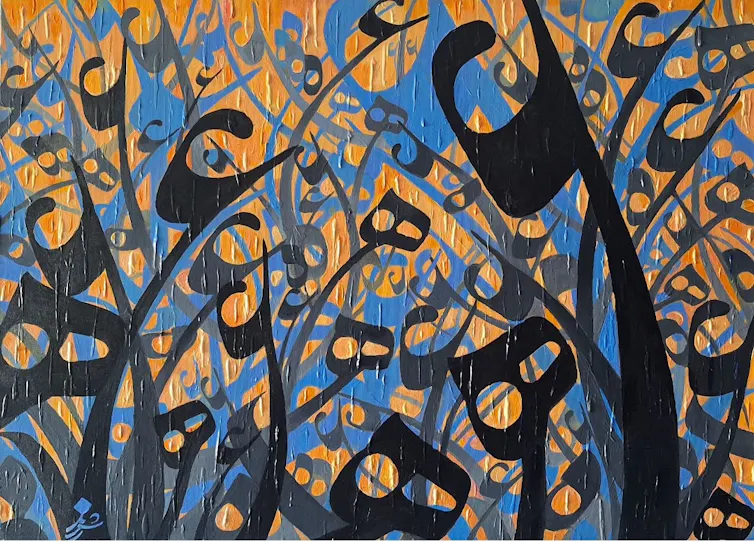
Unseen Narrative by Donya Aby. Mall Galleries
Founded in 2016 by curator Marina Panahi through the gallery Capital Art London, the Iranian Contemporary Art Biennale has become a rare meeting point for artists inside Iran and across the diaspora. It brings together communities separated by migration, sanctions, censorship and political borders.
The biennale foregrounds tensions central to Iranian modern and contemporary experience: homeland and exile, tradition and modernity, visibility and erasure. These curatorial themes reflect the realities of artists working inside Iran. Censorship, economic pressure and restricted mobility shape their daily practice.
Advertisement
These themes also reflect those in the diaspora for whom distance can be both a wound and a resource. Their work often carries the pull of elsewhere: the longing for Iran, the act of translation, and the unsettled feeling of belonging in more than one place. The biennale brings such experiences together without collapsing them into a single story.
But this year, these tensions have sharpened. War, internet restrictions, disrupted phone lines, suspended flights and mounting economic pressure made even the movement of artworks from Iran to London difficult.
Fall by Afshin Rezaei. Mall Galleries
Works that might once have moved through ordinary shipping routes had to travel through more fragile and improvised channels. The exhibition’s existence is therefore part of its meaning. The works on display are examples of persistence under pressure.
That persistence is economic as well as symbolic. Because the works are for sale, the biennale can offer artists an economic lifeline at a time when sanctions, currency collapse and restricted exchange have made producing and selling art increasingly difficult.
Advertisement
The art market is often viewed with suspicion, especially when politically charged work enters systems of taste, ownership and value. Yet for many artists, sales can mean the ability to keep working and remain connected to a wider cultural economy.
This produces one of the exhibition’s most compelling tensions: the desire to enter the global art market without being consumed by it.
A global perspective
Iranian artists have long had to navigate the expectations of international audiences who often approach their work through familiar frames of politics, gender, conflict or cultural heritage.
The exhibition’s breadth is central to the resistance to conform to such expectations. Bringing together artists from Iran, the UK and 14 countries across Europe, North America and the Middle East, the variety of works mirrors the diversity of Iranian culture and society itself.
Advertisement
Work by Esmaeil Rashvand on show in the biennale. Mall Galleries
It also places established figures such as Simin Keramati and photographer Armin Amirian in dialogue with artists still building their international profile. This gives the exhibition historical depth while foregrounding practices that may not otherwise reach global audiences.
But even an exhibition of more than 100 artists can still only offer a partial view. For every work that reaches London, many others remain unseen – held back by closed borders, limited resources, fear, bureaucracy or the simple impossibility of getting work out.
The exhibition is shaped around two main curatorial themes: Eternal Iran and Art of Conflict. Together, they show the different tensions running through the show.
Eternal Iran focuses on cultural inheritance. It looks at how Iranian identity has lasted and changed across generations, political systems and countries. Tradition here isn’t frozen in the past, but something alive. Artists treat calligraphy, poetry, myth and visual symbols as tools they can reshape, break apart and rebuild in new ways.
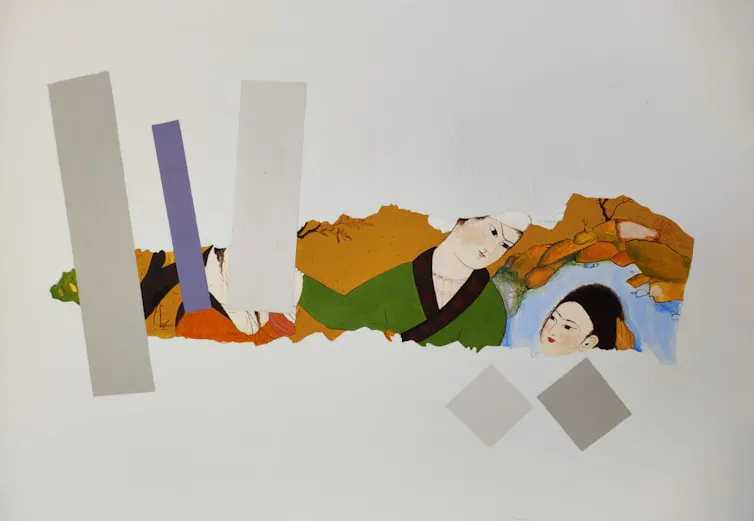
Collage by Parvaneh Babaie. Mall Galleries
By contrast, Art of Conflict confronts the violence of the present more directly. It includes paintings, photographs and prints by 19 artists currently living in Iran and experiencing recent violence and war firsthand.
This section features photographs by Majid Saeedi, Alireza Memariani and Shahla Khodadadi, alongside battlefield photography by Maryam Saeedpoor and Maryam Rahmanian. These works bring a different register into the exhibition, being produced in proximity to instability, fear and loss.
Advertisement
The contrast between Eternal Iran and Art of Conflict gives the biennale much of its force. One section turns towards memory and the deep histories of Iranian culture; the other confronts the violence and uncertainty of the present. Together, they refuse an easy division between Iran as ancient civilisation and Iran as contemporary crisis. Both are true. Both are incomplete without the other.
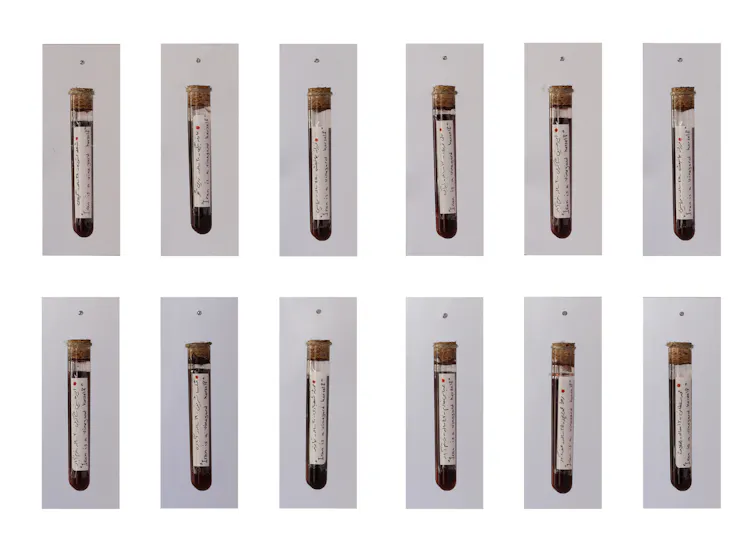
Iran Herself is a Vineyard by Homa Bazrafshan. Mall Galleries
This tension becomes especially vivid in Homa Bazrafshan’s Iran is a Vineyard Herself. The work evokes both fertility and mourning. Its vials of red liquid, which read visually as blood, suggest a memorial language without reducing the piece to a single political message. The vineyard, usually a symbol of cultivation and abundance, becomes a field of grief as well as endurance.
Panahi describes the biennale as an opportunity for audiences to move “outside the language of politics and conflict” and hear the voices of Iranian artists worldwide.
That ambition refuses to let politics become the only language through which Iran is understood.
At a time when Iran is often made visible only through crisis, the exhibition asks viewers to look slowly, to recognise historical depth without romanticising it, and to encounter conflict without allowing it to become the whole story.
Advertisement
This biennale is a reminder that Iranian art is not absent from the global stage. It is just moving through more precarious routes, carried by the artists, curators and communities who are determined that it should still be seen.
With My Roots is on show at Mall Galleries, London until May 30 2026.
After making a controversial transfer from Tottenham in 2001, Sol Campbell won two league titles and three FA Cups with Arsenal, as well as scoring in the 2006 Champions League final.
Alongside him was Ivorian Kolo Toure – moulded by Wenger from a central midfielder into one of the league’s finest centre-backs.
Both were key parts of Arsenal’s ‘Invincible’ season.
Advertisement
At right-back, Ivorian Emmanuel Eboue was a cult figure at Arsenal under Wenger, making 214 appearances between 2005 – 2011.
Meanwhile, Cole is widely regarded as one of the best left-backs in the history of the Premier League. He was part of the Gunners’ ‘Invincibles’ side of 2003-04, as well as the Chelsea side that scored a then-record 103 goals in 2009-10.
2026
For Arteta’s side, French centre-back William Saliba is ever reliable and was voted in the Professional Footballers’ Association team of the year three consecutive seasons between 2023 and 2025.
Advertisement
Alongside him, Gabriel is another contender for Arsenal’s player of the season. As well as being solid at the back, he ended the Premier League season with seven goal involvements (three goals, four assists).
Since 2000, the pair rank second behind Rio Ferdinand and Nemanja Vidic in terms of Premier League partnerships with the most clean sheets.
With Ben White injured, Arsenal fans will be hoping that Dutch defender Jurrien Timber can make it back from injury in time to play right-back against PSG’s Khvicha Kvaratskhelia.
Meanwhile, Arteta has options at left-back and has rotated this season between Italian full-back Riccardo Calafiori, Ecuadorian defender Piero Hincapie and academy graduate Myles Lewis-Skelly.
Hidden along the English coastline is a quite seaside village with a cafe right by the beautiful beach
If you’re looking for your next seaside escape, this village offers a slice of tranquillity by the sea and plenty of options for a good cup of tea.
Advertisement
Along the Norfolk coast, this village sits quietly with the most beautiful beach and clifftops, offering expansive views and a getaway from the business of life.
Old Hunstanton sits next to the larger resort of Hunstanton, also known as New Hunstanton, the more popular neighbour, but it’s not a destination that should be overlooked. Its quiet character makes for a different option for those who don’t quite fancy the fuss of a bustling seaside town, with steady walks and stripped cliff sightings.
It’s safe to say the real star of the show in the village is Old Hunstanton Beach, a beautiful stretch of sand that welcomes families, and even your dog, to explore it and go for a dip when the weather permits.
In fact, their dog-friendly feature is something that draws in a lot of avid walkers and visitors keen for their pups to have a true sense of freedom. One visitor wrote on TripAdvisor: “Old Hunstanton Beach is a top pick for dog owners. Dogs are welcome year-round with no leash required on the spacious sands, offering true freedom.
Advertisement
“This likely reflects the beach’s size and a culture of responsible dog ownership. Enjoy the beautiful cliffs and calm waters with your happy dog by your side!”
Making up part of this glorious landscape are the cliffs, famously striped, with three layers of colour, red, brown and white. Their natural striped layers draw a lot of attention to the beach and are thought to be a geological site of specific interest which dates back to the Cretaceous Period.
Another landmark of the area is the historic Old Hunstanton Lighthouse, originally built in 1844, sitting on top of the famed cliffs. This makes for a lovely walk on a nice day and offers spectacular views of the area.
Advertisement
Café on the beach
Situated on beautiful Old Hunstanton Beach, opposite the RNLI is Old Town Beach Cafe, which serves a varied menu that focuses on locally sourced ingredients. If you’re hoping for a more traditional resting stop, they also happen to serve up a delightful afternoon tea.
An afternoon tea right by the sea sounds like a dream, and yet it’s very real, with customers opting for lunch and breakfast food options too. You can sit outside in the sand and look out at the blue hues of the rolling waves as you sip away.
One customer shared on Tripadvisor: “I visited the old boathouse café twice this week, once for breakfast and again another day for afternoon tea. It’s in a great location just on Old Hunstanton Beach, and the food and service is excellent. A really great place to call into after a walk on the beach.”
Advertisement
Another dubbed the spot as an “outstanding little café Hunstanton” while someone else pointed out the cleanliness of the place.
They wrote: “Spotlessly clean throughout, lovely friendly staff, excellent quality, cater for gluten-free, freshly cooked, served piping hot, mega breakfast excellent as were homemade sweet potato patties gluten-free. Would definitely recommend.”
John Gerrish, his wife, Ellen Chung, and their one-year-old daughter Miju, were found dead in a baffling scene in a National Park. It took months for authorities to work our what had happened.
Jonathan Gerrish, 45, Ellen Chung, 31, their one-year-old daughter Aurelia Miju Chung-Gerrish and their dog Oski, eight, set out on an eight-mile hike in California’s Sierra National Forest. The temperature reached 42°C.
All four were found dead on a remote hiking trail on August 18, 2022. Despite the FBI working tirelessly to discover more about what happened to the family – their phone records revealed the truth of their horrifying last moments.
There was no mobile reception where the family was discovered, but records show Jonathan had tried to send multiple text messages.
One heart-breaking attempt read: “Can you help us.” The father also tried to make five phone calls, none were to emergency services. Ellen’s body was found further up the trail and it looked as if they had all sat down in the sun, according to Strange Outdoors.
Advertisement
The family’s babysitter raised the alarm two days before they were found when she turned up to look after their daughter and found no one at home.
She contacted their family who then reported the three missing that night. Search and rescue teams first found the family’s car, but were initially baffled at the cause of death when they found their bodies.
Mariposa County Sheriff’s spokeswoman Kristie Mitchell said, “Coming across a scene where everyone involved, including the family dog that is deceased, that is not a typical thing that we have seen or other agencies have seen. That is why we’re treating it as a hazmat situation. We just don’t know.”
Advertisement
Mariposa County, Sheriff Jeremy Briese said: “When we located the family there were no apparent causes of death.”
Multiple causes of death ruled out over the course of the investigation including: suicide, being caused by a gun or other weapon, alcohol, illegal drugs, a lightning strike, extreme heat and exposure to cyanide, carbon monoxide or carbon dioxide, according to The Fresno Bee.
Briese, said: “I’ve been here for 20 years and I’ve never seen a death, with any case, like this. There are no obvious indicators of how it occurred . . . you have two healthy adults, you have a healthy child and what appeared to be a healthy canine all within a general same area, deceased. It’s frustrating and we’re not going to rest . . . it’s devastating to everyone”
Advertisement
Jonathan, a Lancashire man who moved to the US to work for Google had texted someone saying: “On savage lundy trail heading back to Hites cove trail. No water or ver [over] heating with baby.”
Briese previously said one empty water bladder backpack was found with the families’ bodies alongside some snacks and baby formula, but they had no other water containers with them.
Two months later, after autopsies and extensive investigations, it looked like the family had simply run out of water and shelter.
The Mariposa County Sheriff’s Office released messages supporting the the coroner’s ruling that the family died due to environmental exposure.
Advertisement
In October of that year, Briese said what happened was “an unfortunate and tragic event due to the weather.”
Photos recovered from the phone showed the family left for the walk at 7.45am, with the final image of a creek taken at around 12pm.
Mariposa County Sheriff Jeremy Briese said: “The cell phone data results were the last thing both the family and detectives were waiting on. The extracted information confirms our initial findings.
“I am very proud of my team and our partner agencies for all the work they put in. Their dedication has allowed us to close this case and answer lingering questions the family had, bringing them a little peace.”
Advertisement
Tragically, the family had completed most of the hike before they died. One theory circulating was they were killed by toxic algae found in the nearby water.
Investigators worked with toxicology experts to determine whether the algae could have poisoned the family. Sheriff Briese confirmed there was “no evidence they drank any of that water”.
The area around the trail was also known to contain mines. Sheriff Briese said one mine was also located close to where the family were found but that there was no evidence the family had come into contact with it.
Manosphere influencers peddling toxic masculinity have tripled their followers in Latin America and Africa in the last year, marking a worrying rise in global misogyny
Earlier this year, Louis Theroux’s Netflix show, Inside the Manosphere, examined the growing influence of the ultra-masculine network, led by influencers like self-proclaimed misogynist Andrew Tate, across the US and the UK. But for the BBC World Service documentary, Manosphere Messiahs, disinformation reporter Jacqui Wakefield spent a year examining the influence of manosphere heavyweights El Temach (Luis Castilleja) in Mexico, who has over 7.3 million followers on TikTok and 2 million on Instagram; and Andrew Kibe, in Kenya, who has 464,000 followers on Instagram and has had 530 million TikTok views.
Advertisement
She tells The Mirror: “Content creators in developing countries are seeing the success of people like Andrew Tate and HS TikkyTokky, and wanting a piece of it for themselves; the fame, money and influence that comes with it.”
The same manosphere slang words appear, popularised by Andrew Tate – currently facing allegations including sexual intercourse with a minor. Jacqui says it’s unclear whether influencers like former DJ Kibe – who calls himself ‘Jesus’, tells fans to ‘worship me’, and asks how he can respect a woman he wants to sleep with – believe what they say, or if they are just touting for followers.
But, after speaking to women who’ve been affected, she says the adverse impact is substantial. Kenyan student Joy says women recently standing for the student union had to have a male student stand with them, or they wouldn’t get elected. She says: “It’s getting worse.”
Advertisement
Kibe followers, she says, feel women are “less capable, less deserving of those leadership positions.” Kenyan superfan Ryan, says: “I first discovered Andrew Kibe when I was 18. My father had died 10 years ago and I was in a dilemma of being masculine or remaining just a boy.” Saying he lacked a father’s influence, he continues: “Kibe states that women are just a distraction in your journey to greatness as a man.”
Dr Awino Okech, a professor of Feminist Studies at SOAS University, explains the social difficulties facing men and boys who are drawn to Kibe. She says: ”They are tapping into young men and boys with real mental health challenges … in societies where unemployment rates are high, people do not have the resources to be able to live a meaningful life.”
Instead of blaming the state, she says they see women as the problem. Similarly in Mexico, failed pastor and actor El Temach is pumping out testosterone-fuelled propaganda about self-improvement to 11 million followers.
Advertisement
His younger sister Alex says: “It’s astonishing to see him now because he was a totally different person.” Once close, they no longer talk. She adds: “He copied everything from Andrew Tate. I don’t think he actually has a clear idea of what feminism entails. I think he just decided it was the best enemy for his content.”
In one video, El Temach says: “A liberal wife is the worst mistake you can make as a man.” But in Mexico City, doctor Fernanda, says Manosphere teachings led to her former boyfriend – who she met while she was a medical student – threatening to kill her.
Fernanda says: “He started to become obsessed, He went from one video to the next – he’d spend hours watching them. It wasn’t just El Temach, it was other creators too with similar ideas. He took it as absolute truth. He’d use him to justify me not being allowed to speak to single women, because they might ‘put ideas in your head’ about cheating.
Advertisement
“He’d only let me wear clothes that he thought weren’t too revealing. I think he was already a sexist when we met. But he hid it. El Temach made him feel he didn’t have to feel bad about it.”
The final straw came when he forced her to spend hours watching El Temach videos. She says: “He wouldn’t let me leave the house. He broke my phone. He was physically aggressive. I was afraid for my life. He did actually threaten to kill me. But the only way I could stay safe was to sit there and watch.”
Eventually he let her go. Blaming Manosphere influencers for brainwashing men like her ex, who would justify appalling behaviour saying ‘El Temach says I’m right,’ she adds: “Some people can’t separate a video from real life.”
Advertisement
Meanwhile, Jacqui concludes: “Social media has created a breeding ground for misogyny which is much more global than we first thought and it’s growing exponentially.”
ONCE again, the ugliness of juvenile crime has hit the headlines, this time in the shape of victims of rape.
And once again, the perpetrators cannot be named because of their age. These three monsters, at 13, 14 or 15 years of age were fully aware of what they were doing or about to do.
We have just learned that the offenders have escaped custodial sentencing. Youth rehabilitation orders hardly cover the seriousness of the offences against these girls of similar age to the offenders
Advertisement
How long must we prevail with this limp excuse for the most heinous of crimes?
If it’s not rape, it’s stabbings – schoolboy on schoolboy; if it’s not stabbings it’s extreme cases of anti-social behaviour.
I think it’s about time that the anonymity law for some underage crimes were scrapped and the offenders should be named and shamed regardless of age.
At the ages 13, 14 and 15, (and in the case of young Jamie Bulger’s torture and subsequent murder, only 10) they were all well aware of what they doing, or about to do.
Advertisement
At this age you know rape and murder is wrong.
These archaic laws were imposed when youngsters were committing what we used to refer to in the 60s as ‘petty crimes’ which included burglary, theft, unruly behaviour etc, (none of which were ‘petty’ should you have been on the receiving end of these).
Rape and murder are not mistakes that can be wrapped up in the adage ‘boys will be boys’ – and it is mostly boys who are the perpetrators, although not exclusively.
These serious crimes should not come under the umbrella of youthful mistakes.
Advertisement
If ‘under-the-cosh’ Prime Minister Keir Starmer wants to show some political clout, he could do worse than address this issue and ban this out-of-date law.
W Martin
Holgate,
York
Advertisement
—
Rape sentencing is a ‘wake-up call to us all’
THE recent court case in Hampshire, where two youths who carried out multiple rapes were given community sentences, must act as a wake up call to us all.
The judge’s rationale for not giving them a custodial sentence was that he did not want to criminalise them unnecessarily.
Advertisement
I’m afraid that, by carrying out multiple rapes and placing videos of their actions on you tube, they had already criminalised themselves. It is essential that the appeal court reviews this sentence, otherwise it will reinforce the message that misogynists like Andrew Tate have been spreading: that violence against women and girls is acceptable for male gratification. It certainly isn’t in the sort of civilised society I want to live in. and the legal system must impose sentences which deter contrary views.
Tony Fisher,
(Liberal Democrat councillor for Strensall ward)
West End,
Advertisement
Strensall,
York
—
Rather be a judge than a coalminer…
Advertisement
A SKETCH by Peter Cook once stated that he would rather be a judge than a coalminer because, when you become too stupid and silly to work, the mine gets rid of you.
Where the exact opposite can be said of a judge.
This certainly seems to be the case in Southampton where a number of vicious, scheming, predatory teenaged boys have basically got away with rape because a judge thinks that perpetrators with ADHD or a lower than average IQ or stress cannot be held responsible for their (planned) actions and therefore should not receive a custodial sentence!
Unbelievable.
Advertisement
I pray their victims can live a life in the future with at least some semblance of normality. Though I doubt it.
Nigel Cummings,
Charlton Street,
York
Advertisement
What do you think?
Feel strongly about an issue? Write us a letter. Please write no more than 250 words and you must provide your full name, address and mobile number. Send your views by email to: letters@thepress.co.uk
Write a comment
Join the debate and leave a comment in our comments section below this article – we may use your comments for a follow up article.
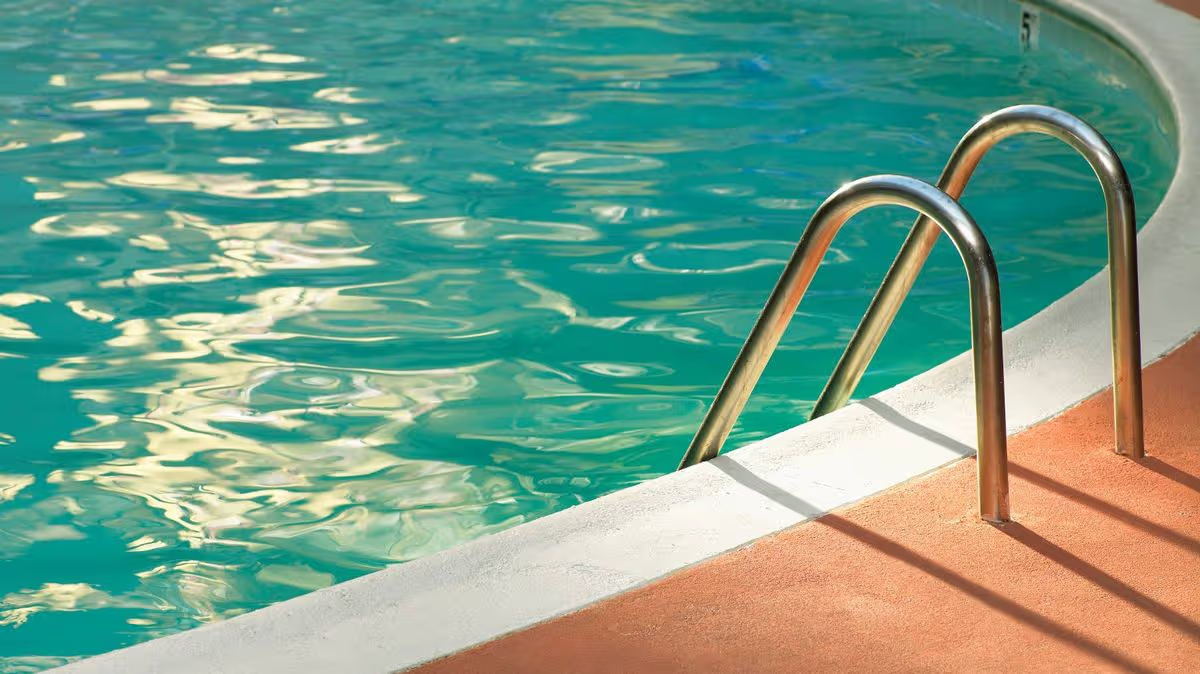
A woman has been praised after how she got revenge on her neighbours when they allegedly tried to use her private swimming pool without permission – but the furious neighbours insist she should have simply learned to share
06:43, 28 May 2026Updated 06:43, 28 May 2026
A woman has been slammed for how she reacted when her neighbours tried to use her private pool – but she insists they deserve the consequences of their actions. She explained how she owns a private swimming pool in her garden and takes measures to safeguard it from wildlife and intruders by putting up signs, fencing and covers.
Despite these precautions, she spotted some ‘strange figures’ attempting to break into her property while she was on holiday, prompting her to alert the police. The anonymous woman said on Reddit: “The front of my driveway has a sign that reads ‘Private Property No Trespassing’ as you pull up to the driveway.
“I have a fence up around my pool to keep out unwanted animals and intruders with only way in is a key to unlock the gate. I have security cameras on certain places of the house pointing to the pool.”
Advertisement
While away on holiday, she received a notification on her phone from her security system warning her about suspicious behaviour. “I checked to see the live footage, it was three teens that were in early teens and one adult trying to climb the fence to my pool,” she said.
“I have a tarp over my pool at all times which can only be removed from a switch in my house, you’d think they’d see the tarp and leave. I immediately called the police and they told me they’d take care of it.”
Nevertheless, the neighbours continued to try and scale the fence, but were arrested before gaining access to the pool. The woman continued: “The day I get home my neighbour, who must’ve been watching for my car, storms over and starts screaming at me, ‘My sister and her kids are going to have a criminal record now because of you!’
“I said, ‘So that’s who my cameras detected. You should know my sign in front of my house says private property no trespassing!’” The furious neighbour ‘promised’ to take her to court, fully expecting to walk away without penalty.
Advertisement
She said: “The sister of the neighbour plead in court it was a hot summer day and they wanted to cool down so her sister insisted that they go use my pool but to ignore the sign that said private property because her sister and I are good friends.
“My neighbour and I are not good friends. I explained to the judges I did not give consent for neighbour to use my pool while I was gone.
“The judges saw all the evidence needed, especially of the sign in my driveway saying no trespassing, and found the neighbour and her sister guilty of second degree trespassing, which in my state carries the punishment of £200 fine and 20 days in jail.”
She revealed the judge also found the two nephews and niece guilty, and her lawyer filed for a restraining order.
Advertisement
She added: “The teens’ lawyer tried to explain the teens didn’t know about the sign in my driveway but the judge dismissed that because they willingly listened to their mother and aunt it was ok to trespass.”
Responding to her post, one user wrote: “Imagine trespassing then suing the person you trespassed on. Olympic level delusion.”
A second user added: “Love the neighbour blaming you for her family’s records, when it was in fact she that prompted all this.” While a third added: “I’d inform the whole neighbourhood about this.”
There’s a £40m boos on its way, but the question will be how best to invest the cash
Despite the sunny weather and holidays, lots of the shops in Peel Green, Salford, are shuttered up and the streets are quiet. The suburb on the edge of Eccles has seen a steady decline over the past few years, say local residents.
Advertisement
So much so, the government is handing £2m to locals for the next 10 years to try and rejuvenate the area. As part of the Pride in Place scheme, Brookhouse and Peel Green are one of two Salford areas to benefit from a £40m cash boost – with the other area being Pendleton.
Locals are being asked to join a ‘neighbourhood board’ to decide how the money should be spent. And anyone with a ‘strong connection’ to the area – so living, working, or other ‘strong ties’ – has until Sunday to sign up.
Click here to get the biggest stories straight to your inbox in our Daily Newsletter
But the question will be how best to invest the cash, with locals naming everything from more shoe shops and pubs to safer streets.
Advertisement
“This area definitely needs help,” said Malik Usman, a 29-year-old shopkeeper who has lived in the area for two years. Despite the nearby police HQ, Malik says security in the area is a big issue. “We’ve only had this business for seven months and someone tried to break in from the land at the back, which isn’t looked after by its owner. It really scared me, because I live upstairs with my partner and we have a newborn baby. They need to make things more secure around here.”
And that’s not the only problem facing business owners.
“I think another big thing is parking. It’s double yellows along the whole street. If there was parking, even just half an hour, I think that would make a massive difference to the businesses. Right now it’s a real struggle because people can’t stop, so they just drive on.”
Advertisement
And helping local shops thrive is exactly what the area needs, according to lifelong resident Susan Wilkes. The 77-year-old reminisced about her childhood, when the streets were full of shops and community events.
“Now there’s f*** all,” said the colourfully-dressed retiree. “They need to put more shops in. A butcher’s, a shoe shop, an eatery. Just more of a mixture. You’ve basically got to go all the way into town for that kind of thing now.”
Susan is concerned about the council being involved in improving the area – even though the scheme is supposed to be resident-led. “They seem to just put up loads of bl**dy flats,” she said.
Yet according to local dad Emmanuel Dalmeida more housing options is exactly what the area needs. The 33-year-old, who has lived nearby for eleven months and works at Trafford Park, says he struggled to get a flat.
“I’ve been in the UK for 12 years, working and paying tax and I’m finding it hard to secure housing. Even though I’ve been here for a while, landlords ask me for guarantors. I came to this country by myself, I don’t have anyone here who could do that.”
He’s doubtful the Pride in Place scheme will be enough to transform the area, and that local problems are linked to national ones.
“It’s good that they’re giving money,” he went on. “But the issues are big ones, like houses. I think they need to build more houses for people in different circumstances. I also think they need to put local people first – people who’ve lived here for a long time.”
Advertisement
Back in Malik’s phone repair shop, the shop owner and local resident also thinks the local area’s decline is linked to wider issues.
“I do think people are becoming more selfish and isolated everywhere, because of cellphones,” he said. “So, actually, I think the single biggest thing we could do round here is create more parks, more community halls, more pubs, things like this. Places where people can gather, have chai with people. Have a community.”
Locals who sign up to influence the money-spending decisions will have their work cut out for them – but whatever they do could ‘create lasting change in the areas that need it most’, according to Salford Mayor Paul Dennett.
A “key concern” raised by neighbours includes potential flood risks
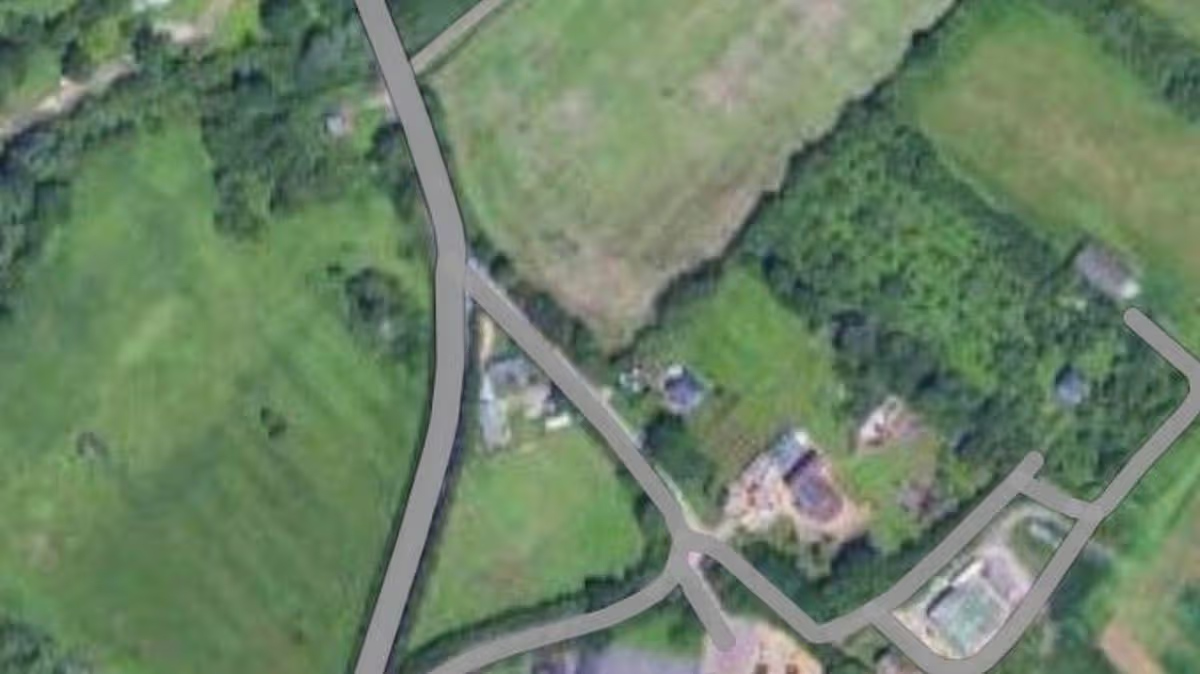
Plans to build 15 affordable houses in Girton have been slammed by people living near the proposed site. Neighbours have shared a “key concern” about the potential flood risks at the development and in the surrounding area.
Advertisement
The homes are proposed to be built on the former practice ground of Girton Golf Club at land north of High Street in Girton, around two miles from Cambridge. Full Planning Permission is being sought by Abbey Properties Cambridgeshire Limited to provide 15 new homes – 13 of which would be made available as affordable housing for rent with the other two being for shared ownership occupation.
The properties comprise a mix of sizes including six two-bed houses, four one-bed houses, one three-bed house and four two-bed bungalows. Abbey Properties Cambridgeshire Limited said its proposals seek to “respond to an identified need for affordable housing” and that “the type of units being proposed reflects the identified need for smaller dwellings”.
All of the proposed houses and their amenity areas are located within flood zone one. The proposed drainage attenuation feature and a landscaped area which is to be used for biodiversity net gain purposes is located mainly within flood zone two, according to a planning statement.
Plans for the new homes has seen local backlash with multiple objections lodged so far. One objector said that they “recognise the need for new housing of this size in Girton”, but a potential flood risk is a “key concern”.
Advertisement
They said: “The assessment appears too narrow because it focuses on the proposed development site, rather than the long history of flooding affecting nearby homes around Fairway and Oakington Road.
“This local history should be considered before assessing the risk to any new homes. The fact that the proposed homes are shown in Flood Zone 1 does not demonstrate that the development is safe, or that it will not increase flood risk to existing homes nearby.”
The same objector said the proposed access onto Oakington Road would be “dangerous”. They wrote: “The main access is onto Oakington Road close to a blind bend with vehicles coming into the village at speed. This presents a real hazard, particularly for vehicles manoeuvring in or out (eg refuse lorries or delivery vans that need to swing across both lanes).
“The situation is also dangerous for pedestrians who are expected to cross the road at that location to use the footpath on the other side of the road. Anyone with reduced mobility, or parents with a toddler or a pushchair, would struggle to cross both lanes in the time between cars appearing round the bend and reaching that part of the road.”
Advertisement
A similar concern was raised by another local who said that their property, along with neighbouring properties have experienced flooding on multiple occasions and suggests that “any new development should mitigate rather than worsen these risks”.
They said: “This is already on a knife edge with numerous flood warnings each year and the Brook regularly at maximum capacity however this application focusses too narrowly on managing flood risk in the development itself rather than the impacts on nearby homes on Fairway and Oakington Road.”
Another concern was raised about the proposed development being “built in green belt” which is “likely to disturb habitats”.
Meanwhile, a separate concern regarding privacy and property boundary issues was raised by another neighbour. They said that plots one, two and three would cause “significant privacy loss” for their house and back garden, with potentially some overlooking their property from plots four and five.
A Chinese activist was detained in South Korea after crossing more than 300km of open sea in a rubber boat, spending nearly 30 hours sailing in a fourth attempt to flee the country and reunite with his family in Canada.
Dong Guangping, 68, a former police officer who was previously jailed for his activism, was spotted 38 nautical miles off the South Korean coast on Monday evening by a fishing boat, which then alerted the coast guard.
He had left from China‘s eastern Shandong province on a 3.3-metre boat with a 10 horsepower motor.
In a statement on Wednesday, the South Korean coast guard confirmed that a Chinese man in his 60s had been arrested and was being questioned on suspicion of immigration law violations, according to Reuters.
Advertisement
Mr Dong was fired from the police force in 1999 after co-signing a letter marking the 10th anniversary of the Tiananmen Square crackdown on pro-democracy protests. He was then imprisoned for three years in 2001 for “inciting subversion of state power” and arrested again in 2014 for participating in another Tiananmen commemoration.
This is at least his fourth attempt to leave China. In 2015, he fled to Thailand with his wife and daughter, where the family was granted refugee status by the UN. While his wife and daughter were able to travel to Canada, Mr Dong was deported back to China. He was sentenced to three-and-a-half years in prison and released in 2019.
That same year, he tried to swim to Kinmen, an island controlled by Taiwan a few kilometres off China’s eastern coast, but was reportedly picked up by Chinese fishermen and handed to police.
In 2020, he crossed into Vietnam and lived there for two years before being detained and deported. He was released in October 2023 after serving 11 months for illegal border crossing.
Advertisement
“For more than a decade, he has never ceased striving for liberty and reunion with his family,” Human Rights in China, a rights group in New York, said in a statement. “That a man nearing seventy years old was driven to cross open seas in a small inflatable boat is itself a devastating indictment of the human rights situation in China.”
The group urged Seoul to uphold humanitarian principles and not return Mr Dong to China, where it said he faced “a grave risk of persecution and torture”.














































You must be logged in to post a comment Login