Connect with us
DAPA Banner
DAPA Coin
DAPA
COIN PAYMENT ASSET
PRIVACY · BLOCKDAG · HOMOMORPHIC ENCRYPTION · RUST
ElGamal Encrypted MINE DAPA
🚫 GENESIS SOLD OUT
DAPAPAY COMING

Tech

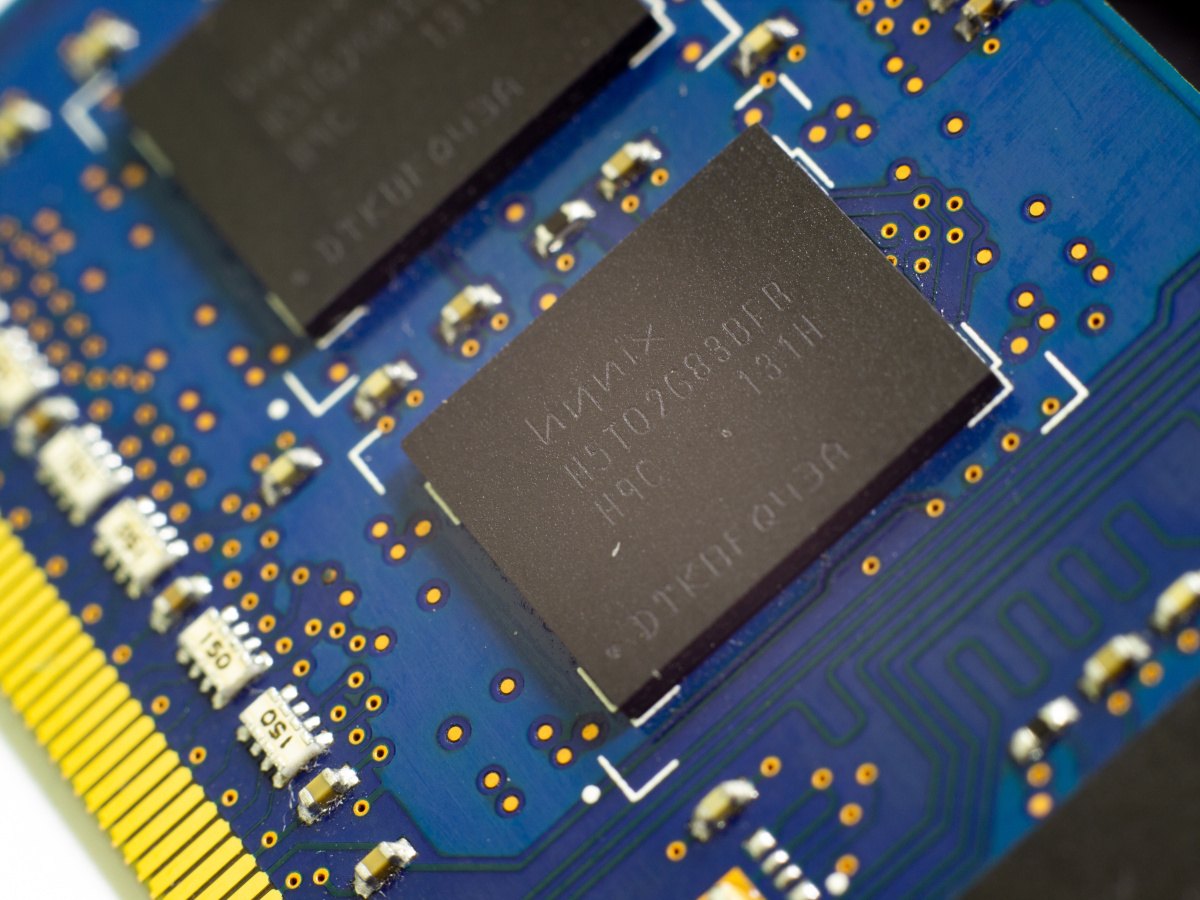
Micron, SK Hynix hit $1trn valuation amid AI chip demand

Published

on

Micron and SK Hynix join rival chipmaker Samsung in the $1trn club, after the latter hit the milestone valuation at the start of the month.

Leading chipmakers Micron and SK Hynix have both surpassed $1trn in market value, as AI drives demand for the companies’ memory chips.

Micron shares grew by more than 19pc yesterday (26 May) after investment bank UBS published a report that tripled its price target on the company’s stock from $535 to $1,525 per share – with UBS citing long-term agreement opportunities with major customers and partially fixed pricing on those deals.

The valuation milestone comes after Micron hit a valuation of $700bn at the start of the month.

Advertisement

Meanwhile, South Korean chipmaker SK Hynix also reached a $1trn valuation after its shares rose by 12pc today (27 May).

Last month, the company reported a five-fold surge in quarterly profits, while recent research from Counterpoint showed that SK Hynix held 57pc of the high bandwidth memory market in the fourth quarter of 2025.

Micron and SK Hynix join rival chipmaker Samsung in the $1trn club, after the latter hit the milestone valuation at the start of the month.

The valuations come as AI continues to fuel significant demand for the companies’ memory chips – a critical component of data centre expansion.

Advertisement

Other tech giants have benefitted majorly from this demand, including Nvidia, which recently revealed record Q1 revenue of $81.6bn. Last year, Nvidia became the first company to hit a $4trn valuation.

While companies like Micron, SK Hynix, Samsung and Nvidia have benefitted from the chip demand, the surge has also led to a major global chip shortage.

Earlier this year, IDC and Gartner warned that the global chip shortage could cause significant decline in smartphone and PC shipments, while also predicting sharp rises in price for the products due to a predicted surge in combined DRAM and solid-state drive prices by the end of 2026.

While chipmakers continue to grapple with the demand, reports indicate some companies might be considering alternative solutions to the shortage.

Advertisement

Last month, Reuters reported that AI giant Anthropic is considering the possibility of building its own chips. Rivals Meta and OpenAI already have such projects underway.

Don’t miss out on the knowledge you need to succeed. Sign up for the Daily Brief, Silicon Republic’s digest of need-to-know sci-tech news.

Source link

Advertisement
Continue Reading
Click to comment

You must be logged in to post a comment Login

Leave a Reply

Tech

How Often Should You Be Cleaning All The Remote Controls In Your Home?

Published

on


No television would be complete without a remote control. TV companies have started to take liberties with this tried-and-true control method, from making them really tiny and eliminating buttons to incorporating microphones and even screens on remote controls. While many modern smart TVs have shifted to Bluetooth or Radio Frequency (RF) connections, there are still millions of good old-fashioned infrared and universal remote options out there. Every TV owner also knows that a remote control getting dirty is pretty much unavoidable. 

Whether it’s dust from not using it very often or from the oil of snacks you prepared for movie night, it’s just a fact of life — remote controls get dirty. Cleaning a remote control is simple, and you should try to do it monthly, especially if someone in your house is sick, to kill any potential germs. All you need is 70% rubbing alcohol, a microfiber cloth, and some toothpicks, all of which you probably already have lying around the house.

Advertisement

The process to clean a remote control

The cleaning process itself is pretty straightforward. First, for safety, ensure that you remove the batteries from the remote. Then dab or spray a bit of rubbing alcohol onto the microfiber cloth and gently wipe down the remote. If you can’t find 70% isopropyl alcohol, don’t worry, you can also use a standard electronics-safe disinfecting wipe, which is among the useful gadgets and tools to keep your electronics clean and sanitized. This helps with stickiness, and as we know, stickiness is an unavoidable reality with any remote control, whether that is from food and skin creams, or perhaps the remote you have is really old, and the buttons have developed rubber reversion. 

If you’re cleaning your remote primarily to kill germs or disinfect it after someone in your house was sick, the American Chemistry Council has a handful of products, which were approved during the COVID-19 days, including Lysol and Clorox disinfecting wipes.

Once you wipe it down, use a toothpick to remove any leftover grime around the buttons’ edges. Then, dry off the remote, re-insert the batteries, and you may continue your Netflix movie nights. Not only does cleaning the remote control help maintain good hygiene around the house, but let’s face it, none of us wants to hand one of our guests a dirty remote with sticky buttons. We might risk never having them as our guests again.

Advertisement


Source link

Advertisement
Continue Reading

Tech

Samsung Is Testing Galaxy Watch 8 To Prevent Muscle Loss On GLP-1s Like Ozempic

Published

on

Samsung has teamed up with the Massachusetts General Hospital (MGH) Diabetes Research Center to investigate how wearables can help people on GLP-1 manage muscle loss. They’re specifically using Galaxy Watch 8, which the company released last year, for their study. Samsung says the study will focus on investigating the “feasibility of managing muscle loss for GLP-1 patients by utilizing biometric data including body composition, activity levels and heart rate provided by Galaxy Watch and Samsung Health.”

In its announcement, the company has referenced a KFF poll that says nearly one in five adults in the US has taken a GLP-1 drug at some point to manage Type 2 diabetes and to lose weight. With that many people using the medication, it’s no surprise that companies like Samsung would want to incorporate features that would serve them into their products. 

At this point, scientists are still figuring out the long-term effects of using GLP-1. Mayo Clinic’s David N. Brennan, M.D. said one of doctors’ emerging concerns is the loss of muscle mass. Over 30 percent of weight loss on the medication can be from muscle, he wrote. And while it’s not that different from the muscle loss one experiences with other weight-loss methods, scientists are worried that patients aren’t always regaining that muscle when they regain weight after stopping treatment. 

Researchers from the University of Virginia conducted a study into muscle loss from GLP-1 drugs and determined that it could undermine long-term health. “This is a serious concern. Muscle, especially axial muscle, is essential for posture, physical function and overall well-being,” they wrote. They explained that losing lean body mass increases the risk of cardiovascular diseases, which could lead to diminished quality of life.

Advertisement

Samsung’s study, which will be led by Dr. Melissa Putman from the MGH Diabetes Research Center, will divide 100 adults just starting GLP-1 treatment into two groups. One group will use Galaxy Watch 8 to monitor their body composition with its Bioelectrical Impedance Analysis (BIA), as well as to track their physical activity and to get personalized exercise guides to prevent the loss of muscles. The other group will be given the standard guidance most people taking GLP-1 get. Researchers will then use clinical-grade DXA scans to track the changes in the participants’ body composition. By comparing results between the two group, they can figure out if wearables like the Galaxy Watch 8 can effectively support people on the medication. 

“Many GLP-1 patients struggle with muscle mass loss, a common side effect that can cause an increased risk of cardiovascular disease and a drop in basal metabolic rate, which can lead to future weight regain,” said Dr. Putman. “We’re interested in exploring how continuous data from a wearable device can provide invaluable insights into a patient’s activity levels, heart rate and body composition, giving clinicians a more holistic view of treatment impact and allowing for more timely, data-driven adjustments to their care plan.” 

Samsung regularly collaborates with educational institutions to determine how its wearables can be used to monitor and predict health problems. It teamed up with Stanford University last year to improve its sleep apnea feature. More recently, it said it figured out how to predict fainting with “high accuracy” after working with the Chung-Ang University Gwangmyeong Hospital in Korea.

Advertisement

Source link

Continue Reading

Tech

Perfect Randomness Realized For the First Time

Published

on

ETH Zurich researchers say they have generated certified “perfect randomness” for the first time by using a quantum Bell-test setup with two entangled superconducting chips connected by a 30-meter cooled link. “In the long term, this work could play a similar role in digital security as atomic clocks do for timekeeping: a physically certified source of randomness that other systems can rely on,” reports Phys.org. “Possible applications range from the encryption of sensitive communications and digital identities to public randomness services for lotteries and blockchain applications.” From the report: They call their method randomness amplification. “This was made possible by an improved so-called Bell-Test with simultaneously high quality and high data rate,” says [Renato Renner and Andreas Wallraff]. He and his coworkers use a complex setup that consists of two superconducting chips, which they cool down to very low temperatures close to absolute zero. Each chip represents a quantum bit or qubit, which can take on the states “0” or “1” or any arbitrary superposition of these states. A 30-meter-long tube, which is also cooled down, connects the two chips.

Microwave photons can fly back and forth between them, thus creating quantum mechanical entanglement. This means that a quantum measurement on one qubit, which randomly yields the values “0” or “1,” influences automatically and at a distance whether “0” or “1” is measured on the second qubit. The separation of 30 meters ensures that, during the measurement, even at the speed of light, no information can be exchanged between the qubits. This would disturb the perfect randomness.

Wallraff and his team made the choice of the exact type of measurement (or “measurement basis” in technical jargon) on the two qubits depending on an imperfect random number generator. Renner’s coworkers could then amplify the randomness of the measurement results further using a special algorithm. “The resulting sequence of zeros and ones is now really perfectly random, and we can even certify that,” says Renner. He likens this result to crossing a ridge: “The technical improvements allowed us, for the first time, to create random numbers that will remain perfectly random for all eternityâ”no matter what analytical methods are used to assess their randomness.”
The findings have been published in the journal Nature.

Source link

Advertisement
Continue Reading

Tech

Out Of Control RFK Jr. Fires Leaders Of Preventative Services Task Force

Published

on

from the brain-drain dept

Alright, this is getting dire. In addition to all of the anti-vaxxer bullshit that has infected HHS thanks to RFK Jr.’s appointment to run the department, we have also made the point recently that an equally big problem is the talent drain occurring at HHS as well. Between the voluntary exits by smart people who don’t want to be part of something this stupid and the scores of smart people who have been fired by Kennedy and his hand-picked goon squad, HHS and its child agencies have significantly less talent within them today than they did a year and a half ago. And I haven’t even mentioned yet that we don’t currently have Senate-confirmed heads of the FDA, the CDC, or a Surgeon General. What’s the point of these positions if they mean so little that the Trump administration isn’t going to bother to fill them?

But Kennedy isn’t done, yet. Just recently, he fired the leadership of the U.S. Preventive Services Task Force, a volunteer group that works with government to mandate what preventative care procedures are approved such that insurance services have to cover them without copay.

In letters dated May 11, Health Secretary Robert F. Kennedy Jr. notified the two doctors who chaired the U.S. Preventive Services Task Force that he was terminating their appointments immediately, before the end of their multiyear terms.

The Department of Health and Human Services already had largely sidelined the task force, indefinitely postponing scheduled public meetings over the past year and thus leaving some long-expected updates on cervical cancer screenings and other topics in limbo.

Kennedy didn’t inform Drs. John Wong and Esa Davis as to why their positions were being terminated in his letter. But he did go before Congress recently and talked about wanting to reform the task force because he considered their approach and work lazy and not transparent enough. We’ve heard Kennedy make these noises about transparency in the past and we know that they are bullshit. He is almost certainly instead looking merely to install sycophants that will do whatever his bidding happens to be. Particularly as it appears that the task force was prevented from publishing some of its work.

Advertisement

Some health advocates had worried that Kennedy was preparing to replace the expert panel with less experienced political appointees, like he had done with a critical vaccine advisory committee. Over the past year, the task force wasn’t allowed to publish its final update to the cervical cancer screening guideline or take steps to update recommendations about maternal depression, said former task force chairman Dr. Michael Silverstein, a pediatrician.

“This is a level of government intrusion into scientific processes that I’ve not experienced in my 10 years on the task force,” he said.

What chaos comes out of this move remains to be seen, though there can be no doubt that chaos is on the menu. There are treatments out there that could benefit from approval from the task force, but insurance won’t cover them without that approval. We’re talking about screenings for cancer and other dangerous afflictions. Kennedy could also install people who will approve whatever crazy whim he comes up with next. Perhaps insurance will have to cover snorting cocaine off of toilets while supervised by a doctor.

You may laugh at that, but look around you. Does it really sound that crazy with all that has gone on at HHS the past 18 months?

Filed Under: esa davis, health, health & human services, john wong, preventive services task force, rfk jr.

Advertisement

Source link

Continue Reading

Tech

Snowflake commits $6B to Amazon Web Services over 5 years in latest AI infrastructure deal

Published

on

Snowflake’s office in Bellevue’s Spring District, where it expanded its regional presence last year. (GeekWire Photo / Kurt Schlosser)

Snowflake on Wednesday committed to spend $6 billion on Amazon Web Services over five years, adding to the cloud giant’s growing roster of AI infrastructure deals.

Snowflake, which sells cloud-based data warehousing and AI tools to big businesses, said the commitment includes the use of Amazon’s custom Graviton processors and other chips to power AI and agentic applications.

The deal expands a relationship that dates back to the data company’s founding 11 years ago. Snowflake’s five-year AWS spending commitment has grown from $1.2 billion at the time of its IPO in 2020 to $2.5 billion in 2023 to the current $6 billion, CNBC reported.

It’s the latest in a series of large-scale commitments for AI-related infrastructure on AWS, including deals of more than $100 billion with Anthropic, $138 billion with OpenAI, accompanying Amazon’s investments in the AI labs. Meta also plans to deploy tens of millions of Graviton chip cores for agentic AI.

Amazon’s custom chips business has become a major revenue driver. Amazon CEO Andy Jassy said in his annual shareholder letter in April that the business generates more than $20 billion a year and is growing at triple-digit rates.

Advertisement

Two large customers asked to buy all of Amazon’s available Graviton capacity for 2026, Jassy wrote in the letter at the time, and the company was compelled to turn them down.

Snowflake is headquartered in Bozeman, Mont., with a large presence in the Bay Area and a significant office in Bellevue, Wash. The company reported strong fiscal first-quarter results Wednesday, with revenue of $1.39 billion, beating analyst expectations.

Its stock rose as much as 33% in extended trading.

Source link

Advertisement
Continue Reading

Tech

Recess Took a Break in Some Schools. A Push is On to Bring It Back.

Published

on

Increased attendance, better attention in classrooms, stronger friendships, and more engaged citizens – these are not a long wishlist of preferred traits in an elementary school student. They are what some advocates believe are a direct impact from recess.

Recess, long a staple in children’s school days, has been put on the back burner or cut entirely by some districts as the push for more class time, higher academic performance, and increased test scores take center stage.

Recess advocates are pushing back in their efforts to guarantee a playtime each day. They argue adding in more structured play time benefits children’s academic, social and emotional well-being.

“It’s not that we don’t need hard work and concentrated effort, but when you hit a wall, you take a break,” says Catherine Ramstetter, who co-authored a new report for the American Academy of Pediatrics touting the importance of structured play. “That’s where I think, systematically, we’re kind of broken; that we expect little kids to be like little robots.”

Advertisement

The Push for Play

The AAP recently affirmed its 2013 stance that not only is recess important for children’s cognitive, physical and emotional well-being but expanded the recommendations to include middle and high school students too.

“I don’t know many high school teachers that are studying or deep into play,” Ramstetter says, pointing out early childhood teachers typically receive training in structured play. “Also, culturally in older grades, rigor is somehow equated with your nose to the grindstone –- when in reality, when we want to attain rigor, we have to have breaks.”

Similar to a push against screentime – specifically cell phones – in the classroom, grassroots efforts have formed to bring back recess. More than a dozen states, largely led by the nonprofit Yes to Recess Movement, are pushing for 60 minutes of play per day and ensuring it is not used as a bargaining chip for good or bad behavior.

“There has been a lot of evolution of the understanding of the value of recess over 30 years,” says Elizabeth Cushing, CEO of PlayWorks, a nonprofit that helps schools implement evidence-based play tactics.

Advertisement

“What might have been perceived as a ‘break’ is now seen as a critical part of the school day,” she adds. “It’s enabling kids to be in connection with each other in a way that’s fun, with low stakes, to build a community.”

Pushing for state or federal bills have yielded mixed reactions. Each advocate interviewed points out that they have never come with an allocation of funding to help facilitate the implementation, and also had concerns with a lack of other resources, namely helping teachers find time to accommodate the recess breaks. Deborah Rhea, founder of the Let’s inspire innovation ‘N Kids (LiinK) Project, suggests each local district tackles it by deciding what is best for its own schools and students.

“I think we have made more strides than I ever thought possible,” says Rhea, who also serves as a professor of kinesiology at Texas Christian University. “But at the same time, we’re limping along. We’re not being successful with momentum. Doing this propels them forward academically.”

But Ramstetter says introducing those minutes alone is not enough.

Advertisement

“I think policy can help support practice, but to make it quality playtime — something that doesn’t feel like an onerous task on a school — you have to spend some time planning,” she says. “Similar to introducing a new curriculum on English. It’s treating it like the crucial instructional time that it is.”

The Benefits of Play

In addition to benefiting younger students, the boost in social skills like teamwork and inclusion, along with physical benefits can be particularly important as students get older, Cushing says.

“The opportunities and skill building that happens in elementary school around cooperation, teamwork and how to include everyone in a game are easily done at that age,” she says. “They follow into middle and high schools where technology and social pressures require they have those skills already. If we want to develop citizens who work in a team and make friends, we have to start early.”

Experts added that recess can also boost attendance, a particularly important factor given high rates of chronic absenteeism sweeping the nation. Massachusetts-based Bedford High School offered “movement breaks” during lunch and saw chronic absenteeism decrease from 35% to 23% within its first year alone.

Advertisement

“There’s a lot of focus on recess to help with belonging and source of positive, joyful feelings about school,” Cushing says, adding schools with the PlayWorks framework saw lower chronic absenteeism rates than those without it.

Rhea of LiiNK listed multiple benefits she’s seen across the roughly 25,000 students that underwent her programming: cortisol levels (tested by hair samples) went down; academic assessment scores went up; off-task behavior in the classroom dropped 40 percent, and schools found offering the programming could be used as a recruitment tactic.

“The only time I had to convince parents was the first year I started this,” she says. “After that, word of mouth spread.”

There still is the uphill battle of convincing schools to find time in their day. Not every district can afford to roll out a system similar to Rhea’s or Cushing’s, either financially or with spare time.

Advertisement

The Future of Play

However, Cushing pointed out even with little resources, children tend to thrive with simple, structured play.

“Recess is the only time in the school day where children naturally know they have mastery,” she says. “The beauty of recess is that kids will play everywhere. Despite all the complexity there’s a real beauty in the universality of it.”

However, students do need some resources, like a jump rope and designated play areas, otherwise they may not receive the full benefits of recess even if they are outside.

“If you look at a playground where there’s no frame for it, you’ll see a majority of kids standing around the outside of the playground,” Cushing says. “They’re too afraid or shy to jump in and don’t know if it’s going to be fun or not. It’s not that they don’t want to play, they just need the conditions created to do it.”

Advertisement

While cell phones are less common in elementary school settings, experts added a lack of screens could improve play conditions.

Schools have pushed for more tech-free time, specifically with “bell to bell” bans that require cell phones remain untouched for the entirety of the school day, including during lunch, recess and passing periods.

The AAP study did not explicitly mention the use of technology. However, Ramstetter says the implication was “yeah, get it out of the way,” she adds.

“Don’t give them to kids at recess: Encourage them to connect, give them quiet places to sit. to run around, to dig in the dirt,” she says, comparing the ban to other forms of consent. “If I tell you I don’t want to play anymore, I need to mean it. Otherwise it gets muddy.”

Advertisement

She adds sometimes simple is best, pointing toward schools that just have a jump rope, chalk, and Four Square – things that allow children to make their own rules. “Everyone agrees recess is beneficial, but you have to do it well to reap the benefits,” Ramstetter says. “If we all believe it’s beneficial, let’s take a step back to see how can we better tap into some of this time, preparing to do it well.”
Source link

Continue Reading

Tech

Blue Origin readies New Glenn rocket to launch 48 Amazon Leo satellites after FAA clearance

Published

on

New Glenn rockets are being processed inside Blue Origin’s Florida facility. (Blue Origin Photo)

Five weeks after experiencing its first launch failure, Kent, Wash.-based Blue Origin is getting ready to put its heavy-lift New Glenn rocket back in service to launch 48 satellites into low Earth orbit for the growing Amazon Leo constellation.

The mission, designated as NG-4 for the rocket and LN-01 for the payload, will mark the first time Blue Origin’s rockets have launched satellites for Amazon — forging a new connection between the two best-known companies founded by Jeff Bezos. It will also set a new high for the number of Leo broadband satellites launched on a single mission.

“Couldn’t be prouder to support the Leo team on this mission,” Blue Origin CEO Dave Limp said in a post to X. Before he joined Blue Origin in 2023, Limp was the Amazon executive in charge of the Amazon Leo program (when it was known as Project Kuiper).

This will be the fourth launch of a New Glenn rocket. The first-stage booster for NG-4 is nicknamed “No, It’s Necessary” — a line from the movie “Interstellar” that refers to the need for a bold space maneuver.

New Glenn had been grounded in the wake of last month’s unsuccessful launch of an AST SpaceMobile satellite from Florida. But last week, the Federal Aviation Administration said it accepted the findings of an investigation led by Blue Origin. The investigation said the mishap was caused by a cryogenic leak that froze a hydraulic line, leading to a thrust anomaly during the second-stage engine burn.

Advertisement

Blue Origin identified nine corrective actions to prevent a recurrence of the mishap, and the FAA authorized the company to return to flight. An FAA advisory suggested the launch could take place as early as next week.

Amazon Leo currently has just over 300 satellites in orbit, and thousands more satellites are due to be launched in the next three years. Under the terms of its original license from the Federal Communications Commission, more than 1,600 satellites were supposed to be launched by June 30, but Amazon is seeking a two-year extension of that deadline.

So far, most of the satellites have been launched by United Launch Alliance’s Atlas 5 rockets, but the pace of deployment is expected to double over the coming year as heavy-lift rockets including New Glenn, ULA’s Vulcan and Arianespace’s Ariane 6 swing into action. Amazon says it has 24 New Glenn rocket launches reserved for satellite deployment missions.

Advertisement

Amazon Leo aims to start phasing in commercial satellite broadband internet service as soon as this summer, starting in mid-northern and mid-southern latitudes. Coverage is expected to expand as more satellites are launched. Leo hasn’t yet announced pricing for its service.

SpaceX’s Starlink network currently dominates the satellite broadband market, with more than 10,000 satellites in low Earth orbit and more than 12 million subscribers. SpaceX also serves as a launch provider for Amazon Leo, illustrating how even rivals can become partners in the space industry.

In other developments:

  • Amazon laid out further details in its plan to acquire Globalstar and its direct-to-device satellite constellation this week in a filing with the FCC. The plan, which requires FCC approval, calls for Apple to transfer its 20% stake in Globalstar to Amazon (via a newly created subsidiary called “Grapefruit”). Globalstar’s infrastructure and its licenses for satellite service would be transferred to Amazon, and Amazon would file its own license application to operate a global D2D satellite system purpose-built for mobile connectivity. The system would be complementary to the broadband service offered by Amazon Leo. When the $10.8 billion acquisition deal was announced last month, Amazon said the agreement was expected to close in 2027.
  • The FAA said it will oversee an investigation of last week’s flight test of SpaceX’s Starship V3 rocket. During the test, the engines on the rocket’s Super Heavy first-stage booster failed to fire properly after stage separation for what was meant to be a controlled descent and splashdown. As a result, the booster tumbled through its atmospheric re-entry and broke apart, with debris falling into the Gulf of Mexico. Starship’s return to flight will be based on the FAA determining that any system, process or procedure related to the mishap will not affect public safety.

Source link

Advertisement
Continue Reading

Tech

AutoFlight V5000 Matrix, the World’s Largest eVTOL, Flies in Formation With Two Smaller Aircraft

Published

on

AutoFlight V5000 Matrix Largest eVTOL Formation Flight
AutoFlight completed a coordinated flight on May 24 that paired its largest aircraft with two smaller models from the same family. One V5000 Matrix eVTOL flew alongside a pair of V2000 series aircraft in what the company called a heterogeneous three aircraft formation. The exercise checked communication between the platforms, shared route planning, and overall safety management across machines that differ sharply in size and weight.


The V5000 Matrix’s wings span an impressive 20 meters (66 feet) from one tip to the other. The body is 17.1 meters (56 feet) in length and 3.3 meters (11 feet) in height. The maximum takeoff weight of 5700 kilograms puts it in a class of its own when compared to other known crewed electric VTOLs. There are two variants of the V5000, and they are very different creatures. The passenger model is entirely electric, with seating for up to ten people in business class or six in a more luxurious configuration. It will take you about 250 kilometers on a single charge. The hybrid electric cargo vehicle, known as the V5000CGH, can lift an amazing 1500 kilos of goods inside a 14 cubic meter hold that can accommodate two standard AKE air cargo containers.

Sale


DJI Neo, Mini Drone with 4K UHD Camera for Adults, 135g Self Flying Drone that Follows You, Palm Takeoff…
  • Due to platform compatibility issue, the DJI Fly app has been removed from Google Play. DJI Neo must be activated in the DJI Fly App, to ensure a…
  • Lightweight and Regulation Friendly – At just 135g, this drone with camera for adults 4K may be even lighter than your phone and does not require FAA…
  • Palm Takeoff & Landing, Go Controller-Free [1] – Neo takes off from your hand with just a push of a button. The safe and easy operation of this drone…

AutoFlight V5000 Matrix Largest eVTOL Formation Flight
It travels at 280 kilometers per hour and can easily cover 1500 kilometers. 20 lift motors handle the vertical portions, but they also allow the wings to perform the work when cruising, resulting in a smooth transition. As a safety precaution, there is built-in redundancy, which means that even if two of those motors fail at the same time, which is more than likely, I believe, the aircraft will remain under control.

AutoFlight V5000 Matrix Largest eVTOL Formation Flight
Engineers claimed the successful test flight demonstrated that the shared systems between the V5000 and the smaller 2-ton class V2000 operated flawlessly. Different sizes result in different flying characteristics, therefore they had to organize the timing, spacing, and orders to avoid conflicts. Back in February, the V5000 completed a full transition flight at the Kunshan civil drone test base, which was no easy accomplishment. It took off vertically, switched to wing-supported cruise mode, and then landed vertically again, which is a difficult maneuver for any aircraft that combines the two technologies.

AutoFlight V5000 Matrix Largest eVTOL Formation Flight
The hybrid freight version of the V5000 has now officially entered the airworthiness certification procedure with China’s Civil Aviation Administration, signaling the end of the research phase and the start of the official regulatory process for commercial use. The certification team at AutoFlight has extensive experience, having worked on aircraft such as the ARJ21 and C919, as well as the Diamond DA42.
[Source]

Advertisement

Source link

Continue Reading

Tech

Cognition raises $1B at $26B valuation for AI coding agent

Published

on

TL;DR

Cognition AI has raised more than $1 billion at a $26 billion valuation for Devin, its AI coding agent. Revenue grew from $37 million to $492 million in 12 months, with Goldman Sachs, Mercedes-Benz, and the US government among its customers.

Cognition AI has raised more than $1 billion in new funding at a $26 billion valuation, more than doubling its worth since a September round that valued the company at $10.2 billion. The round was co-led by Lux Capital, General Catalyst, and 8VC, with participation from Ribbit Capital, Atreides Management, and Peter Thiel’s Founders Fund. The company has now raised more than $2.5 billion in total funding.

Advertisement

The numbers behind the valuation tell the story. Cognition’s revenue run rate has grown from $37 million in May 2025 to $492 million today, a 13-fold increase in 12 months. The company says it aims to cross $1 billion in annualised revenue later this year. Its customers include Goldman Sachs, Mercedes-Benz, NASA, Santander, and several parts of the US government.

What Devin does

Cognition’s flagship product is Devin, an AI agent designed to automate the programming process end-to-end. Unlike code completion tools that suggest lines or blocks of code while a human developer writes, Devin operates as a full coding agent that can take a task description and produce working software autonomously. It plans, writes, debugs, and deploys code across complex multi-step workflows.

The most striking claim comes from inside Cognition itself. Scott Wu, the company’s co-founder and CEO, said that more than 90% of the company’s internal code is now written by Devin. That figure, if accurate, makes Cognition one of the most aggressive practitioners of its own product in the history of enterprise software. It is a company that has automated its own engineering function using the tool it sells to automate engineering functions at other companies.

Cognition runs Devin on a mix of its own proprietary models and models from OpenAI and Anthropic. Wu framed this as a strategic advantage rather than a dependency. As the model layer gets more competitive, he said, working with a combination of models produces better results than relying on any single provider. Cognition routes customers to the best tools for their specific needs, positioning itself as an orchestration layer rather than a model company.

The AI coding market is on fire

Cognition’s raise lands in the hottest category in venture capital. Cursor, the AI coding editor built by Anysphere, hit $2 billion in annual recurring revenue in roughly three years and was in talks to raise $2 billion at a $50 billion valuation before SpaceX struck a deal in April for the right to acquire the company for $60 billion. OpenAI and Anthropic are both investing heavily in coding capabilities within their foundation models. Salesforce expects to spend $300 million on Anthropic tokens this year, primarily for coding use cases.

Advertisement

The competitive dynamics are unusual. Cognition uses models from OpenAI and Anthropic, the same companies that are building competing coding products. Wu addressed this directly, arguing that Cognition’s value is in the agent layer, the orchestration, planning, and execution logic that sits on top of foundation models, rather than in the models themselves. This is a bet that the model layer will commoditise while the agent layer captures durable value. It is also a bet that OpenAI and Anthropic will not build equally capable agent products that undercut their own API customers.

The Windsurf acquisition and consolidation wave

Cognition is also growing through acquisition. In July 2025, the company acquired the remaining assets of Windsurf, a coding startup that had been the subject of a bidding war between OpenAI and Google. Google ultimately struck a $2.4 billion deal for Windsurf’s top engineering talent and licensing rights, while Cognition picked up what was left, including technology, customers, and employees who chose not to join Google.

The Windsurf deal illustrates the consolidation dynamics at play. AI-native enterprise spending surged 94% year on year in early 2026 while traditional SaaS growth cooled to 8%, and the capital flowing into AI coding tools is driving a wave of acquisitions, talent raids, and competitive positioning that resembles the early days of cloud computing compressed into months rather than years.

Cognition said it plans to use the new funding to refine its models, improve the customer experience, and potentially make more acquisitions. Wu emphasised on Bloomberg Television that the raise allows Cognition to remain independent, a pointed comment given the SpaceX-Cursor deal and the broader trend of AI startups being absorbed by larger platforms.

Advertisement

The independence question

Whether Cognition can stay independent at this scale and growth rate is the open question. The company is valued at $26 billion with $492 million in revenue, a multiple of roughly 53 times. That valuation holds only if growth continues at its current pace and the AI coding market does not compress around a few dominant players. Every major software company is building AI coding capabilities, and the foundation model providers are steadily improving their native coding performance with every model release.

Cognition’s defence is execution speed and the claim that the agent layer, not the model layer, is where enduring value lives. If Devin can genuinely automate 90% of a company’s coding output, the product is not a developer tool. It is a replacement for a significant portion of the software engineering workforce. That is the same logic driving layoffs at Meta and Microsoft, where companies are converting payroll budgets into AI infrastructure spending. Cognition is selling the tool that makes that conversion possible.

Founded in 2023, Cognition went from a demo that went viral on social media to a $26 billion company in less than three years. The speed is unprecedented, but so is the market it is operating in. AI coding is not a niche product category. It is a direct bet on the proposition that software can write itself, and that the companies that automate programming fastest will capture a disproportionate share of the $600 billion global software market.

Advertisement

Source link

Continue Reading

Tech

Nvidia To Spend $150 Billion a Year In Taiwan

Published

on

Nvidia CEO Jensen Huang says the company plans to spend around $150 billion a year in Taiwan, calling it the “epicenter of the AI revolution.” “Four years ago, five years ago, Nvidia was spending about $10, $15 billion dollars a year in Taiwan. Now we’re spending $100, going to $150 billion dollars in Taiwan each year,” Huang said. Reuters reports: Huang was speaking at a launch celebration in Taipei for the chip company’s planned Taiwan headquarters, which he said will break ground this year and aims to become operational in 2030. He did not provide a timeframe for the number of years the company plans to invest $150 billion. The Taiwan headquarters will bring Nvidia closer to TSMC, the world’s largest contract chipmaker which makes many of the advanced semiconductors powering the trend towards AI and is a major supplier to the U.S. tech company.

“Taiwan is booming,” Huang said on stage at the celebration which was attended by his parents, wife, daughter and son in addition to around 1,000 employees. “Taiwan is the epicentre of the AI revolution. This is where the chips come, packaging comes, this is where the systems are made, this is where AI supercomputers were created. The number of partners we work with here in Taiwan, incredible.”

Source link

Continue Reading

Trending

Copyright © 2025