

Crypto World
Polymarket Exec Says KYC Limited To Beta Product

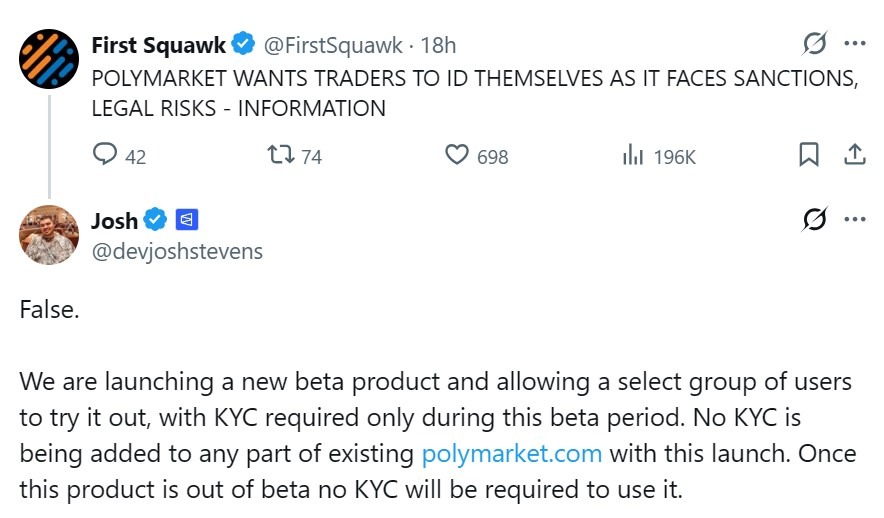
Polymarket’s vice president of engineering, Josh Stevens, clarified that the prediction market platform is not adding mandatory Know Your Customer (KYC) checks to its existing service, after a report said the company had considered user verification requirements.
Stevens said in an X response that Polymarket is launching a new beta product for a select group of users and that KYC is required only to access the beta during its early test period. “No KYC is being added to any part of existing polymarket.com with this launch,” Stevens wrote. He said that once the product is out of beta, no KYC will be required to use it.
He later addressed questions about whether KYC could be added later, saying “no” and clarifying that he was “just highlighting” that identity checks are tied to early access for a new beta product rather than a broader move away from pseudonymous trading on Polymarket’s main prediction market.
The clarification followed a report from The Information that said Polymarket had considered mandatory user verification requirements amid growing pressure from regulators.
Cointelegraph reached out to Polymarket and Josh Stevens for more information but had not received a response by publication.
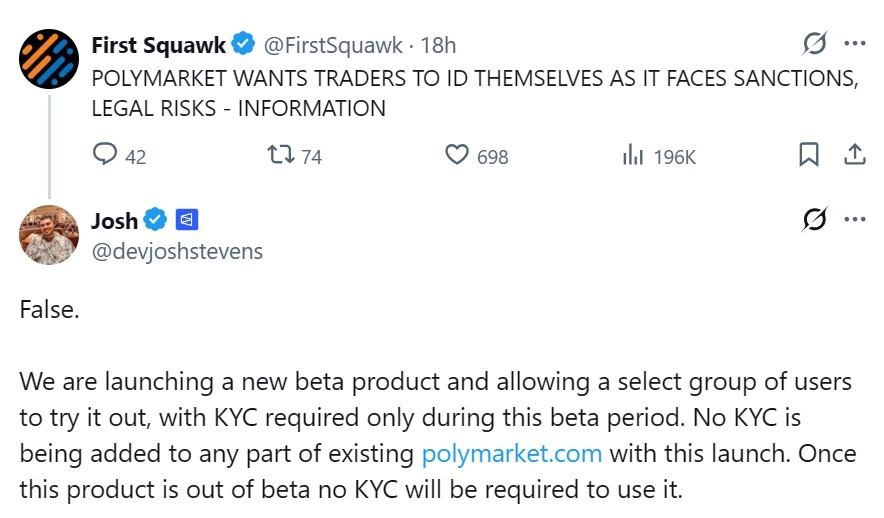
Source: Josh Stevens
Polymarket restrictions grow amid regulatory scrutiny
Polymarket’s clarification comes as the platform faces widening access restrictions across several jurisdictions.
As of Thursday, Polymarket listed dozens of restricted jurisdictions, including countries where users are blocked from placing orders and others where access is limited to closing existing positions.
Related: Monthly prediction market volume hits $25.7B as user activity shifts beyond one-off events
In April, Brazil moved to block 27 prediction market platforms, including Polymarket and Kalshi, after authorities said the services operated outside the country’s legal framework.
In May, Spain’s gambling regulator also blocked local users from Polymarket and Kalshi as a “precautionary measure” while authorities pursued legal proceedings over alleged unlicensed gambling activity.
Despite the restrictions, Polymarket has continued to pursue expansion in major markets. In April, the company was reportedly in talks with the US Commodity Futures Trading Commission over a broader US relaunch, and in May, it was reportedly seeking entry into Japan despite the country’s strict gambling laws.
Magazine: Big Questions: Do we really only need 2–5 cryptocurrencies?


The list of altcoins hitting all-time high zones in June 2026 is growing fast despite market uncertainty. Three tokens currently sit within striking distance of new peaks.
One faces a major token unlock on June 6. Another already broke into price discovery this week before pulling back. The third is completing a textbook cup pattern. Each setup hinges on a single breakout level.
Stable (STABLE)
STABLE trades at $0.0376 after consolidating since May 25. The token launched its mainnet in December 2025 as a Tether-backed Layer-1 where users pay gas in USDT. It now sits among the altcoins hitting all-time high zones in June 2026.
Want more token insights like this? Sign up for Editor Harsh Notariya’s Daily Crypto Newsletter here.
The fundamental setup turned constructive this week. Stable shipped StableEarn on May 26, integrating Theo yield strategies and Morpho risk management. This adds the right ATH tailwind as the price action steadily enters June 2026.
From the technical perspective, a cup and handle pattern has formed on the 12-hour chart. Price hit the $0.0448 all-time high on May 14. It dropped to $0.0303 on May 23, then recovered to $0.0440 by May 25. The cup is complete.

The handle is now forming as the price consolidates post hitting $0.0440 on May 25. Selling pressure has stayed thin while price tries to rise inside the falling channel. The consolidation appears to be ending.
The first level to breach is $0.0389, which clears the handle. The decisive level is the $0.0442 neckline, where price meets the previous ATH zone. Clearing $0.0442 on volume completes the pattern. A confirmed breakout projects a 45.74% measured move to $0.0644 during June. That move confirms this altcoin can reach ATH in June.
The risk is well defined. A break below $0.0357 weakens the pattern. A 12-hour close under $0.030 invalidates the bullish pattern entirely.
Hyperliquid (HYPE)
HYPE trades at $57.86, down roughly 11% from the $64.80 all-time high reached on May 26. The token has been one of the best performing altcoins of the May rally.
The price moved from $38.15 on May 13 to $64.80 on May 26. That 70% surge was powered by spot HYPE ETF demand. Bitwise’s BHYP pulled in $19 million on May 27 alone, taking cumulative ETF inflows to $55 million.
The fundamental headwind comes 9 days from now. HYPE token unlock on June 6 releases 9.92 million tokens worth $564.66 million, or 2.54% of released supply. That unlock is the June 6 litmus test.

Either ETF buying absorbs the new supply, or holders rotate out near the highs.
The daily chart shows a bullish pole and flag pattern developing. The pole ran from $38.15 to $64.80. Since May 26, price has compressed inside a descending channel that forms the flag.
A daily close above $59.83 breaks the flag and triggers the bullish breakout. The first hindrance is the $64.80 all-time high. The next levels stack at $69.25, $78.66, and $93.90.

The pattern projects a 69.97% move to $101.74, crossing the psychological $100 mark, possibly in June if the hype around HYPE continues. The risk sits below. A close under $54.02 weakens the structure. A break under $47.13 invalidates the pattern entirely.
Rain (RAIN)
RAIN trades at $0.0143, only 3.5% below the $0.0149 all-time high reached on May 26. The token is up over 23% in the past 24 hours, already moving in as one of the prospective altcoins hitting all-time high in June or maybe earlier.
Rain Protocol is a decentralized prediction markets platform on Arbitrum. Its deflationary tokenomics allocate 2.5% of trading volume to buy and burn RAIN.
The token’s surge follows real catalysts. Rain joined the top 3 prediction markets by volume this week. Nasdaq-listed Enlivex Therapeutics committed $212 million to RAIN treasury accumulation. DraftKings partnered with Polymarket, expanding institutional interest in the category.
The daily chart shows a bull flag forming after an explosive rally. The pole ran from $0.0072 on May 23 to $0.0149 on May 26, a 106% move in three sessions. Price has since consolidated inside a descending channel.
A daily close above the current $0.0142 level shows initial strength. The decisive breakout level is the $0.0149 previous peak. Clearing $0.0149 confirms price discovery for RAIN.

The pattern projects a 106.25% measured move to $0.0301, possibly in June considering its aggressive price surges. The consolidation remains active above $0.0131. A break below $0.0110 invalidates the setup entirely.
The post 3 Altcoins That Can Hit All-Time High in June 2026 appeared first on BeInCrypto.

Disclosure: This article does not represent investment advice. The content and materials featured on this page are for educational purposes only.
XRP Power AI Smart App gains attention for combining AI automation with cloud-based passive income features.
Summary
- XRP Power AI Smart App promotes AI-driven yield contracts, automated settlements, and crypto-funded participation models.
- The platform supports assets including XRP, Bitcoin, Ethereum, and Dogecoin for activating AI-based earning contracts.
- XRP Power says it uses KYC, AML, 2FA, and security frameworks aligned with standards like ISO/IEC 27001 and SOC 2, though users should independently verify risks, withdrawals, and platform legitimacy before investing.
This is a recent sentiment shared by a retired user in Florida within the crypto community. With the rising cost of living in the US in recent years, increasing pressure on retirement savings, and escalating volatility in the crypto market, more and more American retirees are seeking a more stable and automated way to generate digital income.
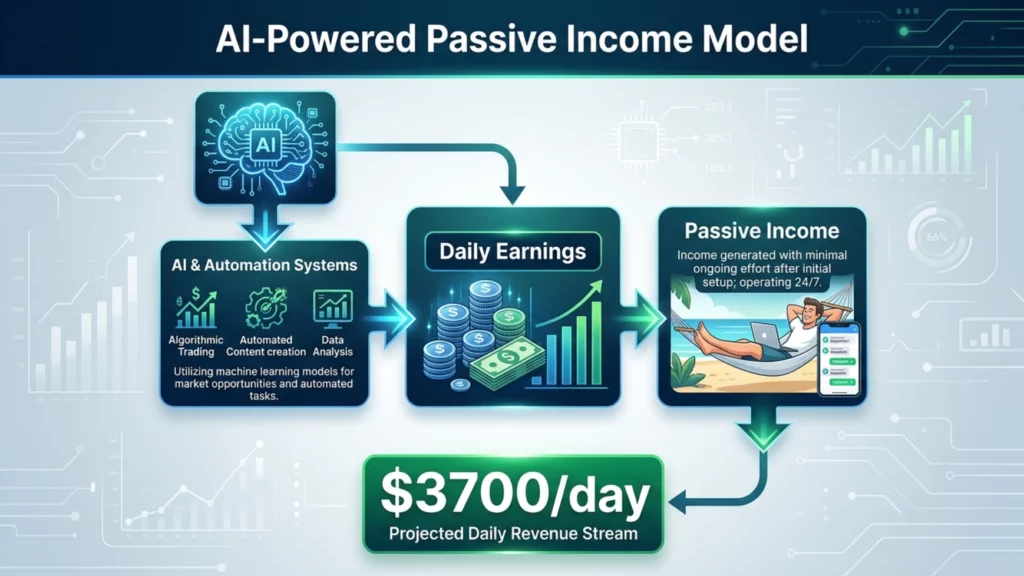
Recently, the XRP Power AI Smart App has become a hot topic. The platform combines an AI-powered system, an automated cloud computing ecosystem, and a daily earnings mechanism, allowing users to experience a more relaxed digital passive income model without complicated operations or constant monitoring.
How to start earning daily income with XRP Power ai smart app
1. Quickly register an account
2. Flexible AI smart yield contract selection
The platform offers AI smart yield contracts ranging from $100 to $100,000, with different yield plans corresponding to different periods. Users can choose flexibly according to their needs.
3. Activate contracts with mainstream cryptocurrencies
Users can use mainstream cryptocurrencies such as XRP, BTC, USDC, USDT-TRC20, ETH, and DOGE to pay contract fees and activate the AI smart yield system, which is automatically run and managed by the platform’s AI.
4. Daily earnings automatically returned to account
During contract operation, the platform automatically settles earnings daily, and the earnings will be automatically returned to the account balance. Users can freely withdraw funds as needed or continue to purchase other AI smart yield contracts.
5. Earn long-term extra income by inviting friends
The platform offers a friend referral reward mechanism. Users who invite friends to join can receive up to 3% + 2% long-term earnings rewards, providing the opportunity to continuously earn additional digital income even without additional investment.
Basic AI smart contracts
Contract Name: Dogecoin [AI Smart Quantitative] Investment Amount: $1,000, Term: 7 days, Daily Yield: $13.20, Total Profit: $92.40, Principal Return at Maturity: $1,000
Contract Name: Bitcoin/Bitcoin Cash [AI Global Smart Ecosystem] Investment Amount: $3,000, Term: 10 days, Daily Yield: $40.80, Total Profit: $408, Principal Return at Maturity: $3,000
Click to view more contract details
XRP Power AI smart security system
Regarding user data security and privacy protection, XRP Power continuously references international information security and data privacy standards such as ISO/IEC 27001, SOC 2 Type II, and GDPR to continuously improve the platform’s security architecture, data encryption technology, and privacy protection mechanisms, further enhancing user account security, data management capabilities, and overall platform stability.
Meanwhile, the platform integrates an AI-powered intelligent risk identification system with KYC identity verification, AML anti-money laundering mechanisms, and 2FA two-factor authentication technology to build a multi-layered intelligent security protection system. This continuously strengthens anomaly risk monitoring, account security management, and overall platform risk control capabilities, creating a safer, more stable, and reliable AI-powered intelligent digital ecosystem for global users.
About XRP Power
Currently, XRP Power has over 3 million users worldwide, with operations spanning 189 countries and regions. The platform continuously integrates AI intelligent systems, cloud computing ecosystems, and automated digital technologies to optimize user experience, security systems, and its global ecosystem.
Join the XRP Power AI intelligent ecosystem now and experience a more stable and intelligent daily passive income model, enabling more and more retirees to enjoy an easier and more automated digital income experience.
For more information, visit the official website and download the iOS or Android app.
Disclosure: This content is provided by a third party. Neither crypto.news nor the author of this article endorses any product mentioned on this page. Users should conduct their own research before taking any action related to the company.

The Depository Trust & Clearing Corporation (DTCC), a Wall Street central clearinghouse that processes $2.5 quadrillion in securities transactions annually, announced plans Wednesday to connect its tokenized securities platform to the Stellar network by the first half of 2027.
This is the first time DTC-custodied securities will live on a public chain. This will also bring the core of U.S. market infrastructure onto an open ledger, and to do it under an SEC no-action letter that covers Russell 1000 stocks, ETFs, and U.S. Treasuries.
Discover: The Best Crypto to Diversify Your Portfolio
DTCC-Stellar Integration Mechanism

DTCC’s Depository Trust Company retains the authoritative legal record, or the so-called “golden record,” while Stellar hosts a synchronized on-chain representation of the same asset. The blockchain token functions as a mirrored record. This embedded in the SEC’s December 2025 no-action letter, is what makes broker-dealer and ATS integration legally tractable.
The integration will support issuance, settlement, and lifecycle management of blockchain-based versions of traditional securities, with explicit plans to extend into highly liquid assets, including major indices and U.S. Treasury debt instruments.
Post-trade settlement on Stellar compresses the timeline from T+1 to near-instantaneous finality, freeing collateral, reducing counterparty exposure, and enabling markets to operate outside standard trading hours.
DTCC is not stopping at Stellar. Nadine Chakar, DTCC’s global head of digital assets, confirmed the firm plans to connect to “multiple layer-1 and layer-2 networks,” framing Stellar as the first node in a deliberate multi-chain strategy.
Chakar also noted that Stellar is first because of its compliance-oriented design, built-in asset clawback and restricted transfer features, and an established track record with regulated institutions, including MoneyGram and Circle’s USDC.
The RWA tokenization narrative has been building for two years. What has been missing is a systemically important institution putting its own custodied inventory on a public chain under a regulatory framework that holds.
Frank La Salla, DTCC’s President and CEO, stated the collaboration “represents another step forward in DTCC’s efforts to build an open, interoperable digital infrastructure that bridges traditional and digital markets.”
Discover: The Best Token Presales
Sets in Motion for Market Structure
The immediate forward pressure is on competing CCPs and central securities depositories globally. If DTCC’s model produces clean outcomes through 2027, the blueprint becomes exportable. Other market infrastructures watching regulatory outcomes in the U.S. will face direct institutional pressure to replicate or fall behind.
— 𝓐𝓶𝓮𝓵𝓲𝓮 (@_Crypto_Barbie) May 26, 2026
 RIPPLE PARTNER SECURITIZE JUST POSTED THIS:
„TOKENIZATION IS GOING TO ALLOW US TO DO IS GO 24 BY 7, 365 VIA THE INTERNET, DISTRIBUTED EVERYWHERE IN THE WORLD. 

MOVE CAPITAL AS YOU & I SLEEP – WE‘RE GOING TO HAVE TO CHANGE THE TECHNOLOGY!“  pic.twitter.com/gCeTzXJ0zP
Analysts expect DTCC to run additional pilots testing intraday tokenized settlement, corporate actions processing, and cross-chain interoperability between Stellar and permissioned ledgers before expanding the eligible asset set. The legislative environment around digital asset infrastructure will determine how quickly this expansion happens.
Tens of billions in Treasuries and money-market fund shares are already tokenized across siloed platforms. DTCC bringing its own custodial inventory on-chain collapses the distance between pilot-scale tokenization and core market plumbing.
Discover: The Best Crypto to Diversify Your Portfolio
The post DTCC to Integrate Tokenized Assets on Stellar XLM appeared first on Cryptonews.

OP Labs said exchange-owned chains built on the OP Stack generated more than $495 million in application revenue in the second half of 2025. The figure includes sequencer fees from transactions, revenue generated through applications embedded directly into exchange platforms, and assets that remained onchain.
According to the official press release shared with CryptoPotato, OP Labs said exchanges historically relied on third-party networks that captured much of the value generated from settlement activity, application fees, and broader onchain monetization linked to user activity.
OP Stack Onchain Revenue
Over the past year, however, applications running across exchange-owned chains built on the OP Stack have expanded rapidly. OP Labs highlighted that Morpho’s total value locked (TVL) on Coinbase-backed Base rose from $48 million at the beginning of 2025 to more than $960 million by the end of the year, representing nearly 20x growth. The company said the increase was driven mainly by lending products integrated directly into the Coinbase app rather than through wallet-based user acquisition.
Base has now become Morpho’s second-largest chain globally and accounted for 32% of Morpho’s application fees in H2 2025, which OP Labs said was 13 times that of Arbitrum and 60 times that of OP Mainnet.
Meanwhile, Kraken’s Ink chain added more than one million unique addresses since December 2024. OP Labs said fewer than 0.6% of those addresses had any prior onchain history with Kraken, while the remaining 99.4% represented net-new onchain wallets, which it described as evidence that exchange-owned chains are expanding the overall onchain market rather than merely shifting existing users between networks.
OP Labs further noted that Tydro, the Aave V3 white-label lending protocol launched on Ink in October 2025, reached $100 million in TVL within its first 24 hours and surpassed $500 million within 90 days. The company said comparable Aave deployments on neutral Layer 2 networks previously took between 142 and 721 days to reach similar milestones.
Optimism Foundation’s Chief Business Officer Kyle Jenke said the H2 figures showed a shift from the old system, where exchanges made money from trading while external networks captured the value generated thereafter. He added
“Exchanges now own the settlement, distribution, and application layers their users transact on. They’re doing it on a shared standard precisely so they don’t fragment from each other in the process.”
Ecosystem Record High
Across the wider ecosystem, OP Stack chains secured $16.33 billion in total value, held $6.8 billion in DeFi TVL, and processed 3.6 billion transactions during H2 2025. This was an all-time high across more than 50 live chains covering exchanges, consumer applications, financial infrastructure, and developer platforms.
Additionally, regulated companies are also choosing the OP Stack for institutional blockchain projects. Bitpanda’s Vision Chain uses the OP Stack for institutional finance aligned with Europe’s MiCA and MiFID II regulations, while Japan’s Mitsui & Co. Digital Commodities launched the regulated precious-metals-backed Zipangcoin on OP Mainnet.
The post Exchange-Owned OP Stack Chains Made Nearly $500M in Onchain Revenue, OP Labs Says appeared first on CryptoPotato.

Key Highlights
- Shares of Dollar Tree rallied 11% in premarket hours to approximately $106 following impressive Q1 results
- The company delivered adjusted EPS of $1.74, significantly surpassing the Street’s $1.53 expectation
- Total revenue increased 7.2% year-over-year to $4.98 billion, topping the $4.96 billion consensus
- Comparable store sales advanced 3.5%, exceeding analyst projections of 3.3%
- The discount retailer unveiled a strategic on-demand delivery collaboration with DoorDash
Dollar Tree delivered an impressive first fiscal quarter performance, propelling shares 11% higher to roughly $106 during Thursday’s premarket session.
The discount chain had experienced a 22% decline in 2026 prior to this earnings release — marking the first complete calendar year following the company’s divestiture of its Family Dollar division at a substantial loss during the previous summer.
On an adjusted basis, earnings per share reached $1.74, representing a jump from $1.26 in the same period last year and comfortably beating the analyst consensus of $1.53, based on FactSet data.
Top-line revenue expanded 7.2% to $4.98 billion, narrowly exceeding the Street’s projection of $4.96 billion.
Comparable store sales posted a 3.5% year-over-year gain, fueled by a 4.5% increase in average transaction value. Customer traffic declined 1%, though the elevated spending per visit successfully counterbalanced this softness.
CEO Mike Creedon characterized the performance as evidence of “continued progress across the business” and highlighted merchandise assortment enhancements, expense discipline, and store-level improvements as primary catalysts.
DoorDash Partnership Expands Delivery Capabilities
In a separate announcement Thursday morning, DoorDash revealed a new partnership with Dollar Tree that will enable on-demand delivery across the retailer’s entire U.S. store network.
Dollar Tree currently maintains delivery relationships with Uber Eats and Instacart for expedited fulfillment, making DoorDash the latest addition to its third-party platform ecosystem.
Company Lifts Full-Year Forecast
Looking to Q2, Dollar Tree provided adjusted EPS guidance of $1.00 to $1.15 on midpoint net sales of $4.85 billion. Wall Street had previously modeled $0.99 per share on $4.84 billion in revenue.
Second-quarter comparable sales are projected to climb 2.5% to 3.5%, compared to the consensus estimate of 2.8%.
Management increased its full-year EPS guidance range to $6.70–$7.10 per share, up from the previous target of $6.50–$6.90. This new range exceeds the current Street consensus of $6.67.
The retailer maintained its full-year net sales outlook at $20.5 billion to $20.7 billion, with comparable sales growth anticipated in the 3% to 4% range for fiscal 2025.


Polymarket has moved to ease a wave of regulatory uncertainty around its service by clarifying its stance on identity checks. The platform’s vice president of engineering, Josh Stevens, said there will be no mandatory KYC (Know Your Customer) requirements for the core Polymarket.com platform. Instead, a new beta product will require KYC access only during its early testing phase, after which no KYC will be required to use the main site.
The clarification follows a report from The Information that Polymarket had considered imposing user verification amid mounting regulatory scrutiny. Stevens reaffirmed the distinction: identity checks are tied specifically to early access for a separate beta product, not to the established prediction market that underpins Polymarket’s main offering.
Cointelegraph contacted Polymarket and Stevens for further comment but did not receive an immediate response. For context, the company has been navigating a broader regulatory landscape that has included widening geoblocking and cross-border access restrictions in several jurisdictions.
Key takeaways
- Polymarket states no KYC will be required for its main platform; KYC will only apply to a beta product during its early access phase.
- Stevens cautioned that this beta-related identity check is not an indicator of a broader shift away from pseudonymous trading on Polymarket’s core market.
- The clarification comes amid reporting that regulatory pressure has prompted discussions around user verification and platform access.
- Regulatory restrictions are expanding, with dozens of geographies outlined in Polymarket’s access controls and several jurisdictions taking action against prediction-market platforms.
- Policy and market dynamics point to a fragile balance between global access to prediction markets and the regulators’ focus on licensing and consumer protection.
KYC clarification amid regulatory pressures
The core message from Polymarket comes directly from Stevens’ X (formerly Twitter) posts, where he said the beta product would require KYC only for early access and that no KYC would be added to the existing Polymarket.com platform as part of this launch. He later emphasized that these identity checks are tied to a new beta product’s early access, not to a broader move away from pseudonymous participation on the main market.
The report from The Information had suggested that Polymarket had considered mandatory user verification in response to regulatory scrutiny. While multiple outlets have explored the regulatory implications for crypto-linked prediction markets, Polymarket’s stance here appears designed to prevent a blanket shift away from its current model while still enabling a controlled trial of a new product with identity checks.
Markets and users are watching how this will be implemented in practice. The beta will be accessible to a select group of users, with Stevens signaling that the approach is experimental and isolated from the platform’s ongoing, non-beta operations.
Geoblocking and the evolving regulatory backdrop
Polymarket’s stance arrives as the platform contends with expanding access restrictions in several jurisdictions. A Cointelegraph report noted that Polymarket had restricted access in dozens of jurisdictions, with some regions blocking new orders while others only permitting closing positions. The evolving geoblocking landscape underscores the tension between global reach and local regulatory regimes.
In April, Brazil moved to block Polymarket and other prediction platforms, among 27 services, in what authorities described as actions against unlicensed gambling activity. Spain’s gambling regulator followed suit in May, blocking local users from Polymarket and Kalshi as it pursued investigations into unlicensed gaming activity.
Despite these regulatory frictions, Polymarket has not halted expansion efforts. Reports from April suggested dialogue with the U.S. Commodity Futures Trading Commission (CFTC) about a broader relaunch in the United States, while May coverage indicated ongoing interest in entering Japan, despite the country’s strict gambling laws.
The dynamic illustrates a wider pattern in which prediction-market platforms face a patchwork of national rules, some of which permit limited participation while others impose outright bans or licensing requirements. For investors and users, the key question is whether access constraints—and any future KYC requirements—will erode liquidity or alter the platform’s competitive landscape.
Implications for users, investors, and builders
From a user perspective, the distinction between a beta-access KYC requirement and a non-KYC core platform matters. Beta participants may gain early exposure to new features or risk controls, but access will be limited. For the broader user base, Polymarket’s public, pseudonymous trading model remains a potential differentiator in a sector where regulators are increasingly scrutinizing online gambling and prediction-market activities.
For investors and platform builders, the situation highlights several critical considerations. First, regulatory alignment remains a moving target, with regional actions potentially changing the feasibility of cross-border participation. Second, any future product iterations that incorporate identity checks could set a precedent for other prediction-market operators seeking regulatory legitimacy, while simultaneously risking reduced user anonymity and participation in certain markets.
Finally, the ongoing talks and market rumors about a possible U.S. relaunch with regulatory clarity from the CFTC, alongside interest in markets such as Japan, signal a strategic pivot toward compliance-driven expansion. Yet the path remains uncertain, given the patchwork nature of global regulation and the persistent questions around licensing, consumer protection, and enforcement in different jurisdictions.
Analysts will be watching not only the technical rollout of the beta but also how Polymarket negotiates the balance between user privacy, regulatory expectations, and the demand for faster, more accessible forecasting markets. As jurisdictions continue to shape the boundaries of permissible activity, the platform’s ability to sustain liquidity and user trust will hinge on transparent governance and clear, enforceable rules.
Readers should monitor updates from Polymarket’s leadership, regulatory developments in key markets, and any formal statements about beta access criteria, licensing steps, or changes to the main platform’s KYC posture as the year progresses.


On March 4, 2026, the Sui blockchain launched USDsui, a US dollar stablecoin issued by Bridge (a Stripe-acquired firm) through its Open Issuance platform.
Summary
- USDsui routes reserve yield into SUI buybacks and DeFi liquidity instead of issuer-only revenue.
- Sui’s prior $1T stablecoin volume gives the model a real base to test adoption.
- Bridge’s Stripe-backed Open Issuance platform gives USDsui enterprise rails and cross-network potential.
- The model’s success depends on market share migration from USDC and USDT.
The launch was treated by most coverage as a routine product announcement. The structural reality is more consequential. USDsui is the first major Layer-1 native stablecoin where the reserve yield flows back to the underlying network rather than to the issuer. Sui processed over $1 trillion in cumulative stablecoin transfers before launching its own, including $111 billion in January 2026 alone. The yield generated on those reserves, under the traditional Circle and Tether model, would have gone to the issuer. Under USDsui, it goes to SUI token buybacks and DeFi liquidity. This is a structural shift in how blockchain economics work, and it may matter more than the launch headlines suggested.
What USDsui actually is
The Sui blockchain launched USDsui on March 4, 2026, after announcing the product in November 2025. The stablecoin is issued by Bridge, which Stripe acquired for $1.1 billion in February 2025. Bridge runs the Open Issuance platform, which launched September 30, 2025, and provides infrastructure for launching network-aligned stablecoins. The custodians for USDsui’s reserves are BlackRock, Fidelity, and Superstate. The underlying backing consists of US Treasury bonds and other liquid financial instruments.
In the simplest terms, USDsui is a dollar-pegged stablecoin like USDC, USDT, RLUSD, or PYUSD. The same basic mechanics apply: one USDsui equals one US dollar, the issuer holds reserves equal to the circulating supply, users can mint and redeem for dollars through approved channels, and the token works as a payment and trading instrument on the Sui blockchain.
What makes USDsui structurally different from the dominant stablecoin models is what happens to the reserve yield. The issuer holds the reserves in interest-bearing instruments (mostly short-term US Treasury bonds). Those instruments generate yield. Under the traditional model, that yield goes to the issuer as revenue. Under USDsui’s model, the yield flows back to the Sui network through two channels: SUI token buybacks and capital deployed into DeFi protocols and automated market makers.
This is the structural innovation. The yield that would have gone to Bridge as issuer revenue under a Circle or Tether model instead goes back to the network whose blockchain the stablecoin runs on. The arrangement is enabled by Bridge’s Open Issuance platform, specifically designed to support this kind of yield-sharing structure with networks rather than retain all reserve income for Bridge itself.
The result is a stablecoin where the economic incentives align with the underlying blockchain rather than against it. The more USDsui circulates on Sui, the more reserve income flows back to the Sui ecosystem. The arrangement creates a positive feedback loop that does not exist with USDC on Solana, USDT on Tron, or any other dominant stablecoin-blockchain pairing where the issuer captures all the economic upside.
Why this matters more than it looks
To understand why USDsui’s yield redistribution model is structurally significant, you need to understand the scale of money being captured by stablecoin issuers in the traditional model.
Tether, the largest stablecoin issuer, reportedly generated over $13 billion in profit in 2024 alone. The vast majority of that profit came from yield on the reserves backing USDT. Tether holds approximately $130 billion in reserves, mostly in short-term US Treasuries that yield around 4 to 5 percent annually. The math is straightforward: $130 billion at roughly 5 percent yield produces $6.5 billion in annual reserve income, before considering Tether’s other investments and trading activities.
Circle, the issuer of USDC, follows a similar model. Circle’s recent IPO disclosed that the company’s revenue is overwhelmingly driven by reserve yield, with management fees representing a relatively small portion of total revenue. The structure is the same: USDC circulates, Circle holds the reserves, the reserves generate yield, Circle keeps the yield.
The question USDsui asks is: why should the issuer capture all of that yield when the blockchain provides the rails that make the stablecoin usable?
Under the traditional model, the answer is “because the issuer takes on the regulatory and operational risk.” That answer is partially accurate. Stablecoin issuers do bear meaningful regulatory burdens, operational costs, and reputational risk. But the answer also obscures the reality the blockchain provides essential infrastructure (settlement, transaction processing, smart contract integration) that makes the stablecoin commercially valuable. Without the blockchain, the stablecoin would be a database entry with no utility.
Bridge’s Open Issuance platform, which Stripe inherited through its acquisition, is built around the premise this revenue split has been unbalanced. The platform offers networks the ability to launch stablecoins where the reserve yield is shared with the underlying network rather than retained entirely by the issuer. Sui is one of the first major networks to use this structure at scale, and USDsui is the proof of concept.
If the model works as designed, the implications are significant. Every Layer-1 blockchain that hosts substantial stablecoin volume would, in principle, prefer a native stablecoin arrangement where the network captures some of the reserve yield. The dominance of USDC and USDT across the industry would, over time, face structural pressure from native alternatives offering better economics to the underlying networks.
This is the broader competitive question USDsui raises. Whether the answer plays out in Sui’s favor depends on adoption, integration, and whether other networks follow with similar native stablecoin strategies.
The numbers that make Sui specifically a logical launch network
USDsui is not the first attempt at a network-aligned stablecoin. Earlier projects, including USDH on Hyperliquid, have tried similar structures with varying success. What makes Sui a particularly logical platform for this experiment is the scale of stablecoin activity the network was already supporting before USDsui launched.
Sui processed over $1 trillion in cumulative stablecoin transfers as of early 2026. In January 2026 alone, the network handled $111 billion in stablecoin transfer volume. Between August and September 2025, Sui processed a combined $412 billion in stablecoin transfers. These numbers, sourced from Sui’s own reporting, place the network among the larger stablecoin transfer venues globally.
The math implies meaningful potential yield capture. If even a fraction of that transfer activity flows through USDsui rather than USDC or USDT, the network captures yield that previously went to Circle or Tether. The exact percentage of yield that flows back to Sui under the USDsui structure has not been publicly disclosed in precise terms, but the general framework distributes a substantial share to the Sui ecosystem.
The activity is real and growing. The network’s stablecoin throughput has scaled materially over the past 18 months, driven by DeFi protocols (Suilend, NAVI, Bluefin, Scallop, Cetus, Turbos), decentralized exchange volume (DeepBook), and growing institutional integration. USDsui launches into an ecosystem that already has the stablecoin activity to justify the structure, rather than launching into a hypothetical future demand.
This is the practical reason Sui chose to move first on the native stablecoin strategy. The volume already exists. The yield capture is real. The question is whether USDsui can capture meaningful share from the dominant stablecoins now operating on the network.
How the yield loop actually works
The mechanics of USDsui’s yield redistribution are worth understanding in detail, because they determine whether the structural promise translates into operational reality.
When a user mints USDsui by depositing dollars, those dollars are sent to Bridge, which manages the reserves through its custodial relationships with BlackRock, Fidelity, and Superstate. Bridge invests the deposited dollars in US Treasury bonds and other liquid instruments that generate yield. The reserves are held one-to-one against circulating USDsui supply, ensuring the stablecoin can be redeemed at any time for the face value of one dollar.
The yield generated by the reserves accumulates as Bridge holds the Treasuries. Under the traditional model, this yield would flow to the issuer as revenue. Under the USDsui structure, the yield is redirected through Bridge’s Open Issuance platform back to the Sui Foundation, which then deploys it through two channels.
The first channel is SUI token buybacks. The yield is used to buy SUI from the open market, which reduces circulating supply and supports the token’s price through structural demand. This is similar to the buyback mechanism Hyperliquid runs with HYPE, though smaller in absolute scale because USDsui is newer and the reserve base is smaller than Hyperliquid’s protocol revenue.
The second channel is DeFi liquidity provision. The yield is deployed into automated market makers, lending protocols, and other DeFi infrastructure on Sui to deepen on-chain liquidity. This is meant to improve the trading experience on Sui-based DeFi, reduce slippage for users, and incentivize further DeFi development on the network.
Both channels are designed to create a positive feedback loop. More USDsui circulation produces more reserve yield. More reserve yield produces more SUI buybacks and deeper DeFi liquidity. Higher SUI price and better DeFi infrastructure attract more users and activity to Sui. More activity drives more USDsui adoption, which produces more reserve yield. The loop, if it holds, is self-reinforcing.
What the loop requires to hold is consistent USDsui adoption growing relative to other stablecoins on the network. If USDC keeps dominating Sui’s stablecoin activity, the yield captured by USDsui is limited to the share of activity that migrates to the native option. The faster USDsui captures market share from existing stablecoins on the network, the larger the yield loop becomes.
This is the operational question that will determine USDsui’s success. The structural framework is in place. The technical infrastructure works. The economic incentives align. Whether users, developers, and DeFi protocols actually migrate to USDsui in meaningful volume is the empirical question the next 12 to 18 months will answer.
The Stripe and Bridge connection
The infrastructure behind USDsui deserves more attention than it gets in most coverage. Bridge, the issuer, was acquired by Stripe for $1.1 billion in February 2025. The acquisition gave Stripe a foothold in stablecoin issuance infrastructure that complements its core payments business.
Stripe is one of the largest payment processors in the world, handling hundreds of billions of dollars in annual transaction volume across millions of businesses. The company has been gradually expanding into crypto-adjacent infrastructure, including stablecoin payments, on-chain settlement, and now stablecoin issuance through Bridge.
The strategic implications of Stripe-as-issuer are substantial. Stripe brings institutional credibility, regulatory relationships, payment processing infrastructure, and a global customer base traditional crypto-native stablecoin issuers cannot easily match. For USDsui specifically, Stripe’s involvement signals the product is being built to enterprise standards rather than as a crypto-experimental project.
Bridge’s Open Issuance platform, which launched September 30, 2025, is the technical infrastructure that makes the USDsui structure possible. The platform is designed to let networks like Sui launch custom stablecoins with yield-sharing arrangements traditional issuance models do not support. Open Issuance is, in effect, the productized version of the network-aligned stablecoin concept.
If Open Issuance proves successful with USDsui, the platform is positioned to launch similar native stablecoins for other major Layer-1 networks. The competitive implications extend beyond Sui. If networks like Avalanche, Aptos, NEAR, or others adopt similar native stablecoin strategies through Bridge’s platform, the broader market share calculus for USDC and USDT shifts. The question for Circle and Tether becomes whether they can match the yield-sharing terms network-native alternatives can offer.
The Bridge platform also brings regulatory compliance built into the structure. USDsui is compliant with the GENIUS Act, which President Trump signed into law on July 18, 2025. The legislation established the federal payment stablecoin framework, and Bridge’s infrastructure is designed to work within that framework from launch. This is a meaningful difference from earlier network-aligned stablecoin attempts that operated in regulatory gray areas.
What this means for other stablecoins on Sui
USDC, USDT, and other dominant stablecoins still run on Sui. The launch of USDsui does not eliminate them. The question is how the competitive dynamics play out over time.
For users, the differences between USDsui and other stablecoins on Sui are subtle. All major stablecoins maintain the one-to-one peg with the US dollar. All are usable for payments, trading, and DeFi participation. The user experience of holding USDsui versus USDC versus USDT is, at the transaction level, nearly identical.
The differences become more visible when you look at where the value flows. Using USDC on Sui generates reserve yield that goes to Circle. Using USDsui on Sui generates reserve yield that goes back to the Sui ecosystem. For sophisticated users who care about the broader economic implications of their stablecoin choices, USDsui offers a structural alignment the other options do not.
For DeFi protocols, the calculation is more direct. Protocols that build liquidity around USDsui benefit from the DeFi liquidity deployment channel in the yield loop. The Sui Foundation can deploy yield-generated capital into specific protocols that use USDsui as their primary stablecoin. This creates direct economic incentives for protocols to prioritize USDsui integration over competing stablecoins.
For institutional users, the choice depends on existing relationships, regulatory considerations, and operational preferences. Institutions that have built infrastructure around USDC will not switch easily. Institutions evaluating new digital asset infrastructure may consider USDsui as a structurally aligned option with strong regulatory framework support through Bridge’s GENIUS Act-compliant structure.
The realistic outcome is probably gradual market share migration rather than dramatic displacement. USDC and USDT are deeply entrenched, have first-mover advantage on most networks, and benefit from network effects in trading pair liquidity and exchange listings. USDsui starts at zero market share and needs to grow through organic adoption rather than network displacement.
The pace of that growth will determine whether USDsui becomes a significant player in Sui’s stablecoin landscape or stays a niche option with structural advantages that fail to translate into market dominance.
The competitive question for other Layer-1s
The most interesting implication of USDsui is not what it means for Sui specifically. It is what it means for every other major Layer-1 blockchain that hosts substantial stablecoin activity.
Solana processes more stablecoin transfer volume than Sui. Ethereum hosts the largest absolute stablecoin supply. Tron is the dominant network for USDT transfers globally. Each of these networks generates substantial stablecoin activity that produces reserve yield. Each of those reserve pools is captured by Tether, Circle, or other issuers rather than by the underlying networks.
Under the USDsui model, each of these networks would have economic incentive to launch native stablecoins that capture some of the reserve yield rather than ceding it entirely to external issuers. The infrastructure to do this (Bridge’s Open Issuance platform, or competing platforms that may emerge) is now available. The regulatory framework (GENIUS Act in the US, MiCA in the EU) provides structural clarity. The economic logic is straightforward.
The constraints are also real. Solana, Ethereum, and other major networks have deep integration with existing stablecoins that would be expensive and disruptive to migrate away from. Network effects in stablecoin liquidity make it difficult for new entrants to displace established players. The user experience switching costs are substantial. And Circle, Tether, and other issuers are not passive participants. They will compete aggressively to maintain their positions.
But the structural pressure USDsui creates is real. If the model proves successful on Sui, other networks face a choice: accept that they cede billions of dollars in potential annual yield to external stablecoin issuers, or pursue similar native stablecoin strategies. The first choice is the status quo. The second choice is a meaningful shift in how blockchain economics work.
This is the broader competitive question USDsui raises that goes beyond Sui specifically. The model may or may not succeed for Sui. The model existing and being operationally proven changes the strategic calculus for every other network that hosts substantial stablecoin activity.
For Tether and Circle, the structural threat is similar to the one the CLARITY Act’s stablecoin yield provisions create. Both developments push toward a world where the reserve yield captured by stablecoin issuers is increasingly shared with networks, exchanges, or end users rather than retained entirely by the issuer. The era of issuers capturing all the yield, which has produced extraordinary profits for Tether specifically, may be entering a structural decline.
What could go wrong
A fair assessment of USDsui has to name the conditions under which the strategy could fail.
The first risk is adoption. The yield loop only works if USDsui captures meaningful market share from existing stablecoins on Sui. If users and DeFi protocols keep defaulting to USDC and USDT despite the structural advantages of USDsui, the reserve base stays small and the yield loop is too modest to drive meaningful network effects. This is a real possibility because stablecoin adoption is sticky and the user experience differences between options are subtle.
The second risk is operational complexity. The yield-sharing arrangement between Bridge, the Sui Foundation, and the underlying SUI buyback and DeFi liquidity channels requires sophisticated coordination. Operational failures, accounting disputes, or governance disagreements over how the yield is deployed could undermine the structure’s credibility and adoption.
The third risk is regulatory. While USDsui is structured to comply with the GENIUS Act, the broader regulatory environment for yield-sharing stablecoin structures is still evolving. The CLARITY Act’s provisions on stablecoin yield and the ongoing fight between banking interests and crypto on this question create uncertainty about how regulators will treat USDsui’s structure long-term. A future regulatory change could require modifications that weaken the model.
The fourth risk is competitive response. Circle and Tether are not going to passively accept market share loss to network-aligned stablecoins. Both companies have substantial resources and could match USDsui’s yield-sharing structure for specific networks if they choose to do so. Circle’s banking license pursuit and operational scaling are partly defensive moves against exactly this kind of competitive threat. If Circle introduces a USDC variant with yield-sharing for major networks, USDsui’s structural advantage narrows.
The fifth risk is broader market conditions. USDsui’s yield loop depends on Treasury yields staying high enough to generate meaningful reserve income. If interest rates fall significantly, the absolute yield captured shrinks, and the buyback and DeFi liquidity channels become less impactful. The current rate environment is favorable. A return to near-zero rates would weaken the model.
None of these risks invalidate the structural innovation USDsui represents. They are the conditions under which the model could fail or be diluted. The honest read is that USDsui is a meaningful experiment in network-aligned stablecoin design whose success depends on factors largely outside Sui’s direct control.
What to watch over the next 12 months
For readers tracking USDsui’s progress and the broader native stablecoin question, three things are worth watching over the coming year.
The first is USDsui’s market share on Sui. If USDsui captures 20 to 30 percent of Sui’s stablecoin volume within a year, the model is working as designed and the yield loop becomes structurally meaningful. If USDsui stays under 10 percent, the model is struggling against network effects and user inertia.
The second is whether other Layer-1 networks follow with similar native stablecoin launches through Bridge’s Open Issuance platform or competing infrastructure. If Avalanche, Aptos, or NEAR launches a similar arrangement in 2026 or 2027, the structural shift toward network-aligned stablecoins becomes a sector-wide pattern rather than a Sui-specific experiment. If no major network follows, USDsui remains an isolated case study.
The third is competitive response from Circle and Tether. Both companies will likely respond to the structural threat in some form, whether through their own yield-sharing arrangements, aggressive partnership deals with major networks, or regulatory advocacy that constrains the network-aligned stablecoin model. The shape of that response will determine how much of the structural shift USDsui represents actually translates into broader market change.
The bottom line
USDsui is more interesting than it looks. The launch was treated as a routine product announcement by most coverage. The structural reality is USDsui represents one of the first serious attempts to break the dominant stablecoin business model where issuers capture all the reserve yield while networks provide the infrastructure that makes the stablecoin valuable.
The math is genuinely consequential. Tether generated over $13 billion in profit in 2024 from reserve yield. Circle’s revenue is overwhelmingly driven by the same source. The blockchains that provide the rails for these stablecoins captured none of that economic value. USDsui changes the equation by routing reserve yield back to the underlying network through SUI buybacks and DeFi liquidity deployment.
Whether the model succeeds depends on adoption, competitive dynamics, and regulatory evolution. The structural framework is in place. The infrastructure works. The economic incentives align. The empirical question is whether users, developers, and DeFi protocols actually migrate to USDsui in meaningful volume on the network, and whether other major Layer-1 networks follow with similar strategies.
For Sui specifically, USDsui is a long-term structural positive that supports the network’s positioning as a payments and DeFi platform. The yield captured will compound over time, supporting SUI’s price and the network’s DeFi infrastructure. The impact in the first 12 months will be modest. The impact over 24 to 36 months could be substantial if adoption follows the structural framework.
For the broader stablecoin market, USDsui is a meaningful test case. If the model proves successful, the structural pressure on Circle and Tether’s business models intensifies. If it fails, the dominant model goes unchallenged. The outcome will shape how stablecoin economics evolve across the industry for the rest of the decade.
For readers, the practical lesson is native stablecoins are no longer just a theoretical concept. USDsui is operational, regulated, backed by enterprise-grade infrastructure through Stripe’s Bridge, and integrated across Sui’s major DeFi protocols. The model is being tested in real conditions, with real adoption metrics that will tell us within 12 to 18 months whether the structural innovation translates into competitive market share.
The Stripe and Bridge backing matters because it brings institutional credibility purely crypto-native stablecoin alternatives have struggled to match. The Open Issuance platform matters because it productizes the network-aligned stablecoin model for replication across other networks. The Sui Foundation’s commitment matters because it shows major Layer-1 networks are willing to bet on this structural approach.
USDsui is not going to displace USDC or USDT in the next 12 months. The question is whether USDsui shows a different model is viable, and whether that demonstration changes the strategic calculus for every other major blockchain network that currently lets its stablecoin yield flow entirely to external issuers.
That is the bet Sui is making with USDsui. The bet is rational. The execution is in place. The outcome will be visible in the adoption metrics over the next year.
What this all comes down to is a simple question: should the reserve yield from blockchain stablecoin activity go to the issuer or to the network that provides the infrastructure? The traditional answer has been the issuer. USDsui is the first serious attempt to give a different answer at scale.
The answer to that question, however it plays out, will define a significant piece of how blockchain economics work for the next decade.
This article is for informational purposes and does not constitute financial or investment advice. Stablecoin structures and adoption metrics evolve quickly; the figures and milestones described reflect reporting available as of late May 2026. Always do your own research.
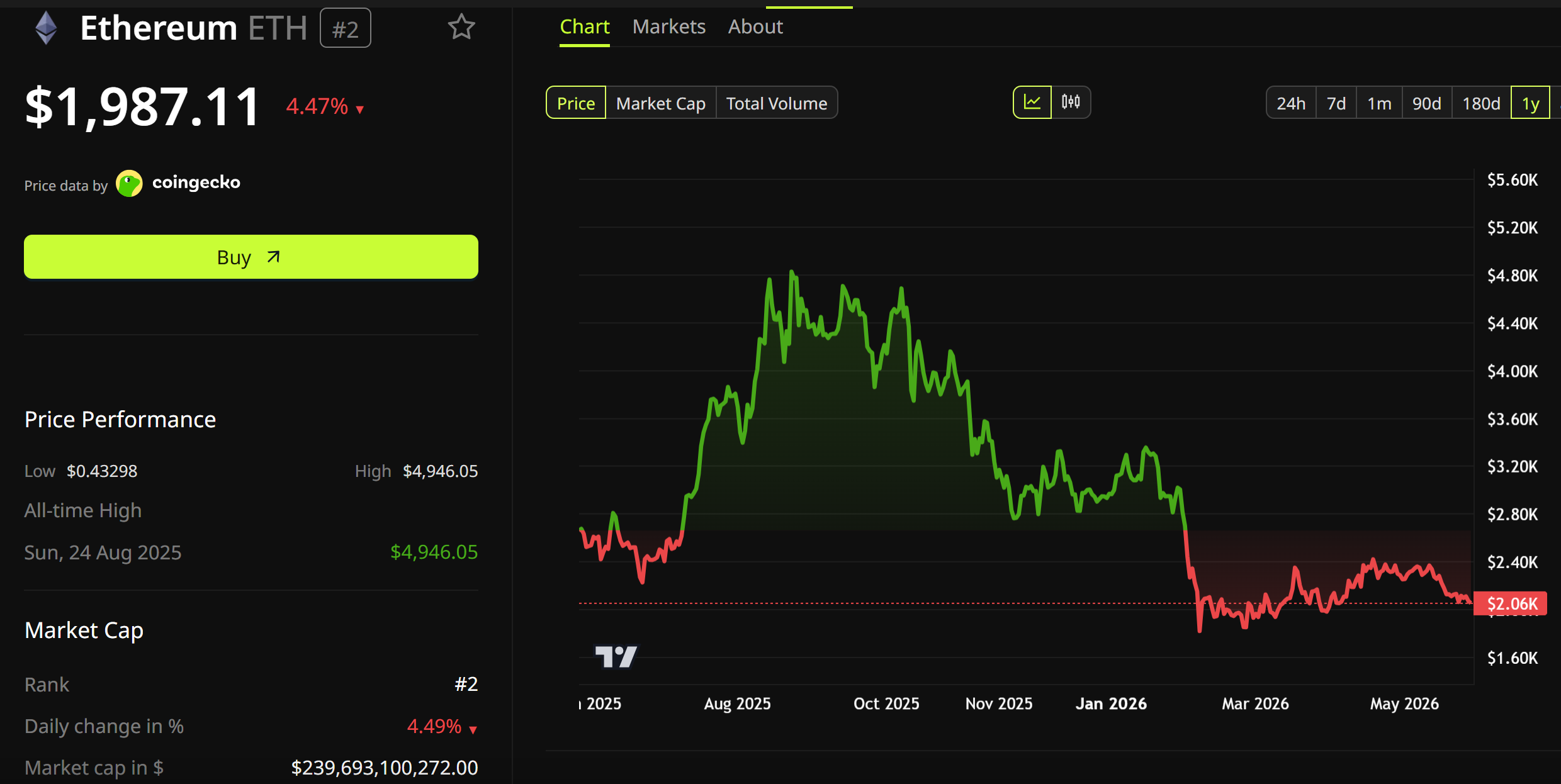
Standard Chartered reaffirmed its $40,000 Ethereum (ETH) target for end-2030, with the bank holding the call even as ETH slipped below $2,000 for the first time since late March.
Global Head of Digital Assets Research Geoff Kendrick compared Ethereum’s slump to Amazon during the 2001 dot-com bust. He argued the network’s internal metrics keep improving while its token price decouples.
Bezos Analogy and Long-Term Forecast
Kendrick reaffirmed targets of $4,000 for ETH by end-2026 and $40,000 by end-2030. He laid out the call in a research note circulated to clients.
Transaction counts and total value locked (TVL) sit near all-time highs in ETH terms, per the note. That contrasts with ETH below $2,000 today and a 57% drop from the August 2025 record of $4,946.

“I view ETH’s performance very much as Jeff Bezos described AMZN share price during the 2001 tech bubble burst,” Kendrick wrote.
The Standard Chartered executive framed the divergence with a 2018 Jeff Bezos speech about the 2001 Amazon stock crash.
The stock is not the company. And the company is not the stock. And so, as I watched the stock fall from $113 to $6, I was also watching all of our internal business metrics… every single thing about the business was getting better,” Bezos had said.
Follow us on X to get the latest news as it happens
He noted Amazon shares have multiplied roughly 1,000 times since 2001 once adjusted for splits.
Geoff Kendrick also projects stablecoin market capitalization will rise sixfold by end-2028.
Tokenized real-world assets could multiply fiftyfold over the same period, with Ethereum hosting 50% to 65% of both segments.
Retail Buys, Institutions Sell, Shorts Pile In
Even as the Ethereum price falls below $2,000, the ETH/BTC ratio dropped to a five-year low around 0.027.
Santiment data flagged a wave of retail “buy the dip” orders once the $2,000 level broke. Institutional flows moved the other way.
“Retail has erupted with “buy the dip” calls toward ETH as a result of this drop below a key psychological support level. This typically means the price may have a bit further to fall, due to the crowd (which usually gets calls wrong) being too optimistic,” Santiment analysts predicted.

The Polymarket prediction market now prices a 54% probability of ETH closing below $1,500 this year. That bet is backed by $6.4 million in trade volume.
Positioning, however, looks crowded on the short side. Rising open interest and positive funding rates create roughly $2 billion of short squeeze exposure.
That risk would mount if ETH reclaims the $2,000 level.
Whether Kendrick’s Amazon analogy holds may hinge on Ethereum’s ability to convert network usage into token-level value capture.
Longtime bulls like Bankless co-founder David Hoffman now argue value is accruing to apps and Layer 2s, not ETH itself.
The post Standard Chartered Says Ethereum Could 20X After ETH’s Brutal Crash Below $2,000 appeared first on BeInCrypto.
HYPE set a new record high, but this attracted sellers, pushing it into a pullback.
Hyperliquid (HYPE) Price Predictions: Analysis
Key support levels: $52
Key resistance levels: $63
Pullback Ongoing as Sellers Return
As soon as HYPE set a new record price just under $65, sellers returned, sending it into a pullback. At the time of this post, the price is around $57 and is likely to fall even lower, with key support at $52.
Even so, this cryptocurrency remains one of the best-performing assets of 2026, with its price doing a quick 3x since January. For that reason, a pullback here is normal and was expected. The question is if $52 will hold or not to maintain the uptrend intact.

Short Term Bearish, Long Term Bullish?
While the price may enter a correction in the short- to medium-term, the outlook on higher timeframes remains quite bullish. HYPE’s fundamentals are some of the strongest in crypto, and the recent HYPE ETFs bring additional buy volume which was not present in the past.
This is why a correction here could prove quite shallow, especially if the support at $52 holds. In that case, the uptrend remains very much intact and would open the way for the price to make new records later.

RSI Entered Danger Zone
One of the key signals that HYPE was getting overheated and overextended could be seen on the 3-day RSI where this indicator reached over 77 points, a level not seen since May 2025.
Whenever the RSI enters the overbought area (above 70 points) it’s always prudent to be careful since the price may show emotional buying which no longer offers an edge and could be a top. So far, this pullback seems to confirm that.

The post Why is the Hyperliquid (HYPE) Price Down Today? appeared first on CryptoPotato.

In the latest monthly list of new buys by the best mutual funds, top money managers did not put their chips on DraftKings (DKNG) or FanDuel parent Flutter (FLUT). But these savvy investors did scoop up shares of online betting platform Super Group (SGHC). The sports betting and online casino operator earns a spot in the IBD Live ready list…
Copyright ©2026 Investor’s Business Daily, LLC. All rights reserved. 87990cbe856818d5eddac44c7b1cdeb8

3 Altcoins That Can Hit All-Time High in June 2026

Jennifer Lawrence’s Colorful Summer Flats Style Is on Amazon

Five more arrested in connection with Eston ‘murder’


-

 Crypto World7 days ago
Blockchain.com files with SEC for U.S. IPO
-

 Fashion6 days ago
Holiday Weekend Open Thread – Corporette.com
-

 Politics3 days ago
Bridgerton Season 5: Cast, Release Date And Everything We Know So Far
-

 Crypto World6 days ago
Bitcoin Accumulation Weakens as BTC Realized Losses Hit $600M
-

 Tech3 days ago
Microsoft’s quiet Claude Code retreat and the real cost of enterprise AI
-

 Crypto World5 days ago
Robinhood crypto COO Tanya Denisova exits
-

 Business6 days ago
Dell Technologies DELL Stock Surges 15% on AI Server Momentum and Analyst Upgrades in 2026
-

 Business4 days ago
NYT Strands Answers May 24 2026 Revealed for Puzzle No. 812 Theme Summer Essentials
-

 Business6 days ago
Trump Invests $1M-$5M in Kura Sushi USA Chain With 27 California Locations
-

 Politics6 days ago
Makerfield: a tale of two social-media histories
-

 Crypto World6 days ago
Space X IPO Is ‘Bad News’ for Tech Stocks: But What About Bitcoin?
-

 Business2 days ago
Selena Gomez Reportedly Upset Over Benny Blanco’s Comments on Her ‘Terrible’ Diet
-

 Business3 days ago
BTS Sells Out Four Las Vegas Shows at Allegiant Stadium for ARIRANG World Tour
-

 Crypto World6 days ago
MicroStrategy’s Saylor Says Miners No Longer Set Bitcoin Price, Another Force Has Taken Over
-

 Tech7 days ago
WhatsApp ads could make Irish debut after discussions with DPC
-
Tech1 day ago
The Samsung pay deal is the moment Korean unions changed register
-
 Tech6 days ago
A 0.12% parameter add-on gives AI agents the working memory RAG can’t
-

 Crypto World6 days ago
AI infrastructure race heats up as IREN pitches full-stack strategy, WhiteFiber lands $160M deal
-

 Tech3 days ago
Westone Audio and Etymotic Acquired by Fidelity Collective in Major IEM Market Move
-
 Crypto World3 days ago
Nvidia (NVDA) CEO Calls on Super Micro to Strengthen Export Controls Amid Smuggling Probe
You must be logged in to post a comment Login