

Crypto World
Bitcoin ETFs Turn Negative as IBIT Posts Near-Record Losses

BlackRock’s spot Bitcoin exchange-traded fund (ETF) posted its second-largest daily outflow on record as US Bitcoin funds extended an eight-day redemption streak during a sharp pullback in the cryptocurrency to below $75,000.
BlackRock’s iShares Bitcoin Trust (IBIT) saw $527.8 million in net outflows on Wednesday, helping push total withdrawals from US spot Bitcoin ETFs to $733.4 million for the day, according to data from Farside Investors.
The outflows marked IBIT’s second-largest daily loss since launch, slightly below the fund’s record $528.3 million outflow on Jan. 30, 2026.
The latest pullback extended a streak of eight consecutive trading days of net outflows across US-listed spot Bitcoin ETFs, with cumulative withdrawals reaching roughly $2.6 billion over the period.
The sustained withdrawals come as several market indicators point to weakening Bitcoin demand, with analysts at CryptoQuant reiterating that $70,000 could emerge as the next major BTC price support level if selling pressure continues.
Bitcoin ETFs flip back to negative territory
The latest wave of withdrawals has pushed US spot Bitcoin ETFs back into negative territory for the year, reversing strong inflows seen earlier in 2026.
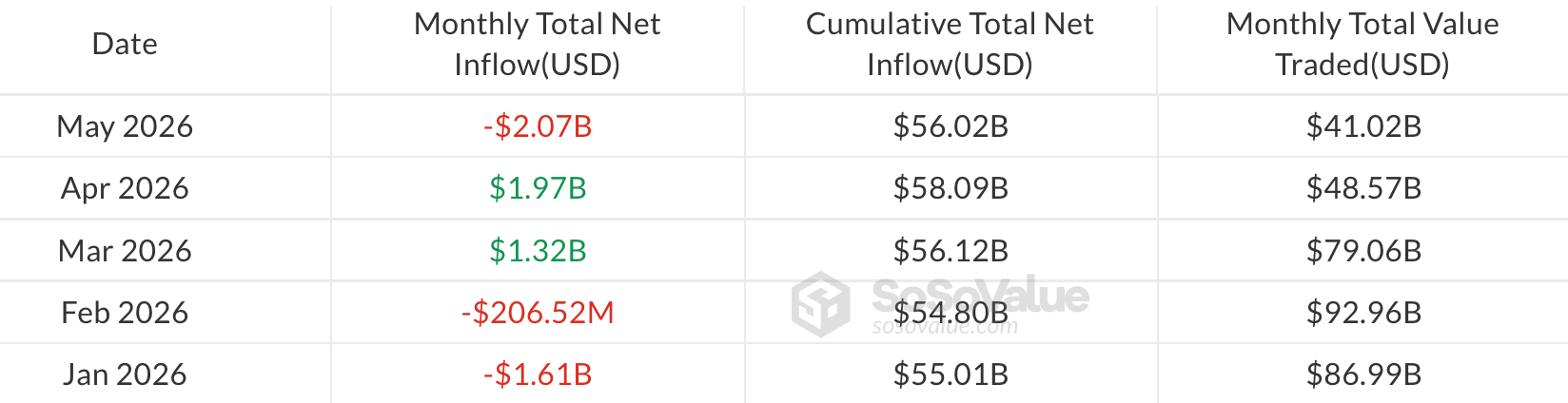
US spot Bitcoin ETFs now show about $596 million in net outflows year to date according to SoSoValue data, with May alone accounting for roughly $2.1 billion in withdrawals, the largest monthly outflows so far this year.
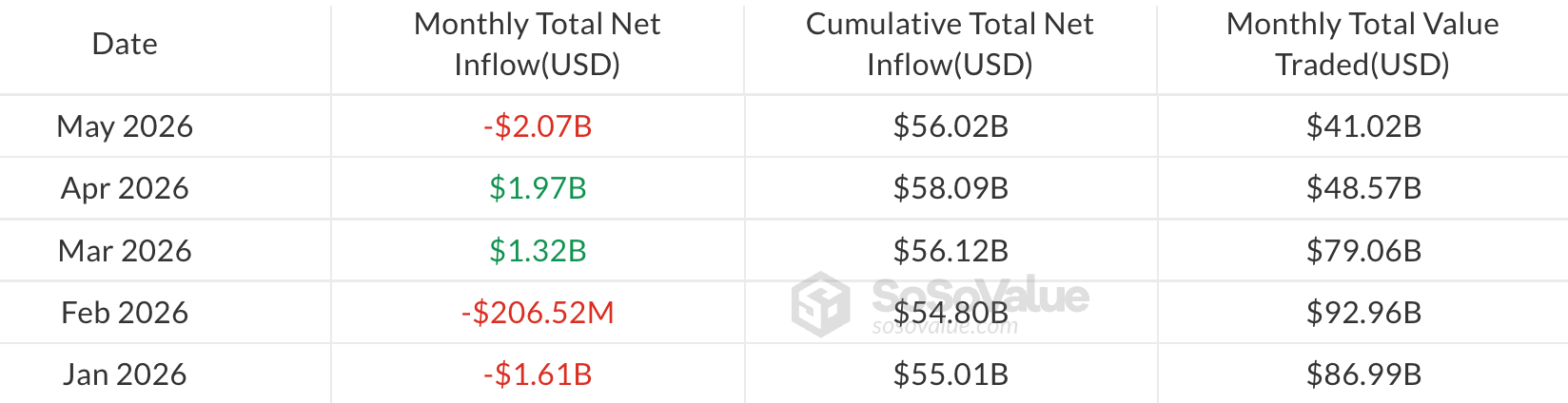
Monthly flows of US-listed spot Bitcoin ETFs. Source: SoSoValue
Although BlackRock’s IBIT saw near-record outflows on Wednesday, total daily withdrawals across US spot Bitcoin ETFs were still well below the worst day on record.
Related: Bitcoin price shrugs off $1.3B BlackRock ETF block sale
According to Farside data, the sharpest sell-off was recorded on Nov. 13, 2025, when the funds recorded about $866.7 million in outflows, with losses spread across nearly all issuers.
Analysts warn of institutional demand shift amid Strategy cash concerns
Outflows from US spot Bitcoin ETFs come as analysts warn of a potential shift in institutional Bitcoin demand, with some pointing to weakening support from key corporate buyers.
Much of that support is linked to Strategy, the largest publicly listed Bitcoin holder, according to crypto market intelligence platform 10x Research.
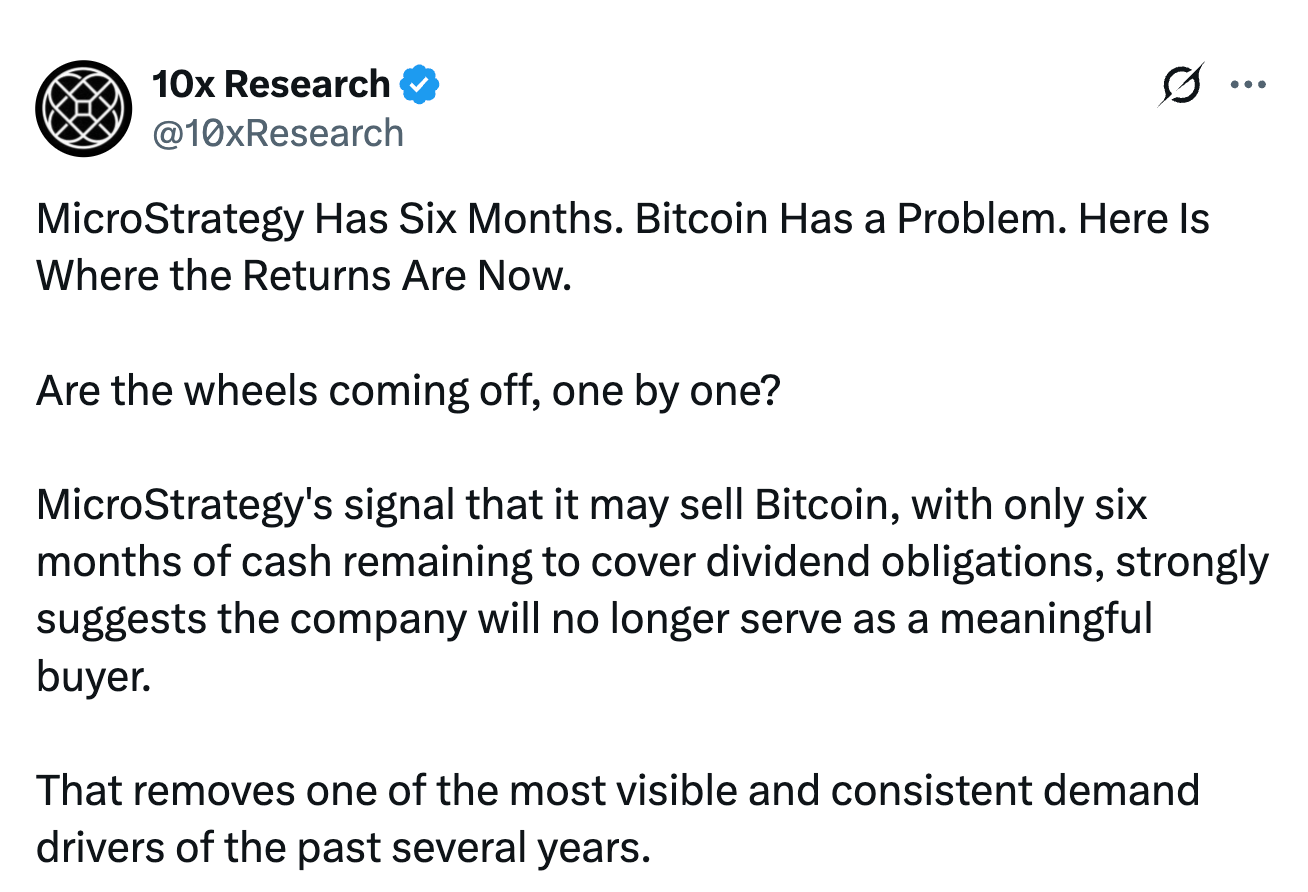
Source: 10XResearch
In an X post on Tuesday, 10x Research analysts said Strategy could face pressure within months if it needs to fund dividend obligations, raising the possibility it may no longer act as a steady source of Bitcoin demand.
Related: Strategy buys back $1.5B of debt at discount, cuts outstanding notes to $6.7B
Strategy co-founder Michael Saylor raised the possibility of selling Bitcoin in mid-May, saying that sticking too rigidly to a “never sell” approach could ultimately work against the very asset the company is built to accumulate and hold.
Magazine: Big Questions: Do we really only need 2–5 cryptocurrencies?

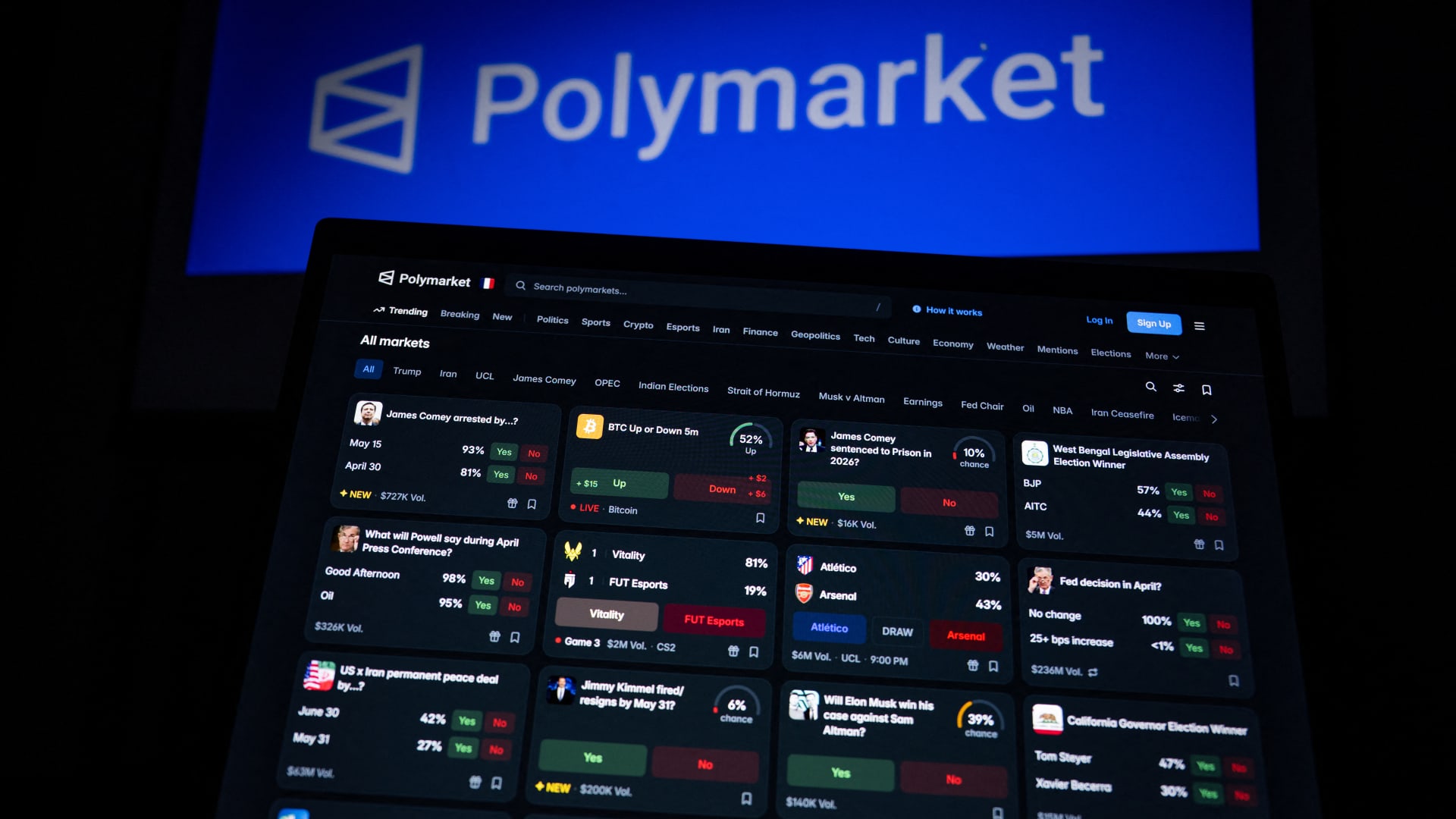
Screens displaying the logo and home page of US cryptocurrency based prediction market platform Polymarket, in Saint-Mande, east of Paris, on April 29, 2026.
Martin Lelievre | Afp | Getty Images
The Commodity Futures Trading Commission announced it was suing Rhode Island on Thursday, one week after the state took action against two prediction market platforms.
It marks the seventh state the CFTC has sued in a dispute over who has the right to regulate prediction markets.
Rhode Island’s attorney general Peter Neronha sued Kalshi and Polymarket last week, saying that the companies were violating the state’s sports-betting laws through their sports-related event contracts, an argument other states have also made. However, the CFTC asserts that the right to regulate these markets falls under the federal agency’s jurisdiction over swaps and derivatives, which it says includes event contracts.
“CFTC-registered exchanges have faced an onslaught of lawsuits seeking to limit Americans’ access to event contracts and undermine the CFTC’s sole regulatory jurisdiction over prediction markets,” said CFTC Chairman Michael Selig in a press release announcing the lawsuit. “This power grab ignores the law and decades of precedent.”
The CFTC is seeking both to intervene in the state’s existing lawsuit against platforms and filed its own complaint against Rhode Island.
In all, 18 states are currently engaged in litigation over prediction markets. One of those states, Minnesota, has moved to outright ban them.
In a social media post on Tuesday, President Donald Trump said it was critical that the commission’s exclusive jurisdiction over prediction market regulation is maintained.
While authorities in the states involved in legal proceedings over prediction markets are on both sides of the aisle, the CFTC has only gone after ones with Democratic attorneys general. Neronha, the Rhode Island attorney general, is also a Democrat.
The Rhode Island Attorney General’s office could not be immediately reached for comment.
Disclosure: CNBC and Kalshi have a commercial relationship that includes customer acquisition and a minority investment.


The Sui blockchain is currently down, with transactions “paused” for almost three hours, at the time of writing. The outage is the network’s third in 18 months.
Sui’s status page shows an ongoing “mainnet settlement” incident the cause of which, despite the issue having been identified, the team hasn’t disclosed.
However, activity in Sui-developer Mysten Labs’ GitHub repository appears to show developers working on an emergency fix.
According to Sui block explorer Suiscan, transactions have been stalled since 13:48 UTC.
Read more: ‘Solana killer’ Sui does Solana things — goes offline for 2 hours
Sui Network, the spiritual successor to Meta’s planned cryptocurrency, Diem, was launched in 2023, just a year after the latter was abandoned.
Since then, Sui has faced a two-hour outage in 2024 as well as six hours of disruption in January this year. Additionally, the network’s main exchange, Cetus, was hacked for over $200 million last year, wiping $1 billion off SUI’s market cap.
The network bills itself as “high-performance” and is often compared to Solana as a fast, high-throughput alternative to Ethereum. Indeed, Solana was at one point well-known for its intermittent outages.
Other blockchains, so-called “layer twos” which focus on scaling the Ethereum ecosystem, have also stuttered recently.
Last year, Coinbase’s popular Base network went offline for 44 minutes, and Starknet turned itself off and on again twice in one day.
Got a tip? Send us an email securely via Protos Leaks. For more informed news and investigations, follow us on X, Bluesky, and Google News, or subscribe to our YouTube channel.
The post SUI: Stops Unexpectedly and Intermittently appeared first on Protos.

Key Highlights
- Arm shares climbed 13% during Wednesday’s session, reaching an intraday peak of $345.60
- Mizuho Securities upgraded its price forecast from $290 to $360 while keeping its Outperform designation
- The revised target suggests approximately 19% potential appreciation from Arm’s prior close of $302.71
- Achieving $360 would establish a fresh record high for the semiconductor designer
- The upgrade reflects expectations for sustained DRAM demand extending to 2027 and expansion in the high bandwidth memory sector
Arm Holdings (ARM) experienced a significant 13% rally on Wednesday following Mizuho Securities’ decision to elevate its price objective to $360 from the previous $290, accompanied by a reaffirmed Outperform rating. The stock touched $345.60 during intraday trading and has posted gains exceeding 210% since early 2026.
Arm Holdings plc American Depositary Shares, ARM
Mizuho’s updated $360 price objective indicates potential upside of approximately 19% compared to Arm’s latest settlement price of $302.71. Should the stock reach this level, it would set a new peak in the company’s trading history.
The analyst firm’s bullish revision stems from two fundamental convictions. Mizuho anticipates that DRAM demand will maintain momentum through 2027. Additionally, the firm projects continued expansion in the addressable market for high bandwidth memory—both trends expected to benefit Arm’s semiconductor operations.
The evolving AI narrative provides additional support. Arm has increasingly emphasized emerging opportunities within agentic AI, a theme that market participants are viewing as a significant long-term catalyst.
The semiconductor designer’s gross margin currently registers at 94.08%, while its market capitalization has expanded to approximately $322 billion following Wednesday’s advance.
Potential Headwinds Under Scrutiny
Despite the enthusiasm, the rally comes with certain considerations. Arm has recently identified new operational risks associated with demand forecasting as it transitions into production silicon.
The organization cautioned that closer collaboration with chip foundries may present complications related to supply chain management, manufacturing yields, and inventory optimization. These challenges represent legitimate concerns for an enterprise scaling its hardware manufacturing footprint.
Nevertheless, Mizuho’s choice to increase rather than moderate its outlook indicates the firm believes the company’s growth trajectory overshadows these operational considerations in the near term.
Current Market Position
ARM’s 52-week trading band extends from $100.02 to $349.11. Wednesday’s intraday peak of $345.60 positions the stock near the upper boundary of this range.
Typical daily trading volume hovers around 9.2 million shares. On Wednesday, activity measured 403,900 shares—substantially below the average—indicating this price movement reflects a sentiment adjustment rather than aggressive institutional accumulation.
The stock’s performance since the beginning of the year now exceeds 176%, representing one of the semiconductor sector’s standout performers in 2026.
Mizuho’s revised $360 price forecast represents the most current analyst assessment available as of Wednesday’s close.


Key Highlights
- Major indices approached all-time highs fueled by robust corporate results and artificial intelligence enthusiasm
- Snowflake (SNOW) skyrocketed more than 35% following stellar quarterly results and a massive $6 billion Amazon Web Services partnership
- Unusual Machines soared up to 67% amid speculation about Pentagon funding for domestic drone production
- Crude oil prices experienced dramatic volatility, with Brent briefly hitting $93 before retreating on diplomatic developments between Washington and Tehran
- Semiconductor leaders like Marvell and AMD remained in focus as the AI infrastructure buildout continued
Equity markets extended their advance Thursday as impressive quarterly earnings and renewed artificial intelligence optimism bolstered investor sentiment. The S&P 500 and Nasdaq Composite both flirted with record territory throughout trading.
Oil emerged as the session’s most volatile asset. Brent crude temporarily spiked to $93 per barrel following escalating geopolitical tensions in the Middle East involving Iran. However, prices reversed course after media reports indicated potential diplomatic progress between the United States and Iran.
Energy markets remain under close scrutiny by market participants. A sustained climb in petroleum prices could reignite inflationary pressures and potentially alter the Federal Reserve’s monetary policy trajectory.
Snowflake (SNOW) Rockets 35% Following Stellar Earnings and Major AWS Partnership
Thursday’s standout performer was undoubtedly Snowflake. The cloud-based data platform provider exploded higher by more than 35% after delivering quarterly earnings that substantially exceeded analyst projections and upgrading its full-year revenue guidance.
Snowflake simultaneously unveiled a five-year AI infrastructure collaboration with Amazon Web Services valued at approximately $6 billion.
The impressive performance eased investor anxieties that artificial intelligence advancements might undermine established software enterprises. Company executives emphasized that customer appetite for AI-powered solutions is intensifying rather than diminishing.
The positive momentum rippled through the broader software sector. Oracle, MongoDB, and ServiceNow all registered gains in Snowflake’s wake.
Numerous software companies had faced headwinds throughout 2026 amid concerns that generative AI applications could cannibalize traditional revenue streams. Snowflake’s quarterly performance suggested the contrary, demonstrating that AI is functioning as a growth catalyst rather than a disruptive threat.
Defense Drone Stocks Skyrocket on Government Funding Speculation
Military and drone-related stocks posted explosive gains Thursday. Market chatter intensified around potential increased federal funding earmarked for American-based drone manufacturers.
Unusual Machines surged as much as 67% intraday. The dramatic price movement followed reports suggesting the company could be positioned to benefit from anticipated Pentagon procurement initiatives.
The buying frenzy extended throughout the defense technology space. AeroVironment and Kratos Defense & Security Solutions also attracted strong investor demand as traders positioned for companies likely to capture expanded military and intelligence surveillance budgets.
Heightened Middle Eastern geopolitical instability has amplified investor attention toward defense technology equities. Market observers note the unmanned aerial vehicle sector has emerged as one of the equity market’s most dynamic investment themes as nations worldwide expand defense appropriations.
Semiconductor Stocks Maintain Strength Amid Persistent AI Demand
Semiconductor equities remained prominently featured throughout the trading session. Marvell Technology advanced after posting quarterly results that exceeded Street estimates.
Advanced Micro Devices climbed as capital continued flowing into AI infrastructure-focused investments.
Thursday’s trading action underscored a marketplace still predominantly oriented toward artificial intelligence expansion and earnings strength. Crude oil volatility and Middle Eastern geopolitical developments represent ongoing risks commanding investor attention.
For the present, solid corporate profitability continues underpinning the market’s upward trajectory.


Sequans Communications, the French semiconductor company that pivoted to bitcoin (BTC) treasury operations 11 months ago to escape a New York Stock Exchange delisting warning, is winding down its experiment.
The chipmaker confirmed today that it fully redeemed its convertible debt by selling BTC.
It also plans to quietly “monetize” its remaining 658 BTC. At its peak, the company held 3,234 BTC.
Sequans once vowed to accumulate over 3,000 BTC as a “long-term reserve.” Long-term apparently meant less than a year.
Sequans’ SQNS common stock opened for trading today down 77% over the past year and 97% over the past five years.
Its brief existence as a BTC treasury company, coinciding with heavy promotions by Swan Bitcoin and its CEO Cory Klippsten, began on June 23, 2025. That was 18 days after NYSE warned Sequans that its market capitalization and shareholders’ equity had both fallen below the exchange’s $50 million minimum.
“Sequans is poised to lead among bitcoin treasury companies,” Klippsten said with SQNS trading at $23.40 per share. Those same shares opened for trading today at $3.98.
Bitcoin strategy died on the launch pad
The original sales pitch was familiar to victims of digital asset treasury stocks that have almost all declined in value after the bubble popped in early summer 2025.
Using phrases that have aged like milk, Sequans CEO Georges Karam said the company had “strong conviction in BTC as a premier asset and a compelling long-term investment.”
Sequans named Swan Bitcoin as its implementation partner and Coinbase Prime as its custodian. In addition, Northland Capital Markets and B. Riley Securities served as joint lead placement agents on a $384 million private placement.
However, of this, only $195 million of that came from equity sold at $1.40 per American depositary share.
The remaining $189 million was secured convertible debentures collateralized by the BTC itself. From day one, Sequans was a treasury company whose reserve was effectively pledged to its lenders.
By October 3, Sequans held 3,234 BTC at an average cost basis of $116,643 per coin. For context, BTC this morning was worth less than $73,000.
Barely a month later, Sequans would become a leader among publicly traded BTC treasuries for the wrong reason — liquidating 970 BTC to pay off some of its debts.
That sale violated the core dogma of the BTC treasury playbook. Strategy founder Michael Saylor, the leader of the sector, had famously told investors to “sell a kidney if you must, but keep the bitcoin.” Sequans sold the BTC.
Read more: Why billions in Bitcoin treasury purchases can’t pump the price
‘Treasury Strategy Concluded’
Five months later, Sequans scrapped the strategy entirely. Today’s press release states simply, “Treasury Strategy Concluded.”
CEO Karam, who once described BTC as a premier asset, now says the debt redemption “marks an important turning point” and that Sequans is “fully focused on scaling our IoT semiconductor business.”
Gone is the praise of BTC’s unique properties and the commitment to long-term shareholder value through treasury management. There is only a plan to sell.
The Q1 2026 earnings release telegraphed the exit three weeks earlier.
Buried in the risk-factor section was an explicit reference to the company’s planned exit from its BTC treasury strategy. The same release booked a $50.5 million operating loss for the quarter.
Revenue fell to $6.1 million.
For all of 2025, Sequans reported a net loss of $109.3 million, including a $67.4 million unrealized impairment on BTC, per its annual report. Its accumulated deficit had reached a staggering $145.1 million.
In summary, Sequans lost tens of millions of dollars by buying BTC high and selling it low.
Its treasury strategy was meant to enhance financial resilience and create long-term shareholder value, but it did neither. SQNS now trades 80% lower than its high on the day it launched its BTC treasury, and 92% below its 52-week high.
Got a tip? Send us an email securely via Protos Leaks. For more informed news and investigations, follow us on X, Bluesky, and Google News, or subscribe to our YouTube channel.
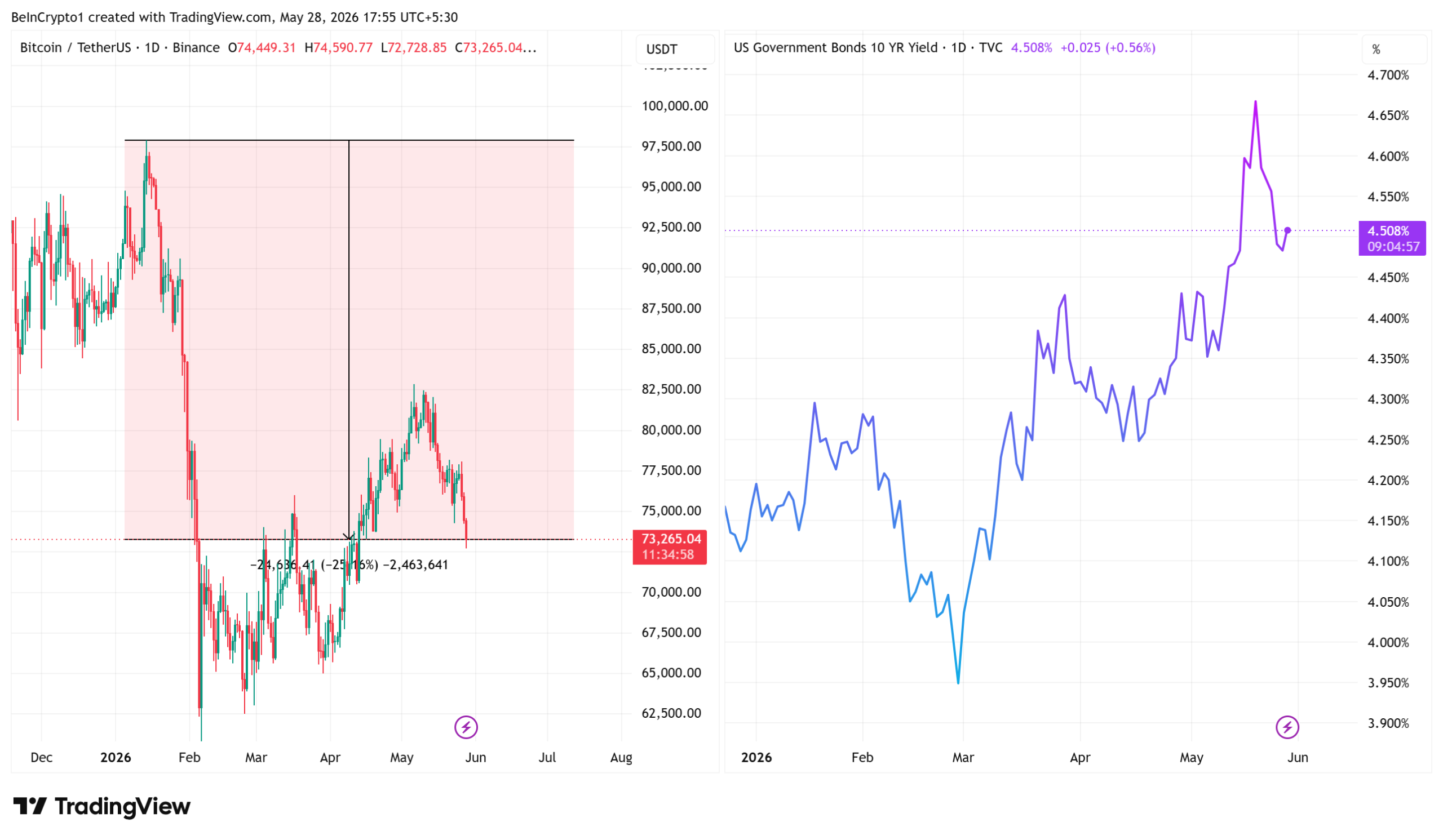
Bitcoin miners outperformed BTC by a wide margin in 2026, with a tracked basket of crypto equities up 56% year-to-date while the pioneer crypto fell 17%, according to 10x Research.
Last week, five mining and AI-infrastructure stocks led the gains as Bitcoin slid on rising Treasury yields and hawkish Federal Reserve expectations.

The catalysts ran from hyperscaler GPU deals to mega campus acquisitions, all signaling that the miner-to-AI-infrastructure pivot is accelerating.
Follow us on X to get the latest news as it happens
1. KEEL Infrastructure (KEEL), +30%
KEEL, formerly Bitfarms, posted the strongest weekly gain after Chardan initiated coverage with a Buy rating.
The company is repositioning its 2.2-gigawatt power pipeline across Pennsylvania, Washington, and Quebec toward AI and high-performance computing workloads, joining a broader Bitcoin miner AI pivot that has reshaped sector valuations through 2026.
2. Cipher Mining (CIFR), +29%
Cipher rode the same wave on the back of fresh institutional backing and continued progress on its hyperscale leasing pipeline.
Analysts pointed to the company’s Texas power footprint and balance-sheet capacity as the key drivers behind investor appetite for more AI data center capacity announcements.
3. IREN (IREN), +29%
IREN signed a $1.6 billion purchase agreement with Dell on May 26 for Blackwell GPU systems that will service its five-year, $3.4 billion managed AI cloud contract.
Commissioning is targeted for early 2027 at the company’s Childress, Texas campus, and is expected to lift IREN’s annualized run-rate revenue from $3.7 billion to $4.4 billion.
4. TeraWulf (WULF), +24%
TeraWulf added a 285-acre Muskie Data Campus in Eastern Kentucky on May 26 that the company expects to support up to 1 gigawatt of capacity, with initial 500 MW delivery slated for late 2028.
The acquisition extends TeraWulf’s AI and HPC expansion beyond its existing Lake Mariner and Abernathy sites.
5. Hut 8 (HUT), +22%
Hut 8 signed a 15-year, $9.8 billion lease for its Beacon Point campus in Nueces County, Texas.
The 352-megawatt facility was designed to NVIDIA’s DSX reference architecture and lifts the company’s contracted AI capacity to about 597 megawatts, building on Hut 8’s expansion plans across Louisiana, Texas, and Illinois.
“Hut 8’s $9.8 billion Texas lease all signaled that the Bitcoin miner-to-AI-infrastructure pivot is accelerating rapidly,” read an excerpt in the 10X Research note.
Why Bitcoin Lagged the Miners
Bitcoin traded around $73,367 on Thursday, down nearly 5% on the week, BeInCrypto data showed.

BlackRock’s IBIT extended a multi-day net outflow streak, mirroring the BlackRock AI infrastructure deal thesis that capital is rotating from passive BTC exposure toward miners with hyperscaler contracts.
The 10-year Treasury yield eased to 4.47% to 4.50% ahead of the PCE inflation print, and the next FOMC meeting on June 16-17 will likely shape whether the mining stocks rally case holds into the summer.
The post 5 Bitcoin Miner Stocks Crushing BTC as AI Infrastructure Spending Explodes appeared first on BeInCrypto.

Key Highlights
- Seven Grand Managers LLC acquired 3 million shares of ACHR valued at approximately $22.56 million during Q4
- Shares opened Thursday at $6.53, representing a gain of roughly 6.56%
- Q1 results showed an EPS loss of -$0.28 against a consensus estimate of -$0.25; revenue totaled $1.60M compared to expectations of $1.66M
- Advancements in FAA certification and participation in UAE’s air taxi program are improving market sentiment
- Wall Street analysts maintain a “Moderate Buy” consensus with an average target price of $11.83
Shares of Archer Aviation (ACHR) soared 6.56% during Thursday’s trading session, beginning the day at $6.53, following the revelation that Seven Grand Managers LLC established a significant new position in the electric vertical takeoff and landing (eVTOL) manufacturer valued at around $22.56 million.
The investment comprises approximately 0.46% of Archer’s total shares and ranks as the 17th largest position within Seven Grand Managers’ portfolio. This holding represents about 1.7% of the fund’s complete investment allocation.
This institutional commitment arrives on the heels of a challenging Q1 financial report released on May 11. The company recorded an earnings per share loss of $0.28, exceeding the anticipated loss of $0.25. Top-line results reached $1.60 million, falling marginally short of the $1.66 million analyst forecast.
The quarterly loss deepened compared to the prior year period, when Archer reported an EPS of -$0.17. Wall Street projections indicate a full-year EPS loss of -$1.51 for the ongoing fiscal year.
Nevertheless, market participants seem to be prioritizing regulatory developments over near-term financial performance.
Regulatory Milestones Fueling Optimism
Archer continues to advance through the FAA certification process and has recently been accepted into the UAE’s air taxi regulatory approval framework. These achievements represent tangible progress toward launching commercial flight operations.
Such regulatory victories are providing momentum for bullish investors, despite the company’s ongoing negative cash flows and profitability challenges.
Institutional investors collectively control 59.34% of Archer’s outstanding shares. Additional funds have expanded their positions recently — Bank of Jackson Hole Trust increased its holdings by 45.9% in Q3, while Center for Financial Planning boosted its stake by 138.8% during the identical quarter.
Executive Share Sales Continue
Contrasting with institutional buying activity, company insiders have been divesting shares. Over the previous 90 days, insiders have sold 502,739 shares totaling approximately $3.12 million.
Chief Accounting Officer Harsh Rungta disposed of 22,826 shares at $6.46 per share on March 5, decreasing his holdings by 25.86%. Eric Lentell, another company insider, sold 48,169 shares at $5.95 each on May 18, similarly reducing his stake by approximately 25%. Both transactions were associated with tax obligations related to vesting equity compensation.
Corporate insiders maintain ownership of 7.65% of the company’s shares.
Regarding analyst coverage, opinions remain varied. Canaccord Genuity reduced its price objective from $13 to $12 on May 12 while preserving a “buy” recommendation. Needham lowered its target from $10 to $9 on March 3, also retaining a “buy” stance. Weiss Ratings has issued a “sell” rating on the shares.
The overall analyst consensus stands at “Moderate Buy” with a mean price target of $11.83 — significantly above current market levels.
ACHR trades within a 52-week range of $4.80 to $14.62. The stock’s 50-day moving average stands at $5.87, while the 200-day moving average sits at $7.05. With a beta of 3.13, the equity exhibits substantial volatility.
Financially, Archer maintains a current ratio of 18.06 and carries a minimal debt-to-equity ratio of 0.06, indicating conservative leverage.
For the year-to-date period, ACHR shares have declined approximately 12.90%, making Thursday’s advance one of the stronger single-session performances in recent trading activity.
The company’s market capitalization currently stands at roughly $4.94 billion.
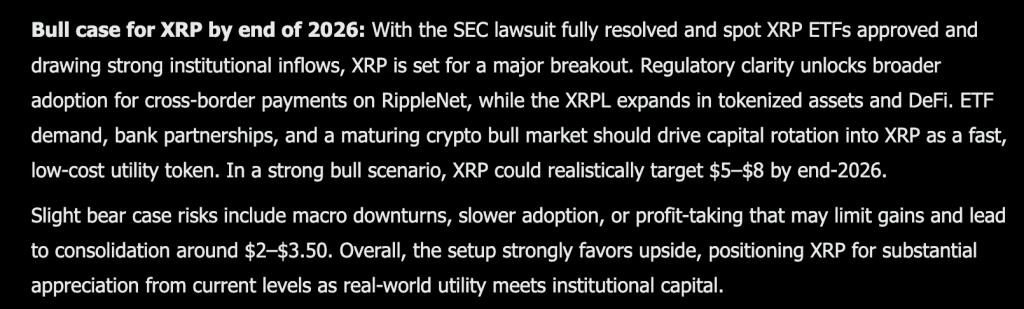
Grok AI predicts $5 to $8 on XRP by end of 2026, and Elon Musk’s AI is building that call on a foundation that looks more credible today than it did 12 months ago when most of these catalysts were still hypothetical.
The SEC lawsuit being fully resolved changes the entire institutional access picture. For years that legal cloud was the single biggest reason serious money stayed away from XRP regardless of the utility argument.
That overhang is gone now, spot XRP ETFs are approved and drawing real inflows, and the door to bank partnerships and RippleNet expansion is wider open than it has ever been.

Grok is connecting those dots into a capital rotation story where XRP becomes the obvious beneficiary as cross-border payment infrastructure matures and the XRPL expands into tokenized assets and DeFi.
In a market that rewards low-cost utility tokens when institutional money starts moving, XRP’s positioning is hard to argue against.
The bear case is lighter than the bull case but not negligible. Macro downturns, slower-than-expected adoption, or profit-taking from holders who have been waiting years for a recovery could cap the move and keep XRP consolidating between $2 and $3.50.
That is still a meaningful gain from current levels, but it would leave the bigger targets sitting on the shelf for another cycle.

XRP Price Just Flushed to $1.26 on the 4-Hour, the Timing Could Not Be More Interesting
XRP is trading at $1.29 on the 4-hour chart and what is happening right now on this timeframe is worth paying attention to.
Price has been in a choppy range between $1.33 and $1.55 for most of the past 2 months, grinding without direction and frustrating holders on both sides.
Then in the last few days something shifted, a sharp 3-candle flush dropped XRP from $1.52 all the way to $1.26, cutting through the range floor and tagging levels not seen since late March.
That kind of flush after a prolonged range is usually one of 2 things: either a genuine breakdown that signals more downside ahead, or a liquidity grab below range support that sets up a sharp reversal.
The speed of the move and the wick structure on the low suggests the latter is more likely, but the follow-through in the next 48 to 72 hours is what confirms it.
The $1.29 to $1.30 zone is where the dotted support line on this chart sits, and price is sitting right on it. Holding here and reclaiming $1.33 quickly would be a bullish read on the flush. Failing to hold and breaking below $1.26 with conviction opens the door toward $1.20, which is the major daily support level that has held since February.
RSI is at 32.88 with the signal line at 38.37, and that is a genuinely oversold reading on the 4-hour. RSI in the low 30s after a flush this sharp is the kind of setup that precedes mean-reversion bounces, and the gap between RSI and its signal line suggests the selling was fast and emotional rather than structural.
For Grok’s end-of-2026 targets to stay relevant, this $1.26 to $1.30 zone needs to hold. A recovery from here back toward $1.50 and then a clean break above $1.60 on the daily is the sequence that puts the larger move back in play.
Discover: The best crypto to diversify your portfolio with
Grok AI Predicts That Bitcoin Hyper Could Outperform XRP Next
Some traders rotating between cycles are already looking past large caps entirely.
Bitcoin Hyper is positioning itself for that rotation. The project is building the first Bitcoin Layer 2 with Solana Virtual Machine integration, claiming sub-Solana latency while keeping Bitcoin’s security layer intact.
Fast, low-cost smart contracts on Bitcoin without abandoning its trust model. That is a gap neither Ethereum nor Solana fills directly.
The presale has raised $32 million at $0.013679 per token with high APY staking available for early participants.
The risk profile is different here. Higher upside potential, earlier entry, and significantly more execution risk than anything trading on major exchanges. That tradeoff is the whole point.
The post Elon Musk Grok AI Predicts XRP Price by The End of 2026 appeared first on Cryptonews.

Solana News: Seoul Southern District Prosecutors’ Office has arrested and indicted five suspects in South Korea’s first-ever criminal case targeting a rug pull executed on a decentralized exchange.
The charges, brought under the Virtual Asset User Protection Act, which took effect in July 2024, cover market manipulation and fraud, with 256 investors losing a combined 900 million won ($600,000) after liquidity was drained from the CATFI token pool.
The case marks the first time South Korean authorities have applied the Act’s unfair-trading provisions to a DEX-based scheme, explicitly framing it as “the first legal prosecution of a crypto crime executed through a DEX.”
LATEST: — CoinMarketCap (@CoinMarketCap) May 27, 2026
 South Korean authorities arrested the the operators of Solana memecoin CatFi in what prosecutors say is the country's first criminal rug-pull case under new legislation. pic.twitter.com/5cqWqXaVmD
Suspects were arrested on May 11, 2026; all five were formally indicted by the Seoul Southern District Prosecutors’ Office on May 27, 2026.
The main suspect, identified by the surname Park, operated online as the influencer “Eth Father”, a fake persona constructed to manufacture organic-looking community interest in CATFI.
Park and four associates launched the meme coin on a Solana-based decentralized exchange, quietly pre-loading wallets with a dominant token position before the public promotion campaign began.
Using circular trading and coordinated wash trades across multiple wallets, the group pumped CATFI’s price 1,001-fold within 26 hours, attracting retail buyers before pulling the liquidity entirely.
The organizers pocketed approximately 400 million won ($260,000) in illegal profits, leaving 256 investors holding worthless positions.

Two suspects were arrested and indicted for market manipulation; one was indicted without detention; two others were charged for helping the main suspect evade authorities – one of whom allegedly spent three months in disguise to avoid arrest.
Discover: The Best Crypto to Diversify Your Portfolio
Solana News: South Korea CATFI Arrest and DeFi Regulation
DEXs have operated in a persistent regulatory blind spot across most jurisdictions, no centralized listing process, no mandatory issuer disclosure, and pseudonymous wallet structures that historically frustrated enforcement.
Before CATFI, South Korea’s Virtual Asset User Protection Act had been applied exclusively to centralized-exchange market abuse cases, including manipulation on Bithumb and the ACE token scheme. The CATFI prosecution is the first time those unfair-trading clauses have been tested against on-chain DEX conduct.

Prosecutors did not charge the group under unregistered exchange or token-listing statutes. Instead, they relied on traditional fraud and market-manipulation provisions within the User Protection Act, arguing that circular trading, fake influencer promotion, and deliberate misrepresentation of insider token control constitute “fraudulent means, plans, or techniques” in digital asset trading.
That legal theory is significant: it means prosecutors do not need a registered entity or a centralized platform to bring charges – conduct on-chain is enough.
Seoul Southern District prosecutors framed the enforcement mandate explicitly, stating the office would “resolutely deal with acts that disrupt the digital asset market and undermine public trust.”
The CATFI case does not exist in isolation. South Korea introduced five-minute reconciliation requirements and automated kill switches for crypto platforms earlier in 2026, alongside a new Digital Asset Act carrying a 100% reserve requirement for stablecoins.
Authorities also signaled in January a reconsideration of the country’s long-standing ban on spot bitcoin ETFs.
Against a backdrop of $110 billion in crypto outflows through 2025, regulators have been systematically closing the gap between DeFi activity and formal oversight, and as broader crypto regulatory frameworks evolve globally, South Korea’s enforcement posture is increasingly setting the pace for DeFi-specific cybercrime prosecution.
Discover: The Best Token Presales
How did They Trace Them?
Investigators built the CATFI case using wallet clustering to map insider token concentration, circular trading pattern analysis to identify wash-trade coordination across linked addresses, and off-ramp KYC intersection, the point at which pseudonymous wallets convert to fiat at a centralized exchange with identity verification requirements.
That off-ramp exposure point is the structural vulnerability in every DEX-based rug pull: operators can obscure their identity on-chain, but converting proceeds to fiat requires passing through a regulated gateway.
Online investigators initially identified the suspect wallets and filed complaints, but authorities temporarily closed the case after the group claimed they had been hacked.
The Financial Services Commission later re-referred the matter, prompting a renewed forensic investigation that brought in both financial and tax authorities to complete the chain of evidence. Additional details on the investigative timeline confirm the FSC’s re-referral was the turning point that unlocked the full forensic reconstruction.
Analysts frames the case as signaling the end of DEXs as an enforcement blind spot, noting that authorities are now mapping on-chain behavior, social promotion, and market manipulation into conventional prosecutorial theories. Pseudonymous branding and multi-wallet setups do not place a case beyond reach when combined with modern blockchain forensics and KYC off-ramp tracing.
DeFi regulation in South Korea has now moved from exchange oversight to on-chain conduct, and Solana meme coin operators who assumed decentralization meant immunity are reading that statement very carefully right now.
The post Solana News: South Korea Sets DeFi Precedent with First DEX Rug Pull Criminal Case appeared first on Cryptonews.
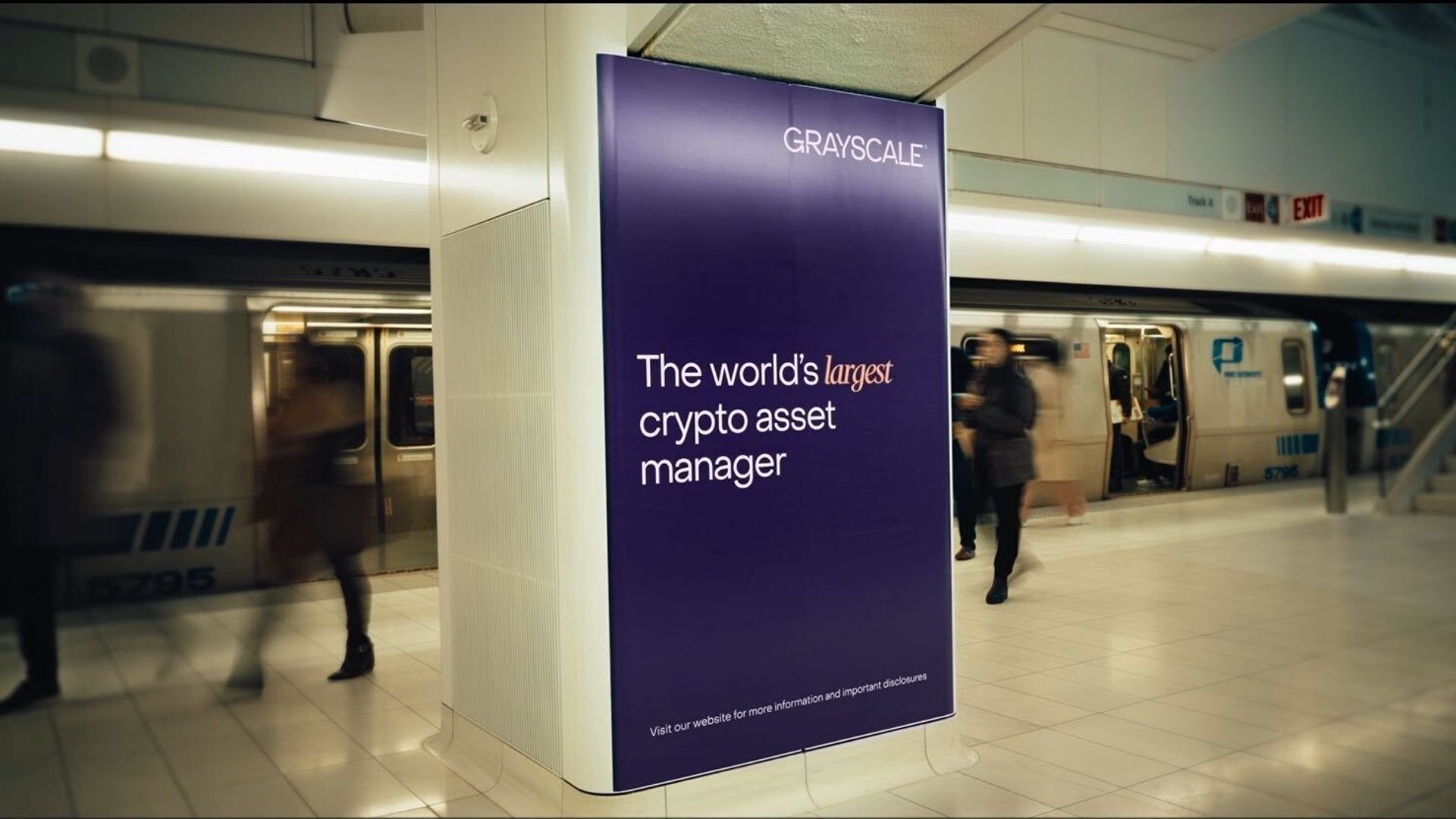
Asset management giant Grayscale is the latest crypto firm to delay its plans to go public due to market conditions, according to a person with knowledge of the matter.
The Stamford-based investment firm has paused its IPO preparations, and is unlikely to restart the process until the fourth quarter at the earliest, the person said, who spoke on condition of anonymity as the matter is private.
DCG subsidiary Grayscale, one of the world’s largest crypto asset managers and the firm behind the Bitcoin Trust ETF (GBTC), filed confidentially for a U.S. IPO in November last year.
“Due to the SEC-mandated quiet period, we are unable to comment at this time,” a Grayscale spokesperson said in emailed comments.
Grayscale is a leading digital asset investment platform that provides investors with secure and regulated exposure to the cryptocurrency market. Through its suite of single-asset, diversified, and thematic investment products, the firm enables institutional and retail investors to access digital assets without the operational complexities of directly buying, storing, or managing crypto. Since its founding in 2013, the firm has played a central role in bridging traditional finance and the evolving digital asset ecosystem.
Crypto firms entered 2026 anticipating a breakout year for IPOs after successful public listings from companies such as Circle (CRCL) and Bullish (BLSH), the parent company of CoinDesk, helped revive investor interest in digital-asset businesses last year. Since then, however, worsening market conditions, softer trading activity and underwhelming post-listing performance from newly public firms, including BitGo (BTGO), have tempered enthusiasm for additional digital asset IPOs.
As a result, several major crypto firms, including Payward, the parent company of Kraken; Ethereum software developer Consensys; and hardware wallet manufacturer Ledger, have delayed their IPO plans as they wait for market conditions to stabilize.
Still, some firms are moving ahead with their listing plans. Blockchain.com said last week that it had confidentially filed for a U.S. IPO with the SEC.
Grayscale’s Ethereum Staking Mini exchange-traded fund (ETF) ranked as the top-performing U.S. ETP for Ethereum in the first quarter of 2026, drawing $337 million in inflows as of March 31, according to Bloomberg data. Despite a broader downturn in crypto markets, the firm has moved to convert or uplist 10 digital asset investment products into exchange-traded products since the fall of 2025.

2026 Charles Schwab Challenge Friday tee times: Round 2

Justice Department investigates Trump accuser E. Jean Carroll

Burlington Stores, Inc. (BURL) Q1 2026 Earnings Call Transcript


-

 Fashion6 days ago
Holiday Weekend Open Thread – Corporette.com
-

 Politics3 days ago
Bridgerton Season 5: Cast, Release Date And Everything We Know So Far
-

 Crypto World7 days ago
Bitcoin Accumulation Weakens as BTC Realized Losses Hit $600M
-

 Crypto World5 days ago
Robinhood crypto COO Tanya Denisova exits
-

 Business7 days ago
Trump Invests $1M-$5M in Kura Sushi USA Chain With 27 California Locations
-

 Tech3 days ago
Microsoft’s quiet Claude Code retreat and the real cost of enterprise AI
-

 Business4 days ago
NYT Strands Answers May 24 2026 Revealed for Puzzle No. 812 Theme Summer Essentials
-

 Business6 days ago
Dell Technologies DELL Stock Surges 15% on AI Server Momentum and Analyst Upgrades in 2026
-

 Business2 days ago
Selena Gomez Reportedly Upset Over Benny Blanco’s Comments on Her ‘Terrible’ Diet
-

 Politics6 days ago
Makerfield: a tale of two social-media histories
-

 Crypto World6 days ago
Space X IPO Is ‘Bad News’ for Tech Stocks: But What About Bitcoin?
-
Crypto World2 days ago
Micron Crosses $1 Trillion Market Cap as AI Demand Reshapes Memory Sector
-

 Business3 days ago
BTS Sells Out Four Las Vegas Shows at Allegiant Stadium for ARIRANG World Tour
-

 Tech7 days ago
WhatsApp ads could make Irish debut after discussions with DPC
-

 Crypto World7 days ago
MicroStrategy’s Saylor Says Miners No Longer Set Bitcoin Price, Another Force Has Taken Over
-
Tech1 day ago
The Samsung pay deal is the moment Korean unions changed register
-
 Tech6 days ago
A 0.12% parameter add-on gives AI agents the working memory RAG can’t
-

 Crypto World6 days ago
AI infrastructure race heats up as IREN pitches full-stack strategy, WhiteFiber lands $160M deal
-

 Tech3 days ago
Westone Audio and Etymotic Acquired by Fidelity Collective in Major IEM Market Move
-
 Crypto World3 days ago
Nvidia (NVDA) CEO Calls on Super Micro to Strengthen Export Controls Amid Smuggling Probe
You must be logged in to post a comment Login