The start of summer on the Shore is never subtle. The beach traffic is already stupid, Brooklyn has made its presence felt, and the usual collection of road warriors remain baffled by New Jersey jughandles, as if the state installed them last Tuesday just to ruin their soft-serve pilgrimage. Add Netflix Studios at Fort Monmouth under construction, half the neighborhood torn up, and the constant soundtrack of trucks, cones, dust, and poor life choices, and the appeal of sitting outside with music, a cold ginger beer or Rooibos in hand, and a portable speaker that does not sound like it came free with a hotel rewards program becomes rather obvious.
That brings us to the $250 KEF Muo, the company’s new portable Bluetooth speaker and follow-up to its earlier attempt at this category. KEF is not exactly early here. Sonos, Marshall, JBL, DALI, and Soundcore have been circling this part of the market for years, and some of them have become very good at making compact speakers that can survive patios, kitchens, hotel rooms, and the occasional bad decision near a pool.
The Muo’s angle is different. KEF is leaning on its hi-fi background, Ross Lovegrove’s sculpted industrial design, and a form inspired by the company’s far more exotic Muon loudspeakers. That could have turned into design-office theater, but the engineering story has more substance than the average “premium portable” pitch.
A large racetrack driver handles much of the output, while a dedicated tweeter is used for the top end, giving the Muo a proper two-way driver arrangement rather than asking one small driver to perform musical gymnastics. The company’s Music Integrity Engine DSP suite is tuned specifically for the Muo, with limiter and Dynamic Bass Boost technologies related to the LS60 Wireless.
KEF Muo Technology: Small Box, Real Engineering, No Free Pass
After four nights in Vegas, nonstop work, travel delays, a 24-hour birthday extravaganza for my 13-year-old daughter, and torrential rain that turned the deck into a splash zone, I was more than ready to stand outside and let a portable speaker make some noise.
Advertisement
The KEF Muo did not need much encouragement.
At $249.99 USD, the Muo lands in a very crowded portable Bluetooth speaker category, but KEF is trying to separate it from the usual rubberized bricks with a more serious engineering story. The enclosure is made from recycled plastics sourced from everyday waste, including old bottles and outdated electronics, which gives the Muo a stronger sustainability angle than much of the competition. That does not automatically make it sound better, but it does make the design feel more considered than another disposable Bluetooth box with a logo slapped on the grille.
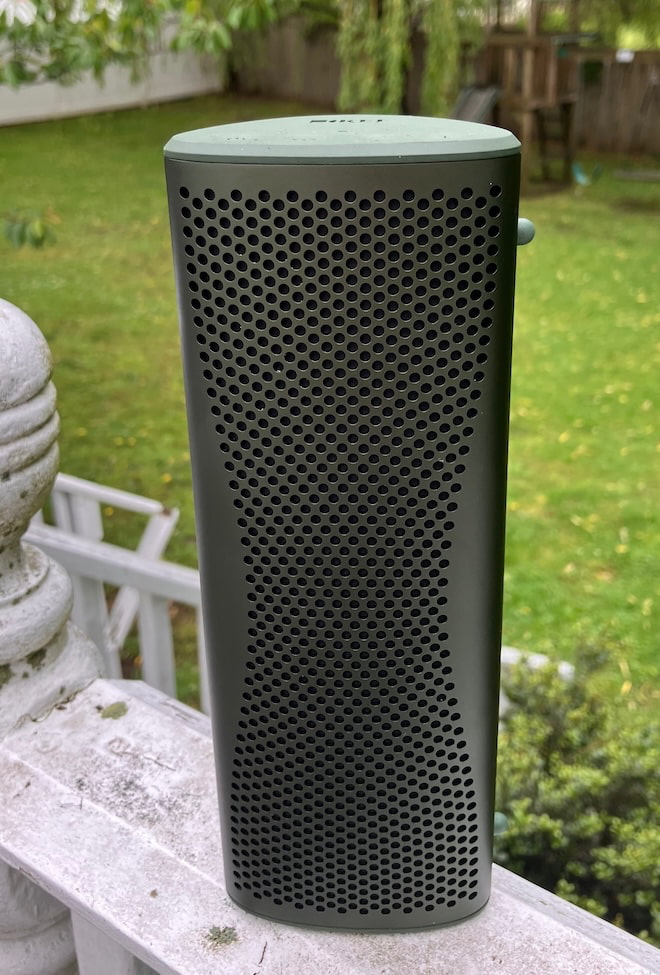
The new Muo measures 216 x 82 x 59 mm, or roughly 8.5 x 3.2 x 2.3 inches, and weighs 740 grams, or 1.6 pounds. That makes it genuinely portable, but not toy-like. It has enough mass to feel planted on a table, deck rail, or kitchen counter without coming across like something that will rattle itself into the neighbor’s hydrangeas.
Inside, KEF uses a proper two-driver layout. A 20mm tweeter handles the high frequencies, while a 58 x 117mm racetrack driver covers the midrange and bass. That larger racetrack driver is doing the heavy lifting, and KEF supports it with its P-Flex surround, a pleated surround technology also used in the company’s KC62 and KC92 subwoofers. The goal is to help the driver resist internal air pressure and move more accurately, which matters when you are asking a compact speaker to produce bass without turning into a wheezing plastic lunchbox.
Advertisement
Power comes from two Class D amplifiers: 10 watts for the tweeter and 30 watts for the mid/low driver. KEF rates the Muo at a maximum 90 dB SPL at one meter, with a claimed frequency response of 43 Hz to 20 kHz at 85 dB/1m. Those numbers are useful, but the important part is how the Muo behaves when pushed outdoors, where small speakers often lose body, composure, or both.
Battery Life and Weather Resistance: KEF’s Numbers Hold Up…Mostly
The KEF Muo is not just built to sit on a desk and look sculptural. KEF claims up to 24 hours of playback on a full charge, with a full recharge taking about two hours. A 15-minute quick charge is rated for roughly three hours of playback, which is actually useful if you forgot to plug it in the night before heading to the beach, the deck, or wherever you plan to annoy the squirrels with The Clash.
Advertisement. Scroll to continue reading.
Those battery claims are not fantasy math. I gave the Muo a full charge and let it play until it shut itself down. At a moderate listening level, it lasted 22 hours and 38 minutes. That is close enough to KEF’s 24-hour claim that nobody should be complaining unless they also write angry letters about cereal boxes not being filled to the top.
Advertisement
KEF also rates the Muo for operation between -20°C and 45°C, which gives it a wider usable temperature range than most people will ever test willingly. Winter on the Jersey Shore was especially brutal this year, and we did drop below that mark for more than a week, which is not exactly normal for this part of the world. Even this Canuck was not sadistic enough to stand outside in that kind of cold to test a Bluetooth speaker. I had the good sense to head down to our Florida home for a week just as the snow and misery arrived.
So the cold-weather test will have to wait. Maybe next year.
Rain was another matter. I did stand outside and let the Muo play while it got wet. No drama. No shutdown. No weird behavior. It just kept playing. I would not take it into the shower, even if those old 1970s shower radios deserve their own museum exhibit, but the Muo feels properly robust for outdoor use, damp weather, and normal summer abuse.
It also survived Tyrion the Westie licking it, which is not part of KEF’s published test procedure, but perhaps should be.
KEF Muo: Smarter Connectivity, with One Caveat
Connectivity is handled by Bluetooth 5.4 with aptX Adaptive, SBC, and AAC codec support. The Muo also supports Google Fast Pair and Microsoft Swift Pair for easier setup, while the KEF Connect app handles settings and firmware updates.
Advertisement
Wired playback and charging both run through the USB-C port, which supports up to 48 kHz/24-bit audio depending on the source. That gives the Muo a little more flexibility than the average portable Bluetooth speaker, especially for listeners who still like having a cable option when the wireless world decides to behave like a committee.
Pairing two Muo speakers creates a true stereo setup with defined left and right channels, which is a meaningful upgrade over the pretend “stereo” some portable speakers try to sell with a straight face. KEF only supplied one review sample, so I was not able to test stereo pairing.
Auracast support also allows multiple Muo units to link together for larger setups, but that requires a compatible Android device. I did not have one on hand during testing, so that feature remains untested for this review. Useful on paper, but I’m not pretending I climbed that particular hill.
On the practical side, the built-in microphone supports calls with noise and echo cancellation, and in actual use, it worked better than expected. I called my mother in Florida for the daily weather report and the obligatory “you’ll never guess who died” update, and the Muo held its own.
It took her a few minutes to notice I was not speaking directly through my iPhone, which is probably the highest praise this kind of feature is going to get. She only asked once if I was driving, so the microphone was clearly doing something right. Voices sounded clear enough, background noise was kept under control, and the call quality was perfectly usable for real conversations rather than just emergency “I’ll call you back” moments.
Advertisement
Ross Lovegrove’s Muo Design Still Has Moves
Ross Lovegrove’s influence is obvious the moment you look at the Muo. KEF has borrowed the sculpted language of its much larger Muon loudspeaker and shrunk it into a portable speaker that will not require a forklift, a trust fund, or a very patient spouse. Just wait till she sees the ATC EL50 Anniversary coming in July. So dead. At least I’ll be saving her the price of a pine box.
Advertisement. Scroll to continue reading.
The build quality leans heavily on aluminum, and KEF offers seven finish options: Silver Dusk, Amber Haze, Orange Moon, Blue Aura, Moss Green, Cocoa Brown, and Midnight Black. My review sample arrived in Moss Green, which looks utterly awesome in person. It has just enough color to stand out without looking like a Bluetooth speaker designed by a sneaker company after three espressos.
Amber Haze, however, does sound suspiciously like an inside joke at KEF. Say it quickly and it lands a little too close to Amber Waves from Boogie Nights. No judging. Greatest movie. Moving on.
Advertisement
Placed horizontally beneath the front of my iMac, the Muo produced a soundstage that was slightly wider than the cabinet itself. DSP is clearly part of the equation, but KEF uses it carefully. The presentation sounded open for a speaker this size without becoming thin, hollow, or obviously processed.
Outside, I preferred the Muo in its vertical orientation. It projected sound farther, held together better in open space, and made more sense when the goal was getting music beyond the immediate patio zone. The design may be the hook, but the orientation sensing is not just a brochure bullet. It changes how the speaker behaves in real use.
Listening
After downloading the KEF Connect app and completing the required firmware update, I spent time moving between TIDAL and Qobuz to get a better sense of how the Muo behaved with different material.
One thing stood out rather quickly: the Muo sounds better at lower listening levels than a lot of Bluetooth speakers I have reviewed. That includes the Bose Lifestyle Ultra Speaker I covered recently, which needed more volume before it really started to open up.
Advertisement
The KEF was different. Listening late at night in the kitchen with my laptop and the Muo positioned vertically off to the left, the speaker remained clear, detailed, and composed at roughly 25% volume. That matters, because not every portable speaker sounds balanced when you are trying to listen without waking the house or alerting the neighbors that Dolly Parton has returned to the premises.
Bass impact does take a hit at lower volume, and nobody should buy the Muo expecting it to behave like a small subwoofer with buttons. It is not a bass monster, and I’m fine with that because it gets so much of the rest right. You can add some low-end weight through the KEF Connect app, but it is not going to rattle your teeth. Not its bag.
The Black Keys’ “Little Black Submarines” and Metallica’s “Nothing Else Matters” made for an interesting contrast.
Dan Auerbach’s vocals and guitar were clean, focused, and presented slightly forward, almost on the same plane as the front of the speaker. Presence was very good, and the Muo did a solid job preserving the tone of the acoustic guitar without making it sound thin or brittle.
Advertisement
When Patrick Carney’s drums entered, the Muo kept the pacing together, but the impact was a little soft and hazy around the edges. That took away some of the spaciousness and clarity the track builds toward. Sub bass was not the Muo’s strength here, which is hardly shocking given the size of the enclosure. Nobody is mistaking this for a portable subwoofer unless they also think gas station sushi is a calculated risk.
Switching to Metallica, James Hetfield, Lars Ulrich, and company came across with better definition. “Nothing Else Matters” sounded spacious and clear, with stronger separation and a more convincing sense of scale. The lower bass still leaned soft, but the Muo sounded more composed on this track, with improved definition through the midrange and better overall control.
Advertisement. Scroll to continue reading.
Because I was in that kind of mood, I moved over to a Batman theme: Nirvana’s “Something in the Way” and Michael Giacchino’s “The Batman.” After a long day, both felt appropriate.
Advertisement
Giacchino’s score for the Pattinson version of the Dark Knight is especially strong, and I often listen to it at night driving back from Gotham — I mean New York City — while passing the West Side of Manhattan and thinking about someone I probably should not be thinking about. And you thought Bruce Wayne had emotional baggage.
The Muo carried both selections well. “Something in the Way” sounded spacious and suitably restrained, with enough texture in Kurt Cobain’s voice and the surrounding atmosphere to make the track work at lower volume. The KEF did not overplay the darkness or smear the midrange, which matters with a song that can collapse into murk on small speakers.
Giacchino’s “The Batman” had a convincing sense of space and mood, although the same limits in deeper bass were still apparent. The Muo can suggest weight, but it does not deliver the full low-end menace of that score. Still, the presentation was emotionally satisfying enough to pull me in and leave me staring out into the dark, wondering where she is. Batman had Gotham. I had a Bluetooth speaker and bag of biltong as cold comfort.
Switching over to Dolly Parton, Amy Winehouse, and Depeche Mode made one thing very clear: the Muo is genuinely confident with the human voice.
Advertisement
Dolly’s “I Will Always Love You” and Depeche Mode’s “Somebody” showed that in very different ways. The Muo handled Dolly’s vocal tone, phrasing, and that unmistakable quiver with enough clarity and presence to make the song land emotionally. When she reaches higher, the speaker does not turn hard or glassy, which is where a lot of compact wireless speakers start behaving badly and hope nobody notices.
Amy Winehouse was another strong fit. The Muo gave her voice body and texture without pushing it too far forward or sanding off the edges that make her delivery so compelling. There was enough punch to keep the arrangements moving, but the focus stayed where it should: on the voice.
Depeche Mode’s “Somebody” was more intimate and exposed, and the KEF did a solid job keeping the vocal centered, clear, and tonally believable. It is not a speaker that overwhelms you with bass weight, but voices are another story.
I finished with a smattering of Aphex Twin, Kraftwerk, Nick Cave, and Deadmau5, which gave the Muo a different kind of workout.
Electronic music played to a lot of its strengths. The presentation was spacious, pacing was very good, and synth lines had enough snap and texture to keep the music moving. It handled pulsing rhythms well without sounding congested, even when the tracks became more layered.
Advertisement
Kraftwerk and Deadmau5 both confirmed that the Muo is more comfortable with speed, clarity, and spatial information than outright low-end punishment. Synths hit cleanly and with decent weight, but the deepest bass was still the obvious limitation. That is the tradeoff here. You get control and openness, not chest compression.
Nick Cave’s “Avalanche” was a pleasant surprise. The Muo filled my kitchen with more piano weight than I expected from a portable Bluetooth speaker, and Cave’s voice had enough body and presence to keep the track from sounding thin. No, it did not create the tonal scale or dimensionality of a properly set up stereo pair, but for a compact speaker sitting in a kitchen, it was impressively composed.
Advertisement. Scroll to continue reading.
Moving the Muo outside produced three consistent impressions. First, it projects farther and wider than its size suggests. My backyard is roughly 150 feet by 100 feet, and with the speaker positioned on the deck railing, I could hear it clearly in all four corners. Second, it does have some volume limits compared to larger portable Bluetooth speakers I’ve used, but it still played loud enough for how I would actually use it. Third, sub bass remains the main weakness. The Muo can fill space, throw sound, and stay clear outdoors, but it is not going to turn the yard into a club. And frankly, neither are most of your neighbors.
Advertisement
The Bottom Line
The KEF Muo is not the portable speaker to buy if your priority is chest-thumping bass or party-level output. Sub bass is its clearest limitation, and while the strap is useful, the aluminum build gives it enough heft that I would rather toss it in a backpack than carry it around by hand all day.
But the Muo gets the important things right. It sounds clear at lower volumes, throws a surprisingly wide soundstage for its size, handles voices with real confidence, and projects well outdoors without falling apart. The orientation-aware DSP actually matters, the build quality is excellent, and the weather resistance makes it a practical speaker for kitchens, decks, beaches, and weekends where nobody checked the forecast.
A stereo pair could make a very compelling office or bedroom system, especially for listeners who want something cleaner, better built, and more refined than the usual rubberized Bluetooth brick.
It is not perfect, but it pressed almost every button on my portable speaker list. And unlike a lot of design-first audio products, the Muo does not forget that it still has a job to do.
Advertisement
Pros:
Clear, detailed sound at lower listening levels
Excellent vocal clarity and tone
Wide soundstage for its size
Orientation-aware DSP works well
Premium aluminum build quality
Strong real-world battery performance
Solid weather resistance
Superb value for the money
Cons:
Sub bass is limited
Not as loud as some larger portable Bluetooth speakers
Meta announced new upcoming subscription plans for Instagram, Facebook, and WhatsApp this week. Instagram isn’t going behind a paywall, no. Rather, users will now be able to pay $4 a month for extra features, like seeing who rewatched your story post or pinning more posts to the top of your profile. Instagram Plus, Facebook Plus ($4 a month), and WhatsApp Plus ($3 a month) will roll out globally sometime this summer.
These “Plus” plans are an attempt by Meta, led by CEO Mark Zuckerberg, to diversify how it makes money from users. Meta is also doing what Meta does best with this move: mimicking other social media platforms’ successes—specifically, Snapchat.
“Loving husband, father of four boys, VP Product @ Meta” reads Evan Spiegel’s tongue-in-cheek LinkedIn profile. Spiegel, the cofounder and CEO of Snap, has never actually worked at Meta, though his social media platform has directly inspired at least some existing features on Instagram. After Instagram launched Stories in 2016, then-CEO Kevin Systrom didn’t mince words about how his platform was sometimes iterating on Snapchat features, telling TechCrunch that “they deserve all the credit” for the format of Stories.
In 2017, Snap launched a “Maps” tool where users could opt in and see the pinpoint location of where all of their friends were based on when they last opened the app. Instagram launched a very similar “Maps” feature just last year, where users could track the location of friends who chose to share their GPS data.
Advertisement
And while IG’s recently launched “Instants” app, with its ephemeral, unfiltered snaps, is more like the once-popular BeReal than anything, disappearing photo messages are totally Snapchat’s main lane.
“As we shared earlier this year, we’re testing and scaling new subscriptions that provide deeper, more enhanced ways to use our apps and AI glasses,” says Maria Cubeta, a Meta spokesperson, over email. “So far, we’ve been testing subscription features for people to enhance how they express themselves and connect on Instagram, Facebook, and WhatsApp, like profile customization, stories insights, and super reactions.” She says this is just the start of the larger “Meta One” umbrella of subscription offerings, which will eventually include different, more expensive tiers catering toward businesses and creators as well as users who want extra access to Meta AI.
At launch, Instagram Plus will have the most extra features, from additional pins on your profile and unique bio fonts to creating siloed audiences for your Story posts and “Super Heart” reaction buttons. Facebook Plus will mainly allow you to control and customize your experience with Story posts, like rewatch insights. WhatsApp Plus will include more pinned chats, visual customizations, and premium stickers.
These subscription plans are simply history repeating itself. Snapchat dropped a $4 a month plan, called Snapchat+, back in 2022. It offered users access to exclusive features in the app and expanded over the few years, adding more options as well as AI tools. In February, Snapchat announced that this style of subscription plan helped the company achieve a “$1 billion annualized revenue run rate” in direct payments with over 25 million current subscribers around the world. (Despite being a font of feature inspiration, everything isn’t rosy at Snapchat, as the company struggles to turn a profit.)
Advertisement
So, even down to the Plus naming convention, Meta seems to be heavily inspired by Snapchat once again. I would expect nothing less from the company that renamed itself during the metaverse fad. Following trends is Meta’s modus operandi. Keep an eye out for what Snapchat does next for a sneak peek at what Meta might do in a few years.
Anthropic’s most capable generative AI model is still in the hands of a select few organizations and cybersecurity professionals, but the most powerful Claude model you can use now is getting an upgrade.
Claude Opus 4.8, released Thursday, is a “modest but tangible improvement” over Opus 4.7, Anthropic said in a blog post.
But the company also said it’s making significant progress on producing a version of its Claude Mythos Preview model that it’s willing to release to the public. Right now, it has restricted access to Mythos to a consortium of partners as part of what it calls Project Glasswing, explaining that the model’s cybersecurity capabilities are advanced enough to warrant giving cybersecurity experts and major tech companies some lead time to patch flaws found by the model.
Advertisement
“Models of this capability level require stronger cyber safeguards before they can be generally released,” Anthropic said. “We’re making swift progress on developing these safeguards and expect to be able to bring Mythos-class models to all our customers in the coming weeks.”
Mythos for everyone?
Anthropic’s decision to withhold Mythos Preview from the general public, at least for now, has been an interesting one. Was it a wise, forward-thinking move to protect the internet’s critical infrastructure from potential flaws? Was it an easy way to churn up marketing hype? Security researchers have found that the model is certainly capable of finding exploits much more quickly than human hackers, even if it isn’t necessarily pushing beyond human capabilities. Mozilla’s latest version of Firefox included more than 200 fixes identified by Mythos Preview.
But the fact that Mythos will soon be available to anyone, even with significant cybersecurity guardrails, means we’ll finally get to see if the model lives up to the hype, with all the risks that might entail.
Advertisement
Darren Williams, founder and CEO of the cybersecurity firm BlackFog, told CNET in an email that big model releases are often tense moments.
“On one hand, Anthropic’s decision to stage the release, holding back until safeguards are developed, shows the right instincts,” he said. “But the more capable a model is, the higher the stakes if those safeguards fall short or if the model is eventually misused. The window between a powerful model’s release and broad adoption of defenses against it is always a vulnerable moment.”
Mythos is going to be far more expensive to run than other AI models, however, and that could limit its usefulness to hackers. Jake Williams, a cybersecurity researcher and faculty member at IANS Research, said Mythos was 30 times as expensive in tests as the previous Opus model.
“This is outside the reach of many, including any commodity threat actors,” Williams told CNET in an email. “Nation-state actors already had better technology for finding vulnerabilities. This is only changing the game for a small percentage of threat actors.”
Advertisement
What’s new about Claude Opus 4.8
As for Opus 4.8, Anthropic said it’s an improvement across benchmarks compared to Opus 4.7. Tests found that Opus 4.8 was less likely to make unsupported claims and more likely to indicate uncertainty, the company said.
A few new features are also coming to Anthropic’s AI products, including the ability to control how much “effort” a model will use to respond to a prompt on Claude.ai and in Claude Cowork. Higher effort will likely get better results as the model spends more time on a response, but it will burn through your usage limits faster. A lower setting will respond faster and hit rate limits more slowly.
An anonymous reader quotes a report from Cybernews: The technology giant Microsoft has been accused of leaking the data of civil servants working for the Netherlands’ regulatory agencies to the US House of Representatives. The civil servants affected by the leak work at the Authority for Consumers and Markets (ACM) and the Dutch Data Protection Authority (AP), according to the NL Times. They are involved in implementing the Digital Services Act (DSA), the European Union regulation on online services, aimed at combating illegal content and protecting user rights.
NL Times reports that Microsoft shared emails, minutes, and invitations sent by the civil servants without redacting their names in the documents. Willemijn Aerdts, Dutch State Secretary for Digital Economy and Sovereignty, said she discussed the allegations with US Ambassador to the Netherlands Joe Popolo. […] The allegations against Microsoft further strengthen concerns over Europe’s dependence on American technologies, which poses major risks to data privacy. Further reading:Netherlands Blocks US Takeover of Vital Digital Supplier
The ongoing saga of Microsoft versus Nightmare Eclipse (aka Chaotic Eclipse), the disgruntled bug hunter with a deep understanding of Windows and an even deeper grudge against Microsoft, reached a fever pitch, with the researcher, who has thus far released six Windows zero-days, promising a “bone shattering” drop on July 14.
Microsoft, for its part, finally responded to the security researcher and their weaponized Windows flaws with a blog post on (un)coordinated vulnerability disclosure about the now-public bugs: RedSun, UnDefend, BlueHammer, YellowKey, GreenPlasma, and MiniPlasma. Redmond says that none of these were reported via its official channels prior to being made public.
YellowKey, GreenPlasma, and MiniPlasma still don’t have fixes, and Microsoft has deemed “exploitation more likely” for YellowKey, aka CVE-2026-45585, citing a working POC.
Advertisement
“We remain firmly opposed to these actions, and any disclosure outside proper coordination that could harm our customers and the digital ecosystem,” Microsoft wrote in a Wednesday blog, and then seemingly threatened legal action against Nightmare:
“Uncoordinated disclosures that put proof-of-concept code for unpatched vulnerabilities into the hands of bad actors are never justifiable and have real-world consequences. Our security teams across the company work tirelessly tracking threat actors who look for weaknesses just like these to attack Microsoft and our customers. Our Digital Crimes Unit will continue bringing cases against these actors and those that enable their criminal activity – coordinating as needed with law enforcement around the world.”
Microsoft did not respond to The Register’s questions, including whether its legal team planned to sue Nightmare, whether the zero-day researcher is a current or former employee, and whether Microsoft axed Nightmare’s MSRC account, meaning that the bug hunter can’t disclose vulnerabilities to the Windows giant.
Nightmare, in their latest anti-Microsoft missive, claims Microsoft did just that.
Advertisement
“When I actively asked you to communicate with me, you refused, humiliated me and made sure to insult me in front of people,” they wrote on Saturday. “You defame me in public with your CVE-2026-45585 advisory even though you literally deleted the Microsoft account I used to report bugs to you with and I got zero pennies from doing so and I still happily did like an idiot.”
Mark this date July 14th, I will make sure your bones are shattered that day
Nightmare also noted that “Microsoft still has chains in my hands,” preventing them from releasing “documents” yet, or anytime in June, and then warned: “Mark this date July 14th, I will make sure your bones are shattered that day.”
Regardless of what does or does not happen on July 14, Nightmare has already caused chaos – and real enterprise-level damage, as systems engineer Muhammad Qasim Shahzad said on LinkedIn.
Advertisement
“One person caused more enterprise-level damage in six weeks than most APT groups cause in a year,” Shahzad wrote. “The gap between disclosure and weaponization is now measured in hours, not days. Your patching window is shrinking fast.”
Zero Day Initiative’s bug hunter-in-chief Dustin Childs, who previously spent about seven years working for Microsoft security and has decades of experience on both sides of the coordinated vulnerability disclosure (CVD) process, told The Register that Microsoft could have handled this better. And he wondered what happened between the two parties to get to this point.
“CVD is a two-way street,” he said. “The vendor has some responsibility as well, so to go out publicly stating this person violated CVD without showing any of the correspondence seems bold.”
Microsoft could also improve its communications to customers on “what the real risks from these bugs are and how they can defend themselves,” Childs added. “That clear direction seems to be missing.”
“It confusingly claims their program ‘ensures researchers are compensated and publicly acknowledged’ in a statement answering a researcher who says he got neither,” Moussouris told The Register. “The language choices are also not deescalating. Microsoft invoked the outdated term ‘responsible disclosure,’ which I retired years ago at Microsoft because it was subjective and judgy.”
This phrase, Moussouris added, “got in the way of coordination” when the two sides disagreed about how to best protect end users.
“The mention of the Digital Crimes Unit in a post discussing vulnerability disclosure makes the post vaguely threatening, which seems intentional, but then they wrap up the post saying they welcome reports regardless of disclosure history,” she said. “No one except the parties involved can know for sure what happened between this researcher and Microsoft. Whatever the facts, it’s hard to imagine why Microsoft would not try to deescalate, if for no other reason than avoiding the chilling effect on other researchers.”
Advertisement
Security sleuth Kevin Beaumont, in his blog on the ongoing Microsoft-Nightmare Eclipse saga, called it a “dumpster fire of [Microsoft’s] own making.”
Beaumont also used to work at Microsoft, and he noted that the Windows company previously hired a hacker called SandboxEscaper after she published zero-day POC exploits for Microsoft products – something that Redmond’s blog now describes as criminal.
“If Microsoft’s tactic is to try to criminalise not following often arbitrary ‘responsible disclosure’ frameworks, good luck defending that in court – because there’s a whole clown car of prior decision making within Microsoft and facts which would emerge in that process,” Beaumont said.
To be clear: neither Beaumont nor the researchers that The Reg spoke to support Nightmare’s zero-day antics. Childs called the “July 14” post “troubling” and Moussouris said the date plus “incendiary language … doesn’t help organizations trying to make sense of the technical risk.”
Advertisement
‘David and Goliath dynamic’
Moussouris did add that this latest missive, taken in context with the earlier blog posts, “paint[s] a picture of someone who believes they have been pushed to this extreme. It is the sound of someone who believes every legitimate channel was closed to them: GitHub account deleted, payments withheld, credit stripped, then publicly accused of violating CVD after Microsoft cut off their ability to coordinate. The researcher’s grievances are serious and specific.”
Ultimately, “the bugs are Microsoft’s,” Moussouris said. “They wrote the code and they own the risk to customers. Often researchers who previously work with a vendor respond in the extreme only when they feel there is no other choice. The power they hold is not at all proportionate to the vendor. This is a David and Goliath dynamic we don’t like to see play out, especially since it’s users who lose when coordination negotiations fail.”
While it’s a very extreme – perhaps the most extreme – example of coordinated disclosure gone wrong, it’s not an isolated problem. Researchers have been complaining about CVD, and specifically Redmond’s bug disclosure habits, for years.
“While some companies have improved, Microsoft has not,” Childs said. “If anything, they are seen as difficult to work with, especially if your bug is Moderate instead of Critical. I’ve had researchers tell me that they stopped looking at Microsoft altogether because they were too difficult to work with.”
“We as an industry need to take a breath, remember there are real people involved, and that poor interactions could lead to real customer risk,” Childs said. “Real-world impact is lost far too often when disclosure goes wrong.” ®
The AI assistant had its personality stripped in pursuit of a more consistent experience.
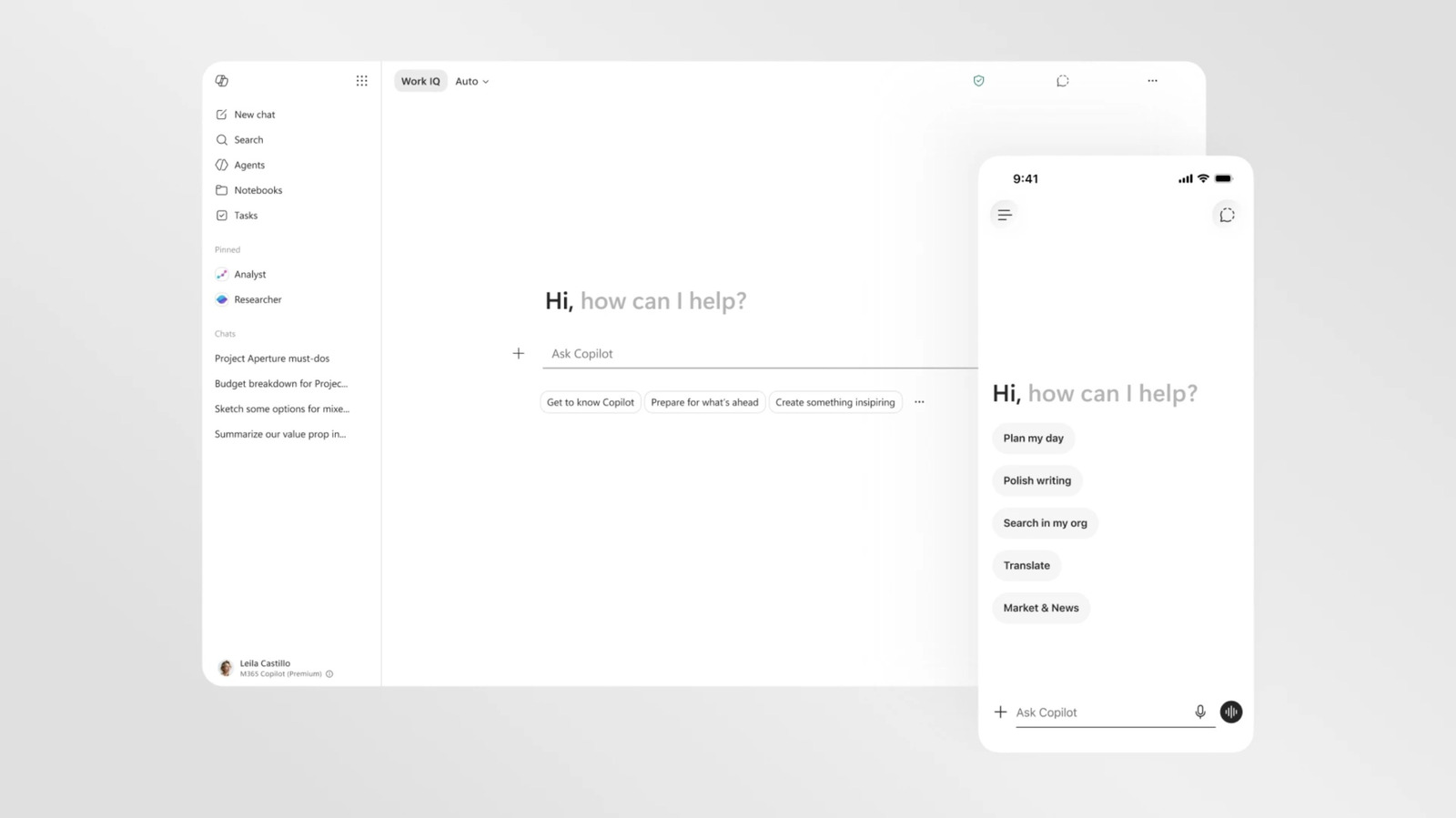
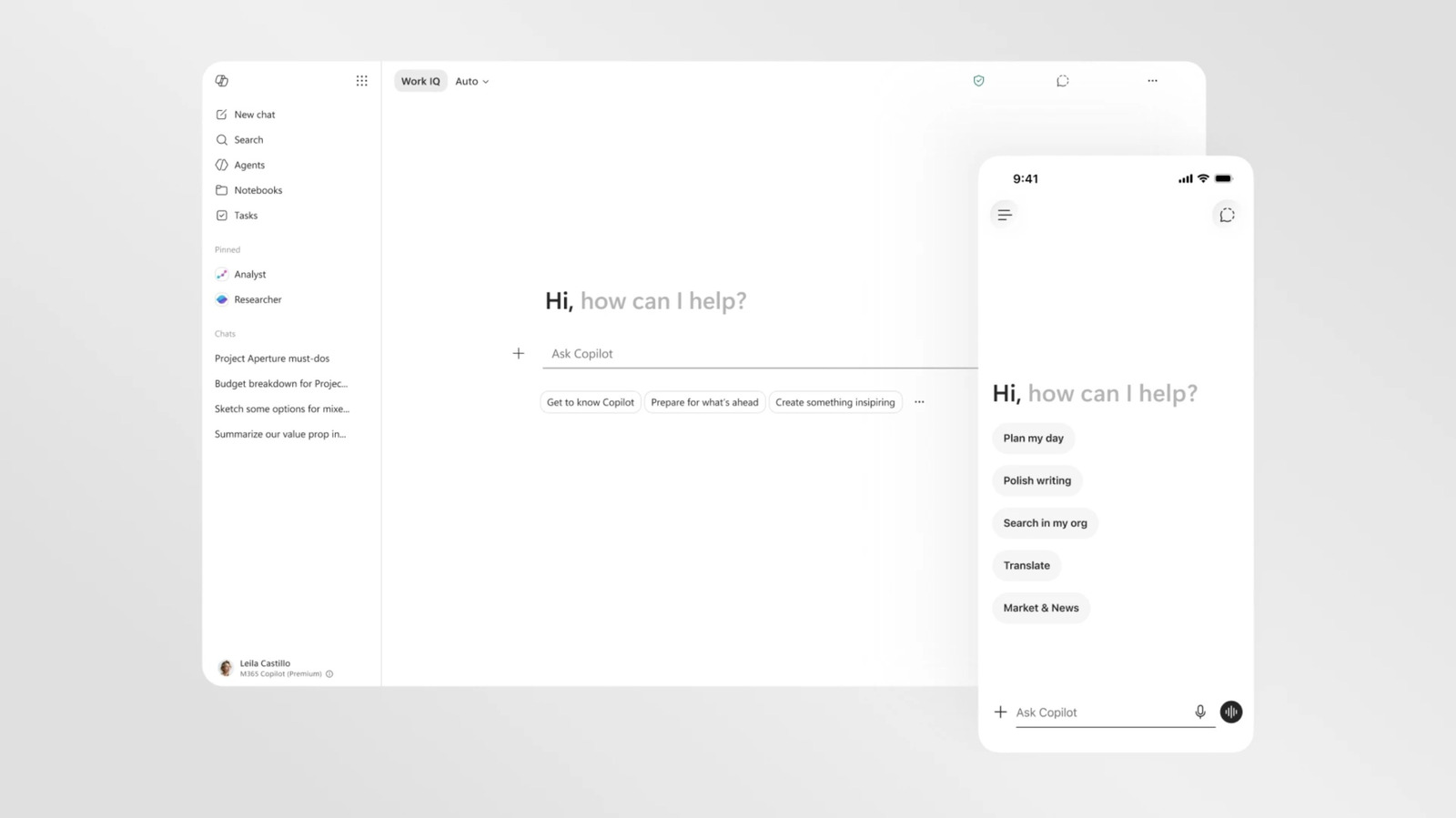
Copilot is getting yet another visual overhaul as Microsoft reconsiders its approach to AI across Windows and its various apps. The new changes are focused on the version of Copilot accessible in Microsoft 365, and visually streamline the AI assistant to using it more consistent across apps like Word, PowerPoint and Excel.
The most striking difference in Copilot’s new look is how little color it has. You can still get Copilot to produce full-color outputs and it will reference other apps by their colorful app icons. By default, though, the Copilot interface is now a largely black and white, text-forward affair. Part of this change was driven by a desire to make everything more readable and responsive, but Microsoft suggests it’s also reflective of an attempt to “craft intelligence that feels present but not imposing.”
That approach also applies to the tweaks Microsoft querying the AI assistant itself. The Microsoft 365 Copilot app and the Copilot experience in Microsoft apps feature a new “prompt surface” that changes size and reveals new functions as you type. You can input a purely text-based request to Copilot and it will answer, but if you refer to the AI assistant’s other skills, like the ability to research or visualize, the text box will unfurl menu options for selecting files or guiding Copilot’s visual responses. The app’s new side panels and menus, which collapse when not in use, are another example of this approach. Importantly, these changes also apply to how Copilot appears in apps like Word. The AI is now available in a consistent location across all Microsoft 365 apps — a side pane — and works similarly to the standalone Copilot app.
The only wrinkle to Microsoft’s Copilot redesign is that, at least for now, it’s limited to the company’s productivity software. The more consumer-friendly Copilot that was introduced in 2024 and lives in Microsoft’s mobile app is still bright, colorful and (occasionally) blobby. It’s possible this more buttoned-up look will make the jump to other versions of Copilot at some point, but that may depend on where Microsoft’s AI plans land.
The company has committed to being more thoughtful about where Copilot and AI features appear in Windows 11 and even started pulling Copilot out of certain apps. It’s also changing what AI models it uses. After being an early investor in OpenAI and a beneficiary of its GPT models, the two companies have redefined their partnership. Microsoft has now started rolling out its own in-house AI models and investing in other AI companies. A visual redesign isn’t a fix for the issues Windows users had with Copilot, but it does seem like a sign that Microsoft’s AI strategy is very much in flux.
Illinois lawmakers on Wednesday passed a landmark AI safety bill (SB 315) that would require major AI companies to publish safety plans, submit annual third-party testing reports, report serious incidents quickly, and protect whistleblowers who flag emerging risks. OpenAI and Anthropic supported the bill, which could make Illinois a testing ground for state-level AI governance as federal regulation remains stalled. Ars Technica reports: To force companies to be more transparent about rapid developments, Illinois would likely rely on “the Big Four accounting and auditing firms — Deloitte, EY, KPMG, and PwC — to audit their safety practices,” [said Scott Wisor, a policy director at a nonprofit called Secure AI Project, which supported the bill]. The required independent audits will likely frustrate Trump, who has tried and failed to stop states from implementing AI safety laws as Congress stalls on passing any legislation.
For Trump, the priority has been to promote AI industry interests, but he began considering expanding federal government safety testing after Anthropic’s Mythos was released and the AI firm limited access due to safety concerns. Whether or not governments at any level are prepared to protect society from the most catastrophic AI risks remains a major concern for critics who wonder how and when governments will intervene. After inside sources started leaking the details of Trump’s AI safety testing plans, critics warned that even the federal government may lack the necessary expertise to audit frontier AI models. And it seems the same criticism extends to independent auditors that Illinois may rely on but industry insiders suggest some AI firms may not entirely trust.
Adam Kovacevich is CEO of Chamber of Progress, a trade group that opposed SB 315 and counts Google and Apple among its members. He told Wired that Illinois’ requirements “would force companies to expose sensitive systems to untested auditors in a regulatory regime that’s all liability and no standards.” Governor J.B. Pritzker confirmed his intent to sign, proclaiming that “Illinois is leading the nation in holding Big Tech accountable.”
“I look forward to signing SB 315 and working with the legislature so that AI, when used, is used responsibly,” Pritzker said.
Advertisement
Steve Wimmer, a senior policy and technical advisor for the Transparency Coalition, said his group considers the law to be “one of the most important pieces of legislation in 2026.”
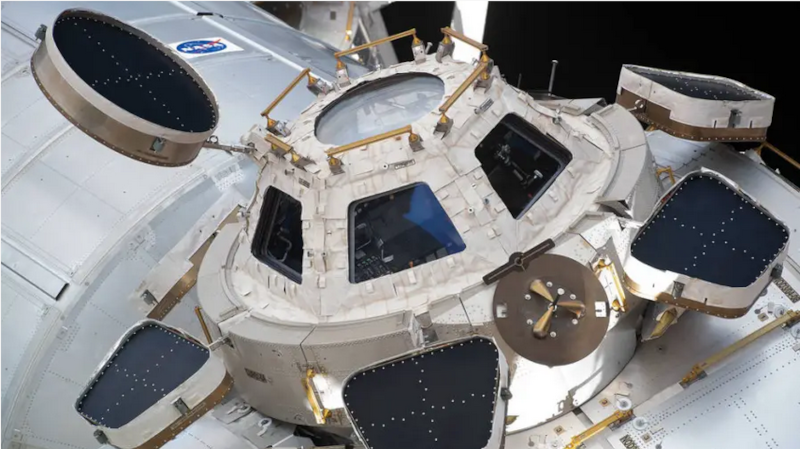
While designing anything for operation in space has its challenges, there is at least one thing that is more of a problem for objects in Earth orbit than for deep-space probes: atomic oxygen. We like oxygen because we need it to live, but it is also highly reactive as a single atom. Luckily, on Earth, most of what we breathe is O2. [Space Daily] talks about the challenges of the International Space Station dealing with the “space weather” of atomic oxygen in low Earth orbit.
Part of the problem is that even when we know better, we tend to think of the atmosphere coming to an abrupt end and space being a hard vacuum. But in reality, the atmosphere gradually dissipates, and at “only” 400 km above the Earth, the Space Station is really flying through a very thin atmosphere.
To compound the problem, this is above the ozone layer, so the Sun’s UV light rips O2 into single oxygen atoms. Over time, these free oxygen atoms can affect many parts of a spacecraft exposed to them. Engineers first noticed that materials recovered from spacecraft had more damage and changes to material properties on the pieces facing the direction of travel. NASA has spent years testing different materials by mounting trays of different material samples outside the ISS.
Carbon-based polymers take a big hit from atomic oxygen exposure. Polymide film is frequently used, but it erodes with exposure. Carbon composites also lose mass. Other materials change in other ways. For example, an optical surface may roughen with exposure.
Advertisement
The usual answer is to over-design for mission objectives or to cover certain polymers with coatings like silicon dioxide or aluminum oxide, which are not as reactive to free oxygen. For a long-duration mission like the ISS, you may have to pay special attention to the materials in use. Very low satellites also need special care, as there is more oxygen in lower orbits.
There are other effects, too, such as extreme thermal cycles, debris strikes, and other indignities that space-traveling materials must withstand. But in deep space, atomic oxygen is a rare issue. Until, at least, we go somewhere else that has a lot of oxygen.
If you could buy a humanoid robot for less than a smartphone, would you? Would you buy several robots to handle cooking, cleaning, babysitting, and even your job?
This is the pitch being made by Zhou Yong, the 40-year-old founder and chief technology officer of LinkerBot, one of China’s leading manufacturers of dexterous humanoid hands. The startup’s hardware comes complete with five fingers and at least 11 joints and is sold for as little as $600 in China. LinkerBot’s hands can play piano, thread needles, tighten screws, and assemble electronics. In three to five years, Zhou predicts, the price for one will fall to just $200. Eventually, “everyone will own ten robots on average,” Zhou said in an exclusive interview with WIRED.
Marketing spectacles like the humanoid robot marathon in Beijing have drawn attention to robots’ legs, but the real frontier in humanoids is hands. “The hands are the majority of the engineering difficulty of the entire robot,” Elon Musk said at an event last fall. Founded in 2023, LinkerBot has quickly emerged as a market leader in the space. The company says it shipped 10,000 robotic hands last year, representing 80 percent of worldwide demand. Its clients include research labs, manufacturers, and other humanoid robot makers.
The startup is also a venture capital darling: It completed six rounds of fundraising in just 13 months from investors including the Chinese government, Alibaba’s Ant Group, and HongShan Capital, Sequoia Capital’s Chinese spinoff. LinkerBot is now seeking another round of financing at a $6 billion valuation, double what the company said it was worth only a few months ago. And it’s reportedly exploring going public in Hong Kong, according to Bloomberg. (Zhou declined to comment on the rumored plans.)
Advertisement
In 2019, after selling a previous startup focused on autonomous driving, Zhou turned his attention to robotics. He says he predicted the industry would begin booming around 2025, but was still taken aback by how quickly it grew. While OpenAI was once at the forefront of developing robotic hands, in recent years Chinese startups have taken the lead as many of their American counterparts shifted their focus toward large language models and other AI software.
For robotics companies, “the valuation gap between the Chinese and US primary markets has been basically erased,” Zhou says.
Zhou says his lifelong goal is to make a real-life version of Doraemon, the Japanese anime character that has an infinite supply of magical gadgets in its pocket. (His WeChat avatar is a picture of Doraemon.) He sees building a capable, dexterous hand as an instrumental step toward achieving that dream.
Courtesy of LinkerBot
Advertisement
Selling Shovels to Miners
Successful companies, Zhou argues, focus on doing one thing well. That’s why LinkerBot zeroed in on hands, rather than trying to build the entire body of a humanoid. That also allows it to avoid directly competing with leading humanoid companies like Unitree or Tesla.
“When the humanoid robot industry size is so massive, specializing in making hands is like selling water or shovels [during the gold rush],” says Hong Shangguan, a veteran investor in China’s tech industry and a former partner at the Beijing-based fund Legend Capital.
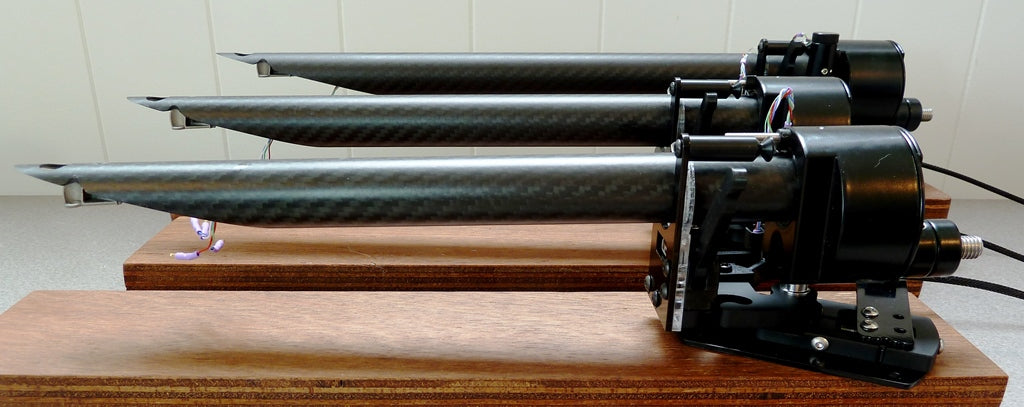
The Wand has been one of those tonearms that has intrigued me for years, largely because it never looked like it was designed by committee, or by someone trapped in front of a CAD workstation after midnight with too much confidence and something much stronger than coffee. They do it differently in New Zealand. Its wide to narrow carbon fiber arm profile helped make it instantly recognizable, and the design has built a real following over time. The latest chapter arrives next week at HIGH END Vienna 2026, where Wand will unveil its new 12-inch Dark-Light tonearm, a longer version of the 10-inch Dark-Light that first appeared at Munich High End 2025.
Long tonearms are not new, and neither is the argument over whether the added length is worth the extra real estate and setup demands. Wand already offers 9.5-inch, 10.3-inch, 12-inch, and 14-inch arms, and the company claims a 12-inch arm can reduce distortion by roughly 30% compared to a 9-inch design. That matters if the arm can keep resonance, rigidity, and bearing behavior under control, which is where Wand has always tried to separate itself from the usual aluminum tube and prayer routine.
My own curiosity goes back to some oddball tonearms I tried years ago, including the Japanese RS Labs RS-A1, a rotating headshell design that looked faintly mad but made a persuasive case for thinking differently about geometry and tracking. I also came across The Wand while looking at restored idler drive Lenco turntables, including the Dutch PTP Audio projects built around classic Swiss Lenco decks from the 1970s. PTP adopted The Wand for some of its turntables back in 2014, which only made the rabbit hole deeper. Naturally, I fell in. That is how these things happen.
The new 12-inch Dark-Light is not just about making the arm longer because the internet needs another argument. It is about whether Wand can preserve the speed, low noise, and musical flow that made the shorter model interesting, while taking advantage of the lower tracking distortion that a properly executed 12-inch arm can deliver. For vinyl listeners with the deck, space, cartridge, and patience to make it work, this could be one of the more interesting analog debuts at HIGH END Vienna 2026.
Advertisement
Handmade in New Zealand, Designed by Simon Brown
Design Build Listen is not just another boutique analog brand making pretty bits for expensive turntables. Based in Aotearoa / New Zealand, the company hand builds The Wand Tonearm along with other audio accessories, including its “No Ring Rings” tube dampers designed to reduce unwanted vibration.
Created by designer Simon Brown and launched in 2011, The Wand Tonearm has earned multiple design awards and five star reviews for its distinctive carbon fiber arm design. Its large diameter arm tube is claimed to be at least four times stiffer than traditional tonearms, which helps explain why The Wand has always felt less like a retro accessory and more like a serious rethink of how a tonearm should work.
Longer Reach, Tapered Stiffness, Serious Vibration Control
The new Wand Dark-Light 12-inch tonearm is not just a longer version built for people with more plinth real estate and stronger opinions. Its core advantage is Wand’s Musical Taper design, which increases the arm tube diameter toward the pivot as length increases. That larger rear section is intended to preserve stiffness rather than sacrifice rigidity, while also allowing more internal brass mass near the bearing assembly.
The added mass lowers the center of gravity and gives vibrational energy a more controlled path away from the cartridge and arm tube. For a 12-inch tonearm, that matters: the longer geometry can help reduce tracking distortion, but only if the arm remains stable, rigid, and free enough to trace the groove properly. The Dark-Light’s appeal is that it tries to balance those demands without turning the design into another heavy analog science project with nicer photography.
Advertisement
Will The Wand Tonearm Work With Your Cartridge?
The Wand Tonearm should work with a wide range of cartridges, which is one reason it has attracted attention from both high end analog users and listeners building more sensible vinyl systems. Design Build Listen says The Wand has been used with cartridges from Lyra, Transfiguration, Koetsu, Kiseki, Dynavector, Denon, Ortofon, Hana, and others, which covers a pretty broad slice of the cartridge world.
The standard Wand Tonearm is considered a medium mass design, with a claimed effective mass of 12.5g, while the 12-inch version is listed at 15g. The Master Series arms add roughly another gram.
Very high compliance cartridges still need some care, but Design Build Listen notes that even a Shure V15Vx measured at a 7Hz resonance, which remains usable. Lower compliance moving coil cartridges are also considered a good match.
Advertisement. Scroll to continue reading.
Advertisement
Denon DL-103 and Ortofon 2M models appear to be among the most popular cartridge choices with Wand users, which makes sense. One is a classic low output moving coil with a long history, and the other is a widely used moving magnet family that covers a broad range of budgets. Wand also recommends Hana moving coil cartridges, especially the Hana ML.
The practical takeaway is that The Wand is not a one-cartridge science project. It should work with many common MM and MC cartridges, provided setup is done properly and the turntable is not being asked to rescue warped records from the witness protection program. As always, compliance, cartridge weight, counterweight range, and phono stage compatibility still matter, but for most users, The Wand should not create a matching crisis.
Will The Wand Fit Your Turntable?
The Wand is designed around Rega-style mounting dimensions, but that does not mean it is the obvious upgrade path for every Rega Planar 3, Pro-Ject Debut PRO, or other sub-$1,000 turntable. This is a serious tonearm, and not an inexpensive one, so the better question is whether the turntable, cartridge, plinth, and overall system justify the move. Bolting a high-end tonearm onto an entry-level deck can work mechanically, but it may not be the smartest use of the budget. Vinyl has enough ways to separate you from your money without handing it the keys.
Where The Wand makes more sense is on turntables with the space, adjustability, and mechanical foundation to take advantage of it. Design Build Listen offers mounting information and kits for a wide range of decks, including the Linn LP12, Technics SL-1200 and SL-1500 family, including newer GR models, Lenco L75 family turntables, Thorens TD-160 and TD-150 models, Thorens TD-318 family turntables, Michell turntables, and SME-style armboards.
Advertisement
The 10.3-inch Wand is especially interesting because it was designed to deliver much of the appeal of a 12-inch arm in a more compact footprint. Design Build Listen describes it as the longest arm intended to fit on a Linn LP12 or Technics SL-1200 family turntable, which gives owners of those decks a way to go longer without needing a battleship-sized plinth.
Suspended turntables should not be ruled out automatically. The Wand weighs roughly 500g, which is in the same general territory as an SME 3009 and somewhat heavier than many Rega arms. That means most properly adjustable suspended decks should be able to accommodate it, but setup matters. Arm height, lid clearance, suspension adjustment, mounting geometry, and counterweight clearance all need to be checked before anyone starts drilling holes and pretending this is IKEA furniture.
The Bottom Line
At €8,900, the Wand 12-inch Dark-Light tonearm is not a casual upgrade. It is built for serious turntables, serious cartridges, and vinyl listeners who care about geometry, stiffness, resonance control, and setup precision.
Its appeal is the way Wand tackles the 12-inch tonearm problem: lower tracking distortion, a tapered carbon fiber arm tube designed to maintain rigidity, internal brass mass for vibration control, and, finally, headshell lifts for better day-to-day usability.
Advertisement
This is for experienced Linn, Technics, Lenco, Thorens, Michell, and custom plinth users, not someone trying to turn a budget deck into an analog miracle. It is available now and can be heard at Vienna High End in Halle 5, S15.
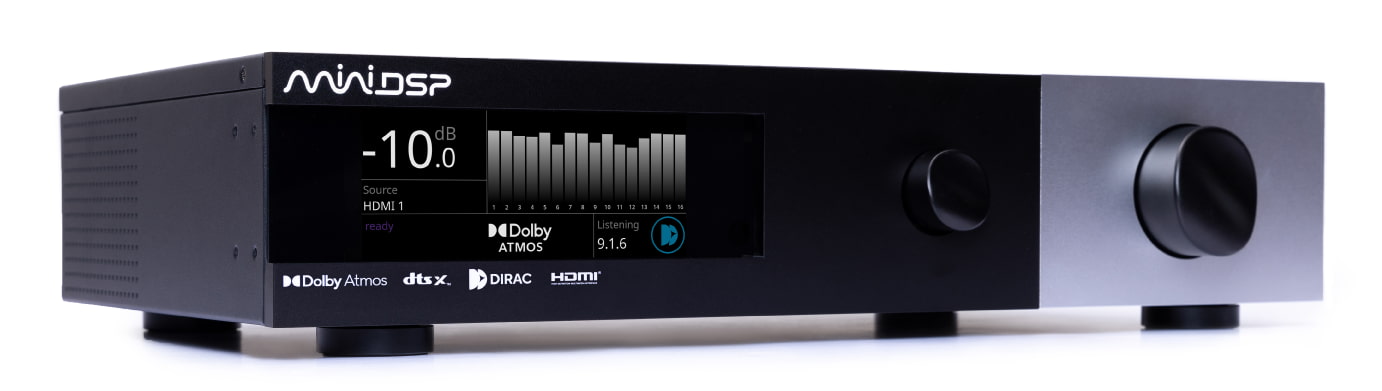
Dirac Live Active Room Treatment is coming to miniDSP’s new Tide16, giving the 16 channel multi-channel processor access to Dirac’s full room optimization suite, including Dirac Live Room Correction, Dirac Live Bass Control, and ART.
That matters because Tide16 is aimed at systems where channel count, bass control, and acoustic correction are not afterthoughts. Designed for audiophiles, integrators, and system designers, the processor gives users a more flexible path to managing complex playback systems without turning the room into the villain of the story.
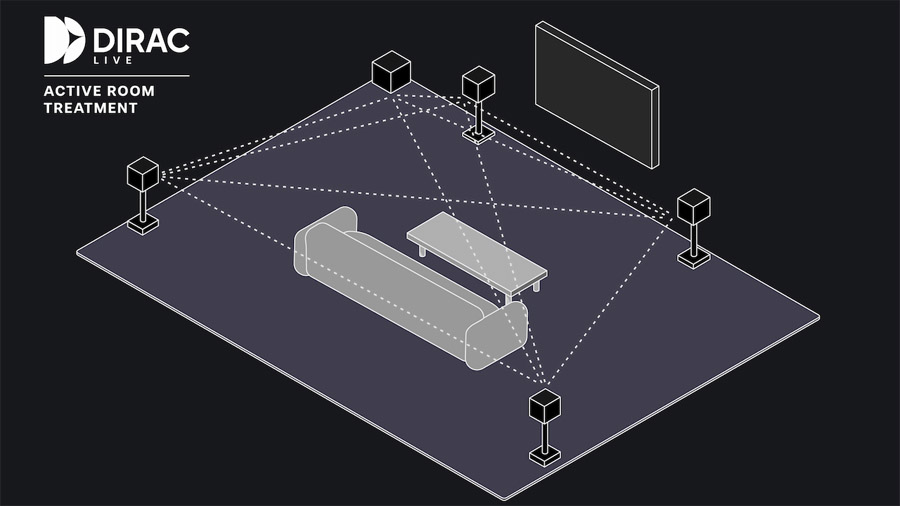
Introduced in 2023, Dirac Live ART takes the concept beyond traditional room correction by using the speakers in a system as a coordinated acoustic control network. The goal is to reduce low frequency resonances and improve bass consistency across the listening area, especially in rooms that do not behave nicely because, naturally, rooms rarely do.
“miniDSP has built a global reputation for flexible, high-performance DSP tools that empower enthusiasts and professionals alike,” said Rikard Hellerfelt, VP & Head of BA Consumer Electronics. “By integrating Dirac Live Active Room Treatment into the new Tide16, miniDSP is making cutting-edge room optimization accessible to a wider audience, unlocking studio-grade performance in real-world listening rooms.”
Advertisement
What Does the miniDSP Tide16 Actually Do?
The miniDSP Tide16 is not a receiver in the usual living room sense. There are no amplifier channels inside, and it is not designed to be an all-in-one box for someone plugging in five speakers and calling it a day. Think of it as the control center for a more advanced stereo, home theater, immersive audio, or custom installation system.
Its job is to accept audio from sources, process that signal, apply room correction, manage bass, decode formats such as Dolby Atmos and DTS:X, and then send the corrected signal out to external power amplifiers or active speakers. That is where the 16 balanced XLR outputs matter. Tide16 can support complex layouts, including 9.1.6 systems, depending on the source material, speaker layout, and the rest of the system.
Connectivity includes HDMI, Toslink, USB Audio, balanced XLR and unbalanced RCA stereo analog inputs, plus Bluetooth for wireless playback. That gives Tide16 enough flexibility to work in a serious two channel system, a dedicated theater, an immersive audio room, or a professional listening space. A calibrated microphone is sold separately, so buyers should factor that into the final cost and setup process.
The headline feature is the inclusion of the full Dirac Live suite out of the box: Dirac Live Room Correction, Dirac Live Bass Control, and Dirac Live Active Room Treatment. That matters because Dirac licenses are often an added expense on competing products, and those costs can add up quickly.
Dirac Live Room Correction addresses frequency and timing issues caused by the room and speaker placement. Dirac Live Bass Control focuses on integrating subwoofers with the main speakers so the low end is more consistent across more than one seat. Dirac Live ART goes further by using multiple speakers in the system as a coordinated acoustic control network. Instead of treating each speaker and subwoofer separately, ART uses Dirac’s MIMO technology to help reduce low frequency decay and room resonances.
Advertisement
That does not mean Tide16 replaces smart speaker placement, competent setup, or physical acoustic treatment. Anyone expecting software to turn a bad room into Abbey Road by Tuesday is going to need a chair and a quiet moment. But for systems with multiple speakers, subwoofers, and enough complexity to make manual setup painful, Tide16 gives users a powerful DSP platform with the Dirac tools already included.
The Bottom Line
The miniDSP Tide16 matters because it brings 16 channel immersive audio processing, Dolby Atmos and DTS:Xdecoding, advanced bass management, and the full Dirac Live suite into a $3,500 processor. That price is not pocket change, but it is aggressive for a processor that includes Dirac Live Room Correction, Dirac Live Bass Control, and Dirac Live Active Room Treatment rather than treating them like toll booths.
Advertisement. Scroll to continue reading.
Tide16 is not a traditional AVR. There are no amplifier channels inside, so buyers still need external amplification, speakers, subwoofers, and a calibrated microphone. Its strength is control: 16 balanced XLR outputs, support for complex layouts like 9.1.6, multi subwoofer integration, and Dirac ART’s ability to use the speaker system as a coordinated tool to reduce low frequency room issues.
Advertisement
The right buyer is an enthusiast, integrator, or system designer building a dedicated theater, active speaker system, advanced stereo setup, or multi subwoofer room where precision matters more than plug and play convenience. At $3,500 before amps, cables, microphones, and setup time, Tide16 is not cheap. But for users who want Dirac ART and 16 channel flexibility without jumping into far more expensive processor territory, it could be a very important box.





















































You must be logged in to post a comment Login