

Business
At Computex, Nvidia and Taiwan’s expanding role in AI infrastructure set to take centre stage






Trump says he will soon decide on Iran deal, demands reopening of Hormuz Strait

Video games are often judged by their graphics or story. But the real magic usually happens under the hood. That is where developers build the systems that make worlds feel alive.
Hooman Arman Nissani has spent his career doing exactly that.
The Glendale, California native is a video game developer, game designer, and technical director known for his work on complex game systems, artificial intelligence, and open-world mechanics. Over the past decade, he has worked across multiple studios and projects before launching his own independent studio, Nissani Interactive, in 2021.
His goal is simple but ambitious.
“I want games to feel like living ecosystems,” Nissani says. “The best moments in games are the ones the developers didn’t script.”
Early Curiosity: From Arcade Games to Programming
Nissani’s path into the gaming industry started early.
He grew up in Glendale, just outside Los Angeles, in a household where education and creativity were strongly encouraged. As a child in the late 1990s, he became fascinated with the games that defined that era.
Titles like The Legend of Zelda: Ocarina of Time, Half-Life, Final Fantasy VII, and StarCraft left a strong impression on him.
But playing games was only part of the experience.
“What fascinated me most was not just playing,” he recalls. “I wanted to understand how the game actually worked.”
By age 12, he was teaching himself programming using books and tutorials from the Glendale Public Library. His first languages included QBASIC, HTML, JavaScript, and C++.
One of his earliest projects was a simple 2D platform game inspired by the Santa Monica Pier and Griffith Park.
“I remember trying to recreate places I knew,” he says. “Even back then I was thinking about how environments shape gameplay.”
Studying Computer Science and Game Design at UC Irvine
Nissani attended Clark Magnet High School in Glendale, a school known for its engineering and technology programs. There he focused on computer science, robotics, and digital media.
During his senior year, he won a regional student competition for creating an educational game that taught physics concepts through interactive puzzles.
The experience reinforced his interest in interactive systems.
After high school, he enrolled at the University of California, Irvine, earning a Bachelor of Science in Computer Science with a minor in Game Design and Interactive Media.
At UC Irvine, he focused on subjects that would later shape his career.
These included game engine architecture, artificial intelligence systems, graphics programming, and procedural generation.
He also joined the university’s Game Developers Club, where students collaborated on small independent projects.
“That environment was important,” he says. “You learn quickly that game development is deeply collaborative.”
Breaking Into the Gaming Industry
After graduating in 2009, Nissani moved to Santa Monica, where many game studios operate.
He began working as a Junior Gameplay Programmer at PixelForge Interactive, contributing to mobile and indie PC titles.
The role gave him hands-on experience writing gameplay mechanics, debugging game engines, and optimizing performance for smaller devices.
Those early years shaped his technical approach.
“You spend a lot of time fixing problems,” he says. “Debugging teaches you how complex systems actually behave.”
Eclipse of Empires and a Breakthrough Project
Nissani’s career took a major step forward in 2013 when he joined NovaRealm Studios as a Gameplay Systems Engineer.
There he worked on the open-world RPG Eclipse of Empires, which launched in 2014.
His responsibilities included designing enemy AI behaviors, building procedural weather systems, and creating parts of the game’s player skill tree architecture.
He also worked on environmental physics interactions.
“The goal was to create a world that reacts to the player,” Nissani says. “Weather, AI, and physics all had to talk to each other.”
The game’s success raised his profile inside the industry and opened the door to larger technical leadership roles.
From Lead Programmer to Technical Director
In 2017, Nissani became Lead Programmer on the cyberpunk action game Neon Circuit.
The game was set in a futuristic version of Los Angeles and required complex urban simulation systems.
His work included crowd simulation, NPC dialogue AI, and vehicle physics designed for dense city gameplay.
Three years later, he served as Technical Director on the strategy sandbox game Frontier Architects.
The project pushed deeper into simulation systems.
Players could build colonies on distant planets using procedural terrain generation and autonomous NPC colony management.
“These kinds of games are about systems interacting,” he says. “When players discover unexpected outcomes, that’s when a game becomes memorable.”
Founding Nissani Interactive
In 2021, Nissani founded his own studio, Nissani Interactive, based in Los Angeles.
The company operates with a small distributed team of developers, artists, and writers.
The studio focuses on narrative-driven indie games and experimental AI-driven NPC behavior.
For Nissani, the move to independence was about creative flexibility.
“Smaller teams can take bigger risks,” he says. “You can explore ideas that might not fit inside a large studio pipeline.”
Much of his current work explores adaptive storytelling and AI-generated characters.
The Future of AI-Driven Game Worlds
Looking ahead, Nissani believes the gaming industry is entering a new phase.
Advances in artificial intelligence and procedural generation are changing how interactive worlds are built.
Instead of scripted experiences, games may evolve into dynamic environments that respond continuously to players.
“The future of gaming is systems that learn and adapt,” he says. “Stories won’t always be written ahead of time. They will emerge from how players interact with the world.”
For developers like Hooman Nissani, that future is already taking shape inside the code.

In a 96-page order, Sebi said an earlier adjudication order passed in June 2025, which had exonerated Suzlon and its executives, was erroneous and not in the interest of the securities market. The regulator has now invoked its revisionary powers under the Sebi Act to reconsider the matter and impose penalties.
Sebi initiated investigation after it received an anonymous complaint in 2019 alleging irregularities in Suzlon’s dealings with subsidiaries and associates. The regulator later appointed a forensic auditor to examine transactions undertaken by the renewable energy company between FY14 and FY20.
A key transaction under Sebi’s scrutiny is Suzlon’s 2014 sale of its operations and maintenance services (OMS) business to its wholly owned subsidiary, Suzlon Global Services (SGSL), for ₹2,000 crore.
Sebi alleged the business was worth only around ₹77 crore and that the deal enabled the company to book a gain of ₹1,922.9 crore.

The regulator alleged that only ₹700 crore was actually received over FY15 and FY17, and the remaining ₹1,300 crore was shown through circular bank entries routed multiple times between Suzlon and SGSL.
The same assets were later used to generate another accounting gain of ₹829.78 crore, when SGSL shares were transferred to another subsidiary, it said.These transactions helped Suzlon avoid reporting a negative net worth and enabled it to raise capital, Sebi said.
The regulator also alleged that Suzlon failed to properly disclose a contingent liability of about ₹4,050 crore linked to a standby letter of credit issued for loans availed by overseas subsidiary AE Rotor Holding BV.
It said Suzlon incorrectly classified the exposure as an insurance contract instead of a financial guarantee liability under accounting standards.

Burlington Stores BURL 7.76%increase; green up pointing triangle raised its outlook for the year after logging higher profit and sales in its fiscal first quarter, as concerns about inflation and the economy continued driving consumers to seek value.
The off-price retailer on Thursday posted net income of $114.7 million, or $1.79 a share, for its three months ended May 2, compared with $100.8 million, or $1.58 a share, a year earlier.
Copyright ©2026 Dow Jones & Company, Inc. All Rights Reserved. 87990cbe856818d5eddac44c7b1cdeb8

Analysts said the move could provide a much-needed boost to social stock exchanges in India, which have struggled to attract sufficient investors. Companies spent ₹34,909 crore on CSR activities in 2023-24, according to the latest official data.
A social stock exchange operates as a dedicated segment of an existing bourse such as BSE or NSE, enabling social enterprises to raise funds through market-linked instruments. Eligible entities include both not-for-profit organisations and for-profit social enterprises.
In a notification, the ministry defined a zero coupon zero principal instrument as a security issued by a not-for-profit organisation registered with a social stock exchange under Securities and Exchange Board of India regulations.
Under the Companies (Corporate Social Responsibility Policy) Amendment Rules, 2026, companies subscribing to such instruments will be exempt from carrying out impact assessments for projects funded through them. The rules came into effect on Friday.
“For years the social stock exchange has had one basic problem, which is that there were never enough buyers. This amendment goes some way to fixing that,” said Manpreet Singh, partner and sustainability practice leader at Grant Thornton Bharat.
The move also changes the conversation in the boardroom, he said. “Until now the question was which NGO to write a cheque to. It now becomes how to build a CSR portfolio that is properly vetted and tracked,” Singh said. For companies, the notification “not only enhances transparency, accountability and impact measurement in CSR initiatives, but also enables more strategic alignment of social investments with ESG and sustainability objectives”, said Sandeepp Jhunjhunwala, partner at Nangia Global Advisors.The move, Jhunjhunwala added, is expected to “encourage companies to participate in outcome-oriented development projects through a regulated and market-linked mechanism”.
The move “helps in furtherance of a transparent and credible mode of funding CSR projects by the companies and enable social enterprises to access a wider pool of capital”, said Anshul Jain, partner-regulatory at PwC India.

Drawing parallels with the past boom-and-bust cycles such as the dotcom in late 1990s and British Railways in the 19th century, Wood, in his newsletter Greed & Fear, said, “…..a lot of capital will be destroyed in this AI capex cycle and that capital is most likely to be destroyed by US players given the Chinese AI capex of “only” Rmb 841 billion ($124 billion) this year.”
The Chinese investment is equivalent to 18% of the projected US$680 billion of capex by the four hyperscalers, he said, referring to Amazon Web Services, Microsoft Azure, Google Cloud Platform, and Meta, which dominate the cloud and data-centre operations.
Despite the rapid adoption of artificial intelligence technologies, Wood cautioned that the pace of investment may not be sustainable.
“The reality is that the world is now adopting Artificial Intelligence at breakneck speed; though Greed & fear’s base case is that adoption will be slowed down in due course by an over-investment bust in the US, if not in China,” said Wood.

Parex Resources: The Bargain Train Is Leaving The Station
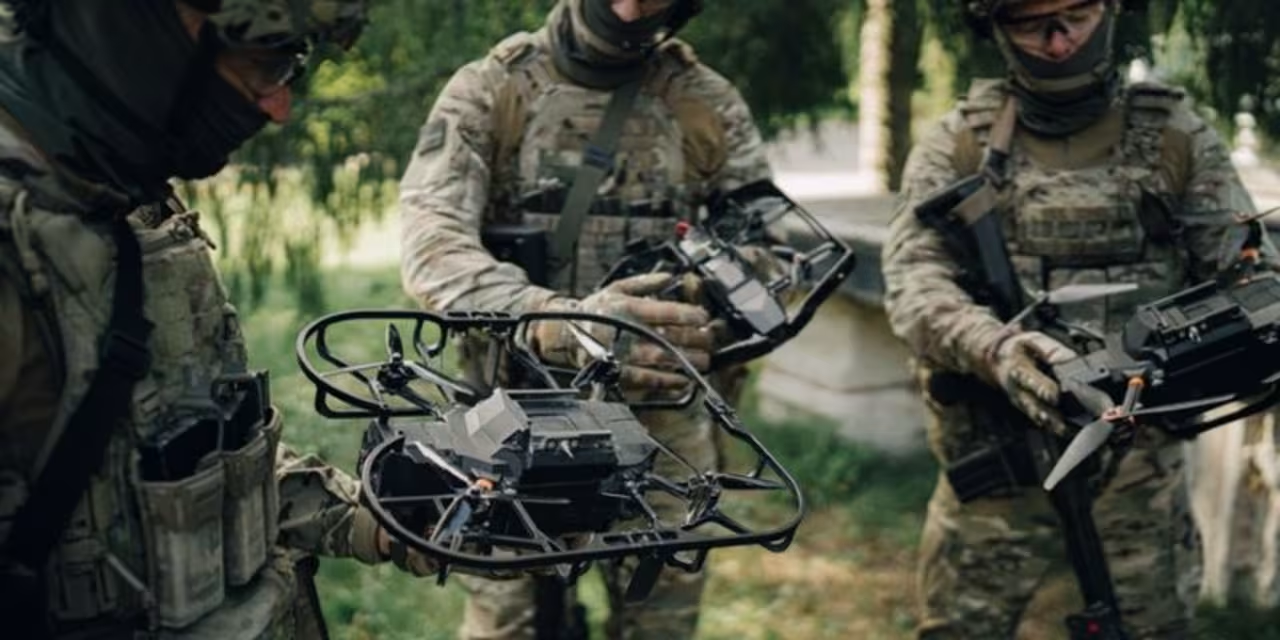
This Trump-Linked Drone Maker May Get a Pentagon Deal. The Stock Soars 57%.

Form 13G Eloxx Pharmaceuticals For: 29 May


I’m an individual investor looking to grow my wealth over the long term. I’ve tried many different styles of investing over the last 25 years and have found that buying dividend growth stocks and reinvesting the dividends is one of the easiest ways to grow wealth over the long term. Over the years, I’ve owned stocks, options, ETFs, treasury notes, and mutual funds. I operate a blog, HarvestingDividends.com, that provides information on the S&P Dividend Aristocrats and other dividend growth stocks.
Analyst’s Disclosure: I/we have a beneficial long position in the shares of FLO either through stock ownership, options, or other derivatives. I wrote this article myself, and it expresses my own opinions. I am not receiving compensation for it (other than from Seeking Alpha). I have no business relationship with any company whose stock is mentioned in this article.
I may take or change my position(s) in any of the stocks mentioned in this article in the near future.
Seeking Alpha’s Disclosure: Past performance is no guarantee of future results. No recommendation or advice is being given as to whether any investment is suitable for a particular investor. Any views or opinions expressed above may not reflect those of Seeking Alpha as a whole. Seeking Alpha is not a licensed securities dealer, broker or US investment adviser or investment bank. Our analysts are third party authors that include both professional investors and individual investors who may not be licensed or certified by any institute or regulatory body.

Pink Floyd – Money (PULSE Restored & Re-Edited)

Echo Comment on the wave of littering following the heatwave

Trump says he will soon decide on Iran deal, demands reopening of Hormuz Strait


-

 Business5 days ago
NYT Strands Answers May 24 2026 Revealed for Puzzle No. 812 Theme Summer Essentials
-

 Politics5 days ago
Bridgerton Season 5: Cast, Release Date And Everything We Know So Far
-

 Crypto World7 days ago
Robinhood crypto COO Tanya Denisova exits
-

 Business3 days ago
Selena Gomez Reportedly Upset Over Benny Blanco’s Comments on Her ‘Terrible’ Diet
-

 NewsBeat3 days ago
Israel says it has killed new Hamas military leader in Gaza City airstrikes
-

 Tech5 days ago
Microsoft’s quiet Claude Code retreat and the real cost of enterprise AI
-
 Crypto World3 days ago
Micron Crosses $1 Trillion Market Cap as AI Demand Reshapes Memory Sector
-

 Business5 days ago
BTS Sells Out Four Las Vegas Shows at Allegiant Stadium for ARIRANG World Tour
-
Tech3 days ago
The Samsung pay deal is the moment Korean unions changed register
-

 Tech23 hours ago
Waymo dominates autonomous vehicle registrations as Tesla trails behind
-

 Tech3 days ago
Millions of AI agents imperiled by critical vulnerability in open source package
-

 Tech5 days ago
Westone Audio and Etymotic Acquired by Fidelity Collective in Major IEM Market Move
-
 Tech4 days ago
China assigns ID codes to 28,000+ humanoid robots
-
 Crypto World5 days ago
Nvidia (NVDA) CEO Calls on Super Micro to Strengthen Export Controls Amid Smuggling Probe
-
Crypto World3 days ago
SpaceX’s $2 Trillion IPO: Why Tech Giants Nvidia (NVDA), Apple (AAPL), and Microsoft (MSFT) May Face Pressure
-

 Tech3 days ago
NASA taps Blue Origin to deliver lunar rovers for Moon Base initiative
-
Crypto World5 days ago
Brian Armstrong Outlines Crypto Vision for the Future Financial System
-
 Entertainment4 days ago
‘Breaking Bad’ Star’s Easy-to-Binge 6-Part Crime Series Spin-Off Is Finally Heading to Free Streaming
-

 Crypto World3 days ago
Spain blocks prediction markets Polymarket Kalshi
-

 Business5 days ago
Yatra Online, Inc. 2026 Q4 – Results – Earnings Call Presentation (NASDAQ:YTRA) 2026-05-25
You must be logged in to post a comment Login