

Crypto World
ASML (ASML) Stock Soars 53% in 2026: Is Now the Time to Buy or Stay on the Sidelines?


Key Highlights
- Shares of ASML have surged 53% since the start of 2026 and 120% in the trailing 12 months, reaching a peak near $1,612
- First-quarter 2026 earnings exceeded analyst projections, with revenue rising 13% and operating income advancing 15%
- Morningstar has issued a Sell rating, noting the stock commands a 19% premium above its estimated fair value
- UBS analysts boosted their price objective to €1,900, while the Street consensus supports a “Moderate Buy” recommendation
- Proposed US legislation targeting chip equipment exports to China poses a significant headwind for the company
ASML shares commenced trading Friday at $1,612.76, hovering close to the 52-week peak of $1,654.20. This represents substantial appreciation from the yearly low of $683.48.
The Netherlands-based semiconductor equipment manufacturer has emerged as a standout performer in the artificial intelligence investment theme during 2026, posting year-to-date gains exceeding 53% and annual returns of 120%. With a market capitalization reaching $634 billion, the company now holds the distinction of being Europe’s largest publicly traded enterprise.
The remarkable price appreciation stems from explosive demand for cutting-edge semiconductors. ASML produces the critical machinery that enables chip fabrication — functioning as the indispensable infrastructure provider for the semiconductor industry. Major clients include TSMC, Samsung Electronics, and Micron Technology.
First-quarter 2026 financial performance surpassed Wall Street estimates. Revenue increased 13% year-over-year, operating income jumped 15%, and gross margin reached 53%. Company leadership elevated its annual revenue guidance to a range of EUR 36–40 billion.
Morningstar equity analyst Javier Correonero enhanced his long-range projections, now forecasting ASML could achieve EUR 60 billion in annual sales by the decade’s end.
Street Sentiment Remains Positive Despite Valuation Debate
The analyst community maintains a generally optimistic stance. According to MarketBeat data, three firms assign Strong Buy ratings, twenty recommend Buy, six suggest Hold, and three advise Sell. The average price target stands at $1,504.38 — interestingly below current trading levels.
UBS elevated its price objective to €1,900 from €1,600 recently, maintaining its Buy recommendation. Barclays likewise upgraded the stock to Buy on May 19. Deutsche Bank and Sanford C. Bernstein have both affirmed their Buy assessments.
The primary contrarian voice comes from Morningstar, which moved ASML to Sell this week based on valuation metrics. At present levels, shares command a 19% premium relative to Morningstar’s intrinsic value calculation. The research firm acknowledges ASML’s formidable competitive advantages but highlights vulnerability should semiconductor manufacturers reduce capital expenditures given the company’s high equipment prices.
ASML currently trades at a price-to-earnings multiple of 57.85, accompanied by a PEG ratio of 1.32. The 50-day moving average registers at $1,458.41.
Geopolitical Uncertainty Clouds Near-Term Outlook
The regulatory environment introduces additional complexity. Proposed United States legislation could prohibit sales of ASML’s lower-tier deep ultraviolet (DUV) equipment to China — expanding beyond the advanced EUV systems already subject to existing sanctions.
The Chinese market represents a substantial revenue contributor for the DUV product line. Elimination of this access would materially impact short-term financial performance.
Balancing this concern, ASML recently announced a collaboration with Tata Electronics to support India’s inaugural front-end semiconductor manufacturing facility — representing a promising new market opportunity.
Institutional ownership has been expanding. Consolidated Capital Management established a fresh $3.96 million position during the fourth quarter. Additional firms, including Founders Financial and Texas Yale Capital, have enlarged their holdings. Institutional investors collectively control 26.07% of outstanding shares.
In its most recent quarterly report, ASML delivered earnings per share of $8.28 for Q1, accompanied by quarterly revenue of $10.15 billion and a net profit margin of 27.65%.




Circle moved about $4.4 billion in USDC to a Coinbase address through HyperEVM, according to Arkham, in what the analytics firm called the largest USDC transaction ever.
Summary
- Circle moved 4.397 billion USDC to Coinbase on HyperEVM, Arkham said, marking a record transfer.
- The transfer follows Coinbase becoming Hyperliquid’s official USDC treasury deployer under its AQA framework.
- Hyperliquid uses USDC as a core quote and settlement asset across its trading ecosystem.
Circle sends record USDC transfer
Arkham said Circle moved $4 billion to Coinbase on HyperEVM. The transfer involved about 4.397 billion USDC and went to a Coinbase-linked address.
“Circle just moved $4 billion to Coinbase on HyperEVM,” said Arkham.
The transfer stood out because of its size and route. HyperEVM is linked to the Hyperliquid ecosystem, where USDC plays a main role in trading, quoting, and settlement.
Arkham also described the move as the largest USDC transaction ever. The transaction has drawn attention because it connects Circle, Coinbase, and Hyperliquid at a time when stablecoin liquidity is becoming more central to onchain markets.
Coinbase role on Hyperliquid adds context
The transfer appears connected to Coinbase’s role as Hyperliquid’s USDC treasury deployer. Coinbase announced in May that it would expand support for USDC on Hyperliquid under the Aligned Quote Asset framework.
Coinbase said the setup would strengthen USDC’s role as the preferred stablecoin for onchain capital markets. The company also said concentrating liquidity around USDC could make markets more efficient by reducing the need for conversions.
USDC had already become the leading stablecoin on Hyperliquid. Coinbase said USDC supply on Hyperliquid had reached about $5 billion and had doubled year over year.
That makes the large Circle transfer easier to read as part of a wider treasury and liquidity setup, rather than a normal exchange deposit. Still, neither Circle nor Coinbase had issued a separate public statement on this specific transfer at the time of writing.
Hyperliquid shifts stablecoin structure
The Coinbase and Hyperliquid arrangement also affects USDH, the Native Markets stablecoin tied to the ecosystem. Coinbase said Native Markets agreed to terms giving it the right to purchase USDH brand assets.
USDH markets remain active for now, but Coinbase said they will be phased out over time. Users can still convert USDH to USDC without fees or redeem it for fiat during the transition.
Hyperliquid has also said Circle will serve as the technical deployer for CCTP and native cross-chain infrastructure. Coinbase will handle the USDC treasury side, while Circle supports the technical flow of USDC across chains.
As previously reported by crypto.news, Hyperliquid had already reached record trading activity before this treasury shift. Moreover, Circle’s native USDC and CCTP V2 were expected to support direct on and off ramps, cross-chain transfers, and better liquidity for DeFi and derivatives markets.
The record transfer puts fresh attention on stablecoin flows across major onchain trading venues. USDC is widely used for collateral, settlement, and quote markets, so large treasury movements can shape liquidity conditions.

BITCOIN ASIA 2026 ANNOUNCES FIRST WAVE OF SPEAKERS FOR AUGUST HONG KONG EVENT
Balaji Srinivasan, Simon Gerovich, Hugh Hendry, and Other Additional Voices from Global Finance, Policy, and Bitcoin Infrastructure Confirmed for Asia’s Largest Bitcoin Conference
Nashville, TN, USA — June 11, 2026 — Bitcoin Asia 2026 today announced its first wave of confirmed speakers for the two-day conference taking place August 27–28 at the Hong Kong Convention and Exhibition Centre (HKCEC). The event is organized by BTC Inc. a subsidiary of Nakamoto Inc. (NASDAQ: NAKA) and presented by Metaplanet.
Headlining the event is Balaji Srinivasan, founder of Network School and author of The Network State, one of the most recognized voices at the intersection of Bitcoin, technology, and sovereign network theory. Srinivasan joins a speaker lineup spanning institutional capital, legislative policy, macro finance, and Bitcoin development.
“We are incredibly excited to bring together the East and West bitcoin markets, industries, and communities to build through this bear market and continue to explore the ways bitcoin is changing the world around us.” Brandon Green, CEO at BTC Inc.
This year’s programming centers on the convergence of Eastern and Western Bitcoin ecosystems at a defining moment for institutional adoption. Sessions will span macro and monetary policy, corporate treasury strategy, Bitcoin infrastructure, and the regulatory landscape across Asia.
Additional confirmed speakers include:
- Dr. Hon. Johnny Ng, Kit Chong MH, JP, Member of the Legislative Council of the Hong Kong Special Administrative Region
- Bilal Bin Saqib, Pakistan’s Minister of State, and Chairman of the Pakistan Virtual Assets Regulatory Authority
- Justin Sun, Ambassador and former Permanent Representative of Grenada to the WTO, Founder of TRON, and Advisor to WBTC and HTX
- Gracy Chen, CEO of Bitget, a leading global crypto exchange and one of the world’s largest derivatives trading platforms
- Simon Gerovich, CEO of Metaplanet, Japan’s largest corporate Bitcoin holder and the Bitcoin Asia 2026 title sponsor
- David Bailey, CEO of Nakamoto Inc. (NASDAQ: NAKA)
- Hugh Hendry, founder of Acid Capitalist and former global macro hedge fund manager and founder of Acid Capitalist, known for his public conversion to Bitcoin as a monetary asset
- Matt Cole, Chairman and CEO of Strive, a publicly traded Bitcoin treasury and structured finance company
- John Riggins, CEO and Co-Founder of Moon Inc, a leading operator in Hong Kong’s prepaid products market
- Caspar Wong, CEO of Web3Labs and a key figure in Hong Kong’s Bitcoin ecosystem
- Koji Higashi, Co-Founder of Diamond Hands, a leading Bitcoin community organization in Japan
Bitcoin Asia 2026 is expected to welcome more than 10,000 attendees from 125+ countries for two days of main stage programming, investor sessions, policy dialogue, and open-source development discussions.
Additional speakers will be announced in the weeks ahead. Ticketing and other information is available at asia.b.tc. Press credentials can be requested at asia.b.tc/contact/press-pass.
Tickets
https://asia.b.tc/ use CryptoBreaking10 for a 10% discount.
About BTC Inc.
BTC Inc. is the world’s leading Bitcoin media enterprise, operating Bitcoin Magazine, the Bitcoin Conference, andBitcoin for Corporations. Through its media, events, and educational platforms, BTC Inc. delivers trusted news, research, and experiences that advance Bitcoin adoption among individuals, institutions, and enterprises worldwide.BTC Inc. is a subsidiary of Nakamoto Inc. (NASDAQ: NAKA), a publicly held Bitcoin company that owns and operates a global portfolio of Bitcoin-native enterprises.
Forward-Looking Statements
Certain statements in this press release constitute forward-looking statements, as defined under U.S. federal securities laws. Forward-looking statements can be identified by the use of words such as “estimate,” “project,” “predict,” “believe,” “expect,” “anticipate,” “potential,” “intend,” “could,” “would,” “may,” “plan,” “will,” “seek,” “target,” or the negative of such terms or other variations thereof. However, the absence of these words does not mean that a statement is not forward-looking. Forward-looking statements in this press release include, but are not limited to, statements regarding BTC Inc.’s business plans and strategies, including plans for new products, services, and media platforms; projected or targeted audience size, reach, impressions, and distribution; expected launch dates and production schedules; the Company’s advocacy positions and the expected outcomes of industry and regulatory engagement; and the anticipated role and growth of Bitcoin-related media, events, and educational services.These forward-looking statements are inherently uncertain and involve numerous assumptions and risks. Factors that could cause actual results to differ materially from those projected include, but are not limited to: (i) the volatility of Bitcoin prices and its effect on audience interest, advertiser demand, and the commercial viability of Bitcoin-focused media; (ii) changes in audience size, engagement, or platform distribution that could affect BTC Inc.’s reach or revenue; (iii) the risk that new products or services, including new media platforms, may not launch on schedule, achieve projected audience levels, or generate anticipated revenue; (iv) the risk that advocacy or industry engagement efforts may not achieve their intended outcomes; (v) dependence on third-party distribution platforms whose policies, algorithms, or terms of service may change; competition from other media companies and content providers; (vi) the evolving regulatory environment for digital assets and its potential impact on BTC Inc.’s operations, content, and audience; (vii) reliance on key personnel and creative talent; the risk that projected audience metrics, impressions, or distribution figures may not be achieved or sustained; (viii) risks associated with the integration of BTC Inc. into Nakamoto Inc.’s operations following the February 2026 acquisition; (ix) general economic conditions and their impact on advertising and events revenue; and (x) other important factors detailed in Nakamoto Inc.’s Annual Reports on Form 10-K, Quarterly Reports on Form 10-Q, Current Reports on Form 8-K, and other documents that are filed, or will be filed, with the SEC and that are or will be available on Nakamoto’s website at www.nakamoto.com and on the website of the SEC at www.sec.gov.Because Nakamoto Inc. (NASDAQ: NAKA) is the parent company of BTC Inc., investors in Nakamoto Inc. common stock should be aware that the performance and risks of BTC Inc.’s media, events, and educational operations may affect the consolidated financial results, reputation, and regulatory profile of Nakamoto Inc. and its subsidiaries. Any forward-looking statement speaks only as of the date on which such statement is made, and neither BTC Inc. nor Nakamoto Inc. undertakes any obligation to update any forward-looking statement, whether as a result of new information, future events, or otherwise, except as required by applicable law.
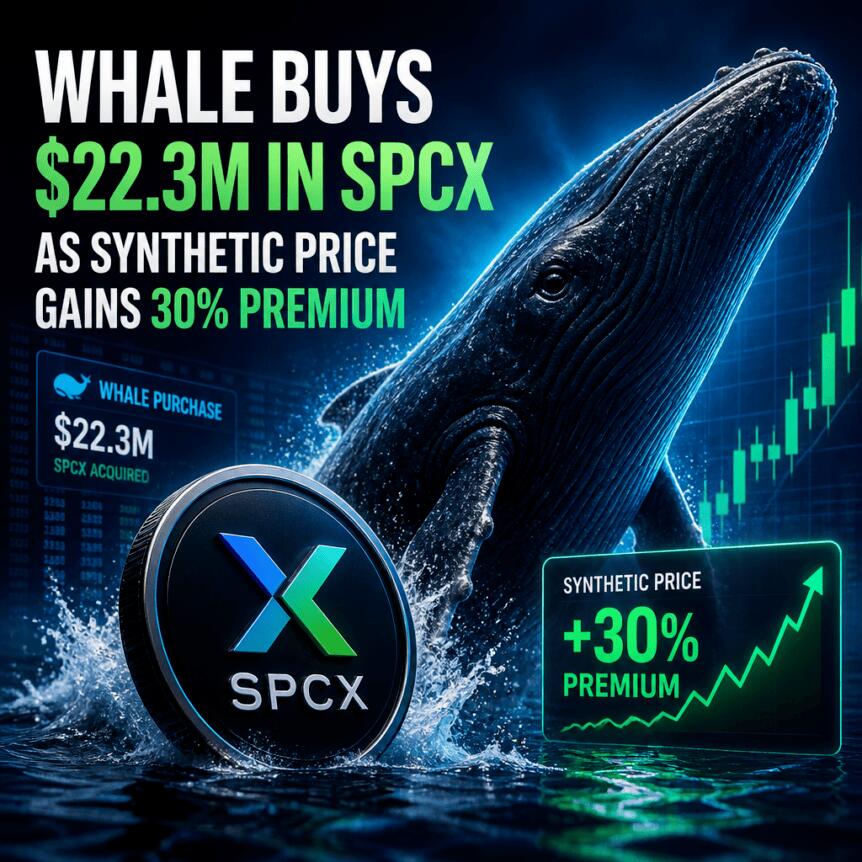
Crypto traders are already positioning around SpaceX’s IPO through a synthetic perpetual market, and one large account is sitting on paper gains—highlighting how quickly equity speculation can migrate into leveraged derivatives.
According to data on Hypurrscan, a whale has opened an isolated 2x leveraged long on “xyz:SPCX,” a synthetic pre-IPO perpetual contract tied to SpaceX. The position is currently valued at about $22.29 million and, based on entry and recent pricing, is showing more than $1.15 million in unrealized profit after only limited funding costs.
Key takeaways
- The whale’s isolated 2x long on synthetic SPCX is worth about $22.29 million, with unrealized profit of roughly $1.15 million.
- Synthetic SPCX trades near $175—around 30% above SpaceX’s $135 IPO offer price—suggesting traders expect a strong first-day move.
- IPO history cited from Jay Ritter’s research shows first-day outperformance often benefits offer-price holders more than late buyers.
- Multiple valuation estimates from traditional investors point to potential post-listing downside, which could matter for leveraged traders if prices revert.
A large leveraged bet already in the money
The Hypurrscan listing for address 0x9cc10bd3c7e2486c0ae4623e4f7cc3ff143fac56 shows the trader holding an isolated long position on xyz:SPCX. The notional size is about $22.29 million, and the account appears to have entered near $168.
With the synthetic market recently trading around $175, the whale’s position is left with an estimated unrealized gain of approximately $1.15 million. The position has reportedly incurred just over $500 in funding fees so far—an important detail for traders because funding can erode profits on leveraged perpetuals if the market remains on one side for long periods.
While the account shows strong mark-to-market performance, it also implies downside risk. The liquidation level is reported around $93.27; if SPCX were to fall to that threshold, the position could face an estimated loss of roughly $9.4 million.
Why synthetic SPCX is trading at a premium
SpaceX priced its IPO at $135 per share and plans to raise about $75 billion by selling roughly 555.6 million shares, putting the company’s valuation at around $1.77 trillion. The stock is expected to begin trading on Nasdaq under the ticker SPCX.
In the synthetic perpetual market, traders are effectively paying up. At roughly $175, SPCX is trading about 30% above the IPO price, according to the coverage and chart references cited in the original reporting. That premium implies crypto derivatives participants are leaning toward a strong early rally—potentially before broader equity trading fully reflects the listing.
Market-implied expectations across other platforms align with the same direction. Bloomberg cited derivatives “implied” valuations suggesting SpaceX could be priced around $2.4 trillion, more than 35% above the IPO valuation. Polymarket also reportedly placed odds that the company will land in a $2 trillion to $2.5 trillion market-cap range on the first day of trading.
For traders, the practical takeaway is that the synthetic market is not merely tracking the IPO; it is pricing in a sequence of outcomes. When the derivative premium is large, it can reflect optimism—but it can also set up crowded positioning, especially if the first prints in the equity market fail to match expectations.
IPO dynamics: first-day strength doesn’t always help later entrants
Even with a 30% premium signaling aggressive demand, IPO history cautions against interpreting early pricing as a durable trend—particularly for investors entering after the initial enthusiasm.
According to Jay Ritter’s IPO database (as cited in the original article), US IPOs from 2020 to 2025 averaged about 30% first-day gains. However, Ritter’s research also emphasizes that much of that upside accrues to investors who actually receive shares at the offer price. Buyers who arrive only after the opening print typically face a different setup as sentiment and order-flow normalize.
Ritter’s longer-run analysis (2001 to 2024) further indicates that companies with positive first-day returns averaged a 29.6% debut gain, but later underperformed the broader market by about 8.5 percentage points over the next three years. The pattern becomes sharper for higher-valuation offerings: IPOs with trailing sales above $100 million and price-to-sales ratios above 40 reportedly delivered an average three-year return of -44.8% for buyers at the first close.
The original reporting frames SpaceX as one of the most oversubscribed IPOs in recent memory, and it notes that the company is going public at nearly 94 times trailing sales—an attribute that, in Ritter’s framework, is associated with more challenging post-listing performance.
Recent listings cited as analogs underline how quickly “day-one” attention can fade. Cerebras (CBRS) reportedly opened significantly above its offer price, then declined sharply after the first session. The original article also references post-debut pressure in deals like Rivian (RIVN) and Uber (UBER), connecting part of the drawdown to the timing of lockup expirations that can increase supply.
Traditional valuation warnings add pressure to the bullish trade
Beyond derivatives pricing, traditional valuation perspectives also raise the question of whether synthetic SPCX’s premium is justified.
Morningstar’s Nicholas Owens, as cited in the original coverage, valued SpaceX at about $780 billion—roughly 55% below the IPO price—arguing that the stock appears significantly overvalued and that investors should wait for the share price to settle after listing.
NYU professor Aswath Damodaran, also cited, estimated fair value around $1.25–1.3 trillion and described the $135 offer as “rich.” Another view from analyst The Fundamental Investor, referenced via an X post, suggested the stock is likely to trade below the IPO price, potentially leaving early retail buyers underwater for years.
For crypto traders using leverage, these warnings matter because they intersect with the mechanics of perpetuals. If SPCX begins to mean-revert toward a range closer to offer-price expectations, leveraged longs—especially those initiated at the first signs of premium—can unwind quickly due to margin constraints and liquidation risk.
That makes the whale position’s margin profile a key monitoring point. With liquidation indicated around the low $90s, the trade has meaningful room on paper if the market stays elevated, but it also carries asymmetric risk if the IPO underwhelms relative to what the synthetic premium implies.
Going forward, readers should watch how the synthetic SPCX premium evolves once the IPO opens on Nasdaq—particularly whether early equity prints validate the ~30% uplift or trigger a rapid premium compression in the perpetual market. Until then, the gap between traditional valuation skepticism and crypto derivatives pricing is likely to remain the central tension for anyone taking leveraged exposure.

Coinbase has moved deeper into the AI-agent trend by launching “Coinbase for Agents,” a tool designed to let artificial intelligence models connect to a user’s Coinbase account to make payments and execute crypto trades on the user’s behalf.
Announced Thursday in a blog post, the offering targets a growing narrative across the sector: that increasingly capable AI systems will perform many small, repetitive transactions—such as automated trading routines and micro-payments—faster and more consistently than manual workflows.
Key takeaways
- Coinbase for Agents is intended to let AI models connect to a user’s exchange account and submit trades or strategies based on prompts.
- The company says agent payments can be enabled through Coinbase’s AI payments protocol x402, aimed at letting bots pay for data services involved in strategies.
- Access is offered via both a model context protocol (MCP) approach and a developer-friendly command-line interface.
- Coinbase also introduced “Coinbase Advisor,” an agent integrated into its app that the company describes as SEC- and CFTC-registered for advisory guidance.
- Recent academic research raises a caution: in studied cases, token holders reportedly lost more than agent treasuries gained on paper, and many projects showed limited proof of fully autonomous trading.
What Coinbase for Agents actually enables
Coinbase says Coinbase for Agents allows AI models such as ChatGPT and Claude to connect with a user’s exchange account. Once connected, the models can be prompted to place trades or carry out pre-defined trading strategies.
The tool is positioned for developers and integrations rather than as a standalone consumer feature. Coinbase said it will be available through two routes: via a model context protocol (MCP), which supports connecting AI models to external systems, and through a command-line interface for building and automating workflows.
The company’s framing emphasizes reduced oversight for users. In its description, the goal is to manage crypto activities “without the constant manual oversight,” including tasks like distributing funds to reward programs and scheduling recurring purchases.
Payments for agents via x402
Beyond trading, Coinbase says AI agents can also make payments using its AI payments protocol x402. The practical implication is that agents could pay for third-party services—such as data providers—needed to execute trading logic, without direct human involvement at every step.
This matters because many AI-agent use cases depend on pulling information from external systems in real time or near real time. If an agent cannot pay for those services, the workflow often breaks into manual steps. Coinbase’s approach suggests it is trying to reduce that friction by providing a payment channel built for automation.
Coinbase previously highlighted x402 in an AI-payments context, and the new announcement ties that capability directly to agent behavior—linking account connectivity, strategy execution, and agent-to-service payments within a single ecosystem.
Coinbase Advisor and the boundary between guidance and execution
Alongside Coinbase for Agents, Coinbase introduced “Coinbase Advisor,” an AI agent integrated into its app. Coinbase states that Coinbase Advisor is a US Securities and Exchange Commission and Commodity Futures Trading Commission-registered financial adviser and can offer guidance on trades.
The distinction between guidance and execution is likely to be important for users trying to understand risk and responsibility in automated systems. Coinbase’s broader agent tool is described as enabling AI models to connect to an exchange account and carry out prompts that can include trades. Coinbase Advisor, by contrast, is framed as advisory support inside the app.
Coinbase also offered an illustrative example of how agents could automate a routine: it described an ETH dollar-cost averaging scenario where an agent would pull 30 days of hourly price data, identify historically low times of day, then schedule a recurring $20 market buy at those times for a defined period.
Why the AI-agent pitch is gaining traction—and why it’s controversial
Coinbase’s launch lands during a period when many crypto infrastructure firms are betting that AI agents will become active participants across services, not just consumers. In the same general direction, Circle recently introduced tools intended to help AI agents use wallets, discover services, and make programmable payments with its token, with CEO Jeremy Allaire predicting that “billions of AI agents” will use stablecoins within five years. Earlier, Crossmint launched a service allowing AI agents to make payments using eligible Visa credit and debit cards.
There are also industry claims about real-world transaction volume involving autonomous agents. A report from crypto investment firm Keyrock in May said AI agents quickly created an “developed ecosystem,” citing $73 million settled across 176 million transactions between May 2025 and April 2026.
At the same time, a study published last month introduces a counterpoint that should temper expectations about fully autonomous performance. According to the research, conducted by teams including Pantera Capital, Stanford University, Ava Labs, and the Initiative for Cryptocurrencies and Contracts, investigators reviewed over 925,000 token holders. The paper reports that agent treasuries made gains of $30 million on paper, while token holders collectively lost $191.7 million.
The study also argues that many projects it examined did not provide clear evidence of autonomous trade execution, with a substantial share described as “basic API integrations.” In other words, the presence of an agent-like interface may not necessarily imply real autonomy in trading decisions or execution quality.
For investors and developers, that tension matters: if agent systems are not truly operating independently, or if incentives and outcomes are misaligned, the expected benefits—such as consistent execution or superior risk-adjusted returns—may not materialize for end users.
What to watch next
As Coinbase for Agents rolls out, users and builders should watch how Coinbase defines—and practically enforces—the line between AI planning, payment authorization, and actual trading execution, especially given recent research questioning the level of autonomy in some agent-driven token ecosystems. The next signals will likely be adoption details, integration documentation, and whether third-party evaluations confirm that these agents deliver value beyond the interfaces they provide.
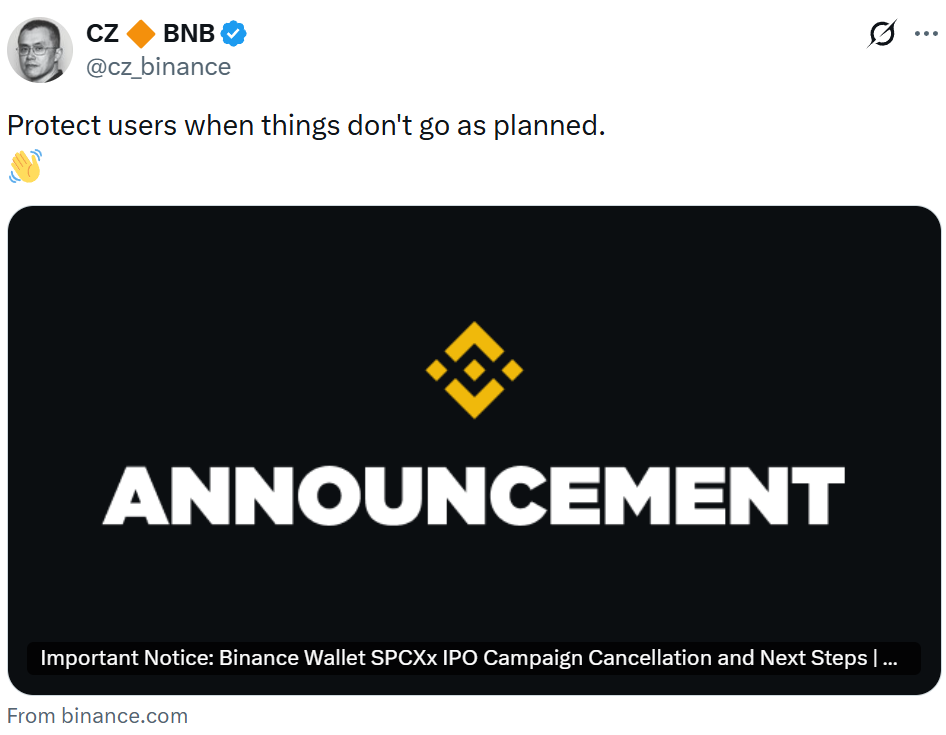
Crypto trading platforms Bybit, Binance, Bitget Wallet and MEXC canceled their tokenized SpaceX IPO campaigns and offered refunds for users as SpaceX went public on the Nasdaq on Friday.
SpaceX’s IPO, which was reported as more than four times oversubscribed, raised $75 billion as it became a publicly traded company. SpaceX shares opened for trading at $150 on Friday, up from its IPO price of $135. It closed the day at $161.11, valuing the company at over $2 trillion.
However, major crypto platforms offering tokenized access to the IPO were unable to fulfill demand for SpaceX allocations, with several blaming Kraken-owned xStocks’ inability to deliver the underlying assets.
Bybit, which was offering tokenized access to SpaceX through its new Bybit IPO Express, was one of the first to announce the cancellation.
“Due to xStocks’ inability to deliver the underlying assets, no SpaceX allocations were received. As a result, subscribed users will not receive SpaceX allocations.”
Binance’s SpaceX tokenized IPO campaign, which attracted over $557 million in USDC deposits, said it was unable to proceed to the campaign due to “circumstances outside of our control.” Binance Wallet was also relying on xStocks.
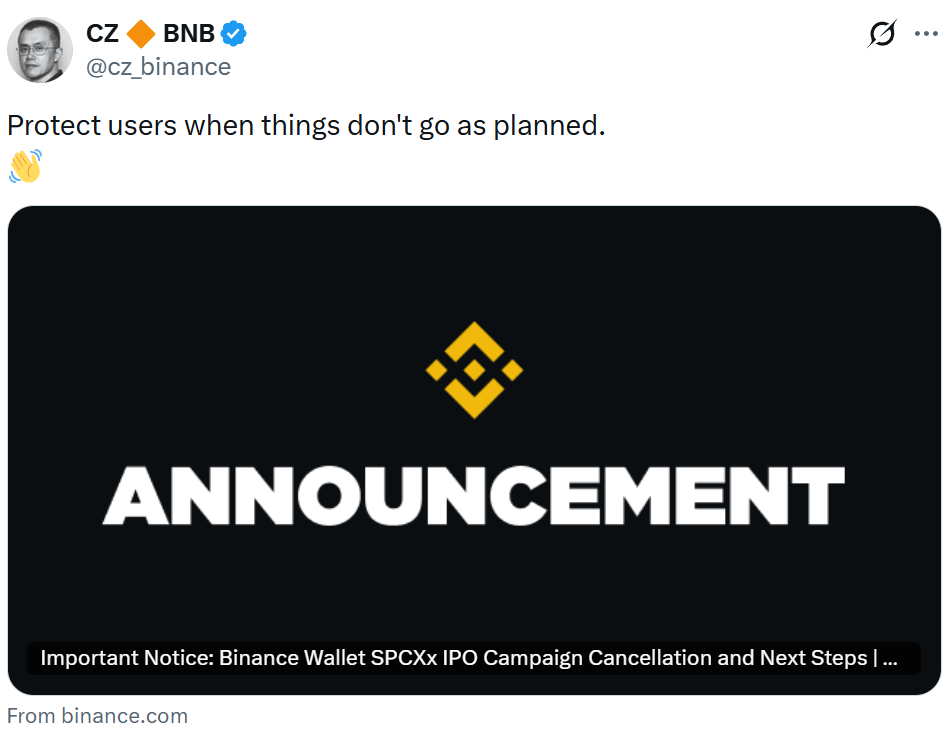
Source: Changpeng Zhao
Bitget Wallet and MEXC also said they would be refunding affected users after being unable to secure an allocation of xStocks’ tokenized SPCX.
Related: Bitcoin surfs SpaceX IPO at $64K as trader warns key BTC price support may crumble
“It’s disappointing that this didn’t work out in the end. We are in the process of sending out the refunds,” Bitget Wallet chief operating officer Alvin Kan said on X.
“Yes, we have hit a setback, and trust in the industry has taken a blow, but we’ll come out of this stronger,” he added.
Magazine: Does ‘Paper Bitcoin’ mean there’s an unlimited supply of BTC?


OpenAI has expanded its banking footprint through a deal that will bring ChatGPT Enterprise to all 120,000 BBVA employees, up from the 11,000 staff members already using the platform.
Summary
- BBVA will expand ChatGPT Enterprise access from 11,000 employees to its entire global workforce of 120,000 staff across 25 countries.
- The bank plans to use OpenAI technology for customer services, risk analysis, software development, and internal productivity tools.
- The agreement adds to OpenAI’s growing presence in financial services following its recently announced partnership with Visa on AI powered commerce and payments.
According to OpenAI, the multi-year agreement with BBVA will extend ChatGPT Enterprise across the bank’s operations in 25 countries and support the development of new AI-powered tools for customer service, risk analysis, software development, and internal operations.
The deployment represents a tenfold increase from BBVA’s current rollout and ranks among the largest generative AI implementations in the financial services sector. OpenAI said the bank will also work directly with its product, research, and technology teams as it expands AI across customer-facing and internal functions.
“We were pioneers in the digital and mobile transformation, and we are now entering the AI era with even greater ambition. Our alliance with OpenAI accelerates the native integration of artificial intelligence across the bank to create a smarter, more proactive, and completely personalized banking experience, anticipating the needs of every client,” – Carlos Torres Vila, Chairman, BBVA.
The agreement arrives as OpenAI continues to deepen its presence across financial services. Just one day earlier, payments giant Visa announced a strategic partnership with OpenAI as part of its new agentic commerce initiative, designed to enable secure Visa payments inside AI-driven shopping experiences.
BBVA expands AI rollout after early results
Nearly two years after the first deployment began, OpenAI said BBVA had already rolled out thousands of custom GPTs across the organization. The bank initially introduced 3,300 ChatGPT accounts in May 2024 before expanding access to 11,000 employees.
OpenAI reported that workers using the tools saved close to three hours per week on routine tasks, while more than 80% of users engaged with the platform daily.
Building on those results, BBVA will now extend ChatGPT Enterprise to its entire workforce. The rollout includes access to OpenAI’s latest models, privacy and security controls, and tools that allow employees to create internal AI agents connected to BBVA systems.
Additional training programs will also be developed under the agreement to support adoption across different departments and business units.
“BBVA is a strong example of how a large financial institution can adopt AI with real ambition and speed,” said Sam Altman.
“With this expansion of our work together, BBVA will embed our AI into the core of their products and operations to enhance the overall banking experience for their customers.”
OpenAI pushes further into enterprise and banking services
Beyond workplace productivity, OpenAI said BBVA is using its models to build customer-facing services. The bank has already launched an AI assistant called Blue, which helps customers manage accounts, cards, and other banking tasks through natural-language interactions.
As part of the latest partnership, BBVA is also exploring ways for customers to interact directly with banking products and services through ChatGPT.
The announcement adds another large enterprise customer to OpenAI’s growing commercial business. OpenAI said more than one million business customers, including Deutsche Telekom, Virgin Atlantic, and Accenture, now use its products.
Growing enterprise adoption comes as OpenAI prepares for a possible public market debut. Earlier this week, reports said the company had confidentially filed for a U.S. initial public offering and could seek a valuation of up to $1 trillion.


Anthropic said it suspended access to its Fable 5 and Mythos 5 AI models after receiving a US government export control directive citing national security concerns.
In a statement posted Friday, Anthropic said it received the directive at 5:21 pm ET, instructing it to suspend all access to Fable 5 and Mythos 5 by any foreign national, whether inside or outside the United States, including foreign national Anthropic employees.
Anthropic abruptly disabled the models for all users in order to ensure compliance. It said all other Anthropic models, such as Opus 4.8, are not affected.
“We are complying with the government’s legal directive and are removing access to Fable 5 and Mythos 5 for all users,” the firm said.
The directive comes just days after Anthropic released Fable 5 and Mythos 5, two powerful AI models built on top of Mythos Preview, a general-purpose language model that the company previously said had found thousands of vulnerabilities in critical software.
Anthropic said the government did not provide specific details about the alleged threat, but said it believes authorities are concerned about a possible “jailbreak” method capable of bypassing Fable 5’s safeguards.
Related: AI researcher claims he’s already bypassed Anthropic’s Fable 5 guardrails
“To date, the government has only given us verbal evidence of a potential narrow, non-universal jailbreak, which essentially consists of asking the model to read a specific codebase and fix any software flaws,” said Anthropic.
A non-universal jailbreak is a far lower threat than a “universal jailbreak,” a method to broadly bypass a model’s safeguards, it explained.
“We disagree that the finding of a narrow potential jailbreak should be cause for recalling a commercial model deployed to hundreds of millions of people. If this standard was applied across the industry, we believe it would essentially halt all new model deployments for all frontier model providers,” it added.
Anthropic said it believes the government order is a result of a misunderstanding and is working to restore access for users as soon as possible.
Magazine: Does ‘Paper Bitcoin’ mean there’s an unlimited supply of BTC?
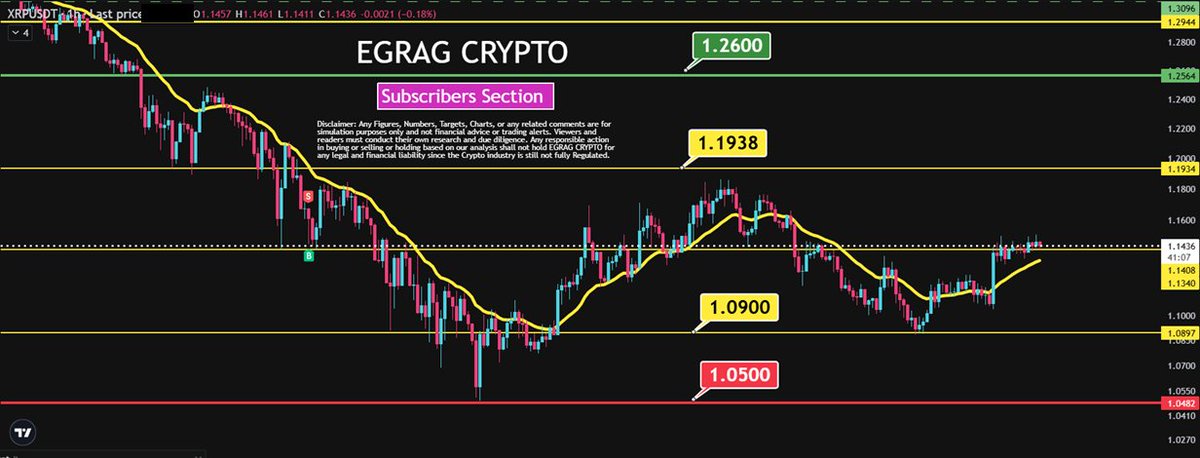
XRP is holding a crucial short-term support zone as analyst EGRAG Crypto maps a possible breakout path toward $1.26. The token remains near $1.14 after rebounding from $1.09, while whale activity adds pressure to the recovery setup. With resistance at $1.1938 and deeper support near $1.05, XRP’s next move depends on whether buyers can defend the current range.
Key Insights
- EGRAG Crypto says XRP bulls must defend $1.1340 to $1.1408 to keep short-term control intact now.
- Ali Charts reported whales offloaded roughly 60 million XRP, adding pressure to the recovery setup.
- TradingView analysis shows XRP faces resistance near $2.40 to $2.50 after a strong daily breakout move.
Xrp Bulls Defend Key Short-Term Support
XRP traded near $1.1436 as analyst EGRAG Crypto said the token remained above an important short-term support range. The analyst identified the $1.1340 to $1.1408 area as the zone that buyers need to defend to keep control on the lower time frame.
EGRAG Crypto said XRP recently bounced from the $1.0900 support level, which acted as an important demand area on the chart. Buyers pushed the price back above the short-term moving average, keeping the recovery structure active while the token consolidated near the mid-range.

The analyst marked $1.1938 as the first major resistance for XRP. A clean move above that level could open the way toward $1.2600, which was listed as the next upside target if momentum expands.
On the downside, EGRAG Crypto identified $1.0900 as the main support level and $1.0500 as the deeper invalidation zone. A loss of the current support range could send XRP back toward $1.0900, while a break below $1.0500 would weaken the recovery setup.
Whale Balances Add Pressure To Recovery Setup
Market analyst Ali Charts reported that large XRP entities have reduced exposure over the past week. According to the analyst, active whales offloaded roughly 60 million XRP instead of absorbing circulating supply during the current recovery attempt.
The whale data showed a decline in large-holder balances from May 29 through June 1. This movement suggested that some major wallets were distributing tokens while XRP remained below important resistance levels.

Ali Charts’ data also showed a mild recovery in whale holdings after balances moved near 3.75 billion XRP. Holdings increased for two consecutive sessions, suggesting some limited accumulation may have returned after the earlier decline.
However, whale balances had not recovered to the 3.80 billion to 3.82 billion XRP range at the time of the update. Until that area is regained, the broader whale trend remains weaker than it was before the recent selling phase.
Xrp Price Daily Chart Shows Higher Recovery Zone
TradingView-based daily chart analysis showed XRP finding strong support around the $1.80 to $1.85 area, where sellers failed to push the price lower after several attempts. That range acted as an accumulation zone before the latest upside move developed on the chart.
The recent green candles showed a breakout above the $2.00 and $2.10 levels. Price then moved toward the $2.30 to $2.35 area, which marked a major short-term recovery zone after weeks of weakness.

Volume increased sharply during the breakout, which supported the bullish move and showed broader market participation. A breakout backed by rising volume is generally viewed as stronger than a low-volume move because it reflects wider buyer activity.
The next key resistance sits near $2.40 to $2.50 on the daily chart. If XRP closes above this zone, the next upside target could be around $2.60 to $2.70, while the first support now sits near $2.10 to $2.15 and a deeper correction could bring price back toward the $2.00 psychological level.
Crypto World
SHRMiner launches free cloud mining service for BTC, XRP, ETH holders, offering daily earnings of up to $17,700+

Disclosure: This article does not represent investment advice. The content and materials featured on this page are for educational purposes only.
SHRMiner introduces a free mining service enabling BTC, XRP, and ETH holders to earn passive crypto income.
Summary
- SHRMiner promotes free cloud mining for BTC, XRP, and ETH, claiming easy passive crypto income without hardware.
- The cloud mining platform targets beginners with mobile access and simplified crypto mining via rented computing power.
- SHRMiner highlights large-scale global mining farms and renewable energy use while offering “free” crypto mining services.
As cryptocurrency gains increasing global popularity, more and more investors are looking for ways to generate steady passive income without the need for expensive equipment or specialized skills.
SHRMiner’s new free mining service enables holders of BTC, XRP, and ETH to easily earn passive income without requiring costly hardware or technical expertise.
In the rapidly evolving world of cryptocurrency, ease of use and high returns are paramount. For those seeking an accessible way to earn a steady income with minimal hassle, cloud mining stands out as a highly attractive option. This article delves into the concept of cloud mining and—using the leading brand SHRMiner as an example — explains how it can help generate daily earnings of $7,900 or even more.
The appeal of cloud mining
Cloud mining has long been favored by cryptocurrency enthusiasts for its ease of use and convenience. Unlike traditional mining, it eliminates the need for expensive hardware, specialized technical expertise, or constant monitoring. Cloud mining simplifies the process, enabling anyone — regardless of experience level — to participate in the cryptocurrency revolution. Instead of investing in costly mining equipment and managing complex systems, users can simply rent mining capacity from remote data centers and earn a share of the profits.
Recently, SHRMiner, a UK-based cloud mining platform, officially launched a new “free cloud mining service.” This service is designed for holders of mainstream cryptocurrencies such as BTC, XRP, DOGE, LTC, and EHT, providing users with a new opportunity to participate in cryptocurrency mining without any entry barriers.
At the same time, SHRMiner has launched a new mobile app that enables users to manage their mining activities anytime, anywhere, effectively ushering in the “era of mobile mining.”
SHRMiner: The perfect blend of laziness and profit
SHRMiner takes the simplicity of cloud mining to the next level, making it an ideal choice for beginners. Its user-friendly interface ensures that even those new to cryptocurrency can get started with ease. For SHRMiner, simplicity is not a drawback but a pathway to success.
As a pioneer in cloud mining, SHRMiner operates over 150 mining farms worldwide — equipped with more than 600,000 mining units powered entirely by renewable energy—and has earned the trust and support of over 5 million users thanks to its stable returns and robust security.

How can SHRMiner become a source of passive income?
Start earning mining rewards in just three simple steps:
1. Register an account
By visiting the official SHRMiner website,users can register for a free account in less than two minutes and receive a $15 sign-up bonus; this bonus allows them to quickly experience the platform’s services and earn a daily return of $0.60 from a complimentary trial contract.
2. Select a cloud mining plan
Choose a cloud mining plan that suits particular needs and budget. The platform offers flexible plans ranging from $100 to $200,000 to meet the investment goals of different users.
3. Start earning returns
After purchasing a contract, earnings are automatically settled within 24 hours without requiring additional management or action; users can withdraw their earnings to their cryptocurrency wallet addresses at any time or reinvest the profits to benefit from the compounding effect.
The primary advantage of this model is that it significantly lowers the barrier to entry. Users do not need to research specific mining hardware models or hashrate configurations, nor do they need to set up their own system environments; simply by registering an account, depositing assets, and selecting a mining plan, they can start earning returns.
SHRMiner Platform Advantages:
- Supports daily automatic settlement
- No additional electricity or maintenance costs required
- Utilizes advanced ASIC mining hardware, powered by renewable energy sources, including hydropower, wind power, and solar power
- Supports mining for multiple currencies: earn mainstream cryptocurrencies such as BTC, XRP, ETH, DOGE, USDC, USDT, SOL, LTC, and BCH.
- Equipped with SSL encryption and DDoS protection, a real-time earnings dashboard for easy monitoring of mining performance
- 100% remote access, fully accessible via the SHRMiner application or browser without hardware requirements, and 24/7 online technical support
- Affiliate Program: The Affiliate Program allows users to earn up to 4.5% commission by referring friends, with the opportunity to earn an additional bonus of up to 30,000.
Examples of common contracts:
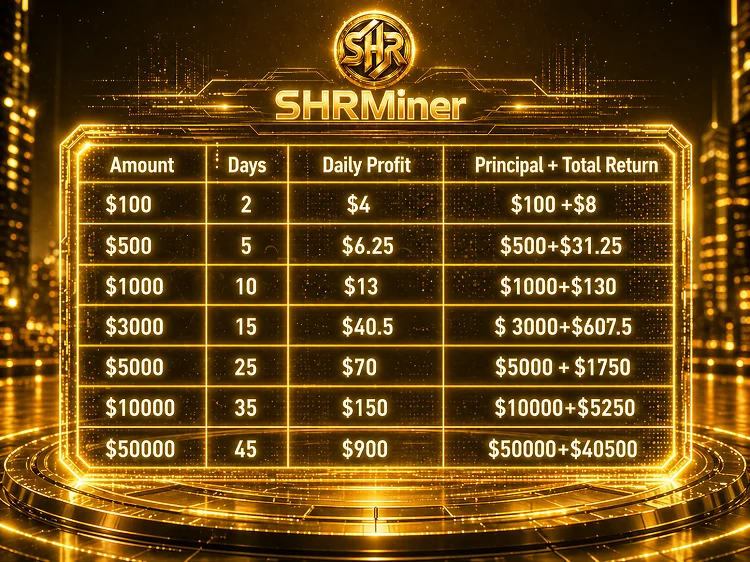
After purchasing a contract, earnings will be automatically credited to a specified account within 24 hours. Upon contract expiration, the principal will be returned in full. Users may withdraw the principal or reinvest it to benefit from compound returns; please click here for more details regarding the mining contract.
Unimaginable money-making opportunities
What sets SHRMiner apart is its extraordinary daily passive income; users have the opportunity to earn $7,900 or even more each day, turning the dream of online wealth into reality. Imagine generating substantial income without the need for ongoing investment or complex setups — that is exactly what SHRMiner offers.
Safety and Sustainability
In the mining sector, trust and security are paramount; SHRMiner fully recognizes this and prioritizes user safety above all else. Committed to transparency and legitimacy, SHRMiner ensures investment is protected, allowing users to focus on profitability. All mining facilities utilize clean energy, making this a carbon-consciouscloud mining operation. Renewable energy protects the environment from pollution while providing a powerful energy source.
In short
For those who are looking for ways to generate passive income, cloud mining could be a choice worth exploring. When approached correctly, these opportunities allow investors to effortlessly build cryptocurrency wealth on “autopilot” with minimal time investment. At the very least, they are far less time-consuming than any form of active trading. Passive income is the ultimate goal for every investor and trader, and with SHRMiner, maximizing passive income potential is easier than ever.
To learn more about SHRMiner, visit the official website.
Disclosure: This content is provided by a third party. Neither crypto.news nor the author of this article endorses any product mentioned on this page. Users should conduct their own research before taking any action related to the company.
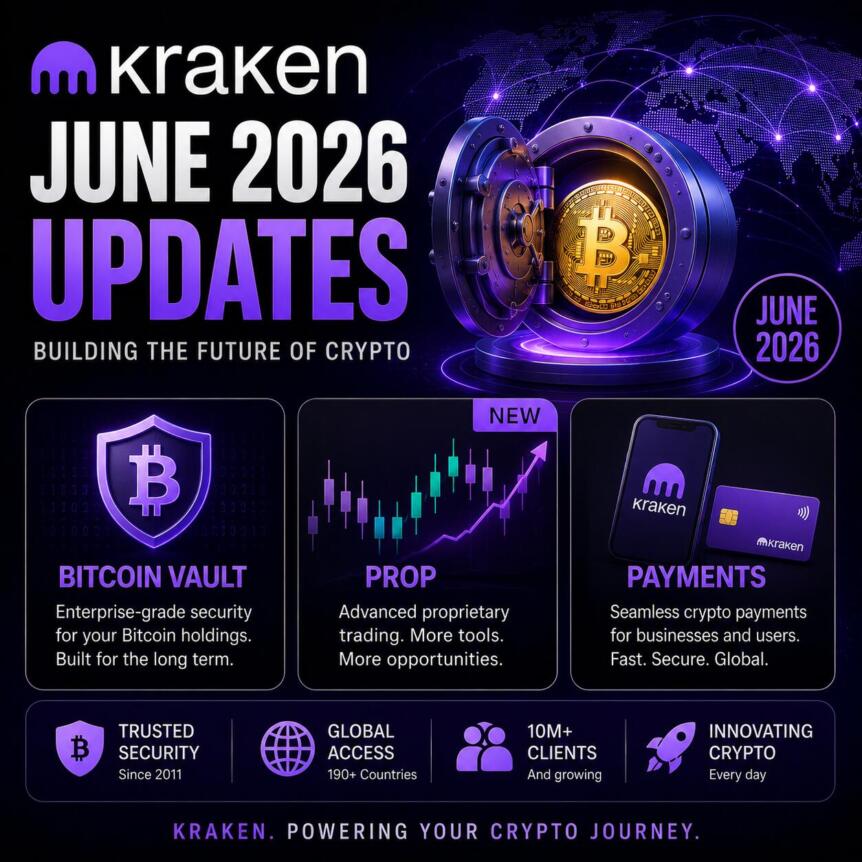
Kraken has outlined a broad set of product and partnership updates for June 2026, spanning retail trading tools, “earn” features denominated in crypto, and new infrastructure links for payments and stablecoins. The announcements arrive as exchanges continue to compete on usability, distribution, and regulated access to higher-risk trading products.
Bitcoin-denominated rewards move in-house
One of Kraken’s headline offerings is Bitcoin Vault, described as a way for long-term BTC holders to earn BTC-denominated rewards directly from their Kraken accounts. The announcement positions the product as designed to avoid external wallet usage and to require no DeFi knowledge, with a stated 1-day lockup period.
For market participants, “earn” products that settle in the same asset they advertise can be attractive because they reduce day-to-day operational friction. At the same time, investors typically need to evaluate how rewards are sourced and how staking or custody terms affect liquidity and risk. Kraken’s framing suggests a tighter integration with the exchange account experience, which may broaden participation among users who do not want to navigate separate protocols.
Kraken Prop expands access to funded trading
Kraken also introduced Kraken Prop, characterized in the update as a funded trading program. According to the details shared in the announcement, participants access wallets after an evaluation process, with capital of up to $200,000 available. The profit split is described as up to 90% of eligible profits, and the program includes 60-plus crypto trading pairs, including BTC and ETH.
The program’s structure is notable in how it mirrors a broader trend across crypto trading education and “pro” funding models. These programs are often marketed to traders who want exposure to larger size without directly funding the full risk capital. For the exchange, they can also increase trading activity density if funded participants become repeat users.
As always, prospective traders typically need to review evaluation rules, eligibility criteria, withdrawal mechanics, and any restrictions on trading strategy, since these factors determine whether the product functions as a path to consistent returns or as a short-term contest with performance filters.
Spot margin and trading availability for US users
On the US trading side, Kraken said that Spot Margin is now available on Kraken Pro for CFTC-regulated spot margin trading to US retail traders. Separately, Kraken referenced additional spot margin availability through six new pairs for US spot margin traders.
The shift matters because margin offerings can change how retail participants construct portfolios, manage exposure, and respond to volatility. While spot margin does not introduce derivatives in the same way perps do, it still increases leverage and liquidation risk. Market observers generally look for how exchanges operationalize risk controls, including margin requirements, liquidation processes, and product eligibility by jurisdiction.
Perpetual futures, CFTC framing, and regulatory segmentation
Kraken also said it is set to launch what it describes as its first CFTC-regulated perpetual futures for US traders. The announcement does not provide trading terms, dates beyond “set to launch,” or additional specification details in the email text provided, but it signals continued expansion of regulated derivatives access.
For exchanges, regulated perpetual offerings can be a balancing act. They require compliance scaffolding and clear risk disclosures, while still competing with offshore venues that often offer broader product flexibility. For traders, the availability of regulated perps can impact execution quality, reporting expectations, and how institutions or compliance-conscious users evaluate venue selection.
Payments and stablecoin infrastructure partnership
Beyond trading, Kraken highlighted a partnership with Tempo focused on global payments and stablecoin infrastructure. The update also stated that USDT0 deposits and withdrawals are now available on Tempo, and that Tempo supports those transfers.
Stablecoin settlement and payment rails are increasingly important for exchanges, particularly where user demand includes faster cross-border movement and more predictable operational workflows. Still, users generally need to distinguish between stablecoin availability, network routes, settlement timelines, and withdrawal finality, since those operational details can vary by infrastructure provider and jurisdiction.
Additional retail features: staking and “Auto Earn”
Kraken’s June update package also includes further staking and earn-style product additions. The email references HYPE staking and Auto Earn as a way to put idle HYPE to work, alongside AVAX staking and Auto Earn for AVAX holders.
These features reflect a pattern common across large exchanges: integrating staking or reward logic into the main account experience rather than forcing users to interact with external staking contracts. The practical value is typically convenience, but the key for users is understanding lockups, reward frequency, and any conditions that affect how assets can be moved or sold.
Tokenized IPO access and other product additions
Kraken also referenced access to the SpaceX IPO via xStocks. In addition, it listed other product and listing-related items, including new asset listings and additional features tied to deposits and withdrawals across supported networks.
Tokenized IPO access is an area where marketing claims can outpace details, so investors usually look for disclosures around underlying issuers, instrument structure, custody, redemption or transferability, and regulatory constraints. The email text provided notes availability, but it does not include instrument terms in a way that would allow full verification of those mechanics.
What these updates signal for the market
Taken together, Kraken’s June 2026 announcements point to three strategic priorities for the exchange and, by extension, the broader market.
- Account-based “earn” products. Bitcoin Vault and Auto Earn features aim to keep rewards within the exchange workflow, reducing friction for users who prefer not to interact with separate protocols.
- Growing regulated trading depth. Spot margin availability and planned CFTC-regulated perpetual futures suggest Kraken is continuing to broaden the range of regulated trading tools available to US retail participants.
- Infrastructure partnerships tied to stablecoin payments. The Tempo collaboration indicates continuing investment in settlement and cross-border payment functionality, which can influence how quickly and reliably users move assets.
For users, the immediate relevance is practical: new products can alter trading options, liquidity planning, and how returns are realized. For the industry, the bigger takeaway is that exchange competition is increasingly about integration quality, regulatory scope, and how well products match user expectations for convenience and speed.

When will Ronaldo and Messi play their first FIFA World Cup 2026 matches? | FIFA World Cup 2026

NanoClaw and JFrog launch ‘immune system’ to block AI agents from downloading malicious code

Rugby legend Kevin Sinfield knighted for sport and MND work


![BITCOIN: CRAZY!!!! THIS IS CRAZY!!!! [trades]](https://wordupnews.com/wp-content/uploads/2026/05/1778214197_maxresdefault-80x80.jpg)

-
 Entertainment6 days ago
The Best Mystery Series of All Time Is Surging on Streaming 30 Years After It Ended
-

 NewsBeat5 days ago
Alexander Zverev wins the French Open to finally earn a 1st Grand Slam title
-

 Crypto World5 days ago
Anatomy of the June crypto crash: Fed, Iran, Saylor
-

 Crypto World1 day ago
Oppenheimer backs SpaceX as $70 billion retail frenzy builds
-

 Crypto World1 day ago
Markets Rally as SpaceX IPO Looms Amid Iran Tensions and Inflation Surge
-
 Crypto World6 days ago
Senator Cynthia Lummis Calls CLARITY Act the Most Consequential Financial Legislation of This Generation
-
 NewsBeat5 days ago
Alexander Zverev conquers demons and outlasts Flavio Cobolli to win French Open for first major title
-

 Tech6 days ago
Microsoft unveils seven homegrown AI models in new bid for ‘long term self-sufficiency’
-

 Business5 days ago
High Stakes for Wembanyama as New York Pushes for 3-0 Lead
-

 Tech7 days ago
Hackers now exploit SolarWinds Serv-U flaw to crash servers
-
 Business6 days ago
The Pain Points Taking a Fragile Tech Rally Down a Notch
-
 Crypto World5 days ago
Eli Lilly (LLY) Stock Surges 4% Following Breakthrough Sleep Apnea Trial Results
-

 Tech5 days ago
Notion restores access to Anthropic after service disruption
-

 Crypto World6 days ago
Trump’s AI Ownership Plan Could Benefit Anthropic at OpenAI’s Expense
-
 Business6 days ago
The investment to transform historic St Helen’s ground in Swansea
-
 Sports3 days ago
Bangladesh beat Australia after 20 years in ODIs, register only their second win over six-time world champions | Cricket News
-

 Business7 days ago
Forensic Expert Floats Handyman Theory in Disappearance of Savannah Guthrie’s Mother
-

 Tech2 hours ago
NanoClaw integrates JFrog registries to secure AI agent downloads
-

 Tech13 hours ago
This Week In Security: Microsoft On Microsoft, Register Your Domains, Linux On ARM, And FreeBSD Joins The File Cache Club
-

 Sports2 days ago
First Time Since 1971: Australia Register Historic Low In ODI Cricket
You must be logged in to post a comment Login