

Crypto World
How to convert XRP, BTC into $1200 daily passive income during a crypto market downturn



Disclosure: This article does not represent investment advice. The content and materials featured on this page are for educational purposes only.
XRPPower unveils AI-driven digital asset platform focused on automation, transparency, and data traceability.
Summary
- XRPPower combines AI-driven analytics and automated management tools to offer a digital asset platform focused on transparency, traceability, and operational efficiency.
- The company says it follows international compliance practices, incorporates risk-management frameworks used by major consulting firms, and monitors evolving financial regulations.
- XRPPower highlights security measures including 2FA, encryption, DDoS protection, KYC verification, AML controls, and real-time risk monitoring to protect users and platform operations.
In the recent volatile cryptocurrency market, more and more investors are realizing that relying solely on price increases to generate profits is becoming increasingly difficult. The market’s sharp fluctuations not only test investors’ patience but also place immense psychological pressure on many long-term holders.
A Bitcoin investor from the United States shared his experience: he bought 10 BTC at nearly $100,000 during the market peak in 2025, expecting the price to continue rising. However, as the market corrected, the price of Bitcoin fell to around $70,000, resulting in a significant reduction in his account assets. This is not an isolated case; many cryptocurrency investors have experienced similar market volatility and are beginning to rethink how to achieve stable returns in bear markets and volatile market conditions.
Entering 2026, with the rapid development of fintech and artificial intelligence, the digital asset industry is undergoing a new transformation. XRPPower combines an AI intelligent analysis system with automated management technology to launch a brand-new digital asset service model. The platform prioritizes transparency, data traceability, and process verification. Through an intelligent system, it reduces human interference, providing users with a more convenient and efficient experience.
How to join XRPPower and experience its AI-powered intelligent profit model?
1. Register an Account
2. Choose a Contract Plan
The platform offers various contract plans with investment periods ranging from $100 to $100,000. Users can choose a suitable profit model based on their needs and financial plans.
3. Activate the Contract
Users can use XRP, BTC, and other mainstream cryptocurrencies to pay contract fees and activate the contract.
4. Earn Profits
Once the contract becomes active, profits will be automatically credited to the account balance according to platform rules. Users can choose to withdraw directly or continue participating in other contract plans for more profit opportunities.
5. Invite Friends
Invite friends to register and join XRPPower to earn up to 3% + 2% team rewards. As the team grows, users can continue to enjoy corresponding reward benefits.
XRPPower platform security and compliance guarantees
1. International compliance management
Headquartered in London, UK, XRPPower continuously monitors global digital financial regulatory developments and references international financial industry compliance standards to constantly improve its platform operation system, providing users with a safer and more transparent service environment.
2. International audit and risk control
The platform references the risk management concepts of internationally renowned institutions such as PwC, Deloitte, EY, and KPMG to continuously improve internal management, operational transparency, and risk control levels.
3. Multi-layered security protection system
XRPPower employs bank-grade data encryption technology, multi-factor authentication (2FA), an enterprise-grade DDoS protection system, and a real-time risk monitoring mechanism to comprehensively protect user accounts, data, and assets.
4. User security and privacy protection
The platform strictly implements KYC identity authentication and AML anti-money laundering management mechanisms and has established a comprehensive data security and privacy protection system, committed to creating a safe, stable, and reliable digital service platform for global users.
About XRPPower
To date, XRPPower has attracted users from numerous countries and regions worldwide. The platform consistently adheres to the core development principles of security, transparency, and innovation, providing users with a more stable and convenient digital service experience through a continuously improving security system, intelligent technical support, and a global service network. In the future, XRPPower will continue to focus on user needs, continuously driving technological innovation and ecosystem development to help more users seize the development opportunities of the digital economy era.
Join XRPPower now and embark on a new digital journey, letting action create value and opening up more possibilities for the future.
For more information, visit the official website and download the mobile app.
Disclosure: This content is provided by a third party. Neither crypto.news nor the author of this article endorses any product mentioned on this page. Users should conduct their own research before taking any action related to the company.


Bitcoin (BTC) dropped below $62,000 on June 4, with the move coinciding with the first meaningful pullback in the flagship cryptocurrency’s dominance in nearly eight months, according to analyst CrediBULL Crypto.
This has prompted several observers to revisit the possibility of an altcoin-led market phase, as the assets have shown unusual resilience during BTC’s decline, a pattern that in the past appeared near major turning points in crypto market cycles.
What the Charts Are Showing
According to CrediBULL, the largest altcoin rally of the 2017 cycle started only after Bitcoin had already fallen 50% from its peak, stabilized, and then set off on a recovery run. That’s when the altcoin market cap tripled off the lows and pushed to new all-time highs.
They believe a similar setup may be developing now with BTC trading more than 50% below the all-time high it set in October 2025, and many altcoins having avoided the type of collapse seen in past bear markets.
“Many are noticing the relative strength in alts at these levels as BTC melts but many alts hold relatively ‘steady,’ sending BTC dominance down in the first significant pullback on BTC dom that we have had in nearly 8 months,” he wrote.
In a follow-up exchange, the analyst suggested there could be a series of “mini altseasons” leading up to a larger one that would arrive after a Bitcoin blow-off top that hasn’t happened yet.
There was a similar assessment of the market earlier this week from another analyst, Sykodelic, who described it as “an exhausted market in which alts are no longer responding to weakness.” They also noted that the OTHERS.D chart had closed above its 200-day moving average, a level that helped spark outsized moves in smaller tokens in the past.
However, Daan Crypto Trades offered a more cautious read, saying that the total altcoin market cap excluding stablecoins has been range-bound for more than 2 years, and the recent strength in the category that everyone has been talking about has mostly been carried by a handful of tokens.
“For this to properly bounce, you’d need more life out of the likes of ETH and other majors,” he stated.
Indeed, ETH just touched a 14-month low near $1,700, with others in the top 10 losing between 8% and 4% in the last 24 hours. Across seven days, only Hyperliquid’s HYPE token held up, gaining over 18% in that period while every other cryptocurrency with an 11-figure market cap and above faltered badly.
What of Bitcoin?
At the time of writing, BTC itself was down nearly 7% in one day and over 13% in the past week. It was trading at around 500 bucks below $63,000, having earlier fallen to a four-month low of about $61,000.
The move wiped out more than 270,000 leveraged traders in 24 hours, with more than $1.6 billion in total liquidations, a majority of which were long positions. And the situation is just as bad around spot Bitcoin ETFs, which have already seen $1.4 billion in outflows in the first three days of June, per data from SoSoValue.
The post Analyst: BTC’s 50% Drop Could Be Setting Up a 2017-Style Altcoin Rally appeared first on CryptoPotato.


Plume and Ether.fi have launched a yield-bearing real-world asset vault with a $100 million exclusive allocation from Ether.fi.
Summary
- Plume and Ether.fi launched a yield-bearing RWA vault with a $100 million exclusive allocation.
- Ether.fi users can access tokenized real-world asset yield directly through the ether.fi app.
- Plume said the vault includes institutional assets such as credit pools, CLOs, and bond ETFs.
- Ether.fi said demand is rising for earn products with institutional-grade risk and lower DeFi exposure.
According to the press release, the allocation comes from ether.fi’s liquidity provider base, including funds, family offices, and high-net-worth individuals. Charles Mountain, ether.fi’s head of ecosystem, said in the press release that the capital also includes managed funds from Ether.fi’s liquid ETH, liquid USD, and liquid BTC vaults, which hold about $300 million in total value locked.
Ether.fi adds RWA yield through Plume
Mountain said Ether.fi is seeing strong demand for earn products with institutional-grade risk and less exposure to DeFi complexity. Through the new product, ether.fi users can access tokenized real-world asset yield directly inside the ether.fi app.
According to Mountain, the integration of Plume Nest Vaults gives users access to institutional-grade real-world asset yield through a platform they already use. He said such products were previously available mainly to select investors.
Plume said users have been looking for more stable yield options after periods of volatility and exploit risks across DeFi. The company described the vault as part of a changing on-chain yield market, where investors want structured products with clearer risk controls.
Plume built Vaults around Ether.fi demand
Plume co-founder and CEO Chris Yin told The Block that Plume spent several months studying demand from ether.fi and its users. After that process, Yin said Plume sourced assets, completed due diligence, and built vaults that matched ether.fi’s needs as a partner and platform.
The vault is designed to bundle several institutional asset strategies into one product, according to Plume. Rather than requiring users to manage different positions manually, the structure allows deposits and withdrawals through a single vault product.
Plume said its RWA vaults work in a similar way to structured income products. The company said the vaults provide exposure to a basket of institutional assets, including overcollateralized credit pools, AAA-rated collateralized loan obligations, and total bond market exchange-traded funds.
Tokenized asset products gain traction
The launch comes as tokenized real-world assets continue attracting large financial institutions. Plume said the assets used in its vaults come from managers that collectively oversee more than $10 trillion.
Over the past year, firms such as Apollo, WisdomTree, Hamilton Lane, and BlackRock have expanded tokenization work as investors seek blockchain-based access to traditional financial products.
Vault products have become one route for packaging tokenized yield opportunities, according to Plume. The company said this model can reduce the need for users to interact with several protocols separately.
Plume said its vaults are non-custodial and built with compliance controls. The company linked that approach to its Bermuda Monetary Authority license and its Securities and Exchange Commission transfer agent approval through Kimber Transfer Agency.
Meanwhile, Ether.fi’s role gives the vault immediate access to one of the better-known restaking and crypto yield user bases. Ether.fi is also one of the largest crypto card providers, according to the company.
US spot Bitcoin exchange-traded funds posted a 13th consecutive session of net outflows on Wednesday, stretching the longest withdrawal streak in the products' history and draining $4.4 billion from the cohort since May 15. The previous record stood at roughly seven consecutive outflow days —… Read the full story at The Defiant
Crypto World
Crypto Clarity Act in spotlight for bad-actor provisions as Senate process grinds forward


Though there’s no new sign of progress on the U.S. Senate’s Digital Asset Market Clarity Act, the crypto industry’s Blockchain Association held an online event Thursday with involved lawmakers continuing to make the case for support — especially in the law enforcement community — as the bill’s advocates contend with a narrow Senate window.
Throughout the months of Clarity Act negotiations, the legislation’s provisions that contend with cryptocurrency abuse in illicit finance have remained among the top concerns of Democratic lawmakers, and a number of Democrats who’ve worked on the bill have so far held back their support while some law-enforcement groups have been hesitant to embrace the bill.
The current version recently advanced by the Senate Banking Committee is “the most highly negotiated bipartisan — or nonpartisan — sophisticated piece of a regulatory framework for digital assets that’s ever been presented to the public in this country,” said Senator Cynthia Lummis, who spoke at the event. Lummis, who heads the panel’s digital assets subcommittee and has been a leading Republican negotiator on the legislation, highlighted that the “current status quo is that digital asset exchanges are subject to lower Bank Secrecy Act and anti-money laundering and sanctions requirements today than they would be if Clarity passes.”
As advocates seek the necessary 60 yes votes it’ll need to pass the Senate, Lummis argued that the timing is urgent.
“If we don’t get it done this year, we’re probably looking at about 2030 before this bill could ever have a shot again of being considered,” she said. The Senate has fewer than eight weeks of floor time available on its calendar before a summer break that will begin the midterm elections season in earnest.
Though the association produced a pro-Clarity Act letter from 160 former law enforcement officials this week and then set up meetings for some of them with Senate lawmakers, the Revolving Door Project — an organization that targets improper ties between the government and corporate interests — accused the Blockchain Association of trying to “hoodwink senators” with its list of former officials, pointing out many of them work for crypto companies. And the Revolving Door Project also contends the crypto organization disregarded “honest concerns expressed by the National Sheriffs’ Association and a host of other law enforcement associations in early May.”
“The cryptocurrency industry is so assured of its complete control over the U.S. Senate that it believes this farce is sufficient to assuage the concerns of senators who were alerted to the flaws of the Clarity Act by actual law enforcement officials,” said Jeff Hauser, the Revolving Door Project’s executive director.
But Patrick Witt, the White House’s chief adviser on crypto, said during Thursday’s online event, “We’re putting real regulatory constraints on businesses and actors that currently live in a state of uncertainty.”
His message to reluctant law enforcement officials: “You should be the biggest cheerleaders for this bill, because this is really what is missing.”
Clarity proponents are walking a tightrope to insist on strong illicit-finance protections while also saying it won’t target crypto developers. Lummis said the bill “allows law enforcement to prosecute bad actors who publish code with the specific intent — and that’s the key — with the specific intent that their code be used to facilitate money laundering.”
Read More: Amid the Clarity Act fanfare is some worry over how a last-minute deal may punch DeFi

TLDR:
- Binance Research projects crypto exchanges will channel $2T and 300M investors into equities by 2031.
- Over 93% of Binance stock trading users come from emerging markets facing traditional brokerage barriers.
- Stablecoins cut cross-border off-ramp costs by an average of 3.6% and roughly $40 per transaction.
- AI themes captured over 70% of total fund inflows on Binance, reflecting strong early adopter awareness.
Tokenized equities and stablecoin-settled stock trading are reshaping global market access. Binance Research projects that crypto exchanges could channel US$2T in capital and 300 million new investors into global equity markets by 2031.
The report maps structural demand from emerging markets, where brokerage barriers and geographic restrictions have historically locked out most retail investors. Stablecoins are emerging as the settlement layer of choice for 24/7 equity exposure.
Emerging Markets Drive Demand for Global Equity Access
Close to 93% of Binance stock trading users originate from emerging markets. This signals deep structural demand that traditional brokerages have largely failed to serve.
Geography, brokerage requirements, and currency barriers have kept participation rates below 20% across most non-US markets.
In contrast, roughly 62% of Americans hold equities through direct ownership or retirement accounts. Meanwhile, US equities account for approximately half of total global equity market capitalization.
Foreign investors hold only around 18% of that market, creating a sharp asymmetry in capital allocation globally.
Fractionalization is a key enabler in this context. Stocks like SNDK and MU reached share prices of US$1,716 and US$1,064 respectively in 2026.
The average worker across Africa and Southern Asia earns below US$300 per month, making single-share ownership effectively out of reach without fractionalization.
Crypto exchanges functioning as financial super-apps remove the friction between holding capital and deploying it.
A portfolio with just 5% allocated to Bitcoin delivered 82% cumulative returns between 2020 and 2026, compared to 60% without. The Sharpe ratio also improved from 0.52 to 0.63 over that period.
Stablecoins and Tokenized Equities Reshape Market Infrastructure
Stablecoins eliminate an average 3.6% and roughly US$40 per transaction in off-ramp costs for cross-border users.
They also remove the need to route funds through local banks before reaching separate brokerage accounts. This positions stablecoins as a practical settlement layer for continuous equity exposure.
TradFi-linked perpetuals have grown from a negligible base to approximately 10% of total stablecoin trading volume. Direct stock trading is expected to deepen this further.
The integration of spot equities on the same platform as derivatives also simplifies funding rate arbitrage execution considerably.
Tokenization adds another layer of utility that traditional equity structures cannot replicate. Staked tokenized shares reduce circulating supply, requiring custodians to purchase equivalent underlying shares.
According to the Inelastic Markets Hypothesis, the realistic market value uplift for a large-cap equity sits at an estimated US$0.30 to US$1 per US$1 locked.
Semiconductors and equipment captured roughly one-third of total fund inflows on Binance’s platform, generating 3.3 times the trading volume of the next sector.
AI-related themes captured over 70% of total fund inflows, reflecting strong financial awareness among early adopters on the platform.

US-listed spot Bitcoin exchange-traded funds (ETFs) extended their sell-off Wednesday to a record 13 consecutive trading days as Bitcoin demand continued to weaken.
Spot Bitcoin ETFs posted $396.6 million in net outflows on Wednesday, bringing cumulative withdrawals to roughly $4.4 billion since the streak began, according to data from SoSoValue.
The current run exceeds the previous record of eight consecutive trading days of outflows in February 2025, which saw roughly $3.2 billion exit the funds.
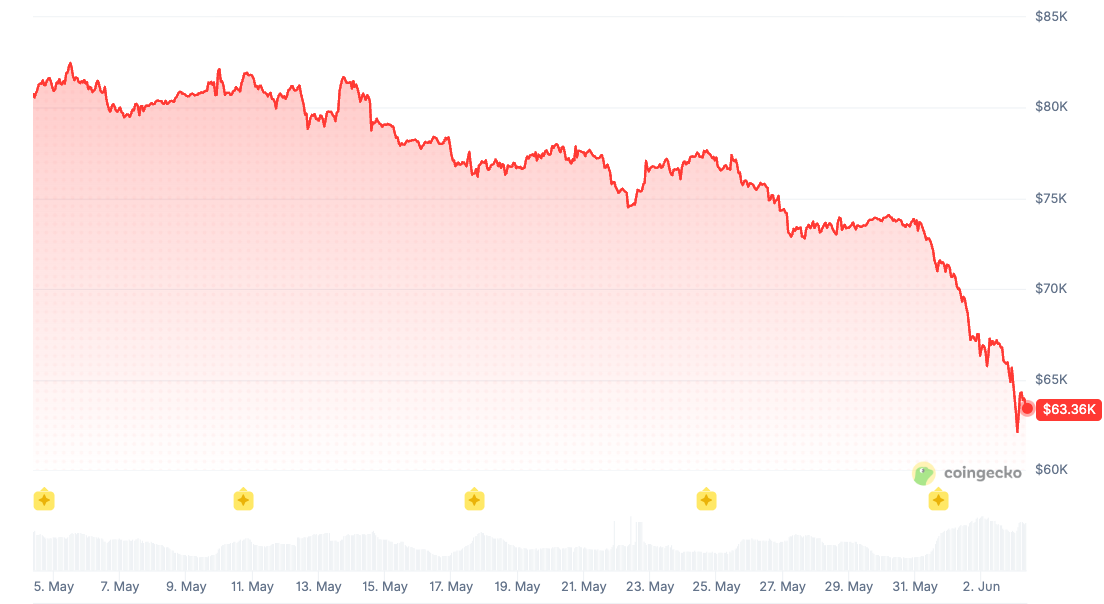
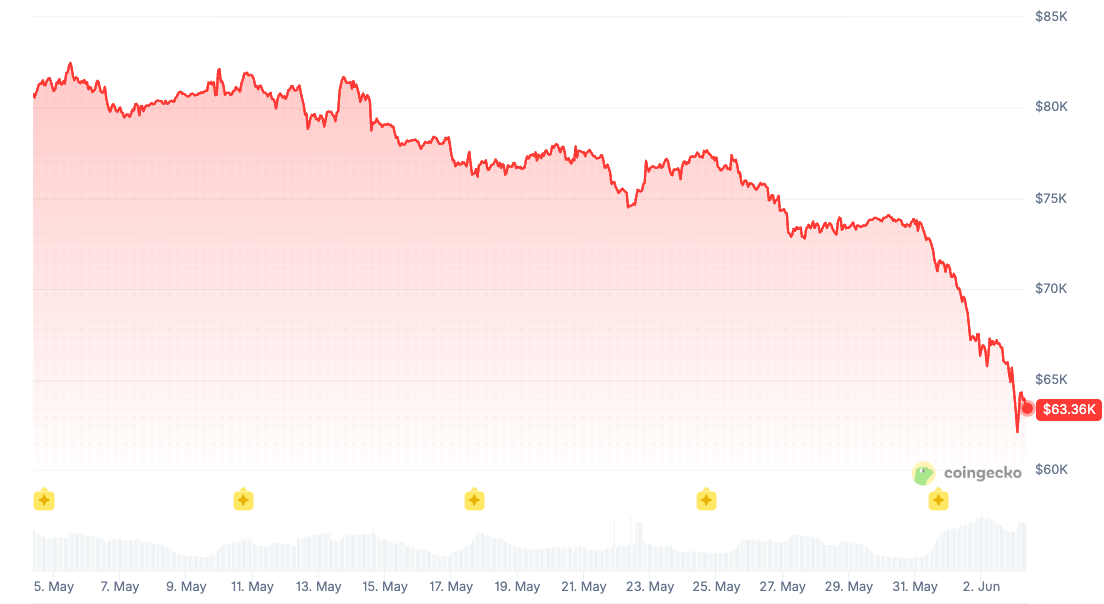
Bitcoin price briefly dipped below $63,000 on Thursday. Source: CoinGecko
Since the outflow streak began on May 15, Bitcoin has fallen about 21% from to $63,400 from about $80,000 as of publication, according to CoinGecko. Analysts have pointed to weakening ETF demand, long-term holder selling and miner pressure as possible drivers of the decline.
BlackRock IBIT leads outflows with $3.3 billion
BlackRock’s iShares Bitcoin Trust (IBIT) accounted for the bulk of redemptions during the 13-day streak, recording about $3.3 billion in outflows, according to Farside Investors data. The amount represents roughly 75% of total withdrawals.
Fidelity’s Fidelity Wise Origin Bitcoin Fund (FBTC) was the second-largest contributor with about $456.6 million in outflows, followed by Grayscale’s Grayscale Bitcoin Trust ETF (GBTC) at roughly $303.6 million.
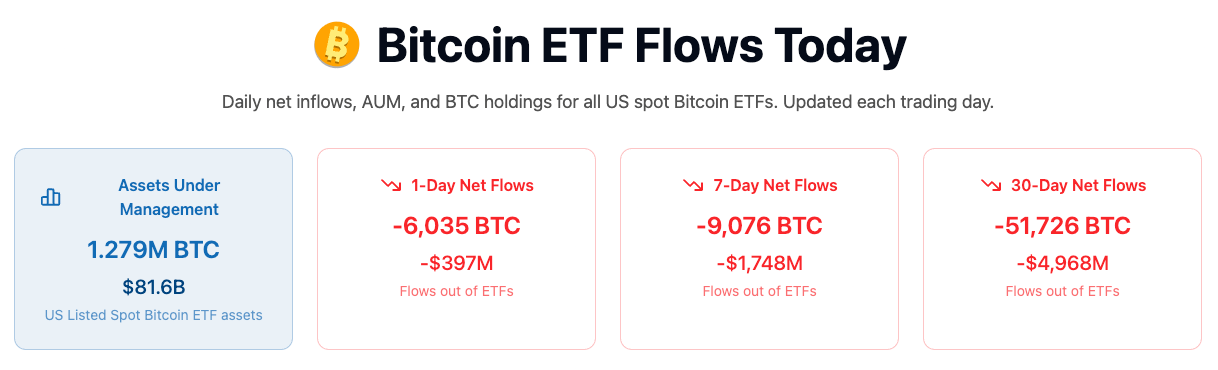
Bitcoin ETF flows, AUM and Bitcoin holdings as of June 2, 2026. Source: WalletPilot
Over the past 30 days, US spot Bitcoin ETFs have shed 51,726 BTC in outflows, or nearly $5 billion, according to WalletPilot data. As of Tuesday, IBIT held about 786,800 BTC, followed by FBTC with 181,770 BTC and GBTC with 146,400 BTC.
Analysts split over Bitcoin demand slump
Bitcoin’s recent outflows and price decline come amid a sharp contraction in demand comparable to the post-Terra/Luna collapse period in 2022, according to CryptoQuant head of research Julio Moreno.
He said overall demand has dropped by about 501,000 BTC over the past month, marking the fastest monthly drop since May 2022.
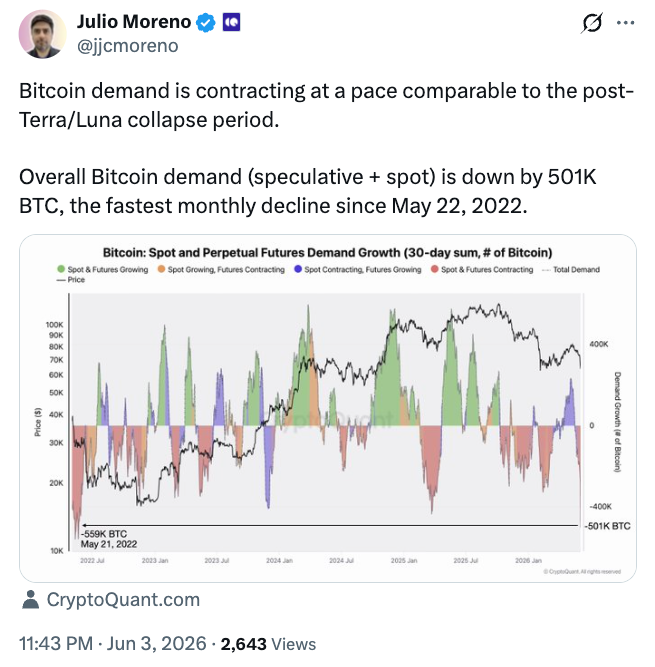
Source: Julio Moreno
Industry observers are divided on what is driving the selling pressure. Bloomberg ETF analyst Eric Balchunas said long-term institutional buyers, including Bitcoin ETFs and Michael Saylor’s Strategy, have remained net accumulators.
“Forget the boomers, someone needs to ‘call the OGs’ — they are behind this,” Balchunas said.
Some market commentary has pointed to derivatives positioning and exchange activity as potential drivers of the price decline, arguing that limited on-chain selling suggests leverage and liquidations may be amplifying volatility.
CryptoQuant founder Ki Young Ju said recent selling by early Bitcoin holders and miners reflects a broader transfer of supply to US institutions, including ETFs and traditional investors. He said the shift in ownership could strengthen long-term demand, even as the market moves away from early “cypherpunk” holders.
Related: Strategy’s Bitcoin sale causes clash for $80M in Polymarket bets
Despite the outflows, Standard Chartered head of digital assets research Geoffrey Kendrick said in a Thursday statement sent to Cointelegraph that Bitcoin ETF holdings have remained broadly stable since February, suggesting more structural resilience than previously expected despite market volatility.
Kendrick also pointed to recent corporate selling as reinforcing a bearish narrative in the short term, noting that Strategy’s 32 BTC sale “fit the DAT naysayer thesis,” and said the timing was unfortunate given Bitcoin was already under pressure.
Magazine: NEAR price may ‘grow 20X,’ Bitcoin ETFs post 10-day outflow streak: Hodler’s Digest, May 24 – 30


🎧 Listen to Interview 💻 Watch Video… Read the full story at The Defiant
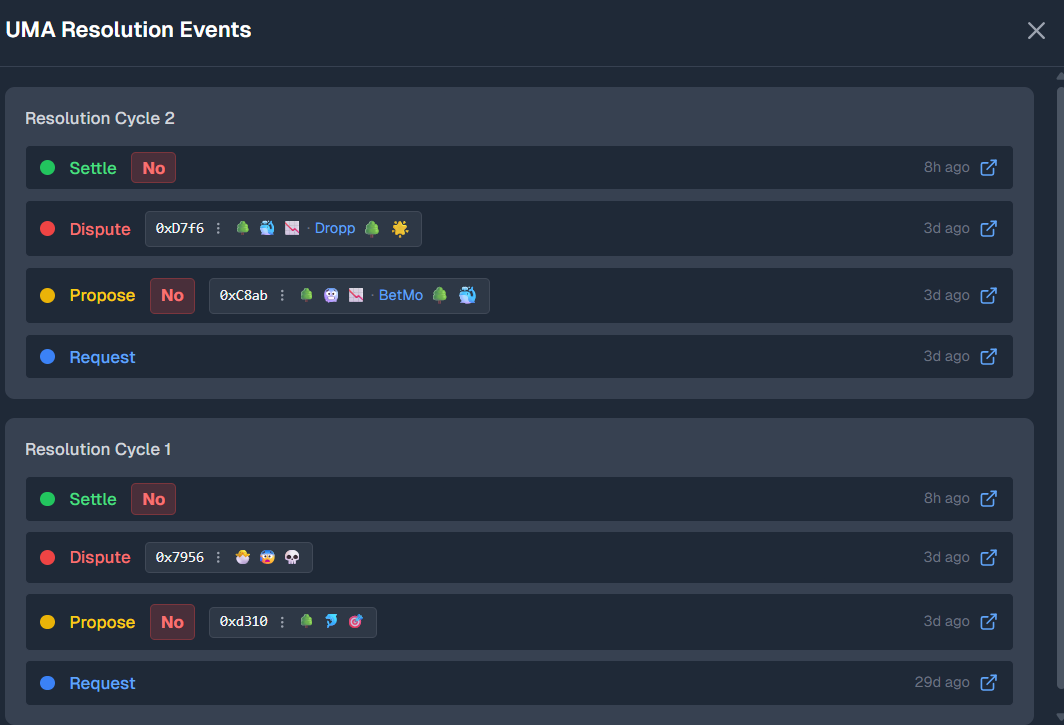
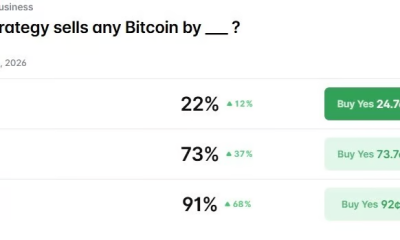
A disputed Polymarket contract on whether Strategy sold Bitcoin by May 31 resolved to “No” after two dispute rounds, despite Strategy later disclosing that it sold 32 BTC during the market’s covered window.
UMA Optimistic Oracle (UMA) token holders voted to settle the market in “no” following a second resolution cycle that closed at 12:34 am UTC on Thursday, blockchain data shows. An overwhelming 98.6% of the 607 participants voted for the market to resolve in “no,” while only 1.4% voted “yes,” data from Betmoar shows.
Polymarket said that no information, onchain data or credible reporting confirmed a Strategy sale within the market’s timeframe, adding that confirmation achieved “outside of the market’s time frame does not qualify.”
Strategy sold 32 BTC between May 26 and May 31, but disclosed the sale in a Monday filing, after the market’s deadline.
The resolution adds to concerns about Polymarket’s token-weighted dispute resolution system, where the wallets with the largest UMA token holdings have proportionally more voting power.
Multiple users cried foul, arguing that the market should have resolved based on when the sale occurred rather than when it was confirmed. One unfortunate trader reported a $500,000 loss tied to their event contract. Over $80 million had been wagered on whether Strategy would sell Bitcoin by May 31, Cointelegraph reported on Tuesday.
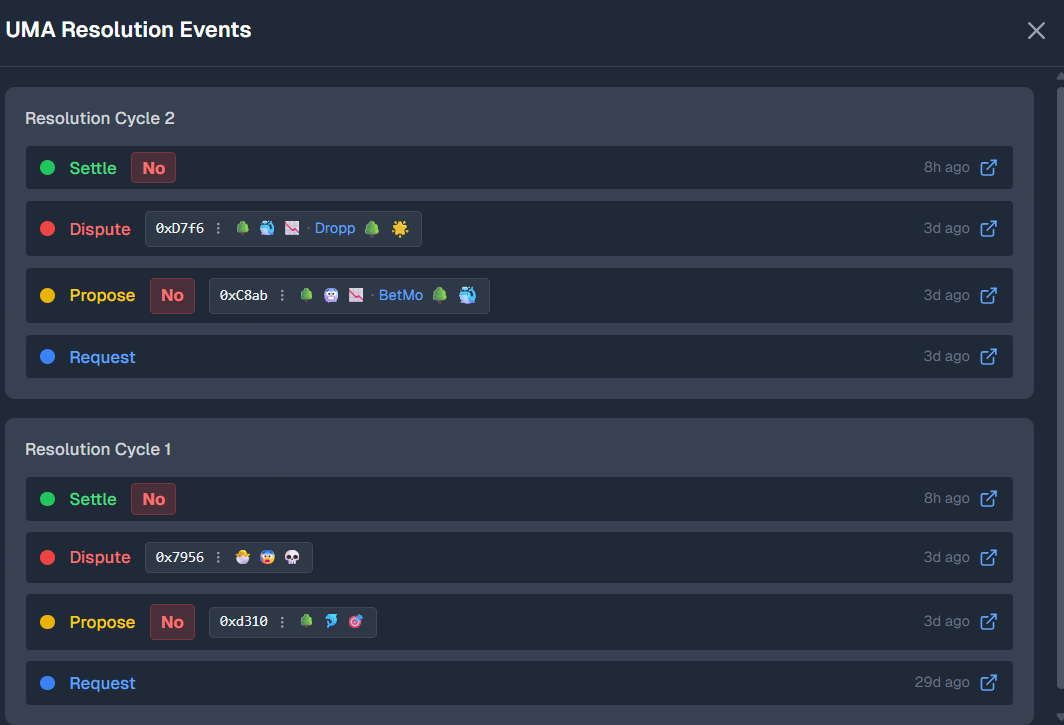
Polymarket dispute on Strategy selling Bitcoin by May 31. Source: Betmoar
“Prediction markets should price what happens, not how the oracle will reinterpret rules after the fact,” as resolution integrity “trumps any single outcome,” said Galaxy Research in a Wednesday X post, adding:
“We outline clear fixes: lock criteria at listing, deterministic resolution for verifiable events, and structural changes ahead of CFTC regulation.”
Galaxy also disclosed a financial interest in the market, adding that it bought “yes” shares as part of its strategy to routinely hedge prediction market positions.
Related: Polymarket team says user funds safe as exploit losses climb above $600K
Polymarket’s dispute resolution system raises concerns
The largest vote in the dispute came from blockchain wallet borntoolate.eth, which held 3.11 million UMA tokens, followed by Kevin Chan with wallet “0xd2a,” who held 1.53 million tokens.
Dispute resolution can be profitable for large token holders. Wallet borntoolate.eth netted over $299,000 from voting on event contract disputes, while the Kevin Chan-tagged wallet bagged over $370,000.
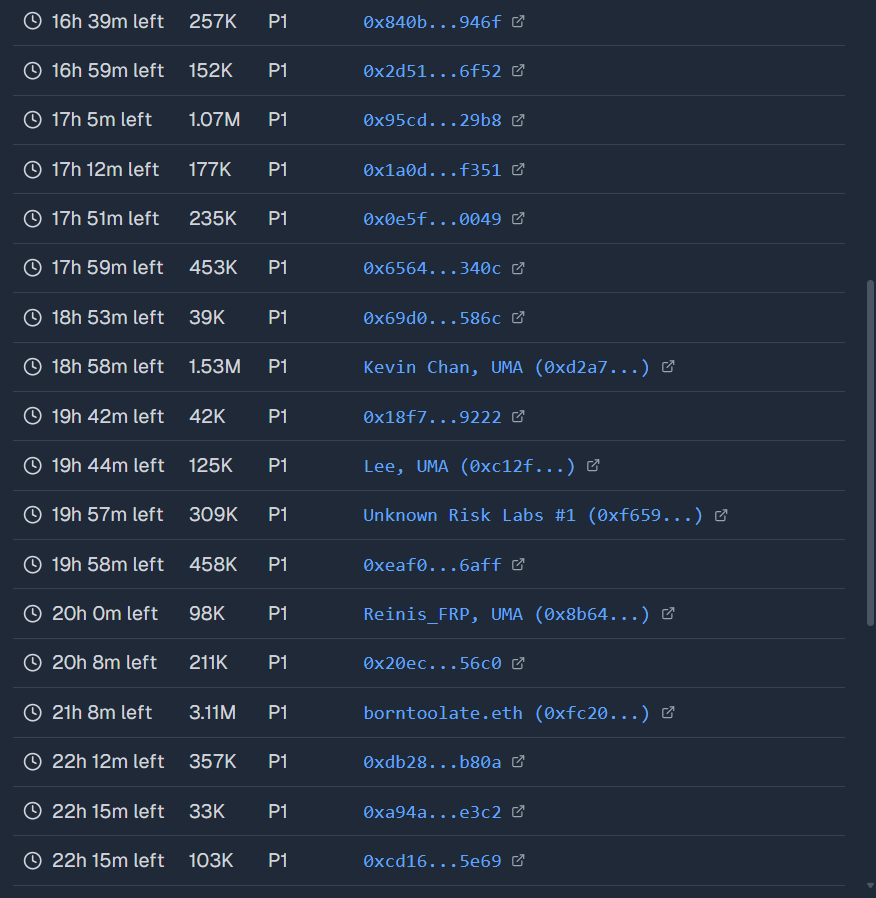
UMA token holders who voted on the disputed Strategy market. Source: Betmoar
Critics also pointed to earlier disputed Polymarket resolutions as evidence of broader concerns with UMA’s token-weighted voting model.
An event contract on whether Ukraine agrees to US President Donald Trump’s mineral deal before April 2025 was resolved as “yes” in March, following two rounds of disputes, despite the agreement being signed only on April 30.
Multiple users called it a “governance attack and whale manipulation but Polymarket did nothing with it,” commented Polymarket trader fr1ko.eth in a Tuesday X post.
The developments come a day after nine Democratic Party lawmakers in the US House of Representatives called on the US Federal Trade Commission to investigate how prediction markets advertise to customers and how they present themselves to regulators.
Magazine: The legal battle over who can claim DeFi’s stolen millions
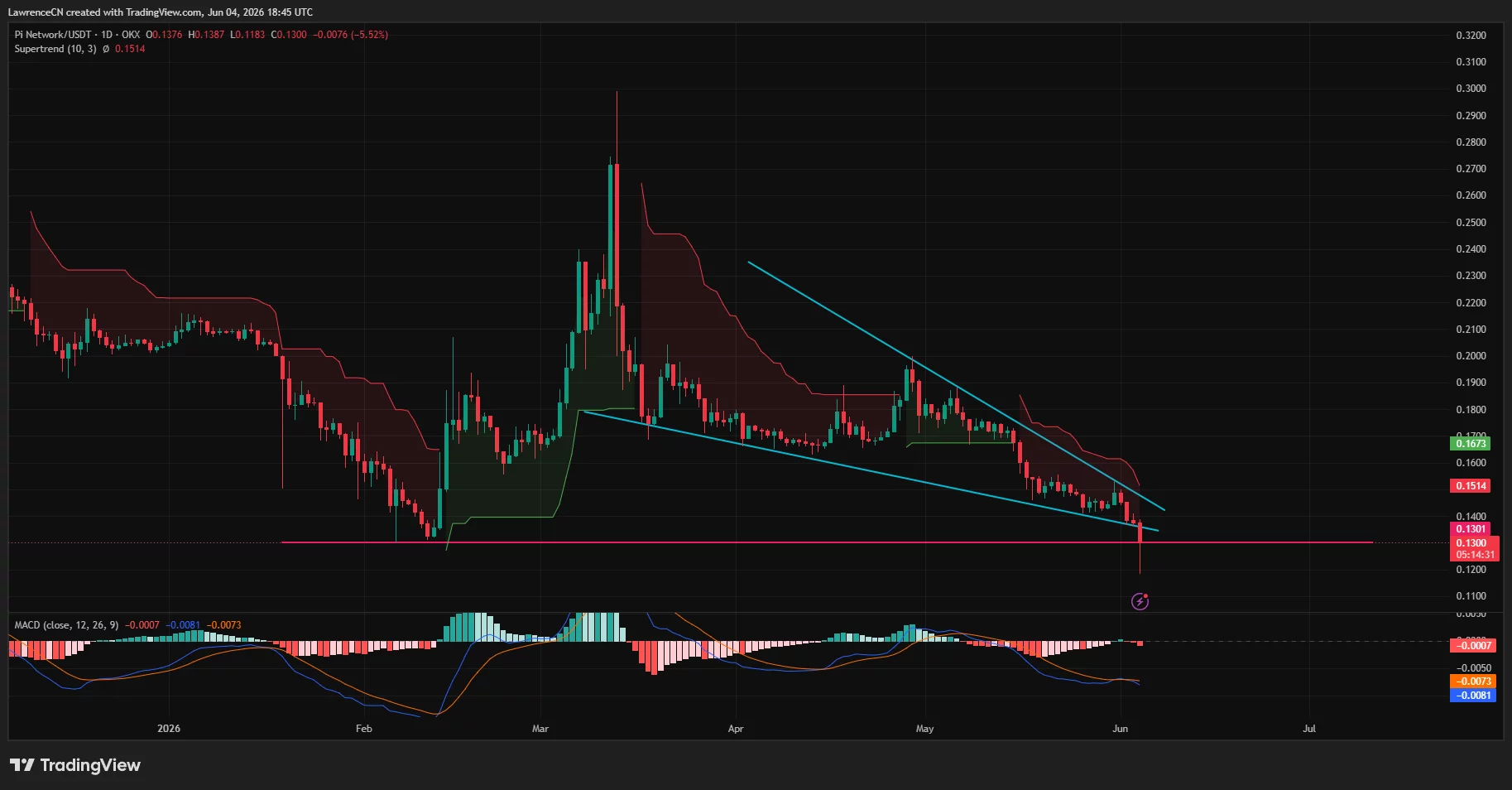
Pi Network price has fallen to a fresh all-time low after heavy token unlock pressure and weak market liquidity triggered another wave of selling across the ecosystem.
Summary
- Pi Network price fell to a new all-time low near $0.126 as traders reacted to more than 163 million PI tokens scheduled to unlock in June.
- Weak liquidity and a crypto market selloff that triggered over $1.6 billion in liquidations added further pressure to the token.
- A confirmed breakdown below a falling wedge pattern and the loss of key $0.13 support have put the $0.10 level in focus for traders.
According to data from crypto.news, Pi Network (PI) price traded near $0.130 on June 5 after plunging to a new record low of approximately $0.126. The token has now lost more than 30% over the past month, extending a downtrend that has persisted since its March rally faded.
A major source of pressure continues to come from the network’s token release schedule. Data from PiScan shows that more than 159 million PI tokens are still scheduled to enter circulation this month, with daily unlocks averaging over 5 million tokens. The largest single-day unlock is expected on June 11, when nearly 16 million PI will become available for trading.
The additional supply arrives at a time when market liquidity remains thin. Daily trading volume has slipped below $20 million across major exchanges, leaving the token vulnerable to large sell orders from early miners and long-term holders who recently completed KYC verification and mainnet migration.
Outside the Pi ecosystem, sentiment across digital assets has deteriorated sharply. Bitcoin (BTC) briefly fell to an intraday low near $61,550 on June 4, while Ethereum (ETH) dropped below $1,800.
CoinGlass data shows the selloff triggered more than $1.6 billion in liquidations across leveraged crypto positions, reducing appetite for speculative altcoins and adding further pressure to Pi Network’s price.
Network activity has offered a mixed picture. CiDi Games recently launched a Developer Center alongside four new games designed to attract builders and users into the Pi ecosystem.
Whale activity has also attracted attention in recent weeks, although those developments have so far failed to offset concerns surrounding rising token supply.
A recent X post from Whale Hunter highlighted the sharp rebound that followed PI’s previous drop to $0.128.
The analyst added that buyers had started returning to the market and argued that a break above $0.20 could trigger renewed momentum.
Falling wedge breakdown opens the door to lower prices
As crypto.news previously reported, Pi Network price was nearing a critical test of falling wedge support on the daily chart. Buyers failed to defend that level, allowing sellers to force a breakdown that eventually pushed the token to a new record low around $0.126.
The decline also took PI below the psychological $0.13 support zone, a level that had repeatedly attracted buying interest in recent months. Although the token managed to recover part of the loss, the breakdown has left the market focused on whether the next wave of June unlocks could trigger another move lower.
Technical indicators remain heavily tilted toward the downside. PI continues to trade below its Supertrend resistance at approximately $0.151, while price action remains well beneath its major short- and medium-term moving averages. The chart has also produced a sequence of lower highs and lower lows since March.
Meanwhile, the MACD remains in bearish territory, with the MACD line still positioned below the signal line. Although histogram bars have started to contract, buyers have yet to generate enough momentum to reverse the prevailing trend.
June token unlocks keep $0.10 level in focus
The most important support now sits near the recent low between $0.126 and $0.13. A decisive break below that zone would place PI in new price-discovery territory and expose the psychologically important $0.10 level.
Token unlocks remain the primary risk factor throughout the month. Fresh supply entering circulation could increase exchange inflows and intensify selling pressure, particularly if crypto market sentiment remains weak.
On the upside, bulls would first need to reclaim the former breakdown area near $0.14 before attempting a move toward the Supertrend resistance around $0.15. Above that, the next notable resistance zone sits between $0.18 and $0.20, where multiple recovery attempts failed during May.
Until buyers absorb the upcoming unlocks and reclaim key resistance levels, the chart structure continues to favor sellers, with the $0.10 threshold emerging as the market’s next major downside target.
Disclosure: This article does not represent investment advice. The content and materials featured on this page are for educational purposes only.

Cryptocurrency exchange Coinbase will allow qualified borrowers to pledge digital assets to fund Fannie Mae-backed mortgage apartments beginning this summer.
In a Thursday notice, Coinbase and its partner, Better Home & Finance, said the mortgage structure plan launching “by summer 2026” will allow borrowers to initially use Bitcoin (BTC) or USDC (USDC) as collateral for loans to fund down payments for homes. The initiative, first announced in March, represented a significant shift in companies allowing digital assets to be used for financing houses.

Source: Pavel Danilyuk on Pexels
“We’re excited to expand access to all qualified borrowers to fix an ongoing issue: buyers who qualify on every measure that matters but cannot clear the down payment hurdle because their wealth isn’t where the system expects to find it,” said Better founder and CEO Vishal Garg.
Garg said in a March post on X:
“This isn’t a niche thing. It’s what everyone is going to do once most financial assets are tokenized. It’s just a better way to buy a house.”
The move by Coinbase and Better followed US regulatory agencies under the Trump administration being friendlier to crypto companies and more accepting of digital assets integrated with traditional finance. In June 2025, the US Federal Housing Finance Agency (FHFA) directed Fannie Mae and Freddie Mac to consider crypto as an asset in mortgage risk assessments without requiring a conversion into fiat.
Related: Crypto mortgages in US face valuation risks, regulatory uncertainty
Other mortgage lenders have made similar moves since the FHFA order. In February, Newrez began allowing borrowers to use their cryptocurrency holdings to qualify for a mortgage application.
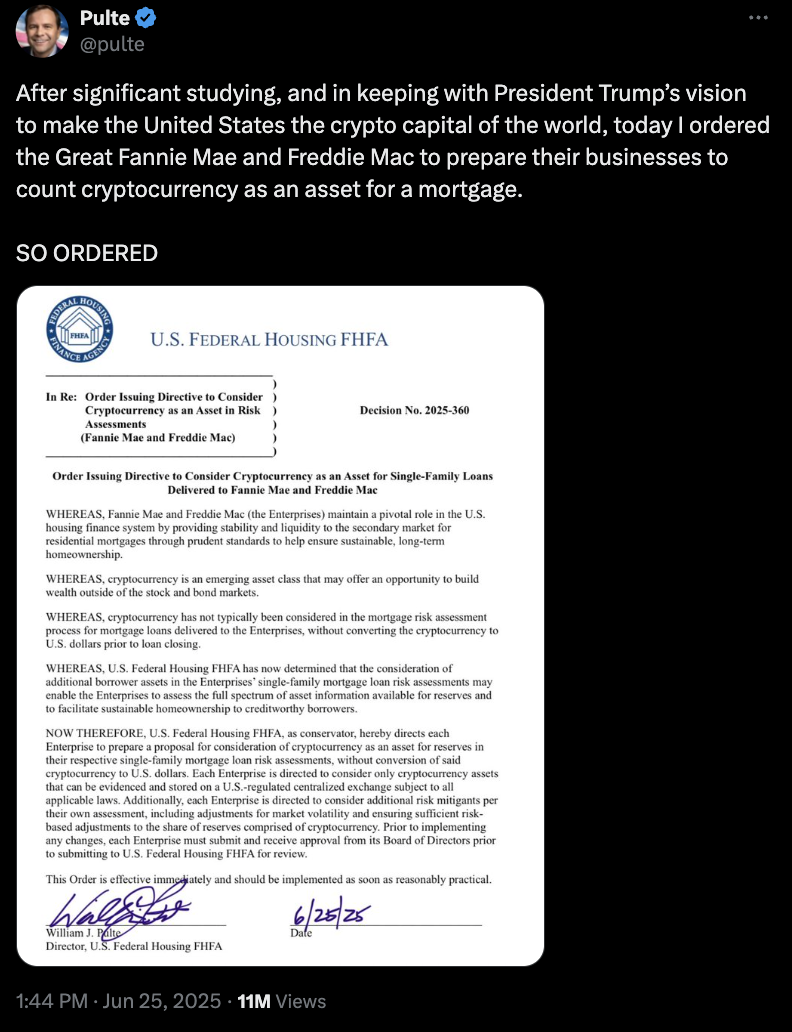
Source: Bill Pulte
Volatile crypto-backed mortgages scrutinized for political motivations
Although the price volatility of cryptocurrencies like Bitcoin may present challenges to the mortgage plan, some US lawmakers have accused FHFA head Bill Pulte of being “unduly influenced” by President Donald Trump in supporting such policies.
“Expanding underwriting criteria to include the consideration of unconverted cryptocurrency assets could pose risks to the stability of the housing market and the financial system,” said five US senators in a July 2025 letter to Pulte following the FHFA order.
Republican lawmakers, including crypto proponent Cynthia Lummis, have proposed codifying the FHFA order into law. She introduced the 21st Century Mortgage Act in July 2025, saying government agencies “must evolve to meet the needs of a modern, forward-thinking generation.”
Magazine: Bitcoin miners are pivoting to AI, so why is the hashrate near ATHs?

HP Introduces Next-Generation AI PCs With NVIDIA RTX Spark

Photos show condition of historic tennis Club House in Scarborough

Lululemon (LULU) earnings Q1 2026



-

 Tech7 days ago
Waymo dominates autonomous vehicle registrations as Tesla trails behind
-

 News Videos6 days ago
This is BROKEN! INSANE 5x MONEY CAR WASH WEEK! The NEW GTA Online UPDATE Today! (GTA5 New Update)
-
 Tech5 days ago
SpaceX just won a second Golden Dome contract. This one is $4.16 billion.
-

 Business3 days ago
Jade Biosciences, Inc. (JBIO) Discusses Positive Interim Results From JADE101 Phase I Healthy Volunteer Study and Development Plans Transcript
-

 News Videos6 days ago
SHE IS KILLING XRP!!! WATCH URGENT AND ACT FAST
-
 NewsBeat6 days ago
FIRST NIGHT REVIEW: Take That bring the Circus back to life in spectacular sun-soaked style
-

 Business5 days ago
Is the Spurs Phenom Already Better Than Prime Diesel?
-
Crypto World6 days ago
CFTC Has Approved the First Regulated Bitcoin Perpetual Contract in the U.S.
-

 Politics6 days ago
The House | Inside Andy Burnham’s Makerfield Campaign: “Nobody Thinks This Is In The Bag”
-

 Sports2 days ago
French Open 2026 results: Alexander Zverev beats Rafael Jodar and will play Jakub Mensik in semi-finals
-
 NewsBeat6 days ago
Novak Djokovic v Joao Fonseca LIVE: French Open latest scores and results after Jannik Sinner’s shocking collapse
-
 Entertainment6 days ago
Weak ‘Supergirl’ Box Office Tracking Amid Milly Alcock Backlash
-

 Tech2 days ago
CryZENx Releases Fresh Playable Content Deep Inside Jabu-Jabu for His Ocarina of Time Remake
-
 Crypto World6 days ago
Snowflake (SNOW) Stock Rallies on Strong Q1 Results and AI Product Growth
-

 Entertainment6 days ago
Maddox Jolie-Pitt Legally Requests to Drop Brad’s Surname
-

 Business6 days ago
Demand Conditions Improve In Chemicals Sector In April 2026
-
 Entertainment5 days ago
One of the Greatest Sitcoms of All Time Shoots Up Apple TV’s Charts 11 Years Later
-
 Crypto World6 days ago
MicroStrategy Moves $30 Million in BTC to Coinbase Prime: Is the Bitcoin Sell-Off Already Here?
-

 Tech6 days ago
This Week In Security: Ubiquiti Fixes, And FreeBSD Joins The Club You Don’t Want To Join
-
 Entertainment6 days ago
Bruce Willis’ Generosity Resurfaces Amid His Dementia
You must be logged in to post a comment Login