

Crypto World
3 Trump-Promoted US Stocks to Watch in June

Trump-promoted US stocks have been among the most talked-about names on Wall Street this year, and three stand out for traders. One earned a Truth Social post for its war-fighting tech.
Another rode a government stake and a strong quarter. A third got a direct buy-it call at the White House. Here is how each trade is looking as we head deeper into 2026.
Palantir Technologies (NASDAQ: PLTR)
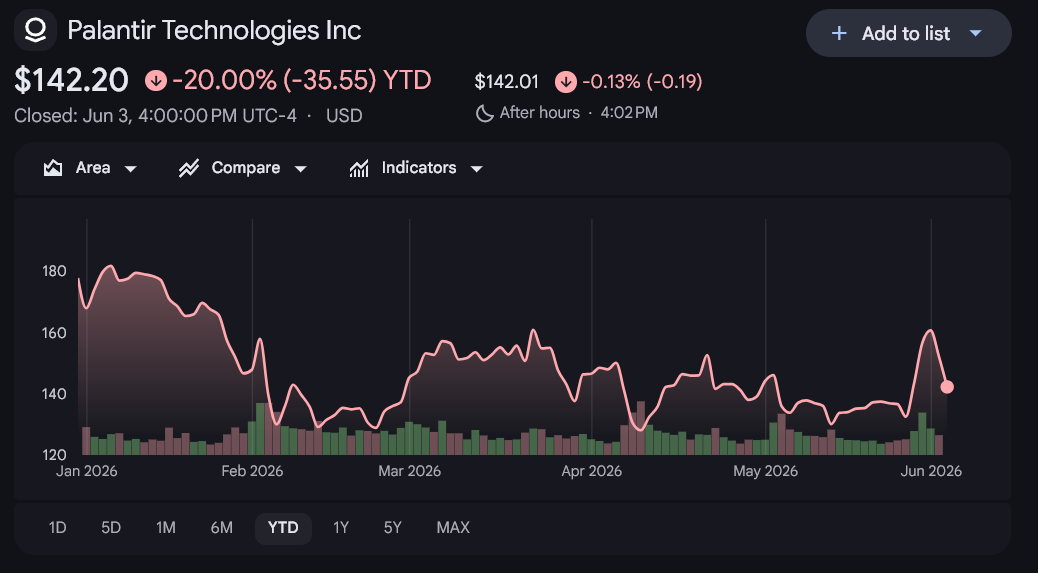
PLTR trades near $142, down 6.5% in the latest session. The pullback interrupts a sharp run that made it one of the standout Trump-promoted US stocks this spring.

Want more insights like this? Sign up for Editor Harsh Notariya’s Daily Newsletter here.
On April 10, Trump posted on Truth Social that Palantir had proven great war-fighting capabilities. The stock was near its April low of around $122 at the time. Since then, it has rebounded about 33%.
Note: Palantir makes AI software rather than weapons, but its platforms power the US military and intelligence work.
That bounce has not broken the broader downtrend. PLTR still trades inside a falling channel, a downward-sloping price range that has held since early November. The structure stays bearish until the price escapes it.
The key levels come from Fibonacci levels, which measure the proportional pullback of a prior move. It runs from the $207 November high to the $122 April low, revealing key levels. PLTR failed to clear $165 on June 1, a key technical level. The real trigger sits at $175, near the channel’s upper boundary.
A move above it by about 15% would shift the structure from bearish to neutral-bullish.

The bearish case is building too. Selling volume has risen since May 22, and a weak broader market could drag PLTR lower. A drop under $142 would expose the $122 low again.
Above $175 turns the trend, while rising sell volume and a break under $142 keep the bears in control throughout June.
Intel Corporation (NASDAQ: INTC)
INTC trades near $108, down 1.28% in the latest session, though pre-market quotes point higher near $114. The stock is the most policy-linked of the Trump-promoted stocks.
The Trump administration holds a stake in Intel, and that position is up nearly 250% as of late April, per data. Trump has taken public credit for the chipmaker’s surge. The fundamentals backed him up.
Intel’s Q1 2026 earnings drove a 15% jump, pushing the stock past its August 2000 record high.
That report powered a much larger run. INTC climbed from about $40 in late March to a peak near $133, a gain above 200%. The move formed a bull flag, a pause that follows a sharp rally and often resolves higher.
The recent dip looks like profit-taking. Price slipped from late May into early June, yet volume held steady rather than spiking. That hints sellers are not panicking. INTC now sits near $108, closing in on the $102 base.
The first hurdle to the upside is $124, where the breakout stalled. A reclaim there opens the path to the $133 peak, again in June, about 24% higher, then $159 and $194.

The bearish case matters too. A drop under $102 weakens the pattern considerably, and a break under $79 would invalidate it. Hold above $102 and reclaim $124 to keep the flag alive, or lose $102 and risk a slide to $79.
Dell Technologies (NYSE: DELL)
DELL trades near $435, down 6.58% in the latest session after touching a record near $469. It carries the most direct endorsement of the three.
In early May, Trump told a White House crowd to go out and buy a Dell, calling them great. The stock was already climbing, and the comment added fuel. Since late March, DELL has run from about $155 to its $469 peak. It has roughly doubled in the weeks since the direct endorsement.
The move traces a clean pole with the flag (consolidation) expected to form now. This is because the volume faded as the price peaked around May 29, while selling pressure has built since late May. Buyers are stepping back, suggesting a pullback.
The economic anchor is real, as Dell’s AI server demand and a $9.7 billion Pentagon contract back the rally continuation, despite the possible pullback.

The key levels come from the Fibonacci levels of the run from $155 to $468. A pullback is likely to first test $394, then $349. Holding there would keep the uptrend intact and set up another push. The bearish case builds below.
A drop under $312 toward $275 would signal a deeper unwind. The risk grows if AI server spending cools or the political tailwind fades.
For now, DELL needs a daily close back above $468 to prove the rally still has strength.
The post 3 Trump-Promoted US Stocks to Watch in June appeared first on BeInCrypto.

Worldcoin price has surged over 40% since late May after whale activity and network growth climbed to their highest levels of 2026, strengthening the case for a move toward the next major resistance zone near $0.65.
Summary
- Worldcoin has surged more than 40% since late May as whale transactions, active addresses, and new wallet creation climbed to 2026 highs.
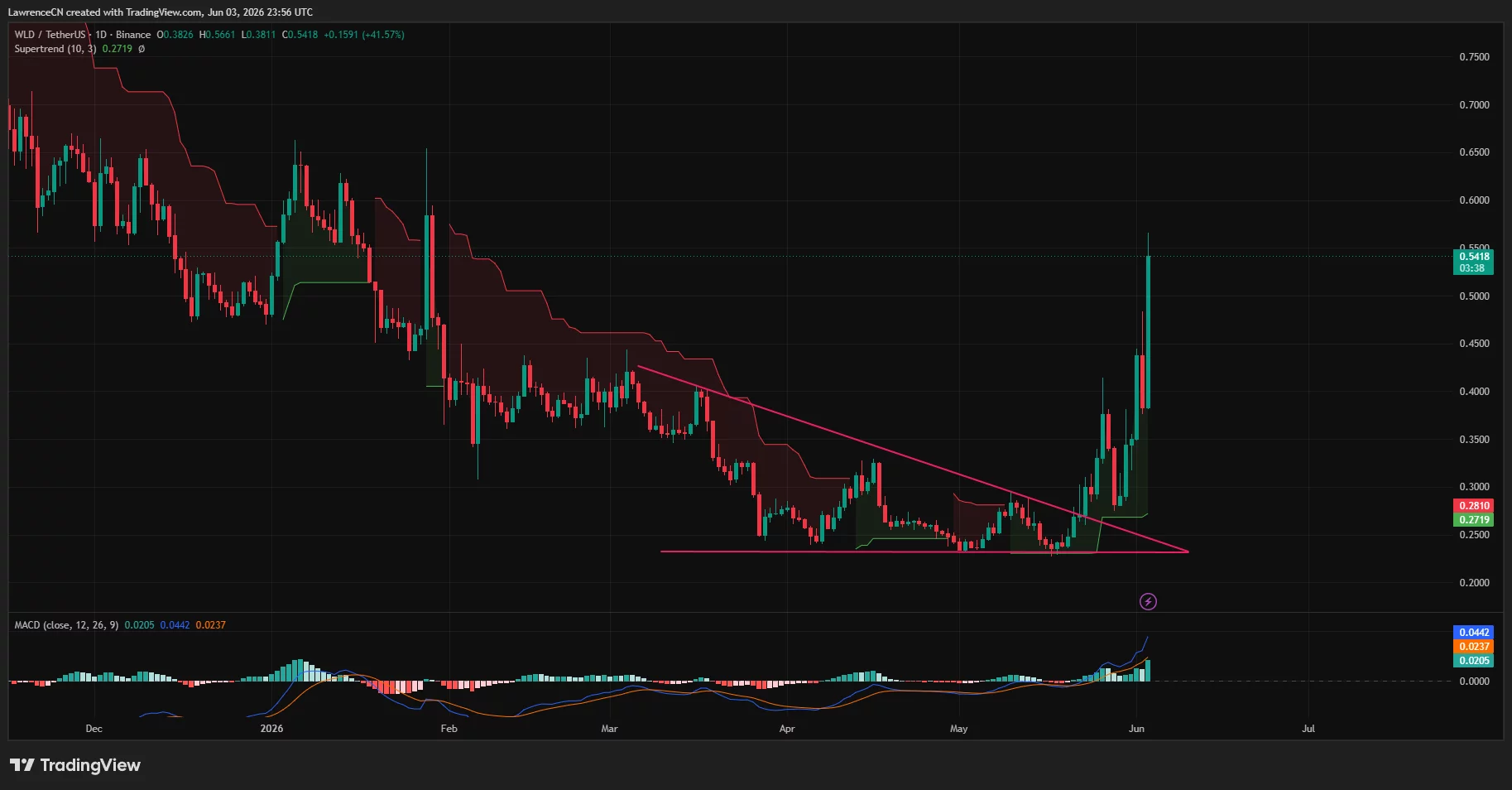
- A breakout from a multi-month descending triangle has pushed WLD above $0.54 and brought the $0.65 resistance zone into focus.
- Growing World App activity and renewed interest in AI-related tokens have supported demand despite weakness across the broader crypto market.
According to data from crypto.news, Worldcoin (WLD) traded near $0.53 at press time on June 4 after rallying from roughly $0.33 just days earlier. The advance coincided with a sharp increase in whale transactions worth more than $100,000, alongside a jump in active addresses and new wallet creation across the network.
Large holders began accumulating as WLD emerged from a prolonged consolidation period that had confined prices for much of the year.
Santiment data showed daily whale transactions reaching their highest level of 2026, while active addresses climbed above 1,300. New address growth also accelerated, suggesting participation was expanding beyond existing holders.
Network activity received an additional boost from the integration of Oku Trade into the World App. The feature introduced weekly rewards of up to 100 WLD for users participating in token swaps through a leaderboard system, creating fresh transactional demand within the ecosystem.
Interest in the project’s AI-linked narrative has also remained strong. With OpenAI chief executive Sam Altman closely associated with Worldcoin, traders have increasingly treated WLD as a proxy for the intersection between artificial intelligence and crypto, particularly as AI-related tokens regain momentum across the market.
Whale activity and network growth support the rally
Worldcoin’s gains have stood out against a difficult backdrop for digital assets. On June 2, the total cryptocurrency market lost more than $40 billion in value as Bitcoin (BTC) fell toward the $70,000 region, yet WLD continued advancing while many large-cap assets moved lower.
Capital rotation appears to have played a role. Rather than exiting crypto entirely, traders shifted into tokens backed by active ecosystem developments and improving on-chain metrics. Worldcoin benefited from both trends as whale accumulation tightened available supply while network usage expanded.
Commenting on the move, crypto analyst Bitcoin Meraklisi highlighted a major technical breakout that unfolded after months of consolidation.
“Descending channel broken. First target reached. Retest completed.”
The analyst’s chart showed WLD breaking above a descending channel that had contained price action since September before successfully retesting the breakout zone.
Technical setup places $0.65 within reach
On the daily chart, Worldcoin has broken above the upper trendline of a descending triangle pattern that had constrained price action for several months. The breakout followed a prolonged base formation near the $0.24 support zone and triggered one of the token’s strongest daily advances this year, lifting WLD above $0.54.
Trading activity expanded significantly during the breakout. Earlier market data showed daily volume surging more than 130% as buyers pushed WLD above its 20-day and 50-day exponential moving averages, reinforcing bullish momentum.
The measured move derived from the height of the triangle places the next major objective between $0.65 and $0.70. From the current price near $0.54, a move to $0.65 would represent roughly 20% upside. A breakout above that area could open the door to a retest of the January highs near $0.75.
Momentum indicators remain firmly bullish. The MACD has produced a fresh bullish crossover while the histogram continues to expand above the zero line. At the same time, the Supertrend indicator has flipped positive near $0.27, confirming a shift in market structure after months of persistent selling pressure.
Traders will be watching the breakout zone around $0.45 as the first key support area. Holding above that level would keep the bullish structure intact and maintain the path toward the $0.65 target. A move back below $0.45 could expose the next support levels near $0.38 and $0.32, where buyers previously stepped in during the consolidation phase.
With whale transactions, active addresses, and new wallet creation all reaching yearly highs, Worldcoin’s on-chain backdrop remains considerably stronger than it was during previous rallies. As long as those trends continue and buyers defend the breakout level, the technical setup continues to favor a test of the $0.65 area in the sessions ahead.
Disclosure: This article does not represent investment advice. The content and materials featured on this page are for educational purposes only.
A quantum computer powerful enough to break Bitcoin (BTC) would never be used to steal it, according to a new report from Swiss custody firm Taurus. The price would collapse before any theft could settle on-chain.
The finding turns the standard quantum doomsday narrative on its head. The breakthrough weapon that could break Bitcoin would destroy its own best target through the market’s reaction, shifting the real threat elsewhere.
A Quantum Attack Ultimately Defeats Itself
Most blockchains secure ownership with the elliptic curve digital signature algorithm (ECDSA). A quantum computer running Shor’s algorithm could, in theory, recover a private key from a public one and forge transactions on the owner’s behalf.
The economics, however, work against any attacker.
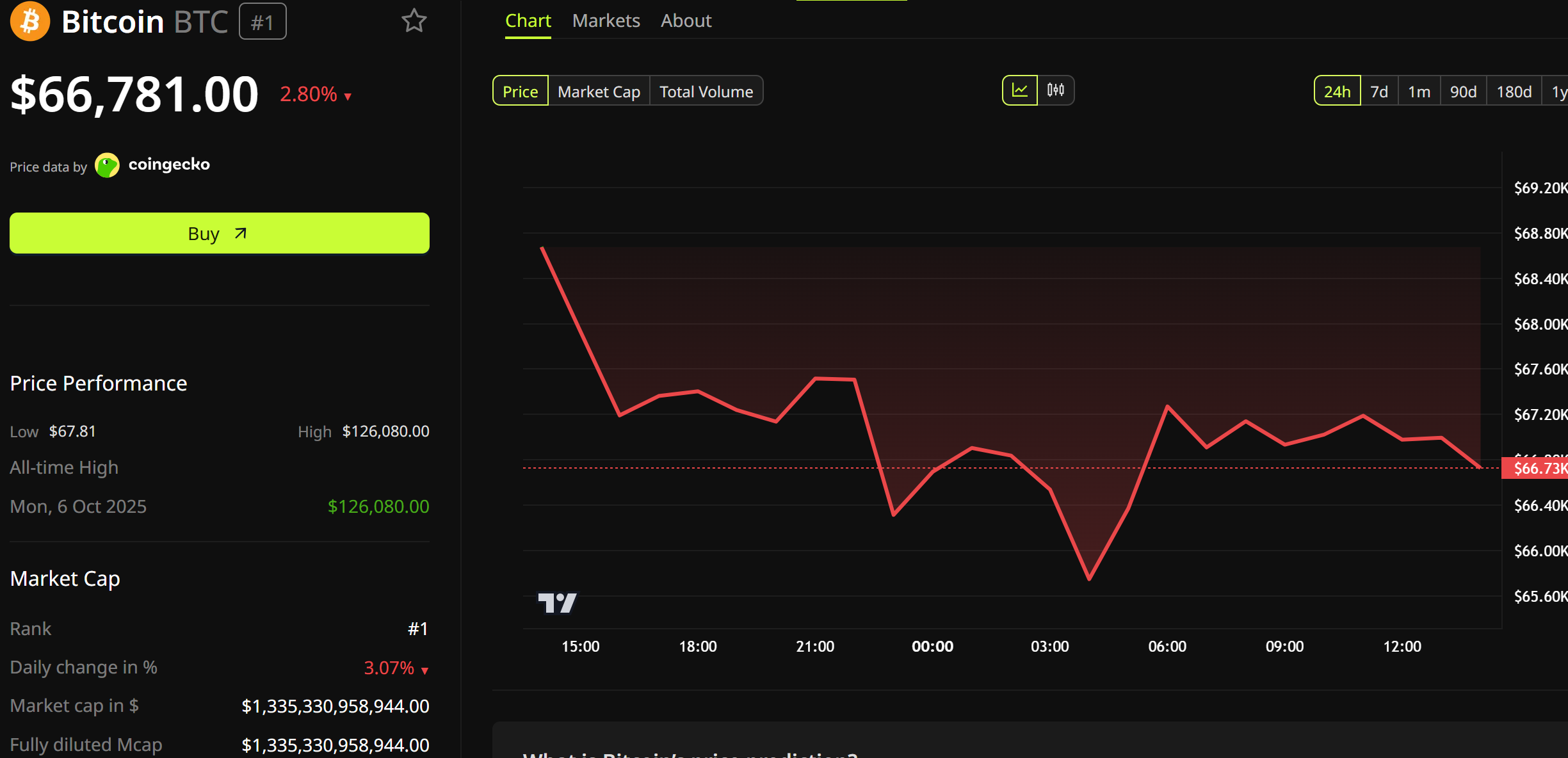
Bitcoin trades for $66,781 as of this writing, with a market value above $1.3 trillion. The volatility itself is a visible proof that if Bitcoin’s cryptography is broken, it would trigger an immediate sell-off.

The report describes this as a form of gravity, reframing familiar quantum doomsday scenarios for the asset.
“… a computer that could break Bitcoin would almost certainly not be used to steal it. If such a machine became known, prices would collapse before any theft occurred,” read an excerpt in the Taurus report.
Follow us on X to get the latest news as it happens
A nation-state holding that capability would also find more valuable targets than a falling asset. Independent assessments have called the broader threat manageable rather than imminent.
Where the Real Quantum Risk Sits
The conclusion sharpens priorities rather than easing them. The dominant near-term danger is the harvest now, decrypt later attack.
An adversary records encrypted data today and waits for a capable machine to read it later.
Public Bitcoin transactions do not suit that method well. Confidential records with a long shelf life, such as contracts and archived messages, are now at risk of exposure.
The migration clock is already moving. NIST guidance deprecates current public-key encryption after 2030 and bans it after 2035, and replacement standards already ship in major software, a point raised across recent Q-Day security takeaways.
Two papers released in late March 2026 further narrowed the hardware gap, including a Google Quantum AI estimate that cut the resources needed to break elliptic curve cryptography.
No custodian can promise full quantum protection, because the blockchain sits outside any single firm’s control.
The practical goal is crypto-agility, swapping algorithms quickly at every layer a provider does control.
“Post-quantum cryptography is not a reason to panic. It is a reason to act,” the report concluded.
Subscribe to our YouTube channel to watch leaders and journalists provide expert insights
The post The Quantum Bitcoin Paradox: Attack the Network, Kill the Prize appeared first on BeInCrypto.
The Hyperliquid, the largest decentralized perpetuals exchange by volume, is share of global perpetual futures volume jumped in June. Hyperliquid's share of monthly perps against global exchanges, including centralized exchanges, jumped to an all-time high of 7.5% in June from 6.6% in May, on track… Read the full story at The Defiant

Wyoming Governor Mark Gordon has signed an executive order establishing a framework for developing data centers and advanced computing facilities, underscoring the state’s push to attract AI infrastructure investment as demand for computing power accelerates.
In an order published Wednesday, titled “Data Centers the Wyoming Way,” Gordon directed state agencies to support the responsible development of large-scale data centers and other advanced computing projects. The framework emphasizes water and environmental sustainability, workforce development and protections for residential electricity customers.
“This Executive Order applies to executive branch agencies involved in permitting, reviewing, regulating, supporting, or facilitating large-scale data center development within Wyoming,” the order states.
The Wyoming directive follows a White House push on AI, coming one day after President Donald Trump signed an executive order promoting advanced AI technologies for national security purposes.
AI-related infrastructure spending continues to surge across the United States. Four of the “Magnificent 7” tech companies — Microsoft, Amazon, Meta Platforms and Google-parent Alphabet — are expected to invest more than $650 billion on AI and data center infrastructure this year alone.
A significant portion of that spend is intended to increase their footprint in the lucrative enterprise cloud market and build up the infrastructure needed to train and run large language models.
Berkshire Hathaway earlier this week increased its investment in Alphabet as the conglomerate seeks to deepen its financial interests in AI.

State of Wyoming Executive Department Executive Order 2026-03. Source: State of Wyoming
Related: Wyoming Senator revives crypto tax exemption debate amid market structure talks
Wyoming’s AI ambitions intersect with Bitcoin mining
Wyoming’s push into AI and data centers aligns with its broader efforts to leverage its energy resources and business-friendly policies to attract technology investment.
The state has also emerged as a hub for Bitcoin mining. In 2024, CleanSpark expanded its Wyoming footprint through the acquisition of a mining facility tied to 75 megawatts of power capacity.
Although CleanSpark remains largely a pure-play Bitcoin miner, several peers have diversified into AI and high-performance computing (HPC) services to offset pressure on mining revenues following the 2024 Bitcoin halving.
Companies including IREN, MARA Holdings, Cipher Digital, Hut 8, HIVE Digital and TeraWulf have expanded their focus beyond Bitcoin mining by pursuing AI and data center hosting opportunities.
Bernstein analysts late Wednesday initiated coverage on TeraWulf and Cipher as part of their tracking of what they call “emerging AI infra.”
Related: Crypto Biz: Crypto infrastructure spending rises as ETF appetite cools
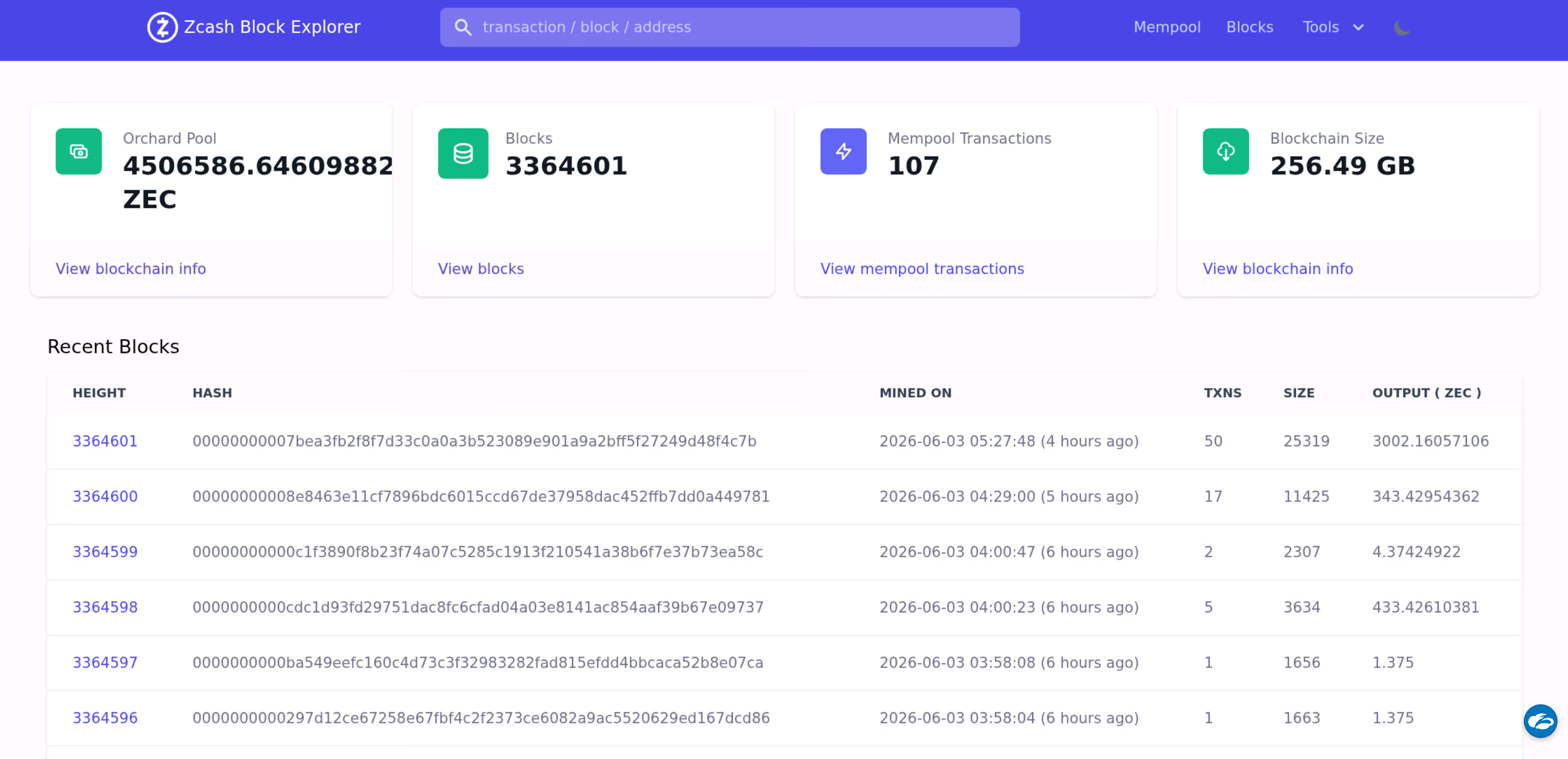
For a few hours Wednesday Asia time, Zcash’s blockchain appeared not to be producing any new blocks — but that’s an issue with the block explorers themselves, not the chain, per some observers.
Think of the blockchain as a ledger that keeps growing as new transactions are added. Each “block” is a new entry in the ledger. So, when the network stops making new blocks, no new transactions can be confirmed. This is like the entire payment system freezing for several hours.
According to multiple Zcash block explorers, the most recent block was number 3,364,601, created at 5:27 AM UTC on June 3. After that, no new blocks appeared for over four hours. Normally, Zcash adds a new block roughly every 75 seconds (just over a minute).
However, the Zcash blockchain was not down. The problem was that some of the block explorers didn’t update their nodes after the recent network upgrade.
“A coordinated Zcash network upgrade was activated at block 3364600. Many block explorers had not yet updated their nodes at the time of the upgrade, resulting in a loss of visibility into the chain’s state,” CEO of ZODL Josh Swihart told CoinDesk.
“In simpler terms, a network upgrade is a ‘hard fork’ of the chain. The miners started producing blocks on the new chain, leaving the old one behind, but many popular block explorers were still watching the old one,” Swihart added.


Mert Mumtaz, CEO of Helius, an infrastructure provider to Solana, also echoed Swihart’s explanation behind the incident.
He said this is an issue with some block explorers not updating their nodes since the network upgrade this week, and that they are working on updates now.
Zcash’s native token ZEC has surged 8% over the past week, according to CoinDesk data, bucking the broader market weakness. The token has gained 46% in the last month.
For crypto investors, this event is a reminder that even well-known networks can run into technical hiccups.
UPDATE (June 3, 18:17 UTC): Adds comments from Josh Swihart.
UPDATE (June 3, 11:00 UTC:) Updates title and text to say the issue may have been with the block explorers.
Crypto World
Bitcoin (BTC) price RSI momentum gauge hints at recovery. Experts remain cautious: Crypto Daily
Bitcoin and the broader crypto market steadied Wednesday from Tuesday’s slide after Strategy (MSTR), the largest publicly listed bitcoin holder, sold a small portion of its stash and spot ETFs extended a record run of net outflows.
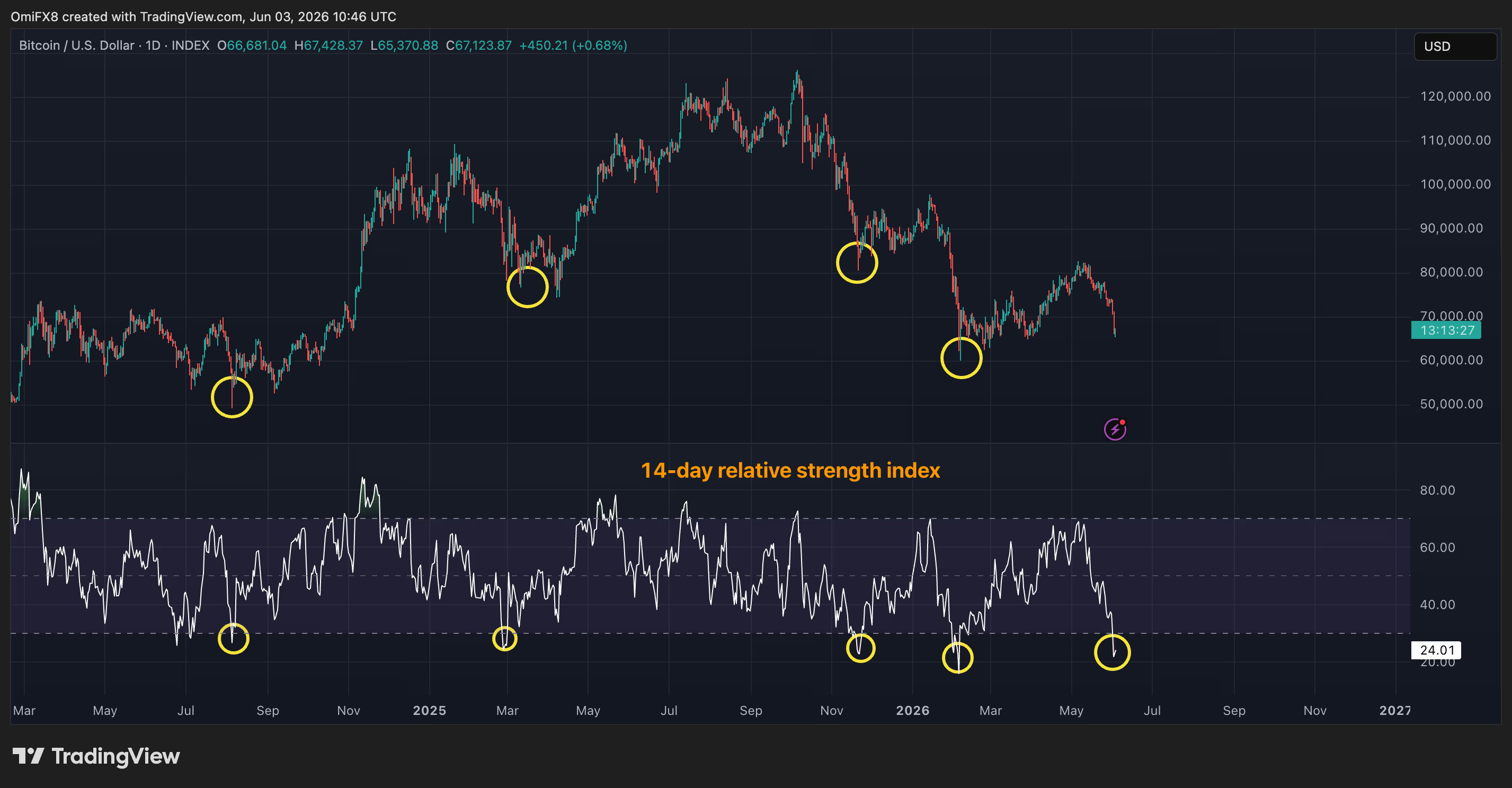
The cryptocurrency’s 14-day RSI has dropped below 30, a textbook oversold reading. The indicator measures the speed and magnitude of price movement over a two-week period.
While a reading below 30 suggests bearish momentum is dominant, analysts often read this as a sign that the selloff has been too rapid and could stall, allowing for a recovery. While not guaranteed, it’s a stance that has played out several times.
Oversold readings in early February, November 2025, late February 2025, and August 2024 marked interim or major price bottoms. So there are hopes the selloff may soon ease.
Some analysts are more cautious. “Blood is in the water, trade accordingly,” Monarq Asset Management said in a Telegram chat.
“With the long‑anticipated regulatory clarity from the Clarity Act looking less likely every day (Jamie Dimon openly hostile, pulling no punches, using DC clout to position against it), value and speculative buyers are stepping back and looking for the long‑term, long‑anticipated capitulation move,” Monarq CIO Sam Gaer told CoinDesk.
According to Gaer, $60,000 is back in focus and a break below that level could trigger a sell‑off to as low as $45,000, as forecast by the theory that the BTC price follows a four‑year cycle.
QCP Capital noted a spike in BTC implied volatility, saying the message is less “buy the dip” and more “please insure the dip before discussing it.”
Broadly speaking, weakening institutional and corporate bids and Fed rate‑hike concerns limit the scope for a sustainable recovery even as the RSI hints at a potential bounce. According to QCP, BTC needs to hold above $67,000 to restore bullish sentiment. Stay alert!
Read more: For analysis of today’s activity in altcoins and derivatives, see Crypto Markets Today . For a comprehensive list of events this week, see CoinDesk’s “Crypto Week Ahead.”
What’s trending
- Bullish crypto bets lose $1.6 billion as ETH, SOL, DOGE drop 9% (CoinDesk): Crypto traders hoping the market would catch up to the global stock rally were left nursing tears on Wednesday as a sharp price drop triggered the largest liquidation event since early February.
- Prediction market traders bet bitcoin’s selloff has further to run (CoinDesk): Markets now imply a 66% chance of bitcoin falling below $55,000 and a coin-flip chance of sub-$50,000 prices before year-end.
- SpaceX is worth less than half of its $1.75 trillion IPO target, Morningstar says (CNBC): With SpaceX expected to start trading on the Nasdaq in just over two weeks, Morningstar analysts say it is “significantly overvalued.”
- Hostilities flare in Iran war, oil jumps with talks at a stalemate (Reuters): The flare-up, which sent oil prices rising more than 1%, comes with the conflict stalemated in a shaky ceasefire and the Strait of Hormuz largely closed, more than three months after initial U.S. and Israeli strikes on Iran.
Today’s signal

The chart shows bitcoin’s daily price swings in candlestick format with the 14-day relative strength index in the lower panel.
The RSI has slipped below 30, suggesting oversold conditions. Similar readings have previously marked interim or temporary price bottoms.


Israeli taxpayer disclosures of profits from cryptocurrencies have reportedly fallen short of expectations at the Israel Tax Authority after enactment of a policy allowing immunity from criminal proceedings for filers correcting their reports.
According to a Wednesday report from Globes, Israeli authorities had expected to gain up to $1 billion in taxes from “voluntary disclosures” allowed under an August 2025 policy, but have so far only received reports of a fraction of those capital earnings.
The local news outlet reported that the tax authority had received reports of $50 million combined from crypto capital, with the potential of billions of dollars in underreported holdings.
“In the cryptocurrency field, the difficulty of the absence of an anonymous track is even more acute,” said Iftach Simhony, a CPA and head of the tax department at the Prof. Bein Law Office, Globes reported. “When the risk assessment of some taxpayers is not high, and the procedure itself does not offer certainty or anonymity in the first stage, the incentive to undergo voluntary disclosure is weakened.”
The voluntary disclosure procedure announced by the tax authority gives crypto holders immunity from criminal charges, provided the value of their holdings did not exceed the equivalent of $522,000 as of December 2024, they filed correct reports and paid their taxes in full before Aug. 31, 2026. Globes reported only 58 filers had attempted to correct their taxes using the procedure.
Related: Israel crypto industry pushes regulatory changes amid strong public support
According to the Bank of Israel’s financial stability report for January to June 2024, Israelis held about $1 billion worth of crypto assets.
US lawmakers seek to create de minimis exemption for crypto taxes
A group of members of the US Congress introduced legislation in May called the PARITY Act that would direct the US Internal Revenue Service (IRS), to review creating a de minimis exemption for digital assets. Under the proposed law, taxpayers could not be forced to reported small crypto transactions to the IRS.
Magazine: HYPE chases $100 target, ETH could dump below $1800: Market Moves


Revolut plans to open a US bank in 2027 that will pair FDIC-insured accounts with stablecoin services in the same app. US chief executive Cetin Duransoy disclosed the plan in a Reuters interview on Wednesday. The British neobank counts 70 million customers globally and was valued at $75 billion in… Read the full story at The Defiant
Crypto World
Crypto PACs go undefeated in June primaries as Fairshake scores bipartisan winning streak


Crypto-backed super PACs swept Tuesday’s primaries, with all 11 candidates supported by Fairshake affiliates advancing or winning their races, extending the industry’s electoral winning streak while revealing a strategy increasingly focused on cultivating Democratic allies rather than backing established crypto champions.
The results spanned nine California congressional races, New Jersey’s 8th District, and South Dakota’s Senate primary. The roster included supporters of the Clarity Act, the GENIUS Act and blockchain developer protections, as well as candidates who signed pro-crypto pledges through Stand With Crypto.
Among the winners were California Democrats Zoe Lofgren, Ted Lieu, Dave Min, Lou Correa, and George Whitesides, along with New Jersey Democrat Rob Menendez as well as South Dakota Republican Mike Rounds.
All this comes just a week after crypto-backed groups scored another series of victories in Texas, where Fairshake affiliates and other industry-backed PACs spent more than $9 million supporting candidates across both parties.
The most notable defeat in Texas was Rep. Al Green, a longtime crypto critic and House Financial Services Committee member who held an F rating from Stand With Crypto.
With Polymarket bettors divided on which party will control Congress after November, crypto groups have increasingly pursued a bipartisan strategy, seeking to ensure they retain influence regardless of whether Democrats, Republicans, or a split government emerges from the midterms.


JPMorgan Chase CEO Jamie Dimon praised Revolut’s speed this week but pledged to fight the crypto-friendly CLARITY Act, which fintechs and neobanks have heavily leaned on.
The contrast captures a wider fight in finance. Dimon respects fast execution in banking, yet opposes the rules that let crypto firms grow with fewer safeguards.
Jamie Dimon Admires the Neobank’s Pace
Speaking about Chase’s UK operation, Dimon offered a blunt verdict on Revolut’s momentum as a British neobank’s.
“I’m jealous, damn it. You watch these people. They move,” Bloomberg reported, citing Dimon.
The envy has a basis. According to its 2025 report, Revolut grew revenue 46% to $6 billion and lifted pretax profit 57% to $2.3 billion.
Those gains reflected record annual profit driven partly by crypto and stablecoin volumes.
The firm now serves more than 75 million customers and adds 1 million every 17 days.
If Revolut hits its $200 billion IPO target, Nikolay Storonsky, CEO of Revolut, will be richer than Ken Griffin and Steve Schwarzman combined.
Follow us on X to get the latest news as it happens
The Rules Dimon Wants to Fight
Days before the Revolut comment, Dimon attacked Coinbase CEO Brian Armstrong and vowed banks would oppose the CLARITY Act.
“It will be fought. Don’t bow down to this guy or company,” Dimon stated in an interview with Fox Business.
His objection centers on yield. According to Fortune, Dimon argues stablecoin issuers should not pay deposit-like interest without bank capital, liquidity, and consumer rules.
He warned the structure could eventually fail. The dispute has stalled the bill, with banks blocking the stablecoin deal over yield terms.
Banking lobbies now want the stablecoin yield language tightened further before any Senate vote.
Where Crypto Fits for Revolut
Crypto remains a growth layer rather than Revolut’s foundation. Its wealth unit, which includes crypto, rose 31% to $876 million in 2025.
Eleven product lines each topped $135 million, so card fees and interest income still anchor the business.
Revolut also runs crypto through separate entities, not its core bank.
Beyond trading, its physical crypto card and wider crypto wealth push keep users engaged. That balance is why a traditional banker can envy the app while resisting looser crypto rules elsewhere.
The coming Senate debate will test whether Dimon’s coalition reshapes the bill, or whether fintech speed keeps outpacing the rules.
The post Jamie Dimon Says He is ‘Jealous’ of Revolut, Then Attacks Crypto Reform appeared first on BeInCrypto.

Can Worldcoin price reach $0.65 as whale accumulation hits yearly highs?
Sarah Sherman reveals the lie she told to get a sketch on “SNL”: 'Don't tell Lorne'

Enzo Maresca to Man City held up by lawyers as Chelsea negotiations delay appointment



-

 Tech6 days ago
Waymo dominates autonomous vehicle registrations as Tesla trails behind
-

 News Videos5 days ago
This is BROKEN! INSANE 5x MONEY CAR WASH WEEK! The NEW GTA Online UPDATE Today! (GTA5 New Update)
-
 Tech5 days ago
SpaceX just won a second Golden Dome contract. This one is $4.16 billion.
-

 Business2 days ago
Jade Biosciences, Inc. (JBIO) Discusses Positive Interim Results From JADE101 Phase I Healthy Volunteer Study and Development Plans Transcript
-

 News Videos5 days ago
SHE IS KILLING XRP!!! WATCH URGENT AND ACT FAST
-
 NewsBeat5 days ago
FIRST NIGHT REVIEW: Take That bring the Circus back to life in spectacular sun-soaked style
-
 Crypto World5 days ago
CFTC Has Approved the First Regulated Bitcoin Perpetual Contract in the U.S.
-

 Business4 days ago
Is the Spurs Phenom Already Better Than Prime Diesel?
-
 NewsBeat5 days ago
Novak Djokovic v Joao Fonseca LIVE: French Open latest scores and results after Jannik Sinner’s shocking collapse
-
 Entertainment5 days ago
Weak ‘Supergirl’ Box Office Tracking Amid Milly Alcock Backlash
-
 Crypto World5 days ago
Snowflake (SNOW) Stock Rallies on Strong Q1 Results and AI Product Growth
-

 Business5 days ago
Demand Conditions Improve In Chemicals Sector In April 2026
-
 Crypto World5 days ago
MicroStrategy Moves $30 Million in BTC to Coinbase Prime: Is the Bitcoin Sell-Off Already Here?
-

 Politics5 days ago
The House | Inside Andy Burnham’s Makerfield Campaign: “Nobody Thinks This Is In The Bag”
-

 Tech5 days ago
This Week In Security: Ubiquiti Fixes, And FreeBSD Joins The Club You Don’t Want To Join
-

 Entertainment5 days ago
Maddox Jolie-Pitt Legally Requests to Drop Brad’s Surname
-
 Entertainment4 days ago
One of the Greatest Sitcoms of All Time Shoots Up Apple TV’s Charts 11 Years Later
-
 Crypto World1 day ago
Seagate (STX) Stock Surges to Record High on AI Boom and Legal Settlement
-
 NewsBeat4 days ago
Everything you need to know as Cambridge’s Strawberry Fair returns after cancelled year
-
 Entertainment5 days ago
Britney Spears Shares Troubling Update After Hard Year
You must be logged in to post a comment Login