

Business
Russell 2000 Climbs 0.9% to 2,932 as Small-Cap Stocks Outshine Broader Market


NEW YORK — The Russell 2000 Index rose 26.20 points, or 0.90%, to close at 2,931.96 on Wednesday, marking a strong session for small-cap stocks amid renewed investor interest in companies more closely tied to the domestic economy.

The gain outpaced the modest advance in the Nasdaq Composite and stood in contrast to the slight decline in the Dow Jones Industrial Average, highlighting a rotation toward smaller companies as traders assessed mixed economic signals and shifting expectations for Federal Reserve policy.
Small-cap stocks have shown renewed strength in recent sessions as investors seek exposure to firms that could benefit from domestic growth, lower borrowing costs over time, and reduced sensitivity to international trade tensions. The Russell 2000, which tracks the performance of approximately 2,000 smaller U.S. companies, has been a key barometer of risk appetite and confidence in the broader economic recovery.
Wednesday’s advance came as several factors aligned in favor of smaller companies. Recent data showing resilient consumer spending provided reassurance about domestic demand, while certain regional banks and industrial firms within the index posted solid earnings. Technology and growth-oriented small caps also contributed positively as artificial intelligence themes extended beyond mega-cap names.
Market analysts noted that small-cap stocks often perform well during periods when interest rate cuts appear more likely. Although the Fed has maintained a cautious stance, traders continue pricing in modest monetary easing later in 2026. Lower rates typically benefit smaller companies that rely more heavily on borrowing for expansion and operations.
The session reflected broader market rotation dynamics. While large-cap technology stocks have dominated headlines for much of 2026, capital has periodically flowed into smaller names perceived as undervalued or positioned for cyclical recovery. Financials, industrials and consumer discretionary sectors within the Russell 2000 led the day’s gains.
Trading volume was healthy, suggesting genuine conviction rather than short-term noise. Advancing stocks significantly outnumbered decliners on the exchange, indicating broad participation across the small-cap universe rather than gains concentrated in just a few names.
This performance builds on the Russell 2000’s solid year-to-date results. The index has recovered from earlier volatility and now trades well above levels seen at the start of the year. However, it still trails the S&P 500 and Nasdaq in total return, reflecting the continued influence of mega-cap companies on major benchmarks.
Economists point to several tailwinds for small businesses and smaller public companies. Steady hiring in service sectors, infrastructure spending initiatives and potential fiscal support measures could create favorable conditions. At the same time, persistent inflation concerns and elevated borrowing costs remain headwinds that smaller firms must navigate carefully.
The Russell 2000’s composition makes it particularly sensitive to domestic developments. With heavy exposure to regional banks, construction firms, retailers and healthcare providers, the index often moves on news related to consumer confidence, housing activity and small business lending conditions.
Wednesday’s gain also coincided with positive sentiment in certain cyclical areas. Energy and materials names within the index benefited from stable commodity prices, while technology-related small caps rode momentum from broader AI enthusiasm. This diversification helped the index post a stronger relative performance compared to large-cap focused benchmarks.
Looking ahead, investors will monitor upcoming economic releases for further direction. Wholesale inflation data and weekly jobless claims could influence expectations for the Fed’s path. Stronger-than-expected figures might delay rate cuts and pressure small caps, while softer data could accelerate the rotation into smaller names.
Corporate earnings from smaller companies will also play a crucial role. Many Russell 2000 constituents report results in coming weeks, offering insights into pricing power, cost management and demand trends. Analysts expect varied performance, with companies demonstrating efficiency and innovation likely to be rewarded.
The current market environment features a divergence between large and small companies. Mega-cap firms benefit from global reach, strong balance sheets and technological leadership. Smaller companies, however, offer potential upside from domestic economic cycles and possible mergers and acquisitions activity as larger firms seek growth opportunities.
Volatility in the Russell 2000 remains higher than in major indices, reflecting the greater business and financial risks associated with smaller enterprises. This characteristic makes the index attractive for active investors seeking alpha but requires careful risk management.
For individual investors, exposure to small caps can provide portfolio diversification. Many financial advisors recommend including Russell 2000-linked funds or ETFs as part of a balanced allocation, particularly during periods of expected economic expansion or monetary easing.
Broader economic context supports cautious optimism for small businesses. GDP growth has remained above 2% in recent quarters, supported by consumer spending and business investment. However, higher interest rates continue constraining certain segments, particularly interest-rate-sensitive industries such as real estate and construction.
International factors also influence small-cap performance indirectly. A stronger U.S. dollar can pressure export-oriented smaller firms, while domestic-focused companies may benefit from reduced foreign competition in certain markets.
As 2026 progresses, many strategists expect small caps to narrow the performance gap with large caps if economic conditions remain supportive. Potential catalysts include clearer monetary policy signals, fiscal measures and continued strength in domestic consumption.
The Russell 2000’s Wednesday advance demonstrates resilience and selective buying interest. While not erasing all concerns about valuations and economic uncertainty, it suggests investors are finding opportunities beyond the largest market names.
Market participants will continue watching central bank communications closely. Any dovish signals from Fed officials could provide additional support for small caps, which tend to benefit more significantly from lower financing costs.
In summary, the Russell 2000’s 0.90% gain to 2,931.96 reflects a constructive session for smaller companies. As investors balance growth expectations with policy realities, small-cap stocks remain an important component of the market narrative in 2026.
The coming weeks will offer more clarity as economic data accumulates and corporate reporting seasons advance. For now, Wednesday’s performance provides a positive signal for those betting on the strength and potential of America’s smaller public companies.


INNIO prices upsized IPO at $27 per share on Nasdaq

Most U.S. regions experienced higher inflation from late April to late May due to energy-related costs tied to the Iran war “with spillovers into shipping, packaging, groceries, and fertilizer,” according to the Beige Book, a roundup of qualitative economic data from the Fed’s 12 regional banks.
“Overall, there were reports of increased credit card usage, fewer retail visits, and stronger demand for necessities,” the report found, sobering signals for an economy that has long been sustained by consumer spending.
Across sectors, the report pointed to a stagflationary combination of weakening consumer demand and rising cost pressures, an unwelcome scenario for any new Fed chair, particularly one picked by a president who has said he expects his new chief central banker to deliver an interest rate cut.
In a sign of the strain that surging gas and other prices are exerting on average families, one contact told the Kansas City Fed: “Middle-income households are squeezing more life out of every dollar before deciding to spend it.”

Navy Federal Credit Union chief economist Heather Long said the report’s findings were “the latest warning sign that inflation is quickly turning into a sticky problem…New Fed Chair Kevin Warsh has to come out at the June meeting showing his firm commitment to containing inflation.”
Some of Warsh’s colleagues are already portraying the fight against inflation as gaining urgency. “I am increasingly concerned that higher interest rates could be necessary later this year,” Dallas Fed President Lorie Logan said on Wednesday, noting that inflation is stubbornly high even as AI investment continues to boom.
Interest-rate futures show traders see about a 75% chance the Fed will increase its policy rate by a quarter of percent to the 3.75%-4.00% range by the end of this year, versus about a 25% probability for no change.
The Beige Book offered fresh evidence that AI is fueling what it characterized as overall “moderate” U.S. economic growth, with nine of the Fed’s 12 regional banks citing data center construction as driving demand for investment as well as labor.
But it was also rife with examples of inflationary pressures and pullbacks in spending in other sectors.
With higher gas prices, consumers are shifting towards hybrid cars or buying fewer new cars altogether, it found. Fewer empty shipping containers are being exported as shippers hold them back due to expectations of weak domestic demand.
Higher energy costs have also increased fertilizer prices. New York apple growers anticipated a much smaller harvest later this year because fertilizer has become too expensive to use.
Manufacturing firms told the Richmond Fed that demand had weakened due to consumer caution, and one equipment producer in the plastics industry said its customers were delaying capital investments due to expected oil shortages.
In the West, tourism-related demand was solid for specific events like concerts and corporate gatherings, the San Francisco Fed said. But demand at “value-oriented venues” declined as consumers cut back on driving and weekend trips.
SOME YOUNG WORKERS SEE HIRING SLOW Warsh replaced Jerome Powell as Fed chief in late May just as many central bank policymakers were starting to get more nervous about inflation, which has reaccelerated in recent months due to the U.S.-backed war with Iran. Inflation has been above the Fed’s 2% target for more than five years.
Inflation by the Fed’s targeted measure jumped to 3.8% in April from 3.5% in March, while the labor market, which looked to be faltering last year as the Fed cut rates in response, has appeared to stabilize. Economists polled by Reuters expect the unemployment rate to remain at 4.3% when May jobs data is released Friday.
Warsh has embraced the idea that artificial intelligence is a disinflationary force that potentially allows the Fed to cut rates.
On Wednesday, Logan argued that the size and timing of AI-driven productivity gains are uncertain, but the boost to demand has already arrived, adding to upward price pressure that is already too high.
Other Fed policymakers have expressed similar views.
In the Beige Book, several Fed districts reported that increased use of AI has slowed hiring for early-career workers, a potential structural change to the labor market that a rate cut would not solve.
Several districts reported that defense-related activity and rising data center demand were supporting hiring in manufacturing.
But more broadly, most regions continued to see a low-hire, low-fire environment with workers reluctant to change jobs.
Wage growth was modest to moderate, the Beige Book said.
In a hint of additional inflation pressures to come, Fed banks reported “more frequent wage adjustments and cost-of-living increases to manage increasing fuel and other household cost pressures.”

The Cabinet, in a meeting chaired by Prime Minister Narendra Modi on Wednesday, approved the promulgation of an ordinance to amend the Income Tax Act to pave the way for this exemption, the people said. A notification is expected soon after the President gives her assent to the ordinance.
More measures are expected to encourage capital flows.
Foreign investors are currently subject to 12.5% long-term capital gains (LTCG) tax on listed shares and bonds held for more than 12 months. They also pay a 20% withholding tax on interest earned from government bonds. The government had ended the concessional 5% rate available to them in 2023.
 Agencies
Industry Demand
The government had used the ordinance route in 2019 to cut the corporate tax rate to encourage private investment.
Market participants have been urging a reduction in LTCG tax and withholding tax on interest earned on government bonds amid sustained capital flows out of India.
The latest move comes in the backdrop of foreign portfolio flows turning negative and the rupee weakening sharply against the dollar with the West Asia conflict continuing.
Regulators are expected to initiate further measures to complement the government’s efforts to make the Indian markets attractive for foreign capital, said one of the persons cited above.
In the calendar year so far, exits by FPIs add up to a net Rs 2.47 lakh crore, more than double the Rs 1.04 lakh crore they pulled out in calendar 2025. The rupee hit an all-time low of 96.965 to the dollar on May 20 but has since rebounded as the Reserve Bank of India has stepped up support and oil prices eased after renewed US-Iran peace efforts.
(With inputs from Anuradha Shukla & Jatin Takkar)
The cancellation of the auction, which effectively curtails the supply of government securities, lent support to bond prices. The yield on the benchmark 10 year government bond fell three basis points from an intraday high of 7.04% to 7.01%, and ended at 7.02% on Wednesday.
“The bids for yields on the T-bill could have been higher than the comfort level of the RBI,” said a trader from a private sector bank, explaining a possible reason for the RBI cancelling the auction.
The 91-day T-bill had an average yield of 5.54% on Wednesday, versus 5.52% last week. The 182-day t-bill and 364-day t-bills had average yields of 5.67% and 5.87% respectively last week.
Another trader said that it could also be a function of high cash balance with the government after the RBI dividend.
The RBI approved a record dividend of ₹2.86 lakh crore in late May, for the 2025-26 fiscal year.
The central bank is set to auction the 10 year 2036 paper for ₹34,000 crore on Friday, along with announcing its monetary policy decision.
Business
Dollar clings to 2-month high as Gulf hostilities flare, yen wobbles near intervention zone
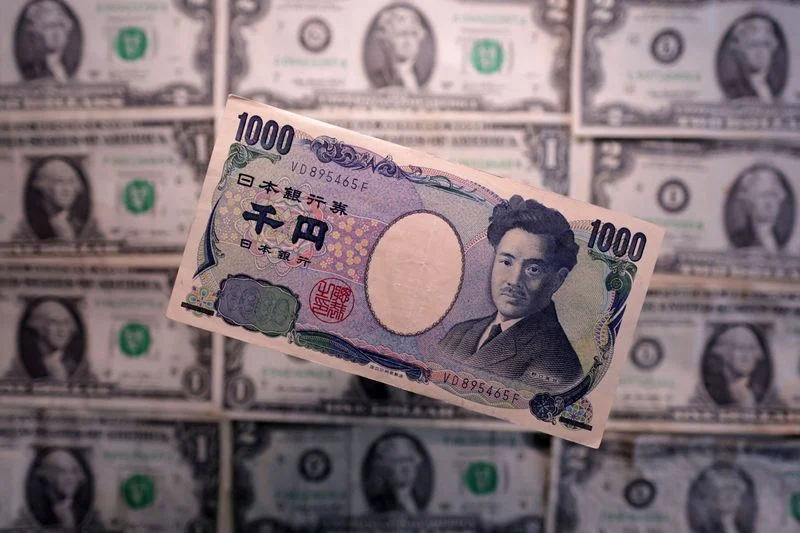

Dollar clings to 2-month high as Gulf hostilities flare, yen wobbles near intervention zone

This is the first dollar bond issued out of India since January this year when ReNew Energy raised $600 million by issuing a five year bond. Since then though geopolitical volatilities more particularly due to the US-Israel attack on Iran has meant that the high overseas yields were beyond the expectations of Indian companies looking to raise funds from abroad.
Nirmal Jain, founder and managing director at IIFL Finance said the successful issue comes at a time of heightened volatilities, pressure on the rupee and capital outflows from India.
IIFL Finance successfully raised $500 million through international dollar bonds, marking the first such issuance from India since January. Priced at 7.6%, the 3.25-year bond attracted significant investor interest despite geopolitical volatilities. Proceeds will fund lending to economically weaker sections, including MSMEs and gold loans.
“It’s a positive thing at a time when there has been no issue from India for a long time. This is also the first social issue from IIFL Finance. The proceeds of this issue will be used to lend to economically weaker sections of society which includes MSMEs, gold loans and loan against property,” Jain said.
Prathamesh Sahasrabudhe, MD & Head, Capital Markets, India, Standard Chartered Bank said, “This marks the market reopening dollar bond transaction for Indian issuers since the onset of the West Asia crisis.

Meta accuses Australia of breaching FTA, invokes US ’trade action’

The well-known Swan Valley distillery has been making a series of changes to slim down the business since it fell into administration last year.
Wall Street stocks pulled back from record highs as flaring tensions in the Middle East and rising crude prices stoked inflation jitters and convinced investors to take some profits.

Check out what’s clicking on FoxBusiness.com.
A woman was arrested at Walt Disney World‘s Contemporary Resort in Florida, after deputies say she threw multiple glasses of water at a restaurant manager, allegedly grabbed another manager by the shoulders and snatched a cast member’s name tag during a dispute over seating arrangements.
Leslie Helen Varley, 57, was arrested and charged with two counts of battery, robbery by sudden snatching and criminal mischief, according to an Orange County Sheriff’s Office arrest affidavit reviewed by FOX Business.
The incident happened May 19, at Steakhouse 71 inside Disney‘s Contemporary Resort.
According to the affidavit, restaurant manager Jessica Lee Brunk told deputies she was helping a large party that became upset after learning the group could not all be seated together. Brunk said the conversation was cordial until staff informed the party that tables could not be moved.
DISNEY WORLD REVIVES ‘LADIES AND GENTLEMEN’ GREETING AFTER YEARS OF GENDER-NEUTRAL MESSAGES
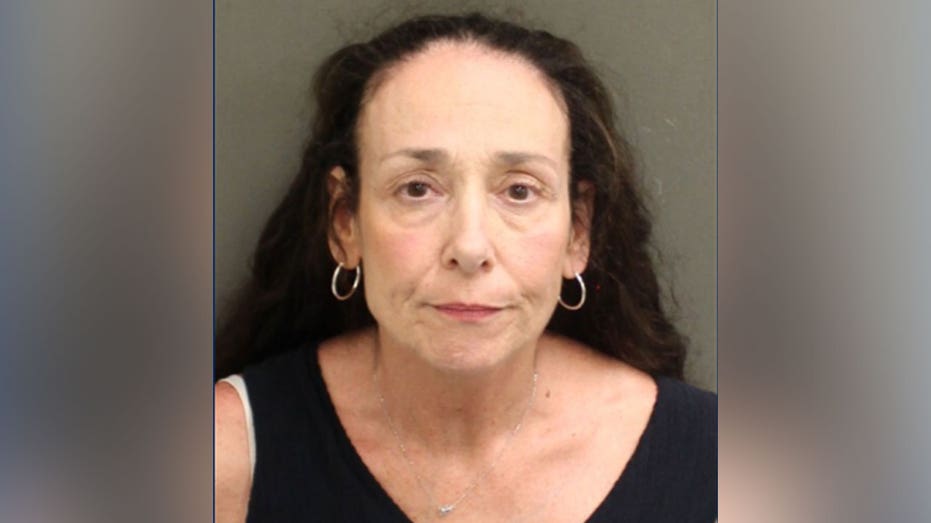
Leslie Helen Varley was arrested after deputies accused her of throwing water at a restaurant manager and taking a cast member’s name tag during a dispute at Walt Disney World’s Contemporary Resort in Orlando, Fla. (Orange County Corrections Department / Unknown)
That’s when Varley allegedly grabbed Brunk by both shoulders and moved her about six steps, the affidavit states.
A second manager, identified in the report as John Kevin Ortiz, then stepped in to assist. Ortiz told deputies Varley became irate and threw three glasses containing water and ice at him. All three glasses struck the front of his body, according to the affidavit.
| Ticker | Security | Last | Change | Change % |
|---|---|---|---|---|
| DIS | THE WALT DISNEY CO. | 99.39 | -2.02 | -1.99% |
Deputies said Varley then approached Ortiz and snatched his Disney name tag from the left side of his suit jacket before walking away from the restaurant.
Ortiz followed Varley to the front desk to retrieve the name tag. During the confrontation, Varley allegedly dropped and broke four glasses valued at about $20, according to investigators.
DISNEY WORLD HONORS WORLD WAR II VETERAN’S BIRTHDAY WITH MOVING FLAG RETREAT CEREMONY
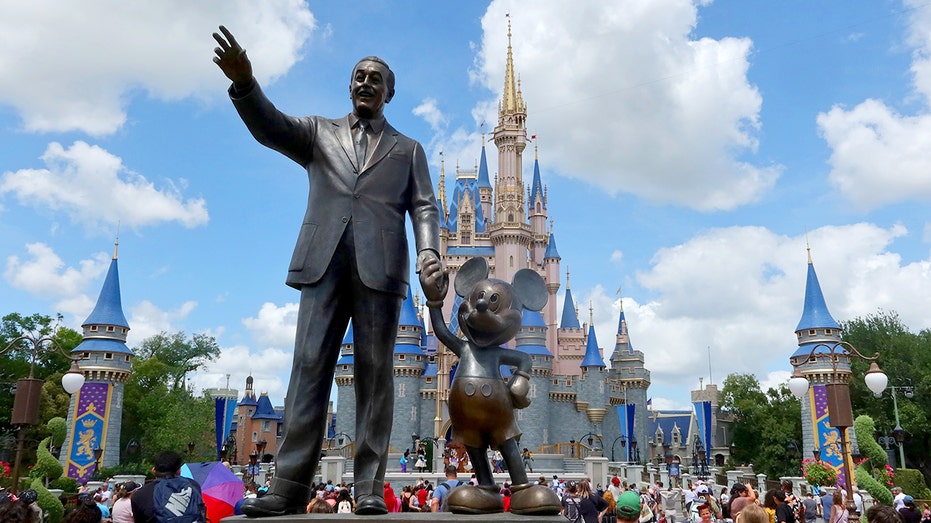
A woman was arrested at Walt Disney World’s Contemporary Resort in Orlando, Fla. (Gary Hershorn/Getty Images, File / Getty Images)
Neither manager reported visible injuries and both declined medical treatment at the scene, the affidavit states. Both told deputies they were willing to prosecute.
When questioned by deputies, Varley admitted she became upset after a comment was allegedly made about her disabled daughter touching a cast member, according to the affidavit.
Varley told investigators she threw a glass of water at Ortiz before throwing two more. She also acknowledged taking his name tag, telling deputies she wanted to photograph it because she was upset and intended to report him.
According to the affidavit, Varley said Ortiz did not give her permission to remove the name tag, though she claimed she returned it shortly afterward.

The incident occurred May 19 at a steakhouse restaurant inside Disney’s Contemporary Resort. (Gary Hershorn/Getty Images, File / Getty Images)
Deputies issued Varley a trespass warning from the property and advised her she could be arrested if she returned.
GET FOX BUSINESS ON THE GO BY CLICKING HERE
Based on statements from the victims and Varley’s own admissions, deputies arrested her on two counts of battery, one count of robbery by sudden snatching and one count of criminal mischief involving less than $200 in damage, the affidavit states.
A representative for Walt Disney Parks did not immediately respond to FOX Business’ request for comment.

Nine in hospital after emergency crews race to primary school in Nottinghamshire
INNIO prices upsized IPO at $27 per share on Nasdaq

Treasury Signals CLARITY Act by Summer; Bitcoin Reserve Moves



-

 Tech6 days ago
Waymo dominates autonomous vehicle registrations as Tesla trails behind
-

 News Videos6 days ago
This is BROKEN! INSANE 5x MONEY CAR WASH WEEK! The NEW GTA Online UPDATE Today! (GTA5 New Update)
-
 Tech5 days ago
SpaceX just won a second Golden Dome contract. This one is $4.16 billion.
-

 Business2 days ago
Jade Biosciences, Inc. (JBIO) Discusses Positive Interim Results From JADE101 Phase I Healthy Volunteer Study and Development Plans Transcript
-

 News Videos5 days ago
SHE IS KILLING XRP!!! WATCH URGENT AND ACT FAST
-
 NewsBeat5 days ago
FIRST NIGHT REVIEW: Take That bring the Circus back to life in spectacular sun-soaked style
-
 Crypto World5 days ago
CFTC Has Approved the First Regulated Bitcoin Perpetual Contract in the U.S.
-

 Business5 days ago
Is the Spurs Phenom Already Better Than Prime Diesel?
-
 NewsBeat5 days ago
Novak Djokovic v Joao Fonseca LIVE: French Open latest scores and results after Jannik Sinner’s shocking collapse
-
 Entertainment5 days ago
Weak ‘Supergirl’ Box Office Tracking Amid Milly Alcock Backlash
-
 Crypto World5 days ago
Snowflake (SNOW) Stock Rallies on Strong Q1 Results and AI Product Growth
-

 Business5 days ago
Demand Conditions Improve In Chemicals Sector In April 2026
-

 Politics5 days ago
The House | Inside Andy Burnham’s Makerfield Campaign: “Nobody Thinks This Is In The Bag”
-
 Crypto World5 days ago
MicroStrategy Moves $30 Million in BTC to Coinbase Prime: Is the Bitcoin Sell-Off Already Here?
-

 Tech6 days ago
This Week In Security: Ubiquiti Fixes, And FreeBSD Joins The Club You Don’t Want To Join
-

 Entertainment6 days ago
Maddox Jolie-Pitt Legally Requests to Drop Brad’s Surname
-
 Entertainment5 days ago
One of the Greatest Sitcoms of All Time Shoots Up Apple TV’s Charts 11 Years Later
-
 Crypto World1 day ago
Seagate (STX) Stock Surges to Record High on AI Boom and Legal Settlement
-
 NewsBeat5 days ago
Everything you need to know as Cambridge’s Strawberry Fair returns after cancelled year
-
 Entertainment5 days ago
Britney Spears Shares Troubling Update After Hard Year
You must be logged in to post a comment Login