

Business
Ford unveils first-ever Bronco Filson for outdoor enthusiasts


Ford and Filson previously collaborated on the 2020 Bronco x Filson Wildland Fire Rig concept vehicle, which supported conservation efforts through the National Forest Foundation. (Credit: Ford Motor Company)
Ford Motor Co. and outdoor apparel brand Filson unveiled the first-ever Bronco Filson on Wednesday, a premium off-road SUV designed for outdoor enthusiasts.
The new model brings together Bronco and the Seattle-based outfitter, known for its durable outdoor gear. The Bronco Filson combines a specially tuned 3.0-liter EcoBoost V6 engine, outdoor-inspired design elements and the quietest cabin ever offered in a Bronco, according to Ford.
“Our owners – whether it’s our owners or Filson’s owners – share the same level of interest in brands like ours, where there’s a high degree of capability, while at the same time being able to have tremendous durability,” Dave Rivers, head of Ford Enthusiast Brands, told FOX Business. “I think it’s the power of our two brands coming together because we have a shared love of the outdoors, we have a shared love of American craftsmanship.”
FORD TEAMS UP WITH OUTDOOR OUTFITTER FILSON TO LAUNCH NEW BRONCO SUV

The 2027 Ford Bronco Filson drives along a dirt trail. (Ford Motor Company)
The Bronco Filson comes standard with Ford’s Sasquatch off-road package, which includes 35-inch tires, front and rear locking differentials and Fox shocks.
The SUV also features Ford’s Terrain Management System with G.O.A.T. (“Goes Over Any Type of Terrain”) modes, as well as Trail Turn Assist and Trail 1-Pedal Drive for enhanced off-road capability.
Rivers said the V6 engine is expected to be one of the vehicle’s biggest draws.
“I would say the three-liter engine is going to be just remarkable in this product,” he said.
Ford said the Bronco Filson will be the quietest Bronco ever built due to improved airflow, acoustic glass and enhanced seals that reduce wind and road noise. The SUV delivers nearly 20% less perceived wind noise than the 2021 Bronco, according to the automaker.
“[Customers] might be most surprised by…how much quieter it is than maybe what they’ve been used to on other Broncos – Just a tremendous reduction in overall noise levels,” Rivers added. “I think it’s just going to add to that overall enjoyment of the vehicle.”
FORD RECALLS OVER 179,000 BRONCO AND RANGER VEHICLES OVER SEAT DEFECT
The 2027 Ford Bronco Filson and the 2027 Ford Bronco Filson First Edition sit along a rocky riverbank.
Inside, the Bronco Filson features quilted leather seats, Filson-inspired materials, ventilated front seats, heated rear seats and an upgraded Bang & Olufsen (B&O) audio system.
The SUV also includes removable cargo bags, door-mounted saddlebags for outdoor gear and a digital rearview mirror that maintains visibility even when the cargo area is packed. Ford said the mirror includes a washer system to help keep the camera lens clear.
“We know that our owners – they spend a ton of time in the outdoors,” Rivers said. “They fly fish, they might hunt and fish and camp, and so we’ve given them as an option two removable storage bags in the rear compartment of the vehicle.”
Additional features include power running boards that automatically deploy when the doors are opened.
HOW CUTTING ONE COSTLY HABIT COULD SAVE SMALL BUSINESSES THOUSANDS ON FUEL: EXPERT

The 2027 Ford Bronco Filson First Edition is shown here. (Ford Motor Company)
Ford will also offer a limited-run Bronco Filson First Edition with exclusive Iron Sands Copper Metallic paint, unique badging and a serialized console plaque.
The Bronco Filson will be built at Ford’s Michigan Assembly Plant. Orders are expected to open this fall, with the SUV set to arrive in showrooms in early 2027. Ford has not yet announced pricing.
A Bronco Filson Tour showcasing the SUV’s design, materials and capability is scheduled to begin in July.
GET FOX BUSINESS ON THE GO BY CLICKING HERE
Ford and Filson previously collaborated on the Bronco x Filson Wildland Fire Rig concept vehicle in 2020, which supported wildfire conservation efforts through the National Forest Foundation.



Israel, Lebanon agree to implement ceasefire, boosting hopes for Iran deal
Business
(VIDEO) Caleb Williams Fulfills Childhood Dream as First Bears Player on Madden NFL 27 Cover

CHICAGO — Chicago Bears quarterback Caleb Williams realized a lifelong goal Wednesday when EA Sports named him the cover athlete for “Madden NFL 27,” making him the first player in franchise history to earn the prestigious honor.
Williams, entering his second NFL season, will grace both the Standard and Deluxe editions of the popular video game, set for release on August 13. The announcement celebrates his breakout rookie campaign in which he led the Bears to a divisional title and their first playoff victory in 15 years.
“When I received the call from Madden, it was like my childhood dream was coming true,” Williams said. “Being on the cover of ‘Madden NFL 27’ is a full-circle moment. I grew up playing Madden and imagining what it would be like to be part of the game.”
The 2025 season saw Williams throw for 3,942 yards and 27 touchdowns, setting a new Bears single-season passing record. Under new head coach Ben Johnson, he guided the team to its first NFC North title since 2018. His ability to engineer comebacks earned the squad the nickname “Cardiac Bears,” with seven fourth-quarter or overtime victories, including in the playoffs.
EA Sports highlighted Williams as the embodiment of a modern franchise quarterback. The Standard Edition cover features his signature jump pass — a memorable fourth-and-8 throw to rookie receiver Rome Odunze during a playoff comeback against the Green Bay Packers. The Deluxe Edition captures his “Iceman” celebration following a 46-yard walk-off touchdown pass to DJ Moore in overtime against the same rival in Week 16, recognized as the 2025 NFL Moment of the Year.
Evan Dexter, EA Sports vice president of franchise strategy and marketing, praised the selection. “Caleb Williams is what a true face of the franchise looks like — the culmination of many moments in the Chicago Bears’ incredible history that has led them to their electric, generational quarterback,” he said.
Williams enters “Madden NFL 27” with a 90 overall rating, reflecting his strong debut. The young quarterback expressed ambition to improve that number through on-field performance. “I know fans are going to love what’s new in this year’s game, and I’m looking forward to getting my rating up to a 99 by the end of the season,” he added.
The Bears organization views the cover selection as validation of Williams’ rapid impact since being drafted first overall in 2024. Selected after a standout college career at USC, Williams quickly adapted to the NFL, displaying poise, arm talent and creativity that excited a fan base hungry for sustained success.
Chicago’s playoff win in 2025 ended a long drought for one of the NFL’s oldest franchises. The Bears last reached the Super Bowl following the 2006 season and have endured multiple rebuilding phases. Williams’ arrival, paired with a talented supporting cast including Moore, Odunze and a strengthened offensive line, has generated optimism around Soldier Field.
The “Madden” franchise remains one of the most influential in sports gaming, shaping how millions experience football. Past cover athletes include stars like Patrick Mahomes, Lamar Jackson and Josh Allen. Williams joins an elite group, representing a new generation of dynamic quarterbacks who thrive in structured offenses while making plays off-script.
Game developers have emphasized enhanced realism and strategic depth in “Madden NFL 27.” Features reportedly include more meaningful management decisions, dynamic play-calling consequences and improved player movement. Williams’ inclusion is expected to boost engagement among Bears fans and casual gamers alike.
The quarterback’s selection also highlights broader trends in the NFL. Mobile, improvisational passers like Williams have changed how offenses operate, forcing defenses to adapt. His jump-pass ability and calm demeanor in high-pressure situations make him an ideal representative for a game striving for authenticity.
Bears coach Ben Johnson, who previously coordinated Detroit’s high-powered offense, has implemented a scheme that maximizes Williams’ strengths. The results were immediate: franchise records, playoff success and now national recognition through the Madden cover.
For Williams, the honor carries personal significance. Growing up in the Madden era, he often simulated his own career in the game. Landing on the cover completes a childhood fantasy while motivating him for greater achievements. At 23 years old, he stands at the beginning of what many project as a long, successful career.
The announcement arrives as the Bears prepare for the 2026 season. Expectations remain high following last year’s breakthrough. Chicago will look to build on its divisional success and make deeper playoff runs. Williams’ development remains central to those ambitions.
EA Sports has a history of celebrating culturally significant moments through its covers. Williams’ “Iceman” celebration — where he calmly warmed his hands inside his muff before the game-winning throw — captured the poise that defines his playing style. Including it on the Deluxe Edition adds emotional resonance for fans.
Reaction across the NFL and gaming communities has been overwhelmingly positive. Teammates and league peers congratulated Williams on social media, recognizing the milestone. For the Bears, it represents another step in elevating the franchise’s national profile.
Williams has embraced leadership responsibilities both on and off the field. His work ethic, humility and connection with fans have endeared him to Chicago. The Madden cover further cements his status as the face of the franchise.
As “Madden NFL 27” approaches release, anticipation builds around new features and how accurately it portrays current stars. Williams’ high rating and prominent placement ensure he will be a focal point for players building their own dynasties in franchise mode.
The Bears’ turnaround under Williams offers a compelling narrative. From years of mediocrity to divisional contention, the young quarterback has accelerated progress. His journey resonates beyond Chicago, inspiring young athletes who see possibility in his rapid rise.
Looking forward, Williams aims to lead the Bears toward championship contention. A strong 2026 season could push his in-game rating higher while solidifying his place among the league’s elite. For now, he savors the moment of seeing himself on the Madden cover — a dream fulfilled that fuels greater aspirations.
The selection of Caleb Williams for “Madden NFL 27” marks a proud chapter for the Bears organization and a personal milestone for the quarterback. It celebrates not just statistical achievement but the excitement and hope he has restored to a historic franchise.

BANGKOK — South‑east Asia’s electric vehicle (EV) market is expanding at remarkable speed, reshaping the region’s automotive landscape and drawing unprecedented investment from Chinese manufacturers. Once dominated by Japanese combustion‑engine models, the region is now experiencing a rapid shift driven by policy incentives, competitive pricing and aggressive localisation strategies by foreign automakers. fdiintellige…
Indonesia and Thailand Lead Regional Uptake
Indonesia has emerged as one of the region’s fastest‑growing EV markets, with one in five vehicles sold in 2025 now electric. Government incentives tied to local content and investment commitments have attracted major Chinese brands, including BYD, Wuling, Geely and Chery. BYD is completing a US$1 billion plant in West Java with annual capacity of 150,000 units. fdiintellige…
Thailand, long the automotive hub of ASEAN, is undergoing a similar transformation. Battery EVs accounted for nearly one‑third of domestic sales in 2025, supported by purchase incentives and a wave of new production facilities. BYD’s US$490 million Rayong plant, also capable of producing 150,000 vehicles per year, is part of a broader push that has turned Thailand into an emerging EV exporter. Exports of fully battery‑powered vehicles surged from US$2.4 million in 2022 to US$478 million in 2025, according to the Ministry of Commerce. fdiintellige…
Malaysia and Vietnam Chart Divergent Paths
Malaysia’s EV transition is progressing more slowly, with EVs representing 5% of new registrations in 2025. The market is shaped by national automaker Proton, which is leveraging technology from shareholder Geely to build local EV capabilities. Foreign brands, however, have been less active in local assembly due to weaker incentives. fdiintellige…
Vietnam stands out for its bold but risky strategy led by VinFast, which produced 200,000 vehicles in 2025 at its Hai Phong facility and expanded production to Ha Tinh, India and Indonesia. Its planned multibillion‑dollar US factory has stalled, highlighting the challenges of competing without the deep supply‑chain integration enjoyed by Chinese rivals. fdiintellige…
China’s Influence Remains the Defining Factor
Across the region, one trend is unmistakable: Chinese technology, investment and supply‑chain integration are driving the EV boom. Countries that align themselves with Chinese production networks—such as Indonesia and Thailand—are advancing fastest. Those pursuing more independent paths, like VinFast in Vietnam, face steeper hurdles. fdiintellige…
Other People are Reading

Form 144 RBC Bearings Incorporated Inc. For: 4 June

This is an edition of the What’s News newsletter, which helps you catch up on the headlines and understand the news, free in your inbox daily. If you’re not subscribed, sign up here.
1. The Trump administration signaled a retreat on its nearly $1.8 billion “anti-weaponization” fund.
The Justice Department said it would abide by a judge’s Friday order to temporarily halt work on the fund ahead of a mid-June hearing. The fund had met powerful pushback from members of Congress and threatened to derail President Trump’s efforts to pass immigration enforcement funding.
Copyright ©2026 Dow Jones & Company, Inc. All Rights Reserved. 87990cbe856818d5eddac44c7b1cdeb8
Business
Exclusive | Is the India story over for FIIs? BofA says investors don’t want to miss what’s next

“There’s still genuine excitement about India. Investors know it’s an economic cycle, and they know India has multiple themes and sectors that will do well over time,” Shah said in an exclusive interview with ET Markets on the sidelines of their India conference.
Edited excerpts from a chat:
Let me start by asking you about the Q4 earnings season. Do you think India Inc managed to obtain passing marks?
Results in general were a beat. But once you start analyzing it further in detail, the picture gets more nuanced.

Two thirds of the Nifty companies that reported delivered a beat. That sounds encouraging, but when you look at the absolute quantum, the total earnings growth from Nifty companies came in at 4.6%, which is quite muted in India’s context.
The second data point is that 45% of that 4.6% earnings growth came from commodity companies due to higher steel prices, higher aluminum prices, and so on. From an investor perspective, you don’t want to assign high valuation multiples to that, because these are considered cyclical earnings. It’s not like a consumer company gaining market share, where that franchise is durable. Markets don’t reward commodity-driven earnings with premium valuations.
Now, if you look at NSE 200 companies, earnings growth was 9%. But again, one third of that came from commodity firms, and unfortunately 80% of companies in that universe missed estimates and only 20% were a beat.
So it really depends on where you want to swing. If you’re an optimist, you focus on two-thirds of Nifty companies delivering a beat. If you’re more balanced, you get into these nuances — it was a marginal beat, mostly driven by commodities, and higher commodity prices will eventually lead to margin pressures in upcoming quarters for a wide range of other companies. The earnings growth outlook is therefore also challenged.
So while Q4 wasn’t bad, I think it’s a signal that earnings are heading weaker going forward.
So one narrative in the market has been that low inflation has led to low earnings growth. Won’t this commodity inflation that you are talking about actually translate into higher growth?
Yes and no. Higher commodity prices lift earnings for commodity companies, but create margin pressure for non-commodity companies — the consumers of those commodities. On an aggregate basis, our estimate is 8.5% earnings growth for FY27, which we describe as low growth on a low base. FY26 as a whole came in at around 6%, so 8.5% off that base is not very encouraging.
Are you not worried about downgrades in Q1 and Q2 given the impact of higher prices of crude oil and other commodities?
No because we had already taken our earnings estimates down in two rounds. First in early March, then in early April. We came down from 14% to 8.5%, factoring in the West Asia conflict — higher crude, higher commodities, the possibility of higher rates, and a weaker rupee. We put all of that together and revised down on a bottom-up basis.
However, when I look at consensus, earnings downgrades are definitely a risk. Consensus is still penciling in 15% earnings growth versus our 8.5%. I don’t believe 15% is going to be the reality. As companies disappoint in the June and possibly September quarters, consensus will have to cut meaningfully. We may not have to.
Talking about the market’s trajectory, do you think the worst of the West Asia crisis is priced in at the index level?
That gets into the timing of how long the conflict lasts, which unfortunately nobody knows. You can only draw scenarios. Our base case assumes the conflict ends by the end of June for the sake of an assumption.
So 8.5% earnings growth is premised on the conflict resolving by the end of June. If it drags beyond that, we have a bear case modeled. If it drags even further, we have a worst case. We can only run sensitivities.
Given we’re already in June, there’s no bull case left anymore. We’re hoping the base case holds, but it could easily become a bear or worst case.
So what does your bear case scenario look like?
The bear case is where markets first de-rate from the 15% consensus growth expectation down toward our 8.5%, and that leads to capitulation of retail domestic flows. Markets have already delivered flat returns for about 19 months. At some point, retail investor fatigue could set in — if growth isn’t materializing, maybe a fixed deposit with a guaranteed return looks more attractive.
If that happens, the way to think about it is this: if India’s nominal GDP growth is 10%, you’d expect Nifty 50 companies to do better because they should be market share gainers. But if they’re growing at 8.5% — below nominal GDP — you logically want to pay them a lower-than-average valuation multiple. So the bear case implies below-average valuations on realistic earnings of 8.5%, which brings you to roughly 12% downside from current levels.
FII outflows have been persistent. Is it valuations, lack of earnings growth, or domestic liquidity providing an easy exit?
It’s a combination. From the September 2024 peak to today, FII outflows total roughly $52 billion. Against that, domestic investors have put in around $60 billion — so yes, domestic flows have clearly been providing FIIs an exit.
But the core reasons for the outflows are: first, plenty of alternatives globally — Korea and Taiwan on the back of AI, Brazil on commodities, Japan on fiscal expansion, even China is cheap at 13x versus India at 20x. Second, India’s growth story has been impacted — lower growth, higher valuations, macro headwinds from the West Asia conflict, weaker rupee, potential rate hikes. And third, LTCG taxes and currency depreciation eat into returns for foreign investors, making the India trade less compelling when you’re already making little or negative returns.
What can India do to bring FIIs back?
Several things. Energy security reforms, even if they take years to implement, give investors a visibility that India is fixing its current account deficit problem structurally. Shipbuilding and power distribution reforms create new growth avenues. Rationalization of regulations and taxes is important. And on the FDI side, India needs to continue improving on the basics — smooth land acquisition, skilled labor, cheaper industrial power, good logistics infrastructure, and easier business processes. We’ve made a lot of progress on each of these, but we’re not at 10 out of 10 yet.
On the rupee — it’s falling because India’s balance of payments is negative. We import a lot of crude and gold, creating a current account deficit. The three main capital inflows that should offset this — FDI, FII, and remittances — are all under pressure. Net FDI is actually single-digit when you account for strategic investors monetizing stakes and repatriating capital. FII flows are negative. And remittance flows are circular — if the rupee is depreciating, Indians abroad hold back dollars waiting for a better rate, which itself adds to the depreciation pressure.
What are the key takeaways from the conversations that you are having with investors at your India conference?
There’s still genuine excitement about India. Investors know it’s an economic cycle, and they know India has multiple themes and sectors that will do well over time.
They want to understand what policymakers are thinking on energy security, fiscal consolidation, capex, and reforms. They want to know how corporates are managing the West Asia headwinds.
They’re doing homework and want to be prepared to know what they want to buy if some of these things were to play out. They don’t want to be left out when India story starts to pick up again.


Daniel is an avid and active professional investor.
He runs Crude Value Insights, a value-oriented newsletter aimed at analyzing the cash flows and assessing the value of companies in the oil and gas space. His primary focus is on finding businesses that are trading at a significant discount to their intrinsic value by employing a combination of Benjamin Graham’s investment philosophy and a contrarian approach to the market and the securities therein. Learn more.
Analyst’s Disclosure: I/we have no stock, option or similar derivative position in any of the companies mentioned, and no plans to initiate any such positions within the next 72 hours. I wrote this article myself, and it expresses my own opinions. I am not receiving compensation for it (other than from Seeking Alpha). I have no business relationship with any company whose stock is mentioned in this article.
Seeking Alpha’s Disclosure: Past performance is no guarantee of future results. No recommendation or advice is being given as to whether any investment is suitable for a particular investor. Any views or opinions expressed above may not reflect those of Seeking Alpha as a whole. Seeking Alpha is not a licensed securities dealer, broker or US investment adviser or investment bank. Our analysts are third party authors that include both professional investors and individual investors who may not be licensed or certified by any institute or regulatory body.

Operator
Good afternoon, ladies and gentlemen, and welcome to Descartes Systems Group Quarterly Results Conference Call. [Operator Instructions] This call is being recorded on June 3, 2026.
I would now like to turn the conference over to Scott Pagan. Please go ahead.
J. Pagan
President & COO
Thanks, and good afternoon, everyone. Joining me on the call today are Ed Ryan, CEO; and Ed Gardner, CFO. And I trust that everyone has received a copy of our financial results press release that was issued earlier today.
Portions of today’s call, other than historical performance, include statements of forward-looking information within the meaning of applicable securities laws. These statements are made under the safe harbor provisions of those laws. These forward-looking statements include statements related to our assessment of the current and future impact of geopolitical, trade and tariff and economic uncertainty on our business and financial condition. Descartes’ operating performance, financial results and condition, cash flow and use of cash, business outlook, baseline revenues, baseline operating expenses and baseline calibration, anticipated and potential revenue losses and gains, anticipated recognition of revenues and incurrence of expenses, potential acquisitions and acquisition strategy, cost reduction and integration initiatives, the approval and potential share purchases under a normal course issuer bid and other matters that may constitute forward-looking statements.

A Federal Court judge has slammed former senator Rod Culleton’s bid to reconsider his $200,000 debt to a Lester Group entity.

The answer runs deeper than most executives — and most policymakers — are comfortable admitting.
When people debate China’s role in Thailand, they tend to argue about trade deficits, foreign investment approvals, or which brand of electric vehicle is outselling which. What gets far less attention is the layer underneath all of those debates: the physical and digital infrastructure that Chinese companies have been quietly installing across the country for the past several years — the 5G backbone, the data centres, the e-commerce platforms, the payment rails, the industrial parks, and the EV supply chain being assembled in the Eastern Economic Corridor.
That infrastructure is not just an investment story. It is a dependency story. And understanding it is increasingly essential for any business operating in Thailand, any policymaker trying to manage it, and any investor trying to price it.
The 5G backbone and what runs on top of it
Start with the most foundational layer: connectivity.
Huawei built much of the 5G network backbone across Thailand’s Eastern Economic Corridor — the 30,000-square-kilometre special economic zone in Chonburi, Rayong, and Chachoengsao that is now the engine room of Thailand’s industrial ambitions. The 5G infrastructure Huawei installed is not a standalone product. It is the operating environment for the smart port management at Laem Chabang, the logistics optimisation systems running through the EEC’s industrial estates, the predictive maintenance systems in EV manufacturing plants, and the smart grid operations connecting new energy facilities to the broader power network.
In other words, the physical infrastructure of Thailand’s most strategically important economic zone runs, in significant part, on Chinese telecommunications infrastructure. That is not a political statement — it is an operational fact that every logistics operator, manufacturer, and technology company in the EEC needs to understand.
Alongside Huawei’s 5G footprint, Alibaba Cloud has built extensive data centre infrastructure across the Bangkok metropolitan area, providing cloud computing services to Thai businesses, government agencies, and the Chinese manufacturers operating in the EEC. Chinese manufacturers arriving in the zone find a digital environment that feels familiar — because it was built by their home-country firms. That familiarity reduces friction and accelerates ramp-up in ways that competitors from other countries cannot match.
ByteDance’s $25 billion bet — and what it means
If Huawei and Alibaba Cloud represent the first wave of Chinese digital infrastructure in Thailand, ByteDance’s investment commitment represents the second — and it is significantly larger.

TikTok’s parent company received BOI approval in 2026 for a $25 billion data infrastructure investment spanning server installation and AI processing facilities across Bangkok, Samut Prakan, and Chachoengsao. This follows a 127-billion-baht data-hosting project approved the previous year. Combined, ByteDance has committed over 270 billion baht in long-term infrastructure investment to Thailand — making it one of the single largest foreign technology commitments in the country’s history, from any source.
These are not server rooms. They are the physical substrate for AI model training, real-time recommendation systems, and logistics orchestration at a scale that will define Thailand’s digital economy for years. When ByteDance scales this infrastructure, TikTok Shop’s ability to serve Thai sellers and reach Thai consumers will deepen significantly — reinforcing a platform dependency that is already substantial.
The e-commerce layer: 98.8 percent and three platforms
Thailand’s e-commerce market surged 51.8 percent in 2025, crossing 1.15 trillion baht in total value — the fastest growth rate of any major digital retail market in Southeast Asia. Three platforms capture 98.8 percent of the gross merchandise value across the region: Shopee, TikTok Shop, and Lazada. Two of the three — TikTok Shop and Lazada — are Chinese-owned. The third, Shopee, operates under Sea Limited, a Singapore company with deep roots in the Chinese technology ecosystem.

TikTok Shop alone has captured 51 percent of Thai consumer attention, with 80 percent of Thai TikTok users making purchases through the platform during major sale periods. Its integration of short-form video with direct purchasing has effectively collapsed the boundary between content and commerce for Thai consumers under 35. A product that does not have a TikTok Shop strategy is increasingly invisible to a significant segment of the Thai market. That is a Chinese platform decision with an unavoidable business consequence for every Thai retailer and every international brand seeking Thai consumers.
The dependency is not just commercial. It is infrastructural. The algorithms that determine what Thai consumers see, the logistics networks that fulfill their orders, and the payment systems that process their transactions are all, to a significant degree, operated by Chinese-linked firms. This is not a future risk — it is the current operating reality of Thai retail.
The payment rails: Ant Group and the quiet dollar bypass
The least-covered dimension of Chinese infrastructure dependency in Thailand is happening in financial plumbing — and it may prove the most consequential over time.
The Bank of Thailand has established a local currency settlement framework that allows Thai exporters and importers to denominate and settle transactions with Chinese counterparties directly in baht and yuan, bypassing US dollar conversion. The practical mechanism running underneath this framework is, in significant part, operated by Chinese-linked firms.
Ant Group — the financial services arm of Alibaba — is a backer of Ascend Money, which operates TrueMoney Wallet, Thailand’s most popular digital payments application with a 53 percent market share. The integration between TrueMoney and Alipay enables seamless cross-border payment flows: Chinese tourists pay with Alipay; Thai merchants receive baht. Thai exporters invoice in yuan; Chinese buyers pay in their home currency. The settlement infrastructure makes it work invisibly.
For treasury teams managing Thai-China trade exposure, this is a system change, not just a product update. A bilateral trade relationship increasingly settled in local currencies, using payment rails controlled by Chinese-linked firms, represents a meaningful shift in financial architecture — one that most FX and payment strategies have not yet caught up with.
The industrial layer: parks, plants, and supply chains
The physical infrastructure dependency extends beyond digital. In the Eastern Economic Corridor, Chinese companies have built the operating environment for Thailand’s new industrial economy in ways that are concrete, structural, and increasingly hard to replicate elsewhere.
The Thai-Chinese Rayong Industrial Park alone has attracted $2.5 billion in investment and employs over 20,000 Thai workers, with more than 100 Chinese manufacturers already established before the latest wave of arrivals. Chinese EV manufacturers have gone beyond showrooms: BYD has built a Rayong plant with 150,000-unit annual capacity; Changan has committed 9.8 billion baht to a facility targeting 100,000 EVs per year; Great Wall has converted its existing Thai factory from ICE to EV production. Sunwoda Electronic, a Chinese battery firm, received approval to invest over $1 billion in battery manufacturing in Chonburi Province.
Taken together, these investments describe a vertically integrated EV supply chain — from battery cells to finished vehicles — that is being assembled in Thailand with Chinese capital and Chinese technology. The EV infrastructure that is being built is not incidental to Thai industrial strategy: it is the foundation on which the government’s 30@30 electrification target depends. Without Chinese capital and Chinese manufacturing capability, the goal of producing 30 percent of all vehicles as EVs by 2030 would remain a policy document rather than a plausible commitment.
The dependency Thailand is trying to manage
None of this is happening without Thai awareness of the risks. The 2026 ISEAS-Yusof Ishak Institute survey found that 90.6 percent of Thai respondents expressed concern about China’s growing economic influence — the highest rate in all of Southeast Asia, ahead of Vietnam, the Philippines, and every other ASEAN member.
That figure sits alongside nearly $7 billion in Chinese FDI approved in two years, a $19.23 billion trade deficit with China recorded in just the first four months of 2025, and 3,796 Thai manufacturing firms deregistering between 2021 and 2025 as Chinese competitive pressure intensified.
Thai policymakers understand the tension. The government’s response has been to pursue multi-alignment — deepening the EU FTA, accelerating BRICS membership talks, maintaining US security arrangements, and keeping every major partner in a position where none feels so essential that it stops being a partner and starts being a constraint. The proposed Southern Economic Corridor land bridge — a $28 billion megaproject expected to attract Chinese backing — is being negotiated carefully, with deliberate pace, precisely because Bangkok knows that accepting Chinese funding at that scale would deepen a dependency it is simultaneously trying to manage.
What this means for business
For executives operating in Thailand, the infrastructure dependency picture has three practical implications.
First, it is already the operating environment. Companies making decisions about cloud providers, logistics partners, payment systems, and e-commerce platforms in Thailand are already making decisions about Chinese infrastructure. The question is not whether to engage with it but how to do so with eyes open.
Second, the dependency is deepening, not stabilising. ByteDance’s $25 billion buildout, the EV battery supply chain taking shape in Chonburi, and the yuan-baht payment corridor expanding through TrueMoney are all in motion. The infrastructure layer of China’s presence in Thailand is becoming more embedded, not less, with each passing year.
Third, the risks are real but manageable. The 90.6 percent public concern figure is a political risk that is already producing regulatory responses — proposed VAT on low-priced Chinese goods, stricter enforcement of foreign business ownership rules, increased parliamentary scrutiny of Chinese-funded projects. Businesses that treat this as background noise will be caught off guard. Those that build genuine local integration — Thai supply chains, Thai employees at all levels, Thai community relationships — are substantially better positioned to navigate whatever regulatory response public sentiment eventually produces.
Thailand is not becoming a Chinese province. Its government is too experienced at managing great-power relationships, and its public is too sceptical of Chinese influence, for that. But the infrastructure that China has built in Thailand over the past decade is real, it is functioning, and an increasing proportion of Thai economic activity runs on top of it. Understanding that fact — precisely, not polemically — is the starting point for any serious business strategy in this market.
Based on the five-part series “Thailand × China: The Business Opportunity.”
Other People are Reading

CFTC Scraps No-Deny Clause in Settlements, Signals Enforcement Shift
Member of “Alaskan Bush People” star Matt Brown's rescue team details emotional mission to find him

Love Island star re-arrested after claims of sexual assault and stalking



-

 Tech6 days ago
Waymo dominates autonomous vehicle registrations as Tesla trails behind
-

 News Videos6 days ago
This is BROKEN! INSANE 5x MONEY CAR WASH WEEK! The NEW GTA Online UPDATE Today! (GTA5 New Update)
-
 Tech5 days ago
SpaceX just won a second Golden Dome contract. This one is $4.16 billion.
-

 Business2 days ago
Jade Biosciences, Inc. (JBIO) Discusses Positive Interim Results From JADE101 Phase I Healthy Volunteer Study and Development Plans Transcript
-

 News Videos5 days ago
SHE IS KILLING XRP!!! WATCH URGENT AND ACT FAST
-
 NewsBeat5 days ago
FIRST NIGHT REVIEW: Take That bring the Circus back to life in spectacular sun-soaked style
-
 Crypto World5 days ago
CFTC Has Approved the First Regulated Bitcoin Perpetual Contract in the U.S.
-

 Business5 days ago
Is the Spurs Phenom Already Better Than Prime Diesel?
-

 Politics5 days ago
The House | Inside Andy Burnham’s Makerfield Campaign: “Nobody Thinks This Is In The Bag”
-
 NewsBeat5 days ago
Novak Djokovic v Joao Fonseca LIVE: French Open latest scores and results after Jannik Sinner’s shocking collapse
-
 Entertainment5 days ago
Weak ‘Supergirl’ Box Office Tracking Amid Milly Alcock Backlash
-
 Crypto World5 days ago
Snowflake (SNOW) Stock Rallies on Strong Q1 Results and AI Product Growth
-

 Business5 days ago
Demand Conditions Improve In Chemicals Sector In April 2026
-
 Crypto World5 days ago
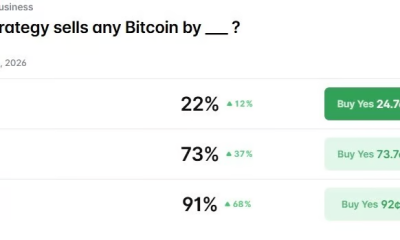
MicroStrategy Moves $30 Million in BTC to Coinbase Prime: Is the Bitcoin Sell-Off Already Here?
-

 Entertainment6 days ago
Maddox Jolie-Pitt Legally Requests to Drop Brad’s Surname
-

 Tech6 days ago
This Week In Security: Ubiquiti Fixes, And FreeBSD Joins The Club You Don’t Want To Join
-
 Entertainment5 days ago
One of the Greatest Sitcoms of All Time Shoots Up Apple TV’s Charts 11 Years Later
-
 Crypto World2 days ago
Seagate (STX) Stock Surges to Record High on AI Boom and Legal Settlement
-
 NewsBeat5 days ago
Everything you need to know as Cambridge’s Strawberry Fair returns after cancelled year
-
 Entertainment5 days ago
Britney Spears Shares Troubling Update After Hard Year
You must be logged in to post a comment Login