

Crypto World
Morgan Stanley taps Galaxy to offer crypto-backed access to Bitcoin ETF products



Morgan Stanley Wealth Management has expanded its crypto offering by enabling eligible clients to convert digital asset holdings into spot crypto exchange-traded products through a new referral arrangement with Galaxy Digital.
Summary
- Morgan Stanley clients can now lend Bitcoin, Ether, and Solana to Galaxy Digital in exchange for shares in spot crypto investment products.
- Galaxy has reduced the minimum lending transaction size for Morgan Stanley referred clients to $5 million from $25 million.
According to a Friday announcement, high-net-worth Morgan Stanley clients can lend cryptocurrencies including bitcoin, ether, and Solana to Galaxy Digital and receive shares in spot crypto investment products in return, including the recently launched Morgan Stanley Bitcoin Trust.
The companies said the process allows investors to move crypto exposure into regulated investment vehicles without selling their digital assets first. The announcement added that the structure could reduce in-kind crypto-to-ETP onboarding times by as much as 75%.
Explaining the rationale behind the arrangement, Alison Nest, Head of Investment Solutions Products at Morgan Stanley, said the bank has been active in decentralized finance and views the referral capability with Galaxy as a way to help wealth management clients integrate digital assets into their portfolios through an institutional framework.
Nest said the arrangement creates a connection between traditional finance and decentralized finance while giving investors additional ways to diversify their holdings.
Morgan Stanley deepens digital asset push
The latest initiative arrives as Morgan Stanley continues to add new crypto-related products and services across its wealth management and brokerage businesses.
Earlier this year, the bank launched the Morgan Stanley Bitcoin Trust, a spot Bitcoin exchange-traded fund that completed its first month without recording a day of net redemptions, according to previous company disclosures.
Recent regulatory filings have also shown the bank expanding beyond Bitcoin products. In May, Morgan Stanley disclosed holdings in the Volatility Shares XRP ETF and the Grayscale XRP ETF, adding XRP-linked investment products to a crypto portfolio that already included Bitcoin and Ethereum exposure.
At roughly the same time, the firm submitted an updated registration statement for the Morgan Stanley Solana Trust, a proposed spot Solana ETF that would hold SOL directly and stake part of its assets through third-party providers. According to the filing, staking rewards generated from those holdings would contribute to the fund’s overall returns.
Crypto access has also extended to Morgan Stanley’s brokerage business. Through a pilot program launched on E*Trade in May, the bank began offering Bitcoin, Ether, and Solana trading through infrastructure provided by Zerohash.
Morgan Stanley executives said at the time that the initiative formed part of a strategy to keep clients within the firm’s investment ecosystem.
Leadership changes have accompanied the expansion. Amy Oldenburg, a longtime Morgan Stanley executive, was appointed earlier this year to lead the firm’s first dedicated digital asset strategy role.
Galaxy expands institutional services
For Galaxy Digital, the partnership adds another institutional channel to its lending and asset management business.
According to company figures, Galaxy generated $505 million in adjusted gross profit during 2025 from its trading, lending, asset management, and staking services division.
Only days before announcing the Morgan Stanley referral arrangement, Galaxy also introduced an institutional over-the-counter prediction market trading desk, adding another service aimed at professional investors.


Bitcoin’s recent crash began with a violent rejection at $82,000 that drove it south to $59,000 on Friday, which became its lowest price tag since before the US presidential elections in November 2024.
Following such a painful decline, the asset has dropped into a critical zone where long-term indicators and historical patterns begin to converge. Perhaps that’s why many analysts have started to debate whether the bottom is just around the corner or another leg down could be in the making.
The Rainbow Chart
Popular analyst Crypto Rover noted recently that BTC had declined below the ‘rainbow chart’ (seen in the embedded video below), which was just the second such occurrence in its recent history. The reason for this long-term valuation model’s rarity is that it comes during extreme market conditions.
The last time it happened, BTC dumped toward $15,000 during the 2022 bear market. For many long-term bitcoin holders, it signals that the cryptocurrency is entering deeply undervalued territory; hence, it could be close to the bottom. For now, though, the asset remains firmly below it even after managing to rebound from the $59,000 low.
$BTC just fell below the rainbow chart.

Historically, this has happened 2 times.
• 2022: $15,500
• 2026: $63,000Most Bitcoin OG’s remember this. pic.twitter.com/SkOQrIDXBT
— Crypto Rover (@cryptorover) June 5, 2026
Another key level now in focus is the 200-week exponential moving average (EMA), which was brought up by fellow analyst CRYPTOWZRD. They noted that it has historically served as a reliable support during bear markets, and in most previous cycles BTC has bottomed either at or very close to it.
Bitcoin is currently testing it, and if it manages to hold above it and reclaim momentum, it could strengthen the case for a bottom forming in the low-$60,000 range. A clean breakdown, though, would likely open the door for deeper losses and extend the correction phase.
Maybe Not Complete?
Rekt Capital compared the current bear phase to the 2022 landscape and concluded that there’s a major discrepancy in the divergences from the previous all-time highs. In 2022, BTC deviated 22% below its 2017 all-time high, while it has not gone just 12% under the 2021 all-time high.
“Bitcoin is getting close to a bottom but it’s not there quite yet and there’s still time left,” the analyst concluded.
For now, the main signals remain mixed as long-term valuation models and key technical levels suggest BTC is getting close to a bottom, but it’s not necessarily there yet. As volatility remains elevated, the market seems to be entering a ‘make-or-break’ phase that could define the next major trend.
The post Bitcoin Nearing a Bottom? Key Indicators Flash Mixed Signals After $59K Drop appeared first on CryptoPotato.


Greece has prepared plans for a 15% cryptocurrency capital gains tax as officials move to bring digital assets into the country’s tax system.
Summary
- Greece is preparing legislation to impose a 15% capital gains tax on cryptocurrency profits, with the first €500 in gains exempt.
- Officials revealed the proposal would formally bring crypto assets into Greece’s tax code, with a bill expected to reach parliament in the coming months.
- The move comes as other jurisdictions, including Israel and Illinois, pursue different strategies to increase crypto tax compliance and revenue collection.
According to a report, Greece’s Finance Ministry is drafting legislation that would impose a 15% tax on profits from cryptocurrency investments, filling a gap in a tax framework that currently lacks dedicated rules for digital assets.
Two government officials familiar with the matter disclosed that the proposal is expected to reach parliament in the coming months. One senior official said the legislation would formally incorporate cryptocurrencies into Greece’s tax code, creating a clearer set of rules for investors and tax authorities.
Under the proposal, the first €500 ($580) in crypto gains would be exempt from taxation. A second official said that the measure would apply to capital gains from cryptocurrency investments but would not cover individuals mining digital assets.
Mining activities conducted through registered companies, however, would remain subject to taxation.
The move places Greece among a growing number of jurisdictions seeking to capture revenue from digital asset activity. Crypto taxation across Europe varies significantly, ranging from about 8% in Cyprus to as much as 30% in France, with most countries taxing capital gains rather than individual transactions.
Governments are expanding crypto tax oversight
Alongside Greece’s proposal, authorities in several countries have recently intensified efforts to improve crypto tax compliance.
Earlier this week, crypto.news reported that the Israel Tax Authority received far fewer disclosures than expected under a voluntary crypto tax reporting program launched in August 2025. As per the report, the authority had hoped to recover up to $1 billion in tax revenue from undeclared cryptocurrency profits but has so far received disclosures covering only about $50 million in crypto assets.
58 taxpayers had used the program, which allows eligible crypto holders to avoid criminal prosecution if they correct past filings and pay outstanding taxes. Taxpayers must complete disclosures and settle liabilities before Aug. 31, 2026, while eligibility is limited to investors whose crypto holdings did not exceed roughly $522,000 as of December 2024.
Back in Greece, officials said that estimating the size of the domestic crypto market remains difficult because many investors use trading platforms located outside the country. As a result, authorities have not yet produced revenue forecasts tied to the proposed tax.
Transaction taxes are also gaining attention
Elsewhere, lawmakers in Illinois have advanced a different approach to taxing digital assets.
According to a fiscal year 2027 budget bill approved by the Illinois General Assembly, the state plans to introduce a 0.2% tax on cryptocurrency transactions facilitated by digital asset brokers. State budget documents estimate the measure could generate approximately $60 million in revenue annually.
Crypto.news previously reported that the proposal, known as the Digital Asset Privilege Tax Act, would require digital asset brokers to register with the state before conducting covered transactions.
The legislation also includes criminal penalties for non-compliance, with unregistered operations potentially facing Class 3 felony charges after Jan. 1.
Industry opposition has already emerged. In a joint letter, the Digital Chamber and the Illinois Blockchain Association argued that the proposal could damage the state’s digital asset sector and noted that no other U.S. state currently imposes a comparable crypto transaction tax.
Against that backdrop, Greece’s proposal adds another example of governments seeking formal mechanisms to tax cryptocurrency activity, even as officials continue to grapple with the challenges of tracking profits generated across global trading platforms.
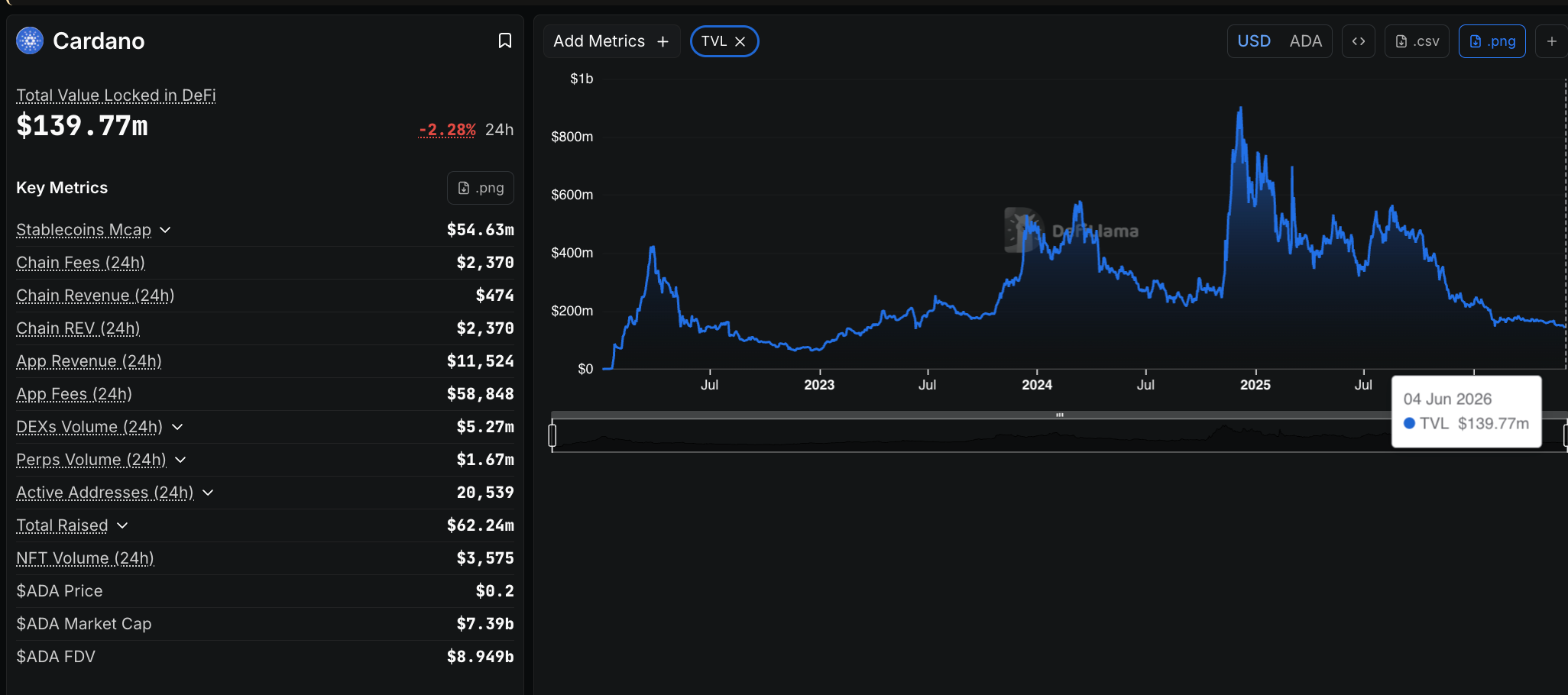
The Cardano (ADA) price has fallen about 35% in under a month, and founder Charles Hoskinson now admits he is powerless to stop the ecosystem’s decline.
That confession, made after another major project announced its shutdown, has revived a blunt question. Is Cardano dead for good, or is this just a brutal cycle low in the making?
A Shrinking Ecosystem Behind Hoskinson’s Warning
The bear case starts with Hoskinson himself. Reacting to the shutdown of analytics platform Tap Tools, he warned of a wave of failures and said he is tired of “managing a decline.”
The data backs the warning. Cardano TVL, the total value locked in its DeFi apps, has collapsed from about $905 million in late 2024 to just $139.77 million. That’s an 85% dip.

Trading has drained too. Weekly Cardano DEX volume has fallen from a peak near 19 million ADA in late 2025 to about 1.9 million, close to the year’s lowest week.

Network use is fading in step. Daily active addresses have slipped from a late-2025 peak near 17,600 to about 14,900, while token (ADA) trading volume has nose-dived.
This reveals low network usage and also low reception for ADA, in a crypto market where trading (riding the volatility) has been a trend lately.

Hoskinson even floated a nuclear option, launching a new Cardano with a proof-of-burn to leave hostile holders behind. He insists the technology is sound, with the Leios upgrade due at year’s end, and blames economics and governance instead.
Want more token insights like this? Sign up for Editor Harsh Notariya’s Daily Crypto Newsletter here.
The question is whether any Cardano project is still growing against the tide.
Top Protocols Bleed, With One Exception
Most of Cardano’s biggest apps are sliding with the chain. Minswap, its largest decentralized exchange, lost about 11% of its locked value over the month. That is evident in the Dune data from earlier, which suggests a dip in DEX trading volume.
Indigo, a protocol for minting synthetic assets, fell roughly 19%. Djed, Cardano’s stablecoin, dropped about 21%.

Even SoSoValue, the multi-chain data and ETF-tracking platform, saw its Cardano footprint shrink about 19%. The weakness reaches beyond native projects.
One name bucks the trend. Surf Lending, a lending protocol, grew its locked value by about 98% over the month and 14% in a week. That is the lone green entry in the top 10 and the closest thing to hope on the fundamental side. Yet Surf Lending holds only about $4.62 million.
A single small protocol cannot reverse an ecosystem that has shed hundreds of millions. The bigger tell sits with the traders who move the most money.
Smart Money and Whales Have Stopped Believing
The positioning data is bleak. Cardano’s smart money index, which tracks how informed money trades against the crowd, has fallen to its lowest level of 2026. This happened as the price corrected by over 35% since May 10 with rising sell volume.

Leverage interest has drained too. ADA futures open interest, the total value of outstanding futures contracts, has collapsed from about $1.6 billion in September 2025 to roughly $324 million.
This aligns with the earlier drop in token trading volume data and highlights a lack of discernible sentiment for the token, either bullish or bearish.

Whales are stuck rather than confident. On Hyperliquid, nearly all large long positions sit underwater, with entries between $0.20 and $0.37, and most hold through the losses.

Even smart money, as revealed by Nansen AI, is offside. Its only profitable trade is a single short, while its long bets keep bleeding.

If the people who move the most money see no rebound yet, the chart has to make the case instead. The only silver lining is that the underwater long trades have not yet closed their positions.
It is optimism or denial, depending on how the ADA price chart shapes up.
The Cardano Price Level That Settles the Question
The chart is brief but blunt. The ADA price has traded inside a falling channel since early January. Its May 10 breakout attempt failed before the slide resumed.
ADA has dropped about 35% from that May peak near $0.29 and now sits close to $0.19. The next key support is $0.17. A break under $0.178 would expose $0.141 and even $0.094, and would hand the dead-chain narrative real weight. That level is only about 9% away.
The on-chain side offers one counter. ADA spot exchange outflows have grown to about $2.26 million, a hint that some holders are continuing to buy despite the fear.

For the bulls, a reclaim of $0.26 would push the death talk to the back seat. That case strengthens if protocols like Surf Lending grow and outflows hold.

For now, $0.17 separates a slide toward $0.09 from a recovery that silences the obituaries.
The post Is Cardano Dead After Hoskinson’s Shocking Confession? appeared first on BeInCrypto.


This article was updated with comments from Bitget CEO Gracy Chen.
Bitget has expanded the use of 15 tokenized stocks and ETFs by enabling them as margin collateral for USDT-M futures trading through its Unified Trading Account and Multi-Asset Mode.
Summary
- Bitget has enabled 15 tokenized stocks and ETFs as margin collateral for USDT M futures trading through its Unified Trading Account.
- Assets including rAAPL, rTSLA, rNVDA, rMSFT, rSPY, and rQQQ can now be used to meet margin requirements while maintaining futures positions.
- The update extends Bitget’s tokenization strategy, following the launch of its Reality platform and a growing lineup of tokenized equities, ETFs, and pre IPO trading products.
According to a press release shared with crypto.news, the update took effect on June 4 and allows traders to use selected tokenized equities and exchange-traded funds to meet margin requirements while maintaining futures positions. Newly eligible assets include rAAPL, rAMZN, rMETA, rMU, rTSLA, rGOOGL, rNVDA, rINTC, rMSFT, rASML, rAVGO, rTSM, rQQQ, rSPY, and rSNDK.
Under Bitget’s Unified Trading Account structure, users can manage spot holdings, derivatives positions, and margin obligations within a single account. The exchange said Multi-Asset Mode for USDT-M futures now allows these tokenized instruments to contribute toward collateral requirements, reducing the need to convert assets into a single settlement currency before entering futures trades.
Speaking about the rollout, Bitget CEO Gracy Chen said users increasingly want more ways to put tokenized assets to work across different trading activities as adoption of tokenized financial products grows.
“As tokenized assets continue to gain traction across global markets, users are looking for more ways to utilize their holdings across different trading activities. Adding tokenized stocks and ETFs as margin assets increases flexibility within the Unified Trading Account and supports a more seamless experience across crypto and traditional market products.”
Tokenized products gain a larger role inside Bitget’s ecosystem
The latest addition builds on Bitget’s recent push into tokenized financial products. In May, the exchange introduced Reality, a regulated tokenization platform that issues blockchain-based rTokens backed 1:1 by publicly traded U.S. stocks and ETFs held through regulated broker-dealers.
According to Bitget’s May announcement, Reality was designed to provide on-chain access to traditional financial assets while addressing issues that have historically limited tokenized markets, including liquidity constraints and the handling of dividends and corporate actions. The company said rTokens are supported by infrastructure connected to major U.S. exchanges and backed by reserve attestations conducted through accounting firm The Network Firm.
Several of the assets added as margin collateral this week originate from the Reality product suite. Rather than limiting those tokens to spot market exposure, Bitget is now allowing traders to deploy them within its derivatives framework.
During the same month, Bitget also launched SPCXUSDT, a SpaceX-linked pre-IPO perpetual contract that lets traders speculate on market expectations surrounding a potential public listing without owning SpaceX shares. The exchange also introduced IPO-linked products and expanded access to tokenized equities through multiple offerings tied to public and private markets.
Competition grows in tokenized asset markets
Beyond its exchange platform, Bitget Wallet integrated xStocks infrastructure in May, bringing access to more than 130 tokenized stocks and ETFs through a self-custodial wallet. Bitget Wallet said the move increased its tokenized real-world asset offering to more than 300 products, including equities, commodities, precious metals, and index-linked assets.
According to Bitget, its tokenized equity products have processed more than $30 billion in trading volume since 2025. The company has also stated that users can access more than 100 tokenized stocks, ETFs, commodities, foreign exchange products, and precious metals through its trading ecosystem.
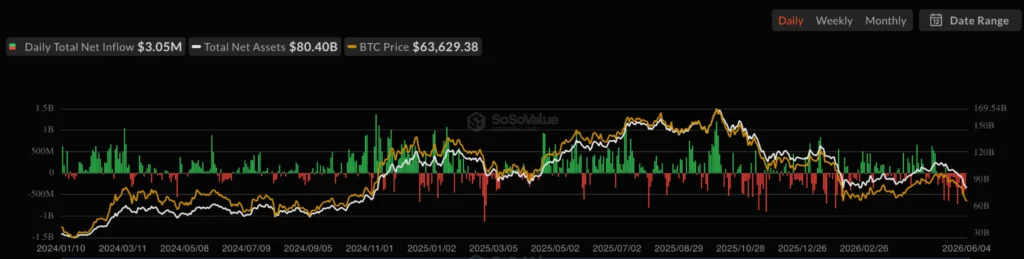
Bitcoin price traded near $61,925 on June 5 as selling pressure kept BTC close to the $60,000 support zone, with ETF flows, whale deposits, and weak sentiment driving the next market test.
Summary
- Bitcoin price slipped near $61,925 as traders focused on $60,000 support after sharp weekly selling.
- ETF outflows and Strategy’s rare sale weakened confidence while AI-linked capital rotation added market pressure.
- Whale Binance deposits doubled in June, adding short-term selling risk as sentiment turned bearish fast.
Bitcoin price nears $60,000 support
Bitcoin price data from crypto.news showed BTC at $61,925, down 3.44% over 24 hours and 15.82% over seven days. The asset traded between $61,394 and $64,353 during the day, while 24-hour volume stood at $56.21 billion.
The latest move placed Bitcoin just above the $60,000 level. That round number has become the main support zone after BTC lost the $65,000 area and failed to hold earlier ranges near $70,000.
Bitcoin has now dropped sharply from last week’s levels above $74,000. The pullback also took BTC far below its October 2025 all-time high of $126,080, with crypto.news data showing a drawdown of more than 50%.
A break below $60,000 would move Bitcoin back into the zone seen during the February drawdown. If sellers keep control below that level, traders may turn to the $55,000 area as the next major support.
ETF outflows and Strategy sale weigh on sentiment
Bitcoin’s latest fall comes as ETF demand weakens. U.S. spot Bitcoin ETFs recently posted heavy outflows.
Fresh ETF data also showed a small $3.05 million daily net inflow on June 4, per SoSoValue. However, that single inflow came after 13 consecutive days of net outflows and did not erase the broader pressure. Total net assets still stood near $80.40 billion, while cumulative net inflows remained strong at $54.27 billion.
Strategy also drew market attention after disclosing its first Bitcoin sale since 2022. The company sold 32 BTC at an average price of $77,135 between May 26 and May 31, raising about $2.5 million for preferred stock distributions.
The sale was small compared with Strategy’s overall holdings. Still, traders watched it closely because Strategy had long acted as a steady corporate buyer during previous market stress.
Michael Saylor framed the weakness as part of a wider capital rotation. He said spot Bitcoin ETFs had seen about $4 billion in outflows since May 14 while capital markets funded AI infrastructure at scale. He called it “a capital rotation, not a Bitcoin impairment.”
Whales move BTC back to Binance
CryptoQuant analyst Darkfost said whale BTC deposits on Binance have accelerated during the June selloff. The analyst defined whales as entities moving more than 100 BTC, equal to over $6 million at current prices.
According to the update, Binance saw whale inflow peaks of about 8,200 BTC on June 2 and more than 6,400 BTC on June 4. The monthly average has also risen from about 1,200 BTC since mid-April to more than 2,800 BTC.
That change shows large holders are moving more coins onto exchanges. Such transfers can signal plans to sell, hedge, or manage risk during a fast market decline.
Darkfost said this behavior looked more like emotional risk management than a planned long-term move. The last time Binance whale inflows reached similar levels was during Bitcoin’s fall below $60,000 in early February.
This adds short-term selling pressure while price trades near a key level. If whale inflows stay elevated, BTC may struggle to reclaim lost support without stronger spot demand.
Sentiment flips as traders watch $55,000
Santiment data showed Bitcoin sentiment turned sharply lower after price fell from the late-May high. The firm said BTC moved from near $78,000 to about $63,800, with most of the decline happening in three days.
Social sentiment was strongly positive near the highs, then turned bearish as price broke down. Santiment said the crowd was most bullish near the top and most bearish near the lower range.
The firm also noted that sentiment is not a timing tool. Still, it said peak fear can sometimes appear near a “potential local bottom.” That wording remains cautious because price has not confirmed a reversal.
Crypto Patel also pointed to lower long-term accumulation zones. He wrote that 2026 to 2027 could become a “potential accumulation period,” with $50,000 to $40,000 acting as a possible spot buying zone if reached.
For now, Bitcoin price analysis remains tied to three levels. Bulls need to defend $60,000 and reclaim $65,000 to ease near-term pressure. Bears need a clean break below $60,000 to open the path toward $55,000 and possibly lower supports.
The next sessions may show whether the current fall is a panic-driven flush or the start of a deeper reset. ETF flows, whale exchange deposits, and Bitcoin’s reaction near $60,000 will likely guide the next move.
Disclosure: This article does not represent investment advice. The content and materials featured on this page are for educational purposes only.
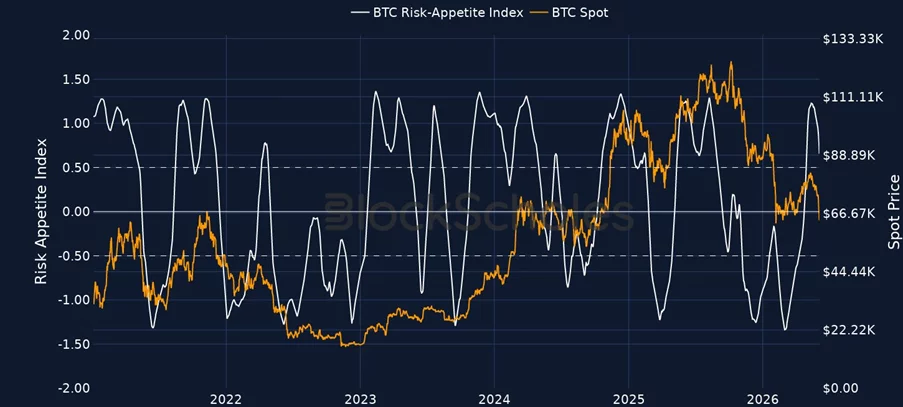
Bitcoin and Ethereum trading activity has fallen to multi-quarter lows on Hyperliquid, while volume in equity-linked and pre-IPO perpetual contracts has climbed sharply.
Summary
- Bitcoin and Ethereum perpetual futures volumes on Hyperliquid have fallen to multi-quarter lows as traders increasingly turn to equity and commodity-linked contracts, according to Block Scholes.
- Pre IPO perpetual trading volume has climbed above $50 million per day from less than $5 million, with SpaceX-linked contracts leading activity.
- Block Scholes analyst Thahbib Rahman said speculative interest remains strong in markets such as stock index perps, commodities, and HYPE despite weaker sentiment around Bitcoin and Ethereum.
According to a June 5 report from Block Scholes shared with crypto.news, risk sentiment around the two largest cryptocurrencies has continued to weaken, even as speculative demand remains active in other parts of the market.
The research firm pointed to its in-house Bitcoin and Ethereum Risk Appetite Indexes, which have moved lower over the past week alongside declines in both assets.
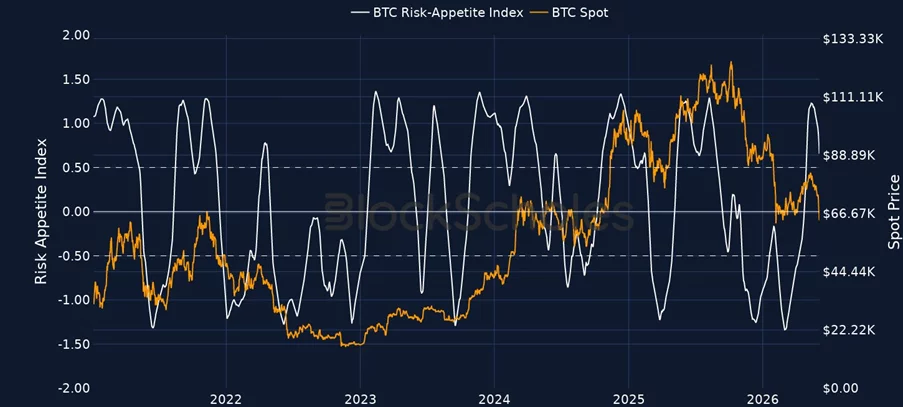
Recent weakness in crypto majors has coincided with several market developments. Block Scholes noted that Strategy sold $2.5 million worth of Bitcoin from its holdings, a move that came after years of public commitment from Executive Chairman Michael Saylor to continue accumulating the asset.
The report also highlighted the longest streak of outflows from U.S. spot Bitcoin ETFs since their launch.
Rather than viewing Bitcoin’s drop toward the low $60,000 region as a sign of fading interest across the entire digital asset market, Block Scholes argued that trading activity has become concentrated in a different set of instruments.
Traders turn to stock and commodity-linked perpetuals
Data from Hyperliquid shows that daily Bitcoin perpetual futures volume has remained near $2 billion, while Ethereum volumes have stayed around $600 million to $700 million, levels Block Scholes described as multi-quarter lows.
At the same time, activity tied to equity and commodity markets has expanded rapidly on the platform. According to Block Scholes, the three most actively traded non-crypto perpetual contracts on Hyperliquid are XYZ100, which tracks the Nasdaq-100, SP500, an S&P 500-linked product, and CL, a contract tied to WTI crude oil.
Combined daily volume across those three markets has reached approximately $1.3 billion, generating $27.1 billion in notional trading volume over the past month. Block Scholes said that total equals about 112% of Ethereum perpetual volume and roughly 38% of Bitcoin perpetual volume on the exchange during the same period.
The report said the development does not necessarily represent a dollar-for-dollar migration of capital from Bitcoin and Ethereum. Instead, the report argued that trader attention and speculative activity that previously supported crypto majors are increasingly being directed toward alternative markets available through the same trading venue.
Pre-IPO contracts draw growing interest
Beyond stock index and commodity products, Block Scholes identified pre-IPO perpetual contracts as another area attracting crypto-native traders.
According to the report, the ratio of pre-IPO perpetual volume relative to Ethereum perpetual volume increased from roughly 0.1% to a peak near 3.0% in recent weeks. Daily trading volume in the segment has climbed from less than $5 million to more than $50 million, with contracts linked to SpaceX accounting for much of the increase.
Block Scholes said the rise has been abrupt and concentrated, with activity accelerating into late May and early June while Bitcoin and Ethereum volumes remained subdued.
The firm’s risk appetite data also showed a divergence among digital assets. While sentiment tied to Bitcoin and Ethereum has weakened, Block Scholes reported that Hyperliquid’s HYPE token is one of the few major crypto assets where its risk appetite indicator continues to move higher.
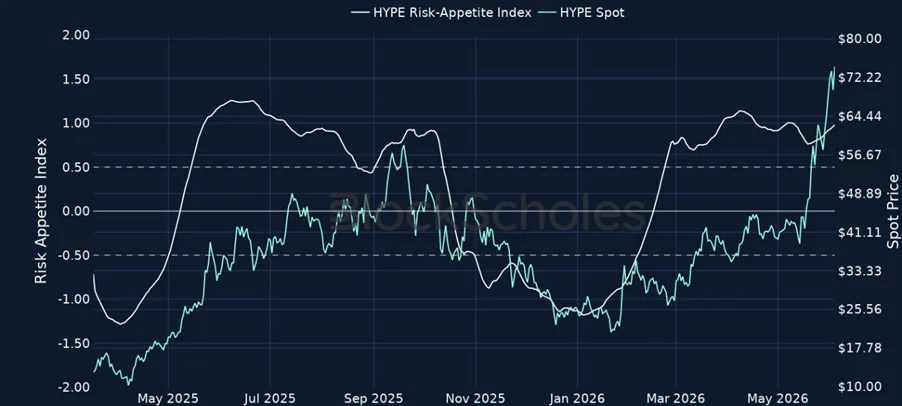
HYPE risk appetite index. Source: block Scholes.
As previously reported by crypto.news, Binance Research recently published a report noting that capital has been flowing toward a concentrated group of U.S. equity sectors, including artificial intelligence infrastructure, semiconductor companies, defense contractors, energy firms, and commodities.
According to the report, strong performance in those sectors has historically reduced liquidity available to Bitcoin and other alternative assets.
Using the CBOE Dispersion Index as a measure of market concentration, Binance Research noted that the indicator recently reached 42, its third-highest reading on record. The firm argued that periods of concentrated equity leadership have often coincided with weakness in Bitcoin as investors direct funds toward a smaller group of high-performing themes.


On-chain investigator ZachXBT warned traders to avoid Rain Protocol after claiming that the prediction market project shows weak user traction, questionable wallet links, and possible on-chain price manipulation.
Summary
- ZachXBT warned traders to avoid Rain Protocol, citing low users, weak traction, and team concerns.
- His on-chain claims linked RAIN wallets to DOP, TOMI, Gems, and exchange deposits.
- ZachXBT cut Kraken’s rating over alleged listing failures tied to manipulated low-quality token markets.
ZachXBT questions Rain Protocol traction
ZachXBT described Rain Protocol as an $8.8 billion project and a top-15 crypto asset by market value. He said the prediction market has few users, limited product traction, no major backers, and a team with little public history in crypto.
The investigator told traders to avoid the project “at all costs.” His warning focused on the gap between RAIN’s reported valuation and its visible product activity.
Rain Protocol had already drawn market attention before the latest alert. Earlier reports said traders had questioned RAIN’s supply structure, liquidity setup, and project links after its fast rise toward a multibillion-dollar valuation.
Wallet trails point to DOP and TOMI
ZachXBT said his on-chain review found wallet links between RAIN team addresses and failed crypto projects, including Data Ownership Protocol and TOMI. He pointed to funding trails involving the Gems hot wallet and several centralized exchange deposit addresses.
He cited two dust transfers sent to the same address on Oct. 14, 2025. One came from a wallet he linked to the RAIN deployer. Another came from a wallet he connected to the TOMI team multisig and a centralized exchange deposit address.
ZachXBT also said the recipient wallet later received funds from another address funded by a DOP multisig. In a separate trail, he said another wallet moved funds to an address that later used the same exchange deposit address as the DOP deployer.
The claims remain allegations unless the project, exchanges, or regulators confirm them. Rain Protocol had not issued a public response in the material reviewed.
Price activity and valuation draw scrutiny
ZachXBT also alleged that RAIN’s price appears manipulated on-chain. He said addresses linked to the deployer used Uniswap V3 liquidity pools while routing spot transfers through the Gems hot wallet.
He also questioned Enlivex, the Nasdaq-listed company tied to RAIN’s digital asset treasury plan. Enlivex announced a $212 million treasury strategy in November 2025, but ZachXBT argued that RAIN does not compare with prediction market platforms such as Kalshi or Polymarket.
DefiLlama data cited in his post showed Rain Protocol with $27.2 million locked on Arbitrum. ZachXBT said the full amount was held in RAIN’s own illiquid token, while the protocol generated about $1 million in annual fees.
Kraken rating cut adds exchange angle
ZachXBT also lowered Kraken from S-tier to B-tier. He cited what he called a “lack of due diligence” before listing tokens he described as low quality or manipulated, including M, RAIN, RIVER, and RAVE.
He also criticized Kraken’s handling of its recent security breach disclosure. He said the exchange did not mention compensation for affected users, while rivals such as Coinbase and Bybit had prioritized customer repayment after past incidents.
ZachXBT said he raised his bounty to as much as $100,000 for insiders who can provide documents or chat logs tied to alleged centralized exchange market manipulation schemes.
The latest Rain Protocol alert now sits within a broader debate over token listings, thin liquidity, market-maker activity, and retail risk. For now, traders are watching whether RAIN or Kraken respond to the claims with verifiable on-chain or operational details.
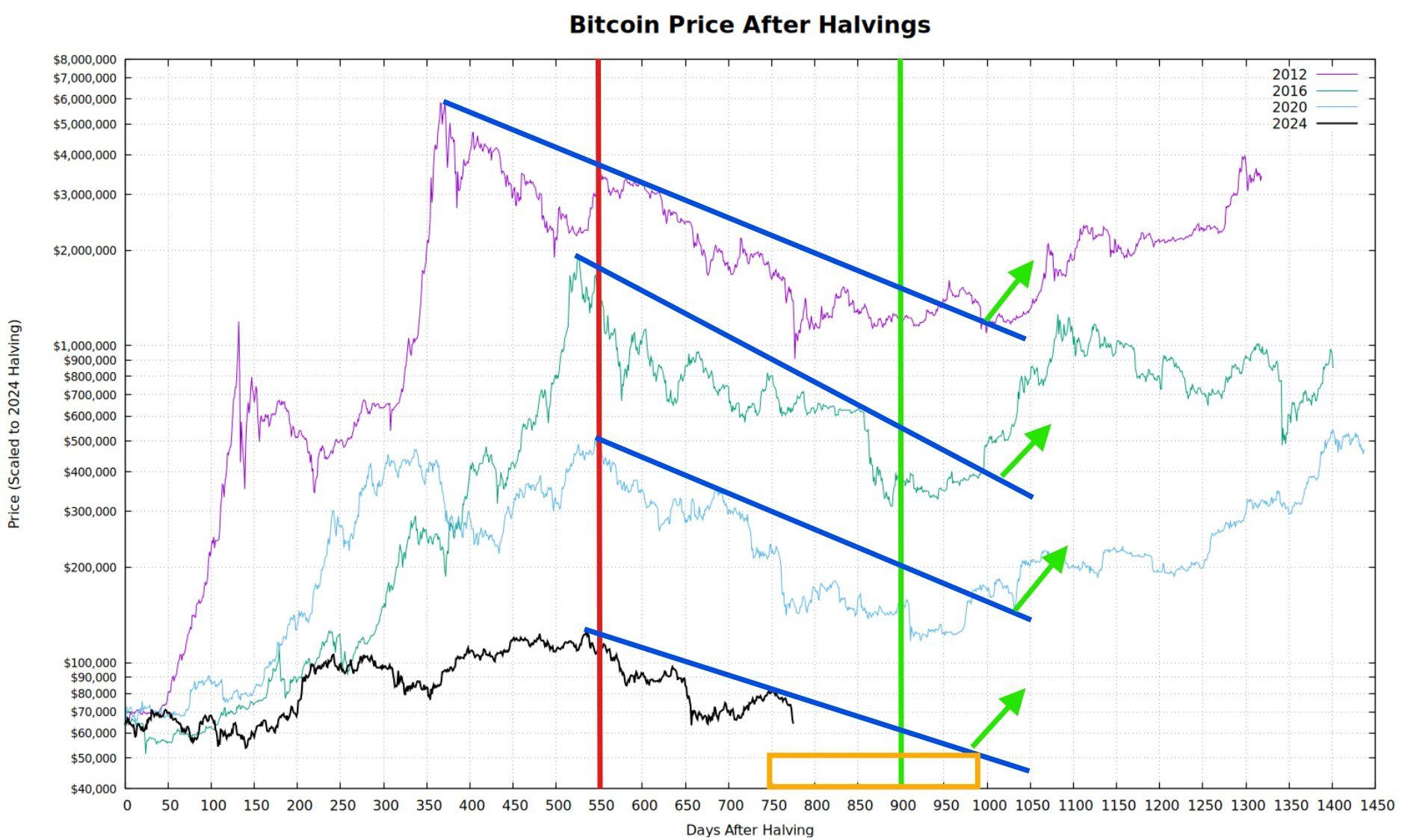
Bitcoin (BTC) trades near $60,000 after a 5% daily drop, leaving it about 50% below its record high. Three widely shared charts argue that the four-year cycle is intact and that the deeper cycle bottom still lies ahead.
The setup echoes recent BeInCrypto analysis, placing the cycle low in the fourth quarter of 2026. The new charts put a rough date and a price on that thesis.
Bitcoin’s Halving Clock Points to Day 900
The first chart, from analyst Jesse Olson, scales all four cycles since 2012 to the 2024 halving. Every prior cycle bottomed near day 900 after its halving.
The current cycle reached day 775 this week. That leaves about 125 days, or roughly four months, before the historical bottom window opens.
An orange band on the chart marks the projected low in the $40,000s. The black 2024 line has already rolled over, mirroring the post-top declines of 2012, 2016, and 2020. A prior BeInCrypto analysis reached the same read on the halving rhythm.

The Bitcoin Spiral Shows This Time Is Not Different
The second chart plots price on a spiral. Each loop represents one four-year cycle. The angle marks the position in the cycle, while the distance from the center marks the price.
Tops cluster in one arc, bottoms in another, and halvings in a third. The 2026 and 2027 markers fall inside the same arc that has framed every previous low.
The analyst captioned the chart “This time is different,” a nod to the institutional narratives. Its self-similar shape makes the opposite case.

Moving Averages Have Flipped to Resistance
The third chart stacks the levels Bitcoin must reclaim. The 21-week simple moving average sits at $75,100, the short-term holder cost basis at $77,000, and the 200-day average at $78,900.
Each acted as support during the bull phase. All three now sit overhead as resistance. Price below short-term holder cost basis means recent buyers, the holders most likely to sell, are underwater.
BTC has since slid toward the 50% drawdown line near $63,000. The newsletter behind the chart framed the grind as a slow, time-based capitulation rather than one violent flush.

The Cycle Timing Lines Up With October
The charts match a recent BeInCrypto report on analyst Benjamin Cowen. He notes Bitcoin topped on day 1,162 of the cycle, within a week of the prior two peaks at day 1,059 and day 1,168.
“Bitcoin topped within one week of when it historically tops, despite the narratives for calling the four-year cycle dead.”
Cowen places his base case at low in October 2026. That date sits about 125 days out, the same window Olson’s day 900 count produces.
Where the Bull Case Could Break the Pattern
The thesis is not guaranteed. Spot ETFs, corporate treasury demand, and a sovereign reserve narrative have pulled new money into Bitcoin at a scale earlier cycles never saw.
Some analysts argue this institutional bid could stretch or flatten the cycle rather than repeat it. A weekly close back above the $78,900 average would weaken the bearish read.
For now, the burden of proof sits with the bulls. Until Bitcoin reclaims those overhead levels, the path of least resistance points lower.
Bitcoin Price Outlook
Three independent methods, a halving day count, a cyclical spiral, and price structure, point to the same place. Each suggests Bitcoin has not yet found its cycle bottom.
A drop into the $40,000s would align with the orange target band and the on-chain floor. The 50% drawdown near $63,000 is the first marker; deeper levels are open if it breaks.
The likely window centers on the fourth quarter of 2026, near October. A weekly reclaim of $79,000 would be the first real signal that the pattern has finally broken.
The post Bitcoin Has 125 Days Until the Real Bottom, Charts Warn appeared first on BeInCrypto.

Kraken is broadening access to SpaceX’s upcoming IPO by enabling participation through its tokenized equities platform, xStocks. The exchange announced that SpaceX will be the first public offering available via IPO Access, a feature that lets eligible users acquire tokenized shares before the actual market open.
Under the program, investors can apply for IPO access through the Kraken mobile app. The offering is not accessible via Kraken Pro or the desktop platform, and eligibility is limited by region and regulatory constraints. Kraken notes that IPO Access is available across the European Economic Area and more than 110 international markets, but participation is unavailable in the United States, Canada, Australia, and the United Kingdom due to local rules.
Investors who receive an allocation will be issued SPCXx, a tokenized representation of SpaceX equity that is backed 1:1 by the underlying shares. The tokens are tradable 24/7 on Kraken and other participating xStocks platforms, enabling around-the-clock liquidity for a portion of the traditional equity lifecycle.
Kraken’s move underscores a broader push to bridge crypto infrastructure with traditional capital markets, offering a familiar stock-like instrument in a programmable, on-chain format. The company has previously highlighted that tokenized equities can give a wider audience access to high-profile listings and provide new trading modalities that operate beyond regular stock market hours.
In related context, prior coverage has highlighted that xStocks has already seen significant on-chain activity, with volumes and wallet activity illustrating growing interest in tokenized equities. This latest SpaceX IPO access case adds another high-profile asset to the roster of tokenized offerings on crypto-native platforms.
SpaceX targets a historic IPO debut
SpaceX is widely expected to begin public trading on June 12, marking a milestone for a privately held company that has grown into a major force in aerospace and satellite communications. Bloomberg, citing demand dynamics around the offering, reports that demand has already outstripped the number of shares available, with SpaceX seeking roughly $75 billion in proceeds and a valuation of at least $1.8 trillion. If reached, that would position SpaceX’s IPO as the largest ever, surpassing the previous record set by Saudi Aramco in 2019.
The growth story driving SpaceX’s valuation remains closely tied to Starlink, its satellite internet business, which has become a meaningful revenue stream and profitability driver for the company. At the same time, SpaceX’s launch and exploration ventures are capital-intensive and continue to entail substantial costs, raising questions about how early investors will appraise the business in a public market setting.
News of the anticipated mega-IPO has drawn attention to how investors value private companies as they transition to public markets, and how tokenized representations might influence price discovery, liquidity, and access. The SpaceX filing and the ensuing market reaction will be watched closely by practitioners and policymakers alike as they assess the implications for tokenized equity formats and cross-border trading.
For readers tracking the broader space, SpaceX’s on-chain disclosures and asset mix have already been a focal point of discussions about crypto-enabled capital markets. The trajectory of this IPO, and the way tokenized instruments perform in the weeks after listing, could shape how exchanges approach future cross-asset tokenization and whether similar models gain traction among other high-profile offerings.
Source: Kraken
Related: Kraken’s xStocks tops $25B in tokenized-equities volume with thousands on-chain holders
What tokenized equity means for crypto markets
The SpaceX IPO through xStocks illustrates a notable convergence: established public offerings can be mirrored as on-chain tokens that are tradable around the clock. For traders and investors, the arrangement potentially unlocks new avenues for liquidity, hedging strategies, and exposure to marquee names without traditional stock-market hours constraints. For issuers, tokenized access expands the potential investor base beyond geographic and logistical boundaries that often constrain classic IPOs.
From a risk-management perspective, tokenized equities introduce considerations around custody, settlement, and regulatory alignment across jurisdictions. While the SPCXx token is anchored 1:1 to SpaceX shares, the on-chain environment introduces new layers of operational risk and governance that market participants will watch closely as more companies explore tokenized offerings. The ongoing regulatory dialogue around tokenized assets will also influence how quickly and broadly these products scale in traditional markets.
For investors, the SpaceX case offers a practical glimpse into how crypto-native platforms are integrating with real-world capital markets. The use of a tokenized instrument tied to a well-known private company as it transitions to the public market could serve as a blueprint for future tie-ins between crypto infrastructure and mainstream equity markets. As with any IPO, due diligence remains essential: investors should assess not only the company’s business trajectory but also how much bandwidth tokenized formats have to deliver reliable, timely access to allocations and post-listing trading liquidity.
As the IPO unfolds and more details emerge about allocations, pricing, and secondary-market activity for SPCXx, market participants will be weighing how tokenized formats compare with traditional post-IPO liquidity and whether the added accessibility translates into meaningful long-term value capture for investors.
Investors should monitor the next steps for SpaceX’s public debut, including allocation outcomes and how the tokenized structure performs in live trading. The evolving regulatory framework around tokenized assets will likewise shape how quickly such offerings expand and how broadly they are accepted by retail and institutional participants alike.
What remains uncertain is how pricing will align between the on-chain representation and the actual SpaceX equity on public markets, once trading begins. If demand remains robust and the tokenized vehicle gains deeper adoption, SpaceX’s IPO could become a defining moment for tokenized equity infrastructure and the broader integration of crypto platforms with traditional capital markets.
Disclosure: This article does not represent investment advice. The content and materials featured on this page are for educational purposes only.
Investors assess early-stage crypto opportunities as DOGEBALL gains attention alongside lessons from past launches.
Summary
- Investors continue searching for early-stage blockchain projects, hoping to capture growth before major exchange listings and broader market adoption.
- DOGEBALL positions itself as a Layer-2 ecosystem combining gaming and payments, with a focus on low-cost transactions and crypto-to-fiat settlement tools.
- Supporters argue the project’s DOGEPAY infrastructure and cross-border payment capabilities help differentiate it from purely speculative crypto offerings.
Missing out on early-stage blockchain opportunities is one of the most common regrets in the digital asset space. The investors who achieve life-changing returns are rarely the ones buying assets after major exchange listings. Instead, they are the analytical buyers who secure allocations when utility projects are still in their infancy.
This article analyzes a massive market shift where transactional utility is intersecting with high-growth community-driven ecosystems. This guide evaluates the performance dynamics of historic launches like Internet Computer (ICP) and provides an evidence-based breakdown of why the ongoing DOGEBALL allocation is emerging as a top crypto presale candidate for strategic portfolios in 2026.
With multiple projects competing for market share, investors are actively searching for concrete tech stacks that go beyond empty speculation. To make informed decisions, market participants are looking closely at how structural token mechanics and deflationary designs influence long-term asset value. By comparing structural performance across different network frameworks, this analysis breaks down the true financial utility behind the scenes. This direct review covers everything from historical multipliers to the modern mechanics driving the current DOGEBALL crypto presale 2026 window.
The History of Internet Computer (ICP): A Lesson in timing and resilience
The launch of Internet Computer (ICP) remains one of the most discussed events in tokenomic history. During its initial coin offering (ICO) phase, the project was met with widespread skepticism. Critics doubted its ambitious architecture, which aimed to replace the traditional centralized web with a decentralized global compute platform. However, early evaluators who looked past the noise and understood the underlying infrastructure secured allocations at an ICO price of approximately $0.03 per token.
When the network officially launched and mainstream trading commenced, the asset experienced an astronomical surge, briefly scaling heights above $700. For those early buyers, this multiplied their initial capital by over 20,000x at peak valuation, turning modest allocations into multi-million-dollar positions. The dramatic growth of ICP serves as an emotional and psychological case study for missing major market cycles. It highlights how initial market doubt often creates the most profitable entry points.
The core reason behind this historic trajectory lies in the project’s institutional-grade tokenomics and aggressive early developer-grant marketing. While missing that specific window left many buyers behind, the cyclical nature of decentralized finance continuously introduces new technical frameworks. For investors looking to capture similar early-stage upside, identifying structural value through a top crypto presale before the broader market catches on is the key to minimizing future portfolio regret.
Unpacking the DOGEBALL ecosystem and architectural utility
The ongoing DOGEBALL project represents a structural shift in how high-throughput ecosystems combine consumer gaming with global liquidity channels. Built on a custom, EVM-compatible Ethereum Layer 2 blockchain called DOGECHAIN, the platform establishes a hybrid model integrating GameFi and PayFi frameworks. The primary architecture solves two of the largest pain points in the current web3 landscape: high transaction friction and complex fiat offramping. Rather than forcing users to navigate multiple decentralized exchanges and centralized intermediaries to cash out, the native ecosystem enables instant crypto-to-fiat conversion directly into global bank accounts.
Smart money is increasingly leaning toward the DOGEBALL crypto presale 2026 due to its distinct structural advantages over legacy utility tokens. The core engine, known as DOGEPAY, supports over 30 fiat currencies with zero foreign exchange (FX) fees, completely bypassing traditional remittance networks like PayPal or Wise. Furthermore, the underlying DOGECHAIN Layer 2 infrastructure achieves sub-second transaction finality with near-zero gas fees. This technical setup provides developers, esports organizations, and casual gamers with a seamless micropayment network. By providing immediate, real-world transactional value alongside an audited, 100% secure smart contract infrastructure, the asset differentiates itself through tangible, cross-border settlement mechanics.
Analyzing the financial mechanics and presale growth potential
To truly understand why this asset is gaining traction as a top crypto presale, we must look at the hard tokenomic numbers, deflationary mechanics, and structural pricing schedule currently in play.
Metric
Details & Figures
Current Presale Stage
Stage 6
Current Token Price
$0.000741
Total Capital Raised
$298K+
Total Active Participants
1,000+ Investors
Projected Exchange Launch Price
$0.015
Recent Supply Deflation
4 Billion Tokens Burnt (20% of Presale Supply)
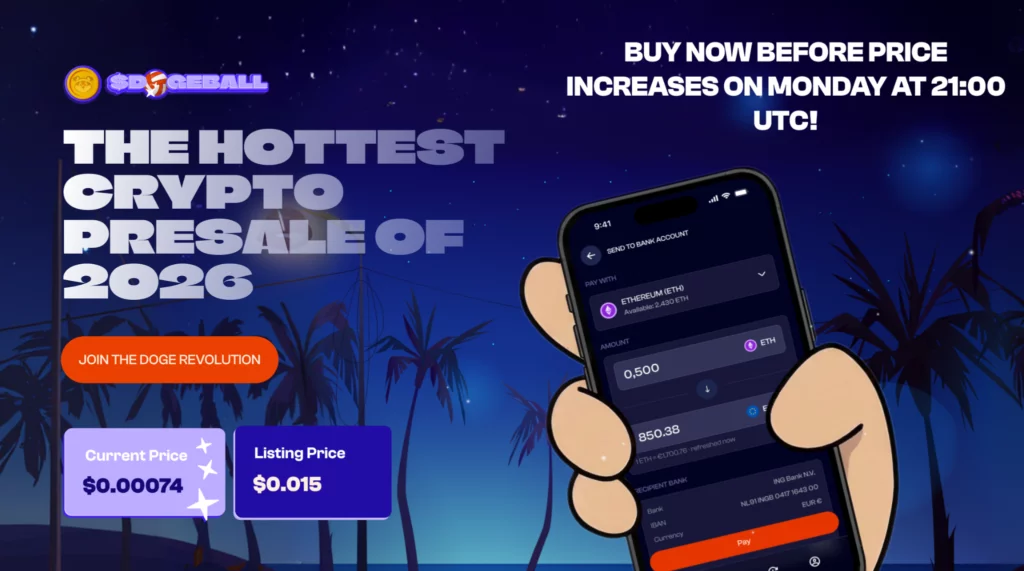
The project has transitioned away from static funding rounds to a highly disciplined, timed crypto presale structure consisting of 22 total stages. Each stage lasts a maximum of 7 days. However, the current pricing stage is expiring this weekend. At 21:00 UTC, the current stage closes permanently, and the next sequential stage begins with an automatic, mandatory price increase. Any unsold tokens from a completed stage’s allocation are immediately and permanently burnt, accelerating supply scarcity. This means this weekend represents the last opportunity to secure the asset at this exact low entry point before the acquisition cost increases.
Let us calculate the mathematical return on investment (ROI) for an investor acquiring tokens at the current Stage 6 valuation in plain text:
- Current Stage 6 Acquisition Price: $0.000741
- Fixed Exchange Launch Price: $0.015
- ROI Calculation Formula: (0.015 – 0.000741) / 0.000741 is approximately equal to 19.2429
- Percentage Growth Profile: ~1,924.29% baseline to launch
This means a capital allocation of $1,000 at the active presale price of $0.000741 is mathematically projected to scale to a gross value of $20,242.91 upon exchange listing, representing an approximate 19.24x multiplier before the token even hits mainstream trading platforms (not including the extra tokens unlocked by utilizing the DB30 30% bonus code).
Exclusive 30% Bonus Activated: Also, the Bonus code DB30 can be used for 30% BONUS tokens, so hurry up! Inputting code DB30 at checkout immediately grants an extra 30% token allocation on top of the order, allowing investors to maximize their portfolio depth before the tier rolls over this weekend.
Because the price climbs automatically at the upcoming phase deadline, securing an allocation this weekend minimizes cost basis and maximizes the mathematically locked-in launch premium.
Step-by-step guide: How to acquire DOGEBALL
Securing an allocation in this top crypto presale requires a few simple, secure steps before the looming pricing escalation occurs:
- Step 1: Set up a secure, EVM-compatible web3 wallet such as MetaMask, Trust Wallet, or Coinbase Wallet, ensuring it is properly funded with ETH, USDT, or MATIC.
- Step 2: Navigate to the official project website to access the secure, updated Timed Presale Widget.
- Step 3: Connect a web3 wallet to the widget, select a preferred network (Ethereum or BNB Chain), and input the exact amount of crypto to exchange.
- Step 4: Apply the active bonus code DB30 in the promotional field to claim a 30% bonus multiplier.
- Step 5: Authorize and confirm the smart contract transaction within the wallet interface at the current $0.000741 rate, ensuring the process is completed this weekend before the stage cut-off.

Conclusion: Strategic positioning in early-stage utility markets
Navigating the decentralized market requires looking past short-term speculation to identify assets with robust, underlying infrastructure. Historical assets like Internet Computer proved that investors who absorb early-stage volatility can capture exponential rewards. As the broader blockchain landscape evolves, ecosystems that merge low-cost Layer 2 rollups with global fiat settlement networks are positioned to lead the next major adoption cycle.
The structural setup of the DOGEBALL presale offers an asymmetric risk-to-reward opportunity. By combining an audited Ethereum Layer 2 framework with a zero-fee fiat offramp app, the platform positions itself far ahead of standard speculative assets. With a fixed launch target of $0.015 and an aggressive deflationary burning schedule that permanently eliminates unsold tokens, early participants have a transparent path to calculated capital growth. Given that the current pricing tier expires this weekend and moves upward across the remaining timed stages, securing an entry at the current Stage 6 pricing represents the most efficient risk-mitigated entry point for portfolios before mainstream exchange trading begins.
For more information, visit the official website, Telegram, and X.
FAQs for top crypto presale
Which presale crypto is best?
The best presale option is DOGEBALL (DOGEBALL). It combines a custom Ethereum Layer 2 blockchain with DOGEPAY, a utility engine offering zero FX fees, instant bank offramping across 30+ currencies, and a mathematically sound 1,924.29% launch growth profile.
Which crypto has 1000x potential?
Assets with custom Layer 2 technical foundations like DOGEBALL hold major long-term scaling potential. Its built-in utility requires the token for all ecosystem transaction fees, generating persistent market demand alongside an aggressive weekly token burning mechanism that continuously shrinks circulating supply.
Is it good to buy presale crypto?
Yes, purchasing presales like DOGEBALL provides a distinct liquidity advantage. Buying early locks in a lower cost basis relative to the fixed $0.015 exchange listing price, guaranteeing automated value increases as the project moves through its timed stages.
What is the biggest crypto presale in history?
While EOS and Ethereum hold historical fundraising records, the ongoing DOGEBALL campaign is setting new structural benchmarks. It utilizes a highly strategic timed mechanism where all unsold stage tokens are permanently burnt to aggressively preserve early investor value.
Which meme coin will reach $1 in 2026?
While traditional meme assets lack utility, DOGEBALL is uniquely architected to reach long-term milestones. Its dual integration of a $1M Play-to-Earn gaming prize pool and real-world PayFi global remittance channels builds sustainable capital inflows to drive asset valuation, especially when supercharging early stakes with bonus code DB30.
Disclosure: This content is provided by a third party. Neither crypto.news nor the author of this article endorses any product mentioned on this page. Users should conduct their own research before taking any action related to the company.

Gogglebox Sophie and Pete Sandiford related to comedy icon

Teeing Up The Next Great Rug Pull

Politics Home Article | Inside The Lib Dem Strategy Rethink



-

 Business4 days ago
Jade Biosciences, Inc. (JBIO) Discusses Positive Interim Results From JADE101 Phase I Healthy Volunteer Study and Development Plans Transcript
-
 Tech7 days ago
SpaceX just won a second Golden Dome contract. This one is $4.16 billion.
-

 Sports3 days ago
French Open 2026 results: Alexander Zverev beats Rafael Jodar and will play Jakub Mensik in semi-finals
-

 Business7 days ago
Is the Spurs Phenom Already Better Than Prime Diesel?
-

 Tech4 days ago
CryZENx Releases Fresh Playable Content Deep Inside Jabu-Jabu for His Ocarina of Time Remake
-

 Fashion13 hours ago
Weekend Open Thread: Evereve – Corporette.com
-

 Politics7 days ago
The House | Inside Andy Burnham’s Makerfield Campaign: “Nobody Thinks This Is In The Bag”
-

 Business3 days ago
Trump Taps Housing Chief Bill Pulte as Acting Intelligence Director After Gabbard Exit
-
Crypto World21 hours ago
LBank Surpasses 25 Million Users Worldwide as AFA Partnership Continues to Drive Global Growth
-
 Entertainment7 days ago
One of the Greatest Sitcoms of All Time Shoots Up Apple TV’s Charts 11 Years Later
-

 Business7 days ago
Demand Conditions Improve In Chemicals Sector In April 2026
-
 Crypto World17 hours ago
Jensen Huang Approves Samsung, SK Hynix, and Micron for NVIDIA (NVDA) HBM4 Memory Supply
-
 NewsBeat7 days ago
Everything you need to know as Cambridge’s Strawberry Fair returns after cancelled year
-
 Crypto World4 days ago
Seagate (STX) Stock Surges to Record High on AI Boom and Legal Settlement
-
 NewsBeat3 days ago
Republicans balk at Trump’s attempt to appoint a MAGA enforcer to lead National Intelligence
-
 Entertainment7 days ago
Britney Spears Shares Troubling Update After Hard Year
-
 Crypto World3 days ago
EU AI Data Center Project Faces Delays as Funding Gaps Grow
-

 Business3 days ago
Aehr Test Systems Stock Soars 17% Amid Surging AI Demand and Conference Spotlight
-

 Tech7 days ago
Intel and 3DGS back a $3.3bn glass-substrate plant in India’s Odisha
-

 Tech7 days ago
Acer’s Swift Air 14 is a peppy MacBook Neo rival with some cool upgrades and a $699 ask
You must be logged in to post a comment Login