

Crypto World
XRP Ledger Eyes Tokenized Finance as Schwartz Maps Next Use Cases



David Schwartz, Ripple’s CTO emeritus, says XRP Ledger utility is moving beyond its early role in payments as enterprises test wider blockchain-based finance.
Summary
- David Schwartz says XRP Ledger use is expanding from payments into tokenized real-world financial assets.
- RLUSD’s multichain rollout gives XRPL developers more liquidity for tokenization, payments, and DeFi products.
- XRPL activity rose in Q1 as tokenized assets gained traction despite weaker XRP market performance.
His comments came in a recent “XRP in One Minute” session, where he said the network is being used for tokenized assets and may later support tokenized securities, stocks, money market funds, repos, and loans.
XRP Utility Moves Beyond Payments
Schwartz said Bitcoin opened the door for public blockchains by allowing users to hold and transfer value without a central operator. He said the XRP Ledger followed with a similar native asset model, while also supporting issued assets.
That design allowed XRPL to handle assets beyond XRP itself. These can include stablecoins, tokenized funds, and other blockchain-based versions of real-world assets.
Schwartz said enterprises are now using the XRP Ledger to provide tokenized real-world assets. He added that future products may include tokenized securities, money market funds, stocks, repos, and loans.
“Enterprises are using the XRP Ledger to provide tokenized real-world assets,” Schwartz said in the short video format, according to the report.
RLUSD Expansion Adds Fresh XRPL Context
The comments came as Ripple’s RLUSD stablecoin continued to expand across blockchain networks. Crypto.news reported that RLUSD is now available across more than 40 chains through Wormhole’s Native Token Transfers framework.
The rollout includes Ethereum layer-2 networks such as Base, Optimism, Ink, and Unichain. It also includes the XRP Ledger EVM sidechain, giving developers access to RLUSD through Ethereum-compatible tools.
This matters for XRPL because stablecoin liquidity is often needed for tokenized finance products. Payments, lending, asset trading, and on-chain settlement usually need a reliable dollar asset.
Crypto.news also reported that RLUSD has grown to more than $1.7 billion in market capitalization since its late-2024 launch. That growth gives Ripple a larger stablecoin base as it pushes into institutional blockchain use.
XRPL Data Shows Tokenization Growth
Recent network data also shows rising XRPL activity. Crypto.news cited Messari data showing that XRP Ledger daily transactions rose 35.3% quarter-over-quarter in Q1 2026.
The same report said XRPL’s real-world asset market cap rose 124.1% during the quarter to $2.25 billion. RLUSD also reached $340.3 million on XRPL by quarter-end, making it the network’s largest stablecoin.
That data shows a split between XRP’s price action and ledger activity. XRP fell during the quarter, but transactions, stablecoin use, and tokenized asset value moved higher.
Tokenized Funds and Loans Become the Next Test
Schwartz’s comments point to a broader push into tokenized finance. The main question is whether enterprise use can lead to deeper retail access over time.
Tokenized securities, repos, and loans would bring more traditional finance products onto XRPL. These markets are large, but they also need compliance, custody, liquidity, and trusted issuers.
Crypto.news previously reported that JPMorgan, Mastercard, Ripple, and Ondo tested a cross-border tokenized Treasury redemption using XRPL and banking rails.
That pilot showed how XRPL can support asset movement while traditional banks handle cash settlement. For XRP, the next test is whether more of these pilots turn into live financial products with real user demand.

Key Highlights
- BTC plummeted to $59,100, marking its lowest level in 2026, before staging a recovery past $60,000
- Crypto markets experienced a devastating $1.6 billion liquidation cascade, primarily affecting leveraged long positions
- Robust US employment figures diminished expectations for Federal Reserve interest rate reductions, pressuring risk-on assets
- On-chain analyst Ali Charts reports 10.46 million BTC now underwater — a metric historically signaling market capitulation
- Strategy offloaded Bitcoin holdings for the first time in two years, creating additional market anxiety
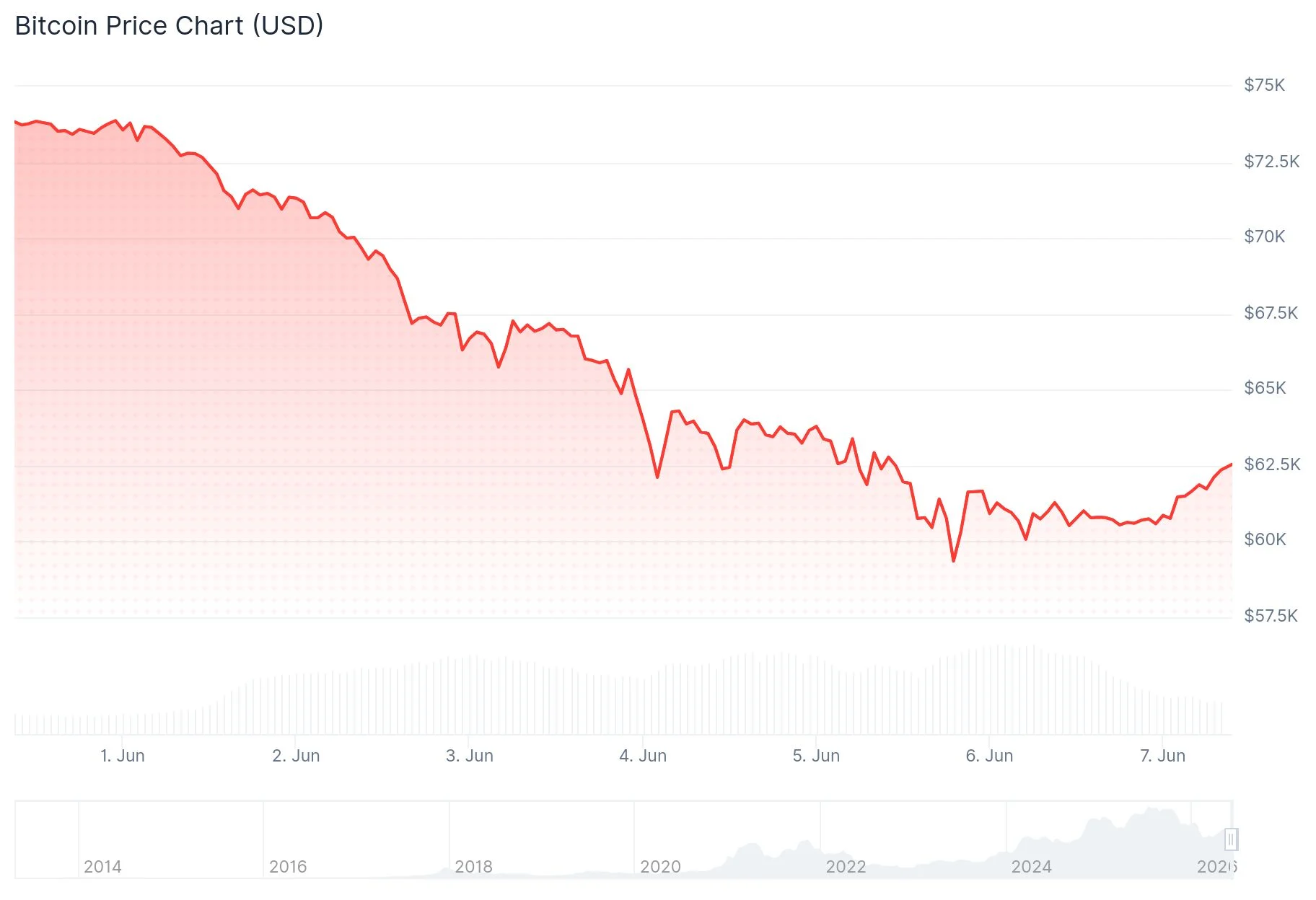
Bitcoin experienced a sharp decline on Friday, plunging to $59,100 — its weakest level this year — before market participants stepped in to defend the psychological $60,000 threshold. By Saturday, BTC had stabilized around $60,702, representing a modest 1% daily decline.
The catalyst for the downturn came from surprisingly robust US labor market statistics. May’s nonfarm payrolls revealed 172,000 new jobs, substantially exceeding the anticipated 85,000. Additionally, April’s figures received an upward revision of 64,000 positions. This economic resilience diminished market expectations for Federal Reserve monetary easing, triggering a surge in Treasury yields and dollar strength while punishing risk-sensitive assets.
The tech-heavy Nasdaq 100 tumbled approximately 5%, marking its sharpest single-day decline since April 2025. The S&P 500 retreated 2.6%. Digital assets were swept up in the broader risk-off sentiment.
Massive $1.6 Billion Liquidation Cascade
Intense selling pressure throughout cryptocurrency markets resulted in rapid liquidation of overleveraged positions. According to CoinGlass analytics, approximately $1.6 billion worth of positions were forcibly closed within a 24-hour window, with bullish bets absorbing the majority of losses. Bitcoin alone contributed over $500 million to this liquidation total, while Ethereum accounted for more than $400 million.
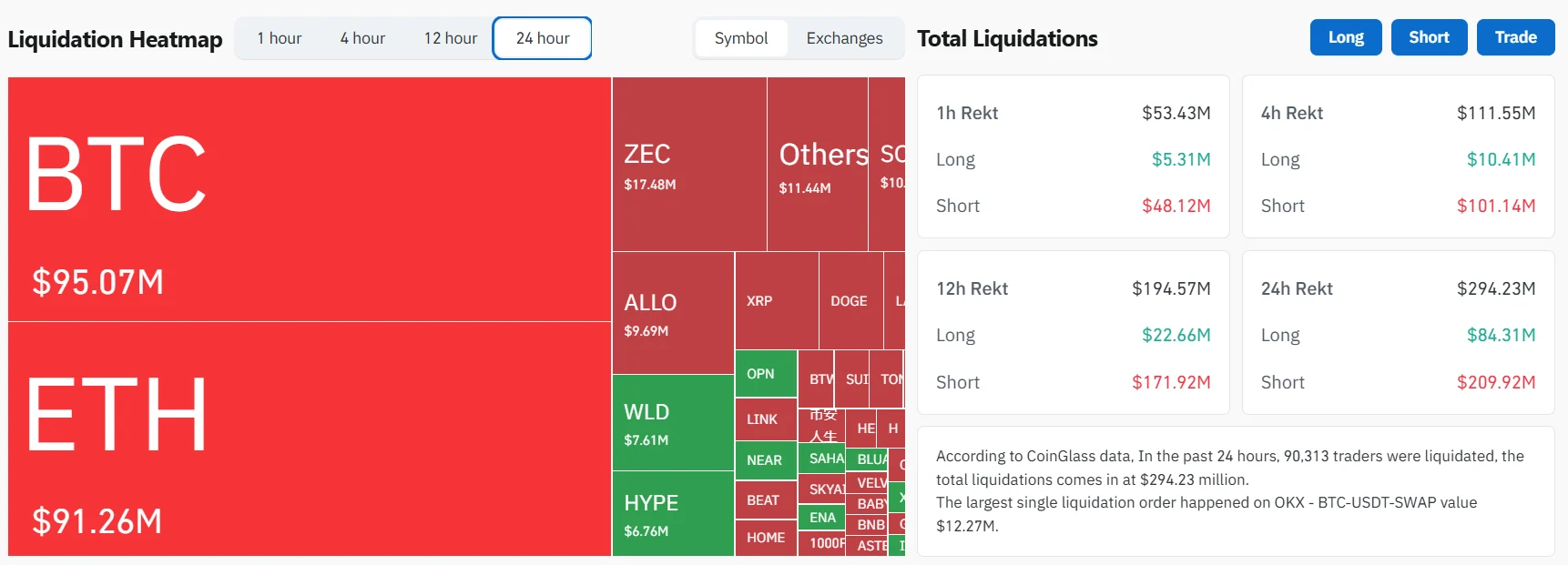
Altcoins suffered similarly brutal corrections. Ethereum has shed over 20% across the past seven days. Solana, XRP, Dogecoin, and BNB all recorded double-digit percentage losses during the same timeframe.
Market participant Daan Crypto Trades observed on X that Bitcoin had completely retraced its spring rally. “Really was a case of stairs up elevator down,” he commented.
On-chain analyst Ali Charts highlighted a crucial blockchain metric. His analysis reveals that 10.46 million BTC currently sit underwater — a threshold that has historically coincided with significant market troughs.
“Selling pressure often begins to fade as fewer investors are willing to realize losses, increasing the probability of a market bottom forming,” he explained on X.
Strategy Breaks Two-Year Buying Streak
Compounding market anxiety, Strategy revealed it had liquidated a portion of its Bitcoin treasury for the first time since 2022. While the sale represented only a fraction of the company’s substantial holdings, it sparked speculation about potential additional selling from one of cryptocurrency’s most prominent institutional accumulator.
US-based spot Bitcoin exchange-traded funds have registered consecutive weeks of capital outflows, eliminating a crucial demand pillar that had underpinned price action during earlier months.
Market observers are closely monitoring the $60,000 threshold for signs of support or breakdown. Analyst Exitpump observed that funding rates were drifting toward negative territory, interpreting this as “early signs of seller exhaustion.”
As of Saturday afternoon, Bitcoin was trading at $60,702.

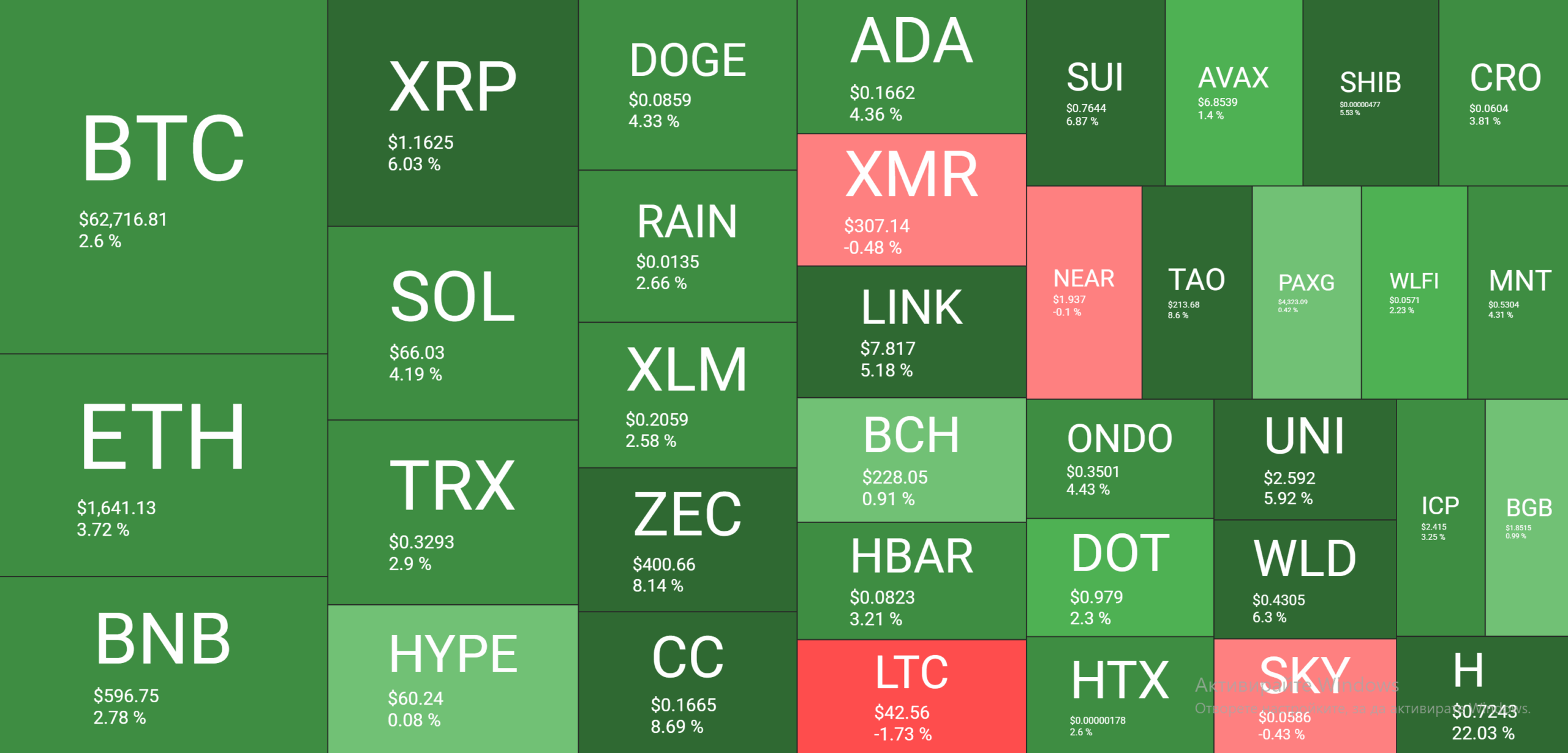
Bitcoin’s price recovery from the Friday calamity to under $60,000 has continued in the past 24 hours, with the asset climbing toward $63,000.
Most larger-cap altcoins have followed suit, posting notable gains on a daily scale. ETH has risen toward $1,650, while XRP has jumped past $1.10 and $1.15.
BTC to Challenge $63K?
We have written multiple times in the past few days about the large extent of the market-wide crash that took place during the last business week, especially on Friday. Bitcoin entered it at roughly $73,000 before its painful breakdown began. It kept losing value daily, first dropping below $70,000 before it dumped to $65,000 by the middle of the week.
Although it tried to rebound to $67,000, this attempt became a dead-cat bounce. The following days were even more brutal, especially Friday. At the time, the bears did something they couldn’t do even during the early February crash and drove BTC to under $60,000 for the first time since late 2024.
The silver lining for bitcoin is that the calamity affected Wall Street and gold, and worsened after the positive US jobs report in the US. After that multi-year low, the cryptocurrency finally rebounded and jumped past $60,000 almost immediately. It tapped $61,000 yesterday and has risen to almost $63,000 as of now.
Its market capitalization has climbed past $1.250 trillion on CG, while its dominance over the alts stands above 56%.

XRP, Alts Rebound
The daily scale is quite positive for the altcoins, which were crushed during the market-wide decline. ETH had dumped to $1,500, but it’s close to $1,650 now after a 4% daily gain. BNB has neared $600, while XRP has rebounded above two important support levels at $1.10 and $1.15. The asset dipped to $1.05 on Friday.
SOL, TRX, DOGE, RAIN, and XLMR have posted gains of up to 4%, while ZEC continues its post-FUD recovery with an 8% surge to $400. LINK, CC, SUI, SHIB, TAO, UNI, and WLD are also well in the green. Double-digit price increases come from lower-cap alts, such as LAB, H, BEAT, SIREN, and M.
The total crypto market cap has recovered roughly $150 billion since the low on Friday and is up to $2.240 trillion on CG.
The post Ripple’s XRP Reclaims Key Support, Bitcoin (BTC) Eyes $63K: Weekend Watch appeared first on CryptoPotato.

TLDR:
-
- The Ethereum whale cohort now holds 11.04M ETH, the lowest balance recorded across the full dataset history.
- Total holdings have fallen roughly 62% from the early-2022 peak of 28.83M ETH to the current level.
- Balances dropped nearly 50% in 12 months, falling from 22M ETH in mid-2025 to 11.04M ETH today.
- Data cannot confirm if outflows reflect actual selling or relocation into staking contracts and ETF custodians.
The Ethereum whale cohort tracking addresses holding between 100,000 and 1,000,000 ETH has reached a historic low.
On-chain data shows the cohort now holds just 11.04M ETH. This marks the lowest reading across the entire dataset history.
The figure represents a steep decline from the early-2022 peak of 28.83M ETH. Total reduction stands at approximately 17.8M ETH, or roughly 62% of peak holdings.
A Four-Year Decline Across Multiple Market Cycles
The Ethereum whale cohort’s balance erosion has unfolded gradually over four years. Early 2022 saw the cohort holding a peak of approximately 28.83M ETH.
By mid-2023, that figure had stabilized near 17M ETH for about 12 months. The extended plateau suggested a temporary pause rather than a reversal.
A partial recovery followed when balances climbed back to around 22M ETH in mid-2024. That uptick coincided with ETH prices rallying toward $4,500.
However, the recovery proved short-lived as balances resumed their downward trend shortly after. The cohort never reclaimed its prior peak during that period.
On-chain analytics platform Alphractal noted the trend in a recent post, stating: “The Ethereum 100K–1M ETH balance cohort just printed 11.04M ETH — the lowest reading on the entire chart history.”
The data covers wallet addresses holding institutional-scale positions. These sit below extreme concentration tiers such as exchange reserves and foundation wallets.
What makes the decline notable is its consistency across different market conditions. The cohort reduced holdings during both price rallies and drawdowns alike. This behavior points to sustained distribution rather than panic selling during a single downturn.
Distribution or Relocation — Two Readings of the Data
The steepest portion of the decline has occurred over the past 12 months. Balances dropped from roughly 22M ETH in mid-2025 to 11.04M ETH today.
That represents a 50% reduction within a single year. The sharpest leg down coincided with ETH falling from around $4,500 toward the current $1,780 range.
Two distinct interpretations exist for this data. The first is straightforward distribution, where large wallets have steadily sold or reduced ETH exposure over time. This reading suggests institutional-scale holders have been exiting positions regardless of price direction.
The second reading involves relocation rather than actual selling. Holdings moved into staking contracts, restaking protocols, or ETF custodians would not appear in the cohort balance.
Those assets leave the 100K–1M wallet tier but remain within the Ethereum ecosystem. The cohort metric alone cannot distinguish between these two scenarios.
Tracking the destination of outflows would clarify which dynamic is at play. Without that data, both readings remain valid.
What the on-chain data confirms is that the Ethereum whale cohort holds approximately 62% less ETH today than at the dataset’s recorded peak.


Bitcoin traders are watching a tense derivatives setup after on-chain analyst Maartunn pointed to a drop in BTC price while open interest moved higher.
Summary
- Bitcoin’s price fell while open interest climbed, showing traders added leverage during market weakness.
- Rising open interest during a selloff can raise liquidation risk if price moves sharply.
- Crypto.news reported Bitcoin fell below $60,000 as liquidations crossed $1.7 billion.
The setup suggests traders are adding new futures positions while Bitcoin remains under pressure. That can raise short-term risk because crowded leverage often makes price moves faster in both directions.
Bitcoin price falls as open interest climbs
Maartunn shared a simple warning around Bitcoin market structure, noting that price was moving down while open interest was moving up. Open interest tracks active futures contracts that remain open.
When open interest rises during a price drop, it often means traders are adding fresh positions into weakness. These positions can include shorts betting on more downside or longs trying to catch a rebound.
“Bitcoin: Price down, Open Interest up,” Maartunn wrote in the post.
The signal does not show direction by itself. It shows that leverage is building while the spot market remains weak. That makes the next move more sensitive to liquidations.
Why rising open Interest matters
Open interest is important because it shows how much active money sits in derivatives markets. A fast rise can point to crowded trading.
If many traders are positioned in the same direction, a sudden price move can force quick exits. That can create a short squeeze if price rises against shorts, or a long squeeze if price falls against longs.
This is why traders often watch open interest with price action. Price weakness with higher open interest can show growing pressure under the surface.
It also shows that the market has not fully stepped back from risk. Even after a selloff, traders are still opening positions instead of reducing exposure.
Bitcoin selloff adds pressure to traders
The warning comes after Bitcoin slipped below major support levels during a wider market decline. Crypto.news reported that Bitcoin fell below $60,000 after stronger U.S. jobs data reduced rate-cut hopes.
The same report said more than $1.7 billion in crypto positions were liquidated as traders exited leveraged bets. Bitcoin touched an intraday low near $59,100 before stabilizing near $59,400.
That backdrop makes rising open interest more important. If leverage returns too quickly after a large liquidation wave, the market can stay unstable.
Moreso, bitcoin also remains under pressure from ETF outflows and weak risk appetite. Crypto.news reported that spot Bitcoin ETFs posted $325.7 million in net outflows on June 5.
Traders watch bitcoin support and liquidations
The main level traders are watching is the $60,000 area. A strong recovery above that zone could pressure late shorts and support a short squeeze.
A failure to reclaim it could keep sellers in control. In that case, rising open interest may increase the risk of more liquidations below nearby support.
At press time, Maartunn’s post points to a market with more leverage than comfort. Bitcoin’s price is weak, but traders are still adding exposure.


Centralized crypto exchange spot volume fell to $679 billion in April 2026, marking its lowest monthly level since October 2023, according to CryptoQuant data cited by Wu Blockchain.
Summary
- CryptoQuant data shows centralized exchange spot volume fell to $679 billion in April 2026.
- Weak retail demand, lower search interest, and Bitcoin’s pullback reduced activity across crypto exchanges.
- Crypto.news reports show exchanges are leaning on derivatives, stablecoins, and services as spot trading slows.
The drop shows that traders are using spot markets less as the wider crypto market faces weaker demand, falling retail interest, and pressure from Bitcoin’s sharp pullback from its 2025 highs.
Crypto spot volume hits lowest level since 2023
CryptoQuant data showed that spot trading volume across centralized exchanges fell to $679 billion in April. The figure marked a sharp decline from the late-2025 market peak.
The report said the drop reflected weaker retail participation and lower demand. It also suggested that the market’s current problem is not only heavy selling, but a lack of buyers.
Perpetual futures volume also fell as speculative leverage left the market. That shift shows that traders have reduced risk across both spot and derivatives markets.
The data follows a wider slowdown across centralized exchanges. As previously reported by crypto.news, centralized exchange volume dropped about 48% from the October 2025 peak to $4.3 trillion in March 2026.
Retail interest falls across crypto markets
Crypto.news recently reported that global Google search interest in cryptocurrency fell to 26–30 out of 100. That is about 70 points below the August 2025 peak.
The fall in search interest points to weaker retail attention. It also shows that crypto prices and public interest are no longer moving together as closely as in past cycles.
Bitcoin has also traded under pressure. Crypto.news reported that Bitcoin fell below $70,000 on June 2 and traded near $69,200, about 45% below its October 2025 cycle high.
This weaker market setting has reduced trading activity. When prices fall and retail interest fades, spot volumes often drop because fewer users buy, sell, or rotate between assets.
Exchanges feel pressure from lower activity
Lower spot trading has already affected major exchange businesses. Crypto.news reported that Coinbase posted a $394.1 million Q1 loss as transaction revenue fell from a year earlier.
Coinbase said trading volume dropped to $202 billion from $401 billion in the same period last year. The company also said global crypto spot trading volume fell 44% during the quarter.
This shows how exposed exchanges remain to trading cycles. When spot volume drops, fee revenue can fall quickly, especially for platforms that rely heavily on transaction activity.
Some exchanges are now leaning more on derivatives, stablecoins, stock trading, and other services. These areas can help reduce dependence on spot crypto fees during slow markets.
Bitcoin selloff adds more market stress
The April volume drop also fits the latest market weakness. Crypto.news reported that Bitcoin and Ethereum faced a $1.89 billion options expiry on June 5 while prices traded near multi-month lows.
Bitcoin briefly approached $60,000 during the selloff. Traders also increased downside hedging as market sentiment weakened.
“Spot trading volume across centralized exchanges fell to $679 billion in April 2026,” CryptoQuant’s report said, according to Wu Blockchain.
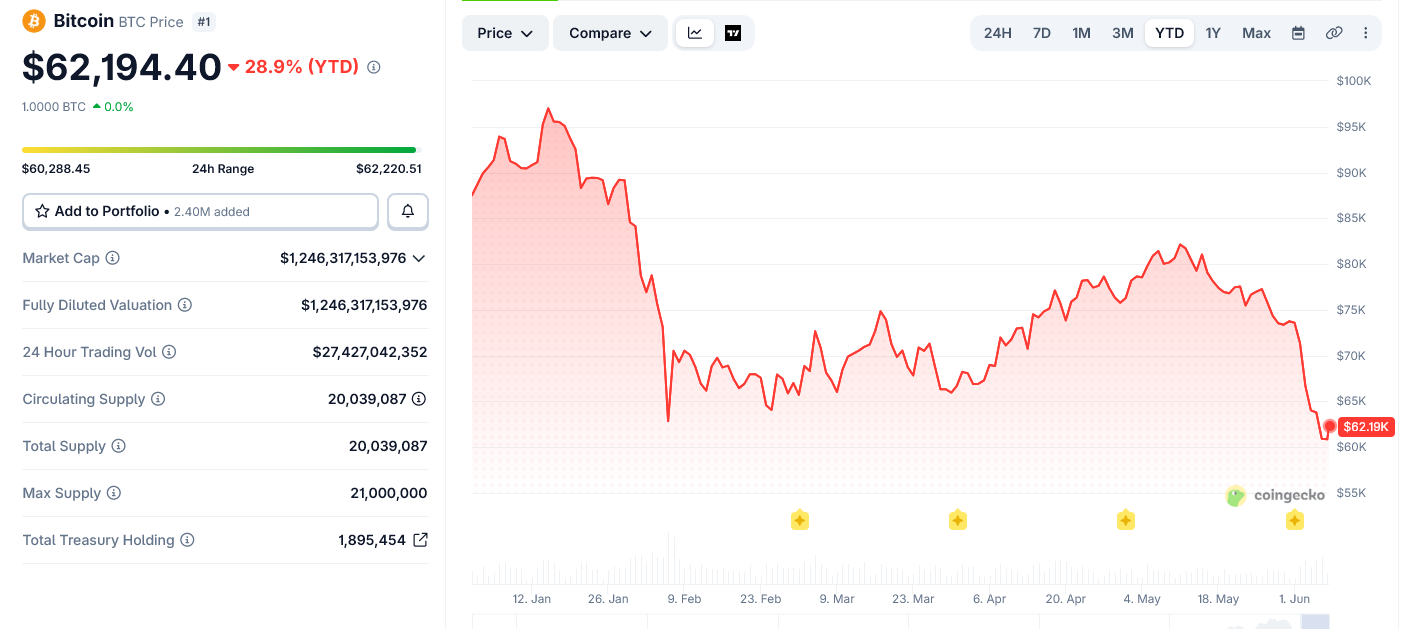
Bitcoin (BTC) trades near $62,000, roughly 7% above the $57,900 average price Germany received for the 49,858 BTC it sold in 2024. Arkham Intelligence says a 6% slide would push the market below the government’s exit level.
The on-chain analytics firm flagged the threshold, tracking every wallet movement when Germany liquidated the stash between June 19 and July 12, 2024.

Germany Bitcoin Sale Becomes a Market Reference Point
Saxon authorities seized roughly 50,000 BTC in January 2024 from the operators of the piracy site Movie2K.
Because German law treats prompt liquidation of seized assets as standard procedure, the government concluded its sell-offs in just 23 days, routing coins through Kraken, Bitstamp, Coinbase, Cumberland, and Flow Traders.
Follow us on X to get the latest news as it happens
The sale drew two years of criticism, and as Bitcoin doubled after the liquidation, calculations based on a one-year retrospective showed that the stash would have fetched over $6.6 billion, making Germany’s 2024 move the worst economic mistake of the decade.
“I feel very sad for the German people. Among all the bad decisions being made for the country at the moment, this turns out to be the worst,” one Bitcoin investor noted at the time.
A 6% Drop Would Rewrite the Sold-Too-Early Narrative
However, the 2026 correction has changed the comparison. Bitcoin recently fell below $60,000 on Binance and Coinbase for the first time since 2024, while spot ETFs bled $4.33 billion during a 13-day outflow streak.
At current prices, Germany’s exit no longer looks like a historic blunder. The gap between the market and the government’s average sale price has narrowed from over 100% at the 2025 peak to under 7%.

In retrospect, however, 2024 was a bad year for governments divesting from crypto. The likes of El Salvador and Bhutan, deliberately accumulated Bitcoin, while Germany tried to get rid of it.
Under President Biden, the US also began liquidating its holdings. Between these two nations and Ukraine, which also performed a complete liquidation, state-owned reserves dropped by 12%.
Neither China nor the UK acquired or disposed of any assets that year.
The post Germany’s Infamous $2.89 Billion Bitcoin Sale Is Suddenly Looking Smarter appeared first on BeInCrypto.
It was a painful week, no matter how you look at it or which cryptocurrency asset you support. Ripple’s XRP, arguably one of the alts with the biggest and loudest community, was no exception, as it dropped hard.
However, there’s a silver lining for the asset, as the exchange-traded funds tracking its performance in the US still managed to close the week in the green, unlike almost all other major crypto ETFs.
XRP ETFs Still Ended in Green
We will begin by admitting that the actual numbers weren’t the greatest. It wasn’t anything close to the ETFs’ early weeks, in which they attracted $1 billion in just over a month after the launch of the first one. The week ended with a modest $2.62 million in net inflows, but it’s still much better than the funds tracking bitcoin, for example, which shed a massive $1.7 billion (yes, with a B).
The spot XRP ETFs had only one day in the red last week, with June 3 seeing $5.34 million in net withdrawals. However, the net inflows of $4.13 million on June 1 and $3.83 million on June 4 managed to offset the losses. The other two trading days saw little to no reportable action, with SoSoValue showing $0.00 against both.
Thus, the funds’ total cumulative flows continued to increase slightly and tapped a new all-time high at over $1.43 billion. Bitwise’s XRP has extended its lead over Canary Capital’s XRPC, as both ETFs now hold $467 million and $458 million, respectively.
XRP Price Still Plummeted
Despite the positive news on the ETF front, the underlying asset was not spared from the overall market-wide calamity. In a week in which BTC dumped from over $73,000 to $59,000, Ripple’s cross-border asset went from $1.33 to $1.05. This 21% crash meant that XRP has marked its lowest price tag since late 2024, just after its post-US presidential election rally began.
Although the asset slumped to just inches above the coveted $1.00 psychological level, its rebound has been quite modest, and it still trades below $1.10. Analysts remain hopeful about its long-term potential, but even the biggest believers, such as EGRAG CRYPTO, warn that a dip below $1.00 may be unavoidable at this time unless the broader market’s structure improves rapidly.
The post Ripple ETFs Offer Rare Bright Spot Despite XRP’s Crash to 19-Month Low appeared first on CryptoPotato.


OpenAI is preparing its biggest ChatGPT overhaul since the chatbot launched in 2022. The redesign would turn ChatGPT into a super app built around coding tools, AI agents, and creative features.
The rollout starts in the coming weeks across ChatGPT’s website and mobile apps. It anchors a pre-IPO push for enterprise customers, where margins run higher than consumer subscriptions.
ChatGPT Redesign Puts Enterprise Tools First
The new interface will steer ChatGPT’s reported 900 million weekly users to built-in coding, image generation, and partner apps.
The plan elevates Codex, previously a standalone product, and adds agents that execute multistep tasks. The FT cited more than a dozen current and former employees.
The long-term goal goes further, according to the report.
“Over time, OpenAI intends to ditch the prompts and features, betting that its models will be able to automatically understand users’ intentions when they are on the app or site.”
The strategy builds on a $122 billion funding round that closed in March at an $852 billion valuation. Amazon committed $50 billion, while Nvidia and SoftBank invested $30 billion each.
OpenAI generates about $2 billion in monthly revenue but remains unprofitable under heavy compute costs.
Steering users into higher-margin enterprise tools could improve that picture before public investors examine the books.
“This literally sounds like the beginning of the AGI transition! I think they’re moving in the right direction. I assume by ‘ditching prompts’ will mean we get a better voice interface,” one user indicated.
Follow us on X to get the latest news as it happens
IPO Race With Anthropic Raises the Stakes
The reorganization ties to sharpening competition with Anthropic. The Claude maker joined the AI IPO race by filing a confidential S-1 with the SEC on June 1.
A $65 billion Series H recently valued Anthropic at $965 billion. Its revenue run rate hit $47 billion in May.
OpenAI submitted its own confidential IPO paperwork in late May. Goldman Sachs and Morgan Stanley are advising on a listing that could exceed $1 trillion by late 2026.
A debut at that scale could rank among the largest US listings on record.
Both companies are now part of a crowded trillion-dollar IPO wave that also includes SpaceX.
A platform story may help justify premium multiples in markets wary of AI cash burn.
The coming weeks will show whether a unified super app persuades investors that OpenAI is more than a chatbot company.
The post OpenAI Plans Biggest ChatGPT Overhaul Before IPO appeared first on BeInCrypto.

The past week or so has been nothing short of a bloodbath in the cryptocurrency markets, with bitcoin plummeting to $59,000 on Friday for the first time in 19 months.
Aside from losing more than $20,000 in approximately three weeks, BTC’s calamity dragged almost all altcoins. This has intensified the pressure on the largest corporate holders of those assets, and the analysts at Lookonchain provided specific numbers about the extent of those companies’ paper losses.
UPDATE:
Tom Lee (@fundstrat)’s #Bitmine is down $10.35B.
Michael Saylor (@saylor)’s #Strategy is down $12.27B.https://t.co/YUVOVx6KSS pic.twitter.com/h0bZBiGncp
— Lookonchain (@lookonchain) June 6, 2026
Strategy and Bitmine Lead the Bad Way
Before delving into the details of the aforementioned corporate crypto holders, we need to add a brief disclaimer. The data above is subject to change since the cryptocurrency market operates 24/7 and prices fluctuate constantly. Nevertheless, they provide a clear and painful picture for many of those companies, beginning with Michael Saylor’s Strategy.
The largest corporate holder of bitcoin (or any other cryptocurrency) has continued to accumulate substantial portions of BTC for the past year and a half, and its digital fortune has grown to 843,706 units even after selling a tiny amount last week. Given its average accumulation price of $75,600 per BTC, the firm has spent roughly $63.8 billion to acquire its stash. However, its current value of $51.6 billion leaves Strategy with the highest unrealized loss in its history of more than $12 billion.
Although Bitmine’s crypto holdings are far behind Strategy, its unrealized losses are relatively close. The Tom Lee-chaired firm now sits on a paper loss of well over $10 billion on its Ethereum bet, even though he has repeatedly predicted in the past few months that ETH has bottomed and crypto spring is just around the corner.
The Rest
Similar to Bitmine, SharpLink is also down on its Ethereum exposure, as Lookonchain’s data shows a value drop of around $1.7 billion at current prices.
Japan-based Metaplanet, often referred to as ‘Asia’s Strategy,’ has experienced unrealized losses of over $1.4 billion on its BTC holdings. It’s worth noting that the company aggressively accumulated bitcoin to hedge against currency depreciation and macro uncertainty during the run in 2024/2025 but has mostly halted its purchases in the past several months.
Forward Industries follows with a $1.14 billion paper loss on its Solana exposure. SOL typically carries higher volatility, amplifying both upside potential and downside risk.
The post Here’s How Deeply Underwater Corporate Crypto Bets Have Become After Latest Crash appeared first on CryptoPotato.
Crypto World
Tether Designates Independent Board Member to Restore Twenty One Capital’s Audit Committee
TLDR:
- Tether International designated an independent director to Twenty One Capital’s board after SoftBank’s exit created a vacancy.
- The new appointee meets SEC Rule 10A-3 and NYSE Section 303A.02 independence standards for audit committees.
- Twenty One Capital holds over 43,500 Bitcoin and is building a vertically integrated Bitcoin business model.
- Paolo Ardoino stated that oversight strength must match the strength of Twenty One Capital’s balance sheet.
Twenty One Capital has appointed an independent director to its board, filling a vacancy on its audit committee. The move comes after Tether International acquired SoftBank Group’s stake in the Bitcoin treasury company on May 20, 2026.
The new appointee meets the independence standards set by both the SEC and NYSE. This restores the audit committee to full composition following the governance changes that came with the ownership transition.
Board Change Follows SoftBank Exit
The vacancy on the audit committee opened after Tether completed its acquisition of SoftBank’s stake in Twenty One Capital.
When that transaction closed, SoftBank’s board representatives stepped down, including one who served on the audit committee. Twenty One Capital promptly notified the NYSE of the change in committee composition at that time.
The newly designated director qualifies as independent under Rule 10A-3 of the Securities Exchange Act. The appointee also meets the requirements outlined in Section 303A.02 of the NYSE Listed Company Manual.
These two standards are central to maintaining a compliant audit committee for a publicly listed company.
Tether CEO Paolo Ardoino spoke directly on the appointment, stating, “XXI is building one of the most important Bitcoin companies in the world, and so, we have been putting a great deal of rigor into finding the best candidate.”
He added that the goal was to find a director who could deliver shareholders thorough, independent oversight of the company’s operations.
Bitcoin Treasury Strategy Stays Central
Ardoino further noted, “The strength of the oversight needs to match the strength of the balance sheet,” pointing to XXI’s priority of appointing a director who meets all applicable SEC and NYSE requirements. That standard reflects the scale of responsibility tied to managing a Bitcoin treasury of this size.
Twenty One Capital was founded as a Bitcoin treasury company and currently holds more than 43,500 Bitcoin. The company is building a vertically integrated Bitcoin business that covers mining, treasury, capital markets, and financial services. The governance update runs alongside that broader strategic direction.
Tether has remained the controlling shareholder in Twenty One Capital through these recent changes. The acquisition of SoftBank’s stake in May deepened Tether’s commitment to the company rather than reducing it.
For a company managing assets at this scale, maintaining a fully composed and independent audit committee is a regulatory priority, and the latest appointment addresses that requirement directly.

Bitcoin (BTC) Plunges to $59K as $1.6B Liquidation Event Rocks Crypto Markets

LIVE: 2026 PBA Commissioner’s Cup Finals Game 3

Meet Pikachu and Gyarados at Wakura Onsen’s New Free Pokemon Footbath



-

 Business6 days ago
Jade Biosciences, Inc. (JBIO) Discusses Positive Interim Results From JADE101 Phase I Healthy Volunteer Study and Development Plans Transcript
-

 Fashion2 days ago
Weekend Open Thread: Evereve – Corporette.com
-

 Sports4 days ago
French Open 2026 results: Alexander Zverev beats Rafael Jodar and will play Jakub Mensik in semi-finals
-
 Crypto World2 days ago
Jensen Huang Approves Samsung, SK Hynix, and Micron for NVIDIA (NVDA) HBM4 Memory Supply
-

 Tech5 days ago
CryZENx Releases Fresh Playable Content Deep Inside Jabu-Jabu for His Ocarina of Time Remake
-

 Business4 days ago
Trump Taps Housing Chief Bill Pulte as Acting Intelligence Director After Gabbard Exit
-
Crypto World2 days ago
LBank Surpasses 25 Million Users Worldwide as AFA Partnership Continues to Drive Global Growth
-
 NewsBeat4 days ago
Republicans balk at Trump’s attempt to appoint a MAGA enforcer to lead National Intelligence
-

 Tech2 days ago
RCS Messages Between iPhone and Android Get End-to-End Encryption With iOS 26.5
-
 Crypto World5 days ago
Seagate (STX) Stock Surges to Record High on AI Boom and Legal Settlement
-
Crypto World4 days ago
EU AI Data Center Project Faces Delays as Funding Gaps Grow
-

 Entertainment4 days ago
Did The Mandalorian And Grogu Already Ruin The Next Star Wars Movie?
-

 Business4 days ago
Aehr Test Systems Stock Soars 17% Amid Surging AI Demand and Conference Spotlight
-
 Business5 days ago
Claude AI Down Today Reason: Why Anthropic’s AI is not working today? What’s the latest quota update
-
 Crypto World2 days ago
Merlin (MRLN) Stock Soars 32% on Major USSOCOM Autonomy Milestone
-

 Tech5 days ago
Instagram will stop bombarding teens with the same kind of obsessively unhealthy content
-

 Business4 days ago
Relay Therapeutics Shares Surge 20% on ASCO Momentum for Zovegalisib Breast Cancer Program
-

 Tech2 days ago
Credit card theft campaign abuses Stripe to host stolen payment info
-

 Tech2 days ago
Meta steals a tactic from Tesla and builds data centers in tents
-
Crypto World5 days ago
Tether Brings Google’s TurboQuant to Production, Unlocking Long-Context AI on Everyday Devices
You must be logged in to post a comment Login