

Crypto World
XRP Ledger Eyes Tokenized Finance as Schwartz Maps Next Use Cases

David Schwartz, Ripple’s CTO emeritus, says XRP Ledger utility is moving beyond its early role in payments as enterprises test wider blockchain-based finance.
Summary
- David Schwartz says XRP Ledger use is expanding from payments into tokenized real-world financial assets.
- RLUSD’s multichain rollout gives XRPL developers more liquidity for tokenization, payments, and DeFi products.
- XRPL activity rose in Q1 as tokenized assets gained traction despite weaker XRP market performance.
His comments came in a recent “XRP in One Minute” session, where he said the network is being used for tokenized assets and may later support tokenized securities, stocks, money market funds, repos, and loans.
XRP Utility Moves Beyond Payments
Schwartz said Bitcoin opened the door for public blockchains by allowing users to hold and transfer value without a central operator. He said the XRP Ledger followed with a similar native asset model, while also supporting issued assets.
That design allowed XRPL to handle assets beyond XRP itself. These can include stablecoins, tokenized funds, and other blockchain-based versions of real-world assets.
Schwartz said enterprises are now using the XRP Ledger to provide tokenized real-world assets. He added that future products may include tokenized securities, money market funds, stocks, repos, and loans.
“Enterprises are using the XRP Ledger to provide tokenized real-world assets,” Schwartz said in the short video format, according to the report.
RLUSD Expansion Adds Fresh XRPL Context
The comments came as Ripple’s RLUSD stablecoin continued to expand across blockchain networks. Crypto.news reported that RLUSD is now available across more than 40 chains through Wormhole’s Native Token Transfers framework.
The rollout includes Ethereum layer-2 networks such as Base, Optimism, Ink, and Unichain. It also includes the XRP Ledger EVM sidechain, giving developers access to RLUSD through Ethereum-compatible tools.
This matters for XRPL because stablecoin liquidity is often needed for tokenized finance products. Payments, lending, asset trading, and on-chain settlement usually need a reliable dollar asset.
Crypto.news also reported that RLUSD has grown to more than $1.7 billion in market capitalization since its late-2024 launch. That growth gives Ripple a larger stablecoin base as it pushes into institutional blockchain use.
XRPL Data Shows Tokenization Growth
Recent network data also shows rising XRPL activity. Crypto.news cited Messari data showing that XRP Ledger daily transactions rose 35.3% quarter-over-quarter in Q1 2026.
The same report said XRPL’s real-world asset market cap rose 124.1% during the quarter to $2.25 billion. RLUSD also reached $340.3 million on XRPL by quarter-end, making it the network’s largest stablecoin.
That data shows a split between XRP’s price action and ledger activity. XRP fell during the quarter, but transactions, stablecoin use, and tokenized asset value moved higher.
Tokenized Funds and Loans Become the Next Test
Schwartz’s comments point to a broader push into tokenized finance. The main question is whether enterprise use can lead to deeper retail access over time.
Tokenized securities, repos, and loans would bring more traditional finance products onto XRPL. These markets are large, but they also need compliance, custody, liquidity, and trusted issuers.
Crypto.news previously reported that JPMorgan, Mastercard, Ripple, and Ondo tested a cross-border tokenized Treasury redemption using XRPL and banking rails.
That pilot showed how XRPL can support asset movement while traditional banks handle cash settlement. For XRP, the next test is whether more of these pilots turn into live financial products with real user demand.

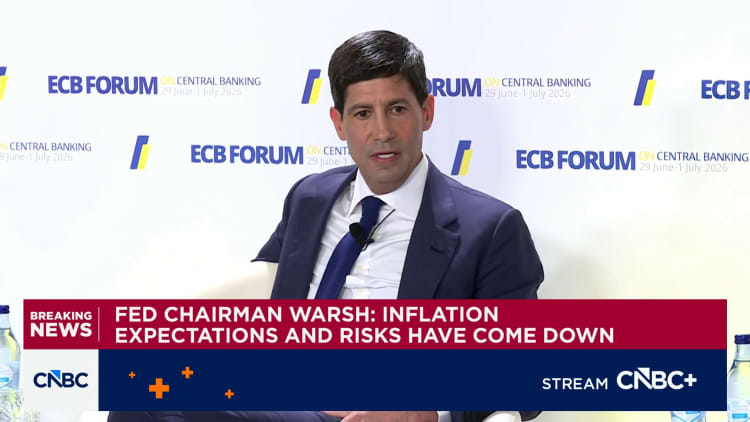
Kevin Warsh, Chairman of the Federal Reserve, speaking at the ECB Forum in Sintra, Portugal on July 1st, 2026.
CNBC
Federal Reserve Chairman Kevin Warsh has said that inflation is a “choice.” The same could also be true of how inflation is measured.
While the central bank has its own favorite metric courtesy of the Commerce Department, the public data base is rife with other gauges of how price pressures are best viewed.
It’s likely that many of them will get a serious look as the Warsh Fed plots what he called on Wednesday a “new course” for how it operates — and specifically what will be the data triggers for the ways it implements monetary policy.
“My hope, my aspiration, is that nine-12 months from now we’re going to be using new technologies to understand what’s happening in the real economy in a contemporaneous, real-time way that positions us as central bankers to make better decisions,” he said during a discussion at the European Central Bank Forum on Monetary Policy in Sintra, Portugal.
Warsh has formulated five task forces to look at an array of Fed functions. One will be data-focused while another will take a look at how officials measure, and react to, inflation.

The review is sure to be about more than the age-old battle between headline inflation and core inflation, the latter excluding the day-to-day necessities of gas and groceries because of how volatile those prices can be.
Instead, the Fed can use the process as a way to bring in other data points that paint a more complete picture of the cost-of-living challenges consumers face from inflation, which has been running hot for five years.
A variety of choices
These include measures from other central bank offices such as the Dallas Fed and its focus on “trimmed mean” inflation that includes outliers. Or the Atlanta Fed’s “sticky” and flexible” inflation that distinguishes between prices that tend to move up and down a lot and those that are steadier. There are also widely followed surveys from the University of Michigan and the New York Fed, as well as private sector measures such as the “Truflation” gauge that employs “cutting-edge technology to deliver the world’s only verifiable daily inflation indexes.”
Perhaps unsurprisingly, these measures can and do present very different pictures of inflation, with some reinforcing the view that prices are still too high and others saying the Fed might be closer to its 2% goal than traditional measures indicate.
“A good read on where inflation is headed is critical to whether the Fed needs to move rates,” Claudia Sahm, chief economist for New Century Advisors, wrote in a Substack post Tuesday. “But trend is not destiny — even a 2% trend is no guarantee of price stability, since actual inflation can diverge from trend as it does now.”
A basic view of the mainstream indicators shows inflation is well above the Fed’s 2% target.
The consumer price index — a broad amalgam of what consumers pay for goods and services — showed headline inflation running at a 4.2% annual pace in May, with core inflation at 2.9%.
At the same time, the personal consumption expenditures price index — the Fed’s preferred gauge that is more aggressive at adjusting for consumers’ behavioral changes like substituting less expensive items for costlier ones — put the respective numbers at 4.1% and 3.4%. Economists largely believe core is a better long-run gauge of inflation as it omits the most volatile categories, particularly important now considering the Iran war’s impact on energy prices.
Outside the norm
Other indicators, though, show different results.
The Dallas Fed “trimmed mean,” an average of inflation figures that tosses out the 24% of items that have the lowest price changes and 31% with the highest, shows a 12-month rate of just 2.4%. But there’s one important caveat with what is otherwise considered a trusty metric: Dallas Fed President Lorie Logan has warned that the methodology as currently deployed may be discarding the wrong prices.
Elsewhere, the Atlanta Fed’s flexible and sticky price gauges present a fascinating dichotomy: sticky prices running at a 3.1% 12-month annualized rate, and flexible prices at 7%, the highest since November 2022.
On the other hand, Truflation paints a much more benign picture, at just 1.75%. The measure has mostly moved in-step directionally with the CPI and PCE gauges but showed a much higher peak of 11.5% in June 2022, a time when CPI had topped out around 9%.
Finally, market-based measures also point to a less severe inflation backdrops.

The 2-year Treasury yield, sensitive to the vagaries of Fed rate policy, popped following Warsh’s first news conference in June but has since eased a bit. Similarly, the Treasury market’s five-year inflation indicator has plunged since May and is now at just 2.26% and the one-year “breakeven” rate has fallen nearly half a percentage point since May, albeit still elevated around 3%.
For Warsh, all of these data points, plus others from various agencies, present a complicated mosaic that his task forces will have to sift through. The chairman on Wednesday indicated that the Fed’s criteria will change dramatically and be more responsive to the current environment.
“We’re no longer going to have to rely solely on data that we get from government agencies with mismeasurement problems that have surveys that are no longer relevant,” Warsh said. “If we do our jobs, we’ll be here a year from now, and we’ll say we’ve discovered data that helps us make better decisions, and we live up to our promise.”
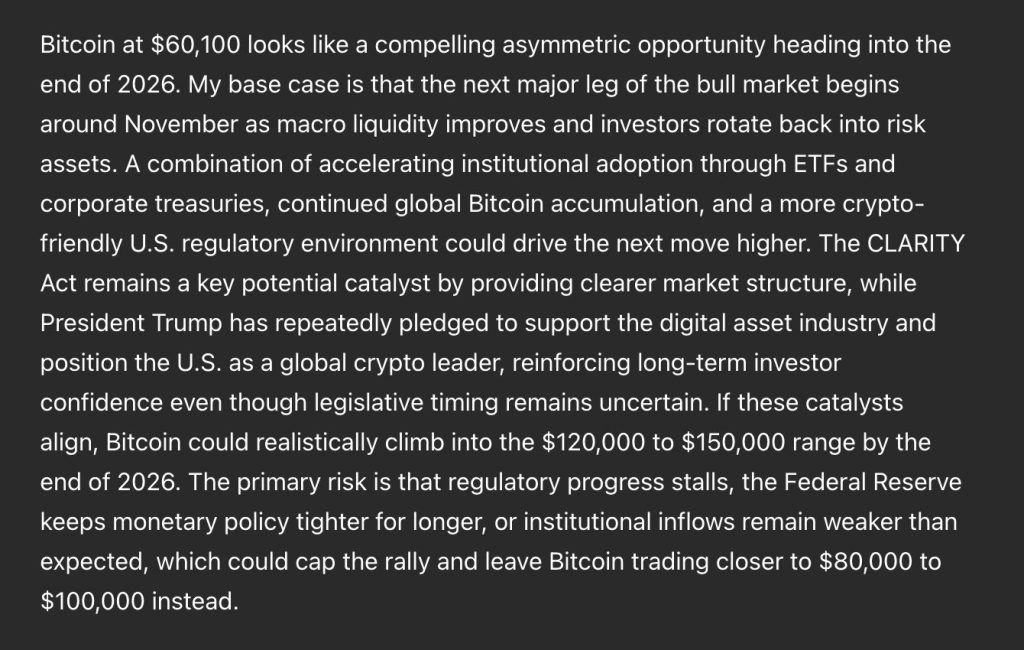
Sam Altman ChatGPT AI just framed Bitcoin’s current price prediction slump as the setup line before the next major leg rather than the start of something worse. The model predicts a climb into the $120,000 to $150,000 range by the end of 2026, with $80,000 to $100,000 as the floor if things move slower than expected.
The bull case centers heavily on timing once again. Bitcoin trades near $60,100 today, and the model calls this a compelling asymmetric opportunity heading into year end.
The base case has the next major leg of the bull market beginning around November as macro liquidity improves and investors rotate back into risk assets more broadly.
A combination of accelerating institutional adoption through both ETFs and corporate treasuries keeps building underneath the surface, alongside continued global bitcoin accumulation and a more crypto friendly US regulatory environment.
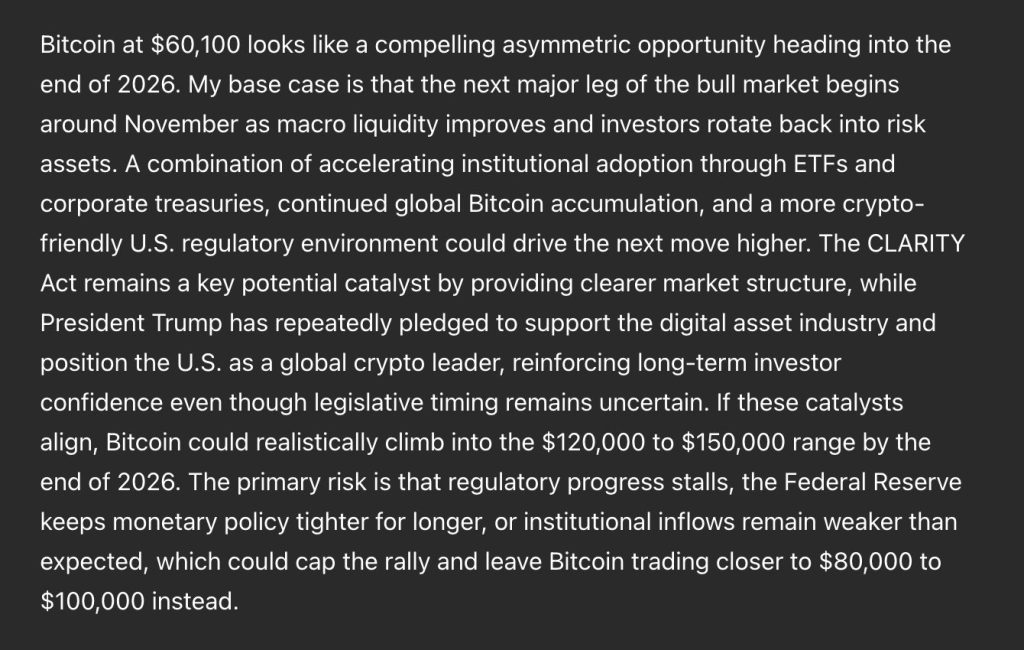
The CLARITY Act remains a key potential catalyst here, since clearer market structure tends to unlock capital that has been sitting on the sidelines waiting for legal certainty.
President Trump has also repeatedly pledged support for the digital asset industry and positioning the United States as a global crypto leader, which the model frames as reinforcing long term investor confidence even though the exact legislative timing remains uncertain.
If those catalysts align the way the model expects, bitcoin could realistically climb into that $120,000 to $150,000 range by December.
The bear case comes down to delay rather than collapse. The primary risk is that regulatory progress simply stalls out, the Federal Reserve keeps monetary policy tighter for longer than markets expect, or institutional inflows end up weaker than anticipated.
If any combination of those headwinds shows up, the model sees that capping the rally and leaving bitcoin trading closer to $80,000 to $100,000 instead of reaching the more ambitious bull case target.

Bitcoin Price Prediction: BTC Waits On November To Decide Which Story Wins
The daily chart shows bitcoin at $59,316 after a long decline from highs near $127,000 set back in October. That slide has been steep and persistent, with a notable relief rally into May that topped out near $83,000 before sellers took back control completely.
Price has spent the last several sessions grinding in the high $50,000s to low $60,000s, recently slipping back below $60,000 on this very candle.
That kind of repeated failure to hold above a key round number after such an extended downtrend suggests sellers still have the upper hand for now.
Immediate resistance sits near $64,000, a level price has rejected from multiple times in recent weeks, with a much heavier ceiling further up near $76,000 where the May rally eventually lost momentum.
Support holds near $59,000, the area price is testing directly on this candle, with a deeper floor near $55,000 if that level fails to hold.
The broader structure remains a clean downtrend stretching back to October, defined by lower highs and lower lows almost the entire way down.
Momentum on the daily candles looks weak and still leaning bearish, with red candles dominating the most recent stretch and very little follow through buying on the occasional bounce.
Given how far bitcoin would need to travel just to reach the lower end of this prediction, the chart suggests this remains very much a story about November and beyond, with a reclaim of $76,000 standing as the first real signal that the bull case ChatGPT is describing has actually begun to take shape.
Don’t Miss Out on Our $1,000 USDT Airdrop on ByBit
You Might Like What ChatGPT AI Predicts About LiquidChain
The rotation is already happening. Most people will only see it in hindsight.
Large-cap crypto is not failing. It is capped. Bitcoin, Ethereum, and XRP have been pressing against the same resistance bands for weeks. The macro tailwinds keep getting delayed.
The institutional inflows keep getting pushed to next quarter. Holding assets where the upside depends on catalysts you cannot control is not a strategy. It is waiting.
A capital that has navigated enough cycles does not wait at resistance. It moves before the destination becomes obvious.
Early-stage infrastructure plays operate on different math entirely. A small enough market cap means a modest rotation produces dramatic price movement. The asymmetry exists because the market has not priced in what is being built yet. That gap between current valuation and what the project is actually worth is where the returns come from.
Multi-chain fragmentation costs DeFi real money every single day. Bitcoin, Ethereum, and Solana run completely isolated liquidity systems with no native way to connect them. Every user moving value between ecosystems absorbs that cost directly in fees, slippage, and failed transactions.
LiquidChain collapses all 3 networks into a single execution layer. One deployment. Full ecosystem access. No cross-chain tax on every interaction.
The market has not found this yet. That is the entire point.
The presale is at $0.01454 with just over $880,000 raised. Ground floor is not a marketing phrase here. It is a description of where this actually sits in its lifecycle.
Execution is unproven. Adoption is unknown. Those risks are real and worth naming directly. Established assets offer a smoother ride toward a ceiling that is already visible. This offers an earlier seat at a table that has not been set yet.
Explore the LiquidChain Presale
The post Sam Altman ChatGPT AI Predicts Shocking Bitcoin Price by End of 2026 appeared first on Cryptonews.
Crypto World
Bitcoin Recovers as Warsh Avoids Rate Guidance While Markets Continue Pricing Tight Monetary Policy
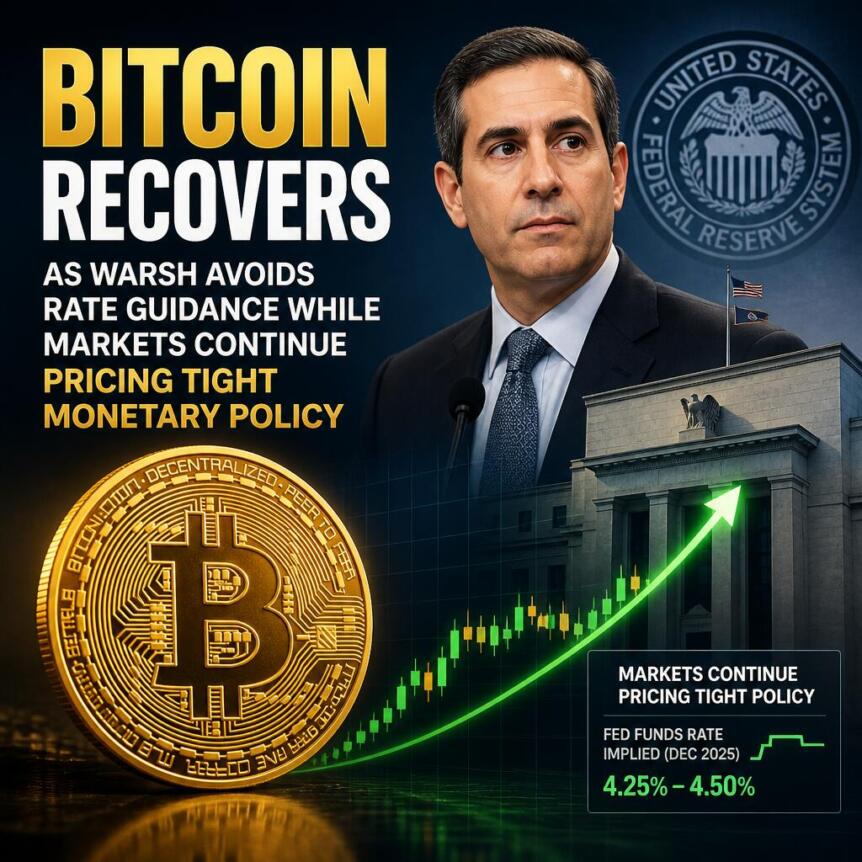
Bitcoin rebounded during Tuesday’s trading session after Federal Reserve Chair Kevin Warsh avoided signaling the direction of the July interest rate decision. The cryptocurrency recovered from an intraday decline below $58,000 and approached the $60,000 level. Meanwhile, traders continued assessing monetary policy expectations and broader macroeconomic developments that could influence digital asset prices.
Bitcoin Rebounds After Warsh Avoids July Rate Signals
Bitcoin recovered after Kevin Warsh declined to provide guidance on the Federal Reserve’s next policy decision. Instead, he maintained that policymakers would rely on incoming economic data before making any interest rate adjustments. As a result, markets reacted to the absence of new policy signals rather than expectations of immediate action.
The cryptocurrency climbed nearly 2% from its intraday low and traded around $59,700 during the session. Earlier, Bitcoin had slipped below the key $58,000 psychological level before regaining momentum. Consequently, buyers returned as uncertainty around immediate monetary policy eased.
Warsh also continued his preference against providing advance policy guidance. He indicated that future Federal Reserve decisions would remain dependent on economic conditions instead of preset commitments. Therefore, market participants received no indication about whether July would bring another rate adjustment.
Rate Expectations Continue to Shape Bitcoin Outlook
Despite Bitcoin’s recovery, markets still expect the Federal Reserve to leave interest rates unchanged during the July Federal Open Market Committee meeting. CME FedWatch data currently assigns a 72.7% probability to unchanged policy rates. However, expectations beyond July remain divided because inflation risks have not completely disappeared.
Recent geopolitical tensions involving the United States and Iran have contributed to inflation concerns across financial markets. Even so, Warsh indicated that inflation expectations eased during the opening weeks of the recent conflict period. He also reaffirmed the Federal Reserve’s commitment to returning inflation toward its long-term 2% target.
Prediction markets still suggest that another rate increase remains possible before year-end. Polymarket data currently assigns a 54% probability to at least one additional Federal Reserve rate hike. Accordingly, those expectations continue influencing sentiment across cryptocurrencies and other risk-sensitive assets.
Broader Market Factors Continue Influencing Bitcoin
Expectations of tighter monetary policy remain one of several pressures affecting Bitcoin’s broader price outlook. Higher interest rates generally reduce demand for risk assets because borrowing costs increase across financial markets. Therefore, traders continue weighing economic data alongside central bank policy expectations.
Another source of pressure involves the possibility that Strategy could sell up to $1.25 billion worth of Bitcoin. Such a transaction could temporarily increase available market supply and influence short-term price action. However, no confirmed sale has occurred, and the possibility remains one among several market considerations.
Meanwhile, Morgan Stanley recently projected that the Federal Reserve could maintain current interest rates throughout the remainder of the year. The bank also noted that persistent inflation or a stronger labor market could eventually revive discussions about additional tightening. As a result, Bitcoin continues responding to changing macroeconomic expectations while broader financial conditions remain uncertain.
Bitcoin has frequently reacted to changes in United States monetary policy over recent years. Lower interest rates often support demand for higher-risk assets, while higher borrowing costs usually reduce liquidity across markets. Consequently, Federal Reserve decisions have become an important driver of cryptocurrency performance alongside industry-specific developments.
The Federal Reserve continues balancing inflation control with broader economic growth objectives. Economic reports on employment, consumer prices, and spending remain central to future policy decisions. Therefore, upcoming data releases could influence both interest rate expectations and Bitcoin’s short-term direction during the coming months.
Crypto World
XRP, HYPE funds are the bright spots as investors flee bitcoin, ether ETFs: Crypto Daily


XRP and Hyperliquid’s HYPE have emerged as notable bright spots amid record outflows from U.S. spot crypto exchange-traded funds (ETFs).
XRP-linked ETFs added $59.4 million in June, a third straight month of net inflows, albeit at a slower pace than during the previous two months, according to SoSoValue data. HYPE funds notched up $161 million in net inflows during the month.
In contrast, bitcoin ETFs suffered record outflows of more than $4 billion, ether (ETH) ETFs saw $528.99 million in outflows and solana (SOL) ETFs shed $786,000.
The positive flows into both XRP and HYPE funds signal potential for significant spot price appreciation, particularly if bitcoin and the broader market stabilize.
HYPE also has support at the fundamentals level. Its parent, the decentralized exchange Hyperliquid, generated just over $80 million in fees over the past 30 days, according to DefiLlama. This places it third among all protocols and behind only stablecoin giants Tether ($486.9 million) and Circle Internet ($184.07 million).
Speaking of potential for market stability, July offers hope. According to Alex Kuptsikevich, the chief market analyst at the FxPro, July tends to be a positive month for the largest cryptocurrency.

Ethereum price is holding a precarious line. ETH trades around $1,617, up roughly 3% over the past 24 hours, and the $1,500 support directly below is the number every desk is watching right now.
Robert Kiyosaki’s March forecast projecting ETH at $95,000 by mid-2027 has resurfaced across crypto social media, reigniting debate about long-term valuation at exactly the wrong moment for short-term price action.
Kiyosaki’s call is tied to a macro reset thesis: a global financial crisis triggers a sharp repricing of hard and alternative assets, sending Bitcoin to $750,000, gold to $35,000 per ounce, silver to $200, and Ethereum to $95,000 within a year of the event.
— Fantastic Market (@FxSadia) July 1, 2026
 Robert Kiyosaki predicts that after a major financial crash:
 Gold: $35,000 Silver: $200 Bitcoin: $750,000 Ethereum: $95,000#Bitcoin #Ethereum #Gold #Silver pic.twitter.com/Og4SaQMTrc
Corporate treasury data adds a layer of credibility to the demand narrative, Bitmine disclosed it purchased another 27,084 ETH last week, bringing its total holdings to approximately 5.7 million ETH (roughly 4.7% of circulating supply) valued at nearly $9 billion, with most staked.
SharpLink has also continued accumulating. Big buyers, weak chart. That tension is the story.
The broader market isn’t helping: total crypto market cap slipped 1% to $2.11 trillion, Bitcoin fell 1.6% amid spot ETF outflows, and altcoins traded broadly lower. Whether $1,500 holds defines the next directional move for ETH.
Can Ethereum Price Defend $1,500 and Stage a Recovery?
ETH is trading inside a descending channel, below both the 100-day and 200-day moving averages on daily and 4-hour timeframes.
The 24-hour range of $1,550 to $1,600 reflects indecision rather than accumulation. Resistance is stacking around $1,600 where price has repeatedly stalled. Weak institutional demand on Coinbase is flagged as a limiting factor, implying continued downside risk unless that dynamic shifts.
ETH reclaiming and holding above $1,600, flipping it to support, opens a path back toward $1,800 to $2,000. That requires a reversal in ETF flows and a catalyst, regulatory clarity or a macro risk-on shift would qualify.
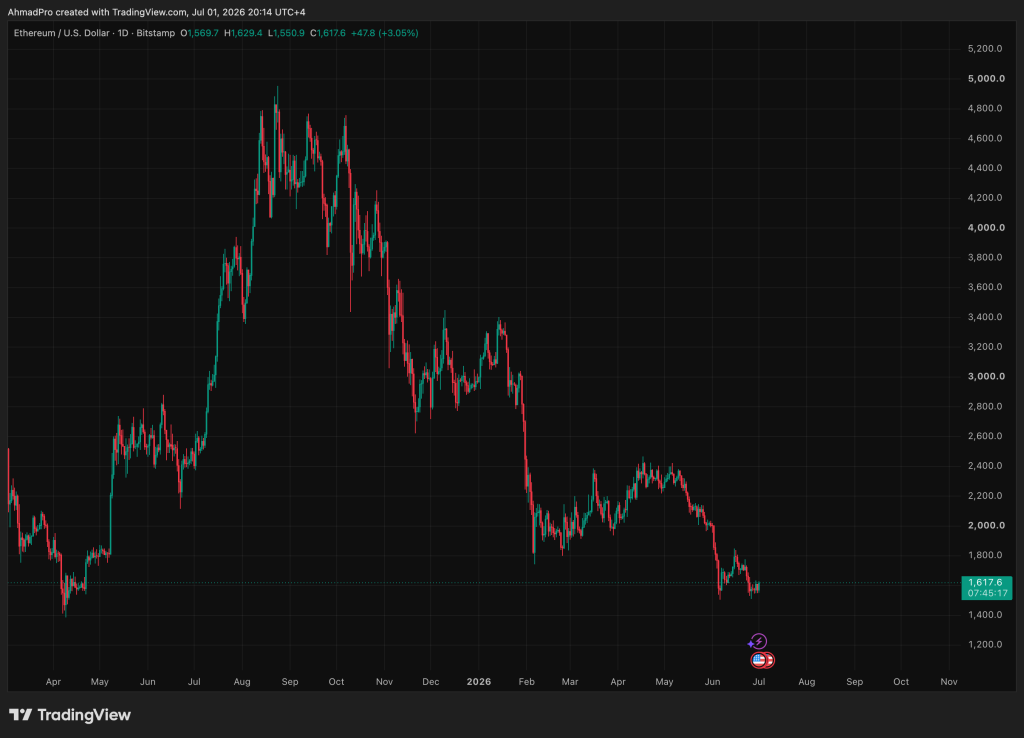
Without that, consolidation continues between $1,500 and $1,600 with buyers defending the level but lacking the firepower to push through overhead resistance.
A daily close below $1,500 opens accelerated selling with no obvious technical floor until $1,300 to $1,350, the scenario traders are hedging against most actively right now.
Kiyosaki’s $95,000 target and Tom Lee’s ETH forecast framework are both multi-year macro calls, not trading signals. Useful for framing long-term conviction. Not useful for near-term entry timing. The current technical setup needs to clean up considerably before either longer-range thesis becomes actionable for active traders.
LiquidChain Targets Early Mover Upside as Ethereum Tests Key Levels
Ethereum grinding at $1,500 raises a fair question. If near-term upside is capped and downside risk is real, where does fresh capital find asymmetric exposure right now?
ETH at current prices offers leverage to a recovery but also full drawdown risk if support breaks. Early-stage infrastructure plays present a different risk profile entirely, with their own category of uncertainty.
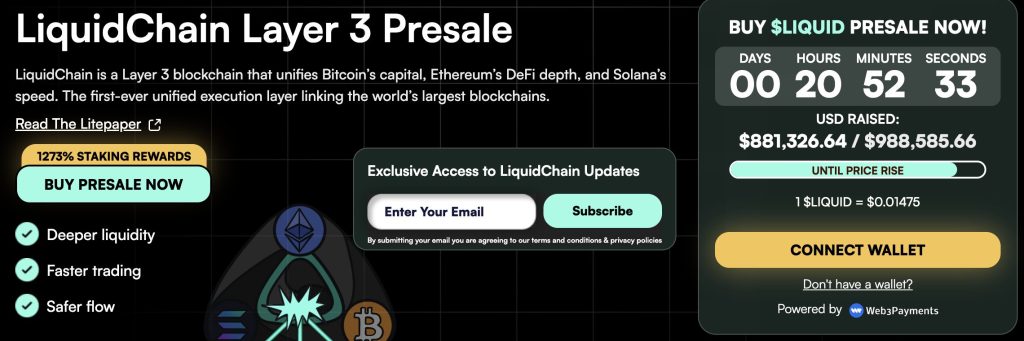
LiquidChain is a Layer 3 project positioning itself as the cross-chain liquidity layer the market is missing. The architecture fuses Bitcoin, Ethereum, and Solana liquidity into a single execution environment through a Unified Liquidity Layer, Single-Step Execution, Verifiable Settlement, and a Deploy-Once model that lets developers access all 3 ecosystems without redeployment.
The L3 thesis underpinning this raise is gaining traction as cross-chain fragmentation becomes harder to ignore. The presale is currently priced at $0.01475 with $881,054 raised to date.
Execution risk is real. Tech delivery, adoption timelines, and liquidity at launch are all unproven. That is the nature of early-stage infrastructure. The question is whether the asymmetry justifies the uncertainty.
Research LiquidChain before allocating.
The post Ethereum Price: Kiyosaki Forecats $95K as Ethereum Battles $1.5K appeared first on Cryptonews.
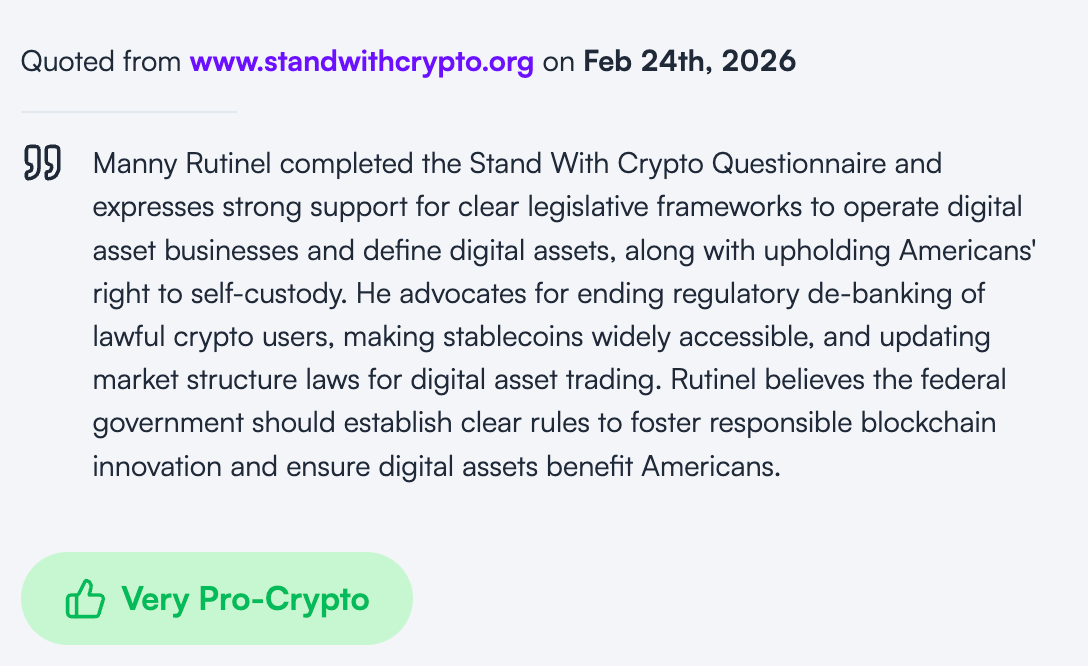
Manny Rutinel, a Democratic candidate running to represent Colorado’s 8th congressional district, has won his party’s primary and will head to the November election after being supported by a crypto-aligned political action committee (PAC).
Early on Wednesday, Rutinel reported that Rutinel would be the Democratic nominee for Colorado’s 8th district, having won with 61.7% of the vote against Shannon Bird’s 33.6%. Before the primary, the You Can Push Back Super PAC, backed by $3.5 million from Ripple Labs co-founder Chris Larsen, reportedly spent $1 million on media to support Rutinel’s run.
The Colorado Democrat has a “strongly supports crypto” rating from the Coinbase-affiliated Stand With Crypto organization, based on his answers to questions about stablecoins, market structure and regulatory clarity. Coinbase is also a major contributor to the Fairshake PAC, which supports what it considers “pro-crypto” Democratic and Republican candidates for Congress.
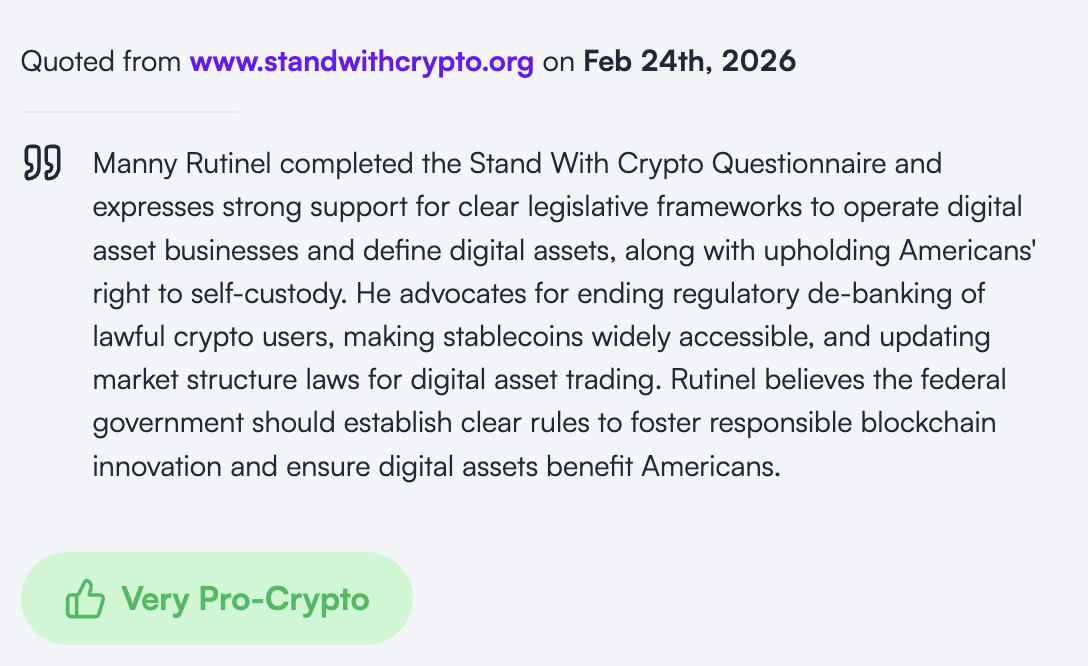
Source: Stand With Crypto
On Tuesday, the consumer advocacy group Public Citizen reported that the cryptocurrency industry had spent about $189 million so far on contributions to influence the 2026 US elections, largely through PACs. In what some experts say is the industry repeating its 2024 strategy, crypto-aligned groups are expected to continue spending to elect what they consider “pro-crypto” politicians.
Related: Senate leaders push for July passage of CLARITY Act
Cointelegraph reached out to a spokesperson for You Can Push Back but did not receive an immediate response.
Poll shows Americans think crypto has too much influence in Washington, DC
A new poll commissioned by Americans for Financial Reform released on Wednesday showed that a majority of Americans are concerned about the influence the crypto industry has on US lawmakers. The results followed financial disclosures showing that US President Donald Trump profited by more than $1.4 billion from his crypto investments.
“Voters have seen serious crypto corruption and high ranking government officials raking in profits while everyday people experience crypto-fueled losses and scams,” said Mark Hays, the associate director of crypto and fintech at Americans for Financial Reform. “Voters want crypto to have to play by the same kinds of rules as other financial companies, not dictate special privileges for itself.”
White House Deputy Press Secretary Anna Kelly said on Tuesday that neither Trump nor his family “has ever engaged — or will ever engage — in conflicts of interest.”
Among the poll’s results included a majority of Democrats, Republicans and Independents being concerned about crypto-related laws being influenced by donations from those in the industry. Americans for Financial Reform concluded that voters were likely to agree that the crypto industry needs sensible regulation.
Magazine: The end of anonymity? AI could unmask crypto’s hidden identities
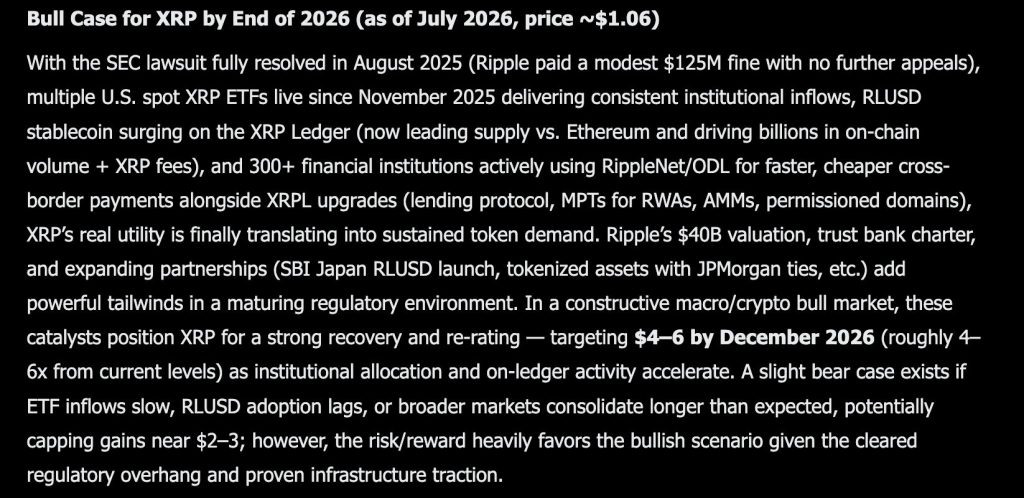
Elon Musk Grok AI just put together what might be the most detail rich XRP price prediction bull case in this entire series. The model predicts $4 to $6 by December 2026, roughly four to six times where the coin sits right now.
The bull case treats XRP as an asset whose actual utility has finally started translating into real sustained token demand, even while price refuses to acknowledge it.
XRP sits near $1.06 today, and the foundation of this thesis is a full legal clean slate, with the SEC lawsuit completely resolved in August 2025 after Ripple paid a modest $125 million fine with no further appeals.
That outcome unlocked multiple US spot XRP ETFs which have been live since November 2025 and delivering consistent institutional inflows ever since.
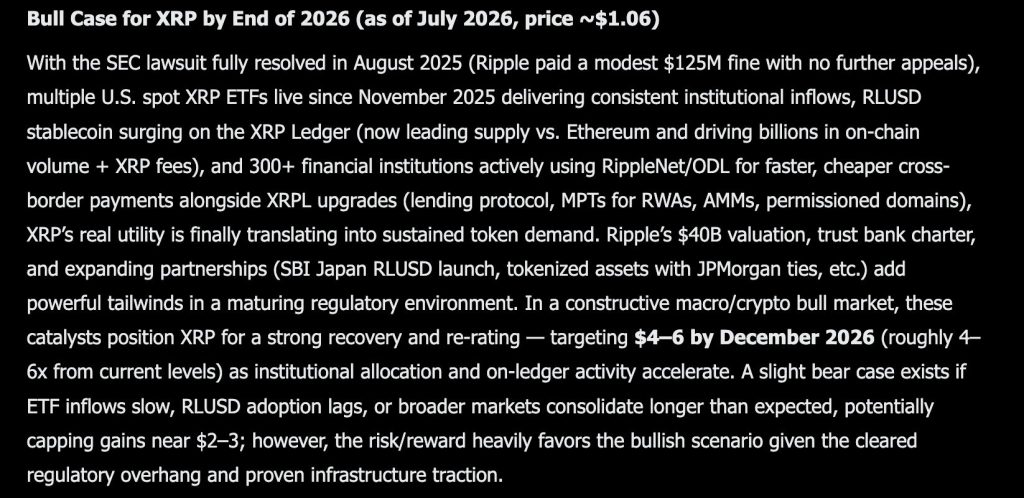
RLUSD stablecoin is surging on the XRP Ledger and has actually pulled ahead of Ethereum in supply, driving billions in on chain volume and XRP fee generation at the same time.
Over 300 financial institutions are now actively using RippleNet and On Demand Liquidity for faster and cheaper cross border payments, while the XRPL itself keeps adding infrastructure through a lending protocol, multi purpose tokens for real world assets, automated market makers, and permissioned domains.
Ripple itself carries a $40 billion valuation, has secured a trust bank charter, and keeps expanding partnerships including an SBI Japan RLUSD launch and tokenized asset work with JPMorgan ties.
If a constructive macro and crypto bull market materializes alongside all of that, Grok sees institutional allocation and on ledger activity accelerating together toward that $4 to $6 target by year end.
The bear case is narrow compared to the weight of the bull thesis. If ETF inflows slow, RLUSD adoption lags, or broader markets consolidate longer than expected, gains could end up capped near $2 to $3 instead.
Even under that scenario the model still frames the risk reward as heavily tilted toward the bull case given cleared regulatory overhang and proven infrastructure traction that now exists beneath the price surface.

XRP Price Prediction: XRP Carries A Year Of Cleared Catalysts Into A Chart That Has Not Moved Yet
The daily chart shows XRP at $1.06010 after a long, grinding decline from highs above $3.65 set back in early August of last year.
That drop has been almost entirely one directional, interrupted only briefly by a bounce near $2.40 in November before sellers regained control completely.
The most recent leg lower in June pushed price to a fresh low below $1.03 before a modest recovery brought it back to current levels. That kind of late stage capitulation after such an extended downtrend often signals sellers running out of ammunition rather than a healthy pause on the way lower.
Resistance sits first near $1.20, the level that has capped every recent bounce attempt, then a heavier ceiling near $1.60 where price stalled out multiple times earlier this year.
Support is being tested right at current levels near $1.04 to $1.06, the exact zone the chart has been grinding along for the past several days. The overall structure remains a clean descending staircase stretching back nearly a full year, with every relief rally setting a lower high than the one before it.
Momentum on the daily candles looks cautiously stabilizing rather than reversing right now, with slightly more green candles visible in the most recent sessions compared to the weeks prior.
That is a thin read but worth noting after such a long stretch of one sided selling. Given how far XRP would need to travel just to reach the low end of this prediction, the chart tells you this is entirely a story about the next five months rather than the last five, and a decisive close back above $1.60 would be the first real technical signal that Grok’s re-rating scenario has actually started.
Don’t Miss Out on Our $1,000 USDT Airdrop on ByBit
Discover: The best crypto to diversify your portfolio with
Here is What Grok AI Predicts For LiquidChain Near Future, Very Bullish
Sitting at resistance waiting for a breakout is not positioning. It is standing in line.
Bitcoin, Ethereum, and XRP have been pressing against the same ceilings for weeks. The catalyst that unlocks the next leg is perpetually one data print away.
The institutional inflows are perpetually next quarter. Every large-cap trader waiting for a breakout is waiting on a decision that belongs to someone else’s balance sheet.
Early-stage infrastructure plays by completely different rules, Copilot AI predicts. Capital that would vanish as statistical noise at Bitcoin’s scale moves a small undiscovered project by multiples.
The asymmetric return lives in one place only: the gap between what something is genuinely worth and what the market currently thinks it is worth. That gap exists because the project has not been found yet. The moment it gets found, the gap is gone.
Cross-chain fragmentation has been extracting value from DeFi participants since the first bridge went live and nobody has eliminated it. Bitcoin, Ethereum, and Solana were engineered as independent systems with no shared architecture and no intent to interoperate.
Every transaction that crosses those boundaries pays the price of that design in fees, slippage, and execution failures. Bridges were supposed to be the solution. They became the mechanism through which the problem collects its fee.
LiquidChain eliminates the fee entirely. Three networks inside a single execution layer. One deployment reaches all of them. No cross-chain tax on any interaction anywhere.
ChatGPT AI flagged it as worth watching. The presale is at $0.01454 with just over $860,000 raised.
Execution is unproven. Adoption is unknown. Established assets offer a predictable ride toward a ceiling that is already fully visible. LiquidChain is an entry point that disappears once the market finds it.
The post Elon Musk Grok AI Predicts Shocking XRP Price by End of 2026 appeared first on Cryptonews.
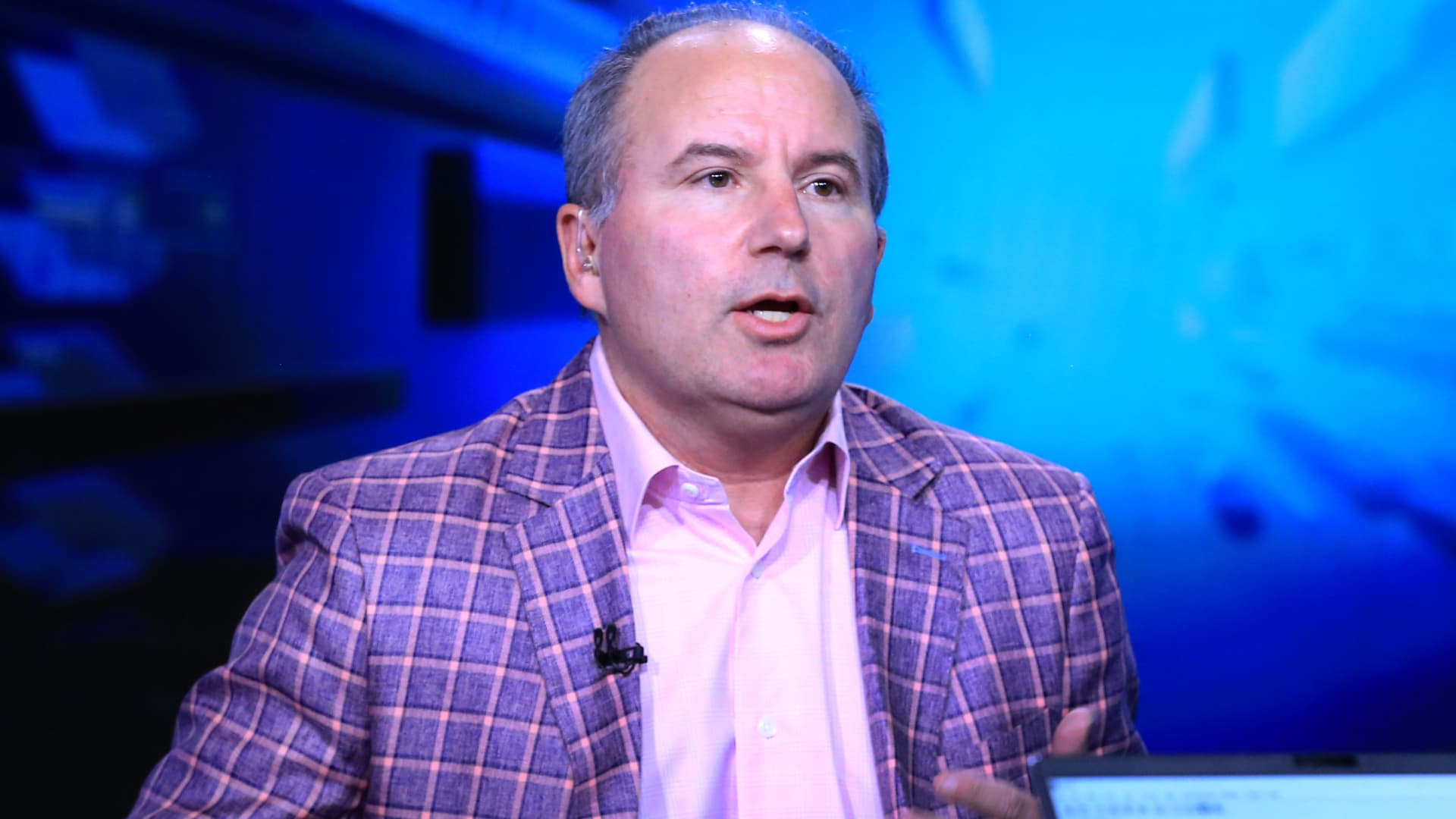
Dan Ives, Wedbush Securities analyst.
Scott Mlyn | CNBC
Dan Ives, one of Wall Street’s most recognizable technology analysts, is leaving his longtime role at Wedbush Securities to launch a merchant bank aimed at combining research, advisory, capital raising and investing under one roof.
Ives, who has spent the past eight years at Wedbush and more than 25 years covering technology stocks, said the new firm will seek to build what he described as a “modern merchant bank” focused on helping companies and investors capitalize on opportunities created by artificial intelligence and other structural shifts across the economy.
“It’s been a phenomenal eight years at Wedbush,” Ives said in an interview. “But in looking at the next opportunity, it’s to create a modern merchant bank with great partners, long-term capital and something I think will change the way Wall Street looks at investment banks.”
The firm, which Ives said will be formally announced in the coming weeks, plans to provide proprietary research, strategic advisory services, capital raising and investments across sectors including technology, energy and financials. Ives said he also intends to continue covering technology stocks in a research capacity while helping build the broader business.
The move marks an unusual career pivot for one of the sell side’s highest-profile analysts, whose bullish calls on AI beneficiaries and energetic television appearances have made him a familiar face to investors. Known for his colorful jackets and outspoken style, Ives even launched his own clothing line last year.
At Wedbush, Ives also held roles rarely seen among sell-side analysts, serving on the advisory board of Zeta Global and briefly as chairman of Eightco Holdings. At Eightco, he led a crypto treasury strategy centered on Worldcoin, the digital token associated with Sam Altman’s identity venture, World.
Ives said the firm aims to recruit talent from across Wall Street and position itself at the center of the AI-driven transformation reshaping industries.
“My career has almost built up to something like this,” Ives said. “In this AI revolution, it’s seeing the opportunities that are around the corner, and that’s what I think this firm is going to be able to do.”
President Donald Trump’s positive comments on U.S.-Iran negotiations have lifted crypto markets, pushed oil below $70, and added more than $74 billion to gold’s market value as investors reposition for easing geopolitical risks.
Summary
- Trump’s positive comments on U.S.-Iran talks helped lift crypto prices while pushing oil below $70.
- Bitcoin topped $60,400, Ethereum gained 2.8%, and the total crypto market cap rose to $2.14 trillion.
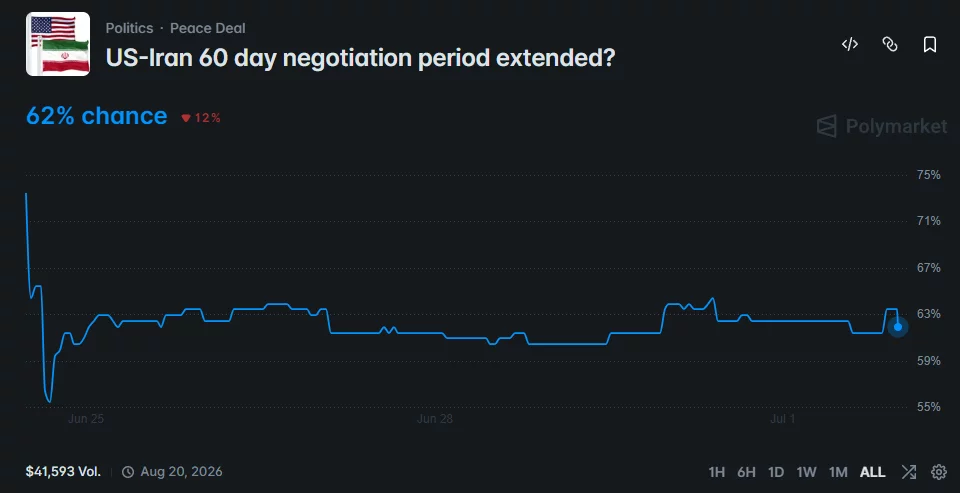
- Polymarket assigns a 62% chance of extending the U.S.-Iran negotiation period, keeping markets focused on Doha.
According to President Donald Trump, relations with Iran have remained positive and ongoing negotiations in Qatar are progressing well, prompting a swift reaction across financial markets as traders reassessed the likelihood of a prolonged Middle East conflict.
Speaking on Wednesday, Trump said Iran’s “denuclearization is well on its way” and described the meetings as “excellent” before adding, “We’ll see.” His remarks followed a Truth Social post earlier this week in which he said U.S. officials would meet Iranian representatives in Doha at Tehran’s request.
Crypto extends gains as geopolitical tensions ease
While diplomatic discussions continued in Qatar, Bitcoin climbed more than 3% to an intraday high of $60,401 before easing to $60,120 at press time. Ethereum gained 2.8% to $1,620, XRP added 1.5%, and Solana outperformed with a 5% advance. The total cryptocurrency market capitalization also increased about 2% to $2.14 trillion.
The rally came as investors reduced demand for traditional safe-haven assets tied to geopolitical uncertainty. Gold added more than $74 billion in market value during the session, while U.S. benchmark WTI crude oil fell more than 2% for the first time since tensions between the United States and Iran intensified, closing below the $70 level.
Analysts nevertheless urged traders to remain cautious despite the rebound, noting that negotiations are still underway and that market direction will continue to depend on diplomatic developments.
Earlier this week, as reported by crypto.news, renewed attention also returned to comments from Rich Dad Poor Dad author Robert Kiyosaki, whose March prediction that Ethereum could reach $95,000 by mid-2027 resurfaced across crypto social media.
Kiyosaki argued that a major global financial crisis could trigger a sharp repricing of alternative assets, forecasting Ethereum at $95,000, Bitcoin at $750,000, gold at $35,000 per ounce, and silver at $200 following such an event.
Markets remain focused on the outcome of Doha negotiations
Diplomatic efforts have continued beyond Trump’s latest remarks. U.S. representative Jared Kushner and envoy Steve Witkoff are in Qatar for another round of discussions, while Qatar and Pakistan are serving as mediators during the negotiations.
Separate talks have also taken place between Iran and Oman, which recently established a joint committee to address issues surrounding the Strait of Hormuz and other ceasefire-related matters. Those discussions have added to expectations that negotiations are expanding beyond the immediate nuclear issue.
Prediction market Polymarket currently assigns a 62% probability that the United States and Iran will extend their 60-day negotiation period. Although that estimate suggests traders expect diplomacy to continue, it does not guarantee an agreement.
For now, Trump’s latest comments and the ongoing meetings in Doha have encouraged investors to price in a lower risk of further escalation. At the same time, market participants continue watching for concrete progress, since a formal agreement could extend the current rally across risk assets, while another breakdown in negotiations or the expiration of the 60-day deadline without an extension could reverse recent moves in cryptocurrencies, oil, and other global markets.


To support its case, the report highlighted Ethereum’s technical track record, noting that the network has maintained uninterrupted uptime since launching in 2015. Citing a recent OpenZeppelin report, the foundation said Ethereum was secured by roughly $76 billion worth of staked ETH as of March 2026, while emphasizing its geographically distributed validator network, multiple independent client implementations and large developer ecosystem.
Beyond technical metrics, the report framed Ethereum as digital public infrastructure rather than simply a financial network. It pointed to existing deployments, including decentralized identity initiatives in Bhutan and Buenos Aires and Ethereum-based land registry projects in India, as examples of governments already experimenting with the technology.
The publication comes as governments around the world increasingly explore blockchain-based infrastructure for identity, asset tokenization and public records. The Ethereum Foundation said policymakers should distinguish between decentralized public blockchains and networks that remain controlled by corporations or foundations, arguing that governance structures will play a critical role in determining which platforms are suitable for long-term public sector use.
Read more: Ethereum gets a new nonprofit focused on institutional adoption

Wimbledon star bursts out crying after throwing racket in angry outburst on Centre Court
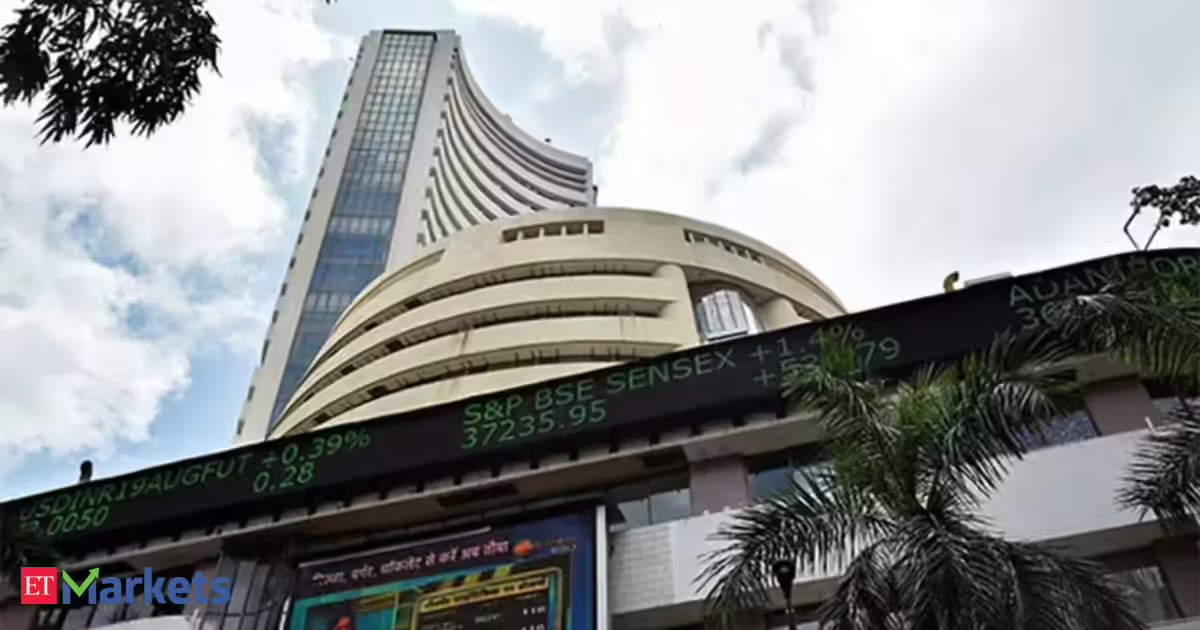
BSE launches REITs and Commercial Real Estate Index for passive investment products

Warsh faces multiple alternative inflation signs as Fed charts new course





-

 Fashion5 days ago
Weekend Open Thread: Staud – Corporette.com
-

 Politics6 days ago
The House | Manchesterism won’t survive the painful trade-offs unless it gets citizens on board
-

 Crypto World2 days ago
Strategy authorizes up to $1.25B in Bitcoin sales under new capital plan
-

 Politics6 days ago
Potential 2028er World Cup attendee leaderboard
-

 Business6 days ago
Asia stock markets slide as tech shares slump
-

 News Videos3 days ago
MAJOR BITCOIN & MARKET UPDATE!!!! (MUST WATCH ASAP!!!)
-

 Tech6 days ago
A Look At A Gaggle Of Transputer Boards
-
 Crypto World6 days ago
Dell (DELL) Shares Tumble Over 5% Following Analyst Downgrade to Hold
-

 Crypto World4 days ago
Coinbase, Circle Deepen Crypto Stock Losses Despite Resilient S&P 500
-

 Business2 days ago
Australia treasurer says alleged access of prime minister’s bank data ’incredibly concerning’
-

 Crypto World5 days ago
Kraken's xStocks Opens Bending Spoons IPO Registration to EEA Retail
-

 Sports5 days ago
FIH Pro League: India defeat Pakistan 7-1, register biggest win of campaign | Other Sports News
-

 Crypto World6 days ago
Bitcoin Sparks $600M Hourly Liquidations With $65,000 Set To Become Resistance
-

 Tech4 days ago
Bluekit phishing kit adopts browser-in-the-middle for login theft
-

 Tech4 days ago
Russian hackers now target Signal backup recovery keys
-
 Crypto World5 days ago
Hyperliquid Named on Singapore MAS Investor Alert Register
-

 Crypto World5 days ago
RTX holders must register wallets before token distribution begins
-
 Crypto World7 days ago
Ripple and SBI launch RLUSD in Japan after JFSA approval
-
 Business2 days ago
The AI boom won’t burst all at once. It will pop in ‘rolling bubbles’: Macquarie
-

 Tech2 days ago
Anonymous researcher drops 0-day ‘exploitarium’ repo
You must be logged in to post a comment Login