

Crypto World
RIpple-linked token steadies above $1.10 from four-month lows

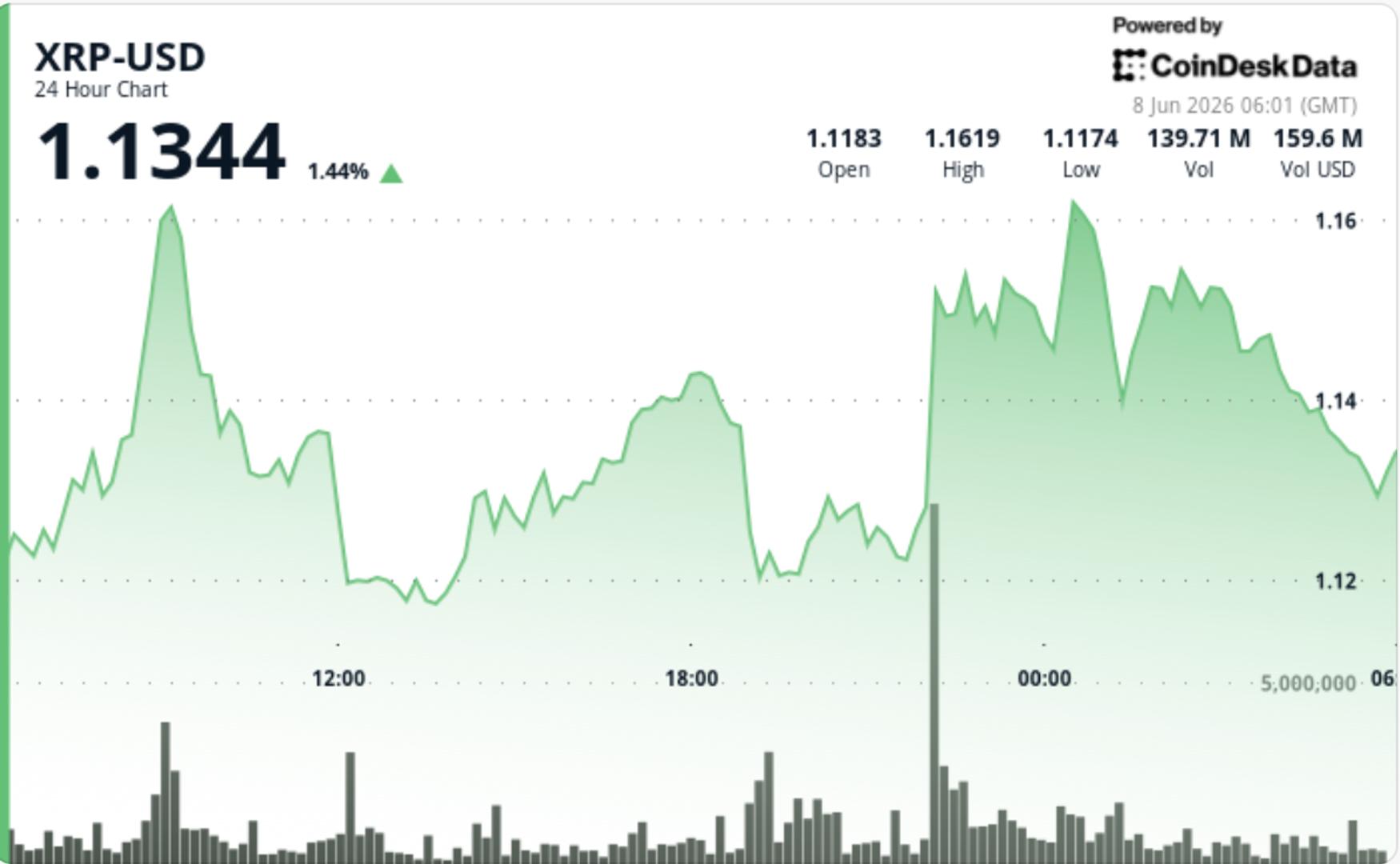
XRP finally found buyers after one of its sharpest selloffs of the year, but the recovery looks more like stabilization than a trend change. The token bounced from levels last seen before the November 2024 breakout, yet every rally is still running into sellers, leaving XRP stuck between deeply oversold conditions and a market that hasn’t stopped de-risking.
News Background
• More than 25 million XRP left exchanges in recent days, extending a trend that typically points to accumulation rather than immediate selling.
• XRP-linked ETF products continued attracting capital, with roughly $118 million in inflows recorded during May and cumulative inflows approaching $1.4 billion.
• Analysts and forecasting models increasingly view the $1.10-$1.20 area as a potential stabilization zone after XRP’s recent 17% weekly decline.
Price Action Summary
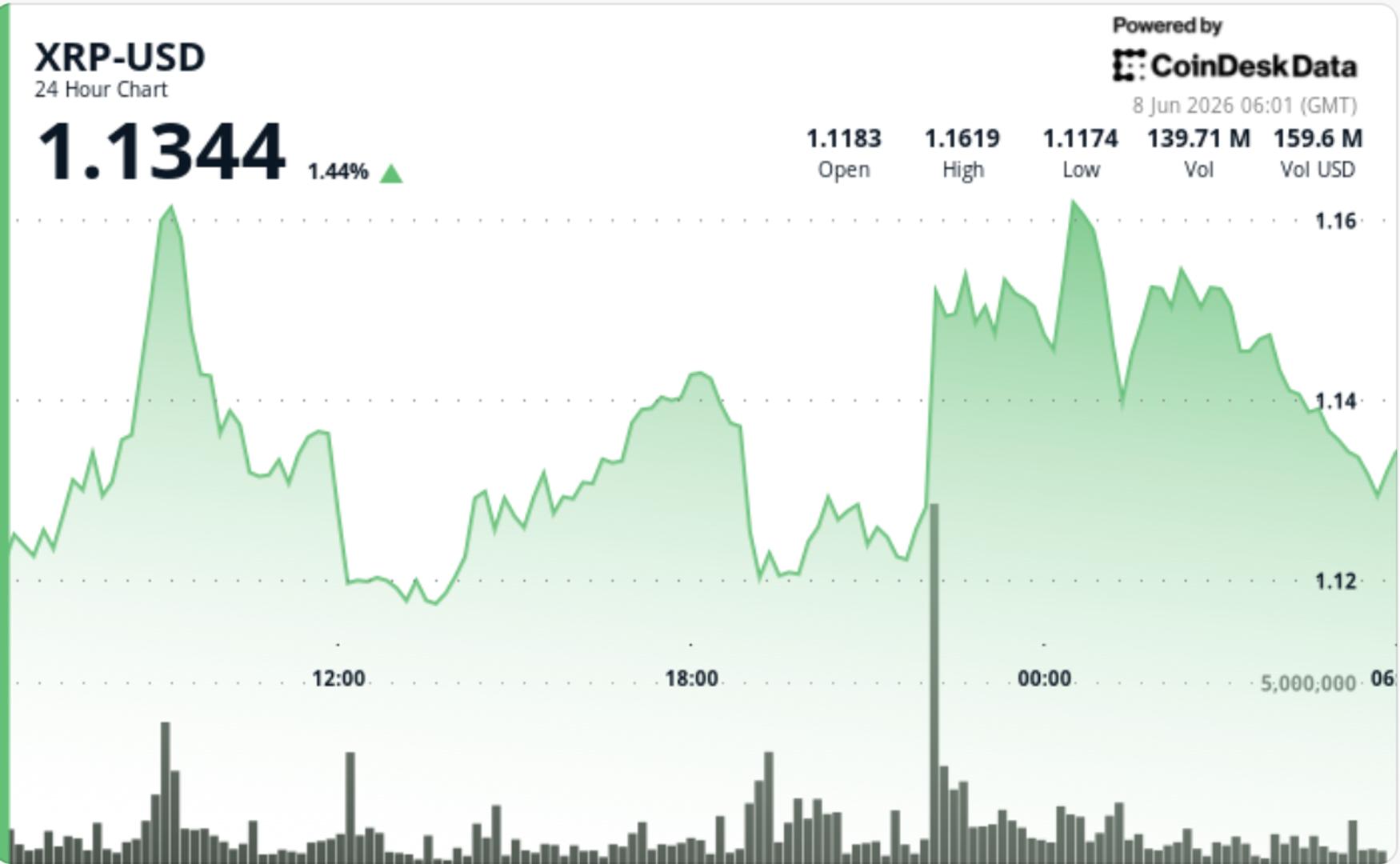
• XRP gained 1.6% over the session, recovering from lows near $1.09 and climbing back toward $1.14.
• The strongest move came during the 22:00 UTC session, when volume surged to 145.3 million XRP and pushed price through resistance near $1.1350.
• Momentum faded into the close, with XRP slipping from $1.1488 to $1.1386 before buyers stepped back in near support.
Technical Analysis
• The bigger story is that XRP remains trapped inside a descending channel despite the bounce. The recovery eased immediate downside pressure but did not break the broader pattern of lower highs.
• The RSI has fallen to one of its most oversold readings since before the November 2024 rally, a sign that selling may be becoming exhausted.
• Exchange outflows and ETF inflows continue to point toward accumulation beneath the surface, but price action still resembles a market trying to find a floor rather than one beginning a new uptrend.
• The bounce from $1.09 matters because it showed buyers are willing to defend the area, though follow-through buying remains limited.
What traders should watch
• $1.13-$1.14 is now the key near-term support zone after the latest recovery.
• $1.15 remains the first meaningful resistance level and the upper boundary of the current descending channel.
• A move above $1.20 would be the first sign that XRP is starting to repair the damage from the recent selloff.
• If support near $1.10 fails again, traders are likely to focus on whether the psychologically important $1.00 level becomes the next downside target.

Crypto World
Crypto News, June 8: BTC USD Bouncing, Strategy Buys More Bitcoin, Hayes Denies LookOnChain Claims as ZachXBT Calls his Pn’D Scheme

BTC USD saw sharp volatility as it dipped below $63K, rebounded to $63.7K, then dumped again after fresh Iran-Israel strikes. Not helping the case, an 8% KOSPI crash triggered a circuit breaker in South Korea as the Asian stock market tumbled. Geopolitical tensions rattled global risk assets while crypto extended last week’s pain.
The Crypto Fear & Greed Index fell to 8, an extreme fear condition, the worst sentiment since 2 months. Last week alone, crypto shed $390 billion in its worst performance since the FTX collapse, with BTC USD down 17% and ETH down 22%. BTC USD briefly tested sub-$60K levels before a weekend relief rally pushed it back to $63K.
Geopolitical tension is also pushing oil higher as safe-haven flows into the dollar. Thus, BTC/USD took a hit amid fears of Japan’s BOJ’s moves.
— Crypto Rover (@cryptorover) June 7, 2026
 JAPAN MAY BE ABOUT TO TRIGGER ANOTHER CRYPTO CRASH.
USD/JPY is back above 160 again.
This is the same danger zone where Japan usually starts getting serious about defending the yen.
And when Japan intervenes, the chain reaction is simple:
Yen strengthens.
Carry trade… pic.twitter.com/uLo7zuz6tW
Discover: The best pre-launch token sales
Strategy Hints More BTC USD Buys, Hayes Denies LookOnChain Claims, ZachXBT Cries Foul
Michael Saylor posted Strategy’s signature Bitcoin accumulation chart with the caption “a good time to add more dots,” despite their unrealized losses. The firm’s CEO, Phuong Le, backs Saylor’s remark. “Rumors otherwise are just rumors.”
Strategy continues executing its long-term plan even as public companies holding BTC as treasury assets lost $62 billion in combined market cap during the June rout.

At the same time, BitMEX co-founder Arthur Hayes denied LookOnChain reports that he rebought HYPE after a large wallet withdrawal was spotted. On-chain detective ZachXBT publicly called out Hayes for promoting then dumping HYPE, NEAR, ZEC, and WLD in quick succession, accusing him of creating exit liquidity for followers. Hayes brushed it off, saying he sells to willing buyers and shares trades openly.
The drama has fueled debates on Crypto Twitter about influencer transparency. ZachXBT also disputed separate Dubai scam claims while the timeline recapped Twitter’s drama as banks pushing onchain tokenized deposits. This happened after JPMorgan’s Dimon called Coinbase’s Armstrong full of shit.
Another drama comes from Justin Sun’s HTX. The exchange delisted Trump-backed stablecoin USD1 after World Liberty Financial froze exchange-linked wallets. HTX converted user holdings to USDT at 1:1 and suspended related pairs, escalating a public feud tied to prior sanctions and asset freezes.
— Coin Bureau (@coinbureau) June 8, 2026
 JUSTIN SUN-LINKED HTX DELISTS TRUMP FAMILY'S USD1
HTX, a crypto exchange reportedly owned by Sun, has delisted $USD1 after claiming Trump's World Liberty Financial froze some of its on-chain addresses.
HTX says it may pursue legal action if the freeze is not reversed.
Sun… pic.twitter.com/E9fxOsJw2a
Discover: The best crypto to diversify your portfolio with
Senate Progress on Clarity Act Keeps Hope Alive
Senator Cynthia Lummis declared victory after the Clarity Act passed the committee:
“The floor is next. We did not come this far to quit at the 5-yard line.”
Lawmakers now eye a full Senate vote before summer recess, though we see trimmed passage odds slashed to 60% as the clock ticks.
However, extreme fear often precedes explosive recoveries. History shows Fear & Greed readings below 10 have frequently marked local bottoms before powerful BTC USD rallies. With corporate buyers like Strategy still committed and geopolitical noise likely to fade, the current washout could send crypto higher.

On the bullish front, institutional adoption from major banks and clearer U.S. rules will drive capital back into Bitcoin and quality assets. The BTC USD dip may prove to be the final shakeout before summer strength returns. Extreme fear at 8 is not sustainable.
Follow us here for more updates today.
Discover: The best pre-launch token sales
The post Crypto News, June 8: BTC USD Bouncing, Strategy Buys More Bitcoin, Hayes Denies LookOnChain Claims as ZachXBT Calls his Pn’D Scheme appeared first on Cryptonews.
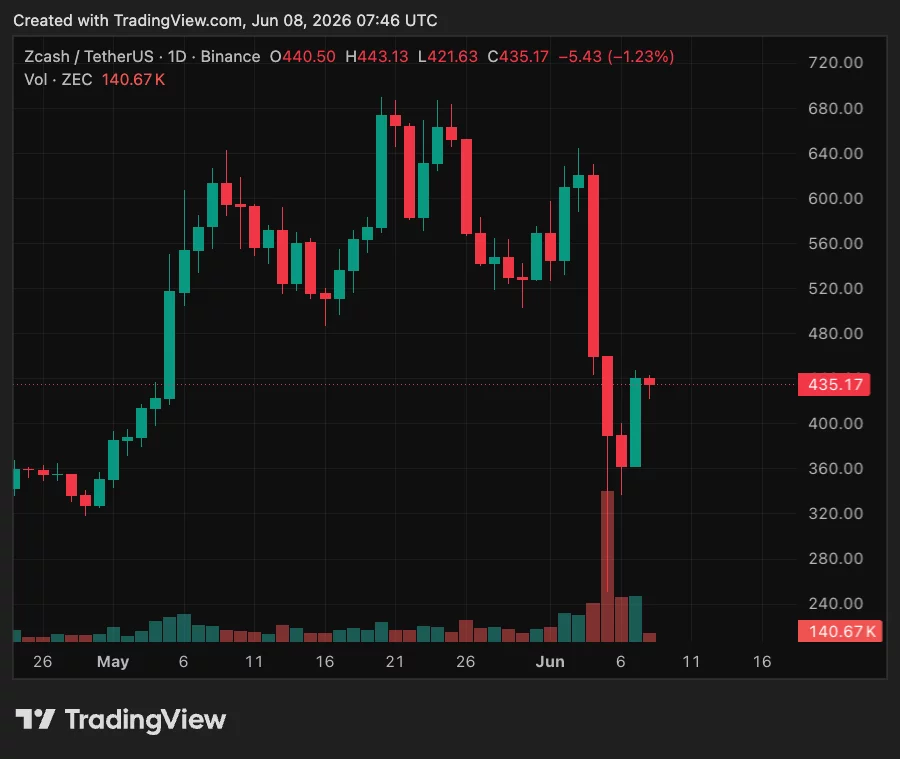
Josh Swihart has detailed Zcash’s emergency response to a vulnerability that could have enabled unlimited counterfeit ZEC creation, as the token has recovered more than 41% from its post-disclosure low.
Summary
- Zcash deployed a soft fork and a hard fork to fix a critical Orchard vulnerability that could have enabled unlimited counterfeit ZEC creation.
- Josh Swihart said mining pools and exchanges reviewed the emergency code changes, with ViaBTC and Foundry helping coordinate the response.
- ZEC has recovered more than 41% from its June 5 low after the vulnerability was patched and Orchard transactions were restored.
According to Josh Swihart, founder of Zcash Open Development Lab (ZODL), the team deployed a two-stage network upgrade after discovering a critical flaw in Zcash’s Orchard shielded pool, the network’s primary privacy-focused transaction system.
In a June 8 post on X, Swihart said the first step involved a soft fork that disabled Orchard transactions while allowing developers to reduce the risk of exploitation without publicly revealing details that could have exposed the network to further threats.
A second upgrade, the NU6.2 hard fork, went live on June 3 and addressed the underlying vulnerability before Orchard transactions were restored.
The update follows last week’s disclosure from Shielded Labs, an independent support organization for Zcash, which warned that a flaw in the Orchard circuit could have allowed an attacker to mint unlimited counterfeit ZEC.
Shielded Labs said the issue had been fixed and added that it considered prior exploitation unlikely, although it acknowledged there was no cryptographic proof that the bug had never been used.
Orchard serves as Zcash’s main shielded pool, allowing users to send and receive ZEC through zero-knowledge proofs that conceal transaction details while validating transfers.
Mining pools and exchanges reviewed emergency fix
During the response process, Swihart said ZODL worked closely with mining pools, exchanges, and other ecosystem participants that requested code reviews before supporting the upgrade.
Among those participants, Swihart identified ViaBTC and Foundry as key contributors that helped coordinate the network response and verify the emergency changes before activation.
Earlier discussions around the vulnerability had already prompted conversations about longer-term recovery measures. Shielded Labs previously outlined a proposal known as Ironwood, which would isolate the existing Orchard pool, track coins leaving the system through turnstile accounting, and eventually guide users toward a new shielded pool with stronger supply verification mechanisms.
Separate comments from David Schwartz, CTO emeritus of Ripple, also addressed concerns from Zcash users about funds left behind in Orchard.
Schwartz said passive holders would not automatically lose ownership of their coins if no exploit occurred before any migration process, explaining that consensus rules could continue recognizing those balances even if the pool stopped seeing regular activity.
ZEC rebounds after sharp selloff
Market reaction to the disclosure was immediate. According to previously reported price data, ZEC fell from roughly $630 to around $303 after news of the vulnerability emerged, as traders grappled with uncertainty surrounding the integrity of the shielded pool and the possibility that counterfeit coins may have entered circulation.
Questions about the protocol’s security reached beyond the Zcash community. Among the high-profile reactions, BitMEX co-founder Arthur Hayes said he had exited his entire ZEC position after learning of the vulnerability.
Recent trading has shown signs of stabilization. According to crypto.news data cited by Swihart, ZEC rose 13.5% over the past 24 hours to $428.67, representing a recovery of about 41.5% from the June 5 low near $303.
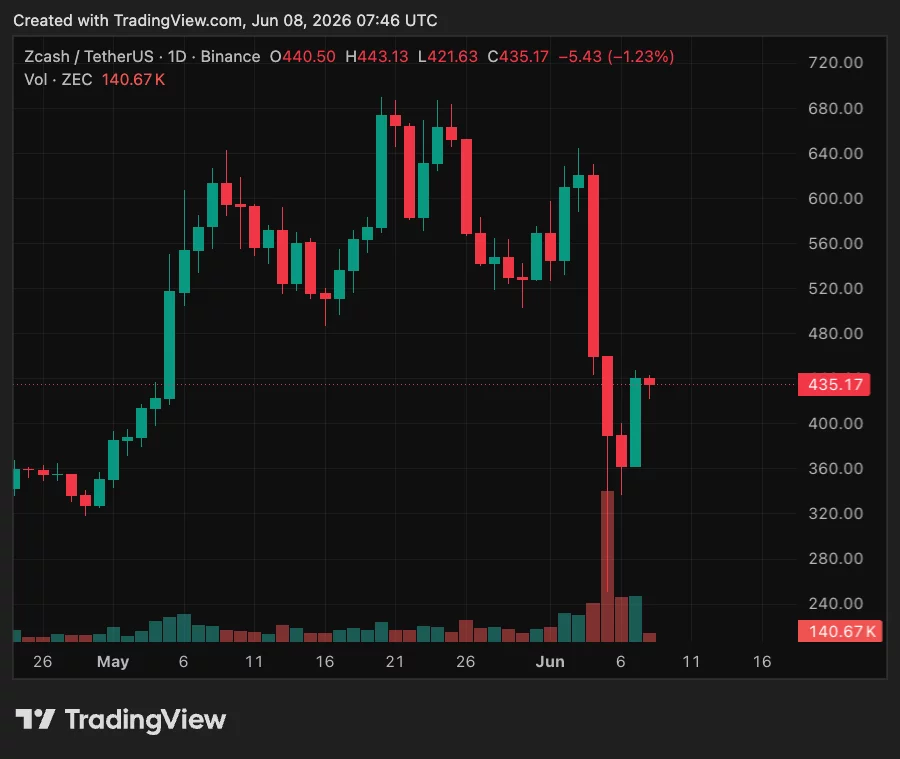
Summing up the incident, Swihart said the network had resolved the vulnerability, tested its incident response procedures, strengthened relationships with ecosystem partners, and aligned developers around a recovery path for the project.
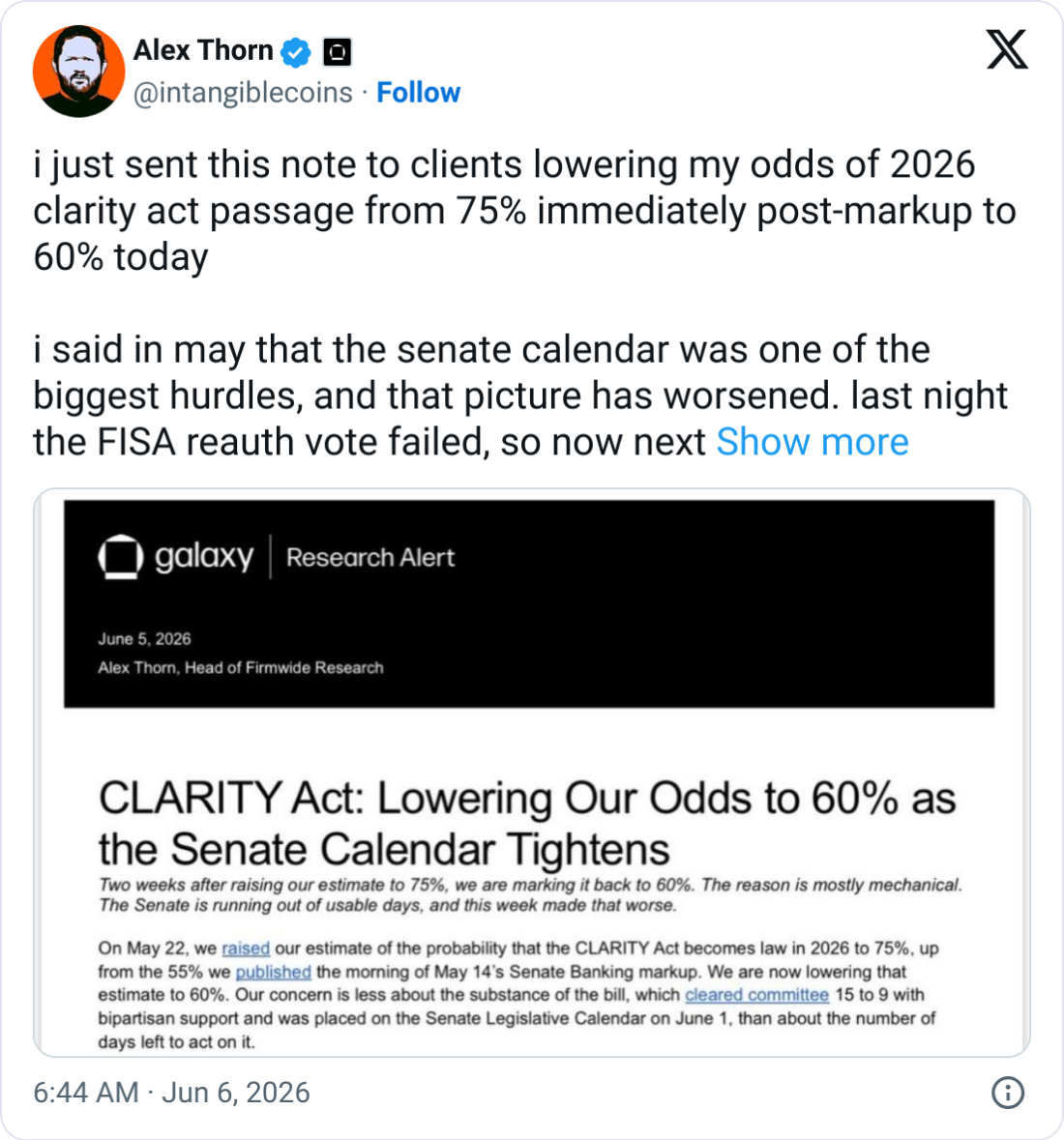
Crypto firm Galaxy Digital has lowered the odds of the Senate passing its crypto market structure bill before the end of the year, noting that the window for lawmakers to act on the bill is closing.
“On May 22, we raised our estimate of the probability that the CLARITY Act becomes law in 2026 to 75%, up from the 55% we published the morning of May 14’s Senate Banking markup, Galaxy’s head of research Alex Thorn said in a note on Friday. “We are now lowering that estimate to 60%.”
Thorn said the bill must pass the Senate before a month-long August recess starting in late July, as “after that, the window effectively closes.” He added that major legislation has historically not moved in the lead-up to the midterm elections due to lawmakers campaigning.
Many Senate lawmakers have been pushing for the chamber to pass the bill after the House passed its version, called the CLARITY Act, last year.
The Senate Agriculture and Banking Committees have passed versions of the bill, and it now needs at least 60 votes on the Senate floor to pass without prolonged debate.
“For a 60-vote bill that still needs floor debate, an amendment process, reconciliation with the Senate Agriculture text, and then House action on the changes, Majority Leader [John] Thune realistically needs to schedule floor time at some point in July,” Thorn said.
“Anything later and the procedural steps do not fit before the recess,” he added.
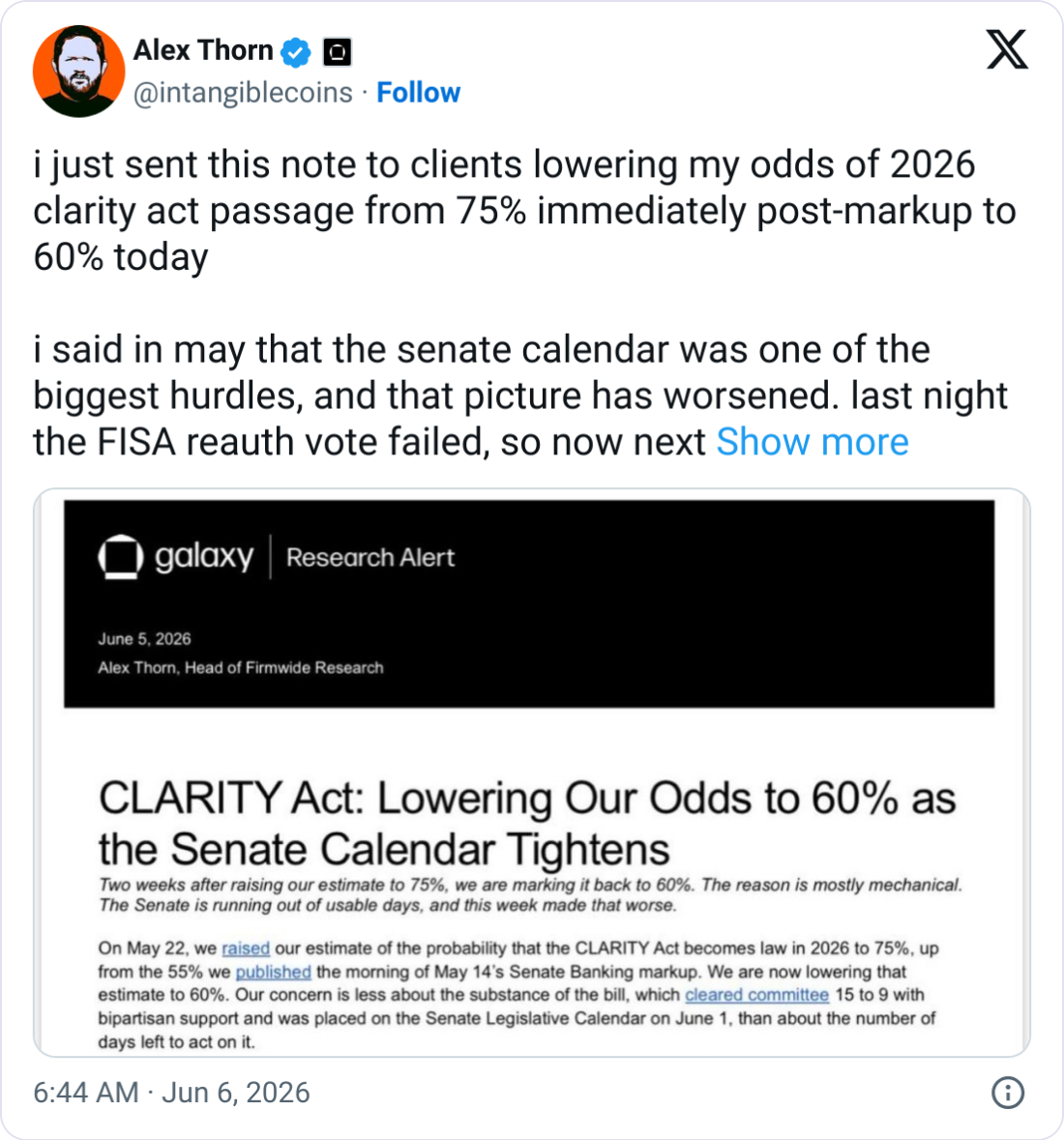
Source: Alex Thorn
Thorn said another reason Galaxy lowered its odds is that no information shows that the bill, or negotiations around it, have advanced, and provisions around ethics and illicit finance are a sticking point that have not yet been resolved.
He added that Galaxy would revise its odds if Senate leaders committed to passing the bill next month and that provisions to get lawmakers on side are finalized.
Galaxy’s latest odds came after analysts at JPMorgan on Wednesday said they see less than a 50% chance that the CLARITY Act passes this year, similarly citing a tightening congressional calendar ahead of the elections.
Meanwhile, Bitwise investment chief Matt Hougan said on Tuesday that his view of the bill passing this year is “less optimistic,” and that “D.C. insiders” he spoke with put the odds of its passage between 5% and 30%.
Senator Cynthia Lummis, the chair of the Senate Banking Subcommittee on Digital Assets, has escalated her calls for the Senate to pass the bill, having made at least 15 posts on X about the legislation so far in June.
“The Clarity Act passed committee. The floor is next. We did not come this far to quit at the 5 yard line,” she posted on Sunday.
Lummis told CNBC on Wednesday that lawmakers working on the bill are addressing issues, including around ethics and illicit finance, that could see it lose support on a floor vote.
Large Ethereum (ETH) holders bought heavily after the latest crash, with one early investor rebuying more ETH and Wrapped Bitcoin (WBTC) than they sold earlier.
Exchange reserves also fell sharply, a sign that holders moved coins away from trading platforms.
Ethereum Whales Accumulate ETH Near $1,600
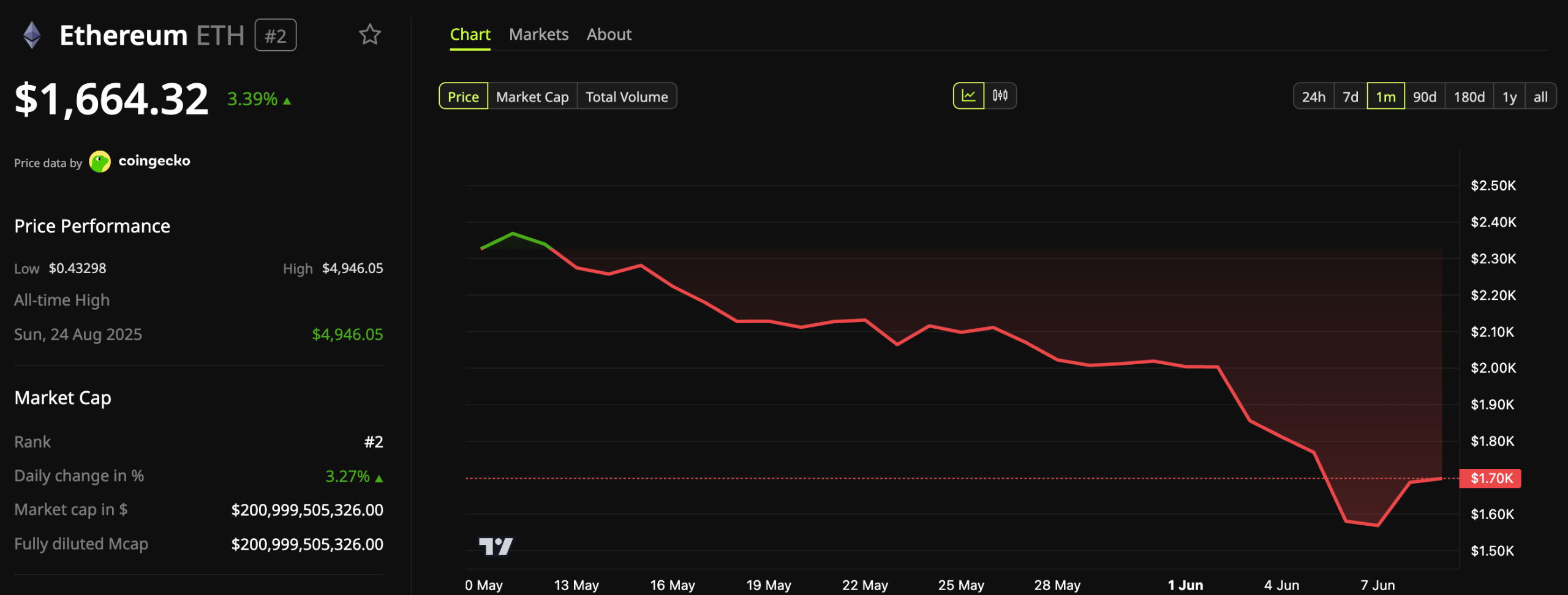
Ethereum fell sharply last week alongside the broader market. The altcoin dropped by more than 16.8% over the past 7 days and even slid below $1,600 on Friday.
Macro pressure drove the move. Renewed Middle East tensions and a cautious Federal Reserve weighed on risk assets. Steady outflows from spot exchange-traded funds added to the strain.
On Monday, the second-largest cryptocurrency saw modest gains of over 3%. At press time, it traded at $1,664.
Follow us on X to get the latest news as it happens

Still, the backdrop turned the dip into an entry point for some of the market’s largest wallets.
Whales Buy as Reserves Decline
Blockchain tracker, Lookonchain, flagged a standout move. An Ethereum OG sold 60,000 ETH near $2,040 before the drop. The whale also sold 600 WBTC at $78,538 and 9,442 wrapped staked ETH (wstETH).
After the crash, the same wallets bought back more than they sold. They repurchased 60,088 ETH and 10,000 wstETH at $1,606. They also added 611 WBTC at $63,280. Lookonchain called it a clean example of selling high and buying low.
Other buyers followed near the lows. A wallet reportedly linked to Chun Wang withdrew 17,560 ETH worth $28.67 million from Binance.
Cohort data from Santiment shows the buying was uneven. Wallets holding 1 million to 10 million ETH lifted their balance to about 6.89 million ETH, adding roughly 290,000 ETH in the first week of June.
Mid-sized wallets moved the other way. Addresses holding 10,000 to 100,000 ETH cut their stack to about 26.87 million ETH, extending the slide.
Meanwhile, exchange reserves told a similar story. Tracked ETH on Binance, OKX, Gemini, and Bitfinex fell by about 475,000 ETH in early June. Binance alone shed roughly 190,000 ETH between June 4 and June 7.
“A reserve decline across several major exchanges can point to tighter available ETH liquidity on centralized platforms, especially if it continues while spot demand improves,” analyst Amr Taha wrote.
Whether the accumulation holds will depend on demand over the coming days.
Subscribe to our YouTube channel to watch leaders and journalists provide expert insights
The post Whales Buy the Dip as Ethereum Exchange Reserves Keep Falling appeared first on BeInCrypto.
Bitcoin (BTC) price rebounded about 1.6% over 24 hours to near $63,100, yet the move that matters sits beneath.
After six weeks of selling, Bitcoin miners have flipped to net accumulation just as price carved a cycle low, an on-chain shift that echoes the last major turn. Exclusive BeInCrypto data threads three signals into one picture.
Bitcoin Miners Flip to Accumulation After Six Weeks of Selling
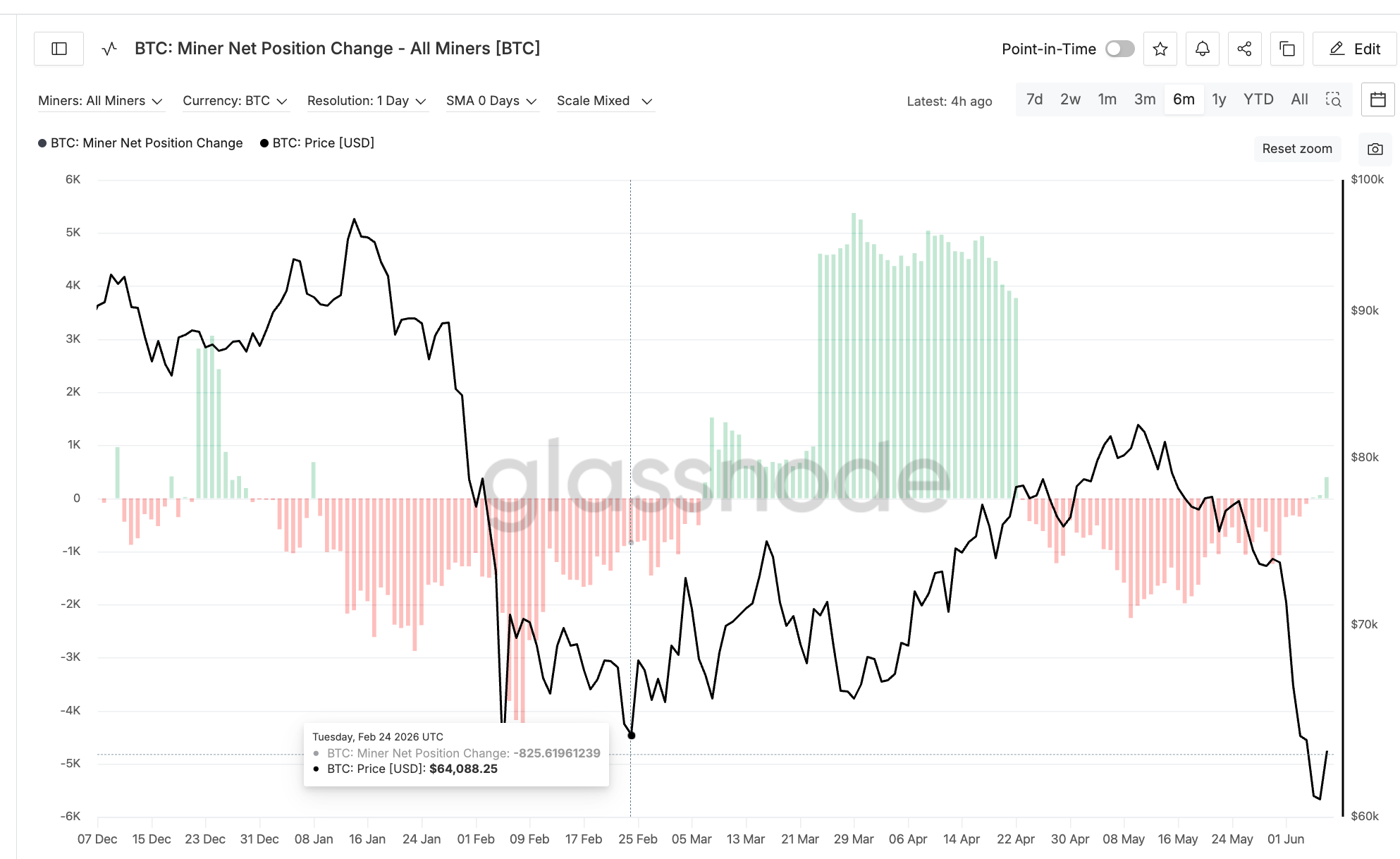
Since June 5, Bitcoin miners have posted three consecutive days of positive net position change, a metric that tracks whether miners add to or draw down their holdings.
The shift breaks a stretch of red that ran from April 23 through June 4, one of the longer miner capitulation phases of the year.
The timing stands out. The flip to green arrives just after the price breached its sub-$60,000 low, the same pattern seen at the previous turn.
A local bottom near $64,088 in late February closed the prior capitulation, after which miner flows turned positive in early March and coincided with the Bitcoin price recovery.

Want more token insights like this? Sign up for Editor Harsh Notariya’s Daily Crypto Newsletter here.
Miners hold structural insight into network economics, so a move back to accumulation after heavy selling is worth watching. Whether it repeats the March sequence depends on what the next signal shows about network demand.
Network Revenue Hit Its 2026 High as Miners Turned
The accumulation shift lines up with a quiet recovery in network demand, per BeInCrypto’s exclusive Dune dashboard. Bitcoin network revenue, the total transaction fees miners earn, climbed to 89 BTC in May, the strongest monthly reading of 2026.
That figure tops February’s 80 BTC, March’s 79, and April’s 74, marking a clear pickup in fee income just as miners stopped selling. Stronger fee revenue eases the operational pressure that forces miners to liquidate, which helps explain why their net position turned.

June’s reading sits at 26 BTC. Yet, that figure covers only the first eight days and remains incomplete, so it cannot be read as a drop.
Yet, the BTC trend still looks positive, which explains why the miners’ net position change has turned up.
Note: When network revenue rises, miners earn more from fees, so they feel less need to sell their Bitcoin to cover costs, which is why their net position can flip from selling to accumulating.
The relevant point is the May surge, the best fee month since the start of the year, landing alongside the miner flip. Two signals now point the same way. The third tests whether leverage could undo them.
Open Interest Stays Low, Easing the Long-Flush Risk
The final signal sits in derivatives, where the setup looks calmer than it did before last week’s crash. Total open interest dropped from about $31.26 billion in late May to near $22.31 billion, after touching $21.09 billion.
That matters because the current funding rate of 0.005%, which reflects what traders pay to hold long positions, sits just below the 0.006% reading from early June that preceded the price crash.
The difference is open interest. Leverage stood far higher on June 1, so the same lean toward longs carries less risk of a cascading long flush now.
That leverage cooling coincides with the Bitcoin miner pickup.

However, there are some warning signs. Funding turning positive again shows buyers leaning long, and sellers have reappeared as new whales realize losses.
For now, watch whether miner accumulation holds, whether fee revenue builds in June, and whether open interest stays contained. Those three, not price alone, will show if the on-chain turn has staying power.
The post Bitcoin Miners Flash Rare Signal After Price Crashed Below $60,000 appeared first on BeInCrypto.
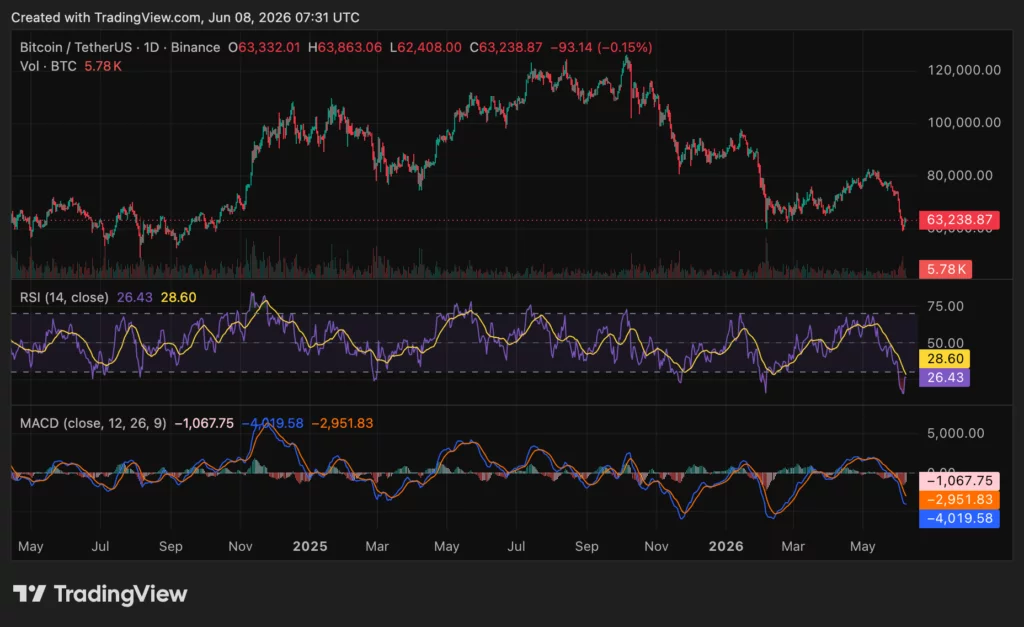
Bitcoin price recovered above $62,000 on Monday after last week’s selloff pushed the asset to about $59,100.
Summary
- Bitcoin reclaimed its 200-week average after sweeping February’s low, but resistance remains near $64,000.
- Oversold RSI supports a relief bounce, while bearish MACD shows sellers still control broader momentum.
- Rising open interest increases liquidation risk as traders watch $55,000 if the recovery loses support.
The rebound briefly carried BTC near $64,200 before sellers returned, leaving the market between long-term support and its first recovery barrier.
At the time of writing, Bitcoin traded near $63,000, up 1.39% over 24 hours. Its daily range stood between $61,206 and $63,739, while the seven-day loss remained 14.06%. Buyers have slowed the decline, but they have not reversed the broader weekly trend. ETF flows and futures positioning also remain important tests for the rebound.
Bitcoin price holds the 200-week moving average
Bitcoin closed the week above its 200-week simple moving average near $62,800 after sweeping the February low, according to crypto analyst Crypto Rover. Traders follow this average because it tracks Bitcoin’s long-term trend.
Holding above it could support another test of $64,000 to $64,200. A daily close below the average would return attention to $60,000 and the recent $59,100 low.
The June decline followed several waves of macro pressure. Higher inflation weakened expectations for easier monetary policy in May. Strong U.S. employment data then added another setback.
The economy created 172,000 jobs in May, compared with forecasts of 85,000, while unemployment stayed at 4.3%. As previously reported by crypto.news, Bitcoin’s break below $60,000 came as total crypto liquidations passed $1.7 billion within 24 hours.
Oversold RSI meets a still-bearish MACD setup
Bitcoin’s 14-day relative strength index stands at 26.43, below the 30 oversold threshold and its RSI moving average of 28.60. The reading shows that selling became stretched, which can support a relief bounce without confirming a lasting bottom. According to analyst Crypto Rover, the Fear and Greed Index has also fallen to 8, placing sentiment in “extreme fear.”
The Wolf of All Streets trader Scott Melker said Bitcoin may be forming a weekly bullish divergence from oversold RSI. “Need this week to close with a clear elbow up on price and RSI,” he wrote. The signal remains unconfirmed because price and momentum must turn higher together.
Bitcoin’s MACD line sits near -4,019.58, below the signal line at -2,951.83, while the histogram remains negative at -1,067.75. Rising selling volume supports the bearish momentum reading and shows that sellers remain active despite the rebound.
Trump-Iran headlines keep Bitcoin traders cautious
Bitcoin’s move toward $64,000 followed comments from U.S. President Donald Trump about a possible agreement with Iran. Trump said the parties were “very close” to a deal and claimed Israeli Prime Minister Benjamin Netanyahu did not control the process, according to Reuters. Traders initially treated the remarks as a possible reduction in geopolitical risk, helping stocks and cryptocurrencies recover from their late-week lows.
Events on June 8 weakened that optimism. Israel struck military targets and a petrochemical site in Iran after Tehran fired missiles toward Israel. Trump maintained that the attacks would not derail talks, but the renewed exchange left the agreement uncertain.
Brent oil rose above $96 per barrel as prices gained more than 3%. Higher energy costs could keep inflation and interest-rate concerns active for Bitcoin. The market may therefore remain sensitive to each new military or diplomatic update.
Bitcoin support levels place $55,000 next in focus
Analyst Ali Martinez listed the 200-week average at $62,800, the 300-week average at $55,000 and the 400-week average near $42,500. These levels form a long-term support ladder rather than fixed targets.
Bitcoin must first defend $62,800 and $60,000 before the lower averages become active tests. The $55,000 area also matches a long-running trendline tracked by Crypto Patel, making it the next broad support zone if the recent low fails.
Calls for $42,500 or $35,000 remain conditional bearish cases rather than immediate forecasts. Bitcoin would need to lose the 200-week average, the $60,000 level, the $59,100 low and the $55,000 region before those levels gain weight. That sequence gives traders several areas to assess before treating a deeper fall as the main path.
Derivatives data adds another risk. Crypto.news reported that open interest rose while Bitcoin’s price fell, showing that traders added leverage during weakness. That setup can produce a short squeeze if BTC clears $64,200, or another long squeeze if the price falls below $60,000. A firm close above $64,200 would strengthen the recovery and support the bullish RSI case.
For now, $62,800 remains the main dividing line. Holding it would keep $64,200 within reach and give buyers time to build a base. Failure to hold the 200-week average would place $60,000, $59,100 and $55,000 back in focus, while the bearish MACD would remain the stronger trend signal.
Disclosure: This article does not represent investment advice. The content and materials featured on this page are for educational purposes only.


PiggyBank has closed a hedge tied to LAB after sharp price swings and deeply negative funding rates made the trade too costly to maintain.
Summary
- PiggyBank closed the LAB short after volatility and negative funding breached its internal risk limits.
- The USDC vault faces a 15% drawdown, while SPYx and JitoSOL show smaller reported declines.
- ZachXBT questioned using depositor funds for LAB after earlier allegations around its token distribution structure.
The DeFi yield protocol said the move will reduce the net asset value of several vaults, including an estimated 15% drawdown for its USDC product.
The disclosure drew fresh questions about how PiggyBank used depositor capital and measured risk. On-chain investigator ZachXBT said the protocol had lost user assets by “gambling on blatant scam coins,” while PiggyBank said it acted before the position crossed its risk limits.
PiggyBank closes LAB short after funding pressure
PiggyBank said it opened the position about one month earlier with $100,000, equal to roughly 2% of its portfolio at that time. The strategy involved buying locked LAB tokens at a discount through an over-the-counter desk and shorting LAB perpetual contracts to offset price risk.
The protocol said LAB then faced “violent manipulation,” thin liquidity and deeply negative funding rates. Those conditions raised the cost of keeping the short open. PiggyBank said maintaining the hedge had become “economically irrational,” so it closed the short to limit further losses.
USDC vault faces the largest NAV drawdown
PiggyBank valued its locked LAB position at about $1.35 million using current prices. However, the protocol removed that holding from its net asset value calculation because the tokens cannot yet be sold. The first unlock is scheduled for August 14.
As a result, PiggyBank expects its USDC vault to show an estimated 15% drawdown. SPYx could record a 12% decline, while JitoSOL could fall 9%. These figures reflect the accounting treatment announced by the protocol and may change when the locked LAB tokens begin unlocking.
ZachXBT questions LAB exposure and risk controls
ZachXBT criticized the trade and questioned why user funds gained exposure to LAB. His response followed earlier claims about the token’s ownership and trading activity. As previously reported by crypto.news, he alleged in May that LAB-linked insiders controlled more than 95% of supply and had hidden key distribution details.
Those claims remain allegations, and the available PiggyBank statement did not address LAB’s token distribution. It focused on the hedge, funding costs and the decision to exclude locked tokens from NAV. PiggyBank also did not announce compensation or explain whether users can withdraw at the revised values.
Detailed PiggyBank report remains pending
PiggyBank said it will publish a detailed report with its next steps. The team has not yet released that report publicly. The coming update may provide trade records, risk thresholds, loss calculations and plans for the August unlock.
Until then, users have limited information on the final recovery value of the LAB position. The locked tokens could regain value before release, but they could also trade lower. PiggyBank’s next report will determine how the protocol records future changes and manages the affected vaults across its three products.
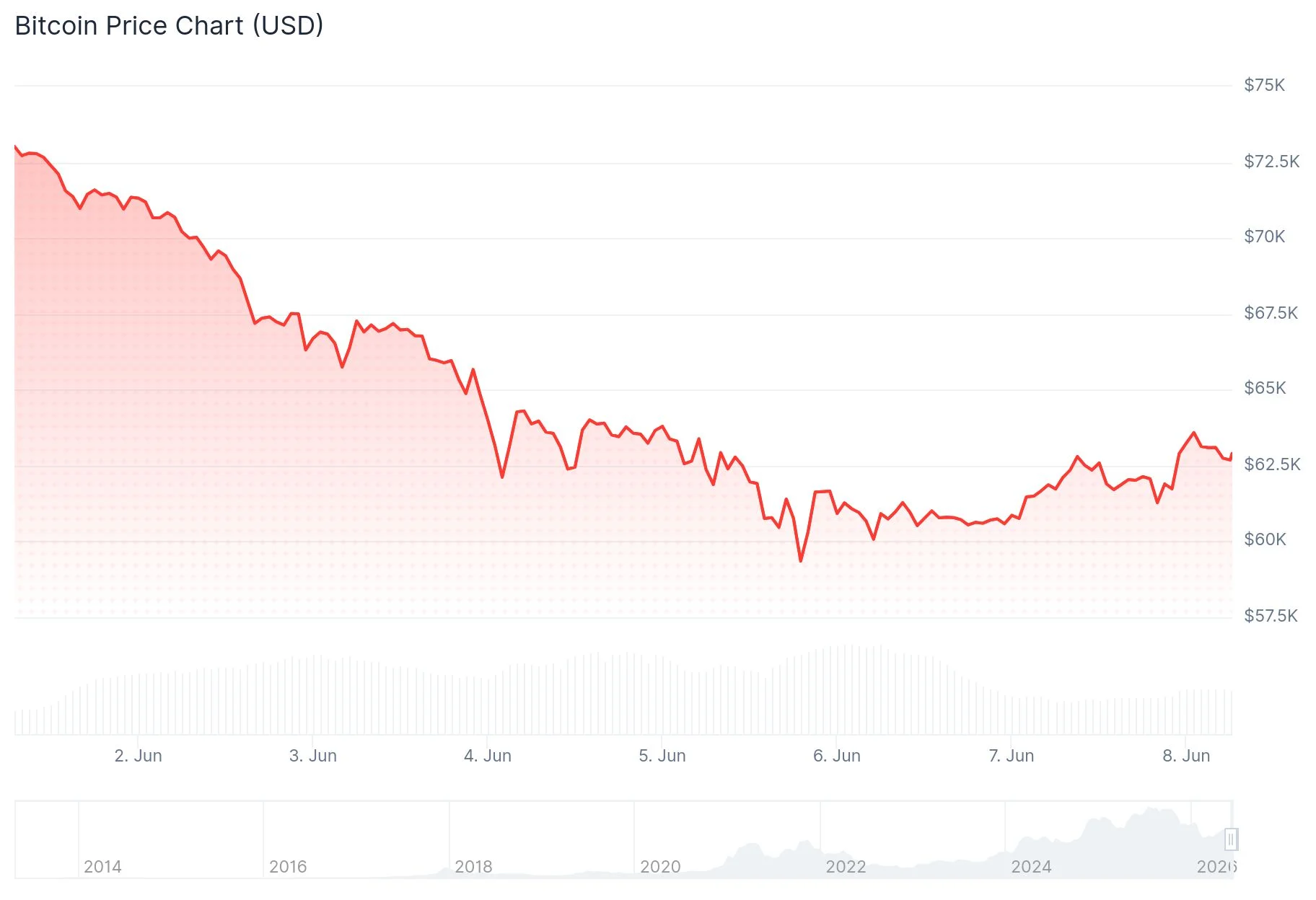
Key Takeaways
- Bitcoin’s price declined to approximately $62,900 following military exchanges between Iran and Israel that shattered a temporary ceasefire
- Asian markets experienced severe losses, with South Korea’s KOSPI plummeting 6.8% and Japan’s Nikkei declining 3%, prompting circuit breakers
- Crude oil surged more than 3% to reach $93.50 per barrel, driving Treasury yields upward and weighing on risk-sensitive investments
- The Nasdaq suffered a 4.2% decline on Friday, marking its steepest single-session loss since April 2025, driven by semiconductor and artificial intelligence sector weakness
- Bitcoin has declined approximately 14% throughout the past week, momentarily dropping beneath the $60,000 threshold
Military strikes between Iran and Israel over the weekend dismantled a ceasefire that had temporarily stabilized energy markets. The resurgence of hostilities created turbulence across international financial systems on Monday.
Bitcoin’s value retreated to approximately $62,900 by 4:00 UTC on Monday. This represents a decline from Sunday’s peak of $63,776, based on CoinDesk market data.
West Texas Intermediate crude oil futures climbed more than 3% to $93.50 in the aftermath of the military action. Escalating oil prices intensify inflation concerns and elevate Treasury yields.
Elevated Treasury yields generally strengthen dollar demand. This dynamic typically creates downward pressure on speculative assets including digital currencies.
U.S. President Donald Trump advocated for de-escalation following the strikes. He informed Axios that he had spoken with Israeli Prime Minister Benjamin Netanyahu, urging him to avoid further military response.
Notwithstanding Trump’s request, Israel conducted strikes against Iranian military installations on Sunday evening. These operations were executed in retaliation to earlier Iranian missile launches.
Asian Stock Markets Experience Sharp Declines
Asian equity indices suffered significant losses on Monday. South Korea’s KOSPI index plunged 6.8%, activating an automatic trading suspension. Japan’s Nikkei index declined more than 3%.
The widespread selloff mirrored heightened risk aversion throughout global financial systems. Market participants shifted capital away from equities and other higher-volatility instruments.
U.S. Equities Already Facing Downward Momentum
U.S. stock index futures showed mixed performance early Monday. S&P 500 futures remained unchanged at 7,397.25 points, while Dow Jones futures decreased 0.4%. Nasdaq 100 futures registered a modest 0.2% gain.
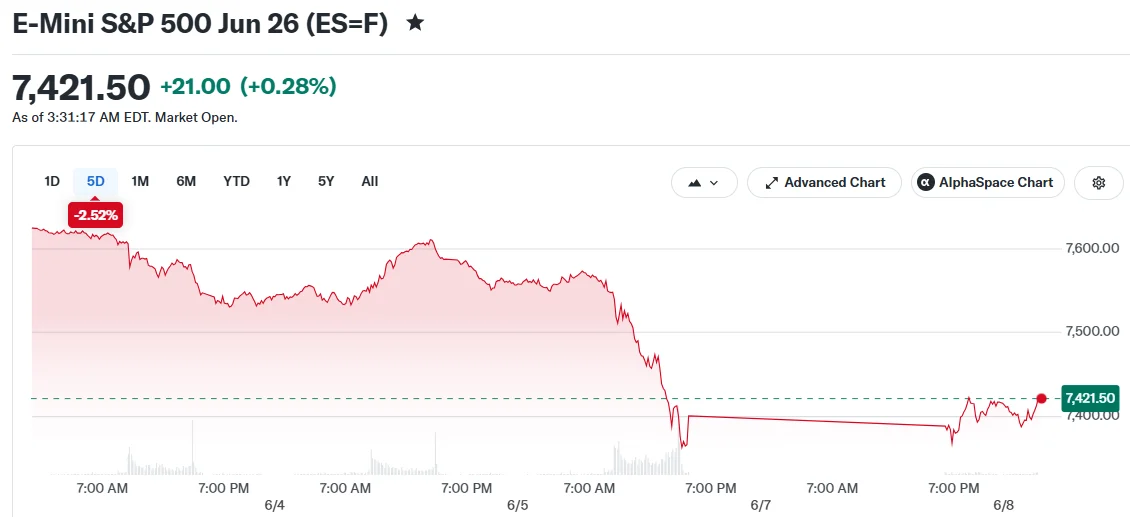
These movements followed substantial declines on Wall Street from Friday’s session. The Nasdaq Composite tumbled 4.2% to close at 25,709.43 points, representing its most severe single-day decline since April 2025.
The S&P 500 retreated 2.6% to settle at 7,383.74 points. The Dow Jones Industrial Average decreased 1.4% to finish at 50,866.78 points.
Semiconductor stocks experienced the most pronounced losses. Nvidia declined more than 6% on Friday as market participants took profits following a recent artificial intelligence-fueled surge.
Friday’s market weakness was additionally influenced by robust U.S. employment figures. Stronger-than-anticipated payroll data heightened speculation that the Federal Reserve might maintain elevated interest rates for an extended period.
Bitcoin Confronts Multiple Challenges
Bitcoin was experiencing downward pressure even prior to the weekend’s geopolitical escalation. Prices contracted nearly 14% during the previous week, temporarily falling below $60,000.
Contributing elements included capital withdrawals from spot Bitcoin exchange-traded funds, investment rotation toward AI equities, and Strategy’s recent Bitcoin liquidation.
Market volatility is anticipated to persist throughout the week. Forthcoming U.S. inflation reports and significant initial public offerings, including SpaceX and Anthropic, may further influence market liquidity conditions.
The weekend’s geopolitical developments have compromised advancement toward a potential U.S.-Iran diplomatic agreement. Tehran has indicated that a Lebanon ceasefire must precede any comprehensive settlement.


Securitize, a leading platform for tokenizing real-world assets, is one step closer to a public listing after the U.S. Securities and Exchange Commission approved a Form S-4 registration statement tied to a Cantor Equity Partners II SPAC merger. The move clears the path for a shareholder vote on June 29, with a potential NYSE listing under the name Securitize Corp, ticker SECZ, should the deal pass.
CEO Carlos Domingo framed the development as a meaningful milestone for both Securitize and the broader push toward institutional adoption of tokenization. “This marks another important milestone for Securitize and for the broader institutional adoption of tokenization,” he said. The company currently reports roughly $4 billion in assets under management and has partnered with prominent asset managers to offer tokenized funds, including Apollo, BlackRock, BNY Mellon, and VanEck. In the first quarter, Securitize posted revenue of $19.5 million, up about 39% from a year earlier.
Beyond its SPAC trajectory, Securitize has already been advancing ties with traditional finance. The New York Stock Exchange signed a memorandum of understanding with Securitize in March as part of a broader initiative to explore blockchain-based stock trading infrastructure for Wall Street.
Securitize is the largest tokenization platform by market share. Source: RWA.xyz
Tokenized real-world assets reach new highs as market matures
Looking at the broader market, the on-chain value of tokenized real-world assets has surged in the past year, signaling growing institutional interest even in a broader crypto bear market. Data from RWA.xyz show total on-chain RWA value rose to a record $32 billion in May, up roughly 220% over the previous 12 months, excluding stablecoins. The composition of this on-chain wealth remains heavily skewed toward government securities and traditional metals and commodities.
According to the same data, tokenized U.S. Treasuries account for about half of on-chain assets, while tokenized commodities represent around 16%. Tokenized stocks remain a smaller slice, at roughly 4.8% or about $1.5 billion. The Ethereum ecosystem and various layer-2 networks continue to dominate the technical backbone of these tokenization efforts, collectively handling more than 60% of activity.
The RWA push has also been reflected in the naming and leadership of the sector. Securitize stands out as the largest tokenization platform by market share, underscoring the central role that established platforms play in driving liquidity and standardization for these assets.
What the SPAC path could mean for investors and the market
If the June 29 vote clears, Securitize would join a growing set of crypto-finance and tokenization platforms that have pursued public-market access through SPAC mergers. The potential NYSE listing would not only validate Securitize’s business model but could also signal a broader appetite among traditional investors for exposure to tokenized RWAs. The company’s existing relationships with major asset managers, combined with tangible revenue growth and a sizeable AUM base, provide a concrete basis for investor interest in a tokenization-focused public company.
For players in the space, the development highlights several trends: the continued convergence of traditional finance and blockchain-based infrastructure; the pursuit of regulated, compliant platforms to manage tokenized assets; and the ongoing effort to quantify and improve liquidity for RWAs across asset classes. Yet the picture remains nuanced. While the on-chain RWA market has expanded rapidly, tokenized stocks remain a relatively small segment, and regulatory clarity surrounding digital assets continues to evolve.
As Securitize moves toward a shareholder vote and potential exchange listing, market watchers will be watching not only the outcome of the SPAC merger but also how the company scales its technology and governance to support a broader set of investors and asset types. The coming months should reveal how Wall Street’s embrace of tokenization translates into practical, tradable markets for real-world assets.
Readers should watch for updates from the June 29 vote, any subsequent disclosures from the merged entity, and evolving regulatory guidance that could shape the pace and scope of on-chain asset tokenization across the broader market.


Michael Saylor’s Strategy has seen JPMorgan turn cautious on digital assets, with the bank warning that the company may need to rebuild its $ reserves as annual dividend obligations reach about $1.7 billion.
Summary
- JPMorgan said Strategy may need to replenish its dollar reserves to ease concerns about future Bitcoin sales tied to dividend obligations.
- The bank expects Strategy’s Bitcoin purchases to reach about $32 billion in 2026 despite recent scrutiny over its sale of 32 BTC.
- JPMorgan has lowered its outlook for digital assets and now sees less than a 50% chance of the CLARITY Act becoming law this year.
According to a Friday report from JPMorgan analysts led by Managing Director Nikolaos Panigirtzoglou, investor concerns increased after Strategy sold 32 Bitcoin between May 26 and May 31, even though the bank described the transaction as symbolic and voluntary.
The analysts said the sale appeared intended to demonstrate flexibility and commitment to preferred stockholders. Even so, they argued that the move raised questions about how Strategy plans to fund future dividend payments without relying on its Bitcoin holdings.
JPMorgan estimated that Strategy’s remaining dollar reserves cover only about 6.3 months of dividend payments. Strategy had established a $1.44 billion reserve in December to support preferred stock dividends and service interest payments on outstanding debt.
In the report, the analysts said restoring confidence may require Strategy to replenish those reserves, reducing concerns that additional Bitcoin sales could be needed to meet future obligations.
Hours after those concerns surfaced, Strategy co-founder and Executive Chairman Michael Saylor hinted at another Bitcoin purchase, posting on X that it was “a good time to add more dots.”
Strategy currently holds 843,706 Bitcoin acquired at an average price of $75,699. JPMorgan estimated the position represents an unrealized loss of roughly $11.5 billion at current market prices.
Bitcoin buying expected to continue
Despite concerns about reserves, JPMorgan said it still expects Strategy to remain an active Bitcoin buyer.
Based on the company’s acquisition pace so far this year, the analysts projected around $32 billion in Bitcoin purchases during 2026, up from approximately $22 billion in both 2024 and 2025. The estimate was revised higher from the bank’s previous forecast of $30 billion issued last month.
Recent debate over Strategy’s funding model has also drawn responses from industry figures. Earlier this month, BTCTOP CEO Jiang Zhuoer said he does not expect Strategy to become a significant net seller of Bitcoin even during a severe market decline.
In comments posted on X, Jiang argued that Strategy’s reputation as a long-term Bitcoin holder carries substantial value and that large-scale sales would damage the company’s public image. He also said a drop in Bitcoin to $30,000 would raise Strategy’s leverage ratio from roughly 5% to around 10%, which he described as manageable.
Jiang further suggested that Strategy could sell older, lower-cost Bitcoin to realize accounting gains and help cover STRC dividend obligations while continuing to acquire Bitcoin through new capital raised from investors.
Those comments contrasted with warnings previously raised by Grayscale, which said weakness in both MSTR shares and STRC preferred stock could make fundraising more difficult and increase pressure on the company’s financing model.
JPMorgan cuts confidence in crypto outlook
Elsewhere in its latest outlook, JPMorgan lowered its expectations for crypto market developments that it previously viewed as supportive for digital assets.
The analysts now assign less than a 50% probability that the U.S. crypto market structure legislation, known as the CLARITY Act, will pass this year. Earlier this week, JPMorgan said the bill faces a narrowing legislative window as midterm elections approach and debates over stablecoin yield provisions continue.
A positive second half for digital assets would depend partly on clarity around Strategy’s dividend funding plans and progress on market structure legislation, according to the bank.
JPMorgan’s latest stance contrasts with its February outlook, when the analysts said they were overweight and positive on digital assets for 2026 because they expected institutional investors to drive stronger inflows into the sector.
The bank also pointed to weaker capital entering crypto markets this year. JPMorgan estimates digital asset inflows at roughly $22 billion year to date, which translates to an annualized pace of about $52 billion, nearly half the level recorded in 2025. The calculation includes crypto fund flows, CME futures positioning, venture capital fundraising and corporate treasury purchases such as Strategy’s Bitcoin acquisitions.
Bitcoin’s production cost also remains an important metric in the bank’s analysis. JPMorgan said its central estimate fell from $90,000 at the start of the year to $77,000 before recovering to about $87,000 as mining conditions changed. Historically, the bank noted, production cost has often acted as a support level for Bitcoin prices.
Even after adopting a more cautious outlook, JPMorgan said the current pessimism across crypto markets could become a bullish contrarian signal if market conditions improve later in the year.

Battle of the World Cup TV pundits: Who’s lining up for BBC and ITV

Dubai International Airport Open Today as DXB Flight Status Shows Active Operations Across Major Routes
Crypto News, June 8: BTC USD Bouncing, Strategy Buys More Bitcoin, Hayes Denies LookOnChain Claims as ZachXBT Calls his Pn’D Scheme



-

 Fashion3 days ago
Weekend Open Thread: Evereve – Corporette.com
-

 Business6 days ago
Jade Biosciences, Inc. (JBIO) Discusses Positive Interim Results From JADE101 Phase I Healthy Volunteer Study and Development Plans Transcript
-
 Crypto World3 days ago
Jensen Huang Approves Samsung, SK Hynix, and Micron for NVIDIA (NVDA) HBM4 Memory Supply
-

 Sports5 days ago
French Open 2026 results: Alexander Zverev beats Rafael Jodar and will play Jakub Mensik in semi-finals
-

 Tech6 days ago
CryZENx Releases Fresh Playable Content Deep Inside Jabu-Jabu for His Ocarina of Time Remake
-

 Business5 days ago
Trump Taps Housing Chief Bill Pulte as Acting Intelligence Director After Gabbard Exit
-
 Business1 day ago
The Pain Points Taking a Fragile Tech Rally Down a Notch
-
Crypto World3 days ago
LBank Surpasses 25 Million Users Worldwide as AFA Partnership Continues to Drive Global Growth
-
 NewsBeat5 days ago
Republicans balk at Trump’s attempt to appoint a MAGA enforcer to lead National Intelligence
-

 Tech3 days ago
RCS Messages Between iPhone and Android Get End-to-End Encryption With iOS 26.5
-
 Crypto World6 days ago
Seagate (STX) Stock Surges to Record High on AI Boom and Legal Settlement
-

 Tech3 days ago
Microsoft launches MXC, an OS-level sandbox for AI agents, with OpenAI and Nvidia already on board
-

 Tech3 days ago
Meta steals a tactic from Tesla and builds data centers in tents
-

 Business3 days ago
(VIDEO) Justin Bieber Delivers Surprise Happy Birthday Serenade to Diners at Los Angeles Mexican Restaurant
-
 Crypto World5 days ago
EU AI Data Center Project Faces Delays as Funding Gaps Grow
-

 Entertainment5 days ago
Did The Mandalorian And Grogu Already Ruin The Next Star Wars Movie?
-

 Business5 days ago
Aehr Test Systems Stock Soars 17% Amid Surging AI Demand and Conference Spotlight
-
 Crypto World3 days ago
Merlin (MRLN) Stock Soars 32% on Major USSOCOM Autonomy Milestone
-
 Business6 days ago
Claude AI Down Today Reason: Why Anthropic’s AI is not working today? What’s the latest quota update
-

 Tech3 days ago
Credit card theft campaign abuses Stripe to host stolen payment info
You must be logged in to post a comment Login