Connect with us
DAPA Banner
DAPA Coin
DAPA
COIN PAYMENT ASSET
PRIVACY · BLOCKDAG · HOMOMORPHIC ENCRYPTION · RUST
ElGamal Encrypted MINE DAPA
🚫 GENESIS SOLD OUT
DAPAPAY COMING

NewsBeat

Verdict that SAS killing of four IRA men was not justified is ‘illegal and irrational’

Published

on

Belfast Live

Both the UK government and military veterans involved in the 1992 operation are seeking to have findings from an inquest quashed, claiming a failure to properly consider the potential threat they posed

An inquest verdict that SAS soldiers were not justified in opening fire and killing four IRA men in a Co Tyrone village was illegal and irrational, the High Court heard today.

Advertisement

The coroner failed to carry out the correct assessment before ruling that the use of lethal force at Clonoe in February 1992 was unreasonable, a judge was told.

Kevin Barry O’Donnell, 21, Sean O’Farrell, 22, Peter Clancy, 21, and Patrick Vincent, 20, died in the ambush just minutes after they had carried out a gun attack on Coalisland police station.

Both the UK government and military veterans involved in the operation are seeking to have the inquest findings quashed, claiming a failure to properly consider the potential threat they posed.

Joseph Aiken KC, representing the Secretary of State for Defence, argued: “The terrorists that the soldiers expected they would have to confront were among the most ruthless and dangerous members of a highly effective terrorist organisation.”

Advertisement

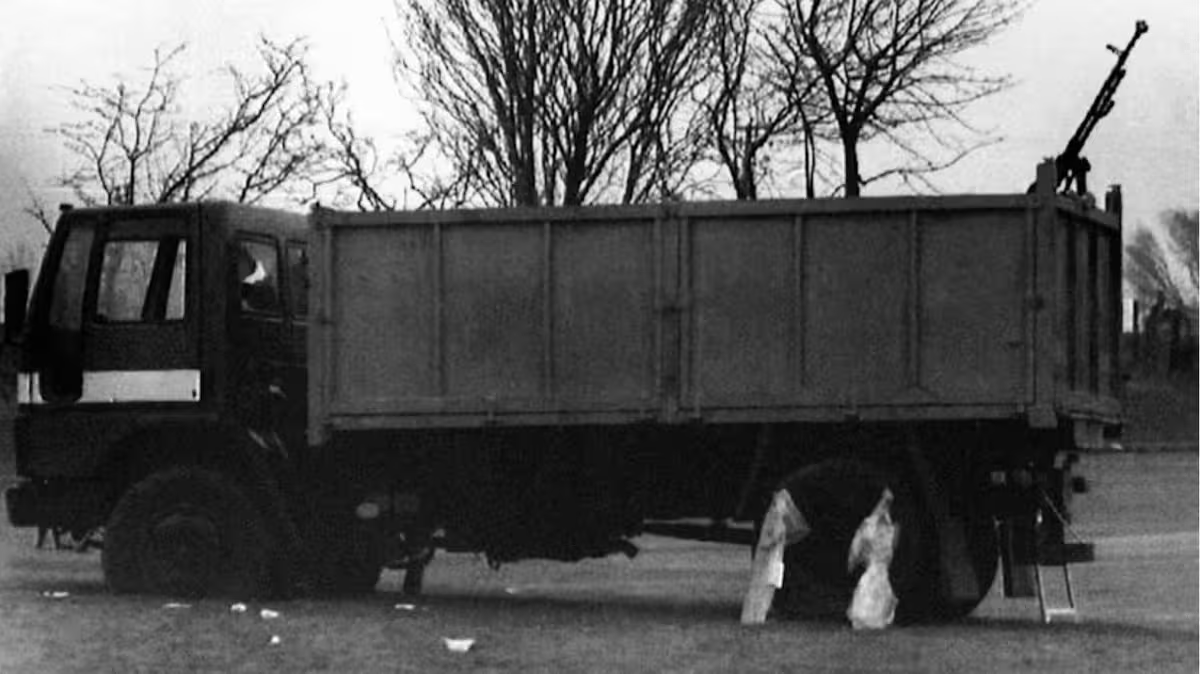
Members of a specialist military unit opened fire when the men arrived at a church car park in a hijacked lorry with a heavy machine gun welded onto the back.

Twelve soldiers were in position and waiting for them at the scene.

At the time the SAS men insisted the use of lethal force was justified to protect their lives and those of their colleagues from the danger posed by the IRA Active Service Unit.

However, in February last year, coroner Mr Justice Humphreys found that their actions were not reasonable or justified.

Advertisement

He identified no attempt made to arrest the four IRA men, even as they lay wounded.

According to the coroner, experienced soldiers lying in wait at the church would have known the IRA men needed to dismount the machine gun – improving the chances of making arrests.

And in that scenario the ability to arrest them would have improved.

Amid criticism from unionist and Conservative politicians at the findings, judicial review challenges have been brought against the outcome reached.

Advertisement

Opening a case listed for a two-week hearing, Mr Aiken claimed the coroner’s approach involved “a significant legal error” in assessing the central issue of the Article 2 justification for opening fire.

Based on that alleged mistake, he contended the verdict was illegal, irrational, wrongly took some factors into account and did not properly consider other relevant issues.

It was unreasonable to suggest the soldiers did not honestly believe their lives were in danger when they confronted members of an IRA unit which had just fired an anti-aircraft machine gun and other weapons, the court heard.

Opening a case listed for a two-week hearing, Mr Aiken suggested a failure to “stand in the shoes” of the SAS men who used force at the scene.

Advertisement

Instead, he argued, the legal test for self-defence and justification when faced with heavily-armed terrorists was incorrectly applied.

Mr Justice McAlinden was told events which led to the four men’s deaths unfolded in the space of two minutes.

Along with the 12 soldiers, there were also at least 10 IRA men, a lorry with a mounted anti-aircraft gun and other vehicles all at the scene.

“If you are assessing the express belief of a soldier and their decision-making… then you have to take into account exactly what else was happening at the point that decision was made,” Mr Aiken submitted.

Advertisement

“There is an absence of consideration about the nature of the terrorist threat that the specialist military unit was dealing with on that night.”

Describing the attack on Coalisland RUC Station as part of a wider, sustained campaign of terrorism, the barrister insisted the incident was unlike other law enforcement scenarios.

“Given the opportunity, the terrorists involved would have tried to kill the soldiers,” he added.

“If we are right on any of these legal errors on the Article 2 justification assessment, then the (inquest) findings and verdict must be quashed.”

Advertisement

The case continues.

For all the latest news, visit the Belfast Live homepage here and sign up to our daily newsletter

Source link

Advertisement
Continue Reading
Click to comment

You must be logged in to post a comment Login

Leave a Reply

NewsBeat

Path taped off and blue tent erected after Peterlee incident

Published

on

Path taped off and blue tent erected after Peterlee incident

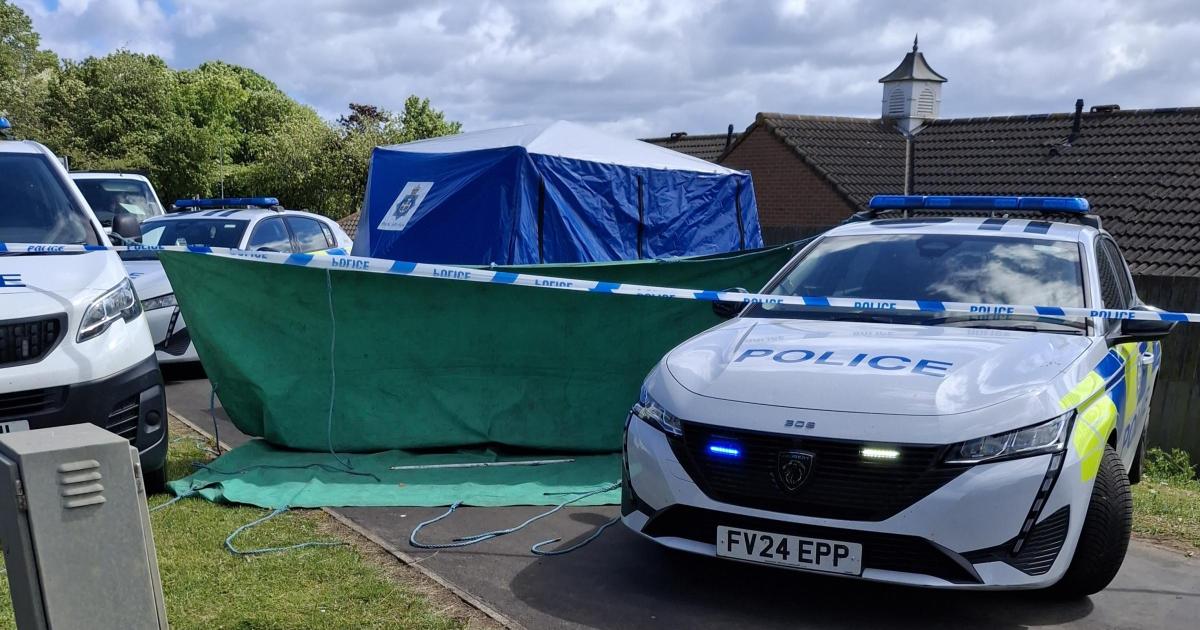
Emergency services were called to Passfield Way, near the junction with Southway, earlier today (June 13) following an incident. 

A footpath and patch of grass was cordoned off by officers, with crime scene investigators pictured at the scene on Saturday morning. 

(Image: THE NORTHERN ECHO)

(Image: THE NORTHERN ECHO)

Images show an officer standing beside the blue and white tape where at least three police cars block the blue tent, which is also partly covered by a green sheet. 

Police and crime scene investigators remained at the scene until 11.45am.

Advertisement

(Image: THE NORTHERN ECHO)

It is understood that part of Passfield Way was closed earlier in the day due to the incident, with forensic officers seen taking photos at the scene.

The nature of the incident remains unknown at this stage. 

Durham Police has been contacted for more information.

Advertisement

Source link

Continue Reading

NewsBeat

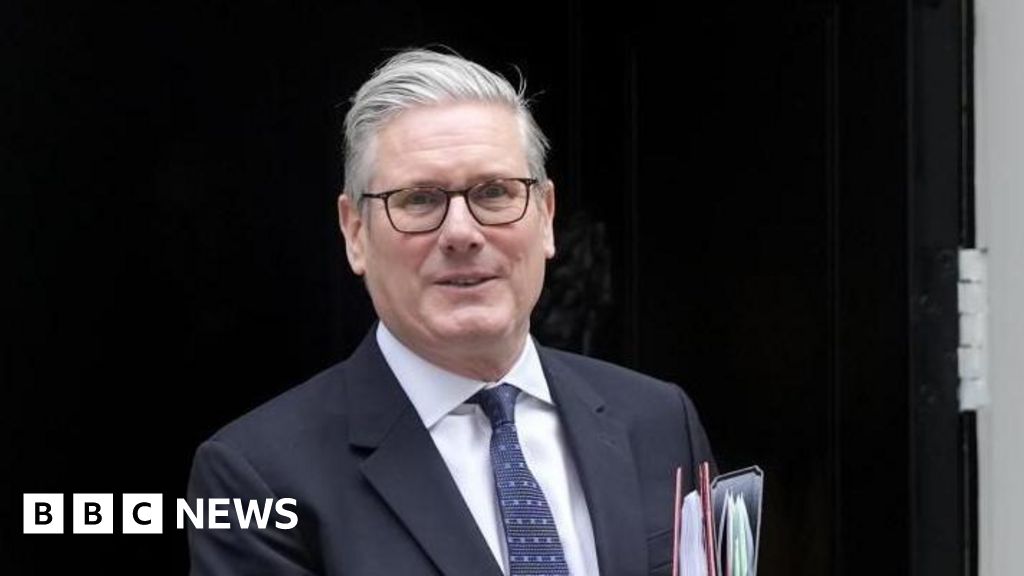
Starmer defiant after defence spending row

Published

on

Starmer defiant after defence spending row

He pointedly said every cabinet minister, every government department, had contributed cuts to their long-term, so-called capital budgets, to provide more for defence. The prime minister himself was involved in plenty of these negotiations, I’m told – and some were pretty hard going, given it required reopening budget deals that had been assumed to have been already settled.

Source link

Continue Reading

NewsBeat

Workers begin removing Trump’s name from the Kennedy Center

Published

on

Workers begin removing Trump's name from the Kennedy Center

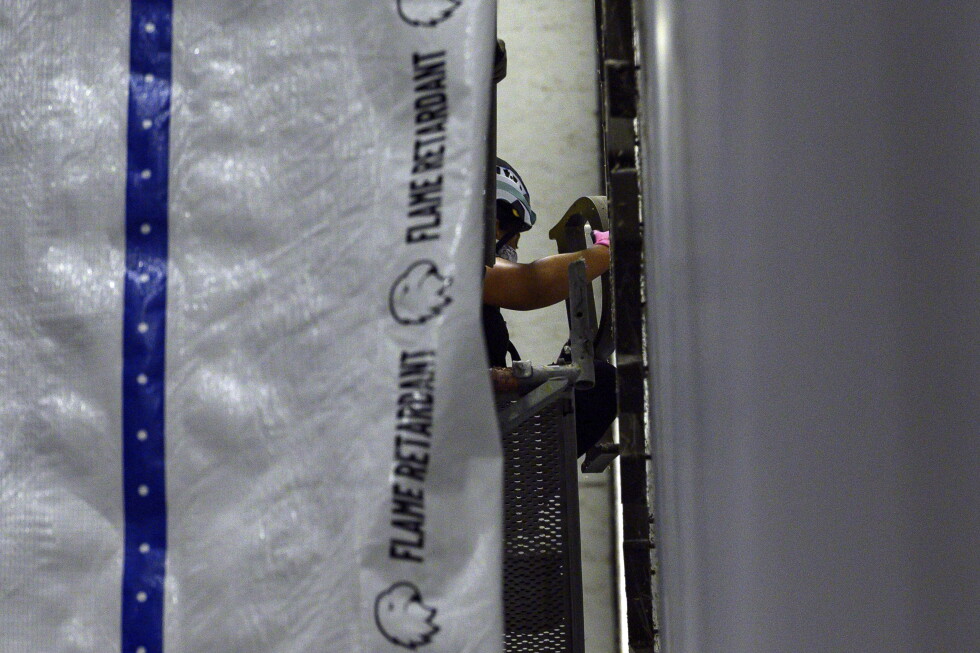
WASHINGTON (AP) — Workers began removing President Donald Trump’s name from the facade of the Kennedy Center early Saturday, hours after a court-ordered Friday deadline to remove references to Trump from the building and other aspects of the iconic performing arts venue’s operations.

Scaffolding was erected Friday around a section of the building that includes Trump’s name, but shortly after midnight, the Kennedy Center asked a judge to extend the deadline until noon Eastern Time on Saturday because of thunderstorms that had swept through the Washington area, causing a delay.

In the filing, the Kennedy Center offered assurance that the “removal work is presently ongoing” and would “conclude in the early hours of the morning.”

A few hours later, workers began covering the scaffolding with tarps before they eventually started taking down Trump’s name. They packed up and left the site around 3:30 a.m., though the tarps remained, leaving it impossible to determine if all the letters had been removed.

Advertisement

Dozens of people spent hours Friday on the plaza in front of the Kennedy Center taking pictures and cheering occasionally as they broke into chants of “take it down.” Rep. Joyce Beatty, D-Ohio, an ex-officio board member who sued to have Trump’s name removed from the building, was spotted at one point on the plaza.

Earlier Friday afternoon, a judge rejected a request to pause the court-ordered deadline. The institution appealed that ruling, an effort that was also rebuffed Friday evening.

After ignoring the Kennedy Center for much of his first term, Trump has wielded tremendous influence over the venue during his return to office. Just a month into his second term, he ousted the center’s previous leadership and replaced it with a board of trustees that named him chairman. Trump’s name was quickly added to the building.

In his ruling that only Congress could make changes to the Kennedy Center’s name, U.S. District Judge Christopher Cooper also blocked the administration from closing the cultural and arts venue for major renovations that had been planned to start in July and last for two years.

Advertisement

The Kennedy Center’s leadership argued in its appeal Friday that the renovation was badly needed and accused the lower court, in terms that seemed similar to Trump’s speech patterns, of interfering in the effort.

“The District Court is not allowing us to close in order to properly fix up and repair the Building, including potentially life threatening structural damage like beams and parking garage ceilings that are rusted, and in serious danger of falling onto people below,” according to the appeal. “Indeed, total collapse!”

Even as the Kennedy Center has fought efforts to remove Trump’s name from the building, it has taken steps to comply with Cooper’s initial ruling.

A June 4 memo to staff from the Kennedy Center’s Office of General Counsel said email signatures, letterhead and other documents must reflect the name as “The John F. Kennedy Center for the Performing Arts” or “Kennedy Center.”

Advertisement

The Kennedy Center’s website has dropped Trump’s name. And an earlier email sent to members offering ticket packages for the June 28 Mark Twain Award for American Humor ceremony came from the Kennedy Center without including Trump’s name.

___

Associated Press journalists Anna Johnson, Mark Sherman and Emily Wang in Washington and Bill Barrow in Atlanta contributed to this report.

Advertisement

Source link

Continue Reading

NewsBeat

Two arrested after car crashes following police chase

Published

on

Cambridgeshire Live

Two arrests were made, both have been released on bail

A car crashed near the A1M following a police pursuit. The crash happend at around 7pm on Wednesday evening (June 10) on the A1M at Little Paxton when a vehicle travelling southbound failed to stop for police.

The grey Toyota Yaris left the A1 at Little Paxton and crashed a short time afterwards. The driver, a 21-year-old man from St Neots was arrested on suspicion of dangerous driving, failing to stop, driving while unfit through drink or drugs, possession with intent to supply – other than class A and possession with intent to supply class A. He has been released on bail.

The passenger of the car, a 22-year-old woman also from St Neots, was arrested on suspicion of supplying a controlled drug – class A, and possession of a controlled drug with intent to supply – class B. She has also been released on bail.

Advertisement

Police are now appealing for anyone who was driving in the area at the time on Wednesday who has dashcam footage to get in touch. Anyone with any information is urged to report it by calling 101 and quoting reference 35/43396/26.

Source link

Continue Reading

NewsBeat

‘I caught neighbour in heinous act outside my house and it’s left me scarred’

Published

on

Daily Mirror

A woman was left horrified after installing a security camera in her garden, only to find someone from the local area engaging in a disgusting act outside her home

A neighbour was left feeling like they “may throw up” after spying someone from their neighbourhood doing something outrageous in their garden. Most people have a high tolerance when it comes to the people who live around them in their local area, as they tend to want to keep the peace for as long as possible.

However, one resident reached the end of her tether when she caught someone on her new security camera doing something truly grim. Doorbell and security cameras are a fantastic way to give yourself peace of mind when you’re not physically at the property. But they can also catch some things you’d rather not see.

One woman fumed: “My new security camera caught someone using my yard as a toilet. We’ve had issues with vandalism due to signs we have in our yard.

Advertisement

“We’ve had juvenile trees ripped to shreds, things ripped out of the ground, sunflowers plucked of petals… my spouse is opposed to monitoring, and it took three years to talk him into a camera.”

She explained that they had the security measures now “for a few weeks,” and she noticed that someone had thrown Red Bull cans into their kids’ play yard, so she went back and looked at the footage.

“I didn’t see who threw it (although with timing, it’s likely the same person), but I do see a person walk up, look around and then pop a squat under our brand new, freshly planted cherry tree,” she said.

“It very much looks like they take their pants down, based on the motion. I went out and looked, fully expecting a big pile of s*** but the ground was wet.”

Advertisement

To add insult to injury, “after they finished peeing, they stood in front of [their] free little library reading books and dropping trash across the sidewalk”.

The woman fumed that the camera wasn’t a deterrent for someone behaving in such a way, wondering what would stop people from behaving like this in the future.

Someone in the comments recommended that they get “motion-activated sprinklers” to deter people from going on their land. “This is the solution to SO many issues. Can’t go wrong!” another agreed.

But the original poster pointed out a flaw, saying: “The issue is it’s right in front of our free little library. We get little kids visiting all day long. We stock kids’ books.”

Advertisement

A Redditor responded: “Move the library. Besides, it’s no longer sanitary to have it there!” Someone else wrote: “Just turn it on each night before you go to bed, and turn it on again when you get up. Or, put it on a timer.”

A social media user fumed: “Standing there reading books after peeing in your yard is such a bizarre level of confidence.”

However, one woman suggested the pettiest revenge they’d tried themselves, sharing: “When I caught somebody stealing flowers out of my yard, I took a still from the video, printed it, had it laminated, and taped it to my garage door.”

Source link

Advertisement
Continue Reading

NewsBeat

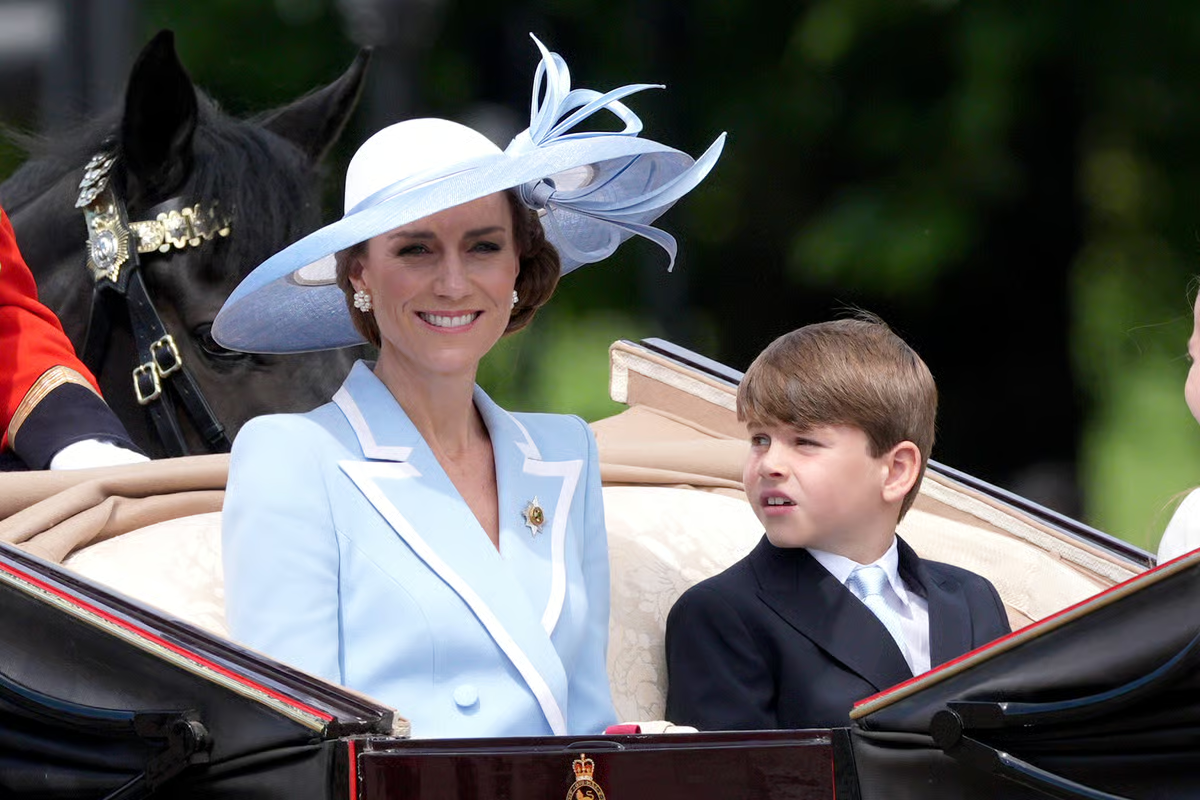
Trooping the Colour 2026: Princess of Wales and children among royals at King’s birthday celebrations

Published

on

Trooping the Colour 2026: Princess of Wales and children among royals at King's birthday celebrations

Crowds were treated to the sight of a royal carriage procession along The Mall as the King, Queen and the Princess of Wales, joined by her children Prince George, 12, Princess Charlotte, 11, and Prince Louis, eight, were guarded by a Sovereign’s Escort provided by the Household Cavalry Mounted Regiment.

Source link

Continue Reading

NewsBeat

Scotland return to centre stage at last in must-win World Cup opener

Published

on

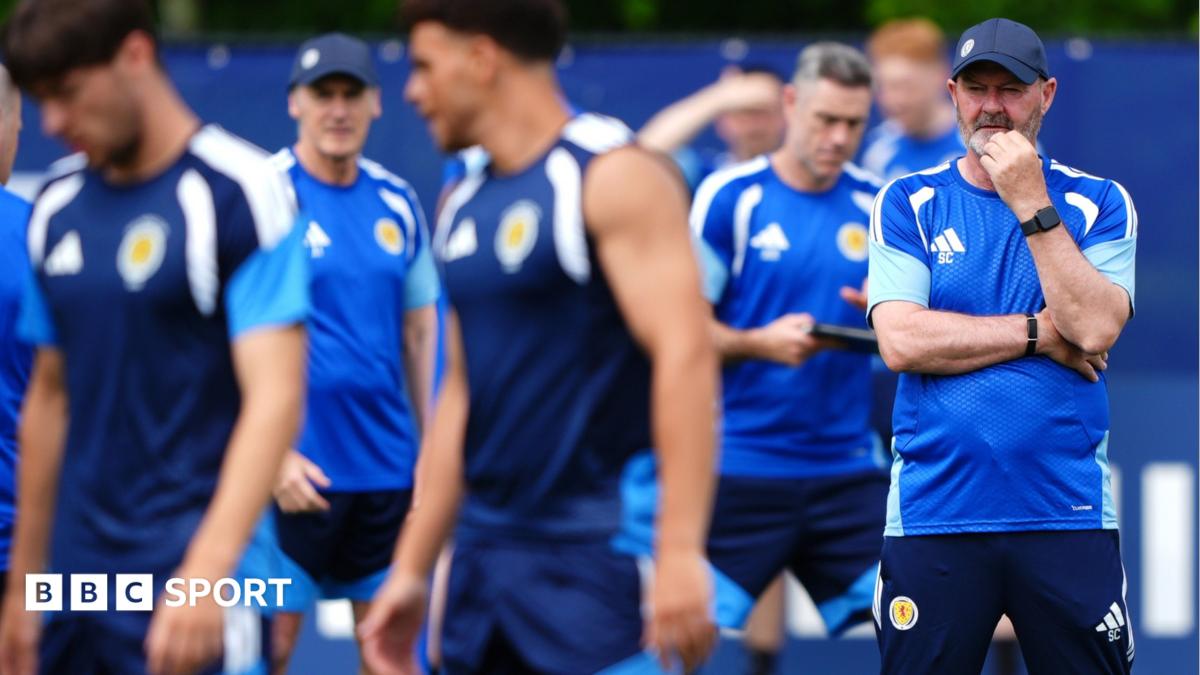
Scotland head coach Steve Clarke is thoughtful during training

An overhead kick from Scott McTominay, a Lewis Ferguson corner that was going in until Lawrence Shankland helped it on its way, a curler to beat all curlers from Kieran Tierney and then a fourth from the other end of the earth – or the halfway line to be precise – from Kenny McLean.

It was the perfect night, a night that further reinforced the bond between these players, which is genuinely tight. That’s always said, but this group is extremely close, a club side in national team colours, a band of brothers who have each other’s back.

There was a collective swoon when news came through on Thursday that McTominay, the totem, had an iffy tummy, but he’s good now. The Napoli midfielder with the Midas Touch probably just waved his hand over his stomach and, hey presto, he was healed.

What’s absolutely fascinating about this game is the options that Clarke has and the way he’s talking about the utilisation of his bench, hinting that he might keep a heavy hitter in reserve.

Advertisement

On more than one occasion he’s suggested that the team that finishes the game might have to be as strong, or stronger, than the one that starts.

It’s inconceivable, for this game, that he’ll go away from his new approach of playing Shankland and Che Adams up front, so one of his star midfielders most probably won’t start.

Scotland are buoyed by the eight goals they scored in their last two games. There were caveats – Curacao had 10 men for much of it at Hampden and fell away to lose 4-1 and Bolivia were, well, not all that good.

But confidence is a valuable thing, no matter how you get it. Clarke, as is his wont, has been talking up the threat of Haiti, referring regularly to their size, their power and their athleticism.


Advertisement

In warm-up games, Haiti hammered New Zealand 4-0 before New Zealand lost just 1-0 to England soon after. That form line makes them a theat.

Haiti are a distant 83rd in the Fifa world rankings, but Clarke has been at pains to point out their strengths. One of those strengths is a mental fortitude that comes with representing a country that is riven by crisis and humanitarian disaster.

The capital, Port-au-Prince, is controlled by armed gangs – instability, hunger, killings, kidnappings and sexual violence is rife. Public services have collapsed. Thousands of schools have closed, 10% of the population have fled. The football team can’t play any games at home. Two years into his role as head coach, Sebastien Migne still hasn’t been able to set foot in Haiti.

That level of hardship could breed some amount of determination. Clarke knows it and you sense that his players know it, too.

Advertisement

Scotland have played 23 matches at World Cups and have won only four, a sobering stat when you set it alongside the memories of nightmares past, the loss to Costa Rica in 1990 chief among them.

So Clarke is taking nothing lightly. This is a must-win given the scale of what’s to come against Morocco and Brazil.

Nobody in Clarke’s camp is hiding from that. They have said repeatedly that they’re here to make history as the first Scotland team to make it through a group.

They have a vast travelling army with them and millions more at home, a strange amalgam of positivity and anxiety, belief and fear. All human emotion on the grandest stage.

Advertisement

Thrilling and terrifying. What a time to be alive.

Source link

Continue Reading

NewsBeat

Woman critically injured in shark attack off popular Sydney beach

Published

on

Daily Record

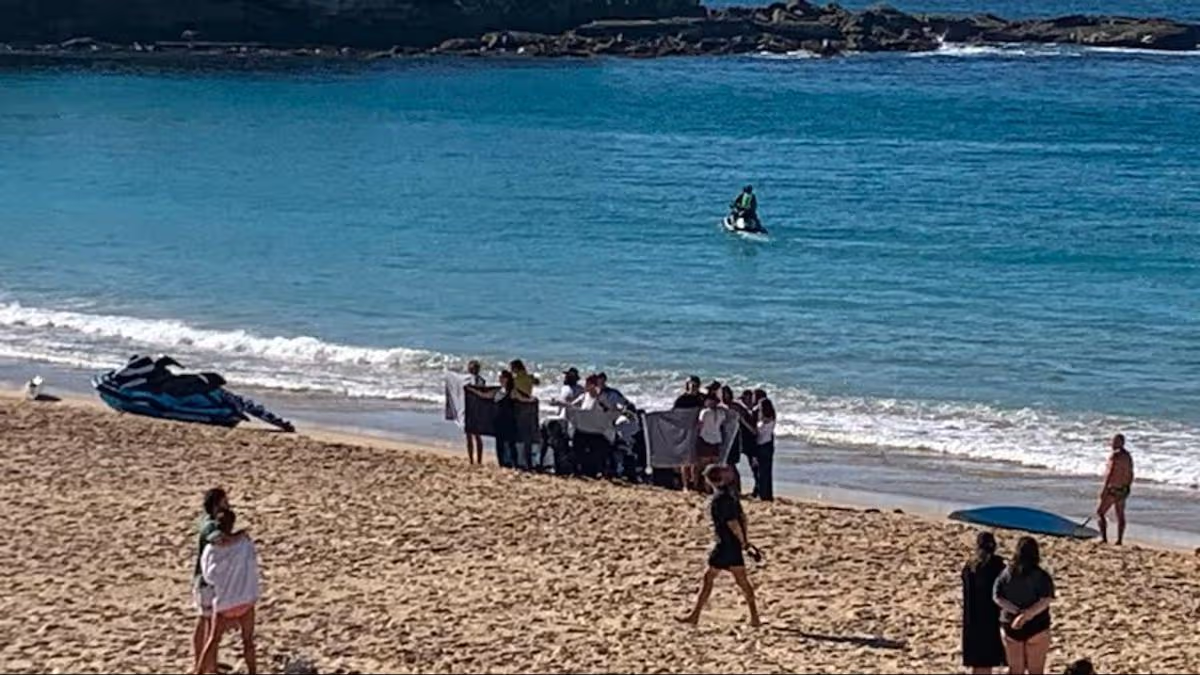
The incident took place near to Coogee Beach in southwest Sydney at around 11.15am local time this morning.

A woman has been critically injured off a popular Sydney beach in the latest in a spate of shark attacks in Australia. The woman, believed to be in her 30s, suffered serious leg and arm injuries in the attack at 11.15am (2.15am BST) off Coogee Beach, police said.

Advertisement

Three spearfishing divers have been killed by sharks off the Australian coast since May 16, bringing the total of fatalities in the nation this year to four. Australia has averaged between two and three fatal shark attacks a year since 2000, according to the Australian Shark Incident Database.

On Saturday, police said the victim was attacked while swimming. Bystanders pulled her from the water and commenced first aid on the beach before paramedics arrived, the statement said. The victim was taken to a rugby field near the beach from where she was flown by helicopter to hospital.

Get more Daily Record exclusives by signing up for free to Google’s preferred sources. Click HERE

Advertisement

Police described her condition as critical. Last Saturday, a 15ft white shark killed Daniel Turpin, 35, as he was spearfishing with family off Michaelmas Island near the port city of Albany in Western Australia state.

On May 24, 39-year-old spearfishing diver Michael Jensz suffered fatal head injuries in an attack on the Great Barrier Reef off Australia’s north-east coast. Bull sharks had been seen in the vicinity.

A week earlier, on May 16, a 13ft white shark fatally mauled 38-year-old spearfishing diver Steve Mattabonni off the coast of Perth, Western Australia. Australia’s other fatal shark attack this year occurred in January, when a 12-year-old boy died in hospital days after he was mauled by a bull shark in Sydney Harbour.

Last year, Australia recorded five fatal shark attacks. Attacks in Australia have become more common over the decades as the population has grown and activities such as surfing and scuba diving have gained in popularity.

Advertisement

Get Daily Record Premium for just £1 per month in exclusive offer to celebrate the world cup. Click HERE.

Source link

Continue Reading

NewsBeat

Diddly Squat Jeremy Clarkson Lamborghini tractor auctioned in Cambridgeshire

Published

on

Cambridgeshire Live

Jeremy Clarkson and co-star Kaleb Cooper attended the auction in Cambridgeshire

Jeremy Clarkson, the former Top Gear presenter who has turned to farming at Diddly Squat Farm, has sold his Lamborghini tractor at an auction in Cambridgeshire. The green tractor went under the hammer at the Cheffins Monthly Machinery Sale at Sutton, near Ely, on Monday, June 9, 2025.

Advertisement

Cheffins features in Series five of Clarkson’s Farm, appearing in episode six, which was released on June 10, 2026. The auctioneers had been called in to value and sell Jeremy Clarkson’s most famous pieces of kit – a 50-horsepower 2016 Deutz-Fahr tractor.

Having first visited Diddly Squat to assess the tractor, Oliver Godfrey, head of machinery sales at Cheffins, provided a valuation in April 2025 before entering it into the firm’s monthly sale. As seen in the episode, Mr Clarkson said: “The green Lambo hadn’t turned a wheel in weeks, so I decided to sell it, which meant getting it valued by an agricultural auctioneer.”

After Mr Godfrey inspected the tractor, Mr Clarkson asked: “So, I would be quite keen to hear what you think you could get for it?”

Mr Godfrey replied: “It’s not the easiest thing to sell in the world, I’ll be honest, but I would look somewhere in the region of between £50,000 and £60,000.” Mr Clarkson replied: “It’s quite a lot less than I paid for it. I paid £80,000.”

Advertisement

However, the tractor itself proved a magnet for attention on sale day, according to Cheffins. Modified by Mr Clarkson himself with a bespoke cab lift and Lamborghini branding, it drew strong interest from both serious buyers and Diddly Squat fans. With 3,180 hours on the clock, it sold finally for £70,500 to a UK-based regular buyer, following a total of 62 bids.

Clarkson, accompanied by farming contractor and co-star Kaleb Cooper, attended the sale at the Cheffins’ auction facility, with filming taking place throughout the day. The pair toured the 40-acre sale ground, reportedly discussing the diverse range of machinery on offer.

As the Deutz-Fahr entered the drive-through auction hall, Mr Clarkson predicted: “Here it is. There’s going to be a frenzy of bidding.” As the bidding gathered pace, he added: “We are actually getting closer to the £80,000 that I had paid for it.”

When the hammer finally fell at £70,500, both Clarkson and Cooper appeared delighted with the result. Summing up the outcome, Clarkson joked: “Well, it was a financial hit, but it wasn’t a financial kick in the nuts.”

Advertisement

Mr Godfrey said: “Clarkson’s Farm has done a huge amount to raise awareness of the realities of farming life in the UK. With its massive ratings, Jeremy Clarkson has brought the challenges and economic pressures facing farmers to a much broader audience, both here and internationally. It’s been a real boost for the industry’s profile, and many farmers are genuinely grateful for that.

“We were therefore really pleased to be invited to work with Jeremy on the sale of the Deutz-Fahr tractor. In true Clarkson style, he’d added a few entertaining modifications — particularly the lift, which was unlike anything I’ve seen before, along with the Lamborghini badges — and these certainly got people talking and added to the appeal on the day.”

The episode of Clarkson’s Farm featuring Cheffins can be watched on Amazon Prime Video.

Advertisement

Source link

Continue Reading

NewsBeat

AP Was There: Summit at French castle plants seed for future G7 club of wealthy nations

Published

on

AP Was There: Summit at French castle plants seed for future G7 club of wealthy nations

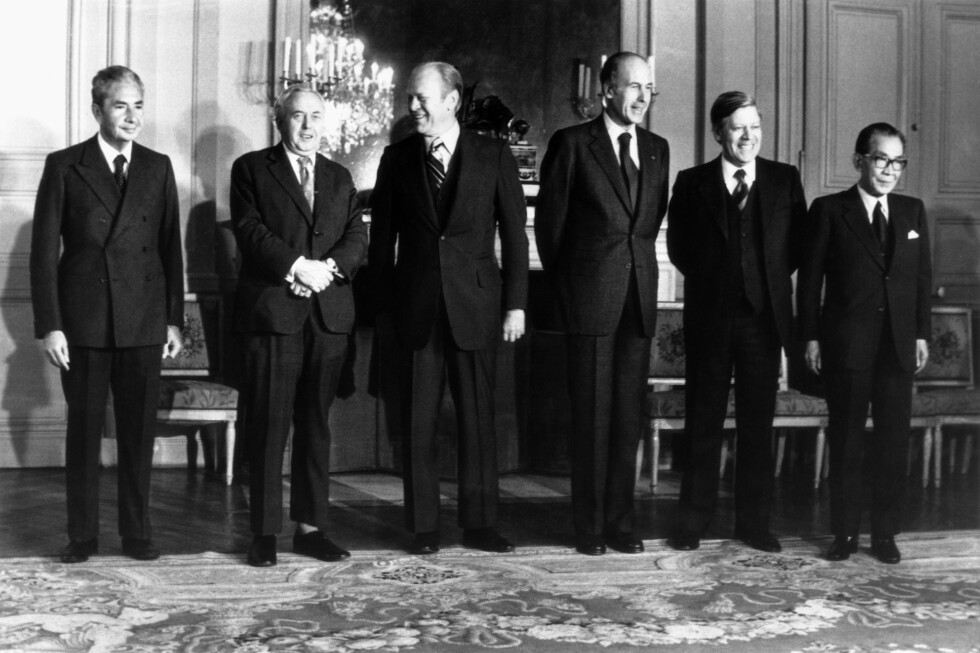
EDITOR’S NOTE: When U.S. President Gerald Ford and leaders of five other leading democracies gathered for talks at a castle outside Paris on Nov. 15, 1975, they planted the seed for what subsequently became the Group of Seven nations.

The initial six industrial powers that huddled at the Château de Rambouillet for three days of brainstorming about fixes for the global economy became the G7 the following year when Canada joined the elite club.

During and after the Cold War, the G7 became a powerful tool of influence, enabling Western allies and Japan to hammer out common positions not only on economic issues but also their foreign policy and security priorities.

The combined economic, industrial, military, and diplomatic strength of G7 nations ensures the summits they hold annually, rotating hosting duties, are always major news events.

Advertisement

The next G7 summit is in France next week.

As part of its coverage, The Associated Press is republishing extracts of the story that AP correspondent Arthur L. Gavshon wrote on the first day of the inaugural summit in 1975, hosted by French President Valéry Giscard d’Estaing and also including the leaders of West Germany, the U.K., Italy and Japan, as well as Ford.

___

By ARTHUR L. GAVSHON

Advertisement

RAMBOUILLET (AP) — President Ford called on leaders of five other major industrial nations Saturday to set themselves the task of transforming the world’s economic slump into prosperity by 1977.

Addressing the opening session of an economic summit meeting amid the splendor of the 14th-century Chateau de Rambouillet, Ford “categorically rejected the view” that expansion in the industrial world is impossible at pre-recession rates, an aide told newsmen.

He added that Ford said America’s economic recovery has been stronger than anticipated and forecast a growth rate of between 6 and 7 percent through 1976.

The first meeting with leaders of France, Britain, West Germany, Japan, and Italy began shortly after the President arrived at the historic chateau, 30 miles south of Paris.

Advertisement

The free-flowing talks broke nearly three hours later for dinner, and the host, French President Valéry Giscard d’Estaing, told newsmen: “I am optimistic. I think we can arrive at something concrete.”

A French spokesman said the leaders were reaching “a remarkable convergence of views.” British officials indicated a consensus was emerging that the worst of the economic downturn might already be over.

Advertisement

Secretary of State Henry A. Kissinger struck the same positive note, saying the meeting “went very well.”

The dinner was remarkably simple in comparison with the usual fare for a state occasion in France and was in line with the low-key approach favored by the French.

Stuffed chicken was the main course, with wines that were good but not spectacular.

In other developments at the six-nation talks:

Advertisement

— Japanese Prime Minister Takeo Miki who reported his country has been hurt by a decline in world trade, began pressing immediately for a freer flow of international commerce.

— British Prime Minister Harold Wilson disclosed through aides he wants his fellow leaders to back up a plan for a new and strengthened world code to check the spread of nuclear know-how, equipment, and weapons.

— Ford will join Giscard d’Estaing and Italian Prime Minister Aldo Moro Sunday morning for services at the Roman Catholic church in Poigny la Forêt, a 10-minute drive from the chateau.

The setting was priceless furniture and statuary trucked from the Louvre for the occasion, but the mood at the start of the summit was that of a relayed businessmen’s weekend seminar.

Advertisement

“It’s just a beautiful place here,” said Ford as President Valery Giscard d’Estaing of France led the participants from six nations into the pink and gray hall of marble at the chateau where Louis XVI passed idle hours and Napoleon his last night in France before banishment to St. Helena.

“The facilities are really gorgeous,” Ford said to Giscard d’Estaing. “It’s very comfortable.”

“I hope you feel as positive about all this afterwards,” Giscard d’Estaing shot back with a laugh. Then he called out “Helmut, oh Helmut,” as West German Chancellor Helmut Schmidt entered the room.

The relayed mood also was apparent in the dress of the leaders. Giscard d’Estaing wore a greenish tweed weekend suit, and Schmidt had on a light gray one. Ford was the most formally dressed of the leaders in a dark blue suit with a vest and white shirt.

Advertisement

The group, 18 in all including the finance and foreign ministers of participating nations, was spread out nine on each side of a 30‑foot long table. Giscard d’Estaing and Ford faced each other across the chestnut-colored upholstery covering the table, as did Harold Wilson of Britain and Aldo Moro of Italy, and Takeo Miki of Japan and Schmidt.

Each of the participants had earphones on which to follow proceedings. There were five closed-in interpreters’ booths at one end of the smallish room, and a bust of King Francois I of France, who died at the chateau, at the other end.

The leaders do not expect to reach firm decisions at the three-day seminar but to define directions their individual governments can take in fighting inflation, unemployment and declining world trade.

Presidential press spokesman Ron Nessen said during Ford’s flight across the Atlantic that the summit may result in an improved performance in the American economy.

Advertisement

“The President has always thought of it in practical terms – what it means to the American consumer,” Nessen said.

Each of the visiting leaders was assigned an apartment in the chateau, home of French kings and rulers from the 14th century. Moving men had worked until the early hours Saturday uncrating furniture and paintings brought from the Louvre to spruce up the rooms.

More than 3,000 armed French police were deployed around the wooded grounds and gardens of the palace.

Ford was given the top room of the Francois I tower, which a French spokesman described as “the most comfortable apartment in the chateau.” It has a Spanish-made bed with a working fireplace at the foot and a direct telephone linking Ford to the White House.

Advertisement

Prime Minister Harold Wilson of Britain was given an apartment done in mahogany and satin overlooking the garden ponds; Japanese Prime Minister Takeo Miki was down the hall in an apartment with heavy beams and Louis XVI furniture; Chancellor Helmut Schmidt of West Germany was in an apartment furnished in Directoire style, and Premier Aldo Moro of Italy had rooms furnished in Empire style.

With the idea of achieving general economic growth – and a cutback of the 15 million jobless in Western countries – the six nations intend to try to align their policies on such big issues as:

— The old French-American dispute over reform of the world monetary system. The French dislike the present floating exchange rates and want to return to a more rigid system while the United States and Britain would as soon leave the system flexible.

— The formulation of a common energy policy. Ford can count on majority backing for his view that the economic and political future of the industrial democracies cannot be left to the mercy of the oil producers. New sources of supply and new conservation programs should be jointly and quickly developed.

Advertisement

— The general world economic outlook and ways of tackling the inflation which is undermining political stability many places.

— Relationships between the older industrialized nations of the West, the newly rich producers of oil and other scarce raw materials, and the poorest developing lands.

Advertisement

Source link

Continue Reading

Trending

Copyright © 2025