

Connect with us
DAPA Banner
DAPA Coin
DAPA
COIN PAYMENT ASSET
PRIVACY · BLOCKDAG · HOMOMORPHIC ENCRYPTION · RUST
ElGamal Encrypted MINE DAPA
🚫 GENESIS SOLD OUT
DAPAPAY COMING

Sports

NBA Finals Takeaways: Anunoby delivers defining moment as Knicks near title

Published

on

Officially, historically, the craziest NBA Finals game of all time. 

In the space of 48 minutes, you had the San Antonio Spurs setting an NBA Finals record for made threes in a half (14) and the largest lead by a road team through the first two quarters (27 points). It seemed like what had already been a remarkable Finals in so many ways was going to get just a little bit weirder: with the veteran New York Knicks and upstart Spurs heading into Game 5 tied at 2-2, neither team having won a game on its home court. 

But the craziness was just getting started, with the Knicks eventually making the greatest comebacks in NBA Finals history.

After allowing the Spurs to shoot 59.6 per cent in the first half — including 53.8 per cent from three — and forcing just two turnovers and absolutely killing the atmosphere in Madison Square Garden along the way, the Knicks decided to play some defence in the second half. That, combined with some regression in San Antonio’s shooting, a rising energy in the Garden and the youthful Spurs — for one of the few times in this post-season run — looking like a team that relies heavily on a rookie (Dylan Harper), a second-year player (Stephon Castle) and a third-year superstar (Victor Wembanyama). The possessions got rushed. Too many hasty threes were settled for, and suddenly the Spurs couldn’t hang onto the ball. The Knicks cut what was a 29-point Spurs lead with 9:40 to play in the third quarter to 15 to start the fourth. 

Advertisement

But even with that, the Spurs pushed their advantage to 20 with 9:33 left in the gam, when Wembanyama tipped in his own missed lay-up. 

But then everything fell apart — for the Spurs at least. 

The team that couldn’t miss in the first half made just eight field goals on 39 attempts in the second half, 4-of-19 in the fourth quarter. After setting an NBA record for three-point shooting in the first half, they shot 3-of-17 from deep in the second. After making just two turnovers in the first half, they made five in each of the third and fourth quarters. 


It was a total collapse, punctuated in some ways by Wembanyama — an 86 per cent free-throw shooter through these playoffs — missing three free throws in the fourth quarter, including a pair with 1:47 left and the Spurs clinging to a one-point lead. He had 23 points, 13 rebounds and three blocked shots, but was just 9-of-25 from the floor.

Advertisement

Meanwhile, the Knicks and Knicks fans will long celebrate the greatest single game in the history of one of the NBA’s charter franchises, going back to 1946. 

It culminated in a hard-to-believe 107-106 win that gave the Knicks a 3-1 lead as the series shifts back to San Antonio for Game 5 on Saturday, where the Spurs will have to win to avoid elimination. 

Most NBA players go their entire careers without making a meaningful play to decide an NBA Finals game. Knicks star OG Anunoby made two legacy-defining plays in the final 11 seconds of Game 4 that will make him the toast of New York for the rest of his life, should the Knicks close out the Spurs and win their first title in 53 years. On the first play, when he tracked down Spurs guard De’Aaron Fox in transition, it appeared that the speedy Fox was going to be able to take a long rebound and sneak by the Knicks’ defence for a lay-up that would have put the Spurs up by three with 11 seconds to play. Nope. Anunoby — as he does so many times on transition plays in the series — was able to turn away the certain seeming score. 

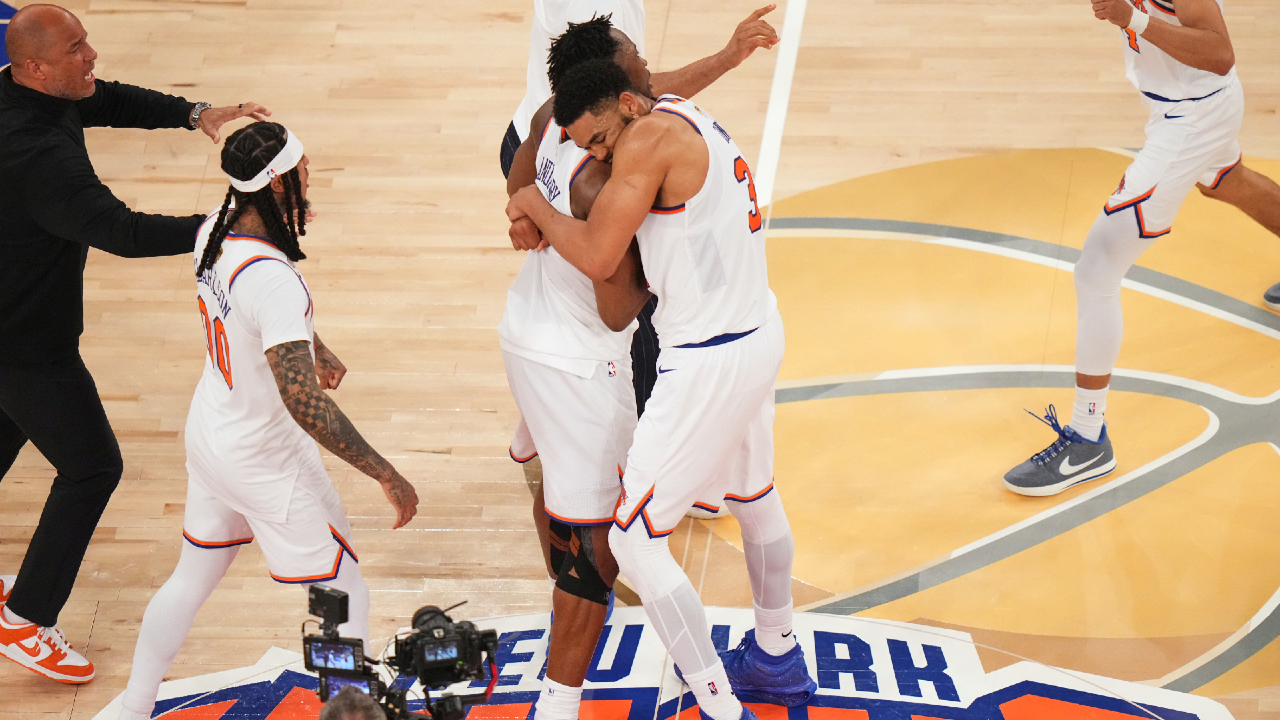
That was only to set up the biggest play he’ll likely ever have in his career. With the Knicks down by one and just 4.3 seconds left, it was looking very much like their historic comeback was going to fall just short. Instead, Anunoby ran into the lane following a Jalen Brunson three-point attempt, timed his leap perfectly and managed to tip the long rebound gently back into the rim with his right hand at least one foot above it. Bedlam. 

Advertisement

The Knicks were able to defend the Spurs’ last chance off an inbounds pass with 1.2 seconds left. 

The block and the tip-in capped as complete an all-around game as is possible to play for a (superstar) ‘role’ player who took just 15 shots but scored 33 points while going 7-of-9 from three. As well, he took turns guarding — to great effect — everyone from Wembanyama at seven-foot-four, fighting him at the rim, to Fox, squaring up the Spurs guard on the perimeter down the stretch in the fourth quarter. 

The playoffs are, by definition, full of noisy information that gets overemphasized based on the outcome of each game. The Spurs led the first three games in the final two minutes but won only one of them. Would the information we’ve gleaned to this point in the series mean any less or any more had they won two of them, or all three? The difference splitting the Knicks and Spurs through six halves of the most intense basketball imaginable was seven points. 

But what the heck, the games have to mean something, right?

Advertisement

There were at least three data points that seemed correlated to each team’s success heading into Game 4. The first was the ratio of Wembanyama’s shots in the restricted area to shots from the three-point line. In the Spurs’ two losses, it was 4:3. In their Game 3 win, it was more than 2:1. In Game 4? Wembanyama took eight threes (making just two) and 11 shots at the rim, so it would seem that when Wembanyama is more focused on getting shots off around the restricted area, the better off the Spurs are. 

Another was turnovers. It’s been a low-turnover series, given how physical the defence has been, but in the first three games, the team that came out ahead in the turnover margin won. That the Spurs turned it over only eight times total — less even than the paltry 13.5 they averaged during the regular season, which was the fourth-best mark in the NBA — was one of the key underlying reasons the Spurs won in Game 3.

In Game 4? Turnovers were arguably the story of the game. When the Spurs jumped out to a 27-point first-half lead, they had a 7-2 advantage in turnovers. When the Knicks beat the Spurs by 28 points in the second half, it was New York that had the turnover advantage, 10-7. 

One trend that was constant through the first three games was the Knicks’ advantage on the offensive glass. They came into Game 4 with a 36-20 edge in that category, winning the battle in all three games, with a commensurate edge in second-chance points. That trend reversed itself in Game 4, with the Spurs having a 12-8 advantage in offensive rebounds, but missing 31 shots in the second half probably had a lot to do with that. And then again, the Knicks got the most important offensive rebound of the series on Anunoby’s soaring, game-winning tip-in. 

Advertisement

Brunson in a no-win situation, but still wins

Prior to meeting the Spurs, and as the Knicks were layering onto one of the most dominant runs in NBA playoff history, Brunson was just his typical superstar self. In the first three rounds of the playoffs, the Knicks star was averaging 26.9 points over 14 games, along with 6.6 assists and 2.3 turnovers with an effective field goal percentage (capturing the value of two and three-point field goals) of 54.1, all numbers very close to his season averages (26/6.8/2.4 with an eFG of 53.3). As well, his usage rate stayed pretty constant — 30.4 per cent in the regular season compared to 30.7 in the first three playoff rounds. But against the Spurs and the relentless defensive pressure they can put on him, Brunson’s efficiency has cratered.

If the Spurs were able to knock two-time MVP Shai Gilgeous-Alexander off his game, it makes sense that Brunson — about five inches shorter than the Thunder star — would struggle. He came into Game 4 with an effective field goal percentage of 41.4. Among qualified players, the lowest eFG during the regular season was New Orleans Pelicans rookie guard Jeremiah Fears at 48.5. But what has possibly hurt the Knicks more is that his usage rate has skyrocketed, jumping from 30.7 over the first 14 playoff games to 39.6 in three games against the Spurs. The reason is that the Spurs don’t have to trap him and can put pressure on him without automatically sending a second defender. Brunson has to put in more work to put up worse shots. 

But Brunson finds a way. He got rolling in Game 4, delivering his best game of the series when the Knicks absolutely needed it, as he finished with a game-high 36 points on 12-of-25 shooting. He scored 19 seemingly inconsequential points in the first half when it seemed like they were just going to be empty calories. To his credit, Brunson kept his foot on the gas. And then — as he does — he delivered clutch score after clutch score down the stretch in the fourth quarter, taking advantage of the Knicks going to a smaller lineup, spreading the floor and dragging Wembanyama from the rim. It was Brunson’s driving floater with 1:22 left that gave the Knicks their first lead and set the Garden on fire.

Advertisement

Wembanyama picked up a flagrant foul in the third quarter for an inadvertent elbow to the jaw of Karl-Anthony Towns. There was no intent and Wembanyama instantly apologized for catching Towns as he tried to break free of the Knicks star’s meaty hands. But the NBA doesn’t allow for a lot of leeway for contact to the head that isn’t a result of a play on the ball. But it was a non-call on a very intentional shot to the head — in this case, Brunson’s head — in Game 3 that could have an outsized role in the series. One of the NBA’s disciplinary measures is that, as flagrant fouls accumulate, they can result in an automatic suspension. A flagrant 1 — like the foul Wembanyama was called for on Game 4 — is worth one point. A flagrant 2 – where a foul is deemed intentional and dangerous — results in an instant ejection and is worth two points. A player who accumulates four total flagrant foul points over the course of the post-season is suspended for the next game.

This is why — some might remember — Draymond Green was suspended for Game 5 of the NBA Finals in 2016. It wasn’t because he kicked LeBron James in the groin; it was because the flagrant foul gave him four flagrant foul points for the playoffs. Since Wembanyama picked up a flagrant 2 for a nasty elbow to the head of Naz Reid of the Minnesota Timberwolves in the second round, his elbow to Towns’ jaw now gives him three flagrant foul points. If he picks up one more flagrant foul in Game 5 or 6, he’ll be suspended for the following game (the suspensions don’t take effect until after the game). The Knicks would argue that he should already have been suspended for his shove on Brunson in Game 3.

Source link

Advertisement
Continue Reading
Click to comment

You must be logged in to post a comment Login

Leave a Reply

Sports

Ping’s PLD Putting Lab showed me something I hadn’t seen before

Published

on

Source link

Advertisement
Continue Reading

Sports

Report: Ghana player to miss World Cup game after Canadian denial, says FIFA

Published

on

Ghana will be without a key midfielder for its World Cup opener.

Veteran Thomas Partey, who has been charged with seven counts of rape and one count of sexual assault in England over the last year, was denied entry to Canada, The Athletic reported on Friday.

In a statement to The Athletic, FIFA confirmed that Partey would miss Ghana’s Wednesday match against Panama at Toronto Stadium.

“FIFA can confirm that player Thomas Partey will be unable to travel from Ghana’s team base camp in Boston to Canada for their its match against Panama on Wednesday, June 17, as his visa application has been refused by the Canadian government. FIFA is not involved in the immigration processes of host countries, including the adjudication of visas. As with previous FIFA events, the host government ultimately determines who receives a visa and is admitted into the country,” the statement said.

Advertisement

Partey, who plays for Villareal but formerly suited up for Arsenal, was charged with five counts of rape and one count of sexual assault in London last July.

He was charged with two new counts of rape in September. He has pleaded not guilty on all.

The 32-year-old is still awaiting trial on the charges.

The Canadian government website says “if you have committed or been convicted of a crime, you may not be allowed into Canada.”

Advertisement

However, Immigration, Refugees and Citizenship Canada told The Athletic in a pre-tournament statement that its officers can deny access into the country.

“IRCC officers are trained decision-makers who assess an individual’s eligibility and admissibility in accordance with Canadian immigration laws. If they believe that an individual could pose a security risk, they may decide to deny them entry,” the statement said.

Partey will be able to return for Ghana when it moves to the U.S. for its final two group-stage matches against England and Croatia.

Source link

Advertisement
Continue Reading

Sports

Why NBA Players Earn More Than Footballers — The Truth About Sports Salaries

Published

on

One of the most common debates in sports is surprisingly simple:

Which athletes make more money?

Whether it’s football versus basketball, football versus baseball, or even footballers versus musicians, fans are constantly comparing salaries and wondering why one superstar appears to earn significantly more than another.

  • Aryna Sabalenka reacts emotionally during her French Open quarterfinal defeat after being knocked out of Roland-Garros 2026.Aryna Sabalenka reacts emotionally during her French Open quarterfinal defeat after being knocked out of Roland-Garros 2026.

Advertisement

The latest example involves New York Knicks star Jalen Brunson and Paris Saint-Germain forward Ousmane Dembélé.

On paper, Brunson reportedly earns substantially more in annual salary than Dembélé despite football being the world’s most popular sport and Dembélé being one of the biggest names in the game.

At first glance, it doesn’t seem to make sense.

Advertisement

But the reality is that comparing salaries across different sports often tells only part of the story.

The systems that generate and distribute money in football, basketball and even the music industry are completely different.

The Brunson vs Dembélé debate

The comparison that recently went viral showed that Brunson’s annual NBA salary is significantly higher than Dembélé’s reported fixed salary at Paris Saint-Germain.

That immediately raised questions.

Advertisement

How can an NBA player earn more than a footballer who plays for one of the biggest clubs in the world?

How can a player competing in a sport followed by billions of people earn less than a basketball player whose league is largely concentrated in North America?

The answer lies not in popularity, but in economics.

Why NBA salaries are so high

The NBA operates under a salary-cap system that is directly tied to league revenues.

Advertisement

Players receive a significant share of Basketball Related Income (BRI), meaning the league’s earnings are shared between owners and players.

More importantly, NBA rosters are small.

Each franchise typically carries around 15 players.

That means billions of dollars in league revenue are divided among far fewer athletes.

Advertisement

As a result, elite NBA players regularly sign contracts worth $40 million, $50 million or even $60 million per season.

Jalen Brunson’s contract reflects not only his value as a player but also the financial structure of the NBA itself.


Advertisement

Football clubs spend money differently

Football operates under an entirely different model.

When a club signs a player, the cost goes far beyond wages.

Clubs may have to pay:

  • Transfer fees
  • Agent commissions
  • Signing bonuses
  • Loyalty bonuses
  • Image-rights agreements
  • Performance incentives
  • Salaries

When Paris Saint-Germain signed Neymar from Barcelona, the French club spent a world-record €222 million transfer fee before accounting for wages.

Real Madrid paid over €100 million to acquire Jude Bellingham.

Advertisement

Those costs do not exist in the NBA.

Basketball teams generally spend their money directly on player salaries rather than transfer fees.

That is one of the biggest reasons NBA salaries often appear larger.

Squad sizes matter

Football clubs also carry much larger squads.

Advertisement

A Champions League club may have 25 to 30 senior players, plus academy players regularly training with the first team.

NBA teams typically have only 15 roster spots.

That means football clubs must spread their resources across far more players.

Even when football generates enormous revenue, the money is distributed differently.

Advertisement

Popularity doesn’t equal salary

One mistake many fans make is assuming popularity automatically determines earnings.

Football remains the world’s most popular sport.

Players such as Lionel Messi, Cristiano Ronaldo, Kylian Mbappé and Ousmane Dembélé are recognised across virtually every continent.

Yet popularity alone doesn’t dictate salary levels.

Advertisement

The NBA’s revenues are concentrated within a single league featuring just 30 franchises.

Football’s revenues are spread across hundreds of leagues and thousands of professional clubs worldwide.

The structure of the business matters more than follower counts on social media.

Why some musicians earn more than footballers

The same debate exists outside sports.

Advertisement

Fans often wonder why some musicians appear to earn more than elite footballers.

Again, the answer depends on where the money comes from.

A footballer’s income generally comes from:

  • Club salary
  • Bonuses
  • Sponsorship deals
  • Image rights

A musician can earn through:

  • Touring
  • Streaming royalties
  • Publishing rights
  • Merchandise sales
  • Brand endorsements
  • Ownership of music catalogues
  • Investments

Unlike athletes, musicians are not restricted by salary caps, squad budgets or transfer markets.

A global tour can generate hundreds of millions of dollars.

Advertisement

Artists such as Taylor Swift, Drake, Beyoncé, Burna Boy and Davido have built business empires that extend far beyond music itself.

In many cases, their total earnings can rival or exceed those of elite athletes.

The hidden value footballers create

Another factor often overlooked is the transfer market.

Football clubs treat players as assets.

Advertisement

A club may pay €100 million to sign a player and later sell him for another massive fee.

That transfer value becomes part of the player’s overall economic worth.

In the NBA, most of that value is reflected directly in salaries.

In football, it is split between wages and transfer fees.

Advertisement

That is why a player earning less than an NBA star may still represent a far greater overall financial investment.

The real takeaway

The next time a graphic comparing the salaries of an NBA player, footballer or musician goes viral, remember that salary alone rarely tells the full story.

Jalen Brunson earning more than Ousmane Dembélé does not mean basketball players are more valuable than footballers.

Likewise, a musician earning more than a footballer does not automatically mean the music industry is richer than football.

Advertisement

Each industry distributes money differently.

Different business models create different pay structures.

And while the numbers on the paycheck may grab attention, they are only one piece of a much bigger financial puzzle.

Advertisement

Source link

Continue Reading

Sports

JJ Gabriel, Michael Carrick, World Cup impact – Manchester United’s plan for pre-season

Published

on

JJ Gabriel, Michael Carrick, World Cup impact – Manchester United’s plan for pre-season – Manchester Evening News

reach logo

At Reach and across our entities we and our partners use information collected through cookies and other identifiers from your device to improve experience on our site, analyse how it is used and to show personalised advertising. You can opt out of the sale or sharing of your data, at any time clicking the “Do Not Sell or Share my Data” button at the bottom of the webpage. Please note that your preferences are browser specific. Use of our website and any of our services represents your acceptance of the use of cookies and consent to the practices described in our Privacy Notice and Terms and Conditions.

Source link

Advertisement
Continue Reading

Sports

Can any nation stop Europe’s dominance in the FIFA World Cup 2026? | FIFA World Cup 2026

Published

on


For decades, the FIFA World Cup’s greatest rivalry was not between nations but continents. South America gave the tournament its first champion when Uruguay lifted the trophy in 1930. Brazil would go on to win a record five titles, while Argentina produced some of the sport’s defining moments through Diego Maradona and, more recently, Lionel Messi.


Europe responded with dynasties of its own, from Italy and West Germany to France and Spain. The balance was remarkably even. Between 1930 and 2002, South American nations won nine World Cups and European countries won eight.


Advertisement


Every tournament seemed to reinforce the idea that football’s biggest prize belonged to two continents separated by an ocean but united by excellence. The modern World Cup tells a different story.


Italy won in 2006. Spain followed in 2010. Germany triumphed in 2014 and France in 2018. Argentina interrupted the sequence in Qatar four years ago, but Europe still claimed four of the last five titles and occupied eight of the 10 finalist spots during that period.


Advertisement


As the World Cup returns to North America in 2026, Europe once again enters as the continent everyone else must beat.


From rivalry to European supremacy


Looking at the World Cup’s honours list alone, the contest appears close. Europe has won 12 titles and South America 10. Yet those numbers mask a significant shift.


For much of the tournament’s history, South America often punched above its weight despite having only three traditional contenders in Brazil, Argentina and Uruguay. Europe enjoyed strength in numbers, but the trophy regularly crossed the Atlantic.

Advertisement


That has happened far less frequently in recent decades. Since 2006, European nations have established a level of consistency unmatched by any other confederation.


Three of the last five finals were all-European affairs, while only Argentina and Brazil have prevented Europe from completely monopolising the tournament’s biggest matches.

Advertisement


The semi-final numbers are even more revealing. Of the 20 available semi-final places across the last five World Cups, 15 were occupied by UEFA nations. Only Argentina, Brazil, Uruguay and Morocco managed to break through.


Europe’s dominance becomes even clearer when examining the finalists. Eight of the last 10 places in World Cup finals have been filled by European teams. Argentina are the only non-European nation to reach that stage during this period, doing so in 2014 and 2022.

Advertisement


Those figures showcase the difference between producing an occasional champion and sustaining excellence across an entire continent. Europe has not relied on a single golden generation or one dominant team. Instead, it has continuously produced multiple contenders capable of making deep runs and challenging for the trophy. 


Why Europe keeps producing contenders


The reasons extend well beyond international football. Europe remains home to the world’s strongest domestic leagues, largest clubs and most competitive football environment.


The Premier League, La Liga, Bundesliga, Serie A and Ligue 1 attract elite talent from every corner of the globe, exposing players to the highest standards week after week. That influence can be seen even among Europe’s rivals.

Advertisement


Argentina’s World Cup-winning squad in 2022 featured Europe-based stars such as Lionel Messi, Julián Álvarez, Alexis Mac Allister, Enzo Fernández and Cristian Romero. Brazil’s hopes in 2026 rest heavily on Vinícius Júnior, Rodrygo, Bruno Guimarães and Marquinhos, all of whom compete in Europe.


Morocco’s historic semi-final run in Qatar was driven by Achraf Hakimi, Sofyan Amrabat, Hakim Ziyech and Yassine Bounou, players whose careers were largely shaped within European football.

Advertisement


In many ways, Europe has become the centre of gravity in the modern game. Even nations hoping to end its dominance often rely on players developed within the same ecosystem.


FIFA rankings entering World Cup 2026


The latest FIFA rankings reinforce the argument. Seven of the world’s top 10 teams entering the tournament are European. Spain, France, England, Portugal, the Netherlands, Belgium and Germany all sit among the game’s elite.


Advertisement


Only Argentina, Brazil and Morocco break Europe’s monopoly at the top of the rankings.


That depth is perhaps Europe’s biggest strength. Most continents can point to one or two genuine contenders. Europe can point to half a dozen.


Advertisement


Spain arrive as one of the form teams in international football. France continue to possess a squad overflowing with talent led by Kylian Mbappé. England believe Jude Bellingham, Bukayo Saka and Phil Foden can help end a title drought stretching back to 1966. Portugal have blended experienced stars with a new generation led by players such as Rafael Leão and João Neves.


Even Germany and the Netherlands, often discussed as being a tier below the favourites, possess enough quality to challenge for the trophy.


Advertisement


Top 10 FIFA rankings entering World Cup 2026:


Rank

Team

Rating

1

Argentina

1877.27

2

Spain

1874.71

3

France

1870.7

4

England

1828.02

5

Portugal

1767.85

6

Brazil

1765.86

7

Morocco

1755.1

8

Netherlands

1753.57

9

Belgium

1742.24

10

Germany

1735.77

11

Croatia

1714.87

12

Italy

1704.73

13

Mexico

1700.98

14

Colombia

1698.35

15

Senegal

1684.07

16

Uruguay

1673.07

17

USA

1671.23

18

Japan

1661.58

19

Switzerland

1650.06

20

IR Iran

1619.58


Argentina and Brazil lead the resistance


If history offers one lesson, it is that writing off South America is dangerous.


Advertisement


Argentina arrive as defending champions and remain one of the most complete teams in the tournament. While Messi’s presence inevitably attracts attention, Lionel Scaloni’s side is increasingly defined by the generation that emerged around him. Julián Álvarez, Enzo Fernández, Alexis Mac Allister and Cristian Romero are entering their prime years and provide the foundation for another serious challenge.


Brazil’s pursuit of a sixth title has become one of football’s longest-running stories. More than two decades have passed since their last triumph, yet few nations can match their depth of attacking talent. Vinícius Júnior remains one of the world’s most dangerous forwards, while Rodrygo, Endrick and Bruno Guimarães give Brazil the firepower to compete with any opponent.


Advertisement


Under Carlo Ancelotti, Brazil hope to turn potential into silverware. Together, Argentina and Brazil remain the most realistic non-European challengers to UEFA’s dominance.


Morocco showed another route is possible


For years, conversations about potential World Cup winners rarely extended beyond Europe and South America. Morocco changed that in Qatar.


The Atlas Lions became the first African nation to reach a World Cup semi-final, defeating Belgium, Spain and Portugal along the way. Their success was built not on fortune but on tactical discipline, defensive organisation and a squad capable of competing with elite opposition.

Advertisement


Achraf Hakimi remains the team’s standout figure, but Morocco’s strength lies in the collective quality of a generation that includes Brahim Díaz, Noussair Mazraoui and Youssef En-Nesyri.


Senegal also carry African hopes into the tournament. Led by Sadio Mané, Kalidou Koulibaly, Nicolas Jackson and Pape Matar Sarr, they possess the experience and talent to trouble more established powers.

Advertisement


Neither nation starts among the favourites, but Morocco’s breakthrough proved that barriers once considered permanent can be broken.


Can the rest of the world catch up?


Every World Cup arrives with its own surprises. Croatia reached the final in 2018 despite a population of fewer than four million. Morocco became Africa’s first semi-finalist in 2022. Argentina ended Europe’s run of titles in Qatar when many expected another UEFA champion.


Advertisement


Those examples serve as reminders that football rarely follows a script. Yet when viewed across multiple tournaments rather than a single month, the evidence remains difficult to dispute.


Europe has won four of the last five World Cups. UEFA nations have occupied 15 of the last 20 semi-final spots. Seven of the world’s top 10 teams come from Europe.


Advertisement


The challengers are undoubtedly stronger than they were a decade ago. Argentina are defending champions. Brazil remain Brazil. Morocco have shown Africa can compete with the very best.


But until another continent consistently matches Europe’s success on football’s biggest stage, the burden of proof remains with the challengers.


Advertisement


The World Cup’s history has always moved in cycles. The current one belongs to Europe.

Source link

Continue Reading

Sports

Ivory Coast vs Ecuador Prediction and Betting Tips

Published

on

Group E sees Africa and South America collide in the 2026 FIFA World Cup, as Ivory Coast face Ecuador at Philadelphia Stadium in Pennsylvania on Sunday. The Elephants last featured at a World Cup in 2014.

Ivory Coast have won all three of their friendly matches in the lead-up to the World Cup this year. In March, Ivory Coast thrashed South Korea 4-0 and beat Scotland 1-0.

Coach Emerse Fae’s team only organized one friendly match in June, but it was a big one against World Cup favorites France, with Ivory Coast securing an unexpected 2-1 victory over their more illustrious opponents.

France took the lead in that match on the stroke of halftime thanks to Man City star Rayan Cherki, but Ivory Coast had other ideas, and a second-half fightback produced goals for Guela Doue and Amad Diallo, giving the Elephants an impressive victory.

Meanwhile, Ecuador placed second (29 points) in the CONMEBOL qualification table for the 2026 FIFA World Cup to qualify automatically. Only Argentina, on 38 points, finished above them.

The South Americans played two warm-up games in the last few weeks. La Tri beat Saudi Arabia 2-1 on 30 May. Jackson Porozo and Anthony Valencia scored the goals for Ecuador, with Sultan Mandash providing a late consolation strike for Saudi.

A few days later, on Sunday, 7 June, Ecuador defeated Guatemala 3-0, with Jordy Caicedo’s 19th-minute penalty breaking the deadlock before further goals from Nilson Angulo and Pervis Estupinan gave El Tri a comfortable win.

Advertisement

Four-time world champions Germany and World Cup debutants Curacao complete the Group E quartet.


Ivory Coast vs Ecuador head-to-head stats and key numbers

  • This will be their first-ever meeting on a football pitch at senior level, and they will both be determined to get a positive result to kick off their World Cup journey.
  • Ecuador have qualified for five World Cups, including this one, while this will be Ivory Coast’s fourth World Cup.
  • Ivory Coast topped their qualifying group with an unbeaten record that featured eight wins and two draws.
  • Ecuador striker Enner Valencia is a goal-scoring machine and his country’s all-time leading goal-scorer, having netted 49 goals in 105 caps.

Ivory Coast vs Ecuador prediction

Both these teams have very strong defensive records and prioritize compact backlines designed to blunt their opponents’ attacking edge.

Counterattacks will be key in a match that is expected to be cagey and tactical, with Ivory Coast’s powerful attacking players matched with Ecuador’s disciplined defense in an entertaining battle.

We could see a one-goal margin in favor of either side, but we are predicting a low-scoring draw.

Prediction: Ivory Coast 1-1 Ecuador

Advertisement

Ivory Coast vs Ecuador betting tips

Tip 1: Draw

Tip 2: Both teams to score

Tip 3: Ecuador to score first