
Crypto World
Blockworks Acquires Messari in Crypto Data Consolidation



Crypto data and media company Blockworks has acquired rival research platform Messari, the Wall Street Journal reported Friday. Bloomberg also confirmed the deal. The acquisition joins two of the most prominent names in crypto data and research. Blockworks, cofounded by Jason Yanowitz and Michael… Read the full story at The Defiant



South Korea will begin taxing cryptocurrency gains at a combined rate of 22% from Jan. 1, 2027, ending expectations that the long-delayed measure could be postponed for a fourth time.
Summary
- Annual crypto gains above 2.5 million won will become taxable as “other income.”
- Investors will pay 20% national tax plus 2% local income tax on gains exceeding the allowance.
- Critics warn that the absence of loss carryforwards could push trading toward offshore platforms.
- A pending opposition bill could still repeal the provisions before the rules take effect.
South Korea confirms crypto tax launch
Deputy Prime Minister and Finance Minister Koo Yun-cheol confirmed the implementation schedule during a National Assembly Finance and Economy Planning Committee meeting on July 29.
“We are pushing forward with the plan to tax cryptocurrency starting next year as scheduled,” Koo said.
Under the Income Tax Act, income earned by transferring or lending virtual assets will be classified as other income. Annual gains exceeding 2.5 million won, or about $1,740, will face a 20% national tax. A local income tax raises the combined rate to 22%.
Investors whose annual gains remain below the threshold will owe no tax under the framework. Taxpayers are expected to file their first returns in May 2028 for income earned during 2027.
The government first approved the levy in 2020 and planned to introduce it in January 2022. Lawmakers initially postponed implementation until 2025 before a December 2024 amendment moved the deadline to 2027. South Korea’s National Assembly approved that latest delay through revisions to the Income Tax Act.
Loss rules raise offshore trading concerns
People Power Party lawmaker Kim Sang-hoon questioned the tax design during the committee meeting, arguing that investors would not be allowed to offset losses against gains earned in later years.
Kim warned that the restriction could encourage traders to move activity away from domestic exchanges, including Upbit, Bithumb, Coinone and Korbit. Possible alternatives include overseas centralized exchanges, decentralized finance platforms and peer-to-peer markets.
Such a shift could reduce trading volume and tax visibility inside South Korea. Kim argued that implementation should wait until the OECD’s Crypto-Asset Reporting Framework is fully operational, allowing authorities to exchange tax information across borders.
Koo acknowledged the concern but said moving virtual assets into a capital-gains framework would require a broader review of South Korea’s tax treatment of financial markets. He left open the possibility of revising the system after authorities collect operational data.
A separate opposition bill introduced in March seeks to remove crypto income from the Income Tax Act entirely. Lawmakers referred the proposal to a subcommittee on July 29, meaning repeal or another delay remains legally possible before the end of 2026.
Crypto policy develops beyond taxation
The tax confirmation comes as South Korea considers a broader regulatory framework for digital assets and stablecoins.
Hashed Open Research and the Solana Policy Institute called for interim stablecoin licensing guidance in a policy report published July 29. The recommendations include temporary rules covering issuance, payments, permitted activities and foreign-issued tokens while lawmakers negotiate the Digital Asset Basic Act.
The proposals are advisory and do not change existing law. However, the report argues that waiting for the complete legislation could leave businesses without clear requirements for issuing or using won-backed stablecoins.
South Korea is also expanding state-backed investment in technology. As crypto.news previously reported, the government approved plans for a 20 trillion won investment account under the Korea Investment Corporation.
Unlike KIC’s existing overseas-focused portfolio, the new account can invest domestically in artificial intelligence, data centers and other industries considered strategically important.
What the tax means for US investors
The Korean framework differs from the US approach, where the Internal Revenue Service generally treats digital assets as property. US taxpayers can use capital losses to offset capital gains, subject to the applicable tax rules and reporting requirements.
South Korea’s lack of loss carryforwards could therefore leave some active traders with a less flexible tax position than US investors. The direct tax applies to income covered by Korean law, but US investors using Korean platforms should still monitor whether exchanges change access, reporting requirements or available products before 2027.
Domestic exchanges must now prepare their reporting infrastructure, while lawmakers consider the repeal bill and possible changes to loss treatment. Unless the National Assembly intervenes, the 22% levy will take effect on Jan. 1.


Talk about crypto trading with any savvy trader, and the first thing that comes up these days is perpetual futures, or “perps” — derivatives contracts that allow traders to control a much larger position than the money held in the account. Perps work like standard futures, but with one key advantage: there is no expiry.
While bitcoin and ether traders can dabble in spot, futures, options, perpetual futures and even structured products, for traders of other altcoins, perps are perhaps the only avenue for derivatives available to them. Dated futures (those with expiry) for altcoins are illiquid, and the spot market is an afterthought for anybody who doesn’t plan to hold.
So, CoinDesk talked to traders who have thrived in the perpetual futures market to explain what makes perps different from other derivatives, how they help efficiently manage the needs of institutional traders and retail traders alike and what perps trading actually costs.
Their answers were clear and nearly unanimous: everyone loves perps because of their deep liquidity, cheap trading fees and brutal margin efficiency, which is the amount of trading exposure you can get per unit of collateral you post.
But trading fees aren’t the only expense for traders. There’s also a recurring cost for keeping positions open, called funding rates. Think of it as an interest charge that builds up the longer you hold, and the traders we spoke with are concerned about how much this could add up.
Why perps?
If you ask traders why crypto perps average a daily volume of over $200 billion, they’ll tell you it’s not a matter of choice, but one of necessity.
Lucas Krenn, a derivatives trader at market-making firm STS Digital, and an independent trader for six years, said perps are the plumbing underneath everything the firm does.
“Outside bitcoin and ether, dated futures liquidity is thin to the point of being unusable,” he said. “So perps are not one tool among several. For a crypto native firm, they are the tool.”
Dated futures aren’t popular mainly because they have to be replaced with new contracts at expiry, and that process costs money. Those same costs are why futures-based ETFs tend to be less efficient than spot ETFs.
Liquidity refers to the market’s ability to absorb large buy and sell orders at stable prices. Per Krenn, standard dated futures are largely illiquid, meaning a few big orders can easily sway prices in either direction, raising slippage and spoiling execution for traders. (Slippage is the price at which the trade was submitted and the price at which it was actually executed.
Kenneth Ong, an independent trader for six years, with most of his trading activity concentrated in perps, explained a similar draw to perpetual futures from the perspective of a retail trader. According to Ong, perps offer better fills, meaning your order is executed at a more favorable price than you expected or than the ongoing market quote when you sent the order, lower fees, and the ability to run both sides at once via hedge mode. In simple terms, the hedge mode allows the trader to hold longs (bullish bets) and shorts (bearish plays) on the same token at the same time in the same account. These are treated as separate positions, not netted against each other.
That’s a big advantage over a regulated venue like CME, which offers standard futures in which a single account is typically netted by default.
Ong started in the spot market and drifted almost entirely into perps once he saw the difference. Spot, for him now, is “for actually holding something long term.”
Both Ong and Krenn told CoinDesk that margin efficiency was the real draw to perps. As noted earlier, for most tokens, perps listed across different exchanges are the only real venue to trade. That fragmentation is an issue for perps, but the leverage they offer, which is significantly greater than that of standard futures, helps manage risk efficiently across different venues and tokens.
Because perps require only a fraction of a position’s value as collateral, the same pool of capital can be split across a dozen venues and still back meaningful positions at each one.
Perps and price discovery
The always-on nature of perps has shifted price discovery to occur whenever the news breaks, not just whenever markets are open.
Ong found himself in the middle of this during the Iran conflict, which flared up repeatedly across the first half of 2026. It started with the conflict’s opening weekend in late February, when tokenized oil trading on Hyperliquid saw its first real surge in volume.
“That opening weekend, all the real reaction happened on crypto/tokenized commodity perps while the ‘official’ market was straight up closed,” Ong said. “By Monday, a chunk of the repricing already happened somewhere else.”
Krenn sees the same mechanism playing out in perps tied to other traditional assets.
For instance, building a proper tokenized equity product is genuinely hard primarily because it requires recreating the full legal, operational, and regulatory machinery of traditional share ownership on-chain. A perpetual that references the price sidesteps all of it, and is handy for those looking to just trade rather than invest for the long-term.
“That is why the instrument is so powerful and why it keeps spreading into new asset classes,” Krenn said.
Both traders see this perpification of various assets gaining momentum in the coming years. Ong said that tokenized oil trading over the weekend “is basically a preview” of what’s to come for other commodities. Deepen that liquidity across commodities and equities, and “it kills one of the last reasons to bother with dated futures at all,” he said.
Beware the funding rate
Ask any crypto trader what’s wrong with perps and you’ll usually get “liquidations,” or forced closure of long and short positions on account of margin shortage. But, according to Krenn and Ong, the funding rate is more of a cause for concern.
A dated futures contract tells you the interest rate of the trade right away. The trader knows exactly what he is getting into. A perpetual futures contract, on the other hand, has a funding rate that changes over time and is typically charged every eight hours. The trader, therefore, remains exposed to the floating rate while holding the position, with no built-in mechanism to lock it in. And if the market doesn’t move as expected, that funding rate becomes a burden.
“It is unquantifiable at the point of trade and unhedgeable afterwards,” Krenn said.
Ong was blunter in expressing his concern: “That funding’s not just some tiny fee you can ignore. It’s not. If you hold positions for long periods, it can potentially balloon to the point where a profitable trade loses money.”
The myth of the safe trade
Bitcoin’s current bear market kicked off with the Oct. 10 crash last year, which triggered widespread deleveraging across both losing and profitable positions. In a sense, it was the opposite of the Fed’s quantitative easing response to past crises, in which liquidity injections lifted both weak and strong assets alike.
.
On Oct. 10, exchanges socialized losses to protect their own systems. Longs got liquidated on price, which is normal. Then, profitable shorts were force-closed anyway, because the exchange’s insurance fund couldn’t absorb losses coming from the other side. Being right and being well-capitalized didn’t matter, and perpetuals faced a lot of criticism then.
But Krenn said the problem wasn’t with perps..
“It is not a perpetual problem. It is a crypto exchange margin model problem,” Krenn said. “Dated futures on those same venues sit behind the same insurance funds and the same deleveraging queue.”
“The distinction that matters is not perpetual versus dated [futures]. It is whether you are facing a proper clearing house with a mutualized default fund, or an exchange that socializes losses onto the winners,” Krenn added.
The asymmetry almost nobody prices correctly
Krenn, the institutional trader, offered one insight that inverts what most people assume about perp risk.
“Being long is the structurally safer side,” Krenn said.
His logic is that positive funding is easy to arbitrage away. Anyone holding stablecoins can buy spot, sell the perp, and pocket the spread, thereby compressing positive funding.
However, when the funding rate is negative, the arbitrage, involving a long position in the per and short position in the spot, the so-called reverse cash-and-carry is easier said than done. This only works if you can short the underlying token and only existing holders can readily short, and it becomes even more difficult if the circulating supply is small and concentrated. With arbitrage constrained, the gap between perp and spot prices can persist, meaning funding rates can stay extremely negative for long stretches.
Funding rates can stay extremely high or low for a long time.
“So the long side has a bounded cost and an unbounded upside. The short side has a bounded upside and an unbounded cost,” Krenn explained. “That asymmetry sits in very few risk models.”
He pointed to lending protocol Euler’s token this year as an example: a hard run on a listing, a small and concentrated float, funding on the perp going deeply negative, a situation where shorts “paying in the region of one percent every four hours,” to longs with almost nobody able to compress it because almost nobody had the token stash.
The takeaway
Perps seem to have democratized futures trading by solving the problem of access, cost and margin efficiency, but they are not without unique pain points, namely, the
volatile funding-rate exposure that can’t be quantified while taking bets and can’t be hedged once the trade is on.
As Krenn put it: “Until there is a liquid dated curve in crypto, the whole market is carrying an interest rate exposure it cannot price and cannot hedge.”
In the meantime, funding is the tax everyone pays for easy access to this leveraged market.
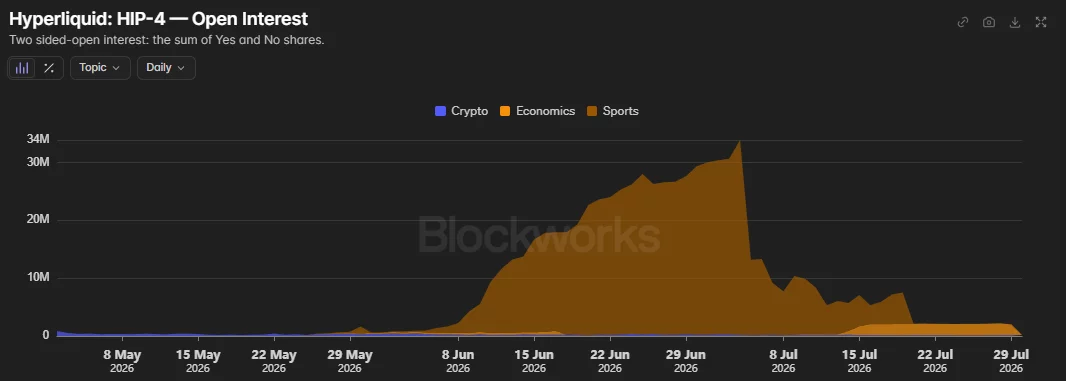
HYPE fell below $55 after Hyperliquid activated permissionless HIP-4 deployments on testnet, with whale transfers and broader crypto market weakness weighing on the token.
Summary
- HIP-4 permissionless deployments are now live on testnet, allowing developers to create prediction markets.
- HYPE declined almost 2% to around $54.70, losing the psychological $55 support level.
- HIP-4 markets hold roughly $182,000 in open interest and $881,000 in notional trading volume.
- A whale moved previously unstaked HYPE to FalconX and Coinbase Prime, according to Lookonchain.
Hyperliquid opens HIP-4 deployments on testnet
Hyperliquid has released the first implementation of permissionless deployments for its HIP-4 prediction-market framework on testnet.
The update allows developers to begin testing their own prediction and outcome markets on the decentralized exchange. Hyperliquid said it plans to introduce more features, including configurable fees and additional testnet templates.
HIP-4 extends the permissionless listing model used by HIP-3, which allows developers to deploy perpetual futures markets for different assets. The newer framework applies a similar approach to event contracts, placing Hyperliquid in closer competition with prediction-market platforms such as Polymarket and Kalshi.
A mainnet launch is expected to follow the testing phase, although Hyperliquid has not provided a confirmed date. Developers will likely use the testnet period to assess market settlement, liquidity, and contract configuration before deploying products involving real capital.
HIP-4 activity declines after the World Cup
Current activity on HIP-4 remains limited compared with established prediction-market platforms. Blockworks data shows that HIP-4 markets have about $182,000 in open interest and $881,000 in notional trading volume.
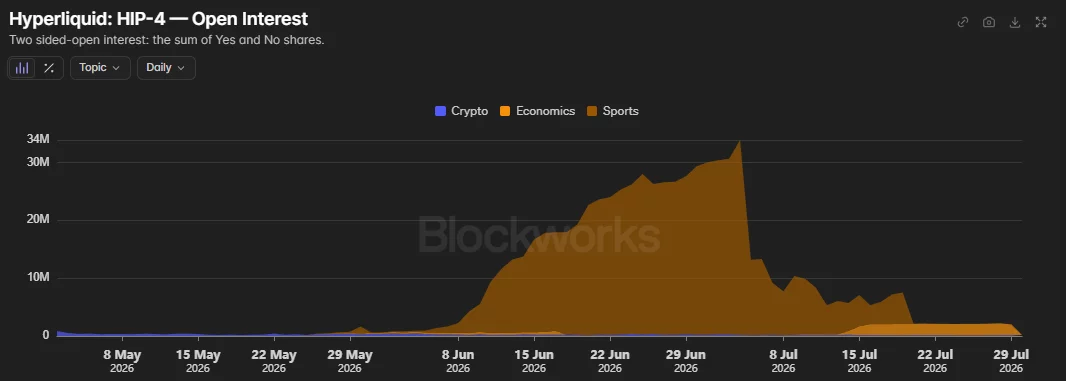
Sports contracts have accounted for most of the open positions. However, open interest has declined since the end of the 2026 FIFA World Cup earlier in July, reducing activity across Hyperliquid’s early event markets.
Permissionless deployment could broaden the available contract range beyond sports. Developers may eventually create markets tied to economic releases, elections and other measurable events, subject to the platform’s rules and applicable regulations.
The rollout also carries operational risks. Crypto.news reported on July 28 that Hyperliquid’s SK Hynix perpetual contract briefly dropped about 17.9% after an unusually low pre-market trade in South Korea affected its oracle price.
The market, listed as xyz:SKHX and displayed as SKHYNIX-USDC, tracks the U.S. dollar value of SK Hynix shares and offers leverage of up to 10 times. A Hyperliquid representative said Trade.xyz deployed and operated the market under HIP-3. Trade.xyz is investigating the incident and plans to release an update after completing its review.
Although that incident involved HIP-3 rather than HIP-4, it shows the importance of reliable pricing and settlement systems as Hyperliquid opens market creation to more developers.
HYPE price loses the $55 level
HYPE traded near $54.70 at the time of reporting, down almost 2% over the previous 24 hours. The decline pushed the token below $55 despite the HIP-4 testnet announcement.
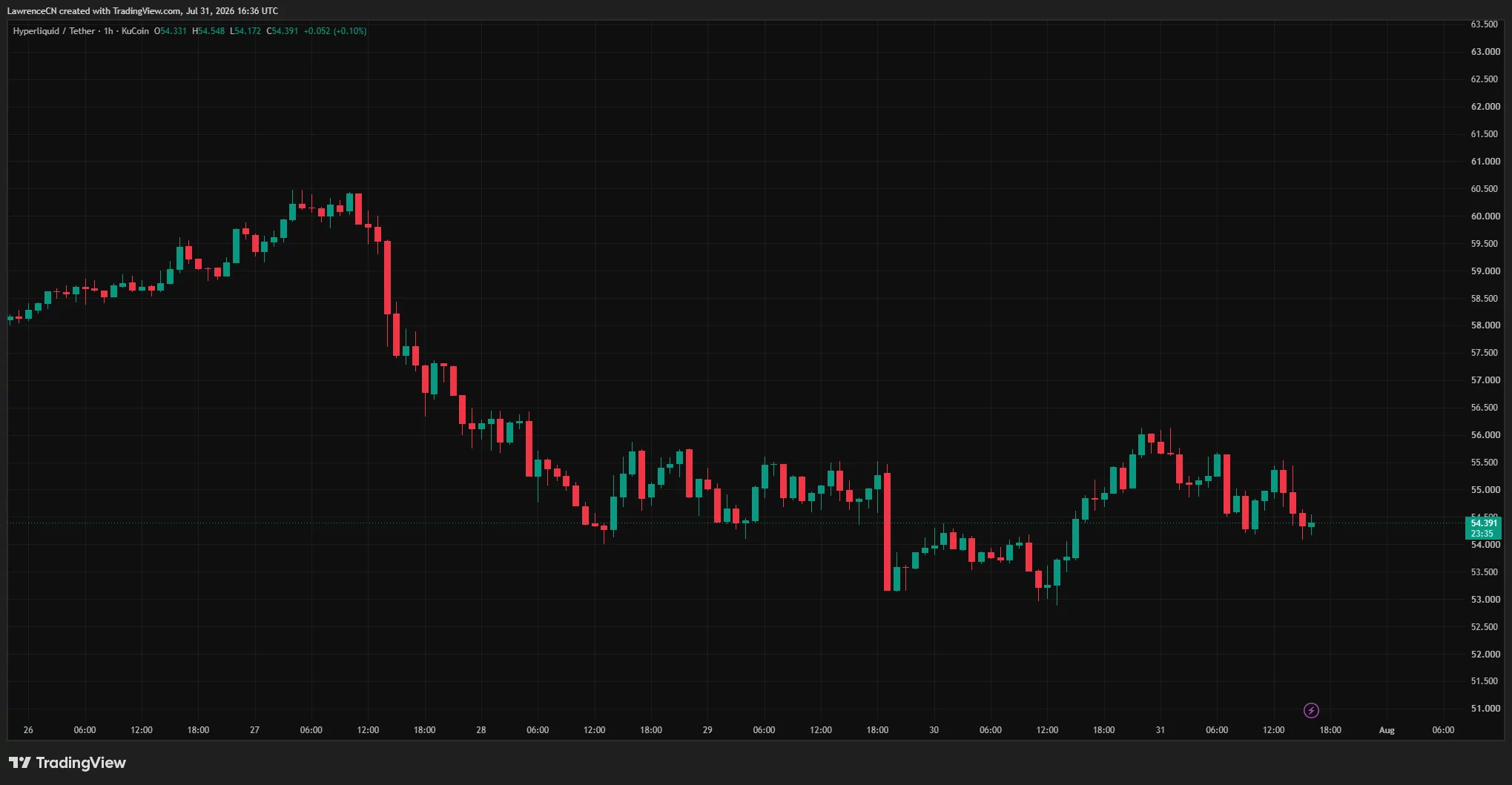
The move followed weakness across the broader crypto market as Bitcoin fell below $64,000. Risk appetite declined amid reports that the United States and Israel were discussing a land blockade on Iran, raising concerns about a further escalation of the conflict.
On-chain transfers added to the pressure. Lookonchain identified a whale that acquired HYPE at an average price of about $18 several months ago before unstaking the tokens and depositing them with FalconX and Coinbase Prime.
Transfers to institutional trading platforms do not prove that a sale occurred. However, they can increase expectations of incoming supply, particularly when the holder sits on a large unrealized gain.
US prediction-market rules remain in focus
HIP-4’s expansion comes as U.S. regulators consider clearer federal standards for event contracts.
The Hyperliquid Policy Center and Multicoin Capital filed a joint comment supporting the Commodity Futures Trading Commission’s proposed prediction-market framework on July 27. They argued that written standards would help operators structure event contracts while limiting policy changes between presidential administrations.
The CFTC proposal addresses how the agency reviews contracts involving gaming, war, terrorism, assassination and conduct prohibited under federal or state law. These rules could affect how prediction markets are offered to U.S. traders, even as Hyperliquid advances its permissionless infrastructure.
HIP-4’s mainnet timing, developer participation, and recovery in open interest will determine whether the framework can develop beyond its initial concentration in sports markets. HYPE, meanwhile, must reclaim $55 to ease the immediate pressure created by market weakness and potential whale selling.

Bitcoin’s reaction to the Bank of Japan’s latest policy decision may look calm on the surface, but one analyst believes a much bigger liquidity risk is building beneath global markets.
His warning came after the BOJ left its benchmark interest rate unchanged at 1% on July 31.
Japan’s Bond Market Dilemma Could Spill into Crypto
According to EGRAG CRYPTO, Japan’s financial system has run for more than three decades on the assumption that money would stay almost free. That assumption formed after the Nikkei peaked near the end of 1989, and policymakers spent the following decades pushing rates toward zero to avoid a repeat collapse.
The approach let Japan pile up one of the largest public debt loads of any developed economy, and the Bank of Japan became the biggest single buyer of its own bonds.
The analyst wrote that “Japan is approaching one of the most dangerous monetary crossroads in modern financial history,” pointing to wage growth that has pushed past 5%, a level not seen since before the country’s deflationary stretch started.
That change weakens the old case for near-zero rates. Raise them, and Japan risks losses for banks, insurers and pension funds sitting on low-yield bonds, plus higher refinancing costs on its own debt. Keep them low, and the yen keeps sliding, pushing up import costs on energy and food.
Cheap yen also fed the carry trade for years, with investors borrowing in Japan and buying higher-yielding assets abroad, including US Treasuries, tech stocks and Bitcoin. EGRAG warned that a fast unwind would force those same assets to be sold to repay yen loans, a chain reaction that would not stay contained to Japan.
“Foreign assets are sold → yen is bought → yen strengthens → more leveraged positions are forced to close,” he wrote.
Bitcoin traded close to $64,000 following the rate decision, per CoinGecko data, up almost 9% in the past 30 days, although it was down nearly 2% for the week and roughly 18% over three months. The OG crypto had earlier shrugged off the volatility that came after the US Federal Reserve kept interest rates unchanged at 3.50% to 3.75% during the week.
Other Analysts Have Been Here Before
The idea that Japan could become a source of tighter global liquidity is not new. Earlier in the year, analyst Ted Pillows argued that rising Japanese bond yields were already making the yen carry trade less attractive, reducing the flow of money into higher-risk assets such as cryptocurrencies.
More recently, market commentator Hupzy suggested prolonged yen weakness could continue supporting demand for Bitcoin and stablecoins, while warning that any sudden intervention by Japanese authorities could trigger short-term liquidations across crypto markets.
EGRAG himself stopped short of claiming that a major unwind is already underway. Instead, the analyst suggested that investors should closely watch the yen, Japanese government bond yields, Bank of Japan policy decisions and capital flows for signs that the country’s decades-old monetary system is beginning to change, with consequences that could eventually extend to Bitcoin and the broader digital asset market.
The post Japan’s Bond-vs-Yen Dilemma Could Shake Bitcoin and Crypto: Analyst appeared first on CryptoPotato.
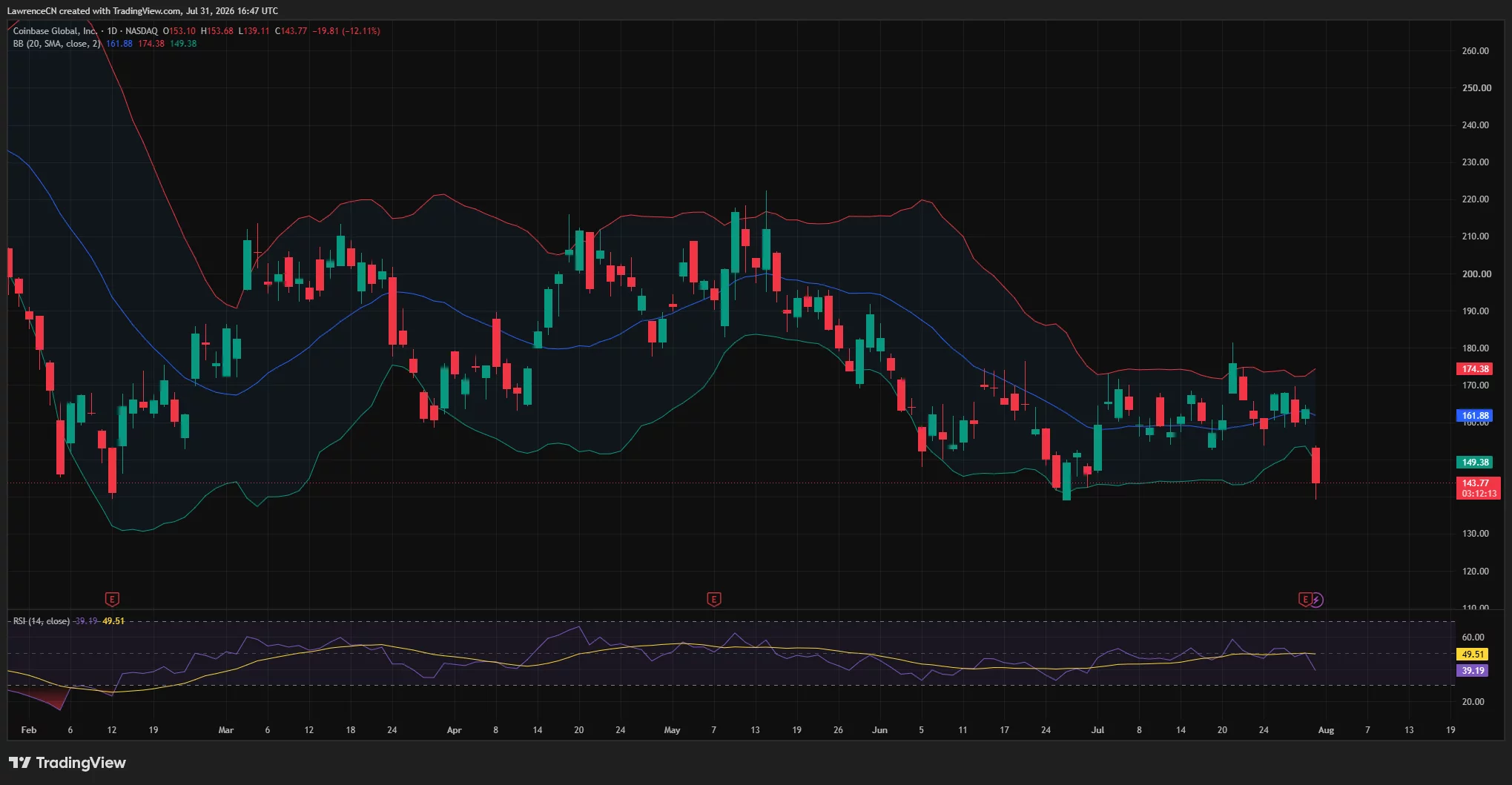
Coinbase stock extended its post-earnings sell-off on Friday, falling more than 12% as weaker trading revenue and a $359 million quarterly loss raised concerns about the exchange’s near-term growth.
Summary
- COIN fell 12.11% to $143.77, extending an initial 5.12% premarket decline.
- Second-quarter revenue reached $1.22 billion, below Wall Street’s $1.29 billion estimate.
- The stock broke below its $149.38 lower Bollinger Band, while daily RSI dropped to 39.19.
- Coinbase is targeting stablecoins, Base and prediction markets to reduce its dependence on trading fees.
Coinbase stock extends its post-earnings decline
Coinbase shares opened under heavy selling pressure after the company reported weaker-than-expected second-quarter results.
COIN traded at $143.77 at the time of the chart reading, down $19.81, or 12.11%, for the session. The stock touched an intraday low of $139.11 after opening at $153.10, showing that the sell-off accelerated after the opening bell.
The move followed a 5.12% premarket decline to $155.20. Coinbase had closed Thursday at $163.58 after gaining 2.18% during regular trading, but the earnings reaction erased that advance and pushed the shares to their lowest level since late June.
Weakness across the broader cryptocurrency market added to the pressure. Bitcoin fell 1.34% to approximately $63,655, while the total crypto market capitalization declined 1.11% to $2.18 trillion.
It matters for Coinbase because transaction fees remain tied to crypto prices and trading activity. Lower volatility or falling asset prices can reduce retail participation, even when the exchange gains market share.
Q2 revenue miss exposes trading slowdown
Coinbase reported $1.22 billion in second-quarter revenue, missing the $1.29 billion Wall Street estimate. Revenue fell 14% from the previous quarter and 18.5% from the same period last year.
The company also recorded a net loss of approximately $359 million. Lower retail and institutional transaction revenue weighed on the result as digital asset trading slowed across key markets.
Coinbase nevertheless said its share of global crypto trading volume reached a record 10.3%, up from 9.1% during the first quarter. The exchange has now gained market share for three consecutive quarters despite weaker conditions across the wider market.
Derivatives activity remained close to the previous quarter’s record, while event contracts and related revenue increased 106% quarter over quarter. That business surpassed a $100 million annualized revenue rate, according to the company.
Stablecoins also provided a source of growth. Average USDC held across Coinbase products reached a record $20 billion, representing more than 30% of the stablecoin’s circulating supply.
Chief Executive Brian Armstrong has positioned stablecoins, the Base blockchain and prediction markets as important parts of Coinbase’s expansion beyond spot cryptocurrency trading. Subscription and services revenue could also reduce its exposure to sharp changes in transaction activity, although the latest earnings show that trading conditions still have a large effect on overall performance.
Coinbase stock breaks below a key technical level
Coinbase’s daily chart shows that the earnings decline pushed the stock below the lower boundary of its Bollinger Bands.
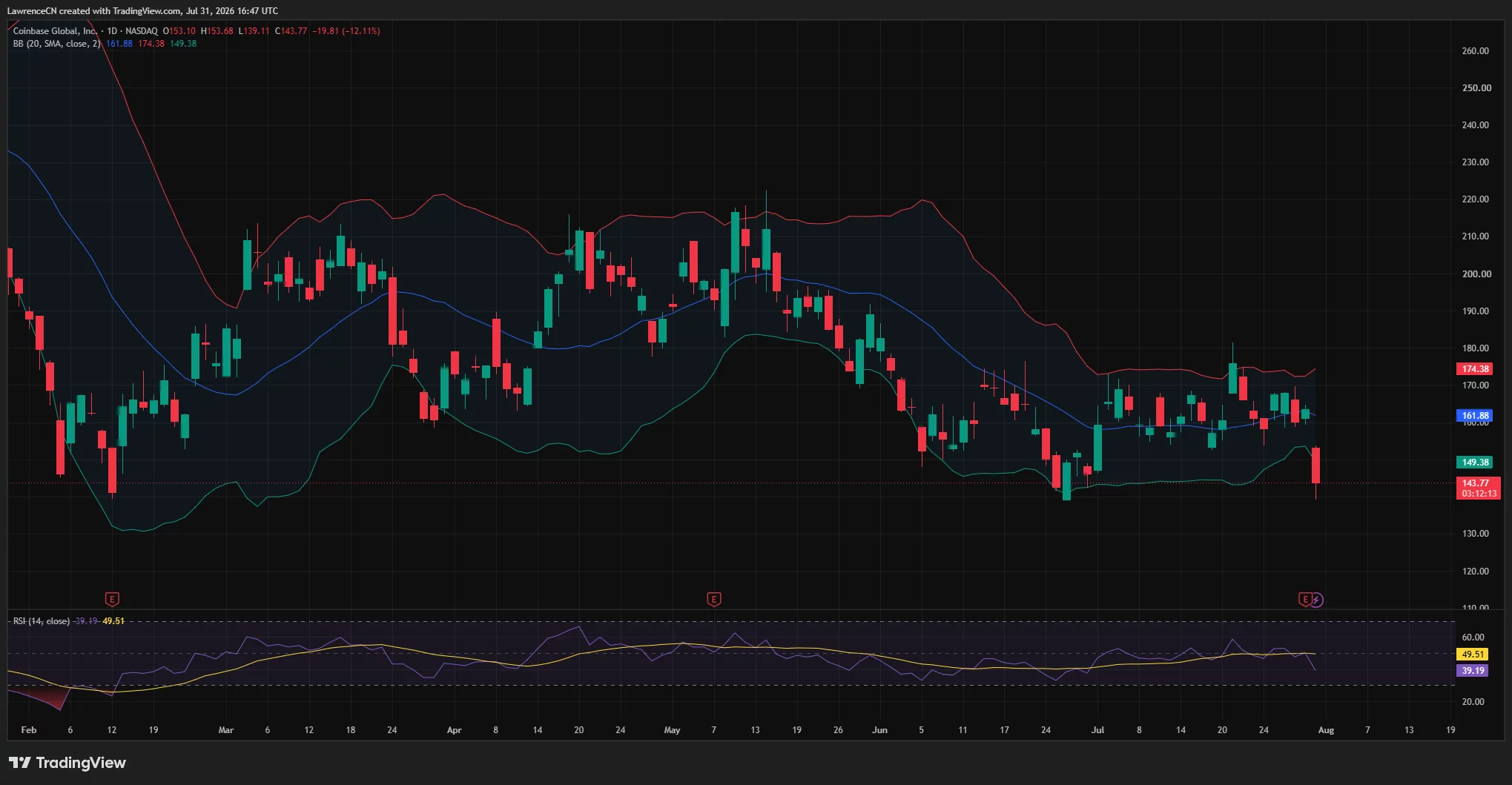
COIN traded beneath the lower band at $149.38 after reaching $139.11. A drop below that boundary suggests the selling move has stretched beyond the stock’s recent trading range, although it does not guarantee an immediate recovery.
The daily relative strength index fell to 39.19, below its signal average of 49.51. Momentum has weakened sharply, but the RSI remains above the conventional oversold threshold of 30, leaving room for additional losses if sellers remain active.
Immediate support sits between $139 and $140, where buyers briefly entered during Friday’s decline. A decisive break below that area could expose the $130–$135 region, which supported the stock during its February sell-off.
On the upside, COIN must first recover the lower Bollinger Band near $149.38. Further resistance sits around Friday’s opening range between $153.10 and $153.68.
A sustained rebound above those levels could shift attention toward the Bollinger midpoint at $161.88. That level now stands close to Thursday’s $163.58 closing price and represents a more demanding test for any earnings-driven recovery.
Leadership changes add to the uncertainty
The earnings decline follows several changes across Coinbase’s senior management team. As crypto.news reported one week before the results, the exchange replaced or reassigned four senior leaders after cutting 14% of its workforce.
Chief People Officer Lawrence Brock is scheduled to leave his role on Aug. 17, with Dominique Baillet expected to succeed him. Greg Tusar, co-head of Coinbase Institutional, has moved into a policy-focused position.
Paul Grewal also planned to leave his roles as chief legal officer and corporate secretary on July 31. Molly Abraham is set to become general counsel and secretary, while Ryan VanGrack will serve as Coinbase’s first vice chair and head of corporate affairs.
Coinbase separately appointed early company engineer Rob Witoff as chief technology officer on July 28. Armstrong credited Witoff with helping make Coinbase “one of the most AI-enabled companies in the world,” although that description represents the chief executive’s assessment rather than an independently measured ranking.
For U.S. investors, the earnings miss places more attention on Coinbase’s ability to turn its wider product strategy into recurring revenue. The company has expanded across derivatives, stablecoins, stocks and prediction markets, but COIN’s near-term direction may continue to depend on crypto trading volumes and whether the shares can recover above $149.
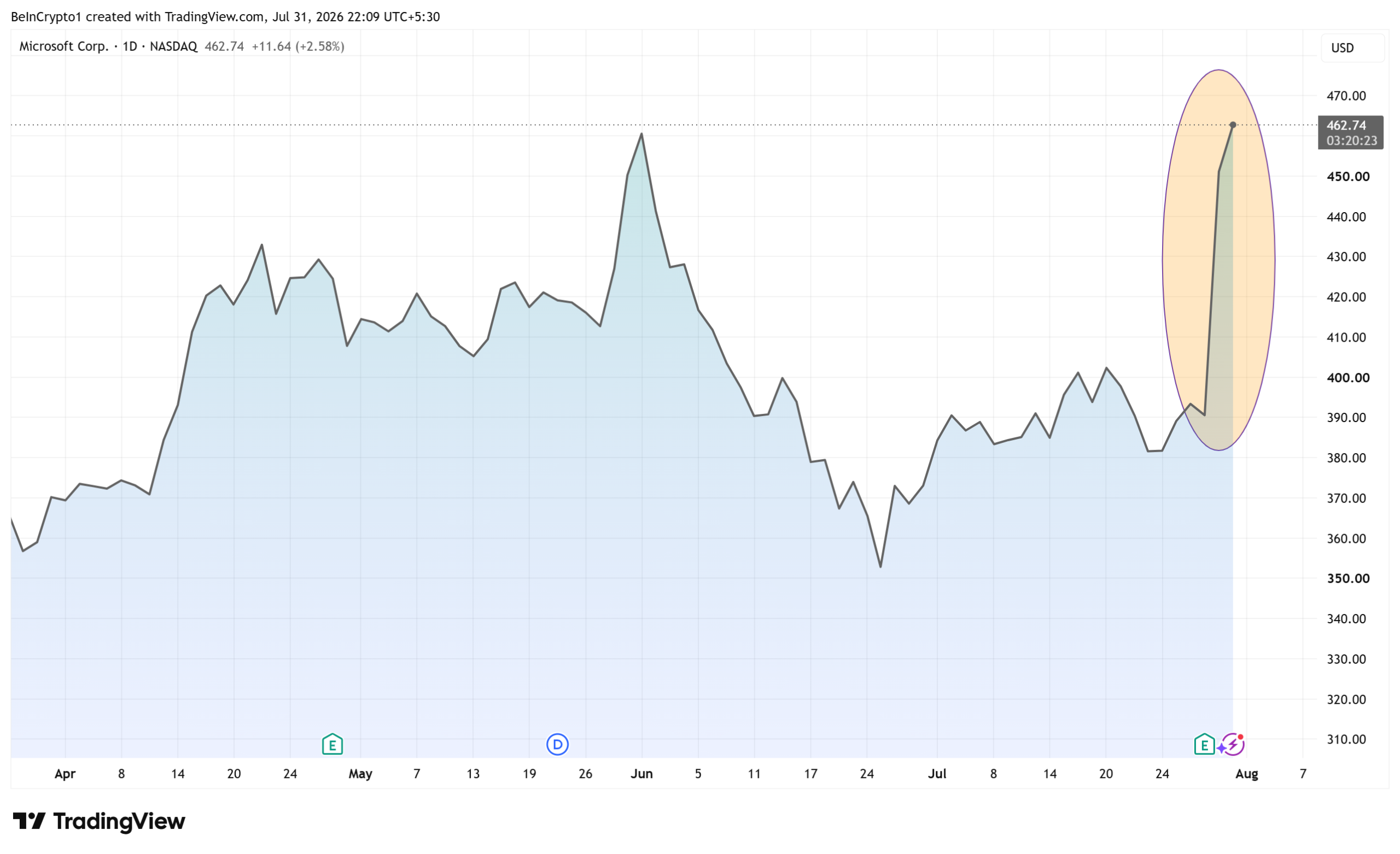
Microsoft investors have 11 days to take control of a fraud lawsuit. It says the company hid trouble inside Copilot, its main artificial intelligence product.
The timing is odd. Microsoft just set a US record for market value gained in a single day. The engine behind that gain was the same product the lawsuit attacks.

What the Lawsuit Says
The case covers anyone who bought Microsoft stock between May 1, 2025 and January 28, 2026.
Investors say Microsoft praised Copilot in public while hiding its flaws. They argue the stock traded far above what it was worth.
The suit sits in a federal court in Washington state. A police and fire pension fund from Michigan is named first.
The alleged flaws are simple ones. Confusing branding. Tools that did not work well together. Customers who tried Copilot and never paid for it.
The Day the Stock Broke
Microsoft reported fiscal second quarter results on January 28. Revenue rose 17% to $81.3 billion. Azure grew 39%.
Investors looked past those numbers. Record capital spending worried them, and Microsoft put Copilot at just over 15 million paid seats.
The complaint puts it harder. It says Azure growth slowed suddenly and the Copilot figure landed well below what analysts had modelled.
The stock fell the next day from $481.63 to $433.50. That is $48.13 gone, or 10%.
Similar suits have followed big tech AI spending letdowns all year.
Then Microsoft Came Roaring Back
On Wednesday, Microsoft posted $90 billion in fiscal fourth quarter revenue. Azure grew 43%. Copilot seats doubled to more than 30 million.
Shares jumped over 16% on Thursday. Microsoft gained roughly $450 billion in value, the biggest one-day rise any US company has ever posted.
“This year, Azure revenue surpassed $100 billion for the first time, and Microsoft 365 Copilot reached over 30 million paid seats, reflecting the confidence customers are placing in us to power their AI transformation,” Nadella said in the earnings release.
Follow us on X to get the latest news as it happens
The stock traded at $462.52 on Friday, up 2.53%. That is still under the $481.63 close before the January fall. The losses are real. So is the comeback, and Microsoft’s lawyers will say so loudly.

So Will Investors Get Money Back?
Most will not, and the few who do will likely wait years for a small cheque. August 11 is not a payday. It is the last day to ask the court to lead the case.
Anyone who bought in that window keeps the right to money later. No sign-up, no lawyer, and no fee.
The notices filling inboxes this week are adverts. Law firms send them after every big stock drop.
Microsoft will now ask a judge to throw the case out. Most suits like this die right there. The ones that survive tend to settle for a small share of the losses claimed, and that takes three years or more.
The rally makes the climb steeper. It is harder to argue investors are still out of pocket when the stock has clawed back most of the fall.
The lesson for traders is short. AI promises now carry legal risk, and that risk sits in the market’s biggest names. That matters while shares still move as one giant AI trade, and it belongs in any list of US stocks to watch in August.
The post Microsoft Copilot Lawsuit Deadline Is August 11: Will Investors Get Money Back? appeared first on BeInCrypto.


Memecoin platform Pump Fun reportedly fired staff members months before their Pump Fun tokens were about to be unlocked, leaving one employee cut off from a potential seven-figure payout.
That’s according to crypto news outlet Sandmark, which obtained recordings and files on the firings.
It reports that Pump Fun was able to grow its employee count to 100 this year. However, recordings of a March meeting revealed the platform’s co-founder Noah Tweedale telling staff that layoffs were needed as Pump Fun “grew too quickly” and couldn’t move “fast and rough.”
Sandmark claims that several employees were terminated in April. Many of those affected reportedly signed a token agreement in mid-June 2025 that would’ve seen a quarter of their Pump Fun tokens unlocked two months later.
According to one X account claiming to campaign on behalf of Pump Fun employees who were laid off before their vesting period unlocked, over 40 staff members have faced the chop in the last two months.
The account’s owner says they were laid off just one day before the vesting period unlocked, and that many of the employees were “treated like cattle.”
They have since restricted the account and deleted one of its posts.
Read more: Crypto firms cut jobs as bear market and AI shift bite
Pump Fun is behind on its regulatory filings
Sandmark also spotted that the business accounts of Pump Fun’s UK parent company, Baton Corporation, are overdue by one month. Indeed, UK Companies House states the accounts dated up to 30 September 2025 are yet to be filed.
It says the penalty for being more than a month overdue is £375 ($505), over three months is £750 ($1,010), and over six months will land Pump Fun with a fine of £1,500 ($2,020).
Of course, this is chump change for a firm that recently hit cumulative revenue of over $1 billion. Its PUMP token, however, is down almost 76% since it’s all-time high last September.
Read more: Coldcard attack: 25 minutes, 500 wallets, $38M in BTC gone
Pump Fun has joined a raft of crypto firms that have fired staff this year. However, the firm’s “grew too quickly” explanation appears to differ from the prevailing narrative across the industry.
When crypto exchange Coinbase announced in May that it would lay off 14% of its workforce, it claimed this was due to market conditions and Coinbase’s desire to incorporate AI.
Gemini also let go of 25% of its staff in February while citing AI changes, while Jack Dorsey’s Block cited AI when it decided to fire 50% (around 4,000 members) of its staff.
Got a tip? Send us an email securely via Protos Leaks. For more informed news and investigations, follow us on X, Bluesky, and Google News, or subscribe to our YouTube channel.


Senate leaders still intend to bring the CLARITY Act to the floor before the August recess, although unresolved negotiations and a crowded calendar leave the timing uncertain.
Summary
- Sen. Cynthia Lummis expects Senate action on the CLARITY Act before the August recess.
- Majority Leader John Thune has reportedly reserved floor time for the crypto market structure bill.
- Revised ethics language would let state authorities enforce restrictions on federal officials’ token activities.
- The Senate must navigate nominations, funding talks and sanctions legislation before leaving Washington.
Lummis says CLARITY Act remains on the agenda
Sen. Cynthia Lummis told crypto journalist Eleanor Terrett that Senate leadership is still seeking to take up the CLARITY Act before lawmakers leave Washington for their August recess.
Lawmakers have “one more week here in Washington,” according to Lummis. She said multiple nominations, discussions over a continuing resolution and votes related to Iran and Russia-Ukraine sanctions were competing for limited floor time.
Despite those demands, Lummis said Senate Majority Leader John Thune had continued to reserve space for the crypto bill.
“Senator Thune has kept a place for the Clarity Act on the agenda before the August recess for many, many weeks now,” Lummis said. “I believe he does intend to go through with it.”
The exact schedule has not been confirmed. Lummis said the Senate could proceed within days but could not say whether action would begin immediately or early next week. Her comments indicate that leadership still intends to test the bill on the floor, rather than guaranteeing a final passage vote.
Revised ethics proposal could unlock Democratic votes
The renewed timeline comes as Senate negotiators seek to resolve an ethics dispute that has prevented a broader bipartisan agreement.
Republican Sen. Thom Tillis and Democratic Sen. Ruben Gallego have reportedly submitted revised language to the White House. Their proposal would allow state authorities to enforce a ban on federal officials issuing or sponsoring digital tokens, instead of placing enforcement solely with the U.S. Attorney General.
Several Democrats had argued that exclusive Justice Department enforcement would provide insufficient independence because the department operates within the executive branch. The counterproposal could address that concern, but it still requires support from the White House and enough senators to advance the broader legislation. Earlier reports state that the Tillis-Gallego compromise would need approval from both sides.
The White House said on July 22 that it had accepted extensive federal ethics restrictions following talks with Republican Sens. Lummis and Bernie Moreno. Officials did not release the final text or explain the proposed enforcement process at the time.
CLARITY Act still faces a 60-vote Senate test
Republicans control 53 Senate seats, meaning the legislation would likely need at least seven Democratic votes to clear the chamber’s 60-vote procedural threshold.
The House passed its version of the CLARITY Act by a 294–134 vote in July 2025, with 78 Democrats supporting it. The proposal seeks to divide oversight of digital assets between the Securities and Exchange Commission and Commodity Futures Trading Commission while establishing rules for exchanges, brokers and token issuers.
Treasury Secretary Scott Bessent increased pressure on senators this week by calling for an immediate vote. He accused Democrats of delaying the legislation and argued that further inaction could weaken U.S. competitiveness in digital assets. Bessent wrote on X that the Senate needed to vote “NOW.”
What happens before the August recess
The immediate test is whether the White House accepts the revised ethics language and whether Thune formally schedules floor proceedings.
Other disputes, including provisions affecting blockchain developers and stablecoin rewards, could still complicate negotiations. Even if the Senate begins considering the bill, amendments and procedural votes may prevent final passage before the recess.
Failure to act within the remaining window would likely push the CLARITY Act into the Senate’s post-recess calendar, narrowing the time available to reconcile it with the House version. For U.S. crypto firms and investors, the outcome will determine whether a federal market structure framework advances this summer or remains unresolved for another legislative period.
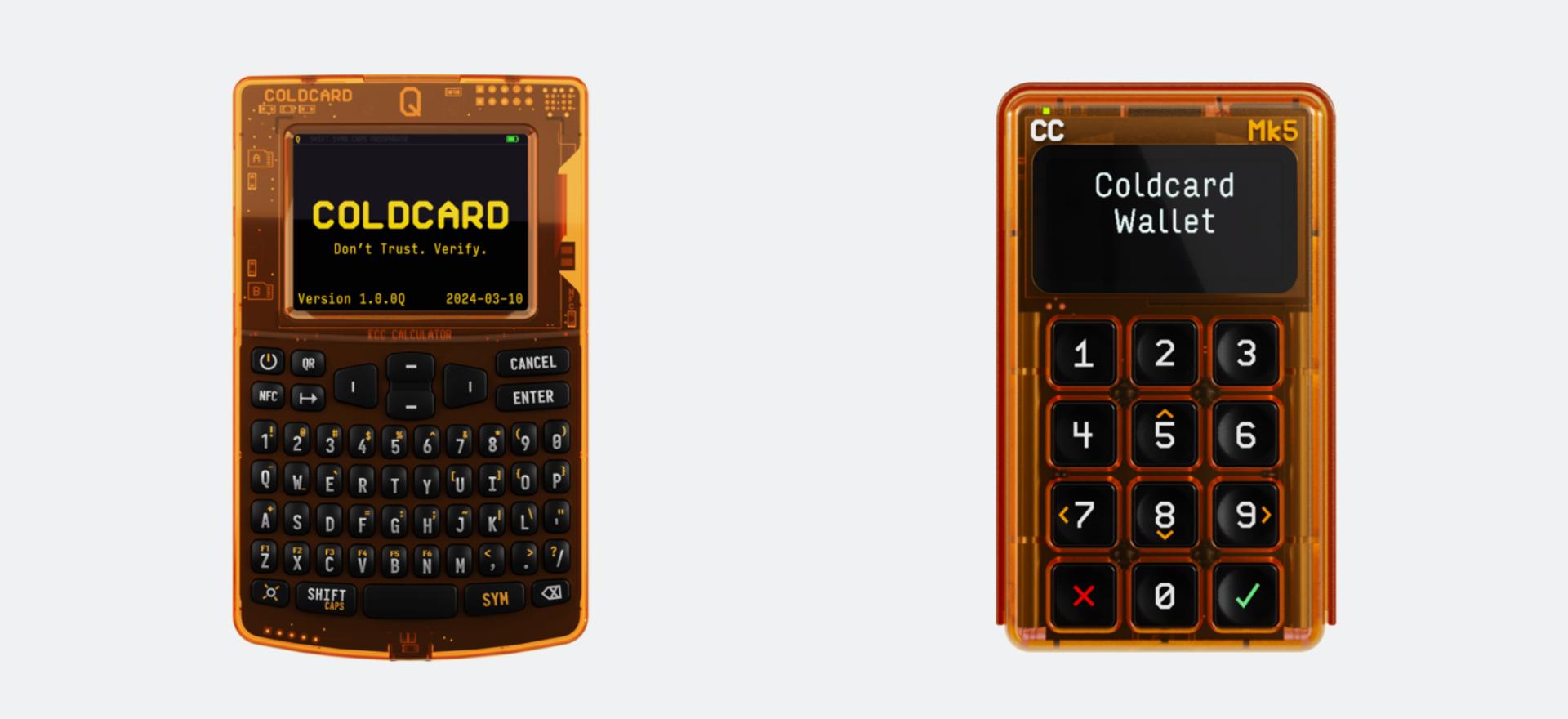
Some prominent bitcoin advocates say the incident is among the most damaging failures of self-custody the industry has experienced.
“This is the worst hit in bitcoin history to the most knowledgeable and ‘properly secured’ bitcoiners,” said Bitcoin commentator Guy Swann. “This isn’t an exchange getting hacked because of hot keys. This is thousands of individuals having their personal private keys recreated out from underneath them.”
Trading one risk for another
For years, bitcoin advocates have argued that holding private keys removes the counterparty risk of centralized exchanges, a lesson reinforced by failures such as FTX. Analysts now argue that users have simply exchanged one set of risks for another.
“The self-custodial hardware space is a disaster at this point and creates more bad rep for the industry than anything else,” said Lorenzo Valente, director of digital asset research at ARK Invest.
“In practice, consumers have traded counterparty risk for software risk, hardware risk, supply-chain risk, phishing risk, backup risk, and the possibility of losing everything through one mistake,” he said. “Frankly, you are better off today holding funds across several publicly-traded exchanges or ETFs.”
The Coldcard flaw illustrates that challenge. Researchers found that certain firmware versions generated wallet seeds using far less randomness than intended, making them susceptible to brute-force attacks.
Beth Hammack, president and chief executive officer of the Federal Reserve Bank of Cleveland, during a research conference at the Federal Reserve Bank of Dallas in Dallas, Texas, US, on Friday, Oct. 31, 2025.
Desiree Rios | Bloomberg | Getty Images
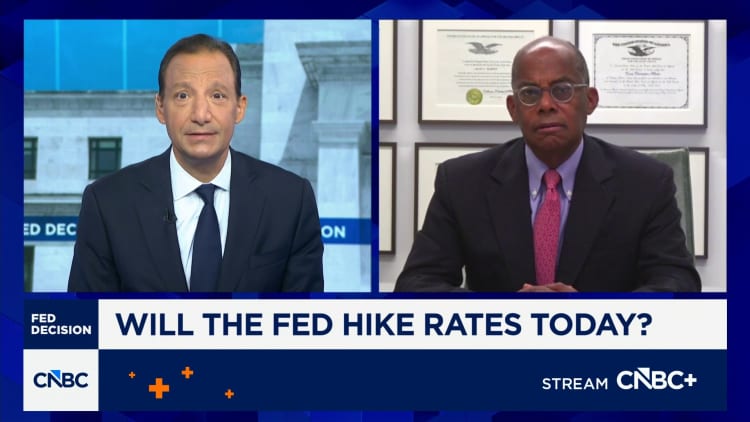
Federal Reserve officials who voted this week against the decision to hold interest rates steady said Friday they favor hiking now as a way to stave off inflation.
“In my view, now is the time for the [Federal Open Market Committee] to act to speed the return of PCE inflation to our 2 percent objective and deliver on our commitment to price stability for the American people,” Cleveland Fed President Beth Hammack said in a statement. “The longer that high inflation persists, the more challenging and costly it can be to bring it back down.”
Similarly, Minneapolis Fed President Neel Kashkari said in a separate statement that he believes small hikes now can prevent the need for larger moves later.
“In my view, a potential series of small policy moves would be better than waiting and eventually concluding that even bolder actions were necessary,” he said.
Kashkari and Hammack joined Dallas Fed President Lorie Logan in dissenting against holding the Fed’s key overnight borrowing rate in a range between 3.5%-3.75%. The other nine voting members of the FOMC voted in favor of keeping the rate steady, where it has been all year following a series of three cuts in the latter part of 2025.

Inflation has held above the Fed’s 2% target for more than five years, spiking again this war following the Iran war and the impact of President Donald Trump’s tariffs.
Logan said the Fed can’t count on an unexpected jolt to the economy to lower inflation and needs to be proactive.
“Labor, consumption and financial market conditions indicate that monetary policy is not restraining the economy,” she said, also in a prepared statement. “Without any policy restraint, inflation will likely continue to trend above target until there’s an unanticipated shock.”
Though price increases eased in June as Middle East tensions briefly eased, energy costs again have risen and generated fears that the Fed will have to tighten.
Though he voted in favor of the hold, Fed Chairman Kevin Warsh said he remains resolute in getting inflation back to target.
“We have begun a new chapter, and we understand that the five-plus years of inflation above target cannot be cured in nine weeks — or by a single month of modest price decreases,” he said.
However, Hammack said she is “not confident it will return to our objective on its own.”
“Supply-side factors, including energy prices, have boosted inflation this year, but I see inflationary pressures coming from the demand side of the economy, as well,” she added.
Hammack said her constituents in the Cleveland area have been describing “pricing pressures as broadening rather than fading, and consumers are expressing despair over persistently higher prices.”
For his part, Kashkari’s comments harken back to both the 1970s period of high inflation and the more recent episodes in which Fed officials initially dismissed the flare-up as “transitory” and brought on up issues related to the Covid pandemic.
“Economic theory argues that monetary policy is the right tool to address demand-driven inflation but faces greater trade-offs when dealing with supply shocks,” he said, adding, “I increasingly believe that monetary policy does have an important role to play in addressing a series of successive supply shocks that might lead to entrenched higher inflation.”
Logan is expected to release a statement explaining her vote later Friday morning.

Jenrick Attacks Burnham Over A Tax The PM Has Not Actually Launched
Anime Expeditions Promise Ring guide

Chinese AI Researchers Are Finding Their Voice on X


-
 Sports5 days ago
Commonwealth Games boxing: Jadumani Singh seals dominant 5-0 win over Pakistan’s Sumama Rehman to enter quarter-finals | Commonwealth Games News
-

 Business2 days ago
Why Trees Belong on the Risk Register
-

 Tech5 days ago
Intel is reversing course and bringing hyper-threading back to its server chips
-

 Crypto World6 days ago
Ripple bought a bank in pieces. The $4 billion audit
-

 Politics4 days ago
Luke Littler dismantles Gerwyn Price to retain title in Blackpool
-

 Politics3 days ago
The Part of the Electric Transition Nobody Wants to Discuss
-

 News Videos5 days ago
BITCOIN JUST ENTERED THIS CRITICAL ZONE…
-
 Entertainment3 days ago
‘Stargate’ Creator’s New Sci-Fi Series Returns for Season 3 Tomorrow
-

 Business3 days ago
Major shareholder moves on Canyon
-

 Crypto World5 days ago
XRP Ledger adds $2.6B as RWA inflows rank second
-

 News Videos1 day ago
Bitcoin Enters the 3rd Stage of the Bear Market
-

 Politics5 days ago
Spain sweeps the board at 2026 World Cup with individual awards
-

 Entertainment6 days ago
Sara Gilson Killed By Husband After Viral “Pedophile” TikTok Video
-

 Crypto World3 days ago
Kraken Enables Retail Access to Jersey Mike’s IPO via Tokenized Shares
-

 Tech7 days ago
Anthropic launches Claude Opus 5, a cheaper AI model for coding, agents and enterprise workflows
-

 Tech4 days ago
New macOS Sequoia & Sonoma security updates for older Macs
-

 News Videos3 days ago
Claude: Build Financial Dashboards in Minutes (2026)
-

 Politics1 day ago
Luke Littler’s dominance sparks GOAT debate
-

 Sports18 hours ago
Seema Kaliramna Wins Discus Throw Bronze, Takes India’s CWG Medals Tally To 17
-

 Crypto World6 days ago
Upbit expands KRW market with two major DeFi token listings
You must be logged in to post a comment Login